Visual overview
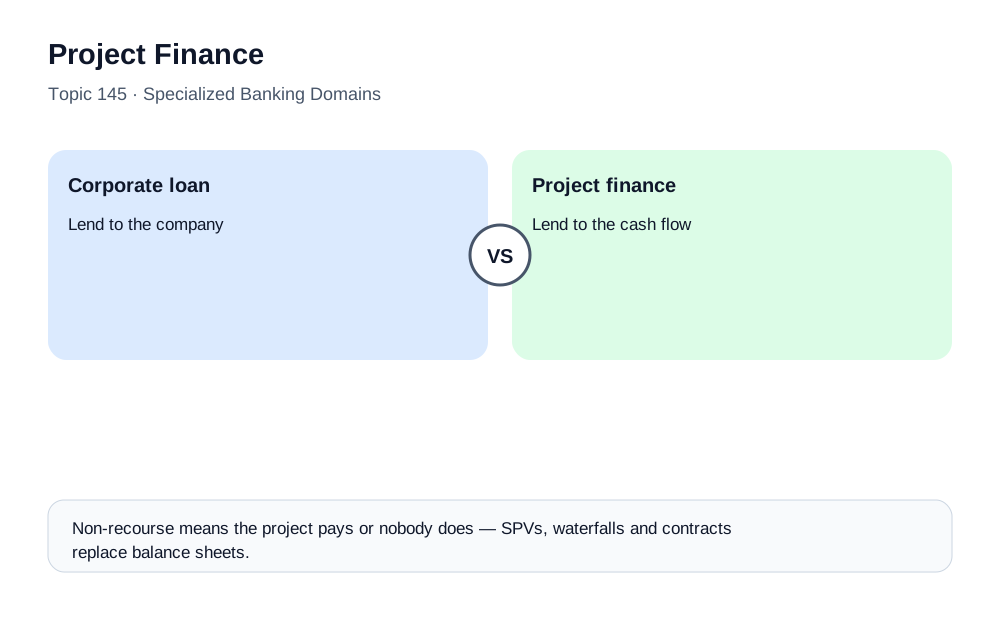
Project Finance at a glance — Infrastructure finance, PPP, non-recourse lending.
SPVs, Non-Recourse Lending, Cash Flow Waterfalls, and Infrastructure Finance
Project finance is the banking structure used when the success of a loan depends mainly on one project, not on the general balance sheet of a large company. It is common in highways, power plants, airports, ports, metro systems, telecom towers, renewable energy parks, oil and gas assets, hospitals, industrial plants, and other capital-intensive infrastructure.
In normal corporate lending, a bank asks: "Can this company repay us from its overall business?" In project finance, the question is sharper: "Can this specific project generate enough cash to repay debt after construction, operating costs, taxes, reserves, and risk events?"
The borrower is usually a Special Purpose Vehicle (SPV) created only for that project. The SPV signs contracts, owns the project assets, borrows money, collects revenue, pays operating costs, and services the debt. Lenders usually have limited or no recourse to the sponsors' other assets. That makes project finance powerful, but also demanding: the bank must understand contracts, engineering, permits, demand, regulation, cash flow modelling, and risk allocation.
Learning objectives
By the end of this chapter, you should be able to:
- Explain how project finance differs from corporate lending.
- Understand the role of the SPV, sponsors, lenders, contractors, offtakers, authorities, and advisers.
- Describe non-recourse and limited-recourse lending.
- Read the logic of a project cash flow waterfall.
- Explain DSCR, LLCR, PLCR, financial close, completion risk, and step-in rights.
- Identify construction, revenue, regulatory, environmental, currency, and operating risks.
- Understand how PPP models such as BOT, BOOT, DBFOT, HAM, and VGF support infrastructure finance.
- Recognise why project finance requires strong monitoring after loan sanction.
1. What Project Finance Means
Project finance is a long-term financing structure where lenders rely mainly on a project's future cash flows for repayment.
The project is usually placed inside a legally separate SPV. The SPV may be newly incorporated and may have no operating history. Its value comes from:
- the project assets it will build or operate;
- the contracts it signs;
- the permits and concessions it receives;
- the equity committed by sponsors;
- the debt committed by lenders;
- the future revenue expected from users, buyers, government payments, or tariffs.
A project finance loan is therefore not just a loan to a company. It is a financing package built around a project ecosystem.
2. Project Finance vs Corporate Lending
| Area | Corporate lending | Project finance |
|---|---|---|
| Borrower | Existing company | Project SPV |
| Repayment source | Overall business cash flows | Cash flows of one project |
| Recourse | Usually full recourse to borrower | Limited or non-recourse to sponsors |
| Collateral | Corporate assets, receivables, guarantees | Project assets, contracts, accounts, concessions |
| Risk analysis | Borrower financial strength | Construction, contracts, demand, regulation, project economics |
| Tenor | Often short to medium term | Often long term |
| Leverage | Moderate, based on borrower strength | Often high, based on projected project cash flows |
| Monitoring | Financial statements and covenants | Construction progress, technical milestones, cash waterfall, reserve accounts, operational performance |
The key idea is separation. The project is ring-fenced so that its money, assets, and risks can be monitored independently.
3. Why Banks Use Project Finance
Banks use project finance because many infrastructure assets are too large, too long-term, or too specialised for ordinary corporate lending.
Project finance helps:
- match long-term assets with long-term funding;
- share risk among sponsors, lenders, contractors, insurers, and government authorities;
- attract private capital into public infrastructure;
- finance projects where sponsors do not want full balance-sheet exposure;
- create disciplined control over project cash flows;
- support economic development through roads, power, transport, ports, and utilities.
But the structure is only as strong as the assumptions behind it. A weak project model, unrealistic traffic estimate, delayed permit, poor contractor, or unstable regulation can damage repayment even if the financing documents look impressive.
4. The Special Purpose Vehicle
The SPV is the legal borrower and project owner.
Sponsors create the SPV and contribute equity. Lenders provide debt. The SPV enters into project contracts, receives project revenue, pays operating costs, and repays lenders.
The SPV structure provides several benefits:
- Ring-fencing: project assets and cash flows are separated from sponsors' other businesses.
- Clear accountability: contracts, permits, debt, equity, and accounts sit inside one project company.
- Bankruptcy protection: sponsor distress does not automatically collapse the project if the SPV remains viable.
- Cash control: lenders can monitor project accounts and payment waterfalls.
- Multi-sponsor ownership: several investors can participate through defined shareholding.
For a bank, the SPV is both useful and risky. It gives clarity, but it may have no independent repayment capacity outside the project.
5. Main Parties in Project Finance
A project finance transaction usually involves many parties.
| Party | Role |
|---|---|
| Sponsors | Equity investors who develop or own the project |
| SPV | Borrower and legal project company |
| Lenders | Banks, DFIs, bondholders, or institutional lenders providing debt |
| Lead arranger | Structures the debt and coordinates lenders |
| Security trustee | Holds security on behalf of lenders |
| EPC contractor | Designs, procures, and constructs the project |
| O&M contractor | Operates and maintains the project after completion |
| Offtaker | Buyer of project output, such as electricity or gas |
| Concession authority | Government or public authority granting project rights |
| Technical adviser | Reviews engineering, construction, and operating assumptions |
| Legal adviser | Reviews contracts, permits, security, and enforceability |
| Insurance adviser | Reviews insurance coverage and claims protection |
| Model auditor | Checks the financial model for formula and logic errors |
Project finance is multidisciplinary. Credit teams must work with engineers, lawyers, risk specialists, treasury teams, operations teams, and external advisers.
6. Non-Recourse and Limited Recourse Lending
Non-recourse lending means lenders rely only on project cash flows and project assets. If the project fails, lenders cannot generally claim the sponsors' unrelated assets.
Limited recourse lending gives lenders some defined sponsor support, often during construction or early operation. For example, sponsors may provide:
- equity support undertakings;
- completion guarantees;
- cost-overrun support;
- debt service support during delays;
- limited guarantees until commercial operation date;
- sponsor undertakings to maintain ownership or technical support.
In practice, many project finance deals are limited recourse, especially before the project is completed. Once the project passes completion tests and begins stable operations, sponsor support may reduce.
7. Project Finance Lifecycle
A typical project finance deal moves through these stages:
- Project development: sponsors identify the asset, business case, land, permits, and partners.
- Feasibility study: technical, legal, environmental, market, and financial feasibility are tested.
- SPV formation: a dedicated project company is created.
- Contracting: EPC, O&M, offtake, concession, supply, insurance, and other key contracts are negotiated.
- Financial modelling: cash flows, debt sizing, covenants, returns, and downside scenarios are modelled.
- Due diligence: lenders review technical, legal, financial, tax, environmental, insurance, and market risks.
- Credit approval: lenders approve limits, structure, pricing, covenants, and conditions.
- Financial close: documents are signed, conditions precedent are satisfied, and debt becomes available.
- Construction: funds are drawn in stages as milestones are achieved.
- Completion testing: the project must prove that it works as agreed.
- Operations: revenue begins, operating expenses are paid, and debt service starts.
- Monitoring and restructuring: lenders track covenants, DSCR, reserves, performance, delays, waivers, or refinancing.
The biggest shift happens at completion. Before completion, the bank worries about whether the project can be built. After completion, the bank worries about whether it can operate and earn enough cash.
8. Cash Flow Waterfall
A cash flow waterfall defines the order in which project cash is used.
A simplified waterfall may look like this:
- project revenue is received into controlled accounts;
- taxes and statutory payments are paid;
- operating and maintenance expenses are paid;
- senior debt interest is paid;
- senior debt principal is repaid;
- reserve accounts are topped up;
- subordinated debt is paid, if allowed;
- distributions are made to sponsors, if covenants permit.
This structure protects lenders by preventing sponsors from taking dividends before essential project obligations are met.
9. Key Coverage Ratios
Project finance uses several ratios to test whether cash flows are strong enough.
| Ratio | Meaning | Why it matters |
|---|---|---|
| DSCR | Cash flow available for debt service divided by scheduled debt service | Measures whether the project can pay current debt obligations |
| LLCR | Present value of cash flow over the loan life divided by debt outstanding | Measures repayment capacity during the loan period |
| PLCR | Present value of cash flow over the full project life divided by debt outstanding | Measures long-term project value relative to debt |
| Debt-to-equity | Debt compared with sponsor equity | Shows leverage and sponsor commitment |
| Project IRR | Return generated by project cash flows | Helps test project economics |
| Equity IRR | Return expected by sponsors after debt service | Shows sponsor incentive and investment attractiveness |
A DSCR above 1.0 means projected cash flow is greater than debt service. But banks usually require a cushion, because projections can be wrong.
10. Major Project Risks
Project finance is really a risk allocation exercise. The question is not only "What can go wrong?" but also "Who is best placed to manage it?"
| Risk | Example | Common mitigation |
|---|---|---|
| Construction risk | Delays, design failure, cost overrun | Fixed-price EPC contract, performance guarantees, liquidated damages |
| Completion risk | Project cannot meet output standards | Completion tests, sponsor support, technical monitoring |
| Revenue risk | Traffic, demand, tariff, or offtake lower than expected | Conservative forecasts, offtake agreements, minimum revenue support |
| Supply risk | Fuel, raw material, or input shortage | Long-term supply contracts, diversified sources |
| Operating risk | Poor plant availability or high maintenance cost | Experienced O&M contractor, performance standards |
| Regulatory risk | Tariff changes, permit delays, policy shifts | Concession protections, legal review, government undertakings |
| Land and environmental risk | Land acquisition, clearances, community objections | Early diligence, environmental approvals, social safeguards |
| Currency risk | Foreign debt but local-currency revenue | Hedging, local financing, tariff indexation |
| Interest-rate risk | Floating-rate debt becomes expensive | Hedging, fixed-rate tranches, sensitivity analysis |
| Political risk | Expropriation, convertibility restrictions, civil disruption | Insurance, multilateral support, government guarantees |
| Force majeure | Natural disasters, pandemics, war | Insurance, contract relief provisions, contingency planning |
A good deal does not eliminate all risk. It makes risk visible, priced, allocated, and monitored.
11. Public-Private Partnership Models
Many infrastructure projects use Public-Private Partnership (PPP) structures.
| Model | Meaning |
|---|---|
| BOT | Build, Operate, Transfer: private party builds and operates, then transfers asset to government |
| BOOT | Build, Own, Operate, Transfer: private party owns during concession period, then transfers |
| DBFOT | Design, Build, Finance, Operate, Transfer: private party handles full lifecycle before transfer |
| HAM | Hybrid Annuity Model: government pays part during construction and remaining through annuities |
| VGF | Viability Gap Funding: government support makes socially useful but marginal projects bankable |
PPP structures are especially important where public infrastructure needs private investment but government remains central to permissions, payments, tariffs, or concessions.
12. Lender Controls
Because repayment depends on project performance, lenders build strong controls into the loan.
Common lender controls include:
- conditions precedent before first drawdown;
- milestone certificates before each construction draw;
- controlled project bank accounts;
- escrow arrangements;
- debt service reserve accounts;
- major maintenance reserve accounts;
- restrictions on additional debt;
- restrictions on dividends;
- minimum DSCR covenants;
- reporting requirements;
- insurance requirements;
- step-in rights if the project fails to perform;
- security over project assets, contracts, receivables, and accounts.
Step-in rights are especially important. They may allow lenders or their nominee to intervene, replace contractors, or protect the project if serious default occurs.
13. Practical Example
Assume a solar power project costs 1,000 crore. Sponsors contribute 250 crore as equity. Lenders provide 750 crore as long-term debt.
The SPV signs:
- a power purchase agreement with a distribution company;
- an EPC contract to build the plant;
- an O&M contract to maintain operations;
- land and grid-connection agreements;
- insurance policies;
- loan and security documents with lenders.
After construction, electricity sales generate cash. That cash enters a controlled account. Operating costs are paid first, then lender interest and principal, then reserve accounts. Sponsors receive dividends only if covenants are satisfied.
If power generation is lower than expected, DSCR may fall. Lenders may block dividends, require explanations, ask for corrective action, or consider restructuring depending on severity.
14. Common Misconceptions
Misconception 1: Project finance is safe because the asset is physical.
A physical asset is not enough. A road, plant, or port must generate cash. Poor demand, weak contracts, construction delays, or bad regulation can make a physical asset financially weak.
Misconception 2: Non-recourse means lenders have no protection.
Lenders may not have full sponsor recourse, but they protect themselves through contracts, security, reserve accounts, insurance, covenants, step-in rights, and tight monitoring.
Misconception 3: The financial model is the truth.
A model is only a structured forecast. Banks must test assumptions, sensitivities, downside cases, and real-world execution risk.
Misconception 4: Project finance ends at financial close.
Financial close is only the beginning. Construction monitoring, covenant tracking, cash control, and operational review continue for years.
15. Frequently Asked Questions
Is project finance always non-recourse?
No. Many deals are limited recourse, especially during construction. Sponsors may provide support until the project is completed and stable.
Why is an SPV used?
An SPV separates project assets, contracts, cash flows, and liabilities from the sponsors' other businesses. This makes risk and cash flow easier to monitor.
What is financial close?
Financial close is the stage when financing documents are signed, required conditions are met, and lenders are ready to fund the project.
Why do banks care so much about DSCR?
DSCR shows whether projected cash flow can cover scheduled debt service. A weak DSCR means the project may struggle to pay lenders on time.
What happens if construction is delayed?
The impact depends on loan terms and contracts. Sponsors may need to inject equity, contractors may pay damages, drawdowns may pause, or lenders may require a revised plan.
16. Key Terms
- SPV: Special Purpose Vehicle, the project company that owns and borrows for the project.
- Sponsor: Equity investor that develops or owns the project.
- Non-recourse: Lenders rely only on project assets and cash flows, not sponsors' wider assets.
- Limited recourse: Lenders have defined sponsor support, often during construction.
- Financial close: Completion of financing documents and conditions so debt can be drawn.
- EPC contract: Engineering, Procurement, and Construction contract.
- O&M contract: Operations and Maintenance contract.
- Offtaker: Buyer of the project's output.
- DSCR: Debt Service Coverage Ratio.
- LLCR: Loan Life Coverage Ratio.
- PLCR: Project Life Coverage Ratio.
- Cash waterfall: Contractual order for using project cash.
- Step-in rights: Lender rights to intervene when the project is in serious trouble.
- Concession: Government-granted right to build, operate, or collect revenue from an infrastructure asset.
17. Interview Insights
Interviewers often test whether you understand the difference between lending to a company and lending to a project.
Strong answers usually mention:
- the SPV as borrower;
- repayment from project cash flows;
- limited or non-recourse structure;
- importance of contracts and permits;
- DSCR and cash waterfall;
- construction risk versus operating risk;
- lender controls such as reserve accounts and step-in rights.
A good short answer:
"Project finance funds a specific asset through an SPV. Lenders rely mainly on the project's future cash flows, so they focus heavily on contracts, construction risk, revenue assumptions, coverage ratios, reserve accounts, and lender control over project cash."
18. Summary
Project finance enables large infrastructure and industrial projects by matching long-term capital with long-term cash flows. It uses an SPV, limited or non-recourse debt, contractual risk allocation, cash flow waterfalls, reserve accounts, and intensive monitoring.
For banking learners, the key lesson is this: project finance is not just credit analysis. It is credit analysis plus engineering, contracts, regulation, operations, financial modelling, and disciplined cash control.
Next: Topic 146 - Custody and Clearing Services
<!-- MBA-DEEP-DIVE-START -->Project Finance Deepening — Bankability, Contract Risk Allocation, Cash Control, and Lifecycle Monitoring
Project finance is a contractual credit rather than a simple asset-backed loan
A lender cannot rely only on the existence of a power plant, road, airport, port, data centre, or renewable-energy asset. The physical project must be connected to enforceable contracts, permits, revenue mechanisms, operating capability, and a cash-flow structure that can service debt. The bank therefore underwrites an ecosystem. The SPV is the legal centre, but its ability to repay depends on sponsors, contractors, suppliers, offtakers, public authorities, insurers, operators, lenders, and account banks performing their obligations. Bankability comes from the strength of that whole arrangement.
The SPV ring-fences risk but also concentrates it
A project company often has no diversified business, historical earnings, or independent liquidity beyond sponsor equity and project funding. Ring-fencing makes it easier to track project assets and cash flows, yet it also means a single delay or contract failure can have a large effect. Banks should therefore resist the idea that an SPV structure automatically reduces risk. It makes the risk more visible and contractually organised; it does not make the project economically sound by itself.
Sponsor quality matters even in limited-recourse structures
Sponsors may not provide full corporate guarantees, but their experience, financial strength, reputation, strategic commitment, and ability to solve problems remain important. Strong sponsors can inject additional equity, negotiate with authorities, replace weak contractors, and manage unexpected events. Lenders examine whether sponsors have delivered similar projects, whether their equity is truly at risk, and whether incentives remain aligned throughout construction and operation.
Equity timing is a credit-control question
Lenders often require sponsor equity to be funded before debt, alongside debt, or according to a specified ratio. If debt is drawn too early while sponsor equity remains only a promise, lenders can become disproportionately exposed to an unfinished asset. Drawdown controls should therefore track actual equity contributions, eligible project costs, invoices, technical-certification evidence, and the agreed funding ratio. Equity that exists only as an accounting receivable is not the same as cash invested in the project.
Bankability begins with risk allocation to the party best able to manage each risk
Construction risk is usually allocated substantially to the EPC contractor, operating risk to the O&M contractor, supply risk to suppliers, revenue risk partly to offtakers or concession arrangements, and political or regulatory risk through public-sector agreements, insurance, or support mechanisms where available. The allocation is never perfect, and some risks remain with the SPV. The lender's task is to identify residual risk after contractual mitigation rather than assume a signed contract transfers everything.
Fixed-price EPC terms reduce cost risk only when the contractor can perform
A fixed-price, date-certain construction contract can protect the SPV from some cost overruns and delays. But protection is weak if the contractor is undercapitalised, the scope is ambiguous, exclusions are broad, or damages are capped far below the potential loss. Lenders therefore examine contractor capability, parent support where applicable, performance security, schedule, interface risk, change-order mechanisms, and the gap between contractual compensation and debt-service consequences.
Liquidated damages are not a substitute for successful completion
Delay or performance damages can provide cash when the contractor misses contractual targets, but a project that cannot reach commercial operation may still fail regardless of damages. Lenders need a credible path to physical completion, not merely a financial claim against the contractor. Completion support, contingency budget, replacement-contractor options, insurance, and sponsor undertakings can therefore matter alongside damages.
Completion tests should measure the project the lenders actually financed
Mechanical completion is not necessarily financial completion. A plant may be physically built but still fail output, efficiency, reliability, environmental, grid-connection, permit, or performance tests. Finance documents can define completion through a package of technical, legal, financial, and operational conditions. Releasing sponsor support or allowing distributions before those conditions are satisfied can transfer excessive risk to lenders.
Independent technical advisers create evidence between engineer and lender
Bank credit teams are not expected to perform engineering design review themselves. Independent engineers or technical advisers can assess construction progress, cost-to-complete, schedule, performance tests, operating assumptions, maintenance plans, and technical risks. Their reports inform drawdown and monitoring decisions, but banks should still understand the key conclusions and limitations rather than treating the adviser as a substitute for credit judgement.
Cost-to-complete analysis is more useful than percentage-complete alone
A project reported as 80% physically complete can still be financially dangerous if the remaining 20% contains expensive, complex, or delayed work. Lenders should compare remaining committed costs, contingency, available debt and equity, claims, unpaid invoices, expected overruns, and funding sources. The key question is whether the project has enough committed resources to reach completion, not merely how much concrete has already been poured.
Contingency is a real funding resource only if it remains available
Project budgets often include contingency for unexpected costs. As construction progresses, that reserve can be consumed. Monitoring should show original contingency, amounts used, reasons, remaining headroom, and forecast cost-to-complete. A project that remains on schedule but has exhausted contingency early may have little protection against later problems.
Construction drawdown should be evidence-driven
A draw request can require invoices, engineer certification, evidence of sponsor contribution, compliance with representations, confirmation that no blocking default exists, and proof that the amount relates to eligible project cost. The agent or lenders should avoid paying simply because the borrower submits a spreadsheet. Drawdown controls translate the financing model into actual use-of-funds discipline.
Sources and uses must stay in balance
At financial close, the project has defined funding sources such as equity, senior debt, subordinated debt, grants, viability support, or other contributions, and defined uses such as construction, land, fees, financing costs, reserves, and contingency. Changes in one side can require changes in the other. A cost overrun is not solved because the financial model still balances; the project needs an executable source of additional money.
Revenue certainty determines how much leverage the project can support
A contracted power project with a long-term creditworthy offtaker has a different risk profile from a toll road relying on uncertain traffic or a merchant power plant exposed to market prices. Lenders examine volume, price, indexation, termination rights, payment security, counterparty credit, demand elasticity, and historical evidence. The stronger and more predictable the cash flow, the more debt the project may be able to service, subject to other risks.
Offtake contracts shift risk but create counterparty concentration
A long-term power purchase or take-or-pay agreement can reduce market risk, but it makes the project's cash flow dependent on the buyer. If the offtaker is financially weak, politically exposed, or able to terminate easily, contractual revenue may not be as secure as the model assumes. Credit analysis therefore extends beyond the SPV to the parties expected to pay it.
Government-backed revenue is not automatically risk-free
Availability payments, annuities, concessions, and regulated tariffs can create relatively predictable revenue, but public-sector obligations still depend on legal enforceability, budget process, political commitment, currency, dispute resolution, and sovereign or sub-sovereign credit. Lenders should understand exactly which public entity owes the payment and what remedies exist if payment is delayed.
Demand risk can dominate transport and social infrastructure projects
Road traffic, airport passenger volume, port throughput, hospital utilisation, or telecom demand can be lower than forecast because of economic change, competing infrastructure, technology, pricing, or user behaviour. Forecasts should therefore be independently reviewed and stressed. A base case built to justify debt capacity is not enough. Lenders need downside cases showing whether the project remains serviceable when demand disappoints.
Revenue models should distinguish tariff risk from volume risk
A project can have stable demand but uncertain price, or regulated price but uncertain usage. Those risks respond to different mitigants. Indexation can protect against inflation but not low volume. Minimum-offtake agreements can protect volume but not counterparty default. The financial model should separate drivers so lenders know which assumption causes a coverage ratio to weaken.
Supply contracts deserve the same attention as offtake
A power plant without fuel, a manufacturing project without feedstock, or a data centre without sufficient power and network capacity cannot generate revenue. Lenders should examine supplier credit quality, pricing formula, transport, quantity commitment, quality standards, force majeure, alternative sources, and contract tenor. A mismatch between long-term debt and short-term supply security can create hidden risk.
Interface risk appears where contracts meet
An EPC contractor may build the plant to one specification while the offtake contract requires another performance standard. A fuel contract may start later than the commissioning schedule. A concession may impose obligations not passed through to the operator. Project finance due diligence therefore compares contracts against each other rather than reviewing each in isolation. Unallocated interface risk usually falls back on the SPV.
Force majeure allocation should be examined across the whole contract set
If an event excuses the contractor but does not excuse the SPV from debt service or offtake obligations, the project can suffer a mismatch. Definitions, notice periods, relief, termination rights, insurance, and compensation should be compared. “Force majeure is covered” is not a meaningful conclusion until the bank knows who bears the financial consequence.
Insurance is risk transfer with limits and conditions
Construction all-risk, delay-in-start-up, property damage, business interruption, liability, political-risk, and other covers can protect against defined events. Policies have exclusions, deductibles, limits, waiting periods, claims processes, and renewal requirements. Insurance cannot make a fundamentally uneconomic project bankable. Lenders should understand whether proceeds are sufficient and how they flow through secured accounts after a claim.
Environmental and social risk can become financial risk
Failure to obtain permits, community opposition, land disputes, environmental damage, labour problems, or resettlement issues can stop construction, increase costs, trigger litigation, or damage the sponsor's licence to operate. Lenders therefore include environmental and social due diligence and ongoing covenants appropriate to the project and applicable standards. These are not separate from credit quality when they can delay or shut down the asset.
Land risk often sits on the critical path
Infrastructure can be delayed because rights of way, title, access, resettlement, easements, or site handover are incomplete. A construction contract cannot cure lack of lawful access. Lenders should know which land parcels are available, which remain disputed, who bears acquisition responsibility, and whether the project can proceed in phases. Financial close before critical land risk is addressed can convert a legal issue into a funding problem.
Permits should be mapped to project stage
Some approvals are needed before construction, others before commissioning, operation, environmental discharge, tariff collection, or expansion. A generic condition saying “all material permits obtained” can be difficult to interpret. A permit matrix with owner, issuing authority, status, expiry, renewal, and dependency helps lenders monitor legal readiness through the lifecycle.
Cash-flow waterfalls transform credit priorities into payment rules
The waterfall determines what project cash can be used for and in which order. It can distinguish taxes, essential operating cost, senior interest, principal, hedging payments, reserve funding, subordinated obligations, and distributions. The account bank or agent may implement controls on releases. The purpose is to prevent discretionary sponsor payments from outranking obligations necessary to keep the project operating and debt current.
Waterfalls need operational rules, not only a diagram
The system should know which account receives revenue, when transfers occur, which amounts are due, what happens on a non-business day, which reserve must be topped up, and whether a lock-up condition blocks distributions. If waterfalls are executed through manual spreadsheets and emails, a legally sophisticated structure can still fail operationally. Reconciliation should prove that bank accounts match the contractual sequence.
Debt service reserve accounts buy time during temporary shortfalls
A DSRA can hold enough cash or eligible support to cover a defined period of debt service. It is not extra project profit. If used, the project may be required to replenish it before sponsor distributions. Lenders should monitor funded amount, permitted investments, release conditions, expiry of guarantees or letters of credit used as substitutes, and whether the reserve remains accessible when needed.
Major-maintenance reserves address predictable future expenditure
Some assets require large periodic overhauls. If the model assumes those costs but the SPV distributes cash instead of setting money aside, debt service can be threatened later. A maintenance reserve or lifecycle account can accumulate funds over time. Technical advisers help assess whether the reserve profile matches the asset's actual maintenance cycle.
Cash traps and distribution lock-ups are early-protection mechanisms
A project can remain current on debt while coverage ratios weaken. Finance documents may stop dividends when DSCR or another metric falls below a threshold, allowing cash to remain inside the SPV. This gives lenders protection before payment default. Operations need precise lock-up logic, test dates, cure conditions, and approval authority so restricted cash is not accidentally released.
DSCR should be understood as a period measure
Debt Service Coverage Ratio compares cash available for debt service over a defined period with scheduled debt service for that period. The precise definition of cash available, taxes, working capital, reserve movements, hedging, and debt service comes from the finance documents or model conventions. A DSCR of 1.20 does not mean the project has “20% spare cash” in every sense; it means the defined numerator is 1.2 times the defined debt-service amount for that test.
LLCR measures the debt against cash flow over the remaining loan life
Loan Life Coverage Ratio discounts forecast cash available for debt service during the remaining debt tenor and compares that value with outstanding debt. It therefore captures more of the future repayment profile than a single-period DSCR. Discount-rate assumptions and forecast credibility matter. A strong LLCR cannot compensate for an immediate liquidity shortfall if the project cannot pay the next instalment.
PLCR includes value after the scheduled debt maturity
Project Life Coverage Ratio can include cash flows through the broader economic life of the project. It can indicate long-term value and refinancing flexibility, but those distant cash flows are more uncertain. Banks should avoid using PLCR alone to justify aggressive debt sizing when near-term debt service is weak.
Debt sculpting aligns repayment with forecast cash generation
Rather than using equal principal instalments, project debt can be structured so scheduled debt service follows expected project cash flows while maintaining target coverage. This can increase debt capacity, but it also makes the facility sensitive to forecast accuracy. If cash flows are delayed or lower than expected, the sculpted profile may need restructuring.
Tail period provides refinancing and recovery cushion
Lenders often prefer debt maturity before the concession, offtake contract, or useful project life ends. The remaining period is the tail. It gives time for refinancing, cash sweep, enforcement, or recovery if projected repayment is delayed. A project whose debt matures on the same day its core revenue contract expires has less structural flexibility.
Cash sweeps can accelerate deleveraging when performance is strong
Excess cash after required payments can be used partly to prepay debt instead of being fully distributed to sponsors. The percentage and triggers depend on the agreement. Sweeps reduce outstanding debt and future credit risk but also lower sponsor distributions. This is one way lenders balance leverage with project performance.
Interest-rate risk can materially change debt capacity
Long-tenor project loans often have floating rates while project revenue may be fixed or only partly indexed. Rising rates can reduce coverage. Hedging through swaps, caps, or fixed-rate debt can stabilise debt service, but hedge maturity, notional, counterparty, collateral, termination costs, and accounting need attention. Hedging should align with the debt profile rather than create speculative exposure.
Currency mismatch can overwhelm otherwise strong project economics
If a project earns local currency but borrows foreign currency, depreciation can increase the local-currency cost of debt. Revenue indexation, natural hedges, derivatives, reserve accounts, local-currency debt, or public support can reduce the risk. Long-dated hedges may be expensive or unavailable in some markets, so lenders need realistic downside scenarios rather than assuming exchange rates remain stable.
Hedging counterparties become part of the project structure
A swap provider can have claims on the project and may share security with lenders. Intercreditor arrangements need to define ranking, termination payments, close-out rights, voting, and enforcement treatment. Replacing a hedge provider after downgrade or default can also be operationally complex. Hedging is therefore connected to legal and creditor structure, not merely treasury execution.
Security is valuable only if it can be enforced and preserves project value
Lenders can take security over shares, project assets, bank accounts, receivables, contracts, insurance proceeds, and other rights where law permits. But enforcement of a half-built project may produce poor recovery if key concessions terminate or operations stop. Direct agreements and step-in rights can be more valuable than physical asset security because they help preserve the contracts needed to keep the project alive.
Direct agreements give lenders a route to cure before contract termination
A concession authority, offtaker, EPC contractor, or other critical party may agree to notify lenders before terminating a key contract and allow a cure or substitution period. This can give lenders time to step in, replace the project company or contractor, or arrange a sale. The exact enforceability depends on law and contract, but the principle is continuity of project value.
Step-in rights need an operational plan
A legal right to step in does not mean the lender should operate a power plant itself. The lender or security trustee may appoint a qualified substitute, receiver, or replacement operator according to the legal structure. Planning should identify how licences, employees, systems, insurance, and contracts would continue. Enforcement strategy should aim to preserve cash-generating capability rather than merely seize assets.
Intercreditor agreements manage competing creditor rights
Projects can contain senior debt, subordinated debt, hedging, working-capital lines, bondholders, development-finance institutions, and sponsor loans. The intercreditor agreement can define ranking, payment blockage, voting, enforcement control, turnover of recoveries, and standstill periods. Operations and legal teams need to understand which creditor instructions control in different scenarios.
Multilateral and development-finance institutions can change project risk allocation
Development banks and export-credit agencies may provide direct loans, guarantees, political-risk support, or catalytic funding. Their participation can extend tenor or improve confidence, but it can also introduce procurement, environmental, reporting, or policy requirements. Commercial lenders should understand those conditions because breach can affect the whole financing package.
PPP projects combine project risk with public-contract risk
In a concession or PPP, the private party may design, build, finance, operate, and eventually transfer an asset, while the public authority can control tariffs, land, standards, availability payments, or termination compensation. Lenders therefore analyse both project economics and the concession framework. The exact labels—BOT, BOOT, DBFOT, hybrid annuity, and others—matter less than the actual allocation of construction, demand, ownership, payment, and residual-value risk.
Termination compensation can determine lender recovery
If a concession ends because of authority default, project default, force majeure, or another event, the payment to the SPV can differ materially. Lenders should know whether termination compensation is sufficient to repay debt and which deductions apply. The financial model should not assume full debt recovery unless the contract supports it.
Refinancing risk should be explicit when debt does not fully amortise
Some projects depend on refinancing a balloon payment or construction facility after completion. The future market may be less liquid or more expensive. A credible plan examines debt maturity, asset performance, expected leverage, remaining contract life, and alternative sources. “Refinance at maturity” is an assumption, not a repayment source guaranteed by the market.
Operational-phase monitoring should focus on leading indicators
After completion, banks review production volume, availability, revenue, operating cost, receivables, offtaker payment behaviour, maintenance, insurance, covenant ratios, reserve accounts, environmental compliance, and major incidents. Waiting for DSCR to fall below one may be too late. Equipment reliability, delayed invoices, rising receivables, or repeated permit breaches can signal future debt-service pressure earlier.
Model-versus-actual analysis should explain the story behind the variance
A project can outperform revenue but underperform cash flow because receivables are slow. Operating cost may be below budget only because maintenance was deferred. A strong monitoring process decomposes differences in volume, price, timing, operating expenditure, capital expenditure, working capital, tax, interest, and reserve movement. Variance analysis should inform updated forecasts rather than merely colour a dashboard red or green.
The financial model is a decision engine that needs governance
Project models can contain thousands of formulas and drive debt sizing, covenant thresholds, valuation, and sponsor returns. Independent model audit can test formula integrity, circularity, macros, assumptions, and output consistency. Credit teams should still challenge commercial assumptions separately. A perfectly coded model can faithfully calculate an unrealistic traffic forecast.
Model versions must be controlled after financial close
Construction delays, refinancing, waiver agreements, changes in tariff, and revised operating assumptions can produce updated models. The bank should know which model version is contractual, which is management forecast, which was used for a waiver decision, and which feeds current monitoring. Overwriting files named “Final_v27” is not adequate governance for long-tenor debt.
Project-finance accounts require tight payment controls
Revenue accounts, debt-service accounts, reserves, distribution accounts, and construction accounts may all have different permitted uses. Payment workflows should validate account type, waterfall priority, budget, lender consent where required, and supporting documentation. Fraud controls remain relevant even when accounts are contractually controlled. A compromised authorised signatory can still attempt to redirect project cash.
Reconciliation should connect project books, bank accounts, and debt records
The SPV's accounting records, controlled bank accounts, agent facility records, hedge settlements, and lender balances should agree. Breaks can arise from late receipts, wrong value date, fee deductions, tax, interest calculations, or unrecorded transfers. Project finance has many parties, so reconciliation is essential to distinguish a true credit problem from an administrative mismatch.
Waivers and restructurings should preserve the economic record
A covenant breach may be waived, debt may be reprofiled, margin increased, reserve requirements changed, or sponsor support added. Systems should preserve the original breach, decision, lender consent, revised terms, and effective dates. A waiver should not erase evidence that the project entered stress. That history matters for credit review and future negotiations.
Construction delay is a multi-dimensional stress
Delay can increase interest during construction, extend contractor cost, postpone revenue, consume contingency, delay hedge start dates, breach concession milestones, and require sponsor equity. A model should therefore update all connected effects rather than adding a simple number of months to commercial operation date. Delay risk is one reason schedule monitoring matters so much.
Scenario: EPC delay consumes contingency
A renewable project is four months late because imported equipment arrives late. Liquidated damages cover part of the additional cost, but the project also loses expected revenue and must extend construction insurance. The cost-to-complete review shows a funding gap. Sponsors inject agreed support before lenders permit further debt draw. Completion testing and longstop dates are revised through formal lender approval rather than informal email agreement.
Scenario: offtaker payments slow after operations begin
The plant operates at expected output, but the utility buyer begins paying invoices sixty days later than modelled. Accounting revenue looks healthy while cash available for debt service weakens. The project uses part of its DSRA, lenders block distributions, and the SPV pursues collection and support under the offtake arrangements. The example shows why receivables quality matters as much as production.
Scenario: interest rates rise but the hedge covers only part of debt
The project hedged 70% of expected floating-rate exposure. Market rates rise sharply. Debt service increases on the unhedged portion, reducing DSCR but not causing immediate default. The lender reviews forward coverage and distribution lock-up thresholds. This is a controlled risk because the residual exposure was identified and stressed at underwriting rather than discovered after cash shortfall.
Scenario: a concession termination threatens the security value
A toll-road SPV breaches an operational obligation. The authority issues a termination notice. Physical road assets have limited standalone value if concession rights disappear. Lenders rely on direct-agreement notice and cure rights to arrange remediation before termination takes effect. The case demonstrates why contractual continuity can be more valuable than possession of concrete and equipment.
Business analysts should translate finance documents into lifecycle rules
Requirements can cover project budgets, equity and debt draw sequence, conditions precedent, engineer certifications, controlled accounts, waterfalls, interest and fee calculations, reserve requirements, covenant tests, lock-ups, waiver workflows, hedge records, security status, lender notices, and monitoring reports. Each rule should identify source evidence, effective date, owner, exception path, and audit trail. Project finance is particularly vulnerable to spreadsheet dependence because each deal can be bespoke.
Testing should follow the project from construction to stressed operation
Useful tests include insufficient equity contribution, draw above budget, expired permit, engineer certificate missing, late construction, cost overrun, failed performance test, partial offtaker payment, DSRA use, distribution lock-up, covenant breach, lender waiver, hedge settlement, account-payment restriction, security release, refinancing, and enforcement preparation. Tests should verify accounting and cash outcomes, not only workflow status.
Closing perspective
Project finance is a disciplined attempt to make a single long-lived asset financeable without relying fully on the sponsor's wider balance sheet. The SPV provides legal focus, contracts allocate risk, advisers provide specialist evidence, lenders control drawdowns and cash, coverage ratios test repayment capacity, reserves create time, security and step-in rights protect continuity, and monitoring keeps the original credit case honest as reality changes. The strongest project-finance banker understands that repayment comes from an operating project, so every technical, legal, environmental, commercial, and operational dependency that protects that cash flow is part of the credit.
Project Finance Operations — Draw Control and Cash Evidence
Drawdown control should reconcile budget, progress, and bank cash
When a project requests debt funding, the agent or lender should connect the requested amount to eligible cost, certified progress, remaining budget, sponsor equity, and the receiving account. This prevents a technically valid payment instruction from bypassing project-use restrictions. After funding, the cash movement should reconcile to the draw notice and facility utilisation so the debt ledger, project account, and sources-and-uses model remain aligned.
Construction monitoring should highlight forecast change, not only current status
A project can be on schedule today while its expected completion date is deteriorating because key equipment, permits, or contractor productivity are weakening. Monitoring should compare current forecast with prior forecasts and explain movement in cost-to-complete, contingency, schedule float, and expected commercial operation. Trend deterioration gives lenders time to intervene before a formal covenant breach occurs.
Reserve-account releases should require evidence
Debt-service, maintenance, tax, or other reserve accounts may have contractual release conditions. Operations should not transfer cash merely because the project asks for it. The request should be checked against the agreement, current covenant status, required balance, permitted purpose, and approval. This turns the contractual waterfall into an enforceable banking control rather than a diagram in the finance documents.
Project account reconciliation supports lender confidence
Controlled accounts should be reconciled to project ledgers and expected cash flows. Unexplained transfers, stale reconciling items, or repeated manual journals can reveal leakage or weak accounting before debt service is affected. The strongest project-finance monitoring therefore combines engineering evidence with disciplined banking records.
<!-- MBA-DEEP-DIVE-END -->