Visual overview
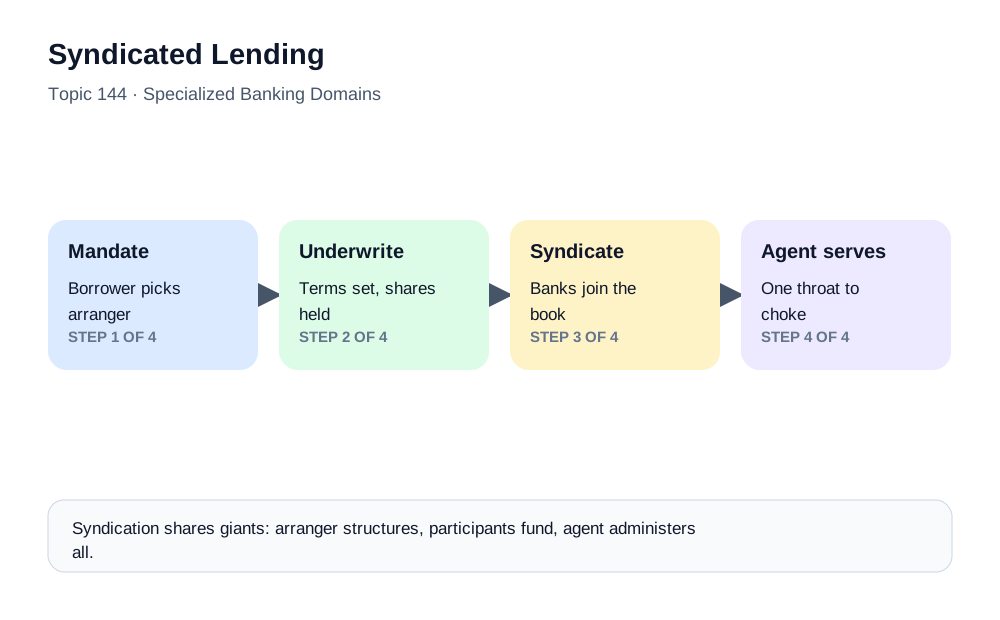
Syndicated Lending at a glance — Loan syndication, agent banks, syndication process.
Multi-Bank Loans, Lead Arrangers, Agent Banks, and Large-Ticket Credit
Some financing needs are too large, too complex, or too risky for one bank to handle alone. A major acquisition, airport, port, steel plant, telecom network, energy project, or sovereign-backed infrastructure programme may require hundreds of millions or billions in funding. One bank may not want that full exposure on its balance sheet. It may breach concentration limits, consume too much capital, or create uncomfortable risk if the borrower later defaults.
Syndicated lending solves this problem by bringing several lenders into one coordinated loan. The borrower receives one large facility, but the risk is shared among multiple banks and financial institutions. A lead arranger structures and sells the deal. An agent bank administers the loan. Each participating lender provides part of the money and receives its share of interest, fees, and repayments.
This chapter explains syndicated lending from a practical banking perspective: why it exists, who participates, how a deal is arranged, how documentation works, how drawdowns and repayments are managed, what the agent bank does, how covenants are monitored, and where operational risk appears.
Learning objectives
By the end of this chapter, you should be able to:
- Explain why syndicated lending exists and how it differs from a bilateral loan.
- Identify the main parties: borrower, sponsor, arranger, bookrunner, agent, security trustee, and lenders.
- Understand the syndication lifecycle from mandate to repayment.
- Explain facility types such as term loan, revolving credit facility, bridge loan, and letter-of-credit facility.
- Describe key loan terms: margin, benchmark, tenor, amortisation, drawdown, covenants, fees, and security.
- Understand the agent bank’s role in payment, notice, covenant, and amendment administration.
- Explain lender voting, waivers, defaults, and secondary transfers.
- Identify operational and data controls needed for syndicated loan servicing.
1. What Syndicated Lending Means
Syndicated lending is a lending structure where a group of lenders jointly provide credit to one borrower under coordinated terms.
The borrower usually signs one main loan agreement or a common set of finance documents. Each lender commits a defined share. The borrower may draw funds under the facility, and each lender funds its proportion. The borrower repays interest, principal, and fees through the agent bank, which distributes money to lenders.
Syndicated lending is common for:
- large corporate loans;
- acquisition finance;
- infrastructure finance;
- project finance;
- leveraged finance;
- sovereign or public-sector borrowing;
- trade and working-capital facilities for major groups;
- refinancing of existing debt.
The structure gives borrowers access to large funding capacity and gives lenders controlled participation in large credits.
2. Syndicated Loan vs Bilateral Loan
| Feature | Bilateral Loan | Syndicated Loan |
|---|---|---|
| Lenders | One lender | Multiple lenders |
| Size | Usually smaller | Usually larger |
| Documentation | Bank and borrower only | Common documentation across lenders |
| Administration | Lender manages directly | Agent bank coordinates |
| Risk | One lender holds full exposure | Exposure shared by lenders |
| Amendments | Bank and borrower agree | Required lender voting may apply |
| Payments | Borrower pays one lender | Agent distributes to syndicate |
| Complexity | Lower | Higher legal and operational complexity |
A syndicated loan is not many separate unrelated loans. It is a coordinated credit structure with shared rules.
3. Why Banks Syndicate Loans
Banks participate in syndication for several reasons.
Risk sharing. No single lender carries the whole exposure.
Capital management. The bank can participate within internal and regulatory exposure limits.
Relationship management. A bank can support an important client without holding the full debt.
Fee income. Arrangers and agents earn structuring, arrangement, underwriting, agency, and commitment fees.
Market distribution. Loans can be distributed to banks, funds, insurers, and institutional investors.
Liquidity and balance sheet management. Banks may later sell participations or assignments to manage exposures.
For borrowers, syndication gives access to scale, competition, and a wider lender base.
4. Main Parties in a Syndicated Loan
Borrower. The company, project SPV, sovereign entity, or group receiving the facility.
Sponsor. In project or acquisition finance, the equity investor or controlling party supporting the borrower.
Mandated Lead Arranger. The bank appointed to structure, arrange, and distribute the facility.
Bookrunner. The institution managing lender demand and allocations during syndication.
Underwriter. A bank that commits to provide funds if the wider syndication does not raise enough commitments.
Facility Agent or Administrative Agent. The bank that administers the loan after signing: notices, payments, rate setting, covenant reporting, and lender communication.
Security Agent or Security Trustee. The party holding security or collateral for the benefit of all secured lenders.
Lenders. Banks or investors committing funds.
Legal counsel. Lawyers for borrower, arrangers, lenders, and sometimes security trustee.
Technical, insurance, environmental, or market advisers. Specialists used in complex transactions.
5. The Syndication Lifecycle
A syndicated loan moves through a clear lifecycle.
Step 1: Origination and Mandate
The borrower discusses financing needs with banks. A lead arranger is selected. A mandate letter sets out proposed amount, pricing, fees, tenor, security, underwriting, and syndication strategy.
Step 2: Structuring
The arranger designs the facility: amount, currency, tenor, repayment, covenants, security, ranking, use of proceeds, conditions precedent, and lender group.
Step 3: Information Memorandum
The arranger prepares an information memorandum describing borrower, business, financials, transaction purpose, risks, projections, security, and proposed terms. Potential lenders use it for credit assessment.
Step 4: Lender Marketing and Bookbuilding
The arranger invites lenders, answers questions, organizes meetings, and collects commitments. If demand exceeds the target, commitments may be scaled back. If demand is weak, pricing or structure may change.
Step 5: Documentation
Finance documents are negotiated: facility agreement, security documents, guarantees, intercreditor agreement, agency provisions, fee letters, legal opinions, and conditions precedent.
Step 6: Signing and Conditions Precedent
The deal is signed. Before first drawdown, the borrower must satisfy conditions precedent such as corporate approvals, legal opinions, security perfection, insurance, regulatory approvals, and financial evidence.
Step 7: Drawdown and Funding
The borrower submits drawdown notice. The agent notifies lenders. Each lender funds its share. The agent pays the borrower or designated account.
Step 8: Loan Administration
During the life of the facility, the agent manages interest periods, notices, repayments, prepayments, covenant certificates, waivers, amendments, defaults, and lender distributions.
Step 9: Repayment, Refinancing, or Enforcement
The loan is repaid, refinanced, amended, sold, restructured, or enforced depending on borrower performance.
6. Facility Types
Term loan. A committed amount drawn once or in stages and repaid according to schedule or at maturity.
Revolving credit facility. Borrower can draw, repay, and redraw up to a limit during availability period.
Bridge loan. Short-term facility used until permanent financing such as bonds, equity, or asset sale is completed.
Acquisition facility. Used to fund purchase of a company or assets.
Capex facility. Funds capital expenditure.
Letter of credit or guarantee facility. Supports trade or performance obligations rather than immediate cash lending.
Multi-currency facility. Allows drawings in more than one currency, creating FX and funding complexity.
A syndicated deal may combine several facilities under one agreement.
7. Key Commercial Terms
Important terms include:
- facility amount;
- borrower and guarantors;
- purpose or use of proceeds;
- currency;
- tenor;
- availability period;
- repayment profile;
- benchmark rate;
- margin or spread;
- arrangement, agency, commitment, and upfront fees;
- security and guarantees;
- covenants;
- representations and undertakings;
- events of default;
- mandatory prepayment events;
- voting thresholds;
- transfer rules;
- governing law.
For a BA or tester, these are not only legal terms. They drive system configuration, accounting, interest calculation, notices, billing, limits, and reporting.
8. Covenants and Monitoring
Covenants are promises made by the borrower to protect lenders.
Common financial covenants include:
- debt service coverage ratio;
- interest coverage ratio;
- leverage ratio;
- net worth requirement;
- liquidity threshold;
- loan-to-value ratio;
- borrowing-base requirement.
Non-financial covenants may restrict:
- additional debt;
- asset sale;
- mergers;
- dividend payments;
- change of control;
- related-party transactions;
- changes in business;
- failure to provide financial statements;
- non-compliance with law.
Covenant breaches may trigger waiver requests, higher pricing, default, restructuring, or enforcement.
9. Role of the Agent Bank
The agent bank is the operational center of the syndicate.
It typically handles:
- lender register;
- commitment tracking;
- drawdown notices;
- interest rate fixing;
- payment collection;
- pro-rata distribution to lenders;
- fee billing;
- covenant certificate collection;
- default notices;
- lender voting;
- amendment and waiver communication;
- transfer administration;
- reporting to lenders;
- record retention.
The agent normally acts administratively, not as credit decision-maker for all lenders. Lenders remain responsible for their own credit risk, unless documents say otherwise.
10. Payments and Loan Servicing
Syndicated loan servicing is operationally sensitive.
A typical interest payment process:
- Agent calculates interest for the period.
- Agent sends payment notice to borrower.
- Borrower pays the agent on due date.
- Agent allocates payment across lenders based on participation.
- Agent distributes funds to lenders.
- Agent updates loan records, accounting, and confirmations.
Problems can occur if:
- borrower pays late;
- benchmark rate is wrong;
- lender share is wrong;
- tax withholding is mishandled;
- payment currency differs;
- lender transfer not reflected;
- default interest applies;
- prepayment changes interest allocation;
- system does not support amendment terms.
A syndicated loan requires strong data and event control.
11. Amendments, Waivers, and Voting
Borrowers often request changes during the loan life: covenant waiver, maturity extension, margin change, security release, currency change, or repayment rescheduling.
The facility agreement defines voting thresholds. Some matters may need majority lenders. Others may need all lenders, affected lenders, or super-majority approval.
Typical sensitive matters include:
- reducing principal or interest;
- extending maturity;
- releasing material security;
- changing currency;
- changing payment waterfall;
- changing voting rights;
- releasing guarantors.
Good agency operations must track votes, deadlines, approvals, dissenting lenders, and final documentation.
12. Secondary Loan Trading
Lenders may sell their participation after origination.
Two common methods are:
Assignment. The buyer becomes lender of record and receives rights and obligations directly under the loan documents.
Participation. The seller remains lender of record, but transfers economic exposure to the participant through a separate arrangement.
Secondary trading helps banks manage concentration, capital, liquidity, and portfolio strategy. It also introduces operational requirements around consent, transfer certificates, registers, KYC, settlement, and confidentiality.
13. Practical Example: Syndicated Term Loan
A large manufacturing group needs 1 billion to build a new plant. One bank is not willing to lend the full amount.
The borrower appoints two lead arrangers. They structure a five-year term loan with floating interest, security over plant assets, guarantees from key group companies, and covenants around leverage and debt service.
Ten lenders join the syndicate. Each commits between 50 million and 150 million. The agent bank maintains the lender register, receives drawdown notices, coordinates funding, collects interest, distributes lender shares, and monitors covenants.
Two years later, the borrower breaches a leverage covenant due to weak earnings. The borrower requests a waiver. The agent circulates the request. Majority lenders approve with higher margin and additional reporting. The agent updates terms and monitors compliance.
This shows syndicated lending as a living structure, not a one-time disbursement.
14. Common Misconceptions
"A syndicated loan is just many banks giving separate loans." No. It is a coordinated facility under shared documentation and administration.
"The lead arranger always holds the largest risk." Not necessarily. Arrangers may underwrite or distribute exposure. Final hold levels depend on syndication and internal strategy.
"The agent bank guarantees the borrower." No. The agent administers the loan. It does not normally guarantee borrower performance to other lenders.
"All lenders must agree to every change." No. Voting thresholds depend on the agreement. Some matters need majority, some all-lender or affected-lender consent.
"Syndication removes credit risk." It distributes credit risk. Each lender still owns its committed exposure.
15. Frequently Asked Questions
What is syndicated lending? It is a loan provided by multiple lenders to one borrower under coordinated documentation and administration.
Who is the lead arranger? The lead arranger structures the deal, negotiates key terms, prepares lender materials, and brings other lenders into the syndicate.
What does the agent bank do? The agent administers the loan: notices, drawdowns, payments, interest, covenant reporting, lender communication, amendments, and records.
What is a covenant? A covenant is a borrower promise or restriction designed to protect lenders, such as maintaining financial ratios or avoiding extra debt.
What is oversubscription? Oversubscription occurs when lenders commit more than the requested facility amount, allowing allocations to be scaled.
Can a syndicated loan be sold? Yes. Lenders may transfer exposure through assignment or participation, subject to documentation and consent rules.
16. Key Terms in This Chapter
- Syndicated loan - loan provided by multiple lenders under coordinated terms.
- Mandated Lead Arranger - bank appointed to structure and arrange the facility.
- Bookrunner - party managing lender demand and allocations.
- Agent bank - bank administering the facility after signing.
- Security trustee - party holding security for secured lenders.
- Commitment - amount a lender agrees to provide.
- Drawdown - borrower use of committed facility.
- Term loan - facility drawn and repaid over defined term.
- Revolving credit facility - facility that can be drawn, repaid, and redrawn.
- Bridge loan - short-term financing before permanent funding.
- Covenant - borrower promise or restriction.
- Waiver - lender consent not to enforce a breach or requirement.
- Assignment - transfer of lender rights and obligations.
- Participation - transfer of economic exposure while seller remains lender of record.
- Pro-rata distribution - payment allocation by lender share.
17. Interview Insights
"Why do banks syndicate loans?" To share risk, manage concentration and capital, support large clients, earn fees, and fund deals too large for one bank.
"What is the difference between arranger and agent?" The arranger structures and sells the deal before signing. The agent administers the loan after signing.
"What operational work does an agent bank perform?" Drawdown notices, lender funding, payment allocation, interest calculation, covenant tracking, waivers, amendments, default notices, lender register, and reporting.
"Why are covenants important?" They give lenders early warning and contractual control if the borrower’s financial condition or behavior worsens.
"What can go wrong in syndicated loan servicing?" Wrong lender shares, incorrect interest, late payment allocation, missed covenant breach, unrecorded transfer, wrong voting threshold, tax error, or weak audit trail.
Summary and Key Takeaways
Syndicated lending allows several lenders to fund one large borrower under a coordinated structure. It is essential for large corporate, acquisition, infrastructure, and project finance deals.
The main lessons are:
- Syndication shares risk and capacity. One borrower gets large funding; lenders divide exposure.
- Roles matter. Arranger, bookrunner, agent, security trustee, and lenders perform different functions.
- The lifecycle is long. Mandate, structuring, syndication, documentation, drawdown, servicing, amendments, and repayment all need control.
- Agent operations are critical. Payments, notices, lender shares, covenants, waivers, and records must be accurate.
- Covenants protect lenders. They create early-warning triggers and negotiation points.
- Secondary transfers add complexity. Lender registers and consent rules must remain current.
- Syndicated loans are operational products. Legal terms must be correctly reflected in systems, workflows, accounting, and reporting.
A syndicated loan is banking collaboration at scale: many lenders, one borrower, shared documents, shared risk, and a strong need for disciplined administration.
Next: Topic 145 - Project Finance
<!-- MBA-DEEP-DIVE-START -->Syndicated Lending Deepening — Credit Structuring, Agency Operations, Loan Trading, and Control
Syndication starts with the borrower's funding problem and the banks' hold appetite
A syndicated facility exists because the borrower needs more capacity, flexibility, or lender diversity than one institution wishes to provide alone. The arranger must therefore solve two problems at the same time. It must design terms the borrower can accept and a risk-return profile that enough lenders are willing to hold. Facility size, tenor, amortisation, security, covenant package, pricing, fees, purpose, guarantors, and information rights all influence that balance. A deal that is attractive to the borrower but impossible to distribute creates underwriting risk for the arranging banks.
Underwriting risk is different from final credit exposure
An arranger may promise the borrower that the full financing will be available before all participating lenders have committed. If the market later refuses the intended distribution, the underwriters may have to fund a larger exposure than planned or sell it at a discount. Underwriting therefore combines borrower credit risk with market distribution risk. Approval should consider the bank's ability to hold the position, the likely investor base, market volatility, syndication timetable, and any contractual flex rights that allow pricing or terms to change.
Best-efforts syndication shifts more distribution risk to the borrower
In a best-efforts arrangement, the arranger seeks commitments but does not necessarily guarantee the entire target amount. If demand is weak, the borrower may receive less funding or need to revise the transaction. Fully underwritten, club, and best-efforts structures therefore create different obligations and economics. Operational teams should know the actual mandate because fee entitlement, commitment records, and borrower expectations depend on it.
A club deal is not the same as a broadly marketed syndication
A club facility usually involves a smaller group of relationship lenders agreeing the structure together, often with less formal distribution. A widely syndicated transaction may involve detailed information memoranda, bank meetings, bookbuilding, allocations, and secondary-market expectations. Both use multiple lenders, but the origination process, roles, fees, confidentiality, and operational setup can differ significantly.
Credit approval remains lender-specific even under common documentation
Every participant should make its own credit decision within its risk framework. The arranger provides information and coordinates the process, but another lender should not treat the arranger's participation as a substitute for due diligence. Each bank may have different country limits, industry appetite, capital constraints, ESG policies, sanctions concerns, or concentration limits. Shared documentation creates common contractual terms; it does not create one shared credit-risk policy.
The information memorandum should support decision making without becoming a warranty
Arrangers typically organise information about the borrower, transaction, industry, financial performance, projections, management, security, and key risks. Potential lenders need enough information to underwrite their participation, while legal documents often contain disclaimers regarding reliance and verification. From an operational perspective, document versions and lender access should be controlled so all participants know which materials formed the basis of the syndication.
Confidentiality is a lifecycle issue
Syndicated loans can involve price-sensitive acquisition plans, forecasts, non-public financial information, restructuring proposals, or covenant negotiations. Access should therefore be limited to authorised personnel and lenders under suitable confidentiality arrangements. When loans trade in the secondary market, information walls and public/private lender groups can become relevant. Data rooms, agent portals, email distribution, and meeting records should preserve access controls and auditability.
Facility structure determines how much operational logic the loan platform must support
A simple term loan with one currency and fixed amortisation is very different from a multi-currency revolving facility with swingline drawings, letters of credit, optional currencies, ancillary facilities, accordion features, benchmark elections, and multiple borrowers. The system should represent the legal facility structure rather than force every deal into a generic balance field. Otherwise staff resort to spreadsheets that create reconciliation and key-person risk.
Commitments and utilisations are separate concepts
A lender may commit 100 but have only 40 currently drawn. The undrawn 60 can still create contractual and liquidity obligations if the borrower satisfies drawing conditions. Commitment utilisation therefore matters for exposure, liquidity, fees, capital, and limit management. Revolving facilities can move repeatedly between drawn and undrawn states, requiring systems to track available commitment after repayments and cancellations.
Commitment fees require an accurate available-amount history
A fee on undrawn commitment cannot be calculated correctly if the system records only end-of-period balances. Drawdowns, repayments, cancellations, transfers, and commitment increases can all change the fee base during the accrual period. The calculation should use the contractual day-count convention, margin, fee rate, effective dates, and lender participation. Amendments can introduce different fee rates by tranche or utilisation level.
Interest calculation should separate benchmark, margin, and other adjustments
A floating-rate loan may use a reference rate plus contractual margin, with possible floors, credit-adjustment spreads, default margin, sustainability-linked adjustments, or utilisation fees depending on the agreement. The agent should calculate according to the legal terms and distribute notices consistently. Systems should retain each component so disputes can be traced. A single all-in rate stored without derivation makes audit and amendment difficult.
Benchmark conventions are contract-specific
After the transition from LIBOR, syndicated facilities can use overnight risk-free rates with compounding or other authorised structures depending on currency and market. Observation periods, lookbacks, rounding, floors, business-day conventions, and fallback language vary. The operational rule should come from the executed agreement. Teams should never assume that two loans referencing the same benchmark calculate interest identically.
Rate fixing is an agency control point
The facility agent may determine or obtain the relevant benchmark and calculate the interest rate for each period. The process should identify rate source, fixing date, observation rules, fallback handling, spread, margin, floor, and approval where manual intervention occurs. If a source rate is unavailable, the contractual fallback must be followed rather than an analyst choosing a convenient replacement.
Drawdown notices should be validated against the agreement
A borrower request should be checked for authorised signatory, notice period, minimum amount, currency, permitted purpose where applicable, available commitment, maturity, conditions precedent, borrowing-base limits, and absence of blocking default conditions. The agent then allocates lender funding shares. Automation can improve speed, but exceptions should be transparent so operations know why a draw is blocked or routed for approval.
Lender funding is a separate cash-flow chain
The borrower does not usually receive every lender's payment independently. The agent coordinates expected contributions and the outgoing borrower payment according to the agreement and settlement model. Late lender funding can create operational and liquidity issues for the agent. Systems need to identify funded, unfunded, short, and late positions by lender and drawdown. A single facility status cannot describe all lender-level cash states.
Pro-rata sharing protects economic equality where the agreement requires it
Principal, interest, and many fees are generally distributed according to lender participation, subject to the exact documentation. Changes in lender shares, prepayments, transfers, defaulting-lender provisions, and different facility tranches can alter the allocation. Agent systems should calculate the distribution from the authoritative register and effective date rather than from manually maintained percentages.
The lender register is critical reference data
The agent's record of lenders, commitments, transfers, addresses, payment instructions, tax details, and contacts drives notices and money movement. Errors can send funds to the wrong institution or exclude a lender from a vote. Changes should therefore use controlled workflows, effective dates, maker-checker review, and audit history. Payment-instruction changes deserve particularly strong authentication because syndicated distributions can be very large.
Secondary transfers change both economics and operations
When a lender assigns its position, the new lender may become the legal lender of record from an agreed transfer date. The agent must update commitments, outstanding utilisation, future cash distributions, voting rights, notices, tax status, and contact details. Accrued interest and trade settlement between seller and buyer may be handled under separate market mechanics. A transfer is therefore not just a static-party change.
Participation structures require clarity about legal versus economic ownership
In a funded participation, the participant can acquire economic exposure while the original lender remains the contractual lender to the borrower. The agent may continue to see only the lender of record depending on the structure. Risk, finance, regulatory, and operations systems must understand this distinction so exposure is not double-counted or omitted. Legal rights on borrower default can also differ from an assignment.
Borrower consent and eligibility conditions can restrict transfers
Facility agreements may require borrower or agent consent, restrict transfers to competitors, require minimum amounts, or define eligible assignees. During a default, some restrictions may change. Agent workflows should enforce the current legal conditions rather than accepting a transfer merely because buyer and seller agreed commercially.
The facility agent is an administrator, not a substitute credit committee
The agent normally acts according to the agreement and lender instructions. It may calculate rates, distribute notices, collect payments, and determine whether formal voting thresholds have been achieved, but it generally does not decide for lenders whether a covenant breach should be waived. Distinguishing administrative authority from credit discretion prevents the agent from assuming obligations it was not appointed to perform.
Voting mechanics need precise denominator logic
A “majority lenders” threshold can depend on commitments, utilisations, affected facility, or another contractual basis. Defaulting lenders may be excluded in some circumstances. A lender that transferred part of its commitment may have different voting power from the prior day. Agent systems should calculate the denominator from current legal positions and the clause governing that decision. Manual percentage estimates are dangerous on material amendments.
All-lender matters should be explicitly identified
Changes to principal, payment dates, interest or fee economics, currency, lender sharing, security release, guarantor release, or voting provisions may require higher consent under the specific agreement. Not every document uses the same sacred rights. Operations should therefore use a deal-specific consent matrix approved by legal counsel rather than a universal checklist copied from another facility.
Waivers should have scope and expiry
A covenant waiver can apply to one testing date, a defined period, or a permanent amendment. It may include conditions such as additional reporting, fee payment, pricing increase, sponsor support, or restrictions on distributions. Systems should record the exact effective period and post-waiver obligations. Leaving a permanent “waived” flag can cause the next breach to be missed.
Amendments can change historical calculations prospectively
A margin step-up may begin on a future date, a maturity can be extended, amortisation can be reprofiled, or a benchmark convention can be replaced. The system should preserve the prior terms for historical interest and reporting while using the new terms from the effective date. Overwriting the old configuration makes earlier notices impossible to reproduce.
Conditions precedent and conditions subsequent need different tracking
Conditions precedent must generally be satisfied or waived before a defined action such as first utilisation. Conditions subsequent are obligations to deliver evidence or complete actions after closing or drawdown. Both need responsible owners, due dates, document evidence, waiver status, and escalation. A closing checklist that disappears after funds are advanced can leave important security or registration actions incomplete.
Security agents coordinate collateral for the lender group
Where security is shared, appointing one security agent or trustee can avoid each lender taking separate security. The role can include holding collateral, receiving enforcement instructions, distributing proceeds, maintaining records, and coordinating releases. The precise legal structure varies by jurisdiction. Systems should therefore distinguish facility agent and security agent roles even when the same institution performs both.
Security perfection can be a jurisdictional operational process
Signing a security document does not always complete enforceability. Registration, filing, notice, possession, account control, or other perfection steps may be required depending on asset and jurisdiction. The bank should track completion evidence and renewal deadlines. In a default, missing perfection can materially reduce recoveries, so this is not merely legal housekeeping.
Covenant monitoring requires both correct data and correct definition
A leverage ratio in one agreement may use a different EBITDA definition, permitted add-backs, debt exclusions, or testing perimeter from another loan. The borrower often provides a compliance certificate, but lenders and agent teams may still review calculations. Automated covenant engines need deal-specific formulas and source data. Generic ratios can create false breaches or miss real ones.
Information undertakings support early warning
Borrowers can be required to deliver financial statements, budgets, compliance certificates, litigation notices, insurance evidence, environmental reports, or other information. Delayed information may itself breach the agreement. Operations should track expected documents, receipt dates, completeness, and escalation. Credit teams need this evidence to reassess risk before the next formal annual review.
Events of default require legal classification, not merely overdue flags
Non-payment is one event, but defaults can also include covenant breach, misrepresentation, insolvency, cross-default, invalid security, or change in control depending on the agreement. Some have grace periods or materiality thresholds. Systems should support legal review and not automatically accelerate a facility because a generic exception code fired. At the same time, potential defaults should not disappear inside unmonitored workflow queues.
Cross-default creates contagion across a borrower's debt structure
A failure under another financing can trigger consequences in the syndicated loan when contractual thresholds and definitions are met. Credit teams therefore need visibility beyond the facility itself. Cross-default provisions can connect bonds, bilateral loans, derivatives, and other obligations, making enterprise exposure and legal-document data important during borrower stress.
Default interest can apply differently by amount and period
Some agreements apply higher interest to overdue amounts rather than the entire facility. The effective date, compounding, benchmark, margin, and day-count need to follow the contract. Operations should separate principal arrears, unpaid interest, unpaid fees, and other overdue amounts where the calculation differs. Manual default-interest adjustments are frequent sources of disputes.
Prepayments affect lenders, fees, and future availability
A voluntary prepayment may reduce a term loan permanently but restore availability under a revolver. Mandatory prepayment can be triggered by asset sale, insurance proceeds, excess cash flow, debt issuance, or other events depending on the deal. Break costs or notice requirements can apply. The agent should update lender shares and future schedules consistently across cash, accounting, limits, and reporting.
Multi-currency facilities add FX and settlement complexity
Commitments may be expressed in a base currency while drawings occur in several currencies. The agreement may require periodic revaluation to ensure the base-currency equivalent does not exceed commitments. Exchange-rate sources, revaluation dates, lender funding currencies, and repayment obligations must be clear. A borrower can appear within limit in nominal currency but exceed the facility after exchange-rate movement if revaluation logic is weak.
Letters of credit and guarantee tranches create contingent exposure
A syndicated facility can include instruments that do not initially move cash but create contingent obligations. Issuing banks may receive fronting fees while other lenders participate in the risk. If the instrument is called, the exposure can become funded. Agent and risk systems should distinguish issued amount, lender participation, cash collateral, reimbursement status, expiry, and claims.
Swingline facilities solve short-notice liquidity needs
A swingline lender can advance short-term drawings quickly, with other lenders later sharing or refinancing the exposure according to the facility terms. This provides operational flexibility to the borrower but creates specific funding and allocation logic. The system should know when a swingline is outstanding, how interest is calculated, and how exposure becomes shared.
Sustainability-linked pricing needs auditable KPI evidence
Some facilities adjust margin or fees based on sustainability performance targets. The bank should record the exact KPI, measurement period, verification requirement, adjustment amount, and effective date. Marketing language is not enough. If the calculation affects interest, the evidence and change should be reproducible like any other contractual pricing component.
Agency fees should be separated from lender economics
The facility agent can receive annual agency fees, the arranger can receive upfront or structuring fees, and lenders can receive participation or commitment fees. These payments have different recipients, recognition rules, and contractual bases. Systems should not treat all fees as interest spread. Finance and tax treatment may differ and should follow accounting policy and local requirements.
Accounting should reconcile contract balances to cash flows
Each lender recognises its own loan asset, interest income, fees, impairments, and possibly fair-value effects according to applicable accounting policy. The agent maintains administrative records for the whole facility. Differences between agent notices and lender books need prompt investigation. A lender's internal principal balance should reconcile to its legal share of the agent register after transfers and repayments.
Credit-risk monitoring continues after syndication
Selling down an exposure does not end relationship responsibility for the bank's retained portion. Lenders monitor borrower performance, covenant compliance, industry conditions, collateral, ratings, financial projections, and utilisation. Arrangers can retain reputational exposure even after distributing most of the credit because clients and investors remember the quality of deals they structured.
Concentration should be assessed across related facilities and entities
A bank may participate in several facilities for the same corporate group: term debt, revolver, guarantees, derivatives, trade finance, and project SPVs. The syndicated-loan position is one part of total exposure. Risk systems need group aggregation and connected-counterparty logic so distribution in one facility does not create false confidence about the overall concentration.
Scenario: a drawdown arrives just before the contractual notice deadline
The borrower requests a large same-day utilisation. The agent validates notice timing, authorised signatory, available commitment, currency, and absence of a blocking condition. Lender notices are produced automatically, but one lender's settlement instruction was amended that morning. The change remains pending independent verification, so the system uses the previously approved instruction and escalates the amendment. This prevents urgency from bypassing payment-control standards.
Scenario: one lender fails to fund
Nine lenders send their shares, but one does not. The agent must follow the agreement rather than improvise. Depending on terms, a defaulting-lender mechanism, replacement funding, agent funding, or borrower shortfall process may apply. Operations records the missing amount separately and escalates to credit and legal teams. The borrower-facing status should reflect the contractual outcome, not simply “drawdown complete” because most funds arrived.
Scenario: a covenant waiver changes pricing
The borrower breaches leverage but obtains the required lender consent for a six-month waiver. In exchange, margin increases by 75 basis points from the waiver effective date and the borrower must provide monthly liquidity reports. The agent platform records the limited waiver period, new pricing schedule, reporting obligation, consent evidence, and next testing date. When the waiver expires, normal covenant logic resumes automatically rather than remaining suppressed.
Scenario: a secondary transfer settles mid-interest period
A lender sells half its commitment. The transfer becomes effective after agent consent and register update. Future borrower payments must be split according to the new lender shares, while accrued economics between buyer and seller may be handled through the secondary trade settlement process. The agent should preserve pre-transfer history while applying the new participation from the effective date.
Business requirements should be clause-driven
For a syndicated-loan platform, a BA should map major legal clauses to system behaviour: utilisations, interest, fees, repayments, prepayments, lender sharing, transfers, voting, covenants, defaults, security, notices, amendments, tax, and reporting. The goal is not to automate legal interpretation but to make approved contractual rules executable and auditable. Exception paths should preserve manual legal decision where judgement is required.
Testing should use lender-level and facility-level assertions
A test that verifies only the total borrower balance can miss wrong lender allocation. Test cases should confirm each lender's commitment, funded share, accrual, fee, vote, repayment, and transfer effect as well as facility totals. Multi-currency and multi-tranche structures require additional reconciliation. The agent's total assets and liabilities should agree with the sum of participant positions where the operating model requires it.
Agent-bank resilience is a market service issue
If the agent's platform fails on a large payment date, the borrower and many lenders can be affected simultaneously. Business continuity should support rate calculation, notices, cash collection, lender distribution, and emergency communication. Recovery procedures must avoid duplicate payments when systems return. Agency operations therefore combine credit administration with payment-system discipline.
Closing perspective
Syndicated lending is sometimes taught as a way for banks to share a big loan. In practice it is a coordinated operating system built around a legal contract. Credit appetite creates commitments, the agent converts the contract into notices and cash flows, the lender register controls economic ownership, covenants create ongoing decision points, voting governs change, and transfer mechanics let risk move through the market. The quality of the facility depends not only on underwriting the borrower but also on administering thousands of small contractual details correctly for years.
Syndicated Lending Operations — Cash Control, Agent Resilience, Notices, and Position Integrity
Agency cash accounts should be reconciled by facility and event
An agent can receive borrower interest, principal, fees, and prepayments before distributing money to lenders. These flows should not become an opaque pooled balance. Reconciliation should identify which facility, payment event, currency, and lender allocation explain each movement. Unapplied cash needs immediate ownership because a delay can affect lender income, borrower status, and the agent's own financial exposure.
Borrower payment does not equal lender receipt
The borrower may pay the agent correctly while one lender distribution fails because of incorrect settlement instructions, sanctions review, bank holiday, or technical rejection. The facility can be current from the borrower's perspective while an agency payable remains unresolved. Systems should therefore track borrower obligation and lender distribution as separate states and avoid marking the whole cash event complete merely because incoming funds arrived.
Settlement-instruction changes are high-risk events
Fraudsters can target syndicated-loan payments because amounts are large and payment instructions may be changed through email-heavy processes. Instruction changes should use authenticated channels, independent callback or equivalent verification where appropriate, maker-checker approval, effective dates, and audit history. Urgent drawdown or distribution deadlines should not override this control. The previously approved instruction should remain authoritative until the new one is verified.
Agency notices should be generated from the same authoritative terms used for calculation
A rate notice, drawdown notice, payment notice, or fee statement should reflect the terms stored in the facility system. If operations calculate interest in one spreadsheet and create the notice manually in another, inconsistencies become likely. The notice should carry calculation period, rate components, amount, due date, currency, and relevant reference so lenders and borrowers can reconcile the cash movement to the contract.
Notice versioning matters during amendments
A borrower may receive an original interest notice and later a corrected notice after a benchmark or participation error is found. The agent should preserve both, mark which one is current, explain the correction, and link it to any cash adjustment. Replacing the old PDF in a shared folder destroys the evidence needed for disputes and accounting.
Lender positions should reconcile after every transfer
Secondary trades change future entitlement to principal, interest, fees, and voting. The agent register should reconcile opening commitment plus transfers, increases, cancellations, and repayments to closing commitment. Effective date is critical: seller and buyer can have different entitlement to accrued amounts around settlement. Position integrity should be verified before the next cash distribution or lender vote.
Failed transfer settlement should not alter legal lender status prematurely
A buyer and seller may agree a trade, but the agent should update the legal register only when the transfer conditions and effective process required by the agreement are satisfied. If trade settlement fails or borrower consent is outstanding, economic exposure between seller and buyer may exist separately while the borrower-facing lender of record remains unchanged. Systems should distinguish trade status from legal registration.
Agent operational resilience is borrower and lender risk
A facility can be perfectly performing while the agent experiences a technology outage. Drawdowns, rate settings, notices, lender distributions, and consent processes can all be disrupted. Business-continuity plans should identify alternate communication, calculation, payment, and approval procedures. Critical facility data and lender instructions need recoverable copies with strong access control.
Multi-bank cut-offs should be considered in funding timetables
A drawdown requiring ten lenders in several currencies and time zones cannot be managed using one generic internal deadline. The agent should account for borrower notice time, lender funding deadlines, local payment cut-offs, currency holidays, and the time needed to repair a failed transfer. Adequate operational margin reduces the risk that one late payment prevents the borrower receiving funds on the contractual date.
Agent liquidity exposure should be explicit
Depending on the agreement and operating model, the agent may face a decision whether to advance funds when one lender is late or to pass through only amounts received. Any temporary funding by the agent creates credit and liquidity exposure and should follow approved policy and contractual rights. Operations should never cover a short lender contribution informally simply to make the borrower payment look complete.
Fee allocation should reconcile to contractual roles
Arrangement, underwriting, participation, agency, security-agent, commitment, utilisation, and amendment fees can accrue to different institutions and periods. The system should identify payer, recipient, basis, tax treatment where relevant, accrual period, and settlement. Fee differences are common sources of agency disputes because they may not follow the same pro-rata share as principal.
Defaulting-lender treatment should be systematised
A lender that fails to fund can be subject to special contractual consequences such as suspension of voting, reduced fee entitlement, replacement rights, or allocation changes depending on the agreement. The agent should record the status, effective date, evidence, and clauses applied. A free-text comment is not enough when future cash and voting calculations depend on the classification.
Borrower group changes should propagate through the facility structure
Mergers, guarantor changes, acquisitions, disposals, or group reorganisations can change covenant calculations, security, account instructions, and reporting. The agent's party model should preserve legal entity identity and effective relationships. Renaming a borrower record without tracking the legal change can break historical statements and KYC or sanctions evidence.
Loan operations should coordinate with sanctions and KYC controls without confusing responsibilities
The agent and each lender may have their own regulatory obligations. Changes to borrower, guarantor, lender, or payment instructions can require screening or due diligence according to policy. Agency systems should provide the necessary party and payment data while specialist compliance teams own their decisions. A facility should not be treated as permanently “cleared” because its parties were screened at origination years earlier.
Reconciliation should connect contractual, accounting, and cash positions
For each lender, the bank should be able to bridge legal commitment, drawn principal, accrued interest, fees, cash received or paid, and accounting balance. The agent register provides one source of contractual evidence; the lender's own books provide another. Differences after transfers, amendments, or prepayments should be investigated promptly rather than carried as unexplained operational adjustments.
Period-end operations need explicit cut-off treatment
Interest periods, principal balances, undrawn commitments, and fee accruals can cross month, quarter, or year end. Late notices or backdated transfers can alter financial reporting if not handled consistently. The bank should define which legal effective date drives the books and how subsequent corrections are posted. Historical calculations should remain reproducible after the facility terms change.
Covenant information should feed credit decisions, not disappear in agency workflow
An agent may receive compliance certificates and financial statements as an administrative function, but lender credit teams need timely access to material breaches and waivers. Workflow should route significant covenant events to the appropriate risk owners. An agency platform that records the document but does not alert the lenders' internal credit processes creates a governance gap.
Facility closure requires more than principal reaching zero
Before closing a facility record, the agent should confirm all utilisations are repaid, contingent instruments expired or cancelled, interest and fees settled, lender distributions complete, security releases authorised, outstanding notices resolved, and required records retained. Residual agency cash or unresolved claims should remain visible. Closing too early can orphan later adjustments and correspondence.
The strongest syndicated-loan operation preserves position integrity across every participant
A syndicated facility is one contract interpreted through many bank books and cash accounts. The agent's job is to keep lender shares, borrower obligations, rates, notices, transfers, votes, and cash aligned through years of change. Stable reference data, effective dating, authenticated payment instructions, reconciliation, and resilient agency operations are what make the legal syndicate function as an operational whole.
<!-- MBA-DEEP-DIVE-END -->