Visual overview
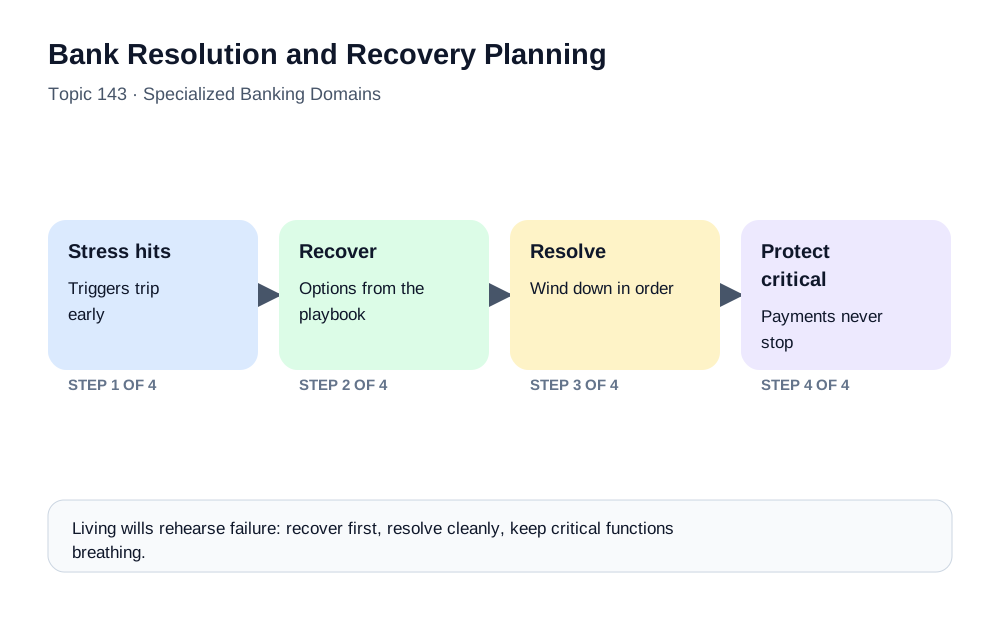
Bank Resolution and Recovery Planning at a glance — Living wills, recovery plans, resolution authorities.
How Banks Prepare for Severe Stress, Failure, and Orderly Wind-Down
Banks are allowed to perform a special role in society. They take deposits, run payments, provide credit, support trade, hold client assets, and connect households and businesses to the financial system. Because of this role, a disorderly bank failure can harm far more than shareholders. It can affect depositors, payment systems, borrowers, employees, other banks, market confidence, and the wider economy.
The 2008 global financial crisis made this painfully clear. Some institutions were considered too important to fail suddenly, but public bailouts created anger and moral hazard. Regulators responded by strengthening recovery and resolution frameworks. The idea is simple: banks must prepare for severe stress before it happens, and authorities must be able to resolve a failing bank without uncontrolled panic or taxpayer rescue wherever possible.
This chapter explains recovery planning and resolution planning in plain banking language. It covers recovery triggers, recovery options, resolution tools, living wills, bail-in, bridge banks, critical functions, deposit protection, financial stability, and why planning for failure is part of responsible banking.
Learning objectives
By the end of this chapter, you should be able to:
- Distinguish recovery planning from resolution planning.
- Explain why regulators require banks to prepare for severe stress and failure.
- Identify common recovery triggers such as capital, liquidity, profitability, market, and operational indicators.
- Describe recovery options available before a bank becomes non-viable.
- Explain resolution tools such as bail-in, sale of business, bridge bank, asset separation, and liquidation.
- Understand critical functions and why payments, deposits, and essential services must continue.
- Explain depositor protection and why shareholders and creditors may absorb losses first.
- Discuss practical examples such as global living wills and India’s Yes Bank reconstruction.
1. Recovery vs Resolution
Recovery and resolution are related but different.
Recovery happens while the bank is still viable or can reasonably be restored to viability. The bank leads the process. The goal is to survive stress, rebuild capital or liquidity, restore confidence, and continue operating.
Resolution happens when the bank is failing or likely to fail and ordinary recovery is no longer enough. The resolution authority or regulator leads the process. The goal is to protect financial stability, maintain critical functions, protect insured depositors, allocate losses according to law, and wind down or restructure the bank in an orderly way.
A simple memory rule:
- Recovery asks: How can the bank save itself?
- Resolution asks: How can authorities manage failure without chaos?
2. Why Recovery and Resolution Planning Exists
Bank failure is different from ordinary company failure.
If a normal company fails, suppliers, employees, lenders, and shareholders suffer. If a bank fails suddenly, customers may lose access to deposits, payments may stop, borrowers may lose credit lines, correspondent banks may pull limits, markets may panic, and other banks may be affected through exposures and confidence.
Planning exists to avoid three bad outcomes:
- Panic. Depositors and markets rush to exit because no one knows what happens next.
- Bailout dependency. Governments rescue institutions with taxpayer money because no orderly alternative exists.
- Value destruction. A disorderly collapse destroys more value than necessary.
Recovery and resolution frameworks create options before the crisis becomes uncontrollable.
3. Recovery Triggers
Recovery plans define triggers that warn the bank is entering serious stress.
Common triggers include:
| Trigger Type | Examples |
|---|---|
| Capital | capital ratio falls, buffer breached, large losses, credit deterioration |
| Liquidity | LCR pressure, deposit outflows, wholesale funding unavailable, payment liquidity stress |
| Profitability | sustained losses, margin collapse, large provisions |
| Asset quality | rising non-performing loans, concentration losses, collateral value fall |
| Market confidence | credit rating downgrade, share price fall, CDS spread widening |
| Operational resilience | major cyber incident, payment outage, core system failure |
| Legal/compliance | major enforcement action, sanctions breach, fraud scandal |
| Governance | management failure, board crisis, audit qualification |
Triggers do not automatically mean failure. They activate governance, escalation, analysis, communication, and possible recovery actions.
4. Recovery Options
Recovery options are actions the bank can take to restore strength.
Examples include:
- raise common equity;
- issue capital instruments;
- suspend dividends or bonuses;
- sell non-core businesses;
- sell liquid assets;
- reduce risk-weighted assets;
- slow new lending;
- sell loan portfolios;
- reduce costs;
- access central bank liquidity facilities;
- pledge collateral;
- obtain committed funding;
- restructure liabilities;
- change management;
- simplify the legal entity structure.
A recovery plan should not merely list options. It should estimate feasibility, timing, financial impact, operational dependencies, legal constraints, market reaction, and communication needs.
A capital option that takes three months is not useful for a liquidity crisis tomorrow. A liquidity option that damages market confidence may solve one problem and create another.
5. Critical Functions
Resolution planning focuses heavily on critical functions. These are services whose sudden disruption would harm customers, markets, or financial stability.
Critical functions may include:
- deposit access;
- payment services;
- clearing and settlement;
- lending to households and SMEs;
- trade finance;
- custody and client asset services;
- market-making in important instruments;
- treasury and liquidity operations;
- access to financial market infrastructures;
- correspondent banking services.
The goal of resolution is not always to save the entire bank. It may be to preserve critical functions while shareholders and creditors absorb losses and non-critical parts are sold or wound down.
6. Resolution Tools
Resolution authorities use different tools depending on law, bank structure, and crisis conditions.
Sale of business. Critical operations or the whole bank are sold to a healthier institution.
Bridge bank. Critical functions are transferred temporarily to a new bank controlled by the authority until sale or restructuring.
Bail-in. Certain creditors' claims are written down or converted into equity, absorbing losses and recapitalizing the institution without taxpayer bailout.
Asset separation. Good assets and viable operations are separated from bad or hard-to-value assets, sometimes through a bad bank or asset management vehicle.
Liquidation. The bank is wound down when no viable continuity option exists, with depositor protection schemes paying insured depositors according to law.
Temporary public ownership. In some frameworks, the state may take temporary control as a last resort to preserve stability.
The available tools depend on jurisdiction. Not every country has the same legal powers.
7. Bail-In and Loss Absorption
Bail-in means shareholders and certain creditors absorb losses by having claims written down or converted to equity.
The usual loss order is:
- shareholders;
- additional tier 1 instruments;
- tier 2 instruments;
- subordinated debt;
- eligible senior debt;
- other creditors depending on law;
- insured depositors are normally protected by deposit insurance or preferred treatment.
Bail-in is designed to reduce taxpayer bailouts. But it must be legally clear and well communicated. If ordinary depositors fear their deposits will be bailed in, panic can worsen. This is why depositor protection rules and hierarchy of claims must be understood.
8. Living Wills and Resolution Plans
A resolution plan, often called a living will, explains how a bank could be resolved in an orderly way.
It may include:
- legal entity structure;
- critical functions;
- shared services;
- financial market infrastructure access;
- intercompany exposures;
- operational dependencies;
- data and systems mapping;
- funding and liquidity structure;
- separability of business lines;
- loss-absorbing capacity;
- communication plan;
- resolution strategy;
- barriers to resolution and remediation actions.
Large and complex banks may have to simplify structures if regulators find they cannot be resolved safely.
9. Deposit Insurance and Customer Protection
Deposit insurance protects eligible depositors up to a defined limit. The limit differs by country. It helps prevent panic because small depositors know they are protected even if the bank fails.
Deposit insurance is not the same as unlimited guarantee. Customers with balances above the insured limit may still have exposure depending on the resolution method and creditor hierarchy.
Customer protection during resolution also includes:
- access to insured deposits;
- continuity of payment services where possible;
- clear communication;
- transfer of accounts to another bank;
- protection of client assets where applicable;
- complaint and claim channels.
10. Operational Dependencies in Resolution
A resolution plan fails if it ignores operations and technology.
Authorities need to know:
- Can customer balances be identified quickly?
- Can insured deposits be calculated accurately?
- Can payment systems continue operating?
- Can the bank be separated from group systems?
- Which vendor contracts support critical functions?
- Which staff are essential?
- Which data is needed for sale or transfer?
- Can branches, ATMs, cards, and digital channels continue?
- Can treasury fund the bridge bank?
Resolution is not only legal and financial. It is operational execution under stress.
11. India Example: Yes Bank Reconstruction
India's Yes Bank reconstruction in March 2020 is a useful practical case.
The bank faced severe asset-quality and confidence problems. The Reserve Bank of India imposed a moratorium with withdrawal restrictions while a reconstruction plan was arranged. A consortium led by State Bank of India invested capital, a new board was put in place, depositor access was restored, and certain capital instruments absorbed losses.
The case showed several important points:
- depositor confidence must be protected quickly;
- payment and account access matter immediately;
- capital support and governance change may be needed together;
- loss absorption can affect investors in bank capital instruments;
- speed and communication are critical;
- ad hoc resolution can work, but predictable frameworks are better.
Different countries would handle a similar case under different laws, but the underlying objectives are common: stabilize, protect critical functions, allocate losses, and restore confidence.
12. Global Frameworks
Many jurisdictions have strengthened resolution frameworks since 2008.
Examples include:
- the Financial Stability Board's Key Attributes of Effective Resolution Regimes;
- the United States Dodd-Frank resolution framework and living will requirements;
- the European Union Bank Recovery and Resolution Directive;
- the Single Resolution Board for the Banking Union;
- the United Kingdom resolution regime led by the Bank of England;
- total loss-absorbing capacity and minimum requirement for own funds and eligible liabilities rules in relevant markets.
The details differ, but the direction is common: banks should be resolvable without uncontrolled systemic damage.
13. Common Misconceptions
"Recovery and resolution are the same." No. Recovery is bank-led survival before failure. Resolution is authority-led management when the bank is failing or likely to fail.
"Resolution means saving shareholders." No. Shareholders are usually first to absorb losses. Resolution protects critical functions and financial stability, not shareholder value.
"Deposit insurance covers everything." No. It covers eligible deposits up to the legal limit. Larger balances may depend on resolution outcome and creditor hierarchy.
"Bail-in means all customer deposits are taken." No. Bail-in normally applies according to a legal creditor hierarchy and often excludes or protects insured deposits. The exact law matters.
"Resolution is only a regulator topic." No. Banks must maintain data, systems, legal structures, operational plans, and recovery options that make resolution possible.
14. Frequently Asked Questions
What is a recovery plan? A recovery plan is the bank's plan for restoring financial strength during severe stress while it remains viable.
What is a resolution plan or living will? It is a plan showing how authorities could resolve or wind down a failing bank while preserving critical functions and financial stability.
What is bail-in? Bail-in writes down or converts certain investor and creditor claims to absorb losses and recapitalize the bank.
What is a bridge bank? A temporary bank used to continue critical operations while a failed bank is restructured, sold, or wound down.
What are critical functions? Services whose sudden failure would harm customers, markets, or stability, such as deposits, payments, lending, clearing, and custody.
Why do banks need living wills? So authorities can understand structure, dependencies, and options before a crisis, rather than improvising during panic.
15. Key Terms in This Chapter
- Recovery plan - bank-led plan to restore viability during severe stress.
- Resolution plan - authority-focused plan for managing failure.
- Living will - common term for a bank resolution plan.
- Critical functions - services that must continue to avoid serious harm.
- Bail-in - loss absorption by writing down or converting creditor claims.
- Bridge bank - temporary institution used to continue critical operations.
- Sale of business - transfer of operations to a healthy buyer.
- Asset separation - moving bad or non-core assets away from viable operations.
- Deposit insurance - protection for eligible depositors up to a limit.
- Moratorium - temporary restriction on withdrawals or operations.
- Loss-absorbing capacity - capital or eligible debt available to absorb losses.
- Financial stability - condition where financial system functions continue safely.
- Resolution authority - public authority empowered to manage bank failure.
16. Interview Insights
"What is the difference between recovery and resolution?" Recovery is bank-led action to survive stress while still viable. Resolution is authority-led action when the bank is failing or likely to fail.
"What are examples of recovery options?" Capital raise, asset sale, dividend suspension, cost reduction, balance sheet reduction, central bank liquidity, collateral use, and management change.
"What does bail-in mean?" Bail-in means certain shareholders and creditors absorb losses through write-down or conversion to equity, reducing reliance on taxpayer bailout.
"Why are critical functions important?" Because resolution may allow the bank's owners and creditors to take losses while keeping essential services such as deposits, payments, lending, and custody operating.
"Why is resolution planning operationally difficult?" Because authorities need accurate customer data, balances, systems, contracts, staff, payment access, FMIs, liquidity, and separability under crisis pressure.
Summary and Key Takeaways
Recovery and resolution planning prepare banks and authorities for severe stress and possible failure. The aim is not to pretend banks cannot fail; it is to ensure failure can be managed without unnecessary harm.
The main lessons are:
- Recovery and resolution are different phases. Recovery tries to save a viable bank; resolution manages failure.
- Triggers create early warning. Capital, liquidity, market, operational, and governance indicators activate action.
- Recovery options need realism. Timing, feasibility, market reaction, and legal constraints matter.
- Resolution protects critical functions. Deposits, payments, clearing, lending, and custody may need continuity even if the bank fails.
- Losses should follow hierarchy. Shareholders and eligible creditors usually absorb losses before public support.
- Operational readiness is essential. Data, systems, legal entities, contracts, and staff dependencies can make or break resolution.
- Clear frameworks reduce panic. Predictable tools and communication help preserve confidence.
Planning for failure may sound pessimistic, but in banking it is a form of responsibility. A safe financial system is not one where no bank ever fails; it is one where failure can be handled without bringing everyone else down.
Next: Topic 144 - Syndicated Lending
<!-- MBA-DEEP-DIVE-START -->Bank Recovery and Resolution Deepening — Critical Functions, Resolvability, Execution, and Operational Continuity
Recovery planning starts before the bank is close to failure
A recovery plan is most useful when it is treated as part of normal risk management rather than a document opened only during crisis. The bank should know which indicators show deterioration, who receives them, which governance body can activate the plan, what management actions are available, and how quickly each action can create capital or liquidity. This allows decision makers to act while choices still exist. Waiting until market access is closed, deposits are running, collateral is exhausted, and confidence has collapsed turns a recovery plan into a historical description rather than a survival tool.
Recovery capacity should be measured after realistic constraints
A plan may list a business sale worth billions, but that value is irrelevant if the sale would require six months and the bank has three days of liquidity. Another option may raise cash quickly but consume collateral needed for payment settlement. Banks therefore estimate recovery capacity after considering execution time, market conditions, legal approvals, operational dependencies, tax effects, customer reaction, rating consequences, and overlap between options. Two options cannot both be counted at full value if they depend on selling the same assets or using the same collateral.
Triggers and early-warning indicators serve different purposes
Early-warning indicators should show that conditions are weakening before formal recovery triggers are breached. A trigger is a more serious threshold that activates defined governance or recovery actions. Capital ratios, liquidity measures, wholesale-funding access, deposit outflows, asset quality, profitability, market spreads, collateral usage, payment failures, operational incidents, and reputational events can all contribute. A framework should avoid relying on one ratio because a fast-moving bank crisis can begin with confidence and liquidity well before accounting capital visibly deteriorates.
Escalation needs named decision rights
During stress, uncertainty can cause dangerous delay if business units do not know who can declare recovery mode, stop dividends, change pricing, sell assets, draw facilities, communicate with supervisors, or restrict new activity. The plan should identify decision authorities, alternates, quorum rules, emergency meeting procedures, and the evidence required. Governance design should assume some executives or systems may be unavailable. Resilience of decision making is part of financial resilience.
Recovery actions can interact negatively
Raising deposit rates may attract liquidity but worsen margins and signal distress. Selling securities can create cash but crystallise losses. Reducing new lending conserves balance sheet but harms customers and future revenue. Selling a profitable subsidiary may strengthen capital but weaken the remaining franchise. A credible plan therefore considers secondary effects, sequencing, and stakeholder reaction. Management should understand which options can be executed together and which could undermine one another.
Central-bank liquidity is not the same as solvency support
A solvent institution facing temporary liquidity pressure may be able to use ordinary central-bank facilities subject to the applicable framework, eligibility, collateral, and pricing. Resolution, by contrast, addresses non-viability and loss allocation. Learners should not treat every central-bank loan as a bailout or assume liquidity assistance can cure negative net worth. The distinction between liquidity and solvency is essential when analysing bank stress.
Recovery planning and capital planning should connect
Capital plans examine how the bank remains above required and internal capital levels under normal and stressed conditions. Recovery planning considers more severe deterioration and management actions when ordinary plans are no longer enough. The assumptions should therefore be coherent. If one exercise assumes a portfolio can be sold quickly at a strong price while another assumes the same market is frozen, senior management should challenge the inconsistency.
Recovery planning and liquidity contingency planning should also connect
A bank can breach liquidity thresholds much faster than capital thresholds. The contingency funding plan usually contains immediate operational actions such as monetising collateral, raising secured funding, using committed facilities, changing payment priorities where permitted, or increasing deposit funding. The recovery plan should build on those capabilities rather than describing unrelated options. Treasury, risk, operations, and resolution teams need a common view of usable liquidity by legal entity and currency.
Resolution begins with the public-interest objective, not with preserving the bank as it was
When a bank becomes non-viable, authorities generally focus on protecting financial stability, maintaining critical functions, respecting the legal hierarchy of claims, and avoiding unnecessary value destruction. The objective is not to protect existing shareholders, management, or every business line. A bank can therefore be restructured, transferred, split, recapitalised through loss absorption, or partly wound down while essential services continue. Understanding this helps separate the concept of “saving a bank” from “preserving critical banking functions.”
Critical functions are identified by impact, not by internal importance
A business unit can be highly profitable but not critical to the wider economy. Another service can generate modest profit yet be critical because millions of people depend on it for deposits or payments. Assessment can consider substitutability, market share, customer type, time sensitivity, interconnectedness, and the consequences of sudden disruption. Payment, clearing, deposit, custody, and credit functions may be critical in some contexts, but the classification depends on the institution and jurisdiction.
Critical shared services are different from critical functions
A payment service may be a critical function, while identity management, data centres, cloud services, treasury operations, HR access, network connectivity, or a shared ledger platform may be critical shared services that allow the function to operate. Resolution planning must map these dependencies. Transferring customer accounts to a bridge institution does not help if the bridge cannot access the core banking system or essential vendor contracts the next morning.
Resolvability asks whether the planned strategy can actually be executed
A resolution strategy may look elegant on a legal diagram but fail in practice because information is unavailable, contracts cannot be transferred, liquidity cannot be forecast, shared services are entangled, or local entities cannot operate independently. Resolvability assessment identifies these barriers before failure. Banks may be required to simplify legal structures, improve data, amend contracts, increase loss-absorbing capacity, create service agreements, or build transfer capabilities so authorities have workable options.
Legal-entity mapping is fundamental
Large groups can contain banks, broker-dealers, service companies, holding companies, branches, special-purpose entities, and subsidiaries across many countries. Customers may interact with one brand while contracts legally sit in different entities. Resolution planning needs to know which entity owns each asset, owes each liability, employs key staff, holds licences, owns intellectual property, provides systems, and belongs to payment or securities infrastructures. Group-level aggregates are not enough when authorities must transfer or recapitalise specific legal entities.
Single-point-of-entry and multiple-point-of-entry are different strategic concepts
Some large groups can be resolved primarily at a top holding company, where losses are absorbed and capital is downstreamed while operating subsidiaries continue. Other structures may require separate resolution actions in several entities or jurisdictions. The suitability depends on group design, legal powers, loss-absorbing resources, cross-border cooperation, and operational dependencies. These strategies should be taught as conceptual approaches rather than assumed universal templates.
Loss-absorbing capacity must be positioned where losses arise
It is not enough for a group to have instruments somewhere on the consolidated balance sheet. Resolution planning considers whether resources can absorb losses and recapitalise critical operating entities when needed. Legal, contractual, and regulatory structures influence whether capital can move. Internal loss-absorbing arrangements can therefore matter in addition to externally issued instruments. Positioning and transferability are as important as headline quantity.
Bail-in follows legal hierarchy and resolution rules
Bail-in is often simplified as “creditors become shareholders,” but execution is more disciplined. Authorities determine losses, write down equity and eligible liabilities according to the legal framework, convert eligible claims where appropriate, and recapitalise the continuing institution or successor. Some liabilities can be excluded by law or policy. Creditor hierarchy, valuation, safeguards, and jurisdiction-specific rules matter. Teaching should avoid implying that all creditors or all deposits are treated identically.
Depositor protection and resolution work together
Deposit insurance or guarantee schemes can support confidence by protecting eligible deposits up to the applicable limit and can have a role in payout or transfer strategies. Resolution authorities may prefer transferring protected deposits and matching assets to another institution rather than forcing customers through a lengthy claim process. Operational readiness therefore includes accurate depositor data, eligibility indicators, aggregation rules, and the ability to produce the required information quickly.
Depositor data quality can determine crisis speed
A bank may know its total deposit balance but still struggle to identify which balances belong to the same beneficial depositor, which are eligible, which are excluded, which are pledged, or which are held through intermediaries. Resolution and deposit-protection processes need granular, reconciled, legally meaningful data. Banks should test their ability to generate required depositor files under time pressure, not assume normal reporting is sufficient.
Valuation is central to loss allocation
Authorities need a view of the bank's assets and liabilities, expected losses, and the capital needed for the resolved institution. Valuation can be difficult during market stress when asset prices are volatile or uncertain. Different valuations can be needed for different legal purposes. Systems should preserve data lineage and positions at the relevant cut-off so valuations can be explained. Poor valuation data can slow resolution and create legal challenge.
The no-creditor-worse-off safeguard protects legal fairness
Many resolution frameworks include safeguards intended to ensure that creditors do not receive less in resolution than they would have received under the relevant insolvency counterfactual, subject to local law. This requires valuation and comparison after the event. The principle illustrates why resolution must balance speed with legal discipline; authorities cannot allocate losses arbitrarily simply because a bank is in crisis.
Bridge institutions buy time, not certainty
A bridge bank can receive selected assets, liabilities, and critical operations so services continue while authorities arrange a sale or longer-term solution. The bridge still needs management, capital, liquidity, licences or authorisations, staff, systems, payment access, risk controls, and accounting. Planning should identify how those capabilities would be provided. A legal power to create a bridge is not enough if the institution cannot operate on Monday morning.
Sale-of-business strategies require separability
Selling a business line quickly requires the bank to identify its customers, assets, liabilities, contracts, staff, data, systems, and shared-service dependencies. If everything is embedded in one platform and contracts cannot be carved out, a rapid sale can be impossible. Resolvability programmes often focus on separability because market transactions are easier when the perimeter of the business is known and operationally transferable.
Operational continuity in resolution protects the plumbing
Critical functions depend on communications networks, data, facilities, licences, vendors, staff, security credentials, settlement accounts, and infrastructure memberships. Contracts should not automatically terminate merely because a group entity enters resolution where continuity is required and law permits. Service companies need funding. Key staff need access. Cyber controls cannot be relaxed. Operational continuity is one of the reasons resolution planning reaches far beyond finance and legal teams.
Financial market infrastructure access is a major dependency
A bank may participate in payment systems, central securities depositories, central counterparties, card networks, FX settlement arrangements, and clearing houses. Those infrastructures have membership, collateral, default, liquidity, and operational requirements. A resolution strategy must consider whether the bank or successor can continue to meet them. Losing access to a major payment or clearing system can undermine the objective of preserving critical functions.
Resolution liquidity is different from recapitalisation
A resolved bank can be solvent after losses are allocated and still need liquidity because deposits leave, market funding is unavailable, collateral is trapped, or payment obligations fall due immediately. Authorities and firms therefore analyse liquidity needs during resolution separately from capital needs. Funding options are jurisdiction-specific and can involve private sources, asset monetisation, central-bank frameworks where conditions are met, or resolution financing arrangements. Capital alone does not settle tomorrow's payments.
Communication can change the size of the problem
Customers, employees, markets, counterparties, rating agencies, infrastructures, suppliers, and regulators all need information during crisis. Poorly timed or inconsistent communication can accelerate deposit outflows and counterparty withdrawal. Overpromising can destroy credibility. Resolution plans should define who communicates, what can be said, which facts require legal approval, and how channels remain available during operational stress. Communication is a risk control, not public-relations decoration.
Weekend resolution planning exists because timing matters
Authorities often prefer to perform major resolution actions when markets and many customer-facing processes are closed, giving time to value, transfer, recapitalise, test, and communicate before reopening. This creates intense operational deadlines. Data extracts, legal documents, system changes, customer notices, payment configurations, and accounting adjustments may need to be completed within hours. Dry runs and simulation exercises are therefore crucial.
Resolution playbooks turn strategy into executable tasks
A high-level plan may say “transfer deposits to bridge bank.” A playbook should identify the source data, transfer perimeter, reconciliations, legal approvals, technical scripts, system owners, test evidence, account mapping, customer communication, card and digital-channel treatment, standing orders, direct debits, payment limits, fraud controls, and post-transfer monitoring. Playbooks reveal dependencies that strategy documents can miss.
Dry runs expose practical barriers early
A bank can simulate producing depositor data, estimating resolution liquidity, transferring a sample customer population, separating a business line, or operating a crisis-governance process. The purpose is not theatrical rehearsal. It is to measure how long tasks take, identify missing data, test staff access, verify interfaces, and update playbooks. Findings should be tracked like other material risk issues.
Cross-border resolution depends on cooperation before the crisis
Global banks operate through multiple legal systems and supervisory authorities. Home and host authorities can have different mandates and concerns. Information-sharing arrangements, crisis-management groups, cooperation agreements, and common understanding of the preferred strategy help reduce conflict. Without preparation, local authorities may protect domestic assets and liquidity in ways that undermine the group strategy. Cross-border planning therefore needs legal and operational realism.
Ring-fencing risk should be part of liquidity and capital planning
During stress, authorities or boards may restrict movement of cash or capital from a local entity if transferring it could endanger domestic creditors or regulatory compliance. A group that assumes free transferability can overestimate recovery options. Plans should identify where resources are located and whether they can legally and operationally move under severe conditions.
Recovery should not consume resources needed for resolution without analysis
A bank in recovery may pledge high-quality assets, sell businesses, use liquidity buffers, or issue secured funding. Those actions can improve immediate survival but leave fewer unencumbered assets or separable businesses if resolution later becomes necessary. Recovery governance should therefore consider how major actions affect resolvability, particularly when the probability of failure is rising.
Management information must accelerate as stress worsens
Normal monthly reporting is not enough during a bank run. Crisis management may need same-day or intraday views of deposits, liquidity, collateral, payment queues, large exposures, capital, market funding, legal-entity positions, and customer behaviour. Resolution planning should identify data sources and production times before crisis. A spreadsheet assembled manually by a few experts creates key-person risk.
Data lineage matters because authorities may challenge the numbers
If a reported deposit outflow, liquidity gap, or loss estimate drives a major decision, the bank should be able to show where the number came from and how it was transformed. Reconciliation between finance, risk, treasury, and core systems becomes especially important. Crisis speed does not remove the need for evidence; it increases the value of trusted data.
Cyber and operational incidents can trigger financial recovery actions
A bank can enter severe stress because of a cyberattack, core-banking outage, destructive malware, payment-system failure, or third-party collapse even when credit assets remain sound. Prolonged inability to serve customers can cause deposit outflows and market concern. Recovery planning should therefore integrate operational resilience scenarios and not assume every crisis begins with loan losses.
Outsourcing contracts can become resolution barriers
A critical service hosted by a third party may include termination rights, access restrictions, payment obligations, data-location constraints, or licensing terms affected by insolvency or transfer. Banks should understand whether the service can continue for a bridge institution or buyer. Resolution-resilient contracting can include appropriate continuation, transfer, access, and cooperation provisions subject to law and commercial negotiation.
Cloud services require the same continuity questions as traditional outsourcing
Cloud technology can improve resilience, but resolution planning still needs identity access, billing continuity, encryption keys, tenant ownership, data export, contract transfer, concentration assessment, and successor access. If the legal entity paying the cloud provider fails while critical applications serve another entity, the dependency must be understood in advance.
Employees and decision makers are critical resolution resources
A resolution weekend may require treasury specialists, core banking engineers, payment experts, legal teams, finance staff, data owners, security staff, vendor managers, and communications personnel. Plans should identify critical roles, alternates, access rights, contact information, and retention arrangements. Systems alone do not execute a resolution.
Customer authentication and fraud controls must survive transfer
If accounts move to a bridge bank or buyer, customers still need secure access. Authentication credentials, device bindings, payment beneficiaries, fraud models, card tokens, and limits may depend on systems outside the transferred perimeter. Weak planning can force authorities to choose between blocking customer access and accepting unacceptable fraud risk. Digital continuity should therefore be part of separability testing.
Payment history must remain traceable after a legal transfer
Customers can raise disputes or investigations about transactions initiated before resolution and completed afterward. Records should preserve original identifiers, legal entity, account history, sanctions and fraud decisions, accounting entries, and settlement evidence. A transfer should not break the chain needed for reconciliation, complaints, returns, recalls, or regulatory reporting.
Resolution accounting needs clear opening positions
A bridge bank or recapitalised entity requires an opening balance sheet that reflects transfers, write-downs, conversions, and valuation adjustments. Finance systems must distinguish the old entity's final records from the successor's opening records while maintaining auditability. This can be operationally complex when a resolution occurs between normal accounting periods.
Scenario: confidence shock creates a rapid deposit run
Imagine a bank remains above regulatory capital minimums on Monday but adverse news causes uninsured corporate deposits to leave rapidly. Wholesale lenders shorten maturity and collateral usage rises. Early-warning indicators trigger crisis governance. The bank executes pre-planned secured funding, adjusts deposit pricing, sells a non-core liquid portfolio, and communicates with supervisors. Because actions occur while sufficient collateral and market access remain, the bank stabilises. The scenario shows why recovery is about speed and options, not only capital ratios.
Scenario: recovery actions fail and resolution becomes necessary
Suppose outflows continue, a planned capital raise collapses, and authorities conclude the bank is no longer viable. A preferred resolution strategy transfers protected deposits and critical payment services to a bridge institution while equity and eligible liabilities absorb losses according to the legal framework. Operations keep digital access and payment processing available. Non-critical assets remain in the residual entity for wind-down. The exact legal mechanics vary by jurisdiction, but the functional objective is continuity without preserving every part of the original bank.
Scenario: a shared technology company becomes the hidden barrier
A banking group plans to sell one subsidiary during resolution. Testing reveals that all customer data, cybersecurity tooling, employee identities, and payment interfaces are operated by a service company owned elsewhere in the group with no clear transfer contract. The business cannot operate independently. Resolvability work then creates service agreements, access rights, data-separation capability, and funding arrangements. This is a typical example of operational complexity mattering as much as financial structure.
Business analysts can make resolution plans more executable
A BA can map critical functions to customer journeys, legal entities, applications, interfaces, data stores, vendors, settlement accounts, and teams. They can define recovery-trigger workflows, crisis dashboards, depositor-data requirements, transfer logic, reconciliation controls, and cutover tests. Resolution work benefits from people who can connect policy language to system behaviour. The requirement is not merely “support living will”; it is the precise ability to identify, separate, transfer, and operate required services under severe time pressure.
Testing should prove continuity under abnormal conditions
Useful tests include failure of a critical vendor during a crisis, inability to access one data centre, late deposit file, incorrect insured-depositor flag, unavailable executive approver, payment-system membership change, legal-entity transfer, mass customer communication, rapid credential provisioning, bridge-bank opening balances, and reconciliation of transactions crossing the transfer time. These tests expose whether recovery and resolution are operational capabilities or only documents.
The FSB Key Attributes remain a central international reference
The Financial Stability Board's Key Attributes set out internationally recognised features for effective resolution regimes, including resolution powers, safeguards, funding, cross-border cooperation, resolvability assessment, recovery and resolution planning, and information access. The FSB published a revised version in 2024 incorporating amendments to guidance for financial market infrastructures. Banks should use current authoritative material together with the laws and supervisory requirements of each jurisdiction rather than relying on an old summary copied into internal policy.
Local law always determines the executable resolution toolset
Terms such as bail-in, bridge institution, sale of business, deposit preference, moratorium, resolution authority, and loss-absorbing capacity do not have identical legal treatment everywhere. Educational content can explain common international concepts, but a real bank must map those concepts to the applicable statute, regulator, deposit-protection framework, creditor hierarchy, and court or administrative process. Resolution is an area where jurisdiction matters deeply.
Closing perspective
Recovery and resolution planning is often described as planning for an unlikely disaster. A better interpretation is that it forces the bank to understand itself. It reveals where liquidity resides, which customers depend on which services, how legal entities are connected, where critical data lives, which contracts can be transferred, who can make emergency decisions, and whether losses can be absorbed without stopping essential functions. A bank that is easier to recover and resolve is usually also easier to govern in normal times because its dependencies, data, and decision rights are clearer.
Resolution Execution — Data Rooms, Transfer Readiness, Command Structure, and Day-One Continuity
Resolution data should be pre-positioned rather than assembled from scratch
During severe stress, authorities and management may need legal-entity balances, depositor populations, collateral, payment exposures, critical contracts, staff, vendors, and infrastructure memberships within hours. A resolution data room should therefore have defined sources, owners, refresh frequency, access control, and reconciliation. The bank does not need to keep every crisis document permanently open, but it should know how quickly each required dataset can be produced and whether the latest dry run met that target.
Transfer perimeters should be technically testable
A strategy to transfer a deposit book or business line should identify the exact accounts, balances, linked products, customer identities, mandates, pending payments, cards, standing instructions, complaints, and historical records that move. Technical teams can test sample extraction and import long before a crisis. This reveals hidden dependencies such as an account whose fee plan or digital credential sits in a shared platform outside the proposed transfer perimeter.
Pending transactions complicate a resolution weekend
Payments initiated before a transfer can settle after the legal perimeter changes. The bank needs rules for which entity owns the debit, settlement obligation, return, investigation, and customer communication. Stable transaction references and preserved legal-entity history are essential. Simply moving account balances without in-flight transaction logic can create duplicate debits, missing returns, or reconciliation breaks on the first business day after resolution.
Crisis command should separate strategic authority from technical execution
Senior authorities and executives may decide which recovery or resolution action to take, but execution requires dozens of operational teams. A command structure should translate decisions into controlled workstreams with owners, dependencies, deadlines, and escalation. Treasury, finance, payments, core banking, cyber, legal, data, communications, HR, and vendor management need a common fact base. One uncontrolled messaging channel is not an adequate command system for a systemic event.
Change freezes should be selective
A resolution weekend can require urgent system changes, but unrelated releases should normally stop to reduce uncertainty. At the same time, the bank may need specific emergency configuration changes for account ownership, payment routing, limits, branding, or reporting. Emergency release procedures should preserve maker-checker, rollback, testing, and evidence even under time pressure. “Crisis” should not mean abandoning change control entirely.
Opening-balance reconciliation is a Day-One gate
If accounts or assets move to a bridge or buyer, the receiving entity needs an opening balance position that reconciles to the transferring entity's closing position after approved valuation and loss-allocation adjustments. Finance should be able to explain every difference. Customer account balances, general-ledger totals, settlement accounts, and transferred liabilities need controlled bridges so the successor does not begin operations with unexplained breaks.
Customer access should be tested independently from accounting transfer
A successful data migration does not guarantee customers can log in, use cards, receive payments, or contact support. Day-One testing should cover authentication, payment initiation, beneficiary lists, limits, statements, card authorisation, fraud controls, and service channels for representative transferred customers. Critical access problems can accelerate panic even when accounting records are correct.
Resolution communications should use verified operational facts
Telling customers “all services are available” before payment routing or card access is confirmed can damage credibility. Communication plans should consume readiness status from operational workstreams and use approved language for uncertainty. Separate messages may be needed for depositors, corporate treasury clients, market counterparties, employees, and vendors because their practical questions differ.
Vendor continuity should include payment of the vendor
A critical technology or facilities provider may continue service only if invoices can still be paid by the relevant legal entity or successor. Resolution planning should identify which entity holds the contract, how billing continues, whether the agreement can transfer, and what emergency contacts exist. Operational continuity is threatened if a shared-service company or bridge loses the ability to pay a provider even though the technical service remains available.
Cyber controls should remain at full strength during crisis
Attackers can exploit organisational confusion, emergency access, mass password resets, and rushed configuration. Privileged access should be time-limited and logged, emergency accounts controlled, and sensitive data-room access monitored. A financial crisis and cyber incident can reinforce one another. Resolution execution therefore needs security staff embedded in workstreams rather than treating cyber controls as a later clean-up activity.
Day-One success should be measured by critical-function outcomes
The key question is whether protected or transferred customers can access essential funds and services, critical payments settle, market infrastructures recognise the correct participant, and finance can account for the new perimeter. Non-critical reports or cosmetic interfaces can be repaired later. A prioritised Day-One checklist helps teams focus scarce time on continuity of the functions resolution was designed to preserve.
Resolution dry runs should measure elapsed execution time
A playbook is credible only if teams know how long critical tasks actually take. Producing a depositor file, changing payment routing, creating opening ledgers, validating digital access, or transferring contract data should be timed during exercises. The measured duration can then be compared with the resolution window and used to prioritise automation or simplification where manual steps are too slow.
Post-resolution reconciliation should have dedicated ownership
After a transfer or recapitalisation, differences can emerge between old and new entity books, payment systems, settlement accounts, and customer records. A dedicated reconciliation workstream should identify expected transition differences and investigate unexplained items rapidly. Resolution is not finished when the legal action is signed; financial integrity has to be demonstrated after the new structure begins operating.
Resolvability findings should compete for investment like other material risks
A barrier such as inseparable technology, unavailable legal-entity data, or non-transferable critical contract may require years to fix. Findings should therefore have severity, accountable executive, funding, milestones, and closure evidence. Leaving them as narrative observations inside an annual plan makes the preferred strategy less credible exactly when the bank needs it.
Critical-service maps should include the people who can operate them
Technology inventories alone do not prove continuity. A payment or deposit service can depend on a small number of staff who know emergency procedures, vendor contacts, credentials, and manual workarounds. Resolution planning should identify these operational roles, deputies, access requirements, and geographic dependencies so the service remains usable if ordinary organisational structures are disrupted.
Resolution evidence should be refreshed after material change
A merger, cloud migration, new core platform, legal-entity restructuring, or major outsourcing arrangement can invalidate an earlier transfer or continuity assumption. Change governance should therefore ask whether the approved resolution strategy is affected and trigger targeted re-testing when necessary.
<!-- MBA-DEEP-DIVE-END -->