Visual overview
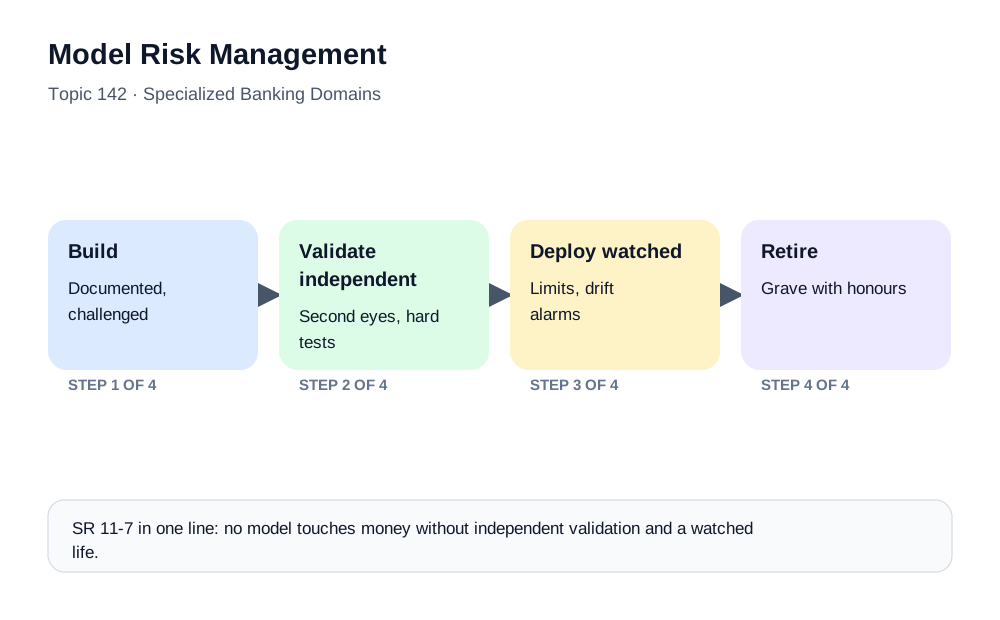
Model Risk Management at a glance — Model validation, model governance, SR 26-2.
Validating, Monitoring, and Governing Models Used in Banking Decisions
Banks use models everywhere. A credit model estimates whether a borrower will default. A fraud model scores a card or instant-payment transaction. A market-risk model estimates trading losses. A liquidity model forecasts cash needs. A pricing model values a derivative. A stress-testing model estimates what happens if unemployment rises, rates move, currencies fall, or markets freeze. Increasingly, AI and machine learning models also support document processing, customer service, compliance review, underwriting, and operations.
Models help banks make faster and more consistent decisions, but they also create risk. If a model is wrong, poorly built, badly used, biased, stale, or misunderstood, the bank can approve bad loans, reject good customers, misprice products, understate capital, miss fraud, overstate liquidity, or mislead management and regulators.
Model risk management is the discipline that controls this risk. It makes sure models are fit for purpose, independently validated, properly approved, monitored during use, reviewed over time, and retired when they are no longer reliable.
Learning objectives
By the end of this chapter, you should be able to:
- Explain what model risk means in banking.
- Identify common banking models in credit, market risk, liquidity, fraud, AML, pricing, capital, and AI use cases.
- Understand the model lifecycle from development to retirement.
- Explain independent validation, conceptual soundness, data quality, calibration, back-testing, and benchmarking.
- Distinguish model development, model validation, model ownership, and model use.
- Understand model governance, model inventory, tiering, approvals, and issue management.
- Explain why AI and machine learning create additional model-risk challenges.
- Discuss how model failures can affect customers, capital, compliance, and financial stability.
1. What Is a Model?
A model is a simplified representation of reality used to make an estimate, prediction, classification, valuation, or decision.
In banking, a model may:
- estimate probability of default;
- predict loss given default;
- calculate expected credit loss;
- value a derivative;
- estimate market risk;
- forecast liquidity outflows;
- score fraud risk;
- detect suspicious transactions;
- classify customers by risk;
- forecast deposit behavior;
- calculate capital requirements;
- generate stress-test outcomes;
- rank collection priorities;
- recommend next best product;
- process documents using AI.
A spreadsheet with formulas can be a model. A statistical regression can be a model. A machine learning algorithm can be a model. A vendor tool can contain models. The label does not depend only on sophistication; it depends on whether the tool materially estimates or drives decisions.
2. What Model Risk Means
Model risk is the possibility that a model causes loss, harm, wrong decisions, regulatory breach, or reputational damage because it is incorrect or misused.
Model risk can arise from:
- wrong assumptions;
- poor methodology;
- bad data;
- biased training data;
- coding error;
- weak documentation;
- use outside intended purpose;
- model drift;
- missing human oversight;
- poor interpretation of output;
- weak implementation;
- lack of monitoring;
- overreliance on model results.
A model can be mathematically elegant and still wrong for the business context. A model can perform well in testing and fail later when customer behavior, market conditions, fraud patterns, or regulation changes.
3. Examples of Banking Models
| Model Type | Example Use | Main Risk if Wrong |
|---|---|---|
| Credit scoring | Approve or reject loan applicants | Bad loans or unfair rejection |
| PD/LGD/EAD models | Estimate expected credit loss and capital | Understated provisions or capital |
| Market risk models | VaR, sensitivities, stress losses | Trading risk understated |
| Liquidity models | Forecast cash outflows and funding stress | Liquidity gap missed |
| Fraud models | Score transactions in real time | Fraud losses or customer friction |
| AML models | Detect suspicious activity patterns | Missed financial crime or alert overload |
| Pricing models | Value loans, derivatives, and securities | Mispricing and valuation losses |
| Stress-testing models | Simulate adverse scenarios | Weak capital and recovery planning |
| Customer analytics | Segmentation and propensity | Mis-selling or poor targeting |
| AI/LLM tools | Summarization, classification, decision support | Hallucination, bias, confidentiality, wrong advice |
The more material the model's impact, the stronger the governance should be.
4. The Model Lifecycle
A model should have a controlled lifecycle.
Step 1: Business Need
The model owner defines the decision or process the model will support. A model without a clear use case becomes difficult to validate.
Step 2: Development
Developers select methodology, data, variables, assumptions, training approach, limitations, and performance measures.
Step 3: Documentation
The model is documented: purpose, data sources, methodology, assumptions, limitations, users, outputs, controls, and intended use.
Step 4: Independent Validation
A validation team independent of development reviews whether the model is conceptually sound, technically correct, data-supported, and fit for use.
Step 5: Approval
A model committee or authorized governance forum approves use, rejects use, or approves with conditions and remediation actions.
Step 6: Implementation
The model is deployed into production systems, reporting tools, decision engines, or business processes with controls around access, versioning, and change.
Step 7: Ongoing Monitoring
Performance is monitored through back-testing, drift checks, exception analysis, stability, overrides, user feedback, and outcome tracking.
Step 8: Periodic Review or Revalidation
The model is reviewed at defined frequency or when material changes occur.
Step 9: Change or Retirement
If the model is no longer reliable, it is recalibrated, redeveloped, replaced, restricted, or retired.
5. Independent Model Validation
Validation is the critical challenge function. It should not simply confirm what developers already believe.
Validation asks:
- Is the model's purpose clear?
- Is the methodology appropriate?
- Are assumptions reasonable?
- Is the data accurate, complete, and representative?
- Are variables stable and explainable?
- Does the model perform on out-of-sample data?
- Is calibration acceptable?
- Are limitations documented?
- Are outputs understandable to users?
- Are controls sufficient for production use?
- Is the model being used only for approved purposes?
Validation may include conceptual review, code review, data testing, performance testing, benchmarking, sensitivity analysis, stress testing, bias testing, and implementation testing.
6. Key Validation Concepts
Conceptual soundness asks whether the model makes sense theoretically and economically.
Data quality checks whether inputs are accurate, complete, timely, representative, and controlled.
Calibration checks whether predicted probabilities or outputs align with observed outcomes. If a model predicts 5% default, do roughly 5% of similar borrowers actually default?
Back-testing compares model predictions against actual results after the fact.
Benchmarking compares the model against alternative models, simple rules, vendor models, or industry references.
Sensitivity analysis checks how outputs change when inputs or assumptions change.
Stability testing checks whether model performance remains reliable across time, segments, and economic conditions.
Override analysis reviews when humans override model decisions and whether those overrides improve or worsen outcomes.
7. Model Inventory and Tiering
A bank should maintain a model inventory: a controlled register of models used across the institution.
A good inventory includes:
- model name;
- owner;
- business use;
- methodology;
- system location;
- version;
- data sources;
- materiality;
- risk tier;
- approval status;
- validation date;
- limitations;
- open issues;
- next review date;
- retirement status.
Model tiering classifies models by risk and impact. A model used for regulatory capital or loan approval should receive more scrutiny than a small internal reporting model. Tiering helps allocate validation effort where it matters most.
8. Model Governance
Model governance defines who is accountable.
Common roles include:
- model owner - accountable for business use and performance;
- model developer - builds or configures the model;
- model validator - independently challenges the model;
- model user - applies model output in decisions;
- model risk management team - sets policy and oversight;
- model committee - approves material models and issues;
- internal audit - reviews the effectiveness of governance.
This often aligns with the three lines of defence: business owns and uses models, risk independently challenges, audit reviews the framework.
9. AI and Machine Learning Model Risk
AI and machine learning create additional challenges.
These include:
- explainability limitations;
- training-data bias;
- feature leakage;
- model drift;
- overfitting;
- adversarial manipulation;
- lack of transparency in vendor models;
- privacy and confidentiality risk;
- hallucination in generative AI;
- unfair outcomes across customer groups;
- difficulty reproducing outputs;
- unclear human accountability.
AI models used in banking should still follow model-risk principles: clear purpose, approved data, validation, testing, monitoring, controls, human oversight, issue management, and audit trail.
An AI tool that summarizes documents may not carry the same risk as an AI model approving loans, but both still need appropriate governance.
10. Model Misuse
A model can be valid for one purpose and dangerous for another.
Examples:
- a fraud model used to make credit decisions;
- a marketing propensity score used as affordability evidence;
- a stress-test model used for daily liquidity forecasting;
- a model trained on one country applied to another country without validation;
- a retail customer model used for SME customers;
- an AI summarizer used as final legal advice.
Model use must stay within approved scope. When business teams want to use a model differently, they should trigger model-risk review.
11. Practical Example: Credit Scorecard
A bank develops a credit scorecard for unsecured personal loans.
The model uses income, repayment history, credit bureau data, employment stability, existing debt, account behavior, and prior delinquency. It predicts probability of default over twelve months.
Validation checks:
- Is the target variable correctly defined?
- Is the training sample representative?
- Are excluded customers creating bias?
- Are variables stable and legally permitted?
- Does the model rank risk well?
- Is calibration acceptable?
- Does performance hold across segments?
- Are protected groups treated fairly?
- Are overrides controlled?
- Are cut-offs approved by credit policy?
- Is monitoring defined after deployment?
This shows that model risk is not only mathematics. It is policy, fairness, data, business use, and governance.
12. Common Misconceptions
"Model risk is only for quants." No. Business owners, product teams, risk, compliance, operations, technology, and audit all depend on model outputs.
"A model is valid because it is accurate." Accuracy is only one measure. Stability, fairness, calibration, explainability, data quality, implementation, and use are also important.
"AI models cannot be governed like traditional models." They may need additional controls, but the core principles still apply: purpose, validation, monitoring, limits, accountability, and evidence.
"Vendor models do not need validation." They do. The bank remains responsible for how the model is used and must understand performance, limitations, and controls.
"Once validated, a model is safe forever." No. Models degrade as data, markets, customers, fraud patterns, and regulation change.
13. Frequently Asked Questions
What is model risk management? It is the governance framework used to identify, validate, approve, monitor, and control risks created by models.
What is independent validation? It is review by a team separate from model development to challenge methodology, data, assumptions, performance, limitations, and use.
What is model drift? Model drift occurs when model performance changes because real-world data or behavior changes after deployment.
What is back-testing? Back-testing compares model predictions with actual outcomes to see whether the model performed as expected.
What is model inventory? A model inventory is a controlled register of models, owners, uses, versions, risk tiers, validations, and open issues.
Why is explainability important? Because customers, regulators, users, and validators may need to understand why a model produced a decision, especially in high-impact areas such as lending or fraud.
14. Key Terms in This Chapter
- Model - tool that estimates, predicts, classifies, values, or supports decisions.
- Model risk - risk of loss or harm from incorrect or misused model output.
- Model owner - accountable business owner of model use.
- Model validation - independent review of model quality and fitness.
- Conceptual soundness - whether methodology and assumptions make sense.
- Calibration - alignment between predicted and observed outcomes.
- Back-testing - comparing predictions with actual results.
- Benchmarking - comparing model performance with alternatives.
- Model drift - performance deterioration due to changing conditions.
- Model inventory - register of models and governance information.
- Model tiering - risk classification of models by materiality.
- Override - human decision to change model-recommended outcome.
- Explainability - ability to understand model drivers and decisions.
- Overfitting - model fits training data too closely and performs poorly on new data.
15. Interview Insights
"What is model risk?" Model risk is the risk that a model causes wrong decisions, losses, customer harm, regulatory breach, or reputational damage because it is flawed or misused.
"How would you validate a credit model?" Review purpose, data quality, methodology, assumptions, discriminatory power, calibration, back-testing, stability, fairness, implementation, limitations, and monitoring.
"Why is independent validation important?" Because developers may miss weaknesses in their own model. Independent challenge protects the bank from overconfidence and unsupported use.
"How is AI model risk different?" AI can add explainability, bias, drift, reproducibility, data privacy, hallucination, and vendor-transparency challenges, especially when outputs affect customers.
"What should be in a model inventory?" Model owner, purpose, version, methodology, data, system location, risk tier, approval status, validation date, limitations, issues, and review date.
Summary and Key Takeaways
Model risk management ensures that models used in banking are fit for purpose, validated, governed, monitored, and controlled.
The main lessons are:
- Models are everywhere in banking. Credit, fraud, liquidity, pricing, AML, capital, stress testing, and AI all use models.
- Wrong models create real harm. Customers, capital, liquidity, compliance, and financial stability can all be affected.
- Validation is independent challenge. It tests data, methodology, assumptions, performance, implementation, and use.
- Governance creates accountability. Owners, validators, committees, inventory, tiering, and issue tracking matter.
- Models must be monitored after deployment. Drift, overrides, outcomes, complaints, and performance changes must be reviewed.
- AI does not remove model-risk discipline. It increases the need for explainability, fairness, privacy, and human oversight.
- Use matters as much as build. A good model used for the wrong purpose can become a bad control.
A bank that manages model risk well does not blindly trust mathematics. It uses models with evidence, limits, review, and accountability.
Next: Topic 143 - Bank Resolution and Recovery Planning
<!-- MBA-DEEP-DIVE-START -->Model Risk Management Deepening — Inventory, Validation, Change Control, AI, and Decision Accountability
Model risk begins when a model influences a real decision
A model becomes operationally important when somebody relies on its output to price, approve, reject, reserve, allocate capital, investigate, hedge, forecast, or communicate. The risk is therefore not confined to equations. It sits in the complete decision chain: the data that enters the model, the assumptions embedded in it, the code that implements it, the system that delivers the output, the policy that interprets the score, the employee or automated process that acts on it, and the monitoring that later tests whether the result remained reasonable. A strong model-risk framework governs that chain rather than treating validation as a one-time statistical review.
A bank needs a clear definition of what counts as a model
Without a practical model definition, inventories become inconsistent. One team registers a complex machine-learning engine while another omits a spreadsheet that materially determines pricing. A useful definition generally focuses on quantitative or computational methods that transform inputs using assumptions, statistical relationships, mathematical techniques, rules, or algorithms to produce estimates, classifications, forecasts, valuations, or decision support. Banks often maintain additional categories for non-model tools, calculators, expert rules, vendor services, and end-user computing so material risk is not lost merely because an artefact falls outside the strict model definition.
Model inventory is the foundation of governance
The bank cannot control models it does not know it has. A robust inventory records model identifier, owner, developer, user population, business purpose, materiality, risk tier, methodology, data sources, system implementation, version, approval state, validation history, limitations, dependencies, change history, monitoring metrics, open findings, compensating controls, and retirement status. Inventory quality should itself be tested. Duplicate entries, missing owners, obsolete versions, and unregistered local models are signs that governance exists on paper but not in practice.
Materiality determines the depth of challenge
Not every model deserves identical governance effort. A regulatory capital model, loan underwriting score, derivative valuation model, liquidity stress model, or real-time fraud model can have far greater impact than a low-value internal forecasting tool. Tiering can consider financial exposure, customer impact, regulatory use, decision automation, complexity, opacity, frequency of use, data sensitivity, and systemic importance. Higher-risk models normally need stronger independent validation, more senior approval, tighter change control, more frequent monitoring, and clearer contingency arrangements.
Model ownership should sit with the business that relies on the output
Developers understand methodology, but the business owner understands the decision being made. Ownership should include responsibility for approved use, performance, limitations, monitoring, user training, issue remediation, and the decision to continue, restrict, or retire the model. A model with no accountable business owner can remain in production long after its original assumptions have stopped being credible. Governance committees should therefore challenge ownership as firmly as technical accuracy.
Development documentation should allow an informed outsider to reconstruct the logic
Good documentation explains the problem being solved, target population, modelling approach, data lineage, exclusions, variable treatment, assumptions, training and validation periods, performance metrics, segmentation, thresholds, known limitations, implementation requirements, and intended use. For deterministic valuation or finance models, equations and parameter sources matter. For statistical and machine-learning models, training design, feature engineering, sampling, leakage controls, tuning, and out-of-sample testing matter. Documentation that says only “the model performs well” is not evidence.
Conceptual soundness asks whether the model makes economic and business sense
A model can show attractive statistical performance while relying on relationships that are unstable, spurious, prohibited, or inconsistent with the intended decision. Validation should therefore ask why variables belong, why the mathematical form is suitable, whether assumptions match the product and population, how outputs should behave under plausible scenarios, and what circumstances invalidate the approach. Conceptual challenge is especially important when historical data contains unusual periods that may not represent the environment in which the model will be used.
Data validation is separate from model validation but inseparable from model quality
A sophisticated algorithm cannot repair missing, stale, mislabelled, biased, or incorrectly joined data. Validation should trace key data from authoritative sources through extraction, transformation, feature creation, model execution, and reporting. It should test completeness, accuracy, timeliness, representativeness, reconciliation, outliers, missing-value treatment, and population shifts. For externally sourced or vendor data, the bank should understand provenance and usage rights rather than assuming purchased data is automatically reliable.
Target leakage can make a model look excellent and fail in production
Leakage occurs when training data contains information that would not truly be available at the time of decision or indirectly reveals the outcome being predicted. A credit model might accidentally use a field updated only after delinquency. A fraud model might use an investigation outcome generated after the transaction. Performance metrics then become unrealistically strong. Validation should reconstruct the exact decision timestamp and verify that every input could genuinely have existed at that point.
Sampling decisions can create hidden blind spots
Models are often developed on a subset of historical data. Excluding declined customers, closed accounts, fraud-confirmed cases, thin-file borrowers, new products, or unusual regions can distort the development population. Validation should understand why observations were included or excluded and whether the resulting sample represents future use. Reject inference, selection bias, class imbalance, survivorship bias, and data availability can all matter depending on the model type.
Performance needs several measures, not one headline accuracy number
Classification models can be assessed using discrimination, calibration, precision, recall, false-positive rates, false-negative rates, stability, and business outcomes. Forecasting models need error measures and scenario behaviour. Valuation models need benchmark comparison, sensitivities, and independent price verification. A fraud model with high overall accuracy can still be useless when fraudulent transactions are rare. Metrics should therefore reflect the economic consequence of different errors rather than the easiest statistic to publish.
Calibration and ranking answer different questions
A credit model may rank borrowers correctly from lower to higher risk yet systematically underestimate the actual probability of default. Conversely, probabilities may be broadly calibrated while rank ordering is weak. Validation should separate these properties. Business decisions such as pricing, provisioning, capital, and limit setting can depend on absolute probability, while underwriting prioritisation may depend heavily on ranking. Using one performance measure as a universal quality test can conceal important weaknesses.
Back-testing should reproduce the decision logic that was actually used
Comparing predicted outcomes with realised outcomes is useful only when the test uses the correct model version, population, policy thresholds, overrides, and observation horizon. If production data was transformed differently from development data, a theoretical back-test can miss implementation risk. Mature monitoring therefore compares both model output and downstream decision performance, including whether manual overrides improved or worsened results.
Benchmarking provides challenge without requiring an identical alternative model
A validator can compare output with a simpler model, historical method, market standard, external vendor benchmark, challenger algorithm, independent valuation, or expert expectation. The purpose is not always to prove one model is universally superior. Benchmarking helps identify unexplained differences, excessive complexity, unstable segments, and circumstances where a simpler approach performs similarly. Complexity should earn its place through measurable benefit.
Sensitivity analysis reveals whether small input changes create unreasonable outcomes
A model should respond to changes in economically meaningful variables in ways that can be explained. If a tiny input movement creates a huge pricing jump, or worsening borrower leverage unexpectedly lowers predicted risk, the validator should investigate. Nonlinear models can legitimately produce complex responses, but critical discontinuities and edge cases need understanding. Sensitivity testing is particularly valuable where data is sparse or the model will operate near policy cut-offs.
Stress testing examines behaviour outside normal observations
Historical performance is not enough when the bank needs a model during crisis conditions. Liquidity, credit, market, and capital models should be challenged under severe but plausible scenarios. Fraud models should consider new attack patterns and abrupt channel shifts. AI systems should be tested with adversarial, ambiguous, or unsupported prompts where appropriate. Stress testing should identify where output becomes unreliable and what fallback process applies when the model leaves its safe operating range.
Implementation validation proves the approved model is the model that runs
A common failure is a correct development model implemented incorrectly. Variables may be mapped to the wrong fields, rounding can differ, default values can be wrong, code versions can diverge, or production data may use different timing. Validation should compare independent test cases from source input to final output, inspect code or configuration where appropriate, and verify version control. A model should not be approved only at notebook level if the business decision occurs in a production engine.
Model change control should distinguish recalibration, redevelopment, and technical change
Changing a threshold, parameter, data source, feature, algorithm, segmentation rule, or implementation can have different risk implications. Governance should define which changes require full revalidation, targeted validation, notification, or standard software testing. Teams should not avoid model governance by describing a material methodology change as “configuration.” Conversely, minor technical fixes should not be forced through an unnecessarily heavy process if risk has not materially changed.
Emergency changes need stronger evidence afterward, not weaker governance forever
During a crisis, fraud attack, market disruption, or regulatory deadline, a bank may need to change a model quickly. An emergency path can permit accelerated approval with documented rationale, temporary controls, and restricted scope. It should also require post-implementation review and a deadline for full validation. Emergency governance is a controlled exception, not a permanent bypass.
Model limitations should change how the model is used
A limitation is useful only if it drives a control. If a model performs poorly for new-to-bank customers, the bank can apply additional review or a different model. If a pricing model is unreliable for illiquid instruments, valuation reserves or independent pricing can be required. If an AI tool cannot reliably cite source evidence, it should not be used as an autonomous policy decision maker. A list of limitations with no operational consequence is documentation theatre.
Overrides are a source of both control and risk
Human override can correct a model that lacks relevant context, but uncontrolled overrides can undermine consistency and fairness. The bank should define who may override, permitted reasons, approval thresholds, evidence requirements, and monitoring. Override outcomes should be analysed. If experienced underwriters consistently improve results in a particular segment, the model may be missing information. If overrides systematically worsen outcomes, policy enforcement may need strengthening.
A model can be statistically sound and still create unfair customer outcomes
Fairness should be assessed in the context of applicable law, product design, and legitimate risk factors. Bias can enter through historical decisions, proxy variables, sampling, missing data, label construction, and feedback loops. High-impact customer models therefore need appropriate fairness testing, documentation of justified differences, review of adverse outcomes, and escalation of unexplained disparities. Mathematical neutrality is not guaranteed simply because protected characteristics were removed from the input.
Explainability should be matched to the audience and decision
A validator may need technical explanation of feature importance and model structure. A credit officer may need the main drivers of a score. A customer may need a clear reason for an adverse decision where law or policy requires it. Senior management needs to understand material limitations and risk, not every coefficient. Explainability is therefore not one output. The bank should define what each user needs to understand in order to act responsibly.
Vendor models remain the bank's responsibility when the bank relies on them
A vendor can protect proprietary intellectual property, but the bank still needs enough evidence to understand purpose, data requirements, performance, limitations, security, change process, and suitability. Contract terms should support audit, incident notification, version control, and access to required information. If the vendor cannot provide enough transparency for a high-impact use, the bank should reconsider the use or add independent controls rather than declaring the model outside its governance scope.
Third-party data can create model risk even when the algorithm is internal
Credit bureau data, geospatial data, market data, device intelligence, sanctions data, and external behavioural signals can change definitions or coverage. If a vendor modifies a field without adequate notice, model performance can shift. Data contracts and monitoring should therefore include schema, quality, timeliness, lineage, and change notification. Model monitoring should detect input distribution changes even when the model code has not changed.
Model drift is broader than declining accuracy
Population drift means the input population changes. Concept drift means the relationship between inputs and outcomes changes. Data drift can result from source-system changes. Policy drift can occur when the bank changes eligibility or pricing around the model. Fraud models face adversarial drift because criminals deliberately adapt. Monitoring should identify which type of change is occurring so the response is appropriate; retraining is not automatically the answer to every deterioration.
Monitoring thresholds should trigger defined actions
Dashboards are not controls unless someone owns the response. Metrics can include discrimination, calibration, prediction error, stability indexes, input distributions, override rate, approval rate, loss rate, fraud capture, false positives, complaints, fairness indicators, missing data, latency, and system errors. Threshold breaches should define investigation, escalation, restriction, recalibration, or temporary fallback. Repeated amber warnings should not remain open indefinitely because nobody defined decision rights.
Champion-challenger approaches can reduce dependence on one model
A challenger can be a simpler method, alternate model, vendor tool, or retrained candidate run in parallel. It provides evidence about whether the champion still adds value. For real-time decision systems, a challenger can operate in shadow mode without affecting customers while its outputs are compared. The bank should avoid deploying a challenger merely to satisfy policy; its design should answer a meaningful model-risk question.
Model risk and software risk overlap but are not identical
A software defect can implement a correct model incorrectly. A model can be methodologically wrong even when the software works perfectly. Testing therefore needs both disciplines. Software teams test code, interfaces, security, availability, and deployment. Model-risk teams challenge methodology, data, performance, limitations, and use. Implementation validation connects them. Assigning all responsibility to either technology or validation leaves a gap.
Model risk and data governance should share lineage
When a key feature is questioned, the bank should trace it back to its source and understand transformations. Data owners should know which material models consume a field so a schema or definition change triggers impact assessment. Model owners should know the quality controls on critical inputs. This two-way dependency mapping becomes especially important when enterprise data platforms feed hundreds of models.
Model risk can affect accounting and regulatory reporting
Expected credit loss, fair-value estimates, capital calculations, stress testing, and liquidity projections can all rely on models. A weakness can therefore alter financial statements or regulatory submissions, not only customer decisions. Finance and regulatory-reporting controls should understand which model versions generated material numbers, what overlays were applied, and how management judgement was documented. Reproducibility at reporting date is essential.
Management overlays require governance because they are model adjustments
When unprecedented conditions make a model unreliable, management may apply an overlay or adjustment. This can be appropriate, but the rationale, methodology, evidence, approval, duration, and monitoring should be documented. An overlay should not become an unexplained plug that persists year after year. If the adjustment remains necessary, the underlying model may need redevelopment.
Model aggregation can create risk not visible in individual models
A stress-testing framework may combine macroeconomic scenarios, credit models, revenue models, balance-sheet assumptions, and capital calculations. Each component can pass validation while the integrated result remains weak because dependencies, correlations, timing, or feedback effects are inconsistent. Enterprise model-risk assessment should therefore examine model chains and shared assumptions, not only isolated inventory entries.
Dependency mapping matters when one upstream model fails
A customer-risk rating can feed pricing, limits, monitoring, capital, and collections. If that rating model is unavailable or found defective, multiple downstream processes are affected. The inventory should identify these dependencies and define fallback processes. Business-continuity planning for models is therefore about more than keeping a server available; it includes what decision method the bank will use when the model itself cannot be trusted.
Retirement is a controlled lifecycle stage
A model should not simply disappear from a system. Retirement should confirm that no active process still calls it, historical decisions remain reproducible, required records are retained, replacement logic is approved, and reports or interfaces no longer depend on the old version. Data retention and audit requirements can outlive production use. Uncontrolled retirement can make past regulatory or customer decisions impossible to explain.
Generative AI introduces output variability and grounding risk
Large language models can produce different wording for similar prompts and can generate plausible statements unsupported by source evidence. For banking use, teams should distinguish deterministic controls from probabilistic assistance. Retrieval grounding, constrained prompts, citation checks, human review, red-team testing, prohibited-use rules, data-loss controls, and output monitoring can reduce risk. A generative model should not be assumed reliable merely because answers sound fluent.
Prompt, retrieval, orchestration, and tool use can all change the effective AI model
In an AI application, behaviour may depend on the foundation model, system prompt, retrieved documents, embedding model, tool permissions, temperature, safety filters, agent logic, and post-processing. Changing one layer can materially alter outcomes even if the base model version stays the same. Governance should therefore define the governed artefact at the application level rather than validating only the underlying vendor model.
AI evaluation should reflect the actual banking task
Generic benchmark scores do not prove suitability for sanctions review, policy summarisation, customer communication, coding, or credit analysis. Evaluation sets should reflect real task distributions, difficult edge cases, sensitive data, prohibited content, factuality requirements, and expected failure modes. High-impact applications need clear acceptance criteria and evidence that the chosen model plus controls meet the business requirement.
Human-in-the-loop design needs defined responsibility
Simply placing a human after a model does not guarantee control. The reviewer needs enough time, authority, information, and training to challenge the output. If employees approve thousands of alerts mechanically, human review is nominal. Governance should define what evidence the reviewer sees, what decisions can be changed, when escalation is mandatory, and how reviewer effectiveness is monitored.
Automation bias can make a technically optional recommendation functionally mandatory
Employees may learn to trust a score or AI recommendation because the system rarely appears wrong or because challenging it is inconvenient. Over time, the model can dominate decisions even when policy says it is advisory. Monitoring override rates, user behaviour, complaints, and incident investigations can reveal this drift. Interface design should not present uncertain model output as unquestionable fact.
Model-risk findings need severity, ownership, and closure evidence
Validation often identifies limitations and remediation actions. Each issue should have severity, owner, due date, interim control, impact assessment, and closure criteria. High-severity findings may require use restriction or senior risk acceptance. Extending due dates repeatedly without new evidence weakens the framework. Closure should be independently verified where material rather than accepted solely on the model owner's statement.
Risk acceptance should be explicit and time-bounded
Sometimes a bank knowingly uses a model with a limitation because replacement would cause greater disruption or because an interim control is effective. That can be a legitimate risk decision if the responsible authority understands impact and alternatives. The acceptance should specify scope, compensating controls, expiry, and remediation. Permanent informal acceptance is not governance.
Internal audit tests the framework rather than re-performing every validation
Audit can examine whether the inventory is complete, tiering is applied consistently, independence is real, validators have sufficient skills, findings are remediated, monitoring works, changes are controlled, and senior committees receive truthful information. Audit may sample individual models, but its broader role is to assess whether the model-risk management system itself is effective.
Senior management needs a portfolio view of model risk
A committee should see more than a list of validation dates. Useful reporting includes inventory growth, high-risk models, overdue validations, material findings, temporary approvals, performance deterioration, vendor concentration, AI use cases, unregistered models discovered, and recurring root causes. The goal is to identify systemic weaknesses such as poor data quality or insufficient validation capacity before they create losses across many models.
Scenario: a credit model remains accurate overall but fails for a growing segment
Suppose a personal-loan model performs well across the full portfolio, but new-to-bank digital customers have doubled in volume and show materially worse calibration. Aggregate performance can hide the issue. Segment monitoring identifies the deterioration, the bank tightens approval or adds manual review for that population, investigates data and behavioural differences, and develops a revised model. This is model-risk management working before losses become portfolio-wide.
Scenario: a fraud model's false positives rise after a channel change
A bank launches a new mobile-payment flow. Transaction patterns change, and the existing fraud model blocks many legitimate payments. Fraud losses remain low, so a narrow “fraud caught” metric looks successful. Customer complaints and false-positive rates reveal the real problem. The bank recalibrates features, tests a challenger, and monitors both fraud capture and customer friction. Model performance must reflect the full business objective.
Scenario: a vendor updates an AI model without a bank code release
The bank's application code is unchanged, but the external model provider introduces a new version and output behaviour changes. Summaries become more concise but omit required risk statements in some cases. Vendor-version monitoring and regression evaluation detect the difference. The bank temporarily pins the approved version or adds controls while the new version is validated. Third-party change is still model change when the bank depends on it.
Requirements for a model-governance platform should preserve evidence
A business analyst should capture model registration, ownership, tiering, version history, validation workflow, approvals, findings, risk acceptance, monitoring metrics, evidence attachments, dependencies, usage locations, and retirement. Permissions should separate developers, validators, approvers, and administrators appropriately. Audit history should show who changed what and when. Reports should reconstruct the status of a model at a historical date, not only its current state.
Testing model governance systems requires workflow and permission scenarios
Tests should include unapproved model deployment, expired validation, owner change, material version update, high-severity finding, rejected validation, temporary approval, duplicate model registration, validator conflict of interest, overdue remediation, retirement with active dependencies, and unauthorised modification of evidence. The platform is a control system; successful page rendering is not enough.
SR 11-7 is an influential model-risk reference, but local requirements still govern
The Federal Reserve and OCC's 2011 supervisory guidance describes core concepts such as robust model development and implementation, effective validation, and sound governance, policies, and controls. Its influence extends beyond the institutions directly subject to it because the principles are widely recognised. A global bank should nevertheless apply the rules, guidance, and supervisory expectations relevant to each legal entity and use case rather than presenting one U.S. document as a universal law.
Primary-source verification should be built into model-risk practice
For regulatory models, teams should maintain current references to the applicable prudential standard, accounting rule, consumer-protection requirement, or supervisory guidance. For vendor AI, they should track model documentation and material version changes. For internal policies, they should record the approved version that governed the decision. Model governance is stronger when evidence can be traced to authoritative sources instead of relying on inherited assumptions.
Closing perspective
A mature bank does not ask only whether a model is clever or accurate. It asks whether the model is known, owned, fit for purpose, independently challenged, correctly implemented, used within limits, monitored against real outcomes, explainable to the necessary audience, resilient when conditions change, and removable when it stops being trustworthy. Model risk management turns quantitative power into controlled banking practice. That discipline becomes more important, not less, as models move from back-office analytics into automated customer and financial decisions.
Model Operations — Production Evidence, Fallback, Deployment, and Incident Control
A production model should leave a decision record
For each material decision, the bank should be able to reconstruct model identifier, version, input snapshot or key features, output, policy threshold, overrides, timestamp, and final business action. The record need not expose proprietary detail to every user, but internal teams must be able to reproduce what influenced the decision. This becomes essential when a customer complains, a regulator asks for evidence, or a model defect is discovered after thousands of decisions were made.
Model service availability is a business-control dependency
A scoring model delivered through an API can fail even when the methodology is sound. The business therefore needs a defined fallback: hold the transaction, use a validated simpler model, route to manual review, or restrict activity depending on risk. “Model unavailable” should not silently become “approve everything” or “reject everything.” Fallback behaviour should be tested and included in operational-resilience exercises.
Feature freshness should be governed
Real-time models often consume features from stores or streaming pipelines. A value can be present but stale, which is more dangerous than a clean missing-data error because the model continues to score with false confidence. Critical features should carry observation time or freshness rules, and the model service should know when a value is too old for the intended decision. Monitoring should separate stale, missing, defaulted, and valid inputs.
Shadow deployment reduces change risk
A new model can run beside the current production model without influencing customers. Teams can compare scores, decisions, latency, segment behaviour, and operational effects on current traffic. Shadow evidence is especially useful when historical back-testing cannot capture recent behaviour. Promotion to production should follow defined acceptance criteria rather than enthusiasm for a higher offline metric.
Rollback must restore the complete decision stack
Changing the model binary alone may not restore the prior behaviour if feature definitions, policy thresholds, or preprocessing changed at the same time. Release packages should identify the model, feature code, configuration, thresholds, and dependencies that form one approved decision stack. A rollback procedure should return all of those to a known good version and verify outputs on reference cases.
Model incidents need population scoping
If a defect is discovered, teams must identify which decisions used the affected model version and input condition. This requires versioned decision logs and transaction or customer references. Scope analysis determines whether accounts need review, prices need correction, regulatory numbers need restatement, or customers need remediation. Without traceability the bank may be forced to review a much wider population because it cannot identify the affected decisions precisely.
Model and application inventories should be linked
A model inventory can say a model is active without revealing which APIs, batch jobs, channels, reports, or business processes depend on it. Linking model records to application and service inventories improves change impact and resilience planning. When a model is retired or restricted, technology can identify every production consumer rather than relying on institutional memory.
Control testing should verify the safeguards around the model
Model validation tests the model, while operational control testing can verify that threshold approvals, manual-review routing, fallback, decision logging, access, monitoring, and override governance actually work in production. A strong model with broken surrounding controls can still create material risk. Periodic control evidence therefore complements statistical monitoring.
Model-service changes should be visible in incident management
A production incident can originate from the model, feature pipeline, serving infrastructure, configuration, or downstream decision policy. Incident records should identify which layer failed and whether customer or financial decisions were affected. Restoring the API without validating output quality is not enough if the service had been returning incorrect scores before the outage was detected.
Customer-impact mapping should be part of model governance
For material models, the bank should know which customer journeys can be delayed, declined, repriced, escalated, or otherwise changed by the output. This helps validation focus on consequential errors and helps incident teams prioritise remediation. A statistically small defect can be high impact if it systematically affects a vulnerable or important customer population.
Production monitoring should reconcile model and policy outcomes
A model can continue producing stable scores while a downstream threshold or decision rule changes approval rates dramatically. Monitoring should therefore compare input, score, policy decision, override, and realised outcome. This prevents the model team from declaring performance healthy while the overall automated decision process has drifted because configuration changed elsewhere.
Challenger evidence should include operations, not only statistics
A challenger can outperform the incumbent on predictive metrics yet create slower decisions, more manual referrals, unstable explanations, or expensive data dependencies. Promotion decisions should therefore include latency, availability, customer impact, operational capacity, and fallback readiness. Model governance is strongest when the selected model is both analytically sound and controllable in production.
Override trends can reveal model or policy weakness
Frequent human overrides deserve analysis by reason, direction, product, segment, and outcome. Repeated overrides may show that the model misses a legitimate pattern, that policy is unclear, or that staff are bypassing controls. Monitoring the interaction between automated output and human judgment helps the bank improve both.
Decommissioning is part of model risk management
A model remains a risk object until every production dependency, fallback path, report, feature feed, decision rule, monitoring job, and user procedure has been retired or migrated. Formal decommissioning should therefore confirm data retention, downstream replacement, access removal, evidence preservation, and ownership transfer rather than treating retirement as a simple switch-off.
<!-- MBA-DEEP-DIVE-END -->