How Banks Borrow, Lend, and Manage Short-Term Liquidity
Banks do not manage liquidity only with customer deposits. Every day, they also borrow from and lend to each other. Some banks finish the day with surplus cash. Others need funds to meet settlement obligations, reserve requirements, customer withdrawals, securities settlements, or intraday payment flows. The interbank market is the place where these short-term needs are balanced.
This market is one of the financial system's quiet engines. It keeps payment systems moving, supports treasury operations, transmits central bank policy rates, prices short-term money, and provides early warning when trust between banks weakens. If the interbank market freezes, even solvent banks can struggle to fund themselves, as the 2008 crisis showed.
This chapter explains interbank markets as a practical banking function. It covers call money, overnight funding, repo, secured and unsecured lending, central bank facilities, money-market benchmarks, liquidity management, settlement funding, and why interbank rates matter to the wider economy.
Learning objectives
By the end of this chapter, you should be able to:
- Explain why banks borrow and lend to each other.
- Distinguish unsecured interbank lending from secured repo funding.
- Understand overnight, term, call, notice, and intraday funding.
- Explain how central bank policy rates influence interbank rates.
- Describe the role of collateral, government securities, and central counterparties.
- Connect interbank funding to payment settlement, liquidity risk, and monetary policy transmission.
- Identify what can go wrong when interbank trust weakens.
- Explain major concepts such as repo, reverse repo, standing facilities, benchmarks, and liquidity corridors.
Visual overview
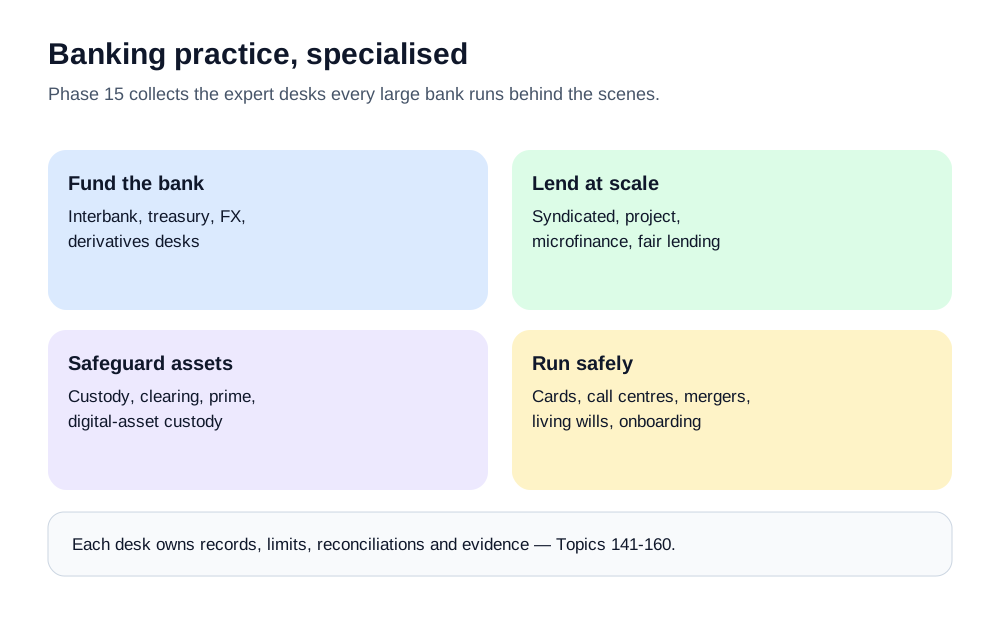
Phase 15 map: fund the bank, lend at scale, safeguard assets, run safely. Each desk owns its records and evidence.
1. What the Interbank Market Is
The interbank market is the market where banks and eligible financial institutions lend and borrow funds among themselves, usually for short maturities.
The maturity may be:
- intraday;
- overnight;
- two to fourteen days;
- one month;
- three months;
- or another short-term period depending on the market.
The funding may be unsecured, where the lender relies on the borrower's creditworthiness, or secured, where the borrower provides collateral such as government securities.
The interbank market is not one single product. It is a family of markets and facilities that help banks manage liquidity and funding.
2. Why Banks Need Interbank Funding
Banks need short-term funding for many reasons.
Payment settlement. A bank may face heavy outgoing RTGS, instant-payment, card, securities, or clearing settlement obligations before incoming funds arrive.
Reserve or liquidity requirements. Banks may need to maintain required balances or liquidity ratios.
Unexpected withdrawals. Large corporate or institutional deposit movements can change the liquidity position quickly.
Asset-liability mismatch. A bank may hold longer-term loans and securities while needing short-term cash today.
Treasury optimization. A bank with surplus funds may lend them overnight rather than leave money idle.
Market-making and trading activity. Banks active in securities, FX, and derivatives need short-term funding to support positions.
The market allows surplus liquidity and deficit liquidity to meet efficiently.
3. Unsecured Interbank Lending
Unsecured interbank lending means one bank lends to another without collateral. The lender depends on the borrower's ability and willingness to repay.
Common forms include:
- overnight money;
- call money;
- notice money;
- short-term deposits;
- interbank placements.
Because there is no collateral, unsecured rates reflect credit trust between banks. In calm markets, strong banks borrow cheaply. In stress, lenders become selective, rates rise, maturities shorten, and weaker banks may lose access.
This is why unsecured interbank markets are sensitive confidence indicators.
4. Secured Funding and Repo
Repo, or repurchase agreement, is secured short-term funding.
In a repo, one party sells securities and agrees to repurchase them later at a slightly higher price. Economically, it is a collateralized loan: the borrower receives cash and gives securities as collateral; the lender gives cash and receives securities as protection.
Repo is important because it reduces credit risk compared with unsecured lending. If the borrower fails, the lender can sell the collateral, subject to market and legal rules.
Repo markets commonly use high-quality collateral such as government securities. They are central to bank treasury, money-market funds, securities dealers, and central bank operations.
5. Central Bank Facilities
Central banks influence interbank markets through facilities and policy rates.
Typical facilities include:
- policy repo or refinancing operations;
- standing lending facility;
- standing deposit facility;
- marginal lending facility;
- discount window;
- intraday credit;
- open market operations;
- term funding operations during stress.
These facilities create reference points for market rates. If banks can borrow from the central bank at a defined rate, interbank rates normally do not rise far above that level for eligible institutions and collateral. If banks can deposit surplus funds at the central bank, market rates normally do not fall far below that level.
This creates a rate corridor: a floor, a ceiling, and a policy target or operating rate within the corridor.
6. Monetary Policy Transmission
Central banks use short-term rates to influence the wider economy.
The chain looks like this:
- Central bank changes policy rate or liquidity conditions.
- Interbank and money-market rates adjust.
- Bank funding costs change.
- Deposit and lending rates gradually adjust.
- Borrowing, saving, investment, and spending decisions change.
- Inflation and economic activity respond over time.
Transmission is not always perfect. Competition, deposit structure, fixed-rate loans, credit risk, regulation, and market stress can slow or weaken the pass-through. But the interbank market is still one of the first places where monetary policy becomes visible.
7. Benchmarks and Reference Rates
Interbank and money-market rates often become benchmarks for loans, deposits, derivatives, and valuation.
Examples across markets include overnight indexed rates, secured overnight financing rates, euro short-term rates, sterling overnight rates, and domestic money-market benchmarks. India has benchmarks such as MIBOR and market rates linked to TREPS and repo conditions.
Benchmarks matter because they price large volumes of financial contracts. After the LIBOR scandals and benchmark reforms, global markets moved toward more robust, transaction-based, nearly risk-free reference rates.
The lesson is simple: benchmark integrity matters. If the reference rate is weak or manipulated, every contract linked to it becomes suspect.
8. Collateral and Haircuts
Secured funding depends on collateral quality.
A lender asks:
- Is the collateral eligible?
- Is it liquid?
- How volatile is its price?
- Is legal title or pledge enforceable?
- What haircut should apply?
- Can it be valued daily?
- Can it be sold quickly if the borrower defaults?
A haircut reduces the value credited to collateral. If securities worth 100 are accepted with a 2% haircut, the borrower may receive only 98 in funding. Haircuts protect the lender against price movement and liquidation risk.
Collateral management is therefore a treasury, legal, risk, and operations discipline.
9. Interbank Markets and Payment Liquidity
Interbank funding connects directly to payment operations.
A bank may need funds because:
- high-value payment queues are building;
- an instant-payment settlement window creates a net debit;
- securities settlement requires cash;
- FX funding is needed in a nostro account;
- a large corporate outgoing payment arrives unexpectedly;
- central bank account balance is below internal threshold.
Treasury may borrow in the interbank market, use repo, draw intraday credit, move funds between accounts, or sell liquid assets. Payment operations may reprioritize queues or monitor cut-offs while treasury funds the position.
Liquidity is not abstract here. It determines whether payments release on time.
10. What Happens During Stress
Interbank markets depend on trust. When trust weakens, the market can change quickly.
Stress signs include:
- banks stop lending unsecured;
- maturities shorten;
- secured funding haircuts rise;
- weaker banks pay higher rates;
- market rates move away from policy targets;
- central bank facility usage rises;
- collateral eligibility becomes critical;
- payment queues and settlement pressure increase.
During the 2008 crisis, distrust between banks made interbank lending extremely difficult. Central banks had to provide extraordinary liquidity support. This showed that interbank markets are not only technical funding channels; they are confidence channels.
11. India Example: Call Money, Repo, and TREPS
India provides a useful practical example.
The call money market supports unsecured overnight borrowing and lending among eligible participants. Repo markets allow collateralized borrowing using securities. TREPS, operated through CCIL, supports tri-party repo where collateral management and settlement are handled through a central infrastructure. RBI policy operations, standing facilities, and liquidity tools influence overnight rates and broader money-market conditions.
The exact instruments and names differ by country, but the principles are global: unsecured trust-based funding, secured collateralized funding, central bank facilities, benchmark rates, and liquidity management.
12. Common Misconceptions
"Banks only lend customer deposits." No. Banks also fund themselves through wholesale markets, interbank borrowing, repo, central bank facilities, bonds, and other treasury tools.
"Repo is the same as selling securities permanently." No. Repo is a sale with an agreement to repurchase, economically used as secured funding.
"Interbank markets are only for treasury teams." Treasury owns the market activity, but payment operations, risk, finance, settlement, and regulators all depend on the outcome.
"Central bank policy rate directly changes every customer loan immediately." No. Policy first affects money-market rates and bank funding costs. Customer-rate transmission depends on product, competition, benchmark, regulation, and timing.
"Secured funding has no risk." Collateral reduces risk but does not remove market, legal, operational, liquidity, or wrong-way risk.
13. Frequently Asked Questions
What is the interbank market? It is the market where banks and eligible financial institutions borrow and lend short-term funds to manage liquidity and funding needs.
What is call money? Call money is usually unsecured overnight borrowing and lending between eligible institutions.
What is repo? Repo is collateralized funding where securities are sold with an agreement to repurchase later.
Why do banks borrow overnight? To meet settlement needs, reserve requirements, liquidity buffers, unexpected withdrawals, or treasury positioning.
What is a rate corridor? A corridor is the range created by central bank lending and deposit facilities, guiding overnight market rates.
Why did interbank markets matter in 2008? Because banks lost trust in each other and unsecured funding dried up, forcing central banks to provide emergency liquidity.
14. Key Terms in This Chapter
- Interbank market - market where banks lend and borrow among themselves.
- Call money - unsecured overnight interbank borrowing/lending.
- Notice money - short-term unsecured borrowing/lending beyond overnight, depending on local definition.
- Repo - repurchase agreement used as secured funding.
- Reverse repo - opposite side of repo, where cash is lent against securities.
- Collateral - asset pledged or transferred to secure borrowing.
- Haircut - reduction applied to collateral value.
- Standing facility - central bank facility for lending or depositing funds.
- Rate corridor - floor and ceiling guiding short-term market rates.
- Benchmark rate - reference rate used to price financial contracts.
- MIBOR/TREPS - India-specific money-market reference examples.
- Liquidity stress - condition where funding becomes scarce or expensive.
- Monetary policy transmission - pass-through from central bank rates to wider financial conditions.
15. Interview Insights
"Why do banks use interbank markets?" To manage short-term liquidity, settlement needs, reserve positions, treasury funding, and surplus cash deployment.
"What is the difference between call money and repo?" Call money is typically unsecured overnight lending. Repo is secured funding backed by securities collateral.
"How does central bank policy affect interbank rates?" Central bank facilities and policy rates shape the cost of short-term funds, creating a floor, ceiling, and target range for market rates.
"Why is collateral important in repo?" Collateral protects the lender if the borrower defaults. Its quality, liquidity, valuation, haircut, and legal enforceability determine the risk.
"What happens when interbank trust falls?" Unsecured lending shrinks, rates rise, maturities shorten, central bank facility usage rises, and liquidity stress can spread through payment and funding systems.
Summary and Key Takeaways
Interbank markets allow banks to manage short-term liquidity and funding. They are central to payment settlement, treasury management, and monetary policy transmission.
The main lessons are:
- Banks borrow and lend short-term funds daily. This supports settlement, liquidity, and treasury operations.
- Unsecured and secured markets differ. Call money depends on credit trust; repo depends on collateral.
- Central banks shape the market. Policy rates, standing facilities, and liquidity operations guide short-term rates.
- Collateral quality matters. Repo reduces risk only when collateral is eligible, liquid, valued, and enforceable.
- Interbank rates transmit policy. They influence bank funding costs and eventually customer rates.
- Stress shows up quickly. When banks stop trusting each other, liquidity markets tighten and central banks may need to intervene.
- Payments and funding are connected. A bank's ability to release payments depends on usable liquidity, not only accounting solvency.
The interbank market is therefore not a remote treasury topic. It is one of the mechanisms that keeps money movement, bank funding, and monetary policy connected.
Next: Topic 142 - Model Risk Management
<!-- MBA-DEEP-DIVE-START -->Interbank Markets and Funding Deepening — Treasury Decisions, Settlement Liquidity, Collateral, and Stress
The interbank market begins with a bank's cash position, not with a trading screen
A practical way to understand interbank funding is to start with the treasury cash ladder. A bank receives customer deposits, loan repayments, securities proceeds, FX receipts, card settlements, and incoming payments. At the same time it must fund customer withdrawals, outgoing transfers, securities purchases, derivative margin, tax payments, loan drawdowns, and settlement obligations. Those flows rarely arrive in a perfectly balanced sequence. Treasury therefore forecasts the bank's position by currency, legal entity, settlement account, value date, and time of day. The interbank market is one of the mechanisms used to close the resulting surplus or deficit while keeping regulatory, internal-risk, and operational limits intact.
Solvency and liquidity must not be confused
A bank can own assets worth more than its liabilities and still face a liquidity problem today. Loans may mature over years while payment obligations fall due within hours. A government bond can be valuable yet still require sale, repo, or central-bank eligibility before it becomes usable cash. Interbank funding therefore addresses timing and convertibility, not only the long-run balance-sheet position. This distinction matters in incidents: a bank that is economically sound can still miss a settlement deadline if usable liquidity is in the wrong currency, wrong account, wrong entity, or wrong form at the required moment.
Intraday liquidity is different from overnight funding
A treasury desk may finish the business day with a comfortable cash balance and still face severe intraday pressure. High-value payments can leave early while incoming flows arrive later. Securities settlement and central-counterparty margin calls can create concentrated time-specific demands. Intraday credit, collateral mobilisation, payment queuing, liquidity-saving mechanisms, internal transfers, and daylight overdraft arrangements can therefore matter as much as overnight borrowing. The operational question is not merely “Do we have enough cash by close?” but “Do we have sufficient usable liquidity at every critical settlement point?”
Payment operations and treasury are joined through the settlement account
Payment teams often focus on message validation, routing, sanctions, fraud, and scheme processing, while treasury focuses on funding. In reality both meet at the settlement account. A technically perfect payment cannot settle if the required cash or credit capacity is unavailable. Conversely, treasury may have adequate funding but still see liquidity trapped because payment queues, cut-offs, operational holds, or system failures prevent flows from moving. Mature banks therefore connect payment-queue monitoring, expected settlement obligations, nostro balances, central-bank money, and treasury funding decisions in near real time.
Interbank borrowing is one tool inside a broader funding stack
Banks do not choose interbank borrowing in isolation. Other sources can include retail and corporate deposits, secured repo, certificates of deposit, commercial paper where permitted, bond issuance, central-bank facilities, internal group funding, asset sales, committed lines, and retained liquidity buffers. Each source has a different tenor, cost, collateral requirement, market capacity, legal constraint, and reputational implication. Treasury decides which combination is sustainable rather than simply selecting the cheapest visible rate. A very cheap overnight source can become dangerous if the bank depends on rolling it every day.
Funding tenor should match the underlying risk horizon
Using overnight money to fund long-dated or illiquid assets creates refinancing risk. The bank must return to the market repeatedly, and a future shock may make funding expensive or unavailable. Longer-tenor funding is usually more stable but can cost more. Asset-liability management therefore examines maturity gaps, behavioural assumptions, contractual cash flows, stress outflows, and the concentration of maturities. Interbank funding can efficiently bridge short-term mismatches, but it should not conceal a structural funding weakness.
Unsecured interbank credit is fundamentally a counterparty decision
When Bank A lends cash to Bank B without collateral, Bank A takes credit exposure to Bank B. The price and limit should therefore reflect the borrower's creditworthiness, tenor, market conditions, legal entity, jurisdiction, and the lender's own risk appetite. Treasury cannot treat an unsecured placement merely as surplus-cash investment. Credit-risk approval, counterparty limits, wrong-way risk, concentration, settlement exposure, and documentation all matter. During stress, unsecured limits are often among the first to tighten because lenders have no specific collateral to realise if the borrower fails.
Counterparty limits are dynamic controls, not static annual numbers
A bank may have a formally approved interbank limit but still reduce usage when market information deteriorates. Credit spreads can widen, deposit outflows can become visible, a rating can change, regulatory action can be announced, or a country shock can affect several banks simultaneously. Treasury and counterparty-risk teams therefore need current utilisation, pending deals, settlement exposure, collateral positions, and group-wide aggregation. A limit that looks available in one system may already be consumed by derivatives, FX, securities financing, or another desk if aggregation is weak.
Secured funding changes the risk, but does not remove it
Repo reduces unsecured credit exposure by giving the cash lender collateral, yet it introduces its own control set. The collateral can fall in value, be difficult to liquidate, become ineligible, suffer wrong-way risk, or be operationally unavailable when needed. Legal enforceability of close-out and collateral rights matters. Settlement can fail. Margin calls can create new liquidity needs. A bank should therefore avoid the simplistic statement that secured funding is “risk free.” It is usually safer from a credit-loss perspective when properly structured, but market, liquidity, legal, operational, and concentration risks remain.
Repo economics are driven by both cash and collateral
A repo has two economic sides. One party wants cash; the other may want a particular security or acceptable collateral exposure. The repo rate can therefore reflect not only the cost of money but also the scarcity or desirability of the security. A specific government bond can trade “special” when many participants need to borrow it. General collateral repo behaves differently from a transaction driven by a scarce security. Treasury analysts should understand whether a trade is primarily funding-driven, collateral-driven, or both, because the risk and pricing logic can differ.
Haircuts protect against liquidation uncertainty
If collateral has a market value of 100, a lender may provide less than 100 of cash. That difference is the haircut. Its purpose is to absorb potential price movement, liquidation cost, valuation uncertainty, and timing risk between a counterparty default and collateral sale. Haircuts usually depend on asset quality, maturity, volatility, liquidity, currency, issuer, and market conditions. Stress can make haircuts increase exactly when borrowers most need cash, creating a procyclical liquidity squeeze. Treasury stress testing should therefore consider not only higher funding rates but also lower borrowing capacity against the same collateral pool.
Margining makes secured funding a continuing process
A repo is not finished once the opening cash and securities exchange occurs. If collateral value changes, variation or maintenance mechanisms can require additional securities or cash depending on the agreement and market practice. Those calls must be valued, agreed, settled, and reconciled. Disputes over price sources, eligibility, settlement fails, or corporate actions can create operational work and liquidity pressure. Collateral management therefore sits across treasury, operations, legal, risk, and technology rather than belonging to one dealing desk.
Collateral inventory should be viewed by usability, not only market value
A bank may own a large portfolio of securities but only part of it may be immediately available for funding. Assets can already be pledged, held in another custodian, denominated in the wrong currency, subject to settlement delay, ineligible at a central bank, restricted by legal entity, or required for another regulatory or operational purpose. Good collateral systems therefore show location, owner, encumbrance, eligibility, haircut, market value, settlement route, and substitution possibilities. “We have enough securities” is not an adequate liquidity answer unless the bank knows which securities can actually be mobilised.
Encumbrance links funding strategy to balance-sheet flexibility
Secured borrowing makes assets unavailable for other uses while they remain pledged or transferred under the funding arrangement. If too much of the balance sheet becomes encumbered, the bank may have fewer assets available for future stress funding. Treasury and risk functions therefore monitor asset encumbrance and the quality of unencumbered liquid assets. Cheap secured funding today should not consume all of tomorrow's emergency funding capacity.
Central-bank money anchors the settlement hierarchy
Many major payment systems settle obligations in accounts at a central bank. That gives central-bank money a special role because participants ultimately need balances or approved credit at the settlement layer. Commercial-bank deposits and interbank claims can circulate widely, but settlement obligations may still converge on central-bank accounts. Treasury must therefore understand how market funding is transformed into usable settlement liquidity, which assets qualify for central-bank operations, and what operational steps are required to move collateral or balances before cut-offs.
Central-bank facilities are part of market design but not a substitute for funding discipline
Standing lending, deposit, intraday, refinancing, and open-market facilities vary across jurisdictions, yet they commonly help central banks implement monetary policy and support orderly liquidity conditions. A bank should understand eligibility, collateral, pricing, maturity, operational access, and contingency procedures before it needs the facility. At the same time, routine dependence on emergency or penal facilities can signal a structural problem. A contingency funding plan should distinguish normal market access, ordinary central-bank operations, and true stress support.
The overnight policy framework shapes market rates through incentives
Where a central bank offers a remunerated deposit or reserve facility and a lending facility, eligible banks compare market opportunities with those alternatives. That creates economic boundaries around overnight rates, although actual frameworks differ by jurisdiction and can use floors, corridors, reserve remuneration, open-market operations, or combinations of tools. The key concept is that central-bank implementation arrangements influence the marginal value of short-term cash. Learners should understand the mechanism rather than assume every country uses the same corridor design.
The effective federal funds rate and SOFR are not the same benchmark
In the United States, the effective federal funds rate represents overnight unsecured transactions in the federal funds market, while SOFR is a broad measure of the cost of borrowing cash overnight collateralised by U.S. Treasury securities. They arise from different transaction sets and therefore represent different economic risks. The Federal Reserve Bank of New York publishes both under defined methodologies. Treating every overnight benchmark as interchangeable can lead to incorrect pricing, hedging, valuation, and basis-risk assumptions.
Benchmark reform changed the architecture of floating-rate markets
The transition away from LIBOR was not merely a ticker-symbol change. Legacy contracts had to identify fallback provisions, systems had to ingest replacement rates, compounding conventions had to be implemented, curves and valuation models had to change, and operations had to manage contract populations with different transition dates and legal terms. A robust banking lesson should therefore treat benchmark transition as a cross-functional programme involving legal, treasury, risk, finance, operations, technology, product, and customer communication.
A benchmark's publication timing matters operationally
An overnight rate may be known only after the relevant transaction day, while some legacy term benchmarks were set in advance. Products that need a payment amount before an interest period ends may therefore use compounding, lookbacks, observation shifts, or authorised term structures depending on the market and contract. These conventions affect accruals, customer notices, cash forecasting, reconciliation, and system configuration. Treasury and operations teams need exact contractual conventions rather than assuming a benchmark name alone determines the calculation.
Basis risk survives when assets and liabilities reference different rates
A bank may fund itself at one benchmark while customer loans, derivatives, or securities reference another. Even if both rates are overnight or closely related, their spreads can change during stress. That difference creates basis risk. Treasury hedging and funds-transfer-pricing frameworks therefore need to identify which benchmark truly reflects the institution's marginal funding economics. Replacing one historical benchmark with several risk-free or near-risk-free alternatives did not eliminate the need to understand basis behaviour.
Funds transfer pricing connects market funding to business-line economics
Retail lending, corporate banking, cards, mortgages, and transaction banking all use balance-sheet resources. Internal funds transfer pricing assigns a funding and liquidity value to those businesses rather than allowing each product to appear profitable simply because central treasury obtains the cash. A sound framework can reflect maturity, optionality, liquidity premium, currency, behavioural characteristics, and hedging. Interbank and wholesale market rates are important inputs because they help treasury estimate the economic cost of funding at different horizons.
Deposit pricing and interbank funding influence each other
A bank deciding whether to raise a large corporate deposit compares the all-in cost and stability of that deposit with alternatives such as repo, interbank borrowing, secured issuance, or other wholesale sources. Deposits are not automatically cheaper or more stable. Some operational deposits can be sticky; some rate-sensitive corporate balances can leave very quickly. Treasury therefore studies behavioural evidence rather than classifying every deposit as stable and every market borrowing as volatile.
Foreign-currency liquidity is a separate problem
A bank can be liquid in its domestic currency and short in U.S. dollars, euros, sterling, yen, or another currency. Funding markets, central-bank access, collateral eligibility, nostro balances, and settlement times differ by currency. Converting domestic cash through FX or swaps may be possible, but the cost and market capacity can deteriorate during stress. Liquidity management should therefore be performed by significant currency, not only at consolidated balance-sheet level.
FX swaps are important funding instruments even though they look like foreign exchange trades
A bank can exchange one currency for another today and reverse the exchange later through an FX swap. Economically, this can be used to obtain temporary foreign-currency funding without taking the same directional FX exposure as an outright position. The implied funding cost can diverge from cash-market rates because of demand, balance-sheet constraints, collateral, and market segmentation. Treasury should therefore compare cash borrowing, repo, FX swaps, and other alternatives on a consistent all-in basis.
Nostro funding converts market liquidity into cross-border payment capacity
For correspondent banking, a bank may need sufficient balance or credit capacity in a nostro account at another bank. Raising domestic interbank funds does not automatically solve a short nostro position in another currency or time zone. Treasury may need to borrow that currency, execute an FX swap, transfer cash, use an intraday line, or coordinate with the correspondent. Payment operations should provide timely forecasts of large expected outflows so treasury can fund the nostro before customer payments are delayed.
Cut-offs make liquidity a time-sensitive control
A funding transaction that settles after the relevant payment-system or securities cut-off may be economically useful but operationally too late. Treasury systems should therefore track expected settlement time, not just trade date and value date. Contingency playbooks need escalation points early enough to mobilise collateral, access another market, prioritise payments, or contact the central bank or correspondent where permitted. A liquidity buffer available tomorrow cannot cure a missed settlement today.
Netting reduces liquidity needs but creates dependency on the netting mechanism
Clearing systems and bilateral arrangements can reduce gross payment requirements by netting obligations. That can lower the amount of cash participants need. However, the bank then depends on the integrity, rules, timing, and default-management process of the netting arrangement. A participant failure or unexpected change in a net position can create a larger-than-forecast obligation. Liquidity planning should therefore understand both gross flows and the assumptions that convert them into expected net settlement.
Liquidity-saving mechanisms can change payment timing without changing customer obligations
Some high-value payment systems use queue algorithms, offsetting, or optimisation to reduce participants' liquidity needs. These mechanisms can be highly effective, but they mean a payment can be technically valid while waiting for conditions that allow settlement. Customer channels and operations should distinguish a queued payment from a rejected one. Treasury should understand how additional liquidity changes queue release and how priority settings can affect other payments.
Stress testing should break normal market assumptions
A meaningful funding stress test should not merely add a few basis points to the normal interbank rate. It can consider loss of unsecured access, widening secured haircuts, deposit outflows, collateral downgrades, margin calls, trapped liquidity, currency-specific shortages, operational disruption, ratings pressure, reduced intragroup transferability, and higher payment obligations. The point is to see whether the bank can survive when several normally reliable funding channels weaken together.
A contingency funding plan must specify executable actions
A list saying “use repo” or “sell securities” is not enough. A real plan identifies which legal entity owns the securities, where they are custodied, whether documentation is signed, whether limits exist, who can trade, how quickly settlement can occur, which assets are central-bank eligible, and what governance is required. It should also identify communication responsibilities and escalation triggers. Contingency funding is operational preparedness, not merely a policy document.
Market-wide stress and idiosyncratic stress produce different responses
If one bank is under pressure while markets remain open, counterparties may reduce that bank's unsecured limits even though market liquidity is plentiful. If the entire market is stressed, even strong banks may hoard liquidity and secured markets may become more selective. Combining both scenarios is particularly severe. Treasury should understand whether its planned source of cash depends on counterparties that would themselves be stressed under the same scenario.
Concentration risk can hide behind a diversified-looking list of trades
A bank can have many transactions yet still depend heavily on one clearing bank, one money-market fund sector, one collateral type, one maturity date, or one currency. Funding concentration should be measured economically, not by counting counterparties. A dozen lenders controlled by the same parent group or exposed to the same market shock may not provide true diversification.
Interbank rates can carry information about confidence and scarcity
A widening spread between unsecured and secured overnight rates can reflect changes in credit perception, balance-sheet costs, collateral scarcity, or market segmentation. Rising term funding costs can indicate concern about future liquidity rather than only today's policy rate. Analysts should avoid assigning one universal interpretation to a spread, but the shape and dispersion of money-market rates can provide valuable evidence about stress conditions.
Dealing controls protect both money and market integrity
Interbank dealing requires authorised traders, counterparty limits, approved instruments, recorded communications, independent confirmations, segregation of duties, valuation controls, and settlement instructions. A trader should not be able to agree a deal, amend settlement details, confirm it, and release cash alone. Straight-through processing reduces manual risk, but exceptions still need controlled investigation. Treasury controls are therefore as important as pricing skill.
Settlement instructions are high-risk reference data
A legitimate interbank trade can still create loss if cash or securities are sent to the wrong account because settlement instructions were changed fraudulently. Static-data changes should use maker-checker approval, authenticated counterparty communication, effective dates, audit history, and restricted access. Payment teams should not accept last-minute bank-detail changes merely because the trade itself is valid.
Confirmation and reconciliation close the treasury transaction lifecycle
After execution, the bank should independently confirm economics such as principal, currency, rate, maturity, collateral, and settlement instructions. Cash and securities movements then need reconciliation against expected positions. Breaks can result from booking error, settlement fail, valuation dispute, wrong account, late payment, or counterparty disagreement. Treasury profit-and-loss reporting is not reliable until front-office trades, risk records, accounting entries, cash movements, and confirmations are aligned.
Failed settlement can become a liquidity event
If expected incoming interbank funds do not arrive, the bank can suddenly lose the cash it planned to use for other payments. Operations should escalate failed receipts quickly based on materiality and timing. Treasury may need replacement funding while the original claim remains outstanding. This creates both credit exposure and liquidity demand, demonstrating why settlement risk and funding risk cannot be managed in separate organisational silos.
Wrong-way risk can make collateral protection weaker exactly when needed
Suppose a bank lends to an institution and receives collateral issued by an entity highly correlated with that borrower's health. If the borrower fails during the same shock that damages the collateral issuer, both the counterparty and the protection weaken together. Eligibility rules and concentration limits should therefore consider correlation, not only current credit rating or market value.
Legal entity matters in a banking group
A global banking group may appear to have abundant liquidity, yet law, regulation, tax, resolution planning, local ring-fencing, or operational constraints can prevent immediate transfer from one subsidiary to another. Interbank and intragroup funding should therefore be planned at the entity level as well as the consolidated level. A group treasury view that ignores transferability can overstate usable resources.
Intragroup funding still needs governance
Loans and deposits between entities in the same group are not free of risk or documentation needs. Pricing, maturity, currency, collateral, regulatory limits, transfer-pricing rules, and recovery or resolution considerations can matter. During stress, home and host authorities may focus on protecting local liquidity. A robust framework treats intragroup flows as real exposures rather than assuming the parent can always move cash instantly.
Recovery planning should identify funding actions before a crisis
Recovery options can include reducing asset growth, raising deposits, issuing secured or unsecured funding, selling liquid assets, monetising collateral, reducing distributions, or using other management actions permitted by the jurisdiction. The key is credibility: the bank must estimate capacity, execution time, market dependency, operational readiness, and side effects. An option that requires healthy markets may have little value in a systemic shock.
Interbank funding has a customer impact even when customers never see the trade
A bank with strong liquidity can honour withdrawals, release corporate payments, fund card settlement, provide loan drawdowns, and avoid emergency restrictions. A bank with weak funding can delay transactions, tighten credit, reprice deposits, reduce balance-sheet activity, or increase customer friction. Treasury is therefore not a remote wholesale function. Its decisions influence whether customer promises can be delivered when due.
A practical treasury dashboard should combine positions, limits, and forward obligations
Useful information includes central-bank balances, nostro balances, expected clearing settlements, securities cash flows, margin calls, large customer movements, interbank maturities, collateral availability, committed facilities, counterparty headroom, and projected end-of-day positions. The dashboard should distinguish confirmed flows from forecasts and identify uncertainty. A single aggregate cash number hides too much to support real-time decisions.
Forecast error is itself a risk metric
Liquidity forecasts are never perfect, but the bank should measure where they are wrong. Repeated underestimation of customer payment outflows, securities settlement, or deposit volatility can force expensive late borrowing. Repeated overestimation can leave excess liquidity idle. Treasury can improve forecasts by analysing business calendars, payroll and tax cycles, historical customer behaviour, corporate events, and intraday patterns while retaining conservative buffers for genuinely unpredictable flows.
Scenario: a large corporate payment arrives earlier than forecast
Assume a corporate customer releases a very large same-day payment at 10:15. The payment passes validation and compliance, but it would reduce the bank's central-bank account below its internal intraday threshold. Payment operations place the instruction in an authorised liquidity queue rather than rejecting it. Treasury sees the obligation, repos eligible securities for same-day cash, confirms settlement of the funding leg, and releases the queued payment before the scheme cut-off. The customer experiences a normal payment, but several control layers worked together behind the scenes.
Scenario: an unsecured lender withdraws at maturity
Suppose a bank normally rolls a sizeable overnight borrowing with the same counterparties. After negative market news, one lender decides not to renew. The borrowing matures as planned, so there is no default, but the bank must replace the funding. Treasury can use unencumbered securities in repo, raise alternative deposits, reduce outgoing balance-sheet use, or access ordinary central-bank facilities if eligible. The lesson is that rollover dependence is a liquidity risk even when every existing contract is honoured.
Scenario: collateral haircuts rise during market stress
A portfolio previously supporting 980 of cash against 1,000 of securities may support materially less if lenders increase haircuts. The bank therefore needs more securities to raise the same cash. If some securities also become ineligible or hard to price, usable capacity can fall further. A good stress test measures funding capacity under stressed collateral terms instead of assuming today's haircut remains available through the crisis.
Scenario: a nostro account is short while the group is cash-rich
A European subsidiary can have excess domestic cash but insufficient U.S. dollars at its correspondent before a large dollar payment cut-off. It may execute an FX swap, borrow dollars, transfer funds from an eligible entity, or use an approved correspondent line. Each option has timing, legal, credit, and settlement implications. Consolidated liquidity alone does not prove the payment can settle; the right currency must be in the right place at the right time.
Requirements for interbank funding systems should be written from economic outcomes
A business analyst should specify trade capture, rate and day-count conventions, maturity, counterparty, legal entity, currency, collateral, haircut, settlement instructions, limit checks, confirmations, accounting, interest accrual, maturity cash flows, exception handling, amendments, cancellations, and audit events. For repo, securities legs and margin processes are equally important. For payment integration, requirements should show when expected funding becomes available for liquidity calculations and what happens if settlement fails.
Testing should include failure paths, not only successful trades
Important tests include expired counterparty limits, duplicate trade capture, wrong settlement instructions, partial collateral allocation, late confirmation, failed cash leg, failed securities leg, haircut change, margin dispute, interest-calculation boundary, holiday mismatch, early termination where supported, system retry, duplicate message, cut-off breach, and recovery after outage. A treasury platform can calculate the correct rate yet still create financial loss if its operational controls fail.
The strongest mental model is a chain from market trade to customer settlement
Interbank funding should be understood as a complete chain. Treasury forecasts a deficit, chooses a funding source, passes limits, agrees terms, records the trade, allocates collateral if required, settles cash and securities, updates liquidity positions, funds payment obligations, accrues and accounts for interest, reconciles balances, and repays or rolls the transaction at maturity. Every link has an owner, evidence, exception path, and control. That is what turns a money-market concept into bank-grade practice.
Primary-source anchors for further verification
For current U.S. overnight-rate methodology, the Federal Reserve Bank of New York publishes the effective federal funds rate and SOFR and explains their underlying transaction bases. Central banks in other jurisdictions publish their own operating frameworks and benchmark methodologies. For regulatory liquidity principles, Basel Committee material on liquidity risk management and liquidity standards should be read together with the applicable local rules. Product teams should always verify the current central-bank facility terms, eligible participants, collateral schedules, and benchmark conventions in the jurisdiction where the bank actually operates.
Closing perspective
Interbank markets are often introduced as a list of instruments, but a bank experiences them as a continuous liquidity-control problem. Unsecured borrowing converts counterparty confidence into cash. Repo converts collateral into cash. Central-bank facilities connect policy implementation and settlement liquidity. FX swaps move funding across currencies. Payment queues expose the timing dimension. Collateral systems determine how quickly balance-sheet assets can be mobilised. Reconciliation proves whether the expected funding really arrived. The best treasury operation therefore combines market knowledge, balance-sheet discipline, real-time operational visibility, and strong controls so that funding remains available before customers and settlement systems discover a problem.
Interbank Funding — Practical Treasury and Settlement Controls
Counterparty limits matter before the dealing decision
An unsecured overnight placement creates credit exposure to the borrowing institution until repayment. Treasury systems should therefore check approved counterparty limit, tenor, legal entity, currency, and any concentration restrictions before the trade is confirmed. A trader seeing an attractive rate does not override credit appetite. Limit usage should include other relevant exposures so several desks do not independently consume the same capacity.
Repo control depends on collateral operations as well as pricing
A repo can be economically sound and still fail operationally if the collateral cannot be delivered, is ineligible, or is incorrectly valued. Trade capture should connect to collateral eligibility, haircut, settlement instruction, substitution rights, margining, and maturity. The cash and securities legs must both reconcile. A missed securities movement can create an unsecured exposure even though the trade was documented as secured.
Intraday funding should be connected to payment queues
Treasury needs visibility into large pending settlement obligations, not only end-of-day projections. A rising RTGS or clearing queue can indicate that the bank needs to mobilise collateral, borrow, or move liquidity between accounts. Operations should see when treasury action is expected so they do not treat every queued payment as a technology defect.
Interbank trade settlement needs independent evidence
A confirmed deal is not proof that cash moved. Operations should reconcile trade terms to settlement-account debit or credit and investigate unmatched movements promptly. Counterparty, principal, interest, maturity, currency, and value date should all match. This closes the control loop from dealer agreement to actual funding position.
Interbank exposures should be visible across products
A bank may lend unsecured overnight while also holding derivatives, nostro balances, securities-financing trades, or settlement exposure to the same counterparty. Treasury and credit risk should therefore aggregate relevant exposure rather than judge each desk independently. A small new placement can be inappropriate when the wider counterparty limit is already heavily used.
Funding concentration should be monitored on both sides
A bank that regularly borrows from only a few counterparties can appear liquid in normal markets but become vulnerable if one lender withdraws. Treasury should monitor funding source, tenor, currency, collateral dependence, and rollover concentration. Diversification does not guarantee market access during stress, but it reduces reliance on one relationship or instrument.
Interbank operations should preserve the funding story
For each material borrowing or placement, the bank should be able to connect deal approval, counterparty limit, confirmation, settlement cash, interest accrual, maturity, and repayment. This prevents a treasury position from appearing closed merely because the dealer ticket matured while cash or accounting remains unresolved. The same evidence also supports liquidity forecasting and counterparty review.
<!-- MBA-DEEP-DIVE-END -->