Visual overview
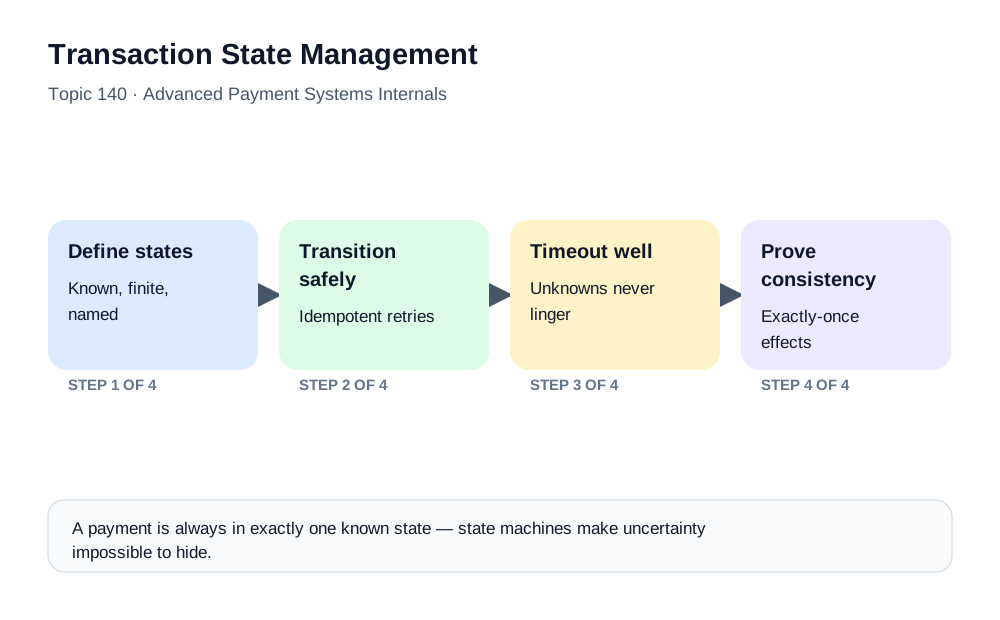
Transaction State Management at a glance — State machines, status transitions, idempotency.
Statuses, Idempotency, Retries, Timeouts, and Consistency in Banking Systems
A banking transaction is not only an amount moving from one account to another. It is also a state machine. It begins in one state, passes through controlled intermediate states, and must eventually reach a final state that the bank can explain, reconcile, and audit.
This is easy to underestimate. If a payment is debited twice because a request was retried, the customer loses money. If a payment is marked successful when the beneficiary was never credited, trust breaks. If a timeout leaves the bank unsure whether the external scheme accepted the payment, operations must investigate. If two systems show different statuses forever, reconciliation fails. Transaction state management is the discipline that prevents these problems.
This chapter explains how banking systems manage transaction states in a distributed world. It covers ACID transactions, state machines, idempotency, retries, timeouts, eventual consistency, compensation, reversals, sagas, reconciliation, and the business meaning of statuses.
Learning objectives
By the end of this chapter, you should be able to:
- Explain transaction state management in banking.
- Distinguish technical processing state from customer-visible status.
- Understand why idempotency is essential for payment retries.
- Explain ACID properties and why distributed banking flows need additional patterns.
- Describe pending, queued, held, success, failed, reversed, returned, and unknown states.
- Understand timeout handling and status enquiry.
- Explain compensation, reversal, and saga patterns in simple terms.
- Identify testing scenarios for duplicate prevention, failure recovery, and reconciliation.
1. What Transaction State Means
A transaction state is the current condition of a transaction at a specific point in its lifecycle.
Examples include:
- initiated;
- validated;
- pending;
- queued;
- held;
- sent;
- accepted;
- settled;
- credited;
- rejected;
- failed;
- timed out;
- unknown;
- reversed;
- returned;
- completed.
A state should not be just a display word. It should define:
- what has already happened;
- what has not yet happened;
- who owns the next action;
- which next states are allowed;
- what the customer should see;
- what operations should do;
- what reconciliation should expect;
- whether accounting entries exist;
- whether the state is final or temporary.
Without clear state definitions, teams argue about meaning during incidents.
2. Customer Status vs Internal State
Customer-visible status and internal processing state are related, but not the same.
A customer may see "Processing" while internally the payment is waiting for beneficiary-bank response. A customer may see "Under review" while internally the payment is held by sanctions screening. A customer may see "Failed" after the bank has reversed the debit, while internal systems preserve separate states for original debit, scheme reject, reversal posted, and customer notified.
Good banks map internal states to clear customer messages. They do not expose every technical state, but they also do not mislead.
Example:
| Internal State | Customer Message |
|---|---|
| Fraud step-up required | Confirm this payment to continue |
| Sanctions review hold | Payment is under review |
| Scheme timeout | Payment status is being confirmed |
| Beneficiary reject | Payment could not be completed |
| Reversal posted | Amount has been returned |
| Completed and settled | Payment completed |
The mapping must be controlled because customer communication can create disputes, duplicate attempts, or regulatory complaints.
3. A Simple Payment State Machine
A basic payment state machine might look like this:
- Initiated - instruction received.
- Validated - initial checks passed.
- Held - waiting for fraud, sanctions, approval, or manual review.
- Queued - waiting for liquidity, cut-off, or release condition.
- Sent - sent to scheme, network, or receiving bank.
- Accepted - external party accepted the instruction.
- Completed - final success outcome achieved.
- Rejected - stopped before completion with reason.
- Failed - processing failed and correction is required or complete.
- Reversed - debit corrected back to sender.
- Returned - funds sent back from receiving side.
- Under investigation - final outcome uncertain or disputed.
Each transition needs rules. Can a payment move from held to completed? Usually no; it must first be released and sent. Can a completed payment become failed? Normally no, but it may later have return, recall, chargeback, or dispute events. Can a failed payment become completed? Only if the earlier failure was not final or was corrected under defined process.
State discipline prevents impossible histories.
4. ACID Properties Inside One System
Within a single database or core banking system, reliable transaction processing depends on ACID properties.
Atomicity means all parts of a transaction succeed or all fail. A debit posting should not half-complete.
Consistency means the transaction moves the system from one valid state to another. Accounting rules and balance rules must remain valid.
Isolation means concurrent transactions do not corrupt each other. Two payments should not spend the same available balance at the same time.
Durability means once committed, the transaction survives system failure.
ACID is essential inside a bank's core systems. But modern payments often cross many systems and institutions. One ACID database transaction cannot cover the customer app, payment hub, core banking system, external scheme, beneficiary bank, and settlement account all at once. Distributed flows need additional state-management patterns.
5. Distributed State and Eventual Consistency
In distributed banking, different systems may temporarily have different views.
For example:
- the channel says the payment was submitted;
- the payment hub says it was sent;
- the core says the debit was posted;
- the scheme says response pending;
- the beneficiary bank has not yet confirmed credit;
- settlement file arrives later.
This is eventual consistency. The systems should converge to a common truth, but not every system knows that truth at the same instant.
Eventual consistency is not an excuse for confusion. It requires:
- clear states;
- correlation references;
- retry rules;
- status enquiry;
- timeout handling;
- reconciliation;
- customer communication;
- exception ownership.
The goal is controlled convergence, not blind waiting.
6. Idempotency: Safe Retry Without Duplicate Processing
Idempotency means that repeating the same request produces the same result as processing it once.
This is crucial because distributed systems fail in ambiguous ways. A customer submits a payment. The bank sends the request to the payment hub. The network times out before the app receives a response. The customer or app retries. Did the first request fail, or did only the response get lost?
Without idempotency, the retry may create a duplicate payment. With idempotency, the system recognizes the same request and returns the existing result instead of executing it again.
A good idempotency design includes:
- unique request ID;
- uniqueness rules by customer, account, amount, beneficiary, and time where appropriate;
- storage of original request and outcome;
- replay-safe response;
- expiry policy;
- duplicate-alert monitoring;
- audit trail.
Idempotency is not optional in payment systems. It is one of the controls that prevents duplicate debits.
7. Timeout and Unknown Status
Timeouts are dangerous because they do not prove success or failure. They prove only that a final response was not received in time.
A timeout can occur:
- between app and bank;
- between bank channel and payment hub;
- between payment hub and core;
- between bank and scheme;
- between scheme and beneficiary bank;
- between bank and notification service.
The correct response depends on where the timeout occurred and whether the transaction may still complete.
Possible actions include:
- query current status;
- wait for callback;
- retry safely using idempotency;
- mark as pending;
- trigger reversal if debit succeeded and final failure is confirmed;
- send to investigation queue;
- reconcile at settlement or end of day.
The worst practice is treating every timeout as failure or every timeout as success. The bank must discover the truth.
8. Compensation, Reversal, and Saga Pattern
Distributed banking flows often cannot use one atomic transaction across every system. Instead, they use controlled steps and compensating actions.
A compensating action is an action that corrects or offsets a previous step. If the sender was debited but the beneficiary could not be credited, the compensation may be a reversal to the sender.
A saga is a sequence of local transactions with defined compensations if later steps fail.
Example:
- Reserve or debit sender account.
- Send payment to scheme.
- Beneficiary bank attempts credit.
- If credit succeeds, complete.
- If credit fails, reverse sender debit.
- If reversal fails, create high-priority exception.
Sagas accept that intermediate states can exist, but they make sure failures have defined recovery paths.
9. State Transition Rules
State transition rules define which moves are valid.
Examples:
- initiated -> validated;
- validated -> held;
- validated -> queued;
- queued -> sent;
- sent -> accepted;
- accepted -> completed;
- sent -> timed out;
- timed out -> status confirmed;
- failed -> reversed;
- completed -> returned;
- completed -> recalled/requested;
- held -> released;
- held -> rejected.
Invalid transitions should be blocked or investigated. For example, a payment should not jump from initiated to settled without validation and release evidence. A reversed transaction should not later post the original debit again. A completed transaction should not be overwritten as failed because a late message arrived out of order.
This is why systems need sequence numbers, timestamps, versioning, and event ordering.
10. Event Logs and Audit Trail
A transaction state should be reconstructable from events.
A good event log records:
- event type;
- timestamp;
- system source;
- old state;
- new state;
- reason code;
- user or service ID;
- message reference;
- amount and currency where relevant;
- related original transaction;
- error details;
- retry count;
- approval details;
- customer notification event.
This is essential for investigations, reconciliation, audit, and incident review. If the bank cannot reconstruct the state journey, it cannot explain the transaction.
11. Reconciliation as the Final Safety Net
Even good state management needs reconciliation. A transaction may show completed internally, but the settlement file may not include it. A reversal may be posted in core but not visible in the customer notification system. A scheme may send a late reject after the bank's status already changed.
Reconciliation compares independent records and forces unresolved differences into exception handling.
State management and reconciliation support each other:
- state management controls the live journey;
- reconciliation proves the final truth.
A transaction should not remain permanently unknown. It must reach a final state or an owned investigation state.
12. Practical Example: Duplicate Retry Prevention
A customer initiates a 2,000 payment. The app sends request ID REQ123. The bank processes the payment and sends it to the scheme. The response to the app is lost because of a network timeout. The customer taps pay again.
The app resends REQ123.
The bank checks the idempotency store:
REQ123already exists;- amount, customer, and beneficiary match;
- original status is pending external confirmation;
- no new debit should be posted.
The bank returns the current status instead of creating a second payment. Later, when scheme success arrives, the same transaction becomes completed. The customer is not debited twice.
This is simple to describe, but it is one of the most important controls in digital payments.
13. Common Misconceptions
"Timeout means failed." No. Timeout means no response in time. The final result may be success, failure, or still pending.
"Retry solves the problem." Only if retry is idempotent. Unsafe retry can duplicate payments.
"State is a technical detail." No. State drives customer message, accounting, operations, reconciliation, and regulatory evidence.
"Completed means nothing can happen later." Completed may mean the original payment succeeded, but later events such as return, recall, dispute, chargeback, or investigation can still occur depending on rail.
"Eventual consistency means inconsistency is acceptable." Temporary inconsistency is acceptable only when convergence, reconciliation, and exception ownership are controlled.
14. Frequently Asked Questions
What is transaction state management? It is the control of a transaction's status and allowed transitions from initiation to final outcome, including failures, retries, reversals, and reconciliation.
What is idempotency in payments? It means the same request can be safely submitted more than once without creating duplicate financial processing.
What is an unknown status? It is a state where the bank cannot yet determine whether the transaction succeeded or failed, usually because of timeout or missing response.
What is a compensating transaction? It is a corrective transaction that offsets an earlier step, such as reversing a debit when the beneficiary credit fails.
What is eventual consistency? It means distributed systems may temporarily show different views but should converge to a common final truth.
Why do banks need status enquiry? To ask a scheme, network, or counterparty for the current transaction outcome when the local system did not receive a reliable final response.
15. Key Terms in This Chapter
- State - current condition of a transaction.
- State machine - defined set of states and allowed transitions.
- Final state - state that normally ends the original processing path.
- Intermediate state - temporary state awaiting further action.
- Idempotency - safe repeat processing without duplicate effect.
- Timeout - no response received within expected time.
- Unknown status - final outcome not yet known.
- Retry - repeated attempt after failure or timeout.
- Compensation - corrective action for a completed earlier step.
- Reversal - compensation that returns funds to sender.
- Saga - distributed pattern using local transactions and compensations.
- ACID - atomicity, consistency, isolation, durability.
- Eventual consistency - temporary difference across systems that should converge.
- Event log - chronological record of transaction state changes.
- Correlation ID - identifier connecting events across systems.
16. Interview Insights
"Why is idempotency important in payments?" Because retries are common after timeouts. Without idempotency, the same request can create duplicate debits or duplicate external instructions.
"How should a bank handle timeout?" Do not assume success or failure. Use idempotent retry, status enquiry, pending state, callback handling, reconciliation, and investigation rules to determine the final outcome.
"What is the difference between ACID and eventual consistency?" ACID protects consistency inside a single transactional system. Eventual consistency handles distributed systems where different systems may temporarily have different views but must converge.
"What is a saga in payment processing?" A sequence of local transactions with compensating actions if later steps fail, such as reversing the sender debit if beneficiary credit fails.
"What should be included in a transaction state model?" States, allowed transitions, owner, triggers, reason codes, accounting impact, customer message, retry rules, timeout rules, audit events, and reconciliation behavior.
Summary and Key Takeaways
Transaction state management is what keeps banking systems honest when payments move through many systems and failures happen in the middle.
The main lessons are:
- A transaction is a state machine. Each status must have clear meaning and allowed transitions.
- Customer status and internal state are different. The customer sees useful messages; the bank tracks detailed control states.
- Idempotency prevents duplicate money movement. Safe retry is impossible without it.
- Timeout is uncertainty, not failure. Banks must confirm the final outcome.
- Distributed systems need compensation. Sagas and reversals help recover when cross-system atomicity is impossible.
- Event logs are evidence. The bank must reconstruct what happened, when, where, and why.
- Reconciliation closes uncertainty. No transaction should remain permanently unknown.
Good state management is invisible when it works. But it is one of the reasons customers can trust that digital money will not disappear, duplicate, or remain unexplained.
Next: Topic 141 - Interbank Markets and Funding
<!-- MBA-DEEP-DIVE-START -->Transaction State Management Deepening — Distributed Truth, Idempotency, Ordering, and Recovery
A state machine should represent economic truth, not application convenience
Developers often create statuses because a screen needs them, but bank-grade state design starts with the economic lifecycle. If a customer is debited, a beneficiary is credited, or an interbank obligation is final, those facts should be represented independently of whether a UI page loaded successfully. Internal state should answer what has happened to the instruction and money. Customer-facing wording can then be derived without changing the underlying history.
State and event are different concepts
A state describes the current condition of a transaction; an event records something that happened. “Pending” is a state. “Scheme acknowledgement received” is an event. Several events can occur while a payment remains in the same state, and one event can trigger a state transition. Systems that store only the latest state lose investigative history. An append-only event trail plus current state gives both operational speed and auditability.
Finality should constrain allowed state transitions
Once a payment reaches a legally final settlement state, a later problem should not rewrite that history as though settlement never occurred. A return, recall, refund, chargeback, or compensating transaction should be modelled as a related event or new transaction. State machines should incorporate the rail's finality rules so a late technical message cannot incorrectly move a genuinely final payment back to “failed.”
State transitions should be monotonic where possible
A well-designed flow generally moves forward through defined phases rather than oscillating unpredictably. Temporary states such as pending or held can resolve in several ways, but completed economic facts should not disappear. Monotonic design reduces race conditions and simplifies reconciliation. Where correction is needed, an explicit compensation is safer than silently rolling state backwards.
Business state and technical delivery state should be separate
A message can fail to deliver while the payment remains valid and pending retry. Conversely, an API call can succeed technically while the business instruction is rejected. Systems should not map HTTP success directly to payment success. Technical states such as queued for delivery, retrying, and callback failed can coexist with business states such as accepted or settled. Separating them prevents infrastructure errors from corrupting financial logic.
Posting state deserves its own dimension
A payment can be accepted externally while the customer debit is pending, or a reversal can be due while the original debit remains posted. Payment state and accounting state should therefore be linked but distinct. Useful posting states can include no posting, funds reserved, debit posted, credit posted, reversal pending, reversal posted, and GL interface confirmed. This precision makes debit-no-credit investigations far easier.
External state should record source and confidence
The payment hub may infer an external state from a timeout, scheme callback, status enquiry, settlement file, or receiving-bank message. These evidence sources are not equivalent. Systems can record the authoritative source and timestamp behind an external status. A direct final scheme confirmation may carry higher confidence than a local assumption after a timer expired. Operations should know which kind of evidence supports the displayed status.
Unknown is a first-class state
Many systems resist storing “unknown” because product teams prefer a simple success/failure answer. In distributed payments, uncertainty is real. If the bank sent an instruction but did not receive a final response, pretending it failed can cause duplicate execution and pretending it succeeded can leave a customer out of funds. Unknown should trigger controlled enquiry, timeout policy, reconciliation, and communication until evidence resolves it.
Timers should trigger actions, not invent outcomes
A timer can say that a response is late; it cannot prove why. State models should use timers to trigger status enquiry, retry, alert, or escalation. They should not automatically mark a payment failed merely because a fixed duration passed unless the scheme rules explicitly define that result. Timer semantics need product and rail ownership.
Idempotency scope must match the business instruction
An idempotency key should represent one intended financial action. If the key is scoped too narrowly, retries create duplicates. If scoped too broadly, a customer cannot legitimately make two similar payments. API contracts should define who generates the key, how long it remains valid, which request attributes must match, and what response is returned on replay. The store should survive service restarts and failover.
An idempotent API is not enough if downstream processing duplicates
A channel may prevent duplicate requests while an event consumer later processes the same message twice. Every boundary that can redeliver should have duplicate protection appropriate to its role. At-least-once messaging often requires consumers to record processed business IDs or design ledger postings to reject duplicate references. End-to-end idempotency is a chain of controls, not one HTTP header.
Exactly-once is usually an economic objective rather than a transport guarantee
Distributed messaging systems often provide at-least-once or effectively-once patterns. The bank's real requirement is that one customer instruction produces one intended economic effect. This can be achieved through durable identifiers, deduplication, transactional outbox, consumer idempotency, and reconciliation even if technical messages are delivered more than once. Requirements should describe the financial outcome rather than demand an unrealistic universal transport guarantee.
Transactional outbox helps avoid dual-write gaps
A service may need to update its database and publish an event. If it commits the database but crashes before publishing, downstream systems never learn about the change. If it publishes first and then the database fails, consumers may act on an uncommitted state. The transactional outbox pattern records the event in the same local transaction as the business update and publishes it afterward, reducing this dual-write risk.
Inbox patterns protect consumers from redelivery
A receiving service can store the message or business ID before applying an effect and ignore later duplicates. This is useful when brokers redeliver after consumer failure. The inbox record should be durable and linked to the resulting business transaction. Cleanup policies must retain keys long enough to cover realistic replay windows.
Event ordering cannot be assumed across distributed systems
A late “accepted” message could arrive after a “rejected” or final status due to network delay or retries. State transition rules should reject stale events rather than overwrite newer truth. Sequence numbers, event versions, logical clocks, or source-specific ordering rules can help. Timestamp alone is not always safe because system clocks can differ.
Version checks prevent lost updates
Two services or operators can attempt to change a transaction concurrently. Optimistic locking can require the expected current version before accepting an update. If the state changed meanwhile, the second action must re-evaluate rather than overwrite. This is especially useful for manual release, cancellation, or investigation actions racing against automated callbacks.
Compare-and-set logic can protect one-time transitions
A reversal job should change “reversal pending” to “reversal posted” only if the current state still permits it. If another process already completed the reversal, the second attempt should do nothing. Conditional updates make retry safe and prevent duplicate compensation. This pattern is simple but powerful in payment recovery.
Sagas need business-specific compensation
A generic microservice framework can orchestrate steps, but only the business can define valid compensation. A posted transfer cannot always be undone by deleting a row. Compensation may be a new reversal, a return request, a financial adjustment, or a manual investigation. Saga design should distinguish technical rollback from legally and economically valid corrective action.
Orchestrated and choreographed sagas have different trade-offs
An orchestrator explicitly tells each service which step to perform next, making the overall journey easier to observe. Choreography lets services react to events without a central controller, which can reduce coupling but make flow understanding harder. Banks can use either, but payment state ownership and auditability must remain clear. A highly distributed event mesh should not leave operations unable to answer who owns a stuck transaction.
Compensation itself can fail
A reversal service can be unavailable, the account may have changed state, or a downstream ledger may reject a correction. The state machine needs “compensation pending” and “compensation failed” paths with high-priority operational ownership. Assuming compensation always succeeds merely moves the unknown state later in the flow. Failed compensation is often one of the most customer-sensitive exceptions.
Retry policy should depend on error classification
Network timeout, rate limit, temporary database outage, invalid account, sanctions block, insufficient funds, and duplicate request require different treatment. Errors should be classified as transient, permanent, business-repairable, or uncertain. Retries need backoff, maximum attempts, cut-off awareness, and idempotency. Permanent business rejects should not consume resources through repeated automated retries.
Exponential backoff needs business limits
Technical libraries often retry with exponential delays, but a payment has cut-offs and customer expectations. A retry that waits thirty minutes may be useless for an instant payment or miss a market deadline. The retry schedule should fit the rail's SLA and transition to enquiry or investigation when the uncertainty becomes business-significant. Engineering defaults should not determine payment policy.
Dead-letter queues are not final business states
A message that exhausts technical retries may move to a DLQ, but the underlying financial transaction still needs resolution. Operations should receive enough business context to determine whether money moved, what compensation is due, and whether the message can be replayed safely. A DLQ monitored only by developers can hide customer-impacting financial exceptions.
Replay needs version awareness
Replaying old events after a defect fix can re-run business logic under a newer code version. The outcome may differ from what would have happened originally. Systems should know whether replay is for rebuilding a projection, recovering a missed effect, or re-executing a financial action. Financial replay needs stricter controls and often explicit idempotency than analytical event replay.
State stores should survive regional failover
If a disaster-recovery region accepts retries but cannot see the original idempotency record or payment state, it can duplicate processing. Critical state, deduplication keys, and transaction history need a recovery architecture consistent with the service's resilience promise. DR testing should include ambiguous in-flight payments, not only cleanly completed records.
Active-active architectures increase concurrency complexity
Two regions may receive related requests at nearly the same time. Distributed locking or globally unique business rules may be required to prevent double spend or duplicate beneficiary creation. Performance benefits should be balanced against the difficulty of maintaining financial consistency. For critical ledger effects, a clearly authoritative writer can sometimes be safer than unrestricted multi-master updates.
Cached state can be dangerous for payment permissions
A channel may cache account status, available balance, or transaction state for performance. If the source changes because of a freeze, reversal, or completion, stale cache can cause incorrect decisions. Critical state needs suitable expiry, invalidation, or synchronous verification. Systems should identify which data can be eventually consistent and which must be current before money moves.
Customer status mapping should be deterministic
The same internal state should not show “pending” in mobile, “failed” in internet banking, and “success” in the call-centre screen. A governed mapping layer can translate detailed internal states into consistent customer language by channel. Exceptions should be intentional and documented. Conflicting statuses cause duplicate attempts and complaints.
Customer messages should include actionability
“Pending” is more useful when the customer knows whether to wait, retry, contact the bank, or provide information. The message can be specific without exposing restricted fraud or sanctions detail. State design should therefore include customer-action metadata or reason families, not only technical codes.
State transition reason is as important as state
Two payments can both be rejected for very different reasons: invalid beneficiary, insufficient funds, sanctions, duplicate, cut-off, or account restriction. The reason determines whether retry is appropriate, whether the customer can fix the issue, and which team owns it. A state model without reason codes forces downstream systems to infer business meaning from logs.
State history should be immutable even when current state is corrected
If a bug marked a payment completed incorrectly, the bank may correct the current state, but the original erroneous event should remain in audit history with a correction event. Immutable history supports incident analysis and proves that records were not silently manipulated. Customer views can show the corrected status without exposing internal mistakes unnecessarily.
Reconciliation can repair projections without rewriting evidence
A reconciliation process may discover that the scheme settled a payment while the local state remained pending. The bank can create a reconciliation event that advances the local projection to the evidenced final state. This is safer than directly editing the status field with no trace. Reconciliation becomes part of the state machine rather than a separate spreadsheet workaround.
Manual operations should use state-aware actions
An operator should choose actions such as release hold, resend safely, raise status enquiry, post reversal, or close investigation rather than directly editing a status dropdown. Each action validates current state and creates required events. Direct status editing bypasses business rules and can leave accounting or external systems inconsistent.
State-machine changes need backward compatibility
Adding a new state or transition can affect old in-flight transactions, reporting, APIs, customer channels, and reconciliation. Release planning should define how existing records are migrated or interpreted. Consumers should tolerate new events where contracts require it. A state change is a cross-system business change, not a local enum update.
Reporting should distinguish current state and lifecycle outcome
A payment that completed and was later returned should not be counted simply as “failed.” Reports may need original outcome, current financial state, return status, and investigation status separately. Preserving lifecycle events allows regulators and management to calculate metrics according to the required definition instead of forcing all analysis through the latest status field.
State management is the grammar of distributed banking
Every service, operator, and customer channel needs to agree on what a transaction's condition means and which action can legally and operationally follow. Good state design turns failures into controlled paths instead of mysteries. Idempotency prevents duplicate economics, ordering prevents stale truth, compensation handles partial completion, and reconciliation resolves remaining uncertainty. Together they make distributed payment systems explainable and recoverable.
Transaction State Management — Concurrency, Event Ordering, Repair, and Production Control
State ownership should be explicit before systems are distributed
A distributed payment can be represented in many applications, but only one domain should own the authoritative business state for a particular stage. The channel may own the customer's draft and confirmation status, the payment domain may own processing state, the ledger owns booked balances, and an external scheme owns its own acceptance or settlement status. Problems begin when two internal systems both believe they can independently declare the same payment completed. Architecture should therefore define state authority and the evidence that allows one domain to advance another.
Command, event, and state are different concepts
A command requests an action such as “submit this payment.” An event records that something happened, such as “payment accepted for processing.” State is the current business condition derived from valid events or stored directly under controlled rules. Mixing these concepts produces fragile integrations. A consumer should not treat a command as proof that an action succeeded, and a historical event should not be edited merely because the current state changed. Clear separation makes retries and reconstruction much safer.
Optimistic concurrency prevents lost updates
Two services can attempt to update the same transaction at nearly the same time. For example, a fraud-review release and a customer cancellation may race. If each reads version 8 and blindly writes a new status, the second write can overwrite the first without knowing it. Version numbers or compare-and-swap controls can require the update to apply only if the expected version is still current. When the version changed, the service reloads the state and re-evaluates whether its transition is still valid.
Distributed locks should be used carefully
A lock can prevent concurrent work, but long-lived distributed locks create their own failure modes. A service can crash while holding a lock, network partitions can create ambiguity, and excessive locking can reduce throughput. Financial state should therefore rely primarily on durable transition rules, idempotency, version checks, and unique constraints. Locks can still be useful for narrow critical sections, but the system should not depend on one fragile lock service to guarantee the economic correctness of a payment.
Exactly-once delivery is usually a business effect, not a transport promise
Messaging platforms may offer strong delivery semantics, but banking systems should still assume that messages can be duplicated, replayed, or observed after uncertain failure. What matters is that the financial effect occurs once. A ledger-posting consumer can store the event identifier together with the posting result in the same transactional boundary. If the same event arrives again, the consumer returns the existing outcome rather than creating a second debit. This is practical exactly-once business processing built on idempotent effects.
Out-of-order events need sequence-aware handling
Networks and queues can deliver a late event after a newer event. A “sent” notification may arrive after “settled,” or a delayed fraud-release message may arrive after the transaction was already cancelled. Systems should not regress state simply because a message arrived later. Event sequence, transaction version, event timestamp, and permitted transitions should determine whether the event advances state, becomes informational, or is rejected as stale.
Monotonic state does not mean nothing can happen after completion
The original processing state can remain final while related lifecycle events continue. A settled payment can later be returned, recalled, disputed, or compensated. Modelling these as linked events or sub-lifecycles is safer than overwriting COMPLETED with FAILED. The bank preserves the fact that the original transfer completed and separately records what happened afterward. This produces clearer accounting and customer explanations.
Unknown state should have an owner and expiry
“Unknown” is useful after an ambiguous timeout, but it must not become a permanent parking status. The transaction should have a next enquiry time, responsible service or operations queue, external status source, maximum uncertainty window, and escalation path. Reconciliation can eventually resolve cases that real-time enquiry cannot. An unknown state without recovery logic is simply an unowned incident hidden inside the transaction table.
Status enquiry should be idempotent and non-destructive
An enquiry asks for evidence; it should not create a new payment or alter financial state merely because it was invoked. When an external network provides a status response, the bank maps that response through transition rules and verifies that it belongs to the expected transaction. Repeated enquiries should be safe. This distinction prevents operations from using a “resend” function when what they actually need is confirmation of an uncertain outcome.
Saga orchestration and choreography have different control characteristics
In an orchestrated saga, one service tracks the workflow and calls or reacts to each step. This provides a clear place to see progress and compensation. In choreography, services react to events without a single controller, which can reduce central coupling but make the overall business state harder to observe. Banks can use either pattern, but the chosen design should preserve an end-to-end transaction view, deterministic compensation rules, and accountable ownership when multiple services disagree.
Compensation is not always the inverse of the original action
Reversing a debit can restore principal but may not restore value date, fees, FX rate, or customer opportunity cost. A customer payment rejected after currency conversion may require a separate FX treatment. A card reversal can follow different timing from an account transfer. Compensation design should therefore model the actual economic correction rather than assume every step has a perfect mathematical undo operation.
Ledger state should remain authoritative for booked money
A workflow can say “reversed,” but the customer balance is not restored until the ledger records the reversing entry. Transaction orchestration should therefore distinguish workflow completion from accounting completion. If the reversal instruction was generated but ledger posting failed, the transaction remains financially unresolved even though the orchestration service finished its logic. Reconciliation should compare state and ledger evidence so display status never outruns money.
State repair should append evidence rather than rewrite history
Production teams sometimes discover a transaction stuck because an event was lost or a status update failed. A repair tool can replay the missing event, create a controlled correction, or advance state based on verified evidence. It should not allow an operator to edit a database status directly with no record. Repair actions need case reference, operator, reason, approval where material, old state, new state, and the external or ledger evidence supporting the change.
Replay is powerful and dangerous
Event replay can rebuild projections or recover downstream systems, but a consumer that performs financial side effects must distinguish historical replay from new instructions. Read models and analytics can often replay freely; payment posting, notifications, or external submissions may need deduplication or replay suppression. Recovery design should classify consumers so a disaster-recovery replay does not accidentally resend old payments or duplicate customer communications.
Event sourcing requires snapshots and governance at banking scale
An event-sourced system can reconstruct state by replaying immutable events, which gives strong history. Over years, however, replaying every event can become expensive, and event schemas evolve. Snapshots can store a verified state at a known event version, after which only later events need replay. Schema evolution should preserve the ability to interpret old events. Event sourcing is therefore not “store every message forever”; it is a disciplined historical model with retention, versioning, and migration rules.
State-machine definitions should be versioned
A bank can change processing logic while older transactions are still in flight. Version 3 may introduce a new sanctions hold or settlement state that version 2 did not have. Each transaction should know which state model or rules apply, or the migration must explicitly map old states to new ones. Otherwise a release can strand existing transactions because the new code no longer recognises their status.
API contracts should expose stable business states
Internal implementations can evolve without forcing every client to understand new microservice statuses. A public or channel API should offer a stable business vocabulary and version its contract when meaning changes. Internally, richer states can map into that vocabulary. This avoids a situation where a backend refactor changes a technical code and suddenly mobile apps, corporate APIs, and support screens all present inconsistent customer messages.
Manual approval is a state transition, not a side note
Corporate payments, high-value exceptions, and operational repairs may require maker-checker or multi-signature approval. The transaction should record required approval count, eligible approvers, approvals received, rejected approvals, expiry, and whether material data changed after approval. If the beneficiary or amount changes, old approval may no longer be valid. Treating approval as a comment rather than part of state can permit unauthorised release.
Timers and deadlines should be durable
A payment held until a future cut-off, approval expiry, fraud review deadline, or scheduled execution date should not depend on an in-memory timer inside one application instance. Durable scheduling should survive restart and failover. The timer should carry transaction identity, due condition, and idempotency so repeated wake-up events remain safe. When a deadline is missed during outage, recovery rules should decide whether to execute, reschedule, or expire the instruction.
Clock consistency matters in incident reconstruction
Distributed services can log events with slightly different clock offsets. For ordinary processing this may be harmless, but during an investigation it can appear that a settlement happened before submission. Systems should use reliable time synchronisation and distinguish event occurrence time from processing or ingestion time. Ordering should not rely solely on wall-clock timestamps when an authoritative sequence number or version is available.
State projections can be rebuilt but customer channels need freshness guarantees
A mobile app may read from a fast projection rather than the transactional database. If that projection lags after a major event, the customer can see a stale status and retry. Architecture should define acceptable lag, show pending indicators when freshness is uncertain, and provide a path to query authoritative state for sensitive actions. Read scalability should not undermine duplicate prevention or customer confidence.
Cache invalidation is part of financial state management
Caching account or transaction status improves performance, but stale cache can expose an already-cancelled payment as releasable or show funds as available after a reservation. Sensitive state changes should invalidate or version caches promptly. A cache key can include entity version so old data is naturally rejected after a change. High-risk decisions should avoid trusting a cache whose freshness cannot be established.
Reconciliation can promote state only with defined evidence
Sometimes the only reliable proof of final outcome arrives later through settlement or statement reconciliation. The bank can use that evidence to resolve a transaction that remained unknown. The reconciliation process should invoke a controlled transition or repair event rather than edit status directly. This preserves the distinction between the live processing path and the later evidence that established the truth.
Operational dashboards should show state population and ageing
A healthy platform knows how many transactions sit in each non-final state, their value, oldest age, and trend. A sudden increase in SENT, HELD, UNKNOWN, or REVERSAL_PENDING can reveal an external outage or internal defect before customers report it. Thresholds should consider the normal duration of each state. One thousand payments in a two-second state is very different from one thousand payments in a two-day investigation state.
State cardinality should remain understandable
Adding a new status for every exception quickly produces hundreds of codes that no one can reason about. A better design uses a manageable lifecycle state plus structured reason, substate, or case information. For example, HELD can carry reason FRAUD_REVIEW or SANCTIONS_REVIEW while specialist systems retain detailed case status. This keeps the payment state model coherent without losing operational detail.
Reason codes should have stable semantics
A reason code can drive customer text, operations routing, analytics, and regulatory reporting. Reusing the same code for different meanings or changing its definition silently breaks those consumers. Reason catalogs should be versioned, documented, and mapped carefully when systems are migrated. Free text can supplement a reason but should not be the only machine-readable explanation for a material transition.
Incident response should freeze dangerous automation selectively
During a state-corruption incident, the safest action may be to stop only the affected transition or route while allowing unrelated payments to continue. Feature flags or policy switches can disable one external adapter, hold a payment type, or stop automatic compensation. A full platform shutdown may create more customer and liquidity harm. Selective containment depends on modular state ownership and clear transaction classification.
Failure injection should test ambiguity, not just clean failure
Real incidents rarely fail at convenient boundaries. Tests should simulate the database commit succeeding while the response is lost, the external scheme accepting a payment before the network disconnects, a duplicate event arriving after restart, or a late reject arriving after a timeout. These scenarios prove whether idempotency, enquiry, ordering, and reconciliation work under ambiguity—the condition most likely to create duplicate or incorrect money movement.
Production controls should measure state correctness as well as availability
A service can be 99.99 percent available and still corrupt transactions if transition rules are wrong. Useful controls include invalid-transition attempts, duplicate suppression count, stale-event rejection, unknown-state ageing, compensation failures, manual repairs, reconciliation-driven corrections, and status disagreement between systems. Reliability means the financial state remains correct under failure, not merely that the API responds.
A mature transaction state model makes uncertainty temporary and explainable
Distributed banking cannot eliminate timeouts, retries, delayed messages, and partial failure. It can ensure those conditions are bounded. Stable identities prevent duplication, transition rules prevent impossible histories, version checks protect concurrency, durable events preserve evidence, reconciliation resolves uncertainty, and controlled repair fixes exceptional cases. The result is a transaction lifecycle that remains financially correct and explainable even when the technology underneath it fails in messy ways.
<!-- MBA-DEEP-DIVE-END -->