Visual overview
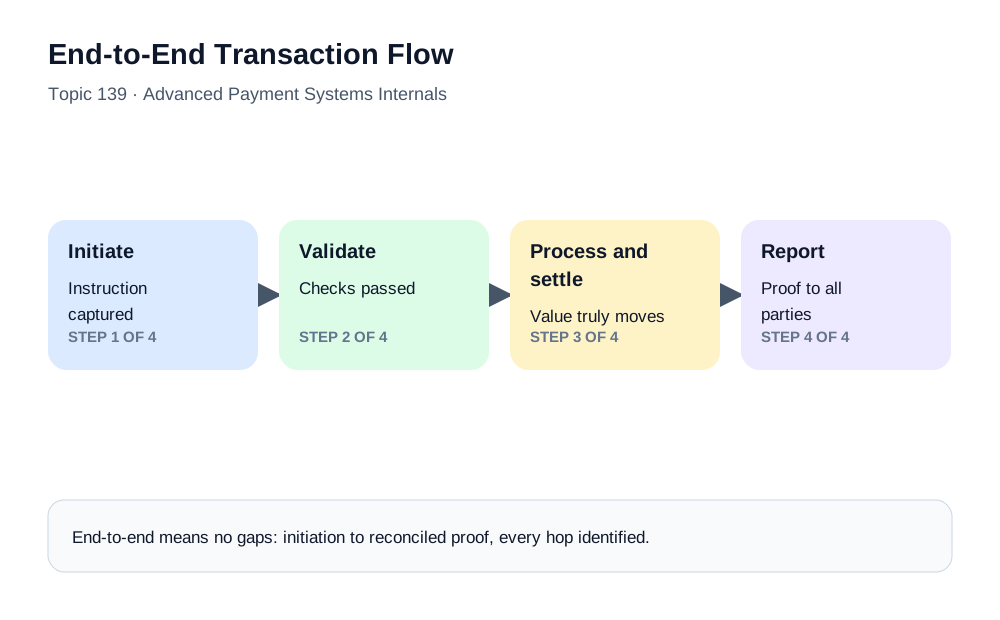
End-to-End Transaction Flow at a glance — Initiation, validation, processing, settlement, reporting.
Following a Payment from Initiation to Settlement, Reporting, and Reconciliation
A payment looks simple to the customer. They enter an amount, choose a beneficiary, approve, and wait for confirmation. But inside a bank, that single action becomes a chain of events across channels, authentication services, payment hubs, fraud engines, sanctions screening, core banking, liquidity controls, clearing systems, settlement accounts, status messages, customer notifications, reporting platforms, and reconciliation tools.
End-to-end transaction flow means understanding that full journey. It is not enough to know that money was "sent." A banking professional must know where the instruction was captured, which checks passed, when the customer was debited, when the payment was released, which rail carried it, when the receiving bank accepted it, when settlement occurred, what status was returned, what the customer saw, and how the bank later proved the records matched.
This chapter explains a payment transaction from initiation to final control. It uses a general bank-payment model and then applies it to an instant-payment example. The goal is to help you see every system, every step, every status, and every control in one connected story.
Learning objectives
By the end of this chapter, you should be able to:
- Describe the end-to-end lifecycle of a bank payment.
- Distinguish customer initiation, authentication, validation, posting, screening, routing, clearing, settlement, notification, reporting, and reconciliation.
- Identify the main systems involved in a payment flow.
- Explain how debit, credit, settlement, and confirmation can happen at different times depending on the rail.
- Understand why references, statuses, timestamps, and audit trail must survive every step.
- Describe common failure points and how reversals, returns, investigations, and reconciliation resolve them.
- Apply the flow to instant payments, RTGS, ACH, card, and cross-border scenarios.
- Explain the flow in business analyst, testing, operations, and architecture language.
1. Why End-to-End Flow Matters
Payment issues rarely sit inside one screen or one system. A customer complaint may begin in a mobile app but the cause may be a failed reversal job, a stale account status, a sanctions hold, a missing settlement file, a duplicate request, or a timeout between bank and scheme.
End-to-end flow helps teams answer:
- Where did the payment enter the bank?
- Which validations were completed?
- Was the customer debited?
- Was the payment sent to the external rail?
- Did the receiving bank accept it?
- Was settlement completed?
- Which status is final and which is only intermediate?
- What should the customer see?
- What should operations investigate?
- What should reconciliation match?
Without end-to-end thinking, teams solve only local symptoms. With end-to-end thinking, they can see the real lifecycle.
2. The Main Stages of a Payment Flow
A typical payment passes through these stages:
| Stage | What Happens | Key Control |
|---|---|---|
| Initiation | Customer, corporate file, API, branch, or system creates instruction | Capture complete and accurate data |
| Authentication | Bank verifies user, device, token, signature, mandate, or approval | Confirm authority |
| Validation | Checks product, account, balance, limits, cut-off, format, beneficiary, and duplicate | Stop invalid instructions |
| Risk checks | Fraud, sanctions, AML, risk, and compliance controls run | Prevent prohibited or suspicious movement |
| Posting/reservation | Account debit, hold, reservation, or accounting entry is made | Protect funds and ledger |
| Routing | Payment hub selects rail, scheme, correspondent, or clearing path | Send through correct channel |
| Clearing | External infrastructure validates, routes, or calculates obligations | Establish participant obligation |
| Settlement | Interbank funds move or net position settles | Discharge obligation |
| Beneficiary processing | Receiving bank validates and credits or rejects | Complete receiver outcome |
| Status and notification | Status messages update channels, customers, and operations | Tell the truth clearly |
| Reporting | Statements, alerts, regulatory, and operational reports update | Make outcome visible |
| Reconciliation | Bank, scheme, settlement, and GL records are matched | Prove the transaction |
Different rails combine or separate these stages differently. That is why a generic flow must always be adapted to the specific payment product.
3. Systems Usually Involved
A payment may touch many systems.
Common systems include:
- mobile app, internet banking, branch, ATM, corporate portal, or API channel;
- customer identity and authentication service;
- entitlement or mandate system;
- payment initiation service;
- payment hub or orchestration engine;
- core banking system;
- account and balance service;
- fraud detection engine;
- sanctions screening system;
- AML or transaction monitoring system;
- limits system;
- FX or pricing service;
- liquidity management system;
- external gateway or network adapter;
- clearing or payment scheme;
- settlement account or central bank interface;
- notification service;
- statement and reporting service;
- reconciliation platform;
- case management or investigation tool;
- data warehouse and archive.
The customer sees one payment. The bank sees a controlled distributed process.
4. References and Identifiers
References are the spine of the end-to-end flow. Without them, tracing becomes slow and unreliable.
Important identifiers may include:
- customer reference;
- payment instruction ID;
- message ID;
- transaction ID;
- end-to-end ID;
- UETR for cross-border tracking where applicable;
- scheme reference;
- clearing reference;
- settlement reference;
- original transaction reference for return, reversal, recall, or chargeback;
- case reference for investigations.
Every transformation should preserve the right identifiers. If a channel reference is lost in the payment hub, or a scheme reference is not stored in core banking, reconciliation and investigation become harder.
5. Debit, Credit, and Settlement Are Not Always One Moment
One of the most important lessons in payments is that debit, credit, and settlement can occur at different times.
In RTGS, interbank settlement may happen before the receiving bank credits the beneficiary. In some instant-payment schemes, the beneficiary may be credited immediately while interbank settlement occurs through prefunding or later net settlement. In ACH, the customer instruction may be accepted today while settlement occurs in a batch. In cards, authorization happens at purchase time, clearing happens later, and settlement happens after that. In cross-border correspondent banking, multiple banks and nostro accounts may be involved before the beneficiary receives value.
So the professional question is never simply "did the payment happen?" The better questions are:
- Was the customer debited?
- Was the payment accepted by the scheme or network?
- Was the beneficiary credited?
- Was interbank settlement final?
- Was the status reported correctly?
- Were all records reconciled?
6. Worked Example: Instant Account-to-Account Payment
A customer sends 5,000 from Bank A to a customer at Bank B using an instant-payment app.
- The customer enters beneficiary, amount, note, and authentication credential.
- The app sends the request to the payment service or bank channel.
- The bank validates session, device, customer entitlement, amount, and duplicate request.
- Fraud scoring checks behavior, device, beneficiary, velocity, and risk signals.
- Sanctions or watchlist screening runs where required.
- The core banking system checks account status and available balance.
- Bank A debits or reserves funds according to scheme design.
- The payment hub sends the instruction to the instant-payment scheme.
- The scheme validates and routes to Bank B.
- Bank B checks beneficiary account status and credit eligibility.
- Bank B credits the beneficiary or rejects with a reason.
- The scheme returns final or intermediate status to Bank A.
- Bank A updates the customer status and notification.
- Settlement occurs immediately, through prefunding, or through later net settlement depending on the scheme.
- Reconciliation compares bank records, scheme records, settlement files, and GL postings.
To the customer this may feel like two seconds. To the bank it is a multi-system chain with risk controls at each step.
7. Failure Points in the Flow
Payments can fail or become uncertain at many points.
Common failure points include:
- customer authentication failure;
- insufficient funds;
- account dormant, frozen, closed, or debit-blocked;
- limit breach;
- cut-off missed;
- duplicate detected;
- fraud decline or step-up failure;
- sanctions or compliance hold;
- invalid beneficiary;
- scheme timeout;
- network unavailable;
- receiving bank reject;
- settlement failure;
- reversal job failure;
- notification failure;
- reconciliation break.
A mature payment system should know which stage failed and what compensating action is required. A vague "failed" status is not enough for operations or customers.
8. Status Handling
Status is how systems communicate transaction truth. Good status handling separates intermediate and final outcomes.
Common statuses include:
- initiated;
- accepted;
- validated;
- pending;
- queued;
- held;
- sent;
- settled;
- credited;
- rejected;
- failed;
- reversed;
- returned;
- recalled;
- under investigation;
- completed.
Each status should have a defined meaning, owner, allowed next status, customer message, operations action, and reconciliation behavior.
9. Reversal, Return, Recall, and Investigation
When a payment cannot complete normally, the flow may branch.
Reversal usually corrects a failed debit or failed transaction by crediting the sender back.
Return sends funds back after the receiving side cannot or should not process the payment.
Recall is a request to cancel or recover a payment after sending.
Investigation traces the payment when the final outcome is unclear or disputed.
These are not interchangeable. A debit-no-credit case may need reversal. A wrong account may need recall or recovery request. A beneficiary-bank reject may create a return. A timeout may require status enquiry before action.
10. Customer Communication
Customer communication must reflect the real payment state.
Bad messages create confusion:
- "Success" when only debit succeeded.
- "Failed" when final status is still pending.
- "Processing" with no timeline or next step.
- "Technical issue" for every case.
Better messages tell the customer what matters without exposing internal complexity:
- payment completed;
- payment pending confirmation;
- payment failed and amount reversed;
- payment under review;
- beneficiary bank rejected the payment;
- payment accepted after cut-off for next business day;
- payment cannot be processed due to account restriction.
The message must be accurate, useful, and aligned with regulatory and compliance limits.
11. Testing an End-to-End Payment Flow
Testing must cover more than the happy path.
A strong test pack includes:
- successful payment;
- insufficient funds;
- dormant account;
- frozen account;
- invalid beneficiary;
- duplicate request;
- fraud decline;
- sanctions hold;
- limit breach;
- cut-off behavior;
- scheme timeout;
- receiving bank reject;
- reversal success;
- reversal failure;
- return flow;
- recall request;
- settlement file mismatch;
- reconciliation break;
- notification failure;
- retry and idempotency;
- audit and reporting.
End-to-end testing should prove not only that the payment moves, but that the bank knows what happened when it does not move.
12. Practical BA View
For a business analyst, an end-to-end flow should capture:
- actors and systems;
- input fields and mandatory data;
- validation rules;
- status model;
- accounting entries;
- risk checks;
- external messages;
- timeout and retry rules;
- repair and exception handling;
- customer communication;
- reporting and reconciliation;
- audit evidence;
- operational ownership.
A flow diagram without statuses, exceptions, references, and reconciliation is incomplete for banking delivery.
13. Common Misconceptions
"The payment is complete when the customer is debited." No. Debit is one step. The beneficiary outcome, settlement, status, and reconciliation still matter.
"The app status is always the final truth." No. The app displays the status it receives or derives. It may lag behind scheme, core, or settlement records.
"Every rail works like instant payments." No. RTGS, ACH, card, cheque, direct debit, and cross-border flows have different timing and settlement models.
"Failure is one status." No. Authentication failure, validation reject, compliance hold, timeout, receiving-bank reject, settlement failure, and reversal failure are very different.
"End-to-end means only technical integration." No. It includes business rules, risk controls, accounting, settlement, customer communication, operations, reporting, and reconciliation.
14. Frequently Asked Questions
What is an end-to-end payment flow? It is the full journey of a payment from initiation through validation, risk checks, posting, routing, clearing, settlement, notification, reporting, and reconciliation.
Why can a payment show pending? Because the bank may be waiting for scheme response, beneficiary-bank confirmation, settlement, compliance review, or timeout resolution.
What is debit-no-credit? It is a failure pattern where the sender is debited but the beneficiary is not credited. It requires reversal, completion, or investigation based on evidence.
Why are payment references important? They allow every system to connect the same transaction across channel, bank, scheme, settlement, reporting, and investigation records.
What is the difference between settlement and customer notification? Settlement discharges interbank obligation. Notification tells the customer a status. They may occur at different times depending on the rail.
What should a BA include in a payment flow? Systems, actors, statuses, validations, risk checks, accounting, messages, exceptions, retries, reversals, customer communication, reporting, reconciliation, and ownership.
15. Key Terms in This Chapter
- End-to-end flow - complete lifecycle from initiation to final control.
- Initiation - creation of payment instruction.
- Authentication - verification that the user or system is authorized.
- Validation - checks that the instruction can proceed.
- Payment hub - orchestration system routing and managing payment processing.
- Clearing - preparation and calculation of obligations.
- Settlement - final discharge of interbank obligation.
- Posting - accounting update to customer or internal ledger.
- Status message - message communicating transaction state.
- Reversal - correction of failed or invalid debit.
- Return - movement back from receiving side under rules.
- Recall - request to recover or cancel after sending.
- Reconciliation - matching independent records to prove outcome.
- Idempotency - duplicate-prevention control for repeated requests.
- Audit trail - evidence of who did what, when, and why.
16. Interview Insights
"Walk me through an end-to-end payment." Start with initiation, authentication, validation, risk checks, account posting, payment hub routing, clearing/network processing, beneficiary-bank outcome, settlement, notification, reporting, and reconciliation.
"Why can a customer be debited before the beneficiary receives money?" Because debit, network acceptance, beneficiary credit, and settlement can happen at different stages. If later stages fail, reversal or investigation is required.
"What are the key controls in a payment flow?" Authentication, account status, balance, limits, fraud, sanctions, duplicate detection, routing, settlement, status handling, reversal, reconciliation, and audit trail.
"How would you test payment failure scenarios?" Test each failure point separately: validation reject, fraud decline, sanctions hold, timeout, receiving-bank reject, settlement failure, reversal failure, notification failure, and reconciliation mismatch.
"Why is customer communication part of the flow?" Because the customer acts based on the displayed status. Wrong status wording can create complaints, duplicate attempts, disputes, and regulatory issues.
Summary and Key Takeaways
An end-to-end transaction flow shows how a payment really moves through the bank and beyond it. It connects customer action, system processing, risk controls, settlement, status, reporting, and reconciliation.
The main lessons are:
- A payment is a lifecycle, not one event. Many systems and controls contribute to the final outcome.
- Debit, credit, and settlement may differ in time. Always ask which stage is complete.
- References are essential. They connect the transaction across systems and later investigations.
- Failure points must be designed, not improvised. Timeouts, rejects, holds, and reversals need clear rules.
- Status must tell the truth. Customer and operations statuses need precise meaning.
- Testing must cover unhappy paths. Real banking quality is proven when things go wrong.
- Reconciliation closes the loop. The bank must prove records agree after the flow completes.
A payment professional who understands end-to-end flow can diagnose incidents, write better requirements, test smarter, and explain to customers and operations what really happened to the money.
Next: Topic 140 - Transaction State Management
<!-- MBA-DEEP-DIVE-START -->End-to-End Transaction Flow Deepening — State, Accounting, Routing, Settlement, and Control Ownership
End-to-end means following both the instruction and the money
A payment instruction can move successfully between systems while the financial posting fails, or the customer can be debited while the external instruction never leaves the bank. End-to-end analysis therefore tracks two related chains: the instruction state and the money state. Requirements and incident analysis should show when an instruction is created, accepted, routed, cleared, and settled alongside when funds are reserved, debited, credited, released, reversed, or returned.
The customer journey begins before the payment object exists
A customer may search for a beneficiary, select an account, view fees and FX, confirm a name match, and pass authentication before the bank creates the formal payment instruction. These pre-initiation steps influence liability, data quality, and customer understanding. Business flows should include them when they affect the decision to pay. A diagram starting only after the final confirm button can miss important fraud and consent controls.
Channel capture should preserve business meaning
The channel may collect debtor account, beneficiary, amount, currency, requested date, remittance information, purpose, fee preference, and customer reference. Each field should map to a defined downstream meaning. If the mobile app labels a field “note” but the payment hub interprets it as regulated remittance text, truncation or character rules can create customer or compliance issues. Field mapping is part of the business flow, not an invisible technical detail.
Authentication proves authority at a point in time
A valid login does not automatically authorise every payment. The bank may need transaction signing, corporate mandate approval, step-up authentication, or a separate consent. End-to-end requirements should show which identity acted, which authority was checked, what transaction details were bound to the approval, and when the approval expires. This matters for disputes because a generic login record is weaker evidence than a signature tied to the beneficiary and amount.
Corporate entitlements should be evaluated before release
A corporate user may create a payment but lack authority to approve it. Another user may need to verify or sign according to amount, account, legal entity, or payment type. The payment therefore enters an internal approval state before bank processing begins. Host-to-host and API channels may use certificates or system-level mandates instead of human screen approval. The flow should represent the real authority model for each channel.
Validation should be layered
Basic syntax, mandatory fields, account status, product eligibility, available balance, cut-off, duplicate controls, beneficiary rules, currency, limits, and scheme-specific data may all be validated at different stages. Repeating a validation can be intentional when a value can change between initiation and execution. For example, a future-dated payment may pass balance validation at capture but need a fresh check on execution day. Requirements should distinguish static validation from dynamic validation.
Reservation and debit are different financial actions
A bank may reserve funds when the customer confirms but debit only when the payment is released. Other products debit immediately. A hold reduces available balance while preserving ledger balance until posting. The design should specify whether reservations earn interest, expire, can be partially released, and how they behave when a payment is cancelled or rejected. Customer channels need to explain available balance accurately.
Fraud and sanctions decisions affect different parts of the flow
Fraud controls often protect the customer or bank from deceptive loss, while sanctions controls determine whether the bank may process particular activity under applicable restrictions. Both can stop a payment but create different case ownership and disclosure. Status models should distinguish fraud decline, compliance hold, sanctions block, and ordinary validation reject internally, even if customer wording is more limited.
AML monitoring may be pre- or post-transaction depending on control
Many transaction-monitoring scenarios analyse behaviour after posting, while certain risk controls can operate before execution. A generic “AML check” box in every payment flow can therefore be misleading. Analysts should document the actual control: sanctions screening, fraud scoring, transaction limit, AML scenario, high-risk-country rule, or manual compliance review. Precise naming improves requirements and incident ownership.
FX introduces a parallel pricing lifecycle
A cross-currency payment can involve quote request, rate validity, customer acceptance, contract reference, debit currency, settlement currency, and beneficiary amount. If the rate expires before release, the bank may need repricing according to product terms. End-to-end flow should show whether the amount or rate is guaranteed and which accounting entries record FX income. Payment status alone cannot explain a dispute about converted value.
Charges need an explicit bearer model
Some payment products allow the sender, beneficiary, or shared parties to bear fees depending on scheme and product rules. Fees may be known at initiation or deducted by intermediaries later. The flow should distinguish bank charges from external deductions so customer statements and investigations can explain why the beneficiary received a different amount. Charge configuration also affects accounting and reconciliation.
Routing is a business decision with technical implementation
A payment hub can choose between domestic clearing, instant rail, RTGS, correspondent route, internal on-us transfer, or another path based on currency, amount, urgency, beneficiary reachability, cost, cut-off, risk, and product promise. Routing rules need business ownership and versioning. A technically valid route can still be commercially wrong if it violates the customer-selected service or misses a deadline.
On-us and off-us flows should diverge explicitly
If both accounts are held within the same bank or banking group, the transaction may be completed through internal ledger postings without external clearing, subject to the bank's design and legal entity structure. Off-us payments require an external participant or infrastructure. The flow should show where the branch occurs because settlement, fees, status, and reconciliation differ. “On-us” should not be assumed solely from customer brand if accounts belong to different legal entities or platforms.
Network acceptance is not settlement finality
A clearing system can acknowledge that it received or validated a payment before settlement occurs. The sending bank should map each external status to a precise internal state. Customer channels should not show “completed” merely because a network accepted the instruction if finality or beneficiary credit is still outstanding. The rail's rulebook determines the legal meaning of statuses.
Beneficiary credit is a separate receiving-bank process
The receiving bank may validate account status, currency, compliance controls, and posting eligibility after it receives the instruction. A payment can settle interbank but still require repair or return before the beneficiary receives usable funds depending on the rail. End-to-end design should include receiving-side outcomes when the bank operates both sides or needs to support investigations with another institution.
Instant customer experience can hide deferred settlement
Some instant payment systems provide immediate beneficiary credit using prefunding, guarantees, or risk controls while interbank settlement follows a separate model. Product teams should understand this distinction when defining liquidity, reconciliation, and final status. “Instant” refers to the service experienced by users; it does not define one universal infrastructure architecture.
Settlement should identify the asset and account
A payment ultimately settles using central-bank money, commercial-bank correspondent money, prefunded scheme balances, or another accepted settlement asset depending on the system. Requirements should name the settlement account and participant position. This helps treasury understand liquidity and finance understand accounting. A diagram with a generic “settlement” box can conceal the most important financial obligation.
Net settlement changes the link between transaction and cash
Thousands of retail payments may contribute to one participant net debit or credit. The bank should retain the link from each customer transaction to the settlement cycle and from that cycle to the cash movement. This supports reconciliation and default analysis. A customer payment may be individually final under scheme rules even though the bank sees only a net settlement entry.
Liquidity checks can alter timing without invalidating the instruction
A high-value payment may be fully authorised and compliant but queue because settlement funds are unavailable. The state should indicate valid-but-queued rather than failed. Treasury or payment operations may add liquidity, reprioritise, or wait for incoming funds. Customer and corporate service teams need to know whether the delay is a funding issue or a validation issue because the next action differs.
Timeouts create uncertain branches
When a bank sends a request and does not receive a final response, the payment state is unknown until further evidence arrives. Retrying blindly can create duplicates; reversing blindly can double-pay if the beneficiary was credited. End-to-end design needs status inquiry, idempotency, reconciliation, and timeout expiry rules. Unknown is a legitimate state that must be managed deliberately.
Retry should be defined by failure type
A transient network failure may be retryable. A sanctions rejection, closed beneficiary account, or exceeded limit usually is not. Systems should classify errors into retryable, repairable, terminal, and uncertain categories. Retry policy should include interval, maximum attempts, duplicate protection, and cut-off impact. “Retry three times” without business logic is not a bank-grade requirement.
Repair changes data and therefore needs audit
A payment missing an address or purpose may enter repair. If an operator changes data, the system should record original value, new value, user, timestamp, evidence, and whether fresh screening is required. Material changes can invalidate previous fraud or sanctions decisions. Repair should not become a hidden path around channel validation.
Cancellation needs a state-dependent rule
A customer may be able to cancel a future-dated instruction before execution but not after release or final settlement. Corporate workflow may allow cancellation while an approval is pending. End-to-end requirements should define the last cancellable state and any fees or notice. A “cancel” button that sends a best-efforts recall after finality should be labelled differently from true cancellation.
Reversal is a compensating posting
When the bank has debited a customer but the payment fails before a valid external outcome, it may need to credit funds back according to product and scheme rules. The reversal should link to the original debit and preserve both records. Deleting or overwriting the original entry breaks audit and can distort interest or statements. Reversal logic should be idempotent so recovery jobs cannot credit twice.
Return is a new movement linked to the original
A receiving bank can return funds when it cannot apply the payment or when scheme rules require it. The return has its own amount, date, reason, charges, and settlement. Customer systems should show the original payment and later return rather than rewrite history. The link is essential for investigation and reconciliation.
Recall is a workflow, not a status guarantee
A sending bank can request recovery after release, but the receiving side may accept, reject, partially return, or not respond depending on rules and circumstances. The case should track request, response, and returned funds separately from the original payment status. Customer service should avoid describing recall initiation as completed recovery.
Posting state and payment state should not be conflated
A payment can be externally rejected while the customer's reversal is still pending. Conversely, customer posting may succeed while external settlement remains queued. Systems need separate but linked state domains. A single “failed” flag cannot tell operations whether money is still missing from the account or whether external action remains.
Notification failure should not change financial outcome
If an SMS or push message fails, the payment can still be financially complete. The notification service should retry or offer status through other channels without changing the transaction state. Customer complaints caused by missing notification should be distinguishable from payment failures. This separation prevents support teams from initiating unnecessary refunds.
Statements are another representation of the transaction
The statement narrative, value date, debit or credit indicator, amount, and reference should reconcile to core postings. A payment can be operationally successful but create a customer complaint because the statement is unclear or duplicated. End-to-end design should include statement mapping and return/reversal presentation, not stop at network response.
Regulatory and management reporting should use authoritative events
If a regulator asks for failed payment rates, the bank should define failure from the lifecycle rather than use front-end error messages. Reporting datasets should know whether a transaction was rejected before submission, timed out, reversed, returned, or settled. Event design that preserves state transitions makes later reporting far more reliable.
Reconciliation proves both external and internal completion
The bank should reconcile customer postings to payment records, payment records to clearing or scheme outcomes, settlement positions to settlement accounts, and relevant sub-ledgers to the GL. Not every rail needs the same control, but the end-to-end chain should have independent proofs. “No customer complaints” is not evidence that the books are correct.
Audit trail should preserve actor and machine decisions
A payment can be touched by customer, corporate approver, fraud engine, sanctions analyst, payment operator, and automated recovery job. Audit should record material decisions and changes with timestamp and source. This is especially important for manual repair, overrides, limit changes, and financial adjustments. Distributed architecture increases the need for coherent evidence.
Correlation IDs support technical tracing but should link to business IDs
Observability platforms often use trace or correlation IDs that are excellent for diagnosing service calls. These IDs may not be meaningful to operations or survive long-term archival. Systems should link technical traces to stable payment and transaction identifiers. Then a case investigator can move from customer reference to technical logs without relying on fragile timestamp searches.
Testing should prove accounting and control outcomes
A test is not complete because the API returned 200. For each scenario, testing should verify account posting, payment state, external message, settlement or queue outcome, reversal or return if relevant, notification, statement, reconciliation, and audit evidence. Negative tests should confirm that invalid payments leave no unexplained financial residue.
Cut-off testing should include boundary seconds and calendars
A payment at 16:59:59 and one at 17:00:01 may have different value dates. Public holidays, daylight-saving changes, weekends, and currency calendars create additional boundaries. Requirements should define the source of cut-off time and time zone. Testing must verify both channel message and downstream accounting date.
Operational dashboards should expose business states
CPU usage and API latency do not tell payment operations whether money is stuck. Dashboards should show volumes by state, aged queues, compliance holds, unknown timeouts, failed reversals, settlement exposure, and external rail availability. Technical observability and business observability should be linked so incident teams can understand customer impact quickly.
Case management should open from the payment record
When an investigation begins, the case should inherit stable references and key lifecycle events rather than require manual re-entry. This reduces error and allows case outcome to feed back to the transaction history. Fraud, sanctions, and payment investigations may have different restricted notes, but the bank should maintain a controlled link between case and original transaction.
End-to-end ownership needs a service view
Each component team can meet its own SLA while the customer payment still fails. The bank needs an owner for the end-to-end payment service who can see channel, core, risk, network, settlement, notification, and reconciliation performance together. Service-level indicators should measure final customer and financial outcomes, not only individual system availability.
The best flow model is rail-specific after the generic foundation
The generic lifecycle teaches common concepts, but implementation requirements must adapt to RTGS, instant payments, ACH, cards, direct debit, cheques, internal transfer, and correspondent banking. Each has different timing, statuses, finality, settlement, dispute, and return rules. A business analyst should start with the common skeleton and then replace generic boxes with the exact scheme behaviour rather than forcing every rail into one diagram.
End-to-End Transaction Flow — Orchestration, State, Ledger Impact, and Operational Evidence
End to end means following one economic instruction across every boundary
A transaction may begin with a customer action but pass through channel validation, authentication, entitlement, limits, fraud, sanctions, product processing, routing, clearing, settlement, accounting, reporting, and notification. Each stage can have a different system owner and technical interface. End-to-end design connects them through one coherent business lifecycle so the bank can answer a basic question at any time: what is the transaction's current financial state and what must happen next?
The transaction should receive a stable internal identity early
Channel references are useful but may differ across mobile, API, branch, host-to-host, and partner channels. The bank should assign or preserve a stable transaction identity that can link downstream events. External network references, customer references, clearing identifiers, and ledger entries can then be associated with it rather than replacing it. This improves status, reconciliation, investigations, observability, and duplicate control.
Initiation data should preserve the customer's instruction
The bank may enrich or transform data after receipt, but the original instruction should remain available. Amount, currency, account, beneficiary, requested date, purpose, and customer reference can change representation across systems. Retaining source data allows operations to distinguish what the customer requested from what the bank derived, such as route, charges, FX conversion, or intermediary information. This is essential when a customer disputes an outcome.
Authentication does not equal entitlement
A user can prove their identity yet lack authority to debit a particular account or initiate a transaction above a mandate threshold. The channel should authenticate the user, while account and corporate entitlement services determine allowed actions. For multi-user corporate payments, creation and approval can be separate lifecycle events. The transaction should not enter irreversible processing until required authority is satisfied.
Validation should distinguish format, product, and business rules
A request may fail because a field is malformed, the account is closed, the currency is unsupported, a value date is invalid, a beneficiary is incomplete, or the product is unavailable. These are different reasons and should be represented explicitly. Early validation improves customer feedback and prevents avoidable downstream exceptions. Rules should be versioned because product and scheme requirements change over time.
Reservation and posting are different financial events
Some transactions reserve funds before final posting. A card authorisation, payment hold, or transfer reservation can reduce available balance without changing the final booked ledger position yet. Systems should distinguish reservation, debit posting, settlement, release, and reversal. Customer channels should present these states clearly so a temporary hold is not mistaken for duplicate debit.
Fraud and compliance controls should return controlled outcomes
A transaction-control service may allow, challenge, hold, reject, or route for review. The payment orchestration layer should treat these as business states rather than generic technical errors. A held transaction needs owner, reason category, ageing, and release path. Sensitive details may remain restricted, but the core transaction must know that processing is intentionally paused rather than failed.
FX should be represented as part of the transaction economics
When debit and settlement currencies differ, the bank should preserve instructed amount, debit amount, settlement amount, rate, rate source or contract reference where relevant, fees, and timing. FX conversion should not be hidden in a generic amount overwrite. Reconciliation and customer service need to explain why the account debit differs from the beneficiary or settlement amount. If the rate expires before approval, policy should define whether the transaction is re-priced.
Routing is a controlled business decision
A payment may have several possible clearing, correspondent, or internal routes. Routing can consider currency, destination, amount, service level, customer product, cost, cut-off, liquidity, risk, and scheme eligibility. The chosen route and rule version should be recorded. If operations later reroute an item, the reason and new path should be visible. Routing should not be an opaque technical switch hidden from transaction lifecycle evidence.
Submission acknowledgement is not settlement
An external infrastructure may acknowledge that it received or validated an instruction long before final settlement. The bank should map technical acknowledgements to precise business states. Customer-facing “completed” should not be emitted merely because an outbound message was accepted by a gateway. Status should advance when the evidence appropriate to the product confirms the relevant financial milestone.
Clearing and settlement events need their own identifiers and timestamps
The transaction should retain when it entered clearing, whether it was accepted, what settlement position or reference it generated, and when settlement finality occurred where observable. These events let reconciliation connect internal processing to external financial movement. They also allow investigations to determine whether a missing beneficiary credit is still internal or already downstream at another institution.
Ledger posting should be linked to the transaction, not only the account
A general or customer ledger entry needs a transaction reference that allows the bank to trace debit, credit, fees, FX, suspense, and reversal. If multiple entries arise from one business transaction, their relationship should be explicit. This enables a customer statement to show a coherent event while finance can see the full accounting decomposition.
A transaction can complete financially while post-processing continues
Notifications, analytics, archival, customer reporting, data-warehouse feeds, or marketing events may occur after settlement. The transaction state model should distinguish financially critical completion from non-critical downstream processing. A failed analytics event should not cause the payment itself to be retried. Event-driven architectures need clear ownership of which consumer failures can affect financial state and which are repairable asynchronously.
Idempotency should span the whole instruction lifecycle
A user, channel, or integration may retry after a timeout. The bank should identify whether the request is the same business instruction before creating a new transaction. A stable idempotency key can prevent duplicate initiation, while downstream systems need their own duplicate controls because messages can also be retried internally. End-to-end idempotency is achieved through consistent identities and state, not one API check at the front door.
Timeouts should lead to enquiry, not blind resubmission
When a caller does not receive a response, the transaction may still have been accepted. The correct recovery is to query status using the stable reference and retry only when the bank can prove the first attempt did not create the instruction. This pattern prevents duplicates during network instability. Channels should expose a pending or unknown state instead of telling customers to “try again” automatically when financial outcome is uncertain.
Exception handling belongs inside the lifecycle
A rejected, returned, recalled, repaired, or reversed transaction should not disappear from the primary flow into an unrelated operational system. Exceptions are transaction states with reasons, linked case information, and financial consequences. The original instruction remains the anchor. This helps customers and operations understand the full story rather than search across disconnected queues.
Returns create a second movement linked to the first
When funds come back after external processing, the bank should link the return to the original debit and settlement. Return reason, amount, currency, charges, and timing should be preserved. Customer crediting may require additional accounting or FX treatment. Netting the original and return to zero without history destroys evidence and makes future investigation difficult.
State transitions should be monotonic unless a defined exception reverses them
A transaction should not jump casually from completed back to processing because a late event arrived. The state model should define which events advance status, which create related exception states, and which are informational. Out-of-order events are common in distributed systems, so processing should use event timestamps, sequence, and business rules rather than arrival order alone.
Observability should follow the business reference across services
Technical logs are most useful when they carry transaction correlation identifiers, event type, source, timestamp, and outcome. Operations should be able to search one reference and see the path across APIs, queues, microservices, databases, and external adapters without manually joining unrelated log formats. Sensitive data should be protected, but operational traceability is essential for rapid incident diagnosis.
Service-level measurement should use business milestones
API response time tells only part of the story. Payment service levels may depend on time from customer acceptance to control decision, clearing submission, settlement, beneficiary credit indication, or exception resolution. Metrics should distinguish internal processing from external waiting. This helps the bank identify whether delay comes from its own systems, a clearing infrastructure, a correspondent, or a beneficiary institution.
Reconciliation should validate every critical handoff
Transaction counts and values can be reconciled between channel and payment hub, hub and clearing, clearing and settlement, settlement and ledger, and ledger and statement or general ledger. The exact controls depend on architecture, but each irreversible boundary should have evidence of completeness. End-to-end flow is trustworthy when no transaction can disappear between systems without a control detecting it.
Change impact should be evaluated across the entire chain
A small field change at initiation can affect screening, routing, message generation, settlement, reconciliation, reporting, and investigations. Release governance should trace important data elements and states through downstream consumers. Testing only the service being changed can miss a later accounting or regulatory defect. End-to-end test scenarios should include successful, rejected, held, returned, duplicated, timed-out, and repaired transactions.
Customer status should be derived from business state, not raw system messages
Customers need a small set of understandable statuses such as scheduled, processing, completed, failed, or returned, depending on product. Internally the bank can retain much richer states. A mapping layer should translate technical and scheme events into customer language without claiming more certainty than the evidence supports. Good status design can reduce investigations dramatically because customers know whether action is still pending or genuinely failed.
The transaction record should remain explainable years later
For disputes, audit, tax, legal requests, or regulatory review, the bank may need to reconstruct an old transaction after systems have changed. Durable event history should preserve key data, rule versions, financial postings, external references, and exception outcomes according to retention policy. Relying only on transient application logs makes historical reconstruction fragile.
End-to-end control is ultimately about one consistent financial story
The architecture can contain many services and networks, but the customer and the bank need one coherent truth: what was instructed, what controls decided, where the transaction went, what settled, what posted, and what happened if something failed. Stable identities, explicit state, linked ledger entries, external evidence, reconciliation, and case management create that story. Complexity is acceptable inside the bank only when it remains explainable from end to end.
End-to-End Transaction Assurance
Transaction evidence should distinguish intent, decision, and outcome
A complete record contains what the customer intended, what the bank decided at each control point, and what financially occurred. These are not interchangeable. A customer may intend to send 1,000, the bank may reject the instruction before settlement, and the ledger may therefore show no debit. Keeping the three layers separate makes investigations and disputes far easier than relying on one final status field.
Every asynchronous boundary needs a delivery contract
Queues and event streams decouple systems, but they also create questions about duplicate delivery, ordering, acknowledgement, and replay. Producers and consumers should define how an event is uniquely identified, when it is considered accepted, and how repeated delivery is handled. A consumer should not create a second financial posting merely because the same event is replayed after recovery.
Business state should survive technology replacement
Microservices, databases, and message brokers will change over the life of a banking platform. The transaction model should use durable business concepts and identifiers that can be migrated without losing meaning. If historical status depends on decoding a retired application's internal error code, the architecture has failed to preserve the financial story.
Operational repair should create new evidence rather than edit old evidence
When support teams repair a transaction, they should record the action, reason, operator, approval where needed, and resulting state. Changing the original event to make it appear correct destroys causality. Append-only or versioned histories allow the bank to show both the failure and the remediation while presenting customers with a clear current outcome.
End-to-end assurance should be tested through failure injection
Testing can deliberately create timeouts, duplicate messages, out-of-order events, rejected settlements, unavailable control services, and delayed ledger postings. The objective is to prove that the transaction remains single, traceable, financially correct, and recoverable. Happy-path testing shows that systems can process a payment; failure testing shows that the bank can control one.
<!-- MBA-DEEP-DIVE-END -->