Visual overview
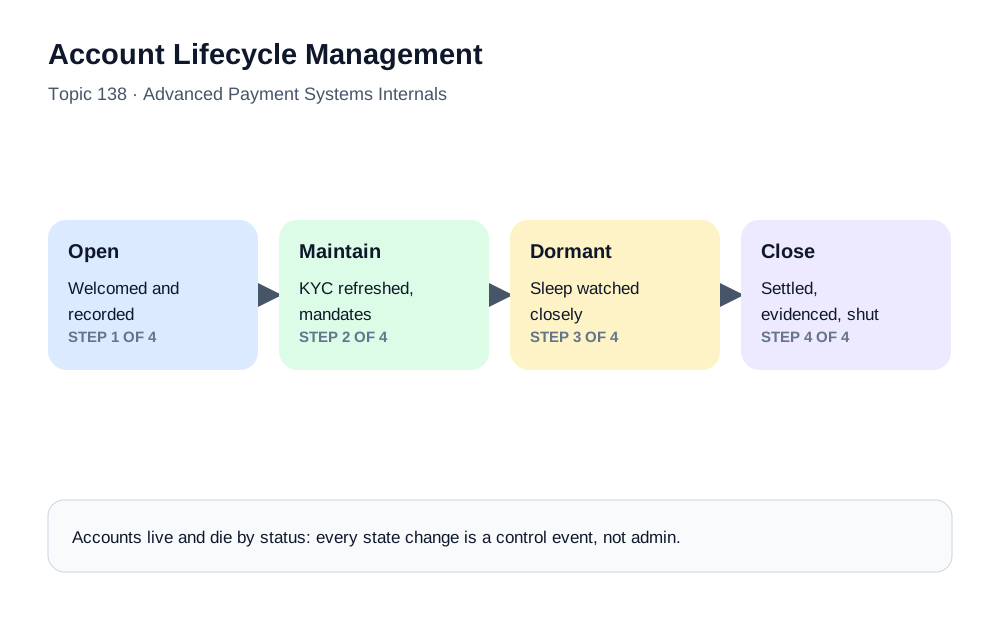
Account Lifecycle Management at a glance — Dormant accounts, account closure, KYC updates.
Managing Account States from Opening to Closure
A bank account is not just a number. It is a controlled relationship with a status, owner, product type, balance, rules, limits, restrictions, documents, mandates, nominees, channels, risk rating, and history. From the day it is opened until the day it is closed, the account passes through many possible states: active, restricted, inactive, dormant, frozen, blocked, under lien, deceased, unclaimed, or closed.
Account lifecycle management is the discipline that controls these states. It ensures that the bank allows the right activity, stops the wrong activity, protects customer money, follows legal and regulatory rules, updates records, supports investigations, and preserves evidence.
This chapter explains account lifecycle management from a practical banking perspective. It covers account opening, activation, maintenance, modifications, restrictions, dormancy, reactivation, freezes, liens, deceased accounts, unclaimed balances, closure, record retention, and how account status affects payments and customer service.
Learning objectives
By the end of this chapter, you should be able to:
- Explain account lifecycle management and why account status matters.
- Distinguish active, inactive, dormant, frozen, blocked, lien-marked, deceased, unclaimed, and closed accounts.
- Understand how account status affects debits, credits, payments, cards, channels, and customer communication.
- Describe account modifications such as address change, nominee change, signatory update, and product conversion.
- Explain dormancy, reactivation, periodic review, and re-KYC.
- Understand freezes, court orders, regulatory holds, and compliance restrictions.
- Describe deceased-account handling and closure controls.
- Identify the data, workflow, audit, and operational controls needed across the account lifecycle.
1. What Account Lifecycle Management Means
Account lifecycle management is the set of processes and system controls used to manage an account from creation to closure.
It includes:
- account activation;
- product and limit setup;
- channel enablement;
- maintenance of customer and account details;
- mandate and nominee management;
- risk rating and re-KYC updates;
- status changes;
- restrictions and freezes;
- dormancy and reactivation;
- legal and regulatory holds;
- closure and record retention;
- handling deceased or unclaimed accounts;
- audit trail for every material change.
Lifecycle management matters because an account's status determines what the bank is allowed to do with it.
2. Why Account Status Matters
Account status affects many operational decisions:
- Can the customer withdraw money?
- Can credits be accepted?
- Can the customer send payments?
- Can the bank debit charges or loan repayments?
- Can the card be used?
- Can internet or mobile banking be accessed?
- Can a standing instruction run?
- Can a cheque be honoured?
- Can interest be credited?
- Can the account be closed?
- Does the case require compliance, legal, or branch approval?
A status error can hurt customers or expose the bank. If a frozen account allows debits, the bank may breach a court or regulator order. If an active account is wrongly blocked, the customer may miss salary, rent, supplier, or medical payments. If a deceased account remains operational, fraud risk increases.
3. Main Account States
| Account State | Meaning | Typical Impact |
|---|---|---|
| Active | Normal operating account | Debits, credits, channels, and products work as permitted |
| Restricted | Some operations limited by product, risk, or compliance rules | Specific debit, credit, channel, or amount controls apply |
| Inactive | No customer-initiated activity for defined period | Monitoring starts; some controls may tighten |
| Dormant/Inoperative | No customer activity for longer defined period | Debits usually restricted until reactivation; credits may continue |
| Frozen | Account restricted due to legal, regulatory, fraud, or compliance reason | Debits and/or credits blocked depending on order/policy |
| Blocked | Specific operation blocked, such as debit block or card block | Only defined activities are stopped |
| Lien-marked | Funds reserved against loan, court order, dispute, or bank claim | Withdrawal restricted up to lien amount |
| Deceased | Account holder reported dead | Operations stopped or restricted pending settlement |
| Unclaimed | Balance not operated/claimed for legally defined period | May transfer to designated fund or unclaimed process |
| Closed | Relationship/account terminated | No further normal transactions; records retained |
The exact terminology differs by bank and country, but the control idea is universal: status drives permission.
4. Active Account Management
An active account still needs maintenance. Customers change addresses, phone numbers, emails, tax status, employment, nominees, mandates, products, limits, and channel preferences.
Common maintenance activities include:
- address update;
- mobile or email update;
- nominee update;
- joint holder addition or removal;
- authorized signatory update;
- account operating instruction change;
- product conversion;
- limit change;
- debit card or cheque book request;
- standing instruction setup or cancellation;
- tax document update;
- risk rating change;
- KYC refresh.
Each change needs appropriate verification. A mobile number update may require OTP and fraud checks. A signatory change for a company may require board resolution. A nominee change may require customer authorization. A high-risk customer profile update may require compliance review.
5. Dormancy and Inactivity
An account becomes inactive or dormant when there is no customer-initiated transaction for a defined period. The exact period depends on local regulation and bank policy. In many markets, a shorter period triggers inactive monitoring, and a longer period triggers dormant or inoperative status.
Dormancy controls protect customers because forgotten accounts are vulnerable to misuse. A dormant account may still receive credits such as interest, salary, pension, government benefits, refunds, or dividends, but customer-initiated debits are often restricted until reactivation.
Dormancy management includes:
- identifying accounts with no customer activity;
- notifying customers;
- restricting risky transactions;
- preventing unauthorized reactivation;
- allowing legitimate credits where permitted;
- suppressing inappropriate fees where regulation requires;
- monitoring dormant-account fraud risk;
- reactivating only after proper verification.
Dormant does not mean the money belongs to the bank. The customer or rightful claimant remains entitled to the funds, subject to legal rules.
6. Reactivation and Re-KYC
Reactivation brings an inactive or dormant account back into normal operation.
A good reactivation process checks:
- customer identity;
- current contact details;
- updated address;
- KYC validity;
- sanctions and watchlist status;
- risk rating;
- outstanding restrictions;
- account ownership;
- whether any fraud or legal hold exists;
- customer request authenticity.
Reactivation is a fraud-sensitive moment. Fraudsters may target old accounts because customers are less likely to monitor them. Banks should require strong verification and maintain audit trail for reactivation.
7. Freezes, Blocks, and Liens
Freezes, blocks, and liens are different controls.
Freeze usually means the account is restricted due to legal, regulatory, fraud, tax, sanctions, AML, or court reasons. The exact permitted activity depends on the order or policy.
Debit block prevents money from leaving the account while credits may still be allowed.
Credit block prevents money from entering the account, used in specific risk or closure scenarios.
Full block stops both debits and credits.
Lien reserves a defined amount. The account may still operate above the lien amount, but the liened funds cannot be withdrawn.
Common reasons include:
- court order;
- tax authority instruction;
- law enforcement request;
- suspicious activity investigation;
- sanctions or financial-crime hold;
- loan collateral;
- card dispute or chargeback exposure;
- bank guarantee margin;
- deceased account notification;
- KYC non-compliance.
These controls require precise setup. A wrong block type can either breach an order or unnecessarily harm the customer.
8. Account Status and Payments
Payment systems must check account status before allowing transactions.
Examples:
- An active account can normally send and receive payments.
- A dormant account may receive credits but should not allow customer-initiated debits until reactivation.
- A debit-blocked account should reject outgoing transfers, cheque payments, ATM withdrawals, and card debits.
- A credit-blocked account may reject incoming funds.
- A lien-marked account should allow withdrawal only above the available balance after lien.
- A deceased account should stop normal operations pending settlement rules.
- A closed account should reject all new transactions and route incoming credits to return or exception handling.
This is why payment validation must call or receive account-status data from core banking. Payment repair, returns, recalls, investigations, and customer communication depend on accurate status codes.
9. Deceased Account Handling
When a bank receives reliable notice that an account holder has died, it must protect the account and support rightful settlement.
The process may include:
- recording date of death and evidence;
- restricting operations;
- stopping cards, cheque books, and digital access;
- identifying nominee, survivor, joint holder, executor, or legal heirs;
- collecting required documents;
- settling balance according to mandate and law;
- closing or converting the account;
- preserving records.
Joint accounts depend on operating instructions. "Either or survivor" is different from "jointly operated." Nomination simplifies claim settlement but does not always remove all legal complexity. Rules differ by jurisdiction, so banks must follow local law and policy.
The human side matters. Deceased-account handling is a sensitive customer-service process, not just a status update.
10. Unclaimed Balances
Unclaimed balances arise when accounts remain inactive or dormant for a long legally defined period. Many countries require banks to transfer such balances to a central fund, government authority, or unclaimed asset scheme while preserving the customer's or heir's right to claim later.
A good unclaimed-balance process includes:
- customer outreach before transfer;
- ageing reports;
- exclusion rules for disputed or legally held accounts;
- transfer calculation;
- reporting to authority;
- claim process for customers or heirs;
- public search or disclosure where required;
- audit trail.
Unclaimed money is a trust issue. The bank must not treat it as forgotten profit.
11. Account Closure
Account closure may be customer-initiated or bank-initiated.
Before closure, the bank should check:
- outstanding balance;
- uncleared cheques;
- pending card transactions;
- standing instructions;
- direct debits or mandates;
- loan linkage;
- liens or holds;
- disputes or chargebacks;
- locker or custody linkage;
- cards and cheque books;
- digital channel access;
- tax and interest posting;
- final statement;
- record retention.
Customer-initiated closure should be smooth when no restrictions exist. Bank-initiated closure requires policy, notice, and fair treatment unless legal, fraud, sanctions, or serious risk reasons require immediate action.
A closed account can still receive incoming attempted transactions. The bank must route them to return, suspense, or exception handling according to rules.
12. Audit Trail and Maker-Checker Control
Account lifecycle changes can be sensitive. A wrong status change can release funds, block a customer, bypass controls, or enable fraud.
Strong controls include:
- maker-checker approval for sensitive changes;
- reason codes;
- supporting document attachment;
- timestamp and user ID;
- old value and new value;
- approval level by risk;
- customer notification where appropriate;
- exception reports;
- periodic review of manual overrides;
- reconciliation of status changes to source requests.
Status management should never be an invisible manual edit.
13. Practical Example: Dormant Account Reactivation
A customer visits the bank to reactivate an account dormant for three years.
The bank should:
- verify the customer's identity;
- check current KYC documents;
- update address and contact details;
- screen the customer against sanctions and watchlists;
- check whether any freeze, lien, deceased marker, or legal hold exists;
- review recent attempted activity for fraud risk;
- capture reactivation request and evidence;
- obtain maker-checker approval if required;
- update account status;
- notify the customer;
- monitor early transactions after reactivation.
This protects the real customer and prevents old accounts being misused.
14. Common Misconceptions
"Dormant means closed." No. A dormant account remains open, but operations are restricted until reactivation.
"Frozen and dormant are the same." No. Dormancy is caused by inactivity. Freeze is caused by legal, regulatory, fraud, compliance, or bank-control reasons.
"A nominee becomes the legal owner automatically in every sense." Rules differ by jurisdiction. Nomination helps settlement, but legal ownership and inheritance questions may still depend on local law.
"Closed accounts disappear from the bank." No. Closed account records must be retained for audit, tax, regulatory, legal, and customer-service purposes.
"Credits should always be allowed into restricted accounts." Not always. Some restrictions permit credits; others block credits too. The restriction type matters.
15. Frequently Asked Questions
What is account lifecycle management? It is the control process for managing an account's status, permissions, restrictions, updates, dormancy, reactivation, closure, and record retention from opening to end of relationship.
What is the difference between inactive and dormant? Inactive usually means no customer activity for a shorter defined period. Dormant or inoperative status usually follows a longer period and applies stronger restrictions.
Can a dormant account receive money? Often yes, depending on local rules and bank policy. Credits such as interest or benefits may be allowed, but customer-initiated debits normally require reactivation.
What is a lien on an account? A lien reserves funds against a claim, collateral requirement, dispute, loan, court order, or bank exposure. The customer may not withdraw the liened amount.
Why can a bank freeze an account? Reasons may include court order, law enforcement, tax authority instruction, suspicious activity, sanctions, fraud, KYC non-compliance, or regulatory direction.
What happens to unclaimed balances? After a legally defined period, balances may be transferred to an authority or fund, but customers or heirs normally retain the right to claim through the prescribed process.
16. Key Terms in This Chapter
- Account lifecycle - stages and controls from account opening to closure.
- Account status - system state controlling permitted activity.
- Active account - account operating normally.
- Inactive account - account with no customer-initiated activity for defined period.
- Dormant/Inoperative account - longer inactive account with stronger restrictions.
- Freeze - legal, regulatory, compliance, or bank-imposed restriction.
- Debit block - restriction preventing outgoing funds.
- Credit block - restriction preventing incoming funds.
- Lien - reservation of funds against a claim or obligation.
- Reactivation - process of restoring account operation after inactive or dormant status.
- Re-KYC - refresh or re-verification of customer information.
- Nominee - person recorded to receive or help claim funds after account holder death, depending on local law.
- Unclaimed balance - balance not operated or claimed for a legally defined period.
- Maker-checker - dual-control approval process.
17. Interview Insights
"Why is account status important in payments?" Because payment validation depends on account permissions. Active, dormant, frozen, debit-blocked, lien-marked, deceased, and closed accounts should behave differently for debits, credits, returns, and investigations.
"How would you reactivate a dormant account safely?" Verify identity, refresh KYC, check sanctions/watchlists, confirm no freeze or lien, capture evidence, apply maker-checker if required, update status, notify customer, and monitor early activity.
"What is the difference between freeze and lien?" Freeze restricts account operations because of legal, regulatory, compliance, or risk reasons. Lien reserves a specific amount against an obligation while the account may still operate above that amount.
"What should be checked before account closure?" Balance, pending transactions, cheques, cards, mandates, loans, liens, disputes, charges, interest, statements, channel access, and record retention requirements.
"Why are deceased accounts sensitive?" Because the bank must prevent misuse, follow legal claim rules, respect nominee/survivor instructions, collect evidence, and support the family carefully.
Summary and Key Takeaways
Account lifecycle management controls what an account can do throughout its life. It protects customers, supports operations, and ensures the bank follows legal and regulatory duties.
The main lessons are:
- An account is a controlled relationship, not just a balance. Status, restrictions, documents, mandates, and history all matter.
- Status drives permission. Payments, cards, channels, cheques, credits, debits, and closures depend on account state.
- Dormancy protects forgotten accounts. Reactivation must verify the real customer and refresh controls.
- Freeze, block, and lien are different. Each has different operational and legal consequences.
- Lifecycle changes need evidence. Maker-checker, reason codes, documents, and audit trail protect the bank and customer.
- Closed and unclaimed do not mean erased. Records and customer rights continue under law and policy.
- Good lifecycle management prevents downstream issues. Payment failures, fraud, complaints, legal breaches, and reconciliation breaks often start with poor status control.
A bank account's life is full of state changes. Managing those changes correctly is one of the quiet disciplines that keeps banking safe and fair.
Next: Topic 139 - End-to-End Transaction Flow
<!-- MBA-DEEP-DIVE-START -->Account Lifecycle Deepening — State Models, Restrictions, Authority, Dormancy, and Closure
Account lifecycle should be modelled as controlled state transitions
An account does not move randomly between active, restricted, dormant, deceased, or closed states. Each transition should have a valid trigger, required evidence, authorised actor, effective timestamp, and permitted next states. A formal state model prevents contradictory combinations such as an account being both closed and fully active. Technology teams can implement state machines, while operations procedures define who may trigger each transition and under what conditions.
Customer status and account status are different
One customer may hold several accounts. A KYC restriction can affect the whole customer relationship while a cheque stop applies to one account and a card block applies to one instrument. Systems should distinguish customer-level, account-level, product-level, and channel-level restrictions. A broad customer block applied for a narrow card problem can unnecessarily stop salary, mortgage, or business activity. Conversely, an account-only restriction may be insufficient when the risk concerns the customer's whole relationship.
Restrictions need explicit debit and credit behaviour
Words such as frozen or blocked are too vague for system design. A restriction should specify whether it stops customer debits, bank debits, incoming credits, outgoing transfers, cards, cash withdrawal, cheques, interest, fees, standing instructions, returns, refunds, or closure. Some legal orders may freeze only a defined amount; others may require broader immobilisation. Payment validation should use precise permissions rather than one generic “account not active” response.
Reason codes should drive the operational pathway
A debit block caused by suspected fraud is different from a block caused by a court order, deceased notification, KYC deficiency, lien, sanctions, or customer request. Even if the immediate transaction effect is similar, review authority, customer communication, expiry, and release conditions differ. Systems should record reason and legal or policy basis separately from the technical restriction applied.
Restrictions should be effective-dated
A future-dated court order, temporary fraud block, time-bound product restriction, or expired lien needs a clear start and end condition. Manual reminders are unreliable. Where legally appropriate, the system can activate or expire controls automatically based on approved dates, while requiring review for restrictions that must not lapse automatically. Effective dating helps prevent both premature release and indefinite unnecessary blocks.
Restriction stacking needs precedence rules
An account can have several restrictions at the same time. Removing one should not accidentally remove the others. For example, a fraud block may be lifted while a legal lien remains. Systems should store restrictions as separate objects and calculate the effective permission from all active controls. A single status field overwritten by the latest request is dangerous because it loses the reason history and can release funds incorrectly.
Available balance must reflect liens and holds accurately
Ledger balance, available balance, blocked amount, lien amount, card authorisation holds, and pending debits can differ. Customer channels should show usable funds accurately without exposing sensitive internal details. Payment validation should use the correct available balance after restrictions. A customer seeing 100,000 ledger balance but only 20,000 available needs a clear explanation of the difference where disclosure is permitted.
Lien release should be as controlled as lien creation
A lien can secure a loan, guarantee, court claim, card exposure, or other obligation. Releasing it can expose the bank or violate an order. Workflow should require evidence that the underlying obligation has ended and approval appropriate to value and reason. Partial releases should update the reserved amount without deleting the lien relationship entirely. Audit history should show every change.
Dormancy is a fraud-control event as well as an inactivity label
Accounts with little customer monitoring can attract internal or external abuse. Dormancy processes should therefore review unusual attempted activity, contact-detail changes, and reactivation requests. Operations should not simply flip a dormant flag back to active after a password reset. Strong identity verification and current KYC are important because the genuine customer may not have interacted with the bank for years.
Dormancy rules must use the applicable definition of customer activity
Jurisdictions and banks can define which customer-induced transactions prevent dormancy and which system-generated entries do not. Interest credit, bank charges, or automated internal postings may not prove that the customer is actively operating the account. Systems should implement the current regulatory and product definition rather than using “any ledger entry” as a shortcut. Rule changes need impact analysis and historical testing.
Credits to dormant accounts need product and legal logic
Pension, dividends, refunds, salary, or other credits may arrive while an account is dormant. Some frameworks permit such credits while restricting customer debits. The bank should know how incoming payments are posted, notified, and considered during reactivation. Automatically returning every credit because the account is not fully active can harm customers; automatically allowing unrestricted withdrawals can undermine dormancy controls.
Dormancy notifications should use reliable contact channels
An inactive customer may have changed address or phone number. The bank can use approved communication channels and encourage details refresh before dormancy. Notifications should avoid exposing balances or sensitive information to stale contacts. Failed contact attempts are themselves useful risk information and may influence the reactivation process later.
Reactivation needs evidence of current customer control
The bank should confirm that the person requesting reactivation is the legitimate account holder or authorised representative. Depending on risk and law, this can involve current identity documents, branch or digital verification, trusted digital identity, contact revalidation, and screening. The system should retain the request, evidence, reviewer, and new activation timestamp. A dormant account should not be reactivated solely because a fraudster knows old account details.
Early activity after reactivation deserves monitoring
A long-dormant account that immediately receives and sends high-value transfers may be legitimate, but it can also indicate takeover or mule use. Fraud and AML systems should know that the account was recently reactivated. Temporary enhanced monitoring or limits can be applied where policy and law support them. Lifecycle events should therefore feed downstream risk engines in real time.
Contact-detail changes are high-risk lifecycle events
Changing mobile number, email, address, or device can affect authentication and fraud recovery. Banks should verify the request using controls that do not rely solely on the new contact point. Recent profile changes can also feed transaction risk. Notification to the old contact channel, where appropriate and safe, can alert the genuine customer to unauthorised changes.
Name changes need identity continuity
Customers can change legal names because of marriage, personal choice, corporate restructuring, or other reasons. The bank should update the current name while preserving previous names and evidence for screening, payments, tax, and investigations. Overwriting history can make old transaction records difficult to trace. Sanctions screening may also need aliases or former names.
Address changes affect more than correspondence
Residence and operating address can influence tax, product eligibility, risk rating, branch ownership, payment data, and regulatory reporting. A move to another country can be a material lifecycle event. Systems should propagate approved address changes consistently across customer master and relevant products while preserving the effective date. Partial updates create conflicting records and unnecessary sanctions false positives.
Mandate changes are payment-authority changes
Adding or removing a signatory, changing “either or survivor,” modifying a corporate approval matrix, or cancelling a power of attorney changes who may instruct the bank. These are high-risk changes and should not be treated like a simple address update. Required evidence, approval, and effective timing depend on account type and legal authority. Digital channel entitlements should update promptly after the mandate changes.
Joint accounts require role-aware lifecycle logic
A joint account can have different operating instructions and survivorship arrangements. One holder's death, incapacity, dispute, or sanctions status may affect the account differently depending on mandate and law. Systems should not assume all joint accounts behave identically. The customer and account relationship model should preserve holder roles and operating rules so the right restriction can be applied.
Power of attorney and guardianship need expiry and scope
An authorised representative may have power to transact only within defined scope or time. The bank should record legal basis, start date, expiry, permitted actions, and revocation. A representative should not automatically gain ownership rights or access to unrelated accounts. Digital channels need entitlement models that can represent delegated authority without sharing the customer's credentials.
Deceased status should trigger a coordinated journey
Once reliable death notification is accepted, cards, digital access, cheques, standing instructions, joint-holder rights, interest, loan obligations, and incoming payments all need product-specific treatment. The bank should not rely on each department discovering the death independently. A central lifecycle event can trigger downstream actions while legal and bereavement teams determine settlement.
Death notification should not automatically determine entitlement
A death certificate establishes that the holder died; it does not by itself establish who is entitled to funds. Nomination, survivorship, probate, succession law, trusts, and account mandate may all matter. Banks should separate protective restriction from final claim decision. Front-line staff need clear guidance to avoid promising payment to a person whose legal entitlement has not been established.
Deceased-account fraud can come from valid credentials
Family members or others may know passwords, PINs, or have access to the deceased person's device. Continuing to use credentials after death may not be authorised even if authentication succeeds. Timely lifecycle updates and channel blocks protect the estate. Fraud teams should treat death notification as a material change in authority, not only a customer-service event.
Unclaimed balances require persistent ownership records
When funds move to an unclaimed-asset fund or authority, the bank may still need to support later customer or heir claims. Records should preserve customer identity, account history, transferred amount, date, authority reference, and claim status. Data migration or archival must not break this chain. Unclaimed does not mean unowned.
Customer outreach should precede unclaimed transfer where required
Banks can use permitted channels to remind customers of dormant balances and reactivation processes. Outreach should be designed carefully to avoid fraudsters exploiting public information about inactive accounts. The bank should also monitor whether contact details are stale and provide secure claim channels. Regulatory requirements differ, so the process must follow current local rules.
Closure eligibility should be a checklist, not a single balance test
Zero ledger balance does not guarantee an account can close. Pending card presentments, uncleared cheques, disputes, refunds, direct debits, standing instructions, safe-deposit links, loans, security interests, fees, or legal holds may remain. A closure engine should gather dependencies and tell staff which items block closure. This prevents “zombie” obligations appearing after the account is marked closed.
Pending incoming payments need a closure strategy
Salary, refund, card credit, or bank transfer can arrive after closure. The bank should have routing rules to reject, return, or handle exceptions according to product and scheme. Reopening a closed account automatically to receive a late credit can violate lifecycle controls. The original closure state should remain authoritative unless a controlled reopening process exists.
Account reopening should be distinct from reactivation
A dormant account is still open and can be reactivated. A closed account has ended. If the bank permits reopening, the process may legally be a new account or a controlled restoration depending on system and jurisdiction. Terminology matters because KYC, account number reuse, statements, and regulatory reporting can differ. Systems should not use the same action for both.
Bank-initiated closure requires conduct governance
A bank may decide to exit a relationship because of risk, product strategy, misuse, or inability to complete required due diligence, subject to law and contract. Notice, access to remaining funds, vulnerable-customer considerations, and reasons communicated can be regulated or sensitive. Automated models should not silently close accounts without an approved decision process and appropriate review.
De-risking should not become indiscriminate exclusion
Exiting entire customer categories because some members are higher risk can create financial-inclusion and conduct concerns. Lifecycle policy should distinguish prohibited relationships from customers who require enhanced controls. Risk appetite can be legitimate, but decisions should be documented, lawful, and proportionate. Account closure data should be monitored for patterns and complaints.
Record retention continues after closure
KYC evidence, transaction history, mandates, consent, communications, and closure records may need to remain available for regulatory, tax, legal, fraud, or customer-service purposes. Closed accounts should become inaccessible for normal transaction processing without becoming invisible to authorised historical inquiry. Retention and deletion schedules should follow applicable requirements.
Data deletion and regulatory retention need reconciliation
Privacy rights may allow customers to request deletion of information that is no longer necessary, while banking law can require retention of certain records. Lifecycle systems should classify data by purpose and retention obligation rather than promise blanket deletion. When data is deleted, evidence of lawful retention decisions may still be needed. Privacy and banking record management should operate together.
Lifecycle events should publish to downstream systems
A status change matters to payments, cards, fraud, AML, sanctions, statements, customer service, collections, and reporting. Event-driven architecture can publish changes so dependent systems update promptly. Consumers should acknowledge and monitor processing. Reconciliation can prove that a critical freeze reached every required channel. A core status update alone is insufficient if a card processor still allows transactions.
Distribution failures need detection
If a legal freeze is written to core banking but the mobile channel's cached account permissions remain active, the bank has a control gap. Critical lifecycle events should have end-to-end propagation monitoring and retry. Systems can record source event, consumer acknowledgements, and outstanding failures. High-risk restrictions may require synchronous checks rather than relying only on eventually consistent caches.
Customer-facing status should be understandable
Internal reason codes can be precise but sensitive. Customers should receive appropriate messages such as “account inactive—verification required,” “debit temporarily restricted,” or other approved wording. The bank should avoid exposing sanctions or investigation details when not permitted. Clear messages reduce repeated payment attempts and help genuine customers understand the next step.
Lifecycle analytics can identify control weakness
Useful measures include dormant-account volumes, reactivation failure, manual restriction overrides, aged legal holds, closure turnaround, accounts reopened after closure, unclaimed balances, repeated contact changes, and downstream propagation failures. Trends can reveal fraud, poor process design, or regulatory exposure. Lifecycle management is therefore a data discipline as well as an operations function.
Account lifecycle is the permission layer of everyday banking
Every payment, card purchase, cash withdrawal, or account service depends on the current relationship state. Strong lifecycle management makes that state precise, evidenced, propagated, and reversible only through controlled process. It protects the customer from misuse and the bank from violating legal, contractual, or risk obligations while keeping legitimate access as smooth as possible.
Account Lifecycle — State, Mandates, Restrictions, Fees, Dormancy, and Closure Controls
An account is a long-lived financial state machine
Opening an account is only the first event in a lifecycle that can span decades. The account may become active, restricted, overdrawn, dormant, blocked, pledged, deceased-estate controlled, transferred, or closed depending on product and law. Systems should represent these states explicitly and define which transactions and services remain permitted in each one. A generic active/inactive flag is too weak for a bank because different restrictions have different legal and operational consequences.
Account state and customer state should remain separate
A customer can hold several accounts with different statuses. One savings account may be dormant while a loan remains active; one corporate account can be blocked while another is usable. Customer risk or relationship status can affect accounts, but systems should avoid collapsing the two concepts. This separation makes restrictions precise and prevents a change intended for one product from unintentionally disabling the entire relationship.
Product terms should be versioned from account opening onward
Rates, fees, limits, eligibility, and service features can change. The bank should know which terms apply to each account and when changes became effective. Historical statements and fee disputes depend on this evidence. Product configuration should therefore use effective-dated versions rather than overwrite today's terms onto old periods. Customer notification and consent requirements for changes should be built into the lifecycle process where applicable.
Mandates and authorised users need granular permissions
Joint holders, corporate signers, attorneys, guardians, delegates, and service users can have different rights. An authority model should define who can view balances, initiate transactions, approve payments, change account details, close the account, or add users. Effective dates, limits, and revocation should be retained. Informal flags such as “authorised person” are unsafe when the bank must enforce precise legal authority.
Joint accounts require ownership and signing-rule clarity
Joint products can operate on single-signature, all-to-sign, survivor, or other arrangements depending on product and jurisdiction. The core account model should represent the rule and make it available consistently to branch, digital, payment, card, and service channels. A digital channel must not accidentally permit a single holder to perform an action that the account mandate requires multiple holders to approve.
Account restrictions should have reason, scope, and authority
A restriction may arise from fraud suspicion, sanctions, legal order, deceased customer, missing documentation, credit control, operational error, or customer request. The system should record why the restriction exists, who or what imposed it, which transactions it blocks, and how it can be removed. A blanket “blocked” status can cause excessive customer harm if only outgoing transfers needed to stop while incoming funds or statement access could safely continue.
Legal holds and liens should not be modelled as ordinary available-balance changes
Funds can be unavailable because of a legal order, pledged collateral, card authorisation, garnishment, or other hold. The ledger should distinguish booked balance from amounts reserved or restricted for specific reasons. Customer-facing available balance should reflect the appropriate restrictions while internal systems retain the legal nature and priority of each hold. Simply subtracting everything into one net number loses information needed for disputes and release.
Available balance requires consistent semantics across channels
Customers lose trust when the mobile app, ATM, branch, and payment engine show different spendable amounts. Each channel should consume a defined available-balance service or equivalent rules that incorporate booked entries, pending items, overdraft limits, holds, and product-specific restrictions. Where a channel intentionally uses a different balance definition, the label should make that clear. Balance consistency is both a service and fraud-control issue.
Overdraft status belongs to the account lifecycle
An account can move within an authorised overdraft, exceed its limit, or enter unauthorised debit. Each state can trigger different fees, interest, collections, payment decisions, and customer communication. The bank should define how pending credits, value dates, and reversals affect the status. Collections should not begin from a stale snapshot if an incoming settlement has already restored the account.
Interest and fee accrual should follow state and product rules
Dormancy, closure, legal restrictions, overdraft, or package changes may alter whether fees or interest continue. Batch and real-time charging services should consume authoritative account state and effective product terms. If a state change occurs mid-period, the calculation needs a clear rule. A fee reversal should link to the original charge so the lifecycle remains auditable.
Dormancy should be based on defined qualifying activity
Not every system event should reset dormancy. Interest posting, bank fees, or internal adjustments may not represent customer-initiated activity depending on policy and law. The bank should define qualifying activity consistently and calculate inactivity from authoritative events. When an account approaches dormancy, customer communication can encourage safe reactivation while avoiding disclosure to outdated contact details without appropriate checks.
Reactivation requires proportionate identity and risk control
A dormant account can be attractive for account takeover because legitimate activity has been absent for a long period. Reactivation may require refreshed authentication, identity evidence, contact verification, or KYC review according to risk and regulation. The bank should not reactivate solely because someone knows an old account number. At the same time, controls should provide accessible paths for genuine customers who have changed address, phone, or country.
Unclaimed balances require a dedicated lifecycle path
Long-inactive accounts may become subject to special unclaimed-property or regulatory processes depending on jurisdiction. The bank needs ageing, customer tracing, required notices, transfer or reporting logic, and a path for legitimate owners or heirs to reclaim funds. These processes should preserve the original customer and account history even if balances move to another ledger or authority.
Deceased-customer handling is an account-state transition
When the bank receives reliable notice of death, different products and ownership structures require different treatment. Individual accounts, joint accounts, loans, cards, investments, and safe-deposit services may not all follow the same rule. The system should record death notification, evidence, estate case, authorised representative, and restrictions. Bereavement teams need coordinated visibility so family members are not required to notify every product department separately.
Address and contact changes need historical traceability
The current mailing address is operationally important, but the bank may later need to know which address was on file when a notice or statement was issued. Customer master data should therefore preserve effective history. High-risk changes such as phone, email, or address may also trigger fraud controls before subsequent sensitive actions. Account systems should consume current verified contact details rather than maintain independent copies that drift.
Product migration should preserve account history
Banks may move customers between product variants because of pricing changes, platform migration, age, or business strategy. Migration should retain transaction history, mandates, liens, statements, tax attributes, and service relationships. If the account number changes, cross-reference should support enquiries and incoming payments according to policy. Migration is not a new-account shortcut; it is a controlled lifecycle event with continuity requirements.
Currency or branch changes can affect more systems than the account screen
Changing home branch, servicing unit, account package, or currency relationship can alter general-ledger mapping, fees, statements, routing, limits, and regulatory reporting. Change workflows should identify downstream dependencies and be idempotent. A front-office update is incomplete until all authoritative systems reflect the approved state consistently.
Account closure should have preconditions
An account should not close while it has unsettled payments, pending card transactions, unresolved fees, liens, legal holds, negative balance, linked loans, disputes, or other obligations that require continued existence. Closure orchestration should check these conditions and explain blockers. Forcing closure through manual override without handling residual obligations can create orphan transactions and reconciliation breaks.
Pending inbound activity needs a closure policy
A salary, refund, return, or payment can arrive after the customer requested closure. Banks need a defined treatment: reject, return, redirect where authorised, or post to a controlled residual account depending on product and rules. The customer should be told how incoming items will behave after closure. Keeping an account technically open indefinitely “just in case” is not a substitute for a clear lifecycle policy.
Closure should terminate entitlements and services coherently
Cards, digital access, direct debits, standing instructions, cheque facilities, alerts, API permissions, and delegated access may be linked to the account. Closure should identify which services end and which remain because the customer has other products. Deprovisioning should be tracked so a closed account does not remain accessible through a forgotten channel integration.
Data retention continues after financial closure
Closing an account does not mean deleting every record immediately. Banks may need transaction history, KYC evidence, statements, tax records, complaints, fraud cases, and accounting evidence for legally required periods. Retention policy should distinguish data that must be preserved from data that can be deleted or anonymised. Access to closed-account data should remain controlled and auditable.
Reopening should usually be a new controlled event
If a closed account must be restored because closure was erroneous, the bank should define whether reopening is legally and technically permitted. Otherwise a new account may be required. Simply flipping a closed flag back to active can leave card, mandate, interest, statement, and reporting services inconsistent. Exceptional reopening should have approval and downstream validation.
Account lifecycle events should feed transaction monitoring and customer service
A sudden restriction, reactivation, ownership change, or closure can explain unusual transaction behaviour. Fraud and AML monitoring should have access to relevant lifecycle context. Customer service should see current status and the reason it can communicate. This reduces false alerts and prevents agents from giving impossible instructions such as asking a customer to retry a payment from an account that is legally blocked.
Lifecycle metrics reveal operational health
Useful measures include duplicate accounts, dormant-account volume, reactivation time, restriction age, unresolved legal holds, closure failures, residual balances, manual overrides, and post-closure transaction exceptions. These indicators show where account architecture or procedures are weak. A bank that only measures new-account openings ignores decades of operational risk after origination.
The best account model preserves both current truth and historical truth
At any moment the bank must know what the account can do now, while also being able to reconstruct what it could do at a past date and why. Effective-dated product terms, state transitions, authorities, holds, balances, and audit events provide that capability. This is what allows payments, statements, investigations, reporting, and customer service to remain consistent across the entire account lifecycle.
Account Lifecycle Integrity and Control Monitoring
Lifecycle changes should emit reliable domain events
When an account becomes restricted, dormant, reactivated, migrated, or closed, downstream services need timely notification. A controlled event can carry account identity, new state, effective time, reason category, and version without exposing restricted details unnecessarily. Consumers such as cards, payments, notifications, fraud, and reporting can then update consistently. Event delivery should be replayable and idempotent so recovery does not create conflicting states.
State conflicts require an authority hierarchy
An account may simultaneously face several conditions: customer-requested debit block, legal hold, fraud restriction, and product closure request. The bank should define which restrictions take precedence and which actions remain permitted. Removing one reason must not accidentally remove another active control. Modelling restrictions as independent effective records is safer than one status field that operators repeatedly overwrite.
Manual overrides should be narrow and time-bound
Operations sometimes need to release a payment, permit a controlled withdrawal, or correct an erroneous status. Override capability should state exactly which control is being bypassed, for which action or period, by whom, and under whose approval. A broad “make account active” workaround can remove unrelated protections. Post-event review should confirm that the underlying account state returned to the intended condition.
Lifecycle history improves complaint resolution
When a customer disputes a rejected payment or missing service, agents should see that the account was restricted at the relevant time and why that restriction affected the transaction. Historical state is more useful than today's status. A timeline linking lifecycle events to customer communications and transaction outcomes makes explanations accurate and reduces unnecessary escalation.
Account controls should be tested during platform migration
Migrating balances alone is insufficient. Dormancy dates, mandates, holds, lien priority, fee plans, interest conditions, closure flags, and restriction history can materially affect account behaviour. Reconciliation after migration should therefore include lifecycle attributes as well as financial balances. A migrated account that has the right money but the wrong authority or restriction is not a successful migration.
Lifecycle design should minimise orphaned dependencies
Every account change should consider linked cards, payments, statements, mandates, digital permissions, fees, reporting, and investigations. A lifecycle event is complete only when dependent services either adopt the new state or record an owned exception. This prevents a technically closed or restricted account from remaining operational through a forgotten downstream channel.
<!-- MBA-DEEP-DIVE-END -->