Visual overview
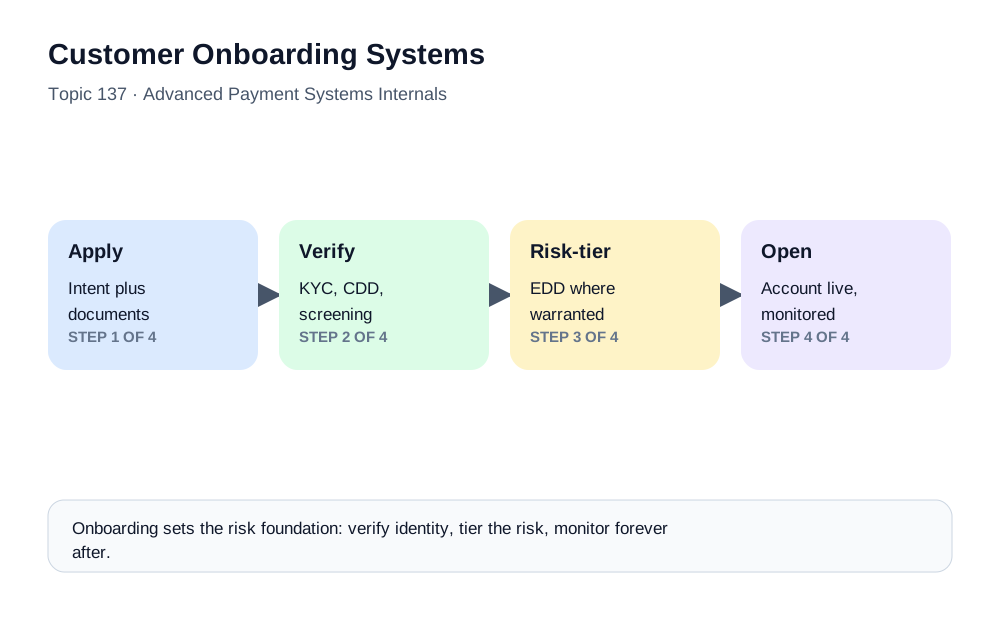
Customer Onboarding Systems at a glance — Application processing, document verification, account opening.
Opening the Relationship, Verifying Identity, and Setting the Risk Foundation
Customer onboarding is the front door of banking. It is the process through which a person, business, or institution becomes a bank customer and receives access to products, accounts, channels, cards, payments, credit, and services.
But onboarding is not only account opening. It is also identity verification, KYC, sanctions screening, PEP checks, risk assessment, product eligibility, consent capture, document management, customer communication, account creation, channel activation, and ongoing monitoring setup. If onboarding is weak, every downstream function suffers: fraud, AML, sanctions, credit, customer service, reporting, and account lifecycle management.
A good onboarding journey must do two things at the same time. It must be easy enough for genuine customers to complete, and strict enough to stop identity fraud, mule accounts, prohibited customers, fake businesses, forged documents, and non-compliant relationships.
Learning objectives
By the end of this chapter, you should be able to:
- Explain customer onboarding as both a customer journey and a bank control process.
- Describe the main onboarding steps from application to account activation.
- Distinguish identity verification, KYC, CDD, EDD, sanctions screening, PEP checks, and risk rating.
- Understand branch, assisted, and digital onboarding models.
- Identify the technology used in modern onboarding: OCR, biometrics, liveness, e-signature, document verification, APIs, and workflow.
- Explain why onboarding data quality affects payments, fraud, AML, reporting, and customer service.
- Understand common onboarding failures, drop-offs, and controls.
- Discuss why onboarding does not end when the account number is created.
1. What Customer Onboarding Means
Customer onboarding is the controlled process of accepting a new customer relationship and making that relationship operational.
It usually includes:
- application capture;
- identity and document verification;
- customer due diligence;
- sanctions and watchlist screening;
- PEP and adverse media checks;
- risk rating;
- product selection and eligibility checks;
- consent and terms acceptance;
- account or customer ID creation;
- channel and card activation;
- customer communication;
- record storage and audit trail;
- trigger setup for ongoing monitoring and periodic review.
A bank should not think of onboarding as a form. It is the first control gate in the customer lifecycle.
2. Why Onboarding Matters
Onboarding affects nearly every later process.
Fraud. Weak identity checks can create mule accounts, synthetic identities, account takeover paths, and fake merchant relationships.
AML and sanctions. Poor KYC data makes suspicious activity monitoring and sanctions screening weaker.
Payments. Incorrect names, addresses, account ownership, or customer type can create payment failures, compliance hits, and reporting issues.
Credit. Poor onboarding data leads to weak borrower assessment and wrong risk pricing.
Customer experience. Slow or confusing onboarding causes abandonment and complaints.
Regulatory reporting. Customer classification, residence, occupation, risk rating, and product details feed regulatory submissions.
Account lifecycle. Future modifications, dormancy, re-KYC, closure, death claim, and legal hold processes depend on clean onboarding records.
Good onboarding is therefore both commercial and defensive.
3. The Onboarding Lifecycle
A typical onboarding lifecycle has several stages.
Step 1: Application Capture
The customer provides basic details: name, date of birth or incorporation, contact details, address, identification number, occupation or business activity, expected usage, product choice, and consent.
Step 2: Identity Verification
The bank verifies that the customer is real and that the person applying is the person they claim to be. Methods may include document checks, database verification, biometrics, video verification, branch verification, or trusted digital identity systems.
Step 3: Customer Due Diligence
CDD builds the risk profile: who the customer is, where funds come from, expected transaction behavior, country exposure, occupation, business model, ownership, and purpose of relationship.
Step 4: Screening
The bank screens the customer and relevant parties against sanctions lists, PEP databases, adverse media, internal blacklists, and other watchlists.
Step 5: Risk Rating
The customer is classified into risk tiers such as low, medium, or high. Risk rating determines monitoring intensity, documentation requirements, approval level, and review frequency.
Step 6: Product and Account Setup
The bank creates customer ID, account number, product package, limits, pricing, tax settings, statement preference, nominee/beneficiary records where applicable, and channel access.
Step 7: Activation
The customer receives debit card, mobile/internet banking, credentials, virtual card, cheque book, API access, corporate approvals, or other services depending on product.
Step 8: Post-Onboarding Monitoring
The bank monitors whether the account behaves as expected. Dormant immediate accounts, rapid high-risk transactions, early fraud signals, or unusual payment activity may trigger review.
4. KYC, CDD, and EDD
KYC, know your customer, is the broad requirement to identify and verify the customer.
CDD, customer due diligence, goes further. It asks whether the bank understands the customer's purpose, risk, source of funds, expected activity, and ownership/control structure.
EDD, enhanced due diligence, applies to higher-risk customers. It may require senior approval, deeper source-of-wealth checks, more documents, adverse media review, site visit, beneficial ownership verification, or more frequent monitoring.
Examples of higher-risk indicators include:
- politically exposed person status;
- high-risk country connections;
- cash-intensive business;
- complex ownership structure;
- adverse media;
- unusual expected transaction volume;
- non-resident or cross-border activity;
- virtual asset exposure;
- prior fraud or account closure history;
- inconsistent documents or behavior.
The exact rules differ by jurisdiction, but the principle is common: higher risk needs stronger evidence.
5. Individual vs Business Onboarding
Individual onboarding is usually simpler. The bank verifies identity, address, tax details, occupation, contact information, and expected account usage.
Business onboarding is more complex. The bank must understand the legal entity and the people behind it.
Business onboarding may require:
- certificate of incorporation or registration;
- tax identification;
- registered address and operating address;
- nature of business;
- ownership structure;
- beneficial owners;
- directors, partners, trustees, or authorized signatories;
- board resolution or mandate;
- source of funds and expected transactions;
- website, invoices, trade licenses, or business proof;
- sanctions, PEP, and adverse media checks on entity and related parties;
- account operating rules and approval matrix.
For corporate banking, onboarding may also include payment limits, user entitlements, maker-checker workflows, host-to-host connectivity, API access, liquidity products, and treasury services.
6. Digital Onboarding
Digital onboarding compresses what once took days into minutes or hours. It may use:
- mobile number and email verification;
- document upload;
- OCR to extract data from documents;
- database verification through trusted sources;
- face match between selfie and document photo;
- liveness detection to prevent photo or video spoofing;
- video KYC or remote agent verification;
- digital signature or e-signature;
- consent capture;
- real-time sanctions and PEP screening;
- instant account creation;
- virtual card or wallet activation.
Digital onboarding improves convenience, but it also creates new risk. Fraudsters can use forged documents, deepfake attempts, stolen identity data, mule recruitment, synthetic identities, remote access scams, and device manipulation. Strong digital onboarding combines customer-friendly design with layered risk controls.
7. Onboarding Data Quality
Onboarding data becomes the foundation for many systems. Poor data creates downstream damage.
Important data includes:
- legal name;
- date of birth or incorporation;
- address;
- country of residence;
- nationality or incorporation country;
- tax identification;
- occupation or business activity;
- source of funds;
- expected account usage;
- risk rating;
- beneficial owners;
- authorized signatories;
- contact details;
- consent records;
- product and channel preferences.
If names are inconsistent, sanctions screening generates noise. If addresses are weak, payment messages and regulatory reports suffer. If occupation or business type is wrong, AML monitoring thresholds may be inappropriate. If mobile number verification is weak, account takeover risk rises.
Onboarding data is not static. It needs maintenance through periodic review and trigger-based refresh.
8. Risk Rating and Approval
Customer risk rating converts onboarding information into an operating decision.
A low-risk salaried customer with clean identity, stable residence, domestic usage, and normal product needs may be approved automatically.
A medium-risk self-employed customer may need additional documentation and standard compliance review.
A high-risk customer may require EDD, senior approval, restricted product access, lower limits, enhanced monitoring, or rejection.
Risk rating should not be a black box without explanation. The bank should know which factors contributed to the rating and which controls apply as a result.
9. Common Onboarding Drop-Offs
Customers abandon onboarding for many reasons:
- OTP not received;
- identity document not accepted;
- poor image quality;
- name mismatch;
- address mismatch;
- video verification queue too long;
- unclear error message;
- too many form fields;
- repeated consent screens;
- device or browser compatibility issue;
- failed face match;
- technical timeout;
- customer does not understand product terms;
- application under review with no status update.
A good onboarding system measures drop-off by step, reason, segment, device, and channel. Reducing friction without weakening controls is one of the core product challenges in banking.
10. Controls and Audit Trail
Onboarding must be auditable. The bank should retain evidence of:
- data submitted by the customer;
- documents provided;
- verification checks performed;
- screening results;
- risk rating;
- approvals and overrides;
- consent and terms accepted;
- account creation timestamp;
- channel activation;
- communication sent;
- exceptions and manual decisions.
Manual overrides deserve special control. If a document mismatch, screening alert, or high-risk rating is overridden, the bank must know who approved it, why, and under which policy.
11. Practical Example: Digital Savings Account Opening
A customer applies for a savings account through a mobile app.
- The app captures mobile number and email.
- OTP verifies contact control.
- The customer enters identity and tax details.
- The app scans the identity document and extracts data using OCR.
- The system checks the document against trusted sources where available.
- The customer takes a selfie; face match and liveness checks run.
- Sanctions, PEP, adverse media, and internal blacklist screening run.
- A risk score is calculated based on profile and expected usage.
- The customer accepts terms and provides consent.
- The core banking system creates customer ID and account number.
- The digital channel activates login and virtual card.
- Post-onboarding monitoring checks whether early account behavior matches expected usage.
The customer sees a simple app flow. The bank sees a controlled onboarding workflow with evidence at every step.
12. Common Misconceptions
"Onboarding ends when the account number is created." No. Early account behavior, funding, first payments, re-KYC triggers, and periodic reviews are part of customer lifecycle control.
"Digital onboarding is weaker than branch onboarding." Not necessarily. Digital onboarding can be stronger if it uses high-quality verification, biometrics, device controls, automated screening, and audit trails.
"KYC is only document collection." No. KYC/CDD means understanding identity, purpose, ownership, risk, source of funds, and expected activity.
"PEP customers must always be rejected." No. PEP status normally requires enhanced due diligence and approval, not automatic rejection, unless specific sanctions or policy restrictions apply.
"Fewer questions always means better onboarding." Only if risk remains controlled. The best onboarding asks the minimum necessary questions at the right time and uses data intelligently.
13. Frequently Asked Questions
What is customer onboarding in banking? It is the process of accepting a new customer relationship, verifying identity, assessing risk, creating the account or product, activating channels, and setting up monitoring.
What is eKYC? eKYC is electronic know-your-customer verification using approved digital identity, databases, documents, biometrics, or remote verification methods depending on local law.
What is beneficial ownership? Beneficial ownership identifies the real individuals who ultimately own or control a legal entity, even if the company has multiple layers.
Why do banks ask expected transaction activity? Because expected activity helps detect unusual behavior later. If a customer says domestic salary account but starts receiving high-value foreign transfers, monitoring can flag it.
What is video KYC? Video KYC is remote identity verification through a live video interaction or controlled video process, subject to local regulatory rules.
Why can onboarding be rejected? Reasons may include failed identity verification, sanctions match, unacceptable risk, incomplete documents, suspicious behavior, policy restrictions, or inability to verify source of funds.
14. Key Terms in This Chapter
- Customer onboarding - process of accepting and activating a new customer relationship.
- KYC - know your customer identity verification requirement.
- CDD - customer due diligence, understanding customer purpose and risk.
- EDD - enhanced due diligence for higher-risk customers.
- PEP - politically exposed person.
- Beneficial owner - individual who ultimately owns or controls a legal entity.
- Risk rating - classification of customer risk level.
- eKYC - electronic KYC process.
- Liveness detection - check that a real person is present during digital verification.
- OCR - optical character recognition used to extract document data.
- Adverse media - negative news or public information relevant to risk.
- Source of funds - origin of money expected to enter the account.
- Consent capture - record that customer accepted terms and data usage.
- Post-onboarding monitoring - early monitoring after account activation.
15. Interview Insights
"What are the main steps in customer onboarding?" Application capture, identity verification, CDD, screening, risk rating, approvals, account setup, channel activation, communication, and post-onboarding monitoring.
"How is onboarding connected to AML?" Onboarding creates the customer profile, risk rating, expected activity, ownership data, and source-of-funds understanding that AML monitoring uses later.
"What controls are needed in digital onboarding?" Document verification, OTP or contact verification, liveness, face match, sanctions/PEP screening, device controls, consent records, fraud checks, audit trail, and manual review for exceptions.
"Why is business onboarding more complex than individual onboarding?" Because the bank must verify the entity, beneficial owners, directors, signatories, ownership structure, business activity, authority to operate, and expected transaction behavior.
"What onboarding metrics would you track?" Completion rate, drop-off by step, time to account opening, verification failure rate, video KYC success rate, manual review rate, fraud after onboarding, activation rate, and first transaction within defined days.
Summary and Key Takeaways
Customer onboarding is the first major control point in the banking relationship. It must balance customer convenience, regulatory compliance, fraud prevention, and data quality.
The main lessons are:
- Onboarding is more than account opening. It creates the identity, risk, product, channel, and monitoring foundation.
- KYC, CDD, and EDD are different layers. Identity verification is only the beginning.
- Business customers require deeper checks. Beneficial ownership, authority, signatories, and business purpose matter.
- Digital onboarding improves speed but changes risk. Strong verification and fraud controls are essential.
- Data quality has long life. Onboarding data feeds payments, AML, sanctions, reporting, service, and lifecycle management.
- Drop-off is a design signal. Banks must reduce friction without weakening controls.
- Onboarding continues after activation. Early account behavior and periodic reviews complete the control loop.
A bank that onboards well starts the relationship with trust, accuracy, and control. A bank that onboards poorly spends the rest of the lifecycle repairing the first mistake.
Next: Topic 138 - Account Lifecycle Management
<!-- MBA-DEEP-DIVE-START -->Customer Onboarding Deepening — Identity, Authority, Risk, Fraud, Data Quality, and Activation
Onboarding should establish a customer relationship, not merely create an account number
A bank can technically create an account before it has established that the applicant is genuine, eligible for the product, properly authorised, and understood from a financial-crime perspective. Good onboarding therefore separates application, due diligence, approval, account creation, funding, and activation. The system should know which controls are still outstanding at every stage. An account that exists in the core but cannot yet transact should have a controlled pre-active state rather than being treated as fully operational.
The legal customer and the human user may be different
For an individual account, the customer and user are often the same person. For a company, trust, partnership, government body, or institution, the legal customer can be an entity while several people act for it. Onboarding needs to distinguish beneficial owners, directors, trustees, authorised signatories, administrators, channel users, and approvers. Confusing these roles weakens both KYC and payment entitlement controls.
Identity verification answers a narrower question than CDD
Identity verification asks whether a person or entity is who it claims to be. Customer due diligence asks whether the bank understands who it is dealing with, why the relationship exists, who owns or controls it, where money is expected to come from, and what activity is expected. A genuine identity can still present high sanctions, AML, fraud, credit, or conduct risk. Passing document verification should therefore not automatically complete onboarding.
Identity evidence should be risk-appropriate and jurisdiction-aware
Different markets permit different combinations of official documents, national digital identity, database checks, video verification, biometrics, or in-person verification. The bank should maintain approved evidence rules by legal entity and product rather than inventing one global checklist. Expired, damaged, foreign, or unusual documents need controlled exception routes. Staff should know when an alternative document is allowed and when compliance approval is required.
Document authenticity and identity ownership are separate controls
A passport can be genuine but stolen. A utility bill can be authentic but belong to another person. Digital onboarding should therefore combine document authenticity, data validation, face or identity matching where lawful, possession or control checks, and fraud signals. Relying only on OCR confirms what the document says, not that the applicant is entitled to use it.
OCR should be treated as data capture, not truth
Optical character recognition can reduce manual typing but can misread names, dates, document numbers, or non-Latin scripts. Critical fields should be validated against the image, checksum, trusted source, or customer confirmation depending on risk. The system should retain confidence and allow review for uncertain extraction. Automatically overwriting customer-entered information with low-confidence OCR can create downstream screening and reporting errors.
Liveness is one layer of anti-spoofing
Liveness checks aim to detect photographs, replays, masks, or synthetic presentations, but no technique is perfect. Deepfakes and injection attacks can target the capture process itself. Banks should combine liveness with secure SDKs, device integrity, document checks, behavioural signals, and post-onboarding monitoring. Failure handling should include accessible alternatives for genuine customers who cannot complete a standard biometric flow.
Face matching needs threshold governance
A biometric comparison produces confidence, not absolute identity proof. Thresholds affect false acceptance and false rejection. Banks should validate performance across relevant populations, devices, lighting conditions, and document quality. Manual review processes should prevent a low-confidence match from becoming automatic rejection without a safe alternative. Biometric models also require privacy, retention, and security governance.
Contact verification should not establish identity by itself
Possession of a mobile number or email proves control of that contact point, not that the applicant is the claimed person. Fraudsters can obtain SIMs, compromise email, or use temporary contact details. OTP is useful for channel activation and communication but should be one component of identity and fraud control. Recent SIM changes or reused contact details can be additional risk signals where lawfully available.
Device intelligence can detect onboarding factories
Mule recruiters and fraud rings may open many accounts from shared devices, emulators, IP ranges, or automation tools. Onboarding fraud systems can monitor device reuse, rapid application velocity, unusual geolocation, emulator signals, and repeated document patterns. These signals should be analysed carefully because shared family devices or public networks can be legitimate. The strongest decisions combine device evidence with identity and behaviour.
Application velocity matters
A single failed application may be innocent. Dozens of applications from the same device, address, phone pattern, employer, introducer, or document template can indicate organised fraud. Enterprise onboarding should therefore analyse relationships between applications, not only each application separately. Graph techniques can reveal synthetic identity and mule networks before any transaction occurs.
Duplicate-customer detection is a control and a service feature
Creating multiple customer IDs for the same real person fragments KYC, limits, sanctions screening, credit exposure, service history, and fraud monitoring. Matching should consider identifiers, name, date of birth, address, contact information, and trusted national identifiers where lawful. Potential duplicates need a controlled merge or link process; automatically combining similar people can be equally dangerous.
Customer master and account master should be separate concepts
One customer can hold several accounts and products. KYC, risk rating, identity, and contact details generally belong to the customer relationship, while product status, balance, mandate, and account-specific restrictions belong to the account. Mixing them creates inconsistent maintenance: a changed address might update one account but not another. Architecture should clearly define which attributes are customer-level and which are account-level.
Purpose of relationship should influence monitoring
A student savings account, payroll account, family office, import-export company, charity, and money-service business have different expected patterns. The onboarding process should capture business purpose in a structured form that transaction monitoring and periodic review can use. Free-text descriptions that never reach downstream controls add little value. Expected activity should be realistic enough to distinguish normal change from unexplained behaviour later.
Source of funds and source of wealth are not the same
Source of funds explains where money used in a transaction or relationship comes from, such as salary, business revenue, sale proceeds, inheritance, or investment redemption. Source of wealth explains how a person's broader wealth was accumulated. Higher-risk relationships may require deeper evidence of one or both depending on law and policy. Onboarding teams should use the terms accurately so customers are not asked irrelevant questions and evidence is reviewed consistently.
Beneficial ownership should identify real control and ownership
Legal entities can have multiple corporate layers, nominees, trusts, or partnerships. Banks need to identify beneficial owners according to applicable law and understand control even where direct shareholding is not obvious. The system should retain ownership percentages, relationship type, evidence, and effective dates rather than only a list of names. Ownership data feeds sanctions, PEP, AML, tax, and credit controls.
Ownership structures change after onboarding
A company can sell shares, appoint new directors, change signatories, or restructure its group. Trigger events should prompt refresh rather than waiting blindly for the next periodic review. External registries, customer notifications, payments behaviour, and screening changes can all indicate that customer data needs attention. Onboarding is the first capture, not the final version of the customer.
Corporate authority needs documentary and system evidence
Opening a company account should establish who has authority to bind the entity, who can operate the account, who can create payment users, and which approvals are required. Board resolutions, mandates, constitutional documents, or other legal evidence may be needed depending on entity type. Digital channel entitlements should be generated from approved authority rather than created independently by a technical administrator.
Maker-checker starts at onboarding for corporate banking
A corporate may require two authorised users to approve payments, separate administrators for entitlement management, or transaction limits by role. These rules should be captured when the relationship is established and maintained through lifecycle changes. If onboarding stores only names but not approval logic, downstream payment channels must reconstruct authority manually, increasing risk.
Product suitability and eligibility should be explicit
A customer can pass KYC but still be ineligible for a particular account, investment, credit, or service. Age, residency, legal form, tax status, financial sophistication, risk appetite, or other rules may matter depending on product and law. Product eligibility should be a separate decision from customer acceptance. This makes it clear whether the bank rejects the relationship or simply cannot offer one product.
Consent should be granular and evidenced
Terms acceptance, privacy notices, marketing choice, Open Finance consent, electronic communication, and product mandates may have different legal bases and withdrawal rules. Onboarding should not reduce all of them to one checkbox. The bank should record what version the customer saw, what action indicated agreement, timestamp, channel, and any later withdrawal. Consent evidence becomes important years after account opening.
Accessibility should be designed into onboarding
A customer with visual, hearing, motor, cognitive, language, or literacy needs should have a safe path through the process. CAPTCHA, tiny document frames, voice-only instructions, or complex timeouts can exclude genuine customers. Assisted digital, branch, accessible video, screen-reader compatibility, and alternative authentication should be considered. Inclusion is strongest when alternative paths maintain equivalent security rather than weakening controls.
Digital onboarding should avoid forcing customers into insecure workarounds
If an app requires a document format customers cannot produce, they may send sensitive images through email or messaging channels to staff. If video queues repeatedly fail, staff may bypass approved verification. Product teams should monitor where customers and employees create workarounds. Friction becomes a control risk when it pushes activity outside governed systems.
Abandonment should be analysed by reason, not just rate
A lower completion rate may result from good fraud prevention or bad user experience. Banks should distinguish customer choice, technical failure, verification failure, compliance review, eligibility rejection, and suspected fraud. Funnel metrics by device, step, language, and customer segment can identify unnecessary friction without encouraging teams to optimise by simply approving more applicants.
Manual review should be risk-based
Routing every application to humans destroys digital efficiency, while auto-approving every edge case is unsafe. Confidence thresholds can send ambiguous identity, ownership, screening, or fraud cases to trained reviewers. Queues should prioritise risk and ageing. Review tools should show the evidence needed to make a decision rather than forcing analysts to search several disconnected systems.
Overrides deserve strong controls
A manual override can be legitimate when automated data is incomplete or wrong. But overriding a document mismatch, sanctions alert, risk rating, or fraud signal can create major exposure. The system should require reason, evidence, authority level, and sometimes independent approval. Override trends should be monitored by employee, branch, product, and reason to identify abuse or poor automated rules.
Screening should cover relevant related parties
For entities, sanctions and PEP checks may need to include beneficial owners, directors, signatories, trustees, or other related parties depending on rules and risk. The onboarding workflow should know which roles require which screening. A clean company name is not sufficient if an owner is restricted. Related-party changes later should trigger rescreening.
PEP status is a risk factor, not a universal prohibition
Politically exposed persons can require enhanced due diligence, source-of-wealth scrutiny, senior approval, and closer monitoring under applicable frameworks. They are not automatically sanctioned merely because they are PEPs. Onboarding systems should keep PEP and sanctions decisions distinct so controls remain legally accurate and customer treatment is fair.
Adverse media should be evidence, not automated conviction
News can contain allegations, outdated reports, mistaken identity, or low-quality sources. Automated adverse-media tools can help find relevant information, but trained review is needed to assess credibility, recency, severity, and connection to the applicant. A simple keyword hit should not become an unchallengeable rejection reason. Decision rationale should distinguish confirmed facts from allegations.
Risk-rating models should be explainable and maintained
Customer risk may combine geography, product, occupation, legal form, ownership, expected activity, delivery channel, PEP status, and other factors. Weightings and thresholds should have documented rationale and validation. Changes in business or regulation can make old scores inappropriate. Monitoring should compare rated risk with observed customer behaviour and investigation outcomes.
Credit decisioning should not contaminate KYC decisions silently
A customer may be acceptable from AML and sanctions perspective but fail credit policy, or vice versa. Combined onboarding journeys should preserve decision reasons by domain. Otherwise a customer could be told “KYC failed” when the real issue was affordability, or compliance staff could mistakenly believe a credit decline means the relationship is prohibited. Clear decision layers improve governance and communication.
Activation should require completion of mandatory gates
Account creation, card issuance, mobile login, outgoing payments, and incoming funding can have different activation conditions. Some banks may allow limited funding before full activation under applicable rules; others may not. The system should enforce exactly what is permitted in each state. A manually created account should not bypass outstanding sanctions or identity checks because a downstream channel sees only “open.”
First funding is a fraud and AML signal
The first money entering a new account can validate whether the relationship behaves as expected. A new salary account funded immediately by many unrelated third parties, or a small-business account receiving high-risk cross-border flows on day one, may warrant review. Post-onboarding monitoring should be more sensitive to early-life behaviour without treating all new customers as suspicious.
Early-life fraud metrics test onboarding quality
Fraud or mule activity within days of opening can indicate weak identity, device, or recruitment controls. Banks should track first 7-, 30-, or other policy-defined day outcomes by acquisition channel, branch, partner, and verification method. This closes the feedback loop between downstream fraud cases and onboarding design. Acquisition growth should not be rewarded without considering early losses and account abuse.
Third-party onboarding partners remain a bank risk
Fintechs, agents, business correspondents, introducers, or outsourced verification providers may perform parts of onboarding. The regulated institution should understand what was delegated, what evidence is returned, how controls are tested, how incidents are reported, and how the partner is monitored. A partner's “KYC complete” flag is insufficient if the bank cannot reproduce the basis of the decision.
API onboarding needs contract and schema governance
A partner may send customer applications through APIs. Mandatory fields, enumerations, document links, consent, error codes, idempotency, and retry rules need version control. If the partner sends a new customer type or code the bank does not recognise, the API should reject safely rather than default to a lower-risk category. Technical validation protects regulatory data quality.
Data minimisation should guide form design
Banks need enough information to meet law, assess risk, and provide the product. Asking for data “just in case” increases privacy exposure and abandonment. Each field should have a defined purpose and owner. Optional marketing questions should not be disguised as mandatory KYC. Cleaner forms improve both customer experience and data governance.
Customer communication should explain review states
Applications can be approved, declined, pending information, under manual review, or technically incomplete. Customers should know whether they need to act and how long an application remains valid, subject to legal limitations. Vague “processing” messages cause duplicate applications and contact-centre load. Internally, compliance-sensitive reasons can remain restricted while customer-facing statuses remain truthful.
Records should support the entire relationship lifecycle
Years after onboarding, the bank may need to prove identity checks, ownership, consent, screening, product terms, and authority. Documents and decision evidence should be retained according to applicable law and policy, with strong access control. The archive should preserve version and provenance rather than only the latest customer profile. Historical evidence matters in investigations and legal disputes.
The best onboarding system creates trusted reusable data
Successful onboarding is not measured only by speed. It should create a verified customer identity, understood ownership and purpose, appropriate risk rating, valid authority, product eligibility, complete consent, and clean master data that downstream payments, AML, fraud, credit, reporting, and service teams can rely on. Fast account opening is valuable only when the bank starts the relationship with evidence it can trust.
Customer Onboarding — Identity, Product Eligibility, Risk Controls, and Operational Handover
Onboarding creates both a customer relationship and a controlled system identity
Opening an account is not only a user-interface journey. The bank must establish who the customer is, what legal or organisational capacity they have, which product they are eligible for, what risk controls apply, which accounts and services should be created, and how the relationship will be maintained afterward. A fast application that creates an incomplete or inconsistent customer record simply moves work into operations and future remediation.
Customer identity should have one authoritative internal representation
A person may arrive through branch, mobile, web, partner, or corporate channels. The bank needs a controlled customer or party record that prevents unnecessary duplicates while respecting legal-entity and privacy requirements. Matching should use appropriate identifiers and evidence rather than name alone. When two records may represent the same person, the process should support review and safe merge or linkage. Duplicate customer identities cause fragmented limits, inconsistent KYC, poor service, and fraud-control gaps.
Identity proofing and authentication are different stages
Identity proofing establishes that the applicant corresponds to a real person or entity using acceptable evidence. Authentication establishes that a returning user can prove control of credentials or factors associated with that identity. A strong onboarding process performs proofing before creating durable access and then binds approved authentication methods securely. Confusing the two can lead to a bank strongly authenticating someone whose identity was never properly established.
Digital evidence should retain provenance
Documents, electronic records, database checks, biometrics, or other evidence may support identity according to market and product rules. The bank should retain what evidence was used, source, time, result, and relevant quality indicators. A generic “KYC passed” flag cannot explain why the relationship was approved. Provenance supports later review when a document expires, a fraud case emerges, or a regulator asks how identity was established.
Document capture requires quality and fraud controls
Images can be blurred, cropped, manipulated, expired, or belong to another person. Automated checks can assess readability and authenticity signals, but uncertain cases need review. The bank should avoid training customers to repeatedly upload sensitive documents without explaining why a capture failed. Storage and access to document images should be tightly controlled because onboarding repositories contain highly valuable identity data.
Biometric use needs liveness, fallback, and governance
Face or voice technology can reduce friction but creates false-match, false-non-match, spoofing, accessibility, and privacy risks. Biometric matching should have tested thresholds and liveness or presentation-attack controls appropriate to the use. Customers who cannot complete the biometric journey need a secure alternative. A low-friction biometric path should never become the only path if it systematically excludes legitimate applicants.
Entity onboarding requires authority, ownership, and structure
Corporate and institutional customers add another layer. The bank may need legal existence, registered details, directors, authorised signers, beneficial owners, ownership chains, business activity, expected transactions, and authority to open accounts. Complex structures should be represented explicitly rather than squeezed into retail person fields. Changes in ownership or signatories after onboarding must update the same authoritative relationship model.
Beneficial ownership is a data-maintenance problem as well as an onboarding problem
Ownership can change through investment, restructuring, inheritance, or corporate transactions. If the bank captures ownership only at account opening, risk information becomes stale. The onboarding data model should therefore support effective-dated ownership relationships and trigger periodic or event-driven refresh according to policy. Evidence of how ownership was determined should be retained for review.
Product eligibility should be separate from identity approval
A customer can be properly identified but not eligible for a particular account, credit product, investment service, or jurisdictional offering. Eligibility services should consider age, residence, legal capacity, customer segment, product restrictions, tax or regulatory factors, and other approved criteria. This separation lets the bank reuse verified identity while applying product-specific rules transparently.
Risk assessment should use declared and verified context
Expected occupation, business activity, source of funds, geography, transaction behaviour, and product use can inform customer risk according to the bank's methodology. The risk model should use defined data elements and retain version and rationale. A score alone is not sufficient if teams cannot explain which information drove enhanced review or monitoring. Risk assessment should be refreshed when material customer circumstances change.
Sanctions and other screening should link to the onboarding case
Potential matches may require manual investigation before the relationship is activated. The onboarding workflow should retain the screening result, list or configuration version, alert disposition, investigator, and decision as appropriate. A screening hold should be represented as a controlled state rather than a technical error. If the applicant updates a material name or ownership field, policy should determine whether re-screening is required.
Fraud controls should examine application behaviour
Synthetic identities, stolen documents, device farms, mule recruitment, repeated applications, and account-opening bots can target digital onboarding. Signals can include device integrity, email or phone history, velocity, document reuse, network relationships, and behavioural patterns. Fraud scoring should not silently replace identity requirements; it complements them. High-risk applications may require step-up evidence or specialist review.
Application state should be explicit and recoverable
A customer may start an application, save it, provide documents later, wait for review, or abandon it. Systems should distinguish draft, submitted, awaiting evidence, under review, approved, rejected, expired, and activated states or an equivalent model. Resuming should not create duplicate accounts or bypass controls already completed. Expired applications need rules for which evidence can be reused and which must be refreshed.
Data should be collected once when possible and validated at source
Repeatedly asking the customer for the same address or tax identifier creates inconsistency and frustration. Shared party data can be reused when valid and permitted, while product-specific information remains separate. Validation should happen as early as practical so incorrect formats, impossible dates, or invalid codes are corrected before downstream systems consume them. Late remediation is more expensive than point-of-entry validation.
Consent and privacy choices should not be bundled invisibly
Operationally necessary data processing, optional marketing consent, third-party data sharing, and product terms may have different legal bases and customer choices. Onboarding interfaces should distinguish them appropriately. A customer should not need to accept unrelated marketing to open a basic product. Consent records should capture what was agreed, version, time, channel, and withdrawal where relevant.
Address handling should support real-world complexity
Customers can have residential, mailing, registered, tax, or temporary addresses. Migrants and customers in informal housing may have limited conventional proof. Corporate structures can have registered office and operating locations. The data model should distinguish address types and evidence rather than overwriting one field repeatedly. Address updates should propagate to the services that require them without corrupting historical records or statements already issued.
Account creation should be idempotent
A timeout after approval must not create two customer accounts when the application retries. Stable application and product-order identifiers should allow the orchestration layer to ask whether the account was already created. The same principle applies to card orders, digital access, and welcome communications. Duplicate products are not only inconvenient; they create accounting, fee, credit, and fraud complications.
Downstream provisioning should be observable
After approval, multiple systems may need to create account records, limits, cards, online access, notification preferences, ledger mappings, and customer service relationships. The customer should not be told onboarding is complete if critical provisioning failed. Orchestration should track each dependency and support repair. A partial activation state should be visible to operations so missing components are corrected without opening a second relationship.
First funding can be part of risk and service design
Some products require initial funding or a first transaction. The bank should define permitted funding sources, account ownership checks, limits, and treatment of failed deposits. Fraudsters may use stolen payment instruments or third-party transfers to activate accounts, while genuine customers can be confused by unclear funding status. The onboarding journey should distinguish account approval from successful funding.
Handover to ongoing monitoring must be complete
When onboarding closes, customer data should feed transaction monitoring, sanctions rescreening, tax reporting, limits, customer service, and periodic review. Expected activity captured during onboarding is valuable only if ongoing controls can access it. The handover should include risk rating, ownership, occupation or business, geographies, products, and review dates as relevant. An onboarding case that remains isolated in a workflow archive creates a broken customer-control lifecycle.
Periodic review should reuse the original evidence intelligently
A review should not force the customer to restart from zero if most data remains valid. The bank can present existing information for confirmation, identify expired evidence, and focus on material changes. At the same time, stale data should not be carried forward indefinitely merely to reduce friction. Review design balances customer convenience with the need for current, reliable information.
Decline communication should be controlled and appropriate
An application may be declined for eligibility, risk, fraud, screening, credit, or incomplete evidence. What the bank can and should tell the applicant varies by context. Systems should use approved reason categories and customer communication rather than exposing sensitive detection logic or returning a generic technical error for every negative outcome. Internal records need enough detail for complaint review even when external disclosure is limited.
Onboarding metrics should include quality after activation
Conversion rate and time to open are useful but can incentivise weak controls if measured alone. Banks should also monitor duplicate customers, remediation rates, early fraud, missing KYC, provisioning failures, complaints, abandonment reason, manual-review volumes, and time to first successful use. A journey that opens accounts in two minutes but creates heavy remediation is not truly efficient.
The mature onboarding process establishes a relationship that can survive future change
A customer will change address, device, employment, ownership, products, risk, and authorised users over time. Good onboarding creates structured, evidence-rich party data that can evolve without losing history. It connects identity, eligibility, controls, product provisioning, and ongoing monitoring through clear states and ownership. That foundation matters more than the visual speed of the first screen because every later banking process relies on the quality of the relationship created at the beginning.
Onboarding Quality and Post-Activation Controls
Early-life monitoring can validate the onboarding decision
The first days of an account often provide information unavailable during application. Immediate high-risk transfers, rapid device changes, unexpected cash movement, or activity inconsistent with the declared profile can indicate fraud, mule use, or an incorrectly understood customer. Banks can apply proportionate early-life monitoring while avoiding automatic suspicion of every new customer. The purpose is to connect onboarding assumptions with observed behaviour and route material inconsistencies for review.
Partner-originated onboarding should preserve bank accountability
A fintech, merchant, employer, or platform may collect application data before passing it to the bank. The bank still needs evidence that required identity, consent, disclosures, and product controls were completed. Partner contracts should define data fields, evidence retention, security, incident reporting, customer communication, and audit rights. A smooth embedded journey should not create an evidence gap in which neither party can later prove what the applicant saw or supplied.
Manual-review operations need calibrated queues
Some applications will remain uncertain after automated checks. Review queues should be prioritised by risk and customer waiting time, with clear information requirements and escalation. Reviewers need consistent decision guidance so similar cases do not receive different outcomes merely because they reached different operators. Sampling and quality assurance can identify drift in manual decisions and feed improvements back into rules or automation.
Onboarding failures should have resumable customer journeys
A temporary service outage, failed verification provider, or missing document should not force a genuine applicant to re-enter every field. The system should save safe intermediate state and allow controlled resumption after authentication. Sensitive evidence should not be cached insecurely merely for convenience. Resumability reduces abandonment while maintaining confidence that a different person has not taken over the unfinished application.
Successful onboarding ends with a usable product
The customer outcome is not “application approved” but the ability to access the account, understand key terms, fund or use it, receive required communications, and obtain help. Banks should test the complete first-use journey. A high approval rate combined with failed card delivery, broken login, or missing payment entitlement is an onboarding quality problem even if the application workflow itself performed perfectly.
<!-- MBA-DEEP-DIVE-END -->