Visual overview
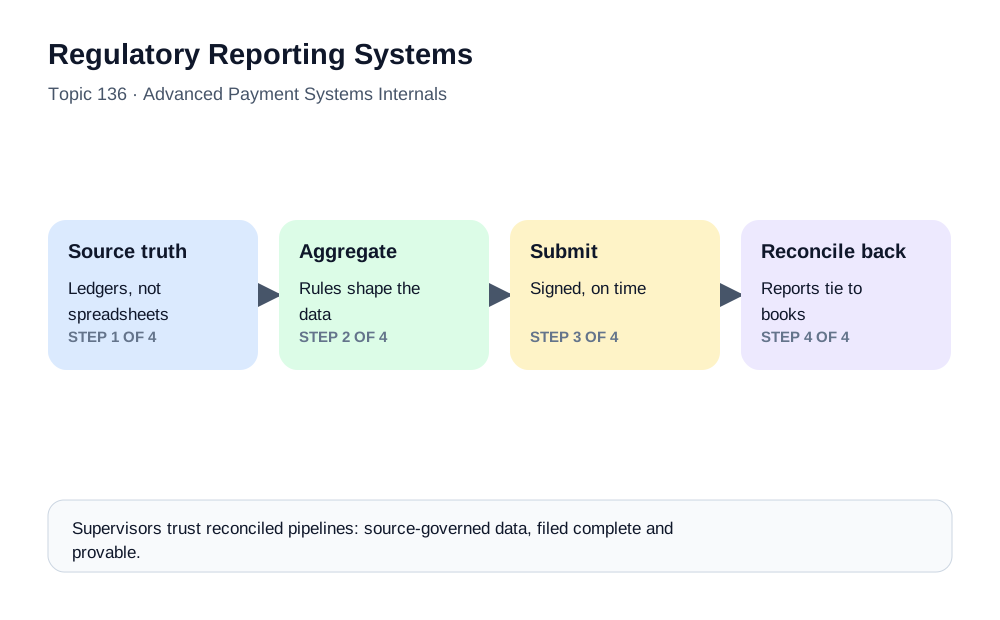
Regulatory Reporting Systems at a glance — Automated reporting, data aggregation, submission workflows.
Turning Bank Activity into Trusted Supervisory Data
A bank does not only serve customers and process transactions. It must also explain itself continuously to regulators. How much liquidity does it hold? How much capital? How many payments failed? How many fraud cases occurred? Which loans are overdue? What suspicious transactions were reported? Which exposures are concentrated? Are customer complaints being resolved on time? Are payment systems available and resilient?
Regulatory reporting is the discipline that answers these questions in prescribed formats, at prescribed frequencies, using controlled data. It is not just a compliance formality. It is how supervisors monitor bank safety, payment-system health, customer protection, financial crime risk, and systemic stability.
This chapter explains regulatory reporting as a banking data and control system. It covers source systems, reporting obligations, data lineage, validation, XBRL/API submission, payment-system reporting, financial-crime reporting, governance, audit trail, errors, resubmissions, and why reporting quality matters to the whole bank.
Learning objectives
By the end of this chapter, you should be able to:
- Explain why banks submit regulatory reports and what regulators use them for.
- Identify major reporting areas: capital, liquidity, credit, payments, fraud, AML, complaints, and operational resilience.
- Understand how data flows from source systems to regulatory reports.
- Explain data lineage, validation rules, control totals, sign-off, and audit trail.
- Distinguish manual, spreadsheet-based, automated, and API-based reporting models.
- Understand payment-system and financial-crime reporting examples.
- Identify common reporting failures and their consequences.
- Discuss why regulatory reporting is a strategic data capability, not only a compliance task.
1. What Regulatory Reporting Means
Regulatory reporting is the process of collecting, transforming, validating, approving, and submitting required information to supervisory authorities.
The regulator may be a central bank, banking supervisor, securities regulator, financial intelligence unit, payment-system operator, data-protection authority, tax authority, deposit insurer, or consumer-protection body.
Reports may be:
- daily;
- weekly;
- monthly;
- quarterly;
- annual;
- event-driven;
- ad hoc during stress, inspection, or incident.
Some reports are aggregated. Others require granular account, customer, exposure, transaction, or incident-level data. The reporting burden is increasing globally because supervisors want earlier warning signals and more detailed evidence.
2. Why Regulators Need Bank Reports
Regulatory reports support several supervisory objectives.
Safety and soundness. Regulators monitor capital, liquidity, asset quality, profitability, concentration risk, and operational resilience.
Financial stability. Data across banks helps supervisors identify systemic risks, contagion channels, credit bubbles, liquidity stress, and payment-system vulnerabilities.
Monetary policy and macroeconomics. Credit growth, deposits, interest rates, money supply, and liquidity reports support policy decisions.
Payment-system oversight. Volumes, values, failures, downtime, settlement issues, fraud, and complaints help regulators assess the health of payment rails.
Financial crime control. Suspicious transaction reports, cash transaction reports, sanctions reports, and high-risk customer data help authorities detect illicit activity.
Consumer protection. Complaint reports, dispute resolution timelines, mis-selling data, and fraud reimbursement data help regulators detect customer harm.
Regulatory reporting is therefore the bank's supervisory mirror. If the mirror is distorted, the regulator cannot see the real risk.
3. Main Regulatory Reporting Domains
Banks normally report across many domains.
| Domain | Examples of Reported Data | Why It Matters |
|---|---|---|
| Capital | capital adequacy, risk-weighted assets, leverage ratio | Shows loss-absorbing capacity |
| Liquidity | liquidity coverage, stable funding, cash reserves, maturity gaps | Shows ability to meet obligations |
| Credit risk | loan classification, arrears, provisions, large exposures | Shows asset quality and concentration |
| Market risk | trading positions, VaR, stress results, sensitivities | Shows exposure to market movement |
| Operational risk | incidents, outages, losses, cyber events | Shows resilience and control weakness |
| Payments | volumes, values, declines, timeouts, settlement issues | Shows payment-system performance |
| Fraud | cases, amounts, channel, loss, recovery | Shows customer and bank loss exposure |
| AML/CFT | suspicious transactions, cash transactions, high-risk jurisdictions | Supports financial-crime supervision |
| Customer complaints | volumes, categories, ageing, resolution | Shows consumer harm and service quality |
| Sustainability/ESG | climate exposures, financed emissions, governance metrics | Supports emerging supervisory expectations |
The exact reports differ by country, but the themes are common across modern banking regulation.
4. Payment-System Reporting
Payment-system reporting has become more important because digital payment volumes are now huge and customer impact is immediate.
A bank or payment participant may report:
- transaction volume and value by rail;
- success, failure, timeout, and decline rates;
- settlement positions and settlement failures;
- system availability and downtime;
- incident reports and root causes;
- fraud by channel and payment type;
- customer complaints and resolution timelines;
- unauthorized transaction claims;
- dispute volumes and ageing;
- performance against scheme SLAs;
- operational resilience metrics.
Payment reporting is not only statistics. It tells regulators whether money movement is reliable, fair, resilient, and safe.
5. Financial-Crime Reporting
Financial-crime reporting is another critical area.
Depending on jurisdiction, banks may submit:
- suspicious transaction reports;
- suspicious activity reports;
- cash transaction reports;
- cross-border wire transfer reports;
- sanctions asset-freeze reports;
- terrorist-financing alerts;
- high-risk country exposure reports;
- PEP or high-risk customer monitoring reports;
- correspondent banking due-diligence information.
In India, FIU-IND receives reports such as suspicious transaction reports and cash transaction reports. In other jurisdictions, equivalent financial intelligence units receive similar reports. The names and thresholds differ, but the principle is the same: banks are expected to detect and report activity that may indicate financial crime.
6. The Regulatory Reporting Data Chain
A regulatory report is only as good as its data chain.
A typical chain looks like this:
- Source systems - core banking, loans, cards, payments, treasury, AML, fraud, CRM, complaints, GL, HR, and finance systems.
- Data extraction - batch files, APIs, database views, event streams, or ETL pipelines pull required data.
- Data transformation - fields are mapped, cleaned, standardized, aggregated, and calculated.
- Business rules - regulatory definitions are applied: classifications, thresholds, ageing, exposure categories, product groups, customer types.
- Validation - completeness, format, cross-field logic, totals, prior-period movement, and reconciliation checks run.
- Review and sign-off - business, finance, risk, compliance, or regulatory reporting teams approve the output.
- Submission - the report is submitted through portal, XBRL, file upload, API, or secure channel.
- Acknowledgement and archive - submission receipt, validation response, final version, and evidence are stored.
Every number in a report should be traceable back to source. This is data lineage.
7. Data Lineage and Audit Trail
Data lineage answers: where did this reported number come from?
For example, a payment-fraud report may show 12,436 fraud cases and a total loss amount. A regulator or auditor may ask how that number was produced. The bank should be able to show:
- source systems used;
- extraction date and time;
- filters applied;
- fraud definition used;
- excluded cases and reasons;
- currency conversion rules;
- aggregation logic;
- adjustments made;
- approver and timestamp;
- submitted report version.
Without lineage, regulatory reporting becomes a trust problem. The bank may submit a number, but it cannot prove the number.
8. Validation Controls
Regulatory reports need multiple validation layers.
Technical validation checks file format, mandatory fields, data types, length, and schema rules.
Business validation checks whether values make sense: totals equal sub-totals, ratios are within expected range, dates are valid, classifications are consistent, and required fields exist.
Reconciliation validation compares reported numbers to GL, sub-ledgers, settlement reports, complaint systems, or prior submissions.
Trend validation checks period-on-period movement. A sudden 80% drop in payment failures may be real, but it should be explained.
Approval validation ensures the right teams reviewed and signed off before submission.
A regulator may reject a technically valid report if the business content is inconsistent or unsupported.
9. Manual vs Automated Reporting
Many banks historically used spreadsheets for regulatory reporting. Spreadsheets are flexible but risky. They can contain broken formulas, manual copy-paste errors, uncontrolled adjustments, version confusion, and weak audit trail.
Automated reporting improves control by using defined source feeds, repeatable transformations, validation rules, workflow approvals, and controlled submissions. But automation is not automatically correct. If source data is wrong or business rules are misunderstood, automation can produce wrong reports faster.
Mature reporting uses:
- governed data definitions;
- automated extraction;
- controlled transformation;
- validation rules;
- exception workflow;
- business sign-off;
- audit trail;
- controlled resubmission process;
- regulatory change management.
10. XBRL, APIs, and Digital Supervisory Reporting
Many regulators use digital submission formats. XBRL, or eXtensible Business Reporting Language, allows structured, machine-readable reporting using defined taxonomies. APIs are increasingly used for direct submission, acknowledgement, and validation.
Digital reporting enables faster validation and comparison across institutions. It also increases pressure on banks because errors can be detected automatically. A field mismatch, taxonomy error, invalid code, or inconsistent total may be rejected immediately.
The trend is toward more granular, more frequent, more automated reporting. Some regulators are exploring near-real-time or data-pull models, where supervisors access standardized datasets rather than waiting for static reports.
11. Common Reporting Failures
Regulatory reporting can fail in several ways:
- late submission;
- wrong format;
- incomplete data;
- wrong classification;
- duplicate records;
- missing branch, product, or customer segment;
- incorrect currency conversion;
- mismatch with GL or prior report;
- outdated regulatory rule;
- unsupported manual adjustment;
- weak evidence for resubmission;
- wrong interpretation of definition;
- failure to report an incident or fraud case within timeline.
The consequence may be resubmission, supervisory query, penalty, inspection finding, remediation programme, capital add-on, restriction, or reputational damage.
12. Regulatory Change Management
Regulatory reports change often. New fields are added. Definitions change. Thresholds move. Submission portals are upgraded. Taxonomies are revised. New incidents require new event-driven reports.
A good regulatory change process includes:
- tracking circulars, rulebooks, and supervisory notices;
- impact analysis across data, systems, operations, and controls;
- interpretation sign-off by compliance/risk/finance;
- mapping changes to source systems;
- development and testing;
- parallel run where needed;
- business user acceptance;
- procedure updates;
- evidence retention;
- post-submission review.
Regulatory reporting is therefore closely connected to business analysis and change delivery.
13. Practical Example: Payment Fraud Report
A regulator asks for monthly fraud data by payment channel.
The reporting team must define:
- What counts as fraud versus customer error or operational error?
- Which channels are included: card, internet banking, mobile banking, instant payments, ATM, branch, wallet?
- Is the report based on reported date, occurrence date, or confirmation date?
- Are attempted frauds included or only successful losses?
- Are recovered amounts deducted or shown separately?
- How are disputed cases treated before final investigation?
- Which source systems provide the data?
- Does the total reconcile to GL loss accounts and fraud case management?
- Who signs off the numbers?
- What evidence is archived?
This example shows why regulatory reporting is not just data extraction. It is definition, control, judgement, and evidence.
14. Common Misconceptions
"Regulatory reporting is just uploading files." No. The submission is the final step. The real work is data definition, extraction, validation, reconciliation, approval, and evidence.
"If the system generated it, the report is correct." Not necessarily. Automated reports can be wrong if source data, mapping, rules, or regulatory interpretation are wrong.
"Only compliance owns regulatory reporting." Compliance may coordinate some reports, but finance, risk, treasury, payments, operations, technology, data, and business teams all own parts of the data.
"Small reporting errors do not matter." Repeated small errors can signal weak governance. Regulators care about accuracy, timeliness, and control discipline.
"Regulatory reporting is separate from business analysis." Many reporting failures are requirements failures: unclear definitions, missing mappings, untested edge cases, weak lineage, or poor change impact analysis.
15. Frequently Asked Questions
What is regulatory reporting in banking? It is the controlled submission of required financial, risk, operational, payment, customer, and compliance data to regulators or supervisory authorities.
What is data lineage? Data lineage shows where a reported figure came from, how it was transformed, and which rules or adjustments were applied.
What is XBRL? XBRL is a structured reporting language used by many regulators to receive machine-readable financial and regulatory data.
Why do reports need business sign-off? Because the numbers must be interpreted correctly, not only formatted correctly. Business owners confirm that the data reflects real activity.
What is a resubmission? A resubmission is a corrected report sent after an error, rejection, or regulatory query. It should be controlled, approved, and explained.
Why is payment-system reporting important? It helps supervisors monitor reliability, fraud, customer impact, settlement performance, operational resilience, and scheme compliance.
16. Key Terms in This Chapter
- Regulatory reporting - controlled submission of required data to supervisors or authorities.
- Return - a prescribed regulatory report or submission.
- Data lineage - trace from reported number back to source and transformation.
- XBRL - machine-readable reporting standard based on taxonomies.
- Taxonomy - defined structure and meaning of reporting elements.
- Control total - total used to verify completeness and accuracy.
- Validation rule - technical or business check applied before submission.
- Regulatory change management - process for implementing changes in reporting requirements.
- STR/SAR - suspicious transaction/activity report submitted to financial intelligence authorities.
- CTR - cash transaction report where required by local law.
- Resubmission - corrected report submitted after error or query.
- Attestation - formal confirmation by responsible owners that a report is accurate.
- Granular reporting - reporting at detailed transaction, account, or exposure level.
17. Interview Insights
"Why is regulatory reporting important?" Because regulators use it to monitor bank safety, liquidity, capital, payment performance, financial crime, customer harm, and systemic risk. Poor reporting weakens supervision and damages regulatory trust.
"What controls should exist in regulatory reporting?" Source reconciliation, lineage, validation rules, control totals, maker-checker review, business sign-off, submission acknowledgement, audit trail, and controlled resubmission.
"What is the difference between data extraction and regulatory reporting?" Extraction pulls data. Regulatory reporting applies definitions, transformations, validations, reconciliations, approvals, and submission rules.
"Why do regulatory reporting projects fail?" Usually because definitions are unclear, source data is poor, mappings are incomplete, ownership is fragmented, testing misses edge cases, or regulatory changes are not tracked properly.
"How would you design a payment-system reporting dashboard?" Include volumes, values, success rates, decline reasons, timeout rates, settlement failures, fraud, complaints, SLA breaches, uptime, incident count, and trend movement by rail and period.
Summary and Key Takeaways
Regulatory reporting turns bank activity into supervisory evidence. It is a data, control, technology, and governance discipline.
The main lessons are:
- Reports are supervisory instruments. Regulators use them to monitor safety, risk, payments, conduct, and financial crime.
- Definitions matter. The same raw event can be classified differently depending on regulatory rules.
- Lineage is essential. Every important number should be traceable to source and transformation.
- Validation is layered. Format, business logic, reconciliation, trend, and approval checks all matter.
- Automation helps but does not replace ownership. Wrong rules produce wrong automated reports.
- Payment reporting is now critical. Digital payment reliability, fraud, complaints, and incidents are supervisory priorities.
- Regulatory change is continuous. Reporting systems must adapt as rules, formats, and supervisory expectations evolve.
A strong regulatory reporting system does more than avoid penalties. It gives the bank and the regulator a shared, trusted view of the bank's true condition.
Next: Topic 137 - Customer Onboarding Systems
<!-- MBA-DEEP-DIVE-START -->Regulatory Reporting Deepening — Definitions, Lineage, Controls, Change, and Supervisory Trust
Regulatory reporting starts with an obligation inventory
A bank can face thousands of reporting obligations across prudential, liquidity, payments, financial crime, conduct, tax, statistics, data protection, and market regulation. The first control is therefore an inventory that states which legal entity must submit which return to which authority, at what frequency, under which rule, using which taxonomy or template, and who owns sign-off. Without an inventory, new obligations can be implemented inconsistently or missed entirely.
One data item can have several regulatory definitions
“Customer,” “default,” “fraud loss,” “payment failure,” “exposure,” or “complaint” may be defined differently in different returns. Reporting architecture should not assume that one enterprise field can be reused unchanged everywhere. A governed semantic layer can map source concepts to report-specific definitions. The bank should preserve the regulatory interpretation and effective date so historical submissions remain reproducible even after definitions change.
Interpretation should be controlled before technology work begins
A reporting requirement often contains legal language that needs finance, risk, compliance, or regulatory-reporting interpretation. Development teams should not infer definitions from field labels alone. A controlled requirements document should explain scope, inclusions, exclusions, aggregation, currency, dates, thresholds, and edge cases. Ambiguous items should be resolved with the responsible policy owner and, where appropriate, the regulator rather than embedded as undocumented code assumptions.
Data ownership should follow the business meaning
Technology may move the data, but a business owner should attest what the data means. Treasury owns liquidity interpretation, finance owns accounting measures, credit risk owns exposure classifications, fraud owns confirmed fraud definitions, and payment operations may own rail status data. Regulatory reporting teams coordinate the return but cannot independently validate every source concept. Clear ownership reduces the common problem where everyone contributes data but nobody is accountable for its meaning.
Source-to-report mapping is the core lineage artifact
For every reported field, the bank should be able to show source system, table or event, field, transformation, aggregation, filter, reference data, manual adjustment, and final output location. Complex calculated metrics may require several inputs. Lineage should be maintained as controlled metadata where possible rather than a spreadsheet that becomes stale. The objective is to trace both forward from source to report and backward from a regulator query to the originating transactions.
Lineage should include time
A field's source can change after a system migration. A regulatory definition can change after a rule update. A mapping that is correct today may not explain a report submitted two years ago. Effective-dated lineage records which source and rule version applied for each reporting period. This is essential for audit, historical correction, and back-testing during remediation programmes.
Data quality dimensions should be explicit
Completeness, accuracy, timeliness, consistency, uniqueness, and validity are different qualities. A dataset can be complete but inaccurate, timely but duplicated, or valid in format but inconsistent with the GL. Each material report should identify critical data elements and the quality checks relevant to them. Generic “data quality passed” indicators can hide which dimension was actually tested.
Reconciliation to the GL is powerful but not universal
Many prudential and financial reports should reconcile to accounting balances or explain differences, but transaction-level operational reports may not map directly to GL values. A fraud case report, for example, can include attempted events that never created a financial posting. Controls should therefore use the appropriate independent source rather than forcing every report to equal the GL. Where totals differ by definition, the bridge should be documented.
Cross-report consistency matters
The same or related data can appear in several submissions. Regulators can compare them. If one report states a loan exposure of 10 billion and another uses 9.6 billion without a definitional bridge, the inconsistency may trigger questions. Banks should create cross-return validation rules and maintain known reconciliation differences. Reporting should be managed as a connected data estate rather than isolated templates.
Prior-period movement is a control signal
A large movement from last month is not automatically wrong, but it should be explained. Trend checks can compare ratios, volumes, concentrations, and key balances with prior periods and expected business events. A sudden drop can indicate real portfolio movement, a source feed failure, or a changed mapping. Reviewers should see both the variance and the drivers before sign-off.
Materiality does not excuse uncontrolled errors
A small error may be financially immaterial but still reveal a weak process or a misunderstood rule. Reporting governance should define materiality for escalation and resubmission while tracking recurring minor defects. Repeated “immaterial” adjustments can accumulate or point to a systemic source issue. The objective is accurate reporting, with materiality used for proportionate response rather than as permission for poor control.
Manual adjustments need explicit provenance
Some regulatory calculations require judgement or late corrections. A manual adjustment should record amount, affected fields, reason, supporting evidence, maker, approver, effective period, and whether it needs to be repeated in future cycles. Hidden spreadsheet overwrites destroy lineage. A controlled adjustment layer allows the bank to distinguish source data from reporting judgment and later remove temporary workarounds safely.
Spreadsheet risk can be reduced but not by pretending spreadsheets do not exist
Banks often use spreadsheets for analysis, reconciliations, or smaller returns. Where they remain, controls can include access restriction, protected formulas, version control, independent review, input-output reconciliation, and change logging. Strategic automation should target high-risk manual processes first. Declaring a spreadsheet “end-user computing” does not make the risk disappear; it makes governance necessary.
XBRL validation has both syntax and semantics
A report can conform to an XBRL taxonomy and still be economically wrong. Technical validation checks element, context, units, dimensions, and schema relationships. Business validation asks whether the reported value is supported and sensible. Reporting teams need both skills. Passing the regulator's automated upload validation is not equivalent to internal sign-off that the submission is accurate.
Taxonomy upgrades require impact analysis
A new XBRL or reporting taxonomy may rename concepts, add dimensions, retire fields, or change validation formulas. Banks should compare versions and identify mapping changes before the first mandatory period. Parallel generation can reveal unexpected differences. Waiting until submission day to discover a new validation rule creates avoidable operational risk.
API reporting changes the operating model
When a regulator accepts data through APIs, submission can become more frequent and interactive. Authentication, certificates, schema version, retry logic, acknowledgements, rate limits, and idempotency become reporting controls. A technical timeout must not cause duplicate submission. The bank should store the exact payload, response, timestamp, and correlation identifier for audit.
“Near real time” reporting increases source-control pressure
A monthly return gives teams time to repair data before submission. More frequent or event-driven reporting reduces that buffer. Data quality and classification must therefore improve upstream in source systems. Supervisory modernisation pushes banks toward controlled data at the point of creation rather than manual reporting cleanup later.
Regulatory reporting and data architecture should reinforce each other
A report should not require a new bespoke extraction from every source if the bank already has governed data products with clear lineage. Conversely, regulatory requirements can expose missing enterprise definitions and data quality. Strong institutions use reporting obligations to improve shared data foundations while preserving report-specific logic where required.
Payment reporting needs a clear event model
“Successful payment” can mean channel acceptance, network acceptance, beneficiary credit, or final settlement depending on definition. Before reporting success and failure rates, the bank should identify which lifecycle event qualifies. Timeouts, reversals, returns, and duplicate attempts need explicit classification. Otherwise operational dashboards and regulatory returns can show different results from the same payment population.
Fraud reporting needs mature labels
A transaction may be reported by a customer as fraud today and later determined genuine. Some authorities require reports by occurrence date, discovery date, reporting date, or confirmed-loss date. The bank should store all relevant dates and states. Reporting logic can then apply the required definition without overwriting case history. Recovery amounts and attempted fraud should be treated according to the specific return instructions.
Suspicious activity reporting is not ordinary management reporting
SAR/STR processes have confidentiality, legal, and access-control requirements that differ from general regulatory returns. Only authorised staff should access sensitive filings, and bank systems must apply local rules around retention and disclosure. Reporting architecture should not indiscriminately replicate suspicious-reporting data into broad data lakes or dashboards.
Incident reporting needs trigger governance
Operational-resilience, cyber, payment, and data incidents may have event-driven regulatory notification thresholds. The bank should define who determines whether an incident is reportable, who approves the notification, what preliminary information can be submitted before root cause is known, and how updates are sent. Waiting for perfect facts can breach notification deadlines; reporting speculation as fact can also create problems.
Resubmission should preserve the original submission
When a correction is required, the bank should archive the original payload, regulator acknowledgement, reason for change, corrected payload, approvals, and final accepted response. Silently replacing files loses evidence. Versioned resubmission allows auditors and supervisors to understand exactly what changed and why.
Repeated resubmissions are a governance signal
A high resubmission rate can indicate weak source data, unclear interpretation, insufficient review, or unstable change processes. Management should analyse causes by return and field rather than accept resubmission as normal operations. The best reporting programme reduces the need for correction by moving controls earlier in the data chain.
Attestation should be meaningful
Senior owners may sign or attest submissions. They need evidence, not just a button. A sign-off pack can include key reconciliations, exceptions, manual adjustments, trend movements, unresolved data-quality issues, and prior regulator feedback. Attestation is strongest when the signer understands what remains uncertain and why the report is still considered fit for submission.
Segregation of duties reduces manipulation risk
The person who changes a reporting rule should not be able to make an unreviewed manual adjustment and submit the final return. Role design can separate data preparation, rule maintenance, review, approval, and transmission according to risk. Smaller organisations may combine roles but need compensating controls. Reporting can influence capital, liquidity, and supervisory perception, so unauthorised manipulation is a serious risk.
Regulatory change management needs a traceable backlog
A new rule should move from regulatory interpretation to impacted returns, source data, business requirements, technology change, testing, procedure update, training, and go-live. Each step should have ownership and evidence. A central obligations register can link the legal change to implementation work so nothing is lost between compliance and delivery teams.
Testing should include historical data and edge cases
A reporting change may work on current clean records but fail on legacy customers, closed accounts, negative balances, multi-currency exposures, or backdated transactions. Test packs should include boundary values, null data, exceptions, prior-period corrections, and high-volume conditions. Reconciliation against a trusted expected result is more powerful than confirming that the file merely generates.
Parallel run gives business evidence before mandatory use
For major changes, the bank can generate old and new versions in parallel and analyse differences. Some differences should be expected because the regulation changed; others reveal mapping defects. Parallel run also tests operational timing, reviewer capacity, and submission processes. It is especially useful when a new source system replaces a long-established reporting feed.
Migration requires continuity of historical definitions
When core, risk, or payment systems migrate, reporting must preserve comparable time series where the regulator expects continuity. New source codes may not map directly to legacy categories. The bank should create bridges and document breaks in series. A system cutover should not make the institution suddenly appear to have changed risk simply because classification logic changed.
Reference data can be as critical as transaction data
Country codes, product classifications, legal-entity hierarchies, sector codes, ratings, exchange rates, and reporting calendars can determine the final output. Reference-data changes need the same governance as source transactions. A wrong country mapping can affect many reports simultaneously. Effective dating and ownership are essential.
Currency conversion should use prescribed rules
Regulatory returns may require specific reporting currencies, exchange-rate sources, dates, and rounding. Using a treasury spot rate because it is convenient can produce a compliant-looking but incorrect figure. Reporting specifications should identify the approved rate source and effective timestamp. Currency logic should be centralised where possible to avoid inconsistent calculations across returns.
Granular reporting magnifies privacy and security obligations
Transaction-level or customer-level supervisory datasets can contain highly sensitive information. Access should be least-privilege, transfers encrypted, environments monitored, and retention controlled. A regulatory requirement to submit data does not mean every internal user needs access to the complete dataset. Security and reporting design should be integrated.
Regulator queries should feed control improvement
A supervisory question may expose a definition ambiguity, unexplained movement, or weak lineage. The response should be captured and, if necessary, turned into a rule clarification, data-quality control, or procedure update. Query management is part of the reporting lifecycle. Repeated questions on the same issue suggest the underlying process is not fixed.
Reporting metrics should measure quality, not only punctuality
On-time submission is necessary but insufficient. Useful indicators include first-time acceptance, resubmission rate, unresolved validation breaks, manual adjustments, lineage gaps, data-quality incidents, regulator queries, late source feeds, and control exceptions. A report can be perfectly punctual and consistently wrong. Management dashboards should reflect both timeliness and correctness.
Regulatory reporting is a trust contract
Supervisors make decisions about capital, liquidity, remediation, and market confidence using reported data. A bank that cannot explain or reproduce its submissions loses supervisory trust even if most numbers are eventually corrected. Strong reporting therefore combines clear obligations, governed definitions, reliable data, transparent lineage, independent controls, timely submission, and disciplined correction. The technology matters, but credibility comes from the whole control chain.
Regulatory Reporting — Data Lineage, Rule Interpretation, Submission Control, and Restatement
Regulatory reporting converts legal obligations into governed data outputs
A regulatory report is not simply a spreadsheet or file generated at a deadline. It is the end of a chain that begins with an obligation, interpretation, scope, data definition, transformation logic, validation, approval, and submission process. A bank should be able to trace a reported number back to source transactions and explain why each entity, account, product, or exposure was included or excluded. Without that lineage, a technically successful submission can still be materially wrong.
The reporting inventory should identify every obligation and owner
Banks can maintain an inventory covering regulator, report name, legal entities, frequency, due date, reporting basis, owner, approver, data sources, submission channel, and material dependencies. The inventory helps prevent missed obligations when organisations change or new products launch. It also enables impact analysis when a system, field, or legal entity is decommissioned. Regulatory reporting should be treated as a product portfolio with accountable ownership, not a collection of calendar reminders.
Regulatory interpretation needs a controlled decision record
Rules often require interpretation before they can be coded. Compliance, finance, risk, legal, or specialist reporting teams may decide how a definition applies to the bank's products and entities. That interpretation should be documented with source reference, effective date, rationale, approver, and affected reports. Developers should not have to infer regulatory meaning from an old SQL query. A traceable interpretation layer reduces the risk that a hidden implementation choice becomes institutional policy by accident.
Data definitions must be shared across business and technology
Terms such as exposure, default, customer, transaction date, residence, capital, liquidity, or eligible collateral can have report-specific meanings. A data dictionary should define the required concept, granularity, unit, currency, sign, reference date, and permitted values. Mapping to source fields should identify transformations and fallback logic. Using the same field name in two reports does not guarantee identical regulatory meaning, so reuse should be based on semantics rather than convenience.
Legal-entity scope is a frequent source of error
Global banks operate branches, subsidiaries, booking centres, and shared service platforms. A report may apply to one legal entity, a consolidated group, a branch population, or a defined prudential perimeter. Reporting logic should therefore carry entity ownership explicitly from source transaction to output. Hard-coded country or system filters are fragile proxies for legal scope. When an entity migrates systems, the regulatory perimeter should not change accidentally.
Product launches should include reporting readiness before go-live
A new loan, payment route, security, account, or digital-asset service can create new reportable data or change classifications. Product governance should identify relevant regulatory reports, required fields, accounting treatment, reference data, and data lineage before production. If reporting is added after customers begin transacting, teams may discover that the necessary source data was never captured. Regulatory reporting is therefore part of product architecture, not a downstream administrative activity.
Source-to-report lineage should be granular enough to reproduce a number
For material fields, lineage can identify source system, table or event, field, transformation, aggregation, reference data, rule version, and report cell or record. This does not mean every report needs a manual diagram at database-column level, but the bank should be able to reconstruct how the output was produced. Automated lineage tools can help, yet ownership remains with the reporting process because technical lineage alone does not explain regulatory interpretation.
Data quality should be tested against reporting meaning
Generic checks such as null rate or file size are useful but insufficient. A report may require tests that exposures reconcile to the general ledger, maturity dates follow product rules, currencies are valid, classifications are internally consistent, and totals move plausibly between periods. Thresholds should have owners and escalation. A data-quality warning that is ignored every month becomes a normalised control failure.
Reconciliation is a core regulatory reporting control
Reports should reconcile to authoritative books or other approved control totals where the concepts are comparable. Differences should be explained through documented adjustments, scope differences, or transformation. For example, a regulatory liquidity measure may not equal a general-ledger balance directly, but the bridge between them should be understood. Reconciliation evidence supports both accuracy and the ability to explain movements to reviewers.
Movement analysis can detect errors that static validation misses
A report can pass every field-level rule and still be wrong. Period-over-period analysis should identify unusual changes in balances, counts, ratios, geographic mix, product mix, and major counterparties. Large movements should be explained by business activity, market change, methodology, data correction, or scope change. Investigation of unexpected movement is particularly valuable after system releases or migrations.
Manual adjustments need the same governance as automated calculations
Reporting teams sometimes add overlays or adjustments because source systems cannot yet represent a regulatory treatment. Each adjustment should have rationale, amount, period, owner, approver, supporting evidence, and expected remediation date. Permanent recurring adjustments are a sign that the source process needs improvement. A spreadsheet cell with no provenance is not an acceptable long-term regulatory control simply because the final total looks correct.
End-user computing should be controlled according to materiality
Spreadsheets and desktop tools may remain necessary for specialist calculations, but material regulatory use requires access control, versioning, change review, formula protection, input validation, backup, and independent check. The objective is not to ban spreadsheets categorically; it is to prevent critical reporting logic from existing in an uncontrolled personal file. Migration to governed platforms should prioritise the highest-risk manual processes.
Report generation should be reproducible for a historical period
If a regulator asks how last quarter's figure was calculated, running today's code against today's reference data is not enough. The bank should preserve data snapshots or immutable source history, rule versions, mappings, adjustments, and application versions necessary to reproduce the reported output. Effective dating is crucial when regulatory rules or internal interpretations change. Historical evidence should reflect what was actually submitted at that time.
Submission controls should validate the final payload
A report can be correct before formatting and become wrong during file generation, rounding, encoding, compression, or schema mapping. Controls should compare the approved report to the actual submission payload. Record counts, totals, checksums, schema validation, and sample field verification can detect transformation defects. The exact file or message sent should be retained together with its submission timestamp and acknowledgement.
Submission acknowledgement is not the same as regulatory acceptance
An electronic gateway may acknowledge receipt while later rejecting records or requesting corrections. Workflow should track transport receipt, technical validation, business validation, regulatory acceptance, and any follow-up separately. A green “file sent” status can hide a failed submission. Ownership continues until the applicable acceptance criteria are met and any queries are resolved.
Correction and restatement need a governed process
If an error is discovered after submission, the bank should assess materiality, affected periods, cause, and applicable correction obligations. A restatement should link the corrected output to the original submission and preserve both versions. Teams should know who decides whether to resubmit, who communicates with the regulator where required, and how downstream disclosures are affected. Silent replacement of historical files destroys evidence.
Regulatory change should trigger structured impact analysis
When a rule, taxonomy, schema, threshold, or submission method changes, the bank should identify affected data, reports, systems, controls, documentation, and testing. Effective dates and transitional arrangements matter. Change registers can connect source publication to internal requirement, implementation ticket, test evidence, approval, and deployment. This reduces the chance that technology implements a format change while business logic remains based on an old definition.
Schema changes can reveal hidden data weaknesses
A new mandatory field may expose that the bank never captured the information at source. Teams should avoid inventing defaults solely to make schema validation pass. The correct response may require upstream data capture, customer remediation, reference-data enrichment, or a documented permitted fallback. Technical completeness is not equivalent to regulatory accuracy.
Testing should cover business scenarios, not only sample files
Report testing should include new accounts, closed accounts, amendments, reversals, backdated entries, cross-currency positions, legal-entity changes, defaults, exceptions, and other edge cases relevant to the rule. Parallel runs against the old process can help during migration, but differences must be explained rather than forced to match automatically. A new implementation may legitimately correct an old error.
Reporting platforms need segregation of duties
Developers or data engineers should not be able to change material production rules and certify the resulting report without independent control. Access should distinguish development, deployment, operations, adjustment, review, and approval roles according to the bank's governance. Emergency changes can use expedited approval but should retain retrospective review. Privileged access and direct data edits should be logged and monitored.
Shared data platforms do not eliminate report ownership
A central lakehouse or regulatory data platform can improve reuse, lineage, and quality, but each report still needs an accountable business owner who understands the obligation. Technology can standardise data delivery while regulatory specialists own interpretation and sign-off. If ownership is transferred implicitly to the data team, business meaning becomes vulnerable to technical assumptions.
Regulatory reporting depends on upstream operational controls
A payment report can be wrong because payment status is wrong; a credit report can be wrong because collateral data is stale; a liquidity report can be wrong because settlement accounts are not reconciled. Reporting teams should therefore have visibility into upstream data-quality incidents and material reconciliations. A report should not certify data blindly when a known source-system incident affects the population.
Data lineage should include reference data and models
Some regulatory outputs use credit ratings, risk weights, behavioural assumptions, valuation models, or classification models. The report should record which version contributed to the result. Reference data such as country classification, currency, sector, or counterparty type should also be versioned. This allows a material change in a report to be traced to a model or mapping update rather than mistaken for a business movement.
Sign-off should be evidence-based
Approvers should see key reconciliations, data-quality exceptions, movements, manual adjustments, known incidents, and submission readiness, not merely a button labelled “approve.” Sign-off thresholds can define which exceptions require senior review. The certification record should identify who approved, when, and on what evidence. This turns accountability into a real control rather than a workflow formality.
Regulatory queries should become part of the knowledge base
Questions from regulators often reveal ambiguity or weakness in interpretation and data. Responses, clarifications, and agreed treatments should be captured and linked to future reporting rules. Otherwise the same question can be answered differently by different teams months later. A controlled knowledge base helps preserve institutional reasoning across staff turnover.
Management information should measure control health, not only punctuality
On-time submission is important but insufficient. Useful indicators include number and value of adjustments, unresolved data-quality issues, reconciliation differences, late source feeds, restatements, regulator queries, recurring manual processes, and control failures. Trend reporting should identify reports that are consistently dependent on heroic manual effort. Reliability means the bank can produce accurate reports routinely, not only meet the deadline through last-minute intervention.
Regulatory reporting should be designed for change
Rules, schemas, products, and organisational structures will continue to change. Modular data models, versioned rules, governed mappings, reusable controls, and clear lineage make change safer. Hard-coded report scripts scattered across teams may work today but create growing operational risk. The durable capability is not a fixed report generator; it is an accountable reporting architecture that can translate changing obligations into reproducible, explainable data.
Regulatory Reporting Control Assurance
Critical data elements should have named ownership
A report can contain thousands of fields, but a smaller set often drives material totals, classifications, or ratios. Banks can identify critical data elements and assign business and technical owners who understand source, permissible values, transformation, and downstream use. When a source field changes, the owner can assess every affected report instead of discovering the impact at submission time.
Reporting incidents should be classified by impact, not inconvenience
A late source feed, wrong mapping, duplicate record, missing population, or failed submission can have very different consequences. Incident assessment should consider affected legal entities, periods, report cells, financial magnitude, regulatory deadline, and whether incorrect information already left the bank. This supports proportionate escalation and determines whether correction, restatement, regulator communication, or broader control review is needed.
Parallel reporting during platform migration needs explanation of differences
When a bank replaces a reporting engine or source platform, running old and new processes in parallel is useful. The objective is not always identical output. Differences can arise because the new process fixes legacy errors, uses more precise data, or implements an updated interpretation. Each difference should be classified and approved. Forcing the new system to match an incorrect old result merely preserves the defect.
Audit trails should include human decisions
Automated lineage shows data movement, but material reporting also contains judgments: an interpretation was selected, an adjustment approved, an exception accepted, or a restatement decision made. These decisions should be captured with rationale and approver. A technically reproducible calculation is incomplete if the bank cannot reconstruct the human governance that determined which calculation was appropriate.
Regulatory reporting resilience needs tested fallback procedures
Submission portals, internal data platforms, and source systems can fail near deadlines. Contingency planning should define alternate extraction, approval, and submission methods where permitted, together with clear criteria for invoking them. A fallback must preserve accuracy and evidence; an uncontrolled spreadsheet assembled under deadline pressure is not an acceptable resilience strategy merely because it can produce a file quickly.
Reporting control should improve upstream banking data
Repeated reporting adjustments often reveal structural defects in customer, product, account, transaction, or reference data. The long-term solution is to correct the authoritative source and prevent recurrence. Regulatory reporting teams therefore provide valuable feedback to data governance and product architecture. A bank becomes more efficient when the same well-defined data supports operations, risk, finance, and reporting rather than each function maintaining its own repair logic.
Certification should remain valid after the reporting deadline
A strong reporting process can answer the same questions months later: which source data was used, which rule version transformed it, which exceptions were accepted, who approved the output, what exact payload was submitted, and what acknowledgement came back. Preserving this evidence turns regulatory reporting from a deadline exercise into an enduring control record and makes later review, restatement, or regulatory enquiry far more reliable.
<!-- MBA-DEEP-DIVE-END -->