Visual overview
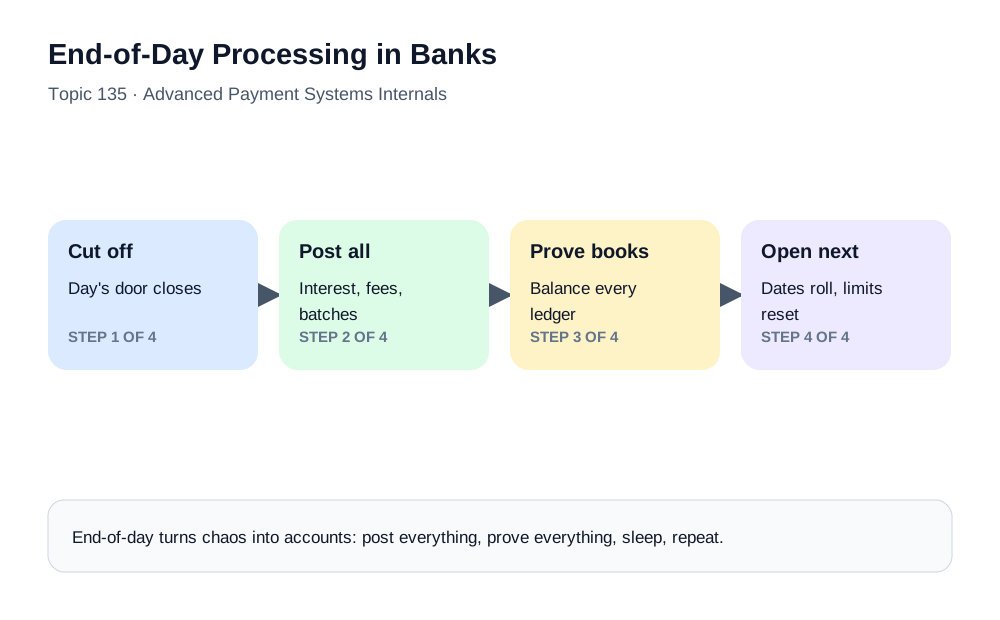
End-of-Day Processing in Banks at a glance — Batch processing, account updates, interest calculation.
Closing the Business Day, Proving the Books, and Preparing the Next Day
A bank never really sleeps, but its books still need discipline. Every business day must be closed, interest must be accrued, fees must be posted, standing instructions must run, failed items must be handled, suspense accounts must be reviewed, ledgers must balance, reports must be generated, and systems must roll forward to the next processing date.
This daily control cycle is called end-of-day processing, often shortened to EOD. In older banking, EOD was a mostly overnight batch run after branches closed. In modern banking, the picture is more complicated because cards, mobile banking, APIs, ATMs, instant payments, fraud controls, monitoring, and customer notifications operate around the clock. Even so, the bank still needs a formal process to prove what happened during the business day and prepare the next one.
This chapter explains EOD as a banking operating model. It covers business-day cut-off, batch processing, interest accrual, loan processing, charges, standing instructions, GL posting, reconciliation, suspense review, regulatory reports, backups, date rollover, failures, recovery, and the move from nightly batch to continuous processing.
Learning objectives
By the end of this chapter, you should be able to:
- Explain what end-of-day processing means in banking.
- Distinguish business-day closure from 24/7 channel availability.
- Describe the main EOD steps: cut-off, posting, interest, fees, reconciliation, GL closure, reporting, backup, and date rollover.
- Understand how EOD affects deposits, loans, payments, cards, ATMs, and regulatory reporting.
- Explain why failed EOD processing can stop next-day operations.
- Identify common EOD failures and controls.
- Discuss how real-time payments and modern core banking change the traditional EOD model.
- Understand why EOD is both a technology process and a financial-control process.
1. What End-of-Day Processing Means
End-of-day processing is the controlled set of activities used to close a bank's business day and prepare systems, ledgers, balances, reports, and operational queues for the next day.
It normally includes:
- closing the business day for selected products or branches;
- completing pending postings;
- calculating interest and accruals;
- posting fees, charges, and taxes;
- executing standing instructions and scheduled payments;
- processing maturities and repayments;
- reconciling sub-ledgers, settlement accounts, and suspense;
- updating the general ledger;
- generating reports;
- running backups and archival jobs;
- rolling the system date forward;
- opening the next business day.
EOD is not one job. It is a chain of jobs, dependencies, controls, approvals, reports, and exception handling.
2. Business Day vs Calendar Day
A banking business day is not always the same as a calendar day. Products, branches, countries, currencies, schemes, and systems may follow different business calendars.
For example:
- a domestic payment rail may have a local public holiday;
- a foreign currency payment may depend on the currency holiday calendar;
- a branch may close before digital channels;
- card transactions may authorize today but clear later;
- an instant payment may occur on a weekend;
- a loan EMI may be due on a non-working day and processed according to product rules.
EOD defines the accounting boundary. It tells the bank which transactions belong to today's books and which belong to the next business day.
This boundary matters for interest, statements, cut-offs, accounting, regulatory reporting, customer communication, and reconciliation.
3. The Typical EOD Lifecycle
A simplified EOD lifecycle looks like this:
Step 1: Cut-Off and Freeze
The system applies cut-off rules. Some channels stop accepting same-day transactions. Some products move new transactions to the next business day. In-flight transactions are completed, rejected, queued, or carried forward according to defined rules.
Step 2: Pending Transaction Posting
Transactions accepted during the day are posted or finalized. This may include branch transactions, ATM entries, payment debits and credits, card settlement entries, fees, reversals, refunds, loan repayments, and internal adjustments.
Step 3: Interest and Accrual Calculation
The bank calculates interest on savings, current accounts where applicable, deposits, loans, overdrafts, and other products. Interest may be accrued daily but posted monthly, quarterly, annually, or at maturity depending on product rules.
Step 4: Charges, Fees, and Tax
Maintenance charges, minimum balance fees, penalty interest, overdraft charges, card fees, GST/VAT, withholding tax, and other charges may be calculated and posted.
Step 5: Standing Instructions and Scheduled Jobs
Recurring transfers, loan EMIs, deposit sweeps, recurring deposit contributions, utility payments, direct debits, and mandate-based payments are executed according to schedule.
Step 6: Product Lifecycle Events
Fixed deposits mature, loans close, limits expire, dormant status changes, account restrictions update, cards renew, and product rules trigger lifecycle changes.
Step 7: Reconciliation and Suspense Review
The bank compares operational records against ledgers, settlement files, scheme reports, nostro statements, ATM records, and suspense accounts. Unresolved items are aged, assigned, escalated, or carried forward.
Step 8: General Ledger Update and Trial Balance
Sub-ledgers post totals to the general ledger. The trial balance must balance. Control accounts, profit and loss entries, provisions, accruals, and suspense balances are reviewed.
Step 9: Reports, Statements, and Regulatory Extracts
The bank generates customer statements, MIS reports, regulatory files, liquidity reports, AML extracts, tax reports, accounting reports, and operational dashboards.
Step 10: Backup, Archive, and Date Rollover
Data is backed up, logs are archived, audit files are preserved, and the system date rolls to the next business day. Beginning-of-day jobs may then load opening balances, parameters, limits, and calendars.
4. EOD and the General Ledger
The general ledger is the bank's financial truth. EOD proves that operational activity has been reflected correctly in that truth.
During the day, many sub-ledgers and operational systems record activity:
- savings account ledger;
- current account ledger;
- loan ledger;
- card ledger;
- payment hub records;
- ATM switch records;
- treasury systems;
- trade finance systems;
- nostro ledgers;
- suspense accounts.
At EOD, these records must feed the GL correctly. Debits and credits must balance. Control totals must agree. Suspense must be explained. Exceptions must be visible. If the GL close fails, the bank may not be able to publish accurate financial positions or open confidently the next day.
5. Interest Accrual and Posting
Interest is one of the main reasons EOD exists.
For deposits, the bank may calculate interest daily based on closing balance or product rules, but post it monthly, quarterly, annually, or at maturity. For loans, interest accrues on outstanding principal, and EMI or installment schedules reduce the balance according to repayment rules.
Important EOD interest activities include:
- savings interest accrual;
- fixed deposit interest accrual or maturity payout;
- loan interest accrual;
- overdraft interest calculation;
- penal interest on overdue accounts;
- tax deduction or withholding where applicable;
- interest reversal for corrected transactions;
- product-wise accounting entries.
A small error in interest logic can affect millions of accounts. This is why EOD interest jobs need strong testing, reconciliation, and exception reporting.
6. Loans, EMIs, and Delinquency Processing
Loan processing is a major EOD area.
The system may:
- debit EMI from the repayment account;
- apply payment to interest, principal, fees, or charges in defined order;
- mark missed payments;
- calculate overdue interest or penalties;
- update days past due;
- classify accounts by delinquency bucket;
- trigger collections workflows;
- update credit bureau reporting extracts;
- classify non-performing assets according to regulatory and bank policy;
- reverse or correct failed debits.
A loan account is not only a balance. It has schedule, status, delinquency, collateral, provision, bureau, collections, and accounting dimensions. EOD updates many of these.
7. Payments, Cards, ATMs, and EOD
Payment systems also depend on daily close processes.
EOD may process:
- payment settlement postings;
- failed payment reversals;
- return and reject accounting;
- card clearing and settlement files;
- merchant settlement;
- ATM cash balancing;
- chargeback and dispute entries;
- scheme fees and interchange;
- standing instructions;
- direct debits and bulk files;
- reconciliation breaks;
- customer statement narratives.
Instant payments have reduced the old idea that payments wait for batch, but they have not removed daily accounting and reconciliation needs. Real-time rails still create settlement files, exception reports, GL entries, fraud feeds, dispute feeds, and operational controls.
8. Suspense Accounts and EOD Discipline
Suspense accounts are temporary holding places for items that cannot yet be posted to their final account. EOD should make suspense visible, not hide it.
A good EOD process reports:
- opening suspense balance;
- new items added today;
- items cleared today;
- closing suspense balance;
- ageing by bucket;
- high-value items;
- customer-impacting items;
- owner and action status;
- reason codes;
- repeated root causes.
A suspense account that grows every day is a warning. It may indicate failed integrations, poor data, manual workarounds, weak reconciliation, or fraud risk.
9. EOD Failures and Their Impact
EOD failures can be serious because many jobs depend on earlier jobs.
Common failure types include:
- batch job failure;
- incorrect input file;
- missing settlement file;
- unbalanced GL posting;
- interest calculation error;
- duplicate posting;
- failed reversal job;
- database performance issue;
- timeout due to large volume;
- calendar or date-rollover error;
- downstream report failure;
- backup failure;
- unresolved critical exception.
The impact can include wrong balances, delayed statements, missed loan debits, incorrect interest, failed regulatory reports, customer complaints, branch-opening delays, and emergency technology calls.
EOD failure handling needs runbooks, restart logic, rollback rules, maker-checker approvals, incident escalation, business sign-off, and clear communication.
10. Controls Around EOD
Strong EOD control includes:
- documented job sequence and dependencies;
- pre-EOD readiness checks;
- cut-off monitoring;
- file receipt validation;
- control totals before and after jobs;
- automated balancing checks;
- exception thresholds;
- maker-checker for manual adjustments;
- GL trial balance validation;
- suspense ageing review;
- backup verification;
- business sign-off;
- incident logging;
- post-EOD review.
The key idea is that EOD should not be a blind technical run. It must be a controlled financial close.
11. EOD in a 24/7 Banking World
Traditional EOD assumed a quiet night. Modern banking does not always allow that. Mobile banking, APIs, card networks, ATMs, instant payments, fraud controls, and customer notifications may run continuously.
This creates design questions:
- Can customer channels remain open while core EOD runs?
- Are transactions posted online, in mini-batches, or after EOD?
- How are instant payments handled during date rollover?
- What business date applies to a weekend instant payment?
- How are interest and fees calculated if balances change continuously?
- Can reconciliation run near real time instead of only overnight?
- What is the fallback if EOD overruns into morning?
Modern banks respond with online posting, micro-batches, real-time accrual engines, event-driven ledgers, cloud scaling, parallel processing, and better observability. But even advanced banks still need daily proof: balances, books, controls, reports, and exceptions must be understood.
12. Practical Example: EOD Run for a Retail Bank
A retail bank closes its business day at 20:00 for branch and same-day accounting transactions. Digital channels remain available, but some transactions are booked to the next business date according to product rules.
The EOD process:
- confirms all branch batches are uploaded;
- posts pending account transactions;
- ingests payment settlement files;
- posts failed payment reversals;
- calculates deposit and loan accruals;
- debits scheduled EMIs;
- processes matured fixed deposits;
- posts fees and taxes;
- reconciles payment, card, ATM, and GL control totals;
- reports suspense ageing;
- generates statements and regulatory extracts;
- backs up databases and archives logs;
- rolls the system date;
- runs beginning-of-day jobs for limits, calendars, and opening balances.
If the failed-payment reversal job fails at step 4, customers may wake up with money still debited for failed transactions. If the EMI job fails at step 6, loan delinquency and collections data may become wrong. If GL control totals fail at step 9, finance cannot sign off the close. This is why every EOD step needs ownership.
13. Common Misconceptions
"EOD is only a technical batch." No. It is a financial-control process run through technology. Accounting, operations, risk, reporting, and customer impact all depend on it.
"If digital banking is 24/7, EOD is obsolete." No. The old overnight batch model is changing, but banks still need daily close, accrual, reconciliation, reporting, and audit boundaries.
"EOD only affects branch transactions." No. It affects accounts, loans, deposits, cards, payments, ATMs, GL, reports, statements, and regulatory data.
"A failed EOD can simply be rerun." Sometimes, but not always. Reruns need controlled restart points, duplicate prevention, rollback rules, and business approval.
"Suspense can be cleaned later." Some suspense is normal, but aged suspense is a serious control risk. EOD should make it visible and owned.
14. Frequently Asked Questions
What is EOD in banking? EOD is the controlled process used to close the business day, complete postings, calculate accruals, reconcile records, update the general ledger, generate reports, back up data, and prepare the next day.
What is BOD? BOD means beginning-of-day processing. It opens the new business day, loads calendars, limits, rates, opening balances, parameters, and other required data.
Why does EOD take hours? Because banks process huge volumes of accounts, interest, fees, standing instructions, loan events, payment files, reconciliations, GL postings, reports, backups, and date-rollover jobs.
What happens if EOD fails? The bank may have incorrect balances, failed postings, delayed statements, unbalanced GL, missed reports, or inability to open the next business day until the issue is resolved.
Can EOD happen while customers transact? In modern systems, some processing can run while channels remain open. But the bank must clearly define business date, posting date, available balance, and transaction cut-off behavior.
Why is reconciliation part of EOD? Because the bank must prove that operational records, settlement files, sub-ledgers, suspense accounts, and GL entries agree before closing the day.
15. Key Terms in This Chapter
- EOD - end-of-day processing, the daily close and control cycle.
- BOD - beginning-of-day processing, the opening cycle for the next business day.
- Business day - accounting and processing date used by the bank or product.
- Cut-off time - deadline after which transactions may move to the next business date.
- Batch job - scheduled process that handles a defined set of records.
- Accrual - recognition of interest or expense before actual cash payment.
- GL close - general ledger balancing and sign-off for the day.
- Trial balance - report proving total debits equal total credits.
- Suspense account - temporary account for unresolved items.
- Date rollover - movement of system processing date to the next business day.
- Standing instruction - customer or system instruction executed on a recurring schedule.
- Control total - expected total used to verify processing completeness.
- Restart point - safe point from which a failed batch can resume.
- Rerun - controlled re-execution of a failed or corrected job.
16. Interview Insights
"What happens during EOD in a bank?" Explain cut-off, pending postings, interest and accruals, fees, standing instructions, product lifecycle events, reconciliation, GL update, reports, backup, date rollover, and BOD preparation.
"Why is EOD risky?" Because many dependent jobs run in sequence. A failure can cause wrong balances, missed interest, duplicate postings, unbalanced GL, delayed reports, or next-day opening problems.
"How does 24/7 banking affect EOD?" It forces banks to support online posting, micro-batches, real-time reconciliation, clear business-date rules, and channel availability while still maintaining daily financial control.
"What controls should exist around EOD?" Pre-checks, job dependencies, control totals, balancing, exception thresholds, maker-checker adjustments, suspense review, backup validation, business sign-off, and incident runbooks.
"What is the relationship between EOD and reconciliation?" Reconciliation proves that the day's operational activity agrees with settlement files, sub-ledgers, suspense accounts, and the general ledger before the bank closes the day.
Summary and Key Takeaways
End-of-day processing is the bank's daily discipline for closing the business day, proving the books, and preparing the next day. It is both a technology process and a financial-control process.
The main lessons are:
- EOD creates the accounting boundary. It defines what belongs to today's business date and what rolls forward.
- EOD is a chain, not one job. Cut-off, postings, accruals, fees, scheduled jobs, reconciliation, GL, reports, backups, and date rollover depend on each other.
- The GL close is central. The bank must prove that sub-ledgers and control accounts support the general ledger.
- Suspense must be visible. EOD should expose unresolved items, ageing, ownership, and root causes.
- Failures can affect customers directly. Wrong balances, missed reversals, failed EMIs, delayed statements, and branch-opening delays can all come from EOD issues.
- 24/7 banking changes the model but not the need. Continuous processing reduces the old batch boundary, but daily control, reconciliation, and reporting still matter.
- Good EOD needs business ownership. Technology runs the jobs, but the bank owns the financial outcome.
EOD is not background machinery. It is how a bank proves, every day, that the ledger still tells the truth.
Next: Topic 136 - Regulatory Reporting Systems
<!-- MBA-DEEP-DIVE-START -->End-of-Day Processing Deepening — Business Date, Dependency Control, Recovery, and Continuous Banking
EOD is an accounting boundary before it is a clock time
A bank can serve customers continuously while still needing a controlled boundary for financial recognition. The business date determines which day's books receive a transaction, which balance is used for accrual, and which reporting period contains an event. In a global bank there may be several business dates at once because products, branches, currencies, and legal entities follow different calendars. EOD design should therefore model business date explicitly instead of assuming midnight is the universal boundary.
Cut-off rules should be product specific
A payment accepted after an RTGS cut-off may move to the next business date, while an instant payment continues normally and a card authorization proceeds under its own network cycle. Deposit value dating, loan repayments, direct debits, and securities also have different boundaries. A single bank-wide “day closed” flag is often too crude. Systems need product and rail calendars so customer promises, accounting, settlement, and reporting remain consistent.
EOD begins with readiness, not with the first batch job
A controlled close should confirm that critical source files arrived, online queues are within limits, settlement cycles are complete or explained, high-risk suspense items are owned, and upstream systems are ready. Starting EOD with missing inputs can produce downstream errors that are harder to repair. Readiness dashboards should show dependencies and allow authorised decision-makers to delay or proceed according to defined tolerance rather than relying on informal phone calls.
Dependency graphs are part of financial control
Interest cannot be posted correctly if balances are not final. GL aggregation should not run before relevant sub-ledger postings complete. Statements should not be produced before required accounting corrections. EOD orchestration should therefore maintain an explicit dependency graph with predecessor and successor jobs. When one job fails, the system should identify which later jobs are unsafe to run. This is stronger than a long script where operators must remember the sequence manually.
Restartability should be designed into every material job
A failed job should have a known restart point and idempotency rules. If a fee batch processed 800,000 of one million accounts before failing, rerunning all one million without duplicate protection can double-charge customers. Systems can record batch checkpoints, processed business keys, and transaction IDs so recovery resumes safely. Restart testing should be part of implementation, not discovered for the first time during a production incident.
Rollback is not always possible
Some EOD actions create external effects that cannot simply be undone by database rollback. A payment file may already have been sent, a customer statement delivered, or a regulatory report submitted. Recovery procedures should distinguish reversible internal processing from committed external events. Compensation may require a new financial transaction or corrected submission rather than deletion of history. This is why EOD recovery is a business process as well as a technical one.
Control totals should travel with the batch
A source population can carry expected count, value, debit total, credit total, and other controls. Each processing stage can prove that the population remained complete. If 100,000 standing instructions enter a job and only 99,998 produce final outcomes, operations should know which two are missing before closure. Control totals provide an early completeness check and support later reconciliation.
Interest calculations need reproducibility
When a customer disputes interest, the bank should be able to reconstruct the balance basis, rate, day-count convention, accrual period, product rule, and any tax or rounding. EOD interest engines should therefore retain effective parameters or versioned rules. Recalculating later with today's product configuration can produce a different answer from what was valid at the time. Parameter history is part of the audit trail.
Effective dating protects product changes
A rate or fee change may become effective at the start of a future business date. EOD and BOD should apply the change exactly once and to the correct population. Systems need effective-from and effective-to dates, approval, and versioning. A poorly timed configuration deployment can cause one day's accounts to accrue using the wrong rate across a large population.
Loan allocation order needs precise rules
A repayment may be allocated to fees, interest, principal, penalties, or overdue components in a defined order. EOD loan jobs should follow contractual and regulatory requirements consistently. A change in allocation order can affect outstanding principal, future interest, delinquency, and customer statements. Testing should include partial payments, overpayments, reversals, backdated corrections, holidays, and accounts already in arrears.
Delinquency status should not be driven by one failed technical job
If an automatic debit file fails because of a bank system outage, the bank should not blindly classify borrowers as delinquent without applying product and regulatory rules. Operations need to distinguish customer non-payment from processing failure. Corrective logic may need to preserve value date or prevent inappropriate charges and bureau impact. EOD incidents can therefore have conduct consequences beyond IT availability.
Standing instructions require outcome reconciliation
A scheduled instruction can be due, attempted, executed, rejected, retried, deferred, or cancelled. The bank should record the reason for each outcome and reconcile the due population to final states. Simply running the batch successfully does not prove that every expected instruction was handled. Customer notification and retry rules should match the product contract.
Fees need eligibility checks at execution time
A fee configured months earlier may no longer apply because the account changed product, received a waiver, entered a vulnerable-customer arrangement, or was closed. EOD fee jobs should evaluate current eligibility and effective rules rather than assume the scheduled amount remains valid. Fee reversals should also be linked to the original charge so revenue and customer statements reconcile.
Tax treatment belongs in controlled product logic
Interest withholding, transaction tax, GST/VAT on charges, or other tax may depend on jurisdiction and customer attributes. EOD systems should use validated tax status and effective rates. Manual tax overrides need approval and audit. Because tax rules change, implementations should separate configurable rules from code where practical and subject changes to legal and finance sign-off.
Maturity processing creates several linked events
A deposit maturity can credit principal and interest, roll over into a new deposit, transfer funds to another account, or wait for customer instruction depending on product terms. The system should preserve the original contract, maturity instruction, applied rate, tax, and final accounting. Failed maturity processing can create both customer loss and liquidity surprises if a large balance was expected to move.
Date rollover should not change transaction truth
A payment initiated before midnight and completed after midnight may carry different processing and settlement timestamps. Systems should not lose the original initiation date merely because the business date changed. Each event should retain its actual timestamp and relevant business date. This is crucial for dispute timelines, interest, fraud investigations, and regulatory reporting.
24/7 channels need dual-date awareness
A customer may transact while the core ledger is closing a prior business date. Modern architectures can post online to a current-value ledger while financial close processes snapshot or partition activity by business date. Whatever design is used, available balance must remain correct and the bank must prevent the same transaction from entering both old and new daily populations. The solution is architectural, not simply extending the batch window.
Event-driven processing reduces some batch concentration
Interest accrual, transaction posting, fraud feeds, and reconciliation can increasingly run continuously or in micro-batches. This reduces the massive overnight processing peak, but the bank still needs daily control totals and period close. Moving from batch to events changes the implementation of EOD rather than removing the need for financial cut-off and attestation.
Snapshot strategy should be explicit
Regulatory, finance, and operational reports often need a view “as of” the close. If source systems continue changing, reporting layers need a consistent snapshot or effective-time model. Mixing records extracted at different moments can create totals that never existed simultaneously. Banks can use controlled snapshots, immutable event histories, or bitemporal data depending on architecture.
EOD performance has a business deadline
A batch that technically completes successfully but finishes after branches or markets need to open can still be a production failure. Service levels should reflect the latest safe completion time for downstream BOD, statements, reporting, and customer access. Capacity testing should include peak month-end, year-end, salary, tax, and holiday volumes rather than average days.
Month-end and year-end add extra control layers
Period close may require valuation, provisions, accrual adjustments, tax, regulatory extracts, finance journals, and stronger sign-off beyond normal daily EOD. The bank should identify which jobs are daily and which activate at month, quarter, or year end. Extra workloads need capacity and extended operational coverage. A system that handles ordinary EOD comfortably can still fail during annual close.
General-ledger interface needs completeness proof
Sub-ledgers may aggregate millions of events into a smaller set of GL entries. EOD should prove that all required sub-ledger activity entered the accounting interface once and that accepted GL postings balance. Control accounts should reconcile to operational populations. A balanced journal can still be incomplete if an entire batch was omitted, so count and source controls matter alongside debit-credit equality.
Trial balance is necessary but not sufficient
Debits can equal credits even when both sides are wrong. EOD finance control should also reconcile material control accounts, investigate unusual movements, and compare against expected operational totals. A duplicate debit and duplicate credit can preserve balance while overstating activity. Financial close therefore combines arithmetic balance with business reasonableness.
Suspense needs ageing and ownership before day close
Not every suspense item must be resolved before EOD, but every material item should be understood, classified, and assigned. Unknown high-value entries should not roll forward unnoticed because the ledger technically balances. Dashboards can show opening, new, cleared, closing, age, value, and root cause. Repeated creation from one interface should trigger remediation.
Reconciliation should distinguish unresolved from expected timing
Some external statements arrive after the bank's internal close. Procedures should define which reconciliations are final, which are provisional, and which timing differences are expected. Carry-forward items need next-day ownership. Calling an unreconciled account “complete” because the external source is late weakens control; calling every expected timing item an incident creates noise.
Customer statements should follow corrected financial state
If a late EOD adjustment changes a posting after a statement has been generated, the bank needs a controlled correction path. Depending on product and law, this may mean regeneration, a subsequent adjustment entry, or customer communication. Statement production should therefore be placed after required posting and reconciliation gates, not treated as an independent printing job.
Regulatory extracts need version and submission linkage
An EOD or month-end process may create files later submitted to regulators. The bank should know which source snapshot and job version produced each submission. If a correction is needed, it should create a controlled resubmission with evidence rather than silently replacing the archived file. Reporting lineage begins during close processing.
Backups need restore evidence
A successful backup job only proves data was written somewhere. Resilience requires periodic restoration tests that show the bank can recover databases, configuration, keys, and necessary reference data within required time. EOD checklists can confirm backup completion, while disaster-recovery programmes prove recoverability. A backup that cannot be restored is not a control.
Archival should preserve business traceability
Logs and transaction records may move to cheaper storage after daily close. Archival must retain the ability to retrieve information for disputes, audits, legal requests, and investigations. References between live and archived systems should survive. Compression or transformation should not destroy the message or accounting evidence needed to reconstruct a historical transaction.
EOD incident severity should reflect financial exposure
A failed non-critical report and a failed customer-balance posting job are not equivalent. Incident classification should consider customer impact, amount, GL integrity, regulatory deadlines, settlement risk, and next-day readiness. This helps allocate the right technical and business responders. EOD bridges many domains, so business severity can be much higher than the error message suggests.
Emergency fixes need controlled deployment
When the clock is approaching BOD, teams may feel pressure to patch scripts or update data directly. Banks should maintain emergency change procedures with peer review, tested rollback, approval, and evidence. Speed and control are not opposites when the process is designed in advance. Unrecorded production edits can solve tonight's batch while creating tomorrow's reconciliation problem.
BOD should prove that the bank opened cleanly
Beginning-of-day processing should verify new business date, opening balances, rates, calendars, limits, channels, product parameters, and critical interfaces. A green EOD does not automatically mean a healthy BOD. The bank should have explicit readiness checks before declaring normal service, especially after an incident or extended close.
Continuous banking still needs daily attestation
Even if the architecture becomes fully event-driven and there is no visible overnight downtime, finance and operations still need to attest that the day's records are complete, balanced, reconciled, and reportable. The modern goal is not to abolish EOD but to reduce disruptive batch dependency while strengthening continuous controls. Daily close remains the point at which the bank can prove the books for that business date.
End-of-Day Processing — Close Control, Batch Dependencies, Accounting Evidence, and Recovery
End of day is a controlled transition between business states
A banking day does not end simply because a clock reaches midnight. Many systems need to establish a controlled boundary after which balances, accruals, interest, fees, classifications, reports, and accounting positions can be treated as complete for a defined business date. End-of-day processing is therefore a coordinated transition from one accounting and operational state to another. The exact sequence differs by product and institution, but the control objective is consistent: all eligible activity for the closing day must be captured once, processed correctly, reconciled, and carried forward without ambiguity.
Business date and calendar date should be separate concepts
A transaction processed at 00:15 local time may belong to the previous or next business day depending on product rules, settlement calendars, and the stage of the close. Systems should therefore carry an explicit business date rather than infer accounting treatment from server time. The same principle matters across time zones. A global bank can have one legal entity still closing Friday while another has already opened Saturday. Central scheduling should understand business calendars and entity-specific dates.
The close needs a dependency graph, not a list of cron jobs
Interest calculation may depend on final balances; general-ledger posting may depend on product sub-ledgers; regulatory extracts may depend on reconciled accounting; statement generation may depend on completed fees and value dates. If jobs run merely because their scheduled time arrived, downstream processes can consume incomplete data. A dependency model should state prerequisites, completion evidence, retry rules, and what can run in parallel. Orchestration then reflects business dependency rather than server convenience.
Intake cut-off should be explicit for each transaction family
Payments, deposits, loans, cards, securities, and treasury products may have different end-of-day boundaries. The bank should define what happens to transactions received before, during, and after the close. Some can continue in real time while accounting snapshots are taken; others may be queued for the next business date. Channel messages should not promise same-day treatment unless the downstream business-date rules support it. Exceptions near cut-off are a common source of complaints and reconciliation breaks.
Pre-close validation prevents avoidable batch failure
Before critical close jobs start, systems can check that required feeds arrived, interfaces are healthy, reference data is loaded, settlement files are complete, suspense thresholds are acceptable, and prerequisite reconciliations have run. A missing exchange-rate file or incomplete branch upload should be detected before interest or accounting calculations depend on it. Pre-close checks turn a late-night surprise into a controlled decision about whether to proceed, delay, or invoke contingency.
Interest accrual needs reproducible input balances
Interest calculations should use defined balance types, rates, day-count conventions, effective dates, and product conditions. If a transaction is back-valued or corrected after close, the bank needs a policy for recalculation and adjustment rather than silently rewriting history. The system should preserve which rate and balance were used for the original accrual. This allows finance and customer service to explain an adjustment later.
Fee processing needs the same discipline as interest
Periodic fees may depend on account status, transaction counts, average balances, waivers, customer segment, or package rules. End-of-day or period-end fee jobs should use effective-dated rules and avoid charging closed, blocked, or exempt accounts incorrectly. A fee generated in batch should retain its rule version and source inputs. If a waiver is added later, the reversal should remain linked to the original charge rather than deleting it from history.
Product sub-ledgers should close before the general ledger is certified
Core banking, loans, cards, treasury, and other product systems often maintain detailed records that aggregate into general-ledger accounts. The close should reconcile sub-ledger totals to general-ledger postings by account and entity. Differences can arise from missing interfaces, failed journals, mapping errors, or timing. Finance should not certify the general ledger merely because the journal interface says “sent.” Acceptance and posted balances are the relevant evidence.
Posting files require control totals
When a batch creates large numbers of accounting entries, headers and trailers or equivalent metadata can carry record counts, total debit, total credit, currency totals, and sequence numbers. The receiving system should validate these before accepting the file or batch. Control totals help identify truncation, duplication, or partial transfer. They are particularly useful during recovery because operations can prove whether a rerun produced the same intended accounting population.
Rerun design must be idempotent
A close job may fail after creating some outputs. If the only recovery method is “run it again,” duplicate interest, fees, statements, or ledger entries can result. Each job should define whether it is restartable from a checkpoint, reversible, or safely rerunnable using stable identifiers and status. Recovery procedures should identify what completed before failure. Idempotency is a core batch-control requirement, not merely a modern API design concept.
Partial completion should be visible as a first-class state
A job that processed 98 percent of accounts before failure is different from one that never started. Orchestration should retain counts, last checkpoint, failed partitions, and generated outputs. Operations can then decide whether to resume the remaining population or roll back. A single red/green job indicator is insufficient for financially significant processing because it hides the scope of partial completion.
Long-running jobs need progress and time-to-complete monitoring
Close windows can become tighter as transaction volumes grow. Historical runtime, current progress, resource consumption, and expected completion time should be monitored. A job that is technically healthy but running twice as long as usual can threaten downstream deadlines. Capacity planning should use peak-day volumes such as month end, salary days, or market events, not average weekdays. Performance degradation is an operational risk when the bank cannot open the next business day on time.
End-of-day processing should not create a global stop-the-world dependency
Modern banks often operate services continuously while some ledgers and reports retain business-day boundaries. Architecture can separate continuous transaction processing from controlled accounting snapshots where the product allows it. This reduces customer downtime but increases the importance of event timestamps, business dates, and consistent snapshot rules. The goal is not to eliminate close; it is to prevent unnecessary batch architecture from stopping unrelated real-time services.
Snapshot integrity matters for reporting
Regulatory, financial, liquidity, and management reports may need positions as of a defined cut-off. Data platforms should know which source snapshot corresponds to the certified business date and whether late adjustments are included. Re-running a report tomorrow against mutable current tables can produce a different answer for yesterday. Immutable or versioned snapshots, together with adjustment logic, support reproducibility.
Late-arriving transactions need a documented treatment
A file can arrive after a product has closed because of upstream delay, branch outage, or correspondent timing. The bank should define whether it is back-posted to the prior business date, posted on the current day with prior value date, or handled another way appropriate to the product. Finance, customer statements, interest, and regulatory reporting need consistent treatment. Ad hoc decisions by night operations create downstream discrepancies.
Backdated corrections should preserve audit history
If an error from a prior day is corrected, systems should record both the original entry and corrective entry or adjustment logic. Rewriting the old record makes reconciliation and audit difficult. Where accounting standards or system design require restatement, the process should still retain evidence of what changed, why, who approved it, and which downstream reports were affected.
Reconciliation gates should protect the close
Critical reconciliations can be defined as preconditions for final certification: settlement accounts, major suspense accounts, product-to-ledger totals, and key clearing positions. Not every minor break must block the bank, but materiality thresholds and escalation should be explicit. If the bank closes with known breaks, the certification should record the value, owner, reason, and expected resolution rather than hiding exceptions behind a completed batch status.
Month-end processing adds another layer of dependency
Month end may include accrual true-ups, depreciation, provisioning, fee cycles, tax calculations, foreign-currency revaluation, management reporting, and regulatory extracts. These processes often depend on daily close being complete first. Month-end calendars should identify which activities are daily, monthly, quarterly, or annual and which legal entities have different fiscal calendars. A quarterly close should not rely on undocumented tribal knowledge about job order.
FX revaluation needs controlled market data
Foreign-currency balances may be revalued using approved rates at defined times. The bank should know the rate source, timestamp, currency pair, fallback process, and treatment when a rate is unavailable. Finance should be able to reproduce the rate used for a historical close. A stale or incorrect rate can affect P&L, balance sheet, customer accounting, and regulatory reporting, so market-data validation belongs inside the close control framework.
Provisioning and risk calculations need versioned assumptions
Credit-loss or risk calculations may run at end of day or period end. Model version, data cut, scenario inputs, overrides, and approvals should be preserved. If a model or parameter changes, finance and risk need to understand which reporting periods used which version. Batch completion alone does not establish model governance. The close should consume approved outputs and make any manual overlays transparent.
Statement generation should follow final customer-visible postings
If statements are produced before fees, interest, reversals, or late postings complete, customers can receive incomplete information. Statement jobs should have defined dependencies and versioning. When a corrected statement is necessary, the customer should be able to distinguish it from the original and understand why it changed. Digital availability does not remove the requirement for statement accuracy.
Opening the next day should have explicit readiness criteria
“Day opened” should mean more than the scheduler incremented a date. Critical ledgers, reference data, limits, rates, channels, and interfaces should be ready for new business. Outstanding close exceptions should be classified as acceptable or blocking. A formal handover from night operations to day operations helps ensure unresolved issues do not disappear between teams.
End-of-day incidents need business-impact triage
A failed analytics extract is not equivalent to a failed customer balance update. Incident priority should consider financial posting, customer availability, regulatory deadlines, settlement obligations, and recoverability. Teams should know which jobs can be delayed, which have manual workaround, and which require immediate executive escalation. This avoids spending scarce recovery time on technically noisy but low-impact failures while a critical ledger remains incomplete.
Recovery should be rehearsed with realistic partial failures
Business-continuity testing should include missing files, corrupted batches, database failover, scheduler failure, delayed market data, and partial ledger posting. The exercise should prove that teams can identify the last good state, restore or rerun safely, reconcile the result, and open the next day with evidence. A disaster-recovery test that only starts infrastructure without executing a financial close does not prove end-of-day recoverability.
Close evidence should be retained as an operational record
For each business date, the bank should be able to show key jobs, start and finish times, control totals, reconciliations, exceptions, overrides, approvals, and final certification. This record supports audit, finance, incident review, and regulatory examination. It also allows trend analysis of late jobs and recurring breaks. End-of-day processing becomes a controlled financial process when completion is evidenced, not merely assumed.
End-of-Day Certification and Operational Handover
Certification should identify what was complete and what remained open
A close is stronger when the final sign-off states the business date, legal entity, critical jobs completed, reconciliations performed, material open breaks, manual adjustments, and any services operating under contingency. This prevents a misleading binary view in which the day is marked closed even though important exceptions remain. The person certifying should have enough evidence to understand the residual risk rather than relying on a scheduler dashboard alone.
Control-room communication should use one shared timeline
During a delayed close, technology, finance, operations, treasury, and product teams can form different views of the same incident. A central timeline should record the failed step, financial scope, last known good checkpoint, recovery action, decision owner, and revised downstream dependencies. This reduces duplicate troubleshooting and prevents one team from restarting a job while another is still repairing its source data.
Batch change management should include volume and recovery testing
A code change can pass functional testing and still extend runtime beyond the close window. Release testing should therefore include production-like transaction volume, restart behaviour, control totals, and downstream dependency timing. New indexing, partitioning, or parallelisation can improve speed but must preserve deterministic financial output. Performance is part of functional correctness when a regulated or customer-critical process has a hard completion deadline.
Operations should compare today's close with its normal profile
Historical baselines for job start time, duration, record counts, values, exception volume, and resource use can reveal abnormal processing before a formal failure occurs. A fee job that completes successfully with half the usual population deserves investigation. Control monitoring should therefore ask not only whether a job ended without error, but whether the result is plausible for the business day.
The close should leave the next shift with actionable information
Morning teams need to know which late items, corrections, reconciliations, or customer effects still require attention. A structured handover should include ownership and due time rather than a generic note that “EOD completed with issues.” This closes the operational loop and stops night-time exceptions from becoming invisible once systems reopen.
<!-- MBA-DEEP-DIVE-END -->