Visual overview
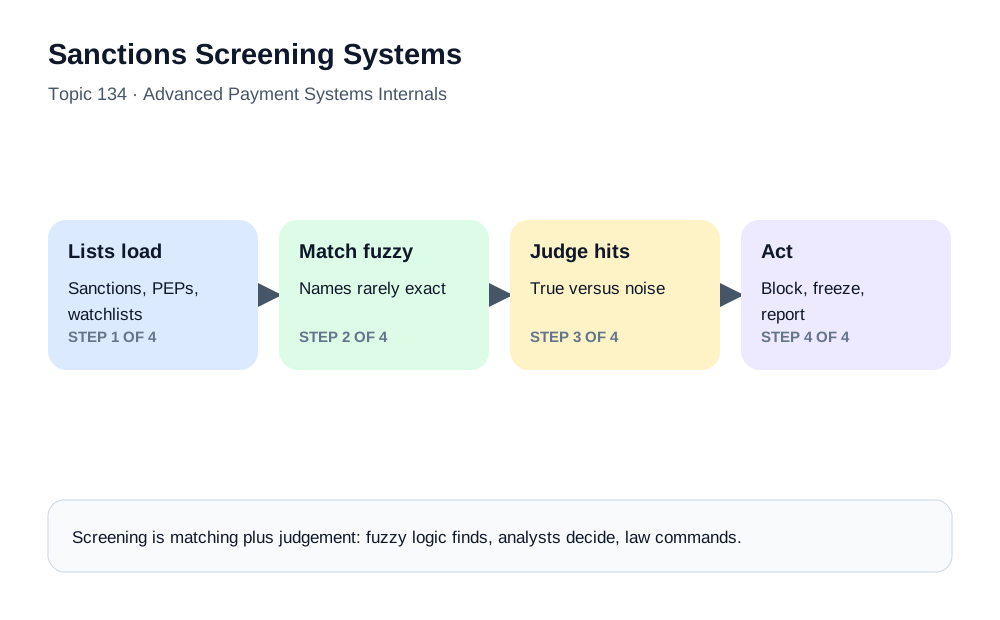
Sanctions Screening Systems at a glance — Watchlist management, name matching, false positive reduction.
Screening Payments, Managing Hits, and Controlling Financial-Crime Risk
A payment is not allowed to move simply because the customer has money and the message is technically valid. Banks must apply the sanctions controls required by the legal regimes, licences, products, currencies, geographies, counterparties, and risk framework relevant to the transaction. Depending on that scope, review may involve parties, financial institutions, ownership, vessels, locations, goods, services, purpose, or payment references. Sanctions screening is one important control, but list matching alone does not establish the full legal permissibility of a transaction.
The challenge is difficult. Screening must be strict enough to stop prohibited payments, but fast enough to support high-volume payment processing. It must catch exact names and messy name variations. It must handle different scripts, transliterations, abbreviations, aliases, address fragments, vessel names, bank names, free-text references, and incomplete customer data. It must reduce false positives without missing true matches. And when a potential hit appears, the bank must pause, investigate, document, escalate, and act correctly.
This chapter explains sanctions screening as a banking control. It covers sanctions lists, payment fields, fuzzy matching, false positives, alert review, real-time and batch screening, cross-border payments, domestic payments, PEP screening, name matching, payment holds, escalation, audit trail, and operational impact.
Learning objectives
By the end of this chapter, you should be able to:
- Explain what sanctions screening does in a payment lifecycle.
- Distinguish sanctions screening from PEP screening, AML monitoring, fraud detection, and KYC.
- Identify which payment fields are commonly screened.
- Understand exact matching, fuzzy matching, transliteration, aliases, and list management.
- Explain false positives and why sanctions teams receive high alert volumes.
- Describe the lifecycle of a screening alert from hit generation to closure.
- Understand what happens when a payment is blocked, rejected, held, or escalated.
- Discuss why sanctions screening affects payment operations, customer communication, correspondent banking, and audit.
1. What Sanctions Screening Means
Sanctions screening is the process of comparing customers, counterparties, banks, payment messages, and transaction details against sanctions lists and other restricted-party data.
The purpose is to prevent or appropriately control activity prohibited or restricted under applicable sanctions measures. Those measures can apply to listed persons and entities, entities caught through ownership rules, specified governments or territories, sectors, vessels, goods, services, financing, or other conduct depending on the programme.
In payments, screening may happen at several points:
- customer onboarding;
- beneficiary creation;
- payment initiation;
- payment repair;
- outbound payment release;
- inbound payment receipt;
- correspondent banking processing;
- periodic customer rescreening;
- list update rescreening;
- post-event investigation.
A payment can be stopped even if it is technically valid. Compliance controls override pure payment processing when legal restrictions apply.
2. Sanctions vs PEP vs AML vs Fraud
These controls are related, but different.
| Control | Main Question | Typical Outcome |
|---|---|---|
| Sanctions screening | Is this party, country, bank, vessel, or activity prohibited or restricted? | Block, reject, freeze, hold, escalate, report |
| PEP screening | Is this person politically exposed and therefore higher corruption risk? | Enhanced due diligence, not automatic blocking |
| AML monitoring | Does the transaction pattern suggest laundering or terrorist financing? | Alert, investigation, suspicious activity reporting |
| Fraud detection | Is this transaction unauthorized, deceptive, or scam-related? | Decline, hold, step-up, block, customer protection |
| KYC/CDD | Do we know the customer and their expected activity? | Onboarding approval, risk rating, periodic review |
A politically exposed person is not automatically sanctioned. A sanctions hit is not the same as a fraud alert. An AML suspicious pattern is not necessarily a sanctions breach. Banks need all controls, but they must not confuse them.
3. Main Sanctions Sources
Banks may screen against multiple sources depending on jurisdiction, currency, business model, and correspondent banking obligations.
Common sources include:
- United Nations sanctions lists;
- United States OFAC lists, including SDN and other programmes;
- European Union sanctions lists;
- United Kingdom OFSI sanctions lists;
- domestic government lists, such as terrorism or national security lists;
- regulator alerts and advisories;
- internal watchlists;
- correspondent-bank requirements;
- commercial data providers consolidating and enriching list data.
A bank must know which lists apply to which business line. USD clearing often creates OFAC exposure. EU operations create EU sanctions obligations. Domestic regulations may require local list screening even for domestic payments. Cross-border payments may touch several regimes at once.
4. What Gets Screened in a Payment
Payment screening is not limited to the sender and receiver names. Modern payment messages can contain many screenable fields.
Commonly screened data includes:
- debtor or ordering customer name;
- creditor or beneficiary name;
- debtor and creditor addresses;
- debtor and creditor account details;
- ordering institution;
- beneficiary institution;
- intermediary and correspondent banks;
- ultimate debtor and ultimate creditor;
- remittance information;
- purpose of payment;
- regulatory reporting text;
- sender-to-receiver information;
- invoice details;
- vessel name, port, goods, or trade references;
- country codes and address countries;
- free-text narratives.
Structured data improves screening because names, addresses, countries, and roles are clearer. Unstructured text can hide risk or create noise. This is one reason ISO 20022 rich data matters: better structure can help compliance, but only if banks capture, store, and screen it correctly.
5. Exact Matching and Fuzzy Matching
Exact matching is simple: the payment name exactly matches a listed name. But real life rarely stays simple.
Names vary because of:
- spelling differences;
- transliteration from Arabic, Cyrillic, Chinese, Hindi, or other scripts;
- initials and abbreviations;
- missing middle names;
- reversed name order;
- corporate suffixes such as Ltd, LLC, GmbH, SA;
- aliases and former names;
- punctuation and spacing;
- data entry errors;
- shortened names in legacy payment formats.
Fuzzy matching attempts to find possible matches even when the text is not identical. It may use phonetic algorithms, edit distance, token matching, alias tables, transliteration logic, country matching, date-of-birth matching, identifier matching, and risk scoring.
Fuzzy matching is necessary, but it creates false positives. A common name can match many innocent people. A company with a generic trading name may resemble a listed entity. A city or street name can trigger irrelevant matches. Good screening is therefore a balance between sensitivity and operational noise.
6. False Positives and True Matches
A false positive is a potential hit that turns out not to be the sanctioned party. A true match is a hit confirmed as the restricted party or prohibited activity.
False positives are common because screening systems intentionally cast a wide net. It is safer to generate an alert and review it than to miss a true sanctions match. But too many false positives can delay payments, overload compliance teams, frustrate customers, and hide genuine risk inside noise.
Banks reduce false positives through:
- better customer reference data;
- structured payment fields;
- country and date-of-birth filters;
- alias management;
- good-quality list data;
- scenario tuning;
- suppression rules for known false matches;
- analyst feedback loops;
- periodic model and rule review;
- segmentation by product, geography, and risk.
The goal is not zero alerts. The goal is useful alerts: enough to catch risk, not so many that compliance judgment is buried.
7. The Screening Alert Lifecycle
A screening alert should follow a controlled lifecycle.
Step 1: Hit Generation
The screening engine compares payment data against lists and generates a potential match based on configured rules and thresholds.
Step 2: Payment Hold
Where rules require it, the payment is paused before release. The payment status should show a controlled compliance hold internally, while customer-facing language must follow bank policy and legal restrictions.
Step 3: Initial Review
An analyst checks the matched name, list entry, payment party role, country, address, identifiers, transaction purpose, and available customer profile.
Step 4: Discount or Escalate
If the match is clearly false, the analyst discounts it with documented rationale. If it cannot be safely discounted, it escalates to senior compliance or sanctions advisory.
Step 5: Decision
The bank decides whether to release, reject, block, freeze, return, report, or seek further information. The correct action depends on legal requirements, list type, payment status, jurisdiction, and bank policy.
Step 6: Reporting and Recordkeeping
Confirmed matches may require regulatory reporting, suspicious activity reporting, asset freeze reporting, or other notifications. Every decision must be auditable.
Step 7: Feedback and Tuning
Repeated false positives and confirmed hits should feed list quality, rule tuning, customer-data improvement, and operations training.
8. Payment Hold, Reject, Block, Freeze, and Return
These words are often used loosely, but they have different meanings.
Hold means the payment is paused while review continues.
Reject means the bank refuses to process the payment before it completes.
Return means funds are sent back through the applicable rail or bank process where permitted.
Block or freeze may mean the bank must immobilize funds or assets due to sanctions requirements, rather than returning them.
Release means the alert was cleared and the payment can continue.
The correct action is legal and scheme-specific. A bank should not automatically return a sanctions-hit payment if the law requires freezing. It should not release a payment just because the customer is urgent. It should disclose only what applicable sanctions law, AML law, privacy obligations, regulatory guidance, and bank policy permit. 'Tipping-off' is a specific legal concept in some AML reporting regimes and should not be used as a blanket explanation for every sanctions-related communication restriction.
9. Real-Time Payments and Screening Speed
Real-time payments increase screening pressure. Customers expect immediate confirmation, but sanctions screening may need review. Some hits cannot be resolved instantly.
Banks manage this through:
- pre-screening customers and beneficiaries;
- screening saved payees before first payment;
- real-time screening engines with low latency;
- risk-based thresholds;
- clear pending or review statuses;
- rapid analyst queues for high-priority payments;
- automated discounting of known false positives where policy permits;
- post-event monitoring where legally acceptable;
- strong exception and escalation workflows.
No bank should treat speed as an excuse to skip sanctions controls. Real-time rails need real-time control design.
10. Cross-Border and Correspondent Banking
Cross-border payments are especially sensitive because they may involve several banks, jurisdictions, currencies, and sanctions regimes.
A single payment may include:
- ordering customer;
- ordering bank;
- intermediary bank;
- correspondent bank;
- beneficiary bank;
- beneficiary customer;
- purpose and remittance text;
- countries of residence, origin, destination, or goods movement;
- currency and settlement path.
Each bank in the chain may screen independently. A payment released by one bank can still be stopped by another. A correspondent bank may ask for more information, reject the payment, hold it for review, or exit the relationship if controls are weak.
For banks that depend on correspondent access, sanctions screening quality is not only a compliance issue. It is a business-continuity issue.
11. Data Quality and ISO 20022
Poor data creates two problems: missed risk and unnecessary alerts.
If a customer name is incomplete, a country code is missing, or an address is unstructured, the system may fail to identify a true risk. If free text contains messy abbreviations, old aliases, or unclear references, the system may create many false positives.
ISO 20022 can help by carrying more structured party, agent, address, remittance, purpose, and regulatory data. But ISO 20022 does not automatically improve compliance. Banks must still ensure that channels capture the right data, payment hubs preserve it, screening engines use it, and analysts can see it in a readable form.
Structured data is useful only when the end-to-end data chain is controlled.
12. Practical Example: Name Hit on Cross-Border Payment
A corporate customer sends a USD payment to a supplier. The beneficiary name partially matches an entity on a sanctions list. The address country is different, but the city and trade reference are similar to a known alias.
The screening engine holds the payment and creates an alert.
The analyst reviews:
- listed entity name, aliases, country, identifiers, and programme;
- beneficiary name and address from the payment;
- customer profile and expected trading activity;
- invoice and goods description where available;
- beneficiary bank and country;
- prior payments to the same beneficiary;
- correspondent-bank requirements;
- whether additional information is needed.
If the analyst can clearly prove it is not the listed entity, the payment may be released with documented rationale. If not, the case escalates. If confirmed, the bank follows blocking, freezing, reporting, and customer communication rules.
13. Common Misconceptions
"Sanctions screening is only for international payments." No. Domestic payments, customer databases, beneficiaries, trade references, and internal transfers may also require screening depending on law and policy.
"A screening hit means the customer is sanctioned." No. A hit is a potential match. It becomes a confirmed match only after review.
"PEP means sanctioned." No. PEP status means heightened corruption or influence risk and normally requires enhanced due diligence, not automatic blocking.
"The bank can always tell the customer exactly why the payment is delayed." Not always. Legal, confidentiality, and tipping-off rules may limit what can be disclosed.
"ISO 20022 solves sanctions screening." It can improve data structure, but screening still depends on data quality, rules, list management, analytics, and analyst judgment.
14. Frequently Asked Questions
What is a sanctions list? A sanctions list identifies individuals, entities, vessels, countries, or activities subject to legal restrictions imposed by governments or international bodies.
What is an SDN? SDN means Specially Designated National, a key OFAC category for individuals and entities subject to blocking restrictions under US sanctions programmes.
What is fuzzy matching? Fuzzy matching finds possible name matches even when spellings are not identical, using techniques such as phonetic matching, edit distance, aliases, and transliteration.
Why do false positives happen? Because many legitimate names resemble listed names, and screening systems intentionally use broad matching to avoid missing true sanctions risk.
What is payment blocking? Blocking generally means restricting or freezing funds or assets according to sanctions requirements. It is different from simply rejecting or returning a payment.
Can a payment be released after a sanctions alert? Yes, if the alert is reviewed and safely discounted under bank policy. The release decision must be documented.
Who reviews sanctions alerts? Usually trained compliance or sanctions operations analysts, with escalation to senior compliance, legal, or sanctions advisory teams for complex cases.
15. Key Terms in This Chapter
- Sanctions screening - comparison of parties and payment data against restricted lists.
- Sanctions list - official or internal list of restricted parties, entities, countries, vessels, or activities.
- SDN - Specially Designated National under OFAC sanctions.
- PEP - politically exposed person requiring enhanced due diligence.
- False positive - alert that is not a true match after review.
- True match - confirmed match to a restricted party or activity.
- Fuzzy matching - approximate matching for spelling, alias, and transliteration variations.
- List management - ingestion, validation, versioning, and deployment of screening lists.
- Payment hold - pause applied while review is pending.
- Blocking or freezing - immobilizing funds or assets where legally required.
- Tipping-off - improper disclosure that may alert a party to investigation or reporting.
- Correspondent banking - banking relationship used to process payments in another currency or jurisdiction.
- Screening threshold - configured level at which a potential match creates an alert.
- Alert discounting - closing an alert as false match with documented rationale.
16. Interview Insights
"What fields are screened in a payment?" Mention debtor, creditor, ultimate parties, agents, intermediary banks, addresses, countries, remittance text, purpose, regulatory reporting, sender-to-receiver information, and trade references where applicable.
"What is the difference between sanctions and AML monitoring?" Sanctions screening checks whether a party or activity is legally restricted. AML monitoring looks for suspicious patterns that may indicate laundering or terrorist financing.
"Why are false positives so high in sanctions screening?" Because names vary across spelling, language, script, aliases, abbreviations, and data quality. Screening systems use broad matching to avoid missing true matches.
"What should happen when a payment gets a sanctions hit?" The payment is held where required, the alert is reviewed, evidence is checked, the case is discounted or escalated, and the bank decides whether to release, reject, block, freeze, report, or request more information.
"How does ISO 20022 help sanctions screening?" It can provide more structured party, address, agent, purpose, and remittance data, which improves screening and review. But it only helps if the bank captures and preserves the data properly.
Summary and Key Takeaways
Sanctions screening is one of the most important compliance controls in payment processing. It protects the bank from processing prohibited activity and protects the financial system from misuse.
The main lessons are:
- Screening is broader than names. Parties, banks, countries, addresses, vessels, goods, purpose, and narratives may all matter.
- A hit is not always a true match. Alerts require trained review and documented decisions.
- False positives are part of the control challenge. Banks must reduce noise without weakening detection.
- Hold, reject, return, block, and freeze are different actions. The correct action depends on law, scheme rules, and bank policy.
- Real-time payments need real-time compliance design. Speed does not remove screening obligations.
- Cross-border payments increase complexity. Multiple banks and sanctions regimes may apply.
- Data quality is decisive. Structured data improves screening only when captured, preserved, and used correctly.
A bank that screens well protects more than itself. It protects access to correspondent banking, regulatory trust, and the integrity of money movement.
Next: Topic 135 - End-of-Day Processing in Banks
<!-- MBA-DEEP-DIVE-START -->Sanctions Screening Deepening — Legal Scope, Ownership, List Operations, Payment Controls, and Alert Governance
Sanctions compliance begins with applicability analysis
A bank should not build one undifferentiated global rule that assumes every sanctions regime applies identically to every transaction. Applicability can depend on the bank's legal entities, location, customers, currency, clearing path, staff, counterparties, licences, and the specific sanctions programme. The compliance framework should map which authorities and restrictions apply to each business. Screening technology then implements part of that legal analysis. A matching engine cannot decide jurisdiction by itself.
List screening is only one part of sanctions compliance
A party can be legally restricted even when its exact name does not appear on a published list. Ownership rules, sectoral restrictions, embargoes, restrictions on particular goods or services, and measures targeting specified governments or regions can matter. A transaction can also involve a listed person indirectly through ownership or representation. Banks therefore combine list screening with customer due diligence, ownership analysis, geographic controls, trade controls, transaction review, and legal advice where necessary.
Ownership rules require data beyond the payment message
An entity's payment name may be perfectly clean while the entity is owned by sanctioned persons. Under OFAC's 50 Percent Rule, entities directly or indirectly owned 50 percent or more in the aggregate by one or more blocked persons are themselves treated as blocked even if not separately named on the SDN List. Other jurisdictions use their own ownership or control concepts. Payment screening must therefore connect to customer and counterparty due diligence rather than assume that a clean name match proves permissibility.
Control and ownership are not universally defined the same way
Under OFAC's published guidance, the automatic 50 Percent Rule is an ownership test, not a general control test, although OFAC urges caution where blocked persons have significant influence and transactions directly involve blocked persons. UK and other regimes can apply different ownership-and-control concepts. Global banks should not copy one jurisdiction's threshold into every sanctions policy. Legal interpretation should be maintained centrally and translated into system rules by jurisdiction and programme.
Aggregate ownership can be operationally difficult
A company may be owned through several layers and by more than one sanctioned shareholder. Determining aggregate direct and indirect ownership requires reliable corporate data and clear calculation rules. The payment engine usually cannot perform a full corporate-tree investigation in milliseconds. Banks therefore need customer and counterparty master data that already contains relevant ownership assessments, with event-driven or periodic refresh when sanctions or ownership information changes.
Beneficial ownership data can become stale
Corporate ownership can change after onboarding. A previously clear entity can become restricted because a new shareholder is designated or ownership percentages change. Banks need triggers for rescreening and enhanced review, including list updates, ownership changes, corporate events, adverse information, and periodic KYC refresh. Static onboarding checks are not enough for a long-lived customer relationship.
Sanctions lists are dynamic operational data
Authorities add, amend, and remove entries. A screening platform needs controlled ingestion, source verification, versioning, deployment, rollback, and evidence of when each list update became effective in production. Operations should know whether a payment was screened against the current applicable list version. A failed list feed is a compliance incident, not a minor technical defect.
Source authority matters
Commercial providers can consolidate, translate, enrich, and structure sanctions data, but the legal source remains the relevant competent authority. Banks should be able to trace a commercial record back to the official designation and programme. If vendor data conflicts with the official source, the issue needs escalation rather than blind reliance on the vendor. Vendor enrichment improves operations; it does not transfer legal accountability.
List quality includes identifiers, not just names
A designation can include date of birth, nationality, address, passport, registration number, vessel IMO number, aliases, and other identifiers. Matching quality improves when systems use these attributes. A common name plus a conflicting date of birth can support discounting, while a less obvious alias plus matching identifier can strengthen a potential hit. Analysts need access to complete designation data and provenance.
Aliases need classification
Sanctions entries can contain strong aliases, weak aliases, former names, alternate spellings, transliterations, and non-Latin scripts. Treating every alias identically can create excessive noise. List providers and internal policy may classify alias strength or relevance. Screening logic should preserve enough sensitivity to catch true variations while allowing reasoned tuning. Analysts should still be able to see the original official form of the name.
Transliteration is not a one-to-one conversion
Arabic, Cyrillic, Chinese, Persian, and other scripts can produce multiple valid Latin spellings. A bank screening only exact Latin forms can miss risk. Transliteration libraries, phonetic techniques, tokenisation, and alias data can improve coverage, but they also create false positives. Testing should include names from the bank's actual customer and payment populations rather than only English examples.
Name normalisation should be transparent
Screening engines commonly remove punctuation, standardise case, strip corporate suffixes, reorder tokens, or normalise accents. These transformations affect matching outcomes. The bank should document them and test edge cases. Over-aggressive normalisation can make distinct names appear identical; weak normalisation can miss obvious variants. Analysts should be able to compare both original and normalised values.
Corporate suffixes need context
Terms such as Ltd, LLC, GmbH, SA, BV, or Bank often add little identifying value, but removing them blindly can create collisions among generic names. Matching logic can down-weight common legal suffixes while preserving meaningful tokens. The same principle applies to honorifics and common words. Screening quality depends on field-aware token treatment rather than simple text comparison.
Addresses can reduce false positives but are imperfect
Country, city, street, and postal code can help distinguish people or entities with similar names. However, sanctioned persons may use multiple addresses, old addresses, incomplete addresses, or deliberately misleading locations. A country mismatch should not automatically clear a strong name and identifier match. Address data should contribute to an evidence-based decision rather than operate as a universal hard filter.
Country screening is more nuanced than a blacklist
Sanctions can target countries, regions, governments, sectors, or specific transactions rather than every person connected with a country. A bank should not assume that a country code alone determines legality. Conversely, a transaction can involve a restricted territory even when the parties' registered countries appear unrestricted. Origin, destination, branch location, goods movement, and free-text references may all matter depending on the programme.
Payment currency can influence sanctions exposure without deciding it alone
A transaction in US dollars may interact with US clearing or US persons and therefore require careful OFAC analysis, but currency is not a universal shortcut for jurisdiction. Similar considerations apply to other legal regimes through entity presence, staff, clearing paths, or local law. Banks should map actual legal touchpoints and correspondent requirements instead of teaching staff that a currency automatically answers every applicability question.
Correspondent banks can impose requirements beyond minimum law
A correspondent may define contractual screening, information, or risk expectations for access to its network or currency-clearing service. Those requirements do not become law merely because the correspondent demands them, but failure to meet them can affect business continuity. Banks should distinguish statutory obligation, regulatory expectation, contractual correspondent requirement, and internal risk appetite in policy and operational procedures.
Payment-field screening should be role-aware
A name appearing as debtor, creditor, intermediary bank, ultimate party, remittance reference, or vessel is not the same type of relationship. Screening engines and analysts should preserve field and party role. A generic free-text mention of a listed name may require different analysis from the beneficiary being the listed person. Role-aware alerts improve prioritisation and investigation quality.
Structured ISO 20022 data improves role clarity
ISO 20022 can separately represent debtor, creditor, ultimate parties, agents, addresses, purpose, and remittance information. This helps screening because the engine can know who is playing which role. But richer data can also create more alerts if systems screen every field with the same sensitivity. Banks should define field-level screening logic based on legal and risk relevance while preserving the original message for investigation.
Hybrid postal addresses require sensible screening
An ISO 20022 party may carry structured address components together with address lines depending on market practice. Screening should not concatenate fields in a way that destroys meaning or duplicates the same information several times. Country, town, street, building, and free-form lines can each contribute evidence. Data mapping from channels and legacy formats should preserve address semantics as far as possible.
Remittance information can reveal hidden sanctions risk
Invoice numbers, vessel names, ports, project names, goods descriptions, or counterparties may appear in remittance text even when party names are clean. Free-text screening can therefore matter, especially in trade-related payments. However, broad fuzzy matching on narrative text can generate enormous noise. Banks may use field-specific dictionaries, vessel lists, geographic terms, and contextual review to balance sensitivity with operability.
Vessel screening needs dedicated identifiers
Vessels can change names, flags, ownership, and operators. IMO numbers are often more stable identifiers than vessel names. Trade and maritime screening should therefore use structured vessel data where available. A payment mentioning a vessel name in free text may require enrichment before a confident decision can be made. Payments, trade finance, and shipping-risk systems need coordinated data.
Goods and services restrictions require more than name matching
Export controls and sanctions measures can restrict categories of goods, technology, financing, or services. A payment description may not provide enough detail to decide whether the underlying trade is permitted. Banks may need invoices, trade documents, customer declarations, commodity codes, or specialist review. The payment engine should be able to hold and route such cases instead of forcing a binary name-screening result.
Sectoral sanctions can permit some activity and prohibit other activity
Not every sanctioned entity is subject to full asset blocking. Some programmes impose restrictions on debt, equity, services, technology, or particular sectors. A list hit therefore needs programme context. Analysts should know whether the restriction calls for blocking, rejection, transaction prohibition, maturity limits, licence analysis, or another response. Treating every sanctions list entry like an SDN can be legally wrong.
Licences and exemptions are part of decisioning
A transaction that would otherwise be prohibited may be authorised under a general licence, specific licence, statutory exception, or humanitarian exemption depending on the regime. Screening systems should not simply override a hit because a customer says a licence exists. Compliance needs to validate scope, parties, dates, limits, conditions, and reporting requirements. Licence evidence should be linked to the transaction and available for audit.
A false positive is not a harmless event
Every false alert consumes analyst time and can delay customer payments. At high volumes, excessive noise can create true risk because analysts become fatigued and high-quality review becomes harder. False-positive reduction is therefore a compliance-quality objective, not merely an efficiency target. Tuning should reduce irrelevant alerts while demonstrating that true-match sensitivity remains adequate.
Whitelisting requires narrow, controlled logic
A repeatedly cleared customer should not have to trigger the same identical false alert forever, but a broad whitelist can hide future risk. Suppression rules should be based on strong identifiers, specific list entries, and known distinguishing attributes. They should expire or be reviewed when customer or list data changes. Name-only whitelists are especially dangerous because another person with the same name may later appear.
Alert prioritisation should reflect legal risk and payment urgency
A strong exact identifier match to a blocking list should not wait behind thousands of weak fuzzy hits. Queues can prioritise score, list programme, party role, amount, currency, geography, correspondent, and payment cut-off. Priority is not a substitute for review; it determines which cases receive attention first. High-value urgent payments may also require faster handling without lowering the legal standard.
Analysts need reason codes, not just similarity percentages
A similarity score of 92 does not explain whether the match comes from surname, alias, date of birth, country, or corporate identifier. Investigation tools should show matched tokens, unmatched attributes, list source, programme, party role, and any ownership or customer context. Better explanations support consistent discounting and faster escalation. Black-box screening creates both operational and model-risk problems.
Four-eyes control may be appropriate for material decisions
Depending on policy and risk, confirmed or complex sanctions decisions may require senior review or independent approval before release, block, rejection, or licence reliance. The system should preserve maker, checker, timestamps, rationale, and supporting evidence. Not every false positive needs dual review, but the approval model should reflect legal consequence and bank risk appetite.
Release after alert needs a durable audit trail
When a payment is released, the bank should be able to show why the hit was not the listed or restricted party. Evidence might include conflicting date of birth, registration number, nationality, address, ownership, or other reliable attributes. “Analyst knows customer” is weak evidence. Structured rationale supports later review if the same party is designated differently or the decision is challenged.
Blocking, rejection, and return are not interchangeable
Some sanctions require property to be blocked or frozen; others prohibit a transaction that may need rejection rather than retention. A returned payment is itself a transaction and can be prohibited in some circumstances. Operational procedures should follow the exact legal regime and competent-authority guidance. Payment applications should provide distinct internal statuses so staff do not execute the wrong financial action after a compliance decision.
Frozen funds need controlled accounting
If funds must be immobilised, the bank needs designated accounts or ledger treatment, access restrictions, interest treatment where applicable, reporting, and reconciliation. The original customer and settlement entries must remain traceable. Compliance decisions should integrate with finance and operations so blocked property is not accidentally released through an automated reversal or end-of-day sweep.
Automated reversals can conflict with sanctions holds
Retail payment systems often auto-reverse failed transactions. If a sanctions control has immobilised funds, a generic failure-reversal job must not automatically credit money back in a way that violates the required action. Payment state management should distinguish compliance blocking from technical failure. This is a key example of why fraud, sanctions, posting, and payment orchestration must share clear statuses.
Inbound payments need sanctions logic too
Banks often focus on outbound screening because they control release, but inbound payments can also create exposure. The receiving bank may need to screen originators, intermediaries, remittance data, and beneficiary relationships before making funds available. If the payment is prohibited, the required action may differ from simply rejecting an outbound instruction. Inbound design should therefore have its own legally reviewed workflow.
Customer onboarding and payment screening should share decisions
If a customer or beneficial owner is confirmed as sanctioned during relationship screening, payment systems need timely restriction flags. Conversely, repeated payment alerts may reveal new information that should trigger KYC review. Separate screening platforms can create dangerous gaps if each knows something the other does not. A controlled customer-risk master can distribute current sanctions status and restrictions across channels and products.
Rescreening is essential after list updates
When a new designation arrives, the bank may need to screen customers, beneficial owners, counterparties, holdings, pending payments, and other relevant populations depending on law and policy. The process should record population, list version, time completed, hits, and actions. Large institutions need scalable event-driven rescreening so a major list update does not take days to propagate.
Data lineage matters in regulatory review
A bank should be able to explain where the screened name came from: customer master, payment message, trade document, external enrichment, or manual repair. If a field was truncated or transformed, investigators need to see the original value. Data lineage helps determine whether a missed match resulted from screening logic or from poor upstream data capture.
Transliteration and matching models need validation
Name-screening algorithms can be rules-based, statistical, or machine-learning assisted. Banks should test them using realistic true-match and false-match datasets across languages, name structures, and customer populations. Validation should examine sensitivity, precision, explainability, drift, and operational volume. A vendor claiming an “AI sanctions engine” does not remove the bank's responsibility to understand performance.
Threshold changes need controlled testing
Lowering a fuzzy threshold may dramatically increase alerts; raising it may miss true variants. Changes should be tested against historical confirmed hits, synthetic variants, false-positive populations, and expected transaction volume. The bank should document the business rationale and approval. Emergency threshold changes during a sanctions event should still be recorded and reviewed afterward.
Scenario testing should include data degradation
A screening model may perform well with full names and addresses but poorly when a correspondent sends abbreviated legacy data. Banks should test missing address, shortened names, transliteration, reordered tokens, and free-text party information. This shows where upstream data quality materially affects detection. It also helps justify channel requirements for structured data.
24/7 payments require 24/7 sanctions operating decisions
An instant payment rail cannot rely on analysts who are available only during business hours if unresolved hits prevent processing. Banks need an operating model that may combine pre-screening, automated discounting of controlled false positives, on-call or round-the-clock review, and clearly defined pending behaviour. The legal control cannot simply be switched off overnight.
Outages need a sanctions fallback policy
If the screening engine or list feed is unavailable, the bank needs a pre-approved response by product and risk. Options may include stopping affected payments, using a resilient secondary instance, applying restricted fallback rules, or lowering limits. Unplanned fail-open processing can create severe legal exposure. Resilience testing should prove both system recovery and integrity of the list version after failover.
Sanctions incident response should preserve the transaction population
If a bank discovers that screening was disabled or a list was stale, it needs to identify every potentially affected transaction and customer during the window. Logs should therefore retain screening request, response, list version, timestamp, and decision. Without this evidence, incident scope becomes guesswork and remediation is slower and less credible.
Correspondent queries are a feedback signal
Repeated requests from correspondents for missing originator, beneficiary, purpose, or ownership information can reveal data-quality weaknesses. Banks should classify and analyse these queries instead of treating each as a one-off repair. Better channel capture and payment mapping can reduce future investigations, improve sanctions outcomes, and protect correspondent relationships.
Customer communication should be truthful but controlled
A generic “technical issue” can be misleading if the payment is under compliance review, yet staff may not be permitted to reveal details. Banks should create approved messages for pending review, information request, rejection, and other outcomes. Front-line teams should know what they may say and when to escalate. Consistent communication reduces both legal risk and customer frustration.
Sanctions control quality is measured by more than alert volume
Useful measures include list-deployment timeliness, screening coverage, latency, true matches, false-positive rate, alert ageing, release turnaround, quality-review findings, stale data incidents, unexplained suppressions, rescreening completion, and correspondent queries. A falling alert count is not automatically an improvement. The bank needs evidence that sensitivity and legal coverage remain sound while operations become more efficient.
The strongest sanctions architecture joins law, data, technology, and operations
Sanctions compliance cannot be delegated to a name-matching engine. Legal teams interpret restrictions; KYC establishes customers and ownership; payment systems preserve structured party data; screening technology detects potential risk; analysts investigate; finance controls blocked funds; operations manage holds and returns; and audit tests the whole chain. The quality of the control depends on all these components working together with current rules and defensible evidence.
Sanctions Screening — Data Quality, Decision Evidence, Queues, and Payment Operations
Screening quality begins with the data presented to the control
A screening engine cannot evaluate information that is missing, truncated, mis-mapped, or placed in the wrong field. Payment and customer systems should preserve names, addresses, countries, identifiers, institutions, vessels or other relevant parties according to the product and screening policy. Data lineage should show how information moved from customer input through enrichment and message transformation. When false negatives or false positives occur, teams need to determine whether the problem was the screening logic or the data supplied to it.
Customer screening and transaction screening solve related but different problems
Customer or party screening evaluates relationships during onboarding and periodically afterward, while transaction screening evaluates parties and information associated with a specific movement or instruction. A customer cleared yesterday can still send a payment involving a newly relevant counterparty today. Conversely, a transaction alert does not automatically mean the customer relationship is prohibited. Operating models should distinguish these control points while sharing governed party data and investigation evidence.
List management requires controlled sourcing and effective dating
Banks should obtain sanctions data from approved sources and know when each list or programme update became effective in their screening environment. Ingestion jobs need completeness checks, versioning, failure alerts, and rollback or contingency procedures. An apparently healthy screening engine running on an outdated list is a serious control weakness. Operations should be able to prove which list version and screening configuration were applied to a historical decision.
Name matching must balance variation against noise
Names can appear in different scripts, transliterations, orders, abbreviations, aliases, and spelling variants. Screening therefore often uses fuzzy or phonetic techniques, but broader matching increases false positives. Tuning should consider the actual customer and payment population, language patterns, available secondary identifiers, and risk appetite. The objective is not the highest theoretical match rate; it is effective detection with an alert volume that trained investigators can handle reliably.
Secondary identifiers are critical for disposition
A name similarity may be impossible to resolve without date of birth, nationality, address, registration number, bank identifier, or other available attributes. Investigation tools should display the source and quality of these data points. Missing secondary data can justify additional customer or counterparty information rather than repeated name-only reviews. Strong onboarding and payment data therefore reduce sanctions operational cost as well as improve compliance quality.
An alert is a request for review, not a sanctions conclusion
Screening systems generate potential matches. Investigators compare the transaction or customer to the relevant listed party and programme, using authorised guidance and available identifiers. Disposition should record why the alert was cleared, escalated, blocked, rejected, or otherwise handled according to policy and law. Treating every alert as proof creates unnecessary customer harm; treating alerts as routine noise creates compliance risk. Evidence-based review is the control.
Queue priority should reflect time and risk
Payment screening can hold transactions while investigation occurs. Queues should consider payment deadline, value, product, risk characteristics, age, and settlement cut-off. High volume near a cut-off can create pressure to clear alerts too quickly. Capacity planning should therefore examine peak alert volumes and not only daily averages. Escalation should be available when a complex match needs specialist legal or compliance interpretation.
Screening should preserve the original and enriched data
Banks may enrich a payment with country, bank, or party information before screening. Investigators need to know what the customer supplied and what the bank added. If an enrichment service assigns the wrong country or entity, the resulting alert should be traceable. Retaining both source and derived values also helps demonstrate that a later list or reference-data change did not silently alter the historical record.
Payment status must distinguish compliance hold from technical failure
A payment under sanctions review is not the same as a rejected or failed transaction. Internal state models should preserve the hold and the owning control. Customer-facing communication may need to be limited, but it should avoid misleading statements such as “technical error” when the item is actually awaiting review. Once a decision is made, downstream systems should receive a controlled release, rejection, block, or other appropriate outcome without duplicate processing.
Screening retries need idempotency
A payment can be reprocessed after an interface failure or data correction. The control should know whether it is re-screening the same instruction, a materially changed instruction, or a new transaction. Material changes to a party or amount may require a fresh decision, while a technical retry should not create duplicate alerts and duplicate case work unnecessarily. Stable transaction and screening references support this distinction.
False-positive reduction should not rely on blind whitelisting
Repeated benign matches can be handled through structured good-guy logic or similar controls where policy permits, but the basis should be specific and reviewable. A broad permanent whitelist for a common name can suppress a future true match. Suppression logic should use sufficient attributes, have owner and expiry or review, and be tested when list data changes. Efficiency improvements must retain the ability to detect materially different parties.
Changes to matching thresholds require regression evidence
Lowering a threshold may reduce alert volume but can also reduce detection sensitivity. Before production change, teams should test historical true matches, representative legitimate traffic, language variants, and edge cases. Results should show expected alert reduction and any detection impact. Approval should involve appropriate compliance ownership rather than treating screening tuning as a purely technical performance change.
Screening incidents need financial-scope analysis
If a list update failed or a rule was misconfigured, the bank must identify the affected period and population. That requires knowing which customers or transactions used the defective configuration. Re-screening may be necessary depending on the issue and applicable requirements. Strong versioning and logs make scope analysis possible. Without them, the bank may have to assume a much wider population was affected because it cannot reconstruct historical screening conditions.
Sanctions and fraud controls should exchange signals without collapsing into one process
A beneficiary or transaction can be suspicious for fraud and also require sanctions screening, but the legal purpose, decision criteria, evidence, and disclosure rules differ. Payment orchestration can call both controls and manage combined holds while each specialist function retains its own case logic. One control should not automatically clear the other. Shared identifiers and timestamps allow a coherent payment history without diluting accountability.
The strongest sanctions operating model makes every decision reproducible
For a historical payment, the bank should be able to identify the data screened, list version, matching configuration, alert generated, investigator, evidence considered, decision, timestamp, and resulting payment action. Reproducibility supports audit, regulatory review, incident analysis, and customer complaints. It also forces architecture to connect screening with payment state and case management rather than treating the engine as an isolated black box.
<!-- MBA-DEEP-DIVE-END -->