Visual overview
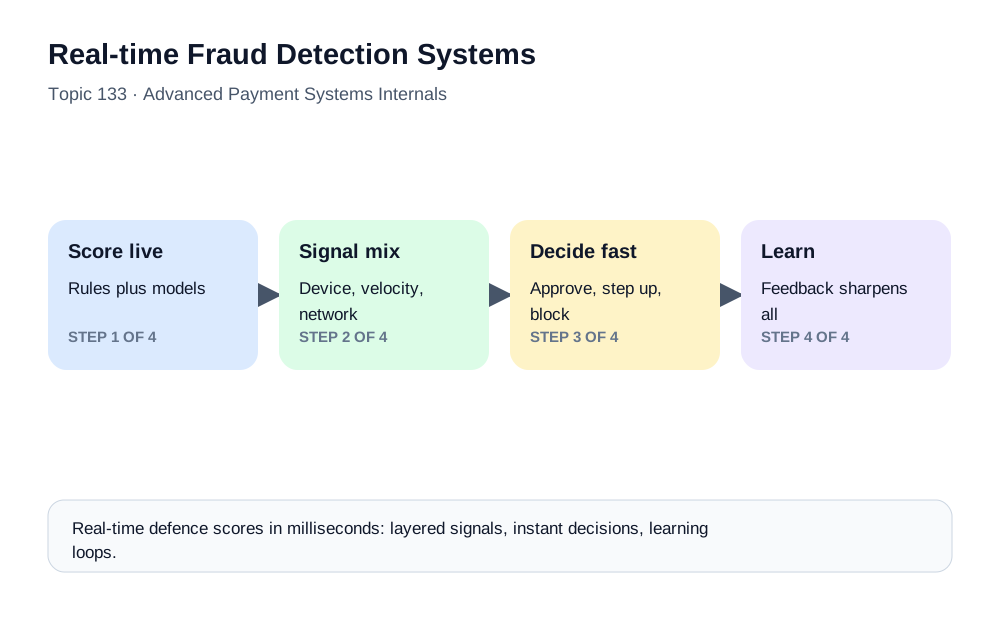
Real-time Fraud Detection Systems at a glance — Rule engines, ML models, real-time scoring, network analysis.
Scoring Payments, Stopping Attacks, and Protecting Good Customers
A digital payment has to pass through two promises at the same time. The first promise is speed: the customer expects the payment, card purchase, wallet transaction, or instant transfer to complete quickly. The second promise is safety: the bank must not allow fraudsters to drain accounts simply because the rail is fast.
Real-time fraud detection is the control that sits between those promises. It evaluates a transaction while the customer is still waiting for a response. In a few milliseconds, the bank must decide whether the transaction looks normal, suspicious, or dangerous. The result may be approval, decline, step-up authentication, temporary hold, customer notification, or referral to a fraud operations queue.
This chapter explains real-time fraud detection as a banking system, not just as an AI model. It covers transaction scoring, rules, machine learning, behavioral profiling, device intelligence, velocity checks, network risk, false positives, case management, and the operating model needed to protect customers without blocking legitimate payments.
Learning objectives
By the end of this chapter, you should be able to:
- Explain what real-time fraud scoring does during a payment lifecycle.
- Distinguish fraud rules, fraud scores, alerts, declines, holds, and step-up authentication.
- Identify the main data signals used in transaction risk assessment.
- Understand how rule engines, machine learning, anomaly detection, and graph analytics work together.
- Explain false positives and why they matter for customer experience.
- Describe how fraud operations teams investigate alerts after system decisions.
- Understand why instant payments and social engineering scams make fraud control harder.
- Discuss the governance needs around fraud models, thresholds, monitoring, and customer liability.
1. What Real-Time Fraud Detection Means
Real-time fraud detection is the process of assessing a transaction for fraud risk before or during execution, using available data about the customer, account, device, beneficiary, merchant, behavior, and payment context.
The system normally answers three practical questions:
- Does this transaction look like the genuine customer's normal behavior?
- Does this transaction match known fraud patterns?
- What action should the bank take now?
The decision has to be fast. A card authorization cannot wait for a long investigation. An instant payment cannot sit for minutes without damaging customer experience. A mobile banking transfer cannot ask the customer twenty questions every time. The fraud system must therefore make a risk-based decision with incomplete information.
2. Where Fraud Detection Sits in the Payment Flow
A simplified real-time payment flow looks like this:
- Customer initiates a payment or purchase.
- Channel validates login, session, device, amount, and basic input.
- Payment or card system creates an authorization or payment request.
- Fraud engine receives transaction data and customer context.
- Rules and models calculate risk.
- Decision engine returns approve, decline, step-up, hold, or review.
- Payment processing continues or stops.
- Alerts and events flow to fraud operations, customer notification, and monitoring systems.
The fraud engine is not always a single system. Large banks may have channel-level fraud controls, card fraud systems, account-to-account payment fraud engines, enterprise case management, AML transaction monitoring, mule-account detection, and customer communication tools. The more important point is that fraud control must be connected to the payment path early enough to stop harm.
3. The Difference Between Fraud and AML Monitoring
Fraud detection and AML monitoring often use similar data, but their purpose is different.
Fraud detection protects the customer or bank from unauthorized or deceptive transactions. It focuses on immediate loss prevention: account takeover, card theft, scam payments, mule transfers, fake merchants, phishing, SIM swap, device compromise, and social engineering.
AML transaction monitoring looks for suspicious financial crime patterns such as laundering, structuring, terrorist financing, sanctions evasion, or unusual movement of funds over time. It often works after transactions occur, although some controls can be real time.
A payment may be non-fraudulent but AML-suspicious. A customer may willingly send money as part of a laundering scheme. Another payment may be fraud but not laundering. Mature banks connect both views but keep their objectives clear.
4. Main Fraud Signals Used in Scoring
Real-time fraud systems use many categories of signals.
| Signal Type | Examples | Why It Matters |
|---|---|---|
| Customer profile | Age, segment, account age, product history | Establishes baseline risk and normal usage |
| Transaction details | Amount, currency, merchant, rail, beneficiary, purpose | Describes the payment being assessed |
| Behavior | Usual amounts, frequency, payees, login style, typing rhythm | Detects deviation from normal customer behavior |
| Velocity | Number and value of transactions in last minutes, hours, days | Detects rapid attacks and account draining |
| Device | Device ID, browser fingerprint, operating system, rooted device indicator | Flags new or compromised devices |
| Location | IP, GPS, country, impossible travel, proxy/VPN risk | Detects unusual geography or evasion |
| Beneficiary risk | New payee, mule-account indicators, recent account creation | Helps stop scam and mule payments |
| Merchant risk | Merchant category, chargeback history, fraud rate | Important for card and e-commerce fraud |
| Authentication | MFA result, OTP success, biometric result, failed attempts | Shows whether the session is trustworthy |
| Network intelligence | Shared device, shared phone, linked accounts, known fraud cluster | Detects fraud rings rather than only single transactions |
The value of fraud detection comes from combining these signals. A high-value transaction is not automatically fraud. A new device is not automatically fraud. A late-night transaction is not automatically fraud. But high value, new device, unusual location, new beneficiary, failed login attempts, and recent SIM swap together create a very different risk picture.
5. Rules, Models, and Decision Engines
Fraud systems usually combine several techniques.
Rule engines apply explicit business rules. Example: decline if the transaction is above a defined limit from a newly registered device to a high-risk beneficiary. Rules are explainable and useful for known patterns, but they can become too rigid and produce many false positives.
Supervised machine learning models learn from historical labelled cases: fraud and non-fraud. They can detect complex patterns that simple rules miss, but they depend on good training data and may struggle with new attack types.
Anomaly detection identifies behavior that is unusual for the customer or peer group. It can detect new fraud methods, but unusual does not always mean fraudulent.
Graph analytics looks at relationships between accounts, devices, phone numbers, IP addresses, merchants, and beneficiaries. It is useful for finding mule networks, collusion, synthetic identities, and organized fraud rings.
Decision engines combine rule hits, model scores, customer value, product rules, liability rules, and bank risk appetite into one action.
A mature system does not blindly follow one score. It combines evidence and applies the right action for the risk level.
6. Fraud Decisions: Approve, Decline, Step-Up, Hold, Review
A fraud score is not the final business outcome. The bank still needs a decision.
Common actions include:
- Approve - allow the transaction without extra friction.
- Step-up authentication - ask for OTP, biometric confirmation, app approval, or other additional factor.
- Soft decline - stop the transaction temporarily and ask the customer to re-authenticate or confirm.
- Hard decline - reject the transaction due to high fraud risk.
- Hold or pending review - pause the transaction for manual or automated review where scheme rules permit.
- Post-transaction alert - allow the transaction but send it to fraud monitoring for rapid follow-up.
- Customer notification - send SMS, push, email, or in-app alert asking the customer to confirm activity.
- Account or card block - restrict further activity if compromise is suspected.
The correct action depends on product, rail, regulation, scheme rules, transaction value, customer impact, and confidence in the fraud signal.
7. Step-Up Authentication
Step-up authentication is the middle path between approving everything and declining too aggressively. It adds friction only when risk justifies it.
Examples include:
- OTP confirmation;
- biometric approval;
- in-app push confirmation;
- additional password or PIN;
- call-back verification for high-value corporate payments;
- cooling period for new beneficiary activation;
- re-authentication after device change.
Step-up is useful, but not perfect. Fraudsters increasingly use social engineering to persuade customers to approve the transaction themselves. If a customer is tricked into entering OTP or approving a push notification, the system may see strong authentication even though the payment is fraudulent. This is why scam detection must look beyond authentication success.
8. Authorized Push Payment Scams
Modern fraud is not only about stealing credentials. Many attacks involve manipulating the genuine customer into sending money.
Examples include:
- fake investment schemes;
- romance scams;
- impersonation of bank staff, police, tax authorities, or delivery companies;
- invoice redirection fraud;
- business email compromise;
- fake customer support numbers;
- remote access app scams;
- emergency family-member scams.
These are hard because the transaction may be technically authorized. The login is real. The device is real. The OTP may be real. The customer may be under pressure and willingly pressing confirm.
Fraud systems need scam signals: new beneficiary, unusual urgency, first payment to a risky account, narrative or purpose mismatch, mule-account intelligence, recent beneficiary creation, unusual call or session behavior, and warnings shown at the right moment.
9. False Positives and Customer Experience
A false positive is a legitimate transaction incorrectly treated as fraud. False positives matter because they hurt real customers.
A blocked card at a hospital, a rejected salary payment, a frozen corporate supplier payment, or a declined travel transaction can damage trust quickly. High false positives also increase call center volume, manual review, complaints, and lost revenue.
Banks reduce false positives through:
- better customer-level baselines;
- richer device and behavioral data;
- segment-specific thresholds;
- dynamic limits;
- feedback from confirmed fraud and confirmed genuine cases;
- model monitoring;
- clear customer confirmation journeys;
- fast unblock and appeal processes.
The goal is not to block the maximum number of transactions. The goal is to stop fraud while allowing genuine customers to transact smoothly.
10. Fraud Operations and Case Management
Real-time decisions are only one part of fraud control. Fraud operations teams handle alerts, customer calls, confirmed fraud cases, recoveries, mule-account reviews, law enforcement requests, and model feedback.
A strong fraud case workflow includes:
- alert type and priority;
- transaction and customer details;
- reason codes and model explanations;
- linked accounts, devices, beneficiaries, and IPs;
- customer contact history;
- action taken: block, unblock, refund, deny, monitor, escalate;
- liability decision;
- recovery attempt;
- evidence and audit trail;
- root-cause classification;
- feedback to model and rule tuning.
Fraud operations must be fast because money moves quickly. In instant-payment scams, recovery chances fall sharply once funds move through mule accounts.
11. Model Governance and Monitoring
Fraud models need governance because they affect customers directly. A bad model can either allow fraud losses or unfairly block legitimate customers.
Banks should monitor:
- fraud detection rate;
- false positive rate;
- false negative rate;
- approval and decline rates;
- step-up success and abandonment;
- model drift;
- feature stability;
- customer complaints;
- segment-level fairness;
- manual-review outcomes;
- financial loss prevented;
- confirmed fraud loss after approval.
Thresholds should be tuned with care. If thresholds are too loose, fraud passes. If thresholds are too tight, customers suffer. Model governance, validation, and documented approvals matter, especially where AI and machine learning are used.
12. Practical Example: Suspicious Instant Payment
A customer who normally sends small domestic transfers initiates a high-value instant payment to a newly added beneficiary at 01:30. The login is from a new device. The IP address is in a different city. The customer recently changed their mobile number. The beneficiary account has received similar first-time payments from many customers in the last hour.
A good fraud system sees the combined pattern:
- unusual amount;
- unusual time;
- new device;
- recent profile change;
- new beneficiary;
- beneficiary linked to network-risk signals.
The system may block or hold the payment, trigger step-up authentication, show a scam warning, and send the case to fraud operations. If the customer confirms suspicious pressure or impersonation, the bank can stop the payment and protect the customer. If the customer confirms genuine activity and supporting evidence is strong, the bank can release with audit trail.
13. Common Misconceptions
"Fraud detection is just AI." No. It is a combination of rules, models, data quality, authentication, operations, customer education, recoveries, governance, and monitoring.
"OTP approval means the payment is safe." Not always. Customers can be tricked into approving fraud themselves. Authorized scam detection needs additional controls.
"A high fraud score means fraud is proven." A score is a probability or risk indicator. The bank still needs decision rules, evidence, and sometimes human review.
"False positives are acceptable because safety comes first." Safety matters, but blocking genuine customers has real cost and can become unfair. Good fraud control balances protection and usability.
"Fraud and AML are the same." They overlap but serve different purposes. Fraud focuses on unauthorized or deceptive loss events; AML focuses on suspicious financial crime and laundering behavior.
14. Frequently Asked Questions
What is a fraud score? A fraud score is a risk measure estimating how likely a transaction is to be fraudulent based on signals such as behavior, device, amount, beneficiary, velocity, and history.
What is velocity checking? Velocity checking measures how many transactions, login attempts, beneficiary additions, device changes, or other events occurred within a time window.
What is a mule account? A mule account is an account used to receive and move fraud proceeds, often through rapid onward transfers to hide the trail.
Why are new beneficiaries risky? Many scams and account-takeover attacks send money to newly added beneficiaries. Banks often apply cooling periods, lower limits, or enhanced checks.
Why does the bank sometimes block my genuine transaction? The transaction may have matched a risk pattern. Good banks should provide fast confirmation and release paths when the customer proves it is genuine.
Can fraud models stop all fraud? No. Fraud patterns change constantly, and some scams use genuine customer authorization. Models reduce risk but must be supported by operations, education, and recovery processes.
15. Key Terms in This Chapter
- Fraud score - risk measure estimating the probability of fraud.
- Rule engine - system applying explicit fraud rules.
- Step-up authentication - extra verification triggered by higher risk.
- False positive - genuine transaction incorrectly flagged as fraud.
- False negative - fraudulent transaction incorrectly allowed.
- Velocity check - control measuring event frequency within a time window.
- Device fingerprinting - method of identifying a device using technical signals.
- Behavioral profiling - comparison of current activity against normal customer behavior.
- Graph analytics - analysis of relationships between accounts, devices, phone numbers, IPs, and beneficiaries.
- Mule account - account used to receive or move fraud proceeds.
- Authorized push payment scam - scam where the genuine customer is tricked into sending money.
- Model drift - degradation when model behavior changes because real-world patterns changed.
- Case management - workflow for investigating fraud alerts and confirmed cases.
16. Interview Insights
"How does real-time fraud scoring work?" Explain that the bank collects transaction, customer, device, location, velocity, beneficiary, and behavioral signals; applies rules and models; then returns a decision such as approve, decline, step-up, hold, or review.
"What is the difference between false positive and false negative?" A false positive blocks a genuine transaction. A false negative allows fraud. Fraud strategy is about balancing both, not only maximizing declines.
"Why are instant payments difficult for fraud teams?" Because funds move quickly, customer expectations are immediate, and recovery windows are short. Social engineering also means the genuine customer may authorize the scam.
"What would you monitor in a fraud dashboard?" Fraud loss, prevented loss, alert volume, false positives, false negatives, decline rate, step-up rate, abandoned transactions, confirmed fraud by channel, mule-account links, model drift, and customer complaints.
"Why is graph analytics useful in fraud?" Because fraud often happens through networks. Shared devices, IPs, phone numbers, beneficiaries, and mule accounts can reveal organized patterns that single-transaction scoring may miss.
Summary and Key Takeaways
Real-time fraud detection protects customers and banks while keeping digital payments fast. It is one of the most important control layers in modern payment systems.
The main lessons are:
- Fraud scoring is a real-time decision discipline. It must act while the transaction is still in flight.
- No single signal proves fraud. Risk comes from combinations of behavior, device, beneficiary, velocity, location, and history.
- Rules and models work together. Rules catch known patterns; models detect complex and changing behavior.
- Step-up authentication is useful but not enough. Scam victims may approve transactions themselves.
- False positives matter. Fraud control must protect customers without unfairly blocking genuine activity.
- Operations complete the control. Alerts, cases, blocks, recoveries, liability decisions, and model feedback make the system effective.
- Governance is essential. Fraud models and thresholds must be monitored, validated, and adjusted as behavior changes.
A good fraud system is not judged only by how many transactions it blocks. It is judged by how well it protects real customers while allowing genuine money movement to continue with confidence.
Next: Topic 134 - Sanctions Screening Systems
<!-- MBA-DEEP-DIVE-START -->Real-Time Fraud Detection Deepening — Decision Architecture, Scam Controls, Model Risk, and Recovery
Fraud control is a decision service, not a score
A numerical risk score has no value until the bank maps it to an action. The same score might trigger a decline for a low-value consumer transfer, a step-up for a card purchase, or manual confirmation for a high-value corporate instruction depending on product, rail, liability, and available time. Fraud architecture should therefore separate feature generation, scoring, business rules, decision policy, and execution. This makes it possible to change thresholds or actions without rebuilding the underlying model.
Latency budget should be designed end to end
A payment channel may promise a response in seconds, but several controls compete for that time: authentication, limits, fraud, sanctions, account validation, routing, and external network response. The fraud engine cannot consume the entire SLA. Teams should define a latency budget, measure median and tail response times, and decide what happens when the fraud service itself times out. Failing open, failing closed, or using a fallback rule set each creates different risk and customer impact.
Fraud features need fresh data
A model using yesterday's beneficiary risk or a device profile updated hours ago can miss a fast attack. Important features may need near-real-time event feeds: recent password reset, new device registration, SIM change signal, beneficiary creation, failed authentication, rapid incoming funds, or linked fraud cases. Feature freshness should be monitored like system availability. A feature store that returns stale values without warning can silently degrade protection.
Feature availability must be consistent between training and production
A model can look excellent in development if training data includes information that would not actually be known at decision time. This is leakage. For example, using a chargeback outcome or future account behaviour to predict whether the current transaction is fraud produces unrealistic performance. Model governance should verify that every feature exists with the same definition and timing in production. Real-time fraud models are especially sensitive to this because milliseconds determine what is knowable before execution.
Rules are strongest when they target known attack mechanics
A rule such as “high amount equals fraud” is crude. A rule that combines a newly bound device, password reset, first-time beneficiary, and rapid transfer after login targets a more specific takeover pattern. Rules should have an owner, rationale, expected population, expiration or review date, and performance monitoring. Temporary emergency rules introduced during an attack often remain for years unless governance forces review, creating unnecessary false positives.
Machine learning should complement expert rules
Supervised models can combine hundreds of weak signals, while rules can enforce policy or immediately respond to newly discovered attack patterns. Neither approach replaces the other. A mature decision stack can use rules for hard prohibitions, models for probabilistic risk, graph scores for network context, and behavioural models for customer deviation. Decision policy then combines them transparently enough for operations and governance to understand why an action occurred.
Unsupervised anomalies need careful interpretation
A transaction can be unusual because the customer is travelling, buying a home, paying tax, or changing financial behaviour. Anomaly does not equal fraud. Unsupervised models are useful for surfacing novel patterns but should be paired with context and controlled actions. A very unusual transaction might trigger verification rather than automatic permanent account closure. Model designers should test how anomaly scores behave for legitimate life events.
Graph analytics changes the unit of analysis
Transaction scoring asks whether one payment is suspicious. Graph analytics asks whether accounts, devices, phone numbers, IP addresses, merchants, beneficiaries, and identities form a suspicious network. A beneficiary receiving first-time transfers from many unrelated victims can become high risk even before every sender individually looks unusual. Graph features are powerful for mule detection, synthetic identity, collusion, and organised fraud because they capture relationships that transaction-only models miss.
Graph data needs identity-resolution controls
Two customers using the same household IP are not automatically connected fraudsters. Shared devices can occur in families, branches, assisted-service locations, or businesses. Entity resolution should use multiple attributes and confidence levels rather than one common signal. Poor linkage can contaminate a graph and cause legitimate customers to inherit risk from unrelated users. Analysts need to see why the system believes two nodes are connected.
Mule risk should be evaluated on incoming and outgoing behaviour
Mule accounts often receive funds from multiple victims and move them onward quickly through transfers, cash withdrawal, crypto purchase, or other accounts. The receiving bank is therefore critical to fraud prevention. Controls can examine account age, incoming fan-in, rapid pass-through, device sharing, beneficiary concentration, and changes in normal behaviour. Stopping the receiving account can protect customers across several sending banks, not only the bank's own account holders.
Beneficiary intelligence should be shared safely where frameworks permit
A sending bank may know a customer is being scammed while the receiving bank sees only an ordinary incoming payment. Industry information-sharing arrangements, confirmation services, fraud-reporting networks, and scheme signals can reduce this asymmetry subject to privacy and legal rules. The objective is to identify risky destinations faster without creating an uncontrolled blacklist that wrongly excludes innocent customers. Governance and appeal mechanisms matter.
APP scam controls need contextual friction
When the genuine customer is being manipulated, stronger authentication alone may confirm the scam rather than stop it. Effective friction asks context-sensitive questions, delays selected high-risk payments, warns about specific scam patterns, or requires confirmation through an independent channel. Generic banners shown on every transfer quickly become invisible. Warnings should be triggered by actual risk features such as new beneficiary, unusual value, risky recipient, or suspicious session behaviour.
Warning design should avoid coaching fraudsters
A scammer on the phone may tell the victim exactly what to click. If the bank always asks the same predictable question, criminals can script the answer. Dynamic warnings and out-of-band contact can be stronger for high-risk scenarios. The bank should also avoid revealing detailed fraud thresholds in customer messages. Communication needs to be clear enough to protect the customer without teaching attackers how to evade controls.
Cooling periods are a targeted control
A bank may delay high-risk activity after a new beneficiary, device, password reset, or profile change. Cooling periods can interrupt account takeover and scam pressure, but they also affect legitimate urgent payments. Policy should define which events trigger delay, duration, exemptions, and emergency handling. Customers need advance explanation so the control does not appear as a random service failure.
Device intelligence is broader than device ID
Fraud systems can use operating system, browser, app integrity, emulator signals, rooted or jailbroken status, IP reputation, proxy use, device age, and historical association with accounts. No single signal proves compromise. Device intelligence should be combined with authentication and behaviour. Device fingerprints also have privacy implications, so collection and retention should follow applicable law and declared purpose.
SIM-swap signals need interpretation
A recent SIM change can increase takeover risk, but legitimate customers replace phones and SIMs. The bank may use telecom or device signals where legally available to trigger extra verification rather than automatic decline. The relevant pattern can be recent profile change plus new device plus high-value beneficiary transfer. Combining signals reduces unnecessary friction while still addressing a known takeover technique.
Behavioural biometrics should be treated probabilistically
Typing rhythm, touchscreen movement, mouse behaviour, navigation pattern, and session speed can help distinguish a customer from an attacker or remote-access session. These signals can drift with injury, device change, ageing, or context. They should not be treated as a secret perfect identity check. Banks need performance testing, privacy governance, and fallback methods where behavioural confidence is low.
Remote-access scams create distinctive session patterns
Victims may install remote-control software after being deceived by fake support staff. Device and behavioural systems can sometimes detect accessibility-service abuse, screen sharing, overlay behaviour, or unusual interaction patterns, depending on platform permissions. Controls should be careful not to block legitimate accessibility technology indiscriminately. Security and accessibility teams need to test together so anti-fraud logic does not harm customers who depend on assistive tools.
Corporate payment fraud needs mandate context
A corporate transfer may be high value and unusual by consumer standards but normal for the business. Fraud controls should understand user roles, mandate limits, dual approval, payment templates, beneficiary history, ERP or host-to-host channel, and business calendar. A new beneficiary entered by one user and approved by another can still be fraudulent if both credentials were compromised or invoice details were manipulated. Corporate fraud requires entity and workflow context, not only individual-user scoring.
Business email compromise often starts outside the bank
An attacker may compromise a supplier or corporate email and instruct a legitimate employee to change beneficiary details. The bank sees an authenticated customer making a valid payment. Controls can look for changed beneficiary accounts, unusual countries, first payments, invoice patterns, and verification history. Corporate customers also need process controls such as independent callback for beneficiary changes. Fraud prevention is shared between bank technology and customer operating discipline.
Card-present and card-not-present fraud need different features
A chip transaction at a physical terminal has different risk from an e-commerce purchase, tokenised wallet payment, or recurring merchant charge. Fraud models should reflect channel mechanics and authentication. Merchant category, terminal, token, 3-D Secure data, card-present indicators, shipping context, and historical merchant behaviour can matter differently. One universal card model can underperform specialised models while creating more false positives.
Tokenisation changes card fraud exposure rather than eliminating it
Network or device tokens reduce exposure of the underlying card number in some scenarios, but criminals can still take over accounts, provision stolen credentials to wallets, compromise merchants, or manipulate customers. Fraud controls need token lifecycle, device binding, wallet provisioning, and merchant data. Security improvements in one layer often shift attacker focus to another.
Fraud and authentication decisions should share context
Authentication systems know login risk; fraud systems know transaction risk. If they operate separately, a suspicious login can be forgotten when the payment starts. Passing session risk, device confidence, recent authentication events, and profile changes into transaction scoring creates continuity. Conversely, a high-risk payment can trigger a stronger authentication method. The customer journey should behave like one risk system even if several platforms are involved.
False positives have unequal harm
Declining a discretionary online purchase is different from blocking rent, hospital payment, payroll, or a time-critical corporate settlement. Decision policy can consider transaction purpose and customer context where reliable. High-risk customers also need fair treatment; the goal is not to create segments that are permanently subjected to friction because of socioeconomic proxies. Conduct and fairness review should examine who receives declines and step-ups, not only aggregate model accuracy.
Sensitive attributes require caution
Age, nationality, location, disability, and similar characteristics can correlate with fraud patterns but may be protected, sensitive, or poor proxies. Banks should involve legal, model-risk, privacy, and fairness teams before using such features. A model should not simply learn that a demographic group is “riskier” because historical data reflects unequal treatment. Fraud prevention needs strong signals tied to behaviour and attack mechanics wherever possible.
Model drift can happen quickly during a fraud campaign
Fraudsters adapt after controls change. A model trained on last quarter may lose effectiveness when criminals switch channel, merchant type, beneficiary network, or social-engineering script. Monitoring should track feature distributions, fraud capture, false positives, and new attack clusters. Rapid rule deployment can provide temporary defence while models are retrained. The bank needs controlled speed: fast enough to respond, but with approval and rollback.
Label delay complicates model monitoring
Fraud is not always confirmed immediately. Chargebacks, customer complaints, investigations, or law-enforcement outcomes can arrive weeks later. Recent transactions may therefore appear genuine simply because labels are immature. Model performance reporting should account for this lag and avoid declaring a new model successful based on incomplete outcomes. Mature evaluation uses observation windows and backfills confirmed labels.
Feedback quality matters more than feedback volume
If analysts incorrectly label alerts, the next model can learn from bad data. Case-management outcomes should distinguish confirmed fraud, confirmed genuine, customer scam, policy decline, unresolved, and other categories. Analysts need clear definitions and quality review. Model teams should not convert every manually declined transaction into a fraud label.
Champion-challenger testing reduces deployment risk
Banks can run a new fraud model in shadow or challenger mode alongside the current production model. This shows how decisions would differ before customer impact occurs. Testing can compare fraud capture, false positives, latency, segment effects, and operational alert volume. A challenger that improves statistical accuracy but doubles manual reviews may not produce a better operating outcome.
Thresholds should be linked to capacity
If a model sends 100,000 alerts to a team able to review 10,000, most alerts provide no practical protection. Decision design should consider analyst capacity, queue priority, and expected value. Very high-risk cases may be stopped automatically; medium risk may go to review; low risk may be monitored. Staffing and model thresholds are part of the same operating system.
Fraud operations need evidence-rich alerts
An alert that shows only a score forces the analyst to repeat the model's work manually. Good case views present key risk drivers, recent transactions, device history, beneficiary links, authentication events, customer contact, and related cases. Analysts should also see which information is uncertain or missing. Explainability improves both decision speed and feedback quality.
Customer contact must resist impersonation risk
When the bank calls about a suspicious payment, the customer may reasonably fear that the caller is a scammer. Verification processes should avoid asking for secrets the bank tells customers never to share. In-app secure messaging, known-number callback, or customer-initiated contact can reduce confusion. Fraud operations should never train customers to hand OTPs or passwords to someone claiming to be the bank.
Post-transaction monitoring remains necessary
No real-time system catches everything. Newly discovered mule accounts, later customer reports, chargebacks, or network intelligence can reveal fraud after approval. Post-event analytics can identify related transactions and restrict further loss. The bank should be able to feed new beneficiary risk back into the real-time engine quickly. Prevention and detection form a loop rather than two separate programmes.
Recovery is part of fraud performance
Stopping fraud before execution is best, but recovery after loss still matters. Banks should measure speed of interbank notification, beneficiary-account restriction where legally possible, funds recovered, and time to customer resolution. A model with slightly lower preventive capture could still perform better overall if the operating model recovers losses faster and produces fewer false positives. Fraud strategy should measure end-to-end customer and financial outcomes.
Fraud controls must degrade safely during outages
If a model service, device-intelligence provider, or graph platform fails, payment processing needs a pre-agreed fallback. Options can include conservative rules, lower limits, step-up authentication, selective holds, or temporary channel restrictions. The decision should depend on rail and risk appetite. Undocumented fail-open behaviour can create a window attackers deliberately exploit during service disruption.
Fraud telemetry should support incident response
A coordinated attack can cause sudden spikes in login failures, new beneficiaries, declines, or payments to a cluster of accounts. Dashboards should detect these shifts quickly and let teams drill down by channel, geography, device, beneficiary, and rule. Incident response may include emergency rules, customer warnings, partner notifications, and enhanced monitoring. The fraud platform is therefore also an operational security sensor.
The best fraud system balances four outcomes
A strong real-time fraud programme minimises fraud loss, minimises harm to genuine customers, meets payment latency, and produces decisions the bank can govern and investigate. Optimising only one dimension creates problems: maximum declines destroy usability; minimum friction increases loss; maximum model complexity can destroy explainability; maximum review overwhelms operations. World-class fraud control treats rules, models, identity, operations, recovery, customer communication, and governance as one system.
Real-Time Fraud — Decision Architecture, Signals, Intervention, and Loss Control
Real-time fraud control operates under a hard time budget
In an instant or near-instant payment journey, a fraud decision may need to occur before settlement becomes difficult or impossible to reverse. The control therefore has to gather signals, score risk, apply policy, and either allow, challenge, hold, or reject within the rail's processing expectations. A highly accurate model that responds too slowly can be operationally unusable. Architecture should allocate latency across device checks, behavioural analytics, beneficiary intelligence, account history, model scoring, and policy rules so the bank knows where time is being consumed.
Fraud detection should combine identity, behaviour, transaction, and network context
No single signal is reliable enough for every attack. Useful evidence can include authentication method, device history, location consistency, session behaviour, transaction amount, beneficiary novelty, account age, recent profile changes, velocity, prior fraud reports, and relationships between accounts. Signals should be evaluated together and in context. A new beneficiary is ordinary for some customers and highly unusual for others. Personalised behavioural baselines can reduce unnecessary friction while retaining sensitivity to anomalies.
Authentication success is not proof that the payment is safe
A customer can authenticate correctly while being manipulated by a scammer, remotely controlled, or tricked into authorising the wrong beneficiary. Fraud controls therefore need to look beyond credential validity. Rapid beneficiary addition followed by a high-value transfer, unusual remote-access indicators, a call in progress during payment, or a payment inconsistent with the customer's history may justify additional intervention even after strong authentication. The objective is to detect both account takeover and authorised push-payment style scams where relevant.
Step-up controls should be proportional to the risk
When risk rises, the bank can request additional verification or present a stronger warning. The challenge should be designed to test the actual concern. Asking for another one-time password may add little value if the scammer is coaching the customer through it. A transaction-specific confirmation that names the beneficiary, explains that bank staff will not ask for the payment, or asks why the transfer is being made may be more useful. Friction should be applied where it can change the outcome, not merely where it is easy to implement.
Beneficiary intelligence is a powerful real-time signal
Risk changes when funds are going to an account newly opened, recently reported for fraud, receiving money from many unrelated senders, or rapidly dispersing incoming funds. Banks can use internal and permitted external intelligence to assess beneficiary risk. However, negative labels require strong data governance because an incorrect fraud marker can block legitimate customers across many transactions. Evidence, expiry, review, and appeal or remediation processes should be defined for high-impact beneficiary controls.
Mule detection is both pre-transaction and post-transaction work
Accounts used to receive and move fraudulent funds may look normal until network patterns emerge. Real-time monitoring can detect sudden incoming bursts, rapid onward transfer, cash-out, or unusual counterparties. Post-event analytics can identify connected accounts and feed new risk indicators back into real-time decisions. This feedback loop needs controls so an investigation hypothesis does not automatically become a permanent adverse label without appropriate validation.
Device intelligence should be treated as evidence, not identity
A familiar device lowers some forms of risk but does not prove the genuine customer is in control. Malware, remote-access software, session theft, and coercion can all occur on a known device. Conversely, a new phone can be legitimate after an upgrade or loss. Device signals should include integrity, change history, binding, emulator or tampering indicators, and relationship to prior sessions while remaining one part of a broader decision.
Behavioural analytics can identify unusual interaction patterns
Typing rhythm, navigation sequence, copy-paste behaviour, hesitation, screen switching, or unusual session duration may provide signals when collected lawfully and appropriately. These indicators can help detect automation, remote control, or a customer following scripted instructions. They are probabilistic and can be affected by disability, stress, travel, or device changes, so they should not become unchallengeable proof. Model validation should test both detection value and unintended customer impact.
Fraud models need an explicit decision policy around the score
A model score does not itself decide what the bank should do. Policy maps risk ranges and contextual conditions to actions such as allow, warn, step up, hold, decline, or route to review. This separation allows the bank to change risk appetite or response strategy without retraining the model. It also makes governance clearer: model teams own predictive performance, while fraud policy owners decide acceptable intervention based on loss, customer friction, legal requirements, and operational capacity.
False positives have real financial and customer cost
Blocking a genuine payment can cause missed purchases, late bills, failed payroll, reputational harm, and support calls. Fraud optimisation should therefore consider more than fraud-loss capture. Useful measures include false-positive rate, genuine-payment approval, customer abandonment, manual-review volume, complaint rate, time to release, and repeat friction for the same customer. A system that prevents fraud by rejecting an excessive share of legitimate activity is not a successful control.
False negatives need rapid learning loops
When a fraudulent payment is later confirmed, the bank should preserve the signals, model version, rule version, device state, beneficiary context, and decision that allowed it. Post-incident review can determine whether the pattern was detectable and whether a rule, feature, model, or customer warning should change. Learning should be controlled; immediately adding a narrow rule for every loss can create an unstable rule base with high false positives. Changes need testing against historical legitimate traffic.
Real-time rules need lifecycle management
Fraud teams often create urgent rules during attacks. Each rule should have owner, rationale, effective date, scope, threshold, expected impact, monitoring, and review or expiry date. Emergency controls can be deployed quickly but should not remain indefinitely without evidence. A large legacy rule set becomes difficult to understand and can interact unpredictably with models. Rule governance is therefore as important as model governance.
Velocity controls should span relevant channels
Fraudsters may distribute activity across mobile, web, ATM, card, or API channels to stay below a threshold in each one. A bank should aggregate risk where customer identity and product design allow. Multiple beneficiary additions, password resets, card tokenisations, and transfers within a short period may be more meaningful together than separately. Cross-channel correlation requires consistent identifiers and timely event sharing.
Profile changes can raise transaction risk temporarily
A recent phone-number change, device re-registration, password reset, address update, or beneficiary modification can increase uncertainty. Policy can apply a temporary cooling period or additional verification for high-risk actions, depending on customer needs and applicable rules. These controls should be carefully designed so legitimate customers are not locked out for routine maintenance. Clear communication and secure exception handling are essential.
Customer warnings should be contextual and actionable
Generic fraud banners become invisible when shown on every transaction. A stronger warning reflects the observed risk: payment to a new investment recipient, request from someone claiming to be bank staff, purchase following remote-access installation, or transfer after a social-media contact. The message should say what the customer should do before continuing. Warning effectiveness can be measured by cancellation rate, confirmed fraud outcomes, and customer comprehension rather than simply whether the screen was displayed.
A hold requires a controlled release process
Some banks or rails may permit a temporary hold or review for suspicious transactions in defined circumstances. Holding creates customer impact and should have reason, maximum duration, ownership, and escalation. Reviewers need the relevant evidence and authority to release or stop the transaction. If the hold expires automatically, the system should know what state follows. Indefinite “pending fraud review” is an operational failure, not a control strategy.
Manual review queues should be risk-ranked
When transaction volumes are high, investigators cannot review every alert. Queue prioritisation can consider model score, amount, beneficiary risk, vulnerability, account takeover signals, and time sensitivity. Staffing should account for peak periods and attack surges. If review capacity is exhausted, the bank needs predefined fallback policy rather than allowing cases to age silently beyond the point where intervention is useful.
Fraud decision services need high availability and safe degradation
If a fraud engine fails, the payment platform must know whether to fail open, fail closed, or apply contingency rules by product and risk. One policy for every transaction is unlikely to be appropriate. Low-risk activity may continue under reduced controls while high-risk payments are held or challenged. Contingency behaviour should be approved, tested, monitored, and reconciled after recovery. An outage is not the moment to invent the bank's fraud risk appetite.
Model drift can follow changes in customer behaviour
New payment products, holidays, economic shocks, merchant trends, or channel releases can alter normal behaviour. A model trained on older patterns may begin generating more false positives or missing new fraud. Monitoring should compare input distributions, scores, decisions, confirmed fraud, and customer outcomes over time. Data-quality incidents should be separated from genuine behavioural drift because a missing feature can look like a sudden change in fraud risk.
Fraud data needs strong lineage
When a customer challenges a blocked transaction, the bank should be able to reconstruct which model and rules were applied and which source data influenced the action, subject to security and legal constraints. This does not mean revealing detection logic to criminals. It means internal teams can reproduce the decision, validate data, and identify defects. Versioned models, feature definitions, rules, and timestamps are essential for accountable automation.
Cross-bank collaboration can reduce fraud movement
Fraud often moves money through several institutions quickly. Where legal and industry arrangements permit, sharing confirmed mule indicators, beneficiary risk, scam typologies, or recovery requests can improve prevention. Information should be proportionate, accurate, secured, and governed. A bank should not export unverified suspicion as fact. Collaboration is most valuable when participants agree evidence standards and correction processes.
Recovery should begin as soon as fraud is confirmed
If a fraudulent transfer has already left the bank, speed matters. The case may require contacting receiving institutions, tracing onward movement, preserving evidence, freezing remaining funds where lawful, and coordinating customer communication. Fraud operations and payment investigations should therefore share transaction identifiers and case information. A fraud case that cannot access the payment's settlement trail loses valuable time.
Customer reimbursement decisions are separate from fraud detection
Whether the bank detected a scam and whether the customer is entitled to reimbursement are related but distinct questions governed by product terms, law, scheme rules, and facts. The fraud system should preserve evidence rather than automatically deciding liability from a model score. Claims teams need authentication records, warnings shown, customer statements, transaction history, and recovery results. Clear separation protects both customer rights and model governance.
Real-time fraud control should be measured end to end
The final scorecard can include prevented loss, realised loss, false positives, genuine approval rate, intervention latency, manual-review time, recovery, complaints, reimbursement, and customer abandonment. It should also track control availability and data quality. This creates a balanced view of protection and service. Fraud prevention succeeds when the bank reduces financial harm while allowing legitimate customers to move money reliably and quickly.
<!-- MBA-DEEP-DIVE-END -->