Visual overview
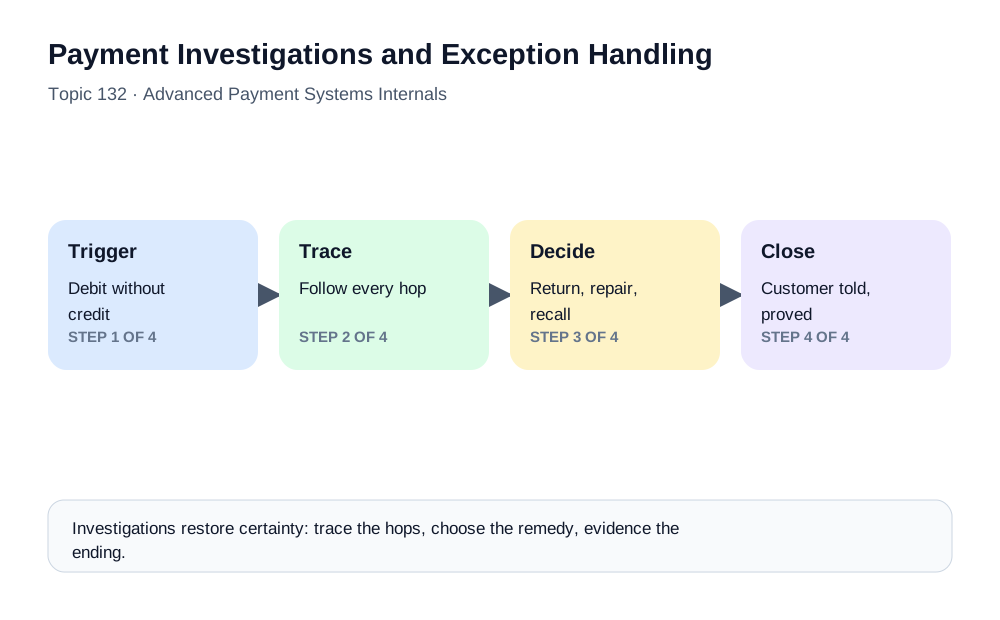
Payment Investigations and Exception Handling at a glance — Dispute resolution, payment tracing, correction processes.
Tracing Failed Payments, Resolving Disputes, and Protecting Customer Trust
A payment is not finished only because a customer pressed send or a system created a transaction reference. It is finished when the bank can prove what happened end to end: who initiated it, which account was debited, which rail carried it, which status was received, whether the beneficiary was credited, whether settlement happened, and whether the customer-facing outcome matches the actual outcome.
Payment investigations begin when that proof is missing, unclear, disputed, or contradicted. A customer says money was debited but not received. A corporate asks why a high-value transfer is still pending. A beneficiary bank says funds never arrived. A cardholder disputes a transaction. A sanctions hold delays a cross-border payment. A reconciliation break shows a payment in one system but not another. Each case has a story, and the investigation team's job is to reconstruct that story accurately.
This chapter explains payment investigations as a banking operations discipline. It covers failed payments, disputes, reversals, chargebacks, recalls, tracing, customer complaints, scheme timelines, fraud cases, wrong-beneficiary scenarios, and the evidence needed to close an investigation properly.
Learning objectives
By the end of this chapter, you should be able to:
- Explain when a payment investigation is needed and what evidence it uses.
- Distinguish operational exceptions, customer disputes, fraud claims, recalls, returns, and chargebacks.
- Trace a debit-no-credit payment across channel, core, payment hub, scheme, beneficiary bank, and settlement records.
- Understand why status codes, references, timestamps, and reconciliation evidence matter.
- Describe how card chargebacks differ from bank transfer investigations.
- Explain customer liability principles for unauthorized electronic transactions.
- Identify good operational controls for investigation queues, ageing, escalation, and closure.
- Discuss how investigation quality affects customer trust and regulatory confidence.
1. What Is a Payment Investigation?
A payment investigation is a structured process used to determine the true status, ownership, and required action for a payment or payment-related complaint.
The investigation may ask:
- Was the payment validly initiated?
- Was the customer account debited?
- Did the payment pass channel validation?
- Did fraud, sanctions, limit, or compliance controls hold it?
- Did the payment hub send it to the correct rail?
- Did the scheme, network, or correspondent accept it?
- Was the beneficiary bank able to credit the recipient?
- Did settlement happen?
- Was a reversal, return, recall, refund, or chargeback needed?
- What should the customer be told?
A good investigation does not jump directly to refund or denial. It builds the payment timeline from evidence.
2. Investigation vs Reconciliation vs Dispute
These terms overlap, but they are not identical.
Reconciliation identifies differences between records that should agree. It may detect that a bank debit has no matching scheme record or that a settlement item has no internal transaction.
Investigation explains the difference or complaint. It asks why the records differ, where the payment stopped, who owns the next action, and what correction is required.
Dispute is a claim raised by a customer, merchant, bank, or counterparty challenging the payment outcome. Disputes normally have formal rules, timelines, evidence requirements, and liability allocation.
Exception handling is the operational process for managing items that cannot proceed normally: failed validations, unclear statuses, missing data, repair items, timeouts, blocked payments, and unresolved breaks.
In practice, one case can involve all four. A reconciliation break may trigger an investigation. The investigation may become a customer dispute. The dispute may require exception handling until reversal or settlement evidence is confirmed.
3. Common Investigation Triggers
Payment investigations usually begin from one of these triggers:
| Trigger | Example | Main Risk |
|---|---|---|
| Customer complaint | "My account was debited, but the receiver did not get money" | Customer harm and regulatory complaint |
| Operations queue | Payment stuck after validation or screening | SLA breach and delayed processing |
| Reconciliation break | Network file and internal records do not match | Financial loss or incorrect books |
| Scheme dispute | Another participant raises a formal query | Scheme penalty or liability shift |
| Fraud alert | Customer denies initiating the transaction | Unauthorized loss and fraud exposure |
| Compliance hold | Sanctions, AML, or regulatory review delays payment | Legal and reputational risk |
| Wrong beneficiary | Customer entered wrong account or proxy | Recovery complexity and customer dissatisfaction |
| Duplicate processing | Same instruction posted twice | Direct financial loss or customer impact |
The source of the trigger matters because it affects priority, evidence, timeline, and communication.
4. The Payment Investigation Lifecycle
A mature investigation process follows a controlled lifecycle.
Step 1: Case Registration
The case is opened with a unique case reference, payment reference, customer details, complaint channel, issue type, amount, currency, date, and priority.
Step 2: Initial Triage
The bank classifies the case: operational failure, fraud claim, wrong beneficiary, duplicate, card dispute, cross-border trace, return, recall, or reconciliation break. Triage determines the workflow and SLA.
Step 3: Evidence Collection
The investigator gathers channel logs, core postings, payment hub events, message records, scheme statuses, network acknowledgements, settlement files, beneficiary bank responses, reversal records, and customer communication.
Step 4: Status Reconstruction
The investigator reconstructs the payment journey step by step. This timeline is the heart of the investigation.
Step 5: Ownership Decision
The bank decides who must act next: sending bank, beneficiary bank, scheme operator, card acquirer, merchant, correspondent bank, fraud team, compliance team, or customer.
Step 6: Resolution Action
Resolution may involve reversal, manual credit, repair and release, return, recall request, chargeback, claim rejection, customer education, fraud blocking, or escalation.
Step 7: Customer Communication
The customer receives a clear outcome. Good communication avoids vague phrases like "technical issue" and explains the practical result: credited, reversed, under beneficiary-bank confirmation, rejected due to incorrect details, or still under scheme investigation.
Step 8: Closure and Root Cause
The case closes only when financial entries, customer outcome, evidence, and audit trail are complete. Recurring issues should feed root-cause analysis.
5. Debit-No-Credit: The Classic Payment Investigation
Debit-no-credit is one of the most sensitive payment exceptions. The sender's account is debited, but the receiver says the funds were not credited.
A proper investigation asks:
- Was the sender actually debited in the core banking system?
- Did the payment hub create one valid instruction?
- Was the instruction sent to the payment scheme or network?
- What response code came back: success, failure, timeout, pending, reject, or reversal?
- Did the beneficiary bank receive the instruction?
- Did the beneficiary bank credit the account or reject it?
- Was the transaction included in the settlement or netting cycle?
- Did an automatic reversal trigger if the payment failed?
- Was the customer's visible status updated correctly?
- Is the case within scheme and regulatory resolution timelines?
The outcome depends on the evidence. If the payment failed and no beneficiary credit occurred, reversal is usually required. If the beneficiary was credited, the bank should not reverse blindly. If the final status is uncertain, the case must be chased through the scheme or beneficiary bank until the outcome is known.
6. Wrong Beneficiary and Recovery Cases
A wrong-beneficiary payment occurs when funds go to an unintended recipient. The cause may be customer error, outdated beneficiary details, proxy mismatch, fraud manipulation, or account-number/keying error.
These cases are emotionally difficult because the customer often expects the bank to simply pull the money back. In many payment systems, once funds are credited with finality, the sending bank cannot unilaterally reverse the payment. It normally must request recovery from the beneficiary bank, and the beneficiary bank may need consent or legal basis to return the funds.
A good process includes:
- verifying whether the bank made any processing error;
- checking the exact beneficiary details used;
- confirming whether account-name verification or confirmation-of-payee controls existed;
- sending a recovery request to the beneficiary bank;
- freezing or holding funds only where rules and law permit;
- guiding the customer on police or legal steps if fraud is involved;
- documenting the outcome clearly.
This distinction matters: a bank-owned error is different from a customer-authorized wrong-beneficiary payment.
7. Card Chargebacks
Card disputes use a different operating model from bank transfers. A card payment involves the cardholder, issuing bank, card network, acquiring bank, merchant, and sometimes payment processor.
When a cardholder disputes a transaction, the issuing bank may raise a chargeback through the card network. The acquiring bank receives the chargeback and asks the merchant for evidence. Evidence may include authorization approval, proof of delivery, refund policy, merchant logs, signed receipts, 3-D Secure authentication data, or communication with the customer.
Chargeback reason codes classify the dispute. Common categories include:
- unauthorized or fraudulent transaction;
- goods or services not received;
- goods or services not as described;
- duplicate processing;
- incorrect amount;
- credit not processed;
- authorization issue;
- processing error.
If the merchant provides valid evidence, the chargeback may be represented or reversed. If the evidence is insufficient, the merchant normally absorbs the loss. If disagreement continues, the network's arbitration process may decide the final outcome.
Chargebacks are evidence-driven. A bank cannot handle them like informal complaints. Every reason code has documentation rules and deadlines.
8. Unauthorized Electronic Transactions and Customer Liability
Unauthorized transaction investigations are highly sensitive because they involve fraud, customer protection, and liability allocation.
The bank must determine:
- whether the customer initiated or authorized the transaction;
- whether credentials, OTP, PIN, device, token, or biometric control were compromised;
- whether the bank's system failed;
- when the customer reported the issue;
- whether additional transactions occurred after reporting;
- whether account blocking or card blocking was performed promptly;
- whether law enforcement or cybercrime reporting is required.
Many jurisdictions apply customer-liability frameworks. These frameworks often distinguish between bank/system failure, third-party fraud with prompt customer reporting, delayed reporting, and customer negligence such as sharing credentials or OTPs. The exact liability rules differ by country and product, so operational teams must follow the applicable regulation and bank policy.
The key principle is simple: fraud investigations must be fast, evidence-based, and fair. Delays can increase loss and reduce recovery chances.
9. Cross-Border Payment Tracing
Cross-border investigations are more complex because multiple banks and networks may sit between sender and receiver. A payment may pass through correspondent banks, cover flows, intermediary agents, sanctions screening, FX conversion, repair queues, and local clearing systems.
Useful evidence includes:
- original payment message and all amendments;
- UETR or equivalent tracking reference;
- sender, receiver, intermediary, and correspondent details;
- value date, currency, amount, charges, and FX details;
- SWIFT gpi tracker status where applicable;
- nostro debit and credit entries;
- correspondent statements;
- return or reject messages;
- investigation messages such as payment status requests and responses;
- compliance hold evidence where disclosure is permitted.
Cross-border tracing requires careful communication. A payment may be delayed because of missing data, correspondent cut-off, local holiday, sanctions review, beneficiary-bank repair, charge deduction, or wrong account details. The investigator should explain the practical status without revealing restricted compliance information.
10. Status Codes, References, and Evidence
Investigations succeed or fail based on data quality.
Important evidence fields include:
- customer reference;
- internal transaction reference;
- end-to-end identifier;
- message ID;
- UETR or network tracking reference;
- amount and currency;
- value date, booking date, processing timestamp, and settlement timestamp;
- original instruction details;
- current payment status;
- response and reject codes;
- reversal, return, recall, or chargeback reference;
- beneficiary bank response;
- settlement cycle or batch ID;
- user, system, and approval logs.
A bank that does not preserve references will struggle to investigate. A bank that preserves references across channel, hub, core, network, settlement, and archive can answer customers and regulators with confidence.
11. Investigation Queue Management
Investigation teams need strong workflow controls because open cases represent customer, financial, and regulatory risk.
A good queue design includes:
- case type and priority;
- SLA by product and regulation;
- ageing buckets;
- owner and backup owner;
- evidence checklist;
- maker-checker approval for financial adjustment;
- escalation path;
- customer communication status;
- linkage to original transaction and related cases;
- root-cause code;
- closure reason;
- audit trail.
The bank should monitor volumes, ageing, reopened cases, breached SLAs, repeat root causes, high-value exposure, fraud-linked cases, and customer complaints. A rising investigation queue is often an early warning that upstream processing, reconciliation, or scheme integration is weak.
12. Practical Case Study: Failed Instant Payment
A customer sends 10,000 through an instant payment rail. The app shows processing, then failed. The customer's account is debited. The beneficiary says nothing arrived.
The investigation shows:
- The channel accepted the instruction and sent it to the payment hub.
- The core banking system posted the debit.
- The payment hub sent the transaction to the scheme.
- The scheme returned a timeout, not a final success.
- The beneficiary bank did not confirm credit.
- The settlement file does not include the transaction as successful.
- The automatic reversal job failed due to a queue issue.
The correct resolution is not to raise a random manual refund without evidence. The bank should trigger or post the reversal with proper approval, update the customer status, close the investigation with evidence, and raise root-cause analysis for the failed reversal job.
This is what good payment investigation looks like: evidence first, correction second, root cause third.
13. Common Misconceptions
"If the customer complains loudly, refund immediately." Customer protection matters, but the bank must verify whether the beneficiary was credited. Blind refund can create double credit and financial loss.
"A successful debit means the payment was successful." No. Debit is only one step. The payment also needs processing, network acceptance, beneficiary-bank outcome, and settlement evidence.
"Wrong-beneficiary payments can always be reversed." Not always. If the payment settled finally to the account details authorized by the customer, recovery may require beneficiary-bank cooperation, consent, legal process, or fraud escalation.
"Chargebacks are the same as refunds." A refund is normally merchant-initiated or agreed. A chargeback is a formal card-network dispute process with reason codes, evidence, deadlines, and liability rules.
"Investigations are only operations work." Investigations expose upstream issues in channel validation, payment hub state management, scheme integration, fraud controls, reconciliation, customer communication, and product design.
14. Frequently Asked Questions
What is a payment trace? A payment trace is the process of locating a payment's current status and path using references, messages, network statuses, settlement records, and counterparty responses.
What is the difference between return and recall? A return is normally the movement of funds back because the original payment could not be completed or must be returned under scheme rules. A recall is a request to cancel or recover a payment after it has been sent, often requiring acceptance by the receiving side.
What is a timeout? A timeout means the system did not receive a final response within the expected time. It does not automatically prove success or failure. The final outcome must be confirmed.
Why do banks ask customers to wait for reversal? Because the bank must confirm whether the payment failed, whether the beneficiary was credited, and whether a reversal has already been triggered. The waiting period should follow scheme and regulatory timelines, not open-ended delay.
Why are chargeback cases slow? Card disputes require evidence exchange between issuer, network, acquirer, and merchant. Each step has formal deadlines, and some disputes can go to representation or arbitration.
Can a bank reveal sanctions-screening details to the customer? Usually not fully. Banks must follow legal and compliance restrictions. They may explain that the payment is under review or delayed, but they cannot always disclose screening details.
15. Key Terms in This Chapter
- Payment investigation - structured process to determine the status and required action for a payment issue.
- Exception handling - operational management of payments that cannot proceed normally.
- Debit-no-credit - sender debited but beneficiary not credited.
- Timeout - no final response received within the expected time.
- Reversal - correction that credits back a failed or invalid debit.
- Return - funds sent back under scheme or bank rules.
- Recall - request to cancel or recover a payment already sent.
- Chargeback - formal card-network dispute raised by the issuer.
- Reason code - code explaining a reject, return, dispute, or chargeback category.
- UETR - unique end-to-end transaction reference used in SWIFT gpi tracking.
- Beneficiary bank - bank holding the receiver's account.
- Nostro statement - correspondent bank statement used to confirm cross-border settlement.
- Case ageing - measurement of how long an investigation remains open.
- Root cause code - classification of the underlying reason for an exception.
- Maker-checker - control requiring one person to prepare and another to approve sensitive action.
16. Interview Insights
"How would you investigate a debit-no-credit case?" Start from the customer's debit, then check payment hub status, network response, beneficiary-bank status, settlement file, reversal status, duplicate controls, and customer-visible status. The answer should show end-to-end thinking, not only customer-service language.
"What is the difference between a payment return and a recall?" A return is usually a formal movement back because the payment cannot or should not be completed under rules. A recall is a request to recover or cancel after sending, and it may depend on the receiving bank or beneficiary response.
"Why are references important in investigations?" References connect records across channel, core, payment hub, scheme, settlement, archive, and customer communication. Without preserved references, investigation becomes manual and unreliable.
"What controls should an investigation workflow have?" Case type, SLA, ageing, owner, evidence checklist, escalation, customer communication status, maker-checker for adjustments, closure reason, and audit trail.
"What is the biggest risk in a payment investigation?" Acting without evidence. A blind refund can create double credit, while a blind rejection can harm the customer and breach regulation. Investigation quality is the balance between speed and proof.
Summary and Key Takeaways
Payment investigations protect the bank's promise that money movement is traceable, explainable, and correct. They turn uncertain payment outcomes into evidence-backed decisions.
The main lessons are:
- A payment investigation reconstructs the payment story. It follows the instruction from channel to posting, network, beneficiary outcome, settlement, and customer status.
- Debit is not final proof of success. A successful debit must be matched with network and beneficiary-bank outcome.
- Disputes have rules. Card chargebacks, instant-payment disputes, recalls, returns, and fraud claims each follow different evidence and timeline requirements.
- Wrong-beneficiary cases need careful handling. Final settlement and customer authorization affect whether the bank can reverse or only request recovery.
- References are the investigation spine. Without stable identifiers, tracing becomes slow and uncertain.
- Investigation queues need strong controls. Ageing, ownership, SLA, escalation, adjustment approval, and audit trail matter.
- Root cause matters. Closing the customer case is not enough if the same system failure keeps creating new cases.
Payment investigation is where banking becomes very human and very technical at the same time. The customer wants one clear answer: where is my money? The bank must answer with evidence, fairness, and speed.
Next: Topic 133 - Real-Time Fraud Detection Systems
<!-- MBA-DEEP-DIVE-START -->Payment Investigations Deepening — Case Logic, Evidence, Recovery, and Customer Outcomes
An investigation should begin with the payment's current economic state
The first question is not “what message do we send?” but “where is the money now?” The sender may be debited, the payment may have been accepted by a scheme, settlement may be final, the beneficiary may have been credited, or the transaction may have failed before any external obligation arose. Each state produces different recovery options. Investigators should reconstruct posting, message, clearing, settlement, and beneficiary status separately rather than relying on one system's generic status.
Case classification prevents the wrong remedy
A duplicate, unauthorized payment, customer-authorized scam, wrong beneficiary, sanctions hold, technical timeout, rejected transfer, card dispute, and missing reversal can all arrive as “payment problem.” They should not follow the same workflow. Triage should identify product, rail, disputed fact, financial state, urgency, possible fraud, and governing scheme. The right classification determines evidence requirements, SLA, liability analysis, and whether funds can be reversed, returned, recalled, or only requested back.
A timeline is more useful than a pile of screenshots
Strong investigations build a chronological record with timestamps from channel initiation through final outcome. The timeline can include authentication, beneficiary creation, customer approval, core posting, fraud decision, sanctions result, outbound message, scheme acknowledgement, settlement, receiving-bank response, reversal, and customer contact. A timeline exposes contradictions quickly. If the core debit occurred after the network rejection, for example, the posting logic may be defective.
Evidence should come from authoritative systems
A customer screenshot can be useful context, but it is not the bank's primary proof of settlement. Investigators should know which source is authoritative for account posting, scheme acceptance, final settlement, card clearing, nostro movement, and customer authentication. Evidence hierarchy prevents teams from closing cases based on a front-end status that was stale or wrong. The case record should state which evidence established the final conclusion.
Timeout is an unknown state, not a failure state
A timeout means a response did not arrive within the expected period. The downstream system may have processed the transaction successfully even though the sender did not receive confirmation. Automatically resending or refunding a timed-out payment can therefore create duplicate value. The bank needs status inquiry, reconciliation, idempotency, or scheme-specific recovery logic to establish the outcome before financial correction.
Idempotency reduces investigation volume
If a customer taps twice or a channel retries after network failure, the bank should recognise the same business instruction and avoid creating a second payment where product rules require single execution. Stable idempotency keys and duplicate checks are preventive investigation controls. When duplicates do occur, investigators need to distinguish a technical retry from two genuinely authorised transactions with similar details.
Debit-no-credit should separate beneficiary evidence from settlement evidence
A scheme may confirm that interbank settlement succeeded while the beneficiary still has not received usable funds because the receiving bank placed the credit in repair, suspense, compliance review, or a closed-account return process. Conversely, a beneficiary may receive a provisional credit before final settlement. The investigation should therefore ask separately whether the receiving bank received the instruction, whether the interbank obligation settled, and whether the beneficiary account was credited.
Missing reversal is often an automation defect
When a failed retail payment debits the customer and reversal logic does not run, the customer experiences a direct loss of available funds until corrected. The case should not end with the manual credit. Root cause should identify why the automatic reversal did not trigger, whether other transactions were affected, and whether reconciliation can detect the population. A single complaint may be the first visible sign of a systemic batch or queue failure.
Wrong-beneficiary cases need a clear responsibility analysis
If the bank altered a correctly supplied beneficiary detail, the bank may own the error. If the customer authorised the exact account identifier that received the money, recovery can be more difficult and may depend on payment-system rules, receiving-bank cooperation, beneficiary consent, fraud law, or court process. Confirmation-of-payee or name-check services can reduce some errors but do not change the underlying need to establish exactly what the customer authorised and what the bank executed.
Name mismatch warnings should be retained as evidence
Where a beneficiary-name verification service exists, investigators may need to know what result the customer saw: match, close match, no match, unavailable, or another scheme-defined response. If the customer proceeded after a warning, that fact can be relevant to liability or scam analysis, subject to local law. Systems should therefore retain the response and customer action rather than display it transiently and discard the evidence.
Recall is a request unless the scheme gives stronger rights
Operations and customer service should avoid saying “we cancelled the transfer” when only a recall request has been sent. After final settlement, the receiving side may need to agree to return funds or follow specific legal procedures. A case should track recall requested, received, accepted, rejected, funds returned, partial recovery, and no response as distinct states. This gives the customer an accurate picture and supports escalation.
Returns should preserve the original payment history
A returned payment is normally a new movement linked to the original. The original should remain visible as sent and settled or processed according to its actual history. Overwriting the original to “failed” after a return destroys the audit trail. Investigation systems need linkage between original payment, return message, returned amount, charges, reason, and posting date.
Partial recovery needs careful customer accounting
A receiving bank may recover only part of a wrong-beneficiary or fraud payment because some funds have already moved. The sending bank should not close the case simply because a response arrived. It needs to post the recovered amount correctly, explain any remaining loss, and maintain the outstanding investigation where further recovery is possible. Case status and financial status should be separate fields.
Card disputes require reason-code discipline
A cardholder saying “I don't recognise this” can imply fraud, merchant-name confusion, recurring subscription, duplicate presentment, or family use. The issuer should classify the dispute accurately before raising a chargeback. The wrong reason code can cause a valid claim to fail or create unnecessary merchant disputes. Network rules and evidence deadlines change over time, so operational procedures should use current scheme documentation rather than static training notes.
Authorization is evidence but not proof of customer intent
A card or payment can pass authentication even when the customer has been manipulated or credentials have been compromised. Investigators should examine device, authentication, behavioural signals, merchant or beneficiary context, and customer narrative. Strong authentication affects liability in some regimes, but it should not be treated as automatic proof that no fraud occurred. The exact legal framework matters.
Customer-authorized scams require a different analysis from account takeover
In account takeover, an attacker controls the account or credentials without genuine customer intent. In an authorised scam, the customer may log in and approve the transfer after deception. Fraud detection, recovery, and liability can therefore differ. Case taxonomy should preserve this distinction because model feedback is also different: device compromise indicators matter in one case, beneficiary-network and social-engineering indicators may matter more in the other.
Recovery attempts should begin quickly
Fraud proceeds can move through mule accounts within minutes. Once the bank has credible evidence of an unauthorized or scam payment, applicable law and scheme rules may allow or require rapid interbank contact, account restriction, or recovery action. Investigation workflow should not wait for slow administrative steps when funds are still recoverable. At the same time, actions affecting another customer's funds need appropriate legal basis and controls.
Mule-account investigations connect multiple cases
A beneficiary linked to many fraud complaints should not be investigated one case at a time in isolation. Graph or network analysis can show shared devices, incoming victims, rapid onward transfers, cash withdrawals, or connected accounts. Linking cases improves recovery and can support decisions to restrict or exit a mule relationship. It also provides feedback to real-time beneficiary risk scoring.
Cross-border investigations need agent-by-agent tracing
A correspondent payment may pass through several institutions. The investigator should identify each agent, message reference, value date, charge instruction, and status. UETR tracking can improve visibility for SWIFT gpi payments, but it does not replace nostro evidence or local beneficiary-bank investigation. If an intermediary deducted charges or repaired data, the customer-facing outcome may differ from the original instruction without the payment being lost.
Compliance holds have disclosure constraints
A payment under sanctions or AML review may require limited customer communication. Operations should use approved language and avoid revealing internal thresholds, watchlist logic, suspicious activity reporting, or information that law or policy restricts. Investigation platforms can separate customer-visible notes from restricted compliance notes so service staff know what they may say without accessing sensitive analysis.
Trade payments can require document investigation
A cross-border trade payment may be delayed because invoice, goods, vessel, port, beneficiary, or regulatory information requires review. Payment operations should know when to route the case to trade, sanctions, AML, or regulatory-reporting specialists. A payment message alone may not contain enough evidence. Case workflow should support document requests and record the relationship between trade documents and payment decision.
High-value corporate investigations need proactive communication
A delayed treasury or supplier payment can create contractual penalties, liquidity issues, or supply disruption for a corporate customer. Banks should not wait for the customer to discover the delay. For material cases, operations and relationship teams need escalation thresholds and agreed communication. The customer should receive factual status, expected next action, and whether a cut-off or value date is at risk without being given unsupported promises.
SLA should reflect business consequence
A 50-unit retail payment and a 50-million market settlement may both be “pending,” but the operational priority is different. Case-management systems can consider value, product, customer vulnerability, cut-off, regulatory requirement, fraud risk, and settlement consequence. Priority should not be determined only by customer segment or who complains most loudly.
Ageing needs pause reasons
Some investigations depend on external responses. Simply stopping the SLA clock whenever the case is “waiting” can hide poor performance. Workflow should distinguish waiting for customer information, waiting for another bank, regulatory hold, internal queue, and analyst inactivity. Management can then see whether delays are genuinely external or caused by internal ownership gaps.
Case ownership should not disappear during handoffs
A case may move from customer service to payments, fraud, sanctions, reconciliation, correspondent banking, or technology. The bank still needs one accountable case owner or clearly controlled transfer. Customers suffer when every team says the case belongs elsewhere. Workflow should show current owner, next action, due date, and escalation path across departments.
Maker-checker is critical for manual financial corrections
Investigators often identify the required adjustment, but the ability to debit or credit accounts should be controlled. High-value or sensitive corrections may require independent approval. The approver should see original transaction, evidence, reason, amount, account, and case reference. This reduces both accidental double compensation and insider fraud.
Compensation is different from transaction correction
A bank may reverse a failed debit and separately decide to compensate the customer for fees, interest, inconvenience, or consequential loss under policy. These are different accounting events and should be recorded separately. Mixing compensation into the payment correction makes reconciliation and customer reporting harder. Case systems should capture both where applicable.
Complaint handling and payment investigation should be linked
A regulatory complaint can continue even after the technical payment issue is fixed. The complaint team needs the evidence and timeline from the investigation, while payment operations needs to know if a case has become a formal complaint with stricter deadlines. Shared references avoid duplicate work and inconsistent explanations. The bank should not close a customer complaint merely because an internal technical ticket is closed.
Evidence retention should match the dispute horizon
Card chargebacks, legal claims, fraud cases, and cross-border investigations can remain relevant long after the original transaction. The bank should retain required messages, authentication evidence, statements, customer communication, and decision records for the period mandated by law, scheme, and policy. Retaining too little weakens defence; retaining everything forever creates privacy and storage risk. Evidence policy should be deliberate.
Investigation quality should be measurable
Useful measures include first-contact resolution, average and percentile resolution time, SLA breaches, reopened cases, recovery rate, manual-adjustment rate, repeat root causes, customer complaints, and cases closed without complete evidence. A low average time can hide a long tail of difficult cases, so ageing distribution matters. Quality review should sample closed cases for correctness, not only speed.
Reopened cases indicate weak closure
If a customer returns because funds are still missing or another system later contradicts the investigation outcome, the original closure may have been premature. Reopen rates by case type and investigator can reveal evidence gaps or poor communication. Closure criteria should require financial state, customer state, counterparty state, and audit evidence to be aligned.
Root cause should feed upstream product and technology change
Investigations produce valuable operational data. Repeated timeouts can identify network weakness; repeated wrong-beneficiary cases can justify beneficiary verification; missing reversals can reveal queue defects; frequent correspondent repairs can show poor data capture. A mature bank converts case trends into backlog items, control improvements, and product changes. Otherwise investigations become permanent manual compensation for upstream design defects.
Automation should assist, not invent conclusions
AI can summarise case histories, retrieve similar cases, suggest likely root causes, or draft customer explanations. It should not fabricate scheme evidence or post financial adjustments without controlled authority. Any automated recommendation should link to the underlying records so an investigator can verify it. Hallucinated certainty is especially dangerous when customer money or regulatory reporting is involved.
Investigation interfaces should present one coherent payment story
Analysts lose time when they must search separate screens for channel, core, fraud, scheme, settlement, and communication data. A case view can aggregate these sources while preserving provenance. Each status should show source system and timestamp. The goal is not to create another database that becomes a conflicting source of truth, but to give the investigator a traceable window into authoritative systems.
The best investigation process reduces future investigations
A high-performing team does more than close cases. It identifies patterns, fixes reference loss, improves status mapping, strengthens reversal logic, tunes fraud controls, clarifies customer communication, and removes manual handoffs. The long-term measure of success is not how many cases the team can process, but how many avoidable exceptions the bank eliminates while resolving genuine disputes fairly and quickly.
Payment Investigations — Case Control, Evidence, Lifecycle Reconstruction, and Customer Resolution
An investigation begins when the expected payment story and observed evidence differ
Customers and operations usually investigate because something does not match expectation: a beneficiary has not received funds, a payment was returned, an amount is wrong, a duplicate appears, a bank cannot identify a credit, or the status is unclear. The investigation process should reconstruct the transaction from initiation through validation, routing, clearing, settlement, posting, and any exception. The aim is not merely to answer a message. It is to establish what happened, who owns the next action, and what financial or customer correction is required.
A case should have one stable identity even when many messages are exchanged
Investigations often span channels, banks, operations teams, and days. A case identifier should link the original transaction, customer request, internal notes, external correspondence, evidence, decisions, and final outcome. Creating a new case for every follow-up fragments history and increases the risk of contradictory responses. Systems can support multiple related transactions or messages under one case while preserving which event each piece of evidence concerns.
The original payment identifiers are core investigation evidence
Operations should capture the bank's transaction reference, end-to-end or customer reference where available, clearing or network reference, amount, currency, value date, debtor and creditor information, and relevant agent or account details. The exact identifiers depend on the rail and product, so case screens should not force every payment into one message-specific template. The principle is universal: enough structured data must be retained to trace the transaction across systems and counterparties.
Payment status should be reconstructed from authoritative events
A case worker should not rely on a single application label such as “completed.” That label may mean the bank completed internal processing rather than the beneficiary received final credit. Investigation tooling should show events from the payment hub, screening, fraud controls, clearing, settlement, correspondent accounts, core posting, returns, and statements as relevant. Each event should have source and timestamp. This timeline helps distinguish technical completion from financial completion.
Missing beneficiary credit is not one problem
A beneficiary may not see funds because the payment was never sent, was rejected before clearing, is queued, settled to another institution but awaiting posting, credited to a suspense account, returned, or posted under an unexpected reference. The investigation should narrow the failure domain before contacting another bank. Sending a generic query externally when internal evidence already shows a rejection wastes time and can create conflicting information.
Settlement evidence should guide external enquiries
If the bank can prove external settlement or correspondent debit, the next investigation step differs from a payment that never left the bank. Evidence may include clearing confirmation, settlement-account movement, correspondent statement entry, or network status depending on the route. Case systems should surface this evidence clearly. Operators should not infer settlement solely from an outbound message or technical acknowledgement.
Returns should be linked to their reason and original transaction
A returned payment can arrive after the original transaction appeared complete. The investigation should connect return amount, currency, reason, fees, date, and returning party to the original payment. If the returned amount differs, the case should explain whether fees, FX, or partial return caused the difference. Customer service needs this linkage so the bank can give a coherent explanation instead of treating the return as an unrelated credit.
Recall and cancellation requests are time-sensitive but not guaranteed
A customer may ask to stop a payment after release. Whether that is possible depends on the payment state, scheme rules, counterparty action, and legal context. Investigation workflows should determine whether the payment is still cancellable internally or whether a recall/request to another institution is required. The customer should be told the request has been initiated without being promised recovery unless the bank has confirmation. Case timers can prioritise these requests because recovery probability may decline with time.
Fraud-related investigations need a different urgency model
When the customer says a payment was unauthorised or induced by fraud, the bank may need immediate protective action in addition to tracing. Account controls, beneficiary intelligence, fraud reporting, recovery attempts, and regulatory or scheme obligations can all become relevant. Investigation systems should support a fraud path without losing the payment evidence. The fact that a payment was technically authenticated does not by itself resolve whether the customer authorised it in the legal or factual sense applicable to the case.
Sanctions or compliance holds need controlled visibility
A payment can be delayed because of sanctions, AML, or other compliance review. Front-line teams may not be permitted to see or disclose every reason or internal alert. Investigation tooling should therefore provide an appropriate customer-facing status and escalation path without exposing restricted information. Case workers need to know that another control owns the item and when to follow up, while compliance teams retain authority over sensitive decisions.
Service-level clocks should stop only for defined reasons
Investigation performance can be distorted if cases are moved to “pending” simply to avoid SLA breaches. A sound model defines when the clock runs, when it can pause—for example, awaiting required customer evidence—and who can approve exceptions. External waiting time should remain visible even if it is measured separately. Management should see both bank handling time and total customer elapsed time.
Case ageing should consider financial and customer impact
A two-day delay on a small low-impact enquiry is different from a two-day delay on a home purchase, payroll, or large corporate settlement. Prioritisation can consider amount, customer segment, stated urgency, fraud risk, regulatory deadline, and time already elapsed. High-value does not always mean highest customer harm, so staff should be able to escalate exceptional circumstances within controlled rules.
Evidence collection should avoid unnecessary customer repetition
Banks often ask customers for screenshots or information already present in internal systems. Case design should pre-populate known transaction details and ask only for evidence the bank genuinely lacks, such as beneficiary confirmation or the context of an alleged scam. This reduces friction and errors. When a case moves between teams, the evidence should travel with it so the customer does not need to restate the same story.
External correspondence should be structured where possible
Free-form messages create ambiguity about which payment, question, and requested action are involved. Structured investigation messages or templates can carry transaction identifiers, case reference, reason category, requested information, and response deadline. Where industry messaging standards exist they should be used appropriately, but internal architecture should not be tied to one format. The case layer can map a consistent business request into the channel required by each network or correspondent.
Duplicate cases should be detected before work is repeated
A customer may call, send a secure message, and visit a branch about the same payment. Corporate users may submit duplicate enquiries from different staff. Case systems should detect likely duplicates using transaction reference, customer, reason, and timing, then link or merge them under governance. Separate responses to duplicate cases can create contradictory promises and unnecessary external messages.
Investigation teams need controlled access across domains
A payment case may require data from core banking, payment engines, fraud tools, sanctions systems, clearing reports, correspondent statements, and customer communication. Giving every investigator unrestricted access to every system is poor security. A case platform can surface the minimum necessary evidence through role-based views while retaining links to specialist systems for authorised users. Access to sensitive notes should be logged and periodically reviewed.
Manual repair should not erase the original failure
An operator may correct an account, repost a transaction, release a held item, or create a compensating payment. The case should retain the failed original state and the corrective action as separate events. Overwriting history makes later reconciliation and audit difficult. Customers also need an understandable explanation of what was corrected and whether fees or value-date effects were remediated.
Compensation decisions need policy and evidence
A bank may compensate fees, interest, FX loss, or other customer harm when the bank caused delay or error, subject to applicable law and policy. Case systems should distinguish financial correction from discretionary goodwill and record approval. Repeated compensation for the same root cause should be visible to product and operations management. Investigation data is valuable for identifying systemic defects, not just resolving individual complaints.
Root-cause coding should be specific enough to improve the bank
Categories such as “operations error” or “technical issue” are too broad to support prevention. Useful root causes can distinguish wrong reference data, duplicate retry, screening delay, insufficient liquidity, failed posting, correspondent delay, customer input error, beneficiary-bank rejection, network outage, or reconciliation failure. Codes should be governed so teams do not choose the easiest category to close a case. Free-text detail can supplement, not replace, structured classification.
Investigations should feed back into product and control design
If many customers report beneficiary non-receipt because the app labels “sent” too early, the solution is not merely faster case handling; the status model should be fixed. If repeated returns arise from an address or account-validation defect, upstream validation should improve. Trend analysis by rail, correspondent, product, release, and reason turns case data into a quality signal. A mature bank reduces investigation demand by eliminating avoidable causes.
Corporate investigations often require richer operational context
A corporate client may reconcile thousands of payments and ask about a specific missing or duplicated item. They may need exact timestamps, bank references, value date, charges, and proof of execution for their own accounting. Service teams should support structured bulk or API-based enquiry where scale justifies it. Requiring a corporate treasury to call individually for every exception is inefficient for both sides.
Investigation closure should state the financial end state
A case is not complete merely because someone sent a response. Closure should record whether the payment settled, returned, was cancelled, was repaired, remains unrecoverable, or was compensated; what happened to customer balances; whether any external action remains; and what was communicated. Reopening should be possible when new evidence arrives. This creates a durable record for complaints, audit, and future disputes.
Good investigation architecture separates case state from payment state
A payment can be settled while an investigation remains open because the customer disputes fees. A case can close while a payment remains in a valid future-dated state. Treating case and payment as the same state machine creates confusion. The payment domain should own transaction lifecycle; the case domain should own enquiry lifecycle, evidence, ownership, and resolution. Links between them provide context without corrupting either model.
The strongest investigation process makes the transaction explainable end to end
Customers do not care which internal department owns a missing event. They need the bank to understand the payment and take the correct next action. A strong operating model therefore combines authoritative event data, clear ownership, controlled external messaging, SLA management, evidence, financial correction, and root-cause feedback. Investigation quality is ultimately the bank's ability to reconstruct reality and resolve uncertainty without making the customer navigate its internal architecture.
<!-- MBA-DEEP-DIVE-END -->