Visual overview
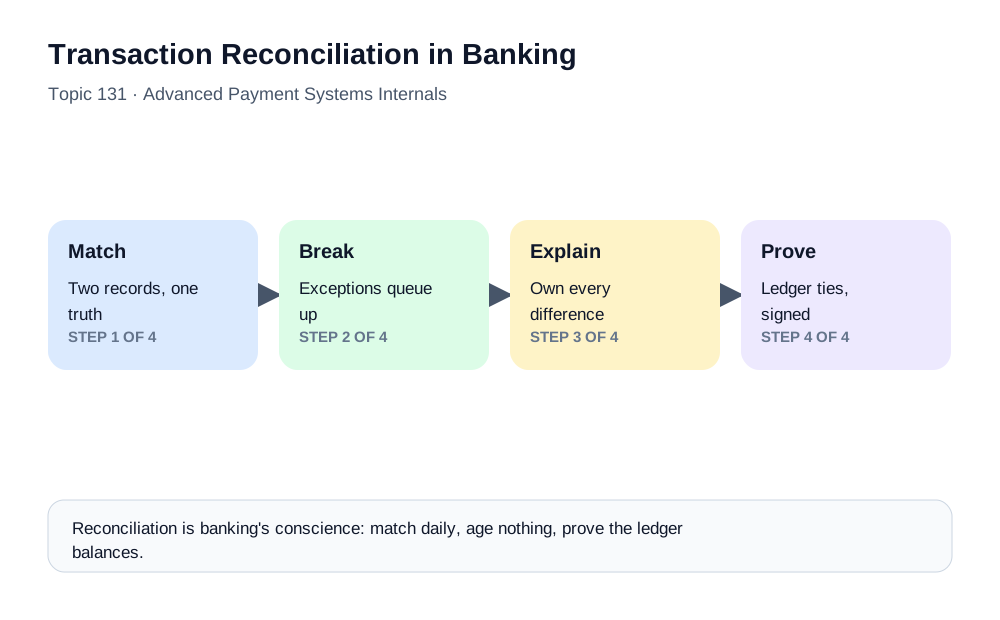
Transaction Reconciliation in Banking at a glance — Matching rules, exception handling, automated reconciliation.
Matching Records, Finding Breaks, and Protecting the Ledger
A bank does not trust a transaction only because one system says it happened. In real banking, the same event is recorded in many places: the customer channel, payment hub, core banking system, card processor, clearing network, settlement account, general ledger, data warehouse, statement platform, and sometimes a correspondent bank. Reconciliation is the control that proves these records agree.
When reconciliation works, customers rarely notice it. Salaries arrive, card transactions settle, ATM withdrawals balance, UPI or instant payments reverse when they fail, correspondent accounts agree, and the general ledger closes cleanly. When reconciliation fails, the bank starts losing certainty. Money may be debited without being credited. A settlement file may show a transaction the bank cannot find. A suspense account may grow. Customer complaints may rise. Finance may not trust the books. Operations may spend days investigating what should have matched automatically.
Reconciliation is therefore not a clerical activity. It is a core banking control. It protects customer money, financial statements, operational resilience, fraud detection, regulatory compliance, and trust in the bank's ledger.
Learning objectives
By the end of this chapter, you should be able to:
- Explain reconciliation as a control across systems, counterparties, and ledgers.
- Distinguish matching, exception identification, investigation, resolution, and closure.
- Describe common reconciliation types in payments, cards, ATMs, nostro accounts, and general ledger control.
- Understand why timing differences are not the same as true breaks.
- Explain debit-no-credit, duplicate, missing reversal, amount mismatch, and settlement mismatch scenarios.
- Identify the data fields needed for reliable automatic matching.
- Understand the role of suspense accounts, ageing, ownership, and audit trails.
- Discuss how automation, workflow, and AI improve reconciliation without removing accountability.
1. What Reconciliation Means
Reconciliation is the process of comparing two or more independent records of the same business event to confirm that they agree or to identify and resolve differences.
The simplest example is a customer transfer. The bank's payment hub says the payment was sent. The core banking system says the customer account was debited. The clearing network says the transaction was accepted. The settlement report says the bank's net position included it. The statement system says the customer can see it. If all records agree, the transaction is reconciled. If one record is missing, late, duplicated, or different, there is an exception.
A reconciliation break does not always mean money is lost. Some breaks are timing differences. One system may post before another. A network file may arrive late. A statement may be generated before settlement confirmation. But every difference needs ownership because timing differences can become real financial breaks if they are ignored.
2. Why Reconciliation Matters
Reconciliation protects the bank in several ways.
Customer protection. If a customer is debited but the beneficiary is not credited, reconciliation should identify the issue and trigger correction or reversal.
Financial accuracy. The bank's books must reflect actual positions. If settlement accounts, clearing files, sub-ledgers, and the general ledger disagree, finance cannot close with confidence.
Fraud detection. Unusual breaks, unexplained credits, repeated reversals, duplicate postings, or manipulated suspense entries can reveal fraud or control weakness.
Operational resilience. Reconciliation shows where systems are silently failing. A payment may appear successful in one system while downstream processing has stopped.
Regulatory compliance. Regulators expect banks to maintain accurate books, resolve customer-impacting errors, manage suspense accounts, and evidence control over payment and settlement processes.
Auditability. Every exception should show what happened, who investigated it, what evidence was used, what correction was posted, and when the item was closed.
3. The Reconciliation Lifecycle
A mature reconciliation process has a clear lifecycle.
Step 1: Source Data Collection
The bank collects records from internal and external sources. These may include core banking extracts, payment hub events, clearing files, card network files, ATM switch logs, nostro statements, general ledger balances, settlement reports, and exception queues.
Step 2: Normalisation
Different systems use different formats, field names, date conventions, currencies, reference structures, and status codes. Normalisation converts data into a comparable structure. Without this step, even genuine matches may fail.
Step 3: Matching
The reconciliation engine attempts to pair records that represent the same transaction. Exact matching may use amount, date, reference, account, currency, and counterparty. Fuzzy matching may handle small differences such as truncated references, time-zone shifts, or minor narrative variations.
Step 4: Exception Identification
Unmatched, partially matched, duplicated, or mismatched items become exceptions. Each exception needs a type, severity, owner, ageing rule, and expected resolution path.
Step 5: Investigation
Operations teams examine source systems, network statuses, customer entries, settlement reports, logs, and message references to identify the root cause.
Step 6: Resolution
Resolution may involve reversal, adjustment posting, manual credit, chargeback, claim to a counterparty, correction of a reference, release of a stuck transaction, or confirmation that the item was only a timing difference.
Step 7: Closure and Reporting
The item is closed only after evidence is attached, financial impact is corrected, customer impact is handled, and reporting is updated. Ageing, root cause, and trend reporting help management see whether the same problem is repeating.
4. Common Types of Reconciliation
Banks run many reconciliations. The most important ones include:
| Reconciliation Type | What Is Compared | Why It Matters |
|---|---|---|
| Payment hub vs core banking | Payment records against account postings | Proves customer debit/credit postings match payment processing |
| Clearing network vs bank records | Scheme or network files against internal transactions | Confirms what the external rail accepted, rejected, or settled |
| Settlement account reconciliation | Central bank or settlement bank records against internal settlement positions | Proves actual interbank settlement agrees with expected settlement |
| Nostro reconciliation | Correspondent bank statement against internal nostro ledger | Controls foreign currency and cross-border payment balances |
| Card reconciliation | Issuer/acquirer records against network clearing and settlement files | Controls authorizations, clearing, merchant funding, fees, and chargebacks |
| ATM reconciliation | ATM cash dispensed, switch logs, and account postings | Identifies dispense failures, cash differences, and reversals |
| GL reconciliation | Sub-ledger balances against general ledger control accounts | Proves financial statements are supported by operational records |
| Suspense reconciliation | Temporary accounts against unresolved items | Prevents old breaks from becoming hidden losses or fraud risk |
Each type has its own rules, but the principle is the same: independent records must agree or differences must be explained and resolved.
5. Matching Keys: The Data That Makes Reconciliation Work
Good reconciliation depends on good identifiers. If key references are missing or transformed badly, the match rate falls and manual work rises.
Useful matching fields include:
- transaction reference;
- end-to-end reference;
- message identifier;
- account number or account identifier;
- amount and currency;
- value date and booking date;
- debit or credit indicator;
- counterparty bank or scheme participant;
- customer reference or remittance information;
- settlement cycle or batch number;
- network response code;
- internal payment status;
- original transaction reference for reversals, returns, recalls, and chargebacks.
Payment transformation can damage reconciliation if references are changed, truncated, overwritten, or not carried end to end. This is why business analysts must treat reference preservation as a requirement, not a technical detail.
6. Common Exceptions and What They Mean
Debit but no credit. The remitter was debited, but the beneficiary did not receive funds. This is highly customer-sensitive and normally requires urgent investigation and reversal or completion.
Credit but no debit. The beneficiary was credited, but the sending debit is missing or failed. This can create financial loss if not corrected.
Unmatched network item. The clearing or scheme file contains a transaction that the bank cannot locate internally. This may indicate missing ingestion, wrong reference mapping, delayed processing, or an external file issue.
Unmatched bank item. The bank has an internal transaction that is absent from the external network file. This may mean the transaction never left the bank, was rejected before network acceptance, or was processed in a different cycle.
Amount mismatch. Internal and external records match on reference but differ on amount. Causes include fees, FX conversion, partial settlement, incorrect mapping, or manual adjustment.
Date mismatch. Dates differ because booking date, value date, processing date, settlement date, and file date are not the same. Some date mismatches are normal, but they must follow defined rules.
Duplicate transaction. Two records appear for what should be one payment. Causes include retries, timeout handling, duplicate file submission, manual reposting, or idempotency failure.
Missing reversal. A failed transaction should have been reversed but was not. This is common in high-volume retail and instant-payment environments and directly affects customer trust.
Suspense ageing. An item has been parked in a temporary account for too long. Ageing suspense is a red flag because unresolved items can hide losses, errors, or fraud.
7. Timing Difference vs True Break
Not every unmatched item is a true error. Timing differences are normal in banking.
For example, a card transaction may be authorized today, cleared tomorrow, settled later, and charged back weeks after that. A cross-border payment may leave one system before a correspondent statement arrives. A domestic clearing file may be delayed. An end-of-day batch may post after the reconciliation extract was taken.
The discipline is to define which timing differences are acceptable and for how long. A one-day timing difference in a card settlement cycle may be normal. A five-day old debit-no-credit instant payment is not normal. A nostro item expected to clear after a public holiday may be acceptable. An unidentified suspense credit aged 90 days is not acceptable.
This is why reconciliation teams track ageing buckets: same day, 1-2 days, 3-5 days, 6-30 days, over 30 days, and so on. Ageing converts a raw break list into a risk view.
8. UPI, Instant Payments, and Real-Time Reconciliation
Instant payment systems raise the standard because customers see failures immediately. The customer does not care whether the issue is in the payment hub, switch, clearing system, beneficiary bank, settlement file, or reversal process. They only know that money left one account and did not arrive in the other.
For UPI, IMPS, RTP, Pix, FedNow, SEPA Instant, or similar instant rails, reconciliation must support:
- transaction status tracking from initiation to final outcome;
- timeout handling;
- debit-no-credit detection;
- automatic reversal triggers;
- duplicate prevention through idempotency keys;
- customer-visible status updates;
- scheme dispute or complaint workflows;
- settlement-window comparison;
- fraud and risk flags;
- audit evidence for regulators and customer care teams.
The older model of reconciling everything at end of day is not enough for customer-impacting real-time payments. Banks still need end-of-day financial reconciliation, but operational reconciliation must increasingly run near real time.
9. Nostro Reconciliation
Nostro reconciliation is especially important in cross-border banking. A nostro account is a bank's account with another bank, usually in a foreign currency. The bank records expected debits and credits internally. The correspondent bank sends a statement showing what actually happened on its books.
Breaks can occur because of:
- missing payment references;
- correspondent charges;
- FX differences;
- cut-off and time-zone differences;
- back-valued entries;
- rejected or repaired payments;
- duplicate correspondent entries;
- missing cover payments;
- investigation fees;
- sanctions or compliance holds.
A clean nostro reconciliation is critical because it proves that cross-border settlement balances are accurate. Unreconciled nostro items can become financial loss, customer investigation cases, liquidity forecasting errors, or regulatory issues.
10. Suspense Accounts and Operational Discipline
A suspense account is a temporary parking account for items that cannot yet be posted to their final destination. Suspense is useful, but dangerous if poorly controlled.
A good suspense process has:
- a valid reason for every entry;
- clear ownership;
- ageing limits;
- daily review for sensitive accounts;
- maker-checker control for adjustments;
- evidence attached to closure;
- management reporting for old or high-value items;
- root-cause analysis for recurring suspense creation.
Suspense should be a waiting room, not a hiding place. Mature banks treat aged suspense as a serious operational risk indicator.
11. Automation and AI in Reconciliation
Modern reconciliation is increasingly automated. Rule-based engines match exact records quickly. Fuzzy matching handles small formatting variations. Workflow tools route exceptions to the right team. Dashboards show ageing, ownership, volumes, financial exposure, and root causes.
AI can help by suggesting likely matches, grouping similar exceptions, detecting unusual patterns, and recommending resolution steps based on historical cases. But AI does not remove accountability. A bank still needs controlled rules, evidence, approval, audit trail, and human ownership for financial corrections.
The best target is not blind automation. The best target is high straight-through matching plus intelligent exception handling. Humans should spend less time searching and more time deciding.
12. Practical End-to-End Example
A customer sends a real-time payment for 5,000. The account is debited and the payment hub sends the instruction to the scheme. The scheme times out before a final response is received. The customer sees a pending or failed status and raises a complaint.
The reconciliation process checks:
- Did the core banking system debit the customer?
- Did the payment hub create one instruction or duplicate instructions?
- Did the scheme receive the instruction?
- Did the beneficiary bank credit the recipient?
- Did a final success, failure, timeout, or reversal response arrive?
- Was the transaction included in the settlement file?
- Was an automatic reversal generated if the payment failed?
- Does the customer-facing status match the real outcome?
If the customer was debited and the beneficiary was not credited, the bank must reverse or complete according to scheme rules and regulatory timelines. If the beneficiary was credited but the bank's debit failed, the bank must recover or post an adjustment. If the issue is only a delayed status message, the customer communication must still be corrected. Reconciliation gives the bank the evidence to decide correctly.
13. Common Misconceptions
"Reconciliation is just matching numbers." It is matching business events across systems, ledgers, counterparties, dates, statuses, and references. Amount is only one part of the proof.
"If a transaction is successful in the payment hub, reconciliation is complete." No. The transaction must also agree with core posting, network status, settlement, reporting, and financial books where applicable.
"Unmatched items are always errors." Some are timing differences. The control question is whether the difference is expected, aged within policy, and supported by evidence.
"Suspense accounts solve reconciliation breaks." Suspense only parks unresolved items. It does not solve them. Old suspense can become a larger control problem than the original break.
"AI can fully replace reconciliation teams." AI can improve match rates and investigation speed, but financial corrections, customer-impact decisions, and audit accountability still need controlled human ownership.
14. Frequently Asked Questions
What is a reconciliation break? A reconciliation break is a difference between records that should agree, such as a payment in the bank's system that is missing from the network file or a settlement entry that does not match the internal ledger.
What is debit-no-credit? It is a customer-impacting exception where the sender's account is debited but the receiver is not credited. It usually requires urgent investigation and reversal or completion.
What is the difference between reconciliation and investigation? Reconciliation identifies and classifies differences. Investigation explains why the difference occurred and what correction is required.
Why are references so important? References allow the bank to link records across systems. If references are lost or changed during transformation, automatic matching becomes difficult and manual work increases.
What is an ageing report? An ageing report groups open exceptions by how long they have remained unresolved. Older items normally carry higher operational, financial, and audit risk.
Why is nostro reconciliation difficult? Nostro records often involve foreign currencies, correspondent charges, time-zone differences, repairs, returns, and limited references. The bank must match its internal expectations to the correspondent's actual statement.
15. Key Terms in This Chapter
- Reconciliation - comparison of independent records to confirm agreement or identify differences.
- Exception - an unmatched, mismatched, duplicate, aged, or otherwise abnormal item requiring review.
- Matching engine - system that pairs records based on defined rules and references.
- Fuzzy matching - matching approach that tolerates controlled variations in data.
- Debit-no-credit - sender debited but beneficiary not credited.
- Missing reversal - failed transaction not reversed as expected.
- Duplicate posting - the same business event posted more than once.
- Suspense account - temporary account used to hold unresolved items.
- Ageing - measurement of how long an exception remains open.
- Nostro reconciliation - matching internal foreign-currency account records with correspondent bank statements.
- GL reconciliation - matching sub-ledgers or operational records to general ledger control accounts.
- Settlement file - file or report showing transactions or net positions settled by a scheme or infrastructure.
- Idempotency - control that prevents duplicate processing of the same instruction.
- Root cause analysis - review of why breaks occur so recurring issues can be fixed permanently.
16. Interview Insights
"Why is reconciliation important in payments?" Because a payment is recorded across many systems. Reconciliation proves that customer posting, network status, settlement, and ledger records agree, and it identifies exceptions before they become customer, financial, or regulatory problems.
"How would you investigate debit-no-credit?" Check the customer debit, payment hub status, scheme response, beneficiary bank status, settlement file, reversal status, duplicate controls, and customer-visible communication. Then decide whether to reverse, complete, or escalate under scheme timelines.
"What fields are important for reconciliation?" Transaction reference, end-to-end reference, amount, currency, account, date, status, network response code, settlement cycle, counterparty, and original transaction reference for returns or reversals.
"What is the risk of aged suspense?" Aged suspense can hide unresolved customer impact, financial loss, fraud, incorrect postings, or weak ownership. Auditors and regulators treat it as a control warning.
"How can automation improve reconciliation?" It improves match rates, reduces manual search, routes exceptions, detects patterns, and speeds resolution. But financial adjustments still need approvals, evidence, and audit trail.
Summary and Key Takeaways
Reconciliation is the bank's proof that independent records of the same business event agree. It is central to payment accuracy, customer trust, financial control, fraud detection, and regulatory confidence.
The main lessons are:
- A transaction is not fully controlled until records agree. Channel, payment hub, core, network, settlement, and ledger views must align.
- Exceptions need ownership. Unmatched and mismatched items require classification, ageing, investigation, evidence, and closure.
- References are control assets. Preserving identifiers across systems is essential for automatic matching and later investigation.
- Timing differences are normal, but ageing matters. A temporary break may be acceptable; an old unexplained break is a risk.
- Suspense is temporary by design. It must be monitored, owned, and cleared with evidence.
- Real-time payments require faster reconciliation. Customer-impacting breaks cannot wait for a slow end-of-day process.
- Automation helps, but accountability remains human. The bank must still own financial corrections and customer outcomes.
Reconciliation is not glamorous, but it is one of the disciplines that makes banking trustworthy. If the ledger is the bank's truth, reconciliation is how the bank proves that truth every day.
Next: Topic 132 - Payment Investigations and Exception Handling
<!-- MBA-DEEP-DIVE-START -->Transaction Reconciliation Deepening — Control Design, Matching Strategy, Evidence, and Root Cause
Reconciliation needs independent evidence
A meaningful reconciliation compares records produced by independent points in the processing chain. Comparing two extracts from the same database can prove that reporting logic agrees with itself, but it may not prove that an external settlement occurred. The strongest controls compare internal books with scheme files, central-bank or correspondent statements, processor records, or independently generated sub-ledgers. Control design should ask what risk each source can independently detect rather than simply how many files are being matched.
Every reconciliation should have a stated control objective
A bank may reconcile customer postings to payment-hub events, payment-hub events to clearing records, settlement records to a central-bank account, and sub-ledger balances to the general ledger. Each control answers a different question. If the purpose is unclear, teams can duplicate work while leaving a real gap uncovered. Documentation should define the population, sources, frequency, matching logic, tolerance, owner, expected timing differences, escalation, and evidence retained.
Completeness is different from accuracy
A reconciliation should prove both that all expected items are present and that the matched items are correct. Matching the amount and reference for ninety-nine transactions does not prove that the hundredth transaction was not silently dropped. Control totals, record counts, sequence numbers, file hashes, batch identifiers, and expected source acknowledgements can help establish completeness before transaction matching begins. This is especially important for large files and event streams where an entire segment can be lost.
File-level controls should precede record-level matching
Before matching millions of transactions, the bank should confirm that the right file arrived, belongs to the right date and participant, is complete, and passed integrity checks. A duplicate or truncated file can create thousands of false exceptions. File name, control totals, record count, checksum, sequence, creation timestamp, and settlement cycle can all be validated. Rejecting a bad source file early is safer than loading it and trying to repair the resulting reconciliation noise manually.
Event-stream reconciliation has different failure modes
Modern payment platforms may use Kafka or other event streaming instead of daily files. Reconciliation must then consider offsets, partitions, duplicate delivery, late events, replay, consumer failure, and event ordering. At-least-once delivery means duplicate events may be technically normal and must be handled idempotently. A reconciliation control can compare source event counts and business keys with downstream processed events to prove that every economic instruction was consumed once in effect, even if technical delivery occurred more than once.
Stable business identifiers are more valuable than technical IDs
A database row ID or event UUID may change between systems. A payment needs persistent business references that survive transformation. End-to-end identifiers, transaction references, scheme references, original transaction identifiers, settlement cycle IDs, and account identifiers improve matching. Where no single identifier survives, the bank may need composite keys combining amount, currency, date, account, and counterparty. Architecture decisions that preserve references can eliminate large amounts of reconciliation work later.
One-to-one matching is only the simplest case
A single internal payment can correspond to several external records because of fees, split settlement, partial fills, multiple legs, or separate principal and charge entries. Conversely, many customer transactions can settle as one net amount. Matching engines therefore need one-to-many and many-to-one logic. Forcing every reconciliation into one-to-one matching can create permanent exceptions even when the economics are correct.
Net settlement needs transaction-to-position proof
When a scheme settles one net debit for thousands of retail payments, matching the net amount alone is not enough. The bank should be able to prove which transactions contributed to the position, how returns or adjustments were included, and that the calculated net equals the settlement entry. This provides a bridge from customer-level processing to participant-level cash movement. If the net differs, operations can identify which component caused the break rather than investigating the entire day manually.
Tolerances must have economic justification
Some reconciliations legitimately allow small differences, for example because of FX rounding or valuation conventions. A tolerance should be defined by product and risk, not used as a convenient way to suppress breaks. A one-cent tolerance could be appropriate for a particular fee calculation and completely inappropriate for a principal payment. Tolerance logic should also prevent many individually small differences from accumulating into a material aggregate exposure.
Date logic needs explicit calendars
Booking date, value date, transaction date, settlement date, statement date, and processing date can differ. Weekend, holiday, and time-zone rules make matching more complex. Reconciliation specifications should identify which date is authoritative for each source and how expected timing differences roll forward. Using a blanket “plus or minus one day” rule can hide genuine errors. Calendar-aware logic is more precise and easier to audit.
Currency conversion creates multi-field reconciliation
An FX-related payment may have instructed amount, settlement amount, debit amount, credit amount, exchange rate, and charges. Matching only one amount can miss an incorrect rate or fee. The reconciliation should reflect the economic contract: which amount is fixed, which is derived, which party bears charges, and what rounding applies. This is particularly important when customer posting and correspondent settlement occur in different currencies.
Fees should not be mistaken for unexplained differences
Correspondent charges, card network fees, acquiring fees, interchange, scheme fees, and account charges can create legitimate differences between gross transaction value and settled cash. Good reconciliation separates principal from fee components. If fees are predictable, they should be posted and matched through dedicated accounts rather than left as recurring “acceptable breaks.” Proper fee reconciliation supports both customer transparency and revenue assurance.
Suspense accounts need reconciliation to named source items
A suspense balance of zero at month-end does not prove good control if items were offset against each other incorrectly. Each suspense posting should link to the underlying transaction and resolution. Reconciliation should ensure that open suspense items sum to the account balance and that cleared items were moved to an appropriate destination with approval. Netting unrelated errors can hide losses and make audit reconstruction difficult.
Ageing should be based on risk, not one universal bucket
A five-minute-old instant-payment debit-no-credit may be urgent, while a two-day timing difference in a card cycle may be expected. Ageing thresholds should therefore reflect product, customer impact, settlement model, financial value, and regulatory timeline. High-risk exceptions need earlier escalation even if they are young. A simple thirty-day aged-break report is too slow for modern payment operations.
Exception classification drives efficient investigation
A useful break taxonomy distinguishes missing source item, duplicate, amount mismatch, date mismatch, status mismatch, missing reversal, settlement mismatch, fee difference, FX difference, reference transformation, late file, and system outage. Each type can route to the right team and suggest likely evidence. Generic “unmatched” queues force analysts to rediscover the problem from scratch. Classification also enables root-cause trend reporting.
Auto-match rate is not the only quality metric
A team can increase auto-match percentage by making fuzzy rules so permissive that unrelated records pair together. That produces a dangerous false sense of control. Reconciliation quality should monitor false matches, manual rematches, reopened cases, residual financial exposure, ageing, and customer impact. A slightly lower match rate with reliable logic can be safer than a high rate achieved through unjustified tolerance.
Fuzzy matching needs confidence and governance
Fuzzy techniques can match truncated narratives, reordered names, or imperfect references, but they should be bounded by strong attributes such as amount, currency, account, and time. High-confidence suggestions can be auto-matched under approved rules; lower-confidence suggestions may require analyst review. Model or algorithm changes should be tested against known historical breaks to ensure they improve matching without introducing false pairings.
Reconciliation automation should preserve evidence
When an engine matches two records, it should record which rule matched them and which key fields agreed. An auditor or investigator should not have to trust a black-box “matched” status. Evidence can include source references, rule ID, matching score, timestamp, input versions, and any tolerance used. Automated control is strongest when its decision can be reproduced.
Manual adjustments need stronger approval than matching
Finding a match establishes evidence; posting an adjustment changes the books. Manual credits, debits, write-offs, or suspense clearings should therefore require appropriate maker-checker or higher approval based on amount and risk. The reconciliation tool should not let an analyst solve every break by posting directly to the ledger without independent control. Separation of investigation and financial adjustment reduces fraud and error risk.
Reconciliation can detect silent processing failure
A system may return HTTP success or an internal “processed” status while failing to write the downstream accounting entry. Monitoring that looks only at application availability may not detect this. Reconciliation compares economic outcomes and therefore acts as a detective control for failures that technical monitoring misses. This is why removing reconciliation after a technology modernisation can be dangerous even when the new platform claims end-to-end straight-through processing.
Reconciliation and observability complement each other
Logs, traces, metrics, and event monitoring can show exactly where a transaction travelled. Reconciliation shows whether the independent financial records ultimately agree. Observability helps explain breaks faster; reconciliation provides the control assertion. A mature bank links the two so an exception case can open the relevant technical trace without manually searching several platforms.
Near-real-time reconciliation should focus on customer-critical breaks
Not every financial reconciliation needs to run every second. The bank should prioritise exceptions where delay causes harm: debit-no-credit instant payments, duplicate postings, missing reversals, high-value settlement mismatches, or failed cash withdrawals. Lower-risk fee and accounting reconciliations can run in scheduled cycles. “Real-time reconciliation” is most useful when frequency matches the speed at which the risk becomes material.
ATM reconciliation combines cash, electronic records, and physical evidence
An ATM transaction can involve account posting, switch authorisation, cash dispenser counters, electronic journal, physical cash, and settlement between institutions. A dispense failure can create a debit without cash, while a cash-count difference can indicate hardware issue, replenishment error, or theft. ATM reconciliation therefore links digital records to physical cash control, making it different from purely electronic payment matching.
Card reconciliation spans a long lifecycle
Authorisation, reversal, clearing presentment, settlement, refund, chargeback, representment, and arbitration can all refer to the same original purchase. Reconciliation needs lifecycle linkage rather than treating each event independently. Amounts may also change between authorisation and clearing. The system should know which differences are expected and which require action. Long-lived card disputes make archival reference quality particularly important.
Nostro reconciliation should distinguish cash ownership and timing
A correspondent statement is an external record of the bank's balance with that correspondent. Internal systems may show expected entries before the correspondent books them. Matching logic should consider value date, charges, and intermediary routing. A true unexplained nostro break can affect liquidity and financial statements, so aged high-value items deserve rapid escalation. Treasury should receive relevant breaks because its view of available currency may otherwise be wrong.
Central-bank account reconciliation has high control significance
Settlement-account movements support the bank's interbank cash position. The bank should reconcile RTGS settlements, liquidity transfers, central-bank facilities, fees, and other entries to internal records. Because these balances can be large and systemically important, unexplained differences should not be carried casually. The control often sits at the intersection of payment operations, treasury, and finance.
General-ledger reconciliation should bridge sub-ledger economics
Operational systems can contain millions of detailed transactions while the GL contains aggregated balances. Reconciliation should prove that the aggregated postings represent the underlying population and that control accounts clear as expected. A balanced operational sub-ledger is not enough if the GL interface failed. Conversely, a balanced GL can hide transaction-level errors if incorrect debits and credits offset. Both levels of control are required.
Reconciliation should identify orphan records
An orphan is a record that has no valid counterpart or parent in the expected lifecycle. Examples include a reversal without an original transaction, a settlement record without an accepted payment, or a chargeback linked to an unknown clearing item. Orphans can signal data loss, migration issues, bad reference mapping, or fraud. Matching engines should explicitly detect them rather than simply leave them in a generic unmatched queue.
Duplicate records need business-level deduplication
Two technical messages are not necessarily two financial transactions. Retries can produce duplicate events, while a legitimate return and original payment can share many attributes. Deduplication logic should use stable business identifiers and lifecycle context. Removing a record simply because amount and beneficiary match can be as dangerous as processing every retry twice.
Backdated adjustments need clear treatment
A correction posted today may relate to a transaction from last month. Reconciliation and financial reporting need to know whether the adjustment changes current-period books, prior-period evidence, or both. Value-date corrections can also affect interest and customer statements. Manual backdating should be restricted and auditable because it can otherwise be used to hide the timing of errors.
Data migration requires parallel reconciliation
When a bank moves payments, cards, loans, or ledgers to a new platform, it should reconcile opening balances, outstanding items, historical references, and in-flight transactions. Parallel-run controls can compare old and new outputs before cutover. Migration is a high-risk period because both systems may contain partial truth. A successful technical data load is not enough; the economic position must be proven.
Reconciliation rules should be version controlled
Matching logic is part of the control environment. Changes to keys, tolerance, date windows, suppression, or fuzzy thresholds can materially alter what is treated as matched. Rules should therefore have documented owners, testing, approval, effective dates, and rollback capability. An analyst should be able to determine which rule version produced yesterday's result.
Suppression rules can become hidden risk
Teams sometimes suppress recurring false exceptions to reduce noise. Suppression is appropriate only when the underlying difference is understood and expected. A broad suppression such as “ignore all items from this source under 100” can hide a new defect or fraud pattern. Suppressed populations should still be monitored and periodically reviewed to confirm the rationale remains valid.
Break ownership should follow root cause, not data source
A reconciliation team may detect an issue but not own the underlying fix. A missing posting may belong to core banking, a malformed reference to a channel, a late file to an external processor, or a funding difference to treasury. Workflow should route the break while retaining central visibility. Otherwise reconciliation becomes a dumping ground where analysts repeatedly repair symptoms without upstream teams fixing the cause.
Customer-facing remediation needs linkage to the control case
If a break causes a manual customer credit or reversal, the adjustment should reference the reconciliation exception and original transaction. Customer service should be able to see that the financial correction is complete without accessing sensitive internal notes. This linkage prevents duplicate compensation when the customer contacts the bank through multiple channels.
Root-cause reporting should measure recurrence
A reconciliation process is not world-class if it clears the same break every day. Management reporting should show repeated causes, affected systems, financial exposure, manual effort, and remediation status. Automation should target root causes where possible: preserving a reference upstream is better than building a fuzzy rule forever. The long-term objective is fewer exceptions, not merely faster exception closure.
Reconciliation is ultimately a proof of financial integrity
The purpose of reconciliation is to establish that the bank's representation of economic events is complete and accurate across systems and counterparties. It supports customer trust, correct liquidity, financial reporting, operational resilience, and fraud control. Technology can make the proof faster and more automated, but the bank still needs clear ownership, independent evidence, controlled adjustments, and disciplined closure.
Reconciliation — Evidence, Break Management, Data Lineage, and Financial Control
Reconciliation proves that separate records describe the same economic event
A bank rarely has one system that contains the entire truth about a transaction. A payment can appear in a channel, payment hub, clearing interface, settlement account, core ledger, fee system, general ledger, and customer statement. Reconciliation compares these independent records and explains differences. Its purpose is not merely to make totals equal. It is to prove completeness, accuracy, ownership, timing, and final financial outcome across the chain.
A good reconciliation begins with a clearly defined population
Before comparing amounts, teams must know which transactions belong in the reconciliation. The population may be defined by legal entity, product, currency, business date, settlement cycle, account, message type, or processing state. If one side uses booking date and the other uses value date, legitimate items can appear as breaks. Control documentation should therefore specify source systems, selection rules, cut-off times, date basis, currency basis, and expected timing differences.
Control totals are useful but insufficient
A total debit of 10 million matching a total credit of 10 million does not prove that individual transactions are correct. Two errors can offset each other. High-quality reconciliation combines aggregate controls with transaction-level matching where appropriate. Counts, values, currencies, references, and key attributes should be compared according to the risk. Aggregate checks can detect missing batches quickly, while detailed matching identifies which individual items require investigation.
Matching rules should be deterministic and ordered
Exact matches should be attempted before fuzzy or tolerance-based rules. A payment may match on unique transaction reference, account, amount, currency, and date. If exact data is unavailable, secondary rules might use references plus a permitted timing window. Each rule should be versioned and documented so an auditor can explain why two records were considered the same event. A broad fuzzy rule that clears many breaks can hide errors rather than solve them.
Tolerances need economic justification
Some reconciliations permit small differences for FX rounding, fees, accrued interest, or market valuation. Tolerances should be linked to the business reason and risk, not chosen simply to reduce break volumes. A fixed amount tolerance can be inappropriate across currencies or transaction sizes. Materiality may need both absolute and relative thresholds. Items within tolerance should remain identifiable so recurring small differences can be analysed rather than permanently ignored.
Timing differences should have an expected ageing pattern
A transaction booked internally today may settle externally tomorrow. That can be a legitimate open item rather than an error. The reconciliation should classify expected timing breaks separately and define when they become overdue. Ageing buckets help distinguish ordinary process latency from unresolved exceptions. An item that is normal for one day can become a control failure after three days. Automated ageing prevents old breaks from disappearing inside a large current-day population.
Break ownership must be explicit
Every unresolved break should have a responsible team, reason code, financial value, age, and next action. Sending a spreadsheet to a shared mailbox is not ownership. Workflow should route breaks based on type: missing settlement, wrong account, fee difference, duplicate, rejected payment, ledger posting error, reference-data issue, or external counterparty discrepancy. Escalation thresholds can consider age and financial impact so material breaks receive attention before reporting deadlines or customer harm increases.
Suspense accounts are temporary tools, not permanent storage
Banks may post unmatched items to suspense or transit accounts so books remain structurally balanced while investigation continues. These accounts require strict control because an old unexplained balance can hide operational errors or fraud. Each item should have a source, owner, date, reason, and expected resolution. Ageing and balance limits should trigger escalation. Clearing an item from suspense should link to the evidence that explains the final accounting treatment.
Reconciliation should distinguish correction from concealment
A manual journal can make two systems agree financially without fixing the underlying process. Corrective accounting may be necessary, but the break should still capture root cause and whether a system or process change is required. Repeated manual adjustments for the same issue are a signal that reconciliation is compensating for a defect. Management reporting should show recurring break families, not only the remaining unresolved balance at month end.
Data lineage makes reconciliation explainable
If a field changes between systems, teams should know whether it was transformed, enriched, truncated, or recalculated. Lineage from source transaction through interfaces and ledgers helps investigators distinguish legitimate transformation from corruption. This is particularly important for amounts, currencies, account identifiers, transaction references, dates, and status. Without lineage, teams can spend hours comparing symptoms while the actual transformation error sits upstream.
Reference data is a common source of breaks
Wrong account mapping, currency code, legal entity, branch identifier, product code, or settlement account can route a transaction into the wrong reconciliation population. Reference-data changes should therefore be controlled, effective-dated, and tested. When a new product or clearing route is introduced, reconciliation design should be part of readiness rather than an afterthought. A transaction that cannot be reconciled reliably should not be considered fully production-ready merely because it can be processed.
End-to-end payment reconciliation needs multiple control points
A bank may reconcile customer instruction to payment-hub acceptance, accepted payments to clearing submission, clearing acceptance to settlement obligation, settlement obligation to nostro or central-bank movement, and settlement result to customer or general-ledger posting. These controls answer different questions. One proves completeness of handoff; another proves external financial settlement. Combining them into one broad end-of-day total can make it difficult to identify where an item was lost.
Returns and reversals must remain linked to the original transaction
A returned payment is not simply the absence of settlement. It is a new lifecycle event related to an original instruction. Reconciliation should preserve the relationship so the bank can prove original debit, external movement where applicable, return, fees, and final customer position. The same principle applies to chargebacks, refunds, recalls, and correcting entries. Netting the original and return to zero can hide operational history that investigations or customers later need.
Reconciliation around FX requires amount-pair discipline
A foreign-exchange transaction may have deal currency, settlement currency, booked amount, rate, fees, and rounding. Matching only one side of the currency pair can miss a wrong rate or wrong converted amount. Reconciliation should identify which amounts are authoritative at each stage and how rounding is expected to work. If a treasury deal funds customer conversions, aggregate currency positions may also need reconciliation between payment activity and FX hedges.
Automation should reduce manual matching, not remove human challenge
Machine learning or heuristic tools can suggest matches for messy references, but material financial reconciliation should preserve explainability. Operators need to know why a proposed match is credible and when the system is uncertain. Auto-match thresholds should be tested and monitored. If a model begins matching incorrect pairs, it can suppress breaks at scale. Human review is particularly important for high-value items and new exception patterns.
Reconciliation controls need maker-checker discipline where adjustments are possible
The person investigating a break should not always be able to create and approve the financial adjustment that removes it. Segregation of duties, approval thresholds, access controls, and journal evidence reduce the risk of concealment. Emergency processes may permit expedited action, but they should retain post-event review and complete audit trails. Reconciliation is a financial control and should be governed accordingly.
Daily certification should reflect unresolved risk
A reconciliation can be operationally complete even if some breaks remain, provided those breaks are known, quantified, owned, and within approved tolerance. Certification should state the number and value of open items, oldest age, material exceptions, suspense balances, and whether any limitation affects financial or regulatory reporting. A simple green status because the reconciliation job ran successfully confuses technical completion with control effectiveness.
Break trends can expose upstream deterioration before an incident
Increasing unmatched counts, slower resolution, repeated reference errors, or rising manual journals may signal a failing interface or process before a major financial loss occurs. Reconciliation data should therefore feed operational-risk and change-management decisions. Trend analysis by system, product, release, and root cause can identify where investment is needed. The control becomes preventive when it is used to improve upstream quality rather than merely repair downstream differences.
Month-end and year-end controls require special attention
Volume, valuation, accruals, closing deadlines, and reporting pressure can increase at period end. Teams may have less time to resolve breaks before financial statements or regulatory submissions. Cut-off rules and escalation should therefore be clear in advance. Material unresolved items may need accounting estimates or disclosure depending on context, but these decisions should be explicit. Reconciliation should support the close rather than become a last-minute obstacle because old breaks were allowed to accumulate.
The best reconciliation is designed together with the transaction flow
When architects introduce a new payment route, product, ledger, or external provider, they should define what evidence proves each handoff and financial outcome. Unique identifiers, acknowledgements, immutable timestamps, and authoritative balances make later reconciliation simpler and more reliable. Designing reconciliation after go-live often leads to fragile spreadsheet controls because the necessary identifiers were never captured. Reconciliation quality is therefore partly an architecture decision made long before the first break occurs.
<!-- MBA-DEEP-DIVE-END -->