Visual overview
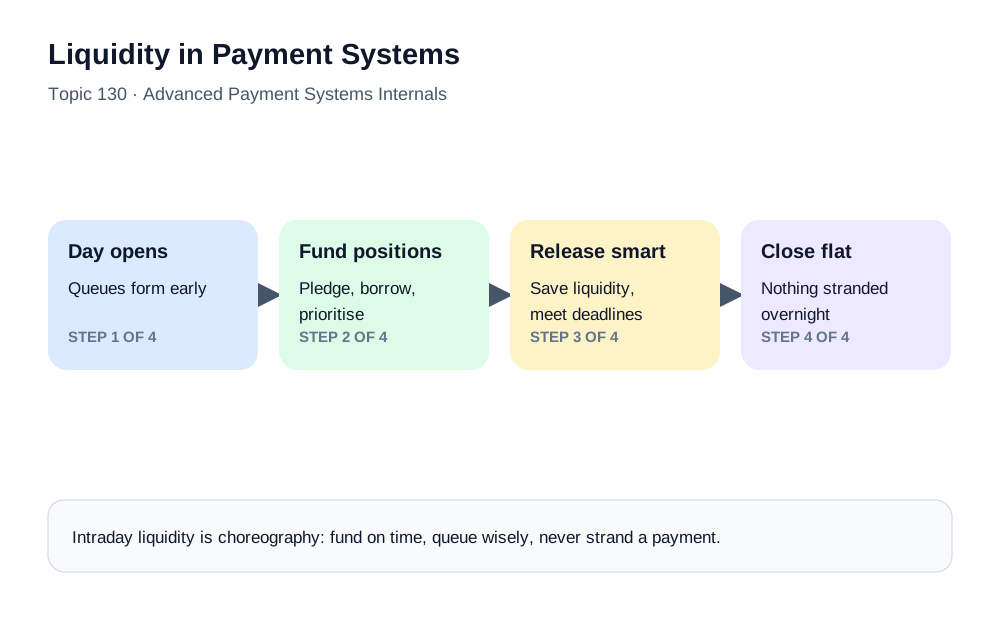
Liquidity in Payment Systems at a glance — Intraday liquidity, funding timing, liquidity optimization.
Intraday Liquidity, Queue Management, and Cash Position Control
A payment system can have excellent messages, strong fraud controls, modern APIs, and beautiful customer screens, but if the sending bank does not have enough settlement funds at the right moment, the payment cannot complete. Liquidity is the fuel of payment settlement. It is not the customer's account balance alone. It is the bank's ability to meet its own interbank obligations through central bank accounts, settlement accounts, correspondent accounts, prefunded balances, or approved credit facilities.
This is why payment liquidity is one of the most important operational disciplines inside a bank. It sits between treasury, payment operations, risk, technology, reconciliation, and regulatory reporting. The work is often invisible when everything goes well. Customers simply see confirmed payments. Corporates see their urgent supplier payments released. Market participants see securities and FX trades settle. But behind that calm surface, the bank is continuously asking one practical question: do we have enough usable money, in the correct account, currency, system, and time window, to settle what we have promised to send?
This chapter explains liquidity management specifically from the payment-system point of view. It connects intraday liquidity, settlement accounts, queues, payment prioritisation, netting, correspondent balances, real-time rails, stress events, and operating controls into one practical story.
Learning objectives
By the end of this chapter, you should be able to:
- Distinguish customer balance, bank liquidity, settlement liquidity, and intraday liquidity.
- Explain why a solvent bank can still fail to settle payments on time.
- Describe how banks manage liquidity across RTGS, deferred net settlement, instant payments, cards, securities, FX, and correspondent banking.
- Understand payment queues, priority rules, gridlock resolution, netting, and prefunding.
- Identify the operational signs of a payment liquidity problem.
- Explain the roles of treasury, payment operations, central banks, and technology teams.
- Discuss why 24/7 instant payments make liquidity management harder than traditional batch banking.
1. What Liquidity Means in a Payment Context
In everyday language, liquidity means having cash available. In banking, the word is more precise. A bank may have many assets: loans, bonds, deposits at other banks, foreign currency balances, collateral, receivables, and expected incoming payments. Not all of these can settle an obligation immediately.
For payment operations, liquidity means usable settlement capacity.
That capacity may come from:
- balances held at the central bank;
- intraday credit granted by the central bank against eligible collateral;
- balances held with correspondent banks in foreign currencies;
- prefunded accounts at payment schemes or settlement agents;
- expected incoming payments that will release trapped liquidity;
- market funding or internal treasury transfers;
- securities that can be pledged or sold quickly.
The word usable matters. A bank may own high-quality government bonds, but if those bonds are not eligible for intraday credit, not pre-positioned as collateral, or cannot be liquidated before a settlement deadline, they do not solve today's payment queue. A bank may expect a large incoming payment at 14:00, but if an urgent outgoing payment is due at 10:30, the future inflow does not help unless the bank has a facility, queue mechanism, or buffer to bridge the timing gap.
A customer balance and a bank's settlement liquidity are also different things. A corporate customer may have sufficient money in its account, and the bank may validly debit that customer, but the bank still needs settlement liquidity to pay the receiving bank or market infrastructure. The customer's ledger entry is internal bank money. Interbank settlement usually requires central bank money, correspondent bank money, or another accepted settlement asset.
2. Solvency Is Not the Same as Liquidity
A bank can be solvent and still face a liquidity crisis. Solvency asks whether assets are worth more than liabilities. Liquidity asks whether obligations can be paid when they fall due.
Imagine a bank with strong loans, healthy capital, and profitable customers. On paper it is sound. But during a busy morning it must settle a series of high-value RTGS payments, fund card and instant-payment settlement positions, support securities settlement, and meet unexpected corporate withdrawals. If the bank's liquid balances are too low and collateral is not available quickly, the bank may miss settlement even though its long-term balance sheet is positive.
In payment systems, timing is everything. A payment due now cannot be settled with money arriving later unless the system allows queuing, offsetting, credit, or rescheduling. This is why intraday liquidity is not just a treasury topic; it is an operational control.
3. The Main Types of Liquidity Banks Manage
Banks manage liquidity over several time horizons.
Intraday liquidity is the money available during the business day to settle payments as they arise. This is the core focus of payment operations. It covers RTGS payments, securities settlements, FX obligations, instant-payment settlement cycles, and other time-sensitive flows.
End-of-day or overnight liquidity is the position after daily flows have been processed. It matters for central bank balances, reserve requirements, money-market borrowing, and treasury funding.
Structural liquidity is the long-term balance between funding sources and asset maturity. Deposits, wholesale funding, loan portfolios, bond holdings, and regulatory liquidity ratios such as LCR and NSFR belong here.
Contingent liquidity is backup access to cash under stress. It includes central bank facilities, committed credit lines, collateral pools, securities that can be repoed, and crisis funding plans.
Payment professionals mostly live in the first category, but they must understand the other three. Intraday failures can become overnight funding pressure. Overnight pressure can become structural liquidity stress. Structural stress can trigger customer and market confidence problems. The categories are separate for management purposes, but in a real crisis they interact quickly.
4. Where Payment Liquidity Is Needed
Payment liquidity is not one pool sitting neatly in one place. Different rails and products need liquidity in different accounts, currencies, and time windows.
RTGS and high-value payments. Real-time gross settlement systems settle each payment individually, normally in central bank money. They provide strong finality but consume liquidity because every outgoing payment needs full funding at the time of settlement.
Deferred net settlement systems. ACH, bulk payment, cheque, card, and some retail systems may calculate net positions and settle at defined windows. Netting reduces liquidity needs, but it creates settlement exposure because participants must meet their net obligations at the settlement time.
Instant payments. Customers experience instant confirmation, but the interbank funding model differs by scheme. Some systems settle each payment immediately in central bank money. Others use prefunding or deferred net settlement with risk controls. Either way, banks must support 24/7 availability and cannot rely only on old end-of-day habits.
Card networks. Card authorization, clearing, and settlement are not the same moment. A transaction approved today may settle later through scheme files and settlement banks. Liquidity planning must consider the card settlement cycle, chargebacks, fees, and merchant funding.
Securities settlement. A bank or custodian may need cash to settle securities purchases while securities are delivered through a central securities depository. Delivery-versus-payment reduces principal risk, but only if both cash and securities are available at the right time.
Foreign exchange. FX settlement creates currency-specific liquidity needs. A bank may have enough domestic currency but lack USD, EUR, GBP, JPY, or another currency in the correct nostro account. Payment-versus-payment systems such as CLS reduce Herstatt risk for eligible currencies and participants, but they also create precise funding deadlines.
Correspondent banking. Cross-border payments often depend on nostro balances with correspondent banks. A bank may need to fund a USD nostro before a cut-off time in New York, an EUR account before a European deadline, or a GBP account before a UK settlement window. Currency, time zone, cut-off, and correspondent rules all shape liquidity.
5. A Practical Intraday Example
Consider a bank that starts the day with 500 million in its central bank settlement account.
At 09:00 it must send 220 million in high-value customer payments. At 09:30 it expects 160 million incoming from other banks. At 10:00 a corporate customer submits an urgent 300 million payment. At 11:00 a securities settlement batch requires 80 million. At 12:00 an instant-payment settlement window creates a net debit of 40 million.
On a full-day basis, the bank may be fine. Incoming flows later in the day may more than cover outgoing flows. But between 09:00 and 10:00, the position can become tight. If the 09:30 incoming payments are delayed, the 10:00 corporate payment may wait in queue. If the queue delay breaches customer or market cut-off expectations, the issue becomes visible. If multiple banks delay payments waiting for incoming liquidity, the system can experience gridlock.
This is why payment liquidity management is not only about total daily inflows and outflows. It is about sequence.
6. Tools Banks Use to Manage Intraday Liquidity
Banks use several tools to manage liquidity pressure.
Opening buffers. Treasury funds settlement accounts before the day starts based on forecasted flows, known obligations, historical patterns, stress assumptions, and scheme requirements.
Payment prioritisation. Some payments are more urgent than others. Central bank operations, market settlements, time-critical corporate payments, and regulatory obligations may receive higher priority than routine payments.
Queue management. RTGS and payment hub systems can hold payments until funds are available. Queues may support priority codes, timed release, partial release, bilateral or multilateral offsetting, and manual intervention by authorised operations staff.
Netting and offsetting. Net settlement reduces the total cash needed by offsetting mutual obligations. Some systems also include liquidity-saving mechanisms that search for payment combinations that can settle together even when individual payments are blocked.
Intraday credit. Central banks may provide intraday liquidity against eligible collateral. This allows banks to settle payments during the day and repay the facility before close. The exact rules differ by jurisdiction.
Collateral pre-positioning. A bank cannot assume that any asset can become cash instantly. Eligible securities often need to be pledged or positioned in advance so they can support intraday credit or emergency funding.
Nostro funding. For cross-border payments, treasury monitors forecasted currency flows and funds correspondent accounts before cut-offs. Overfunding creates idle cash cost; underfunding creates payment delays and repair work.
Liquidity dashboards. Modern banks monitor opening balance, available balance, queued payments, expected inflows, settlement-window obligations, failed releases, collateral usage, and forecast end-of-day position in near real time.
7. Payment Queues and Gridlock
A queue is not automatically a problem. Queues are normal in high-value payment systems because banks release payments based on liquidity availability, customer priority, settlement deadlines, and operational controls.
A queue becomes dangerous when payments are waiting because the whole system is waiting for liquidity that is locked inside the same queue. This is called gridlock. Bank A is waiting for money from Bank B before releasing payments to Bank C. Bank B is waiting for money from Bank C. Bank C is waiting for money from Bank A. Everyone is solvent, but nothing moves.
Payment systems manage gridlock through liquidity-saving mechanisms. These mechanisms look for groups of queued payments that can settle together on a net or offset basis. Instead of asking whether each payment can settle one by one, the system asks whether a group can settle as a package without any participant exceeding its available liquidity. This can release large volumes without requiring every bank to add fresh cash.
For business analysts and testers, queue logic is important. Requirements must define priority, release rules, cancellation behavior, retry behavior, cut-off handling, status reporting, operational overrides, audit trails, and customer communication. A payment sitting in queue is not simply pending; it has a state, a reason, an owner, and a consequence.
8. Role of Treasury and Payment Operations
Payment liquidity management is shared work.
Treasury owns funding strategy, central bank balances, money-market borrowing, collateral pools, nostro funding, liquidity forecasts, and regulatory liquidity metrics.
Payment operations monitors payment queues, settlement windows, payment statuses, exceptions, cut-offs, scheme obligations, and customer-impacting delays.
Technology teams maintain payment hubs, RTGS gateways, settlement adapters, monitoring dashboards, queue engines, event feeds, and alerting.
Risk and compliance review limits, stress assumptions, regulatory requirements, operational resilience, and incident reporting.
Reconciliation teams confirm that what the bank expected to settle actually settled, identify breaks, and feed lessons back into operations and treasury.
When these teams work separately, liquidity problems are discovered late. When they work as one operating model, the bank can see the full chain: forecast, fund, release, settle, reconcile, report.
9. Controls and Warning Indicators
A payment liquidity problem usually leaves signals before it becomes a crisis. Common indicators include:
- increasing RTGS or high-value payment queue depth;
- ageing queued payments close to cut-off;
- repeated use of intraday credit at high levels;
- unexpected net debit positions in retail or instant-payment settlement windows;
- late nostro funding or failed correspondent payments;
- delayed securities or FX settlement obligations;
- high volume of customer complaints about pending payments;
- reconciliation breaks caused by delayed or partial settlement;
- manual overrides increasing during busy windows;
- end-of-day positions repeatedly below internal thresholds.
Strong banks define thresholds and escalation paths. A queue above a certain amount may alert payment operations. A projected funding gap may alert treasury. A missed settlement window may trigger incident management. Repeated breaches may require root-cause analysis, not just daily firefighting.
10. Liquidity in a 24/7 Payments World
Traditional banking had a rhythm: business hours, cut-off times, end-of-day processing, overnight funding, next-day opening balances. Instant payments changed that rhythm. Customers expect payment services at night, on weekends, and during holidays. Fraud monitoring, sanctions screening, posting, notifications, limits, reconciliation, and liquidity controls must operate continuously.
This creates new questions:
- Who monitors liquidity outside office hours?
- How are settlement accounts funded for weekends and holidays?
- What happens if an instant-payment rail has multiple net settlement windows while treasury is closed?
- How are prefunded balances calculated for expected off-hours traffic?
- What status does the customer see if the bank accepts an instant payment but settlement later fails?
- How are incidents escalated at 02:00 when payment volumes spike unexpectedly?
A 24/7 rail cannot be supported by a 9-to-5 operating model. The bank needs automated monitoring, clear thresholds, on-call ownership, real-time dashboards, and tested contingency processes.
11. Common Misconceptions
"If the customer has money, the payment can always go." Not necessarily. The customer balance is internal to the bank. The bank still needs settlement liquidity in the relevant rail, currency, and account.
"Net settlement has no liquidity risk because only the net amount is paid." Netting reduces liquidity needs, but the net amount must still be settled. If a participant cannot meet its net obligation, the system may face delay, unwinding, loss-sharing, or fallback procedures.
"RTGS has no risk." RTGS reduces settlement credit risk because payments settle individually with finality. But it increases intraday liquidity demand and can create queue pressure if banks do not manage balances well.
"Liquidity management is only treasury's job." Treasury funds the bank, but payment operations sees the live queues, settlement windows, statuses, and customer impact. Both are needed.
"Instant payments remove settlement complexity." They remove waiting from the customer experience. They do not remove funding, netting, prefunding, settlement, reconciliation, exception handling, or risk controls.
12. Frequently Asked Questions
What is intraday liquidity? It is the liquidity available during the day to settle payment obligations as they arise. It is different from the bank's final end-of-day position.
Why do banks hold balances at central banks? Central bank balances are usually the safest settlement asset for domestic interbank payments. High-value payment systems commonly settle by debiting and crediting participant accounts at the central bank.
What is a nostro liquidity problem? It occurs when a bank lacks enough funds in a correspondent account for a specific currency or market. The bank may have money elsewhere, but not in the account needed to release the payment before the cut-off.
Why do payments wait in queues? A payment may wait because funds are insufficient, priority is low, required checks are pending, a cut-off rule applies, or the system is using queue logic to release payments efficiently.
What is gridlock in payments? Gridlock happens when multiple banks are waiting for incoming payments from each other before releasing outgoing payments, so liquidity is trapped even though the group may have enough overall liquidity.
How does netting help liquidity? Netting offsets mutual obligations so only the net debit or credit position settles. This can reduce settlement funding needs dramatically compared with settling every payment gross.
Does prefunding eliminate risk? Prefunding reduces settlement exposure because participants provide funds in advance. But it creates liquidity cost and still needs forecasting, monitoring, and replenishment controls.
13. Key Terms in This Chapter
- Intraday liquidity - funds available during the day to settle payments.
- Settlement liquidity - usable money in the correct settlement account, currency, and system.
- Central bank money - claims on the central bank, commonly used for final domestic interbank settlement.
- Nostro account - a bank's account with another bank, usually used for foreign currency and correspondent banking.
- RTGS - real-time gross settlement, where each payment settles individually and finally.
- Deferred net settlement - a model where obligations accumulate and only net positions settle at defined times.
- Payment queue - payments waiting for release due to liquidity, priority, timing, or control rules.
- Gridlock - a condition where payments cannot settle because participants are waiting for liquidity from each other.
- Liquidity-saving mechanism - system logic that releases groups of queued payments using offsetting or netting.
- Intraday credit - short-term funding during the day, often provided by a central bank against collateral.
- Prefunding - placing funds in advance to support settlement obligations.
- Cut-off time - the deadline by which a payment or funding action must be completed.
- PvP - payment-versus-payment, used to reduce FX settlement risk.
- DvP - delivery-versus-payment, used to link cash and securities settlement.
14. Interview Insights
"Why can a solvent bank fail to settle a payment?" Because solvency is about asset value, while settlement is about immediately usable liquidity. A bank may have strong assets but insufficient central bank balance, collateral, or nostro funds at the exact settlement time.
"What is the difference between RTGS and net settlement from a liquidity perspective?" RTGS gives immediate finality and low settlement credit risk, but it consumes more intraday liquidity because every payment settles gross. Net settlement reduces liquidity needs by offsetting obligations, but it concentrates risk at settlement windows.
"What would you monitor in a payment liquidity dashboard?" Opening balance, available settlement balance, queued payments by priority and age, expected inflows, upcoming settlement windows, collateral usage, intraday credit usage, nostro balances, failed releases, projected end-of-day position, and threshold breaches.
"Why are instant payments challenging for liquidity teams?" Because the customer service is continuous. Liquidity forecasting, prefunding, monitoring, incident escalation, settlement-window coverage, and reconciliation must work outside traditional banking hours.
"What is gridlock and how can systems reduce it?" Gridlock is trapped liquidity caused by participants waiting for each other's incoming payments. Liquidity-saving mechanisms can settle groups of queued payments together using offsetting, reducing the need for fresh cash.
Summary and Key Takeaways
Payment liquidity is the bank's ability to settle obligations at the right time, in the right system, account, and currency. It is not the same as a customer's account balance and not the same as long-term solvency.
The most important lessons are:
- Timing is central. A payment due now cannot be settled with money arriving later unless the system supports queues, credit, offsetting, or rescheduling.
- RTGS and net settlement create different liquidity needs. RTGS is safer for finality but heavier on intraday liquidity. Netting saves liquidity but creates settlement-window dependency.
- Queues are normal but must be controlled. A queue needs priority, ownership, status, audit, escalation, and customer-impact handling.
- Nostro and currency liquidity matter. Cross-border payments fail not only because the bank lacks money, but because money is not in the right currency account before cut-off.
- Treasury and operations must work together. Treasury funds the bank; payment operations sees live settlement behavior; reconciliation confirms the outcome.
- Instant payments raise the standard. A 24/7 payment rail requires 24/7 liquidity thinking, monitoring, and escalation.
Liquidity management in payments is therefore not background administration. It is one of the disciplines that allows a bank to keep its most basic promise: when a valid payment is accepted, the bank must be able to move the money.
Next: Topic 131 - Reconciliation and Exception Processing
<!-- MBA-DEEP-DIVE-START -->Liquidity in Payment Systems Deepening — Intraday Funding, Forecasting, Stress, and Control
Payment liquidity is location-specific
A bank can have abundant cash overall and still be unable to settle a payment if funds sit in the wrong account, currency, legal entity, or payment system. Ten million euros in a treasury account cannot automatically fund a dollar nostro or a prefunded instant-payment position. Liquidity management therefore needs a map of usable balances by currency, settlement account, infrastructure, entity, and time. The operational question is not simply “how much cash does the bank have?” but “how much settlement capacity is available exactly where the next obligation will arise?”
Intraday liquidity is about timing sequence
Daily totals can hide large intraday peaks. A bank may receive enough funds by the end of the day while still lacking money at 10:00 to release urgent payments. Treasury forecasts should therefore use time buckets and known settlement events rather than only opening and closing balances. Payroll batches, securities settlements, tax payments, card cycles, correspondent cut-offs, and central-bank operations can create predictable peaks. Historical flow patterns can help, but unusual corporate activity and market stress require live updates.
Forecast quality should be measured
A liquidity forecast is useful only if the bank learns from forecast error. Treasury can compare expected and actual inflows, outflows, settlement positions, and peak usage by hour. Persistent under-forecasting of one payment type indicates a modelling or data problem. Over-forecasting can lead to excessive idle balances and funding cost. Forecast accuracy should therefore be a managed metric, with root-cause analysis for large misses and feedback from payment operations into treasury models.
Known obligations should be separated from behavioural flows
Some liquidity needs are contractually known: securities settlements, central-bank operations, scheduled bulk files, card settlement cycles, or agreed correspondent funding. Other flows are behavioural, such as customer transfers during the day. Forecasting improves when the bank separates these categories. Known obligations can be loaded directly into the forecast, while behavioural flows can use statistical estimates and real-time trend updates. Combining everything into one historical average weakens both precision and explainability.
Customer payment limits are not a substitute for bank liquidity limits
A corporate may be authorised to send a large payment under its account and mandate limits, yet the bank may still lack settlement liquidity. Product limits protect the customer and bank from excessive transaction exposure; treasury limits protect the bank's funding position. Payment orchestration should therefore support both. A transaction can be valid from a customer perspective and still queue because the bank's settlement capacity is constrained.
Liquidity buffers carry an economic cost
Keeping more money in a settlement account reduces the probability of queues but can increase opportunity cost if the funds earn less than alternative assets or funding uses. Treasury therefore balances resilience and efficiency. The optimum buffer is not zero and not unlimited. It reflects payment volatility, market access, collateral, intraday credit, customer expectations, cut-off risk, and stress assumptions. Payment operations should understand this trade-off because requests to “just keep more cash there” have balance-sheet consequences.
Collateral is only useful when operationally available
Government securities or other high-quality assets can support intraday credit or repo funding, but only if they are eligible, unencumbered, correctly valued, and positioned where they can be pledged. During stress, operational delays in moving collateral can matter as much as asset quality. Banks should maintain collateral inventory, haircuts, settlement location, encumbrance status, and mobilisation procedures. Periodic testing should prove that assets can actually be converted into settlement liquidity within the required time.
Haircuts reduce usable liquidity
If a security has market value 100, a central bank or counterparty may lend less than 100 against it to protect against price movement. The difference is the haircut. Treasury should forecast collateral capacity using post-haircut value, not face value or accounting value. Haircuts can also change during stress, which means the same portfolio may generate less liquidity exactly when the bank needs more. Stress testing should include valuation declines and higher haircuts.
Encumbrance limits flexibility
An asset already pledged for another purpose cannot usually be mobilised again. Banks therefore monitor how much of their liquid-asset portfolio is encumbered and how much remains available. Payment liquidity planning should connect to enterprise collateral management so operations do not assume that a securities portfolio shown on the balance sheet is freely usable. Hidden encumbrance can turn an apparently comfortable liquidity position into a real funding constraint.
Intraday credit should have repayment discipline
A bank may use central-bank or settlement-agent intraday credit to bridge timing gaps. The facility should be monitored from drawdown to repayment. Repeatedly ending the day with unresolved intraday borrowing can indicate poor forecasting or structural pressure. Treasury needs escalation before an intraday position becomes an overnight one or breaches facility terms. Payment operations should know whether payment release is consuming secured credit and how close the bank is to internal or external limits.
Liquidity-saving mechanisms reduce but do not eliminate funding needs
An LSM can offset queued payments and release groups that are mutually fundable, but it cannot create money. If the system has a genuine net deficit, participants still need external liquidity. Banks should therefore avoid relying on queue algorithms as a substitute for funding. LSM effectiveness depends on the shape of flows, participant behaviour, priority rules, and timing. Treasury dashboards can show how much value settled through offset versus fresh liquidity to understand the mechanism's contribution.
Payment release strategy can influence system-wide liquidity
If every participant delays outgoing payments until it receives money, the whole system can become less liquid. Market infrastructures and central banks therefore encourage timely payment release through rules, monitoring, pricing, or liquidity-saving features. A bank's internal strategy should balance its own funding efficiency with market obligations and customer service. Excessive strategic delay can create reputational, regulatory, and systemic concerns even if the bank ultimately settles everything by close.
Priority management needs governance
High-value treasury payments, settlement of market positions, central-bank obligations, and urgent customer transfers may require different priorities. The rules should be documented and consistently applied. Manual reprioritisation should be restricted to authorised staff and logged. Without governance, a large or influential customer could repeatedly jump the queue at the expense of obligations that are systemically more important. Priority is a risk-management decision, not simply a customer-service preference.
Currency liquidity cannot always be substituted quickly
A bank may be long in one currency and short in another. FX swaps, spot transactions, internal transfers, and correspondent funding can convert liquidity, but these actions have market, timing, counterparty, and settlement constraints. During stress, FX liquidity can become expensive or scarce. Cross-border payment operations should therefore monitor currency-specific positions rather than aggregate cash. A global bank can be liquid overall and still miss a local currency cut-off.
Nostro optimisation balances idle cash and payment failure risk
Correspondent accounts need sufficient balance to meet expected payments but excess cash across many nostros can be costly. Treasury can use forecasts, sweeps, target balances, and intraday statements to optimise funding. Payment data provides valuable signals about expected debits and credits. Strong integration between payment hubs and nostro management allows treasury to react before the account becomes underfunded rather than after payments reject or queue.
Time zones create liquidity handoffs
Cross-border banks may fund Asia, Europe, and the Americas across overlapping operating days. A currency desk can close while another market remains active. Weekend and holiday calendars also differ. Treasury operating models therefore need handoff procedures, on-call authority, and clear ownership for off-hours exceptions. A 24/7 customer channel cannot depend on one regional desk being available only during local business hours.
Instant payments create weekend funding risk
An instant rail may operate continuously while central-bank funding markets, securities markets, or treasury staff operate on narrower schedules. Banks need enough prefunding or settlement capacity to cover periods when replenishment options are limited. Forecasting should consider weekends, holidays, salary dates, festivals, major events, and known customer patterns. A bank that enters a long holiday with a thin prefunded balance can create avoidable customer outages even though normal weekday liquidity is adequate.
Prefunding should have replenishment triggers
A prefunded rail needs thresholds for warning, escalation, and automated replenishment where possible. The bank should know current balance, reserved amounts, recent run rate, expected inflows, and minimum operational buffer. A simple percentage threshold may be insufficient if traffic varies sharply by time. Forecast-based alerts can estimate how long the current balance will last at observed volume and trigger action before the limit becomes customer-visible.
Settlement-window liquidity can create sudden cliffs
Deferred net systems may calculate a position continuously but require funding at a specific settlement time. A bank can appear comfortable during the cycle and then face a large net debit. Operations should receive preliminary or projected positions early enough for treasury to act. Last-minute discovery increases dependence on expensive or manual funding. Systems should separate current net position, projected final position, and confirmed settlement obligation.
Card liquidity follows clearing economics, not authorisation volume alone
Card authorisations provide an early signal but do not equal settlement obligations. Reversals, presentment, refunds, chargebacks, fees, FX conversion, and merchant settlement timing change the final cash position. Acquirers and issuers need models based on actual clearing and settlement patterns. During peak retail periods, high authorisation volume may translate into material settlement movements several days later, so liquidity planning should look forward across the network cycle.
Securities settlement can consume large intraday peaks
A bank may need cash for a securities purchase while expecting cash from a sale later. Delivery-versus-payment reduces principal risk but does not eliminate timing pressure. Failed securities can also release or change expected cash needs unexpectedly. Treasury should integrate securities settlement projections with payment liquidity so the cash side of market activity is visible in one intraday position.
CLS and PvP create precise funding schedules
Payment-versus-payment reduces FX principal risk by linking currency legs, but participants must meet defined funding requirements in eligible currencies. A missed funding deadline can have consequences beyond one trade because settlement schedules are coordinated across participants. FX treasury therefore treats funding windows as critical obligations. Nostro and correspondent balances must be positioned early enough to meet the required sequence.
Stress can make expected inflows unreliable
A normal-day forecast may assume that counterparties release payments at familiar times. Under stress, other banks may conserve liquidity, markets may become volatile, and customers may withdraw more funds. A bank should therefore stress-test delayed inflows and accelerated outflows. The important question is not only whether the bank survives a large net outflow, but whether it can maintain critical settlement obligations throughout the day while inflows arrive later than expected.
Operational outages should be included in liquidity stress tests
A payment gateway outage can stop the bank from sending while incoming funds continue, or stop incoming information while obligations still mature. A collateral system failure can make assets temporarily unusable. A cyber incident can force channels offline and then release a surge of queued payments after recovery. Liquidity stress testing should include these operational scenarios because technology and funding are tightly connected in modern payment systems.
Customer behaviour can accelerate during confidence stress
Digital banking allows customers to move deposits quickly. Rumours, market events, or social-media narratives can therefore change payment outflows faster than traditional end-of-day liquidity models expect. Treasury needs near-real-time visibility into aggregate customer transfer behaviour and large outliers. Fraud and security controls must remain effective during stress because a bank should not loosen authentication simply to process high volume faster.
Intraday liquidity metrics need business context
Useful measures include peak intraday usage, minimum available balance, value and age of queued payments, collateral utilisation, intraday credit usage, settlement-window coverage, and forecast error. These metrics should be interpreted by currency and infrastructure. A high peak usage may be normal on tax day but concerning on an ordinary day. Trend analysis and thresholds should therefore reflect the payment calendar and expected business profile.
A single liquidity dashboard needs multiple sources
No one system usually contains the full position. Treasury may need central-bank balances, RTGS queues, payment hub instructions, securities obligations, card settlement forecasts, nostro statements, instant-payment prefunding, collateral, and market funding. Integration should identify timestamps and data freshness so users know whether a figure is live, delayed, or estimated. A visually impressive dashboard with stale data can be more dangerous than a simple report whose limitations are clear.
Data latency matters during rapid outflows
A ten-minute delay in a settlement balance may be acceptable on a quiet day and unacceptable during a fast-moving incident. Systems should define data freshness requirements based on decision need. Critical balances may require event-driven or near-real-time feeds, while less volatile positions can update periodically. Monitoring should alert when the feed itself becomes stale, otherwise treasury may mistake old information for a stable position.
Liquidity alerts should be actionable
An alert that says “balance low” is less useful than one that says the projected position will breach the operating buffer in thirty minutes if queued payments release as expected. Good alerts include account, currency, threshold, current balance, projected demand, major drivers, and owner. Escalation should distinguish an informational warning from a situation requiring funding or payment prioritisation immediately.
Manual liquidity actions need maker-checker control
Moving large balances between accounts, changing queue priorities, drawing a facility, or overriding limits can create significant financial risk. Emergency speed should not remove control. Banks can pre-authorise roles and thresholds, use dual approval for sensitive actions, and preserve complete audit trails. Well-designed emergency procedures are faster than improvisation because staff know exactly what authority they have.
Reconciliation closes the liquidity loop
Treasury forecasts what should happen, payment operations sees what is released, and reconciliation proves what actually settled. Differences should feed back into the next forecast. A settlement item missing from internal records can distort both accounting and liquidity. A nostro debit not captured in the payment system can make available cash lower than expected. Reconciliation is therefore part of liquidity control, not merely a finance process after the day is over.
Liquidity incidents need root-cause classification
A missed or delayed payment can arise from insufficient funds, late incoming money, collateral failure, forecast error, incorrect priority, technical outage, limit configuration, or external infrastructure failure. Incident reports should distinguish these causes. Simply labelling everything “liquidity issue” prevents learning. Root-cause trends can guide buffer changes, system improvements, staffing, or counterparty management.
Customer communication should reflect the real state
A queued payment is different from a rejected payment, and a delayed settlement is different from a compliance hold. Customer channels should avoid promising completion until the rail's actual status supports it. For urgent corporate payments, relationship and operations teams may need to explain that the instruction is accepted but pending settlement rather than hiding behind a generic “processing” label. Accurate statuses reduce duplicate submissions and unnecessary investigations.
Liquidity management is a continuous operating discipline
The strongest model connects forecast, funding, collateral, payment release, live monitoring, settlement, reconciliation, and stress testing. No single buffer or algorithm solves the problem permanently. Customer behaviour, payment rails, market conditions, and regulation change. Banks that treat payment liquidity as an end-to-end control can support faster payments without sacrificing settlement reliability or holding excessive idle cash.
Payment Liquidity — Intraday Funding, Queue Economics, Forecasting, and Control
Payment liquidity is about having the right money in the right place at the right time
A bank can be solvent and still fail to settle a payment when required because usable liquidity is not available in the relevant settlement account, currency, or infrastructure. Payment liquidity therefore differs from a broad balance-sheet view of liquidity. It is operationally precise: which account must be funded, by what deadline, for which expected obligations, with what collateral or credit support, and what happens if the forecast is wrong. Treasury, payments operations, settlement teams, and technology all contribute to this control.
Intraday liquidity should be managed as a timed position
An end-of-day cash balance can hide severe intraday stress. A bank may begin the day with ample funds, experience a large sequence of outgoing payments before expected incoming funds arrive, and temporarily exhaust its settlement capacity. Monitoring should therefore show opening resources, expected inflows, queued outflows, settled movements, collateral availability, credit lines, and projected peaks by time bucket. The objective is to identify when liquidity is needed, not merely how much cash exists in aggregate.
Payment forecasts should combine known obligations and behavioural estimates
Some flows are predictable: scheduled settlements, securities obligations, payroll batches, treasury transfers, or recurring high-value corporate payments. Others depend on customer behaviour and market activity. Forecasting can combine contractual schedules with historical intraday patterns, current queues, calendar effects, month-end behaviour, holidays, and large known client instructions. Forecast error should be measured by segment so treasury knows where models are reliable and where larger buffers are prudent.
Forecast quality depends on early visibility from payment systems
Treasury cannot manage intraday liquidity well if it sees obligations only after they reach the settlement interface. Payment hubs can provide earlier signals from accepted customer instructions, sanctions or fraud holds, future-dated payments, and pending release queues. However, early signals need probability and status context. A payment still waiting for customer authorisation should not be treated like an irrevocable settlement obligation. Common state definitions allow treasury to distinguish likely outflow from committed outflow.
Incoming payments are useful liquidity only when they are sufficiently certain
A forecast that assumes every expected incoming payment arrives on time can create false confidence. Counterparty delay, infrastructure incidents, investigations, or market disruption can change the timing. Banks should distinguish confirmed settled inflows, highly predictable scheduled inflows, and uncertain behavioural inflows. Stress scenarios can reduce or delay expected receipts to test how much independent liquidity the bank needs if counterparties do not fund as usual.
Queue monitoring connects liquidity to customer impact
When payments queue for liquidity, the operational question is not only total value. Teams should see age, priority, customer type, deadline, currency, settlement system, and whether a payment is linked to another obligation. A small but time-critical payment can matter more than a larger low-priority one. Queue dashboards should help treasury and operations decide whether to add liquidity, reprioritise eligible items, or investigate a technical blockage without bypassing scheme or policy rules.
Priority rules need governance
Giving one payment priority means another payment may wait. Priority therefore should not depend on an operator's informal preference. Banks can define categories such as infrastructure funding, market settlement, customer urgency, regulatory or contractual deadlines, and ordinary flow, consistent with scheme rules and internal policy. Overrides should be controlled and logged. In a stress event, a documented prioritisation framework supports consistent decisions and later review.
Collateral converts assets into settlement capacity
Some infrastructures or central-bank facilities allow participants to obtain intraday credit or liquidity against eligible collateral. Treasury needs an inventory of available collateral, valuation, haircuts, encumbrance, mobilisation time, and operational steps. An asset is not useful for an urgent payment merely because it is economically valuable; it must be legally and operationally available to support the required facility. Collateral operations should therefore be integrated into intraday liquidity planning rather than managed as an isolated back-office process.
Currency fragmentation creates trapped liquidity
A global bank can hold excess funds in one currency while facing a shortage in another. Converting or moving liquidity may depend on FX markets, correspondent accounts, local cut-offs, and settlement arrangements. Treasury should monitor currency-specific positions and the time needed to rebalance them. During market stress, normal FX or funding assumptions can become unreliable. Contingency plans should identify alternative funding sources and the operational constraints on moving money between legal entities and jurisdictions.
Correspondent balances require their own intraday controls
Cross-border payments can settle through accounts held with correspondent banks. A bank may need to pre-fund or maintain agreed balances, while incoming correspondent activity replenishes the account during the day. Monitoring should reconcile expected payment traffic with available nostro balances and credit arrangements. Excessive pre-funding is costly, while insufficient funding causes delays or rejected instructions. Forecasting should therefore be corridor- and currency-aware rather than based only on consolidated cash.
Liquidity incidents often begin as data incidents
A wrong opening balance, delayed statement, duplicated payment feed, stale queue, or missing settlement confirmation can make a healthy position appear stressed or a stressed position appear healthy. Intraday liquidity systems need data lineage and reconciliation to authoritative sources. When a feed fails, dashboards should display data-quality status rather than silently reuse old values. Decision-makers must know whether a number represents current financial reality or an estimate based on incomplete information.
Duplicate payments can create artificial liquidity stress
A retry after a timeout can produce duplicate settlement instructions if idempotency is weak. Even if the duplicate is later returned, it can temporarily consume liquidity and distort forecasts. Payment architecture should therefore combine unique references, duplicate detection, acknowledgement handling, and reconciliation. Treasury should also be able to identify unusual same-amount or same-beneficiary patterns that may indicate operational duplication rather than legitimate customer behaviour.
Liquidity buffers should reflect uncertainty, not habit
Holding a large permanent buffer may reduce settlement risk but creates opportunity cost. Holding too little can lead to queues and missed obligations. A disciplined approach measures forecast error, stress experience, payment concentration, access to backup liquidity, collateral mobilisation time, and settlement deadlines. Buffers can then be calibrated by currency or system rather than inherited from historical practice. The objective is resilient settlement with efficient use of liquidity.
Stress testing should include operational scenarios
Intraday stress is not caused only by market events. A cyber incident can block incoming payments, a correspondent can delay credits, a payment engine can release a backlog suddenly, or a major client can send an unexpected high-value batch. Scenarios should test the combined financial and operational response: detection, funding, prioritisation, escalation, communication, and recovery. This makes intraday liquidity part of operational resilience rather than only a treasury calculation.
The strongest control closes the loop from forecast to settlement evidence
A mature process compares forecasted flows with actual settlement, explains material variances, learns from recurring errors, and adjusts assumptions. It links customer payment states, clearing positions, settlement-account movements, and treasury actions through consistent identifiers and timestamps. Liquidity management then becomes a measurable control cycle: anticipate, fund, monitor, intervene, reconcile, and improve. That is what allows a bank to settle reliably without immobilising more cash than necessary.
<!-- MBA-DEEP-DIVE-END -->