Clearing, Settlement, Netting, Finality, and the Hidden Machinery of Money Movement
When a customer sends money from one bank to another, the screen may show success in seconds. But behind that simple confirmation, several different things may be happening: the sending bank may debit the customer, the receiving bank may credit the beneficiary, a payment scheme may validate and route the instruction, a clearing system may calculate obligations, and a settlement system may move money between banks.
These steps are often described together as "clearing and settlement," but they are not the same. Clearing decides what each participant owes. Settlement discharges that obligation by moving the settlement asset. Posting updates customer or internal accounts. Confirmation tells participants or customers what status to show. Reconciliation later proves that the records agree.
This chapter explains the mechanics beneath payment systems: gross settlement, net settlement, multilateral netting, settlement finality, central bank money, liquidity saving, deferred settlement risk, payment queues, and the roles of market infrastructures. If payment messages are the language of payments, clearing and settlement are the machinery that makes the promise real.
Learning objectives
By the end of this chapter, you should be able to:
- Explain the difference between payment initiation, clearing, settlement, posting, confirmation, and reconciliation.
- Distinguish gross settlement from net settlement.
- Understand bilateral and multilateral netting.
- Explain settlement finality and why it matters.
- Describe how RTGS, ACH, instant payments, cards, cheques, securities, and FX use different settlement models.
- Identify key risks: credit risk, liquidity risk, settlement risk, operational risk, and systemic risk.
- Explain why central bank money is preferred for many domestic interbank settlements.
- Understand how payment queues and liquidity-saving mechanisms support high-value systems.
Visual overview
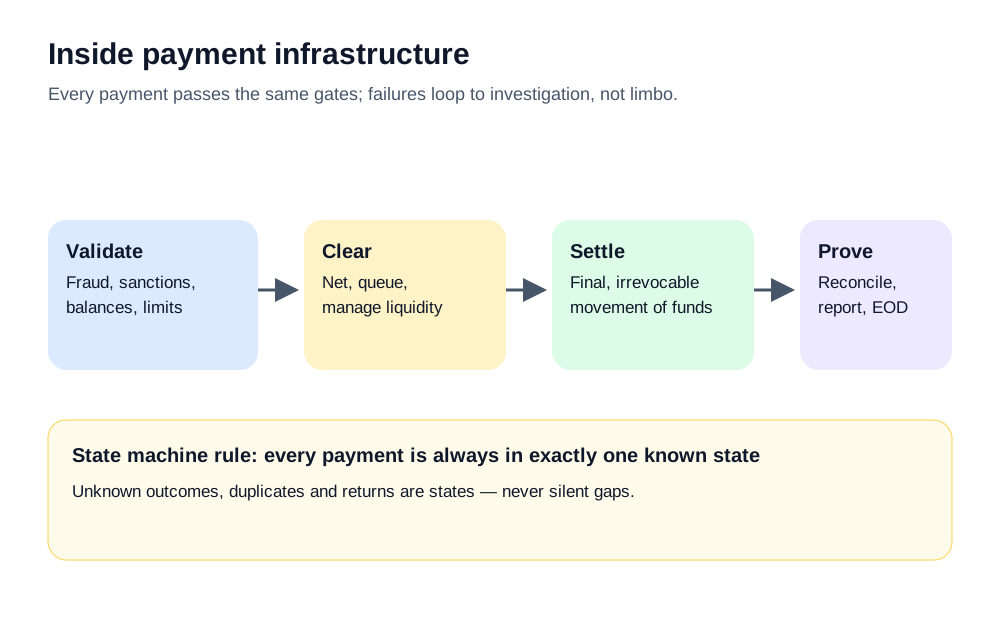
Phase 14 map: validate → clear → settle → prove. Every payment stays in exactly one known state.
1. The Simple Problem Clearing Solves
Suppose customers of Bank A send 10,000 payments to customers of Bank B during a day. At the same time, customers of Bank B send 8,500 payments to customers of Bank A. If every payment had to be funded separately with cash moving back and forth, the system would consume huge liquidity and operational effort.
Clearing systems solve this problem by collecting, validating, sorting, calculating, and sometimes netting obligations between participants. Instead of every bank settling every retail transaction individually, the system can calculate a net amount: after offsetting what Bank A owes Bank B and what Bank B owes Bank A, only the difference needs to settle.
This is the basic economic reason clearing exists: it converts millions of customer-level transactions into manageable participant-level obligations.
2. Clearing vs Settlement
Clearing is the process of preparing obligations for settlement. It may include validation, sorting, routing, matching, confirmation, calculation of bilateral or multilateral positions, and generation of settlement instructions.
Settlement is the actual discharge of the obligation. It happens when the settlement asset moves between participants, usually by debiting one participant's account and crediting another participant's account at a settlement bank or central bank.
A useful way to remember it:
- Clearing answers: who owes whom, how much, and why?
- Settlement answers: has the obligation been paid finally?
A payment can be cleared but not yet settled. A customer may see a provisional credit before final settlement. A card authorization may be approved long before card clearing and settlement. A cheque may be deposited before it is finally paid. These timing gaps create risk and explain why banks need settlement rules, reversals, returns, dispute processes, and reconciliation.
3. Payment Initiation, Posting, Clearing, Settlement, and Reconciliation
Many mistakes happen because people compress the whole payment journey into one word: payment. A bank-grade view separates the stages.
| Stage | What Happens | Example Question |
|---|---|---|
| Initiation | Customer or system gives the instruction | Did the customer request the payment? |
| Validation | Bank checks format, authority, limits, balance, fraud, sanctions, and product rules | Is the instruction allowed to proceed? |
| Posting | Bank updates internal customer or ledger accounts | Was the sender debited or receiver credited? |
| Clearing | Scheme or infrastructure calculates and routes obligations | Which participant owes which amount? |
| Settlement | Settlement asset moves between participants | Did interbank obligation become final? |
| Confirmation | Status is sent to banks, channels, or customers | What should the customer see? |
| Reconciliation | Independent records are matched | Do bank, scheme, and settlement records agree? |
The order can differ by rail. In some instant systems, customer posting may happen before final interbank settlement. In RTGS, settlement may happen before beneficiary credit. In card payments, authorization, clearing, and settlement are separated across time. The important point is to know which stage has actually completed.
4. Gross Settlement
Gross settlement means each transaction settles individually for its full amount. The strongest example is RTGS: real-time gross settlement.
In an RTGS system, if Bank A sends a 50 million payment to Bank B, the system debits Bank A's settlement account and credits Bank B's settlement account for 50 million. The payment does not wait to be netted with other payments. Under the applicable system rules and law, settlement is normally final and irrevocable at the specified finality point; timing, protections and limited exceptions are system-specific.
The benefits are clear:
- strong settlement finality;
- low credit exposure between participants;
- suitable for high-value and urgent payments;
- lower systemic risk from unsettled obligations.
The trade-off is liquidity. Gross settlement requires enough funds for every payment at the time it is released. If many banks hold payments waiting for incoming liquidity, queues can build. This is why RTGS systems often include priority management, queuing, intraday credit, and liquidity-saving mechanisms.
Examples include Fedwire Funds Service in the United States, TARGET services in Europe, CHAPS in the United Kingdom, and RTGS systems operated by many central banks.
5. Net Settlement
Net settlement accumulates obligations over a period and settles only the net amount. The period may be a batch, settlement window, business day, or defined cycle.
Example:
| Flow | Amount |
|---|---|
| Bank A sends to Bank B | 500 million |
| Bank B sends to Bank A | 420 million |
| Net amount Bank A owes Bank B | 80 million |
Instead of Bank A funding 500 million and Bank B funding 420 million, only the 80 million net debit settles. This can dramatically reduce liquidity requirements.
Net settlement supports high-volume retail systems because individual transaction values are smaller and liquidity efficiency matters. But it creates a different risk profile. If one participant cannot meet its net debit at the settlement window, the system needs rules for delay, liquidity support, loss sharing, partial settlement, unwinding, or participant default.
Net settlement is efficient, but it is not risk-free.
6. Bilateral vs Multilateral Netting
Bilateral netting offsets obligations between two participants. Bank A and Bank B calculate the net amount owed between them.
Multilateral netting offsets obligations across all participants in a system. Bank A may owe Bank B, Bank B may owe Bank C, and Bank C may owe Bank A. The clearing system calculates each participant's single net debit or credit against the system.
Multilateral netting is powerful because it reduces liquidity needs even more than bilateral netting. It is common in retail payment systems, card schemes, securities clearing, and clearing houses.
The power of multilateral netting comes with governance needs. Participants must trust the clearing rules, settlement timetable, default procedures, collateral requirements, and loss-sharing model.
7. Settlement Finality
Settlement finality is the point at which a transfer becomes irrevocable and unconditional under the applicable system rules and law.
Finality matters because participants need certainty. A bank that receives final funds can credit its customer, release goods, settle securities, or reduce exposure. Without finality, every payment would remain conditional and commerce would slow down.
Finality is especially important for:
- high-value payments;
- securities settlement;
- FX settlement;
- central bank operations;
- corporate treasury payments;
- settlement of net positions;
- insolvency scenarios.
A key question in any payment rail is: when exactly is the payment final? The answer may differ between customer-visible confirmation, beneficiary credit, interbank settlement, and legal finality.
8. Central Bank Money and Commercial Bank Money
Domestic interbank settlement often uses central bank money because it is the safest settlement asset in that currency. If Bank A and Bank B both hold accounts at the central bank, settlement can occur by debiting Bank A's central bank account and crediting Bank B's central bank account.
Central bank money has no commercial bank credit risk. This is why high-value payment systems and many systemically important settlement systems prefer it.
Commercial bank money is different. A balance held at a correspondent bank or settlement bank is a claim on that bank. It may be perfectly acceptable for many purposes, but it carries the credit and operational risk of the bank holding the account. Cross-border payments frequently use commercial bank money in nostro accounts because the sending bank may not have direct access to every foreign central bank.
Understanding the settlement asset is essential. The same customer payment can involve customer deposits, internal bank ledger entries, correspondent balances, and central bank settlement at different stages.
9. Instant Payments: Instant Experience, Scheme-Specific Settlement
Instant payment systems can be confusing because the customer experience is immediate, but the settlement model differs by country and scheme.
Some instant rails settle each payment in central bank money in real time. Others use prefunded balances. Others use deferred net settlement with strong risk controls and multiple settlement windows. Some combine instant message exchange with periodic settlement.
This means the word instant can refer to:
- instant customer notification;
- instant beneficiary credit;
- instant interbank message exchange;
- instant settlement;
- or a combination of these.
A professional should never assume the settlement model from the customer experience alone. The correct question is: how does this rail manage participant funding, settlement finality, liquidity, and default risk?
10. Cards and Cheques: Authorization Is Not Settlement
Card payments and cheques are good examples of why clearing and settlement must be separated.
In a card transaction, authorization confirms that the issuer approved the transaction at the point of sale. Clearing later exchanges detailed transaction records between issuer, acquirer, merchant, and network. Settlement later moves net funds between participants. Chargebacks can occur after settlement under network rules.
In cheque processing, the customer may deposit the cheque and see a provisional credit. The cheque image and MICR data are cleared through the cheque clearing system. The drawee bank may accept or return the item. Settlement occurs according to the clearing cycle. Only then is the credit truly final.
So a customer-facing approval is not always the same as final settlement.
11. Securities and FX Settlement
Securities and FX add another layer because two assets must move.
Delivery-versus-payment links securities delivery with cash payment. It reduces the risk that one party delivers securities but does not receive cash, or pays cash but does not receive securities.
Payment-versus-payment links two currency legs in FX settlement. It reduces Herstatt risk: the risk that one party pays one currency but does not receive the other because the counterparty fails or time-zone windows do not align.
The lesson is the same as payments: settlement design is risk design. The timing and linkage of obligations determine who is exposed, for how long, and to whom.
12. Main Risks in Clearing and Settlement
Credit risk. One participant may fail before meeting its obligation.
Liquidity risk. A participant may be solvent but unable to fund its obligation at the required time.
Settlement risk. One leg of a transaction may settle while the other does not.
Operational risk. Systems, files, messages, cut-offs, or manual processes may fail.
Legal risk. The finality, enforceability, or default process may be unclear.
Systemic risk. One participant's failure may affect many others because obligations are interconnected.
Clearing and settlement systems reduce some risks but introduce or concentrate others. RTGS reduces credit risk but needs more liquidity. Net settlement saves liquidity but concentrates settlement-window risk. Central counterparties reduce bilateral risk but concentrate risk management in the CCP.
13. Controls That Make Settlement Safe
Strong infrastructures use layered controls:
- participant eligibility and access rules;
- settlement accounts and prefunding;
- collateral and margin;
- exposure limits;
- debit caps;
- queue management;
- liquidity-saving mechanisms;
- default funds and loss-sharing rules;
- settlement finality rules;
- operational resilience and fallback procedures;
- cut-off and extension rules;
- reconciliation and participant reporting;
- incident communication and escalation.
For banks, these controls translate into requirements. Systems must preserve references, process statuses correctly, post accounting entries accurately, monitor queues, manage liquidity, reconcile files, and report exceptions.
14. Practical End-to-End Example
A corporate customer sends a high-value payment from Bank A to a supplier at Bank B.
- The corporate channel captures the instruction and approvals.
- Bank A validates authority, balance, cut-off, sanctions, fraud, and product rules.
- The payment hub assigns internal references and routes the payment to the RTGS gateway.
- The RTGS system checks whether Bank A has enough settlement funds.
- If funds are available, Bank A's central bank account is debited and Bank B's central bank account is credited.
- Settlement finality is achieved under RTGS rules.
- Bank B receives the payment notification and credits the supplier according to its internal process.
- Status messages update Bank A, Bank B, and possibly the customer channel.
- Reconciliation later compares Bank A's payment records, RTGS confirmations, settlement account movement, and general ledger postings.
If Bank A lacks funds at step 4, the payment may queue. If it queues too long, operations may need to add liquidity, reprioritize payments, or notify the corporate customer. This is why clearing mechanics, liquidity management, and reconciliation are tightly connected.
15. Common Misconceptions
"The money moved because the app showed success." The app status may reflect customer posting or scheme response. Final interbank settlement may be a separate event depending on the rail.
"Clearing and settlement mean the same thing." Clearing calculates and prepares obligations. Settlement discharges them by moving the settlement asset.
"Net settlement is weaker than gross settlement." Not exactly. Net settlement is liquidity-efficient and suitable for many retail systems, but it needs strong risk controls around settlement windows and participant default.
"RTGS means no liquidity problem." RTGS gives strong finality, but every payment needs full funding when released. Liquidity and queue management are central to RTGS operations.
"Instant payment always means instant settlement." Not always. Instant can refer to customer credit, message exchange, or settlement. The scheme design decides the settlement model.
16. Frequently Asked Questions
What is clearing in banking? Clearing is the process of validating, sorting, routing, matching, calculating, or netting obligations before settlement.
What is settlement? Settlement is the discharge of obligations by transferring the settlement asset between participants, often through central bank or settlement bank accounts.
What is settlement finality? It is the point at which a settlement is irrevocable and unconditional under the applicable rules and law.
Why do payment systems use netting? Netting reduces the liquidity needed to settle many transactions by offsetting mutual obligations and settling only the net amount.
Why do high-value payments use RTGS? Because high-value payments need strong finality and low settlement credit risk. RTGS settles each payment individually in real time.
Can a payment be credited before settlement? Yes, in some rails the beneficiary may receive provisional or scheme-backed credit before final interbank settlement. The exact risk depends on scheme rules.
What is Herstatt risk? It is FX settlement risk where one currency leg settles but the other does not, named after the 1974 failure of Bankhaus Herstatt.
17. Key Terms in This Chapter
- Clearing - preparation and calculation of obligations before settlement.
- Settlement - final discharge of obligations through movement of a settlement asset.
- Posting - update of customer, internal, or general ledger accounts.
- Settlement finality - legal and operational point at which settlement is irrevocable.
- Gross settlement - each transaction settles individually for its full amount.
- Net settlement - only net obligations settle after offsetting.
- Bilateral netting - offsetting obligations between two participants.
- Multilateral netting - offsetting obligations across all participants in a system.
- RTGS - real-time gross settlement.
- Central bank money - claim on the central bank, often used for final interbank settlement.
- Commercial bank money - claim on a commercial bank, such as a correspondent balance.
- Settlement asset - the money or asset used to discharge the obligation.
- Payment queue - payments waiting for funding, release, priority, or control conditions.
- DvP - delivery-versus-payment for securities settlement.
- PvP - payment-versus-payment for FX settlement.
- Herstatt risk - risk that one FX leg settles while the other fails.
- Systemic risk - risk that one participant's failure affects the broader system.
18. Interview Insights
"Explain clearing vs settlement." Clearing determines obligations: who owes whom and how much. Settlement discharges those obligations by moving the settlement asset. A payment can be cleared but not yet settled.
"Why does net settlement reduce liquidity needs?" Because mutual obligations are offset. Instead of settling every gross flow, each participant pays or receives only its net position for the cycle.
"What risk does RTGS reduce, and what challenge does it create?" RTGS reduces settlement credit risk by settling each payment finally and individually. It creates higher intraday liquidity demand and queue-management needs.
"Why is settlement finality important?" It gives participants legal certainty that funds or assets received cannot be unwound, allowing them to credit customers, release securities, or close exposures safely.
"How are cards different from account-to-account payments?" Card authorization, clearing, settlement, merchant funding, and chargeback rights are separate stages. An approved card transaction is not the same as final settlement.
Summary and Key Takeaways
Clearing and settlement are the hidden mechanics that turn payment instructions into final obligations and final money movement.
The main lessons are:
- Do not collapse the payment journey into one event. Initiation, validation, posting, clearing, settlement, confirmation, and reconciliation are different stages.
- Clearing calculates; settlement pays. This distinction is essential for operations, risk, testing, and customer communication.
- Gross and net settlement solve different problems. Gross settlement gives strong finality; net settlement saves liquidity.
- Finality is the core legal certainty. Without finality, banks cannot safely treat received funds as truly settled.
- The settlement asset matters. Central bank money, commercial bank money, correspondent balances, and prefunded scheme balances carry different risk.
- Instant experience does not always mean instant settlement. Scheme design decides the actual funding and settlement model.
- Clearing mechanics connect directly to liquidity and reconciliation. Queues, funding, settlement files, and ledger records must all align.
A payment professional who understands clearing and settlement can see beneath the screen confirmation and ask the right question: which obligation has actually been settled, in which system, with which asset, and with what finality?
Next: Topic 130 - Liquidity Management in Payments
<!-- MBA-DEEP-DIVE-START -->Payment Clearing Mechanics Deepening — Liquidity, Queues, Finality, Default, and Reconciliation
Clearing starts by defining the settlement obligation precisely
A payment instruction between customers is not automatically the same thing as an interbank obligation. The clearing layer determines which participant owes which other participant or settlement system, in what currency, for what value date, and under which scheme rules. In a bilateral arrangement the obligation may be directly between two banks. In a multilateral system, the clearing house may calculate each participant's net debit or credit against all others. Operations teams need to know which legal obligation is being produced because funding, default handling, finality, and reconciliation all depend on that definition.
Validation before clearing protects the infrastructure
A clearing system normally performs checks before admitting an item into the settlement process. These can include participant eligibility, message syntax, duplicate detection, currency, settlement date, transaction limits, scheme rules, and technical authentication. Some checks belong to the sending bank rather than the clearing system, such as customer authority or account balance. Good architecture distinguishes participant controls from infrastructure controls so teams know where a rejected payment failed and who owns remediation.
Admission time and settlement time can be different
A payment can enter a clearing system at 10:00 and settle later in a scheduled window. In an RTGS system, admission and settlement may be close together if liquidity is available. In deferred net settlement, transactions accumulate before net positions are settled. This distinction matters for status reporting. “Accepted by clearing” may mean the item passed validation, not that the interbank obligation is final. Customer channels should not map every positive infrastructure status to the same word “completed.”
Gross settlement exchanges liquidity efficiency for lower settlement exposure
Settling every payment individually removes the build-up of net settlement obligations but requires participants to fund each payment when it is released. A bank with enough end-of-day liquidity can still face an intraday problem if outgoing payments arrive before incoming funds. RTGS treasury management therefore focuses on timing as well as total cash. Intraday liquidity dashboards, payment queues, collateral, credit facilities, and incoming-flow forecasts help operations manage this timing risk.
Deferred net settlement saves liquidity by accumulating exposure
A retail clearing house may process millions of payments but settle only a handful of participant positions each day. Netting can dramatically reduce the amount of central-bank or settlement-bank money that participants need to move. The trade-off is that obligations remain unsettled during the cycle. A participant default near settlement time can therefore create a funding gap. Scheme rules need clear mechanisms for prefunding, collateral, debit caps, loss allocation, partial settlement, or other default management.
Bilateral netting and multilateral netting produce different obligations
If Bank A owes Bank B 100 and Bank B owes Bank A 80, bilateral netting leaves Bank A owing 20 to Bank B. In a multilateral system, Bank A's flows with Banks B, C, D, and others are combined into one net position. Multilateral netting can save more liquidity, but every participant depends on common rules and calculation integrity. The clearing house must prove that all accepted items are included once, positions sum correctly, and no participant receives an unexplained debit or credit.
Netting must be legally enforceable
A mathematical net amount is useful only if the law and scheme rules recognise the net obligation, including in insolvency. If a participant fails, administrators and counterparties need certainty that the net calculation cannot simply be unwound into gross obligations in a way that destabilises the system. Legal finality and enforceability are therefore core financial-market-infrastructure concerns. Technology cannot substitute for a clear legal basis.
Settlement finality should be identified by rule, not by screen status
A payment application may display “sent,” “processed,” or “credited,” but legal finality comes from the applicable system rules and law. In one rail, finality may occur when settlement accounts are debited and credited. In another, beneficiary credit may be provided before interbank settlement under scheme guarantees or prefunding. Analysts should document the exact finality point because it determines when a bank can treat settlement exposure as extinguished and how returns or reversals must be handled.
Finality and irrevocability are related but not identical concepts
A customer may lose the ability to cancel an instruction before interbank settlement is legally final. Conversely, a settled payment can sometimes be returned through a new transaction under scheme or legal rules even though the original settlement remains final. Operational language should therefore distinguish cancellation, revocation, recall, return, reversal, chargeback, and settlement finality. Mixing these concepts leads to incorrect expectations about whether “money can be pulled back.”
Central-bank money reduces settlement-bank credit risk
When two banks settle across accounts at the central bank, the settlement asset is a claim on the central bank rather than on another commercial institution. This is why systemically important domestic payment systems often use central-bank money where practical. It does not remove operational or liquidity risk, but it avoids exposure to the creditworthiness of a commercial settlement bank for the settlement asset itself. Where commercial bank money is used, participants need to understand and manage that additional exposure.
Access to the settlement asset shapes participation models
Not every payment service provider has direct access to a central-bank account or RTGS system. Some participate indirectly through a sponsor or correspondent bank. The customer may still experience the same payment rail, but the indirect participant has an additional dependency on its settlement agent. This affects cut-offs, liquidity, credit limits, operational resilience, and default handling. Scheme architecture should make direct and indirect participation roles explicit.
Prefunding changes where liquidity risk sits
An instant payment system may require participants to place funds in a dedicated settlement account or prefunded position before they can send payments. This reduces the risk that a participant sends more value than it can settle. The cost is trapped or dedicated liquidity that cannot be used elsewhere while committed. Treasury teams need visibility into prefunded balances and automated alerts before the position becomes too low to support customer payments.
Debit caps limit settlement exposure
A deferred net system can restrict how large a participant's net debit is allowed to become. When the cap is reached, new outgoing transactions may be rejected, queued, or require additional collateral or funding. Debit caps convert an unlimited exposure into a controlled one, but they also create operational consequences for customers. Banks need monitoring and escalation so a cap breach does not surprise channels or operations after payments begin failing.
Collateral protects the system but must be valued conservatively
Some infrastructures require participants to pledge securities or other eligible assets against settlement exposure or intraday credit. Collateral management involves eligibility rules, valuation, haircuts, concentration limits, substitution, and intraday monitoring. A nominal 100 of collateral may secure less than 100 of exposure after a haircut. Treasury and operations teams need to understand usable collateral value rather than simply the face amount of securities pledged.
Intraday credit is temporary liquidity, not free funding
A central bank or settlement agent may provide intraday credit against collateral so participants can settle payments before incoming funds arrive. The facility reduces gridlock and supports smooth market functioning, but it usually comes with eligibility, collateral, repayment, and end-of-day requirements. Banks should not depend on intraday credit as a substitute for sound liquidity planning. Failure to repay or unwind positions by deadline can escalate into overnight borrowing, penalties, or supervisory concern.
Payment queues are liquidity-management tools
When a participant lacks sufficient funds or a payment is held for priority reasons, the item may enter a queue. Queue design can be simple first-in-first-out or include priorities, bilateral offsets, multilateral algorithms, and participant controls. The queue is not merely a technical backlog. It represents unsettled economic instructions whose delay can affect customers, securities settlements, funding markets, or other payments. Operations teams need visibility into aged and high-value queued items.
Priority rules prevent low-value traffic from blocking critical payments
Banks may assign higher priority to central-bank operations, market settlements, urgent treasury transfers, or time-critical customer instructions. Priority design must be controlled because every participant would prefer its own payments to settle first. Systems can reserve liquidity for defined categories or allow participants to reprioritise within rules. Audit trails should show who changed priority and why, especially where delayed lower-priority payments create customer impact.
Gridlock can occur even when the system has enough total liquidity
Suppose Bank A waits for incoming funds from Bank B, Bank B waits for Bank C, and Bank C waits for Bank A. Each bank has outgoing payments queued because individually it lacks enough available balance. Collectively, the payments could settle if obligations were offset. This is gridlock. Liquidity-saving mechanisms identify compatible sets of queued payments and settle them simultaneously or on an offset basis, reducing the amount of external liquidity needed.
Liquidity-saving mechanisms are hybrids between pure gross and net settlement
An RTGS system with an LSM may still provide final gross settlement, but it uses queue algorithms to find offsetting payments before moving funds. This can reduce liquidity demand without waiting for an end-of-day net cycle. Analysts should not classify systems only as “RTGS” or “net.” Modern infrastructures often combine real-time finality with sophisticated optimisation mechanisms. The actual rulebook and settlement logic matter more than the label.
Partial settlement can reduce blocked obligations
Some systems allow part of a large instruction to settle when full funding is unavailable, especially in securities or liquidity-intensive markets. Partial settlement can improve throughput but creates additional accounting and reconciliation requirements. The original obligation, remaining amount, settled amount, fees, and downstream customer status must all stay consistent. A system that supports partial settlement needs data models designed for one-to-many settlement outcomes rather than a simple paid/unpaid flag.
Cut-offs create operational cliffs
A payment that remains queued close to the system closing time can become urgent. Banks may need to add liquidity, reprioritise, contact counterparties, or extend processing under scheme procedures. Missing the cut-off can change the value date, create contractual penalties, or leave a customer obligation unpaid. Operations should therefore use progressive escalation rather than waiting until the final minute. Cut-off management is a business control, not just a scheduler setting.
Extension rules need governance
During a major incident, a market infrastructure may extend a settlement deadline. Extensions help participants complete critical flows but can affect downstream systems, staff, liquidity, and other markets. Banks need a defined process for receiving and acting on extension notices. Internal batch jobs, end-of-day accounting, reporting, and treasury processes may need to move with the market infrastructure. A scheme extension is not useful if the participant's own systems have already closed irreversibly.
Default management determines whether a net system is resilient
If a participant cannot fund its final net debit, the system needs a pre-agreed response. Options can include using the participant's collateral, drawing a default fund, allocating losses, recalculating positions, or excluding certain transactions depending on rules. Unwinding accepted payments can spread liquidity shocks to other participants and is therefore a major design issue. Banks must understand the scheme's default waterfall because it can create contingent funding or loss obligations.
Default funds create mutualised risk
A clearing arrangement may require participants to contribute resources that can be used if a member defaults. This mutualises some risk across the group. Contributions, replenishment obligations, and loss-allocation rules should be understood by finance and risk teams because they create exposures beyond ordinary transaction fees. A low-probability participant default can still produce a material call on other members.
Operational failure can become liquidity risk
A bank can be solvent and funded but unable to send payments because a gateway, network, signing service, queue manager, or settlement interface fails. Incoming payments may continue while outgoing payments stop, or vice versa. This changes intraday positions and can affect counterparties. Payment resilience therefore needs technical recovery targets linked to liquidity impact. An infrastructure incident is not only an IT event when large values are trapped or delayed.
Duplicate processing is a settlement control risk
Retry logic after a timeout can accidentally send the same payment twice if idempotency is weak. At customer level this can create a duplicate debit; at infrastructure level it can create two legitimate settlement obligations if the clearing system sees distinct transaction identifiers. Systems should use stable unique references, duplicate checks, and reconciliation. Operations must know whether to reverse internally, send a return, or raise a scheme investigation depending on where duplication occurred.
Message status must be mapped to settlement state carefully
A pacs.002 or proprietary status may indicate acceptance, rejection, processing, or another stage depending on the rail and implementation. ISO 20022 provides structured messages, but the business meaning still comes from the market practice and scheme rules. A payment hub should not infer legal finality from a generic status code without understanding the infrastructure's settlement model. Message semantics and settlement semantics need explicit mapping.
ISO 20022 improves data but does not choose the settlement model
The same ISO 20022 payment message family can be used in systems with different liquidity, access, and finality arrangements. ISO 20022 standardises financial messaging structure and semantics; it does not determine whether a payment settles gross, net, prefunded, or through a correspondent. Analysts should therefore resist using message names as shorthand for rail behaviour. Scheme design remains a separate layer.
Customer posting and interbank settlement require accounting linkage
A sending bank may debit the customer before settlement, at settlement, or according to product rules. A receiving bank may credit the beneficiary immediately or after confirmation. Each timing choice creates temporary internal accounts or exposure. Finance design should identify suspense, clearing, settlement, nostro, and customer entries for every state. A payment is not operationally complete until the accounting chain can be reconciled end to end.
Reconciliation should prove completeness, not just match totals
Two files can both total 10 million while containing different transactions. Strong reconciliation compares counts, values, currency, settlement date, participant, and unique references. It should identify missing, duplicate, altered, late, and unmatched items. Aggregate control totals are useful but insufficient. Transaction-level evidence is especially important when a payment has been posted to a customer but not included in the clearing position.
Settlement-account reconciliation is a treasury control
A bank should reconcile the movement on its central-bank or settlement-bank account to the payment system's settlement reports and internal ledger. Unexpected differences can indicate missing postings, fees, liquidity transfers, failed batches, or duplicate settlement. This reconciliation affects both financial reporting and intraday liquidity. Large unexplained breaks should be escalated immediately rather than left for ordinary next-day operations.
Nostro reconciliation matters in cross-border settlement
Cross-border payments often settle through correspondent accounts. The sending bank records an expected debit or credit, while the correspondent later provides an account statement. Value date, charges, FX, intermediary deductions, and timing can create breaks. Reconciliation should distinguish expected timing differences from genuine missing or duplicate movements. Nostro breaks can tie up liquidity and conceal customer-impacting errors if not resolved promptly.
Liquidity forecasting should use payment-flow behaviour
Treasury can forecast expected outgoing and incoming flows by time of day, currency, counterparty, and payment type. Large corporate tax payments, securities settlements, payroll files, or market events can create predictable peaks. Forecasting does not need to be perfect to be useful. Better visibility can reduce idle liquidity while lowering queue risk. The payment system provides operational data that should feed liquidity management rather than remain isolated in operations.
Participant concentration can create systemic dependencies
A few large banks may account for a significant share of payment value or act as settlement agents for many indirect participants. Failure of one can therefore affect much more activity than its own customer payments. Infrastructure risk management looks at interconnectedness, not only individual participant solvency. Banks should understand their dependencies on correspondents, settlement agents, and major counterparties because concentration can turn a local outage into a market-wide problem.
Indirect participants need visibility into sponsor risk
A smaller bank or payment institution that accesses a clearing system through a sponsor may depend on the sponsor's credit limits, liquidity, operational hours, and technical gateway. If the sponsor suspends service, the indirect participant may lose access even though its own systems are healthy. Contracts should define service levels, funding requirements, incident communication, and exit options. Concentrating all access through one sponsor can be a resilience risk.
Settlement risk in FX is about synchronising two currencies
A foreign-exchange trade creates two payment obligations in different currencies. If one leg is paid before the other and the counterparty fails, the first payer can lose the full principal. Payment-versus-payment mechanisms reduce this principal risk by linking settlement so one currency leg occurs only if the other can occur. Where PvP is not available, banks need limits, timing controls, correspondent arrangements, and exposure management.
Securities settlement links cash and asset delivery
Delivery-versus-payment reduces principal risk by coordinating the securities leg with the cash leg. But different DvP models can use gross or net processes for one or both legs. Securities may also be subject to fails, partial settlement, corporate actions, and market cut-offs. Payment teams working with securities businesses need to understand that the cash movement cannot be analysed in isolation from the asset-delivery state.
Card settlement separates authorisation, clearing, and funding
A card issuer can approve a purchase in seconds, while final clearing records arrive later and settlement occurs on a network schedule. The cleared amount can differ from the authorised amount because of tips, currency conversion, completion messages, reversals, or incremental authorisations. Merchant funding introduces another layer through the acquirer. Card operations therefore rely heavily on matching authorisation, clearing, settlement, fees, and chargebacks across distinct events.
Instant payments can use different liquidity architectures
One instant system may settle every transaction in central-bank money; another may use prefunded technical accounts; another may provide immediate customer credit while settling interbank positions separately. The customer experience can look identical. Product and technology teams must understand the actual funding and finality model before designing statuses, limits, and exception handling. “Instant” describes a service expectation, not a universal settlement architecture.
Return flows are new payments, not time travel
After final settlement, a return normally creates a new transfer in the opposite direction under applicable rules. The original payment remains part of the ledger and settlement history. This is important for audit and accounting. Systems should preserve linkage between original and return without overwriting the original record as though it never happened. The same principle helps investigations understand the full lifecycle.
Recall requests do not guarantee recovery
A recall can ask the receiving side to return funds, but whether recovery is possible depends on scheme rules, legal rights, beneficiary consent in some cases, account balance, fraud procedures, and timing. Customer service should avoid promising that a recall “cancels” a settled payment. Operations need clear statuses such as requested, received, accepted, rejected, returned, or unresolved so expectations remain accurate.
Sanctions and fraud controls can interact with settlement timing
If screening occurs before release, a payment may be held while liquidity remains available. If a downstream participant flags the payment after settlement, recovery may require a return or investigation rather than simple cancellation. Faster rails compress the time available for intervention. Control design should therefore align screening and fraud decisions with the rail's irrevocability and finality points. The later a control acts, the fewer recovery options may remain.
Queue monitoring belongs in a payment operations cockpit
A useful dashboard shows total queued value, oldest item, highest-value item, priority distribution, available liquidity, projected incoming funds, cut-off countdown, and items blocked by non-liquidity controls. Operations can then distinguish a funding shortage from a sanctions hold or technical error. Aggregating every delayed payment into one queue number hides the action required.
End-of-day processing should not hide unresolved settlement states
Systems often run accounting close, statements, and reporting after payment cut-offs. If unresolved queued or failed items are automatically rolled to the next day without clear status, customers and finance teams can lose track of the original obligation. End-of-day design should define how pending items are carried, cancelled, re-dated, or escalated. Value date changes must be visible and auditable.
Business continuity should preserve settlement capability, not only application access
A disaster-recovery site that can display payment records but cannot connect to the settlement infrastructure does not restore the business service. Resilience testing should cover message creation, security keys, network routes, liquidity controls, participant authentication, settlement confirmation, and reconciliation. Critical payment systems need end-to-end tests involving external infrastructure where feasible. Recovery time should reflect economic deadlines, not only server availability.
The best clearing design makes risk visible
Clearing and settlement are often hidden from customers, but banks should make the underlying risk states visible to internal teams. A payment can be validated, queued, partially settled, final, returned, or under investigation. Each state has different accounting, liquidity, customer, and operational consequences. Systems that compress these states into a single processed flag create manual work and errors. Good payment architecture models the real economic lifecycle explicitly.
Clearing Mechanics — Netting Risk, Cut-Off Discipline, Exceptions, and Settlement Evidence
Clearing converts payment instructions into settlement obligations
A payment message by itself does not move final money between institutions. Clearing validates, sorts, matches, calculates positions, and determines what each participant must ultimately settle according to the rules of the system. Some arrangements settle transaction by transaction; others calculate bilateral or multilateral net positions. The bank therefore needs to understand the difference between customer instruction, clearing acceptance, settlement obligation, final settlement, and customer account posting. Treating these as one event creates poor status reporting and weak exception handling.
Gross and net settlement create different liquidity profiles
In a gross model, each eligible obligation is settled individually, so participants need enough liquidity throughout the day or access to liquidity-saving mechanisms. In a net model, offsetting incoming and outgoing obligations can reduce the amount of settlement liquidity required, but participants accumulate exposure until the net position is settled. Neither approach is universally better. The operating model must understand liquidity timing, credit exposure, finality, queue behaviour, and what happens if one participant cannot meet its obligation.
Netting is valuable only when the legal basis is sound
A mathematical net position is not sufficient if the legal framework does not recognise the netting arrangement under insolvency or participant default. Clearing systems therefore operate under rulebooks and legal structures that define when obligations become binding and how net positions are calculated. Banks should understand the legal finality model of each infrastructure they use rather than assuming all netting has the same enforceability. Treasury and credit-risk treatment depends on that distinction.
Cut-off management is an operational control
Clearing systems use submission windows, settlement cycles, maintenance periods, or final cut-offs. A payment arriving near cut-off can miss the intended cycle because of validation, sanctions review, insufficient liquidity, technical delay, or downstream queueing. Bank channels should therefore avoid promising a settlement time based only on when the customer pressed “send.” End-to-end cut-off logic should include internal processing time and contingency margin. Operations also need clear rules for payments held across a business day boundary.
Calendar management should be centralised and versioned
Payment processing depends on scheme calendars, currency holidays, local bank holidays, weekends, and exceptional closures. If each application maintains its own calendar, inconsistencies can produce wrong value dates or missed settlement. A controlled reference-data service should record calendar source, effective date, currency or market scope, and changes. Calendar updates should be tested across initiation, routing, treasury, settlement, reconciliation, statements, and customer communication.
Queueing is not the same as rejection
A payment may be valid but wait because liquidity is insufficient, a settlement window has not opened, or the infrastructure applies prioritisation. Systems should preserve this intermediate state instead of labelling the payment failed. Treasury may be able to add liquidity, reprioritise eligible payments, or use liquidity-saving tools. Customer-facing status should remain accurate without exposing internal details unnecessarily. Correct state management prevents duplicate resubmission of a payment that is still legitimately pending.
Liquidity-saving mechanisms need operational understanding
Some infrastructures can offset queued payments, search for cycles, or settle groups of transactions that are jointly fundable even when individual participants cannot settle them in isolation. These mechanisms reduce liquidity needs but create more complex state transitions. Bank monitoring should distinguish a normal queued payment from one that is blocked by a participant issue or infrastructure incident. Treasury dashboards need visibility into queued value, age, priority, and expected settlement path.
Participant default procedures must be understood before a crisis
Clearing and settlement systems define procedures for participant failure, which may include loss allocation, unwind, collateral use, liquidity resources, suspension, or other scheme-specific mechanisms. Banks should not discover these rules during an actual default. Legal, treasury, operations, risk, and technology teams should understand the possible effects on unsettled payments, customer balances, intraday exposures, and reconciliation. Scenario exercises can test how the bank identifies affected transactions and communicates status.
Finality determines when reversal becomes a new transaction
Before final settlement, a system may be able to cancel or reject an instruction according to its rules. After finality, correcting an error often requires a return, recall, refund, or separate compensating transaction rather than technically deleting the original settlement. Bank systems should preserve the original record and link any subsequent corrective movement. This is essential for accounting, investigations, customer statements, and audit evidence.
Settlement accounts connect clearing to central or commercial bank money
A clearing system may calculate obligations while settlement occurs across accounts at a central bank, settlement bank, or other designated institution depending on the arrangement. Participants need accurate mapping between clearing positions and settlement accounts. Treasury must ensure funding is available in the correct account and currency at the required time. Operations must reconcile the settlement confirmation back to the clearing position rather than infer settlement merely because the clearing file was accepted.
Reconciliation should prove the position from both directions
A robust control can begin with the bank's accepted outgoing and incoming transactions, calculate the expected position, compare it with clearing reports, and then compare the resulting obligation with settlement-account movements. Differences should be explained by explicit categories such as rejected transactions, fees, adjustments, prior-cycle items, or corrections. The objective is not just a zero difference at day end; it is evidence that every movement contributing to the settlement position is understood.
Duplicate prevention must survive retries and channel failures
Clearing interfaces can experience timeouts after a bank sends an instruction. If the bank cannot tell whether the infrastructure received it, a blind resend can create a duplicate. Idempotent references, sequence controls, acknowledgements, and reconciliation are therefore essential. The recovery procedure should determine whether the original instruction exists before creating a new one. This control becomes especially important in high-volume or real-time systems where manual review cannot keep pace.
Monitoring should connect technical events to financial exposure
An interface outage is more urgent when it traps a large settlement value near cut-off than when it occurs during a quiet period with no queued obligations. Operations dashboards should therefore combine message counts, queue age, rejected items, liquidity, settlement deadlines, and financial value. Incident severity should reflect customer and settlement impact, not only server metrics. A technically minor delay can become a major liquidity problem if it blocks a critical funding payment.
Clearing knowledge should remain infrastructure-specific but conceptually consistent
Different countries and schemes use different rules, settlement cycles, message standards, access models, and finality points. Bank architecture should avoid forcing every infrastructure into an oversimplified identical process. At the same time, a common conceptual model—instruction, validation, clearing, obligation, settlement, posting, reconciliation, exception—helps teams compare systems and design reusable controls. The goal is standardised understanding without erasing rulebook-specific differences.
<!-- MBA-DEEP-DIVE-END -->