Visual overview
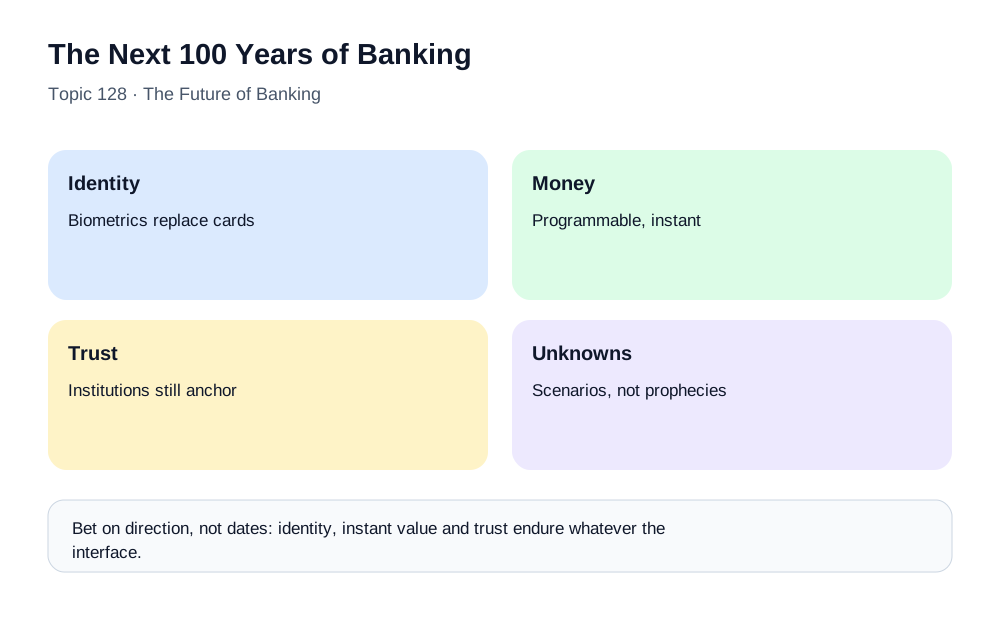
The Next 100 Years of Banking at a glance — Biometric identity, programmable money, trust.
Predictions, Scenarios, and What Lies Ahead for Financial Services
Banking has demonstrated remarkable resilience across its five-thousand-year history, surviving wars, depressions, technological revolutions, and pandemics while continuously adapting to serve evolving economic needs. The institution that began with Babylonian temples storing grain and evolved through Renaissance Italian merchant banking, Industrial Revolution joint-stock companies, and the digital transformation of recent decades now faces its next great transition. The coming century promises transformation at a pace never previously witnessed, driven by artificial intelligence, quantum computing, climate change, demographic shifts, and technologies not yet imagined. This exploration examines the forces shaping banking's future, possible scenarios for how the industry might evolve, and the enduring constants that will likely persist regardless of technological change. Understanding these trajectories helps institutions prepare for multiple possible futures while building capabilities that serve enduring human needs.
Multiple powerful forces will shape banking's trajectory across different time horizons, each with distinct implications for strategy and preparation. Artificial intelligence is already changing parts of banking, but the degree of automation over the next twenty years cannot be forecast reliably. Some activities are well suited to machine assistance, while high-impact decisions remain constrained by data quality, law, model risk, explainability, accountability, and the need for human judgment. Quantum computing has no reliable production timetable for broad banking advantage. The defensible near-term action is post-quantum cryptography readiness because cryptographic migrations take years, while quantum optimisation and risk-model use cases should remain evidence-based experiments until they outperform strong classical alternatives. Climate change represents a persistent force throughout the century and beyond, creating new asset classes alongside stranded assets while fundamentally reshaping green finance and risk management. Demographic shifts will influence banking through 2070 and later, as aging populations, Generation Alpha's emergence, and regional population dynamics reshape customer bases and product needs. Digital currencies including central bank digital currencies will likely mature between now and 2040, potentially replacing cash and transforming monetary policy implementation. Looking further ahead, the space economy between 2040 and 2100 may require banking for space commerce and off-world settlements, extending financial services beyond Earth. Brain-computer interfaces after 2050 could enable thought-initiated transactions and entirely new interaction paradigms that make current interfaces seem primitive. Artificial general intelligence, should it emerge, would enable truly autonomous financial advisors capable of managing entire financial lives better than any human.
Near-term predictions for 2025 through 2035 carry relatively high confidence based on current trajectory analysis and visible technological development. Near-term scenario planning should avoid false precision. Cash use may continue to fall in some markets while remaining important for resilience, inclusion, privacy, and contingency. AI copilots may become common in many banking roles, but adoption will differ by function and jurisdiction. More central banks may launch, pilot, pause, or redesign digital-currency initiatives, and Open Finance may broaden where legal frameworks and customer adoption support it. Branch networks may continue to rationalise in some countries while remaining important elsewhere. Post-quantum migration deserves action because of long lead times, not because anyone can reliably predict when cryptographically relevant quantum computers will arrive. AI may assist compliance documentation and analysis, but regulated firms will still need evidence, review, accountability, and controls.
Medium-term scenarios between 2035 and 2060 present divergent possible futures shaped by how key uncertainties resolve, requiring strategic flexibility. The Platform Supremacy scenario envisions big technology companies—global giants like Google, Apple, and Amazon alongside national leaders like Reliance—becoming primary financial service providers. In this future, banks devolve into regulated utilities providing infrastructure while customer relationships migrate to platforms that control the primary interface. The risk of massive financial power concentration raises systemic and competitive concerns, potentially prompting regulatory intervention. The Decentralized Finance Wins scenario projects mature DeFi ecosystems where smart contracts handle lending, insurance, and trading without intermediaries. Banks become obsolete for many functions, surviving only for complex services requiring human judgment and regulatory compliance. Regulatory chaos and consumer protection gaps pose significant risks in this scenario as innovation outpaces oversight. The Bank Renaissance scenario imagines traditional banks successfully transforming into artificial intelligence-powered, customer-centric, efficient institutions. Banks evolve into hybrid digital-human advisory powerhouses with deepened customer relationships through personalization and trust. Only the strongest survive this transformation, producing massive consolidation that leaves a few global winners. The Government-Led Digital scenario foresees central bank digital currencies, national digital identity systems, and government platforms dominating financial services. Banks become execution arms of central bank digital currency infrastructure while governments serve as primary customer interfaces, raising concerns about financial surveillance and privacy loss that may face public resistance.
Long-term possibilities between 2060 and 2125 venture into more speculative territory but help stretch strategic thinking. Artificial general intelligence managing entire financial lives better than any human advisor becomes conceivable as machine capabilities advance beyond narrow domains. Programmable money with embedded conditions—5,000 rupees that can only be spent on education, for instance—enables precise economic policy implementation and parental controls that current instruments cannot achieve. Biometric payments using face, palm, or iris recognition eliminate need for physical devices entirely, making authentication seamless and universal. Neural banking through brain-computer interfaces could enable thought-initiated transactions and direct financial system interaction without intermediating interfaces. Space banking would support Moon and Mars settlements, asteroid mining operations, and interplanetary commerce, extending financial systems beyond Earth. Immortality banking addresses life and estate planning for dramatically extended lifespans potentially reaching 200 years or more through medical advances, requiring fundamental rethinking of retirement and inheritance. Climate currencies backed by carbon credits or natural capital might emerge as environmental accounting becomes central to economic systems, creating asset-backed currencies for the first time in generations. Digital twins—artificial intelligence replicas of individuals—could negotiate, invest, and manage money autonomously on their originals' behalf, creating entirely new categories of financial agents.
Amid this flux, certain constants will likely persist regardless of technological change, providing anchors for long-term strategy. The need for trust remains fundamental—people will always require confidence in whoever holds their money, whether that entity is a traditional bank, technology platform, or decentralized protocol. Trust may take different forms but its necessity is permanent. The need for credit persists as borrowing and lending are foundational to economic activity, enabling investment, consumption smoothing, and emergency management regardless of how credit decisions are made. The forms of credit may change but the underlying need endures. Risk management remains essential because uncertainty is permanent, and someone must assess, price, and manage risks even if the mechanisms evolve. Payment needs are equally enduring as exchange of value forms the basis of civilization, though the instruments and intermediaries may transform beyond recognition. Regulation will persist in some form because finance affects social stability and will always attract government oversight, even as regulatory approaches adapt to new technologies. Human judgment will retain importance for complex, ambiguous decisions where artificial intelligence assists but does not replace human wisdom and ethical reasoning.
India occupies a unique position to shape and benefit from banking's future, potentially leading rather than following global trends. India's digital public infrastructure—including Aadhaar, UPI, and the Account Aggregator ecosystem—forms one of the world's most extensive large-scale digital-finance foundations. Its significance lies in adoption, interoperability, public-private participation, and the ability to support new services; comparisons with other countries should recognise that digital-public-infrastructure models differ in law, scope, governance, and market structure. This infrastructure advantage compounds over time as network effects strengthen. India retains a relatively young population compared with many ageing economies, although its age structure is gradually shifting and differs significantly by state. Large-scale mobile and internet adoption gives digital banking substantial reach, but device ownership, connectivity quality, digital skills, language, disability, and fraud exposure remain uneven. Strategy should therefore combine digital scale with inclusion and assisted-service design rather than treating national averages as universal access. Regulatory innovation by the Reserve Bank of India demonstrates forward-thinking approaches to fintech, central bank digital currency, and open finance that balance innovation with stability. Scale effects matter—1.4 billion people means innovations that work in India can work anywhere, making the country an attractive testing ground for global financial technologies. India is not merely participating in the future of banking but actively writing the playbook that other nations may follow, exporting its models and expertise.
The next century could bring profound change to banking, but no credible method can measure future change against several millennia of financial history. The useful discipline is to separate observable trends from scenarios, identify decisions that are robust across multiple futures, and avoid presenting imaginative possibilities as forecasts. Institutions that anticipate these changes, build flexible capabilities, and maintain focus on enduring customer needs will navigate successfully. Those clinging to current models risk obsolescence as the industry transforms around them. The constants of trust, credit, risk management, payment, and regulation provide anchors amid turbulence—banking that serves these enduring needs through evolving methods will thrive across whatever technological and social changes the future brings. Preparation for multiple scenarios while building on enduring foundations represents the most robust strategy.
Banking's future is neither predetermined nor entirely predictable, but it is being shaped by decisions made today. The architecture being built, the regulations being written, the technologies being developed, and the business models being tested will constrain and enable possibilities for decades to come. Thoughtful, inclusive, forward-looking approaches today create the foundation for a financial system that serves humanity's needs across the next century of change. The institutions that contribute to building this future will help define it; those that merely react to it will find themselves perpetually behind. The opportunity exists to create a more inclusive, efficient, and responsive financial system that serves billions better than banking has ever done before.
The next century of banking will be written by the decisions made today—in boardrooms, regulatory offices, and technology labs around the world. India has a particular opportunity to lead this future, given its digital infrastructure advantages, demographic profile, and innovative regulatory approach. The banks and fintechs that recognize this moment and invest in building the future will find themselves at the forefront of global financial innovation. Those that focus only on preserving current advantages may find the future arrives faster than expected, leaving them unprepared for the changes ahead. The next 100 years of banking begins today.
The pace of change in banking will likely accelerate as technological capabilities advance and as global challenges demand innovative financial solutions. Climate change, demographic shifts, and economic transformation will require banking to evolve more rapidly than in the past. Institutions that build adaptive capabilities—flexible technology architectures, learning cultures, and strategic foresight—will be better positioned to navigate this acceleration. Rigid structures and legacy systems will become increasing liabilities as the environment changes faster than they can adapt. Agility and adaptability will be essential capabilities for banking success in the coming decades.
The ultimate measure of banking's success over the next century will be its contribution to human flourishing. Financial services exist to serve human needs—to help people save for the future, invest in their dreams, protect against risk, and transact efficiently. The banks that keep this purpose central while adapting their methods to changing times will find enduring success. Those that lose sight of this purpose while chasing technological novelty or short-term profit will ultimately fail, regardless of their technical sophistication. The future of banking is about using advancing capabilities to better serve enduring human needs. This is both a technological challenge and a moral one, and the institutions that navigate it successfully will define the next century of financial services.
The globalization of banking will continue, with implications for how institutions organize and compete. Emerging market banks are becoming increasingly sophisticated and competitive, challenging the dominance of traditional Western institutions. Digital banking reduces the advantages of physical presence, enabling new competitors to enter markets more easily. Regulatory arbitrage—taking advantage of differences in rules across jurisdictions—will remain a challenge, though international coordination may reduce its prevalence. Banks must develop strategies for competing in this more globalized environment, whether through expansion, partnerships, or focus on specific market niches where they can maintain advantages. The global banking landscape of the future will likely be more diverse and competitive than today.
The resilience of banking systems will be tested by the challenges of the coming century, from climate change to technological disruption to geopolitical instability. Institutions must build robustness into their operations—diversified funding sources, flexible technology architectures, and strong risk management capabilities. Stress testing must evolve to address new types of risks and longer time horizons. Recovery and resolution planning must account for scenarios that may differ significantly from past crises. The banks that survive and thrive over the next century will be those that combine innovation with resilience, pursuing new opportunities while maintaining the stability that makes banking possible. This balance between progress and prudence has always been at the heart of banking, and it will remain so as the industry enters its next era.
The role of human judgment in banking will evolve but not disappear as technology advances. While artificial intelligence will handle more routine decisions and analysis, complex, ambiguous situations will continue to require human wisdom. Ethical questions, relationship management, and strategic choices all benefit from human insight that machines cannot replicate. Banks must develop their human talent alongside their technical capabilities, ensuring that employees are equipped to add value in ways that complement rather than compete with technology. The most successful institutions will be those that find the right balance between automation and human judgment, leveraging the strengths of each to serve customers better than either could alone.
The social responsibility of banks will come under increasing scrutiny as their role in society becomes more central and more visible. Issues such as financial inclusion, fair lending, climate impact, and economic inequality will demand attention from banks and their stakeholders. Institutions that proactively address these concerns, embedding social responsibility into their business models rather than treating it as peripheral philanthropy, will build stronger relationships with customers, regulators, and communities. Those that are perceived as indifferent to social consequences may face reputational damage, regulatory pressure, and customer defections. Banking for the next century must be both profitable and purposeful, serving shareholder returns alongside broader social goals.
The institutions that thrive over the next century will be those that successfully balance multiple imperatives—innovation and stability, globalization and local relevance, automation and human connection, profit and purpose. This balance is not a one-time achievement but a continuous process of adaptation as circumstances change. Banks must build cultures and capabilities that enable ongoing evolution rather than seeking single solutions. The future belongs to the adaptable, the resilient, and the principled. As banking enters its next century, the opportunities for those who navigate this complexity successfully have never been greater, nor have the consequences of failure been more significant.
The historical perspective on banking reminds us that the industry has always evolved in response to technological and social change. From the invention of double-entry bookkeeping to the development of electronic trading, from the establishment of central banks to the creation of deposit insurance, banking has continuously transformed itself while maintaining its essential functions. The changes ahead may be more rapid and more profound than in the past, but the pattern of adaptation continues. Banks that embrace this history of evolution, seeing themselves as part of a continuous story of financial innovation, will approach the future with confidence and purpose. Those that see only threats in change may find themselves left behind by history's relentless advance.
<!-- MBA-DEEP-DIVE-START -->The Next 100 Years of Banking Deepening — Scenario Planning Without False Precision
A century is too long for point forecasts
Forecasting the exact shape of banking in 2125 is not a serious planning exercise. Technologies, political systems, wars, regulation, climate, demographics, and social preferences can move in directions that cannot be known today. The value of a hundred-year chapter is therefore not prediction. It is to teach how banks can separate durable functions from changeable mechanisms, identify forces that could reshape the industry, and build capabilities that remain useful across multiple futures. Scenario planning is valuable when it widens thinking without pretending that imaginative possibilities are inevitable.
The durable functions of banking are more stable than the institutions
People and businesses need to store value, make payments, borrow, invest, manage risk, prove identity, and transfer wealth. Those needs are likely to persist even if the organisations serving them change. A future payment may use a bank deposit, central-bank money, tokenised deposit, regulated stable-value instrument, or a mechanism not yet designed. The strategic question is not whether the current product survives unchanged. It is which economic function is being served, what risks are created, and which regulated or trusted institution is accountable for the outcome.
Trust may migrate from buildings to systems and governance
Historically, customers often associated trust with physical branches, a recognisable brand, and long institutional history. Digital banking increasingly shifts trust toward uptime, security, clear dispute handling, privacy, transparent pricing, and reliable recovery when something fails. In a more automated future, customers may judge institutions by how well they govern algorithms and protect data. Trust therefore does not disappear when banking becomes digital; its evidence changes. Institutions that cannot explain decisions or recover safely from incidents may lose trust even if their balance sheets remain strong.
Regulation will evolve because financial externalities remain
Finance can transmit shocks between households, firms, markets, and governments. That gives society a continuing reason to regulate leverage, liquidity, consumer treatment, financial crime, market integrity, and operational resilience. New technologies may change the regulatory perimeter, but they do not remove the underlying public-interest concerns. A future where every financial service is delivered through software would still need rules around insolvency, custody, capital, data, fraud, and accountability. Regulation may become more machine-readable and continuous, but supervision is unlikely to become irrelevant.
Banking architecture will probably become more modular
Large monolithic systems are difficult to change when products, regulation, and customer channels evolve quickly. Over time, banks are likely to continue separating customer experience, product engines, ledgers, risk services, identity, data, integration, and external connectivity into more modular capabilities. This does not mean every bank will use the same microservice design or abandon mainframes. The strategic direction is toward replaceability and interoperability: changing one component without rebuilding the whole institution. Modularity is valuable across many future scenarios because it reduces the cost of adaptation.
Ledgers remain central even if assets are tokenised
A token is still a representation of rights and obligations. Banks will continue to need authoritative records of who owns what, what has been pledged, what is available, what is pending, and what has settled. Distributed ledgers can change where records are maintained and how participants synchronise them, but accounting discipline does not disappear. Reconciliation may reduce in some shared-ledger models, yet controls around identity, finality, corrections, legal ownership, and access remain necessary. The future of banking will still depend on trustworthy state transitions in financial records.
Tokenisation can change market plumbing without changing economic risk
Tokenised deposits, securities, funds, or collateral can enable new settlement models, automation, and fractional ownership. But tokenisation does not eliminate credit risk, market risk, liquidity risk, legal risk, or operational risk. A tokenised bond still exposes the investor to the issuer. A tokenised deposit is still a claim whose legal character matters. Banks should therefore evaluate tokenisation through the same questions they apply to conventional assets: legal claim, settlement asset, custody, default treatment, valuation, liquidity, and operational controls.
Programmability must not be confused with arbitrary control of money
Financial systems already contain conditional logic: standing orders, escrow, spending limits, smart contracts, and conditional disbursements. Future digital money may support richer programmable features, but policy and legal design will determine who can impose conditions and under what authority. A bank should distinguish programmable payment instructions from programmable money itself. The former can automate business rules without changing the nature of the underlying currency. The latter raises deeper questions about fungibility, privacy, control, and monetary design.
Central bank digital currency is one possible future infrastructure
Some central banks are researching, piloting, or implementing retail or wholesale digital currency; others have paused or taken different approaches. No credible analysis should assume one universal model. Retail CBDC can involve questions about privacy, distribution, bank funding, offline use, limits, and the role of intermediaries. Wholesale CBDC or central-bank settlement tokens can target market infrastructure instead. Banks should monitor actual design choices in their jurisdictions rather than build strategy around a generic CBDC concept.
Commercial bank money is likely to remain economically important
Bank deposits are not merely a payment technology. They are part of the credit-creation and funding model of commercial banking. Even if new settlement assets grow, households and firms may continue to hold claims on regulated banks because those balances combine liquidity, payments access, interest, credit relationships, and legal protections. A future with more forms of digital money may therefore be plural rather than a simple replacement of bank deposits by central-bank or privately issued tokens.
Cash can decline without becoming irrelevant
Digital payment growth does not prove that cash will disappear. Cash can provide privacy, accessibility, resilience during outages, and a payment option for people who lack devices or connectivity. Its importance varies sharply by country and use case. Future banking systems should therefore plan for declining cash in some markets while preserving contingency and inclusion where cash remains necessary. Eliminating a channel before substitutes are reliable can create social and operational risk.
Artificial intelligence will change work before it eliminates institutions
AI can already assist with coding, customer service, document review, fraud detection, research, and knowledge retrieval. Over time, it may automate more analytical and operational work. But banks operate under accountability, capital, legal, and trust frameworks that cannot simply be delegated to a model. The near-term transformation is likely to involve human-AI workflows, redesigned controls, and different skills rather than a single moment when “AI runs the bank.” Institutions that treat AI as an operating-model change rather than a software add-on will adapt more effectively.
Autonomous agents require transaction authority design
A software agent might one day compare products, move liquidity, rebalance investments, or negotiate payments for a customer. That possibility raises basic banking questions: how is the agent identified, what authority has the customer granted, what limits apply, how is intent evidenced, and who is liable for an error? Banks already solve versions of these problems for corporate mandates and delegated access. Agentic finance will extend mandate management into machine identities and machine-executed decisions.
Machine identity may become as important as customer identity
Banks currently authenticate people, businesses, devices, and applications. A future with autonomous agents, connected machines, and industrial Internet-of-Things payments may require persistent identities for non-human actors. A vehicle could pay tolls or charging stations; a procurement agent could order inventory within limits. These actors need credentials, permissions, revocation, audit trails, and ownership links. KYC will not disappear; identity architecture will broaden to include relationships between legal persons and authorised machines.
Biometric authentication will coexist with fallback methods
Face, fingerprint, iris, voice, and behavioural biometrics can reduce friction, but no biometric is universally available or infallible. Injuries, ageing, disability, environmental conditions, spoofing, sensor failure, and privacy concerns require alternatives. Banks should not design a future where access to money depends on one body characteristic. Strong authentication will likely combine device, cryptographic credential, behavioural context, and biometrics in ways that can degrade safely when one factor fails.
Privacy will become a competitive and regulatory capability
Future financial systems may know more about customers because of Open Finance, AI, connected devices, and richer transaction data. That creates value for personalisation but also surveillance risk. Banks that can minimise data, explain use, honour consent, and protect sensitive information may build trust. Privacy engineering—purpose limitation, tokenisation, differential access, secure computation, and retention control—could become as strategically important as credit modelling.
Cybersecurity will remain an arms race
Attackers adapt to new technology just as banks do. Future threats may include more capable automation, synthetic identity, deepfake social engineering, software-supply-chain compromise, quantum threats to public-key cryptography, and attacks on autonomous agents. Defenders will also gain stronger detection, cryptography, hardware security, and automated response. There is no future state where cybersecurity is “solved.” Banks need security architectures designed for continuous change, inventory, patchability, strong identity, segmentation, and recovery.
Post-quantum readiness is a good example of robust strategy
Nobody can predict the exact date of a cryptographically relevant quantum computer. Yet banks can still take sensible actions now: inventory vulnerable algorithms, classify data by confidentiality lifetime, build crypto agility, test standardised post-quantum algorithms, and engage vendors. These actions remain useful across faster and slower quantum scenarios. Robust strategy focuses on moves that are valuable under uncertainty rather than trying to win a forecasting contest.
Climate change will affect credit geography
Flood, heat, drought, wildfire, sea-level rise, and transition policy can change the value and insurability of assets over decades. A mortgage booked today can remain on a bank's balance sheet long enough for local climate risk to change materially. Future credit models may need more geographic hazard data, adaptation evidence, insurance availability, and scenario analysis. Climate risk therefore links demographic movement, property finance, insurance, capital, and regional economic development.
Adaptation finance may become a major banking business
Much sustainable-finance discussion focuses on reducing emissions, but households, cities, and businesses also need finance to adapt to physical climate effects. Loans for resilient buildings, water systems, heat management, flood protection, agricultural adaptation, and infrastructure could grow in importance. Banks will need methods to assess whether financed measures genuinely reduce risk. This creates an opportunity to connect lending with measurable resilience rather than relying only on broad sustainability labels.
Demographic divergence will create different banking futures by region
Some countries will age rapidly; others will retain young and growing populations. Some cities will expand while other regions shrink. A universal “future customer” does not exist. In ageing markets, wealth transfer, retirement, healthcare finance, and assisted service may dominate. In younger markets, first-time credit, housing, entrepreneurship, and digital onboarding may grow faster. Global banks should expect regional divergence rather than one synchronized future.
Urbanisation changes financial infrastructure
As people and businesses concentrate in cities, demand for real-time payments, transit payments, small-business services, housing finance, and digital identity can increase. At the same time, rural and remote communities still need access to cash, credit, and advice. Future distribution models may combine fewer traditional branches with agents, mobile service, remote advice, shared infrastructure, and resilient digital channels. The important capability is reach, not the preservation of a particular branch format.
Cross-border payments will keep pressure on friction and transparency
Customers increasingly expect international payments to approach the speed and visibility of domestic digital payments. Regulatory requirements, currency conversion, correspondent relationships, sanctions, liquidity, local-market access, and settlement windows make cross-border payments structurally more complex. Future improvements may come from ISO 20022 data, API connectivity, linked instant systems, better compliance, tokenised settlement, and new infrastructure. The goal is not a specific technology; it is lower cost, better transparency, faster execution, and safe finality.
Instant settlement increases the importance of prevention
When money settles in seconds, there is less time to stop fraud after release. Future payment systems therefore need stronger identity, behavioural analytics, confirmation services, transaction limits, scam intervention, and customer education before execution. Faster infrastructure does not eliminate investigations and exceptions; it changes where controls must operate. Banks will increasingly design fraud prevention into initiation rather than depend on recall after settlement.
Financial crime will exploit new interfaces
Criminals will use whatever channels customers use: social platforms, AI agents, digital identity, crypto-assets, tokenised markets, or embedded finance. Compliance needs to understand economic behaviour across channels rather than build isolated controls for each new product. Better entity resolution, network analytics, and information sharing may become increasingly important. However, stronger surveillance also raises privacy and fairness concerns. Future financial-crime control will require proportionality as well as technical power.
Embedded finance may make the bank less visible
A customer can already obtain payments, credit, insurance, or accounts inside non-bank applications. This trend may deepen, with regulated banking capabilities delivered through retail, mobility, enterprise-software, and marketplace platforms. The bank may become invisible in the customer interface while remaining responsible for regulated functions. That makes partner governance, brand disclosure, conduct, API resilience, and complaint handling essential. Invisible distribution must not mean invisible accountability.
Bank brands may still matter even when interfaces fragment
Customers may use many front-end apps, but they still care who safeguards deposits, provides credit, resolves fraud, or stands behind a service. In periods of stress, the legal institution and its protection regime become highly visible. Future strategy should therefore distinguish distribution brand from balance-sheet trust. A bank can participate in embedded models without assuming its identity has no value.
Competition may come from ecosystems rather than individual products
Customers increasingly compare entire experiences: payments, savings, rewards, investments, credit, identity, commerce, and support. A bank with a strong single product can still lose relevance if another ecosystem offers smoother integration. Open Finance may accelerate this competition by reducing data lock-in. Banks can respond by building ecosystems, partnering selectively, or specialising in capabilities where they have genuine advantage. There is no requirement that every bank become a super app.
Specialisation is a credible future strategy
Some institutions may focus on custody, transaction banking, credit manufacturing, infrastructure, wealth, or regulated balance-sheet services while partners own customer distribution. Others may remain universal banks. Technology can make specialised models more viable because capabilities can be exposed through APIs. Strategy should therefore ask where the institution has defensible expertise, licences, funding, risk capabilities, or trust rather than assuming scale in every product is necessary.
Financial-market infrastructure may become more continuous
Markets that currently operate with cut-offs, batch cycles, and limited hours may extend availability as technology and demand evolve. But continuous operation changes staffing, liquidity, maintenance, risk monitoring, and incident response. A 24/7 market is not simply a market with longer opening hours. Banks need treasury, settlement, reconciliation, and support models that can operate without relying on an overnight reset window.
Reconciliation may shrink in some areas but never disappear entirely
Shared ledgers and standardised data can reduce breaks caused by duplicated records, yet banks will still reconcile between customer ledgers, settlement systems, external providers, regulatory reports, and financial statements. New infrastructure can move the break rather than eliminate it. Future operations should design reconciliation as continuous evidence that systems agree, with automation focused on root-cause prevention rather than only exception matching.
Accounting remains the language that links innovation to the bank
Every new product ultimately affects assets, liabilities, income, expense, capital, or off-balance-sheet exposure. A bank can launch tokenised deposits, embedded credit, or AI-managed portfolios only if finance teams can account for them correctly. Future innovation programmes should include accounting and regulatory reporting early. Otherwise technically successful pilots can fail when they cannot be booked, valued, reconciled, or reported reliably.
Capital and liquidity constraints will continue to shape innovation
A regulated bank cannot scale credit or trading merely because a new platform creates demand. Assets consume capital, liquidity must be managed, and funding has a cost. Technology can improve efficiency but it does not remove balance-sheet constraints. Future business models will still need to price capital, liquidity, expected loss, operational cost, and return. This is why some apparently disruptive financial products eventually converge toward familiar banking economics.
Deposit competition may become more real time
Open Finance, digital onboarding, and faster payments can make it easier for customers to move money between institutions. That can increase deposit sensitivity to rates, trust, and service events. Treasury teams may need more granular behavioural models and faster visibility into outflows. The failure of a digital bank or a viral rumour can produce rapid movement of funds. Future liquidity risk management therefore connects directly to digital customer experience and social-media dynamics.
Crisis management will need faster information flows
Financial stress can spread through markets and social networks quickly. Banks need accurate intraday positions, clear communication, tested recovery options, and decision authority. AI may help summarise information, but crisis accountability remains human and institutional. A bank that automates normal operations without preserving expert understanding may struggle when models fail or unusual events break assumptions. Resilience requires retained knowledge as well as automation.
Human skills will shift toward judgment, design, and control
As routine processing becomes more automated, bank employees may spend more time on exception handling, relationship management, model oversight, product design, investigation, negotiation, and strategic decision-making. This does not mean fewer people in every function; it means different work. Training should help employees understand both banking fundamentals and technology so they can challenge automated outputs rather than merely follow them.
Explainability becomes a service expectation
Customers will increasingly ask why a payment was blocked, why a loan was declined, why an investment was recommended, or why an AI assistant took an action. Banks should build systems that can provide useful reasons without exposing security controls or proprietary models unnecessarily. Explainability is not only a model-risk requirement. It is part of customer trust and dispute resolution.
Financial inclusion can improve or worsen
Digital identity, mobile access, instant payments, and alternative data can bring more people into formal finance. The same technologies can exclude customers who lack devices, documentation, digital skills, or acceptable data histories. Automated models can scale access and scale bias at the same time. Future banking should therefore measure who benefits, who is rejected, and why. Inclusion should be treated as an outcome to monitor, not an automatic consequence of technology.
The best future strategy is option-rich
A bank cannot choose one future and optimise everything around it. It can preserve options: modular architecture, strong data governance, skilled people, partner connectivity, crypto agility, accessible channels, tested resilience, and disciplined balance-sheet management. These capabilities allow the institution to adopt new technologies when evidence supports them and to avoid costly bets when hype fades. Strategic flexibility is more valuable than confident prediction over a hundred-year horizon.
Scenario planning should finish with decisions
A scenario exercise is useful only if it changes what the bank does now. Teams should identify leading indicators, no-regret investments, risks that require hedging, and decisions that can wait. For example, post-quantum inventory can start now; a speculative space-banking product can wait. Open Finance architecture may justify immediate investment where regulation exists; brain-computer banking does not. The discipline is to convert uncertainty into staged choices rather than dramatic forecasts.
The future bank will still be judged by outcomes
Whatever technology dominates, customers will care whether money is safe, payments arrive, credit is fair, investments are understood, fraud is handled, and problems are resolved. Regulators will care whether institutions are solvent, resilient, lawful, and capable of failing without destabilising society. Those outcome measures are more durable than any interface or architecture. The next hundred years of banking will be shaped by technology, but its legitimacy will still depend on whether it performs these basic functions well.
The Next 100 Years of Banking — Scenario Discipline, Strategic Optionality, and Control Principles
A century forecast should be treated as scenario work, not prediction
No bank can credibly forecast technologies, political systems, regulation, currencies, or customer behaviour a hundred years ahead. The useful exercise is to identify forces that could reshape banking and ask which capabilities remain valuable across several futures. Scenarios can explore different combinations of digital identity, artificial intelligence, tokenised assets, central-bank money, private money, climate change, demographic shifts, geopolitical fragmentation, and cyber risk. The aim is not to attach a date to a dramatic invention. It is to test whether the bank's strategy is resilient when important assumptions change.
Some banking functions are more durable than current products
The form of a bank account may change, but societies are still likely to need ways to store value, transfer claims, extend credit, manage liquidity, verify identity, allocate risk, protect customers, keep records, and settle obligations. These functions can be performed by different institutional structures over time. A strategic bank should therefore separate enduring economic functions from today's implementation. Defending a particular branch format, card technology, or message interface is less important than remaining capable of trusted intermediation as technology evolves.
Trust may become more technical but will not disappear
Future customers may rely on cryptographic proofs, automated controls, programmable assets, or machine-to-machine transactions. Even then, trust shifts rather than vanishes. Someone must define the rules, secure keys, correct errors, resolve disputes, manage fraud, recover from outages, and determine legal ownership when systems disagree. A technology can reduce dependence on one intermediary while creating dependence on software, governance, infrastructure, or validators. Banking strategy should ask where trust moves and who becomes accountable when something goes wrong.
Digital identity could become a reusable financial infrastructure layer
A future customer may not repeatedly prove the same identity separately to every bank. Reusable credentials could allow verified attributes to be presented selectively: age eligibility, legal-entity authority, residence, accreditation, or other claims. The banking opportunity is lower onboarding friction and better portability. The risk is concentration around identity infrastructure, credential theft, exclusion when recovery fails, and excessive surveillance. A future-ready bank should therefore invest in privacy-preserving identity, strong recovery, consent, and interoperable evidence rather than assume one permanent identity technology will dominate.
Artificial intelligence may change the unit of competition
If intelligent agents can compare products, negotiate prices, manage liquidity, initiate transfers, rebalance portfolios, and monitor risk for customers, banks may increasingly serve both humans and software agents. Product terms will need to be machine-readable as well as legally understandable to people. Authentication may need to distinguish the customer from an authorised agent acting under limits. Banks will need policy services that can enforce delegated authority deterministically, because a conversational or autonomous model should not have unlimited freedom to move money simply because it can reason about a goal.
Machine-to-machine finance will require bounded authority
Connected vehicles, factories, software services, and devices may initiate economic transactions automatically. A vehicle might pay for charging, a machine may purchase capacity, or a corporate agent may optimise working capital. The control problem is familiar even if the interface is new: who owns the device, what can it buy, within which limits, from which counterparties, with what evidence, and how can authority be revoked? Future banking systems should support granular mandates, spending policies, real-time risk controls, and complete audit trails.
Programmability should not remove reversibility where society needs it
Automation can make payments and contracts execute quickly, but some financial events require investigation, correction, or legal intervention. Fraud, coercion, mistaken identity, court orders, insolvency, sanctions, inheritance, and technical faults do not disappear because a transaction is programmable. Future financial infrastructure will need a deliberate balance between finality and controlled exception handling. “Code is final” may be attractive for simple automation but is inadequate as a universal banking principle.
Tokenisation could change asset servicing more than customer language
Customers may continue to think in terms of deposits, bonds, funds, collateral, or securities even if ownership records become tokenised. The deeper change could be operational: faster transfer, programmable restrictions, automated corporate actions, fractional ownership, or new collateral mobility. Banks should focus on legal ownership, custody, settlement finality, asset servicing, valuation, compliance, and reconciliation rather than assuming tokenisation by itself creates economic value. A token representing a poorly governed asset remains a poorly governed asset.
Custody may evolve from holding certificates to controlling cryptographic authority
Traditional custody protects records, assets, settlement instructions, and corporate-action rights. Digital assets add private keys, multi-party signing, hardware security, smart-contract risk, chain monitoring, and recovery of access. Over decades, custody architecture may become more abstract, but the principles remain: segregation, proof of ownership, authorised movement, resilience, reconciliation, and client asset protection. Banks that understand these principles can adapt even if the underlying cryptographic mechanisms change repeatedly.
Quantum risk is an example of long-horizon technology planning
Banks do not need to assume that a powerful cryptographic quantum computer will arrive on a precise date. They do need inventories of cryptographic dependencies, data that must remain confidential for long periods, upgrade paths, vendor readiness, and the ability to migrate algorithms without rebuilding every system. This is a broader lesson for century-scale planning: the valuable capability is technology agility and inventory discipline, not certainty about one breakthrough.
Climate change can alter banking geography and collateral economics
Over long horizons, physical climate effects, adaptation, insurance availability, migration, infrastructure investment, and policy can reshape property values and economic activity. A mortgage portfolio built on historical location assumptions may behave differently if flood, heat, water, or insurance risks change. Project finance may expand around resilience and energy transition. Banks should therefore improve geospatial risk data, long-term scenario analysis, and collateral monitoring rather than treat climate risk as a temporary reporting topic.
Demographic change can reshape savings and credit simultaneously
Ageing, migration, urbanisation, household formation, and wealth transfer can change deposit behaviour, mortgage demand, retirement products, healthcare finance, and intergenerational support. A bank that plans only around current customer age bands risks building the wrong balance sheet and distribution network. Century-scale scenarios should connect demographics to funding, lending, payments, service channels, and vulnerability rather than discuss population as a separate social trend.
Geopolitical fragmentation could create multiple financial technology blocs
The future may not be one globally unified financial network. Data-localisation rules, sanctions, security concerns, currency competition, domestic payment systems, and regional standards could create partially connected ecosystems. Banks operating across borders may need adaptable routing, legal-entity controls, multiple identity and messaging standards, and the ability to isolate services during geopolitical stress. Interoperability may become more valuable precisely because infrastructure is fragmented.
Central-bank and commercial money may coexist in new forms
Digital central-bank money, tokenised commercial-bank money, regulated stable-value instruments, and existing account money could all coexist in some future markets. The banking challenge would be liquidity management and convertibility between forms of money. Customers will care that value is usable and reliable; banks will care about settlement asset, credit exposure, intraday liquidity, balance-sheet treatment, and regulatory rules. Architecture should avoid hard-coding the assumption that one settlement asset will remain dominant forever.
Future payments may become invisible, making controls more visible internally
A customer experience can become nearly frictionless while the bank performs more control in the background. Identity, fraud scoring, sanctions screening, limits, liquidity, routing, settlement, and reconciliation still need to occur, possibly in milliseconds. The less the customer sees, the more important internal observability becomes. Banks need event histories, correlation identifiers, decision evidence, model versions, and exception handling so invisible automation remains explainable when a payment fails or is disputed.
Human service will remain important at moments of uncertainty
Routine banking may become heavily automated, yet complex life events—fraud, bereavement, financial distress, disputes, business restructuring, major investment decisions—can still require judgment and empathy. Future banks should not assume automation eliminates service; it changes where human expertise is most valuable. A strong operating model uses machines for scale and consistency while preserving accountable human intervention for ambiguity and high-impact exceptions.
Regulation will continue to follow economic function and harm
Specific rulebooks will change repeatedly over a century, so future planning should not anchor on today's exact regulatory text. More durable themes include prudential safety, customer protection, financial crime, market integrity, privacy, operational resilience, competition, and systemic stability. New technologies will be assessed through these concerns even if institutional boundaries change. Banks should therefore build traceable controls and adaptable policy engines rather than embed regulations irreversibly in legacy code.
Data lineage is a century-proof capability
Whatever technologies emerge, institutions will need to explain where a financial number came from, which rule transformed it, which system recorded it, and who authorised the action. Lineage supports accounting, risk, reporting, investigations, AI governance, and customer disputes. A bank with strong lineage can migrate technology more safely because meaning survives platform change. A bank without lineage becomes more fragile each time it adds a new layer of automation.
Resilience should be designed for graceful degradation
Future financial systems may depend on cloud providers, networks, identity utilities, AI services, cryptographic infrastructure, and external data. A resilient bank should assume some dependencies will fail. Critical services need fallback modes, clear priority, isolated recovery, tested backups, and the ability to operate safely at reduced functionality. The objective is not to promise that technology never fails but to ensure failure does not become uncontrolled financial harm.
Strategic optionality is more valuable than one heroic technology bet
A century is too long for a single architecture decision to remain correct. Modular systems, open interfaces, portable data, versioned rules, replaceable vendors, and clear domain boundaries let a bank adopt useful innovations without surrendering control. Optionality also means being able to exit technologies that underperform. A platform that can evolve incrementally is more robust than a future-state blueprint that assumes one predicted technology becomes universal.
The bank of the future will still be judged at the moment money is at risk
Customers may use immersive interfaces, autonomous agents, wearable devices, or technologies not yet imagined. But trust will still be tested when money disappears, a payment fails, an account is compromised, a loan becomes unaffordable, or an institution is under stress. The durable competitive advantage is the ability to keep records accurate, controls effective, service understandable, and obligations honoured while technology changes around them. That is a more credible foundation for thinking about the next hundred years than claiming to know exactly what banking will look like.
<!-- MBA-DEEP-DIVE-END -->