Visual overview
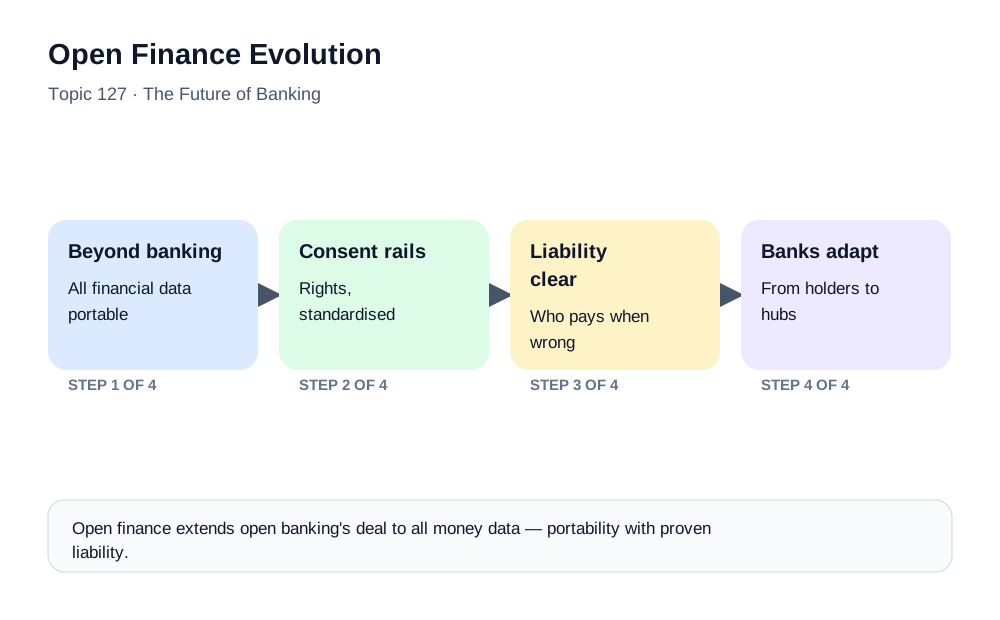
Open Finance Evolution at a glance — Beyond open banking, unified financial data.
Beyond Open Banking — Data Portability, Interoperability, and Customer Empowerment
Open Finance represents a natural and significant evolution from the foundations established by Open Banking, extending principles of customer-controlled data sharing through application programming interfaces from bank accounts to encompass the entire financial ecosystem. The vision encompasses insurance policies, investment portfolios, pension accounts, tax records, and more—all available for secure, consent-based sharing to enable better products, fairer pricing, and genuine financial portability. When fully realized, Open Finance allows any customer to share their complete financial picture with any provider, breaking down the information silos that have historically given incumbents advantages while preventing customers from leveraging their own data for better outcomes. This shift represents a fundamental redistribution of power in financial services—from institutions that have historically hoarded customer data to customers who can use their own information to secure better terms and services.
India's Account Aggregator framework stands among the most advanced implementations of this vision globally, demonstrating how thoughtful regulation and technical architecture can accelerate financial innovation while protecting consumer interests. The framework's design principles—consent-based sharing, data blindness of intermediaries, and granular customer control—provide a model for other jurisdictions developing similar capabilities. Open Banking and Open Finance are related but should not be treated as a single universal maturity ladder. Open Banking commonly concerns access to payment-account data and, in some regimes, payment initiation. Open Finance extends customer-authorised access to a wider range of financial data such as investments, pensions, insurance, and other regulated financial products, but the exact scope differs by jurisdiction. India's Account Aggregator framework already supports financial information across institutions and sectors defined by the applicable regulatory framework, while its scope evolves through regulator decisions and participant implementation. Broader 'open data' initiatives may include non-financial datasets, but those initiatives can sit under different laws, consent models, and governance structures.
India's Account Aggregator framework exemplifies thoughtful architecture for secure financial data sharing that balances innovation with protection. The system operates through four interconnected entities with clearly defined roles and responsibilities. Financial Information Providers are institutions that hold customer financial data—banks, non-banking financial companies, insurance companies, mutual fund houses, and pension funds. These entities maintain the underlying data and make it available through secure APIs, serving as the data sources for the ecosystem. Account Aggregators serve as consent managers that route data between providers and users without ever storing or viewing the information themselves—true to their name, they aggregate access rather than data, serving as trusted intermediaries that facilitate sharing without accessing content. Financial Information Users are institutions that consume shared data to provide services—banks extending loans, NBFCs assessing creditworthiness, fintechs offering wealth management, and others who can create value with customer permission. The customer sits at the center of this architecture, granting and revoking consent through Account Aggregator applications, maintaining control over what data is shared, with whom, and for how long.
The operational flow demonstrates how this architecture protects customer interests while enabling value creation that benefits all participants. When a customer applies for a loan with a new bank, that bank acts as a Financial Information User requesting access to the applicant's financial data through an Account Aggregator. The customer receives a consent request on their Account Aggregator application detailing what data is requested, from which institutions, and for what purpose. This transparency ensures customers understand what they are agreeing to share. The customer then selects specific accounts and data elements to share, sets time limits on access, and approves the request. This granularity prevents all-or-nothing sharing that might expose unnecessary information. The Account Aggregator routes encrypted data directly from Financial Information Providers to the requesting bank—the Account Aggregator itself cannot access, store, or use the data, eliminating a potential breach point. The requesting bank uses this data for credit assessment, potentially making instant decisions based on comprehensive financial history rather than limited documentation. The customer can revoke consent through the Account Aggregator framework. Revocation governs future retrieval under the consent artefact; it does not automatically erase information that a Financial Information User has already lawfully received and is required or permitted to retain under applicable law and the stated purpose.
Several key design principles ensure this system serves customer interests and builds trust necessary for adoption. The consent-based approach requires explicit customer approval for each data sharing instance—no blanket permissions or hidden access buried in terms and conditions. Granular controls allow customers to choose specific accounts, specific data elements, and time limits rather than all-or-nothing sharing that might expose sensitive information unnecessarily. Revocable consent ensures customers can terminate access at will, preventing indefinite retention of sharing rights and ensuring ongoing control. The RBI framework requires that customer financial information accessed from Financial Information Providers must not reside with the Account Aggregator and must not be used beyond the permitted account-aggregation function. This architecture materially limits data-retention risk at the intermediary, although the ecosystem still depends on secure software, authentication, consent handling, endpoint security, and controls at Financial Information Providers and Users. End-to-end encryption between Financial Information Providers and Financial Information Users protects data in transit against interception. Interoperability across the system ensures any Account Aggregator can connect any provider with any user, preventing lock-in and promoting competition among service providers.
India's Account Aggregator ecosystem has developed substantial participation across categories, demonstrating commercial viability. Account Aggregator entities include OneMoney, Finvu, CAMS FinServ, NSDL, and Yodlee, offering customers choice in consent management platforms and preventing monopoly control. Financial Information Providers encompass major banks including SBI, HDFC Bank, ICICI Bank, and Axis Bank alongside mutual fund houses and other institutions, ensuring that most customers can access their primary financial data. Financial Information Users span traditional banks, NBFCs, and fintechs leveraging shared data for lending and wealth management applications, creating a rich ecosystem of value-added services. The scope of data available continues expanding—bank accounts and fixed deposits are currently live, with insurance policies, mutual fund holdings, pension accounts, tax data, and securities positions coming online progressively as institutions complete technical integration.
Use cases for Open Finance data demonstrate the transformative potential of comprehensive financial visibility across multiple domains. In lending, cash flow lending analyzes twelve months of bank statements to enable instant loan decisions without traditional documentation requirements that exclude many creditworthy borrowers. This approach uses actual financial behavior rather than proxy indicators. MSME lending combines GST records with bank data for automated business loan underwriting that assesses actual business performance rather than relying on collateral or personal guarantees. Personal loan decisions incorporate salary and spending patterns to determine appropriate credit limits dynamically, adjusting to individual circumstances rather than applying generic rules.
In wealth management, consolidated views allow customers to see all investments, insurance policies, pension accounts, and bank positions in single dashboards, overcoming the fragmentation that complicates financial planning when assets are scattered across multiple institutions. Artificial intelligence analyzing complete financial pictures generates personalized recommendations reflecting actual circumstances rather than generic profiles based on age or income assumptions. Portfolio optimization identifies overlapping investments and tax inefficiencies that remain invisible when accounts are viewed separately, enabling better diversification and after-tax returns.
In insurance, instant underwriting leverages health and financial data to accelerate approval processes that traditionally take weeks, improving customer experience and reducing operational costs. Claim verification uses financial data to support validation and reduce fraud, lowering costs for honest policyholders. These use cases represent only the beginning as the ecosystem matures and innovators develop new applications.
Global developments show movement toward broader customer-controlled data access, but the legal routes differ. In the European Union, the proposed Financial Data Access framework, usually referred to as FIDA, is the initiative aimed at broader Open Finance; PSD3 and the proposed Payment Services Regulation are separate reforms of the payment-services regime. The United Kingdom has continued work on Open Banking, smart-data legislation, and broader data-sharing possibilities rather than operating a single finished Open Finance regime. Brazil has expanded its Open Finance framework beyond banking, while Australia's Consumer Data Right applies a cross-sector data-portability model that began in banking and has extended beyond it. Comparing these regimes requires attention to legal scope, mandatory participants, data classes, consent, liability, and implementation stage rather than assuming they are equivalent. Each approach reflects local regulatory preferences and market structures, but all share the fundamental recognition that customer data belongs to customers and should be portable to foster competition and innovation.
Challenges remain substantial despite remarkable progress in technical infrastructure and regulatory frameworks. Consumer adoption and willingness to share data remains limited by awareness gaps and privacy concerns—many customers do not yet understand Open Finance benefits or trust the security protections. Building this trust requires education and positive experiences that demonstrate value without compromising security. Financial Information Provider readiness varies, with not all banks and institutions having APIs ready for integration despite regulatory requirements, creating gaps in data availability that limit ecosystem value. Data quality issues persist as inconsistent formats across institutions complicate aggregation and analysis, requiring standardization efforts. Consent fatigue poses risks as frequent consent requests may lead to careless approvals that undermine the protection consent is meant to provide, suggesting need for smarter consent management that batches related requests.
Privacy risks intensify as aggregated financial data creates extremely sensitive profiles requiring robust protection against both external breaches and internal misuse. Liability questions remain unresolved—if shared data is misused, responsibility allocation between Financial Information Providers, Account Aggregators, and Financial Information Users remains unclear and may require regulatory clarification. Addressing these challenges is essential for realizing the full potential of Open Finance.
The trajectory nevertheless points clearly toward broader Open Finance adoption as technical infrastructure matures, use cases demonstrate value, and network effects accelerate participation. As consumer awareness grows, technical infrastructure matures, and use cases demonstrate clear value, participation will accelerate. Institutions that embrace Open Finance opportunities—using shared data to improve underwriting, personalize services, and reduce friction—will gain advantages over those resisting transparency. Customers will benefit from better products, fairer pricing, and genuine portability that reduces switching costs and increases competition.
Open Finance ultimately represents a shift in power—from institutions that have historically hoarded customer data to customers who can leverage their own information for better outcomes. India's Account Aggregator framework demonstrates that this shift can occur securely, with appropriate consent mechanisms and privacy protections that build rather than erode trust. The financial services industry that emerges will be more competitive, more innovative, and more customer-centric than the one it replaces. The winners will be those institutions that recognize data portability as an opportunity to demonstrate value through superior service rather than information advantage.
The expansion of Open Finance will likely accelerate as more use cases demonstrate value and as customers become comfortable with data sharing. Early adopters are already benefiting from faster credit decisions, better investment advice, and more convenient account management. As these benefits become widely known, network effects will drive broader adoption. The financial institutions that embrace this openness, investing in the APIs and data infrastructure necessary to participate fully in Open Finance ecosystems, will find new opportunities for growth and customer acquisition. Those that resist may find themselves increasingly isolated as customers and competitors move toward more open, connected models of financial services.
The technical architecture of Open Finance continues to evolve, with ongoing improvements in security, efficiency, and functionality. Standards bodies are working to harmonize data formats and API specifications across jurisdictions, making it easier for global institutions to participate in multiple Open Finance ecosystems. New technologies such as decentralized identity and verifiable credentials may further enhance privacy and security while maintaining the benefits of data portability. Banks that stay engaged with these technical developments can help shape standards and ensure that their interests are represented. Technical leadership in Open Finance may become a source of competitive advantage as the ecosystem matures.
The regulatory landscape for Open Finance is also developing, with different jurisdictions taking different approaches to balance innovation with protection. Some regulators emphasize strict standards and oversight to prevent abuse, while others take more permissive approaches to encourage experimentation. Banks operating across borders must navigate this complex landscape, ensuring compliance with varying requirements while maintaining consistent customer experiences. Engagement with regulators—providing input on proposed rules, participating in pilot programs, and demonstrating best practices—can help shape favorable regulatory environments. The banks that develop expertise in Open Finance regulation will be better positioned to expand into new markets as frameworks develop globally.
The customer experience of Open Finance is critical to adoption and success. While the technical infrastructure enables data sharing, customers will only participate if the experience is smooth, secure, and clearly beneficial. Consent processes must be simple and transparent, without overwhelming users with legal jargon or complex choices. The value proposition must be immediately apparent—whether through faster loan approvals, better investment returns, or more convenient account management. Security must be visible and reassuring, with clear communication about how data is protected. Banks that excel at customer experience design will drive higher adoption rates and greater customer satisfaction in Open Finance ecosystems.
The business models enabled by Open Finance extend beyond simple data sharing to encompass new ways of creating and capturing value. Aggregators that consolidate financial data from multiple sources can offer comprehensive financial management tools that were previously impossible. Specialized providers can focus on specific use cases—credit assessment, investment advice, financial planning—leveraging shared data to deliver superior services. Traditional banks can participate in these ecosystems as data providers, service consumers, or both. The revenue models are still evolving, with possibilities including subscription fees, transaction charges, and value-based pricing tied to outcomes. Banks must experiment with different approaches to find sustainable models that work for their strategies and customer segments.
The security architecture of Open Finance requires continuous attention and evolution as threats and technologies change. While the Account Aggregator framework provides strong foundations with its data-blind design and encryption, new attack vectors may emerge that require adaptive responses. Banks must monitor security developments across the ecosystem and be prepared to upgrade their defenses as needed. Incident response planning should account for scenarios where shared data is compromised, with clear protocols for notification, remediation, and customer protection. The reputation risks of security failures in Open Finance are substantial, as customers may hold institutions responsible even when breaches occur elsewhere in the ecosystem. Proactive security management is essential for maintaining trust.
The strategic positioning of banks within Open Finance ecosystems will shape their long-term competitiveness. Some banks may choose to be primarily data providers, monetizing their customer relationships through fees from data access while maintaining traditional banking services. Others may position as data consumers, using shared data to enhance their product offerings and customer experiences. Some may attempt to be both, participating in the ecosystem from multiple angles. These strategic choices have significant implications for business models, technology investments, and competitive dynamics. Banks must think carefully about their optimal positioning and build capabilities accordingly.
The long-term vision for Open Finance extends toward a comprehensive digital financial ecosystem where data flows seamlessly and securely between institutions, enabling truly personalized and optimized financial services. In this future, customers will have complete visibility into their financial lives and access to the best products and advice regardless of which institution provides them. Competition will shift from control of customer relationships to excellence in product and service delivery. Banks that embrace this vision, investing in the capabilities to thrive in an open ecosystem, will find new opportunities for growth and differentiation. Those that resist openness may find themselves increasingly marginalized as customers and competitors move toward more connected models.
<!-- MBA-DEEP-DIVE-START -->Open Finance Deepening — Consent, Data Rights, Liability, Architecture, and Bank Operating Models
Open Finance begins with a legal right, not an API
An API can move data, but the legitimacy of that movement comes from law, regulation, contract, and customer consent. Open Finance frameworks differ because jurisdictions make different choices about which institutions must participate, what data must be shared, whether payment initiation is included, how firms are compensated, and who is liable when something goes wrong. Banks should therefore avoid treating “Open Finance” as a single global technical standard. The architecture must be mapped to the exact legal regime in which the customer, data holder, intermediary, and data user operate.
Customer control is stronger than simple data export
Downloading a PDF statement is portability, but it is not the full Open Finance model. Structured, machine-readable data can support automated affordability assessment, account aggregation, investment analysis, insurance comparison, and business cash-flow tools. The customer should be able to understand what information is requested, the purpose, the recipient, the duration, and whether access is one-time or recurring. Good consent design turns these choices into something a normal customer can understand rather than a legal document that is technically compliant but practically opaque.
Consent is not the same as lawful processing for every purpose
A customer may authorise retrieval of transaction data for a loan application. That does not automatically permit the lender to reuse the same information for unrelated marketing, behavioural profiling, or sale to another party. Privacy law and sector regulation can impose additional requirements around purpose limitation, retention, security, fairness, and data-subject rights. Product teams should therefore avoid building a single broad “financial data consent” flag. Consent and other lawful bases need to be tied to specific data uses in the bank's data-governance model.
Revocation governs future access but may not erase history
Customers often interpret revocation as “delete everything.” In practice, a data user may be required to retain information already received for regulatory, contractual, audit, AML, credit, or dispute reasons. The customer experience should explain this distinction. Revoking an access mandate should prevent future retrieval according to the framework, while retention of previously received data should follow applicable law and the original purpose. Clear language prevents distrust when a customer later discovers that records remain in a regulated system after consent is withdrawn.
Data minimisation should shape the request itself
If a lender needs six months of transaction history to assess affordability, requesting five years of all available financial data may be excessive. Open Finance makes broad data access technically possible, which increases the need to ask only for information relevant to the purpose. Minimisation reduces privacy exposure, storage cost, cyber risk, and model complexity. It also makes consent more credible because the customer can see a reasonable link between the requested information and the service being provided.
Account Aggregators are not payment initiators under RBI's AA framework
India's NBFC-Account Aggregator framework is designed for consent-based retrieval, consolidation, organisation, presentation, and transfer of financial information. The RBI Master Directions explicitly state that an Account Aggregator shall not support transactions by customers. This is an important distinction from some Open Banking regimes where account-information services and payment-initiation services are regulated within the same broad payments framework. A bank designing an Indian AA journey should not assume that data access itself authorises a transfer of funds.
Financial Information Providers remain authoritative for their records
An aggregated view can be convenient, but the underlying provider remains the source of truth for its own records. If an Account Aggregator display and a bank's books differ, operational investigation must trace the source data, retrieval time, transformation, and display logic. The AA framework itself recognises the provider's records as authoritative in the event of a difference. This matters for disputes, lending decisions, and reconciliation because an aggregation layer should not silently become a new accounting system.
Real-time retrieval does not mean every source changes in real time
An API can respond immediately with the latest data available at the provider, but the economic event behind that data may have its own posting cycle. Investments may be valued at market close, insurance records may update after processing, and some transactions can remain pending before final posting. Financial Information Users should understand the semantics and timestamp of each data field. “Real-time API” describes transport responsiveness, not necessarily real-time economic finality.
Data semantics are as important as connectivity
Two institutions may both expose “balance” while meaning different things: ledger balance, available balance, current balance, cleared balance, investment market value, or outstanding principal. A technically successful API call can still produce a bad financial decision if the receiving system misinterprets the field. Open Finance programmes therefore need common taxonomies, field definitions, currency handling, timestamps, identifiers, and version control. Semantic interoperability is what turns connected APIs into reliable financial information.
Version management is a bank-grade requirement
APIs evolve. New fields appear, deprecated fields disappear, and validation rules change. A Financial Information User that hard-codes one response format can fail when a provider upgrades. Banks need version negotiation, backward compatibility, schema validation, regression testing, and release governance. Critical journeys such as lending should also have fallback behaviour when one provider temporarily cannot supply data. Open Finance architecture is an ongoing service-management responsibility, not a one-off integration project.
Consent artefacts need auditability
A bank should be able to prove which customer approved which request, for what purpose, what data was retrieved, when it was retrieved, which system consumed it, and when access expired or was revoked. This evidence is essential for complaints, regulator questions, privacy incidents, and internal investigations. Logging should preserve identifiers and decision context without unnecessarily copying sensitive financial content into technical logs. The best design separates evidence of access from wholesale duplication of the accessed data.
Authentication failure is a customer journey problem
Open Finance may require the customer to link accounts or authenticate with multiple institutions. Failed identity matching, outdated mobile numbers, dormant accounts, or provider outages can break the journey. A loan process should not simply show “something went wrong.” It should explain whether the problem is with identity, consent, source availability, or unsupported data, and provide a safe alternative such as manual documents when appropriate. Inclusion suffers when a digitally elegant journey has no exception path.
Identity matching across institutions is difficult
The same customer may have different names, addresses, phone numbers, tax identifiers, or account ownership structures across providers. Joint accounts and business accounts add complexity. Open Finance systems need reliable linking without assuming that a similar name proves identity. Jurisdiction-specific identifiers can help, but privacy and security controls must prevent an attacker from linking accounts through stolen personal data. Identity resolution is therefore both a data-quality and fraud-control problem.
Data quality can create unfair credit outcomes
A missing salary transaction, duplicated transfer, incorrectly categorised expense, or stale account link can change an affordability result. Automated decisions should therefore include data-quality checks and explain when information is incomplete. Customers need a way to challenge significant errors. Model governance should distinguish a negative conclusion based on genuine financial behaviour from one produced by broken or partial data. Open Finance can improve underwriting only if the quality of the input is understood.
Internal transfers must be de-duplicated
A customer moving 50,000 from Bank A to Bank B has not earned another 50,000. Aggregating both accounts without transfer matching can double count income and overstate savings. The same issue appears when customers use wallets, brokerage sweep accounts, or joint accounts. Cash-flow analytics need entity resolution and transfer detection before calculating income, expenses, and disposable cash. This is one of the most practical reasons that “more data” does not automatically mean “better decision.”
Categorisation is probabilistic, not perfect
Transaction-enrichment engines infer whether a payment is salary, rent, grocery, gambling, tax, subscription, or transfer. Merchant descriptors can be ambiguous and customer behaviour varies. Banks should not treat every category label as factual. High-impact decisions should use robust features, confidence thresholds, and where appropriate customer confirmation. A model that rejects credit because it misclassified business purchases as discretionary spending can create both conduct risk and poor commercial outcomes.
Open Finance can improve small-business lending
Small firms often have financial information scattered across bank accounts, tax systems, payment providers, investments, and accounting platforms. Consent-based access can reduce document collection and support cash-flow analysis. But business lending adds complexity around company authority, multiple directors, beneficial ownership, group entities, and mixed personal-business flows. The bank needs to prove that the person granting access has authority for the entity and that the data scope matches the legal borrower.
Wealth aggregation must distinguish visibility from custody
A dashboard may display securities, funds, pensions, and deposits held at multiple providers, but showing an asset does not mean the aggregating firm holds, safeguards, or can transact in it. Customers should understand whether the service is informational, advisory, discretionary, or execution-capable. Different legal duties apply. A consolidated net-worth view can be valuable, but the user interface should not blur ownership, custody, valuation source, or the level of protection attached to each institution.
Insurance data has different semantics from bank-account data
A policy can include coverage amount, premium schedule, exclusions, beneficiaries, surrender value, claims history, and renewal status. These are not simply “balances.” Open Finance designs that extend into insurance need domain-specific data models and customer explanations. A missing or stale policy field can have serious consequences if a financial planner assumes protection exists when it has lapsed. Cross-sector data sharing requires expertise from each sector rather than a banking schema stretched beyond its purpose.
Pension data introduces long-horizon sensitivity
Pension information can reveal employment history, long-term savings, beneficiaries, and retirement expectations. It is highly useful for financial planning and affordability but can also expose intimate information about a customer's future. Data users should limit access to what the service genuinely requires. Retirement projections should state assumptions clearly because aggregation of accurate current balances does not make future pension outcomes certain.
Pricing models can create incentives for excessive data use
If a data holder or intermediary is paid per request, participants may optimise for volume rather than necessity. If access is free, data users may request more than they need because the marginal cost is low. Framework design and internal governance should therefore align commercial incentives with minimisation and customer value. Open Finance should not become a market where customer data is repeatedly moved simply because a technical connection exists.
Liability must be mapped before launch
Suppose a lender relies on incomplete data, a provider sends the wrong record, an intermediary suffers an outage, or a malicious app obtains consent through deception. Who compensates the customer and who investigates? The answer depends on the legal framework and contracts. Banks should create a liability map covering provider error, transmission failure, unauthorised access, data-user misuse, fraud, and customer mistake. Operational teams need this map before an incident, not while a complaint is escalating.
Fraud can target the consent journey itself
A criminal may impersonate a lender, send a fake account-linking request, or trick a customer into authorising data access. Strong branding, verified redirects, clear consent screens, device security, and customer education are important. Banks should monitor unusual consent creation and linking behaviour just as they monitor transactions. Open Finance reduces password sharing when designed well, but it creates new social-engineering stories that fraudsters can exploit.
Data access can reveal vulnerability
Transaction data may reveal gambling, medical payments, debt stress, domestic-abuse patterns, or other sensitive circumstances. A bank using such data needs strict controls on who can see it and what decisions may use it. A feature that is useful for affordability may be inappropriate for marketing. Employees should not have unrestricted access to detailed transaction histories merely because the data arrived through an Open Finance connection. Role-based access and purpose-based controls are essential.
Open Finance can reduce switching friction
A new bank can understand a customer's existing accounts without waiting for paper statements, which can make switching, refinancing, and product comparison easier. This increases competitive pressure on incumbents. A bank cannot rely on information asymmetry or administrative friction to retain customers. Retention must come from service quality, pricing, trust, and relevant products. Strategically, Open Finance can therefore change both acquisition economics and the durability of existing relationships.
It can also strengthen incumbent banks
Large banks hold rich data and already serve many customer needs. Open Finance can allow them to become aggregators and financial-management platforms across external accounts. The strategic question is whether the bank treats outside data as a threat or as a way to improve the customer's total financial view. Success requires product design that creates value from aggregated information rather than simply displaying balances from other institutions.
Data reciprocity can change competitive dynamics
Some frameworks require institutions that consume data to also provide relevant data they hold. This prevents a one-way model where new entrants take information from incumbents without contributing to the ecosystem. India's RBI has required regulated entities joining the Account Aggregator ecosystem as Financial Information Users to also join as Financial Information Providers when they hold specified financial information and meet the definition. Reciprocity can improve coverage but also increases implementation obligations for banks.
Operational resilience spans the whole ecosystem
An Open Finance journey can depend on the customer's bank, an intermediary, the data user's bank, identity services, network connectivity, and several cloud or software providers. End-to-end availability can be lower than the availability of any one participant. Service-level management should measure the customer journey across organisations, with incident codes that distinguish source failure, consent failure, authentication failure, and consumer-side problems. Resilience testing should include degraded-mode and fallback processes.
Reconciliation is required even for data APIs
Banks often associate reconciliation with payments, but data-sharing services also need control totals and completeness checks. A user may request twelve months of transactions but receive only ten months, or a provider may paginate results incorrectly. Systems can compare requested periods, record counts, account identifiers, timestamps, and retrieval statuses. Decision engines should not silently proceed with partial data unless policy explicitly allows it. Completeness is a control attribute.
API security needs defence in depth
Mutual authentication, encryption, certificate management, signing, token controls, rate limiting, input validation, secrets management, and monitoring all contribute to secure data exchange. No single control makes an Open Finance connection safe. Certificate expiry can create outages; weak client validation can permit abuse; excessive logging can leak data. Banks should manage these interfaces as critical external APIs with security testing, key rotation, dependency inventory, and incident response.
Third-party apps need lifecycle governance
A bank may approve or connect with many Financial Information Users, intermediaries, or ecosystem participants over time. Onboarding checks are not enough. The bank needs ongoing monitoring of registration status, security posture, complaints, incident history, and contractual compliance. If a participant loses authorisation or becomes risky, the bank must know how to suspend connectivity without corrupting active customer journeys. Ecosystem openness still requires controlled participation.
Open Finance does not remove AML and fraud duties
Consent-based data access can improve customer understanding, but it does not transfer responsibility for transaction monitoring, KYC, sanctions, suspicious-activity reporting, or fraud controls from the institution that owes those duties. A lender receiving another bank's data should not assume the source bank has already eliminated financial-crime risk. Shared data is an input, not a regulatory safe harbour.
Explainability becomes more important when more data is used
A customer may understand being declined because income is insufficient. It is harder to understand a decision based on hundreds of transaction features drawn from several institutions. Banks should be able to explain the principal factors that affected a significant decision in a meaningful way, subject to applicable law. Model complexity should not become an excuse for opacity. Open Finance should increase customer agency, not create decisions that customers cannot challenge.
Data retention should have an exit plan
When a loan decision is finished or a financial-management service is closed, the bank should know what data must be retained, what can be deleted, what derived features remain, and how backups are handled. Retention schedules should be implemented technically rather than left as policy documents. Long-lived copies of aggregated financial histories create unnecessary breach exposure when there is no legal or business need to keep them.
Cross-border Open Finance remains difficult
Even if two countries have Open Finance regimes, data may not be legally or technically portable between them. Privacy rules, identity systems, currency, tax, financial-product definitions, authentication, and liability can differ. Global banks should avoid assuming that an API built for one market can simply be reused elsewhere. A reusable internal architecture is valuable, but jurisdiction-specific adapters and legal controls are usually necessary.
The right success metric is customer outcome plus ecosystem reliability
Counting API calls or linked accounts says little about whether Open Finance is useful. Better measures include faster and more accurate credit decisions, reduced document burden, improved financial visibility, lower switching friction, fewer manual exceptions, consent comprehension, complaint rates, data-quality failures, and security incidents. A high-volume ecosystem that customers do not trust is not successful. Sustainable Open Finance combines portability, competition, privacy, security, and clear value.
Open Finance — Consent Architecture, Data Semantics, Liability, and Bank Operating Controls
Open Finance is an operating model for permissioned data use
The important idea in Open Finance is not that every financial institution exposes every customer record to everyone else. It is that data and, in some models, permitted actions can move through governed interfaces when the customer or another lawful authority has created a valid basis for that movement. The bank therefore needs more than APIs. It needs identity, consent, entitlement, data classification, purpose limitation, security, audit, dispute handling, third-party management, and clear customer communication. An API without those controls is connectivity, not a mature Open Finance capability.
Consent should be represented as structured data
A customer cannot meaningfully control data sharing if consent is stored only as a PDF, a screen capture, or a generic flag. A robust consent object should identify the customer, authorised third party, data scope, accounts or products covered, purpose where required, permissions, start time, expiry, status, and evidence of how the consent was obtained. It should also record revocation or modification. Structured consent allows downstream services to enforce exactly what was authorised rather than relying on each API to interpret a vague “consent=yes” indicator.
Authentication and consent answer different questions
Authentication asks whether the person or system is who it claims to be. Consent asks whether that authenticated party has permission for the requested data or action. A customer can authenticate successfully and still lack authority over a corporate account. A third-party application can authenticate with a valid certificate and still present an expired consent. Banks should keep these controls separate in architecture so that successful login never becomes an accidental substitute for entitlement and purpose validation.
Corporate and joint accounts make entitlement more complex
A retail customer may control a single personal account, but business accounts can involve roles, mandates, signing rules, legal entities, and multi-user access. A treasury employee may be allowed to view balances but not initiate payments. A joint account may require one or more holders to authorise certain actions depending on the product and jurisdiction. Open Finance services should therefore resolve entitlement from authoritative bank records instead of assuming that the person granting access owns every account visible in an online-banking profile.
Data minimisation should be designed into the API
If a budgeting application needs transaction dates, amounts, and merchant descriptions, it may not need every internal bank field. API products should expose data appropriate to the approved purpose and avoid leaking internal risk scores, investigation notes, staff comments, security metadata, or other information not intended for external use. Minimisation reduces privacy risk and makes data contracts easier to govern. It also limits the damage if a third party is compromised.
Data semantics matter as much as connectivity
Two institutions can expose a field called “balance” and mean different things. It may represent ledger balance, available balance, cleared balance, booked balance, credit limit, or a value after pending transactions. Transaction dates can mean authorisation date, booking date, value date, or settlement date. Open Finance therefore requires precise definitions, code sets, currency rules, sign conventions, timestamps, and status models. Without semantic alignment, aggregation can produce misleading customer insights even when every API call is technically successful.
Transaction enrichment should preserve the original record
Banks or third parties may categorise transactions, clean merchant names, infer subscriptions, or add location data. These enhancements can improve usability, but the original bank transaction should remain distinguishable from derived attributes. If an enrichment model misclassifies a payment, the customer should not lose the authoritative amount, date, reference, or counterparty information. Lineage should show which fields came from the source institution and which were inferred later.
Consent dashboards should show real consequences
A customer-facing consent dashboard should do more than list application names. It should show what data is shared, which accounts are included, whether payment or other action permissions exist, when access was last used, when it expires, and how to revoke it. Clear language matters because many customers will not understand abstract scopes such as transactions.read. The interface can translate technical permissions into practical statements such as “can view balances and transaction history for these two accounts.”
Revocation needs near-real-time enforcement
If a customer withdraws permission, future access should stop promptly according to the applicable framework. Revocation must propagate across consent stores, API gateways, token services, caches, and partner connections. A dashboard that says “revoked” while an old token continues to retrieve data creates a false sense of control. Systems should also define what happens to data already lawfully obtained by the third party, because stopping new access does not automatically erase previous copies.
Token design should limit blast radius
Access tokens should be short-lived and scoped to the consent rather than functioning as broad reusable credentials. Refresh mechanisms should re-check consent status and other relevant conditions. Tokens should not expose sensitive information unnecessarily, and keys or secrets used by third parties must be protected and rotated. A compromised token that can access only one customer's limited dataset for a short period is less dangerous than a long-lived credential with broad access across products.
API gateways need business-aware controls
Rate limits, authentication, encryption, and schema validation are basic API controls, but banking gateways also need business context. They may need to verify the authorised third party, consent identifier, customer or account entitlement, requested scope, idempotency key for actions, and correlation identifiers for audit. Security controls should not be scattered inconsistently across individual microservices. Central policy enforcement can provide consistency while domain services remain responsible for the authoritative banking rules they own.
Availability is a customer-protection issue
Open Finance services may become embedded in budgeting, lending, treasury, accounting, or payment journeys. If the bank's API is unavailable, customers can lose access to services even though the underlying bank account still works. Operational-resilience planning should therefore define service targets, incident communication, degradation behaviour, retry rules, and recovery priorities. Third parties also need to distinguish a temporary bank outage from revoked consent or invalid credentials so they do not tell customers to reconnect unnecessarily.
Idempotency is essential when Open Finance includes actions
If an interface allows payment initiation or another financial action, retries must not create duplicates. The client should provide a stable idempotency reference and the bank should return the existing result when the same request is safely retried. The service also needs a clear transaction state model: received, validated, awaiting customer authorisation, accepted, rejected, submitted, completed, returned, or another scheme-appropriate set. A simple HTTP success response is not enough to describe a financial process that may continue after the API call ends.
Strong customer confirmation should be transaction-specific
When a third party prepares a financial instruction, the bank should present the material details the customer is authorising. For a payment this can include source account, amount, currency, beneficiary, and relevant fees or exchange information. Confirmation should bind to the exact instruction so that values cannot change afterward without renewed approval. This protects against both malicious alteration and accidental mismatch between what the third-party app displayed and what the bank ultimately executes.
Liability needs an evidence chain
When a customer disputes an Open Finance transaction or data access, several organisations may be involved: the customer's bank, a third-party provider, a beneficiary institution, a platform, or an API intermediary. Each needs evidence of authentication, consent, data exchanged, instruction details, timestamps, status, and responses. Good architecture assigns correlation identifiers across the journey so investigators can reconstruct events. Without shared evidence, disputes degrade into organisations blaming one another while the customer waits.
Monitoring should separate technical and business failures
A high API error rate may be caused by infrastructure, but many failures are business-valid rejections such as expired consent, closed account, insufficient funds, entitlement mismatch, or unsupported product. Operations dashboards should distinguish them. A technically perfect API that rejects large numbers of customers because consent renewal is confusing still has a product problem. Likewise, a spike in malformed requests from one provider may indicate poor integration or abuse. Metrics need enough context to drive the right response.
Third-party onboarding should verify more than technical connectivity
Before a provider receives production access, the bank should validate the provider's identity, regulatory or contractual status where applicable, security posture, certificates or keys, permitted API products, support contacts, incident procedures, and test results. Sandbox success alone does not prove production readiness. Onboarding records should also support suspension and offboarding. If a third party loses authorisation or suffers a severe security incident, the bank must be able to restrict access quickly without disrupting unrelated providers.
Third-party concentration can become systemic operational risk
If many customers use one major aggregator or accounting platform, a failure at that provider may affect large volumes of data access or payment activity across multiple banks. Banks should therefore monitor third-party concentration and criticality. Business-continuity exercises can include provider outage, certificate expiry, cyber compromise, or mass consent revocation. Open ecosystems diversify distribution but can also create new common points of failure.
Data freshness should be explicit
Aggregated financial views can mislead customers if balances or transactions are stale. Responses should include appropriate timestamps, and third parties should understand whether the data is real time, near real time, or batch-refreshed. Caching can improve performance but must not create the impression that an old available balance is current. For affordability or treasury use cases, the difference between fresh and stale data can materially affect decisions.
Open Finance can improve lending only when data is interpreted responsibly
Cash-flow data can help assess customers with thin bureau history, but more data does not automatically mean fairer credit. Models can still embed bias, misclassify transfers, or overreact to temporary spending patterns. Banks should document which data drives the decision, validate its predictive value, monitor outcomes, and give customers appropriate explanation or review routes. Consent to share data should not become consent to opaque decision-making without governance.
Fraud controls must distinguish aggregation from account takeover
Open Finance can create new access patterns: tokens, third-party IP ranges, repeated balance queries, and application-to-application traffic. Security systems should recognise legitimate provider behaviour while detecting abnormal access, token theft, consent manipulation, or malicious redirection. Traditional controls that expect every access to come from the customer's device can generate false alarms. New access channels require new behavioural baselines rather than simply reusing online-banking rules unchanged.
Customer support needs cross-provider playbooks
A customer may say, “My finance app cannot see my account,” without knowing whether the problem is consent expiry, provider outage, bank API failure, product eligibility, or authentication. Front-line support should have diagnostic information and clear ownership boundaries. The bank should be able to confirm consent status and bank-side access without exposing third-party secrets. Where the issue belongs to another provider, the handoff should include enough information to avoid forcing the customer to repeat every troubleshooting step.
Open Finance should be judged by customer outcomes
Success is not the number of APIs published. Useful measures include consent completion, successful data retrieval, payment completion where applicable, revocation effectiveness, fraud loss, complaint rates, availability, data accuracy, third-party concentration, and customer understanding. A bank can have a sophisticated developer portal and still deliver a poor Open Finance experience if customers cannot control access or investigate failures.
The mature design treats openness and control as complementary
Open Finance works when customers can use their financial data and services across an ecosystem without losing security, clarity, or accountability. That requires interoperable standards, precise semantics, strong identity, structured consent, entitlement checks, limited tokens, resilient APIs, evidence-rich operations, and fair data use. The goal is not maximum data movement. It is safe, understandable, permissioned financial interoperability that can be trusted at scale.
<!-- MBA-DEEP-DIVE-END -->