Visual overview
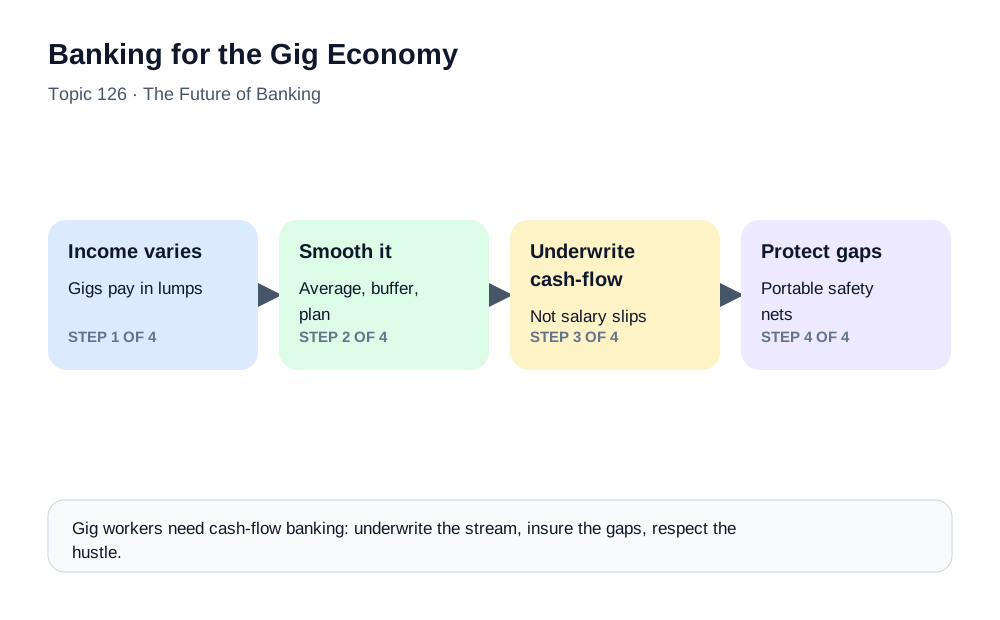
Banking for the Gig Economy at a glance — Freelancer services, income volatility, portable benefits.
Banking for Freelancers, Gig Workers, and the Informal Economy
The gig economy has emerged as one of the most significant structural transformations in contemporary labor markets, encompassing freelancers, platform workers, contract workers, and self-employed professionals who work outside traditional employer-employee relationships. This segment represents one of the fastest-growing workforce categories globally, yet traditional banking products remain stubbornly designed for salaried employees with fixed monthly incomes, regular payslips, and employer-provided benefits. The mismatch between banking infrastructure and workforce reality creates both a substantial challenge for financial inclusion and a remarkable opportunity for institutions willing to innovate. India's gig workforce is significant and growing, but current counts depend on definition and measurement. NITI Aayog estimated about 7.7 million gig workers in 2020-21 and projected around 23.5 million by 2029-30. Bridging this gap requires fundamentally rethinking assumptions about income verification, credit assessment, and financial product design.
The gig economy landscape encompasses diverse platform types and worker categories, each with distinct characteristics and banking needs. Ride-hailing platforms like Uber, Ola, and Rapido connect drivers and riders with customers needing transportation, creating flexible earning opportunities for vehicle owners. Delivery services including Zomato, Swiggy, Blinkit, and Amazon Flex employ millions of delivery partners moving food, packages, and groceries across cities, often serving as primary or supplementary income sources. Freelance marketplaces such as Upwork, Fiverr, and Toptal link developers, designers, writers, and other professionals with clients worldwide, enabling location-independent work. Home service platforms like Urban Company and UrbanClap connect plumbers, electricians, cleaners, and other service professionals with households needing assistance, formalizing previously informal service relationships. Creative platforms including YouTube, Instagram, and Spotify enable content creators to monetize their audiences directly, creating entirely new career categories. Professional services spanning consulting, tutoring, and specialized expertise complete the picture, with independent professionals selling their skills directly to clients without intermediary employers.
India's gig economy exhibits particular scale and significance within the national economy. NITI Aayog estimated about 7.7 million gig workers in 2020-21 and projected around 23.5 million by 2029-30. These figures are estimates rather than a live census, and they should not be treated as a precise current headcount. A wide range of digital platforms operate across transport, delivery, professional services, home services, commerce, and creator work, creating earning opportunities across different skill levels and geographies. Because platform counts change quickly and depend on how a platform is defined, banking analysis should focus on worker cash flows, dependency on platforms, and data portability rather than a fixed platform total. The sector's GDP contribution grows rapidly as platform penetration deepens and new service categories emerge, making gig work economically significant beyond simple headcount. These workers represent a substantial underserved market for banking services adapted to their specific circumstances and income patterns. The diversity within this category—from high-earning software consultants to delivery partners earning modest amounts—requires nuanced product design rather than one-size-fits-all approaches.
Traditional banking fundamentally fails gig workers because its foundational assumptions do not match gig economy realities. Traditional banking assumes fixed monthly salaries that arrive predictably on specific dates, but gig workers experience income varying week to week based on demand, platform algorithms, and personal availability. A driver may earn substantially more during festival seasons than monsoon months, creating cash flow patterns that look nothing like salaried employment. Traditional products require employer-provided payslips as income proof, but gig workers receive payments directly from platforms without standardized documentation that banks recognize. Traditional underwriting assumes steady employment with a single employer, while gig workers typically serve multiple clients through sporadic engagements, making employment verification impossible. Tax deduction at source simplifies tax compliance for salaried workers, but gig workers must manage their own tax calculations and payments, creating administrative burdens and compliance challenges.
Employer benefits including provident fund contributions, health insurance, and paid leave do not exist for gig workers, who must self-provide these protections from variable earnings. Credit scoring through regular payment history builds CIBIL scores for salaried workers, but gig workers often have thin credit files due to limited formal credit history, making them invisible to traditional underwriting. Finally, traditional banking assumes a single bank account receiving salary deposits, while gig workers receive income from multiple platforms into various accounts requiring consolidation to understand true financial position. These structural mismatches exclude millions from formal financial services or relegate them to suboptimal products designed for different circumstances.
Gig workers require banking solutions specifically designed around their unique income patterns and life circumstances. Income management represents perhaps the most pressing need given the psychological and practical challenges of variable cash flow. Income smoothing uses artificial intelligence to average variable earnings into predictable "salary" payments, helping gig workers budget and plan despite irregular cash flows. By holding high earnings and supplementing low periods, these products create stability that enables better financial management. Cash flow prediction algorithms analyze past patterns and platform data to forecast future income, enabling proactive financial management and early warning of potential shortfalls. Multi-source aggregation combines income from various platforms—Uber plus Swiggy plus freelance clients—into a unified view that reflects total earning capacity rather than fragmented accounts. Instant access to earned wages, allowing workers to access payment for work completed today rather than waiting for platform payment cycles, addresses cash flow timing challenges that can force expensive borrowing.
Credit access for gig workers requires alternative approaches to traditional salary-based underwriting that recognizes their actual financial capacity. Income verification can leverage platform earning data accessed through APIs rather than payslips, providing real-time proof of earning capacity that updates continuously. Cash flow-based lending makes loan decisions based on transaction patterns visible in bank statements rather than salary documentation, recognizing that consistent deposits indicate repayment capacity regardless of source. This approach uses actual financial behavior rather than employment category as the basis for credit assessment. Flexible repayment structures allow EMIs that adjust to income—paying more in good months and less in lean periods—accommodating inherent income variability without creating distress. Micro-credit products offering small, short-term loans between 5,000 and 50,000 rupees address working capital needs without requiring extensive collateral or documentation that gig workers cannot provide.
Savings and protection products must similarly adapt to gig worker circumstances and the absence of employer-provided benefits. Emergency fund building through automatic saving of a percentage of each earning helps create buffers against income volatility that can otherwise force expensive debt. Retirement savings linked to gig earnings through NPS or PPF contributions enable long-term wealth building despite irregular income, starting small and growing with earnings. Health insurance becomes particularly critical given the absence of employer coverage, requiring affordable individual and family plans that gig workers can purchase independently. Income protection insurance against injury or illness that prevents work provides essential security for those with no sick leave or disability benefits—an injury that stops work creates immediate crisis without this protection. Accident insurance provided by gig platforms like Uber and Swiggy offers micro-coverage for work-related risks, though gaps remain in comprehensive protection.
Tax compliance presents particular complexity for gig workers who must manage their own obligations without employer support. GST compliance tools automatically calculate and file goods and services tax for earnings above threshold levels, reducing administrative burden and compliance risk. TDS management tracks tax deducted at source by platforms, ensuring proper credit for withholdings and simplifying annual filing. Simplified income tax return filing tools designed specifically for self-employed taxpayers address the complexity that discourages compliance, guiding users through relevant deductions and requirements.
Emerging solutions demonstrate how banking can adapt to gig economy needs across different market segments. Uber provides instant payouts, branded debit cards, and financial wellness tools for drivers, recognizing that financial stability improves driver retention and service quality. Swiggy offers instant earnings withdrawal and insurance coverage for delivery partners, addressing immediate liquidity needs and protection gaps. Urban Company extends lending to service professionals based on platform performance data rather than traditional credit scores, demonstrating alternative underwriting approaches. EarlySalary provides earned wage access specifically for gig workers needing liquidity between payment cycles, avoiding expensive payday lending alternatives. International examples include BrightMoney offering artificial intelligence-driven financial management for variable income households and Portify building credit specifically for gig workers in the United Kingdom, providing models for Indian adaptation.
Regulatory developments promise additional support for gig worker financial security and formal recognition of their economic role. The Code on Social Security, 2020 expressly defines gig workers, platform workers, and aggregators and provides a statutory framework under which social-security schemes can be notified for eligible workers. The Code also provides for aggregator contributions within limits set by law. By 2026, the Ministry of Labour and Employment had published implementation material and Social Security (Central) Rules, 2026. Banks should nevertheless distinguish the existence of the legal framework from actual scheme coverage: eligibility, registration, contribution flows, benefits, and operational rollout depend on the applicable notifications and schemes. Credit or protection decisions should therefore use verified current coverage rather than assuming every gig worker receives a standard package of benefits.
The transformation of gig economy banking is only beginning as the sector grows to encompass nearly 24 million Indian workers within this decade. The financial services industry must fundamentally reimagine products, underwriting criteria, and service models to serve this expanding market segment. Banks that develop deep understanding of gig worker needs, build partnerships with platforms for data access, and create flexible products accommodating income variability will capture a growing and loyal customer base. Those clinging to traditional salary-based models will increasingly find themselves irrelevant to a substantial portion of the workforce and miss significant growth opportunities.
The gig economy is not an aberration but an evolution of how work is organized in a digital, connected economy. Banking must evolve with it, recognizing that a Swiggy delivery partner, an Urban Company plumber, and a freelance developer represent not edge cases but the emerging mainstream of work. Products designed around their realities—variable income, multiple income sources, absence of employer benefits, and need for flexibility—will ultimately prove more resilient and more profitable than those forcing outdated assumptions onto new economic relationships. The institutions that succeed will be those recognizing that serving the future of work requires abandoning the past's assumptions about what employment looks like.
The gig economy also presents opportunities for financial inclusion on a massive scale. Many gig workers were previously outside the formal financial system, earning cash and operating entirely in the informal economy. Platform work brings them into digital payment systems, creates transaction records, and enables access to formal credit and savings products. Banks that develop expertise in serving gig workers can expand financial inclusion while building profitable customer relationships. The social impact of bringing millions into formal finance—enabling savings, credit access, and insurance protection—can be substantial. Gig economy banking thus represents both a commercial opportunity and a mechanism for advancing financial inclusion goals.
The data generated by gig platforms creates unique opportunities for credit assessment that traditional banking has not been able to access. Platform performance metrics—customer ratings, completion rates, earnings consistency—provide rich information about reliability and income potential that can supplement or replace traditional credit scores. Banks that partner with platforms to access this data can make more accurate lending decisions than competitors relying solely on traditional metrics. These partnerships must be structured carefully to protect worker privacy and ensure fair use of data, but when done right, they can expand credit access while reducing risk.
The gig economy also challenges traditional notions of employment and social protection that banking has long taken for granted. As more workers operate outside traditional employment relationships, the frameworks for retirement savings, health insurance, and income protection must evolve. Banks have an opportunity to fill gaps left by declining employer-provided benefits, offering portable products that move with workers across platforms and gigs. The institutions that develop expertise in these areas may find opportunities to serve not only gig workers but also traditional employees as employer benefits decline. The gig economy may thus be a leading indicator of broader changes in how social protection is organized, with banks playing a larger role than in the past.
The regulatory environment for gig work continues to evolve, with significant implications for how gig workers are classified and what protections they receive. Some jurisdictions are moving toward recognizing gig workers as employees entitled to benefits, while others maintain their classification as independent contractors. Banks must monitor these developments as they affect the stability and predictability of gig worker income, which in turn affects creditworthiness and product design. Regulatory clarity can help banks develop appropriate products with confidence, while uncertainty may lead to cautious approaches that limit innovation. Engagement with policymakers can help shape regulations that balance worker protection with the flexibility that makes gig work attractive to many.
The cultural shift toward gig work reflects broader changes in how people view employment, career, and work-life balance. Many gig workers value the flexibility and autonomy that platform work provides, even when it comes with income instability and lack of benefits. Banks serving this segment must respect these preferences while helping workers manage the associated risks. Products that provide security without sacrificing flexibility are likely to resonate—portable benefits, flexible credit, and automated savings that smooth income variability. Understanding the motivations and values of gig workers is as important as understanding their financial circumstances in developing appropriate products and services.
The scalability of gig economy banking products presents both opportunities and challenges. Successful products may see rapid adoption as word spreads through platform communities and social networks. Banks must ensure their systems can handle rapid growth without service degradation. At the same time, the diversity of the gig economy means that products must be adaptable to different types of workers, platforms, and regional contexts. A one-size-fits-all approach is unlikely to succeed across the full spectrum of gig work. Banks must balance the efficiency of standardized products with the need for customization to serve diverse segments effectively. Those that find the right balance will be able to scale efficiently while maintaining customer relevance.
The partnership ecosystem for gig economy banking is complex and evolving. Banks may partner with platforms directly, embedding financial services into platform apps and leveraging platform data for underwriting. They may work with gig worker associations or unions to reach workers and understand their needs. They may collaborate with fintechs that have developed specialized capabilities for serving variable-income customers. Building and managing these partnerships requires skills that traditional banks may need to develop. The institutions that excel at partnership management will find growth opportunities in the gig economy; those that try to go it alone may struggle to reach and serve this dispersed, diverse customer base effectively.
The future of gig economy banking likely includes deeper integration between financial services and platform operations. Embedded finance—where banking is seamlessly integrated into non-financial apps and experiences—may become the norm for gig workers, with financial services appearing exactly when and where they are needed. A driver completing a ride might receive an instant offer to save a portion of earnings or invest in a retirement fund. A freelancer receiving payment might be prompted to set aside estimated taxes automatically. This contextual, just-in-time financial guidance could help gig workers manage their finances more effectively without requiring them to actively seek out banking services. The banks that master embedded finance for gig workers will find significant growth opportunities.
The measurement of success in gig economy banking requires new metrics that capture the unique characteristics of this segment. Traditional measures like average account balance or number of products per customer may not adequately reflect the value of serving gig workers. Instead, banks might focus on metrics like income smoothing effectiveness, improvement in financial resilience, or access to affordable credit previously unavailable. These outcome-based measures align bank success with customer well-being and provide a more complete picture of performance. Developing appropriate measurement frameworks is essential for managing gig economy banking businesses effectively and demonstrating their value to stakeholders.
<!-- MBA-DEEP-DIVE-START -->Banking for the Gig Economy Deepening — Variable Income, Underwriting, Protection, and Platform Risk
Gig work is not one customer segment
A delivery rider, freelance software engineer, independent consultant, creator, driver, tutor, beautician, and small contractor may all be described as gig workers, yet their banking needs can differ radically. Some depend on one platform for nearly all income; others invoice dozens of clients. Some own productive assets such as vehicles or equipment; others sell time and expertise. A bank should therefore segment by cash-flow pattern, income concentration, expense structure, business assets, credit history, and legal status rather than treating “gig worker” as a single risk category.
The core banking problem is income volatility, not job title
Traditional retail lending often starts from a stable monthly salary because salary history is easy to verify and model. Gig workers may earn daily, weekly, per task, per project, or in irregular international receipts. The important question is whether income is sufficiently durable to support the obligation being considered. A customer with variable monthly income can still have strong annual earning capacity and prudent financial behaviour. Underwriting should therefore examine distribution of income over time, downside months, concentration, seasonality, expenses, and liquidity buffers instead of rejecting variability by default.
Cash-flow underwriting needs clean definitions
A bank using transaction data should distinguish gross receipts from usable income. Platform payouts may include reimbursements, incentives, tips, taxes, refunds, or pass-through amounts. A freelancer may receive client payments into several accounts. A driver may have high gross income but also fuel, maintenance, financing, insurance, and platform fees. Credit models need rules for identifying sustainable net cash generation. If the model treats every incoming credit as disposable income, affordability can be overstated and losses can rise when incentive structures change.
Income concentration is a practical risk metric
A customer earning from five unrelated clients has a different risk profile from someone receiving ninety percent of income from one platform. Platform concentration creates dependency on pricing rules, ranking algorithms, account suspension, geographic demand, and contractual changes outside the worker's control. Banks can calculate concentration over time and assess how earnings changed when a major payer disappeared. This is similar to customer-concentration analysis in small-business lending, adapted to an individual or micro-enterprise context.
Seasonality should be modelled rather than penalised
Ride demand, food delivery, tourism work, tax preparation, agriculture-related services, and creative contracts can all be seasonal. A low-income month may be normal rather than evidence of distress. Underwriting should compare like periods, identify recurring seasonal peaks and troughs, and test whether the borrower can service debt in weaker months. Repayment structures can then align with actual cash flow where regulation and product design allow. The objective is not to hide volatility but to distinguish predictable seasonality from deteriorating income.
Platform data can enrich underwriting but creates dependency
Task completion, tenure, ratings, cancellations, payout history, and activity frequency may provide useful information about earning continuity. However, platform metrics are not objective truth. Ratings can be biased, algorithm rules can change, and platform access can be suspended. Banks should not allow one opaque score to become a substitute for credit judgment. Platform data should be validated against bank cash flows, identity, existing liabilities, bureau information, and affordability. Model governance should also consider whether workers understand how such data influences decisions.
Consent and purpose limitation are essential
Access to transaction or platform data should be based on valid customer consent and a clear purpose. A borrower who authorises data for loan assessment does not automatically consent to unrelated marketing or indefinite behavioural surveillance. Banks need data-retention rules, access controls, audit trails, and mechanisms to honour withdrawal or expiry of consent where applicable. Open Finance and account-aggregation infrastructure can make cash-flow lending easier, but easier access to data increases the importance of responsible use.
Thin-file does not mean high-risk
Some gig workers have little formal borrowing history because they have never needed a loan or because traditional lenders excluded them. A thin credit file contains less information; it does not automatically prove poor repayment behaviour. Alternative underwriting can use account conduct, recurring obligations, savings behaviour, platform income, tax records where lawfully available, and other verified signals. The model should distinguish absence of history from negative history and should avoid compensating for uncertainty by offering only expensive credit.
Affordability must include business expenses
A driver earning 60,000 a month may spend heavily on fuel, vehicle finance, servicing, tolls, insurance, and repairs. A freelance designer may have software subscriptions, equipment costs, and tax liabilities. A lender that calculates debt service from gross receipts can overestimate repayment capacity. Affordability should reflect necessary business expenses, personal living costs, existing debts, and a buffer for volatile income. Cash-flow underwriting is strongest when it understands both inflows and the economic cost of generating them.
Flexible repayment can reduce avoidable delinquency
A fixed EMI works well for predictable income but can create stress for irregular earners even when annual income is adequate. Products may use weekly repayment, revenue-linked repayment, permitted payment holidays, seasonal schedules, or the ability to make additional payments in stronger months. Flexibility must be transparent and should not disguise high effective cost or create indefinite debt. Operational systems also need to calculate arrears correctly when scheduled amounts vary, otherwise a customer can be wrongly classified as delinquent.
Small-ticket working capital is different from consumption credit
A delivery worker may need a phone repair or vehicle service to continue earning. A freelancer may need software, equipment, or a deposit for workspace. These needs are economically closer to micro-enterprise working capital than ordinary consumption. Product design can consider the expected income generated by the asset or expense, repayment horizon, and whether funds can be disbursed directly to a supplier. Treating every need as an unsecured personal loan misses the link between credit and the customer's earning capacity.
Asset finance requires residual-value discipline
Vehicles, laptops, tools, and specialised equipment can support gig income, but lenders should not assume the asset remains valuable or productive. Vehicle wear can be high for delivery and ride-hailing use. Technology can become obsolete quickly. Credit policy should consider usage intensity, insurance, maintenance, resale value, repossession practicality, and whether platform eligibility depends on asset age or specification. A productive asset can strengthen repayment capacity only if its economics remain viable.
Earned wage access should not be confused with every form of advance
For employees, earned wage access generally refers to receiving wages already earned before the normal payroll date. Platform workers may have analogous access to confirmed but unsettled earnings, yet some products marketed as instant earnings access are actually short-term credit. The distinction matters for pricing, disclosure, regulation, credit reporting, and customer understanding. Banks and fintechs should describe the product based on legal and economic substance rather than marketing language.
Multi-platform workers need consolidated financial views
A worker may receive money from delivery apps, ride-hailing platforms, direct clients, and marketplace sales. Looking at one account or one platform can understate income and misread volatility. Consent-based aggregation can provide a more complete view, but reconciliation is needed to avoid double counting transfers between the customer's own accounts. Systems should identify genuine external income, internal transfers, refunds, and one-off credits. Accurate aggregation improves both financial management and underwriting.
Tax support can be part of everyday banking
Irregular earners often need to reserve money for tax rather than having all obligations deducted through payroll. A banking app can help estimate tax reserves, create labelled sub-accounts, and remind customers about filing or advance-payment dates without pretending to provide personalised tax advice unless authorised to do so. Separating tax money from spendable balances can improve financial resilience. For cross-border freelancers, banks should also explain fees, foreign-exchange conversion, reporting, and documentation requirements relevant to incoming payments.
Cross-border freelance income adds compliance complexity
A freelancer may receive payments from foreign marketplaces or direct overseas clients. The bank must understand source of funds, purpose codes or reporting requirements where applicable, sanctions and AML exposure, foreign-exchange conversion, and whether supporting documents are required. Repeated small foreign credits can be legitimate business income but may look unusual compared with a salaried profile. Customer onboarding and transaction monitoring should capture the nature of work so normal activity is not repeatedly treated as an unexplained exception.
AML monitoring should understand platform patterns
Gig-worker accounts may show frequent small credits, transfers to fuel stations, equipment purchases, wallet movements, and cash withdrawals. Rules built only around salaried behaviour can generate false positives. At the same time, criminals can use platform identities or mule accounts to disguise illicit flows. Banks need typologies that distinguish expected gig activity from structuring, account takeover, rapid pass-through, or third-party funds inconsistent with the stated occupation. Better customer context improves both detection quality and customer experience.
Account takeover can immediately stop a worker's income
For a platform worker, loss of a phone, SIM swap, phishing attack, or account takeover can affect both banking access and the ability to earn. Authentication and recovery therefore have direct income consequences. Banks should provide secure recovery paths that do not rely only on the compromised device. Fraud teams should recognise that blocking an account for investigation can interrupt essential livelihood, so cases need timely review, communication, and where possible controlled access to undisputed funds.
Insurance should match the actual interruption risk
Gig workers may face accident, illness, theft, equipment breakdown, liability, or loss of platform access. A generic personal accident policy may cover only one part of the risk. Banks distributing protection products should clearly explain covered events, waiting periods, exclusions, benefit limits, and claim evidence. Small premiums are not useful if the customer misunderstands coverage. Product bundles should avoid implying that a worker has comprehensive income protection when the policy only pays for narrowly defined events.
Portable benefits reduce dependence on one platform
A worker may move between platforms or combine several forms of work. Savings, insurance, and retirement products are therefore more resilient when they belong to the individual rather than one employer or platform relationship. Banks can support portability through recurring contributions linked to incoming earnings and by maintaining continuity when the payer changes. This approach fits a labour market where the income source may change faster than the customer's long-term financial goals.
Emergency savings can be designed around percentage flows
A fixed monthly savings instruction may fail when income is irregular. A percentage-of-inflow rule can be more suitable: for example, moving a small share of each qualifying payout into an emergency account until a target is reached. Customers should be able to change or pause the rule, and the bank should avoid sweeping amounts needed for immediate essentials. Behavioural design should support resilience without creating overdrafts or forcing customers to borrow back their own savings.
Income smoothing is not free money
A service that pays a stable amount during weak weeks must be funded somehow. It may use the customer's own reserve, an insurance mechanism, or credit. Each model has different risks and regulatory treatment. If the bank advances money against expected future earnings, the customer is borrowing even if the experience resembles a salary. Product disclosure should explain whether the facility uses savings, debt, or a combination. Smoothing can be valuable only when its economics are transparent.
Platform partnerships create third-party risk
A bank embedding accounts or loans inside a work platform depends on the platform for data, customer communication, technical integration, and sometimes collections. An outage or commercial dispute can disrupt the banking service. Third-party risk management should cover API availability, data quality, incident notification, cyber controls, complaints, subcontractors, and exit arrangements. The bank remains accountable for regulated obligations that cannot be outsourced merely because the customer entered through a partner app.
Embedded finance should preserve the identity of the regulated provider
A worker may see a loan offer inside a platform and assume the platform itself is the lender. Clear disclosure should identify the bank or regulated lender, product terms, complaint route, data-sharing basis, and consequences of default. Dark patterns that make acceptance easy but repayment obligations hard to understand create conduct risk. Embedded distribution should reduce friction in service, not reduce clarity about who is providing the financial product.
Algorithmic platform changes can affect credit performance
A platform can change pricing, driver incentives, delivery zones, ranking rules, or commission with little control by the worker. These changes can alter income quickly across thousands of borrowers at once. Credit risk teams should therefore monitor portfolio concentration by platform and occupation. If many borrowers depend on the same platform, what looks like diversified retail lending may contain a hidden common risk factor. Stress testing can model a reduction in average platform payouts or a major partner exit.
Geographic concentration can create another common factor
Gig demand is often tied to city traffic, tourism, local commerce, weather, events, or regulation. A lender concentrated in one city or one occupation may face correlated losses during a local shock. Portfolio reporting should therefore examine location, platform, occupation, asset type, and income concentration together. Retail-level granularity does not automatically create diversification if many borrowers are exposed to the same economic driver.
Credit bureau reporting can help build formal financial history
Where regulation and bureau rules permit, responsible reporting of well-performing small loans can help customers build a credit record. But a poorly designed flexible product can also harm the customer if the system reports delinquency based on a rigid schedule that the product itself allows to vary. Banks must align contractual repayment rules, core-loan configuration, collections, and bureau reporting. Operational accuracy is part of financial inclusion because an erroneous adverse record can affect access to future credit for years.
Collections should reflect variable income without becoming weak
A missed payment may result from temporary income timing rather than unwillingness to pay. Early collections can ask what changed, offer approved restructuring or schedule options where policy allows, and distinguish persistent affordability problems from short-term volatility. However, flexibility should not become repeated refinancing that hides deterioration. Collections data can also improve underwriting by revealing which income patterns actually predict stress. Customer dignity and clear escalation remain essential regardless of employment category.
Complaints reveal whether the product truly fits gig work
High rates of complaints about income verification, unexpected holds, repayment dates, failed platform links, or credit-reporting errors are signs that the operating model may still assume salaried behaviour. Product teams should analyse complaints by worker type and platform rather than treating them only as service issues. A product marketed as gig-friendly should be tested against real gig-worker journeys from onboarding through delinquency and closure.
Social-security law does not replace bank affordability analysis
Where public or platform social-security schemes exist, they can improve resilience, but a bank should not treat statutory eligibility as guaranteed cash flow. Coverage, registration, contribution history, benefit triggers, and payment timing may differ. Underwriting should use verified income and obligations, not assumptions about future benefits. Similarly, insurance or welfare schemes should not be counted as repayment sources unless the product and law clearly support that treatment.
Informal work and gig work overlap but are not identical
Some platform workers have digital records and formal payments even if their employment relationship is non-traditional. Many informal workers operate entirely outside platforms and may receive cash. A banking strategy focused only on app-based gig workers can therefore miss a much larger group with irregular income. The same principles—cash-flow understanding, flexible savings, alternative documentation, portable protection, and fair underwriting—can extend to self-employed and informal workers, but data availability may be lower.
The strongest gig-banking model focuses on financial resilience
Success should not be measured only by the number of accounts or loans sold. Useful outcomes include more stable cash buffers, lower dependence on expensive emergency credit, better credit history, adequate insurance, tax readiness, and fewer service failures caused by irregular income. Commercially, these outcomes can also reduce losses and improve retention. Gig banking becomes sustainable when the bank helps customers manage volatility rather than monetising volatility through repeated high-cost borrowing.
Gig Economy Banking — Cash-Flow Architecture, Platform Settlement, Credit Controls, and Resilience
The banking relationship should be designed around the income cycle
For many gig workers the most important financial event is not a monthly payroll credit but a repeated cycle of work, platform confirmation, payout calculation, deductions, settlement, and transfer into the worker's account. A bank serving this segment should understand that cycle end to end. The customer may see an earning in the platform before the bank sees cleared funds. Incentives, refunds, platform fees, taxes, fuel advances, or equipment deductions can change the final payout. Product design should therefore distinguish expected earnings from settled cash and avoid presenting an unconfirmed platform balance as money that is already available in the bank account.
Payout timing affects liquidity more than annual income alone
Two workers can earn the same amount over a year but face very different financial stress if one is paid daily and the other is paid after long invoice cycles. Liquidity analysis should consider the interval between work and cash receipt, variability of payout dates, minimum payout thresholds, weekends, holidays, and platform disputes. Savings and credit products can be structured around these timing patterns. A bank that understands when income actually becomes usable can give more meaningful balance forecasts and reduce avoidable overdrafts or missed repayments.
Platform settlement needs reconciliation just like other payment flows
When a platform sends a bulk payout covering thousands of workers, each individual credit should be traceable to the platform's payout record. Exceptions can occur because of invalid account details, closed accounts, duplicate files, returned transfers, or mismatched references. Banks and platform partners need reconciliation between the platform's earning ledger, payout instruction, payment execution, bank posting, and any return or rejection. A worker should not be forced to mediate between a platform and bank when both sides have different views of whether money was paid.
Payment status should be understandable to the worker
Terms such as “processed,” “sent,” “settled,” and “credited” are often used loosely. A platform may mark a payout processed when it has created an instruction, while the worker interprets the same word as final credit to the bank account. Good integration uses clear status definitions and timestamps. If a payout fails, the worker should know whether the issue is with platform approval, payment initiation, clearing, bank rejection, account posting, or return. Clear status reduces contact-centre traffic and prevents unnecessary duplicate payouts.
Instant payout products need careful funding logic
A platform or bank may offer immediate access to earnings before the ordinary payout cycle. If the money has already been earned and irrevocably confirmed, the service may be close to accelerated settlement. If the provider advances funds before final confirmation, the economic substance may involve credit risk. The bank should define who funds the advance, what happens if the underlying earning is reversed, how fees are disclosed, and whether the customer's account can become negative. “Instant access” is a customer experience description, not a substitute for clear legal and accounting treatment.
A payout reversal should not become an unexplained debit
Platform adjustments can occur because of cancelled jobs, customer refunds, incentive corrections, or fraud. If a platform later reduces an amount already paid, the recovery mechanism must be transparent. Automatically pulling money from a bank account without valid authority can create serious conduct and dispute risk. Where set-off, mandate, or future-payout deduction is permitted, the rules should be clear. Workers should be able to see the original earning, the adjustment reason, and the resulting balance rather than receiving a mysterious debit.
Banking systems should separate personal and business cash flows where useful
Many gig workers are economically self-employed even when the activity is small. A dedicated sub-account or business account can help separate platform earnings, operating expenses, taxes, and personal spending. This improves budgeting and can also improve underwriting data quality. The bank should not force unnecessary complexity on low-volume customers, but it can offer simple categorisation or virtual pots that create visibility without requiring full corporate-banking infrastructure. Clear separation also helps when the worker needs income evidence for a mortgage, visa, tax filing, or rental application.
Income verification should be reproducible
When a loan decision relies on variable income, the bank should be able to explain how it calculated usable income. The methodology may examine a defined observation period, exclude internal transfers, identify platform payers, adjust for refunds, estimate necessary business expenses, and apply a prudent treatment to highly volatile months. The same raw data should produce the same result when the decision is reviewed. Reproducibility matters for model validation, complaints, fair-lending review, and credit-file disputes.
Underwriting should distinguish temporary volatility from structural decline
A few weak weeks may reflect seasonality, illness, weather, or a temporary platform issue. A persistent fall in task volume, lower payout per task, reduced customer ratings, or loss of a major platform may indicate structural deterioration. Credit models should use trends and context rather than one-month snapshots. Manual review can be useful when automated signals conflict—for example, when bank inflows decline but the customer has moved to a new platform that is not yet recognised by the model.
Model features must be stable enough for credit use
Platform ratings, acceptance rates, task counts, and incentive tiers may appear predictive, but their definitions can change without notice. A bank using them should monitor data dictionaries and distributions over time. If a platform changes the rating scale or starts counting cancelled tasks differently, the model may behave incorrectly even though the API still works. Data-contract monitoring, feature versioning, and model-drift controls are therefore essential when underwriting depends on third-party operational data.
Workers should be able to challenge incorrect platform data
A credit decline based partly on platform data can be unfair if the source contains errors and there is no correction route. The bank should know which data came from the platform, how recent it was, and what the customer can do if it is wrong. Depending on applicable law and product design, an adverse decision may require an explanation or review process. Even where specific legal duties differ, good governance avoids a black-box chain in which the bank says “the platform score decided” and the platform says “the bank decided.”
Credit limits should respond to demonstrated capacity, not promotional pressure
Variable earners may receive periods of unusually high income from bonuses, festivals, or demand spikes. A bank should not automatically treat a temporary peak as the new normal and increase credit limits aggressively. Limit management should consider sustained income, existing debt, repayment behaviour, volatility, and downside capacity. Conversely, a temporary weak month should not necessarily trigger a sharp limit reduction if the long-term profile remains sound. Stable policy reduces pro-cyclical lending that expands at income peaks and contracts exactly when customers are under stress.
Collections need event-aware treatment
If a worker misses a payment because a platform outage delayed thousands of payouts, collections systems should be capable of recognising the common event. Otherwise automated messages, fees, and adverse reporting can escalate across a portfolio even though the underlying cause is temporary and externally observable. Event flags can support approved forbearance or communication while preserving the contractual record. This requires coordination between partner management, credit operations, collections, and customer service rather than treating every missed payment independently.
Dispute handling should connect bank and platform evidence
A worker may dispute a payout amount with the platform while the bank can only see the amount received. The bank should not promise to resolve earnings calculations it does not control, but partner arrangements can define evidence exchange and escalation. The platform should own work and payout calculations; the bank should own account posting, transfer execution, and bank-side errors. Joint service design should make this boundary invisible enough that customers are not repeatedly redirected without a case owner.
Fraud can originate on either side of the integration
Attackers may compromise the worker's bank account, platform account, email, phone, or payout details. A common attack is changing payout bank details so future earnings are redirected. Strong controls can include confirmation of account ownership, step-up authentication for payout-detail changes, cooling-off periods for high-risk changes, alerts through an independent channel, and monitoring of unusual device or beneficiary changes. The bank and platform need rapid coordination because each may hold only part of the evidence.
Mule-account risk can hide behind legitimate gig narratives
An account opened as a delivery, freelance, or creator account can be used to receive third-party funds unrelated to genuine work. Monitoring should compare expected platform or client patterns with actual credits, rapid onward transfers, cash withdrawals, crypto purchases, or unrelated merchant flows. Customer occupation is context, not proof. When activity deviates materially, the bank should investigate based on risk and evidence rather than accepting a broad “freelance income” description for every incoming payment.
Cross-border gig work needs transparent FX treatment
International freelancers and creators may receive payments in foreign currency through marketplaces, correspondent banks, card networks, or payment providers. The customer should understand the currency received, conversion rate, spread or fee, intermediary charges where relevant, and final credited amount. Banks should also capture transaction purpose and required regulatory information accurately. FX revenue can be legitimate, but opaque conversion can quickly destroy trust in a segment that can compare providers digitally and move business elsewhere.
Treasury should understand concentration in platform-linked deposits
A bank may acquire a large number of accounts through one platform partnership. Those deposits can appear diversified across thousands of individuals while actually sharing a common source. If the platform changes its banking partner, experiences an outage, or alters payout routing, balances may move together. Deposit-behaviour analysis should therefore consider acquisition channel and payer concentration, not just customer count. The same principle applies to credit portfolios whose borrowers depend on one platform for income.
Service-level agreements should reflect income criticality
A delayed rewards credit is inconvenient; a delayed weekly payout may prevent a worker from buying fuel or paying rent. Partner SLAs should therefore distinguish critical payout processing, account-detail validation, API availability, reconciliation, fraud escalation, and dispute response. Metrics should measure end-to-end customer outcome, not only whether each API call returned successfully. A technically healthy integration can still fail customers if the business process around exceptions is slow.
Operational resilience needs a fallback payout route
If an API or file channel between bank and platform fails, there should be a controlled contingency. This may involve an alternate file route, delayed batch process, or manual emergency procedure depending on scale and risk. The fallback must preserve account validation, duplicate prevention, authorisation, reconciliation, and audit evidence. Simply asking the platform to resend later may be inadequate if thousands of workers rely on the payout for essential expenses.
Product profitability should include servicing and volatility costs
Gig-focused products can generate interchange, deposit value, credit revenue, FX income, or partner fees, but they may also create higher verification, service, fraud, and collections costs if poorly designed. Business cases should therefore model the full relationship: acquisition cost, active usage, deposit stability, credit loss, contact rates, fraud loss, partner economics, and customer lifetime value. A product can grow quickly yet remain unattractive if every exception requires manual intervention.
Financial-wellness features should use real cash-flow signals
Budgeting tools for variable earners should not assume the current balance is fully spendable. Useful features can estimate upcoming tax reserves, recurring personal bills, equipment costs, debt payments, and expected payout timing. A “safe to spend” estimate should show uncertainty rather than pretending future income is guaranteed. This kind of design turns transaction data into practical liquidity management and can reduce both customer stress and credit risk.
The bank should measure success through resilience, not only acquisition
A mature gig-banking programme can track whether customers build emergency savings, avoid repeated overdrafts, maintain stable credit performance, receive payouts reliably, resolve disputes quickly, and retain access during device or platform problems. These measures are harder than counting new accounts, but they reveal whether the product actually fits irregular-income lives. Sustainable growth comes from making volatility manageable while preserving sound underwriting, transparent pricing, strong controls, and dependable payment operations.
<!-- MBA-DEEP-DIVE-END -->