Visual overview
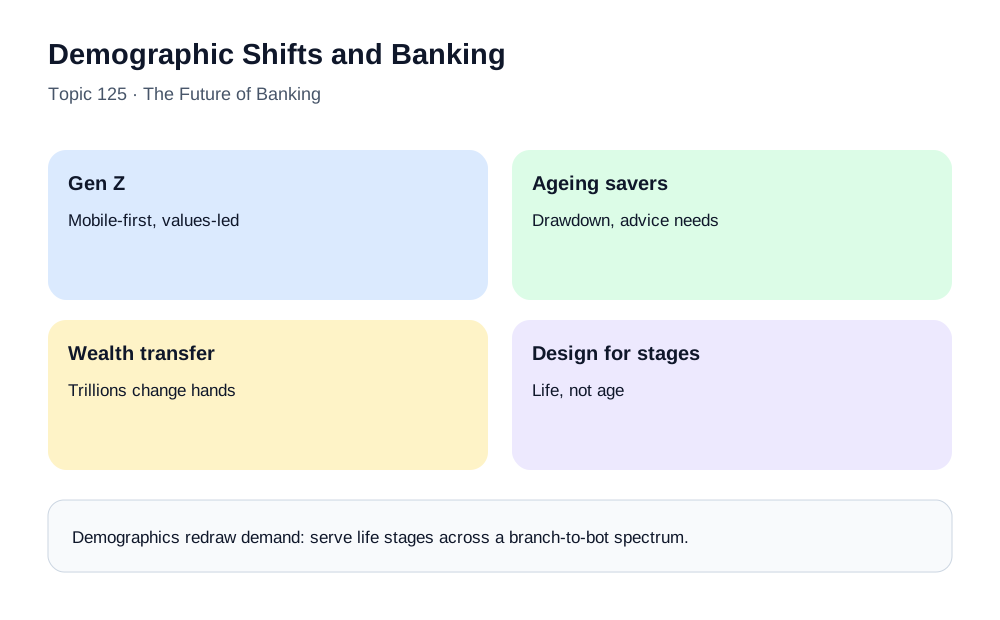
Demographic Shifts and Banking at a glance — Aging populations, Gen Z preferences, wealth transfer.
Gen Z Banking, Aging Populations, Urbanization, and Changing Customer Expectations
Demographic forces shape banking in profound ways that extend far beyond simple population counts. As Baby Boomers enter retirement, Generation Z establishes itself in the workforce, populations urbanize at unprecedented rates, and life expectancy extends across the globe, financial institutions must fundamentally reconsider their products, distribution channels, and business models. The bank capable of serving a twenty-five-year-old digital native in Bengaluru and a seventy-year-old retiree in a Tier-3 town with equal excellence will define the future of financial services. Understanding these demographic shifts and their implications is essential for institutions seeking to remain relevant across diverse and evolving customer bases. Demographics may be destiny in banking—the institutions that align with population trends will thrive while those serving declining segments will struggle regardless of operational excellence.
Each generation brings distinct banking behaviors shaped by the technological, economic, and social environments of their formative years. Baby Boomers, born between 1946 and 1964, typically prefer branch-first banking relationships, place high trust in established institutions with long histories, and value human advisors for complex decisions. Having built wealth over decades of economic expansion, they represent substantial assets for wealth management even as their banking needs shift toward retirement and estate planning. Generation X, spanning 1965 to 1980, occupies a middle ground comfortable with both branch and digital channels, approaches banking pragmatically, and demonstrates price sensitivity developed during periods of economic uncertainty including multiple recessions during their prime earning years. This cohort currently holds significant economic power and will be the next major wealth transfer recipients. Millennials, born between 1981 and 1996, are mobile-first in their banking preferences, prioritize convenience over institutional loyalty, and have proven open to fintech alternatives that better meet their expectations. Having come of age during the 2008 financial crisis, they maintain some skepticism toward traditional banks while embracing technology-enabled alternatives.
Generation Z is often described as a digitally immersed cohort, but banking preferences vary by country, income, access, life stage, disability, and personal circumstance. Many younger customers expect strong mobile capability and fast digital service, yet it is inaccurate to assume that an entire generation wants mobile-only banking or rejects human help for complex decisions. Generation Alpha is still young, so claims that it will be universally AI-native, voice-first, or dependent on invisible finance should be treated as scenarios rather than established behaviour. Banks should design from observed customer needs and accessibility evidence instead of turning generational labels into deterministic product rules.
Generation Z banking preferences demand particular attention as this cohort enters prime banking years with distinct expectations that challenge traditional models. Mobile-only service is non-negotiable—branch visits feel as antiquated to Gen Z as telegraph offices did to previous generations. Everything must happen on their phones, from account opening to complex financial planning. The idea of visiting a physical location to conduct banking business seems inefficient and unnecessary to this cohort. Instant gratification extends to banking—account opening must complete in minutes rather than days, transfers must clear immediately rather than next business day, and insights must update in real time rather than monthly. Transparency expectations reject the hidden fees and complex terms that characterized previous eras; Gen Z demands clear pricing and honest communication, and they will readily share negative experiences across social networks when banks fail to meet these expectations.
Values alignment increasingly influences banking choices, with environmental, social, and governance credentials, sustainability commitments, and ethical practices affecting institution selection. This cohort expects banks to reflect their values and will switch providers when they perceive misalignment. Social influence shapes decisions through finfluencer recommendations and peer opinions shared across platforms—traditional advertising carries less weight than authentic social proof. Gamification engages this generation through savings challenges, reward streaks, and progress visualization that make financial management feel less like chore and more like achievement. Apps that feel more like games than spreadsheets resonate with this cohort. Personalization powered by artificial intelligence replaces one-size-fits-all products with tailored recommendations reflecting individual circumstances and goals. Generic offerings feel disrespectful of their uniqueness.
Popular products among Generation Z reflect these preferences and represent significant market opportunities. UPI enables peer-to-peer payments and bill splitting that match their social payment needs—splitting restaurant bills and shared expenses is frictionless. Digital savings accounts with auto-save features, round-up capabilities, and goal-based structures align with their mobile-first approach and desire for automated good habits. Micro-investing through systematic investment plans starting at 100 rupees makes wealth building accessible despite limited initial capital, removing the barrier of large minimum investments. Buy-now-pay-later services provide interest-free installment options for purchases, fitting their cash flow management preferences and desire for flexibility over traditional credit cards. Credit builder products offer small credit facilities specifically designed to establish CIBIL scores for those new to formal credit, recognizing that building credit history is a priority for this life stage.
While Generation Z captures attention for its disruptive potential, aging populations represent equally significant demographic forces with substantial implications for banking strategy. The silver economy is expanding materially. UNFPA's India Ageing Report 2023 estimated about 149 million people aged 60 or above in 2022 and projected that this group could rise to roughly 347 million, or about 20.8 percent of the population, by 2050. The direction of travel is therefore clear even though projections should not be treated as exact forecasts. Other countries, including Japan, already show how a high share of older residents changes demand for retirement income, health-related financial planning, accessible service, fraud protection, and assisted banking. These demographic shifts create substantial banking needs distinct from those of younger cohorts and require dedicated product development and service models.
Senior citizens require banking services tailored to their life stage circumstances and changing capabilities. Retirement income management encompasses pension administration, senior citizen fixed deposits offering preferential rates, and annuity products providing predictable cash flow. This cohort needs help converting accumulated assets into sustainable retirement income streams. Healthcare financing becomes increasingly important as medical expenses rise with age, requiring appropriate insurance coverage and health savings account structures that prepare for predictable cost increases. Accessibility features address physical and cognitive changes—larger fonts, voice banking capabilities, and simplified interfaces accommodate changing abilities while maintaining dignity and independence.
Fraud protection requires particular attention as seniors disproportionately target financial scams, necessitating enhanced monitoring and protective measures without being patronizing. Estate planning services including will management, nomination facilitation, and succession planning address end-of-life financial organization, helping seniors ensure their wishes are honored and families are protected. Assisted banking capabilities allowing trusted family members to help manage accounts while maintaining appropriate safeguards balance independence with support needs, recognizing that many seniors will need some assistance while still wanting to maintain control.
India offers specific senior-focused products reflecting these needs and the country's demographic realities. The Senior Citizens Savings Scheme provides higher interest rates specifically for older depositors, acknowledging their need for income and reduced risk tolerance. The Pradhan Mantri Vaya Vandana Yojana offers pension benefits tailored to retirement needs, providing government-backed security for seniors. Senior fixed deposits across most banks provide 50 to 100 basis points higher rates than standard offerings, rewarding loyalty and addressing income needs. Reverse mortgage products allow homeowners to borrow against property value while receiving monthly pension-like payments, converting illiquid housing wealth into retirement income while allowing seniors to age in place.
Urbanization presents another powerful demographic force reshaping banking geography and service models. Mass migration to cities creates demand for banking services at migration destinations, particularly for remittances and savings products that help migrants support families in origin locations. The scale of internal migration in India creates massive demand for inter-city banking services. Urban slum populations require financial inclusion approaches adapted to informal settlement contexts where traditional address verification and documentation may be unavailable. Smart city development creates opportunities for digital payment infrastructure and Internet-of-Things-connected banking experiences that integrate financial services into urban life. Rural depopulation forces difficult decisions about branch rationalization versus financial inclusion commitments, as maintaining rural networks becomes economically challenging even as social obligations persist.
Growth in Tier-2 and Tier-3 cities—locations like Jaipur, Lucknow, and Indore—represents India's next banking frontier, with startup and economic activity increasingly shifting beyond traditional metropolitan centers. These cities offer growth opportunities with less competition than saturated metro markets. Indian urbanization specifics include a population currently 35 percent urban projected to reach 50 percent by 2050, representing hundreds of millions of people moving to cities. Tier-2 and Tier-3 cities are experiencing particular growth as economic activity disperses geographically. Gig and platform work is increasingly important in urban banking, but estimates should be handled carefully. NITI Aayog estimated about 7.7 million gig workers in 2020-21 and projected around 23.5 million by 2029-30. For banks, the operational point is the irregularity and multiplicity of income sources rather than any single headline count.
Women's banking represents a demographic dimension with profound implications for financial inclusion and economic development. Account ownership has improved dramatically in India, reaching 77 percent by 2021 compared to just 26 percent in 2011—a transformation driven significantly by the JAM trinity of Jan Dhan accounts, Aadhaar identification, and mobile connectivity. This represents one of history's most successful financial inclusion initiatives. However, account ownership does not automatically translate into equal usage, credit access, enterprise finance, insurance, or investment participation. World Bank Global Findex data show that India's account-ownership gap narrowed substantially, while usage gaps still matter. Women-owned enterprises and women borrowers can also face documentation, collateral, income-formalisation, mobility, and social barriers. Banks should therefore measure active usage and financial outcomes rather than treating an opened account as the end of inclusion. Financial literacy gaps persist, especially in rural areas, limiting effective utilization of available services.
Products targeting women address these gaps through various mechanisms. The Mahila Samman Savings Certificate provides a dedicated savings vehicle with terms designed for women's needs. Self-help group bank linkages connect over 8 million women's groups to formal credit, demonstrating the power of collective approaches and social collateral. MUDRA and self-help-group linkages have been important channels for women borrowers and entrepreneurs, but headline percentages vary by year and by whether they refer to number of accounts or loan value. Banks should use the latest official programme data when measuring reach, ticket size, repayment performance, repeat borrowing, and enterprise outcomes. These initiatives represent progress while acknowledging remaining challenges in achieving gender parity in financial access.
Customer expectations have shifted fundamentally across all demographics, though expressed differently by different cohorts. Where customers once accepted the obligation to visit bank branches, they now expect banks to come to them through digital channels. Approval waiting periods that were once standard are now unacceptable as customers demand instant decisions enabled by automated underwriting. Generic products that treated all customers identically have given way to expectations for life-stage-appropriate offerings that recognize different needs at different ages. Banking hours constrained to 10 AM to 4 PM seem quaint when customers expect 24/7 availability through digital channels. Trust based on institutional size and longevity has shifted toward trust based on transparency and fair treatment, particularly among younger cohorts. Basic service satisfaction has evolved into expectations for experiences comparable to leading technology platforms like Netflix or Amazon.
The demographic challenge for banks is simultaneously serving all these populations with excellence across channels, products, and service models. Digital natives and branch-dependent customers, urban millennials and rural seniors, women entering formal finance and experienced business owners—all require service models adapted to their specific needs. Institutions that build flexible, inclusive capabilities across channels and products will thrive. Those that optimize for single demographics risk losing large market segments to more adaptable competitors. The future belongs to banks that can be simultaneously high-tech and high-touch, digital-first but branch-available, standardized in operations but personalized in experience.
The demographic trends shaping banking are largely predictable and will unfold over decades, giving institutions time to adapt if they pay attention. Banks that invest in understanding their current and future customer bases, developing products for emerging demographics, and building distribution strategies for changing geographic patterns will find themselves well-positioned as these trends mature. Those that fail to adapt to the aging of populations, the rise of digital natives, and the growth of emerging markets will find their customer bases shrinking and their relevance declining. Demographics may be destiny, but banks have agency in how they respond to demographic change. The winners will be those who see these changes coming and prepare accordingly.
The intersection of demographics with technology creates particular opportunities for innovation. Older customers who may struggle with complex digital interfaces can benefit from voice-activated banking and simplified user experiences. Younger customers who are comfortable with technology can be served through sophisticated apps with rich functionality. The key is designing for different capabilities and preferences rather than forcing a single approach on all users. Accessibility features designed for older users—larger text, voice navigation, clear layouts—often benefit younger users in specific contexts as well, such as when multitasking or in low-light conditions. Inclusive design that considers the full range of human diversity typically produces better products for everyone.
Demographic analysis also reveals opportunities in underserved segments. Rural populations, despite migration trends, remain substantial and have distinct banking needs related to agriculture, remittances, and seasonal income patterns. Low-income urban populations require financial products that accommodate small transaction sizes and irregular cash flows. Women continue to face barriers to full financial participation despite significant progress. Banks that develop expertise in serving these segments can access large markets with less competition than mainstream segments. The demographic diversity of countries like India is not just a challenge to manage but an opportunity to serve diverse needs with tailored products and services.
The lifecycle approach to banking recognizes that customer needs evolve systematically as they move through different life stages. Young adults need help establishing credit, building savings habits, and managing early careers. Mid-career customers face mortgage decisions, education funding for children, and accelerated wealth accumulation. Pre-retirees require strategies for converting savings into sustainable income streams. Retirees need income management, healthcare financing, and estate planning. Banks that organize around these life stages can develop deep expertise in serving each segment and build long-term relationships that span decades. This approach aligns bank offerings with natural customer needs while creating opportunities for cross-selling as customers progress through life stages.
The geographic distribution of demographics creates both challenges and opportunities for banks. Urban concentration of young professionals may require different distribution strategies than rural areas with aging populations. Banks must analyze demographic trends at granular geographic levels to ensure their branch and digital strategies align with where their target customers live and work. Expansion decisions should consider demographic projections—entering markets with growing populations of target segments while managing exposure to declining regions. The ability to analyze and respond to geographic demographic trends will increasingly differentiate successful banks from those that misallocate resources based on outdated assumptions about where their customers are located.
The intergenerational transfer of wealth represents a significant demographic trend with profound implications for banking. As older generations pass on accumulated assets to their heirs, substantial wealth will move between demographic segments with very different banking preferences and expectations. Banks that build relationships with inheriting generations before wealth transfers occur will be well-positioned to retain these assets; those that serve only the older generation may find that heirs move assets to institutions they perceive as more aligned with their values and service expectations. Understanding and preparing for these wealth transfers is essential for long-term asset retention and growth. The demographic transition in wealth ownership will reshape banking markets over coming decades.
The marketing and communication strategies required to reach different demographic segments vary significantly. Younger customers may be reached through social media and influencer partnerships, while older customers may respond better to traditional media and personal referrals. Messaging must be tailored to the values and concerns of each generation—sustainability for younger cohorts, security and stability for older ones. Banks must develop capabilities to execute multi-channel, multi-generational marketing strategies that speak to each audience in their preferred language and medium. This requires sophisticated customer segmentation and personalized communication capabilities that many banks are still developing.
<!-- MBA-DEEP-DIVE-START -->Demographic Shifts and Banking Deepening — Life Stages, Inclusion, Service Design, and Balance-Sheet Effects
Demography matters because banking needs change with life stage
A demographic trend becomes relevant to a bank only when it changes customer behaviour, product demand, risk, funding, service economics, or operational design. A younger population may increase demand for first accounts, education finance, unsecured credit, small-ticket investing, and mobile servicing. An ageing population may increase demand for retirement income, term deposits, wealth transfer, healthcare finance, fraud protection, and assisted service. The useful banking question is not simply how many people belong to an age group. It is how household income, assets, liabilities, digital capability, family structure, health, and financial goals change across the life cycle.
Generational labels are useful only as weak signals
Terms such as Baby Boomer, Millennial, Gen Z, and Generation Alpha can help marketing teams describe broad cohorts, but they are not reliable underwriting or service rules. Two customers of the same age can have completely different income, education, language, disability, location, digital confidence, and risk tolerance. A bank that assumes every younger customer wants an app-only relationship can exclude people who need help with mortgages, fraud disputes, bereavement, or complex investments. A better approach combines age with observed behaviour, declared preference, product need, vulnerability indicators, and accessibility requirements.
Ageing affects both sides of the bank balance sheet
Population ageing can change deposits, investments, borrowing, and asset quality at the same time. Older households may reduce mortgage borrowing, draw down retirement savings, hold more deposits or conservative investments, and demand income-generating products. Younger households may borrow more for homes, education, vehicles, and business formation. If a country ages rapidly, a bank cannot treat demographic change only as a retail-marketing issue. Treasury, asset-liability management, wealth, lending, and branch strategy should consider how the mix of deposit duration, loan demand, and fee income could evolve over many years.
Retirement banking is an income-management problem
A retiree who has accumulated assets faces a different problem from a worker building wealth. The bank must help convert savings into a sustainable pattern of income while preserving liquidity for emergencies and managing longevity risk. Products may include deposits, annuities, pension accounts, systematic withdrawals, bond or fund investments, and insurance depending on local regulation and suitability. Advice must consider inflation, taxes, healthcare costs, dependants, and expected spending rather than simply recommending the highest nominal yield. Suitability and clear explanation become especially important when customers rely on assets for essential living expenses.
Longevity risk changes product suitability
Longer life expectancy increases the risk that a customer outlives retirement assets. A product that looks safe over five years may be inadequate over twenty-five years if inflation erodes purchasing power. Banks and wealth providers therefore need scenario-based planning rather than a single expected return. A customer may need a mix of liquidity, capital preservation, growth, and guaranteed income. Suitability should also consider whether the customer can tolerate market volatility emotionally and financially. Longevity risk is not only an insurance concept; it influences deposit strategy, investment advice, estate planning, and credit decisions for older borrowers.
Cognitive decline creates a control challenge without removing autonomy
Some customers may experience cognitive decline, but age alone must never be treated as evidence of incapacity. Banks need controls that protect customers while respecting legal rights and dignity. Warning signs can include unusual transfers, sudden beneficiary changes, repeated password resets, or a new third party directing transactions. Staff need escalation paths for suspected financial abuse and clear rules for powers of attorney, mandates, nominees, and guardianship. The objective is not to block legitimate customer choice. It is to distinguish genuine instruction from exploitation, coercion, mistake, or loss of decision-making capacity.
Elder fraud requires both analytics and human service
Older customers are frequently targeted by impersonation, investment, romance, remote-access, and family-emergency scams, but automated rules alone cannot solve the problem. Transaction monitoring can identify unusual payees, device changes, high-risk transfer patterns, and abrupt changes in behaviour. Human intervention can then ask context-sensitive questions without humiliating the customer. Effective controls should also avoid assuming that every large transfer by an older customer is suspicious. Banks need calibrated thresholds, trained staff, documented rationale, and clear escalation to fraud teams so protection does not become age discrimination.
Accessibility is a banking control, not merely a design preference
Larger text, strong contrast, screen-reader compatibility, captions, keyboard navigation, simple language, and clear error messages reduce operational mistakes for many customers. Accessibility also matters in authentication. A security control that requires a gesture, biometric, or tiny on-screen action may unintentionally lock out customers with disability or changing physical capability. Banks should provide secure alternatives rather than forcing a single method. Good inclusive design reduces failed logins, abandoned applications, call-centre demand, complaints, and vulnerability to scams because customers can understand and complete tasks correctly.
Assisted banking needs explicit authority models
Families often help older relatives or customers with disability, but informal password sharing is a poor control. Banks should support lawful delegation through mandates, powers of attorney, view-only access, transaction limits, dual approval, or other jurisdiction-appropriate arrangements. The system should record who acted, under what authority, and within what limits. This protects the customer, the helper, and the bank. A daughter helping her father check balances is different from a person authorised to sell investments or close an account. Digital channels need the same precision that branch processes use for delegated authority.
Bereavement is a critical moment of truth
When a customer dies, the family may face grief while also dealing with frozen accounts, direct debits, loans, insurance, investments, safe-deposit arrangements, and estate documents. A bank that forces relatives to contact multiple departments repeatedly creates avoidable distress and operational risk. Strong bereavement journeys use a single case reference, clear document requirements, sensitive communication, and coordinated handling across products. They also distinguish between account ownership, nomination, survivorship, estate administration, and legal entitlement. Demographic ageing makes bereavement capability increasingly important for customer experience and control quality.
Intergenerational wealth transfer creates retention risk
A bank can serve a wealthy customer for decades and still lose the assets immediately when they pass to heirs. The inheriting generation may use different channels, advisers, investment platforms, or institutions. Relationship strategy should therefore avoid treating family wealth as belonging only to the current asset holder. Where appropriate and with consent, wealth teams can support family governance, beneficiary education, trusts, estate planning, and conversations about succession. The objective is not aggressive cross-selling to heirs. It is continuity of service across a predictable life event while respecting confidentiality and individual choice.
Younger customers often need financial foundations before complex products
A first salary account, emergency fund, basic insurance, credit history, and budgeting capability may create more long-term value than immediately selling investment or credit products. Younger customers can be financially sophisticated, but many are still learning how interest, credit scores, taxes, insurance, and market risk work. Digital channels should explain consequences at the point of decision. For example, a credit-card limit increase should show repayment implications, and an investment journey should explain volatility rather than presenting only expected returns. Financial literacy should be embedded in product design rather than left to separate education campaigns.
Digital preference does not remove the need for trust
A customer may prefer mobile service for routine payments but still want a person when a transaction is blocked, a fraud event occurs, or a mortgage decision becomes complicated. Banks should distinguish channel preference from relationship preference. Digital self-service is valuable when it is fast and clear, but customers need confidence that escalation is possible. A purely automated journey can become hostile when the customer cannot explain an unusual situation. The strongest operating model uses digital channels for efficiency and human channels for judgment, reassurance, exception handling, and complex advice.
Youth financial behaviour is shaped by platform economics
Younger customers often experience finance through e-commerce, gaming, social media, creator platforms, subscription services, and instant payments. This can change transaction frequency, merchant mix, fraud exposure, and expectations about speed. It also increases the influence of social-media financial content, including misleading promotions and scams. Banks can respond with contextual education, transaction alerts, merchant controls, disposable cards, spending analytics, and easy dispute processes. The objective should be to support safe participation in digital commerce rather than stereotype younger customers as either financially careless or universally technology expert.
Finfluencer risk belongs in conduct and customer protection
Customers may act on investment, credit, or cryptocurrency advice from online personalities who are not regulated advisers. A bank cannot control the internet, but it can reduce harm by making product risks clear, monitoring suspicious payment patterns, and avoiding marketing that mimics irresponsible social-media hype. Wealth and brokerage businesses should distinguish education from advice and comply with applicable promotion rules. Customer-service teams also need scripts for scam or mis-selling complaints where the bank did not originate the recommendation but facilitated the payment or investment account used in the transaction.
Demographic change affects housing finance
Household formation, migration, ageing, and family size influence mortgage demand. Younger populations and urbanisation may increase demand for first homes and rental finance, while ageing regions may face slower housing turnover or greater demand for downsizing and equity-release products. Property values can also diverge sharply between growing and shrinking locations. Credit models should not assume that historic regional appreciation will continue indefinitely. Long-tenor mortgage portfolios need geographic and demographic stress analysis because the population pattern at origination may be different twenty years later.
Internal migration creates portable-banking requirements
A worker moving from a village to a city may need salary receipt, remittance to family, cash access, small-ticket savings, insurance, and credit while lacking stable local documentation. Digital identity and interoperable payments can reduce friction, but operational processes still need to handle address changes, language, device loss, and account recovery. Banks should avoid designing service around a customer who lives permanently at one address and uses one branch. Portability of identity, service, and transaction history is central to banking populations that move for work or education.
Rural ageing can increase the importance of assisted channels
Urbanisation often draws younger adults toward cities while older relatives remain in rural areas. This can create a customer base that is geographically dispersed from family support and may have uneven connectivity. Banks need to think beyond branch closure as a simple cost-saving exercise. Business correspondents, mobile branches, assisted digital service, call support, and interoperable cash networks may become more important even when transaction volumes move online. The right distribution model depends on customer need, service economics, regulatory obligations, and operational resilience.
Women’s financial inclusion must be measured beyond account opening
An account can exist without regular use, independent control, savings growth, access to credit, or protection from financial abuse. Banks should therefore examine active balances, transaction frequency, digital usage, borrowing, insurance, investments, and complaint outcomes by gender where lawful and appropriate. Product teams should investigate why gaps exist instead of assuming they reflect preference. Barriers can include documentation, income informality, collateral ownership, mobility, device access, household control of finances, and branch accessibility. Better measurement helps distinguish genuine inclusion from headline account numbers.
Household structure changes customer journeys
More single-person households, dual-income households, multi-generational families, migrants, and blended families create different banking needs. Joint accounts, shared expenses, family cards, child accounts, beneficiary management, and delegated access should not assume one traditional household model. A customer may financially support parents in another city, share rent with friends, and maintain separate finances from a spouse. Product architecture should support flexible relationships between people and accounts while preserving privacy, consent, and legal ownership.
Younger customers can still be vulnerable customers
Digital confidence does not eliminate vulnerability. A young customer may face unemployment, coercive control, mental-health challenges, gambling harm, debt stress, or online fraud. Banks should detect vulnerability from circumstances and behaviour rather than age stereotypes. A sudden pattern of cash advances, repeated failed payments, or transfers to known scam destinations may warrant support regardless of customer age. Customer-protection frameworks should therefore span the whole population and use demographics as context, not as a substitute for individual assessment.
Language diversity is part of demographic design
Large banking markets contain customers who are financially capable but less comfortable in the institution's primary language. Poor translation can turn a compliant disclosure into an unusable one. Banks need consistent terminology across app screens, statements, contracts, call centres, and branch material. Critical concepts such as interest, penalty, guarantee, lien, consent, and fraud warning should be tested for comprehension. Language support is especially important when digital onboarding reaches regions where the bank previously relied on local branch staff to explain products.
Demographic segmentation can create fair-lending risk
Age, gender, location, family status, and similar attributes can correlate with financial outcomes, but using them carelessly in credit or pricing can create legal and ethical problems. Model governance should distinguish legitimate risk variables from protected or sensitive characteristics and from proxies that reproduce discrimination. Even when a variable is legally usable, the bank should test outcomes, explainability, and customer impact. Marketing segmentation is also not risk-free if it systematically excludes groups from seeing beneficial products. Demographic analytics need conduct and fairness controls as well as commercial logic.
Product profitability should be evaluated across the relationship lifecycle
A student or first-job customer may have low balances today but become a mortgage, investment, or business-banking customer later. An older customer may hold high deposits but require more service support. Profitability models that look only at current-year revenue can lead to poor demographic strategy. Banks should understand acquisition cost, service cost, lifetime value, attrition, product migration, and intergenerational relationships. This does not mean subsidising every segment indefinitely; it means recognising that customer economics change over time.
Branch strategy should use demographic evidence, not only transaction counts
A branch with declining cash transactions may still be important for complex advice, local businesses, elderly customers, safe-deposit access, documentation, or contingency service. Conversely, a busy branch may handle transactions that could move to cheaper assisted-digital channels. Network decisions should combine footfall, customer age, vulnerability, business activity, travel distance, digital adoption, complaint patterns, and resilience needs. Demographic analysis helps explain why two branches with similar transaction volumes may have very different strategic value.
Call-centre demand also changes with demographics
Digital adoption can reduce simple balance enquiries while increasing complex calls about fraud, authentication, investments, bereavement, and digital troubleshooting. Older customers are not the only users of voice support; younger customers may call when a self-service journey fails. Workforce planning should therefore analyse reason-for-contact rather than assuming digital channels make call centres less important. Quality measures should include first-contact resolution, accessibility, vulnerability handling, and safe fraud intervention, not just average handling time.
Demographic forecasting should use scenarios rather than one number
Population projections are not guaranteed outcomes. Fertility, mortality, migration, policy, economic conditions, and shocks can alter trajectories. Banks should use official demographic projections as planning inputs and test multiple scenarios. A branch strategy might ask what happens if a region ages faster than expected; a mortgage portfolio might test slower household formation; a wealth business might test different inheritance patterns. Scenario planning is more robust than attaching a single forecast to a twenty-year investment decision.
Geography can matter more than national averages
India illustrates why national demographic averages can mislead. States differ substantially in fertility, ageing, urbanisation, income, language, and migration patterns. A national product may therefore require different distribution and service models in Kerala, Bihar, Karnataka, or the Northeast. The same principle applies globally: demographic change within a country can be more commercially important than the national trend. Banks should connect census and population data to branch catchments, credit portfolios, deposit markets, and digital usage at a useful geographic level.
Demography should connect to operational resilience
An ageing customer base may rely more on assisted channels during outages, while younger digital-first customers may be highly exposed if a mobile app fails. Migration can concentrate demand around salary days or remittance corridors. Language and accessibility needs can complicate crisis communication. Business-continuity planning should therefore consider who is affected by a channel outage, not only system uptime. A technically restored service is not fully recovered if a vulnerable customer segment still cannot access money or understand what to do.
The best demographic strategy is adaptable rather than predictive
Banks cannot know exactly how each generation will behave over decades. What they can build is flexibility: modular products, accessible channels, portable identity, strong consent, configurable delegated access, human escalation, data-driven segmentation, and fair model governance. These capabilities work across many demographic futures. A bank prepared to serve different life stages and circumstances can adapt as the population changes without rebuilding its operating model for every new cohort label. Demography should guide preparedness, not create rigid assumptions about customers.
Demographic Shifts and Banking — Portfolio Strategy, Customer Controls, and Operating-Model Implications
Demographic analysis should begin with banking outcomes, not age labels
A useful demographic model translates population change into things a bank can observe and manage: account openings, deposit balances, credit demand, payment behaviour, investment flows, channel usage, fraud exposure, complaint volumes, service cost, and customer vulnerability. Age is only one input. Income stability, household structure, migration, disability, education, language, occupation, device access, housing status, and wealth can matter just as much. This is why strong demographic strategy avoids crude assumptions such as “young means digital” or “old means branch.” The bank should ask which customer need is changing, what operational capability serves it, and what control prevents unfair treatment.
Cohort analysis becomes more useful when linked to customer journeys
Instead of creating marketing personas that live separately from operations, a bank can map demographic patterns to real journeys. A first-job customer may need digital onboarding, salary receipt, small-ticket savings, credit-history formation, fraud education, and easy card controls. A new parent may need household budgeting, insurance, education savings, and beneficiary management. A customer approaching retirement may need liquidity planning, debt reduction, pension servicing, investment suitability, and succession preparation. A bereaved family may need coordinated account, loan, card, insurance, and investment handling. Linking demographic insight to journeys helps the bank design practical services rather than produce descriptive reports that never change customer outcomes.
Demographic change can alter funding behaviour
Retail deposits are a major source of bank funding, so population structure can matter to treasury and asset-liability management. Different customer groups may hold different mixes of current accounts, savings, term deposits, investments, and transactional balances. A population with rising incomes may generate larger stable deposit pools, while a population entering retirement may shift between deposits, investments, and drawdown products. A bank should therefore examine demographic trends alongside deposit concentration, behavioural maturity assumptions, runoff experience, pricing sensitivity, and channel behaviour. Demography does not determine liquidity, but it can change the behavioural assumptions behind liquidity planning.
Credit demand also changes across life stages
Household borrowing normally reflects life events. Education, first employment, vehicle purchase, home purchase, business formation, family expansion, and retirement can all change credit need. A bank that sees rapid growth in younger households may need scalable underwriting and servicing for first-time borrowers. A region with an ageing population may see slower mortgage growth but more demand for retirement-oriented products or secured lending against existing assets. Credit strategy should combine demographic projections with affordability, employment quality, property supply, local economic conditions, and regulation. Population growth alone is not a credit case.
Migration creates operational risk as well as commercial opportunity
Internal and cross-border migration can change addresses, employers, tax residence, payment corridors, device usage, and documentation. Customer records that assume a person remains in one location for years can become stale quickly. Banks need simple but controlled address updates, periodic KYC refresh, reliable contact-detail maintenance, device recovery, and mechanisms to distinguish legitimate geographic change from account takeover. Migrant customers may also send frequent remittances or support relatives in another region, so fraud and transaction-monitoring systems should understand legitimate recurring patterns before treating geographic distance as inherently suspicious.
Remittance behaviour should be interpreted in household context
A worker may receive income in one city or country and transfer a large share to family elsewhere. From a customer-experience perspective, the important features are transparent fees, predictable exchange rates where FX applies, reliable status, accessible complaint handling, and fast recovery when a transfer fails. From a control perspective, the bank needs identity, sanctions, fraud, AML, and transaction-monitoring processes appropriate to the corridor and product. Demographic insight helps explain why certain payment patterns are normal, but it must never be used to weaken required controls or profile customers unfairly.
Ageing can increase the complexity of authority and consent
As customers age, some may appoint attorneys, nominees, guardians, executors, or other representatives. The bank needs precise authority records so employees and digital systems know who can view information, initiate transactions, change beneficiaries, close products, or make investment decisions. A vague “family member helps the customer” status is not enough. Authority must be legally valid, appropriately scoped, revocable where required, and visible to front-line staff. Good design protects customers from abuse while also protecting legitimate representatives from unnecessary service barriers.
Financial abuse can be hidden inside apparently valid transactions
A transaction can be technically authenticated and still be the result of coercion, manipulation, or exploitation. Demographic vulnerability is therefore not only about failed authentication or fraud by strangers. Banks may encounter unusual transfers to relatives, sudden asset liquidation, new joint holders, changes to contact details, or repeated cash withdrawals that are inconsistent with prior behaviour. Staff need training to recognise warning signs and escalation procedures that respect privacy and legal rights. The goal is not to second-guess every customer decision but to create a safe path when there is reasonable concern about exploitation.
Digital design should support capability differences without creating second-class service
Customers differ in vision, hearing, dexterity, literacy, language, cognitive load, and comfort with technology. Inclusive digital design can reduce dependence on branch or call-centre assistance while preserving customer independence. Important practices include readable typography, clear navigation, understandable error messages, screen-reader support, captions, alternatives to gesture-only controls, and secure recovery paths. Accessibility should be tested in real customer journeys such as onboarding, payment confirmation, card replacement, dispute raising, and statement access. A beautiful home screen is not enough if a vulnerable customer cannot recover a locked account safely.
Authentication should offer equivalent secure routes
A bank may use biometrics, device binding, passcodes, hardware tokens, one-time passwords, or other factors depending on market and risk. Customers who cannot use one method should have secure alternatives. The alternative should not be dramatically weaker, because attackers will target the easiest recovery route. Demographic inclusion therefore connects directly to security architecture: the bank needs multiple usable methods that still enforce identity, possession, transaction context, and step-up requirements. Inclusive design and strong security are compatible when recovery and exception handling are engineered deliberately.
Product communication should reflect different levels of financial experience
A customer opening a first investment account may need explanations that an experienced investor does not. A customer using a retirement product may care more about income stability, capital risk, inflation, and access to funds. Adaptive communication can change the depth and format of explanation without changing the legal substance of disclosures. Short summaries, calculators, examples, glossaries, and human support can improve understanding. The control objective is comprehension of material features and risks, not merely proof that a long document was displayed.
Intergenerational households complicate simple customer segmentation
Many households contain several generations sharing responsibilities. A younger adult may pay household bills, support parents, and save for children at the same time. An older customer may control family assets but rely on younger relatives for digital assistance. Banks should therefore avoid designing products around isolated individuals only. Family payments, delegated access, joint products, child accounts, beneficiary management, and household budgeting may all matter. Privacy boundaries remain critical: helping a family manage money does not mean one member should automatically see another member's balances or transactions.
Wealth transfer should be operationally prepared, not treated only as a sales opportunity
When assets pass between generations, banks face documentation, tax, legal, product, and service issues. Accounts may need to be frozen or restricted, securities transferred, loans reviewed, standing instructions handled, and beneficiaries validated. Wealth teams may also need to coordinate with executors, trustees, or legal representatives. A strong operating model has clear case ownership and evidence requirements. Retention of inherited assets is commercially important, but customer dignity and legal correctness must come first. Poor bereavement handling can destroy trust built over decades.
Demographic data should be governed like other customer data
Age, disability indicators, household information, language preferences, and vulnerability markers can be sensitive. The bank should define why each data element is collected, who can access it, how long it is retained, and what decisions it may influence. A vulnerability marker used to provide extra support should not quietly become an input to unrelated pricing or marketing. Data governance should separate service-enabling information from risk-decision data and ensure lawful use, consent or other legal basis where required, and clear auditability.
Model governance must test demographic outcomes without stereotyping
Credit, fraud, marketing, collections, and service models may produce different outcomes across demographic groups. Banks should monitor these differences where lawful and appropriate, investigate causes, and determine whether the model, data, product design, or customer behaviour explains them. Statistical disparity does not automatically prove unfairness, but ignoring it is equally weak. The control process should define what is measured, which groups are compared, what thresholds trigger review, and what remediation is possible. Fairness analysis should be connected to actual decisions and customer impact.
Demographic forecasting should feed capacity planning
Changes in customer population affect branch demand, call volumes, digital concurrency, language support, specialist-adviser demand, complaint handling, and fraud operations. A bank entering a fast-growing city may need more onboarding capacity and payment support before it needs a traditional branch network. A region with many retirees may require more assisted service and wealth or pension expertise. Capacity planning should therefore combine customer forecasts with service reason, channel preference, operational complexity, and peak timing. Demography becomes useful when it influences resource decisions early enough to prevent service deterioration.
Scenario planning is stronger than a single demographic forecast
Long-term population forecasts can change because of migration, fertility, mortality, policy, housing, employment, and economic shocks. Banks should test several plausible scenarios. One scenario may assume faster urbanisation; another slower household formation; another higher longevity; another greater digital adoption among older customers. Each scenario can be translated into deposits, lending, payments, branch usage, service demand, and risk. The point is not to predict one future perfectly. It is to build an operating model that remains viable across several credible demographic paths.
The strongest response to demographic uncertainty is adaptable banking architecture
Flexible product configuration, modular customer journeys, portable identity, strong consent, accessible channels, delegated authority, real-time data, human escalation, and well-governed analytics allow a bank to respond as customer needs evolve. These capabilities are more durable than betting the institution on a particular stereotype about one generation. Demographic change matters enormously, but the winning strategy is not to predict every preference. It is to build banking services that can recognise individual circumstances, adapt safely, and remain fair as the population changes.
<!-- MBA-DEEP-DIVE-END -->