Visual overview
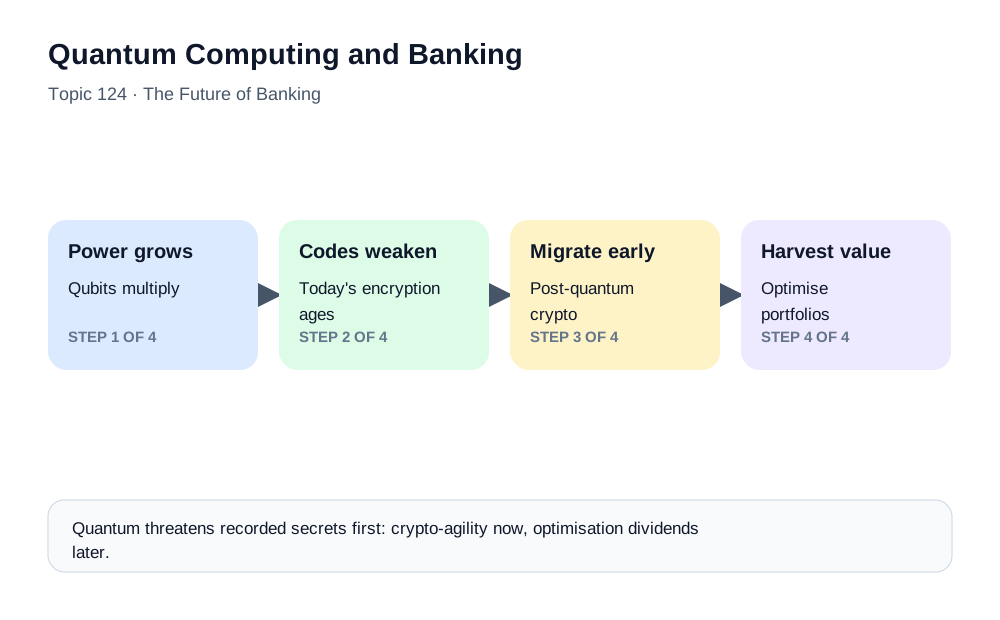
Quantum Computing and Banking at a glance — Cryptography, optimization, post-quantum security.
Post-Quantum Cryptography, Optimization, and the Quantum Threat
Quantum computing could eventually provide important advantages for selected computational problems, while a sufficiently capable fault-tolerant quantum computer would threaten widely deployed public-key cryptography such as RSA and elliptic-curve systems. Practical banking advantage and the date of a cryptographically relevant quantum computer remain uncertain. Banks should therefore separate speculative business opportunities from the more concrete need for cryptographic inventory and post-quantum migration planning, especially for data that must remain confidential for many years.
Understanding the quantum revolution requires grasping how fundamentally different quantum computers are from the classical machines that have powered banking for decades. Classical computers process information in bits, each representing either zero or one. Quantum computers employ qubits, which can exist in superposition—representing zero, one, or both states simultaneously until measured. Superposition allows a quantum state to represent combinations of basis states, but it is misleading to describe a quantum computer as simply evaluating every answer in parallel and reading them all out. Quantum algorithms obtain advantage only when interference and problem structure allow useful information to be extracted with fewer operations than known classical approaches. Qubit counts also do not translate directly into useful computational power because error rates, connectivity, gate fidelity and error correction matter. Hardware roadmaps change quickly and should be checked from current provider sources rather than taught as fixed qubit milestones.
Three quantum properties enable the capabilities that so intrigue banking technologists and concern security professionals. Superposition allows qubits to exist in multiple states simultaneously, enabling parallel exploration of possibilities that classical computers must examine sequentially. Entanglement creates correlations between quantum systems that cannot be reproduced by classical local-hidden-variable models. These correlations are important to many quantum algorithms, but they do not allow usable information to be transmitted faster than light; descriptions suggesting that one measurement simply sends an instantaneous operational effect across any distance are misleading. Interference enables quantum algorithms to amplify correct answers while canceling out incorrect ones through careful manipulation of quantum states, effectively guiding computations toward optimal solutions without exhaustively checking every possibility. These properties combine to create computational capabilities that challenge our classical intuitions about what computers can do.
Banking applications of quantum computing span multiple domains where computational complexity has historically constrained optimization and modeling capabilities. Portfolio optimization represents one of the most promising applications—optimizing a portfolio of one thousand assets requires classical computers to employ approximations, as exploring all possible combinations exceeds practical computational limits. Researchers have proposed quantum and quantum-inspired methods for portfolio optimisation, but practical advantage over strong classical solvers has not been established for general production banking portfolios. Quantum methods do not automatically guarantee the global optimum or make real-time rebalancing feasible; data loading, constraints, hardware noise and classical baselines all matter. The ability to optimize across larger universes of assets with more complex constraints could fundamentally improve portfolio construction.
Risk modeling similarly benefits from quantum capabilities, with Monte Carlo simulations for risk assessment requiring millions of iterations on classical computers to achieve statistical significance. Quantum approaches promise quadratic speedup for such simulations, enabling more scenarios to be evaluated more frequently or more complex models to be run in acceptable timeframes. Derivatives pricing models that strain classical systems become more tractable, potentially improving pricing accuracy for complex instruments and enabling new product structures that are currently too computationally intensive to price and hedge effectively. Scenario analysis can model thousands of possibilities simultaneously rather than sequentially, providing richer understanding of tail risks and interaction effects.
Fraud detection represents another compelling application where quantum advantages may prove decisive. Quantum machine learning and quantum graph methods are active research areas, but no general production advantage has been demonstrated for bank fraud detection. Classical streaming, graph and machine-learning systems already operate at very large scale. Banks exploring quantum approaches should benchmark end-to-end accuracy, latency and cost against strong classical methods rather than assume superpolynomial speedups or lower false positives.
Additional optimization problems pervade banking operations and present quantum opportunities that could improve efficiency and profitability. ATM cash optimization—determining optimal cash distribution across thousands of ATMs to minimize both stockouts and excess holding costs—represents a classic optimization challenge suited to quantum approaches. Branch network planning involves optimal location selection given complex demographic, competitive, and cost considerations that create combinatorial explosion for classical solvers. Loan portfolio allocation seeks to maximize returns while managing risk constraints across thousands of individual exposures with correlated behaviors. These optimization challenges, while less glamorous than fraud detection or derivatives pricing, affect bank profitability daily and accumulate substantial impact across large networks.
The quantum opportunity, however, is matched by an equally significant quantum threat that has security professionals deeply concerned. Cryptographic systems currently securing all digital banking—protecting transactions, authenticating users, encrypting data—face fundamental vulnerability to quantum attacks. The RSA algorithm, widely used for digital signatures and key exchange, can be broken by Shor's algorithm running on a sufficiently powerful quantum computer. The mathematical foundation of RSA—factoring large numbers into primes—becomes tractable on quantum machines, rendering RSA-protected data readable by quantum-enabled adversaries. Elliptic curve cryptography, which secures TLS/SSL connections and digital certificates, similarly falls to Shor's algorithm. The discrete logarithm problems underlying elliptic curve security yield to the same quantum approaches that break RSA.
Grover's algorithm provides a theoretical quadratic speedup for unstructured search, which changes the security analysis of symmetric keys and hash functions but does not break them in the same way that Shor's algorithm threatens RSA and elliptic-curve cryptography. Real attack cost depends on enormous fault-tolerant quantum resources. Banks should follow current cryptographic standards and regulator or security-agency guidance on approved symmetric key sizes rather than infer migration requirements from a simple 'bit strength halved' slogan.
The threat extends beyond future attacks on current communications to encompass data already captured by adversaries. Adversaries today may be executing "harvest now, decrypt later" strategies—intercepting and storing encrypted bank data in anticipation of future quantum capabilities. When quantum computers eventually become powerful enough to break current encryption, these adversaries could decrypt everything they have stored: customer records, transaction histories, proprietary trading strategies, confidential communications, and strategic planning documents. This means that sensitive data encrypted today with RSA or elliptic curve cryptography is already at risk if captured by sophisticated adversaries with long time horizons. Security authorities warn about the 'harvest now, decrypt later' risk in which encrypted data captured today could be attacked in the future. A bank should prioritise information whose confidentiality lifetime could extend beyond the expected lifetime of current public-key cryptography without claiming knowledge of which particular adversaries are currently storing its traffic.
The response to this threat is post-quantum cryptography—new cryptographic algorithms designed to resist attacks from both classical and quantum computers. These algorithms rely on mathematical problems believed to be hard even for quantum computers, such as certain lattice problems, hash-based structures, and multivariate polynomial systems. The National Institute of Standards and Technology finalized post-quantum cryptography standards in 2024 after extensive evaluation processes involving global cryptographic experts and public comment periods. ML-KEM, based on the CRYSTALS-Kyber algorithm, provides key encapsulation for secure key exchange using lattice-based mathematical problems believed resistant to quantum attacks. ML-DSA, based on CRYSTALS-Dilithium, provides digital signatures similarly grounded in lattice problems. SLH-DSA, based on SPHINCS+, offers an alternative digital signature approach using hash functions rather than lattices, providing diversity in the cryptographic toolkit.
Migration to post-quantum cryptography will be a massive undertaking requiring years of careful planning and execution across complex, interconnected systems. The process begins with inventory—identifying all cryptographic systems currently in use across the organization, including those embedded in legacy applications, third-party systems, hardware security modules, and communication protocols. This inventory often reveals surprising scope, as cryptography is deeply embedded throughout modern banking infrastructure. Risk assessment prioritizes these systems based on data sensitivity and required confidentiality duration—systems protecting the most sensitive data for the longest periods receive highest priority for migration. Data that must remain confidential for decades deserves immediate attention, while data with shorter sensitivity horizons may tolerate delayed migration.
Post-quantum migration should follow the institution's risk, vendor readiness and applicable government or industry timelines rather than a universal 2024-2035 schedule. Banks can inventory cryptography, test standardised algorithms, introduce hybrid approaches where appropriate and migrate higher-priority systems first. Dependencies such as certificates, hardware security modules, protocols and third-party products often determine practical sequencing.
Current quantum computing development proceeds rapidly across multiple fronts, with both hardware and software advancing significantly. Technology companies, universities and financial institutions continue to research quantum hardware, algorithms and quantum-safe communications. Hardware specifications, roadmaps and bank pilots change rapidly and do not establish that a commercially useful quantum advantage in banking is imminent. Current primary-source disclosures should be used for named programmes. The strategic lesson is to build informed experimentation while keeping production investment proportional to demonstrated capability.
The quantum future demands action today despite uncertainty about exact timelines. Banks must begin cryptographic inventory and risk assessment immediately, as migration timelines extend many years and the "harvest now, decrypt later" threat is already active. Partnerships with quantum computing providers and academic institutions build internal capabilities and ensure access to expertise. Executive education ensures leadership understands both opportunities and threats, enabling appropriate resource allocation. The organizations that navigate this transition successfully will capture quantum advantages while maintaining security; those that delay risk obsolescence or catastrophic security breaches. Quantum computing represents both the greatest opportunity and the greatest threat to banking cryptography in decades—preparation for both is essential.
The race for quantum advantage is intensifying globally, with significant investments from governments and technology companies driving rapid progress. Banks must monitor these developments closely, both to prepare for the cryptographic threat and to identify opportunities for competitive advantage. The institutions that successfully integrate quantum capabilities into their operations while maintaining security will be positioned to outperform competitors in optimization, modeling, and risk management. Migration away from quantum-vulnerable public-key cryptography is a significant long-term security programme for organisations that rely on it. Urgency should be prioritised according to data confidentiality lifetime, system lifecycle, standards maturity and external deadlines rather than based on an assumed date for a capable quantum computer. Banks that begin preparations now will face a manageable transition; those that wait risk finding themselves exposed to quantum attacks with no ready defense. The quantum era of banking is approaching, and preparation today determines success tomorrow.
The skills required for quantum readiness differ significantly from traditional banking technology expertise. Quantum computing requires understanding of quantum mechanics, linear algebra, and quantum algorithms that are not part of standard computer science or finance curricula. Banks will need to develop these capabilities through hiring, training, and partnerships with academic institutions. Building a quantum-ready workforce is a multi-year effort that must begin well before quantum computers reach scale. Similarly, post-quantum cryptography requires expertise in lattice-based cryptography, hash-based signatures, and other mathematical approaches unfamiliar to most current security professionals. The human capital dimension of quantum preparation is as important as the technical infrastructure, and delays in building these capabilities will be difficult to make up later.
International coordination will be essential for managing the quantum transition in banking. Cryptographic standards are global, and the security of international transactions depends on compatibility across jurisdictions. Banks operating internationally must ensure that their quantum preparations align with standards and timelines in all the markets where they operate. Regulatory harmonization can help—consistent requirements for post-quantum migration across major jurisdictions will simplify compliance and ensure that no markets become weak links in the global financial system. International bodies like the Bank for International Settlements and the Financial Stability Board have important roles to play in coordinating these efforts. The quantum transition is a global challenge that requires global cooperation.
The business implications of quantum computing extend beyond security to encompass potential competitive advantages in optimization, modeling, and machine learning. Banks that develop quantum capabilities early may be able to solve problems that competitors cannot, creating opportunities for superior pricing, risk management, and customer service. The development of quantum algorithms for financial applications is an active area of research, with potential breakthroughs that could reshape competitive dynamics. Institutions should monitor these developments and consider building internal quantum research capabilities or partnerships that provide access to emerging technologies. The quantum future is not only about defense against cryptographic threats but also about capturing opportunities that quantum advantages may create.
The timeline for practical quantum computing applications in banking remains uncertain, with estimates ranging from five to twenty years depending on the rate of hardware advancement and algorithm development. This uncertainty makes planning difficult—banks must invest in preparation without knowing exactly when quantum capabilities will arrive or what they will enable. A prudent approach involves building flexible capabilities that can adapt as the technology evolves, rather than betting on specific timelines or applications. Scenario planning can help institutions prepare for different possible futures, from early quantum advantage to delayed development. The key is to avoid both complacency and panic—investing sufficiently to be prepared without overcommitting to unproven technologies.
The quantum threat is not evenly distributed across banking operations—some systems and data are more vulnerable than others, and prioritization is essential given resource constraints. Customer transaction data, authentication systems, and long-term strategic information warrant the highest priority for protection, as these are most valuable to potential adversaries and most damaging if compromised. Legacy systems that are difficult to upgrade may require special attention, as they often cannot be easily migrated to new cryptographic standards. Third-party dependencies also create vulnerabilities, as banks must ensure that vendors and partners are also preparing for the quantum transition. A thorough risk assessment can help banks allocate their quantum preparation resources where they will have the greatest protective impact.
The educational dimension of quantum preparation is often overlooked but critical for success. Boards and senior management must understand enough about quantum computing to make informed decisions about resource allocation and risk tolerance. Technical teams must develop expertise in post-quantum cryptography and quantum algorithms. Customer-facing staff may need to explain quantum-related changes to clients who are concerned about their security. Banks must invest in training and development to build this organizational knowledge, potentially partnering with academic institutions or specialized training providers. The quantum transition is as much a human challenge as a technical one, and institutions that neglect the educational dimension will struggle to execute effectively.
<!-- MBA-DEEP-DIVE-START -->Quantum Computing and Banking Deepening — Crypto Agility, PQC Migration, and Evidence-Based Experimentation
Quantum readiness has two very different workstreams
Banks should separate post-quantum security from quantum business applications. Post-quantum cryptography addresses a credible future threat to widely used public-key algorithms and requires long migration lead time. Quantum optimisation, pricing or machine learning are research opportunities whose practical production advantage remains uncertain. Combining them into one “quantum programme” can lead to spending on speculative use cases while neglecting cryptographic inventory. Security migration and innovation research need different objectives, funding and governance.
A cryptographically relevant quantum computer is not defined by raw qubit count
Breaking a large RSA key with Shor's algorithm would require fault-tolerant logical qubits and many reliable operations, which in turn can require far more physical qubits because of error correction. Hardware announcements often quote physical qubits or other performance metrics that are not directly comparable. Banks should therefore avoid setting security strategy from headline qubit counts. The relevant question is whether a machine can execute the required algorithm at the scale and error rate needed for a real cryptographic attack.
Logical and physical qubits should not be confused
A physical qubit is a hardware element subject to noise. A logical qubit is an error-corrected information unit built from physical resources and control. The overhead depends on architecture, error rates and error-correction method. A machine with many noisy physical qubits may have less useful computational capacity than a smaller system with better fidelity. Technology monitoring should therefore use multiple metrics rather than one qubit number.
Error correction is central to the long-term quantum threat
Current noisy devices cannot simply run arbitrarily deep algorithms because errors accumulate. Fault-tolerant quantum computing aims to detect and correct errors while computation proceeds. Progress in error correction can be as important as increases in hardware scale. Banks do not need to become quantum physicists, but security strategy should recognise that cryptographically relevant capability depends on the entire fault-tolerant stack.
Quantum advantage is algorithm-specific
Quantum computers are not universally faster than classical computers. Shor's algorithm offers a major theoretical advantage for integer factorisation and discrete logarithms. Grover's algorithm provides a quadratic advantage for unstructured search. Other algorithms may offer speedups under particular assumptions. Many ordinary banking workloads such as database queries, web serving and ledger posting are likely to remain classical. Architecture should target problems with credible algorithmic advantage rather than trying to “quantumise” every system.
Data loading can erase theoretical speedups
A financial optimisation algorithm may assume data is already encoded in a quantum state. Loading millions of market or transaction values into that state can itself be costly. End-to-end benchmarks should include data preparation, classical pre-processing, quantum execution, measurement and post-processing. A quantum subroutine that is asymptotically elegant but slow to feed with real bank data may provide no production advantage.
Classical baselines must be strong
Portfolio optimisation, Monte Carlo simulation and graph analytics already have sophisticated classical algorithms, specialised hardware and distributed computing. Quantum research should compare against the best practical baseline, not a naive brute-force program. Otherwise a demonstration can appear impressive simply because the classical comparator is weak. Responsible innovation asks whether the complete quantum approach improves time, cost or solution quality in realistic conditions.
Quantum-inspired methods can create value without quantum hardware
Some optimisation techniques borrow mathematical ideas associated with quantum approaches but run on classical systems. If they improve a bank problem, that value can be captured today. Teams should be clear about whether a solution is genuinely quantum, quantum-inspired or conventional optimisation. Accurate labels prevent marketing from outrunning technical reality.
Monte Carlo speedup is a research opportunity, not a guaranteed production result
Quantum amplitude estimation can offer theoretical query advantages for certain estimation problems, which has motivated research in derivatives pricing and risk. Practical benefit depends on fault-tolerant hardware, state preparation and algorithm design. Banks should use proofs of concept to understand resource requirements before assuming future VaR or pricing engines will be quantum. Classical simulation remains the production standard today.
Optimisation problems need realistic constraints
A portfolio optimiser must handle transaction costs, liquidity, limits, taxes, cardinality, exposure and regulatory constraints. A quantum experiment that solves a simplified toy problem may not transfer to the production problem. Use-case evaluation should preserve the constraints that make the banking decision hard. The right benchmark is not whether the quantum system returns an answer, but whether it returns a useful answer under real rules.
Fraud detection claims require evidence
Fraud systems process high-volume events with strict latency and constantly changing attack patterns. A quantum algorithm would need to outperform mature classical streaming and graph systems while integrating into that real-time environment. Current research is interesting, but banks should not promise lower false positives or novel detection without controlled evidence. Quantum research can remain exploratory until hardware and algorithms demonstrate operational relevance.
The immediate security task is discovering where vulnerable cryptography exists
Large banks use public-key cryptography in TLS, VPNs, certificates, code signing, email, file transfer, APIs, hardware, identity and third-party products. The first migration problem is often not algorithm selection but inventory. Teams should know which applications use RSA, elliptic curves or other schemes, what keys protect, who owns the component and how long the protected data must remain confidential.
Crypto inventory should include embedded and inherited components
An application team may not realise that a database driver, appliance or cloud service negotiates a particular cryptographic algorithm. Software bills of materials, certificate discovery, network scanning and vendor questionnaires can help. Legacy mainframe and hardware devices may be especially difficult to upgrade. Inventory confidence should be measured rather than assuming a spreadsheet captures everything.
Cryptographic agility is a long-term design capability
A crypto-agile system can replace algorithms, certificates and key sizes without rewriting the entire application. Protocol and configuration should avoid hard-coding one algorithm deeply into business logic. Agility reduces the cost of post-quantum migration and future cryptographic changes. New banking systems should therefore treat algorithm replaceability as an architectural requirement even before full PQC deployment.
Data confidentiality lifetime drives priority
A session token that expires in minutes has a different “harvest now, decrypt later” exposure from a strategic document or customer record that must remain confidential for decades. Risk assessment can compare how long data must be protected with how long migration and potential quantum development may take. Long-lived sensitive data often deserves earlier protection even if the operational system itself can be upgraded later.
Digital signatures create a different migration problem from encryption
Signatures protect authenticity and integrity for software, documents, transactions and certificates. A future quantum attacker could potentially forge signatures based on vulnerable public-key algorithms. Banks should inventory signing use cases separately from encrypted confidentiality. Code-signing roots, document signatures and long-lived certificates may have different replacement and archival requirements.
PKI migration is an ecosystem problem
A bank cannot change certificate algorithms unilaterally if browsers, counterparties, HSMs, operating systems or payment networks do not support them. Public-key infrastructure involves certificate authorities, issuance, validation, revocation and trust stores. PQC migration therefore requires coordinated vendor and industry readiness. Pilot deployments should test compatibility across the full chain.
NIST's 2024 standards provide concrete reference points
NIST finalised FIPS 203 for ML-KEM, FIPS 204 for ML-DSA and FIPS 205 for SLH-DSA in August 2024. These standards give organisations approved algorithm specifications to begin implementation planning and testing. Banks should still follow the requirements of their jurisdictions, regulators, networks and vendors. A published standard is the start of deployment work, not proof that every banking system is ready to use it immediately.
Key encapsulation and signatures solve different cryptographic needs
ML-KEM is designed for establishing shared secret keys, while ML-DSA and SLH-DSA provide digital signatures. Teams should map these functions to current RSA or elliptic-curve uses. A migration programme should not simply replace “RSA” with one PQC algorithm everywhere. Protocol design determines whether the system needs key establishment, authentication, signing or several functions.
Algorithm diversity can reduce dependency on one mathematical family
ML-KEM and ML-DSA are lattice-based, while SLH-DSA uses hash-based signatures. Diversity can be useful if future cryptanalysis weakens one family. However, using multiple algorithms increases implementation and operational complexity. Architecture should follow standards and threat analysis rather than adding algorithms merely to appear safer.
Hybrid cryptography can manage transition risk
A hybrid approach combines classical and post-quantum mechanisms so security does not depend solely on the newer algorithm during early deployment. Protocol support and correct composition matter. Hybrid mode can be useful during migration, but it adds key sizes, processing and interoperability complexity. Banks should follow established protocol designs rather than invent their own cryptographic combination.
PQC changes performance and message size
Post-quantum keys, ciphertexts and signatures can be larger than familiar elliptic-curve equivalents. This can affect certificates, network packets, HSM storage, smart cards, constrained devices and protocol limits. Testing should include throughput and payload sizes under peak load. Cryptographic migration is not just a library change.
Hardware security modules are critical dependencies
Banks use HSMs to protect payment keys, certificate authorities, signing and other sensitive functions. PQC readiness depends on vendor firmware, algorithms, performance and certification. HSM replacement cycles can be long. Inventory should identify where hardware cannot support new algorithms and whether vendor roadmaps align with the bank's risk timeline.
Payment cryptography needs scheme-specific planning
Card payment cryptography, PIN security, EMV and network protocols have specialised standards and hardware. Banks should follow scheme and industry migration plans rather than apply generic internet-PQC guidance directly. Some payment controls rely heavily on symmetric cryptography and may have different quantum exposure from public-key components. The architecture should map exact algorithms before deciding change.
TLS migration affects almost every digital channel
Internet banking, APIs and internal services rely on TLS. PQC-capable TLS depends on libraries, certificates, browsers, gateways and counterparties. Banks can test supported key-exchange mechanisms in controlled environments and monitor interoperability. A partial change that causes clients to fall back incorrectly can weaken security or availability, so deployment needs protocol-level testing.
Third-party readiness should be part of supplier risk
Cloud platforms, SaaS systems, fintechs and network providers can hold or transmit bank data. The bank should ask critical vendors about crypto inventory, PQC roadmap and certificate or HSM dependencies. Contract renewals can include transition expectations where appropriate. A bank cannot complete migration if a critical external system remains locked to vulnerable algorithms.
Legacy systems may require compensating controls
Some old systems cannot support new cryptography without replacement. Options can include wrapping traffic through modern gateways, segmenting networks, reducing data retention or accelerating decommissioning. Compensating controls should be documented as temporary and tied to an exit plan. “Legacy” should not become a permanent reason to ignore the risk.
Cryptographic migration should be staged by business criticality
Banks can prioritise long-lived confidential data, critical identity and high-value signing systems, then progress through lower-risk services. A single enterprise deadline can hide large differences in readiness. Wave planning aligns migration with application releases and vendor availability. Critical exceptions should be visible to senior security governance.
Test environments need representative certificate and key flows
PQC pilots should cover issuance, rotation, revocation, recovery, backup and disaster scenarios, not just successful encryption. Operational teams need to know how new keys are managed. Certificate-expiry or HSM failures can create outages regardless of cryptographic strength. Production readiness is primarily an operational discipline once the algorithm is selected.
Key management remains fundamental after PQC
A quantum-resistant algorithm does not help if private keys are stolen, access controls are weak or certificates are misissued. Banks must preserve HSM security, least privilege, rotation, logging and incident response. Post-quantum cryptography addresses a class of mathematical attack; it does not replace ordinary cryptographic hygiene.
“Harvest now” risk should be linked to actual data paths
Security teams can identify where high-value long-lived data crosses networks using vulnerable key exchange or is stored with quantum-vulnerable protection. Not every encrypted packet needs the same urgency. Targeted analysis makes investment rational and provides a defensible migration plan. Fear-based statements about adversaries storing “everything” are less useful than mapping specific confidentiality exposures.
Quantum-safe does not mean future-proof forever
Post-quantum algorithms are selected based on current cryptanalysis. New weaknesses can be discovered. Crypto agility, patching and standards monitoring remain necessary after migration. Banks should avoid replacing one assumption of permanence with another. Security engineering is an ongoing lifecycle.
Governance should distinguish experiment from production dependency
A quantum optimisation proof of concept can operate under innovation governance. A cryptographic control protecting production customer data belongs in security, architecture and change governance. Experiments should not quietly become critical services without validation. The same technology can therefore have different ownership depending on use.
Quantum cloud services create data-boundary questions
Research teams may access quantum hardware through cloud platforms. Financial datasets should be minimised, synthetic or appropriately protected according to bank policy. A proof of concept does not justify sending confidential trading or customer data to an experimental service. Security and third-party controls apply to quantum research like any other cloud use.
Intellectual property should be considered in quantum research
New pricing or optimisation algorithms can be strategically valuable. Partnerships with universities and vendors should define ownership, publication and confidentiality. Banks should balance open research with protection of proprietary methods. Contract terms matter because quantum expertise often sits outside the institution.
Talent strategy should focus on translation as well as physics
A bank needs people who can translate a real financial problem into an algorithmic form, benchmark classical approaches and understand quantum resource requirements. Hiring only physicists without domain and engineering integration can create impressive demonstrations with little business relevance. Cross-disciplinary teams are more useful than a large isolated quantum lab.
Executive reporting should avoid hype metrics
Boards need to know migration exposure, standards readiness, critical vendor dependency and material research outcomes. Number of qubits or press releases are not management metrics. Security reporting can show percentage of vulnerable cryptography inventoried and migration status. Innovation reporting can show whether experiments beat classical baselines and what conditions are required for practical use.
Scenario planning is better than predicting a quantum date
The bank can prepare for an earlier cryptographic threat, a slower hardware path and a future where useful optimisation arrives before code-breaking capability or vice versa. Each scenario suggests different investment pace, but many actions—inventory, crypto agility, vendor engagement—are valuable across them. This avoids false precision about “five years” or “twenty years.”
The near-term priority is crypto agility and standards-based migration
Quantum business advantage may or may not arrive soon, but banks already depend on cryptography with long system lifecycles. Building an accurate inventory, understanding confidentiality horizons, testing standardised PQC and improving algorithm agility are practical actions today. Innovation research can continue in parallel without promising customers or management capabilities that hardware has not demonstrated.
The long-term opportunity should be earned through benchmarking
When quantum systems mature, financial use cases should compete on measurable advantage: solution quality, runtime, cost, scalability and operational integration. Banks that build strong problem definitions and classical baselines now will be better positioned to recognise genuine quantum value later. The goal is not to be first to use quantum branding; it is to be ready to adopt it when evidence shows a better banking outcome.
Quantum computing in banking: separate strategic preparation from hype
Quantum computing attracts attention because some quantum algorithms could eventually solve particular classes of problems differently from conventional computers. For banks, the correct response is neither to assume that a large fault-tolerant quantum computer is already replacing ordinary infrastructure nor to ignore the subject until a crisis appears. The practical approach is to separate three questions: what quantum computing can theoretically change, what present-day experimentation can realistically demonstrate, and which preparations are valuable even before large-scale quantum advantage exists.
Most banking workloads will continue to depend on classical computing. Core banking ledgers, payment engines, customer channels, databases, fraud platforms, reporting systems, and reconciliation processes require reliability, predictable latency, mature tooling, security, observability, and enormous integration capability. Quantum computers are not general-purpose drop-in replacements for these systems. Their possible value is more specialised: certain optimisation, simulation, search, or machine-learning subproblems may become candidates for quantum or hybrid approaches if the hardware, algorithms, economics, and operational controls mature sufficiently.
Begin with the problem, not the technology label
A bank should not create a quantum project merely because the technology is strategically fashionable. Teams should identify a business problem that is computationally difficult, understand the best classical solution, and define a measurable outcome. Without a classical benchmark, it is impossible to know whether a quantum experiment has created practical advantage.
Potential research areas can include portfolio optimisation, risk simulation, pricing, fraud-pattern analysis, liquidity optimisation, collateral allocation, or complex scheduling. These examples should be treated as hypotheses rather than promised use cases. A problem can look mathematically suitable while still being a poor production candidate because data preparation, hardware access, error rates, run time, integration cost, or the quality of classical alternatives remove the advantage.
A disciplined experiment therefore records the problem size, objective function, constraints, data preparation, classical baseline, quantum or hybrid method, hardware or simulator used, execution time, solution quality, repeatability, and total operational cost. The question is not “Did the quantum program run?” but “Did it produce a result that is materially better than a realistic classical approach under conditions that matter to the bank?”
Understand why today's experimentation has limits
Quantum information is represented using qubits, and useful computation depends on controlling quantum states with sufficient accuracy. Real devices are affected by noise and errors, so practical quantum computation requires error-management techniques and, for many demanding algorithms, large-scale error correction. That makes the gap between a theoretical algorithm and a production banking application significant.
Small demonstrations can still be valuable. They help bank engineers and quantitative teams learn how quantum circuits are constructed, how problems are encoded, how results are sampled, and where hybrid classical-quantum workflows may fit. However, a proof of concept on a reduced dataset should not be presented as evidence that the same approach will outperform established bank infrastructure at production scale.
Simulation also needs careful interpretation. A quantum algorithm executed on a classical simulator is useful for learning and validating logic, but the simulator does not demonstrate hardware-level quantum advantage. As the number of simulated qubits grows, classical simulation can become extremely demanding. Teams should therefore label experiments precisely so decision-makers understand what has actually been proven.
Cryptography is the most immediate governance concern
For many banks, the most important quantum-related work is not a new trading algorithm but long-term cryptographic resilience. Some widely used public-key cryptographic techniques could become vulnerable if sufficiently capable quantum computers become available. The exact timing is uncertain, but cryptographic migration across a large bank can take years. Banks therefore benefit from preparing before an urgent deadline exists.
Preparation begins with a cryptographic inventory. The institution should know where cryptography is used, which algorithms and key sizes are involved, which certificates and libraries implement them, which applications depend on them, who owns those applications, what data is protected, and how long the protected information must remain confidential or trustworthy. The inventory should include internal applications, internet-facing services, mobile applications, APIs, middleware, hardware security modules, network devices, databases, code-signing processes, identity systems, file transfer, backups, third-party products, and external connectivity.
This is difficult because cryptography is often embedded inside products rather than visible as a standalone service. A business application may rely on a framework that relies on a library that uses operating-system cryptographic functions. Third-party platforms may manage certificates internally. An inventory should therefore combine architecture records, automated discovery where practical, vendor information, configuration evidence, and application-owner confirmation.
Crypto-agility is a better objective than a one-time replacement
Cryptographic migration should not be designed as a single algorithm swap. The more durable capability is crypto-agility: the ability to identify, change, test, deploy, and monitor cryptographic mechanisms without redesigning the entire application. This matters because algorithms, implementation guidance, vulnerabilities, and interoperability needs can continue to evolve.
Applications can be assessed for hard-coded algorithms, certificate assumptions, protocol constraints, hardware dependencies, key-length limitations, and vendor lock-in. Interfaces should avoid unnecessary dependence on one cryptographic choice. Configuration and key-management processes should allow controlled change. Test environments should be capable of exercising new certificates, larger keys or signatures where relevant, and mixed compatibility during migration.
Crypto-agility is also an operational discipline. A technically supported algorithm is not useful if the bank cannot rotate keys, renew certificates, distribute trust, update devices, coordinate external partners, or recover from failed deployment. Change management, inventory accuracy, ownership, and monitoring are therefore as important as the cryptographic mathematics.
Consider “harvest now, decrypt later” when prioritising data
Some information needs confidentiality for only a short period; other information remains sensitive for many years. An adversary can theoretically capture encrypted data now and retain it in the hope of decrypting it later if future capabilities improve. This possibility is often described as harvest-now-decrypt-later risk.
Banks can use data sensitivity and required confidentiality lifetime to prioritise migration. Long-lived confidential information may deserve earlier attention than transient low-sensitivity data. The assessment should consider whether historical exposure would still cause harm years later and whether the communication channel can realistically be captured. This produces a risk-based migration sequence rather than attempting to replace every cryptographic component at the same time.
Migration is an ecosystem problem
A bank rarely controls both ends of every secure connection. Payment networks, market infrastructures, correspondent banks, corporate customers, identity providers, cloud services, hardware vendors, software vendors, regulators, and other partners may have their own migration schedules. Interoperability therefore becomes a major planning issue.
A bank can prepare by documenting external cryptographic dependencies and identifying which relationships are operationally critical. It should know where protocol changes require bilateral testing, certification, hardware replacement, or coordinated cutovers. Contracts and vendor governance can require suppliers to provide roadmap information and support agreed security standards when they become necessary.
Hybrid transition approaches may be used in some environments so old and new mechanisms coexist for a period, but coexistence adds complexity. Operations teams need to know which mechanism protected a particular connection, how failures are diagnosed, and when legacy options can be safely retired. Leaving old algorithms enabled indefinitely for compatibility can defeat the purpose of migration.
Key management remains central
Quantum-resistant algorithms do not eliminate ordinary key-management risk. Keys still need secure generation, storage, access control, rotation, revocation, backup, recovery, and destruction. Certificates still need ownership and lifecycle management. Private keys can still be stolen through weak access controls or compromised endpoints. Software implementations can still contain vulnerabilities.
This is important because organisations sometimes treat a new cryptographic algorithm as a complete security solution. In reality, most production failures occur across the wider implementation and operating environment. A bank should therefore integrate post-quantum planning with existing public-key infrastructure, hardware security, secrets management, identity, certificate management, and secure software development rather than creating a disconnected quantum-security programme.
Test performance and message-size consequences
Cryptographic changes can affect CPU usage, handshake time, memory, network traffic, certificate size, signature size, database fields, hardware capacity, and protocol limits. A banking application can be logically compatible with a new algorithm yet fail operationally because a message becomes larger than an old interface permits or because an appliance cannot process peak transaction volumes.
Performance testing should therefore use realistic transaction rates and failure conditions. Teams should examine authentication services, APIs, file-transfer platforms, mobile channels, high-volume payment gateways, batch systems, and devices with limited resources. Capacity planning should include certificate renewal peaks, failover, and recovery rather than measuring only steady-state laboratory performance.
Legacy systems deserve special attention. An application approaching retirement may not justify deep redesign, but the bank still needs a strategy if the system must operate through the migration period. Options can include isolation, gateway protection, accelerated retirement, vendor upgrade, or controlled replacement. The decision should be based on risk and lifecycle economics.
Quantum optimisation needs realistic banking constraints
Suppose a treasury team explores quantum optimisation for liquidity allocation. A toy model might minimise funding cost across a small set of accounts. A production problem is more complicated. It may include legal-entity restrictions, currency, settlement deadlines, intraday credit, collateral availability, account limits, operational cut-offs, transfer costs, uncertain incoming flows, priority payments, and contingency buffers.
The experiment should therefore avoid demonstrating advantage on a simplified problem that removes the constraints responsible for the real difficulty. The classical benchmark should use competent modern optimisation methods, not an intentionally weak baseline. If the quantum or hybrid method produces a promising solution, teams still need to assess explainability, stability, integration latency, availability, control, and fallback.
A bank cannot depend on a specialised optimisation service without an operational alternative. If the service is unavailable near a settlement deadline, treasury still needs a deterministic fallback that keeps payments and liquidity within safe limits. Production design therefore has to treat quantum computation as one component within a controlled banking process, not as an isolated mathematical engine.
Quantum machine learning should be treated as research until evidence supports more
Quantum machine-learning concepts explore whether quantum methods can improve aspects of learning, feature representation, or optimisation. Banking teams should be especially careful about claims in this area because model performance depends heavily on data quality, feature engineering, target definition, validation, and operational controls. A small experimental accuracy improvement does not prove commercial value.
Any experiment should be compared with strong classical models using properly separated training and testing data. Teams should examine stability, calibration, fairness where relevant, explainability, latency, robustness, and monitoring requirements. If classical data must be encoded into a quantum representation, the cost of that encoding should be included in the comparison rather than ignored.
Model risk governance still applies. A model does not become exempt from inventory, validation, documentation, monitoring, change control, and outcome testing because part of its computation uses quantum hardware.
Build expertise without building an uncontrolled technology island
A sensible quantum programme can be small and multidisciplinary. It may include cryptography specialists, architects, cybersecurity teams, quantitative analysts, engineers, model-risk experts, and business owners. The bank can use external research and cloud-accessible environments while retaining internal understanding of the problem and evidence.
Experiment code, datasets, results, and assumptions should be governed. Sensitive bank data should not be uploaded to an experimental platform without normal security, privacy, and third-party controls. Teams can often start with synthetic or appropriately protected data until the business value is established.
Architecture governance should also prevent experimental components from quietly becoming production dependencies. Moving from research to production should require a separate decision covering service criticality, security, resilience, monitoring, vendor risk, data protection, cost, support, fallback, and exit.
A practical cryptographic migration playbook
A bank can structure long-term cryptographic preparation into manageable stages. First, establish governance and ownership so cybersecurity, architecture, application teams, infrastructure, procurement, and business services know their responsibilities. Second, discover and classify cryptographic assets and dependencies. Third, prioritise by data lifetime, system criticality, external exposure, and replacement complexity. Fourth, engage strategic vendors and external networks to understand compatibility and roadmaps.
Next, create test environments and migration patterns. Teams can validate new libraries, certificate chains, hardware support, protocol behaviour, performance, observability, and rollback. Applications nearing major renewal can adopt crypto-agile designs during ordinary modernisation rather than waiting for a separate emergency programme. Procurement standards can require new systems to expose cryptographic configuration and support lifecycle change.
Finally, migration should be monitored like any major technology transformation. Management information can track inventory coverage, systems assessed, remediation status, vendor dependencies, test completion, high-risk exceptions, and retirement of legacy mechanisms. Evidence should show not only that new cryptography was enabled but that obsolete mechanisms were disabled where appropriate and that critical services remained interoperable.
Governance must resist both complacency and exaggeration
Quantum strategy is vulnerable to two opposite errors. One is complacency: because large-scale practical quantum computing is uncertain, the organisation postpones cryptographic inventory and discovers later that migration will take far longer than expected. The other is exaggeration: vendors or internal teams claim near-term revolutionary benefits without evidence and divert investment from proven improvements.
A bank can manage both by demanding precise claims. Is a result theoretical, simulated, executed on quantum hardware, or demonstrated at production scale? Was it compared with a strong classical baseline? Does it include integration and operating cost? What assumptions are required? Which limitations remain? What decision should the bank make because of the evidence?
This evidence-based discipline keeps quantum computing in the right place. It is a strategic technology worth understanding, a security transition worth preparing for, and a research field that may create future banking opportunities. It is not a reason to abandon classical architecture, normal model governance, cybersecurity fundamentals, operational resilience, or rigorous business-case analysis. The bank that prepares well will be able to adopt useful quantum capabilities when they become genuinely advantageous while avoiding expensive decisions driven mainly by terminology.
<!-- MBA-DEEP-DIVE-END -->