Visual overview
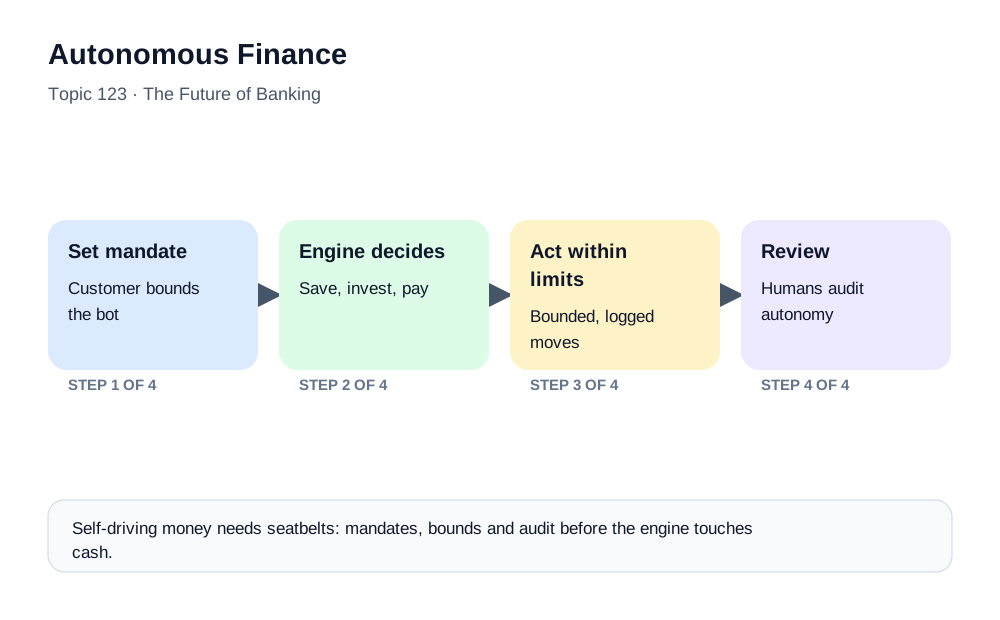
Autonomous Finance at a glance — Self-driving money, hyper-personalization, zero-touch.
Self-Driving Money, Algorithmic Wealth Management, and Automated Financial Lives
Autonomous finance describes financial services in which software can take selected actions on a customer's behalf within agreed permissions, constraints and controls. It is an emerging design pattern rather than an inevitable next stage beyond digital banking, and adoption will differ by product, regulation and customer preference. In this emerging world, money manages itself with minimal human intervention: bills are paid at optimal moments, savings accumulate automatically based on spending patterns, investment portfolios rebalance themselves in response to market conditions, insurance coverage adjusts to life changes, and the entirety of a person's financial life operates as a coordinated, intelligent system. This shift from manual to autonomous represents not simply an incremental improvement but a fundamental reimagining of the relationship between individuals and their financial resources, promising to reduce the cognitive burden of money management while potentially improving outcomes through optimization that exceeds human capacity.
To understand the significance of autonomous finance, it helps to trace the evolution of banking through its major eras, each representing a substantial shift in how customers interact with financial services. The branch era required customers to physically visit bank locations, complete paper forms, and rely on bankers to execute transactions. This model dominated for centuries, with access to banking services limited by geographic proximity to branches and constrained by business hours. The online era brought banking to personal computers, allowing customers to log in, navigate menus, and click to execute actions from their homes or offices. This represented significant convenience but still required active customer initiation of each transaction. The mobile era placed banking in pockets and purses, enabling tap-to-pay convenience and app-based management that made financial services truly portable. The smart era introduced intelligent applications that suggest actions based on customer data, though human approval remains required for execution. More automated services can allow customers to set goals, mandates or rules and permit software to execute selected actions. The system cannot know one universally 'optimal' action, and consequential decisions may still require confirmation, advice controls or human review. Autonomous capability should therefore be viewed as a spectrum rather than a completed final era of banking.
The technical architecture enabling autonomous finance operates through five interconnected layers that work together to create seamless automated experiences. Data aggregation at the foundation layer pulls together information from all customer accounts, cards, loans, and investments into a unified view, with India's Account Aggregator framework providing particularly robust infrastructure for this function. Without comprehensive data visibility, autonomous systems cannot make informed decisions, making this foundational layer critical to overall functionality. Artificial intelligence analysis at the second layer processes this comprehensive data to understand cash flow patterns, predict upcoming expenses, identify optimization opportunities, and learn from customer behaviors over time. Models can be retrained or updated as new data and outcomes become available, but consequential financial systems should not be assumed to learn continuously in production without controlled validation, versioning and change management. A decision engine at the third layer applies rules and machine learning algorithms to determine optimal financial actions, balancing competing priorities and constraints while respecting customer-defined boundaries and risk tolerances.
Automated execution at the fourth layer carries out transfers, investments, payments, and savings actions without requiring manual intervention for each transaction, relying on secure APIs and payment infrastructure to move money seamlessly. User oversight at the top layer provides notifications, dashboards, and override capabilities that keep customers informed and in control of their financial lives, ensuring that automation enhances rather than replaces human agency. This layered architecture enables increasingly sophisticated autonomous capabilities while maintaining appropriate safeguards and customer control.
Automated savings represents one of the most widely adopted autonomous finance applications, addressing the universal challenge of building financial reserves in the face of competing spending priorities. Round-up features capture spare change from every transaction—when a customer spends 87 rupees, the purchase rounds to 100 rupees with the 13 rupee difference automatically directed to savings. These micro-contributions, barely noticeable individually, accumulate substantially over time as dozens of transactions generate regular savings. Surplus detection algorithms analyze spending patterns to identify unspent money at month-end, automatically moving excess funds to savings or investment accounts before lifestyle inflation absorbs them. This addresses the common pattern where available balances get spent simply because they exist. Goal-based saving systems allow customers to specify objectives such as accumulating 5 lakh rupees for a vacation by December 2025, with artificial intelligence calculating required monthly contributions and adjusting for actual spending patterns. If the algorithm detects that regular contributions will miss the target, it can suggest adjustments or identify opportunities to increase savings. Penalty avoidance mechanisms monitor account balances and automatically move money to prevent minimum balance violations and associated fees, protecting customers from expensive oversights.
Automated bill payment systems optimize the timing and method of recurring payments in ways that human management rarely achieves consistently. Automated scheduling can use due dates, balance forecasts and customer preferences to choose a permitted payment date while avoiding late payment. The objective should prioritise reliability and customer instructions; maximising interest float is only one possible consideration and may not be material for many accounts. Rather than paying bills immediately upon receipt or waiting until the due date, autonomous systems identify the ideal payment timing for each bill given the customer's specific cash flow patterns. Where card-network, wallet and customer-consent arrangements permit, software can recommend or select among eligible payment methods using customer-defined preferences such as cost, rewards or funding source. Automatic routing is not universally available and should respect merchant acceptance, card terms, credit limits and the customer's chosen control settings. Subscription management features detect recurring charges, track usage patterns, and can even automatically cancel subscriptions that go unused, addressing the common problem of forgotten recurring payments that drain accounts silently for services no longer valued.
Automated investing extends robo-advisory services into fully autonomous wealth management that manages portfolios continuously without requiring customer action. Algorithmic portfolio construction selects and manages investments based on customer risk profiles, automatically maintaining appropriate asset allocation across market cycles. As market movements shift portfolio weights, the system responds without customer intervention. Auto-rebalancing triggers adjustments whenever portfolio drift exceeds predetermined thresholds, selling appreciated assets and buying underrepresented ones to maintain target allocations and risk levels. Rule-based rebalancing can keep a portfolio closer to its target allocation and reduce ad-hoc emotional decisions, but it does not guarantee improved risk-adjusted returns. Results depend on market conditions, costs, taxes, target design and investor circumstances. Tax-loss harvesting algorithms automatically sell losing investments to offset taxable gains, then repurchase similar but not identical securities to maintain market exposure while capturing tax benefits. This sophisticated strategy, rarely executed consistently by individual investors, becomes routine through automation. Systematic investment plan optimization adjusts contribution amounts when salary increases occur and can temporarily pause contributions during periods of financial stress, all based on detected changes in customer circumstances.
Automated insurance represents a newer frontier in autonomous finance, with applications still emerging but showing significant promise. Usage-based insurance adjusts premiums based on actual behavior—telematics devices track driving patterns and reward safe driving with reduced rates, while fitness data can influence health insurance pricing. Life event triggers monitor customer data to detect changes such as marriage or childbirth, automatically suggesting or even applying for appropriate coverage adjustments as circumstances change. Micro-insurance purchases trigger automatically when relevant activities occur—travel insurance activates when flight bookings are detected, without requiring customer action or risking the common oversight of traveling uninsured.
Real-world implementations demonstrate the growing maturity of autonomous finance across global markets. In international markets, Cleo provides artificial intelligence analysis of spending patterns combined with automatic savings and budget coaching delivered through conversational interfaces that make financial management feel less intimidating. Plum employs artificial intelligence to calculate safe-to-save amounts based on predicted upcoming expenses, then automatically directs those funds to investments without requiring customer decisions about specific amounts. Wealthfront offers sophisticated robo-advisory services with tax-loss harvesting and automatic rebalancing for American investors, demonstrating how autonomous capabilities can scale across large customer bases. Digits provides artificial intelligence-powered financial health monitoring and proactive alerts that help customers stay on track. Salary Finance enables automatic deduction of savings and loan repayments directly from payroll, removing the willpower requirement from financial discipline.
Indian banks and fintechs offer combinations of standing instructions, recurring investments, bill management, savings goals, spending insights and other automated features. Product names and capabilities change quickly, so current provider material should be checked before describing a specific service as autonomous. The useful lesson is to identify the mandate, data source, execution rail and customer control behind each feature.
Several prerequisites must align for autonomous finance to reach its potential across mass markets. Autonomous services can benefit from consented data sharing, reliable payment rails, digital identity and appropriate analytical capability. India's Account Aggregator, UPI and digital-identity infrastructures are important examples, but current coverage and transaction volumes should be taken from official sources rather than fixed headline numbers or 'world-leading' labels. Not every autonomous use case requires all of these components, and each infrastructure has its own legal scope. Regulatory frameworks must evolve to accommodate and protect autonomous financial transactions, an area where policy continues developing to balance innovation with consumer protection.
Significant challenges temper the autonomous finance promise and may slow adoption even as technical capabilities mature. Trust remains perhaps the most fundamental barrier—will customers genuinely accept artificial intelligence moving their money without explicit approval for each transaction? The psychological resistance to automated financial decisions may prove as significant as technical barriers. Accountability for an automated financial action depends on the product contract, mandate, applicable law, regulated entity, technology arrangement and facts of the event. Some existing legal and regulatory frameworks already apply to automated systems even without AI-specific liability rules, so it would be inaccurate to say liability is universally unresolved or that regulation assumes only human decision-making. Security concerns intensify as autonomous systems become high-value targets for attackers who could potentially steal funds at scale through compromised algorithms or manipulate automated systems for fraudulent gain. Regulatory clarity lags behind technological capability, with no comprehensive frameworks yet governing artificial intelligence-initiated financial transactions.
Edge cases present ongoing challenges, as algorithms may not handle unusual life events such as job loss, medical emergencies, or family crises with the nuance and flexibility that human judgment provides. The risk of automated systems making inappropriate decisions during exceptional circumstances requires careful safeguard design. The digital divide means autonomous finance benefits flow primarily to those with smartphones, reliable internet access, and digital literacy, potentially excluding vulnerable populations who might benefit most from improved financial management. Ensuring inclusive access remains an important consideration as autonomous capabilities develop.
The trajectory nevertheless points clearly toward greater autonomy in financial management. Autonomous features may become more common as technology, controls and customer confidence develop, but whether they become the default mode of money management is uncertain. Many customers will continue to prefer confirmation or human advice for consequential decisions, and regulation may deliberately limit autonomy in some contexts. The future envisions financial lives running on intelligent autopilot, with humans serving as strategic decision-makers setting goals and constraints while algorithms handle execution and optimization. This shift promises to reduce the cognitive burden of financial management while potentially improving outcomes through data-driven optimization that exceeds human capacity for continuous monitoring and adjustment. The banks and fintechs that master autonomous finance will define the next era of customer relationships, moving from transactional service providers to trusted autonomous agents managing financial well-being.
The emergence of autonomous finance represents a fundamental shift in the value proposition of financial services. Rather than simply providing tools for customers to manage their own money, institutions will increasingly manage money on behalf of customers, competing on the quality of their algorithms and the trustworthiness of their automation. This shift will favor institutions with strong data capabilities, sophisticated artificial intelligence, and deep understanding of customer needs and behaviors. It will also require new regulatory approaches that address questions of liability, accountability, and consumer protection in automated systems. The transition to autonomous finance will not happen overnight, but the direction is clear, and institutions that begin building capabilities now will be best positioned for this future.
The potential benefits of autonomous finance extend beyond individual convenience to encompass broader economic implications. If well-designed automation helps customers save consistently, avoid fees or maintain suitable investment plans, it can improve some financial outcomes. It can also create harm through poor assumptions, unsuitable actions or over-reliance. Household and macroeconomic benefits should therefore be demonstrated rather than assumed from automation itself. This could have positive spillover effects for the broader economy—higher savings rates enable more investment, better investment returns increase retirement security, and reduced debt burdens free up consumer spending. Autonomous finance may thus contribute not only to individual financial well-being but to macroeconomic stability and growth. Policymakers and regulators have an interest in ensuring that these benefits are widely shared and that autonomous systems do not exacerbate existing inequalities.
The development of autonomous finance also raises important questions about financial literacy and education. As more financial decisions are automated, there is a risk that individuals may lose touch with basic financial concepts and the implications of their choices. This creates a challenge for financial education—how to ensure that people understand enough to set appropriate goals and constraints for autonomous systems without requiring them to master all the details of financial management. Perhaps the answer lies in designing autonomous systems that are not only effective but also educational—providing insights and explanations that help users understand their financial situations better over time. The goal should be to use automation to improve outcomes while preserving and enhancing human financial capability, not to create dependency on opaque algorithms.
The competitive dynamics of autonomous finance will likely favor technology-forward institutions with strong data capabilities and artificial intelligence expertise. Traditional banks may find themselves at a disadvantage unless they invest heavily in technology and partner with or acquire fintechs with relevant capabilities. The barriers to entry for autonomous finance are high—requiring sophisticated algorithms, secure infrastructure, and regulatory compliance—but the rewards for success are substantial. Institutions that establish themselves as leaders in autonomous finance may enjoy customer relationships characterized by high switching costs, as customers become accustomed to the convenience of automated management and reluctant to return to manual approaches. The race to dominate autonomous finance is already underway, and the winners may enjoy significant advantages for years to come.
The trust required for autonomous finance extends beyond technical security to encompass confidence in the judgment and integrity of the underlying algorithms. Customers must believe that automated systems will act in their best interests, even when those interests conflict with the institution's short-term profits. Transparency about how algorithms make decisions can help build this trust, as can clear communication about the limits of automation and the circumstances under which human oversight will intervene. Regulatory frameworks that establish standards for algorithmic accountability can provide additional assurance. Banks that successfully build trust in their autonomous systems will find customers more willing to delegate financial decisions, while those that are perceived as opaque or self-serving will face resistance.
The evolution toward autonomous finance is part of a broader trend toward delegation of complex decisions to intelligent systems. From navigation to content recommendations to medical diagnosis, artificial intelligence is increasingly handling tasks that previously required human judgment. Financial services follow this pattern, with the added complexity of dealing with money and the emotions it evokes. The institutions that navigate this transition successfully will be those that understand both the technical capabilities of artificial intelligence and the psychological factors that influence how people relate to automated systems managing their financial lives. This dual understanding—technical and human—is essential for designing autonomous finance that customers will actually use and trust.
<!-- MBA-DEEP-DIVE-START -->Autonomous Finance Deepening — Mandates, Decision Engines, Payments, Advice, and Customer Control
Autonomous finance is best understood as delegated authority
A customer can authorise software to take defined financial actions within limits, just as customers already use standing orders, direct debits, recurring investments and sweep rules. AI can make the delegation more adaptive by predicting cash flow or selecting among permitted actions, but the core control question remains the mandate. What can the system do, with which account, up to what amount, for what purpose and when must it ask the customer again? Delegated authority turns a futuristic concept into a familiar banking-control problem.
Autonomy is a spectrum rather than an on-off state
At one end, software only provides insight: “your electricity bill is higher than usual.” Next, it recommends an action: “move ₹5,000 to savings.” A higher level prepares the action for one-tap approval. Further along, the system executes within a standing mandate. The highest level can coordinate several financial actions toward a goal. Banks should classify each use case by this spectrum because data, suitability, authentication and liability controls increase as execution authority increases.
Recommendation and execution should be separate layers
A model can estimate that a customer has spare cash, while a policy engine decides whether moving it is permitted. The execution service then performs the transfer through ordinary bank controls. Separating these layers prevents a statistical model from acquiring unchecked authority over money movement. It also makes testing easier: model quality, policy compliance and transaction reliability can each be evaluated independently.
A customer goal is not a complete instruction
“Help me save more” is a preference, not a precise mandate. The system still needs to know minimum operating balance, emergency reserve, protected expenses, maximum transfer amount and whether credit should ever be used. Goal configuration should convert broad preferences into explicit constraints before money moves automatically. The more ambiguous the goal, the more the system should recommend rather than execute.
Guardrails should be deterministic where possible
A savings model may calculate a safe-to-save amount, but deterministic rules can prevent the account from falling below a customer-defined buffer, moving money needed for a known bill, breaching a daily transfer limit or drawing from an overdraft. These rules are easier to explain and test than asking one model to optimise everything. Autonomous finance is safer when AI works inside a hard policy envelope.
Cash-flow forecasting is a key analytical capability
Automated savings or bill management depends on predicting salary, recurring bills, card payments, loan instalments and irregular spending. Forecasts should include uncertainty rather than one exact future balance. A system can be conservative when confidence is low. It should recognise changes such as salary delay or unusually large upcoming payments. Forecast accuracy matters because the consequence of an optimistic error can be a missed bill or overdraft.
Known obligations should be treated differently from predicted spending
A scheduled loan instalment or direct debit has stronger evidence than a model prediction that the customer will spend a similar amount on groceries. Decision engines can reserve funds for known obligations first, then use probabilistic forecasts for discretionary spending. This hierarchy reduces the chance that an autonomous savings transfer competes with a contractual payment.
Recurring payment detection is imperfect
Transactions that look recurring can change date, amount or merchant descriptor. Salary and bills can also be irregular. Automated systems should not assume every repeating transaction is guaranteed. Confidence, tolerance ranges and customer confirmation can improve classification. Mistaking a recurring obligation for spare cash can create direct financial harm.
Safe-to-save should be a bounded estimate
The amount available to save depends on current balance, expected inflows, obligations, risk buffer and customer preferences. A model should not transfer every predicted surplus. Conservative caps and reversal options improve safety. Customers may prefer predictable fixed savings over maximum optimisation. The system should support both rather than assume algorithmic variability is always better.
Round-ups are simple autonomous finance with transparent logic
Rounding a purchase and moving the difference to savings is easy for customers to understand. The rule can be paused, capped and reversed. This illustrates an important design principle: autonomy does not require complex AI. Simple deterministic automation can deliver strong value when the behaviour is clear and controllable.
Sweeps need account hierarchy and liquidity rules
A sweep can move excess cash from a transaction account to savings or investment. The customer should define source, destination, minimum retained balance and timing. If the destination has withdrawal restrictions or market risk, those characteristics should be clear. A sweep between deposits is not equivalent to an automatic investment. Product and liquidity differences matter.
Emergency reserves should be protected from ordinary optimisation
A system seeking higher investment return might treat idle emergency cash as inefficient. Customer objectives can deliberately prioritise liquidity over return. Autonomous finance should therefore recognise protected reserves and not move them merely because another product offers a higher expected yield. The customer's purpose is part of the mandate.
Automated bill payment should prioritise certainty over optimisation
The core objective is to pay the correct bill, from the authorised account, before the due date, without creating avoidable overdraft or duplicate payment. Timing optimisation is secondary. The system should know whether the biller already has a direct debit and avoid paying twice. Payment references and status should be preserved for customer support.
Variable bills need amount controls
A utility or card bill can change dramatically. Customers may authorise automatic payment only up to a threshold, with higher amounts requiring confirmation. The system can alert on unusual increases. This combines automation with anomaly control. Unlimited blanket authority may be convenient, but it creates greater risk if a bill is erroneous or compromised.
Payment method selection should respect cost and credit risk
Choosing a rewards card can be attractive, but the system should consider interest cost, available limit, merchant acceptance, cash-flow timing and customer preferences. Routing a purchase to a card for small rewards can be harmful if the customer then carries expensive revolving debt. Optimisation should focus on net customer outcome, not isolated reward points.
Autonomous transfers still require ordinary payment controls
A system initiating a bank transfer should pass authentication or delegated-authority checks, fraud controls, limits, sanctions or other applicable screening, and scheme validation like any other payment. “AI initiated” is not a bypass category. The payment platform should see a structured instruction with a traceable authority and correlation reference.
Idempotency protects autonomous systems from repeated execution
Agents can retry after timeouts or schedule events can fire twice. A transfer, investment order or bill payment should include a unique instruction key so technical retries do not duplicate the financial action. This is especially important because the customer may not be watching each execution in real time. Reliable automation depends on strong transaction engineering.
Status uncertainty must stop further autonomous action
If a payment request times out, the system should query status before submitting another one. It should not infer failure. An autonomous chain that assumes the first step failed can create duplicate transfers or inconsistent balances. State management and reconciliation are therefore as important as AI planning.
Autonomous workflows need a durable state machine
A multi-step goal can include forecast, transfer, investment and confirmation. Each stage should have explicit states such as proposed, authorised, submitted, accepted, settled, failed or reversed. A durable state machine allows recovery after system restart and prevents the agent from improvising based only on conversation history. Financial automation should be deterministic about transaction state even when recommendations are intelligent.
Notifications should be proportional to materiality
If the customer receives an alert for every tiny savings transfer, notification fatigue can cause them to ignore important events. The bank can provide summaries for routine actions and immediate alerts for large, unusual or failed actions. Customers should control notification preferences within regulatory and security requirements. Transparency does not mean overwhelming the user.
Customers need a clear activity ledger for automation
A dashboard should show what the system did, when, why, under which goal or rule and whether the action is reversible. This is different from the ordinary account transaction list because it explains the automated decision context. An activity ledger helps users build trust and supports disputes. “AI moved your money” is not enough explanation.
Every automated action should have provenance
The bank should be able to reconstruct the data, model or rule version, customer mandate, decision and execution result. This is important if the customer says the transfer was not expected. Provenance also supports model validation and incident investigation. Autonomous finance increases the need for traceability because fewer decisions are manually initiated at the moment of execution.
Reversibility should be designed where the product permits it
A savings transfer between the customer's own accounts can often be reversed easily. An investment trade, external payment or insurance purchase may have market, legal or operational consequences that cannot be instantly undone. The system should know which actions are reversible and use stronger confirmation for irreversible ones. Autonomy should scale with the ability to remediate mistakes.
Investment automation needs a mandate, not just a prediction
A robo-adviser or autonomous investment service should operate within an agreed risk profile, asset universe, liquidity need, tax context and suitability framework where applicable. Market forecasts should not override these constraints. The investment engine can rebalance or invest contributions according to the mandate. Customer circumstances may require periodic reassessment.
Rebalancing maintains a target; it does not guarantee better returns
When asset prices move, portfolio weights drift. Rebalancing restores the chosen allocation, controlling risk relative to the mandate. It may improve or reduce returns depending on market path and costs. The value is disciplined risk management, not guaranteed performance. Autonomous systems should communicate this clearly.
Threshold-based rebalancing can reduce unnecessary trading
Instead of trading continuously, a portfolio can rebalance when allocation drifts beyond an agreed band or at scheduled intervals. This limits cost and tax effects. The method should be documented and consistent with the investment mandate. Automation is useful because it applies the rule systematically, not because more frequent trading is always better.
Tax automation is highly jurisdiction-specific
Tax-loss harvesting, gain realisation and account selection depend on local tax law, holding periods and customer circumstances. A strategy marketed in one country cannot be copied globally. The system needs current rules and should avoid presenting automated tax actions as legal or tax advice beyond its permitted service. Regulatory and tax change can make old algorithms obsolete.
Market stress should trigger risk controls, not uncontrolled optimisation
A model may see large price movements as a rebalancing opportunity, but stressed markets can have poor liquidity, extreme spreads or market closures. Execution engines should apply trading limits and market-risk controls. Human escalation may be appropriate for unusual conditions. Autonomous finance should be robust precisely when optimisation models are least reliable.
Automated advice and execution are legally distinct in some frameworks
A system that merely implements a customer-selected allocation can have different obligations from one that recommends the allocation. The legal classification depends on jurisdiction and product. Designers should identify whether the system provides information, recommendation, discretionary management or execution. The user interface should not blur these roles.
Insurance automation needs explicit authority and suitability
Automatically buying or changing insurance can affect coverage, premium and legal rights. A travel event can trigger a recommendation, but purchase may require disclosure or consent. Life-event inference can also be sensitive. The system should not conclude that a customer married, became ill or had a child solely from indirect data and then silently change coverage. Customer confirmation can remain essential.
Cancellation automation can create unexpected harm
Software might identify a rarely used subscription or service, but low usage does not prove it is unwanted. A customer may keep emergency or annual services deliberately. The safest design is often to recommend cancellation and let the user approve, unless the mandate is very clear and reversal is easy. Autonomous systems should distinguish optimisation from preference.
Credit automation requires strong affordability and conduct constraints
An agent could theoretically move balances, refinance loans or draw credit to optimise cash flow. These actions can materially increase debt and should not be performed from a generic “save me money” goal. Credit decisions and borrowing instructions need product-specific authorisation, affordability and disclosure. Autonomous finance should never treat available credit as simply another source of cash.
Debt repayment optimisation can still be useful
Within a customer-approved plan, software can allocate extra repayment toward higher-cost debt, maintain minimum payments and project payoff dates. It should account for prepayment penalties, promotional periods and liquidity needs. Recommendations are easier to govern than fully autonomous refinancing. Clear assumptions help customers understand trade-offs.
Overdraft avoidance is a practical automation use case
A bank can warn the customer of a predicted shortfall or, where authorised, move money from a linked account before a payment. The system should consider transfer timing and fees. It should not repeatedly move funds in ways that create other missed obligations. Forecast uncertainty should be visible. This is a concrete example where automation can reduce avoidable customer cost without complex investment judgment.
Cross-bank automation depends on permissions and rail capabilities
A customer may hold accounts at several institutions. Data aggregation does not automatically grant authority to move money between them. Consent for information access, payment initiation and standing mandates can be separate. Autonomous finance architecture should map each permission. The system should not assume that seeing an external account means it can transact on it.
Consent should be granular and revocable
Customers should know which data is used and which actions the system can take. A permission to analyse spending does not necessarily imply permission to initiate investment trades. Consent or mandate management should allow revocation and change. Revocation should propagate quickly so an agent cannot continue acting on an old authority.
Consent expiry can be a safety feature
High-consequence mandates can require periodic renewal rather than last forever. Renewal prompts the customer to reassess goals, limits and linked accounts. The appropriate duration depends on service and regulation. An indefinite background authority may be unsuitable when financial circumstances change materially.
Customer preferences can conflict and need hierarchy
A person may want to maximise savings, avoid overdraft, pay debt quickly and maintain an emergency balance. These objectives cannot always all be optimised simultaneously. The system should have an explicit priority order chosen or confirmed by the customer. Hidden optimisation weights create confusion when the agent chooses one goal over another.
Utility functions should be explainable in practical terms
A mathematical optimiser may combine return, risk, liquidity and fees into one objective. Customers do not need the formula, but they should understand the behaviour it creates. For example: “never use overdraft, keep at least ₹25,000 available, then direct up to ₹5,000 monthly to your investment goal.” Clear rules improve trust more than claiming the AI has discovered an optimal financial life.
Uncertainty should reduce autonomy
When income prediction, bill classification or market information is uncertain, the system can shift from automatic execution to recommendation or request confirmation. This dynamic autonomy is safer than applying the same authority regardless of confidence. Confidence thresholds should be validated and accompanied by hard limits. The customer should not suffer because the model was unsure but acted anyway.
New customers create a cold-start problem
An automated cash-flow model has little history when a customer first joins. It can begin with conservative defaults, known scheduled obligations and explicit customer settings. As evidence builds, automation can expand. The bank should not infer a detailed financial routine from a few days of data. Gradual autonomy is a sensible trust and risk strategy.
Life changes can invalidate old optimisation
Job loss, illness, relocation, marriage, retirement or a new dependent can change income, liquidity need and risk tolerance. Some changes can be detected from bank activity, but inference can be wrong and sensitive. The system can recognise unusual patterns and ask the customer to review goals rather than silently rewrite them. Important life-state changes should be confirmed.
Financial difficulty should trigger protective behaviour
If the system sees repeated missed payments or declining balance, continuing automatic investment may be inappropriate. A bank can pause optional automation, alert the customer and offer hardship support according to policy. It should not make a credit or vulnerability diagnosis from weak signals. Protective escalation is different from autonomous intervention.
Vulnerability requires careful design
Some customers may benefit greatly from automation because managing complex finances is difficult. Others may be harmed if they do not understand what the system is doing. Interfaces should support accessibility, simple explanations and human assistance. Customers should be able to reduce autonomy without losing access to the underlying product.
Financial literacy and automation can reinforce each other
An autonomous savings tool can explain how it calculated the transfer and show progress toward the goal. This helps customers understand cash flow rather than making finance invisible. Education should be contextual and optional. The best systems reduce cognitive burden while preserving the customer's ability to understand and challenge decisions.
Trust comes from predictability more than magic
Customers are likely to trust automation when it behaves within clear limits, explains material actions, alerts on exceptions and makes reversal easy. A system that frequently surprises the customer may lose trust even if its average financial result is positive. Predictable control is especially important with money because customers experience unexpected movement as loss of agency.
Autonomy should never be designed to trap the customer
The customer should be able to pause or revoke discretionary automation and move assets subject to ordinary product terms. High switching friction may benefit the provider commercially but undermines trust if it arises from opaque automation dependencies. Exit and portability should be considered in product design.
Provider conflicts of interest must be governed
An autonomous engine might choose among the provider's own products, payment cards or investments. If optimisation rewards the institution more than the customer, the system can create conduct risk. Product ranking should account for applicable best-interest, suitability or disclosure obligations. Commercial incentives should not be hidden inside a black-box objective function.
Revenue optimisation and customer optimisation are not the same
A bank may earn more if customers keep deposits, use credit or buy investment products. An autonomous financial-wellness service may sometimes recommend actions that reduce those revenues. Governance should define the service promise and prevent sales objectives from silently overriding it. Trust depends on customers understanding whose objective the agent is optimising.
Agentic AI does not remove deterministic payment and investment controls
A language-model agent can plan steps and select tools, but the tools should enforce account permissions, limits, product eligibility and transaction rules. The agent should not have unrestricted access to a generic “execute financial action” function. Narrow tools and structured parameters reduce the consequences of hallucination or prompt manipulation.
Tool permissions should follow least privilege
A budgeting agent may only need read access. A savings agent may need transfers between two customer-owned accounts under a cap. An investment agent may need order preparation but not unrestricted withdrawal. Each capability should be granted separately. The model should be unable to exceed the mandate even if a malicious prompt asks it to do so.
Prompt injection is a financial security threat when agents can act
If an agent reads emails, merchant descriptions or websites, malicious content can attempt to instruct it to transfer money or reveal data. External content should be treated as untrusted evidence, not authority. Tool execution should require policy checks and, for material actions, customer confirmation or a pre-existing narrow mandate. Security must sit outside the model's natural-language reasoning.
Data poisoning can alter future automation
If a model learns from user categorisations or external data, malicious or erroneous inputs can affect recommendations. Training and feedback data should have provenance and validation. Autonomous systems should not continuously retrain themselves from every interaction without control. Versioned model changes make behaviour reproducible.
Fraud controls need context about autonomous activity
A legitimate automated transfer can look unusual because it happens at a time the customer does not normally interact. Fraud systems should know that the instruction came from an authorised automation service while still checking beneficiary, amount and risk. Automation provenance is a useful signal but should not exempt a transaction from fraud controls.
A compromised mandate can scale fraud rapidly
If an attacker gains control of an autonomous agent or its credentials, repeated actions could occur without customer interaction. Caps, beneficiary restrictions, transaction monitoring and kill switches limit impact. Security design should assume that automated authority is attractive to attackers because it can operate silently.
Operational resilience should include model and tool outages
If the forecast service fails, existing bills may still need payment. If an investment API is unavailable, the agent should not repeatedly place orders blindly. Each dependency needs a fallback that preserves safety. Some automation can pause without harming the customer; other obligations require a deterministic backup process.
Reconciliation is essential when multiple systems act automatically
The decision engine may believe a transfer occurred while the bank ledger rejected it. Daily or real-time reconciliation should compare intended actions with executed and settled transactions. Breaks should trigger retry only after status is clear. Autonomous finance cannot rely on an agent's memory as financial evidence.
Exception management is the heart of mature automation
Routine transactions are easy. The difficult cases are insufficient funds, changed due date, suspended account, unusual bill, market closure, stale consent, beneficiary risk or conflicting goals. Each material exception needs a defined route. A world-class autonomous service is judged by how safely it handles exceptions, not by how impressive the happy path looks.
Manual support needs full automation context
When a customer calls, the agent should see which goal or mandate triggered the action, the calculation, status and whether reversal is possible. Without this, support staff may tell customers the “AI did it” and be unable to help. Autonomous products require service tooling as much as model technology.
Complaints should feed governance
Repeated complaints that savings transfers are too aggressive or explanations are confusing can reveal design flaws. Complaints should be tagged to the automated feature and model version. Management can then adjust thresholds or UX. Customer feedback is production evidence about whether autonomy is actually serving its intended purpose.
Outcome measurement should include harm and convenience
Useful metrics can include missed-fee reduction, savings goal progress, investment adherence, customer overrides, reversals, complaints, failed actions and time saved. A single “assets under automation” metric encourages scale without proving benefit. The institution should know whether customers are better off and whether the service remains within risk appetite.
Counterfactual benefit is difficult to prove
If a customer saved ₹50,000 through automation, the bank does not know with certainty what they would have saved manually. Product evaluation can use controlled experiments or matched groups where ethical and practical. Marketing should avoid claiming guaranteed improvement from weak evidence. Autonomous finance needs the same disciplined outcome measurement as other financial products.
Model drift can change how aggressively the system acts
A cash-flow model retrained on new spending patterns may produce larger or smaller safe-to-save recommendations. Distribution shifts should be monitored. A material change in action frequency can be a risk signal even if predictive accuracy looks stable. Decision output is often the most customer-relevant metric.
Threshold changes are product changes
Increasing the maximum automatic transfer or lowering the confidence needed for execution changes customer experience and risk. Such adjustments should be versioned and approved. Teams should not treat them as minor technical tuning because they alter the mandate's effective behaviour.
Shadow mode is useful before granting execution authority
A new autonomous feature can first generate recommendations without acting. Teams compare predicted actions with customer behaviour, expert review or later outcomes. This reveals whether the model is too aggressive and whether data is reliable. Only after evidence improves should execution be enabled for consenting users under defined limits.
Progressive autonomy can build trust
The customer can start with recommendations, then enable automatic action for small amounts, and later widen limits if the service performs well. This staged model aligns risk with experience. It also gives the bank production evidence before large-value delegation. Autonomy need not be all or nothing from day one.
Kill switches should exist at customer and bank level
Customers should be able to pause eligible automation easily. The bank should also be able to suspend a feature globally or for a segment during an incident. A kill switch should stop new discretionary actions while preserving essential servicing and giving customers clear information. It should be tested like other critical controls.
Autonomous finance remains subject to product governance
The bank should define target market, customer need, fees, risk, disclosures, complaints and monitoring. Adding AI does not make ordinary product-governance questions obsolete. In fact, automation can magnify both benefit and harm because the action repeats. Product approval should examine the behavioural loop, not just the first transaction.
Autonomous finance is most credible when it automates the boring parts
Predictable bills, savings sweeps, rebalancing within a mandate and reminders can reduce administrative burden. The highest-risk decisions—major borrowing, life-changing investment shifts, unusual transfers—may continue to benefit from explicit human choice. The useful future is likely mixed: more routine delegation with clear human control over goals and exceptions.
The practical goal is controlled delegation, not “self-driving money” as a slogan
Money does not manage itself. Banks, fintechs, models, rules, APIs and customers create a system of delegated decisions. A robust system knows its authority, respects customer goals, preserves liquidity, applies payment and investment controls, records every action and stops when uncertainty exceeds its mandate. Autonomous finance becomes bank-grade when the customer gains convenience without losing agency, evidence or a clear route to correction.
Bounded autonomy is safer than invisible autonomy
The practical question in autonomous finance is not whether software can take an action without a person clicking a button. Banks have automated actions for decades. The harder question is how much discretion the system has, which objectives it is allowed to optimise, which data it may use, what financial limits apply, and how the bank proves that the action remained within the customer's mandate and the institution's risk controls.
A useful design separates recommendation, decision, execution, and confirmation. A system may recommend moving excess cash, decide that a predefined condition has been met, execute an authorised transfer, and then confirm the outcome. Those stages need not all have the same level of autonomy. High-impact or unusual actions can require explicit approval while routine low-risk actions operate automatically inside agreed limits.
Customer consent should be specific enough to control behaviour. A broad permission such as “optimise my finances” is operationally weak. A stronger mandate defines eligible accounts, permitted products, transaction limits, minimum balances, prohibited destinations, timing rules, fee constraints, risk preferences, and conditions under which automation pauses. Customers should also be able to view, change, or revoke the mandate without having to understand the internal decision engine.
Exceptions, observability, and rollback are part of the product
Autonomous systems need controlled failure states. If market data is stale, an account balance is uncertain, an external API is unavailable, authentication changes, or a fraud signal conflicts with the proposed action, the safest response may be to stop and escalate rather than improvise. The system should expose why it paused and which event requires human attention.
Every material action should be reconstructable. Audit evidence should link the customer mandate, relevant data, rule or model output, decision, execution request, external response, ledger result, and customer communication. Without this chain, an automated service may be fast but difficult to investigate when a customer disputes an outcome.
Rollback also requires careful definition. A bank cannot assume that every financial transaction can simply be reversed. Once money has moved, securities have traded, or a contract has been created, the correction may require a new compensating action and may involve market, legal, or customer consequences. Design should therefore distinguish technical rollback from business remediation.
The strongest autonomous-finance model is deliberately constrained: clear mandate, explicit decision boundaries, real-time controls, observable reasoning or evidence, reliable exception handling, and a human escalation path. Autonomy should reduce routine effort without making accountability disappear.
<!-- MBA-DEEP-DIVE-END -->