Visual overview
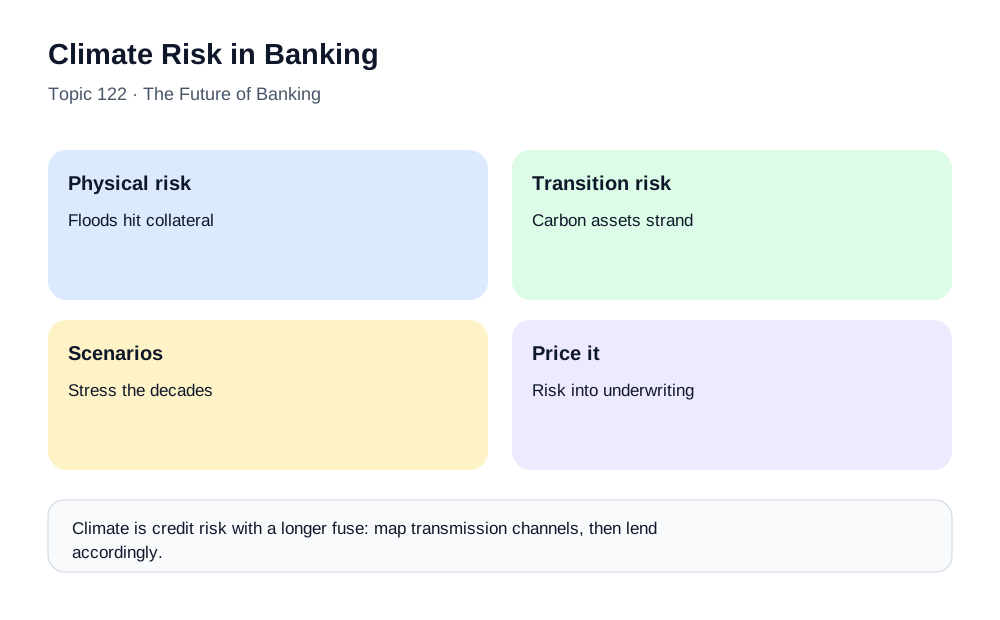
Climate Risk in Banking at a glance — Physical risk, transition risk, climate stress testing.
Physical Risk, Transition Risk, and Scenario Analysis for Banks
Climate change can create material financial risks for banks through physical impacts and the economic transition, with significance varying by geography, sector, portfolio and time horizon. It should be integrated with established risk categories rather than automatically described as the single defining banking risk of the century. Rising global temperatures, increasingly frequent and severe extreme weather events, and the ongoing transition to a low-carbon economy create financial risks capable of wiping out substantial portions of bank portfolios. Unlike conventional credit or market risks that have occupied bankers for generations, climate risk operates across extended time horizons, involves complex systemic interactions, and carries potentially irreversible consequences that defy traditional risk management approaches. The recognition that climate risk is financial risk has prompted regulators and institutions alike to develop sophisticated climate stress testing methodologies—modeling exercises that project how bank balance sheets will perform under various climate scenarios. Climate scenario exercises often use longer horizons than conventional solvency stress tests, sometimes extending for decades, but horizon and regulatory status differ across jurisdictions and exercises. Some are supervisory requirements, others exploratory or internal risk-management tools; current local rules should be checked before describing them as mandatory.
Climate risk manifests primarily through two distinct but interconnected channels, each requiring distinct analytical approaches and management strategies. Physical risks arise from the direct impacts of climate change on assets, operations, and economies, representing the consequences of a warming world on tangible property and economic activity. Acute physical risks include sudden catastrophic events such as floods, cyclones, wildfires, and heatwaves that cause immediate collateral damage, business interruption, and insurance claims. These events can devastate mortgaged properties, destroy agricultural assets, and disrupt supply chains, directly impairing loan portfolios and creating immediate losses. The increasing frequency and severity of such events as climate change accelerates means banks can no longer treat them as rare outliers but must incorporate heightened expectations of catastrophic losses into their risk models. Chronic physical risks develop gradually through persistent changes including rising sea levels, prolonged drought conditions, and shifting rainfall patterns that lead to long-term asset devaluation and agricultural loan defaults as formerly productive land becomes less viable. These slower-moving changes may be less dramatic than hurricanes or floods, but their cumulative impact on property values, agricultural productivity, and economic activity can be equally devastating to bank portfolios over time.
Coastal real estate faces particular vulnerability as sea level rise threatens property values and increases insurance costs, potentially leaving banks with underwater mortgages in both the literal and figurative senses. Properties that served as reliable collateral for decades may become uninsurable or unmaintainable as flooding becomes routine, creating gradual but inevitable impairment of mortgage portfolios concentrated in vulnerable regions. Banks must now evaluate not only current property values but projected values decades hence under various warming scenarios, fundamentally changing real estate underwriting.
Transition risks emerge from the process of moving toward a low-carbon economy and the associated changes in policy, technology, and market preferences. These risks are distinct from physical risks—they result not from climate change itself but from society's response to climate change, creating a different but equally significant category of financial exposure. Policy transition risks include carbon taxation, emissions regulations, and coal phase-out mandates that can strand carbon-intensive assets and increase compliance costs for borrowers. Technology transition risks occur as innovations like electric vehicles replace internal combustion engines and renewable energy supplants fossil fuels, rendering previously valuable assets obsolete long before the end of their expected useful lives. Market transition risks reflect shifting consumer preferences toward sustainable products and the growing influence of ESG investing, which can reduce revenues and access to capital for carbon-intensive companies. Reputation transition risks affect banks themselves when their financing of fossil fuel projects triggers activist campaigns, customer boycotts, and investor divestment. These transition risks compound with physical risks—a borrower facing both stranding of carbon assets and damage from extreme weather may experience distress that neither risk alone would cause, creating complex interaction effects that challenge traditional risk modeling.
The impact of climate risk varies significantly across different bank portfolios, requiring granular analysis by asset class and sector. Real estate mortgages face both physical risks from flood and fire damage to properties and transition risks from building energy efficiency regulations that may require costly retrofits or reduce values of non-compliant buildings. As jurisdictions implement stricter energy codes and carbon pricing for buildings, properties that cannot economically achieve compliance may face value impairment. Agricultural lending confronts drought and erratic rainfall leading to crop failures alongside water pricing and sustainable farming mandates that increase production costs. Farmers in water-stressed regions may find traditional practices economically unviable even as climate change reduces yields, creating a pincer movement of increasing costs and declining revenues. Energy sector financing must contend with infrastructure damage from extreme weather while managing the fundamental risk that coal and oil assets become stranded as the economy decarbonizes. A power plant that faces both physical damage from floods and policy-driven early retirement from carbon regulations represents a particularly acute risk concentration.
Auto portfolios can be affected by physical damage, insurance availability, technology transition and policy changes that influence vehicle demand and residual values. Future restrictions on new internal-combustion vehicle sales do not automatically make existing financed vehicles worthless, so residual-value effects should be modelled rather than assumed. As jurisdictions announce future bans on new internal combustion vehicle sales, the residual value of existing vehicles becomes increasingly uncertain, affecting both direct auto lending and securitization markets. Corporate lending encounters supply chain disruptions from climate events combined with carbon tax increases that raise operating costs. Companies with complex global supply chains face particular vulnerability as climate impacts cascade through supplier networks. Even sovereign bond portfolios carry climate risk, as country-level climate vulnerability and transition policies affect national GDP and debt servicing capacity. Nations heavily dependent on fossil fuel exports or particularly exposed to physical climate impacts may face credit downgrades as climate risks materialize.
Climate stress testing has emerged as the primary tool for quantifying these risks and preparing financial institutions for climate-related financial impacts. Unlike traditional stress tests that examine performance over one to five year horizons reflecting typical business cycle dynamics, climate stress tests model bank portfolio performance over ten to thirty year timeframes, reflecting the gradual but persistent nature of climate change and the long-duration assets typical in bank portfolios. The Network for Greening the Financial System publishes climate scenario frameworks used as reference points by many authorities and financial institutions. Membership, scenario vintages and modelling assumptions evolve, so current NGFS publications should be consulted rather than relying on a fixed membership count. These scenarios range from orderly transition pathways limiting warming to 1.5 degrees Celsius through early, smooth policy action with moderate physical risks, to disorderly transitions achieving the same temperature target but through late, sudden policy action that imposes moderate but sudden costs as economies scramble to catch up on delayed decarbonization efforts.
High-warming scenarios explore pathways in which physical risks become more severe because transition action is limited or delayed. They are scenarios rather than forecasts, and institutions should not attach unsupported probability labels such as 'increasingly unlikely' unless the exercise explicitly does so. Scenario narratives and temperature outcomes should be taken from the current scenario provider. Divergent net zero scenarios explore pathways where different sectors transition at different speeds, creating moderate but uneven physical and transition risks across the economy as some sectors decarbonize rapidly while others lag.
The climate stress testing process involves several interconnected stages that translate climate scenarios into financial impacts. Institutions begin by selecting climate scenarios aligned with their risk appetite and regulatory requirements, typically including both physical and transition risk pathways spanning different temperature outcomes. These scenarios are then mapped to economic variables including GDP growth trajectories, interest rate paths, carbon prices, and energy prices that would prevail under each scenario, drawing on integrated assessment models that link climate and economic dynamics. Sector-level impacts are modeled to understand how different industries—energy, real estate, agriculture, transportation—would be affected under each set of conditions, incorporating specific vulnerabilities and adaptation capacities.
These sector impacts are translated into bank-specific portfolio effects through adjustments to probability of default, loss given default, and collateral values for affected exposures, requiring detailed data on borrower locations, business models, and asset characteristics. The resulting capital impacts are calculated to determine potential losses and any necessary changes to capital requirements, potentially revealing significant capital shortfalls under adverse scenarios. Finally, board review and strategic decision-making processes incorporate these insights into business planning, risk appetite statements, and long-term strategy, potentially leading to portfolio rebalancing, sectoral limits, or new product development.
Regulatory requirements for climate stress testing continue to expand globally as supervisors recognize climate risks as systemic threats requiring coordinated response. The Reserve Bank of India has issued discussion papers on climate risk management for banks, signaling future supervisory expectations and establishing foundational principles for Indian institutions. The Bank of England conducted its Climate Biennial Exploratory Scenario in 2022, examining how banks and insurers would fare under various climate pathways and establishing methodologies that influenced subsequent exercises globally. The European Central Bank's 2022 climate stress test and other supervisory exercises highlighted data and risk-management gaps as well as potential financial impacts. Headline loss figures depend heavily on the scope, scenarios and methodology and should be quoted only with the original exercise context rather than treated as a general estimate of climate losses for European banks. The U.S. Federal Reserve conducted pilot climate scenario analysis with six large banks in 2023, exploring methodologies before potential broader implementation. These regulatory initiatives reflect growing recognition that climate risk poses systemic threats to financial stability that require coordinated supervisory response and that early assessment enables better preparation.
Substantial challenges complicate climate risk assessment and stress testing, limiting precision and comparability across institutions. Data gaps present perhaps the most significant obstacle, as granular emissions data for borrowers remains scarce and inconsistent. Banks often lack reliable information on the carbon intensity of their borrowers' operations, making it difficult to assess transition risk exposure. The long time horizons required for climate analysis—ten to fifty years—far exceed traditional risk modeling periods of one to five years, introducing tremendous uncertainty and making validation difficult given the absence of historical precedent for many projected conditions. Climate models themselves contain wide confidence intervals, and the scenarios used in stress testing necessarily simplify complex, interacting systems that defy precise prediction.
Climate-risk methodologies continue to differ across institutions even as common supervisory scenarios and industry practices improve comparability. Banks should document assumptions and use prescribed scenarios where required; it would be inaccurate to say every bank uses an entirely different approach. Value-chain and financed-emissions measurement is challenging because it depends on borrower data, estimation and attribution methodologies. Financed emissions can be much larger than a financial institution's direct operational footprint, but the exact proportion varies by institution, portfolio and methodology and should not be presented as a universal figure above ninety-five percent. The Partnership for Carbon Accounting Financials has developed standards for measuring these financed emissions, but implementation remains in early stages and data availability constrains accurate calculation. Climate risk also interconnects with credit, market, and operational risks in complex ways that defy simple siloed treatment, requiring integrated risk management approaches that many institutions have yet to develop.
Understanding a bank's carbon footprint requires examining three distinct scopes of emissions, each requiring different measurement approaches and management strategies. Scope 1 encompasses direct emissions from sources the bank owns or controls, including office buildings, vehicle fleets, and any manufacturing or processing facilities. These emissions are relatively straightforward to measure and manage through operational efficiency and renewable energy procurement. Scope 2 covers emissions from purchased energy, primarily electricity consumed by branches and data centers. These indirect emissions can be addressed through green energy purchasing and efficiency improvements. Scope 3 can include value-chain emissions associated with financing and investment under relevant accounting methodologies, and these can be substantial for many financial institutions. Their scale and relationship to climate risk depend on portfolio and calculation method. Operational emissions and financed emissions should be measured and managed for their respective purposes rather than reduced to one universal ratio.
The path forward requires continued investment in data infrastructure, modeling capabilities, and scenario development. Banks must build partnerships with borrowers to improve emissions data availability while developing internal expertise in climate risk assessment. Engagement with borrowers on climate risks and opportunities can improve data quality while supporting transition planning. Regulatory frameworks will continue evolving to incorporate climate considerations into capital requirements and supervisory assessments, potentially increasing capital charges for carbon-intensive exposures. The transition to a low-carbon economy presents both risks and opportunities, and institutions that develop robust climate risk management capabilities will be best positioned to navigate this transformation while supporting their clients through the energy transition. Climate risk management is no longer optional—it is an essential component of prudent banking in the twenty-first century.
As climate science advances and impacts become more visible, the financial sector's role in addressing climate change will only grow more central. Banks that position themselves as partners in the transition—providing green financing, advising on climate strategy, and developing innovative products for a low-carbon economy—will find significant business opportunities. Those that resist this transition or fail to prepare will face increasing regulatory pressure, reputational damage, and financial losses as climate risks materialize. The integration of climate risk into banking is not a temporary trend but a permanent shift in how financial institutions understand and manage risk. The time for preparation is now, before the most severe impacts arrive and while there is still opportunity to shape the transition constructively.
The geographic dimensions of climate risk add additional complexity for banks with diversified portfolios. Climate impacts vary dramatically across regions—some areas will face severe water stress while others deal with flooding; some agricultural regions will see yields increase while others experience collapse. Banks must understand these geographic variations and their implications for portfolio composition. Concentration of lending in climate-vulnerable regions creates systemic exposure that may not be apparent from aggregate portfolio statistics. Scenario analysis must incorporate regional climate projections and their economic implications. For multinational banks, this geographic complexity multiplies as they must assess risks across diverse climate zones and regulatory environments. The institutions that develop sophisticated geographic risk assessment capabilities will be better positioned to manage these complexities.
Climate risk also intersects with other emerging risks in complex ways that banks must learn to model. Pandemic risk, for instance, may interact with climate change as shifting disease vectors and population displacement create new health challenges. Cyber risk may increase as climate impacts disrupt infrastructure and create opportunities for malicious actors. Social instability may rise in regions hardest hit by climate impacts, affecting sovereign risk and political stability. Banks must develop integrated risk management approaches that can handle these interactions rather than treating risks in isolation. The complexity of these interconnections means that climate risk management will increasingly require interdisciplinary expertise—combining climate science, economics, data science, and traditional banking skills. Institutions that build these capabilities now will find themselves better prepared for the risk landscape of the future.
The disclosure of climate risks is becoming increasingly mandatory, with significant implications for bank transparency and market discipline. Regulators in major jurisdictions are requiring banks to report on their climate risk exposures, governance structures for managing climate risk, and strategies for addressing identified risks. These disclosures enable investors, depositors, and other stakeholders to assess how well banks are prepared for climate change and to allocate capital accordingly. Banks that are transparent about their climate risks and their plans to address them may benefit from increased investor confidence, while those that are opaque or dismissive may face higher capital costs and reputational damage. The discipline of public disclosure is a powerful force for improvement, as banks compete to demonstrate their climate preparedness to the market.
<!-- MBA-DEEP-DIVE-START -->Climate Risk in Banking Deepening — Transmission Channels, Scenario Analysis, Data, and Risk Management
Climate risk normally reaches the bank through familiar financial risks
A flood does not appear on a bank balance sheet as a new accounting line called “climate loss.” It damages a borrower's property, interrupts revenue, changes insurance cost or reduces collateral value, which then affects credit risk. Transition policy can change commodity prices, asset values or borrower profitability, creating credit and market risk. Severe weather can interrupt branches, data centres or suppliers, creating operational risk. Climate analysis is therefore strongest when it maps climate drivers into established risk categories rather than treating climate as a completely separate universe.
Physical risk has acute and chronic forms
Acute events include floods, cyclones, wildfire, extreme rainfall and heat episodes that create sudden damage or interruption. Chronic changes include rising average temperature, sea-level change, water stress and shifts in precipitation that develop over longer periods. The same borrower can face both. A property may experience repeated floods while insurance cost gradually rises. Underwriting and portfolio analysis should distinguish sudden event loss from persistent deterioration because the data, timing and mitigants differ.
Hazard, exposure and vulnerability are separate concepts
A climate hazard such as flood is not automatically a financial loss. The asset must be exposed to the hazard, and its vulnerability determines how much damage occurs. Two properties in the same flood zone can have different elevations, construction, drainage and protection. Climate-risk models should therefore avoid treating a postcode-level hazard score as a complete loss estimate. Granular asset information can materially change the financial interpretation.
Adaptation can reduce physical risk
Flood barriers, cooling systems, resilient building design, irrigation, water storage and supply-chain diversification can reduce vulnerability. Banks should consider credible adaptation when assessing customers rather than assume the climate hazard translates directly into loss. Adaptation itself has cost and execution risk, and some locations may remain uneconomic despite investment. The relevant question is residual risk after realistic adaptation, not hazard in isolation.
Insurance availability is an important transmission channel
A mortgaged property may remain physically usable but become expensive or difficult to insure. Higher premiums can reduce borrower affordability; reduced coverage can increase the bank's loss given default after an event. Banks should therefore monitor both hazard and insurance-market response where relevant. Insurance is a mitigant only while coverage is adequate, affordable and likely to pay under the event considered.
Collateral values can change before physical damage occurs
Buyers may discount properties in high-risk locations as information, insurance cost or regulation changes. This can reduce collateral value even without a disaster. Real-estate risk analysis should consider market perception and liquidity as well as direct damage. Climate risk can therefore affect loan-to-value and recovery expectations through forward-looking market repricing.
Geographic concentration can turn many small exposures into a material risk
A bank may have individually modest mortgages, farms or SME loans that are concentrated in one flood basin, coastal area or drought-prone region. Portfolio aggregation should identify common hazards. Geographic diversification only helps if exposures truly face different risk drivers. A national portfolio can still be concentrated if many borrowers depend on the same river system, crop or infrastructure network.
Location data quality is a first-order control
Climate models often need precise coordinates for properties or facilities. Customer address, registered office and actual operating site are not always the same. A corporate borrower can own several plants across different hazard zones. Banks should distinguish geocoded asset location from mailing address and track data confidence. Poor location data can dominate the uncertainty in physical-risk estimates.
Real estate requires asset-level characteristics where possible
Construction type, floor height, age, energy performance, flood defence and building use can affect vulnerability and transition cost. A portfolio model based only on property value and postcode may miss large differences. Banks should collect additional characteristics when proportionate to exposure and product. Data requirements should balance analytical value with customer burden and privacy.
Agriculture combines climate, commodity and borrower resilience
Drought or rainfall variability affects yield, but financial impact also depends on crop type, irrigation, input prices, insurance, commodity prices and farmer leverage. A climate scenario should not translate a rainfall shock directly into the same default increase for every agricultural borrower. Sector expertise and local data are necessary to understand adaptation and cash-flow resilience.
Supply-chain risk can transmit climate impacts across geography
A manufacturer far from a flood zone can still depend on a supplier or port in a vulnerable area. Physical-risk assessment for larger corporates may therefore examine critical suppliers, logistics and geographic diversification. Supply-chain mapping is difficult and should be targeted to material dependencies. The objective is to understand plausible interruption, not to map every supplier in the economy.
Transition risk can come from policy
Carbon pricing, emissions standards, product restrictions, building codes and disclosure requirements can raise cost or reduce demand for certain activities. The timing and severity depend on jurisdiction. A transition scenario should use explicit policy assumptions rather than generic statements that “carbon-intensive sectors will decline.” Borrowers can respond through technology investment, price changes or business-model adjustment.
Technology transition can create both risk and opportunity
New energy, transport or industrial technologies can reduce demand for older assets while creating financing needs for replacement infrastructure. Banks should assess whether customers can adapt, not simply classify a sector as high or low carbon. A conventional auto manufacturer investing successfully in electric vehicles can have a different risk path from one that delays transition. Company strategy matters within sector analysis.
Market transition can change customer demand and asset values
Consumer preferences, procurement standards and investor expectations can alter revenue or financing cost independently of formal regulation. These shifts are difficult to forecast. Scenario analysis should therefore test plausible changes rather than assert certainty about demand. Transition risk is not a guarantee that every high-emitting company becomes unprofitable.
Legal and liability risks can interact with climate strategy
Companies and financial institutions can face litigation or regulatory action relating to environmental damage, disclosure or misleading sustainability claims. The probability and impact vary by jurisdiction. Legal risk should be assessed through the relevant legal framework rather than added mechanically to a climate score. Climate-related litigation is a potential transmission channel, not a universal loss assumption.
Reputation is a secondary transmission mechanism that needs evidence
A bank may face stakeholder criticism for particular financing, but reputational impact depends on visibility, customer response, investor behaviour and management action. Risk assessments should state the plausible mechanism rather than use “reputation risk” as a catch-all. This improves consistency and prevents political or ethical views from being presented as quantified financial facts without evidence.
Climate scenarios are not forecasts
A scenario is a coherent set of assumptions used to explore vulnerability. The Bank of England, for example, explicitly described its Climate Biennial Exploratory Scenario pathways as illustrations rather than forecasts. Banks should not assign a probability to a scenario unless the methodology supports it. The purpose is to ask “what happens if this pathway occurs?” and identify sensitivity, data gaps and strategic weaknesses.
Scenario selection should cover materially different pathways
A useful set may contrast earlier transition, delayed transition and higher physical-risk outcomes. The exact names and assumptions should come from the scenario provider or internal design. Using several pathways helps management see whether a portfolio is more exposed to sudden transition cost or long-run physical damage. It also prevents the analysis from depending on one preferred narrative.
Time horizon should match the exposure and decision
A thirty-year climate pathway can be relevant to mortgages or infrastructure, while a one-year revolving facility may reprice or mature much sooner. Short contractual maturity does not eliminate climate risk if the bank expects to refinance the customer repeatedly, but horizon should be explicit. Scenario analysis can examine both contractual exposure and strategic relationship horizon.
Static and dynamic balance sheets answer different questions
A static exercise holds today's portfolio broadly fixed to reveal vulnerability of current exposures. A dynamic exercise allows the bank and customers to adapt over time. Static analysis can overstate losses if the bank would realistically reduce risk, but dynamic analysis can become optimistic if assumed management actions are unconstrained. Both can be useful when their purpose and assumptions are clear.
Management actions should not be assumed without feasibility
A scenario model may say the bank will exit a risky sector, increase prices or require collateral. In a system-wide stress, every lender may try to do the same thing, and customers may have limited refinancing options. Management actions should be specific, consistent with contracts, market capacity and customer strategy. Scenario results are more credible when actions are constrained realistically.
Macro variables are the bridge from climate narrative to financial models
Climate scenarios may provide GDP, inflation, energy prices, carbon prices, unemployment and interest-rate paths. Banks then translate these into sector and borrower impacts. This bridge is a major source of model uncertainty. Teams should document which variables drive credit models and where expert judgment fills gaps. The climate scenario alone does not produce a bank loss number.
Sector pathways should be granular enough to be meaningful
An “energy” sector contains renewable generators, grid operators, oil producers and service companies with very different transition exposures. “Transport” includes airlines, rail, shipping and electric-vehicle manufacturers. Banks should segment material portfolios where business models differ significantly. Overly broad sectors can hide both risk and opportunity.
Borrower-level analysis improves on sector averages
A company in a high-transition sector may have strong cash flow, low leverage and a credible transition investment plan. Another in the same sector may have obsolete assets and no capital plan. Scenario analysis can use sector stress as a starting point and incorporate borrower-specific information for large exposures. This is particularly important for concentrated corporate portfolios.
Probability of default adjustments should have an economic rationale
A climate stress may reduce borrower earnings or increase costs, which can then affect financial ratios used in credit models. Directly adding an arbitrary percentage to PD because a customer has a “high climate score” is harder to defend. Banks should link climate variables to cash flow, rating drivers or collateral where possible. Transparent transmission improves validation.
Loss given default can change through collateral and insurance
Physical damage, lower property liquidity or reduced insurance can lower recovery after default. Transition can also strand specialised equipment or facilities. LGD impacts should reflect collateral type and enforceability. A change in borrower PD and collateral LGD can interact, making total loss more severe than changing only one input.
Exposure at default may also change
Customers can draw committed credit lines during stress, especially when cash flow deteriorates. Climate-related disruption could therefore increase exposure before default. Scenario analysis should consider whether existing EAD models capture this behaviour. Infrastructure or project finance can also require additional funding to complete adaptation or transition investment.
Market risk can arise from repricing before default
Bonds, equities and traded instruments can lose value as climate expectations change even if the issuer continues to meet obligations. Trading and investment portfolios therefore need different modelling from loan books. Market liquidity can also fall in stressed sectors. Climate analysis should connect to the bank's existing market-risk framework rather than force everything through credit loss.
Liquidity risk can emerge indirectly
A severe physical event may trigger deposit withdrawals, insurance-related payment flows or customer drawdowns. Transition shocks can also affect market funding or collateral values. The materiality varies by institution, and climate-liquidity modelling is less mature than credit analysis. Banks should at least identify plausible transmission channels before deciding they are immaterial.
Operational resilience includes the bank's own climate exposure
Branches, offices, data centres, telecommunications and critical suppliers can be disrupted by heat, flood, storm or water stress. Business-continuity plans should incorporate local hazards where relevant. Moving processing to the cloud does not eliminate physical risk because cloud regions and network infrastructure are also physical assets. Supplier concentration matters.
Data centres face both physical and transition considerations
Cooling, electricity supply and water availability can be affected by climate conditions, while transition policy changes energy cost and source. Banks using cloud services should understand provider resilience and region diversification for critical workloads. Climate risk can therefore appear within technology and third-party risk management, not only lending portfolios.
Climate data should record source and vintage
Hazard maps, emissions datasets and scenario variables are updated as science and methodology improve. A historic analysis should be reproducible using the data vintage that applied at the time. Versioning prevents unexplained changes in risk scores. It also allows management to distinguish true exposure change from a new model or dataset.
Downscaling introduces uncertainty
Global climate models operate at scales larger than individual properties. Vendors may downscale projections to local areas using statistical or physical methods. The resulting map can look precise, but uncertainty remains. Banks should understand confidence and avoid treating a precise coordinate risk score as a guaranteed future event. Model resolution is not the same as predictive certainty.
Hazard metrics should be tied to financial relevance
A temperature anomaly may matter to agriculture or labour productivity but be less relevant to a particular office mortgage. Flood depth, frequency or heat days should be selected according to asset vulnerability. A generic climate score that combines many hazards can be useful for screening but may be too opaque for underwriting. Material exposures often need more specific analysis.
Emissions are transition indicators, not complete transition risk
A high-emitting company can have a credible funded plan to reduce emissions; a lower-emitting company can depend on customers or suppliers exposed to transition. Emissions data should be combined with technology, policy, financial capacity and business strategy. Portfolio carbon intensity is not a substitute for credit analysis.
Transition plans should be assessed for execution capability
Targets are stronger when supported by governance, capital expenditure, technology choices, milestones and performance tracking. Banks can use these elements to judge whether a customer can adapt under a transition scenario. A distant net-zero target without near-term investment provides limited risk evidence. Transition planning can therefore enrich forward-looking credit assessment.
Climate scenario results are highly uncertain
Long horizons, uncertain policy, changing technology and incomplete data mean loss estimates should not be presented with false precision. Management can use ranges, sensitivity and qualitative findings. The Bank of England's 2022 CBES explicitly highlighted uncertainty and data gaps. Scenario analysis is valuable because it reveals vulnerability even when the exact loss number is not forecastable.
Sensitivity analysis shows which assumptions matter
Banks can vary hazard severity, carbon price, borrower adaptation, insurance coverage or management action to see how results change. If the result depends heavily on one weak assumption, management should know. Sensitivity can be more informative than producing one elaborate central estimate. It also guides data-improvement priorities.
Validation should challenge climate-specific components and integration
Model validation can assess scenario mapping, data, assumptions, borrower segmentation, financial translation and aggregation. It should also test how climate components connect to existing credit or market models. A climate vendor score may be outside the traditional model inventory in some institutions but still requires challenge if it materially affects decisions. Governance should follow consequence.
Backtesting has limits for long-horizon climate risk
Historical weather events can test parts of physical-risk models, but future climate conditions may exceed past experience. Transition scenarios also involve policy and technology combinations with limited precedent. Banks should therefore combine historical testing with conceptual review, sensitivity and benchmark comparison. Lack of perfect backtesting does not justify no analysis; it changes how confidence is established.
Climate risk appetite should translate into decision rules
A bank can define exposure limits, enhanced due diligence, data requirements or escalation for material climate-sensitive sectors or geographies. Risk appetite should distinguish risk from sustainability preference. A high physical-risk exposure may still be acceptable with strong collateral and adaptation; a transition-sensitive borrower may be acceptable with credible strategy. Appetite should support consistent judgment rather than blanket labels.
Pricing can reflect risk only when the risk estimate is usable
Banks may eventually incorporate climate effects into credit pricing where they can quantify expected loss or capital impact reliably. Adding a generic “climate premium” without evidence can create conduct and model risk. Pricing should remain connected to established credit economics, with climate factors entering through defensible risk drivers.
Tenor management can be a risk tool but not a complete solution
Shorter maturity can reduce exposure to long-horizon uncertainty, but it can also leave the bank repeatedly refinancing a vulnerable borrower. Relationship strategy should consider expected renewal and transition needs. Climate risk should not be hidden by contractual maturity when the commercial intention is long-term funding.
Covenants can support data and transition monitoring
Large corporate or project financings can include requirements to provide environmental data, maintain insurance or deliver agreed transition milestones where appropriate. Covenants should be specific and enforceable. Vague commitments to “improve sustainability” create little control value. The credit team should know what happens if the covenant is breached.
Portfolio steering should distinguish risk reduction from real-economy transition
Selling or declining a high-emitting exposure can reduce the bank's reported portfolio emissions without changing the underlying asset. Engagement and transition finance may have different real-world effects. The bank should be clear whether a target is designed to manage its financial risk, reduce financed-emissions metrics, support transition or achieve several objectives. These goals can require different actions.
Climate opportunity should be assessed with ordinary risk discipline
Renewable energy, efficiency, adaptation and clean technology can create financing opportunities. They also carry construction, technology, policy, merchant-price and counterparty risk. Banks should not assume a green sector guarantees good returns. Opportunity analysis should use the same credit and project-finance discipline as other growth areas.
Board reporting should communicate uncertainty clearly
Boards need exposure, scenario sensitivity, data quality, concentration, material risk and management actions. They do not need hundreds of climate indicators without decision relevance. Reports should distinguish observed data from modelled estimates and scenario results from forecasts. Good governance helps leadership make informed choices without overstating what climate models can know.
Disclosure should align with internal risk processes
Public climate disclosures are more credible when the metrics, scenarios and governance described are actually used internally. If external reporting uses one portfolio boundary while risk management uses another, inconsistencies can emerge. Disclosure controls should reconcile definitions and preserve evidence. Climate reporting is not merely a communications exercise.
The practical goal is resilience under uncertain transition and physical conditions
Climate-risk management is not about predicting the exact temperature, carbon price or flood loss decades ahead. It is about identifying where the bank and its customers are vulnerable, understanding plausible transmission channels, improving data, testing strategy and taking proportionate action. Scenario analysis is valuable when it changes risk understanding and preparedness, even though its numbers remain uncertain. A world-class bank integrates climate evidence into established risk governance without pretending long-horizon scenarios are precise forecasts.
Turning climate risk into ordinary banking decisions
Climate risk becomes useful to a bank only when teams can explain how a climate-related driver changes a customer, asset, portfolio, market position, or operating process. The phrase is often discussed at a high level, but banking decisions require a transmission chain. A flood does not create credit loss merely because it is a climate event. Loss may arise because a borrower's premises are damaged, production stops, insurance is inadequate, collateral value falls, customers move elsewhere, repair costs consume liquidity, and debt service becomes difficult. A transition policy does not automatically create market loss; the effect depends on how it changes costs, technology choices, customer demand, asset values, and financing needs.
This transmission-chain approach keeps climate analysis connected to familiar risk categories. Physical and transition drivers can influence credit, market, liquidity, operational, insurance, strategic, conduct, and reputational risks. The purpose is not to create a separate risk universe but to identify risk drivers that traditional short-horizon analysis may overlook or understate.
Distinguish physical and transition risk without oversimplifying them
Physical risk includes acute events such as storms, floods, wildfire, extreme heat, or other severe weather as well as chronic shifts such as changing temperature, water availability, sea level, or recurring heat stress. The impact depends on location, exposure, vulnerability, adaptation, insurance, and the wider infrastructure around the asset. Two properties in the same region can have different risk because of elevation, building standards, drainage, backup power, or access routes.
Transition risk arises from changes associated with moving toward a lower-carbon economy. Drivers can include technology, energy economics, regulation, taxation, consumer preferences, investor expectations, litigation, supply-chain requirements, and changing asset values. The same transition can create both downside and opportunity. A manufacturer may face higher costs for an old process while gaining new demand if it invests successfully in an alternative technology.
Physical and transition risk can interact. A business may invest heavily to adapt to physical hazards at the same time that its core product faces declining demand. A household may improve a property's energy efficiency but still face rising insurance costs because of physical exposure. Credit analysis should therefore avoid assigning customers to a single climate-risk box.
Geography matters, but location data needs context
Location is central to physical-risk analysis, yet address data alone is not enough. Banks may need to understand where customers live, where collateral sits, where factories and warehouses operate, where suppliers are concentrated, and where critical infrastructure connects the business. A corporate borrower headquartered in a low-risk city may depend on a single production site or supplier in a high-risk region.
Geospatial tools can help identify exposures, but model output needs careful interpretation. A hazard score may estimate the probability or intensity of an event without describing the financial effect. Analysts still need to understand vulnerability, adaptation, insurance, replacement cost, business continuity, and customer behaviour. A high hazard score for a resilient asset may produce less loss than a moderate hazard affecting a fragile operation with no alternatives.
Data quality is also important. Customer and collateral addresses can be incomplete, outdated, or recorded at an administrative rather than physical location. Location data should therefore have ownership, validation, and refresh processes before it is relied upon for portfolio conclusions.
Climate risk enters credit decisions through cash flow and collateral
For lending, the practical questions are familiar. Could revenue decline? Could operating cost rise? Is capital expenditure required? Could insurance become more expensive or unavailable? Could collateral value become more volatile? Does the borrower have enough liquidity to absorb disruption? Can management adapt its business model? Are suppliers or customers concentrated in exposed sectors or regions?
A bank does not need perfect climate forecasts to ask these questions. It can identify sectors and customers where the financial sensitivity is material and deepen analysis there. An agricultural borrower may be sensitive to water and heat. A property borrower may depend on location, energy efficiency, insurance, and tenant demand. An industrial borrower may face technology replacement and energy-price exposure. A transport borrower may need significant fleet investment and supporting infrastructure.
Collateral analysis should also look beyond current market value. The bank may consider whether physical damage, insurance changes, building standards, obsolescence, or buyer preferences could affect future liquidity and recovery value. This does not mean applying arbitrary discounts. It means ensuring that valuation assumptions are challenged when climate-related drivers could materially alter the asset's economics.
Insurance is an important risk mitigant but not a complete answer
Insurance can reduce the financial impact of some physical events, but the bank should understand coverage limits, exclusions, deductibles, policy renewal risk, claim delays, and the borrower's ability to fund uninsured losses. The presence of an insurance policy does not prove that all relevant business interruption or collateral risk has been transferred.
Banks can also monitor whether insurance availability or affordability is changing in exposed regions. A property can remain physically usable while becoming harder to finance if insurance becomes expensive or limited. That can affect marketability and collateral value. The analysis should therefore connect insurance conditions to the customer's total financial position rather than treat insurance as a simple yes-or-no field.
Scenario analysis should reveal vulnerabilities, not pretend to predict the future
Climate scenarios are useful because long-term outcomes are uncertain. A scenario can explore different combinations of temperature, policy, technology, energy prices, market behaviour, and physical hazards. The bank can then ask how exposures respond. The output is not a forecast with guaranteed probabilities. Its value lies in exposing concentrations, dependencies, and management choices.
Good scenario analysis documents assumptions and transmission mechanisms. If a portfolio shows deterioration under a transition scenario, teams should understand whether the result comes from carbon costs, lower demand, stranded assets, refinancing needs, capital expenditure, or another driver. If physical losses increase, analysts should know which hazards, locations, and asset vulnerabilities create the result. This allows the bank to take targeted action instead of reacting to a single aggregate number.
Management actions should be treated carefully. It is unrealistic to assume that no borrower adapts over a long horizon, but it is equally unrealistic to assume that every borrower adapts successfully at no cost. Scenario analysis can consider different levels of adaptation and investment while making those assumptions transparent.
Portfolio concentration can matter more than individual risk scores
A bank may have many individually manageable exposures that become significant when concentrated in one geography, sector, technology, insurer, or supply chain. Portfolio analysis can therefore examine clusters rather than only customer-level scores. Concentration is especially important where a single event can affect many borrowers simultaneously or where the same transition driver influences a whole industry.
The bank can connect concentration analysis to risk appetite, sector strategy, underwriting guidance, pricing, collateral standards, client engagement, or portfolio diversification. The response need not always be to reduce exposure. In some cases the better action is to understand adaptation plans, require stronger information, structure financing appropriately, or support investment that reduces vulnerability.
Operational risk belongs inside climate analysis
Banks themselves rely on offices, branches, data centres, telecommunications, power, transport, staff availability, suppliers, and financial-market infrastructure. Physical events can disrupt these dependencies. Operational resilience planning should therefore consider whether critical services remain available when a location, utility, or supplier is affected.
A bank may have redundant technology while still depending on employees who cannot reach an operations centre. A cloud service can be geographically resilient while a local telecommunications outage prevents customer access. Business continuity analysis should connect technology, people, facilities, third parties, and customer channels rather than assuming that technical redundancy alone solves the problem.
Transition changes can also create operational workload. New product criteria, customer-data requests, disclosures, or portfolio reviews may increase manual processing and require new systems. A climate programme can therefore create operational risk if the organisation introduces complex controls without sufficient data, training, or workflow design.
Data uncertainty should be visible, not hidden
Climate data often combines customer reporting, vendor datasets, location models, sector averages, and internal estimates. The bank should distinguish observed facts from estimates and show where coverage is incomplete. A precise-looking score can create false confidence if it is built on generic assumptions.
Important data should have lineage. Teams should know the source, methodology, date, owner, update frequency, and permitted use. If a customer provides better information, the bank should be able to replace an estimate without leaving inconsistent versions across credit files, risk systems, and reports. Where external vendors are used, the bank should understand enough of the methodology to interpret the output and challenge obvious anomalies.
Climate risk should influence client conversations constructively
Risk management does not need to become a simple exclusion exercise. Banks can use climate analysis to understand customer investment needs. A borrower may require financing for energy efficiency, resilient infrastructure, new equipment, building upgrades, water management, fleet replacement, or supply-chain diversification. Understanding those needs can improve both credit analysis and relationship management.
The strongest conversations focus on the customer's operating plan. What assets need to change? What will it cost? How is the investment financed? What happens if implementation is delayed? Which technologies are proven? Which dependencies sit outside management's control? How does the plan affect near-term leverage and cash flow? These questions connect transition strategy directly to banking fundamentals.
A practical property-lending example
Consider a commercial property financed by a bank. A weak climate assessment might assign the property a generic physical-risk score and stop there. A stronger assessment begins with precise location and hazard exposure, then examines building design, flood protection, backup power, access, insurance, tenant mix, lease structure, energy performance, expected capital expenditure, local infrastructure, and market demand.
Suppose the property faces moderate flood exposure but has strong protection and insurance. The immediate credit risk may remain acceptable. However, if insurance premiums are rising, tenants increasingly prefer more resilient buildings, and future upgrades require significant expenditure, the bank should understand how those factors affect net operating income, refinancing capacity, and collateral liquidity. The resulting decision may involve monitoring, covenant information, additional analysis, or financing for adaptation rather than an automatic decline.
Climate risk management is therefore most useful when it behaves like disciplined banking analysis: identify the driver, trace the financial mechanism, understand uncertainty, test concentration, examine mitigants, assign ownership, and connect the result to a real decision. The bank does not need certainty about the distant future. It needs a defensible process for recognising material vulnerabilities early enough to manage them.
<!-- MBA-DEEP-DIVE-END -->