Visual overview
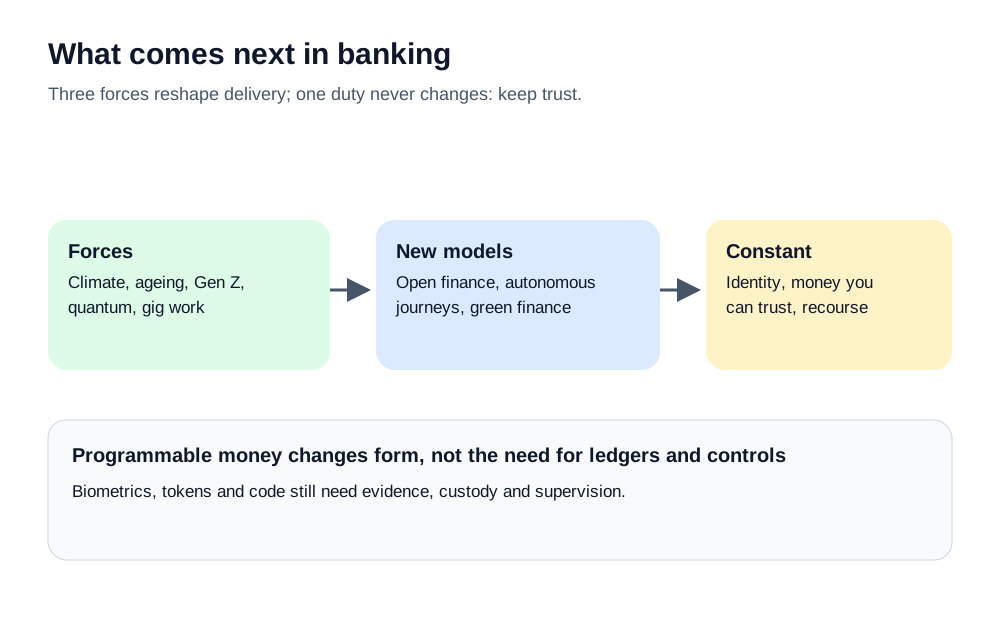
Phase 13 map: climate, demographic and technology forces → open, autonomous, sustainable models. Trust stays constant.
Environmental, Social, and Governance Factors in Financial Services
The world of banking is undergoing a profound transformation, one that extends far beyond the traditional metrics of profitability and risk-adjusted returns. Environmental, Social, and Governance factors—collectively known as ESG—are fundamentally reshaping how financial institutions lend, invest, and operate in the modern economy. What began as a niche concern among socially conscious investors has evolved into a mainstream financial imperative, with climate change, social inequality, and corporate governance failures now recognized as material financial risks that can no longer be ignored or treated as peripheral considerations. This shift has become an important development in banking risk, disclosure, product design and capital allocation, although its importance and regulatory form differ by jurisdiction and should not be ranked against every previous change in banking history.
Banks today find themselves at a critical crossroads. Banks can face financial, legal, disclosure, conduct and reputational consequences when material environmental, social or governance risks are poorly managed. They can also finance transition, adaptation and other sustainable economic activity. The size and profitability of these opportunities, and the relevance of particular ESG factors, vary by market and should be evaluated through current evidence rather than broad claims about inevitable winners and losers. This evolution represents not merely a trend but a fundamental restructuring of how capital flows through the global economy, with banks serving as the primary gatekeepers determining which industries thrive and which fade into obsolescence.
Understanding ESG requires examining its three interconnected pillars, each addressing distinct dimensions of corporate responsibility and sustainable business practices. The environmental component encompasses climate change mitigation and adaptation efforts, carbon emissions reduction initiatives, pollution prevention measures, deforestation concerns, water usage sustainability, waste management practices, and biodiversity protection. These factors assess how a company's operations impact the natural world and how environmental changes might, in turn, affect the company's financial performance. For banks, environmental assessment means scrutinizing not only their own operational footprint but the environmental impact of their entire lending and investment portfolios. A bank financing coal mining operations faces fundamentally different environmental risks than one focused on renewable energy projects, and these differences translate directly into financial performance over time.
The social pillar examines labor practices and working conditions throughout supply chains, workforce diversity and inclusion metrics, human rights protections, community impact of business operations, customer protection and fair treatment, data privacy practices, and contributions to financial inclusion. This dimension recognizes that sustainable business depends on healthy societies and fair treatment of all stakeholders. Banks must evaluate how borrowers treat their employees, whether they maintain safe working conditions, how they interact with local communities, and whether their products serve broader social good. Social factors can affect financial performance through workforce stability, legal liability, supply-chain disruption, customer trust and other channels. Evidence varies by factor, sector and period, so banks should not assume a universal causal relationship between a particular social metric and superior financial returns.
The governance pillar evaluates board composition and independence, executive compensation structures and alignment with long-term performance, transparency and disclosure practices, anti-corruption measures and ethical business conduct, shareholder rights protections, and overall corporate ethics. Strong governance provides the foundation upon which environmental and social commitments can be built and maintained. Banks must assess whether borrowers maintain adequate oversight mechanisms, whether incentives align with sustainable value creation, and whether ethical standards permeate organizational culture. Governance failures have precipitated some of history's most costly corporate collapses, making this assessment essential to prudent risk management.
The role of banks as capital allocators gives them extraordinary influence over the direction of economic development. Through their lending decisions, banks determine which businesses and industries receive the financial resources necessary for growth. When banks choose to finance renewable energy projects rather than coal-fired power plants, or when they prioritize loans to companies with strong labor practices, they actively shape the economy's trajectory. This allocative function carries profound responsibility—capital directed toward sustainable enterprise builds long-term prosperity, while capital supporting destructive practices perpetuates harm that ultimately threatens financial stability. Investment portfolios similarly direct trillions of dollars toward either sustainable or unsustainable activities, with institutional investors increasingly demanding ESG integration in their mandates. Major pension funds, insurance companies, and asset managers now explicitly screen investments for ESG compliance, creating powerful market incentives for corporate sustainability.
Risk management has evolved substantially to recognize that climate risk is fundamentally financial risk. Droughts disrupt agricultural loan portfolios, floods damage mortgaged properties, and transition risks create stranded assets as regulations and market preferences shift away from carbon-intensive industries. Banks that fail to account for these risks in their underwriting and pricing models face unexpected losses as climate impacts materialize. Some banks have made voluntary climate or net-zero commitments individually or through industry initiatives, while participation, governance and targets in such initiatives can change over time. Voluntary commitments should be distinguished from binding law and supervisory requirements, and current membership or target figures should be checked before quotation.
The financial materiality of ESG factors becomes evident when examining specific scenarios in detail. A loan to construct a coal power plant may seem sound today based on current demand and cash flow projections, but as regulations increasingly phase out coal-fired electricity generation worldwide, that asset becomes "stranded"—unable to generate sufficient returns to service its debt. The plant may face forced early retirement, leaving the bank with significant losses and legal complications. Similarly, lending to companies involved in deforestation exposes banks to reputational damage and activist campaigns that can affect stock prices and customer relationships. Major international banks have faced sustained protests and divestment campaigns over their financing of Amazon deforestation, demonstrating how ESG issues translate into tangible business impacts. Poor governance at borrowing companies correlates directly with higher probabilities of fraud and default, making governance assessment an essential component of credit analysis. The collapse of well-known corporations due to governance failures has cost lenders billions, reinforcing the financial materiality of these factors. Climate-vulnerable real estate presents particularly acute risks, as increasing flood and fire frequency drives up insurance costs and reduces collateral values, potentially leaving banks with impaired mortgage portfolios across large geographic regions.
Green finance has emerged as a powerful mechanism for channeling capital toward environmentally beneficial projects while generating competitive returns for investors and lenders. Green bonds represent one of the most significant developments in this space, with bond proceeds dedicated exclusively to funding environmental projects such as renewable energy installations, clean transportation infrastructure, sustainable water management systems, and energy efficiency improvements. Green bond issuance has grown substantially across sovereign, corporate and financial issuers, but cumulative market totals change continuously and depend on classification methodology. Current recognised market data should be consulted before quoting a global issuance figure. Green loans similarly provide financing specifically earmarked for renewable energy development, energy efficiency improvements, and clean transportation initiatives, allowing banks to directly support sustainable projects while earning appropriate risk-adjusted returns.
Sustainability-linked loans add an innovative dimension by tying interest rates to borrowers' ESG performance—companies that meet predetermined sustainability targets enjoy reduced borrowing costs, creating direct financial incentives for improved environmental and social practices. These instruments align borrower and lender interests around sustainability outcomes, embedding ESG performance into the fundamental economics of lending relationships. Carbon markets and sustainability-labelled investment products can support climate and ESG objectives, but market design, credit quality, accounting, regulation and investor definitions vary significantly. Global ESG-assets-under-management totals are especially sensitive to methodology and changing fund labels, so fixed headline values should not be treated as enduring facts. India has issued sovereign green bonds under the Government of India's sovereign green bond framework, with the Reserve Bank acting as debt manager for government securities. The programme can provide sovereign sustainable-finance reference points, but issue dates, amounts and market effects should be verified from current official government and RBI sources.
The integration of ESG factors into banking operations occurs across multiple dimensions, requiring systematic changes to traditional practices. Some banks use exclusion or enhanced-review policies for selected sectors based on law, risk appetite, voluntary commitments or stakeholder expectations. The sectors and thresholds differ by institution. ESG integration should not be taught as a universal requirement to exclude tobacco, weapons, thermal coal or any other sector unless the specific bank policy or applicable rule says so. ESG scoring systems rate borrowers on their environmental and social performance, informing credit decisions and pricing with quantified assessments of sustainability factors. Borrowers meeting stringent ESG criteria may receive preferential interest rates, while loan covenants increasingly require ongoing ESG compliance as a condition of credit extension. Monitoring systems track borrower ESG performance throughout the loan lifecycle, enabling early identification of emerging risks and facilitating engagement to address deteriorating conditions.
Investment approaches have similarly evolved to incorporate ESG considerations systematically. Negative screening excludes companies in harmful industries from portfolios entirely, while positive screening actively favors companies demonstrating strong ESG performance relative to peers. ESG integration incorporates environmental, social, and governance factors into all investment analysis and decision-making processes rather than treating them as separate considerations. Impact investing goes a step further, targeting investments specifically designed to generate measurable social or environmental impact alongside financial returns, with explicit impact metrics tracked alongside financial performance.
Regulatory momentum behind ESG continues to accelerate globally, transforming voluntary initiatives into binding requirements. In India, the Reserve Bank of India has issued climate risk guidelines for banks and established a framework for green deposits, while the Securities and Exchange Board of India mandates Business Responsibility and Sustainability Reporting for listed companies, creating standardized disclosure requirements that enable meaningful comparison and assessment. The European Union has implemented comprehensive regulations including the Sustainable Finance Disclosure Regulation and the EU Taxonomy for sustainable activities, creating standardized frameworks for ESG classification and reporting that affect any bank operating in European markets. The United Kingdom has made Task Force on Climate-related Financial Disclosures mandatory for large companies and financial institutions, requiring detailed reporting on climate risks and opportunities. At the international level, the Basel Committee on Banking Supervision has established climate risk management principles for banks, signaling that climate considerations will increasingly factor into capital adequacy and supervisory assessments.
Despite remarkable progress, significant challenges impede full ESG implementation across the banking industry. Greenwashing—the practice of companies or banks claiming ESG credentials without substantive underlying practices—undermines market integrity and erodes trust. Customers and investors struggle to distinguish genuine sustainability commitments from marketing exercises, complicating decision-making and potentially rewarding superficial efforts over meaningful change. Data quality remains problematic, with ESG data often inconsistent, self-reported without independent verification, and difficult to compare across companies and jurisdictions. The absence of universal measurement standards means that ESG ratings from different providers frequently diverge dramatically for the same company, confusing investors and limiting comparability. The transition to sustainable business models requires substantial upfront investment that may reduce near-term profitability, creating tension between quarterly earnings expectations and long-term sustainability goals. Perhaps most critically, ESG standards developed in wealthy nations may not adequately account for the development priorities and constraints facing emerging economies, potentially disadvantaging businesses in countries like India that are balancing growth imperatives with sustainability concerns.
Sustainable-finance considerations are increasingly relevant to risk management, disclosure and product strategy, but their regulatory status and materiality vary by jurisdiction and portfolio. Banks should integrate factors where they are financially material, legally required or consistent with approved strategy, while avoiding unsupported claims that one ESG approach guarantees competitiveness or that another inevitably leads to obsolescence. The banks that thrive in coming decades will be those that recognize sustainability not as a constraint but as a source of competitive advantage and long-term value creation.
Looking ahead, the integration of ESG into banking will only deepen as regulatory requirements tighten, investor expectations rise, and climate impacts become more pronounced. The banks that develop robust ESG capabilities now—sophisticated measurement systems, experienced sustainability teams, and embedded ESG processes—will find themselves well-positioned as these trends accelerate. Those that delay will face a steep and potentially expensive catch-up process as markets and regulators leave them behind. The transformation of banking through ESG is not a question of if but of how quickly, and the winners will be those who move decisively to make sustainability central to their mission and operations.
The implications of ESG for banking extend beyond risk management and compliance to encompass fundamental business model transformation. As the global economy transitions toward sustainability, entirely new industries will emerge while others decline. Banks that develop expertise in financing renewable energy, circular economy businesses, sustainable agriculture, and green technologies will find significant growth opportunities. Those that remain focused on declining carbon-intensive sectors will face shrinking markets and increasing regulatory pressure. Product innovation will be essential—new lending structures that share sustainability risk, insurance products that cover climate adaptation investments, and investment vehicles that democratize access to green finance will all be needed. The banks that lead in these innovations will capture market share and customer loyalty.
Employee expectations are also shifting, with talented professionals increasingly seeking employers whose values align with their own. Banks with strong ESG commitments find it easier to attract and retain top talent, particularly among younger workers who prioritize purpose alongside compensation. This human capital advantage compounds over time as strong teams drive innovation and execution. Conversely, banks perceived as laggards on sustainability may find themselves unable to compete for the best talent, further hampering their ability to adapt. The ESG transformation of banking is thus not only about managing risks and capturing opportunities—it is also about building organizations capable of thriving in a world where sustainability is increasingly central to how business is conducted.
The measurement and reporting of ESG performance continues to evolve, with significant implications for how banks track and communicate their progress. Current frameworks such as the Global Reporting Initiative, Sustainability Accounting Standards Board, and Task Force on Climate-related Financial Disclosures provide structure, but standardization remains incomplete. Banks often face multiple, sometimes conflicting reporting requirements across jurisdictions where they operate. The development of more consistent global standards would reduce reporting burden and improve comparability, but progress has been slow given differing regional priorities and regulatory philosophies. Banks must invest in robust data collection and reporting systems capable of meeting current requirements while adapting to future standardization. Those that develop best-in-class ESG reporting capabilities will find it easier to meet regulatory demands and communicate with investors, while those that lag will face increasing compliance costs and reputational risks.
The integration of ESG into bank culture is perhaps the most challenging aspect of the sustainability transformation. Policies and procedures are necessary but not sufficient—true ESG integration requires that sustainability becomes part of how people throughout the organization think and make decisions. This cultural change starts with leadership commitment, as employees look to senior management for signals about what is truly valued. Training and development programs can build ESG awareness and capabilities across the organization. Incentive structures must align with ESG goals, ensuring that employees are rewarded for sustainable outcomes, not just short-term financial results. The banks that succeed in embedding ESG into their culture will find that sustainability becomes self-reinforcing, while those that treat it as a compliance exercise will struggle to achieve meaningful change.
<!-- MBA-DEEP-DIVE-START -->ESG and Sustainable Banking Deepening — Materiality, Products, Data, Controls, and Customer Outcomes
ESG is a lens for different risk and strategy questions
Environmental, social and governance factors should not be treated as one single risk score. Environmental analysis can cover climate, pollution, water or biodiversity. Social analysis can cover labour, human rights, customer treatment or community impact. Governance can cover ownership, board oversight, corruption or control quality. The factors relevant to a mortgage portfolio differ from those relevant to project finance or securities investment. Banks should identify the specific decision and material risk channel rather than simply asking whether a customer has a “good ESG score.”
Financial materiality asks how sustainability factors affect the bank or borrower
A drought can reduce agricultural cash flow, a carbon price can raise a manufacturer's costs, poor labour practices can disrupt production and weak governance can increase fraud or strategic risk. These are mechanisms through which ESG factors can affect credit, market, operational or reputational outcomes. Materiality analysis should explain the mechanism, time horizon and evidence. A factor should not be added to credit pricing merely because it appears on a generic ESG checklist.
Impact materiality asks a different question
Some reporting and sustainability frameworks also examine how a company or financial institution affects people and the environment. That question is different from asking how those matters affect financial value. The two can overlap but should not be confused. A bank may have a financially small exposure that creates significant environmental impact, or a financially material climate risk from an activity where the bank's own financed impact is modest. Clear terminology prevents risk analysis and impact reporting from being mixed.
Double-materiality concepts should be applied only where relevant
Certain jurisdictions and reporting frameworks explicitly use a double-materiality approach, while others focus primarily on investor or financial materiality. A global bank may therefore need different reporting logic for different legal entities. Teams should not present one framework as universal banking law. The institution should map which standard applies, which entities are in scope and how definitions differ.
Sustainable finance and ESG risk management are related but distinct
A bank can manage climate-related credit risk without selling a green product, and it can issue a green loan while still needing ordinary credit risk controls. Sustainable-finance products direct capital under defined eligibility or performance criteria. ESG risk management asks whether environmental, social or governance factors change the risk of an exposure. Strong banking practice keeps product labelling, risk assessment and impact claims connected but separate.
A green loan remains a loan
Credit underwriting should still assess borrower capacity, cash flow, collateral, legal structure and repayment source. The environmental purpose does not make weak credit risk disappear. Additional product controls may verify how proceeds are used and whether the project meets the agreed green eligibility criteria. The bank therefore manages both conventional credit risk and sustainable-finance integrity.
Use-of-proceeds instruments require allocation controls
For green or social use-of-proceeds financing, the borrower or issuer commits funds to eligible projects or expenditures. The bank may need criteria, documentation, tracking and reporting to show that proceeds were allocated as intended. If funds cannot be traced, the environmental or social label becomes difficult to support. Product governance should specify what happens when allocation is delayed or a project becomes ineligible.
Sustainability-linked financing is based on performance rather than proceeds
A sustainability-linked loan can be used for general corporate purposes while pricing or other terms depend on agreed sustainability performance targets. The key control is therefore the quality of the KPI, baseline, target, calculation and verification. A weak target that the borrower was already certain to meet creates little incentive and can create greenwashing risk. The financing structure should make the performance mechanism credible.
KPI selection should connect to the borrower's business
An emissions KPI may be meaningful for a heavy industrial company but less relevant for a service firm whose main sustainability risk is workforce or data governance. Materiality assessment should guide target selection. The bank should avoid choosing a metric simply because it is easy to measure. A credible target addresses an important part of the borrower's environmental or social footprint or transition plan.
Baselines need clear boundaries
A company can appear to improve emissions if it sells a high-emitting subsidiary, changes measurement scope or acquires a cleaner business. Financing documents should define organisational boundary, calculation method, restatement rules and treatment of acquisitions or disposals. Without this, year-to-year KPI comparison can be manipulated or become meaningless. Baseline governance is part of sustainable-finance documentation.
Target ambition should be assessed against context
A five-percent reduction can be ambitious in one sector and trivial in another. Banks can consider sector pathways, prior performance, technology availability and the borrower's transition plan. The objective is not to impose one target on every company but to avoid labelling business-as-usual improvement as exceptional sustainability performance. External review can support assessment where appropriate, but the lender still needs to understand the basis.
Margin adjustments should be economically meaningful but not distort credit discipline
A sustainability-linked pricing step can create an incentive, but it should not be so large that it overrides fundamental credit risk or makes the product economically irrational. Conversely, a negligible adjustment may have little effect and function mainly as branding. Product governance should explain the purpose of the pricing mechanism and how it interacts with normal credit pricing.
Greenwashing can occur through labels, targets or reporting
A product can be misleading if eligibility is vague, a target is unambitious, proceeds are not tracked or marketing overstates impact. Greenwashing is therefore not only a communications issue. It can arise from product design and data weaknesses. Legal, sustainability, risk and product teams should review claims before launch and throughout the life of the financing.
Sustainability data needs provenance
Emissions, energy, workforce or other ESG figures can come from audited reports, company estimates, vendors or modelled proxies. The bank should know the source and quality of each value. A precise decimal from a vendor model is not equivalent to a verified company disclosure. Data lineage helps users understand uncertainty and prevents estimated data from being presented as observed fact.
ESG ratings are opinions built from methodologies
Different rating providers can score the same company differently because they use different factors, weights, data sources and definitions of materiality. A rating should therefore be treated as one analytical input rather than an objective truth. Banks should understand what a purchased score measures before inserting it into underwriting or investment decisions. Vendor disagreement can itself be useful evidence of uncertainty.
Missing ESG data should not automatically imply good or bad performance
Smaller or private companies may disclose less than large listed issuers. A missing emissions number can mean weak reporting rather than high emissions, and it can also mean the bank lacks evidence of transition readiness. Policies should define how missing information is handled. Blindly assigning a low or high score can bias lending toward companies with better disclosure infrastructure rather than genuinely better risk.
Proxies should be labelled as estimates
Where borrower-level emissions or environmental data is unavailable, banks may estimate using sector, revenue, asset or geographic information. Estimates can support portfolio analysis, but their uncertainty should be visible. A modelled value should not be used in a contractual KPI without appropriate verification. Better data should replace proxies as it becomes available.
Financed emissions are different from the bank's operational emissions
Energy used by branches and data centres is part of the bank's own operational footprint, while emissions associated with loans and investments are financed emissions calculated under particular methodologies. These categories serve different management purposes. Reducing office electricity does not necessarily change portfolio transition risk. Banks should avoid combining them into a single number without explaining the scope.
Attribution methodology affects financed-emission results
The share of a borrower's emissions attributed to a financial institution can depend on asset class and denominator such as enterprise value or project financing share. Changes in market valuation can move reported financed emissions even when physical emissions remain unchanged. Users should understand the methodology before interpreting trends. Portfolio metrics are useful but not identical to a direct measure of real-world decarbonisation.
Emissions intensity and absolute emissions answer different questions
A company can reduce emissions per unit of output while total emissions rise because production expands. Intensity can show efficiency; absolute emissions show total footprint. Which metric matters depends on sector, transition pathway and objective. Sustainable-finance targets should specify the chosen measure and avoid switching between absolute and intensity values when one becomes inconvenient.
Scope 3 data carries material uncertainty
Value-chain emissions can be large but difficult to measure. Companies may rely on supplier estimates, spend-based factors or product-use assumptions. Banks should use such data with appropriate caveats. Scope 3 can be critical to understanding transition exposure, but apparent precision should not hide methodological uncertainty or double counting across a portfolio.
Taxonomies define eligibility, not necessarily credit quality
A sustainable-finance taxonomy can classify activities according to environmental criteria. Meeting taxonomy conditions does not mean the borrower will repay the loan, and failing a taxonomy test does not automatically imply poor credit. Taxonomy alignment, financial risk and impact are separate dimensions. Product and risk teams should preserve this distinction.
Transition finance requires credible change pathways
High-emitting sectors can require capital to decarbonise. Excluding them entirely may not support real-economy transition, while financing without conditions can perpetuate high emissions. Transition finance examines whether the borrower has a credible plan, governance, investment and milestones to move toward a lower-carbon model. Credibility should be assessed from evidence rather than a distant net-zero slogan alone.
Transition plans need capital expenditure and operational detail
A plan is more credible when it identifies technologies, investment needs, timing, dependencies and responsible management. Banks can ask how targets are embedded in budgets and whether key projects have funding. Plans that depend almost entirely on unspecified future offsets or technology may carry higher execution risk. Credit analysis can use transition planning as evidence about strategy and future cash flow.
Client engagement can be a risk-management tool
Banks can discuss data gaps, transition plans and sustainability targets with borrowers rather than only changing price or exiting. Engagement can improve information and help the bank understand management quality. It should have objectives and documented outcomes. Endless engagement without evidence of progress should not become a substitute for risk action when exposure remains outside appetite.
Sector policies should reflect actual risk appetite
A bank may set limits, enhanced due diligence or restrictions for activities with high environmental or social risk. Policy should define scope, thresholds, exceptions and approval authority. Blanket statements such as “we do not finance fossil fuels” can be misleading if exceptions or legacy exposure exist. Clear policy supports both credit decisions and truthful public communication.
Social risk can enter credit through labour and community conflict
Unsafe working conditions, strikes, land disputes, human-rights controversies or supply-chain abuse can create legal costs, operational delays and loss of licence to operate. These channels can be financially material in sectors such as mining, agriculture, manufacturing and infrastructure. Social due diligence should therefore be connected to the borrower's actual operations rather than treated as a generic reputation score.
Customer treatment is part of the social dimension for banks
Responsible lending, access, complaints, privacy, product suitability and financial inclusion affect the bank's own social performance. A bank should not focus exclusively on ESG of borrowers while ignoring harmful customer practices in its own products. Sustainable banking includes how financial services are designed and delivered, not only where capital is invested.
Financial inclusion requires outcome evidence
A product labelled inclusive should show who gains access, at what cost and with what customer outcome. Expanding credit to underserved groups can be positive, but high default, hidden fees or aggressive collection can create harm. Inclusion metrics should therefore include affordability, usage and service quality rather than account-opening volume alone.
Governance analysis is often already part of good credit work
Ownership transparency, management quality, related-party transactions, audit quality and board oversight have long mattered to lenders. ESG terminology can help systematise these factors, but banks should not pretend governance risk is entirely new. The value lies in consistent assessment and clearer linkage to risk appetite, not simply relabelling existing credit analysis.
Corruption and bribery risk can affect both borrower and bank
A borrower dependent on opaque government contracts or intermediaries can face legal and cash-flow disruption. The bank itself must also control bribery and corruption risk in customer acquisition and third-party relationships. Governance and financial-crime frameworks therefore overlap. Information should be shared appropriately without collapsing different legal controls into one ESG score.
Board oversight should match the bank's material sustainable-finance exposure
Boards and senior management need sufficient information to understand relevant climate, environmental, social and governance risks. They do not need to approve every green loan. Governance should define appetite, strategy, significant commitments and escalation. Management information should connect sustainability metrics with conventional financial and risk measures so decisions are not made in a separate ESG silo.
Incentives can create both alignment and greenwashing risk
Some institutions link management compensation to sustainability objectives. Metrics should be measurable, material and resistant to easy gaming. Rewarding only growth in labelled sustainable assets can encourage weak classification. Balanced incentives can include risk, data quality, customer outcome and verified target achievement. Incentive design should support substance rather than labels.
Disclosure controls should resemble financial-reporting controls
Public sustainability claims can influence investors and customers. Material metrics should therefore have definitions, data owners, review and sign-off. Where estimates are used, methodology and limitations should be disclosed appropriately. A glossy sustainability report is not strong governance if figures cannot be reproduced. Data control is increasingly central to credible disclosure.
Different reporting frameworks can coexist
A multinational bank may report under corporate sustainability standards, prudential climate requirements, securities rules and voluntary frameworks. The same metric can have different boundaries or definitions. A reporting architecture should map source data to each requirement rather than manually rebuild every disclosure. Semantic consistency reduces both burden and contradictory public statements.
Assurance can strengthen confidence in selected sustainability data
External or internal assurance can test whether reported metrics follow the defined methodology and whether controls operate. The level of assurance and scope vary. Assurance does not prove that a target is ambitious or a strategy will succeed; it provides confidence about the information examined. Banks should communicate the difference clearly.
Product suitability still matters for sustainable investments
A customer may prefer an ESG-labelled fund, but the product must still fit investment objectives, risk tolerance and applicable suitability or disclosure requirements. Sustainability preference should not override conventional investor protection. Product labels can also change as methodologies evolve. Advisers and digital channels should explain both financial risk and sustainability characteristics accurately.
Sustainable products can have ordinary market risk
A green bond can lose value because interest rates rise or issuer credit deteriorates. A renewable-energy project can fail due to construction cost or weak demand. Sustainability characteristics do not remove market, credit or liquidity risk. Teaching should avoid implying that sustainable assets are inherently safer or more profitable.
Reputational risk should not substitute for analysis
Banks often cite reputation as a reason for ESG action, but “reputation” can become a vague catch-all. Teams should identify stakeholders, plausible event, transmission channel and financial or strategic consequence. A controversial sector may be acceptable within risk appetite if controls are strong, while a seemingly low-risk sector can create severe conduct problems. Evidence improves consistency.
ESG strategy should define trade-offs
Banks can face tension between transition financing, near-term portfolio emissions, affordability, energy security and development priorities. Responsible strategy acknowledges these trade-offs rather than presenting every objective as automatically aligned. Governance should document how decisions balance risk, customer need, regulation and voluntary commitments. Honest trade-off management is more credible than simplistic sustainability narratives.
Emerging-market context matters
Countries differ in energy mix, infrastructure, income and transition capacity. A pathway designed for a wealthy economy may be unrealistic elsewhere. Banks operating in emerging markets should assess local development needs and policy while still managing material climate and social risks. Context does not eliminate sustainability risk, but it changes transition timing, financing needs and appropriate products.
Just-transition considerations can affect financial outcomes
Rapid closure of a major employer can harm communities and create credit losses across households and small businesses. Transition planning can consider reskilling, alternative economic activity and social impact alongside emissions reduction. For banks, this can be relevant to regional concentration and customer vulnerability. Environmental and social dimensions can therefore interact directly.
Sustainable-finance governance should include second-line challenge
Business teams may have commercial incentives to label more assets as sustainable. Risk, compliance or an independent sustainability control can challenge classification, KPI quality and public claims. The exact structure varies, but there should be enough independence to prevent commercial pressure from defining eligibility alone. Internal audit can later assess whether the framework is operating as designed.
Data-quality exceptions should be visible
A portfolio dashboard may show emissions coverage of only part of the book. Management should see the coverage and estimation rate rather than one precise aggregate that hides missing data. Data quality can be graded by source reliability. This helps prioritise client engagement and prevents weak information from being treated as strong evidence.
Sustainable-finance systems should preserve historical classification
Taxonomies, product frameworks and company data change. A loan that qualified under one framework at origination may be assessed differently later. Systems should preserve the criteria and evidence used at the time while tracking current status. This supports audit, customer reporting and portfolio analysis. Rewriting history when a framework changes destroys important governance evidence.
Portfolio targets need denominator discipline
A target such as “50% sustainable financing” is meaningless unless the bank defines the denominator, eligible products, time period and treatment of refinancing or repeated transactions. Targets should avoid double counting. Management and public reporting should use the same controlled definition. Clear denominators make progress understandable and reduce greenwashing risk.
Impact metrics should avoid unsupported attribution
A bank financing a solar project can report the amount financed and, with suitable methodology, estimated project outcomes. It should be cautious about claiming that the bank itself “created” all emissions avoided or jobs generated. Multiple financiers and other causes contribute. Impact reporting should distinguish project outcome from the bank's attributed share and explain methodology.
The sustainable-banking control model should connect product, risk and disclosure
Product teams define eligibility and customer proposition. Credit and risk teams assess financial risk. Sustainability specialists assess frameworks and data. Finance or reporting teams control disclosure. Legal and compliance review claims and obligations. When these functions operate separately, the same asset can be labelled differently in marketing, risk and reporting. Shared definitions and evidence are essential.
The practical objective is better-informed capital allocation
ESG and sustainable banking are useful when they improve understanding of material risks, create credible financing for transition or social objectives, and communicate outcomes truthfully. They become weak when reduced to one score, one label or broad moral claims. A world-class bank connects sustainability data to the same disciplines that govern other financial decisions: clear definitions, accountable owners, reliable evidence, risk-adjusted economics, customer protection and continuous review.
Making ESG and sustainable banking operational rather than decorative
Environmental, social, and governance considerations become meaningful in banking only when they influence real decisions, data, controls, products, customer interactions, and management oversight. A sustainability statement on a website is not an operating model. The bank needs to translate broad commitments into specific responsibilities across lending, investment, treasury, procurement, risk, operations, technology, finance, compliance, and customer communication. The objective is not to turn every employee into a climate scientist or social-policy specialist. It is to make material sustainability factors visible where they can change a banking decision or create a risk of misleading customers and stakeholders.
The first discipline is materiality. Not every environmental or social issue affects every product in the same way. A mortgage portfolio may be sensitive to physical hazards, energy performance, insurance availability, and household affordability. Commercial lending may be affected by a borrower's emissions intensity, dependence on regulated technologies, labour practices, supply chains, or transition investment needs. Asset-management products may require clear investment criteria and evidence that portfolio holdings match the product description. Procurement may focus on supplier practices, resilience, and data. Governance therefore begins by identifying which sustainability factors are relevant to each activity and why.
Connect sustainability to existing banking risk categories
Banks do not need a completely separate universe of risk to understand ESG. Many sustainability drivers transmit through familiar channels. A physical event can damage collateral and interrupt a borrower's operations, increasing credit and operational risk. A rapid policy, technology, or consumer shift can weaken the economics of a carbon-intensive business and affect default probability, market value, or strategic viability. Poor labour practices can create legal, reputational, supply-chain, and conduct consequences. Weak governance can amplify fraud, financial reporting, corruption, or decision-making problems.
The practical task is to trace the chain from driver to financial impact. This is more useful than attaching a generic ESG score to every customer. For example, a manufacturing borrower may face higher energy costs, a need for capital expenditure, changing customer demand, and stricter supplier requirements. Credit analysis should consider how those factors affect cash flow, leverage, collateral value, refinancing needs, and management capability. The sustainability factor matters because of its connection to repayment capacity and risk, not because a label has been assigned.
Build data lineage before building dashboards
Sustainability data is often fragmented and uncertain. Some information comes directly from customers, some from public disclosures, some from external vendors, and some is estimated by models. A bank should know the source, date, definition, methodology, ownership, and confidence level of important data points. An emissions figure, energy rating, social indicator, or taxonomy classification is not useful if teams cannot explain what it measures or whether it is comparable across customers.
Good data governance distinguishes reported data from estimated data. Estimates can be necessary when direct information is unavailable, but the bank should not present an estimate as if it were a verified customer fact. Material assumptions should be documented. Where a vendor score is used, the bank should understand the score's inputs, limitations, refresh cycle, and treatment of missing data rather than treating the external rating as unquestionable truth.
Lineage becomes especially important when the same data is reused for credit decisions, portfolio analytics, customer disclosures, product labels, management reports, or external reporting. A corrected source value should flow consistently to downstream uses. Otherwise different teams can publish conflicting statements based on different snapshots of the same customer or asset.
Product design needs evidence behind every sustainability claim
A sustainable product should have an explicit eligibility logic. If a loan offers favourable terms for meeting environmental targets, the targets should be measurable, relevant, time-bound, and capable of verification. If an investment product is described as promoting certain sustainability characteristics, portfolio construction, exclusions, stewardship, monitoring, and disclosure should support that description. Marketing language should not be stronger than the underlying methodology.
This is where greenwashing or broader sustainability-misrepresentation risk arises. A product can create risk even when nobody intends to mislead. Ambiguous terms such as green, responsible, impact, aligned, or sustainable can be interpreted more strongly by customers than the bank's internal methodology justifies. Product governance should therefore test whether ordinary customers can understand what the label does and does not mean.
Controls can include documented eligibility criteria, independent review, evidence retention, periodic reassessment, approval of marketing claims, monitoring for breaches, and a clear process when an asset or borrower no longer satisfies the stated conditions. Product teams should also define whether temporary non-compliance leads to remediation, repricing, removal from a portfolio, customer communication, or another action.
Transition finance requires more than measuring today's footprint
A customer with high current emissions may still be economically important and capable of meaningful transition. Conversely, a business with a lower current footprint may have weak governance or no credible plan for future change. Banking analysis should therefore consider direction as well as current state. A transition plan can be examined for governance, investment requirements, milestones, dependencies, technology assumptions, financing capacity, and sensitivity to delays.
The bank should avoid confusing an ambitious target with a funded operating plan. A company may announce a future goal while lacking the capital expenditure, technology, supplier changes, or management capability needed to achieve it. Credit and relationship teams can ask how the transition is financed, which assets may become obsolete, whether costs can be passed to customers, and how cash flow behaves under less favourable scenarios.
This approach also helps client engagement. Rather than using ESG only as a screening mechanism, a bank can understand where customers need financing for efficiency, renewable energy, fleet replacement, building upgrades, supply-chain changes, or other transition investments. The banking opportunity and the risk analysis can therefore be connected rather than treated as opposing agendas.
Social considerations need the same operational discipline
The social dimension is broader than charitable activity. For a bank it can include fair customer treatment, access to essential financial services, accessibility, responsible lending, vulnerable-customer support, workforce practices, community impact, data use, and supply-chain conditions. The relevance depends on the business model.
A simple example is digital channel migration. Moving customers from branches to digital channels may reduce cost and improve convenience for many users, but it can disadvantage customers who have limited connectivity, accessibility needs, low digital confidence, or difficulty completing remote identity checks. A social-risk review should therefore consider alternative channels, assisted journeys, clear communication, and exception processes. The objective is not to stop digital transformation; it is to ensure the transformation does not create avoidable exclusion or unfair outcomes.
Responsible lending provides another example. A product can be commercially successful while producing poor outcomes if affordability assessment is weak, fees are difficult to understand, or collections practices are aggressive. Social considerations should therefore connect to existing conduct, credit, complaints, and customer-outcome controls.
Governance determines whether sustainability information changes decisions
Board and senior-management oversight should be supported by clear ownership below the top level. Sustainability responsibilities often cross traditional functions, so governance forums need defined decision rights rather than becoming information-sharing meetings. Credit risk may own incorporation into underwriting, finance may own certain disclosures, product teams may own labels and customer propositions, operations may own evidence capture, and technology may own data platforms. Central sustainability specialists can set frameworks and provide expertise, but they cannot substitute for accountability inside each business process.
Escalation criteria should be explicit. A material data-quality failure, product-label breach, disputed customer classification, or significant exposure concentration should reach the appropriate decision-maker quickly. Governance is strongest when it can resolve conflicts between commercial objectives, risk appetite, customer promises, and data limitations.
Scenario analysis is a learning tool, not a prediction machine
Long-horizon sustainability risks involve uncertainty. Scenario analysis can help a bank explore how different physical, policy, technology, or market pathways might affect customers and portfolios. The output should not be treated as a precise forecast of future losses. Its value is in revealing concentrations, dependencies, data gaps, and vulnerabilities that ordinary short-horizon risk metrics may miss.
A useful scenario exercise explains assumptions, transmission channels, time horizons, management actions, and model limitations. If a scenario suggests that a particular sector is vulnerable, analysts should understand whether the result comes from energy prices, demand shifts, asset write-downs, insurance costs, capital expenditure, or another mechanism. This makes the exercise usable for credit strategy and client engagement instead of producing a single opaque number.
Controls around disclosures and management information
External sustainability reporting should be supported by the same discipline expected of other important bank information: defined ownership, source controls, reconciliations, review, versioning, evidence, and approval. Qualitative statements need governance as much as quantitative metrics. A narrative assertion that a portfolio is aligned with a strategy should be traceable to criteria and analysis.
Management information should also avoid false precision. Where data coverage is incomplete, the dashboard should show coverage and estimation levels. A portfolio metric based on only part of the book should not be presented as if it were comprehensive. Changes caused by methodology updates should be distinguished from changes in the underlying portfolio.
A practical credit example
Consider a mid-sized logistics company seeking financing for fleet renewal. A superficial ESG process might assign the customer a score and place the score in the credit file. A stronger process understands the operating economics. Analysts examine fleet age, fuel exposure, route patterns, customer requirements, planned replacement technology, charging or refuelling infrastructure, capital expenditure, residual-value uncertainty, maintenance costs, and management capability. They test whether the investment plan improves or weakens near-term cash flow and how delays would affect debt service.
If the bank offers financing linked to specific fleet improvements, the agreement should define measurable criteria and evidence. Operations need to know how performance is captured, who validates it, how exceptions are handled, and whether pricing or reporting changes when conditions are not met. The sustainability objective, credit decision, product terms, data, and servicing process therefore form one continuous banking story.
The mature view of ESG is neither that it replaces traditional banking analysis nor that it is merely a communications exercise. It is a set of potentially material drivers that must be connected to existing banking decisions with defensible data, clear ownership, realistic assumptions, controlled product claims, and evidence that survives challenge. When those disciplines are in place, sustainable banking becomes part of ordinary risk management and customer service rather than a separate layer of terminology.
<!-- MBA-DEEP-DIVE-END -->