Visual overview
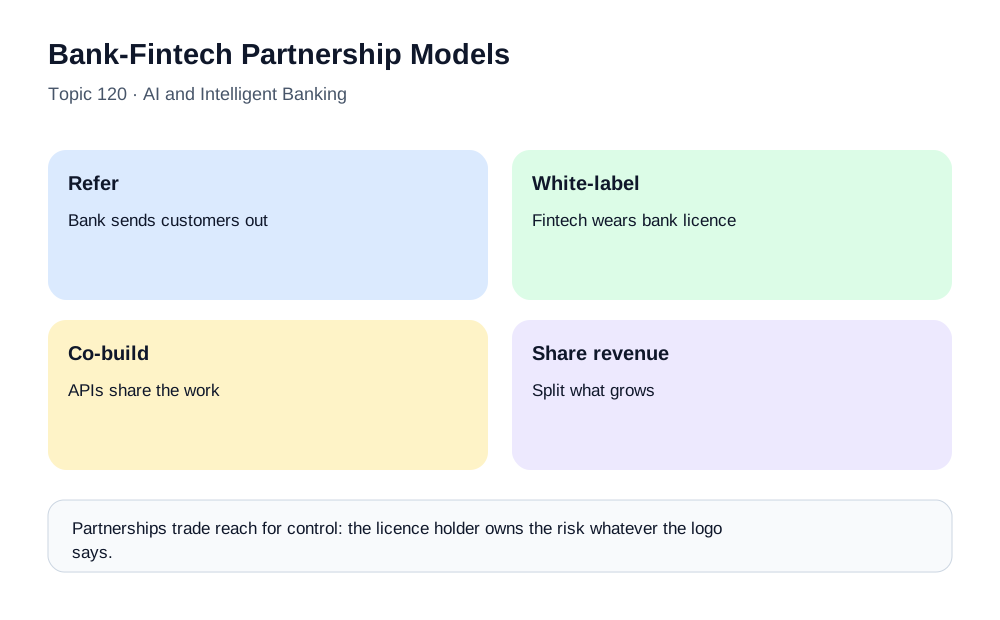
Bank-Fintech Partnership Models at a glance — Collaboration, white-label, revenue sharing.
Collaboration Models, API Ecosystems, and the Future of Financial Services
Banks and fintechs can compete, partner, invest in one another or use each other as service providers, often doing several of these at the same time. Partnership is an important model, but it should not be described as universally dominant because market structure differs by product and jurisdiction. Banks can contribute regulated balance-sheet capacity, payments access, customer relationships, risk and compliance infrastructure, while fintechs can contribute specialised technology, digital distribution, product design or operational capabilities. These are tendencies rather than universal truths: some banks innovate rapidly and some fintechs operate legacy platforms or mature control environments. A partnership should be assessed on the actual capabilities and obligations of each party. Together, banks and fintechs can deliver financial products superior to what either could achieve independently, combining the trust and regulatory foundation of banking with the innovation and experience of technology. The partnership model has become the dominant strategy in financial services globally as both sides recognize their complementary strengths.
Partnership models between banks and fintechs take several distinct forms, each suited to different strategic objectives and regulatory contexts that determine how the relationships are structured. Distribution partnerships have banks providing products while fintechs handle distribution to their customer bases and technology platforms. Distribution partnerships can place a regulated bank product inside a fintech-led customer journey, while technology partnerships can place a fintech platform behind a bank-branded service. Named partnerships, commercial terms and customer branding change frequently, so current agreements and regulatory disclosures should be checked before using a specific firm as an example. The enduring design question is which entity manufactures the regulated product, which distributes or services it, and what the customer is told about each role.
Co-lending or co-origination arrangements can involve two regulated lenders sharing an exposure under the applicable framework, while digital-lending partnerships can involve a regulated entity and a lending service provider performing customer acquisition, underwriting support or servicing. Participation ratios, eligible entities and prudential conditions are jurisdiction- and rule-specific and change over time; they should not be taught as a universal 80/20 or minimum-20-percent formula. Banking-as-a-Service and white-label models likewise do not allow an unlicensed firm to become the legal bank: regulated activities, disclosures, safeguarding and accountability remain with the entities permitted to perform them.
Banks may invest in, acquire or form joint ventures with technology firms when strategic value, valuation, regulatory approvals and integration risk support the case. Specific acquisitions can later be sold, restructured or impaired, so a historic transaction should not be presented as proof that acquisition is always the fastest or best route to innovation. The bank still needs a credible post-deal operating and control model.
The API economy provides the technological foundation enabling these partnerships to operate at scale and speed that would be impossible with traditional integration approaches. Application Programming Interfaces allow different software systems to communicate in real time, enabling integration between bank core systems and fintech applications without expensive and slow custom development for each connection. The typical architecture flows from the bank's core banking system through an API gateway that handles authentication, rate limiting, and monitoring to ensure security and performance at scale. The gateway may connect directly to a partner or through specialised middleware and platform providers. Vendor names, products and ownership change over time; the architectural principle is to expose controlled services through authenticated, monitored and versioned interfaces rather than assume a specific BaaS platform is required. Fintech applications then connect to these platforms to build customer-facing products that leverage banking infrastructure while maintaining focus on user experience.
Common banking APIs enable specific functions across the ecosystem that fintechs can integrate as building blocks for their products. Account APIs open accounts, check balances, retrieve statements, and manage account settings programmatically without manual intervention. Payments APIs initiate UPI, NEFT, IMPS, and other transfers, enabling money movement within fintech applications. Lending APIs check eligibility, process applications, track disbursements, and manage repayments for credit products. Cards APIs issue virtual and physical cards, set limits, handle blocking for security, and manage PINs for customer convenience. KYC APIs verify identity through Aadhaar, PAN, and video KYC, streamlining onboarding while meeting regulatory requirements. Account Aggregator APIs enable consent-based financial data access that supports lending decisions and financial management applications with customer permission.
India has a large bank-fintech ecosystem spanning payments, lending, cards, account aggregation, distribution and technology services. Individual partnerships can change quickly because of commercial decisions, acquisitions, supervisory restrictions or product redesign. Learners should therefore focus on how responsibilities are divided and verify current partnership examples from the regulated entity and relevant official disclosures before treating them as live.
In India, digital-lending, outsourcing, default-loss-guarantee and related rules place responsibilities on regulated entities for partner oversight, customer disclosures, data use and money flows. RBI's DLG framework caps eligible default-loss guarantees at five percent of the specified outstanding loan portfolio under that framework; this should not be described as a generic five-percent limit on every bank-fintech or co-lending arrangement. Current RBI directions should be checked because digital-lending and co-lending frameworks evolve. The core principle is unchanged: using an LSP or technology partner does not remove the regulated entity's responsibility for its regulated activity and customer treatment.
Successful bank-fintech partnerships require attention to several critical success factors that determine whether collaborations thrive or fail to deliver value. Clear accountability must define who owns the customer relationship, who handles complaints when issues arise, and how disputes between partners are resolved to prevent customer service failures. API maturity ensures banks have reliable, well-documented interfaces that fintechs can build upon without constant troubleshooting and unexpected changes that disrupt operations. Cultural alignment addresses the inevitable friction between bank bureaucracy with its risk management and compliance requirements and startup speed with its experimentation and iteration, requiring both sides to adapt and find common ground. Regulatory awareness ensures both parties understand and respect regulatory boundaries, avoiding arrangements that might violate requirements even unintentionally. Data governance establishes clear rules on data sharing, storage, retention, and deletion that protect customer privacy and meet regulatory requirements across jurisdictions. Service level agreements specify response times, uptime requirements, and support levels that partners can depend upon for their own service quality and customer commitments.
Risks accompany the benefits of bank-fintech partnerships and require careful management to avoid problems that can harm customers and institutions alike. Regulatory risk emerges when partnership structures may not comply with evolving regulations, requiring flexibility to adapt as rules change and interpretations shift. Concentration risk occurs when a single bank serves many fintechs, meaning that problems at one bank or its technology can affect multiple fintech customers simultaneously, creating systemic concerns. Reputation risk means fintech misconduct or failures can damage the bank's reputation even when the bank is not directly at fault, because customers associate the bank with the product they use. Operational risk from technology failures at partners affects bank customers who may not understand the distinction between bank and partner services, creating confusion about responsibility. Customer confusion about who to approach for grievances creates service failures when issues are passed between bank and fintech without resolution, damaging trust in both parties.
The future of financial services is collaborative, with banks and fintechs recognizing that their capabilities are complementary rather than competitive in ways that benefit customers. Banks need fintechs for technology innovation and superior user experience that customers increasingly expect from all their service providers. Fintechs need banks for licenses that enable regulated activities, capital for lending that requires balance sheet strength, and the trust that customers place in established institutions with long histories. APIs provide the backbone enabling real-time integration between bank core systems and fintech applications, creating seamless experiences despite underlying complexity that would be impossible to navigate without standard interfaces. Regulatory frameworks increasingly accommodate partnerships while requiring transparency and accountability that protect customers from risks that might emerge from complex arrangements. The winners in this ecosystem will be banks and fintechs that partner effectively, combining their complementary strengths to serve customers better than either could alone, while those that fail to collaborate effectively will find themselves at a competitive disadvantage as the industry evolves toward platform-based distribution and embedded finance that requires ecosystem participation.
<!-- MBA-DEEP-DIVE-START -->Bank-Fintech Partnership Deepening — Operating Models, APIs, Risk, Economics, and Customer Accountability
Start by identifying the regulated product manufacturer
Every partnership should answer a basic question: which legal entity is actually providing the regulated financial product? A mobile interface may carry a fintech brand while the deposit, loan, card or payment service legally belongs to a bank or another regulated institution. The customer journey should not obscure this. Product ownership determines balance-sheet exposure, regulatory obligations, complaints responsibility, disclosures and many downstream controls. A partnership diagram should therefore begin with legal entities and regulated roles before showing APIs or screens.
Distribution and manufacturing are separate capabilities
A bank can manufacture a deposit or credit product while a fintech acquires and serves customers through a digital channel. Conversely, a fintech may provide software to a bank whose own channel handles distribution. These arrangements have different economics and risk. Distribution creates conduct, disclosure and customer-service responsibilities; manufacturing creates underwriting, safeguarding, capital and regulatory responsibilities. Treating “bank-fintech partnership” as one generic model hides these differences.
Lending service providers do not become lenders merely by owning the app
A digital lending journey can involve customer acquisition, data collection, underwriting support, servicing and collections by a technology partner. The regulated lender remains responsible for the lending activity within the applicable framework. Contracts should state which tasks are delegated and which decisions remain with the lender. Customer communications should identify the actual lender and material terms. A polished app must not create uncertainty about who owes the borrower regulatory and contractual duties.
Co-lending is different from outsourcing
In co-lending, more than one regulated lender can hold part of the credit exposure according to the applicable arrangement. In outsourcing, a service provider performs activities for a lender but generally does not become the lender merely by performing the work. Risk sharing, accounting, asset classification, provisioning and customer disclosure can therefore differ substantially. Business analysts should map these models separately even when the same fintech participates in both.
Banking-as-a-Service is a commercial label, not a universal legal category
BaaS can describe API access to accounts, payments, cards, compliance services or ledger capabilities, but regulation usually attaches to the underlying activity rather than the marketing term. A “BaaS provider” may be a licensed bank, a middleware vendor, a programme manager or a combination. Teams should unpack the service into regulated functions, technology services and contractual responsibilities. This prevents architectural shorthand from becoming legal misunderstanding.
Embedded finance moves the product into a non-bank customer journey
A marketplace, software platform, retailer or travel company can present payment, credit or insurance capability at the point where the customer needs it. The financial product may be manufactured by a regulated partner and integrated through APIs. Embedded finance can improve convenience, but it increases the importance of clear disclosures, suitability or eligibility controls, complaints routing and data boundaries because the customer may think they are dealing only with the non-bank brand.
White-label does not mean invisible accountability
A bank can allow a partner to present a customer-facing brand while the bank remains the regulated provider. Even where branding is predominantly the partner's, required disclosures should make the legal provider understandable. Hidden bank identity can create confusion over deposit protection, loan ownership or complaint escalation. The commercial objective of seamless branding should never override regulatory or customer clarity.
Sponsor-bank models concentrate several partner risks in one institution
A bank that provides accounts, card issuing, payments or other infrastructure to many fintech programmes can gain scale, but it also accumulates operational, compliance and concentration exposure. Weak partner onboarding or one critical platform outage can affect many end customers. The bank needs portfolio-level oversight of all programmes, not only bilateral reviews. Concentration limits, common control dependencies and aggregate transaction patterns should be visible to management.
Partner selection should begin with strategic fit
A partnership should solve a clear business problem: reach a new segment, launch faster, add specialist technology, improve economics or access a regulated capability. “Fintech innovation” is not a sufficient objective. The bank should identify the capability gap and how success will be measured. Strategic clarity makes it easier to decide what to build internally, buy as software, outsource or jointly develop.
Due diligence should be proportionate to the activity
A vendor providing a public marketing analytics tool does not create the same risk as a fintech onboarding borrowers or holding sensitive KYC data. Due diligence should cover financial condition, ownership, management, regulatory status, legal issues, information security, data use, resilience, subcontractors, technology and control maturity according to consequence. High-risk partners may require deeper onsite or independent evidence. A standard checklist should not replace risk judgment.
Regulatory status should be verified rather than inferred from branding
A company may call itself a bank, lender, wallet, exchange or payments platform in marketing while its legal permissions are narrower. The institution should verify licences, registrations and regulated entities from authoritative sources. Where the partner relies on another regulated provider, the chain should be understood. This prevents partnerships from being built on assumptions about permissions that do not exist.
Ownership and control matter in partner risk
Banks should know material owners, related parties, significant investors and governance of critical fintech partners. A change of control can alter strategy, risk appetite and financial stability. Contracts can require notification of ownership changes. Due diligence should also understand whether founders or key individuals create concentration risk. Technology quality alone is not enough if the partner's governance is unstable.
Financial viability is an operational risk issue
A fintech can have excellent technology and still run out of funding. If the bank relies on the partner for customer servicing, onboarding or critical transaction processing, sudden failure can create immediate disruption. Financial due diligence should consider liquidity, revenue concentration and dependence on future funding where relevant. Business continuity should include a practical exit or transition plan, not assume the partner will always remain solvent.
Compliance maturity should match the delegated activity
If a partner performs KYC support, collections or customer communication, the bank should assess whether staff, policies, training, monitoring and escalation are adequate. A start-up culture of rapid experimentation can be valuable in product design but dangerous if material customer or compliance processes change without control. The bank should not expect the partner to copy every bank process, but the resulting control outcome must meet the required standard.
Information security review should focus on actual data and access
A fintech that receives account, transaction or identity data creates a different threat surface from a front-end with tokenised identifiers. Security assessment should map data flows, privileged access, encryption, vulnerability management, incident response and subcontractors. The bank should know whether the partner can call production APIs, view raw customer data or change configurations. Security review becomes more useful when tied to architecture rather than a generic questionnaire.
Privacy responsibilities should be mapped across the customer journey
The parties should know who collects personal data, for what purpose, on what legal basis, where it is stored, how long it is retained and who can share it further. A customer giving information in a fintech app does not imply unlimited reuse by either party. Consent and privacy notices should match actual processing. Data minimisation can reduce both compliance and cyber risk.
Subcontractors create a fourth-party chain
A fintech may use cloud providers, KYC vendors, call centres, analytics tools or payment processors. The bank's risk does not stop at the first contract. Critical subcontractors should be identified, and the agreement should establish notification, control expectations and audit or evidence rights proportionate to risk. Deep supply chains can make incident response difficult if nobody knows where customer data or processing actually occurs.
Contracts should translate the operating model into enforceable duties
A partnership contract should reflect who performs onboarding, underwriting, customer support, transaction processing, data processing, reconciliation, reporting, complaints and incident response. Service levels and control obligations should be measurable. Broad phrases such as “partner will comply with all laws” are useful but insufficient for operational execution. The contract should support the process the teams actually intend to run.
Service levels need both technical and business measures
API uptime is important, but a technically available service can still fail customers if processing is delayed or cases are unanswered. SLAs can include response time, transaction success, file delivery, complaint handling, data refresh and incident communication. The right measures depend on the service. Business SLAs connect infrastructure performance to customer outcomes.
Severity definitions should be agreed before an incident
The bank and fintech should use compatible definitions for critical, high and lower-severity incidents. A data breach, payment outage or erroneous credit decision should trigger known contacts and timelines. Without shared severity rules, one party can treat a material event as routine while the other expects immediate escalation. Incident playbooks should be tested jointly for critical partnerships.
Audit rights should be practical
A contract may give the bank broad audit rights, but repeatedly sending onsite teams to every cloud-based partner is neither efficient nor necessarily useful. The bank can use independent certifications, penetration tests, control reports, targeted evidence and onsite review according to risk. The right should remain sufficient to investigate material concerns. Audit evidence should support actual assurance rather than exist only as a contract clause.
Exit rights need operational detail
Termination should address customer communication, data return or deletion, migration of accounts or services, open complaints, transaction history, regulatory reporting and outstanding financial obligations. A bank that cannot continue service after a fintech exit has accepted excessive dependency. Exit planning should be tested for critical arrangements and updated as scale grows.
API contracts are part of the partnership contract
Technical interfaces should define authentication, schema, mandatory fields, error codes, versioning, rate limits, idempotency and expected availability. A commercial agreement that says “provide payments API” is not enough for reliable integration. API specifications create the executable boundary between organisations. Changes should follow notice and backward-compatibility rules so one partner cannot break the other's customer service unexpectedly.
OAuth and token design should reflect delegated authority
Where a fintech accesses customer-permitted bank data or services, tokens should carry limited scopes and lifetimes appropriate to the task. A token for reading balances should not permit transfers. Customer consent and institutional entitlement are separate controls. Strong API security makes delegated access visible and revocable rather than relying on shared credentials or broad service accounts.
Mutual TLS and service identity protect machine-to-machine channels
Critical APIs should authenticate the calling system as well as the customer or user where relevant. Certificates, keys and secrets need controlled lifecycle management. A leaked static credential can expose many customers. Service identity, rotation and monitoring reduce the risk that a malicious party impersonates the fintech or bank service.
Idempotency is essential for payment and account actions
Network retries are normal. If a fintech repeats a payment initiation after a timeout, the bank should not execute it twice. An idempotency key or equivalent reference allows repeated requests to return the same result when appropriate. Both parties should agree how long identifiers remain valid and how duplicate status is communicated. This is a basic but critical partnership control.
Correlation IDs support cross-company investigation
A customer issue may pass through a fintech UI, API gateway, bank payment engine and scheme. A shared reference allows both parties to trace the same event without exposing unnecessary internal details. Logs should preserve this identifier. Cross-organisation troubleshooting becomes much faster when teams can discuss one transaction using a common key rather than searching by approximate time and amount.
Error codes should be stable and understandable
If a bank returns a generic “500 error” for insufficient funds, the fintech cannot give the customer a meaningful message. Conversely, exposing internal stack traces is unsafe. API contracts should distinguish business rejection, validation failure, authentication problem, duplicate request, temporary unavailability and unknown status. Clear errors reduce repeated calls and customer confusion.
Timeouts need a jointly agreed outcome
A fintech can time out while the bank continues processing the request. The customer may then retry and create uncertainty. APIs should support status queries and clear correlation. For financial actions, the client should not assume a timeout equals failure. Partnership architecture should explicitly design for ambiguous outcomes.
Versioning protects both partners from uncontrolled change
A bank may need to add fields or change validation. The fintech may update its customer flow. Versioned APIs and deprecation periods allow controlled migration. Emergency security changes may require faster action, but normal evolution should not surprise production clients. Version governance is particularly important when one API supports many partners.
Sandbox environments should resemble production behaviour
A partner cannot test effectively if the sandbox accepts fields that production rejects or never simulates error conditions. Test environments should cover authentication, realistic validation, idempotency, status changes and negative scenarios. Synthetic data should protect privacy. Good sandboxes reduce production incidents and make partner onboarding faster without weakening control.
Certification testing can protect high-risk integrations
Before launch, the bank can require the fintech to demonstrate critical journeys: onboarding, payment initiation, failure, refund, complaint reference, card block or loan servicing according to scope. Tests should cover errors and retries, not just happy paths. Certification creates evidence that the partner integrated the controlled API correctly before customers are exposed.
Production monitoring should be partner-specific
Aggregate bank metrics can hide a failure affecting one fintech. Dashboards should show transaction volume, success rate, latency, error mix and unusual behaviour by partner. Sudden spikes can indicate integration defects, attack or unexpected customer growth. Partner-level observability also supports billing and capacity planning.
Rate limits protect shared infrastructure
A poorly designed fintech retry loop can overwhelm a bank API. Rate limits, quotas and circuit breakers protect other partners and the bank itself. Limits should reflect legitimate peak usage and have a process for planned growth. Repeated violations should trigger engineering review rather than simply increasing the quota indefinitely.
Capacity planning should include launch events and marketing campaigns
A fintech can acquire customers rapidly after a promotion or product launch. The bank should know expected volumes and test peak conditions. Shared services such as KYC, payment processing or card issuance can become bottlenecks. Joint capacity planning prevents a successful marketing campaign from turning into an operational incident.
Reconciliation proves that both systems agree
A fintech may show a payment as completed while the bank ledger shows a reject, or fee calculations may differ. Daily or intraday reconciliation should compare transactions, balances and settlement records according to the product. Breaks need ownership and ageing. Reconciliation is the financial control that catches integration divergence after the API call itself has succeeded.
Settlement responsibilities should be explicit
For payment or card programmes, transaction execution and settlement can involve scheme accounts, prefunding, reserves or settlement banks. Commercial product teams should understand who funds what and when. Insufficient settlement liquidity can disrupt customers even when the front-end service is healthy. Partner operating models should map settlement, not stop at transaction initiation.
Fees and revenue sharing should be reconcilable
A partnership may include per-transaction fees, interchange sharing, servicing fees, revenue share or performance incentives. Each component should have a defined calculation source and reconciliation process. Ambiguous economics generate disputes and can incentivise harmful customer behaviour. Finance controls should be designed alongside the commercial deal.
Incentives can create conduct risk
A fintech paid only for loan origination volume may have an incentive to push unsuitable or marginal customers. A partner paid for collections recovered may use overly aggressive practices. Commercial models should therefore be reviewed for customer and risk effects. Balanced incentives can include quality, delinquency, complaints or service measures where appropriate.
Credit underwriting ownership should be clear
A fintech may build the score, collect data or recommend a decision, while the bank retains credit approval under policy. Alternatively, a regulated co-lender may make its own credit decision. The process should identify which entity owns the model, policy, affordability assessment, exceptions and final approval. “AI underwriting by partner” is not a sufficient description of accountable credit governance.
Model validation should extend to partner models that influence bank decisions
If a vendor score materially affects approval, pricing or fraud treatment, the bank should understand its purpose, inputs, performance and limitations. Validation may rely on vendor evidence plus the bank's own outcome testing. The institution should monitor whether the model remains fit for its customer population. Outsourcing modelling does not remove model risk.
Alternative data should have a permitted and explainable purpose
A fintech may have access to rich digital behaviour. The bank should not automatically accept every proposed feature for underwriting. Data should be lawfully obtained, relevant, stable and proportionate. Intrusive signals can create privacy and fairness risk for small incremental predictive gain. Partnership governance should make feature approval explicit.
Default loss guarantees need precise regulatory mapping
A guarantee can change incentives and risk transfer. Rules may limit eligible providers, forms of guarantee, portfolio caps and disclosure. The bank should not treat a DLG as a substitute for prudent underwriting or capital. Business analysts should map the applicable rule to the exact arrangement and effective date rather than reuse a percentage from another framework.
Collections are part of customer treatment
If a fintech services overdue loans, scripts, contact frequency, payment channels, hardship handling and agent conduct remain material to the lender's reputation and regulatory exposure. The bank should monitor complaints and sample interactions. Partner collections should feed the same vulnerability and remediation processes used for bank channels where applicable.
Complaints should not bounce between brands
A customer should have a clear path regardless of whether the issue originated in the bank or fintech system. The receiving party can route internally, but it should not simply tell the customer to start again elsewhere. Case references, handoff SLAs and responsibility rules should be shared. The legal complaint owner may differ from the first contact point, but the customer experience should remain coherent.
Complaint data is a partnership-control metric
Patterns such as delayed refunds, incorrect disclosures or repeated login failures can reveal systemic partner issues before financial losses appear. Complaints should be tagged by programme and root cause. Governance forums can review trends alongside API and financial performance. Customer voice is an early-warning signal for operational and conduct risk.
Customer disclosures should reflect the real product chain
The interface should identify the lender, deposit taker, card issuer or other regulated provider where required and relevant. Material fees, terms and grievance channels should not be obscured by the fintech brand. Transparency improves trust and reduces disputes about who is responsible. It also helps customers understand which protections apply.
Marketing claims should be jointly controlled
A fintech may move faster than a bank's usual marketing approval process, but statements about rates, “guaranteed approval,” deposit safety or product eligibility can create legal and reputational risk. The partnership should define approval rules for regulated product marketing. Social-media campaigns and in-app experiments need the same discipline when they describe bank products.
Dark patterns are a partnership risk
A digital interface can nudge customers toward a particular loan, hide opt-outs or make cancellation difficult. The bank should review customer journeys, not only legal terms. In India, current digital-lending directions explicitly address how loan offers are displayed and prohibit certain manipulative design practices. More broadly, good conduct requires informed choice rather than conversion at any cost.
Customer support needs a shared knowledge model
Front-line agents at the fintech and bank should use consistent product terms, status definitions and escalation paths. If one side says a payment is “settled” and the other says “processing,” customers lose trust. Shared knowledge, training and status APIs reduce contradictions. Each party can retain its own organisation, but the customer should experience one coherent product.
Fraud controls should combine both parties' signals
The fintech may see device and behavioural data, while the bank sees account history and network risk. A partnership can improve detection by sharing permitted signals in a controlled manner. Decision ownership and latency must be clear. If both parties independently block the same transaction without coordination, customer remediation becomes confusing.
Security incidents need joint containment
If a fintech credential is compromised, the bank may need to revoke API access immediately. If the bank discovers fraudulent partner traffic, the fintech may need to disable customer sessions. Joint playbooks should define contacts, evidence and authority. Waiting for contractual discussions during an active attack is too slow.
Data breaches require clarity on notification roles
The affected data may sit with one party while the customer relationship or legal notification duty sits with another. Contracts should address rapid information sharing so each entity can meet applicable obligations. Early uncertainty about who must notify should not delay containment or customer protection.
Resilience testing should include partner failure
Business continuity should simulate an unavailable fintech, unavailable bank API, broken identity provider, delayed settlement and loss of a subcontractor. The objective is to understand which customer services can continue and how communication works. Critical programmes may need manual or alternate routes. Resilience is not proven by each company testing itself in isolation.
Recovery objectives should match customer criticality
A marketing analytics partner can tolerate more downtime than a card authorisation or instant-payment dependency. Recovery time and recovery point objectives should therefore be risk-based. The bank should know whether the partner can actually meet the required level and what evidence supports the claim. Contractual numbers without tested capability are weak assurance.
Concentration should be measured across services and vendors
Several fintech brands can depend on the same cloud region, KYC provider or sponsor bank. Looking only at direct contracts can miss common dependencies. The bank should understand which critical services would fail together. Concentration analysis may influence limits, contingency arrangements or architectural diversity.
Geographic expansion can change the partnership's legal character
A model launched in one country cannot be copied globally merely by changing currency. Licensing, outsourcing, data residency, consumer protection, lending and payments rules differ. The parties should reassess responsibilities for each jurisdiction. Global platform reuse is valuable, but local compliance should be explicit rather than assumed.
Product changes need joint governance
A fintech may want to change onboarding screens, fees, eligibility or transaction limits rapidly. The bank should define which changes require approval and which can be made under delegated authority. This protects regulatory and risk boundaries without forcing every minor UX change through a slow committee. Materiality thresholds make partnership governance both safe and workable.
Experimentation should have guardrails
A/B testing can improve conversion or customer experience, but experiments should not bypass required disclosures, affordability or security controls. The parties can define which UI and messaging elements are safe to experiment with. High-risk product terms and decision rules need stronger approval. Innovation works best when the boundaries are known before testing begins.
Governance forums should review one integrated scorecard
A monthly or quarterly partnership forum can review volume, revenue, credit performance, fraud, API reliability, incidents, complaints, security findings, regulatory issues and remediation. This prevents the commercial team from seeing only growth while risk teams see isolated problems. One scorecard encourages joint decisions about the health of the programme.
Escalation should bypass normal forums for material risk
Some events cannot wait for the next partnership meeting: major outage, data breach, regulatory inquiry, severe customer harm or financial instability. Named executives and risk owners should have direct escalation channels. The governance structure should distinguish routine performance management from crisis management.
Internal audit can assess the bank's partnership framework
Audit may examine whether due diligence, contracts, monitoring, data governance, change control and exit planning operate consistently across fintech programmes. It does not need to repeat every partner security test. Its value is to determine whether management's third-party risk framework provides effective assurance and whether exceptions are controlled.
Regulators may look through the partnership to the bank's control
A bank cannot defend poor customer outcomes by saying “the fintech did it.” Supervisory expectations commonly require regulated institutions to manage outsourced or partner activities appropriately. Evidence should therefore show due diligence, contractual control, monitoring and remediation. Partnership strategy should assume the bank may need to explain the end-to-end process to a regulator.
The fintech also needs protection from bank dependency
Partnership risk is mutual. A fintech can be harmed by slow bank APIs, delayed compliance decisions, product changes or bank supervisory restrictions. Strong contracts and transparent roadmaps help both sides. The best partnerships recognise that operational reliability and governance are joint prerequisites for customer trust.
Build, buy and partner should be revisited over time
A capability that was sensible to outsource at launch may become core enough to build internally. A bank-built service may later be replaced by a specialist platform. Partnership strategy should consider economics, differentiation, control and scale periodically. Long contracts should not freeze the architecture when business needs change.
Acquisition does not automatically solve integration
Buying a fintech can bring technology and talent but also creates migration, culture, data and control work. The acquired platform may still need to meet bank security and resilience standards. Integration can destroy the speed that made the fintech valuable if managed poorly. Acquisition is one strategic option, not a shortcut around operating-model design.
The strongest partnerships are explicit about what each party is good at
A bank does not need to build every user interface, and a fintech does not need to reproduce an entire bank. Value comes from combining complementary capabilities while making accountability visible. Clear product ownership, controlled APIs, fair economics, strong data governance, resilience and customer service allow the partnership to scale without becoming a maze of responsibility.
The final measure is customer and risk outcome, not partnership count
A bank can announce dozens of fintech partnerships and still deliver poor service. Success should be measured through customer adoption, resolution quality, product economics, credit or fraud performance, complaints, compliance, availability and strategic value. Partnerships are a means to provide financial services, not a trophy category. The best arrangement is the one that creates a useful product while preserving the control standards expected of the regulated financial system.
Operating a bank–fintech partnership as a controlled banking service
A bank–fintech partnership becomes real only when both organisations can explain the complete service from customer promise to ledger outcome. The commercial agreement may describe distribution, technology, or revenue sharing, but operations need a much more precise picture. Teams should know which party acquires the customer, which entity performs identity checks, who owns the regulated account or credit decision, where customer data is stored, which system authorises a transaction, which party handles disputes, how funds are safeguarded or settled, and who is accountable when a control fails. A partnership that is clear at contract level but vague at process level creates avoidable operational and conduct risk.
The most useful starting point is an end-to-end service map. It should connect customer journeys, APIs, decision engines, bank systems, fintech systems, third parties, data stores, ledgers, settlement accounts, support queues, monitoring tools, and external networks. The map should show normal processing and also failure paths. If an onboarding API times out, does the customer retry, enter manual review, or accidentally create a duplicate profile? If a payment instruction is accepted by the fintech but rejected by the bank, which status does the customer see and which party owns remediation? These details determine whether the partnership behaves like one coherent service or two organisations passing responsibility to each other.
Define the regulated perimeter and control ownership
A partnership should distinguish commercial responsibility from regulatory and control responsibility. A fintech may design the interface and own the customer relationship experience while the bank remains accountable for activities performed under the bank's licence or risk appetite. That does not mean the bank must perform every control itself. It means the bank needs enough governance, information, contractual rights, testing, and oversight to understand whether delegated activities are operating as intended.
A practical control matrix can assign each important activity an owner, performer, reviewer, evidence source, escalation path, and fallback. Activities normally include customer identification, due diligence, sanctions screening, fraud controls, credit decisioning where relevant, transaction monitoring, authentication, data protection, complaints, vulnerable-customer treatment, reconciliation, settlement, regulatory reporting, incident management, change management, access control, and business continuity. Shared ownership without a named accountable party is dangerous because incidents expose the ambiguity immediately.
Control ownership should also follow the actual technical path. If the fintech collects identity evidence but the bank makes the final onboarding decision, the bank needs reliable evidence that the captured data has not been altered, that required fields are complete, and that exceptions are traceable. If a bank fraud engine returns a decline but the fintech interface translates that decline into a generic technical error, the customer experience can undermine the control. Functional, technical, operational, risk, and customer responsibilities therefore need to be designed together.
Treat APIs and data exchanges as business contracts
An API contract is not only a technical schema. It defines how two organisations understand a business event. Good partnership design specifies field meaning, mandatory data, identifiers, timestamps, status values, error codes, retry behaviour, idempotency, security controls, versioning, and service levels. The parties should agree what constitutes acceptance. A HTTP success response may only mean that a request was technically received; it does not necessarily mean the bank accepted the transaction, booked it, or completed settlement.
Identifiers deserve special attention. Customer identifiers, account identifiers, application references, transaction references, and case identifiers should remain traceable across both organisations. Without cross-reference discipline, customer support becomes slow and reconciliation becomes manual. The fintech may know an instruction by one reference while the bank ledger uses another. A durable correlation model allows both organisations to prove that they are discussing the same customer event.
Data minimisation and purpose also matter. The easiest integration is not necessarily to send every available field. Each data element should have a business purpose, defined ownership, quality expectation, retention rule, and permitted use. Sensitive attributes should be protected in transit, at rest, and in operational tooling. Support teams should not need broad production-data access merely to diagnose ordinary customer issues.
Build third-party risk into the service design
Fintech partnerships often introduce fourth parties: cloud providers, identity vendors, messaging platforms, fraud-data providers, card processors, open-banking aggregators, analytics services, or call-centre providers. The bank should understand which external dependency supports each critical function and whether substitution is realistic. A contract with the fintech does not remove operational dependence on the fintech's own suppliers.
Due diligence should therefore examine more than financial health and information-security questionnaires. The bank needs to understand architecture, data locations, privileged-access models, software development controls, incident response, resilience, concentration risk, subcontracting, auditability, and exit feasibility. The depth of review should reflect the criticality of the service and the potential customer or financial impact of failure.
Ongoing monitoring is equally important. A partner that was suitable at onboarding can change materially through acquisitions, rapid growth, new subcontractors, product expansion, technology migration, or deteriorating financial condition. Governance should define which changes require notification, prior approval, additional testing, or a revised risk assessment.
Design customer support before launch
Partnerships frequently fail operationally at the boundary between customer service teams. Customers do not care which company owns a particular microservice. They expect one answer. The operating model should therefore define first-line support, escalation criteria, data sharing, case handoffs, service levels, complaint ownership, reimbursement or adjustment authority, and communication standards.
A strong model avoids blind transfers. If a fintech agent can see that a bank-side transaction was rejected but cannot see the reason, the case should move through a structured escalation with the original context and identifiers attached. The customer should not be asked to repeat the entire story. Likewise, the bank should not receive a free-text ticket with insufficient evidence to reconstruct the event.
Complaints are a valuable control signal. Repeated complaints about delayed refunds, unexplained declines, duplicate applications, frozen accounts, or inconsistent fees can reveal defects that normal technical monitoring misses. Partnership governance should analyse complaint themes alongside incidents, fraud losses, manual-review rates, reconciliation breaks, and service availability.
Reconciliation is the partnership's daily truth test
A well-designed partnership reconciles more than money. Financial reconciliation compares instructions, postings, balances, fees, settlement movements, and suspense positions. Operational reconciliation compares counts and statuses across systems: applications submitted versus decisions received, payments accepted versus booked, refunds initiated versus completed, cases opened versus closed. Data reconciliation can compare critical attributes used for reporting or customer communication.
Unmatched items need ownership and ageing rules. A difference should not remain in a spreadsheet simply because each organisation's system appears internally correct. The purpose of reconciliation is to prove that the two organisations have a consistent view of the service. Breaks should be classified by cause, materiality, customer impact, financial exposure, and recurrence. Persistent low-value breaks can still signal a structural defect.
Manage change as a joint production risk
Independent release cycles can create compatibility failures. A fintech may deploy a new field value, timeout policy, or user journey while the bank assumes the previous behaviour. Joint change governance should therefore cover interface versions, backward compatibility, test environments, release calendars, regression scenarios, performance testing, security testing, and rollback plans.
Critical journeys should be tested end to end rather than only component by component. Testing should include duplicate requests, delayed responses, partial outages, stale tokens, malformed data, fraud declines, compliance holds, ledger failures, settlement delays, and recovery after interruption. The strongest evidence is not that each API returns the expected response in isolation, but that the complete customer and accounting outcome remains correct under realistic failure conditions.
Use service-level indicators that expose customer and control outcomes
Availability alone is too narrow. A partnership dashboard can include onboarding completion rate, manual-review rate, decision latency, payment success rate, duplicate rate, fraud losses, false-positive referrals, reconciliation breaks, complaint volumes, refund ageing, incident frequency, unresolved critical defects, API latency, change failure rate, and recovery performance. Metrics should be segmented where this reveals meaningful differences between products, channels, or customer groups.
Thresholds should trigger action rather than merely create reporting. A sudden rise in manual reviews may indicate degraded identity data, a rule change, or an upstream vendor issue. A payment success rate can look healthy while a small but growing population accumulates in an exception queue. Good monitoring links indicators to investigation owners and escalation rules.
Prepare the exit before it is needed
Exit planning is part of responsible partnership design, not evidence that the relationship is expected to fail. The bank should know how customer data, balances, open cases, contractual obligations, transaction history, credentials, and ongoing services would be migrated or wound down. It should understand the technical dependencies that would have to be replaced and how long replacement could realistically take.
An exit plan should distinguish orderly commercial termination from emergency scenarios such as prolonged outage, cyber compromise, insolvency, or a serious control breach. Emergency exit may require temporary restrictions, customer communication, alternative processing, data recovery, manual operations, or staged migration. The plan should be tested enough to prove that the service is not operationally trapped inside the partnership.
A practical incident example
Imagine a fintech front end shows customers that instant account funding is successful, but a bank-side posting service is intermittently unavailable. The fintech receives an initial acknowledgement and treats it as completion. Customers see increased balances in the interface, while the bank ledger has not booked some funds. The issue is no longer a simple API outage. It creates customer-information risk, reconciliation breaks, possible spending against unavailable funds, support demand, and accounting uncertainty.
A mature partnership detects the divergence through status and reconciliation controls, stops presenting unconfirmed funds as final, correlates affected references, places uncertain items into a controlled exception state, communicates consistently to customers, and repairs ledger outcomes before re-enabling normal processing. After recovery, both parties analyse why the acknowledgement was misunderstood and strengthen the contract between technical status and business finality.
This is the central lesson of bank–fintech partnership management: the partnership is safe only when the combined service is governed as rigorously as an internal banking process. Commercial innovation can move quickly, but accountability, evidence, reconciliation, resilience, customer treatment, and exit readiness must remain explicit from design through daily operation.
<!-- MBA-DEEP-DIVE-END -->