Visual overview
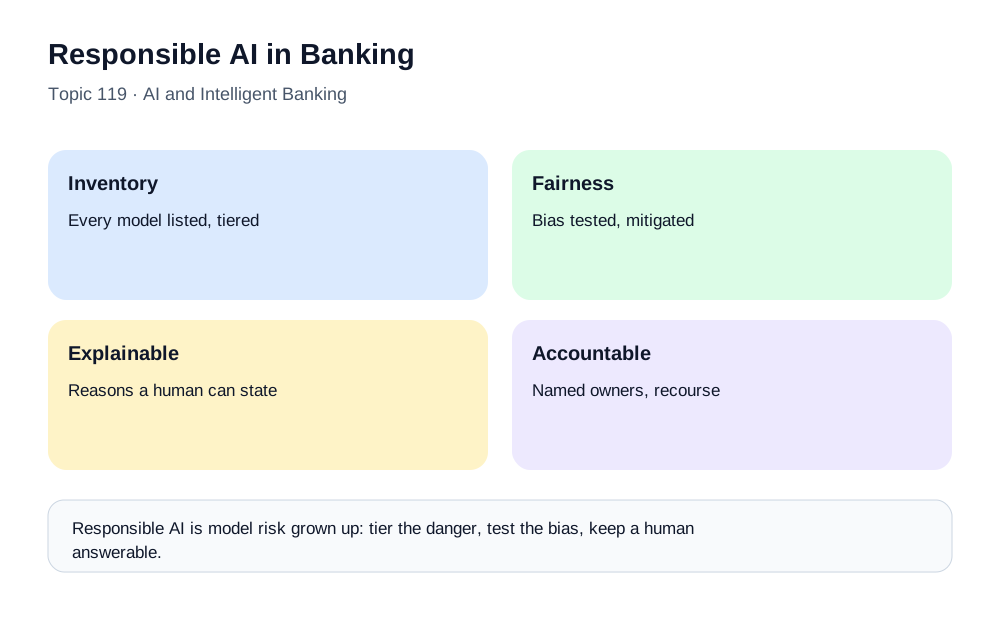
Responsible AI in Banking at a glance — AI ethics, bias prevention, explainability, model risk.
Bias, Explainability, Fairness, and Ethical AI Governance
As banks deploy artificial intelligence across lending, fraud detection, customer service, and risk management, the stakes of getting it wrong have never been higher for institutions and their customers. Biased credit decisions can deny mortgages based on protected characteristics like race, gender, or caste, violating fair lending laws and causing lasting harm to families who are excluded from homeownership. Opaque fraud models can freeze accounts without explanation, devastating customers who depend on access to their funds for daily needs and cannot understand why they have been targeted. Algorithmic trading systems can amplify market crashes through automated responses that lack human judgment to recognize exceptional conditions and pause trading. Responsible AI provides the framework for ensuring that financial AI systems are fair, transparent, robust, and accountable—protecting both institutions from regulatory and reputational harm and the customers they serve from discrimination and error.
The potential consequences of irresponsible AI in banking span every major application area with serious real-world impacts that can affect individuals and communities profoundly. Credit decisions made by algorithms might illegally deny loans to protected groups based on race, gender, or caste, even when those characteristics are not explicitly used as variables, through correlations with seemingly neutral factors like postal codes or shopping patterns that serve as proxies for protected attributes. Fraud detection systems could disproportionately block legitimate transactions for certain demographic groups, creating discriminatory outcomes even without explicit bias in the algorithm, simply because different groups have different typical transaction patterns that the model learns to associate with risk. Insurance pricing AI might use proxy variables such as postal codes or device types that correlate with ethnicity or socioeconomic status, effectively discriminating through apparently neutral factors that perpetuate historical inequalities. Customer service chatbots might provide different quality service to different groups based on language patterns or inferred demographics, creating unequal experiences that damage trust. Collections algorithms could target vulnerable customers more aggressively than others, exploiting weakness rather than treating all borrowers equally regardless of their circumstances. Algorithmic trading systems might amplify market panic through automated responses that sell into declining markets, creating feedback loops that human traders would recognize and avoid but algorithms execute without judgment.
Responsible AI rests on five pillars that together ensure ethical deployment and protect against these risks that can cause significant harm if not properly managed. Fairness requires banks to identify and prevent unlawful or unjustified discriminatory effects in the context of the applicable jurisdiction and use case. Protected characteristics, legal tests and permitted risk factors differ across countries, so responsible-AI governance should connect fairness testing to the laws, customer population and decision being made rather than assume one universal list or metric. Proxy detection must identify when apparently neutral variables such as PIN codes actually correlate with protected characteristics, indicating potential indirect discrimination that violates the spirit if not the letter of fair lending laws. Statistical testing for disparate impact across groups ensures that outcomes do not differ systematically in ways that suggest bias, even without explicit discriminatory intent that might be hidden in complex models. Explainability should provide reasons appropriate to the decision, audience and applicable legal requirements. Some jurisdictions require adverse-action or automated-decision information in particular contexts, while others impose different transparency duties. Banks should design truthful customer-facing reasons without assuming a single universal legal 'right to explanation' applies to every AI-assisted banking decision. Global explainability through feature importance analysis shows which factors matter most overall in model decisions, while local explainability through techniques like SHAP values explains specific decisions for individual customers. Instead of opaque statements like "Your loan was rejected by our AI model," explainable systems provide specific reasons: "Your application was declined due to high debt-to-income ratio of forty-five percent, two recent missed payments in the last six months, and short credit history of eight months."
Transparency requires comprehensive documentation of AI systems for internal governance and regulatory compliance that enables oversight and accountability. Model documentation records what data is used, how models work, their training process, and known limitations that affect appropriate use, creating institutional knowledge that persists beyond individual employees. Model cards provide standardized formats describing ML model capabilities and limitations, enabling consistent evaluation across different systems and vendors. Audit trails log every AI decision for subsequent review, accountability, and dispute resolution, creating evidence of how decisions were made. Disclosure informs customers when AI is involved in decisions affecting them, respecting their right to know how they are being evaluated rather than hiding automated processes behind human-sounding interfaces.
Robustness ensures that AI systems resist adversarial attacks and maintain performance under stress that might occur in production environments. Models must not be easily fooled by manipulated inputs designed to trigger desired outcomes, such as slightly modified images that cause misclassification. Continuous performance monitoring tracks model accuracy over time, detecting drift as relationships between variables change and models become less accurate due to changing market conditions. Stress testing evaluates model behavior under extreme conditions that may not appear in training data but could occur during market crises or other unusual situations. Fallback mechanisms ensure human override and manual processes remain available if AI fails or produces anomalous results that clearly indicate malfunction.
Accountability establishes clear responsibility for AI systems and their outcomes that affects how institutions govern these technologies. Human oversight should be proportionate to consequence. Some high-impact decisions may require meaningful human review, while other systems can operate automatically under validated rules, monitoring and escalation. A nominal reviewer who cannot understand or change the outcome is not effective oversight, and a universal manual review of every decision is not necessarily required. Clear ownership designates specific AI risk owners for every deployed model who are responsible for its performance, compliance, and risk management throughout its lifecycle. Governance boards including AI ethics committees review deployments for alignment with organizational values and regulatory requirements, providing oversight at the institutional level. Remediation processes fix AI errors and compensate affected customers when harm occurs, ensuring that mistakes are addressed rather than ignored or covered up.
AI governance frameworks operationalize responsible AI principles through organizational structures that ensure consistent application across the institution. The Three Lines of Defence model assigns distinct responsibilities across the organization to create checks and balances. Business teams as the first line are responsible for AI model development, deployment, and ongoing monitoring in their domains, owning the models they use. Risk and compliance functions as the second line validate model fairness, robustness, and documentation, providing independent challenge to business decisions and ensuring regulatory compliance. Internal audit as the third line provides independent assurance of AI governance effectiveness, reporting to the board on whether frameworks are working as intended and identifying gaps.
The AI model lifecycle governance ensures responsible practices at every stage from conception to retirement that addresses risks proactively. Problem definition determines whether AI is the appropriate approach or whether simpler methods would suffice with less risk and complexity. Data assessment verifies that training data is representative, unbiased, and complete for the intended use case, avoiding garbage-in-garbage-out problems. Model development incorporates bias testing, explainability features, and comprehensive documentation as integral requirements rather than afterthoughts. Validation provides independent review of model performance and fairness before deployment to production, catching issues before they affect customers. Deployment includes human-in-the-loop oversight and monitoring infrastructure to track performance in real-world use. Continuous monitoring tracks accuracy, fairness, and drift throughout the model's operational life, triggering review when metrics degrade below acceptable thresholds. Retirement processes ensure appropriate decommissioning when models are no longer appropriate due to changed conditions or better alternatives.
Responsible-AI requirements are increasingly shaped by a combination of AI-specific law, existing banking regulation, consumer-protection rules, privacy law and supervisory expectations. In the European Union, Regulation (EU) 2024/1689 classifies AI systems used to evaluate the credit score or creditworthiness of natural persons as high-risk, subject to the Act's scope and exceptions. In the United States, the Federal Reserve, OCC and FDIC issued revised model-risk-management guidance in April 2026 that superseded SR 11-7; it applies to traditional statistical and quantitative models and non-generative, non-agentic AI within its stated scope, while generative and agentic AI are explicitly outside that guidance and still require appropriate risk governance. Other authorities, including regulators in India, Singapore and the United Kingdom, continue to develop or apply principles and existing rules to AI use. Because this area changes rapidly, current primary regulatory sources should be checked for each jurisdiction and use case.
Public controversies and research illustrate why AI outcomes need evidence-based review, but examples must be described accurately. Complaints about Apple Card credit limits prompted an investigation by the New York State Department of Financial Services; its March 2021 report found no evidence of unlawful discrimination under fair-lending law, while highlighting consumer concerns about transparency and broader disparities in credit access. Outside banking, well-documented recruiting and healthcare examples have shown how historical data or proxy targets can generate harmful disparities. The lesson is to investigate outcomes rigorously rather than infer discrimination from an anecdote or assume that an apparently neutral model is automatically fair.
The responsible AI imperative in banking is clear: as AI systems take on increasingly consequential decisions affecting customers' financial lives and economic opportunities, institutions must ensure these systems operate fairly, transparently, and accountably. The five pillars—fairness, explainability, transparency, robustness, and accountability—provide a comprehensive framework for ethical deployment. Human oversight remains essential, with AI augmenting rather than replacing human judgment for decisions that significantly affect customers' lives. The institutions that master responsible AI will earn trust and avoid the regulatory penalties and reputational damage that follow from algorithmic harm, while those that neglect these principles will face increasing scrutiny and consequences as AI governance matures and regulators become more sophisticated in their oversight.
<!-- MBA-DEEP-DIVE-START -->Responsible AI in Banking Deepening — Risk Classification, Fairness, Explainability, and Accountable Use
Responsible AI starts with the banking decision, not the model label
A bank should first identify what the system actually does. An AI service that summarises public research is very different from one that sets a credit limit, blocks a payment, prioritises a sanctions alert, recommends an investment or drafts a customer complaint response. The same technical model can therefore sit in very different risk tiers depending on use. Responsible AI begins by defining the decision, affected customer or employee, financial consequence, legal context, degree of automation and available remedy. Governance that classifies only the algorithm but ignores the use case can dramatically underestimate risk.
AI inventories should record purpose and consequence
A useful inventory includes the business owner, model or provider, data used, users, affected population, decision role, automation level, tools or systems connected, validation status, monitoring and retirement plan. It should also distinguish internal productivity from customer-facing or decisioning use. This creates a map of the institution's actual AI exposure. An inventory that only lists vendor names such as “LLM provider A” or “fraud model B” does not tell management where customer, financial or regulatory consequences arise.
Risk tiering makes governance proportionate
Not every AI application needs the same control intensity. A low-risk drafting assistant working on non-sensitive internal content may need basic access, security and quality controls. A model supporting credit approval, customer authentication or market surveillance requires stronger data validation, independent challenge, fairness testing, change control and evidence. Risk tiering should consider consequence, scale, reversibility, legal obligation and how directly the output determines an action. This avoids two failures: excessive bureaucracy for harmless tools and weak governance for consequential systems.
A model can be technically accurate and still be inappropriate
A credit model may predict default well but use data the bank cannot lawfully or ethically justify. A fraud model may reduce losses while blocking legitimate customers disproportionately. A chatbot may answer correctly on average while occasionally inventing harmful financial advice. Responsible AI therefore evaluates more than predictive performance. Fitness for purpose includes data legitimacy, customer treatment, explainability, resilience, privacy, operational integration and ability to challenge or remediate outcomes.
Problem formulation is itself an ethical choice
Before building a model, teams choose what outcome to optimise. A collections model might optimise repayment collected, probability of contact, customer cure or cost. These targets lead to different behaviours. Optimising only short-term recovery could encourage excessive contact with vulnerable borrowers. A fraud model optimising prevented loss may create more customer friction than one balancing loss and false positives. Responsible AI asks whether the target reflects the institution's legitimate objective and customer obligations, not merely whether it is easy to measure.
Proxy targets can encode social inequality
Sometimes the outcome chosen for training is an imperfect substitute for the real objective. A healthcare example may use spending as a proxy for need; a lending model might use historical approval as a proxy for creditworthiness; a service model might use complaint closure as a proxy for resolution quality. Historical outcomes can reflect unequal access, policy choices or operational weaknesses. Teams should ask what the label actually represents and whether the model will reproduce an old process rather than improve it.
Historical data is not neutral simply because it is factual
Bank data records past customer behaviour and past institutional decisions. It can contain effects of old underwriting standards, channel availability, geographic concentration, sales incentives or previous control bias. A model trained on this history can learn those patterns. Data scientists should therefore understand how the data was generated, who was excluded and which policy changes occurred during the period. Responsible AI treats data provenance as part of model risk rather than assuming a large dataset is objective.
Representation matters when a model serves diverse customers
A model trained mostly on salaried customers in major cities may perform poorly for self-employed borrowers, rural customers or people using another language. Performance should be measured for relevant segments where sample size and law permit. Under-representation can produce both lower accuracy and less reliable explanations. The response may be additional data, separate policy, another model or a decision not to automate that population until evidence improves.
Missing data can create unequal outcomes
One group may have fewer bureau records, less digital history or less access to a particular data source. If the model treats missing values as risk without understanding why they are missing, customers can be disadvantaged for reasons unrelated to their actual credit or fraud risk. Monitoring should distinguish genuine absence from technical failure or structural exclusion. The bank should not convert a lack of information into an unexamined negative judgment.
Data minimisation is a responsible-AI principle
A model does not become better simply because it consumes every available field. Each feature increases privacy, security, validation and explainability burden. Banks should prefer data with a clear relationship to the decision and measurable incremental value. Removing intrusive or redundant variables can make a model easier to govern without materially reducing performance. Data minimisation also reduces the impact if a model pipeline or log is compromised.
Sensitive attributes may be needed for fairness testing even when not used for decisions
A bank may prohibit a production model from using a protected characteristic yet still need controlled access to that attribute to measure whether outcomes differ by group. These are distinct purposes. Governance should separate data used to detect disparity from data used to make the customer decision, subject to applicable law. Without appropriate testing data, the institution may be unable to see discrimination that occurs through proxies.
Removing protected attributes does not automatically make a model fair
Location, occupation, language, education, device type or customer channel can correlate with protected or disadvantaged groups. A model can therefore produce unequal outcomes without directly receiving gender, race or other protected fields. Feature review, proxy analysis and outcome testing are needed. At the same time, correlation alone does not make every variable illegitimate. The bank must examine relevance, legal basis, effect and whether less harmful alternatives achieve a similar risk objective.
Fairness is not one universal mathematical formula
Common measures include demographic parity, equal opportunity, error-rate comparisons and calibration across groups. These metrics can conflict. For credit risk, equal approval rates may be inappropriate if underlying verified risk differs, while unequal false-negative or false-positive rates can still reveal problems. Responsible governance begins with the legal and business question, then selects metrics that illuminate that question. A dashboard containing many fairness numbers is not useful if no one understands what each measure means.
Outcome disparity is a signal for investigation, not automatic proof
If one group receives fewer approvals or more fraud blocks, the difference deserves analysis. It may result from model features, policy thresholds, data availability, customer mix, channel access or legitimate risk differences. Teams should decompose the decision chain before concluding cause. This protects both customers and model governance from simplistic conclusions. Fairness review should be evidence-led and capable of identifying the actual intervention that needs change.
Fairness should be tested end to end
A credit journey can create disparity before or after the model: marketing may reach some customers more often, identity verification may fail disproportionately, manual overrides may differ, or pricing rules may amplify a model score. Testing only the statistical model can miss these effects. End-to-end analysis follows customers from application through decision, pricing, service and later account management. Responsible AI is ultimately about outcomes from the whole system.
Intersectional effects can be hidden by broad averages
A model may appear similar for men and women overall yet perform poorly for older women in a particular region or for a small language group. Where data and law permit, institutions can examine meaningful intersections rather than only single attributes. Small samples require caution because random variation can look significant. The goal is to identify material blind spots, not to generate hundreds of unstable subgroup statistics.
Sample size should influence fairness conclusions
A very small group may show a dramatic percentage difference based on only a handful of cases. Statistical uncertainty should be reported. Responsible AI avoids declaring either safety or discrimination from weak evidence. The bank can combine quantitative results with qualitative review, longer observation periods and targeted testing. Fairness monitoring should mature as more production outcomes become available.
Explainability has several audiences
A model developer needs technical explanations of feature behaviour and interactions. A validator needs evidence of conceptual soundness and limitations. An underwriter or fraud investigator needs actionable reasons. A customer may need clear adverse-decision or security information. Senior management needs portfolio-level trends. Responsible AI should not expect one explanation method to serve all of these audiences. The explanation should be truthful to the model while appropriate to the user's decision and level of detail.
Global explanation describes the model, not an individual case
Feature importance can show which variables influence a model overall, but it does not necessarily explain one customer's outcome. A feature can be important globally and irrelevant to a particular case. Management may use global explanation to understand model dependence and concentration. Customer-facing reasons generally require local or decision-specific evidence. Confusing global and local explanation can produce misleading reason codes.
Local explanation should be faithful to the actual decision
Techniques such as SHAP can estimate how features contributed to a specific output, but explanation quality still needs testing. Reason codes should be stable enough to be meaningful and should map to business concepts the customer or reviewer can understand. If an explanation method produces different reasons after tiny irrelevant input changes, the bank should investigate. A polished explanation is not useful if it does not accurately reflect model behaviour.
Reason codes should separate model drivers from policy rules
A customer may be declined because the model estimates high risk, because affordability fails, because a product eligibility rule applies or because fraud verification is incomplete. The final communication should not blame “AI” for a policy decision it did not make. Decision engines should record which component caused the outcome. Accurate attribution improves customer remediation and internal debugging.
Explainability is not the same as source-code disclosure
A bank can provide meaningful reasons without revealing every coefficient, proprietary algorithm or fraud threshold. Over-disclosure can enable gaming or create security risk. The objective is to provide sufficient transparency for accountability, review and customer understanding. The right level depends on law and use case. Responsible AI balances openness with legitimate protection of security and intellectual property.
Transparency includes knowing when AI is materially involved
Customers and employees may need to understand when an automated system influences a consequential outcome, particularly where required by law or policy. Disclosure should be meaningful rather than a generic statement buried in terms and conditions. At the same time, not every software calculation needs an “AI” label. Governance should define when the technology's role is material enough to require specific communication.
Documentation should make an AI system reproducible
Model records should cover purpose, owner, data, target, methodology, assumptions, exclusions, validation, limitations, fairness, deployment and monitoring. Generative or vendor systems may need additional information on prompts, retrieval, tools and provider versions. Documentation should enable a competent reviewer to understand why the system is used and what could go wrong. Documents that only repeat vendor marketing do not provide effective governance.
Model cards are useful summaries, not replacements for validation
A model card can present purpose, training population, expected use, key performance and known limitations in a consistent format. It helps users understand where the model is safe to apply. However, consequential banking models still need deeper development and validation evidence. Responsible AI uses model cards to improve visibility, not to reduce governance to a one-page checklist.
Data lineage connects explanations to evidence
For a historical decision, the bank should know which source data fed the model, which transformation created each material feature and which model version produced the score. Without lineage, a customer may challenge an incorrect input and the institution cannot reconstruct what happened. Data lineage is therefore both a technical control and a fairness mechanism. Correcting a source error should propagate through future decisions and, where appropriate, remediation.
Version control matters because AI changes over time
Models are retrained, prompts are edited, vendors upgrade systems and reference data changes. Each material production decision should be attributable to the relevant version. Versioning enables regression testing and rollback. It also supports complaints: the model operating today may behave differently from the one that made a decision six months ago. Responsible AI requires historical traceability, not only current-state documentation.
Independent validation should challenge the business case as well as statistics
Validation can examine conceptual soundness, data, performance, implementation, fairness, stability and limitations. It should also ask whether the model is being used for a purpose supported by evidence. A strong model can be unsafe if deployed on a new population or connected to an inappropriate action. Effective challenge requires enough independence and expertise to question assumptions, not merely reproduce the developer's metrics.
Vendor AI remains the bank's risk
A bank may not own the source code for a vendor model, but it remains responsible for decisions made using the service. Due diligence should cover data provenance, intended use, validation evidence, security, privacy, update process, performance, resilience and contractual notification. The institution should have sufficient understanding to know where the vendor model can fail. Commercial secrecy is not a complete substitute for risk evidence.
Generative and agentic AI need governance beyond traditional model definitions
As of April 2026, the revised US interagency model-risk-management guidance explicitly states that generative and agentic AI are outside its defined scope, while also noting that banks should use risk-management and governance practices to determine appropriate controls for tools not covered. This illustrates an important principle: absence from a specific model definition does not mean absence of risk. Banks should map such systems to information security, privacy, operational resilience, conduct, third-party and AI-specific governance even where traditional model validation is not the sole framework.
Human oversight must have authority and information
A reviewer cannot meaningfully oversee a decision if they see only a final score, lack time, or are expected never to disagree. Effective oversight provides relevant evidence, clear escalation and the authority to change or pause the outcome. For lower-risk use cases, post-event sampling may be more useful than approving every case. Responsible AI focuses on whether human involvement actually reduces risk rather than simply whether a human click exists.
Automation bias can make human review ineffective
People often trust a confident system, especially when they are busy. Reviewers may accept model recommendations without critical thought. Interfaces can counter this by showing material evidence, uncertainty, alternative factors and clear responsibility for the final decision. Training should teach users when the model is weak. Human-in-the-loop is not automatically safe; it must be designed against passive reliance.
Excessive manual override can undermine model governance too
If staff routinely ignore a validated model without recording reasons, decisions become inconsistent and fairness may worsen. Overrides should have defined authority, reason codes and monitoring. Later performance can show whether overrides add useful judgment. Responsible AI balances model discipline with human expertise rather than assuming either automation or manual decision-making is inherently superior.
Robustness means tolerating realistic variation
A model should continue to behave sensibly when data is noisy, customer behaviour shifts or inputs are near decision thresholds. Testing can examine missing values, outliers, language variation, image quality, device change and other realistic conditions. Robustness does not mean the model must work perfectly on every imaginable input. It means limitations are known and there is a safe response when conditions fall outside the supported range.
Stress testing should challenge assumptions, not only performance numbers
A credit model can be tested under economic deterioration, a fraud model under a new attack pattern, and a customer assistant under conflicting or missing knowledge. Stress tests identify where relationships learned in normal history may break. The response can be additional monitoring, conservative policy or fallback. Responsible AI prepares for abnormal conditions before customers discover them in production.
Adversarial robustness is particularly relevant to fraud and generative AI
Attackers may manipulate transaction patterns, images, prompts or retrieved documents to influence model behaviour. Red-team testing should reflect the use case. Security controls outside the model—authentication, access control, tool permissions, data validation and rate limits—are essential because no model should be expected to resist every attack by itself. Responsible AI and cybersecurity overlap substantially.
Data poisoning threatens the learning loop
If a model retrains from production feedback, incorrect or malicious labels can gradually distort it. Fraudsters may attempt to create apparently legitimate outcomes, while operational teams can introduce inconsistent classifications. Training data should have provenance and quality controls. Continuous learning should not mean uncontrolled self-modification. Consequential systems generally need versioned retraining and validation before new behaviour reaches customers.
Drift monitoring should distinguish data, concept and policy change
Feature distributions can change because customers behave differently, because an upstream system changed or because the economy shifted. The relationship between features and outcomes can also change. A policy threshold can make observed populations change even if the model is stable. Monitoring should diagnose the type of drift rather than trigger automatic retraining whenever a statistic moves.
Performance should be reviewed by relevant segment
Overall accuracy can hide weak performance for a smaller product, geography or customer group. Segment monitoring can reveal these differences. Segments should be meaningful and large enough for reliable interpretation. If a model is poor for one population, the bank can restrict use, add evidence or build a separate approach. Responsible AI treats “average performance” as insufficient for consequential heterogeneous populations.
Fairness metrics should be monitored after deployment
Pre-launch testing cannot capture every production effect. Customer mix, economic conditions and policy changes can shift outcomes. Banks should therefore monitor material fairness measures over time where lawful and feasible. A threshold can be established for investigation rather than automatic model failure. The goal is to detect emerging disparity early and understand its cause.
Customer complaints are responsible-AI data
Complaints can reveal unexplained declines, repeated false fraud blocks, inaccessible chatbots or incorrect automated advice that quantitative dashboards miss. AI systems should be tagged in complaint data so patterns can be analysed. Root causes may lie in the model, data, user interface or policy. Customer voice provides evidence of real-world harm and should feed model and service governance.
Appeals and remediation make accountability real
A customer affected by an important automated decision needs a path to correct inaccurate data or challenge an outcome where applicable. The process should identify who can review the evidence and how the result is communicated. If an error affected many customers, remediation may need to extend beyond the person who complained. Responsible AI is not complete until the institution can repair harm caused by its system.
Error correction should reach upstream data
If a customer proves that an input was wrong, merely overriding one decision leaves the source defect intact. The bank should correct or annotate the authoritative record where permitted and ensure dependent models receive updated information. Data remediation prevents the same error from recurring across products. This connects customer-rights processes with enterprise data governance.
Accountability needs a named business owner
An “AI team” should not own every consequence. The lending business owns lending decisions, fraud risk owns fraud strategy, customer service owns service outcomes and technology owns system reliability within their responsibilities. Model risk, compliance and audit provide challenge and assurance. A named accountable business owner ensures the AI system remains connected to the activity it changes.
Governance committees should make decisions, not merely receive presentations
An AI or model committee can approve risk tier, exceptions, deployment, material change and remediation. Its membership should match the decisions it makes. A committee that only hears innovation updates adds little control. Clear authority, escalation thresholds and recorded decisions make governance operational. Routine low-risk matters can be delegated so the committee focuses on material risk.
Three-lines governance requires role clarity
The first line operates the business and controls, the second line sets frameworks and provides independent risk or compliance challenge, and internal audit offers independent assurance. The exact organisational design varies, but responsibilities should not be blurred so severely that everyone assumes someone else validated the system. Responsible AI benefits from existing banking governance structures when roles are explicit and expertise is available.
Audit should examine governance effectiveness, not retrain every model
Internal audit can assess whether inventory is complete, risk classification is consistent, validation is independent, change control works, incidents are handled and management reporting is reliable. Audit may sample model evidence but does not need to become the model-development function. Its value is independent assurance that the responsible-AI framework operates as management claims.
Management information should show risk and benefit together
Senior leaders need more than the number of AI use cases. Useful reporting includes high-risk deployments, material incidents, validation issues, fairness findings, vendor concentration, model drift, customer complaints, operational benefits and overdue remediation. This helps management see whether AI is creating value within risk appetite. Adoption volume alone can encourage unsafe scaling.
Risk appetite should define boundaries for autonomy
A bank can state which decisions may be fully automated, which require human approval and which uses of data or AI are prohibited. These boundaries should align with law, customer promises and operational capability. Risk appetite gives product teams design constraints before development. Without it, every project negotiates ethical boundaries from scratch.
Responsible AI should be integrated into the software lifecycle
Requirements can identify data, fairness, explainability and logging needs. Development can implement controls. Testing can include performance and harm scenarios. Deployment can enforce approvals and monitoring. Change management can version models and prompts. Incident processes can contain failures. Embedding these activities into the normal SDLC is more sustainable than a separate ethical review just before launch.
AI-specific acceptance criteria make responsibility testable
A requirement such as “the model must be fair” is too vague. Teams can specify supported populations, maximum tolerated error or disparity indicators, required reason codes, source grounding, fallback, access restrictions and response to missing data. Acceptance criteria turn principles into behaviours that developers and testers can verify. Some thresholds require judgment, but they should still be explicit and approved.
Monitoring should include operational dependencies
A model can remain statistically sound while its feature service, data feed or knowledge base fails. AI observability should therefore include data freshness, missingness, API availability, score distribution, error rates and outcome performance. For generative AI, retrieval and tool health matter as much as language quality. Responsible AI is partly operational resilience.
Fallback should preserve customer safety
If the model or a critical dependency is unavailable, the system should know whether to use a simpler rule, queue for review, limit functionality or stop an action. A technical timeout should not silently become a credit decline or payment approval unless that policy is deliberate. Fallback behaviour should be tested. Reliability is ethical because system failure directly affects customers.
Incident response should classify AI-specific harms
Examples include widespread incorrect credit reasons, discriminatory outcomes, data leakage, prompt injection, model drift, erroneous fraud blocking or autonomous tool misuse. Playbooks should identify how to stop the system, preserve evidence, notify accountable teams and assess affected customers. Incident management should connect technical containment with customer remediation and regulatory notification where required.
Kill switches need realistic scope
A bank may need to disable a model, one tool capability, a prompt version or an entire AI channel. The containment mechanism should match the failure. Turning off all customer service because one recommendation function is unsafe can create its own harm. Granular controls and safe degraded modes improve resilience. They should be tested before an emergency.
Responsible AI includes third-party concentration
If many critical use cases depend on one external model provider, an outage, policy change or security incident can affect multiple bank functions. The bank should know where concentration exists and what fallback is available. Multi-provider architecture can reduce dependency but increases testing and governance. Concentration should be managed deliberately rather than discovered during failure.
Intellectual property risk belongs in use-case design
Generated code, marketing text, research summaries and documents can raise copyright, licensing or confidentiality questions. Employees should know what source material can be uploaded and how generated output may be used. Contractual terms with providers matter. Responsible AI is broader than fairness; it includes the legal and commercial risks created by how generative systems process and produce information.
Environmental and cost impacts can be considered proportionately
Large AI systems consume computing resources and can be expensive to operate. Where a smaller model achieves the same controlled outcome, it may provide lower latency, cost and infrastructure demand. Model size should follow the task rather than prestige. Responsible deployment considers efficiency as part of sustainable operating design without allowing cost reduction to weaken customer protection.
Financial inclusion should be measured, not assumed
AI can help serve thin-file customers, translate information or automate small-value services, but it can also exclude people with limited digital data, older devices or non-standard language. Banks should measure who benefits and who fails the journey. Inclusion claims should be supported by outcome data. Technology is inclusive only when customers can actually access and use the resulting service fairly.
Accessibility is part of responsible customer AI
Chatbots, voice assistants and digital decision journeys should work for customers with disabilities and alternative interaction needs. Automated systems can improve accessibility but can also create new barriers if no human or alternate channel exists. Testing should include real accessibility scenarios. Responsible AI connects technical performance with the bank's obligation to serve diverse customers.
Ethical sales use requires attention to manipulation
AI can identify the moment a customer is most likely to accept an offer, but maximising conversion is not always consistent with fair treatment. Models should not exploit financial distress, vulnerability or behavioural weakness to push unsuitable products. Conduct risk should review objectives, features and customer outcomes. Personalisation should help customers understand relevant options, not create opaque pressure.
Collections AI needs vulnerability safeguards
A model can prioritise customers for contact or suggest communication channels, but repeated automated pressure can harm borrowers in difficulty. The system should recognise hardship processes, contact restrictions and vulnerability indicators defined by policy. Success should include sustainable cure and fair treatment, not only short-term cash collected. Responsible AI protects customers at difficult points in the credit lifecycle.
Fraud AI needs fairness as well as security
False positives can block access to wages, benefits or essential payments. If certain groups experience more unnecessary blocks because of travel patterns, device access or location, the bank should investigate. Fraud prevention has a legitimate security purpose, but that does not remove the need to measure collateral customer harm. Layered controls and step-up authentication can sometimes reduce both fraud and unfair friction.
Investment AI needs suitability and market-risk controls
Automated portfolio or recommendation systems should respect customer mandate, risk tolerance, product eligibility and disclosure obligations. Optimising historical return is not enough. Models should be stress-tested for market regimes and constrained so they do not concentrate risk unexpectedly. Responsible AI in wealth management combines algorithm governance with established suitability and fiduciary or conduct requirements where applicable.
Responsible AI in employee decisions deserves equal attention
Banks may use AI for recruitment, performance, workforce planning or surveillance. These systems can affect employment and privacy even though customers are not involved. Risk assessment should cover legal basis, fairness, transparency and human review. Employee-facing AI should not sit outside governance simply because it is “internal.” Consequence, not audience, determines the need for control.
Responsible AI does not require pretending models are objective people
Models do not possess judgment, ethics or intent. They optimise patterns according to data, objectives and constraints designed by people and organisations. Describing a model as “deciding fairly” can obscure human accountability. Better language states what the system estimates, recommends or executes and who owns the resulting decision framework. This keeps responsibility with the institution.
The strongest responsible-AI culture welcomes evidence of failure
Teams should be able to report bias, model weakness or unsafe behaviour without fearing that it will be treated as failure of the innovation programme. Hidden issues become larger customer and regulatory problems. Management should reward early identification and disciplined remediation. Responsible AI is not the claim that systems never fail; it is the capability to detect, explain and correct failure before harm grows.
Responsible AI ultimately means controlled banking outcomes
The purpose is not to make every AI system perfectly transparent, statistically identical across all groups or manually reviewed. The purpose is to ensure that technology supports legitimate banking objectives without unacceptable customer, legal, financial or operational harm. That requires appropriate data, evidence, fairness analysis, explanation, validation, accountability, monitoring and remediation. A bank has responsible AI when it can explain not only how a model works, but why it is used, who is affected, how risk is controlled and what happens when the system is wrong.
Responsible AI Governance Deepening — Inventory, Risk Tiers, Human Accountability, and Production Control
Responsible AI begins with knowing where AI is actually used
A bank cannot govern models that it has not inventoried. The inventory should cover traditional machine learning, vendor scores, natural-language processing, generative AI, recommendation engines, biometric models, fraud models, credit models, employee copilots, and embedded AI inside purchased software. For each use case, record business purpose, owner, model or provider, data, affected customers, decisions supported, deployment environment, interfaces, material dependencies, and regulatory relevance. An “AI strategy” without a production inventory cannot support effective risk management.
Risk classification should follow the consequence of being wrong
A model that suggests wording for an internal presentation is not equivalent to one that influences credit, fraud blocking, customer eligibility, financial advice, employment, or regulatory reporting. Governance can classify use cases by financial impact, customer impact, legal consequence, autonomy, reversibility, data sensitivity, scale, and vulnerability of affected people. Higher-risk uses should receive stronger validation, approval, monitoring, documentation, and human oversight. The objective is proportional control, not identical paperwork for every algorithm.
Human oversight must define what the human can actually change
Calling a process “human in the loop” is meaningless if staff simply approve model outputs automatically or lack the information to challenge them. Requirements should state when human review occurs, what evidence the reviewer sees, what authority they have to override, what reasons must be recorded, and how override patterns are monitored. If a model makes thousands of decisions per second, the meaningful human control may instead be policy approval, thresholds, sampling, monitoring, and the ability to suspend the model.
Training data needs provenance and permissible-purpose controls
Teams should know where data came from, whether it can lawfully be used for the intended purpose, how it was labelled, what populations it represents, and how quality was assessed. Historical data may contain past business practices or structural bias. Removing a protected field does not automatically remove correlated proxies. Data review should therefore connect legal permission, statistical quality, representativeness, and business relevance rather than treating “more data” as automatically better.
Fairness testing should be linked to the decision context
There is no single fairness metric that resolves every banking problem. Approval rates, error rates, calibration, pricing, false-positive fraud blocks, and service quality can each matter differently depending on the use case and applicable law. Teams should define what outcome is being tested, which comparison is lawful and meaningful, what thresholds trigger investigation, and what remediation is possible. Statistical difference is a signal requiring analysis; it should neither be ignored nor automatically labelled unlawful discrimination without context.
Explainability should serve customers, operators, validators, and regulators differently
A customer may need a concise reason for a credit outcome. An operations analyst needs actionable factors and evidence. A model validator needs methodology, assumptions, variables, performance, and limitations. A regulator or auditor may need governance and historical reproduction. One generic “explainability dashboard” cannot satisfy all four. The architecture should preserve enough trace information to create the appropriate explanation for each audience without exposing sensitive fraud logic or proprietary information unnecessarily.
Generative AI adds prompt and knowledge risks to ordinary model risk
A large language model can produce fluent content even when its evidence is weak. Banking use cases should therefore control system instructions, retrieval sources, tool permissions, prompt injection, confidential data, model updates, and output validation. Retrieval documents should be approved and versioned. A model should not be allowed to convert an uncertain conversational answer directly into a payment, credit decision, or regulatory submission without structured controls outside the model.
Confidential information should not leak through prompts or model training
Employees may paste customer records, source code, contracts, transaction details, or investigation material into an AI assistant if controls are unclear. Banks should define approved tools, permitted data classes, retention, provider training settings, regional processing, and access. Data-loss prevention and secure enterprise configurations can complement policy. A public model interface should not become an unofficial outsourcing channel for confidential banking information.
Third-party AI requires independent understanding
A vendor may provide fraud scoring, KYC, voice analytics, credit models, or generative AI. The bank still needs to understand purpose, inputs, outputs, limitations, model changes, security, data use, service continuity, and validation evidence appropriate to the risk. Contract clauses should address notification of material model changes, incident reporting, audit rights, subcontractors, data return, and exit. “The vendor will not explain the model” is a governance limitation that must be accepted consciously or resolved before use.
Production monitoring should focus on drift and real outcomes
Pre-deployment accuracy can deteriorate when customer behaviour, fraud patterns, products, regulation, or data pipelines change. Monitoring can include input distributions, missing data, score distributions, decision rates, error rates, calibration, overrides, complaints, financial loss, false positives, and subgroup outcomes where lawful. Threshold breaches should have owners and actions. Monitoring that produces a dashboard but no decision process does not control the model.
Data-pipeline incidents can masquerade as model deterioration
A fraud model may suddenly block more customers because one upstream feature changed units or a field became null, not because criminal behaviour changed. Model monitoring should therefore connect to data-quality and lineage controls. Production systems should identify model version, feature version, data source, and decision timestamp so incidents can be replayed. Reproducibility is essential for distinguishing model error from integration error.
AI incidents need their own response playbooks
An AI incident can involve harmful output, unexpected discrimination, confidential-data disclosure, prompt injection, runaway tool use, model drift, vendor model change, or a material error in automated decisions. The bank should define how to disable the capability, preserve evidence, identify affected decisions, notify responsible functions, communicate with customers where necessary, and remediate. Feature flags or kill switches are valuable only when teams know who can use them and have tested the fallback process.
Change governance should cover model and prompt changes
A model version upgrade, retraining, new feature, threshold change, system prompt, retrieval corpus, or tool permission can materially alter behaviour. Change classification should identify which modifications require validation, compliance review, regression testing, or customer-impact assessment. Small wording changes to a generative-AI system can change downstream tool selection, so “prompt only” should not automatically be treated as non-production change.
Independent validation should challenge purpose as well as mathematics
A technically accurate model can still be unsuitable if it solves the wrong problem, uses inappropriate data, is deployed outside its validated population, or creates unacceptable operational consequences. Validation should examine conceptual soundness, data, implementation, performance, limitations, governance, and use. For generative AI, evaluation may include factuality, instruction following, harmful-output controls, retrieval grounding, privacy, tool safety, and robustness to adversarial prompts.
Scenario: a fraud model update doubles false-positive blocks
The new version detects more suspicious transactions but customer complaints and manual releases rise sharply. Monitoring links the increase to a feature whose data distribution changed after a channel release. The bank rolls back or adjusts the affected component, re-evaluates blocked transactions, and documents the incident. Responsible AI is demonstrated by the ability to detect, explain, and correct the outcome rather than by claiming the model is inherently intelligent.
Scenario: an employee copilot invents a policy answer
A staff member asks whether a particular customer fee can be waived. The assistant produces a plausible answer not supported by current policy. Because the tool is configured to show citations and restrict authoritative answers to approved sources, the unsupported response is flagged and the employee is directed to the policy owner. The incident becomes evaluation data. The control lies in retrieval, interface, training, and escalation, not in expecting the language model never to make a mistake.
Responsible AI should end with accountable business ownership
Data science, technology, risk, compliance, legal, security, operations, and audit all contribute, but the business owner remains responsible for why the AI is used and whether the resulting customer or financial outcome is acceptable. Governance committees should not become a place where accountability is diffused among specialists. Every material AI use should have a named executive or product owner who can decide to change, restrict, or stop it when evidence shows the risk has changed.
<!-- MBA-DEEP-DIVE-END -->