Visual overview
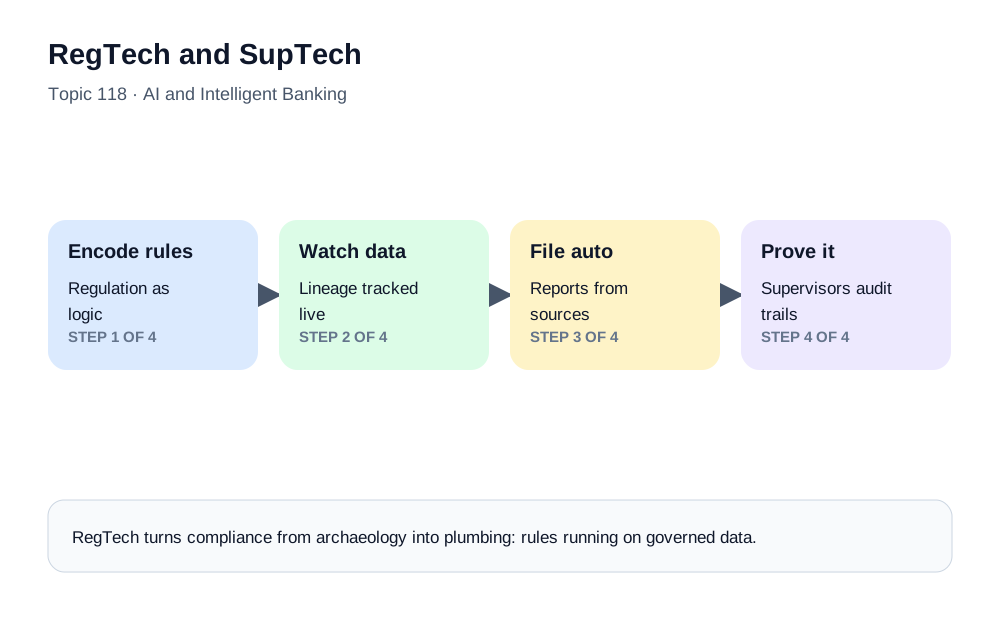
RegTech and SupTech at a glance — Automated compliance, regulatory reporting, supervisory tech.
Automating Compliance with AI, ML, and Advanced Analytics
RegTech, short for Regulatory Technology, applies advanced technology to the complex challenges of regulatory compliance that have become increasingly burdensome for financial institutions operating in an environment of expanding rules and heightened enforcement. This field encompasses automating reporting, streamlining Know Your Customer and Anti-Money Laundering processes, monitoring regulations in real time, and reducing the massive costs associated with compliance activities that have grown exponentially since the financial crisis. Compliance is a major cost and operating responsibility for financial institutions, but expenditure differs substantially by business model, jurisdiction and measurement method. RegTech should be justified by improved control effectiveness, evidence quality and operational efficiency rather than a universal percentage of bank revenue. The technology promises not just cost reduction but improved accuracy, broader coverage, and faster response to regulatory changes that manual processes cannot achieve at reasonable cost.
The compliance cost problem that RegTech addresses is staggering in scale and growing as regulations proliferate across jurisdictions and become more complex. Large financial institutions process extensive regulatory change, monitoring, screening, reporting and control workloads. Headline figures for global compliance spend, employee counts, enforcement fines, alert false-positive rates and promised cost reduction vary by source and change over time, so they should be verified from current primary or well-defined industry data before use. The durable RegTech case is to improve data quality, consistency, traceability, coverage and review productivity while maintaining accountable compliance decisions.
RegTech solutions address distinct categories of compliance challenge through specialized applications designed for specific regulatory requirements. In KYC and identity verification, artificial intelligence-based document reading using optical character recognition and natural language processing replaces manual verification of identity documents that is slow and error-prone. Digital identity and KYC workflows can reduce manual onboarding time when reliable data sources, document verification and approved remote-identification methods are available. Actual time and regulatory requirements differ by institution, customer type and jurisdiction, so a universal days-to-minutes claim should not be assumed. Shared KYC utilities like India's Central KYC Registry eliminate repeated verification at each institution, reducing duplication and improving customer experience while ensuring consistency. AI-based liveness detection addresses deepfake fraud attempts that traditional verification cannot catch, protecting against synthetic identity attacks. For AML and transaction monitoring, machine-learning risk ranking can in some implementations reduce unnecessary alerts or prioritise analyst workload, but improvement varies by typology, data quality, baseline rules and validation method. Banks should measure performance using their own confirmed outcomes rather than assume a universal fifty-to-seventy-percent reduction. Unsupervised machine learning detects unknown laundering methods that predefined rules miss because they have not been seen before or codified into detection logic. Graph analytics map relationship networks to identify coordinated criminal activity across multiple accounts that would appear innocuous when viewed in isolation. AI drafts Suspicious Activity Reports from transaction data, accelerating regulatory filing and ensuring consistency in reporting that meets regulatory expectations.
Regulatory reporting automation addresses pain points across the submission process that have historically been manual and error-prone, creating risk of penalties for late or incorrect submissions. Automated data extraction from source systems eliminates manual aggregation that is slow and creates opportunities for error through copying mistakes or formula errors. Rule engines with automated validation ensure calculation accuracy and flag anomalies for review before submission, catching errors that would otherwise result in regulatory penalties. Scheduled automated report generation prevents late submissions that trigger regulatory penalties and reputational damage. Artificial intelligence monitors regulatory changes and flags those affecting specific reporting requirements, ensuring timely updates to reports as rules evolve without requiring manual monitoring of every jurisdiction.
Risk assessment applications of RegTech enable more dynamic and comprehensive oversight than periodic manual reviews that provide only point-in-time snapshots. Machine learning-based risk scoring replaces static annual models with continuously updated assessments reflecting current conditions as they change. Real-time risk assessment provides immediate awareness of changing conditions rather than waiting for scheduled reviews that may miss deteriorating situations. AI-powered scenario modeling enables more sophisticated stress testing that considers complex interactions between risk factors rather than simple linear assumptions. Automated audit logging can improve completeness and traceability when events are recorded securely with controlled access and retention. Logs are not automatically immutable merely because they are automated; integrity controls, privileged-access management and evidence governance determine how reliable they are for examination.
SupTech, or Supervisory Technology, extends these capabilities to regulators themselves who face similar challenges in overseeing complex financial systems with limited resources. Central banks and regulatory authorities deploy technology to enhance their oversight capabilities and make supervision more effective and risk-based. Automated inspections use AI to analyze bank data remotely before on-site examinations, focusing inspector attention on highest-risk areas and making better use of limited supervisory resources that cannot examine everything in detail. Market surveillance applies machine learning to detect manipulation and insider trading across trading venues that generate more data than human analysts can review effectively. Standardized APIs enable consistent data collection from regulated institutions, reducing burden and improving data quality through automation. Early warning systems identify banks showing signs of financial distress before failure becomes imminent, enabling preventive intervention while remedies remain viable. Natural language processing creates machine-readable regulations that enable automated compliance checking against rules, reducing ambiguity and improving consistency.
Supervisory authorities, including the Reserve Bank of India, use digital platforms, data collection and analytics to support supervision. Platform names, scope and functions evolve, so current regulator publications should be consulted before describing a specific SupTech system. The enduring concept is that supervisors can use better data, workflow and analytics to prioritise risk and improve oversight.
The RegTech market includes providers specialising in identity verification, screening data, transaction monitoring, communications surveillance, digital-asset analytics and regulatory reporting. Vendor products, ownership, claims and geographic coverage change frequently. Banks should evaluate providers through current evidence on data provenance, accuracy, explainability, security, resilience, regulatory fit and integration rather than rely on a static vendor list or marketing claim.
India has several public or regulated digital infrastructures relevant to identity, financial-data sharing, document access, tax information and security-interest registration. Their legal purpose and permitted use differ: for example, the Account Aggregator framework supports consented financial-information sharing and CKYCR supports centralised KYC records, but neither should be described as removing every institution's own compliance responsibility. Current official rules determine how each infrastructure may be used.
Implementing RegTech solutions presents several challenges that institutions must navigate to realize benefits while managing risks appropriately. Legacy integration requires connecting modern RegTech with decades-old banking systems that were not designed for API connectivity or real-time data access, creating technical complexity. Data quality fundamentally constrains AI effectiveness—models are only as good as the data they receive, and banking data is often fragmented and inconsistent across systems. Regulatory acceptance requires demonstrating that AI-based compliance decisions meet regulatory standards for reliability, auditability, and fairness that regulators may not yet fully understand or accept for all applications. Explainability demands that institutions explain why specific alerts were generated or suppressed, challenging for complex machine learning models that operate as black boxes. Cross-border complexity multiplies challenges as regulations differ across every jurisdiction where global banks operate, requiring flexible solutions that can adapt to local requirements. Vendor risk emerges when institutions become dependent on third-party RegTech providers for critical compliance functions that must remain available and secure.
The future of compliance lies in intelligent automation that handles routine tasks while elevating human professionals to judgment-intensive work that requires expertise, discretion, and accountability. RegTech enables this transformation by processing vast data volumes without fatigue, identifying patterns invisible to human analysis, and maintaining continuous vigilance that human teams cannot sustain over time. Institutions that master RegTech will achieve compliance more efficiently and effectively than competitors still relying on manual processes and outdated technology, creating competitive advantage through lower costs, better risk management, and faster response to regulatory changes that are inevitable in the financial industry.
<!-- MBA-DEEP-DIVE-START -->RegTech and SupTech Deepening — Compliance Architecture, Data, Controls, and Supervisory Use
RegTech is not one product category
RegTech is an umbrella term for technology used to help financial institutions meet regulatory, compliance and control obligations. It can include digital identity, sanctions screening, AML monitoring, regulatory change management, regulatory reporting, communications surveillance, trade surveillance, privacy controls, conduct monitoring, model governance and evidence management. These problems have different data and legal requirements. A bank should define the specific control objective before choosing technology rather than assuming a single platform can “automate compliance.”
Technology assists compliance but does not own accountability
A bank remains responsible for the quality of its compliance programme even when a vendor provides screening data, identity verification, transaction monitoring or report generation. Outsourcing technology does not outsource regulatory accountability. The institution should understand what the system does, what it misses, how it changes, and which decisions still require human judgment. Contracts, validation and operating procedures should make ownership explicit.
The strongest RegTech use cases begin with control evidence
A compliance process should produce evidence that the required control occurred: who performed it, what data was used, which rule or model version applied, what exceptions arose and how they were resolved. Technology can make this evidence more complete and timely. If automation merely moves a manual task into a new screen without improving traceability or decision quality, the RegTech value may be limited. Evidence quality is a practical measure of compliance maturity.
Regulatory change management is an information problem and a governance problem
Banks must identify relevant regulatory publications, determine applicability, interpret obligations, assess impact and implement changes. Technology can monitor sources, compare versions, extract potential obligations and link them to policies or controls. It should not assume every published document applies to every legal entity. Applicability depends on jurisdiction, licence, product, customer and effective date. The workflow therefore needs accountable legal and compliance review.
Source hierarchy matters in regulatory intelligence
A regulator's final rule, consultation paper, speech, FAQ and enforcement action have different legal significance. A RegTech system should classify source type and status so users do not treat a discussion paper as binding law or an outdated FAQ as current requirement. Metadata such as publication date, effective date and superseded status should travel with the extracted content. Regulatory intelligence is only as reliable as its source governance.
Machine-readable regulation can improve processing but cannot remove ambiguity
Rules can sometimes be converted into structured obligations, thresholds or taxonomies. This supports automated mapping and reporting. However, regulatory language often contains principles, exceptions and judgment that cannot be reduced safely to a simple rule. Technology can highlight relevant clauses and structure obvious requirements while leaving interpretation to accountable experts. The objective is to reduce search and administrative work, not pretend law is always deterministic code.
Obligation inventories connect regulation to the bank
An obligation inventory can record requirement, source, jurisdiction, legal entity, owner, control, evidence, reporting frequency and effective date. RegTech can help populate and maintain this structure. The inventory creates a bridge from external regulation to internal accountability. Without it, banks can collect large volumes of regulatory text yet still struggle to show which control satisfies which requirement.
Policy mapping should preserve version history
When a regulation changes, the bank may update several policies and procedures. A mapping system should show which version of a policy addressed the obligation at each point in time. This helps audit and examination because the bank can explain what rule applied when a customer or transaction was processed. Overwriting old mappings without effective dates destroys important evidence.
Control libraries reduce duplication
Different regulations can require similar underlying controls such as identity verification, access restriction, record retention or transaction monitoring. A common control library allows one well-designed control to map to several obligations where appropriate. Technology can reveal overlapping requirements and reduce redundant testing. The mapping should still be reviewed because two rules that sound similar may have different scope or evidence expectations.
Automated control testing should test the actual control
A system can check whether a required field is populated, but that does not prove the underlying process was effective. For example, confirming that an AML review date exists does not prove the review used accurate customer information. Automated testing is strongest for deterministic evidence such as timeliness, completeness, access rights or configuration. Judgment-heavy controls may require sample review or thematic assessment.
KYC technology should separate identity, customer due diligence and ongoing review
Identity verification answers whether the claimed identity can be reasonably established. Customer due diligence goes further: purpose, ownership, expected activity, risk factors and required evidence. Ongoing due diligence keeps the information current and investigates material changes. A digital identity vendor may solve only one part. Calling the entire workflow “automated KYC” can hide gaps between verification and full customer-risk assessment.
Document verification should combine several checks
Identity-document systems can inspect image quality, template consistency, security features, data fields and signs of manipulation. They may compare the document with a selfie or authoritative source where permitted. No single check is conclusive. Banks should understand false acceptance and false rejection rates, supported document types, geographic coverage and fallback for customers whose documents or devices cannot be processed automatically.
Liveness detection has to evolve with synthetic-media risk
Face verification can be attacked with photos, video replay, masks or generated media. Liveness controls may use challenge-response, passive analysis, device signals or other methods. Banks should test against current attack methods and monitor performance across demographic groups. A vendor claim of “AI liveness” is not enough. Evidence should include security testing, error rates and update processes.
Name screening is a matching problem with legal consequences
Sanctions, PEP and watchlist screening must compare customer or transaction names with relevant lists despite spelling differences, transliteration, aliases and incomplete data. Fuzzy matching can improve recall but also increases false positives. RegTech can rank matches using additional attributes such as date of birth, country or identifiers. Final disposition must follow the bank's sanctions and compliance framework, with reasons and evidence preserved.
List quality is part of screening quality
A sophisticated matching engine cannot compensate for stale, incomplete or incorrectly mapped reference lists. Banks should know which official and commercial sources are used, how quickly updates arrive, how deletions and aliases are handled and how list versions are retained. Vendor data is a critical dependency. Screening incidents should distinguish matching failure from reference-data failure.
Transliteration needs language-aware testing
Names can appear in different scripts and romanisations. One person may have several legitimate spellings. Screening systems should account for common transliteration patterns without creating unmanageable noise. Performance should be tested across the languages and customer populations the bank actually serves. A matching approach tuned for English names may perform poorly in another market.
False positives are an operational issue, not simply a model metric
Every screening or monitoring alert consumes analyst time and can delay customers or transactions. Reducing unnecessary alerts is valuable, but not if true risks are suppressed. Banks should measure precision, recall or detection performance where ground truth exists, along with queue ageing, investigation time and customer impact. The right threshold reflects risk appetite and legal obligation, not only operational cost.
Sanctions screening and AML monitoring should not be merged conceptually
Sanctions screening often tests names, countries, entities or payment data against prohibitions and restrictions. AML transaction monitoring looks for suspicious behavioural patterns. The systems can share data and case platforms, but legal consequences and decision rules differ. A RegTech architecture should make these differences visible so one workflow does not incorrectly inherit the other's logic.
Transaction monitoring scenarios should have a typology rationale
A rule such as “cash deposits above X” is not meaningful by itself. The bank should know which laundering or financial-crime risk it is intended to detect, which customers it applies to, and how the threshold was justified. Machine learning can rank or supplement scenarios, but the control framework still needs typology coverage. A large scenario inventory without clear rationale becomes difficult to tune and defend.
Customer segmentation can improve AML monitoring
Expected behaviour differs between a salary account, cash-intensive business, charity, correspondent bank and securities firm. Monitoring can use segmentation to establish more relevant baselines and reduce false positives. Segments should be defined from stable business characteristics, not merely statistical clusters that compliance teams cannot explain. Customers can also change behaviour over time, so segmentation needs review and effective dating.
Network analytics can reveal hidden relationships
Graph methods can connect customers, accounts, counterparties, devices, addresses and transactions. This can support mule detection, shell-company analysis, circular flows or links to known high-risk entities. Graph results should remain explainable. Shared addresses or service providers can create legitimate connections. Investigators need to see why entities are linked before a network score influences a consequential decision.
Alert prioritisation is different from alert suppression
A machine-learning model can rank existing alerts so the highest-risk cases are reviewed first. This is often easier to govern than allowing the model to remove alerts entirely. Suppression can be appropriate with evidence, but it changes coverage and needs stronger validation. Banks should be explicit about whether AI is prioritising, augmenting or replacing a control because the risk is different.
Case management is a core RegTech component
Detection without workflow leaves alerts scattered across systems. A case platform can collect evidence, assign ownership, record decisions, enforce approvals and track deadlines. Good case design reduces duplicate work and creates a consistent audit trail. Integration should preserve the original alert, model or rule version and data snapshot so later reviewers can reconstruct why the case existed.
Investigation notes should distinguish facts, interpretation and conclusion
AI can help summarise case evidence, but systems should preserve which statements came from transactions, customer records, external intelligence or analyst judgment. This distinction matters in regulatory reporting and customer disputes. A generated narrative should not turn an inference into a fact. Structured evidence plus human-readable explanation is stronger than a polished paragraph with unclear provenance.
Suspicious activity reporting needs jurisdiction-specific controls
Terminology, filing authority, deadlines and disclosure rules vary by country. A global RegTech platform should not assume one SAR workflow applies everywhere. The system can share common case components but needs local configuration and legal ownership. Confidentiality rules around filings may also restrict what can be shown to customers or non-authorised staff. Access control should reflect this sensitivity.
Regulatory reporting begins with data lineage
A report field should be traceable back through transformations to the source ledger, transaction, customer or risk system. Lineage helps explain differences, restatements and validation errors. A reporting engine that produces a perfectly formatted file from poorly understood source data does not solve the control problem. Regulators and bank management need confidence in both the calculation and the underlying data.
Reporting taxonomies need controlled mapping
Regulatory templates define concepts, dimensions, units and validation rules. Banks map internal data to these requirements. Mappings should have owners, effective dates and testing because product or ledger changes can make an old mapping incorrect. Automated metadata tools can help identify impact, but finance and regulatory reporting experts should confirm meaning. Technical field similarity is not the same as accounting equivalence.
Reconciliation is essential before submission
Regulatory totals should reconcile to appropriate financial, risk or transaction sources. Differences may be legitimate because scope or timing differs, but they should be understood and documented. Automated reconciliation can flag breaks and drill into contributing records. This is more valuable than merely checking that a file passes schema validation. A technically valid report can still be substantively wrong.
Validation rules should run as early as possible
If a regulatory return requires positive amounts, valid country codes or totals that balance, those checks can run during data preparation rather than at the final submission step. Early validation reduces late surprises and supports data-owner remediation. Rules should be versioned because regulators change them. A report should be reproducible with the validation set that applied on the reporting date.
Manual adjustments need controlled evidence
Some regulatory reports require expert adjustments that source systems cannot derive automatically. The system should capture amount, reason, preparer, approver and supporting evidence. Manual does not automatically mean weak; uncontrolled manual change is the risk. Workflow and audit logging can make necessary adjustments transparent without pretending the entire report is machine-generated.
Reporting calendars should understand business and regulatory time
Submission deadlines can depend on local holidays, reporting periods and regulator time zones. RegTech scheduling should use the correct calendar rather than a generic monthly job. Upstream data cut-offs and approval windows should be planned backward from the deadline. A technically automated pipeline can still miss a filing if calendar logic is wrong.
Submission acknowledgement is part of the reporting lifecycle
Sending a file does not prove the regulator accepted it. Systems should capture technical acknowledgements, validation rejects, resubmissions and final acceptance where applicable. Status should be visible to reporting owners. Evidence of submission and acceptance can be as important as the generated report during examination or incident review.
Restatements need versioned reporting evidence
A bank may correct a report after discovering an error. The system should preserve original submission, restated version, reason, approval and communication with the regulator. Replacing the old file erases history. Versioned reporting helps the institution demonstrate transparency and understand recurring data-quality problems.
Communications surveillance has different data challenges
Banks may monitor email, chat, voice or trading communications for misconduct, market abuse or policy violations where lawful. Language, context and sarcasm make detection difficult. Models can prioritise messages for review but should be assessed for privacy, labour-law and false-positive impacts. Communication surveillance is not simply “sentiment analysis for traders.” It requires clear risk scenarios and investigator evidence.
Voice transcription quality affects surveillance quality
Poor audio, accents, specialist terminology and overlapping speech can distort transcripts. A model may then flag language that was never spoken or miss relevant phrases. Surveillance systems should retain confidence and original audio where permitted, with appropriate access controls. Analysts should be able to verify important findings against the source rather than trust transcription blindly.
Trade surveillance needs market context
Suspicious trading patterns can depend on order timing, cancellations, market depth, related instruments and trader relationships. A rule that looks abnormal in isolation may be legitimate during volatile markets. Machine learning can help rank complex patterns, but validation should involve market experts. Surveillance technology supports detection; it does not replace knowledge of how trading venues and products behave.
Conduct monitoring should avoid secret personality scoring
RegTech can identify policy breaches or risky patterns, but employees should not be judged through opaque psychological profiles built from unrelated data. Monitoring should be relevant to the control objective, proportionate and lawfully governed. Clear policy and access restrictions protect both employees and the institution. Predictive sophistication is not a licence to collect every available behavioural signal.
Privacy compliance can itself use RegTech
Data discovery tools can identify personal information, map where it flows, enforce retention and support subject-rights workflows. Consent and preference systems can track permitted uses. However, automated classification can mislabel data, so high-risk actions such as deletion from critical records need safeguards. Privacy RegTech should integrate with information governance rather than operate as an isolated scanner.
Records management needs defensible retention
Banks must preserve some records for required periods while deleting or anonymising others when retention no longer has a legal basis. Technology can apply retention schedules, legal holds and disposition workflows. The challenge is mapping record type and jurisdiction correctly. “Keep everything forever” creates privacy and security risk; deleting too early creates regulatory and legal risk.
RegTech data quality should be owned at source where possible
Compliance teams often discover missing customer fields or incorrect transaction attributes after data reaches monitoring systems. Fixing the downstream copy may hide the problem from other users. Data-quality incidents should trace back to the source owner and remediation should improve the upstream process. RegTech can measure quality and route issues, but enterprise data governance is needed for durable correction.
Reference data is a hidden dependency
Country risk, industry codes, legal-entity hierarchies, sanctions lists, product mappings and customer segments drive many compliance controls. If reference data is stale, models and rules can behave incorrectly. Reference sets should have effective dates, ownership and controlled change. Major compliance incidents can originate from a simple mapping error rather than a sophisticated algorithm failure.
Model governance applies to compliance AI
A machine-learning model used to prioritise AML alerts, match sanctions names or classify regulatory obligations should have documented purpose, data, performance, limitations, validation and monitoring. The governance level should reflect consequence. A model that supports analyst search may be lower risk than one that automatically suppresses alerts. “AI for compliance” should not be exempt from the bank's model-risk framework.
Explainability should focus on the control decision
Compliance users need to know why an alert was generated or prioritised. Feature importance charts can help validators, but investigators need concrete reasons such as unusual transaction velocity, counterparty relationship or name-match attributes. Managers need portfolio and scenario trends. Regulators may need evidence of design and testing. Explanation should be adapted to the audience while remaining faithful to the system's actual logic.
Bias can enter compliance models through data and proxies
Risk models can inadvertently treat geography, language, occupation or channel as proxies for protected or disadvantaged groups. Compliance objectives may legitimately use some risk factors, but fairness and proportionality still matter. Banks should test whether the control creates unjustified disparate treatment and whether alternative features achieve similar detection. Financial-crime prevention and customer fairness are not mutually exclusive obligations.
Vendor models need transparency sufficient for bank oversight
A vendor may protect proprietary intellectual property, but the bank still needs enough information to validate purpose, inputs, performance, limitations, change control and data use. “Black box because commercial secret” is not an adequate risk position for a critical compliance control. Contracts can define evidence and notification without requiring the vendor to publish every algorithmic detail.
Vendor reference data needs provenance
Screening and adverse-media services aggregate information from many sources. Banks should understand inclusion criteria, update frequency, correction processes and how identities are resolved. An incorrect vendor record can harm a customer. Case workflows should allow analysts to distinguish official-list data, media reporting and vendor inference. Data provenance supports both accuracy and challenge.
SaaS RegTech introduces concentration and exit risk
Using a hosted provider can speed implementation, but critical compliance capability may then depend on external availability, pricing and product direction. Business-continuity plans should address outages and vendor failure. Exit arrangements should cover data export, case history, model or rule configuration and migration support. Compliance evidence must remain accessible even if the vendor relationship ends.
Cloud architecture needs data-residency analysis
Compliance data can include identity documents, sanctions cases, suspicious activity and sensitive employee communications. Banks should know where the data is stored and processed, which sub-processors are involved and which jurisdictions apply. Encryption and access control are necessary but do not answer every residency or secrecy obligation. Architecture should follow the legal classification of the data.
API integration should enforce least privilege
A RegTech vendor checking identity does not necessarily need access to the customer's entire account history. Each integration should send only the fields required and authenticate the requesting system. Responses should also be validated before use. Least-privilege APIs reduce breach impact and make data flows easier to explain to risk and privacy teams.
Batch and real-time controls serve different purposes
Sanctions screening at onboarding may be near real time, transaction screening may operate inside a payment decision, while regulatory reporting is often scheduled. RegTech architectures should respect the timing of each control. Forcing every process into “real time” can add complexity without value. Conversely, a batch control may be too late to stop a prohibited payment. Timing should follow the risk event.
Service-level failure should have a defined compliance outcome
If a screening API times out, should the transaction proceed, queue or fail? The answer depends on risk, regulation and product. The decision should be explicit rather than an accidental technical default. Fallback rules, retry behaviour and manual queues should be tested. Availability engineering is a compliance-control issue when the service determines whether a regulated action can occur.
Observability should expose control health
Operations should know whether lists are current, APIs are responding, reporting jobs completed, alerts are flowing and investigation queues are ageing. Technical monitoring and compliance monitoring should meet. A green server dashboard can hide a stale sanctions list, while a healthy compliance metric can hide repeated system retries. End-to-end control observability connects technology status with regulatory purpose.
Change management should include regulatory logic
Updating a screening threshold, risk rule, report mapping or regulatory taxonomy can materially change compliance outcomes. Such changes should have documented rationale, testing, approval and effective date. Emergency changes may be needed during new sanctions or fraud events, but they still require later review. Configuration is part of the control, not an informal operational tweak.
Parallel run is valuable when replacing a major compliance system
A bank can operate old and new monitoring or reporting logic in parallel for a period and compare alerts, calculations or cases. Differences should be understood rather than simply choosing whichever output looks better. Parallel run reveals data and mapping gaps that unit tests may miss. Exit criteria should be defined before cutover so the comparison does not continue indefinitely.
Historical backtesting should reflect the rules that actually applied
When evaluating a new AML model or screening method, the bank should preserve historical list versions, customer data and transaction context. Using today's lists against old transactions can answer a different question. Point-in-time data helps determine whether the new control would have detected known cases under realistic conditions. Backtesting should not quietly benefit from future information.
Quality assurance should sample both positive and negative outcomes
Reviewing only confirmed alerts can miss customers wrongly cleared or excessive false positives. QA can sample escalated, closed and automatically handled cases according to risk. Findings should feed threshold tuning, analyst training and data fixes. Compliance automation is trustworthy when there is an independent mechanism to test what it gets wrong.
Human review should be designed around judgment
If technology presents thousands of low-value alerts, human-in-the-loop becomes a bottleneck rather than a control. RegTech should prioritise, organise evidence and automate deterministic checks so specialists can focus on ambiguity and judgment. Review interfaces should show reasons, source data and history. Human approval is meaningful only when the reviewer has enough time and evidence to challenge the system.
SupTech uses similar technology from the supervisor's perspective
Supervisors can collect structured data, perform risk analytics, monitor markets, prioritise examinations and analyse regulatory submissions. The purpose is not to automate regulatory judgment entirely but to use limited supervisory resources more effectively. SupTech can identify anomalies or institutions requiring attention, after which supervisory teams investigate context. The same principles of data quality and explainability apply to regulators as to banks.
Standardised data can reduce both supervisory burden and ambiguity
When regulators define consistent data models, taxonomies and validation rules, banks can automate submissions more reliably and supervisors can compare institutions more effectively. Poorly specified data requests create manual interpretation and inconsistent reporting. SupTech therefore depends partly on standard-setting and data governance, not only on AI.
API-based supervision requires clear authority and security
More frequent or automated data exchange between institutions and supervisors can improve timeliness, but it raises questions about authentication, confidentiality, permitted scope and operational resilience. An API does not change the regulator's legal authority or the bank's obligations. Strong interface governance is necessary because supervisory data can be highly sensitive.
Early-warning models support attention, not automatic intervention
Supervisors can use indicators of capital, liquidity, asset quality, market behaviour and governance to prioritise institutions for review. A high-risk score should trigger analysis, not automatically determine a supervisory action without context. Banks can experience temporary anomalies for legitimate reasons. Transparent model design helps supervisory teams understand why the signal changed.
Supervisory analytics needs peer comparability
A ratio that is normal for a retail bank can look very different for a specialised investment or development institution. SupTech peer groups should reflect business model and reporting scope. Comparisons should also account for accounting and regulatory differences. Poor peer selection can generate false concern. Supervisory technology is useful when it improves judgment, not when it replaces sector understanding.
Natural-language tools can accelerate supervisory document review
Regulators receive policies, board papers, audit reports, recovery plans and other documents. NLP and generative AI can help search and summarise them, identify recurring themes and compare submissions. Important findings still require human validation. Confidential supervisory information also demands strict data and access controls. The technology can improve review capacity without changing the sensitivity of the material.
Supervisors and banks can both benefit from better regulatory feedback loops
If common reporting errors occur across institutions, supervisors can clarify instructions or improve validation rules. Banks can use rejection patterns to improve source data and mappings. A mature digital ecosystem treats errors as information for system improvement rather than repeatedly fixing the same submission manually. RegTech and SupTech become more powerful when standards and feedback evolve together.
Compliance analytics should avoid metric gaming
If teams are rewarded only for closing alerts quickly, they may sacrifice investigation quality. If a RegTech programme is judged only by reduced alert volume, it may suppress risk. Balanced measures should include detection, QA findings, timeliness, customer impact, reporting accuracy and unresolved issues. Technology should improve compliance outcomes, not optimise a convenient dashboard number.
Cost savings should be a consequence of better process, not the sole objective
Automation can reduce manual effort, but compliance decisions exist to manage legal and financial-crime risk. A project that saves analyst hours while weakening coverage is a failure. Strong business cases describe both efficiency and control improvement: faster review, better evidence, fewer duplicate checks, more consistent decisions and improved data lineage. Sustainable savings come from better architecture rather than indiscriminate headcount reduction.
The RegTech operating model needs joint ownership
Compliance understands obligations and risk. Technology understands architecture, resilience and integration. Data teams understand lineage and quality. Operations understand case workflow. Legal interprets law, and model risk challenges analytics. Effective RegTech programmes bring these roles together. Treating the project as “a compliance tool purchase” or “an AI project” underestimates the cross-functional nature of the control.
The final goal is demonstrably effective compliance
RegTech succeeds when the bank can meet obligations more consistently, detect relevant risk, produce accurate reports, explain decisions, preserve evidence and respond to change without unnecessary manual friction. SupTech succeeds when supervisors obtain more timely, comparable and risk-relevant information to support oversight. Neither field is about replacing accountable professionals with algorithms. The technology is valuable because it makes complex control systems more observable, testable and scalable.
RegTech and SupTech Final Depth — Assurance, Examinations, and Sustainable Control
RegTech should make an examination easier to evidence
A useful test of compliance technology is whether the bank can answer a supervisor's question efficiently: which rule applied, which customer or transaction was in scope, what control ran, what data it used, what exception occurred and how it was resolved. If the institution still needs weeks of spreadsheet reconstruction, automation has not solved the evidence problem. RegTech should shorten the path from regulatory requirement to demonstrable control execution.
Evidence should be preserved at the level needed to reproduce a decision
A screening or monitoring system should retain or reference the list version, model or rule version, material input data and outcome for consequential cases. Regulatory reporting should retain mappings, validations and submissions. KYC should preserve the evidence used for verification and approval according to retention rules. Reproducibility does not mean storing every transient technical detail forever; it means keeping enough controlled evidence to explain the compliance action later.
Examination requests are themselves a workflow
Supervisors can request documents, data samples, explanations and remediation evidence. Technology can log each request, owner, due date, response and approval, reducing the risk of inconsistent or late submissions. Sensitive supervisory information should have restricted access. A structured workflow also helps management see repeated themes across examinations rather than treating every request as an isolated email exercise.
Findings should connect to remediation and control testing
A regulatory or internal-audit finding is not closed because a policy was edited. The bank should identify root cause, affected processes, corrective action, accountable owner, target date and evidence that the new control works. RegTech can track dependencies and overdue actions. Closure should be based on tested remediation, not administrative status. This turns findings management into an evidence-based risk process.
Issues should be linked to the underlying obligation where possible
If a KYC control fails repeatedly, teams should know which regulatory or policy requirements are affected. Obligation linkage helps prioritise severity and determine whether regulator notification may be needed. It also shows whether one technology defect creates exposure across several requirements. This is more informative than a flat list of “compliance issues” without legal or control context.
Control owners need dashboards that show health, not just activity
Counting how many alerts were generated or reports submitted does not show whether the control is effective. Useful dashboards include stale lists, failed data feeds, overdue cases, QA defects, unresolved reconciliation breaks, model drift and submission rejects. Activity metrics can be high while control quality is poor. RegTech observability should therefore focus on whether the regulated process is working as intended.
Threshold changes should be treated as model or rule governance events
Changing a monitoring threshold can dramatically alter alert volume and risk coverage. The bank should record why the change was made, what data supported it, who approved it and how performance will be reviewed. Emergency tuning can occur during new threats, but retrospective governance should follow. Silent operational tuning makes it difficult to explain historic differences in alert behaviour.
Scenario retirement needs evidence
AML or surveillance scenarios can become obsolete, redundant or ineffective. Removing them may be appropriate, but the bank should document why risk remains adequately covered by other controls. Scenario inventories should not grow forever simply because no one wants to retire anything. Rationalisation improves maintainability when it is supported by typology analysis, testing and accountable approval.
New regulations should trigger impact analysis before technology change
A rule change can affect customer terms, operational process, data collection, reporting and training, not only the compliance system. RegTech can identify candidate impacts, but programme governance should coordinate the full implementation. Updating a reporting field while leaving customer onboarding unchanged can create partial compliance. Regulatory change is a business change that technology helps organise.
SupTech data quality can influence supervisory confidence
When banks submit inconsistent or frequently corrected data, supervisors spend more time questioning the information and may increase scrutiny. Strong data lineage, validation and reconciliation therefore improve not only reporting efficiency but also credibility. SupTech makes comparative anomalies easier for regulators to see, increasing the value of banks getting source data and definitions right before submission.
Common data standards reduce bilateral interpretation
If each bank interprets a supervisory data request differently, the regulator receives numbers that are difficult to compare. Standard taxonomies, validation rules and definitions can reduce this ambiguity. Banks benefit because they can automate mappings and understand rejection reasons. The best digital supervision therefore combines technology with clear semantic standards.
Privacy and secrecy obligations apply to supervisory technology too
Supervisors can hold highly sensitive bank and customer information. Collection frequency and analytical capability do not remove confidentiality requirements. Access control, secure transmission, retention and purpose limitation remain important. Banks should similarly restrict internal access to regulatory submissions and examination material. SupTech is powerful precisely because it centralises valuable information, which also increases the impact of misuse.
Human supervisory judgment remains necessary for context
A bank can show an unusual ratio because of a merger, one-off transaction or specialised business model rather than distress. Analytics can identify the anomaly, but supervisors need context before drawing conclusions. SupTech should improve prioritisation and evidence, not encourage automatic enforcement from a dashboard score. Risk-based supervision still depends on experienced interpretation.
RegTech maturity is visible in how exceptions are handled
Routine straight-through processing is often easy to automate. The difficult cases are missing documents, ambiguous matches, conflicting data, unusual ownership structures, failed feeds and legal uncertainty. Mature systems route these exceptions clearly, preserve evidence and support accountable decisions. A platform that performs well only when data is perfect will create hidden manual work around its edges.
Sustainable compliance technology is designed for change
Regulations, sanctions lists, products, customer behaviour and data architectures all evolve. Systems should therefore use versioned configuration, modular rules, controlled mappings and observable integrations rather than hard-coded logic scattered across applications. The long-term RegTech advantage is not a one-time reduction in manual work. It is the ability to change compliance controls quickly while preserving validation, accountability and historical evidence.
RegTech and SupTech Control Deepening — Rules, Data Lineage, and Supervisory Evidence
RegTech should turn obligations into controlled, testable requirements
The value of regulatory technology is not that a machine “knows the law.” A mature design maintains a taxonomy linking source obligation, jurisdiction, legal entity, product, process, data element, control, evidence, owner, and effective date. When a rule changes, teams can identify which reports, screening rules, workflows, or disclosures are affected. This is stronger than embedding regulatory interpretation anonymously inside code where nobody can explain why a threshold exists.
Rules engines need versioning and effective dating
A compliance rule can be correct today and wrong next quarter. Decision services should retain the rule version applied to each customer, transaction, or report and the date from which the rule was effective. Changes should pass legal or compliance interpretation, testing, approval, deployment, and post-release monitoring. Emergency regulatory changes can use an expedited route, but the evidence trail should still show who authorised what.
SupTech depends on data quality at the supervised institution
Supervisory technology can analyse regulatory submissions, transaction patterns, risk indicators, or market data more quickly, but automation does not repair weak source data. Banks need reconciled definitions, lineage from report to source systems, data-quality controls, and explainable transformations. An API submission can be technologically modern while still carrying the wrong legal-entity scope or duplicated exposures.
Automated compliance should preserve human challenge
A sanctions, AML, conduct, prudential, or reporting model can prioritise cases and detect patterns, but high-impact decisions still need governance appropriate to the use case. False positives can overwhelm operations; false negatives can hide risk. Teams should monitor precision, recall where measurable, overrides, exceptions, drift, and customer impact. A vendor score should not become an unchallengeable compliance decision merely because it is produced by machine learning.
Supervisory data exchanges need stable semantics and security
Machine-readable reporting can reduce manual work only if both sides agree what each field means, which period it covers, what units and currencies apply, and how corrections are submitted. Authentication, encryption, non-repudiation, schema versioning, submission receipts, and resubmission rules matter as much as the API itself. The bank should retain the exact payload and acknowledgement as regulatory evidence.
Scenario: a regulatory threshold changes mid-year
The compliance team records the new official source, effective date, interpretation, and affected customer population. The rules engine creates a new version rather than overwriting history. Regression testing confirms that pre-effective-date cases still reproduce the old outcome and new cases apply the new threshold. Monitoring checks the expected change in volumes. RegTech succeeds because it makes regulatory change traceable, not because it removes accountable human judgement.
<!-- MBA-DEEP-DIVE-END -->