Visual overview
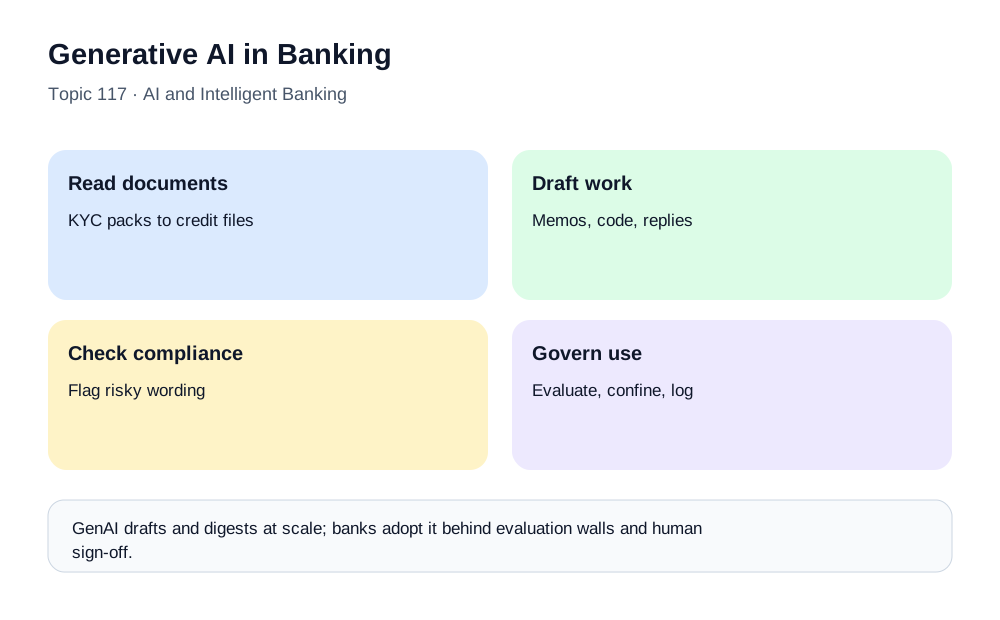
Generative AI in Banking at a glance — Document processing, compliance automation, code assistance.
Large Language Models, Document Understanding, and the AI Transformation of Banking
Generative AI, including large language models from multiple providers and bank-built systems, is an important technology shift for banking knowledge work, customer interaction and software delivery. Its ultimate long-term impact should not be assumed to exceed every previous banking technology change; institutions should judge value by controlled business outcomes. Unlike traditional machine learning that classifies and predicts based on existing data patterns, generative AI creates—drafting documents, writing code, summarizing reports, answering complex questions, and automating workflows that previously required skilled human professionals. Banking, with its massive volumes of documents, complex regulations, process-intensive operations, and knowledge work, presents ideal conditions for generative AI deployment that can dramatically improve productivity and accuracy. The technology promises to transform how banks operate, compete, and serve customers, though realizing this potential requires careful attention to risks and governance frameworks that ensure responsible deployment.
Generative AI capabilities address multiple banking needs through distinct applications that leverage the technology's unique strengths in language understanding and generation. Text generation enables drafting loan agreements, customer communications, compliance reports, and marketing content that previously required substantial manual effort from specialized staff with legal or writing expertise. Summarization condenses hundred-page regulatory filings into two-page executive summaries, accelerating decision-making by extracting key information that executives need without reading entire documents. Question answering powers internal knowledge bases where employees can ask natural language questions and receive accurate answers drawn from vast document repositories, reducing time spent searching for information. Code generation accelerates software development in banking IT teams facing persistent talent shortages and maintenance backlogs, suggesting solutions and automating routine programming tasks. Translation enables multi-language customer support without maintaining large multilingual staff or relying on external services that may not understand banking terminology. Document analysis extracts key terms from contracts, loan documents, and regulatory filings, flagging risks and inconsistencies for human review that might otherwise be missed. Conversational interfaces power next-generation customer chatbots capable of nuanced interactions beyond the rigid constraints of traditional systems that follow decision trees.
Key use cases for generative AI span every major banking function with significant potential for productivity improvement and cost reduction. In compliance and regulatory applications, AI reads new regulations and identifies impacted policies, processes, and controls that require updating to maintain compliance; drafts Suspicious Activity Reports from transaction data for analyst review rather than requiring analysts to write from scratch, improving consistency and reducing time; identifies policy document sections requiring updates when regulations change, ensuring nothing is missed; and answers regulatory questions such as whether specific transactions require filing under anti-money laundering laws based on current rules. In credit and lending, AI generates credit analysis memos from financial data, extracts and analyzes information from uploaded financial statements, flags missing clauses and non-standard terms in loan documents that create risk, and generates personalized loan offer letters for customers that explain terms clearly in language they can understand. Customer service applications include hyper-personalized chatbots that understand context across conversations rather than treating each interaction independently; email management systems that categorize, prioritize, and draft responses to customer inquiries, reducing response times; complaint resolution tools that analyze issues, suggest appropriate resolutions based on similar past cases, and draft responses for agent review; and product recommendation engines that explain in natural language why specific products fit customer needs, improving transparency and trust. Operations applications encompass process documentation generation from workflow data that captures institutional knowledge; meeting minute summarization with action item extraction that ensures follow-through; training content creation for new employees that adapts to role requirements and learning pace; and code review and generation assistance for IT teams that accelerates development and reduces defects through automated checking.
Banks are deploying generative AI through several architectural approaches that balance capability with risk management appropriate to financial services. Private LLMs involve banks training or fine-tuning models on their own data within on-premise or private cloud environments, maintaining maximum control and security though at higher cost and complexity than using public services. API integration can use commercial model services under contractual, technical and data-governance controls. Banks must verify where prompts and outputs are processed, what providers retain, whether data can be used for training, how access is secured and which customer information is permitted to leave bank-controlled systems. Guardrails must be demonstrated rather than assumed. Retrieval-Augmented Generation, or RAG, has AI retrieve relevant bank documents before generating answers, reducing hallucination by grounding responses in actual institutional knowledge rather than generic training data that may be outdated or incorrect. Copilots provide AI assistants for relationship managers, credit analysts, and compliance officers that augment their capabilities without replacing their judgment, making professionals more productive. Human-in-the-loop architectures require human review before AI-generated content reaches customers or regulators, ensuring quality and compliance for external communications.
RAG architecture specifically addresses the accuracy requirements of banking applications where errors can have significant consequences for customers and institutions. When an employee asks about bank policy on lending to cryptocurrency companies, the retrieval component searches the bank's policy database to find relevant documents and excerpts that address the question. The augmentation component passes these retrieved documents along with the original question to the large language model as context to ground its response. The generation component produces an answer grounded in actual bank policies rather than generic knowledge about cryptocurrency that might be incorrect or outdated. For example, a well-designed response can cite the approved internal policy section and effective date that supports its answer. Any policy identifier or eligibility condition used in teaching should be clearly marked as hypothetical unless it comes from the institution's actual controlled policy repository.
Financial institutions have publicly described generative-AI deployments and pilots across adviser support, internal knowledge, software development, customer service and operations. Product names, model providers, employee counts, rollout scale and measured benefits change quickly, so current bank disclosures should be checked before quoting specific deployment statistics. The durable lesson is to distinguish experimentation, employee assistance and customer-facing production because each requires different governance.
The risks of generative AI in banking require careful governance to realize benefits while avoiding harm to customers and institutions. Hallucination—the generation of incorrect or fabricated information—poses particular danger in financial contexts where accuracy is essential for customer trust and regulatory compliance. RAG architectures that ground responses in actual documents and mandatory human review before external communication address this risk but add overhead that reduces some efficiency gains. Data privacy concerns require architecture, contractual terms, access control, minimisation, retention rules and monitoring appropriate to the information processed. Private deployment can reduce some exposure but does not remove privacy, security or insider-access risk, while external APIs can be acceptable only when the bank has verified the provider controls and permitted data use. External communications need controls proportionate to their consequence and applicable regulation. Some low-risk generated content can be automatically constrained and validated, while advice, complaints, regulatory filings or consequential customer decisions may require stronger human review or deterministic controls. A universal requirement for human review of every external message should not be assumed. Bias in model outputs requires regular testing and mitigation to prevent discriminatory effects on protected groups. Model dependency risks suggest multi-model strategies avoiding lock-in to single vendors that might change terms or discontinue services. Intellectual property questions about ownership of AI-generated content remain unresolved in many jurisdictions, creating uncertainty. Cybersecurity risks include prompt injection attacks that manipulate AI behavior and data extraction attempts that steal sensitive information through cleverly crafted prompts that bypass safeguards.
Generative-AI adoption in banking is uneven: some institutions operate production services while others remain in controlled pilots for particular use cases. Deployment maturity, regulation and measured return change quickly, so dated predictions about when the industry will reach scale or which function has the highest ROI should be avoided without current evidence. Each bank should assess value, risk and operating readiness use case by use case. The technology's full impact will unfold over years as models improve, use cases expand, and organizations learn to integrate AI capabilities into their operations effectively without disrupting existing processes or creating unacceptable risks. The institutions that master generative AI will achieve significant productivity advantages over competitors who lag in adoption, potentially reshaping competitive positions in the industry.
<!-- MBA-DEEP-DIVE-START -->Generative AI in Banking Deepening — Use Cases, Architecture, Controls, and Operating Reality
Generative AI should be understood as a capability layer, not a banking system of record
A large language model can draft, summarise, classify, search, explain and orchestrate tools, but it does not become the authoritative source of a customer's balance, a contractual interest rate, a payment status or a regulatory obligation merely because it can talk about those things fluently. In a well-designed bank architecture, the model sits above controlled data, knowledge and transaction services. This separation allows the language capability to evolve while financial truth continues to come from systems designed to record and execute banking events.
The most valuable starting question is what work is being changed
Banks sometimes begin with “where can we use an LLM?” and then search for a problem. A stronger approach identifies expensive or slow work: reading policy, preparing a credit memo, searching procedures, responding to repetitive queries, documenting software, reviewing contracts, drafting investigation notes or comparing regulatory text. The team can then decide whether generative AI is actually the best tool. Some tasks are better solved by workflow automation, deterministic rules, search, OCR or conventional analytics.
Retrieval and generation solve different problems
Retrieval finds relevant evidence. Generation converts evidence into a useful response or draft. A banking assistant needs both when the answer depends on internal documents. If retrieval is weak, a capable model can confidently answer from the wrong policy. If generation is weak, correct documents may be presented without useful synthesis. Teams should test retrieval precision, document freshness and access control separately from language quality. RAG is therefore an information architecture, not simply a prompt pattern.
Internal knowledge assistants need document governance before model sophistication
A bank can own thousands of policy, procedure, product and operating documents with duplicate versions, inconsistent names and unclear ownership. Adding an LLM on top does not solve this disorder. Content should have owners, effective dates, superseded status, jurisdiction, confidentiality level and relevant audience. Retrieval should prefer the current authorised version. Generative AI often exposes weaknesses in knowledge management that were already present but hidden by manual search.
Access control must follow the document, not the model
An employee should not be able to retrieve a restricted credit policy, customer file or investigation report merely because the model has indexed it. Retrieval should enforce the same identity and entitlement rules that apply to the source repository. Access checks should occur before sensitive text enters the model context. A generative system that can answer any employee's question from the entire knowledge estate creates a major confidentiality risk even if the model itself is technically secure.
Citations are useful but should be treated as evidence links
A generated answer can cite the internal document and section used to support it. This improves review and allows employees to verify important conclusions. However, a citation does not prove the answer correctly interpreted the source. Interfaces should make the supporting passage easy to inspect. For high-consequence decisions, users should be encouraged to check the authoritative text rather than accept the generated synthesis as a substitute for policy.
Chunking strategy affects what the model can retrieve
Long policies are often divided into smaller chunks before indexing. If chunks are too small, conditions and exceptions can be separated from the main rule. If they are too large, retrieval becomes noisy and costly. Structure-aware chunking can preserve headings, tables and linked clauses. Teams should test real banking questions that require multi-section reasoning. Retrieval quality is an engineering discipline that deserves its own metrics and regression tests.
Metadata can prevent the wrong policy from being used
A bank may have different lending rules for countries, customer types, legal entities or products. Retrieval filters should use metadata such as jurisdiction, business line, effective date and document status so the model does not combine incompatible rules. This is particularly important in global banks where similarly named policies can differ by regulator or booking entity. Metadata turns a document search into a controlled source-selection process.
Search relevance and legal applicability are not identical
The most semantically similar paragraph may not be the legally applicable one. A model can retrieve a generic group policy while the customer's contract or local regulation contains a specific exception. High-risk use cases should therefore encode source hierarchy: law and regulation, contractual terms, approved policy, procedure, guidance and historical material may have different authority. Generative AI should not flatten all retrieved text into one equal pool.
Summarisation should preserve qualifications and exceptions
Financial and regulatory documents often contain conditions that materially change the meaning of a rule. A summary that omits “unless,” “subject to,” or a defined scope can be dangerously misleading. Summarisation testing should examine whether exceptions, thresholds, dates and responsibilities survive compression. The goal is not the shortest possible summary. It is a concise representation that preserves the decision-relevant meaning.
Regulatory-change analysis should separate detection from legal interpretation
Generative AI can compare new and old regulatory text, identify changed sections and suggest impacted policies. It should not automatically decide the bank's legal obligations unless the governance model permits that level of automation. Compliance and legal experts remain responsible for interpretation where judgment is required. AI is most useful when it reduces search and drafting effort so specialists can focus on significance and implementation.
Obligation extraction needs a controlled taxonomy
A regulation can contain obligations, permissions, definitions, deadlines, reporting requirements and supervisory expectations. An extraction system should classify these consistently and link them to the source paragraph. Free-form summaries are harder to map to controls. A structured taxonomy makes it possible to assign owners, due dates and impacted systems. Generative AI can help populate this structure, but human review may be necessary when the wording is ambiguous or legally consequential.
Regulatory impact mapping should connect text to bank artefacts
Finding that a rule changed is only the beginning. The bank needs to know which policies, procedures, controls, data fields, reports, systems, customer communications and training materials may be affected. Generative AI can search cross-references and draft impact candidates. Owners then confirm or reject them. This turns regulatory intelligence into a change-management workflow rather than a one-off summary document.
Compliance drafting is safer when the model works from structured evidence
For investigation or monitoring cases, the model can help convert transaction facts and analyst findings into a consistent narrative. It should not invent a customer motive, criminal conclusion or unsupported event. Prompts and templates should separate observed facts, system signals and analyst judgment. Generated text should preserve uncertainty. This is especially important when the draft may be used in a regulatory filing, legal record or customer decision.
Drafting a suspicious activity narrative does not automate the filing decision
A model can organise dates, amounts, counterparties and typology indicators into a readable narrative. Whether activity is suspicious and whether a report must be filed depends on applicable law, policy and investigator judgment. Banks should keep this distinction explicit. Automation can reduce writing time without transferring accountable suspicion decisions to a language model.
Credit memo generation should use source-labelled facts
A corporate credit memo may combine financial statements, facility terms, covenant performance, account activity, industry analysis and risk commentary. Generative AI can draft sections, but every material fact should be traceable to a source. Calculations should come from controlled analytical components rather than free text. Analysts should distinguish generated interpretation from verified financial data. A polished memo is not valuable if it obscures where the numbers came from.
Financial statement extraction should combine deterministic and generative methods
OCR, table extraction and accounting parsers can capture values from financial statements, while language models can explain notes or identify unusual wording. Banks should avoid asking a general model to recreate complex tables from visual documents without validation. Reconciliation checks can ensure assets equal liabilities plus equity where appropriate and totals match source documents. The architecture should use each technology for the type of information it handles reliably.
Contract review should focus on deviation and evidence
A model can compare a loan agreement with approved clauses, highlight missing terms and summarise deviations. The useful output is not a legal conclusion from scratch but a structured list of differences with source excerpts. Legal or credit specialists can then assess significance. This pattern—retrieve approved standard, compare, cite and escalate—reduces review effort while keeping accountable judgment with the appropriate function.
Clause libraries need version control
Standard legal clauses change over time and can differ by jurisdiction, product or customer type. A contract-review assistant should know which clause library applies to the transaction. If it uses a newer clause to judge an older agreement, it may flag a false deviation. Effective-date and jurisdiction metadata are therefore just as important in legal AI as in policy retrieval.
Relationship-manager copilots should support preparation, not manufacture client facts
A copilot can summarise recent interactions, product holdings, open service issues, maturity dates and relevant research before a client meeting. These facts should come from authorised systems and approved research. The model can organise and explain them, but it should not invent client goals or attribute opinions that were never recorded. Distinguishing facts, inferred opportunities and suggested questions protects relationship quality.
Meeting notes can improve CRM completeness when provenance is clear
Speech or text summarisation can draft meeting notes and action items. The relationship manager should confirm important commitments, client instructions and suitability information before they become official records. The system can mark which statements came from the transcript and which were generated summaries. This reduces administrative work while preserving accountability for the customer record.
Customer-email drafting should retain the bank's approved voice and disclosure rules
Generative AI can propose responses to routine service questions, but templates, product facts and required disclosures should be controlled. The system should avoid promising resolution dates, refunds or waivers unless authorised. Human review can be risk-based: a low-risk FAQ response may be automated, while a complaint, investment recommendation or credit decision needs stronger control. Drafting productivity should not weaken conduct standards.
Personalisation should use verified customer context
A model can explain the same product differently to a student, small business or corporate treasurer, but personalisation should use information the bank is permitted to process and that is relevant to the task. Sensitive attributes should not be inferred simply to make the response feel tailored. Good personalisation clarifies existing products and needs; bad personalisation creates hidden profiling that the customer cannot understand or challenge.
Recommendation and advice need careful boundary management
An assistant can say what a product does, compare features or explain a fee. Telling a customer that a particular investment, insurance policy or credit product is best for them may become regulated advice or a conduct-sensitive recommendation. The bank should define allowed response patterns and route advice use cases through suitability, eligibility or human workflows. A generative model's persuasive language can make an informal suggestion sound more authoritative than intended.
Code generation can accelerate delivery but not remove software engineering controls
Developers can use generative AI to draft functions, tests, documentation and migration scripts. Generated code still needs review, automated testing, security scanning and change management. Models can produce insecure dependencies, outdated APIs or subtly incorrect logic. In banking, the productivity benefit is strongest when AI operates inside an established SDLC rather than becoming a shortcut around it.
Legacy-code explanation is a valuable low-risk use case
Banks often maintain mainframe, batch and integration code written decades ago. A model can help developers understand unfamiliar functions, data structures and control flow. The explanation should be validated against code and tests because the model may infer intent incorrectly. Even so, faster comprehension can improve maintenance and reduce dependency on a small number of experts. This is a good example where generative AI supports knowledge transfer rather than making a production decision.
Test generation should target banking invariants
AI can propose unit and integration tests, but the strongest tests encode domain rules: accounting must balance, duplicate payment requests must be idempotent, unauthorised users cannot release payments, currency precision is preserved, and cut-off rules behave correctly. Domain experts should define these invariants. Generative tooling can expand coverage around them. The objective is not to generate the largest number of tests but to protect the business behaviours that matter.
Requirements analysis can benefit from contradiction detection
Large programmes produce requirements across product, operations, compliance, technology and scheme documentation. A model can compare documents and flag inconsistent terms, missing actors or conflicting dates. It should present the source passages so analysts can resolve the conflict. This reduces manual reading while preserving the BA's role in deciding the correct business requirement. Generative AI can be a strong review assistant when it surfaces evidence instead of declaring truth without traceability.
Incident summarisation needs exact timelines
During a production incident, AI can organise alerts, tickets, logs and chat updates into a timeline. Time stamps and system facts should remain deterministic. The model can summarise impact and actions but should not infer root cause before evidence exists. After resolution, it can draft the post-incident review from confirmed findings. This helps operations teams communicate faster without allowing a plausible narrative to replace technical investigation.
Operations copilots should distinguish instruction from recommendation
A support analyst may ask “what should I do with this failed payment?” The assistant can retrieve the relevant procedure, system status and known error meaning. If several actions are possible, it should identify them with conditions rather than issue an unsupported command. Operations procedures often include segregation of duties and approval steps that the model must preserve. A copilot is useful when it helps staff follow controlled processes consistently.
Payment investigations are a natural knowledge-rich use case
An investigator can ask what a status means, which system owns the next step, or which message or reference is required to trace a transaction. The assistant can retrieve runbooks and explain the payment lifecycle. It should not fabricate a message status or claim funds are settled without system evidence. Connecting generative explanation with transaction data and approved procedures can reduce investigation time while keeping financial facts authoritative.
Sanctions screening explanations require care
A model can help summarise why a name matched, organise customer data and retrieve screening procedures. It should not independently clear or confirm a sanctions alert without the bank's authorised decision framework. False positives and true matches depend on identity evidence, list data and policy. Generated text should distinguish the match signal from the analyst decision. Consequential compliance outcomes need transparent evidence and accountable review.
Fraud investigation can use generation for narrative, not unsupported attribution
A model can summarise device changes, payment sequence, beneficiary links and customer contact. It should not label someone a fraudster simply because signals are unusual. Fraud investigations often contain uncertainty and competing explanations. Generated narratives should preserve that uncertainty and identify which facts are confirmed. This protects both customer fairness and investigative quality.
Model choice should follow the task rather than vendor popularity
Different banking tasks need different capabilities. A small model may be sufficient for classification and extraction, while complex document reasoning may require a stronger model. Some tasks can run locally for privacy; others can use managed services. Banks should compare accuracy, latency, cost, data controls and operational support. A multi-model architecture can be sensible, but it increases testing and change-management complexity.
Large context windows do not remove information architecture needs
A model that can accept a very long document may still miss the relevant clause, combine incompatible sections or become expensive and slow. Retrieval, metadata and source hierarchy remain valuable even with large context capacity. Banks should not solve every knowledge problem by sending more text. Good information selection improves both accuracy and governance.
Fine-tuning and RAG address different needs
Fine-tuning can adapt response style, format or task behaviour, while RAG supplies current bank-specific facts. Training a model on policy text does not guarantee it will reproduce the latest policy accurately or allow easy deletion when documents change. For dynamic institutional knowledge, retrieval is often easier to update and audit. Fine-tuning can be useful when repeated behaviour, domain language or classification needs justify it.
Prompt engineering is part of application design
System prompts can define role, tool rules, response format, escalation and prohibited behaviour. They should be versioned, tested and reviewed like other production configuration. A prompt that says “be helpful” is not a banking control. High-quality prompts specify source use, uncertainty, tool constraints and how to respond when evidence is missing. Changes can materially alter behaviour and should not be treated as casual copy edits.
Structured output makes AI easier to integrate
Instead of requesting free-form prose, banking systems can ask the model to return typed fields such as intent, risk reason, document clause, action item and confidence. The application validates the schema before using it. Structured output reduces ambiguity and allows deterministic controls around the model. Free text can still be generated for humans after the underlying structured decision support has been validated.
Tool use should be least privilege
A model that can search policy documents does not need permission to update customer records. A customer-service model that can retrieve balances does not need unrestricted payment execution. Tools should be narrow and authorised per use case. Each call should log the authenticated actor, parameters and result. Limiting capability reduces the consequences of prompt injection, hallucination or compromised sessions.
Read-only copilots are a sensible early architecture
Many banks begin with systems that can search, summarise and draft but cannot directly change a customer or financial record. This creates immediate productivity benefit while reducing execution risk. Write capabilities can later be added selectively with confirmation and approval. The staged approach helps institutions build evaluation, logging and governance discipline before allowing an AI agent to perform consequential actions.
Agentic workflows need explicit stop conditions
An AI agent may plan several steps, call tools and revise its approach. In banking, it should have clear limits on number of actions, spending authority, data access and when human approval is required. An open-ended objective such as “resolve the customer issue by any means” is unsafe. The workflow should define the permitted route and escalation. Autonomy is a spectrum that should increase only when evidence supports the control design.
Separation of duties still applies to AI agents
If bank policy requires one user to initiate and another to approve a payment or configuration change, an AI agent should not silently perform both roles. Identity, entitlement and approval services should enforce segregation outside the model. The agent can prepare information for each role, but governance requirements remain. AI does not create an exemption from established control principles.
Human approval should be meaningful, not ceremonial
A workflow is not truly human-in-the-loop if the reviewer receives hundreds of AI outputs and simply clicks approve. Review interfaces should highlight evidence, uncertainty and material changes so the person can exercise judgment. Sampling, thresholding or risk-based review may be better than mandatory approval of every low-risk item. Human control should be designed for actual attention capacity.
Hallucination testing needs domain-specific adversarial questions
Evaluation should include questions where the correct answer is “not in the evidence,” where policies conflict, where a document is superseded, and where the user asks the model to invent a missing threshold. Models should be rewarded for declining unsupported claims. Banking safety depends as much on calibrated uncertainty as on fluent answers. A system that confidently fills gaps is dangerous even if it performs well on ordinary FAQs.
Groundedness should be measured separately from helpfulness
An answer can be helpful in tone yet unsupported by retrieved evidence. Evaluation can ask whether each factual claim is attributable to an approved source, whether citations actually support the statement, and whether the response introduces facts not present in the context. Groundedness metrics are particularly useful for policy and regulatory assistants. They do not replace human evaluation but make evidence quality visible.
Factuality and reasoning are different failure modes
A model may retrieve the correct facts but reason incorrectly about how they apply. Conversely, it may reason well from a wrong or outdated document. Testing should therefore separate source accuracy from interpretation quality. In high-risk uses, deterministic rules can handle known decision logic while the model explains the result. This hybrid architecture reduces the amount of consequential reasoning delegated to free-form generation.
Red teaming should include data and tool attacks
Testing should go beyond offensive language prompts. Teams should attempt prompt injection, unauthorised data retrieval, cross-user context leakage, malicious uploaded documents, tool misuse and excessive action loops. The goal is to see whether external controls contain the model when it behaves unexpectedly. Findings should feed architecture, not only prompt wording.
Sensitive data should be minimised before model invocation
If a task can be completed with masked account numbers, customer segments or extracted facts, the full raw record should not be placed in the prompt. Data minimisation lowers privacy and security exposure and can reduce cost. Pre-processing can remove credentials or unnecessary personal information. The model should receive only what is needed to perform the approved task.
Token logs can become a shadow data warehouse
Prompt and response logging is useful for debugging and evaluation, but over time it can accumulate customer data, internal policies and confidential communications. Banks should apply retention, access control, encryption, masking and deletion rules to AI observability data. A secure production system can still create a new risk if its logs are broadly accessible or retained indefinitely.
Vendor contracts should address model and data changes
Banks need clarity on where data is processed, sub-processors, retention, training use, incident notification, model-version changes, service levels and exit support. A provider may improve or retire a model with limited notice. Contract and architecture should allow the bank to test changes before they affect customers. Third-party risk management is central to generative AI because important capability can sit outside the institution.
Model concentration is both a technology and business-continuity risk
Depending on one external model for customer service, coding, compliance and operations can create a common failure point. Multi-provider strategies can reduce concentration but increase integration and governance workload. Banks should identify which services are critical and what happens if the preferred model is unavailable. Fallback may be another model, deterministic workflow or temporary human service. Resilience should be designed before scale.
Model routing should be policy-driven
An orchestration layer can choose a model based on task, sensitivity, latency and cost. Public FAQ summarisation may use one model, while confidential document analysis uses another deployment. The route should be transparent and testable rather than an opaque optimisation. Data classification should constrain which providers are eligible. This allows a bank to manage a portfolio of AI capabilities without losing control of data flows.
Cost should be measured per useful outcome
Token cost alone can mislead. A cheaper model that produces more errors can increase review, repeat contact and operational risk. A stronger model may be justified for a complex credit or legal task but wasteful for simple classification. Banks should measure cost per correctly resolved case, draft accepted, developer hour saved or investigation accelerated. Business value is the right denominator.
Energy and infrastructure efficiency can be part of model selection
Large-scale AI use increases computing demand. Where two models provide similar quality, a smaller or more efficient option can reduce cost, latency and infrastructure burden. This is not only a sustainability consideration; it can improve resilience and response time. Model sizing should be intentional rather than equating larger models with better banking outcomes.
Employee training is part of control effectiveness
Staff need to understand that generated output can be wrong, how to verify sources, which data may be entered, and when human escalation is required. Training should be role-specific. A developer using code assistance faces different risks from a relationship manager preparing client communication. Good governance is not only a central policy; it changes everyday user behaviour.
Over-reliance is a real operational risk
As assistants become convenient, employees can stop checking underlying evidence. This automation bias is dangerous when the model sounds confident. Interfaces can counter it by showing sources, uncertainty and mandatory review for high-risk tasks. Managers should monitor whether employees understand the tool's limitations. Productivity should not come from replacing professional skepticism with passive acceptance.
Under-use can also destroy value
A perfectly governed tool delivers no benefit if employees find it slow, irrelevant or difficult. Adoption research should identify where the assistant genuinely saves work and where it adds friction. Feedback can improve retrieval, prompts and workflow integration. Banks need both safety and usability; otherwise staff will revert to manual work or use unsanctioned external tools.
Shadow AI should be treated as a governance signal
Employees may use public AI services because approved tools do not meet their needs. The response should combine technical controls with understanding of the underlying work problem. Blocking every service without providing a usable alternative can drive behaviour underground. A secure enterprise assistant, clear policy and training can reduce the incentive for unsanctioned use.
AI inventories should capture use case, not only model name
The same model can support low-risk marketing drafting and high-risk credit analysis. An inventory should record owner, purpose, data, users, decision consequence, tools, provider, validation and controls. This allows governance to focus on impact. Merely listing which foundation models are used does not explain the bank's actual risk exposure.
Risk tiering should determine governance intensity
A system that summarises public research may need basic quality and security controls. A system drafting customer complaints, making eligibility recommendations or invoking payment tools needs stronger validation, monitoring and approval. Risk tiering keeps governance proportionate. It prevents high-risk AI from slipping through under a generic “productivity” label while avoiding unnecessary bureaucracy for harmless experiments.
Evaluation should continue after launch
Model behaviour changes with new prompts, new documents, user populations and provider versions. Production evaluation should sample outputs, track errors, monitor groundedness and compare human corrections. Feedback can identify drift before it becomes a major incident. AI validation is therefore an ongoing process rather than a one-time pre-launch test.
Incident management should recognise AI-specific failure modes
Examples include widespread hallucinated policy answers, sensitive-data exposure, prompt-injection exploitation, retrieval of superseded documents, model outage or unexpected tool execution. Incident playbooks should identify how to disable the feature, switch to fallback and preserve evidence. AI is part of production technology and needs the same operational seriousness as other critical services.
Rollback should include prompts, models, knowledge and tools
A problematic release may come from a model upgrade, new system prompt, indexing error, document change or tool permission. Versioning should allow the bank to restore the last known-good combination. Without coordinated rollback, teams can spend hours guessing which layer caused the change. Release management should treat the entire AI application stack as a controlled unit.
Metrics should distinguish productivity from quality
A credit analyst producing twice as many memos is not a success if corrections increase or risk insight becomes weaker. Banks can measure time saved, acceptance rate, factual error, review effort and downstream outcome together. Customer-facing systems should add complaints, resolution and conduct measures. Generative AI value should be proven with balanced metrics rather than a single productivity headline.
The strongest use cases preserve accountable human expertise
Generative AI excels at reading, organising and drafting at scale. Bank professionals remain essential for decisions involving risk appetite, legal interpretation, customer vulnerability, credit judgment, suspicious activity, regulatory accountability and complex exceptions. The technology creates the most value when it removes mechanical information work so experts can spend more time on judgment and action.
Generative AI should make banking knowledge more usable, not less trustworthy
The end state should be employees and customers finding the right information faster, understanding complex processes more clearly and completing work with fewer manual steps. That requires source control, access control, evaluation, tool restrictions, logging and clear accountability. A fluent model without these foundations can accelerate misinformation. A governed model connected to authoritative banking systems can become a powerful layer for explanation and productivity without pretending to be the bank's source of truth.
Generative AI Final Depth — Assurance, Evaluation, and Controlled Scale
Use-case acceptance criteria should be defined before model selection
A bank should decide what “good enough” means for the task before comparing models. A policy assistant may require high citation accuracy and very low unsupported claims, while a coding copilot may be judged by developer acceptance and test success. Clear criteria prevent teams from choosing a model because it performs well on generic benchmarks that do not represent banking work. They also make later upgrades measurable rather than subjective.
Evaluation sets should include difficult negative cases
A model should be tested on questions it cannot answer, documents outside the user's entitlement, obsolete policies, contradictory sources and requests for invented thresholds. The correct behaviour may be refusal, clarification or escalation. If testing includes only answerable questions, the system learns to look impressive rather than safe. Banking evaluation must reward calibrated uncertainty and source discipline.
Human scoring needs a consistent rubric
Experts reviewing generated outputs should assess the same dimensions: factual correctness, source support, completeness, regulatory or policy alignment, clarity and harmful omission. Without a rubric, two reviewers can rate the same answer differently for personal reasons. Calibration sessions and sampled double review improve consistency. Human evaluation remains important, but it should be managed like a quality process rather than informal opinion.
Automated judges should not become the only assurance layer
A second language model can help score relevance, groundedness or style at scale. This is useful for regression testing, but the judge can share blind spots with the model under test. High-risk acceptance should still include deterministic checks and expert review. Automated evaluation is best used to expand coverage and identify candidates for deeper investigation, not to certify itself.
Output validation can catch obvious financial errors
Structured calculations, dates, currency formats, account masks and required disclosures can be checked after generation. If a model drafts a payment explanation with an impossible currency code or a credit memo whose extracted numbers do not reconcile, deterministic validation can reject it before use. This hybrid approach is powerful because language models handle narrative while conventional controls enforce known invariants.
Model behaviour should be monitored by version
If a provider silently updates a model, response quality can change even when the bank changes no code. Production telemetry should therefore capture model identifier and relevant configuration for each interaction. Trend analysis can compare error and escalation rates before and after a version change. This helps teams distinguish data or prompt issues from provider behaviour.
Knowledge-base changes deserve regression testing too
A perfectly stable model can produce new errors after documents are re-indexed, metadata changes or a policy is replaced. AI operations should treat knowledge releases as production changes. A selected set of high-value questions can be rerun after indexing to confirm the correct sources are still retrieved. This is especially important when an automated ingestion pipeline handles large document libraries.
Tool permissions should be reviewed as use cases expand
An assistant may begin as read-only and later gain access to case creation, customer updates or transaction preparation. Each new tool materially increases consequence. Permission reviews should confirm necessity, scope, authentication and approval. Old tools that are no longer required should be removed. Capability creep is a common way a low-risk copilot gradually becomes a high-risk agent without equivalent governance.
Agent traces should record the path to an outcome
For multi-step workflows, the bank should be able to see which tools were called, what information was returned, which branch the agent chose and where human approval occurred. The trace should avoid unnecessary exposure of hidden reasoning while preserving operational evidence. This supports debugging, audit and incident review. A final answer alone is insufficient when an agent has changed records or triggered external actions.
Kill switches and degraded modes should be practical
High-consequence AI services need a way to disable generation, tool execution or a particular model quickly if harmful behaviour appears. The fallback may be deterministic search, human queue or the previous application version. Controls should be tested before an incident. A kill switch that requires a complex deployment or unavailable specialist does not provide meaningful containment.
Scale should follow evidence, not excitement
A successful pilot with one team does not prove readiness for every country or customer segment. Data, language, process and regulation change across the bank. Expansion should reuse proven controls while retesting local evidence. Phased scale allows the institution to learn which benefits generalise and which depend on a particular workflow or user population.
Benefits should be measured after the novelty period
Employees can initially use a new assistant heavily because it is interesting. Sustainable value appears when usage stabilises and measurable work improves: shorter research time, fewer repeat questions, faster code review, better case consistency or reduced document-processing effort. Banks should compare benefits with review burden, infrastructure cost and incidents. Long-term adoption is a stronger signal than launch-week activity.
Model retirement needs evidence preservation
When a bank stops using a model, historic decisions and generated records may still need to be explained. Configuration, evaluation results, provider terms and relevant model identifiers should be retained according to governance requirements. Retiring the service should not erase the ability to investigate an old customer complaint or compliance case. AI lifecycle management includes exit as well as launch.
Generative AI governance should integrate with existing bank disciplines
Model risk, information security, privacy, third-party risk, operational resilience, records management, conduct and change management already exist for a reason. Generative AI introduces new failure modes, but governance is stronger when it connects to these established disciplines rather than creating a parallel “AI committee” that owns everything. Clear integration reduces gaps and duplicated approvals.
Responsible use is ultimately an operating capability
Policies and principles matter, but day-to-day reliability comes from controlled data, tested prompts, validated tools, trained users, monitored outputs, incident response and accountable owners. Generative AI becomes bank-grade when these practices are routine. The technology may change rapidly; the enduring skill is the institution's ability to evaluate and integrate new models without losing control of customer, financial or regulatory outcomes.
<!-- MBA-DEEP-DIVE-END -->