Visual overview
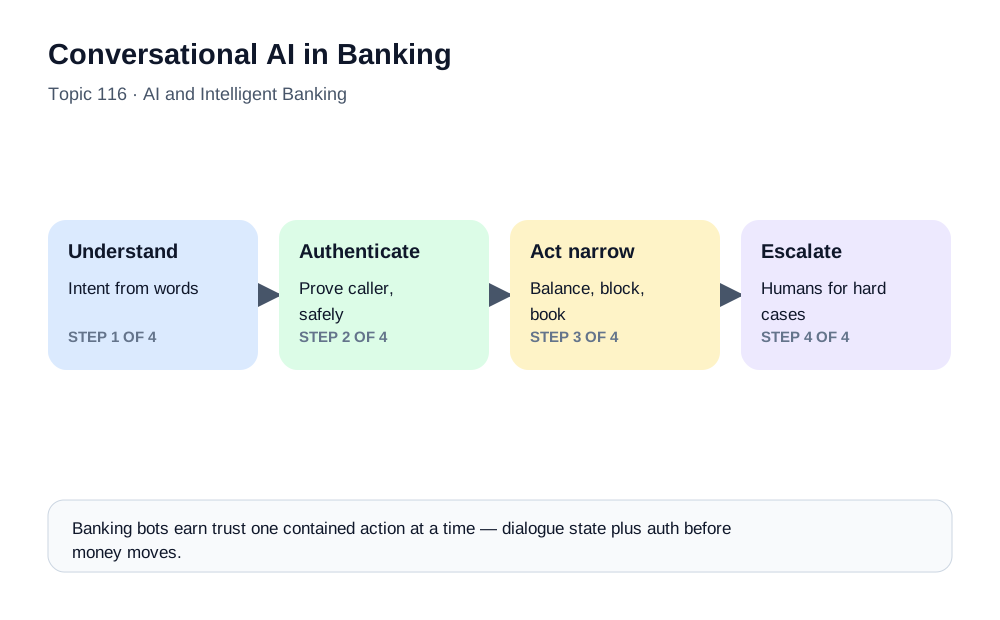
Conversational AI in Banking at a glance — Chatbots, virtual assistants, voice banking.
Natural Language Processing, Virtual Assistants, and Voice Banking
Conversational AI is fundamentally transforming how customers interact with their banks, replacing frustrating phone menus and branch visits with natural language interactions that feel intuitive and responsive to customer needs. Instead of navigating complex interactive voice response systems, visiting physical branches, or waiting on hold for human agents, customers can now ask questions in natural language via text or voice and receive instant, personalized responses that resolve their needs efficiently. Banking chatbots can automate a meaningful share of routine customer interactions, but containment and resolution rates vary widely by institution, language, channel and use case. Success should be measured from verified outcomes such as correct resolution, safe escalation, customer satisfaction and reduced repeat contact rather than a universal automation percentage.
Banking service has evolved through overlapping channels rather than a single global timeline. Branches, call centres, internet banking, mobile apps, messaging and conversational interfaces coexist, with adoption differing by country and customer segment. Conversational AI adds another service layer; it does not automatically replace branches, contact centres or app navigation. The future points toward proactive AI that contacts customers before they recognize their own needs, preventing problems rather than just resolving them after they occur.
Banking chatbots operate through sophisticated technology architectures that combine multiple AI components into coherent conversational experiences that understand intent and maintain context. When a customer sends a message such as "What's my account balance," Natural Language Understanding processes the text to determine the underlying intent—in this case, checking balance—and extract relevant entities such as account type being savings that specify what information is needed. The Dialog Manager coordinates the conversation flow, performing authentication checks to verify identity and querying core banking systems for the requested information securely. Response Generation formulates the answer in natural language: "Your savings account balance is ₹1,23,456.78 as of today." The customer receives this response through their preferred messaging channel, whether the bank's mobile app, website, WhatsApp, or other platforms where they are already active.
The key technology components enabling banking chatbots each serve specific functions that must work together seamlessly for effective conversations. Natural Language Understanding interprets what customers mean even when expressed in varied ways with different wordings, colloquialisms, and incomplete sentences that humans handle naturally but machines must learn. Intent classification maps incoming messages to specific banking actions the system can perform, such as balance inquiry or fund transfer, creating structured understanding from unstructured text. Entity extraction identifies relevant specifics mentioned in customer messages such as account types, amounts, dates, and payee names that are needed to fulfill requests. Dialog management maintains context across multi-turn conversations, remembering what has been established and what remains to be determined to avoid asking for information already provided or contradicting previous statements. Knowledge bases contain FAQs, product information, and policy details that the chatbot can reference for informational queries without requiring integration with transaction systems. Core banking integration enables retrieval of account data and initiation of transactions securely with proper authentication. Sentiment analysis detects frustrated or angry customers for priority escalation to human agents who can provide empathy and judgment that AI lacks.
Banking chatbot use cases span both informational and transactional categories with different authentication and security requirements that determine how they are handled. Informational queries that do not require authentication include product information requests about interest rates, fees, and features that help customers evaluate options; branch and ATM location questions based on the user's current location that enable physical access; FAQs about password resets, application procedures, and policies that resolve common issues without human involvement; and application status checks for loans or cards under processing that reduce anxiety through transparency. Transactional use cases requiring customer authentication include balance inquiries for various accounts; mini-statement requests showing recent transactions for reconciliation; fund transfers between the user's accounts or to third parties for payments; bill payments for utilities and services that eliminate separate login to biller sites; card blocking for lost or compromised cards that must be immediate; and loan EMI information including upcoming payment dates and amounts that help customers manage cash flow.
Banks in many markets operate virtual assistants for service, information, account support and selected transactions. Product names, interaction volumes, supported functions and published accuracy figures change frequently, so learners should consult each bank's current primary-source material before quoting them. The durable design lesson is to connect the assistant to controlled knowledge and banking APIs, authenticate sensitive actions, maintain context and escalate safely to people when automation is not appropriate.
Voice banking extends conversational AI to hands-free interaction through speech, enabling access while driving, cooking, or multitasking when hands are occupied. When a customer speaks a command such as "Hey Alexa, what's my bank balance," Automatic Speech Recognition converts the spoken words into text that downstream systems can process, handling accents and variations in pronunciation. Natural Language Understanding identifies intent and entities as with text chatbots, extracting meaning from the transcribed speech. Authentication may use voice biometrics that verify the speaker's identity through voice characteristics unique to each person, or PIN verification for additional security in high-risk situations. Core banking queries retrieve the requested account data from systems of record. Text-to-Speech technology generates the spoken response delivered to the customer in a natural-sounding voice that is intelligible and appropriately paced. Voice banking can be delivered through a bank's own app, contact-centre technology or approved third-party voice channels. Availability changes as banks and platform providers add or retire integrations, so specific channel examples should be verified before being presented as current.
Generative AI is transforming conversational banking by enabling more natural and capable interactions that go beyond the rigid constraints of traditional chatbots. Before generative AI, chatbots followed rigid conversation flows limited to predefined intents and provided template-based responses that could feel robotic and fail when users deviated from expected patterns. With generative AI, conversations become natural and flexible, handling unexpected questions that were not explicitly programmed by generating appropriate responses dynamically. Responses become human-like and contextual rather than scripted, adapting to the conversation flow and customer tone. Information synthesis from multiple sources replaces simple FAQ lookup, enabling comprehensive answers to complex questions that require combining information from different documents. Large language models can improve multilingual coverage in some contexts, but quality varies by language, dialect, banking terminology and task. Banks should test each supported language for accuracy, safety and escalation rather than assume generative models are uniformly better than established translation or intent systems. However, generative AI introduces new risks specific to banking that must be managed: hallucination where AI generates incorrect financial information that could mislead customers; compliance violations where advice might violate regulatory requirements regarding disclosures and suitability; data privacy concerns about customer data in model training that might leak sensitive information; and prompt injection attacks where malicious users manipulate AI behavior through carefully crafted inputs.
The optimal approach to conversational AI in banking combines AI efficiency with human judgment for the best customer experience that balances automation with empathy. Routine queries can often be automated, while complex, sensitive or uncertain situations may require human support. Escalation is only effective when channel architecture actually transfers sufficient context and permissions to the agent; banks should measure whether handoffs work rather than assume they are seamless. This hybrid model delivers the benefits of automation for common needs while maintaining the human touch for situations requiring empathy, judgment, and creative problem-solving that AI currently cannot provide adequately. As conversational AI continues to evolve, the boundary between AI-handled and human-handled interactions will shift, but the need for human oversight of consequential banking decisions will remain essential for customer trust and regulatory compliance.
<!-- MBA-DEEP-DIVE-START -->Conversational AI in Banking Deepening — Architecture, Authentication, Service Design, and Control
A banking assistant is a channel into controlled services
The safest mental model is not “a chatbot that knows banking.” It is a digital channel that interprets language and then invokes approved information or banking services. The language layer can understand intent, maintain context and formulate responses, but balances, transaction status, product terms and customer entitlements should come from authoritative systems. This separation reduces hallucination risk and makes ownership clear: conversational technology manages interaction, while systems of record remain responsible for financial truth.
Informational and transactional conversations require different controls
A customer asking for branch hours or the meaning of a fee can often be served without authentication. A customer asking for balance, card details, beneficiary changes or a transfer requires identity and authorisation controls appropriate to the action. The assistant should know which intents are public, authenticated, high risk or prohibited. This policy layer prevents a fluent conversation from bypassing the same control expectations that apply in the mobile app or contact centre.
Authentication should not be reinvented inside free text
Customers should not be asked to type passwords, PINs or one-time codes into an open chat field unless the bank has deliberately designed that channel for secure credential capture. A conversational assistant should normally hand off to established authentication mechanisms or operate inside an already authenticated session. Keeping credentials out of the language model and transcript reduces exposure. The conversation can request an action, but sensitive authentication should be handled by dedicated security components.
Authentication and transaction authorisation are separate decisions
Knowing who the customer is does not automatically authorise every action. A customer may be authenticated to view information but need stronger approval to add a beneficiary or send a high-risk payment. Conversational design should preserve this distinction. The assistant can collect intent and parameters, but the transaction engine should enforce limits, signing rights, step-up authentication and product rules. This is particularly important for corporate users where maker-checker or multi-signature authority may apply.
The intent catalogue should map to real banking capabilities
An assistant needs a controlled inventory of supported intents such as balance inquiry, card block, statement request, branch search, payment status or product explanation. Each intent should identify required entities, authentication level, backend service, response rules and escalation path. This creates a bridge between customer language and bank architecture. Without such a catalogue, teams can add conversational phrases faster than the bank can safely fulfil the underlying request.
Entity extraction should be conservative with financial parameters
Amounts, dates, account types, payee names and card references can be extracted from natural language, but ambiguity matters. “Send five to Ramesh” could mean five rupees, five thousand or an incomplete instruction. The assistant should confirm material parameters rather than infer them. Financial conversations need explicit confirmation whenever a misunderstanding could create loss. Natural language flexibility should improve convenience without turning ambiguity into an irreversible transaction.
Context should be scoped to the right session and customer
Conversation history helps avoid repetitive questions, but context can become dangerous if it crosses users, devices or long periods. The assistant should know when a session starts and ends, which customer is authenticated, and which prior facts can safely be reused. Sensitive context may need to expire quickly. A customer logging in on a shared device should not inherit another person's conversation. Context management is therefore a security boundary, not only a user-experience feature.
Memory should distinguish convenience from authoritative customer data
A model may remember that the customer previously asked about a mortgage, but that memory should not override current product or account data. Long-term conversational memory can support personalisation only when consent, retention and accuracy are managed. Banks should avoid storing speculative statements as if they were verified profile attributes. Customer master data belongs in governed systems; conversational memory is a secondary aid whose scope should be clear.
Knowledge answers should come from curated sources
Product rates, eligibility, fees, complaints procedures and regulatory disclosures can change. A conversational assistant should retrieve answers from version-controlled bank content rather than depend on generic model knowledge. Content owners should know when a policy was updated and which version applies by market or product. Retrieval should favour approved documents and preserve citations or provenance internally. This turns knowledge management into part of conversational AI governance.
Retrieval-augmented generation does not eliminate the need for answer controls
RAG can ground a model in bank documents, but retrieval can still return the wrong document, outdated version or irrelevant paragraph. The model can also misinterpret retrieved text. Banks should test retrieval quality, enforce metadata filters such as country and effective date, and design fallback when evidence is weak. High-consequence answers may use templates or direct extraction instead of free generation. Grounding reduces one class of risk; it does not make every answer automatically correct.
Deterministic responses are valuable for high-risk facts
A balance, transaction amount, interest rate effective for a specific product, account number or payment status should usually be returned directly from the relevant system or approved template. Generative phrasing can surround the fact, but the fact itself should not be invented or transformed unpredictably. Deterministic responses make testing and audit easier. Banking assistants become safer when generative capability is used where language flexibility matters and constrained where precision matters most.
Tool calling should use narrow, typed interfaces
If an assistant can call bank APIs, each tool should have a clear schema: required fields, allowed values, authentication context and idempotency rules. A tool for “get balance” should not have permission to move money. A transfer tool should require explicit beneficiary and amount fields rather than an unstructured instruction. Narrow interfaces reduce the chance that prompt manipulation or model error triggers an unintended action. Least privilege applies to AI tools just as it applies to human system access.
Read actions and write actions should be treated differently
Reading a public FAQ is low consequence. Reading an authenticated balance is more sensitive. Writing a beneficiary, blocking a card or initiating a payment can change the customer's financial position. Conversational systems should classify actions by consequence and apply increasing confirmation, logging and human or policy controls accordingly. A single “assistant permission” is too broad for a bank. Capability should be granular and revocable.
Transaction confirmation should be explicit
Before a consequential action, the assistant should present the material details in a clear confirmation step: account, beneficiary, amount, currency, date and any fee where relevant. The confirmation should come from the structured transaction request, not merely repeat free text. Customers need a chance to detect misunderstanding before execution. For some products, the bank may also need separate authentication or signing. Conversational ease should not remove the control value of a final review.
Idempotency prevents duplicate actions when conversations retry
Customers repeat messages, networks fail and assistants may retry backend calls. A payment or card-block action should carry an idempotency or correlation key so the same instruction is not executed twice. The assistant should know whether a previous request succeeded, failed or is still processing. Without idempotency, a seemingly harmless conversational retry can create duplicate financial activity. Transactional chat therefore depends on the same reliability engineering as other payment channels.
Payment status needs lifecycle-aware language
A customer asking “where is my payment?” may have a transaction that is accepted, queued, pending compliance review, sent to a scheme, settled, credited, rejected, returned or under investigation. The assistant should not collapse all states into “successful” or “failed.” It should translate the bank's lifecycle status into customer language without promising more than the system knows. Clear payment status is one of the most useful conversational use cases because customers otherwise call support for interpretation.
Pending does not always mean a problem
A card authorisation can be pending settlement, a transfer can await a cut-off or approval, and a cross-border payment can traverse several institutions. The assistant should explain what “pending” means for the specific product and whether customer action is required. Generic reassurance can be misleading, while unnecessary alarm generates support calls. The underlying status code, product rules and timing information should drive the response.
Corporate banking conversations need entitlement awareness
A corporate user may be allowed to view balances but not initiate payments, or may initiate but not release them. Entitlements can differ by account, legal entity, country and payment type. The assistant should query the same authority service used by other channels and avoid exposing options the user cannot perform. Maker-checker status, pending approvals and signing rules are natural conversational use cases when the assistant accurately reflects corporate entitlements.
Multi-account customers need disambiguation
A retail customer may have several savings, current, loan or card accounts; a corporate user may have hundreds. Saying “your balance is…” without identifying the account can be confusing or unsafe. The assistant should use clear aliases or masked identifiers and ask for selection when intent is ambiguous. It should not expose full account numbers unnecessarily. Good conversational UX makes account context explicit while preserving privacy.
Voice channels create additional privacy risk
A spoken balance or transaction detail can be overheard. Voice assistants should consider whether the customer is using a private bank app, a telephone channel or a shared smart speaker. Sensitive responses may require device confirmation, headphones or a switch to a secure screen. Voice convenience is not universally appropriate. The bank should design what can be spoken aloud and what should be displayed privately.
Automatic speech recognition introduces a new error source
Speech-to-text systems can mishear names, numbers, currencies and account references, especially with accents, background noise or poor connections. Financial values should be confirmed from the transcription before action. A spoken “fifteen” misheard as “fifty” is not a minor language error. Voice banking needs confidence thresholds and fallback to keypad, screen or human support when recognition is uncertain.
Voice biometrics should be one risk signal, not unquestioned proof
Speaker recognition can support authentication or fraud detection, but voices change and can be imitated or synthetically generated. Banks should consider replay, deepfake and recording attacks, as well as accessibility and customer consent. High-risk actions may require another independent factor. Voice biometrics can reduce friction when used carefully, but it should operate inside a broader authentication and fraud framework.
Accessibility should be designed from the start
Conversational interfaces can help customers with visual, motor or literacy challenges, but they can also create barriers. Text, voice, screen-reader compatibility, adjustable pacing and clear language matter. Customers should be able to switch channels without losing progress. Accessibility testing should include real users with different needs. A banking assistant is successful only if it expands access rather than forcing everyone into one interaction style.
Language coverage should be tested by banking task
A model may converse fluently in a language but still mistranslate a product term, payment status or legal disclosure. Banks should test intent recognition, entity extraction, response accuracy and escalation separately for each supported language and dialect. Code-switching is common in multilingual markets and should be considered. Language support is an operational commitment; listing a language in the interface implies the bank can serve customers safely in that language.
Transliteration creates additional ambiguity
Customers may type a local language using Latin characters rather than the native script. The same spelling can represent different words, names or amounts. Models can handle some variation, but high-risk entities should be confirmed. Search and knowledge retrieval should also understand common transliterations. The objective is not linguistic perfection but reliable interpretation of banking intent across the way customers actually write.
Sentiment analysis should support service, not stereotype customers
Detecting frustration can help prioritise escalation, but sentiment models are imperfect and culturally sensitive. A direct writing style should not automatically label a customer abusive or risky. Sentiment should be a supporting signal rather than a basis for denying service. The assistant can recognise repeated failure, complaint language or urgency through explicit evidence and provide human help without making unsupported judgments about personality.
Complaint handling requires a controlled path
When a customer expresses dissatisfaction, disputes a transaction or alleges harm, the conversation may enter a regulated complaint process. The assistant should identify complaint intent, capture key facts, issue reference information where required and route the case to the correct workflow. It should not attempt to “talk the customer out of” a complaint. Complaint classification, acknowledgement and response deadlines belong to the bank's formal service framework.
Vulnerable customers need appropriate escalation
A customer can reveal bereavement, financial difficulty, disability, coercion or scam pressure during a conversation. The assistant should recognise defined vulnerability indicators and route to trained support without making medical or social judgments. Sensitive information should be handled under appropriate privacy rules. Automation can help detect a need for care, but the resulting treatment should be governed by customer-protection policy.
Financial difficulty should not be answered with generic encouragement
A customer saying they cannot make a loan payment may need hardship, restructuring or collections support. The assistant should provide accurate options available under the customer's product and jurisdiction and avoid giving unsupported advice. It can gather context and schedule or transfer to a specialist. This is a good example of why conversational AI needs domain workflows rather than generic language capability alone.
Product recommendation crosses into suitability and conduct risk
An assistant can explain products, but recommending what a customer “should” buy may trigger suitability, advice or conduct obligations depending on product and jurisdiction. The bank should define whether the assistant is providing information, guided selection or regulated advice. Responses should not optimise only for sales. Eligibility, needs, fees, risk and disclosures must remain clear. Conversational fluency does not change the legal character of the interaction.
Sales prompts should respect customer intent
A customer who asks to block a stolen card should not be interrupted with a cross-sell. Conversation design should prioritise service and risk context. Banks can use assistants for relevant product education, but triggers should reflect customer need and consent rather than simply exploit every interaction. Conduct governance should review sales language and outcome metrics. A high conversion rate is not proof of good customer treatment.
Hallucination risk is most dangerous when the answer sounds confident
Large language models can produce plausible but incorrect details. Banking interfaces should avoid presenting generated answers without evidence when the customer may act financially on them. Confidence scores from a language model are not sufficient assurance. Retrieval quality, deterministic data, response policies and human escalation should be combined. The system should be able to say that it cannot confirm an answer rather than fabricate one.
Unknown intent should be a normal outcome
A robust assistant does not force every message into the nearest known intent. When confidence is low, it can ask a clarifying question, offer a menu, search approved knowledge or escalate. Forcing uncertain messages into transactional intents is risky. Unknown-intent rates also provide product insight: repeated unsupported questions can show where new capabilities or clearer user journeys are needed.
Prompt injection is a channel-security issue
Generative assistants can receive instructions embedded in user text or retrieved documents that attempt to override policy, expose data or misuse tools. Banks should separate system instructions from untrusted content, restrict tool permissions, sanitise retrieval sources and monitor suspicious prompts. A model should never be able to reveal another customer's data because a user asks it to “ignore previous rules.” Security controls must exist outside the model's willingness to comply.
Retrieved documents can carry malicious instructions
If a RAG system ingests uncontrolled documents, an attacker could place text instructing the model to reveal secrets or alter behaviour. Document ingestion should therefore validate source, access rights, content type and ownership. Retrieved text should be treated as evidence, not executable instruction. This distinction is especially important when assistants search email, uploaded files or customer-provided documents.
Data leakage can occur through model context
Conversation prompts may contain account details, transaction data and internal policies. Banks should control what is sent to external model providers, how long it is retained and whether it can be used for provider training. Internal model hosting does not remove access-control obligations. Prompt logs can themselves become sensitive datasets. Data classification and minimisation should apply to the whole conversational stack.
Logs should preserve evidence without storing unnecessary secrets
Conversation logs support complaints, quality assurance, security and model improvement, but they can also contain personal or authentication information. Logging design should mask or omit credentials and sensitive fields where possible, apply retention rules and restrict analyst access. A complete transcript is not always necessary for every purpose. Banks should balance auditability with privacy and breach impact.
Agent handoff should transfer context deliberately
When automation cannot resolve a case, the human agent should receive relevant conversation history, authenticated customer context, completed verification and current workflow state. The handoff should not expose hidden model prompts or unrelated sensitive data. Customers should not have to repeat everything, but agents also need to know which facts are customer statements and which were retrieved from bank systems. Provenance improves trust during escalation.
Human agents need authority to correct the assistant
If an assistant gives an incomplete or confusing answer, the human should be able to override, correct and flag it. Feedback should flow into knowledge or model improvement rather than disappear in the call-centre note. Agents are valuable sensors of failure because they see unusual customer questions and downstream consequences. Conversational AI should augment service teams and learn from them, not create an untouchable parallel channel.
Containment rate is not enough to measure success
A bot can keep customers from reaching an agent by giving poor answers repeatedly. Useful measures include first-contact resolution, correct task completion, abandonment, repeat contact, escalation quality, complaint rate, customer satisfaction and cost per resolved interaction. Transactional flows should also measure errors and reversals. The objective is not to maximise the percentage of conversations that stay inside AI; it is to resolve customer needs safely and efficiently.
Escalation rate needs interpretation
A high escalation rate can mean poor automation, but it can also reflect sensible safety design for complex cases. A low rate can hide customers who abandon after failure. Metrics should be segmented by intent and customer outcome. Routine balance queries may target high automation, while fraud disputes or hardship cases may intentionally target rapid human transfer. Service design should define the expected path by use case.
Conversation quality should be tested with real variation
Scripted test phrases such as “what is my balance?” are not enough. Customers use spelling errors, abbreviations, incomplete sentences, slang, code-switching and multi-intent messages. Test sets should include representative linguistic variation and difficult edge cases. They should also cover malicious prompts and ambiguous financial values. Production monitoring can identify new patterns that the original test set missed.
Golden conversations support regression testing
A bank can maintain a controlled set of important conversations with expected intents, tool calls, responses and escalation outcomes. Every model or prompt update can be tested against this set. Golden conversations should cover product facts, transaction states, complaint flows, authentication boundaries and sensitive topics. They make generative systems more testable by turning key behaviours into repeatable acceptance criteria.
Synthetic conversations help coverage but need human review
Generated test data can create many paraphrases and edge cases quickly, but synthetic examples may reflect the same model biases as the system being tested. Domain experts should review important cases and preserve real anonymised interaction patterns where lawful. Synthetic data is useful for breadth, not a replacement for evidence from actual customers. Testing should combine both.
Response latency affects trust
Customers expect a conversation to feel responsive, but the assistant may need authentication, retrieval and backend calls. The system should manage waiting explicitly rather than appearing frozen. For a long-running action, it can confirm that the request is being processed and provide a status path. Latency metrics should separate model time, retrieval, bank API time and channel delivery so the actual bottleneck can be fixed.
Streaming text should be used carefully for financial answers
Showing generated words as they are produced can feel fast, but the model may later qualify or correct an early statement. For sensitive banking responses, it can be safer to validate the complete answer before display. Streaming may be appropriate for low-risk explanatory content. Response presentation should reflect the consequence of being wrong, not simply mimic consumer chat products.
Availability needs graceful degradation
If the language model is unavailable, customers may still need urgent functions such as card blocking, fraud reporting or contact information. The channel should have fallback menus, direct links or human contact. Core service should not become inaccessible because one AI provider has an outage. Resilience design should identify which intents can continue without generative capability.
Vendor outages should not expose internal complexity to the customer
A bank may use several providers for speech, language models, translation and analytics. Customers should receive a clear service message rather than raw technical errors. Internal observability should identify which dependency failed, while the channel chooses a safe fallback. Multi-provider architecture can reduce concentration risk but also increases testing and data-governance complexity.
Versioning is essential for reproducibility
A historic conversation should be traceable to the prompt, model version, knowledge version, tool configuration and policy that were active at the time. This matters when the customer complains that the assistant gave incorrect information. Generative models can change behaviour after provider upgrades. Version control allows the bank to investigate and prevents silent behavioural drift from becoming impossible to explain.
Prompt changes are production changes
A few words in a system prompt can materially alter what an assistant says or which tools it calls. Prompt updates should therefore have ownership, testing, approval and rollback appropriate to consequence. Treating prompts as informal copy edits is unsafe in banking. They are part of application logic and should be governed alongside code and configuration.
Model upgrades should be tested before broad release
A newer model can improve reasoning while changing tone, language behaviour, refusal patterns or tool usage. Banks should compare it against established test suites and real shadow traffic. Benefits should be measured on banking tasks, not vendor benchmark scores. Controlled rollout by channel or customer segment can reduce risk. A model upgrade is successful only when the full service outcome improves.
Cost management should not drive unsafe model selection
Conversational systems consume inference, retrieval, speech and integration resources. Banks should optimise prompts, caching and model size, but not route sensitive decisions to a weaker model solely because it is cheaper. Different tasks can use different models according to complexity and risk. Cost per resolved interaction is more meaningful than cost per token because a cheap incorrect answer creates repeat contacts and potential harm.
Smaller models can be excellent for narrow banking tasks
Intent classification, entity extraction and FAQ routing may not require a frontier general-purpose model. Compact models can be faster, cheaper and easier to constrain. A bank can combine deterministic NLP, small models and larger generative models in one architecture. The choice should follow the task. “Use the biggest model everywhere” is neither necessary nor necessarily safer.
Guardrails should exist outside the model
A model can be instructed not to reveal full account numbers or initiate unsupported transactions, but critical restrictions should also be enforced by APIs, access control and response filters. External guardrails remain effective even when the model misunderstands or is manipulated. Banking security should never rely on a single natural-language instruction as the final control.
Content filters need domain nuance
Generic safety filters may block legitimate banking terms or fail to recognise harmful financial guidance. Banks should tune controls for scams, self-harm involving finances, coercion, abusive language and sensitive personal data according to policy. Filters should support the service objective rather than create unexplained refusals. Human escalation should be available when automated safety classification is uncertain.
The service owner remains accountable
Using a third-party model does not transfer responsibility for customer treatment, privacy, accuracy or transaction control. The bank should understand provider terms, data processing, model changes, security and service levels. Vendor evidence should be reviewed with the same seriousness as other critical technology. Conversational AI may be novel, but third-party accountability principles are familiar.
The strongest architecture separates conversation, decision and execution
The conversation layer understands what the customer wants. The decision layer checks authentication, eligibility, policy, fraud and entitlement. The execution layer performs the approved banking action in a system of record. Keeping these layers distinct makes the service testable and limits what a model can do directly. It also allows the language technology to evolve without rewriting core transaction controls.
The long-term value is better access to banking, not conversation for its own sake
Conversational AI is useful when it reduces search, simplifies complex journeys, supports multiple languages, improves accessibility and helps customers understand what is happening. It is not useful merely because a bank can add a chat bubble. The right measure is whether customers resolve genuine banking needs more safely and easily while the institution preserves control, evidence and human support where needed.
Conversational AI Final Depth — Operational Measurement and Failure Handling
Intent-level service maps make ownership visible
Each supported intent should have a named service owner, backend dependency, authentication requirement, expected resolution path and escalation route. This prevents the conversational team from becoming responsible for failures that actually belong to product or operations systems. If “card block” fails because the card platform is unavailable, the assistant should expose the correct fallback rather than endlessly rephrasing the same request. Service maps turn conversation design into accountable banking operations.
Conversation IDs should link channel and backend evidence
A unique correlation identifier can connect the customer's message, intent classification, authentication event, API calls, response and case escalation. This is invaluable when investigating a complaint such as “the bot said my card was blocked but it still worked.” Teams can trace what happened across systems without relying solely on a transcript. Correlation should persist through retries while distinguishing a new customer instruction from a technical replay.
Partial failure needs customer-safe wording
A workflow can succeed in one step and fail in another. The assistant might verify identity successfully but fail to retrieve the statement, or create a service request but fail to display the confirmation. Responses should state what is known rather than declaring the whole journey successful or failed. If a request has been created, the customer should receive the reference. If status is unknown, the assistant should say so and offer a safe next step.
Timeouts should not create invented outcomes
If a core system does not respond, the assistant should never infer that the transaction failed or succeeded. “I cannot confirm the status right now” is safer than a fabricated answer. The channel can query status again, present a reference or route to support. This principle is especially important for payments, card actions and service requests where customers may repeat an instruction and accidentally create duplication.
Channel migration should preserve the customer's place in the journey
A customer may begin in chat, move to a secure app screen for authentication and then return to conversation. The system should preserve the intended action and relevant context without asking the customer to start again. At the same time, the post-authentication session should confirm that it is still the same customer and request. Secure state transfer is a design feature that makes conversational banking feel coherent without weakening control boundaries.
Escalation should carry reason, not just transcript
A human agent benefits from a structured summary: authenticated customer, identified intent, steps already completed, backend errors, risk flags and the specific reason automation stopped. A transcript alone can force the agent to reread a long conversation. Structured handoff reduces average handling time and improves resolution. The original transcript remains available for evidence, while the summary supports operational efficiency.
Knowledge gaps should become a managed backlog
When many customers ask questions the assistant cannot answer, those unknown intents should be grouped and reviewed. Some indicate missing content, some reveal broken product journeys, and some are inappropriate for automation. Product owners can prioritise improvements based on frequency, customer impact and risk. This feedback loop turns conversational data into service design evidence rather than merely a record of bot failure.
Answer freshness should be monitored
A knowledge assistant can be accurate on launch day and become wrong after a fee, product rule or complaint procedure changes. Content pipelines should track effective dates and index refresh. High-risk knowledge domains can have freshness service levels. If a document is superseded, retrieval should stop using it unless the historical version is explicitly required. Freshness is a production control, not a one-time content cleanup.
Customer confirmation is evidence only when the wording is clear
For consequential actions, the bank may need evidence that the customer confirmed the exact amount, beneficiary or instruction. A vague “yes” after a long multi-topic conversation can be difficult to interpret. The assistant should present a concise confirmation statement immediately before authorisation. The resulting event should store the structured details that were confirmed, not only the text message.
Repeated misunderstandings should trigger a different interaction mode
If the assistant has failed to understand the customer several times, continuing to ask the same question is poor service. It can offer a menu, switch to a form, transfer to an agent or provide a direct secure link. Conversational interfaces should recognise when natural language is no longer the easiest channel. Good automation includes knowing when to stop automating.
Performance should be segmented by language and accessibility need
An overall containment or accuracy score can hide poor outcomes for a smaller language or customer group. Banks should review task completion, escalation and error rates by supported language, channel and relevant accessibility scenario. A service should not claim multilingual success because high-volume English conversations dominate the average. Segment testing makes quality differences visible and actionable.
Production sampling can catch subtle response drift
Automated tests cannot anticipate every real conversation. Risk-based sampling of production interactions can identify new hallucinations, confusing wording, poor escalations or unexpected model behaviour. Review should protect customer privacy and use appropriately authorised staff. Findings can update golden tests so each incident strengthens the future regression suite.
Complaint trends are a model-quality signal
Customers may complain about wrong information, inability to reach a human, repetitive authentication or misunderstood requests. These issues should be linked back to the relevant intent, model and knowledge version. Complaint analysis can reveal harms that ordinary accuracy metrics miss. A conversational system is part of customer service, so its quality should be visible in the same complaint-governance process as other channels.
The bank should know which conversations are not suitable for automation
Certain interactions may involve legal dispute, bereavement, complex vulnerability, high-value fraud, regulated advice or unusual corporate authority. The assistant can recognise and route them quickly rather than trying to resolve everything. Defining out-of-scope use cases is a sign of mature design. The goal is not universal automation; it is the right service path for each customer need.
A reliable banking assistant earns trust through restraint
Customers do not need an assistant that always has an answer. They need one that knows when it has authoritative information, when an action requires authentication, when a backend status is uncertain and when a human should take over. Restraint is a banking quality. A conversational system becomes genuinely useful when convenience is combined with traceability, controlled execution and truthful uncertainty.
Conversational AI Control Deepening — Dialogue State, Authentication, Safe Action, and Human Escalation
A banking conversation needs an explicit state machine
A general chatbot can answer a question and forget it. A banking assistant may move from information to authenticated service and then to a financial action, so each turn should have a controlled state. The system should know whether the customer is anonymous, authenticated, recently re-authenticated, viewing information, preparing an instruction, or confirming a transaction. A phrase such as “yes, do it” is safe only when the system can prove exactly which action, amount, beneficiary, and account that confirmation refers to.
The model should not decide authentication policy
A language model can recognise that a customer wants to change an address or send money, but policy services should decide what authentication or step-up is required. Identity, entitlement, transaction limits, sanctions or fraud controls where applicable, and account state belong to deterministic bank services. This separation lets the conversation remain natural without giving probabilistic text generation authority over financial permissions.
Retrieval should use versioned bank knowledge
Answers about fees, product conditions, cut-offs, complaints, eligibility, or regulatory disclosures should come from approved, current sources. Retrieval architecture should preserve document version, effective date, jurisdiction, product, and legal entity so the assistant does not blend similar rules from different markets. Where no reliable source supports the answer, the system should say that it cannot confirm the information or route the customer to a specialist instead of improvising.
Tool calls need a preview-and-confirm pattern for material actions
Before executing a payment, card block, beneficiary change, standing instruction, or personal-data update, the assistant should present the material details in a structured confirmation step. The actual tool call should use validated structured parameters rather than re-parsing a free-form model response after confirmation. This prevents a subtle wording change from altering the amount or destination between what the customer saw and what the backend receives.
Conversation memory should be purpose-limited
Remembering preferences can improve service, but retaining every message indefinitely creates privacy and security risk. The bank should distinguish transient dialogue context, session state, required service records, complaint evidence, and optional personalisation memory. Sensitive information such as authentication secrets should never become long-term conversational memory. Retention, access, deletion, and model-training use require explicit governance.
Voice assistants introduce impersonation and acoustic risk
Voice channels can be targeted by replay, synthetic speech, background coaching, call forwarding, and social engineering. Voice should not be treated as inherently stronger than text. High-risk actions can require independent device confirmation or another approved factor. The customer should also be warned when the assistant is automated, especially where a natural synthetic voice could create false confidence that a human banker has personally authorised an action.
Hallucination monitoring should examine customer impact, not only model accuracy
A harmless wording error and a fabricated early-repayment charge are not equivalent. Quality assurance should classify errors by financial, legal, conduct, privacy, and customer-impact severity. Test sets should include ambiguous requests, contradictory information, outdated policy, vulnerable customers, language switching, prompt injection, and attempts to make the assistant reveal internal instructions. High-impact error patterns should change retrieval, prompts, tools, guardrails, or escalation rules rather than being accepted as a generic model limitation.
Human handoff should preserve context without forcing repetition
When the assistant cannot safely complete a request, the customer should be transferred with a concise summary, identity state, relevant transaction references, and the reason for escalation, subject to access controls. The human agent should be able to see what the assistant already told the customer and correct it if necessary. A handoff that makes the customer repeat the whole story may technically protect the bank but still create a poor service outcome.
<!-- MBA-DEEP-DIVE-END -->