Visual overview
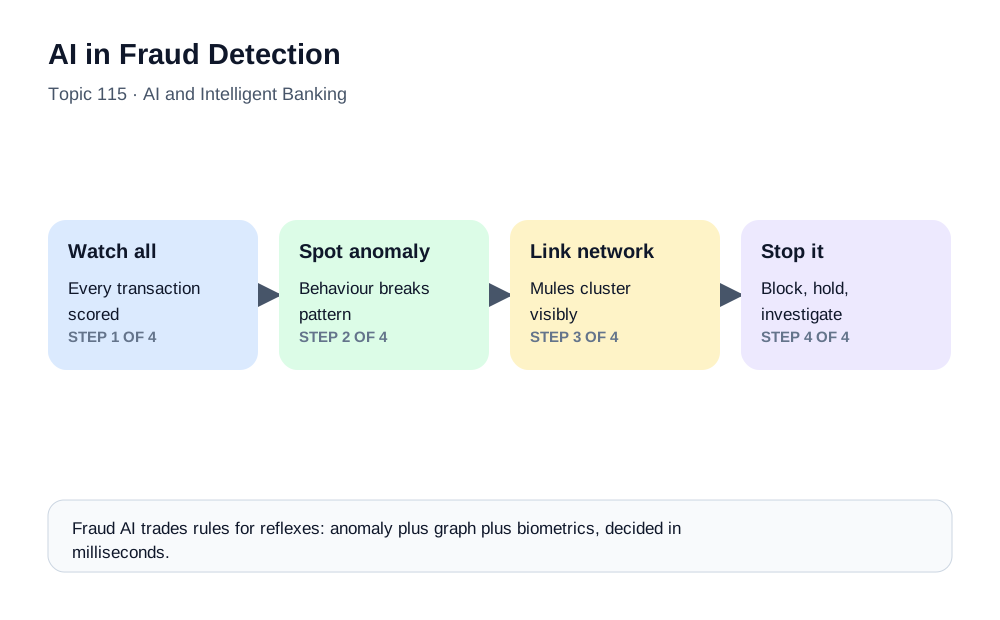
AI in Fraud Detection at a glance — Transaction monitoring, anomaly detection, network analysis.
Real-Time Anomaly Detection, Graph Analytics, and Behavioral Biometrics
Bank fraud represents a perpetual arms race between criminals seeking to exploit financial systems and defenders working to protect them and their customers from substantial financial losses. As detection systems evolve in sophistication, so do fraudster techniques, creating an ongoing competition that demands constant innovation and adaptation from financial institutions. AI-powered fraud detection represents the most significant advancement in this ongoing battle, capable of analyzing millions of transactions in real time, identifying patterns invisible to human analysts, and adapting to new fraud techniques as they emerge. For real-time payments and card authorisation, fraud controls must operate quickly enough to fit the transaction's decision window. The required latency depends on the product, channel and network; the control objective is to reduce fraud without creating unacceptable customer delay or availability risk.
The fraud landscape facing banks encompasses multiple threat categories, each with distinct characteristics, trends, and defensive requirements that demand specialized approaches. Banks face card fraud, account takeover, authorised push-payment scams, digital-payment abuse, application fraud, synthetic identity, mule activity and insider threats. Loss levels and growth rates change by market and year, so current scheme, regulator or industry reporting should be consulted before quoting headline statistics. Application fraud involving fake identities for loans and cards is becoming increasingly sophisticated with synthetic identities that combine real and fabricated data to pass initial verification checks. Insider fraud by employees misusing their positions persists as an ongoing threat despite detection systems and background checks. Money mule accounts used for layered money laundering operations reflect organized criminal activity that moves funds through multiple accounts to obscure their origin and complicate investigation.
Traditional fraud detection relied on rule-based systems with significant limitations that increasingly fail to meet modern challenges as fraud becomes more sophisticated. These systems used simple conditional logic: if a transaction exceeds fifty thousand rupees and occurs in a foreign country and happens between midnight and five AM, then flag it for review by a human analyst. While straightforward to implement and explain to auditors, rule-based approaches suffer from fundamental problems that limit their effectiveness against adaptive adversaries. Static rules cannot adapt to new fraud patterns that emerge constantly as criminals innovate to evade detection. Rule-based fraud systems can generate large numbers of false positives when thresholds are poorly tuned or customer behaviour changes. The actual false-positive rate varies significantly by use case, institution and control design, so it should be measured from the bank's own alert and outcome data rather than assumed from a universal percentage. Rule explosion occurs as thousands of rules accumulate over years to address new threats, becoming unmanageable and creating conflicting signals that reduce accuracy. Rule-based systems can only detect known patterns programmed into rules, missing novel fraud techniques entirely until new rules are developed after losses have occurred. New rules take weeks to implement through change control processes, leaving banks vulnerable to emerging threats during the development and deployment period.
AI and machine learning fraud detection overcomes these limitations through fundamentally different approaches that learn from data rather than following programmed rules, enabling adaptation to new patterns. Supervised learning models train on millions of labeled transactions marked as fraudulent or legitimate, learning subtle patterns that distinguish the two categories across hundreds of variables that no human could manually track. In production, fraud models may score transactions in real time, near real time or batch depending on the use case. Outputs can be probabilities, ranks, anomaly scores or risk bands; they should be calibrated and interpreted according to the model's documented design rather than assumed to use a universal zero-to-one scale. Unsupervised learning through anomaly detection requires no pre-labeled data; instead, models learn what constitutes normal behavior for each customer and flag transactions that deviate significantly from established patterns. This approach can discover fraud patterns never seen before that would evade rule-based systems, identifying novel attacks as they emerge. Isolation Forest, Autoencoders, and various clustering methods provide the algorithmic foundation for effective anomaly detection in fraud contexts.
The real-time scoring pipeline must operate with extraordinary speed to avoid disrupting legitimate transactions while stopping fraud before it completes. A real-time fraud pipeline typically assembles approved features, applies rules and one or more models, then passes the resulting signals to a decision engine. The decision can approve, decline, hold, step up authentication, lower a limit or route the case for review depending on product policy and risk appetite. Thresholds and latency budgets are institution- and channel-specific; fixed values such as 0.3, 0.7, fifty milliseconds or two hundred milliseconds should not be treated as universal banking standards.
Graph analytics provides powerful capabilities for detecting organized fraud networks that individual transaction analysis might miss entirely, revealing connections invisible in isolation. In graph representations, nodes represent accounts, devices, phone numbers, and IP addresses—the entities involved in banking relationships. Edges represent transactions and shared information such as common devices, phone numbers, or addresses that link entities and suggest coordination. Detection algorithms identify clusters of accounts connected by suspicious patterns that suggest coordinated criminal activity rather than independent legitimate users, flagging networks for investigation. Money mule detection exemplifies this approach: when a compromised account sends five lakh rupees to an account that then splits and distributes the funds to multiple other accounts before cash withdrawal at ATMs, graph analytics identifies the connected accounts through shared devices, similar transaction patterns, and coincident creation dates that would not be apparent from examining any single account in isolation.
Behavioral biometrics adds another layer of fraud detection that operates invisibly to legitimate users while detecting account takeover and automated attacks that bypass credential checks. Typing dynamics and related behavioural signals can help estimate whether a session differs from an established pattern, but they are probabilistic rather than unique fingerprints. Banks should treat them as risk signals that require privacy, consent, security and performance governance rather than as conclusive proof of identity. Mouse movement patterns reveal whether a human or automated bot is controlling a session through movement characteristics that differ between natural human behavior and automated scripts. Device handling characteristics including how a phone is held and tilted can detect account takeover even when credentials are correct, since the legitimate user's handling pattern differs from a fraudster's unfamiliar grip. Navigation patterns through applications reveal unfamiliar user behavior that may indicate compromise by someone unfamiliar with the account layout and normal workflow. Session analytics examining login times, durations, and action sequences identify abnormal patterns such as access at unusual hours or sequences that differ from the user's typical behavior. The key advantage of behavioral biometrics is its passive operation—no additional friction for legitimate customers while providing continuous authentication that catches fraud that credential checks miss.
Card networks, banks, payment service providers and digital platforms use machine learning, rules, graph methods and behavioural signals at large scale for fraud prevention. Provider-specific transaction volumes, card counts and claimed false-positive reductions change over time and can be measured differently, so such figures should be checked against current primary-source disclosures before use. The enduring lesson is architectural: fraud controls must scale to peak volume while preserving decision quality, resilience, explainability and customer experience.
The challenges in AI fraud detection remain significant and require ongoing research and development to stay ahead of adaptive adversaries. Fraud is usually a minority class, but prevalence varies widely by product, event type and labeling method. This imbalance can make headline accuracy misleading and requires metrics and sampling strategies that reflect the institution's actual fraud population and operating costs. Adversarial attacks occur as fraudsters test detection systems and adapt their techniques to evade identification, requiring models to be regularly retrained on new patterns. Explainability requirements from regulators demand that banks explain why specific transactions were blocked, challenging for complex models that make decisions based on subtle patterns across hundreds of variables that cannot be easily summarized. Real-time constraints require fraud controls to fit within the channel's end-to-end service-level budget. The allowable model latency differs between card authorisation, instant payment initiation, login risk, batch monitoring and post-event investigation, so architecture should be designed to the specific decision point. Cross-channel correlation must identify fraud spanning cards, UPI, net banking, and mobile applications to catch sophisticated attacks that move across channels to evade detection. Privacy concerns arise from behavioral biometrics and device fingerprinting practices that collect detailed information about user behavior.
The future of fraud detection lies in increasingly sophisticated AI systems that combine transaction analysis, graph analytics, and behavioral biometrics into unified detection platforms that provide comprehensive protection against diverse threats. As real-time payment systems like UPI continue to grow in volume and importance for the economy, the criticality of sub-second fraud detection only increases, making investments in AI detection capabilities essential for competitiveness. The institutions that master AI-powered fraud detection will protect their customers and their bottom lines effectively, maintaining trust that is essential for banking relationships; those that fall behind will face mounting losses and eroding trust that are difficult to recover once damaged.
<!-- MBA-DEEP-DIVE-START -->AI Fraud Detection Deepening — Signals, Decisions, Investigations, and Banking Control
Fraud detection begins with the business event, not the algorithm
A bank does not have one universal “fraud problem.” It has distinct decision points: account opening, login, beneficiary creation, card authorisation, transfer initiation, cash withdrawal, merchant acquisition, lending application, password reset and many others. Each event has a different time budget, loss mechanism and customer consequence. A model that is excellent for card-not-present transactions may be irrelevant for mule-account detection. Good fraud design therefore starts by defining the event, the fraud typology, the available evidence and the action the bank can take before choosing an algorithm.
Fraud and money laundering overlap but are not the same control objective
Fraud controls often try to stop an unauthorised or deceptive transaction before loss occurs. AML monitoring is primarily concerned with identifying suspicious activity and relationships that may involve proceeds of crime or other illicit finance, including activity where the account holder is knowingly involved. The same transaction may trigger both domains, but the case handling, legal basis, reporting obligations and customer communication can differ. Banks should share useful signals while keeping control ownership and outcomes clear.
Authorised fraud creates a special problem
Traditional fraud models were strongest when the customer did not authorise the transaction: stolen card, compromised credential, cloned device. In an authorised push-payment scam, the genuine customer may log in from the usual device and confirm the payment because a criminal has manipulated them. Authentication signals can therefore look legitimate. Detection must examine beneficiary novelty, payment purpose, customer behaviour, scam indicators, warnings ignored, payment velocity and network intelligence rather than assuming successful authentication means the payment is safe.
Account takeover is a sequence rather than a single event
An account takeover may begin with credential theft, followed by an unusual login, profile change, new device registration, payee creation, limit increase and transfer. Scoring each event independently can miss the pattern. Sequence-aware models and rules can combine events across a session or time window. A small anomaly at each step may become highly significant when the steps occur together. This is why session context and event history are central to modern digital fraud controls.
Application fraud requires identity and intent evidence
A person can submit a false lending or deposit application using fabricated details, stolen documents, synthetic identity or genuine identity with dishonest information. Models may examine document consistency, bureau data, device reuse, address history, application velocity and links to known bad entities. The objective is not only to ask “is this identity real?” but also “is this applicant the legitimate controller of the identity and is the application information credible?” Identity proofing and fraud scoring should therefore work together.
Mule-account detection is fundamentally relational
A mule account receives and moves criminal funds, sometimes through a person who is complicit and sometimes through a person who has been deceived. Individual transactions can look ordinary. Network features such as rapid fan-in and fan-out, repeated links to risky counterparties, shared devices, common addresses, unusual pass-through behaviour and short holding periods may reveal the pattern. Graph analytics becomes valuable because the risk often exists in the relationship between accounts rather than in one payment amount.
Fraud labels are difficult because truth arrives late
A model can only learn from labels such as confirmed fraud, customer dispute, chargeback, scam reimbursement or investigator outcome. These labels can be delayed, incomplete or inconsistent. A customer may report fraud weeks later. A case may remain unconfirmed because evidence is insufficient. Some legitimate transactions may be marked suspicious and never corrected in the training set. Fraud-model teams should therefore understand label provenance, delay and confidence instead of treating every historic flag as unquestionable truth.
Confirmed fraud and suspected fraud should not be mixed carelessly
An alert is not the same as a fraud outcome. If a bank trains on old alert decisions, it may simply learn the previous rule system rather than true criminal behaviour. Training data should distinguish system-generated suspicion, analyst decision, customer confirmation, recovered funds, chargeback result and legal outcome where available. Weak labels can still be useful, but their limitations must be documented and tested. Otherwise a sophisticated model can reproduce historical alert noise at greater scale.
Feature design should reflect the fraud story
Useful fraud features usually answer specific behavioural questions: Is this amount unusual for the customer? Is the beneficiary new? Has this device been seen before? Is the customer moving money immediately after receiving it? Are multiple accounts using the same phone or IP address? Is the merchant behaviour abnormal relative to peers? The best features have operational meaning and can be linked to a plausible attack path. Hundreds of uninterpretable variables are not automatically better.
Velocity features capture rapid change
Fraud often occurs in bursts. A customer who normally makes two transfers a week may suddenly create four beneficiaries and send ten payments in fifteen minutes. Velocity features count or aggregate activity over windows such as minutes, hours or days. Multiple windows are useful because criminal behaviour can be both extremely fast and deliberately slow. The challenge is to compute these features consistently at high volume without allowing delayed events or duplicate messages to distort the count.
Peer-group features give context to unusual behaviour
A transaction can be normal for one customer and unusual for another. Peer models compare behaviour with customers, merchants or accounts that share relevant characteristics. A large foreign transfer may be routine for an international business but unusual for a small domestic retail account. Peer groups should be economically meaningful and stable. Poor grouping can create bias or excessive false positives by comparing customers whose legitimate behaviour is fundamentally different.
Device intelligence adds context but should not become a hidden identity system
Signals such as device identifier, operating-system version, app integrity, emulator status, rooted device indicators, IP reputation and previous account associations can support fraud decisions. Device evidence can be powerful for detecting account takeover or automated attacks, but it is not infallible. Devices are shared, replaced and reset. Privacy and retention controls also matter. Banks should treat device intelligence as one layer of evidence rather than conclusive proof of who is operating the account.
Geolocation should be interpreted cautiously
Location can help identify impossible or improbable travel, suspicious merchant geography or anomalous login origin. However, IP location can be imprecise, mobile networks can route traffic unexpectedly, customers use VPNs, and legitimate travellers change countries. A model should therefore consider confidence and context. A single location mismatch may justify additional authentication rather than an automatic decline. Overly rigid geolocation rules can create unnecessary friction for genuine customers.
Behavioural biometrics are probabilistic signals
Typing cadence, touchscreen pressure, swipe patterns, cursor movement and device handling can help compare a current session with previous behaviour. These methods can add useful evidence for account takeover detection without interrupting the customer. They should not be described as perfect biometric identification. Performance can vary by disability, injury, device, environment and user behaviour. Governance should cover consent or lawful basis, data minimisation, security, false-positive testing and appropriate fallback.
Merchant fraud needs a different analytical lens
Acquiring banks and payment providers may monitor merchants for bust-out fraud, transaction laundering, collusion, refund abuse or abnormal chargeback behaviour. The features are often merchant-level: sales growth, ticket-size distribution, card origin, refund ratio, settlement-account changes and links between merchant entities. The action may be reserve adjustment, enhanced review, delayed settlement or account termination rather than blocking one consumer transaction. Fraud architecture should reflect the party whose behaviour is being assessed.
Card fraud has several decision layers
Card ecosystems may apply fraud controls at the merchant, acquirer, network and issuer. The issuer knows the cardholder relationship, while the network can see broader cross-institution patterns and the merchant or acquirer may have rich checkout context. Strong fraud prevention combines these perspectives through standard messages and risk services without assuming any one layer sees the whole attack. Decline reason, authentication result and merchant data all contribute to later model learning.
Instant payments compress the prevention window
When a payment settles quickly and funds become available to the beneficiary, recovery after fraud can be difficult. Fraud controls therefore need to operate before or during payment execution while respecting scheme service levels. This increases the value of beneficiary risk, network intelligence, account behaviour and real-time decision engines. It also creates a tension: excessive blocking undermines the customer promise of instant payments. Fraud strategy must balance speed, security and legitimate payment completion.
Beneficiary risk can be as important as payer risk
Banks historically focused heavily on the sending customer's behaviour. Scam and mule risk makes the receiving side critical. A new beneficiary linked to many recently compromised payers, rapid pass-through of incoming funds or repeated reports can provide strong evidence. Where legal and scheme arrangements permit, intelligence sharing across institutions can improve detection. Controls should still manage false association risk because one legitimate beneficiary can receive payments from many unrelated customers.
Graph analytics needs well-defined nodes and edges
A graph model is only as good as the relationships it represents. Nodes may include accounts, customers, devices, merchants, phone numbers, addresses, beneficiaries and cards. Edges can represent ownership, shared device, transaction, common contact data or other links. Each edge should have provenance and time. A historic shared address is not equivalent to a current shared device. Time-aware graph design prevents stale relationships from creating misleading risk scores.
Community detection can identify clusters but not criminal guilt
Graph algorithms can find densely connected groups, unusual hubs or paths to known fraudulent entities. These findings are leads for risk assessment, not automatic proof of wrongdoing. Families, employers, marketplaces and shared service providers can create legitimate clusters. Investigators need context. Model governance should measure whether graph features improve detection and whether particular network structures create systematic false positives for certain customer types.
Unsupervised models are useful for discovery, not magic unknown-fraud detectors
Anomaly detection identifies behaviour that differs from a learned norm. Some anomalies are fraud; many are legitimate life events such as travel, house purchase or salary change. Unsupervised techniques can help surface patterns for investigation or create features for a supervised model, but the bank still needs a process to determine whether the anomaly represents risk. “Novel” does not mean “fraudulent.” Alert volume and explainability should be considered before production use.
Supervised models depend on the quality of feedback
Supervised fraud models learn from known outcomes. If investigators consistently miss one scam typology, the model receives few positive examples and may remain weak in that area. Feedback loops should therefore capture confirmed cases, customer reports, disputes, recovered funds and investigator dispositions. Fraud operations and data science are interdependent: investigators create labels, and models prioritise investigators' work. Governance should treat this loop as part of the fraud-control system.
Class imbalance changes how performance should be measured
When fraud is rare, a model can show extremely high overall accuracy while missing most fraud. More informative measures can include precision, recall, false-positive rate, detection rate at a particular review capacity, area under precision-recall curve, value captured and customer friction. The correct metric depends on the decision. A model used to rank a finite analyst queue should be evaluated differently from a model that automatically blocks transactions.
Precision has an operational meaning
If only a small share of alerts are ultimately confirmed as fraud, investigators spend most of their time on legitimate activity. Improving precision means a greater proportion of reviewed cases are useful, but it may reduce recall if thresholds are tightened too much. Fraud teams should therefore examine the full trade-off. A small statistical improvement can have significant operational value if it removes thousands of unnecessary reviews while maintaining similar loss prevention.
Recall has a financial and customer meaning
Recall measures how much known fraud the control detects. Missing fraud can create direct loss, reimbursement, customer harm and reputational impact. Yet pursuing one hundred percent recall can be unrealistic because it may require blocking large amounts of genuine activity. The bank should choose thresholds according to fraud value, customer harm, channel risk and available interventions. Different typologies can justify different recall targets because consequences vary.
Monetary loss should not be the only optimisation target
Fraud models often optimise expected financial loss, but customer harm can be severe even when the amount is modest. A vulnerable customer losing savings to a scam may experience more harm than a corporate account experiencing a similar amount that is insured or recoverable. Institutions can consider customer vulnerability, repeat victimisation, operational cost and reputational impact in fraud strategy. The model should support risk appetite rather than define it by one financial metric.
Step-up authentication should be selective
When risk is uncertain, the bank can request additional evidence rather than approving or declining immediately. Step-up methods may include app confirmation, biometric check, trusted-device verification, challenge questions or other controls allowed by the channel. The challenge should match the fraud threat. A one-time password sent to a compromised phone may not protect against SIM-swap risk. Strong authentication is useful only when independent of the attack path.
Customer warnings are part of the decision architecture
For scam risk, the bank may present a targeted warning before the customer confirms the transfer. Generic warnings are easy to ignore. More useful messages explain the specific pattern: new beneficiary, investment scam indicator, request from a supposed bank employee, or pressure to transfer urgently. Warning effectiveness should be tested from behavioural evidence. The purpose is to interrupt manipulation without making every payment journey frightening or slow.
Decline, hold and review are different interventions
A high-risk transaction may be declined immediately, held temporarily, sent for manual review, subject to step-up authentication or allowed with post-event monitoring. Each action has different legal, operational and customer implications. Decision engines should record which intervention was selected and why. Fraud models should be evaluated against the actual action pathway because the same score can produce different outcomes depending on product policy.
Manual review needs complete context
An analyst should not receive only a risk score. Useful case views include transaction details, reason codes, recent account behaviour, device history, beneficiary links, previous alerts and customer contact evidence. Too much raw data can also overwhelm the investigator, so the interface should prioritise material facts. Case design influences detection quality just as much as the model because analysts make the final judgement in many borderline cases.
Investigation dispositions become future training data
When an analyst closes a case as fraud, false positive, customer-confirmed transaction or unable to determine, the disposition should be structured and consistent. Free-text notes are valuable for context but difficult to use as labels. Quality assurance can sample decisions to detect inconsistency. If one team marks the same behaviour as “fraud” and another as “suspicious only,” model training becomes noisy. Operational taxonomy is therefore a data-science control.
Fraud operations should track queue ageing
A model can identify high-risk activity but still fail operationally if alerts wait hours or days for review. Queues should be prioritised according to loss urgency, customer impact and actionability. Ageing metrics show whether cases are being investigated within the period when funds can still be stopped or recovered. Staffing, alert thresholds and automation should be designed together. An excellent detector with an unmanageable queue is not an effective control.
False positives create real customer harm
A blocked salary payment, frozen card while travelling or repeated login challenge can be highly disruptive. Customers may lose trust and move to another bank. Fraud controls should therefore measure friction: decline rate, step-up rate, complaint rate, abandonment and time to resolution. Reducing false positives is not merely a cost-saving exercise. It is part of treating legitimate customers fairly while maintaining strong security.
False negatives need root-cause analysis
When fraud passes undetected, the bank should ask why. Was the typology absent from rules? Was a feature stale? Did the model score correctly but the threshold allow the transaction? Did an investigator close an earlier alert incorrectly? Was the beneficiary intelligence unavailable? Root-cause analysis separates model failure from process or data failure. Improvements should address the actual weak layer rather than automatically retraining the model after every loss.
Fraud strategy should include post-event recovery
Prevention is ideal, but not every fraud can be stopped. Banks need processes for customer reporting, transaction tracing, beneficiary-bank contact, card dispute, recall or freezing where legally and operationally possible. Recovery outcomes should feed fraud analytics because they reveal mule networks and control effectiveness. Prevention, investigation and recovery form one lifecycle. A fraud platform that scores transactions but does not support case and recovery workflows is incomplete.
Cross-channel correlation prevents fragmented detection
A criminal may compromise online banking, add a beneficiary in mobile banking, call the contact centre to change details and then execute a payment. If each channel stores risk separately, no one sees the full sequence. Cross-channel event models can connect login, profile, call, card and payment activity to one customer or session. This requires consistent identifiers and careful data governance but can reveal multi-step attacks that isolated channel rules miss.
Identity-resolution errors can contaminate fraud graphs
A graph may incorrectly join two people because they share a common address, family phone or recycled device identifier. Such errors can spread suspicion through the network. Entity resolution should distinguish strong links such as verified ownership from weak similarity signals. Investigators should be able to see why entities were connected. High-risk automated action should not rely on a fragile match that cannot be explained or challenged.
Model drift is expected because criminals adapt
Fraud is adversarial. Once criminals learn what triggers a control, they change amounts, timing, channels or account structures. Models can also drift because legitimate customer behaviour changes, especially after new products or economic events. Monitoring should compare score distributions, feature distributions, detection rates and emerging typologies. A stable model metric does not guarantee stable protection if the fraud population itself is changing.
Concept drift can make old labels less useful
A model trained on card fraud dominated by stolen credentials may perform poorly when scams or token abuse become the main threat. The relationship between features and fraud has changed. Teams should analyse performance by typology and time period. Retraining on recent data can help, but only if new cases are labelled reliably. Fraud intelligence and investigator expertise are essential for recognising when the problem has changed faster than the data pipeline.
Adversarial testing should mimic realistic attacker behaviour
Fraud teams can test whether models or rules are overly dependent on obvious features by simulating plausible evasion, subject to controlled environments and security policy. For example, would lowering transaction size, spacing payments, using a trusted device or ageing a mule account evade detection? The purpose is defensive validation, not to publish thresholds. Findings can guide feature diversification and layered controls so the system does not fail when one signal is manipulated.
Model security matters because fraud models are themselves targets
Attackers may probe transaction outcomes to infer thresholds, abuse exposed scoring APIs, manipulate upstream data or attempt to poison feedback labels. Fraud platforms should restrict access, authenticate services, monitor unusual query patterns and protect model artefacts. Change control should prevent unauthorised model replacement. Machine learning adds security assets that need the same disciplined protection as payment and customer systems.
Privacy should shape feature selection
A feature can be predictive yet inappropriate. Banks should ask whether the data is necessary, proportionate, lawfully obtained, securely stored and understandable in the context of fraud prevention. Highly intrusive behavioural or social data may create legal and ethical risk disproportionate to its incremental value. Data minimisation can simplify architecture and reduce breach impact while preserving good detection through more directly relevant financial and device signals.
Explainability should support different users
Fraud analysts need detailed drivers and event context. Operations managers need typology and queue trends. Model validators need statistical behaviour and limitations. Customers may need a clear reason for a security intervention without being told sensitive anti-fraud logic. Regulators or auditors may need evidence of design, validation and governance. One explanation format cannot serve every audience. The system should provide truthful, role-appropriate information while protecting detection methods from gaming.
Reason codes should be connected to real evidence
A reason such as “unusual beneficiary behaviour” should be backed by the actual feature or relationship that triggered concern. Generic labels reduce investigator trust and make customer complaints difficult to resolve. Reason-code logic should be tested after model updates because the important features can change. If model explanations become unstable, the bank should know before they are used for high-consequence decisions.
Champion-challenger deployment reduces transition risk
A new fraud model can first run as a challenger alongside the existing system. Teams compare detection, false positives, latency and segment performance before shifting decision authority. This is especially important in high-volume payment channels where a bad threshold can block thousands of customers quickly. Controlled traffic allocation and rollback plans make model change safer. “Better offline AUC” is not enough evidence for immediate full deployment.
Feature outages need explicit fallback logic
A device-reputation service, graph store or streaming feature can become unavailable. If the model silently substitutes zero for missing data, risk scores may shift unpredictably. The decision engine should know which features are critical, detect outages and apply a documented fallback such as conservative rules, alternate features or temporary manual review. Resilience is part of fraud accuracy because unavailable data changes the meaning of the score.
Latency should be measured end to end
Model inference may take only a few milliseconds, while feature retrieval, network calls, rules, authentication and downstream decisioning consume most of the transaction budget. Performance testing should therefore measure the complete path from event arrival to decision response. Peak-volume tests matter because queues and dependency timeouts appear under load. Fraud controls must remain reliable at the moments when transaction volume and attacker activity are highest.
Idempotency prevents duplicate fraud actions
Payment and event systems can retry messages. A fraud service should recognise duplicate requests so the same transaction does not create multiple alerts, repeated customer challenges or inconsistent decisions. Correlation identifiers and deterministic request handling support this. Investigation systems should also link repeated events to one case where appropriate. Operational correctness matters because duplicate actions can look like model instability when the real problem is message processing.
Fraud data needs lineage
For a historic decision, the bank should be able to reconstruct the event, feature values, rule version, model version, threshold, action and later outcome. This lineage supports incident investigation, complaints and model validation. Storing only the final risk score is insufficient because different model versions can assign the same score for different reasons. Reproducibility is especially important when a security intervention has caused customer loss or delay.
Threshold ownership belongs to accountable risk governance
Data scientists can show the trade-off between detection and false positives, but the final operating threshold reflects business risk appetite. Product, fraud risk, operations and customer teams may all be affected. Threshold changes should be approved, versioned and monitored. Emergency adjustments can be necessary during an attack, but they should still be documented and reviewed afterward. A threshold is a policy decision built on model evidence, not merely a technical parameter.
Segmentation can improve fraud performance without creating uncontrolled complexity
Different customer, merchant or product segments may require different thresholds or models when behaviour differs materially. New customers have limited history; corporate users may initiate large payments; travel-heavy customers can appear geographically unusual. Segmentation should be justified by evidence and governed so the decision framework remains understandable. Too many micro-segments can become difficult to validate and maintain. The objective is meaningful behavioural context, not endless customisation.
New-customer fraud needs cold-start controls
A new account has little historical behaviour, so anomaly models cannot rely on a long personal baseline. Early-life controls can place more weight on identity evidence, device reputation, funding source, beneficiary network, application signals and peer behaviour. As genuine history accumulates, customer-specific features become more reliable. Cold-start logic should not permanently penalise new customers simply because the bank has less data about them.
Vulnerable-customer protection can require additional signals and processes
Customers who are elderly, digitally inexperienced or otherwise vulnerable can be targeted by scams. Where law, policy and customer consent allow, banks can design interventions that recognise repeat scam exposure, unusual payment purpose or sudden behavioural change. The response may include a tailored warning or contact by trained staff. Vulnerability should be handled carefully to avoid discriminatory treatment or unnecessary loss of autonomy. Fraud prevention should protect without patronising.
Fraud intelligence should influence models but remain independently reviewable
Investigators, schemes, law enforcement and external intelligence providers can identify new typologies before enough confirmed examples exist for machine learning. Temporary rules or features may be deployed quickly while data accumulates. Later, teams should evaluate whether the intelligence remains useful and whether a model can generalise the pattern. This combination of expert intelligence and statistical learning is often stronger than either approach alone.
Shared intelligence can improve ecosystem defence
Fraud frequently crosses institutions. One bank sees the sending victim, another sees the receiving mule, and a third may see cash-out. Industry or scheme intelligence can help connect these fragments, subject to law, privacy and governance. Shared indicators should include confidence and freshness because stale or weak data can unfairly affect legitimate customers. Cross-institution collaboration is valuable when it improves evidence rather than simply spreading unverified suspicion.
Synthetic identity requires long-horizon monitoring
A synthetic identity can combine genuine and fabricated information, build a credit or transaction history and remain apparently normal for months before committing large fraud. Point-in-time onboarding checks may therefore be insufficient. Banks can monitor identity consistency, account relationships, unusual shared attributes and later behaviour. The risk illustrates why fraud control spans the customer lifecycle rather than ending when onboarding is complete.
Insider fraud needs access and transaction context
Employees can abuse legitimate privileges. Detection may combine unusual system access, sensitive-data viewing, account changes, transaction approvals and conflicts of interest. Employee monitoring requires strong legal, privacy and governance controls. The objective is not mass suspicion of staff but identification of activity inconsistent with role and policy. Segregation of duties and access control remain primary controls; AI can supplement them by highlighting unusual patterns.
Fraud model governance should align with consequence
A model that merely prioritises analyst queues may justify a different governance level from one that automatically blocks customer payments. Banks can tier models by financial, customer, legal and operational impact. Higher-consequence models need stronger validation, fairness review, change control and fallback. Risk-based governance avoids both extremes: treating every experiment as critical infrastructure or allowing consequential algorithms to operate without independent challenge.
The fraud-control stack should be layered
No single model detects every typology. Effective defence combines authentication, transaction rules, machine learning, graph signals, device intelligence, customer warnings, limits, case management and recovery processes. Layers should be designed so one control can compensate when another is weak. The architecture should also avoid contradictory decisions where separate systems independently challenge the same customer. Orchestration is therefore as important as individual model quality.
Success should be measured across the full fraud lifecycle
A mature fraud programme tracks prevented loss, realised loss, customer reimbursement, recovery, false positives, alert workload, friction, complaints, model drift, decision latency and typology coverage. One headline metric cannot describe control quality. A model that reduces fraud but doubles legitimate declines may be unacceptable; a model that lowers alerts but misses high-severity scams may also fail. The goal is controlled reduction of customer and bank harm across prevention, detection, investigation and recovery.
Human expertise remains essential because fraud is adaptive
AI can process volume and detect statistical patterns, but investigators understand narratives, social engineering, emerging criminal tactics and operational weaknesses that may not yet appear in data. Human review is particularly valuable when labels are uncertain, customers are vulnerable or legal action may follow. The strongest model programme treats investigators as sources of intelligence and feedback rather than as a temporary manual layer waiting to be eliminated.
The practical end state is not “AI instead of rules”
Rules remain useful for clear prohibitions, known high-risk conditions, regulatory constraints and emergency response. Models are useful for ranking, pattern recognition and adaptive risk estimation. Graph analytics reveals relationships, while investigators provide judgment. A modern fraud platform coordinates these tools under one decision and case framework. The objective is not technological purity. It is to stop more genuine fraud, create less unnecessary friction, and retain enough evidence to explain and improve every important decision.
AI Fraud Detection Final Depth — Testing, Controls, and Operating Assurance
Fraud models should be tested against real customer journeys
Offline datasets are necessary but incomplete. Production-like testing should replay full customer journeys such as login, beneficiary creation, payment confirmation, retry and reversal so teams can see how rules, features and models interact. A score may be correct while the overall journey still fails because the step-up challenge is unavailable or a timeout defaults to approval. End-to-end testing connects analytical quality with the actual control outcome experienced by the customer.
Backtesting should preserve historical information boundaries
Historical fraud evaluation should use only features that were genuinely available before the decision. Later chargeback status, investigation notes or beneficiary reports must not leak into the scoring data. Otherwise the model appears unrealistically powerful. Point-in-time feature snapshots and versioned reference data help recreate the decision environment. This discipline is especially important in fraud because labels often arrive long after the transaction.
Scenario testing complements statistical testing
Some attack patterns are too rare to produce a large labelled sample. Fraud teams can define scenarios such as compromised credential plus new device plus new beneficiary, mule fan-out after inbound credits, or unusual refund behaviour at a merchant. The objective is to verify that the control stack responds coherently, not to prove a statistical detection rate from invented cases. Scenario tests are useful for known typologies, operational readiness and change regression.
Regression testing prevents a model release from breaking existing protection
When a new feature or model version is introduced, the bank should retest important historical fraud and legitimate cases. Improvements for one typology can accidentally weaken another. Regression packs can include representative high-value attacks, common genuine behaviour, customer-vulnerability situations and dependency failures. This gives release teams a stable safety net while still allowing models to evolve.
A/B testing requires strong safeguards in fraud
Controlled experiments can compare two fraud strategies, but exposing genuinely high-risk transactions to a weaker arm simply for measurement can be unacceptable. Experiments should therefore be designed around low-risk thresholds, shadow scoring, review prioritisation or other areas where customer and financial harm is controlled. Risk ownership should approve the experiment. The fact that experimentation is statistically useful does not remove the bank's duty to protect customers.
Model cards can make fraud controls easier to govern
A concise model card can record purpose, owner, target fraud types, training period, features, performance, known limitations, excluded populations, decision role and monitoring thresholds. It does not replace full validation documentation. Its value is operational visibility: investigators, product owners and technology teams can quickly understand what the model is expected to do and where it should not be relied upon.
Data contracts reduce silent feature breakage
Streaming fraud systems depend on upstream fields such as merchant category, device identifier, beneficiary age or authentication result. A data contract can define schema, units, allowed values, null handling and change notification. If a source changes the meaning of a field without notice, model performance can deteriorate even though the service remains technically available. Data contracts turn feature reliability into an explicit responsibility between systems.
Time synchronisation matters for sequence features
Fraud models frequently compare events across systems. If channel timestamps, device events and payment messages use inconsistent clocks or time zones, a sequence can appear in the wrong order. Systems should preserve event time, processing time and relevant zone or offset information. Analysts also need to know whether late-arriving events were inserted later. Temporal accuracy is a practical requirement for session and velocity models.
Case linkage should avoid repeated investigation of the same attack
One criminal episode can generate many alerts across login, account change and payment monitoring. Case management should link related alerts where evidence supports it so analysts see one coherent story. Over-linking is also risky because unrelated customer events can be merged. Linkage rules should therefore use strong identifiers and preserve the individual alert evidence. Good case structure reduces workload and improves root-cause analysis.
Quality assurance should review investigator decisions
Investigator judgment is part of the control and part of future model training. Supervisory sampling can check whether cases are classified consistently, evidence is sufficient and procedures are followed. Feedback should improve both analyst guidance and model labels. If quality review identifies systematic disagreement between teams, the solution may involve clearer typology definitions rather than simply adding more training data.
Fraud losses should be attributed to the control stage that failed
A realised loss can result from onboarding weakness, authentication compromise, missed transaction signal, poor customer warning, investigation delay or recovery failure. Loss attribution helps management invest in the right layer. Without it, every fraud loss can be blamed on the transaction model even when that model performed as designed. Root-cause categories should be evidence-based and revisited when new information emerges.
Control effectiveness should include avoided customer friction
When a new model reduces unnecessary declines, that improvement matters even if fraud loss stays stable. Banks can quantify approvals restored, step-ups avoided, complaint reduction and analyst hours saved. These benefits should be measured alongside prevented loss. A well-governed fraud programme seeks a better efficient frontier: stronger protection for a given amount of customer friction, not maximum intervention at any cost.
Incident response should include model-specific playbooks
A sudden spike in risky scores, missing features or unexplained declines may indicate data failure, attack, model drift or software defect. Playbooks should identify who can disable a model, revert thresholds, activate fallback rules and communicate with operations. Rollback authority should be clear before an incident. Fraud systems operate in time-sensitive environments, so governance that requires days of approval for emergency containment is not practical.
Post-incident review should feed design changes
After a material fraud event or model outage, teams should reconstruct the timeline and identify which signals existed, which controls acted and where intervention failed. The review should distinguish unavoidable uncertainty from preventable weakness. Actions may include new intelligence, data-quality control, investigator guidance, customer warning or architecture change. The purpose is learning, not simply assigning blame.
A mature fraud platform makes every major decision traceable
For a disputed transaction, the bank should be able to explain what was known, which model and rules were used, what decision was made, what customer interaction occurred and what happened afterward. Traceability enables customer support, audit, model validation and continuous improvement. AI becomes trustworthy in fraud prevention not because it is always correct, but because consequential decisions can be reconstructed, challenged and improved.
<!-- MBA-DEEP-DIVE-END -->