Visual overview
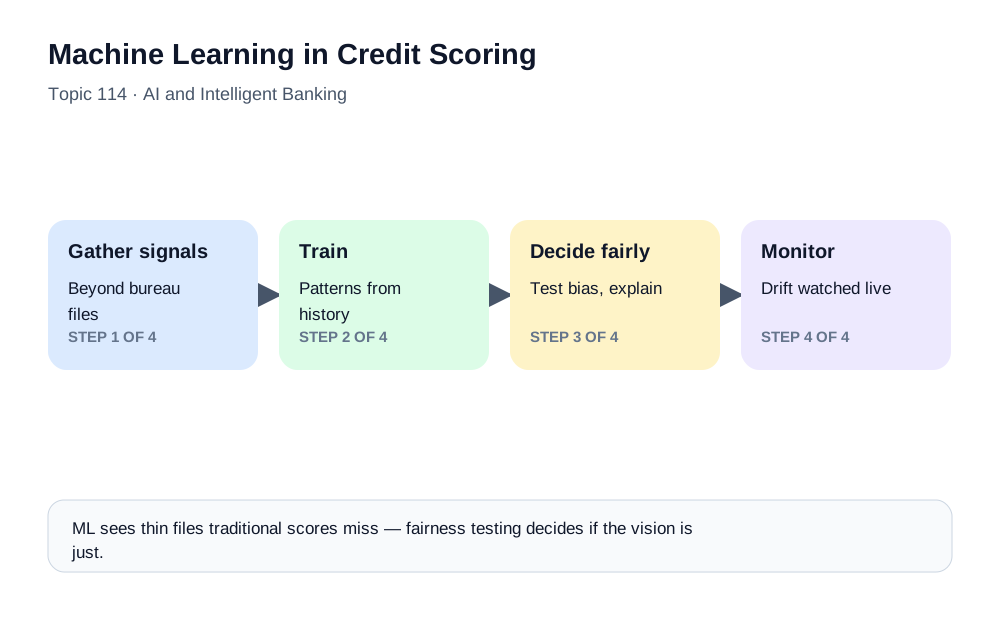
Machine Learning in Credit Scoring at a glance — Alternative data, model training, bias and fairness.
Beyond Traditional Scores — Alternative Data, ML Models, and Algorithmic Lending
Credit scoring—the prediction of whether a borrower will repay a loan—forms the foundation of all lending activity and has been transformed fundamentally by machine learning over the past decade. Traditional credit scores rely on limited data sources, primarily examining past loan repayment history and credit card usage through simple statistical models that were developed decades ago. Machine learning models have revolutionized this field by incorporating hundreds of variables, processing alternative data sources never before used in credit decisions, and enabling accurate credit assessment for billions of people who lack traditional credit history. This transformation is fundamentally changing who receives credit and at what price, with profound implications for financial inclusion, risk management, and fair lending practices that require careful attention to avoid creating new forms of discrimination.
Credit-bureau scores such as TransUnion CIBIL scores summarise information in a consumer's credit file, including repayment and credit-account behaviour, but the exact scoring formula and feature weights are proprietary and should not be presented as a public fixed 30/25/20/15/10 formula. Lenders also combine bureau information with their own underwriting policy, income or cash-flow evidence and product-specific risk criteria. Some Indian consumer bureau scores use a 300-to-900 scale, but lenders set their own cut-offs and decision policies. A particular score band should not be described as a universal definition of excellent, good or poor credit, and lending decisions are not necessarily binary score-only decisions.
However, traditional scoring suffers from significant limitations that constrain its effectiveness and exclude deserving borrowers who might be creditworthy but lack the specific history that traditional models require. Thin-file individuals who are new to credit have insufficient history to generate reliable scores, creating a catch-22 where they cannot get credit because they have no credit history, perpetuating exclusion. Many consumers and small businesses can have limited or no conventional bureau history, creating a thin-file or new-to-credit challenge. The exact population changes over time and depends on the definition used, so current bureau, regulatory or industry data should be consulted before quoting a headline count. Bureau data updates monthly rather than in real time, potentially missing recent changes in borrower circumstances that affect risk, such as job loss or income increases. Traditional scorecards and bureau-based models can use more or fewer variables depending on design. The practical limitation is not a fixed ten-to-fifteen-variable count but reliance on a narrower set of historical credit attributes compared with models that can incorporate richer, appropriately governed cash-flow or behavioural data. Binary approval processes reject borderline applicants who might actually repay, excluding creditworthy borrowers due to rigid cutoff scores that do not account for individual circumstances.
Machine learning credit scoring overcomes these limitations through fundamentally different approaches that leverage modern computational capabilities and data availability. Machine-learning credit models can use a larger and more complex feature set than traditional scorecards, but there is no universal requirement for hundreds of features or millions of historical loans. Model design should reflect sample quality, stability, explainability, production availability, fairness, governance and the actual predictive value of each feature. The models identify non-linear relationships between variables and outcomes, recognizing that risk factors interact in complex ways rather than adding linearly, such as the combination of high utilization and recent inquiries being more risky than either alone. Each applicant receives a real-time score generated instantly through API calls, enabling immediate decisions at points of sale that improve customer experience and conversion rates. Most importantly, the models continuously learn from new performance data, improving prediction accuracy over time as they are exposed to more outcomes and changing market conditions.
The machine learning models used for credit scoring each offer distinct advantages suited to different use cases and regulatory environments that balance accuracy with interpretability. Gradient-boosted trees are frequently useful for tabular credit data, but no algorithm is universally 'best'. Logistic regression, scorecards, random forests, gradient boosting, neural approaches and other methods can each be appropriate depending on data, performance, stability, interpretability, governance and regulatory requirements. Random Forest offers robust performance with better interpretability than gradient boosting, making it widely used where explanation requirements are stringent and regulators demand transparency into model decisions. Neural Networks handle complex patterns and are particularly valuable when analyzing alternative data types like images, text, or audio that traditional models cannot process, such as analyzing bank statements or social media. Logistic Regression provides simple, interpretable baseline models that remain relevant for regulatory compliance where decision logic must be fully transparent and explainable to borrowers in plain language.
Alternative data sources dramatically expand the information available for credit assessment beyond traditional credit bureau reports, enabling accurate scoring of previously excluded populations who lack conventional credit history. UPI transaction history enables income estimation from payment inflows, spending pattern analysis that reveals financial behavior and lifestyle, and assessment of income regularity that predicts stability and ability to service debt. Mobile phone usage data including call patterns and app usage serves as a proxy for stability, social connections, and responsibility that correlates with creditworthiness, on the theory that those who maintain regular patterns are more reliable. Utility payment histories for electricity and water demonstrate payment discipline through non-credit obligations that predict loan repayment behavior, showing willingness to pay even without credit consequences. E-commerce behavior including purchase patterns and cart abandonment indicates financial capacity and decision-making quality, with consistent patterns suggesting stability. Rent payment tracking captures regular rental payments as evidence of creditworthiness equivalent to loan repayment that traditional scoring ignores despite housing being a major expense. GST returns for business borrowers reveal revenue trends, seasonality, and business health that predict loan performance better than static financial statements. Bank statement analysis through cash flow assessment proves more predictive than credit scores alone for many borrowers, showing actual financial behavior rather than just credit history.
India's Account Aggregator framework specifically enables alternative data-based lending through consent-based financial data sharing that protects consumer privacy and control. Customers provide explicit consent for their bank statements and financial data to be shared with lenders digitally through standardized APIs, creating audit trails of permissions. This enables cash flow-based lending decisions for thin-file customers who lack traditional credit history but maintain healthy bank account activity with regular income and responsible spending patterns that demonstrate creditworthiness. The Sahamati ecosystem includes multiple Account Aggregator operators facilitating this data sharing across the financial system, creating infrastructure for a new generation of credit assessment that could dramatically expand financial inclusion.
Lenders and fintechs globally use combinations of bureau, bank-transaction, business, tax, cash-flow and other permitted data to support credit assessment. Provider-specific user counts, feature counts and proprietary modelling practices change over time and are often not independently verifiable, so learners should focus on the control principles: lawful data access, reliable features, affordability, model validation, explainability, fairness monitoring and accountable lending decisions.
The challenges and risks of machine learning credit scoring require careful management to ensure fair and responsible deployment that does not replicate or amplify existing inequalities. Explainability represents a fundamental concern—complex ML models function as black boxes, making it difficult to explain why specific applicants were rejected in terms that are meaningful and actionable for borrowers who want to improve their chances. Algorithmic bias can emerge when models discriminate based on proxy variables such as postal codes that correlate with protected characteristics like caste or religion, even when those characteristics are not directly used, perpetuating historical discrimination through automated decisions. Regulatory compliance requires that credit decisions be explainable to borrowers and regulators, creating tension with complex model approaches that prioritize accuracy over transparency. Data quality issues affect alternative data, which can be noisy, incomplete, or subject to manipulation by sophisticated applicants who learn what signals matter. Adversarial gaming occurs when borrowers discover which signals models use and artificially optimize their behavior to appear more creditworthy than they actually are, undermining model effectiveness. Privacy concerns arise from using phone data and application usage patterns for credit decisions, raising questions about consent and appropriate use of personal information that may feel intrusive.
Fairness in machine learning credit scoring requires specific technical and procedural approaches to ensure equitable outcomes across demographic groups. Protected attribute testing ensures models do not discriminate directly by gender, caste, religion, or other prohibited categories that would violate fair lending laws and constitutional principles. Disparate impact analysis checks whether outcomes differ significantly across demographic groups, even without explicit discrimination, triggering review when found to prevent unfair exclusion. Explainable AI techniques including SHAP values and LIME make black-box model decisions interpretable by showing which features drove specific decisions, enabling appeals and corrections. Human review of borderline cases ensures that algorithmic decisions are not entirely automatic for consequential credit determinations that affect borrowers' lives and economic opportunities.
The transformation of credit scoring through machine learning represents both tremendous opportunity for expanded access and significant responsibility to deploy these capabilities fairly and transparently. The ability to score billions of previously excluded individuals promises expanded financial inclusion and economic opportunity for populations long denied access to credit that could improve their lives and businesses. However, the risks of algorithmic bias and opaque decision-making require careful governance, transparent processes, and ongoing regulatory attention to ensure that this technological progress serves all segments of society fairly rather than replicating or amplifying existing inequalities through automated decisions that are difficult to challenge or correct.
<!-- MBA-DEEP-DIVE-START -->Machine Learning Credit Scoring Deepening — Data, Models, Fairness, and Lending Control
Credit scoring is one input to a lending decision
A credit score estimates some aspect of borrower risk, commonly the probability of repayment difficulty or default over a defined horizon. A lending decision can also consider affordability, income or cash flow, product policy, collateral, fraud risk, regulatory eligibility and relationship information. Separating these elements is important because a model can be statistically strong and still be insufficient for a safe lending decision. A customer with low predicted default risk may nevertheless be unable to afford a proposed instalment after existing obligations. Conversely, a thin-file customer may have limited bureau history but strong verifiable cash flow. Machine learning improves one part of underwriting when it is placed inside a broader decision framework.
The target variable defines what the model actually learns
A model trained to predict ninety-day delinquency is not automatically a model of lifetime credit loss, affordability or fraud. Teams should define the outcome, observation window, performance window and treatment of restructures, prepayments and incomplete accounts. If “bad” is defined differently across products, scores may not be comparable. Label quality matters because historical operational errors can be learned as if they were borrower behaviour. Model developers should therefore work with credit and collections experts to ensure the target represents a meaningful risk event rather than a convenient database field.
Development samples should reflect the population where the model will be used
A model built on salaried urban personal-loan borrowers may perform poorly on self-employed small businesses. If historical approvals excluded many thin-file customers, the development data contains little evidence about how those rejected applicants would have performed. This is a form of selection bias. Teams should understand who appears in the training sample, who is missing and whether underwriting policy changed during the period. Out-of-time and out-of-sample testing can provide evidence of generalisation, but no statistical technique completely removes a major population mismatch.
Bureau scores summarise history but do not reveal every underwriting fact
Credit bureaus provide valuable information about existing accounts, repayment behaviour, enquiries and other reported credit activity. The score is a compressed summary of that file. Lenders should not invent public weights for a proprietary bureau score or treat one score threshold as universal. Two lenders can make different decisions on the same bureau score because their products, risk appetites and customer evidence differ. Bureau data also has timing and completeness limitations. A score is most useful when the lender understands what it represents and combines it with relevant current information.
Thin-file and new-to-credit are information problems, not proof of bad risk
A customer with little credit history may be young, newly formalised, recently migrated, previously cash-based or simply someone who avoided borrowing. Lack of data creates uncertainty; it does not automatically imply poor repayment behaviour. Alternative data can reduce uncertainty when it measures something genuinely related to income, cash flow or payment capacity. The challenge is to find evidence that is lawful, stable and explainable. Machine learning should not replace one unfair assumption—“no history means bad”—with another assumption based on unrelated digital behaviour.
Cash-flow underwriting can be more relevant than lifestyle profiling
Bank-account inflows, recurring obligations, balance volatility, business receipts and verified tax or invoice data can provide direct evidence about ability to service debt. These features often have clearer economic meaning than social-media activity, contact-list patterns or app usage. A bank should prefer data that is relevant to the lending question and can be explained to a borrower. Richer data is not automatically better. Good feature governance asks whether the variable improves prediction, remains stable, respects privacy and has a plausible relationship to credit risk.
Account Aggregator data can support consent-based cash-flow analysis
India's Account Aggregator framework enables customers to consent to sharing financial information from participating Financial Information Providers with authorised Financial Information Users through regulated Account Aggregators. For lending, this can allow the lender to receive structured bank or other eligible financial data without asking customers to upload manipulated screenshots or static PDFs. The architecture separates consent and data transfer from the credit decision itself. The lender still owns underwriting responsibility and should request only the data required for the purpose. Consent does not make every possible use of the data automatically appropriate.
Consent history should be linked to model evidence
When financial data is used to make a credit decision, the institution should know which consent authorised access, what data period was received, when the data was retrieved and which model version used it. This supports investigation if a customer later says the information was wrong or access was not understood. It also helps prevent stale data from being reused beyond the permitted context. Model reproducibility requires more than source values; it requires evidence of lawful and timely access.
Feature engineering should preserve business meaning
Raw transaction data can be converted into features such as average monthly inflow, number of salary-like credits, days with negative balance, variability of business receipts or ratio of debt payments to cash inflows. Each feature should have a documented formula and rationale. Developers should avoid features that are impossible for credit teams to interpret. Complex transformations can improve model fit but make drift and errors harder to detect. A good feature has statistical value, economic meaning and production reliability.
Missing data is information but can also encode exclusion
A missing salary field can mean the applicant is self-employed, the data source failed, the employer does not report consistently or the customer refused an optional permission. Treating all missing values as one category can create bias. Models should distinguish operational missingness from genuine absence where possible. Production monitoring should also detect sudden increases in missing features because a data-pipeline outage can change scores for thousands of applicants. Missing-value handling is therefore both a statistical and operational-control decision.
Data leakage can make a model look unrealistically accurate
Leakage occurs when training features contain information that would not have been available at the time of the real decision. A feature derived from later collections status, post-disbursement balance or manual review outcome can allow the model to “predict” default using future information. Performance in development then looks excellent and collapses in production. Time-aware feature construction and independent validation are essential. Credit models should reproduce the exact information boundary of the intended decision point.
Logistic regression remains useful because simplicity can be a strength
Logistic regression and scorecards can provide stable, interpretable relationships between borrower attributes and outcome. They are not obsolete simply because more complex algorithms exist. In some portfolios the incremental predictive gain from a black-box model may be too small to justify higher governance, explanation and operational complexity. A good model-development process compares methods objectively and chooses the approach that best balances performance, stability, explainability and use-case requirements.
Tree-based models capture interactions but need governance
Decision trees, random forests and gradient-boosted trees can identify nonlinear relationships and interactions without manually specifying every combination. This can improve discrimination in tabular credit data. The same flexibility can learn unstable quirks or proxies for sensitive characteristics. Hyperparameters, feature set, training period and random seeds should be controlled. Feature importance should not be confused with causal explanation. Validation should examine how the model behaves across score ranges and customer groups, not only overall accuracy.
Neural models should be justified by the data problem
Neural networks can be useful for unstructured inputs such as text or complex sequences, but credit scoring is often dominated by structured tabular data where simpler methods can perform competitively. A neural model should not be chosen for prestige. If it materially improves a relevant outcome, teams should still address explainability, stability, monitoring and computational dependencies. Model complexity creates operational costs, and those costs should be justified by measurable benefit.
Accuracy is not one metric
Classification accuracy can be misleading when defaults are relatively rare. Credit modelling may use measures such as ROC-AUC, Gini, precision, recall, Kolmogorov-Smirnov statistics, calibration and business-specific loss metrics. The chosen metrics should reflect how scores drive decisions. A model can rank borrowers well but produce poorly calibrated probabilities. Another can improve overall AUC while performing badly in the high-risk segment that matters most. Validation should therefore use several complementary measures and connect them to economic outcomes.
Calibration matters for pricing and portfolio forecasting
A score that ranks risk correctly does not necessarily estimate the right probability of default. If a grade described as five-percent risk actually defaults at twelve percent, pricing and provisioning can be wrong even though the model still orders customers from safer to riskier. Calibration compares predicted probabilities with realised outcomes. It should be monitored over time and by segment. Economic changes can shift default rates without destroying rank ordering, requiring recalibration or policy adjustment.
Cut-off selection is a business and risk decision
Once a model produces a score, the bank needs a policy for approval, decline or referral. The threshold affects growth, expected loss, customer approval rates and operational workload. A lower threshold may increase approvals and losses; a higher threshold can reduce losses but exclude profitable borrowers. The correct cut-off depends on risk appetite, pricing, capital, product economics and fairness considerations. Model developers can quantify trade-offs, but accountable business and risk functions should approve policy.
Risk-based pricing should not be confused with unlimited pricing freedom
Higher-risk borrowers may be charged more to reflect expected loss and cost, but pricing remains subject to product, conduct, competition and regulatory constraints. A very high rate can also worsen affordability and increase default risk. Models should not create a circular logic where the customer is scored as risky, receives expensive credit, struggles with the resulting payment and then confirms the model's prediction. Pricing analytics should consider customer outcome and sustainable repayment as well as expected return.
Affordability needs its own evidence
Probability of default and ability to afford a proposed loan overlap but are not identical. A customer with an excellent history may request a loan whose instalment is too large relative to current income. Conversely, a new-to-credit customer can have strong cash flow. Lending systems should assess obligations and disposable capacity according to applicable policy rather than asking the ML score to stand in for every dimension of risk. Keeping affordability separate also makes adverse decisions easier to explain.
Fraud screening should be separated from credit scoring
An applicant using a stolen identity can look statistically creditworthy because the identity belongs to a good borrower. Fraud models examine different signals: identity consistency, device behaviour, application velocity, account ownership and document authenticity. The application should pass both fraud and credit controls. Combining them into one opaque score can make it difficult to understand why a case was rejected and which control needs improvement. Separate models can still share features where appropriate, but their objectives and outcomes should remain distinct.
Explainability should answer the decision question
A lender may need to explain to a customer that an application was declined because of high existing obligations, recent arrears or insufficient verified income. A technical explanation that one model feature had a high SHAP value may be useful to developers but not meaningful to the customer. Explainability should therefore be designed for different audiences: model validators need detailed behaviour, underwriters need actionable reason codes, management needs portfolio patterns and customers need clear adverse-decision reasons where required. One explanation format does not serve every purpose.
Reason codes should be stable and truthful
If a model changes, reason-code logic should still map to genuine decision drivers. Generic messages such as “internal policy” can frustrate customers and make fairness review difficult. On the other hand, revealing detailed thresholds can enable gaming. Banks should find an appropriate level of explanation that identifies material factors without exposing security-sensitive logic. Reason-code quality should be tested against actual model behaviour and policy overrides.
Fairness testing requires defined groups and outcomes
A fairness review should identify which customer groups require attention under law, policy and ethical risk, then compare relevant outcomes such as approval, pricing, false-positive or default prediction performance. Differences do not automatically prove discrimination; they require investigation. The bank should ask whether features act as proxies, whether the training sample reflects historical exclusion and whether alternative specifications achieve similar risk performance with less disparity. Fairness is a governance process, not one mathematical metric.
Removing a protected attribute does not remove bias
A model can infer sensitive characteristics indirectly from location, language, occupation, device type or other correlated data. Excluding the explicit field is therefore not sufficient. Proxy testing, feature review and outcome monitoring are needed. At the same time, fairness testing may require controlled access to demographic attributes that are not used in the production decision, subject to law and governance. Banks should distinguish data used to detect bias from data used to make the lending decision.
Historical data can contain historical policy bias
If past underwriters approved one group more frequently, the observed loan-performance data may be concentrated in that group. Training a model on approved accounts can inherit these patterns. Rejected applicants often lack observed repayment outcomes, creating reject-inference challenges. Techniques can reduce uncertainty, but assumptions should be documented. The institution should not claim that a model is neutral merely because it was trained on “objective historical data.” History reflects earlier business choices.
Alternative data can create new proxies for social disadvantage
Phone type, location consistency, shopping behaviour or digital intensity can correlate with income, age, geography or social conditions. A model may use these signals efficiently while systematically disadvantaging people with less digital access. Features should therefore pass a relevance test: does the variable represent credit capacity or behaviour in a way the bank can justify? If a marginal predictive gain comes from an intrusive or hard-to-explain signal, the safest decision may be not to use it.
Data minimisation can improve model governance
Collecting hundreds of features “just in case” increases privacy, security and validation burden. A smaller set of robust variables can be easier to monitor and explain. Feature-selection methods should consider incremental value, correlation, stability and business relevance. Removing redundant features can reduce operational complexity without materially harming performance. Model quality is not measured by feature count.
Model validation should be independent enough to challenge development
Validation should test conceptual soundness, data, performance, stability, implementation, limitations and outcomes. The validator needs authority to challenge optimistic assumptions and require remediation. Independence does not mean isolation; validators should understand the business problem and work with developers to resolve issues. Material models may require periodic revalidation and approval under the bank's model-risk framework. A machine-learning model should not bypass established model governance because it was built by a fintech or vendor.
Vendor models still require bank accountability
A lender can buy a score or decision engine from a third party, but it remains responsible for understanding how the tool affects its credit decisions. Contractual confidentiality cannot justify complete ignorance of inputs, performance or limitations. The bank should assess data provenance, validation evidence, change control, security, bias monitoring and service resilience. If the vendor changes the model silently, the lender's portfolio risk can change without formal approval. Version notification and performance reporting should therefore be part of vendor governance.
Champion-challenger testing supports controlled improvement
A production model can remain the champion while a new challenger is tested on recent data or limited traffic. This allows the bank to compare risk performance, approval rates, stability and fairness before full replacement. The challenger should not be declared better based only on development metrics. Real operational effects, including manual-review workload and data availability, matter. A controlled transition reduces the risk of changing underwriting for the entire portfolio at once.
Model drift can come from the economy
Interest rates, employment, inflation, consumer leverage and market shocks can change borrower behaviour. A model trained during stable conditions can become miscalibrated during stress. Monitoring should compare realised default and feature distributions with expectations. Scenario analysis can complement historical testing by asking how the portfolio behaves under adverse conditions. Retraining is one option, but policy overlays, tightened limits or additional review can sometimes be more appropriate until sufficient new data exists.
Data drift can come from technology rather than customers
An upstream bank may change transaction descriptions, a bureau may redesign a field, an app may alter event tracking or an Account Aggregator feed may have a temporary gap. These changes can shift features even when borrower risk has not changed. Data-quality monitoring should therefore run before model scoring and compare production distributions with expected ranges. If a critical feed is unavailable, the model needs a defined fallback rather than silently treating every missing value as normal customer behaviour.
Model performance should be reviewed by segment
Overall model performance can hide weakness in small but important populations. Banks should examine product, geography, channel, new-to-credit status, income type and other meaningful segments where sample size allows. A model can be strong for salaried borrowers and weak for self-employed customers. Segment results can lead to separate policies, additional data or a dedicated model. The goal is not to create unnecessary complexity but to avoid assuming one population is homogeneous.
Manual review should be purposeful
Borderline or unusual applications can be referred to trained underwriters. Human review is useful when evidence is genuinely nuanced, not as an uncontrolled override channel. Reviewers should receive relevant reasons and data, record their decision and explain deviations from model or policy. Over time, analytics can identify whether manual review improves outcomes. If reviewers consistently override one pattern successfully, the model or policy may need adjustment. If overrides worsen risk, training or authority may need attention.
Decision engines combine models with policy rules
Production lending usually involves more than one score. A decision engine can apply eligibility, fraud, bureau, affordability, product and model rules in a controlled sequence. The bank should know which rule caused the outcome. This makes testing and explanation easier than embedding everything inside a single black-box model. Policy rules can also respond quickly to regulatory or risk changes without retraining the model. Clear separation between prediction and policy is a core architecture principle.
API scoring needs version and timeout controls
Real-time lending often calls a model service through an API. The request should contain validated features and a correlation identifier, while the response should include score, model version, decision-related metadata and status. A technical timeout should not be treated as a credit decline unless policy explicitly says so. Retries should be idempotent. If the model service is unavailable, the lender needs a fallback such as manual review or temporary suspension. High predictive accuracy is irrelevant if the service is operationally unreliable.
Adverse decisions should be reproducible later
A bank should be able to reconstruct the data, model, policy and reason that produced a historical credit decision. This requires storing or referencing feature values, model version, policy version and relevant consent. Reproducibility supports complaints, audit, validation and regulatory review. Simply storing the final score is insufficient because the same score can be generated by different feature combinations or model versions.
Pricing models need separation from profitability assumptions
Expected loss is one component of credit pricing alongside funding cost, capital, operating expense, competition and target return. A credit score can inform risk-based pricing, but the final rate should not be generated without these other economics. Banks should monitor whether higher-priced segments actually deliver expected returns after defaults, collections and servicing costs. Apparent profitability can disappear when losses emerge later in the vintage.
Credit limits should be monitored after origination
Risk changes after a loan or card is approved. Behavioural models can use repayment, utilisation, cash flow and other permitted data to support line increases, decreases or additional offers. These actions should follow policy and fairness controls. A temporary drop in balance should not automatically trigger punitive treatment. Behavioural scores need their own validation because the available data and objective differ from application scoring.
Collections models should not inherit origination assumptions blindly
Once a borrower is delinquent, the relevant question changes from whether default will occur to which treatment is likely to cure, recover or support the account. Collections models may estimate contactability, payment probability or hardship. Using the original application score alone can miss current circumstances. Treatment optimisation should respect conduct rules and customer vulnerability. A high-risk score does not justify aggressive or misleading collection.
Stress testing connects model risk to portfolio risk
Management should understand how modelled risk behaves under adverse economic scenarios. If default probabilities increase sharply, pricing and capital assumptions can change. Stress tests can also reveal concentration in customer groups whose incomes depend on the same sector or geography. Machine learning can improve baseline prediction, but scenario judgment remains necessary because rare crises may not be well represented in training data.
Credit model governance should include retirement
Models should have lifecycle status: development, validation, approved, production, restricted, superseded and retired. When a model is replaced, historical decisions must still remain reproducible. Old APIs should not continue receiving traffic accidentally. Data pipelines and features that are no longer needed should be decommissioned to reduce cost and privacy exposure. Retirement is part of model governance, not merely a technology clean-up.
A thin-file borrower scenario shows the value of relevant alternative data
Consider a self-employed customer with limited bureau history who seeks a modest working-capital loan. With consent, the lender obtains structured bank-account data showing regular business receipts, seasonal variation, existing obligations and cash buffers. A model uses these features alongside bureau information and product policy. The lender can make a more informed decision than if it relied only on credit history. The key is that the alternative data directly relates to cash flow and repayment capacity rather than unrelated lifestyle signals.
A model-drift scenario shows why monitoring matters
Suppose a model has performed well for two years, then approval rates suddenly increase while predicted risk falls. Before celebrating, the model-risk team notices that a source field representing existing obligations has become blank after an upstream system release. The model interprets missing obligations as low debt and scores applicants too favourably. Data-quality monitoring and distribution alerts stop automated decisions until the feed is corrected. This incident is not a failure of machine-learning theory; it is a production-data control failure that strong governance must anticipate.
A fairness scenario shows why outcome review goes beyond feature lists
A lender removes explicit demographic attributes from the model and initially assumes the design is fair. Later monitoring shows one geographic cohort receives materially fewer approvals even after accounting for observed credit risk. Investigation finds that a device and location feature is acting as a proxy for infrastructure access rather than repayment capacity. The bank removes or redesigns the feature with little loss in predictive performance. Fairness was improved not by declaring the model neutral, but by testing real outcomes and challenging the economic meaning of features.
The final credit-scoring test is whether better prediction produces better lending
Machine learning is valuable when it helps the lender distinguish risk more accurately, expand responsible access, price appropriately and intervene earlier while preserving fairness, privacy and explainability. The model should never become an authority that nobody can question. Data must be lawful and relevant, features stable, performance validated, decisions reproducible, outcomes monitored and human accountability clear. A sophisticated model that approves unaffordable loans or discriminates through hidden proxies is not successful credit innovation. The strongest system combines predictive power with disciplined lending judgment.
Machine Learning Credit Scoring Final Depth — Governance, Portfolio Use, and Production Controls
A score is meaningful only when its scale and horizon are defined
A model output such as 0.08, 612, or grade B has no useful meaning unless the bank defines what it represents. The value may estimate probability of default over twelve months, rank applicants by relative risk, or map borrowers into policy bands. Lending teams should know whether higher or lower values indicate more risk, what observation horizon applies, and which population was used to calibrate the scale. This prevents one model score from being reused incorrectly for another purpose such as pricing, collections, or lifetime-loss estimation.
Probability of default should not be confused with expected loss
Credit risk is broader than the probability that a borrower defaults. Expected loss also depends on exposure at default and loss given default. A borrower may have a relatively high probability of default but low loss because strong collateral or guarantees reduce recovery risk. Another borrower may have lower default probability but very high exposure and weak recovery prospects. An ML credit score can support the probability-of-default component, but portfolio economics and capital decisions should not assume the score alone measures total loss.
Application models and behavioural models solve different problems
An application score evaluates information available when the customer applies for credit. A behavioural score evaluates an existing customer's subsequent repayment, utilisation, account or cash-flow behaviour. The features, target and intervention are different. Application models may influence approval and initial limits, while behavioural models may support line management, early warning or collections prioritisation. Reusing one model in the other context without validation can produce misleading results because the population and information set have changed after origination.
Pre-approved credit still requires controlled eligibility logic
A bank may identify existing customers who appear eligible for a pre-approved offer based on internal transaction history, bureau information and established relationship behaviour. The word “pre-approved” should not imply that all checks are complete or that the customer has an unconditional entitlement to credit. Current eligibility, fraud controls, consent, affordability, product rules and any required verification can still apply at drawdown. Marketing language should match the actual decision process so customers are not misled.
Feature stores can improve consistency between development and production
A feature store or controlled feature pipeline can help ensure that a variable such as average monthly inflow is calculated the same way in model development, batch monitoring and real-time scoring. Without this discipline, teams can create training-serving skew: the development model uses one formula while production code uses another. Each important feature should have an owner, calculation logic, source, expected range, refresh frequency and version. Consistent features are a practical foundation for reproducible machine-learning decisions.
Point-in-time correctness prevents future information from leaking into features
Credit models often use rolling balances, arrears, enquiries and transaction aggregates. When backtesting, the bank should reconstruct these variables exactly as they were known on the historical decision date. Using a current data warehouse snapshot can accidentally include later corrections or events that were not available then. Point-in-time feature engineering is therefore essential for honest validation. The same principle supports customer complaints because the bank can explain the decision using information that actually existed at the time.
Model approvals should distinguish development from deployment
A model can be statistically approved yet still be unsafe to deploy if integration, data controls, reason codes or fallback logic are incomplete. Banks should separate validation of the model itself from production-readiness assessment. Deployment testing can confirm feature mappings, data types, score transformations, cut-offs, logging, authentication, throughput and error handling. A strong model implemented incorrectly is still a bad credit-control system. Production sign-off should therefore involve credit risk, model risk, technology and operations where relevant.
Shadow scoring can test a model before it affects customers
A new model can run in parallel with the existing decision process while its output is recorded but does not determine the customer outcome. This shadow period allows teams to compare approval patterns, operational stability, feature availability and segment behaviour using live traffic. It can reveal issues that offline testing misses, such as missing production fields or unexpected channel populations. Shadow scoring should still be governed because it may process customer data, but it reduces the risk of changing lending decisions before the new model is understood.
Overrides need reason codes and performance review
Credit officers may be permitted to override a model or automated decision under defined circumstances. An override should identify who made it, the reason, supporting evidence and whether it increased or reduced risk. Banks can then compare the later performance of overridden cases with model-only decisions. High-quality overrides can reveal information the model does not capture. Poorly controlled overrides can introduce inconsistency, favouritism or risk appetite breaches. An override framework therefore converts human judgment into auditable evidence rather than an invisible exception.
Decline reasons should distinguish model outcome from policy failure
A customer may be declined because the risk score is below threshold, because income cannot be verified, because the requested product is unavailable, because an eligibility rule fails, or because fraud controls require further review. These causes should not be collapsed into a generic “credit score too low” message. Accurate reason attribution improves customer communication, complaints handling and internal analytics. It also prevents teams from trying to retrain a model when the real problem lies in policy, data quality or another control.
Score migration is useful for existing portfolios
For behavioural models, banks can track how customers move between risk bands over time. A migration from low to medium risk can be an early warning even before a payment is missed, while improvement can support appropriate account management. Migration matrices help risk teams distinguish stable portfolios from rapidly deteriorating ones. They should be interpreted alongside economic conditions, product changes and model recalibration. A shift in scores caused by a model version change should not be mistaken for a sudden change in customer creditworthiness.
Vintage analysis connects origination quality with later performance
Loans originated in a particular month or quarter can be grouped into a vintage and followed as they age. This reveals whether a new model or policy produced better or worse repayment performance than earlier cohorts. Vintage curves are particularly useful when rapid growth changes the mix of borrowers, channels or products. A portfolio can look healthy in aggregate while a recent vintage is deteriorating. Credit-scoring governance should therefore connect model metrics with realised account performance rather than judging success only at the point of approval.
Stress testing should examine model behaviour under conditions outside normal history
An ML model trained mostly on benign economic conditions may not know how risk relationships change during severe unemployment, inflation, sector stress or interest-rate shocks. Banks can test how important features and score distributions behave under scenarios, while recognising that stress testing is not the same as retraining on imaginary data. The purpose is to identify vulnerabilities, concentration and policy sensitivity. Management can then decide whether overlays, limits or additional review are needed when the environment moves outside the model's comfortable range.
Policy overlays should be temporary, transparent and measurable
During a shock, a bank may apply a conservative overlay to model-driven decisions rather than immediately rebuilding the model. Examples include tighter exposure limits, additional verification or segment-specific review. The overlay should have a defined rationale, owner, start date, monitoring approach and exit criteria. Permanent undocumented overlays create a hidden second model that is difficult to validate. Temporary controls are useful precisely because they can respond faster than model redevelopment while preserving accountability.
Retraining should not be automatic simply because new data arrives
More recent data can improve relevance, but frequent retraining can also introduce instability. A bank should define triggers such as material performance deterioration, population drift, policy change or sufficient new outcome data. Retraining should pass the same validation and approval standards as the original model. Continuous learning in production may be appropriate in some low-consequence systems, but consequential lending decisions usually require controlled version changes so the bank can explain which model made each historical decision.
Reject inference has unavoidable uncertainty
A lender observes repayment outcomes mainly for applicants it approved. It does not know with certainty how declined applicants would have performed because they did not receive the loan. Reject-inference techniques can estimate missing outcomes under assumptions, but they do not create factual repayment histories. Teams should document the method, test sensitivity and avoid presenting inferred labels as ground truth. Policy changes or controlled experiments can sometimes provide more direct evidence, subject to risk appetite and customer-protection requirements.
Fair lending governance should examine the whole decision chain
Bias can enter through marketing, channel access, data collection, identity verification, model features, cut-offs, manual overrides, pricing and collections—not only through the scoring algorithm. A fairness review should therefore trace the end-to-end lending journey. If one group receives fewer approvals, the cause may be a missing-data problem before scoring or a policy rule after scoring. Looking only at model coefficients can miss the actual source of unequal outcomes.
Explainability should be tested for fidelity, not appearance
An explanation is useful only if it reflects what actually influenced the model. Attractive dashboards can create false confidence if the explanation method is unstable or oversimplified. Teams should test whether reason codes remain consistent for similar applications, whether small irrelevant changes alter the explanation unexpectedly, and whether the explanation maps to actionable business concepts. Technical tools such as SHAP can support analysis, but the bank remains responsible for converting model behaviour into truthful operational and customer-facing reasons.
Documentation should connect model mathematics to lending operations
A practical model document should describe the business purpose, population, data sources, target definition, exclusions, features, method, performance, limitations, fairness testing, validation findings, score transformation and monitoring. Operational documents should add deployment architecture, fallback, reason codes, policy thresholds, escalation and incident handling. This connection matters because model risk often appears at the boundary between analytics and process. Documentation should enable a competent reviewer to understand not only how the model was trained but how it affects a real customer application.
The final test is whether the system makes better controlled lending decisions
Machine learning is valuable when it improves risk discrimination, expands responsible access, reduces manual effort or provides better evidence without weakening affordability, fairness, privacy or accountability. A more complex algorithm is not automatically progress. Banks should compare realised default, customer outcomes, approval quality, complaints, override performance, stability and operating cost against the previous approach. The objective is not to maximise a model metric; it is to make lending decisions that are sustainable for the customer and acceptable for the institution.
<!-- MBA-DEEP-DIVE-END -->