Visual overview
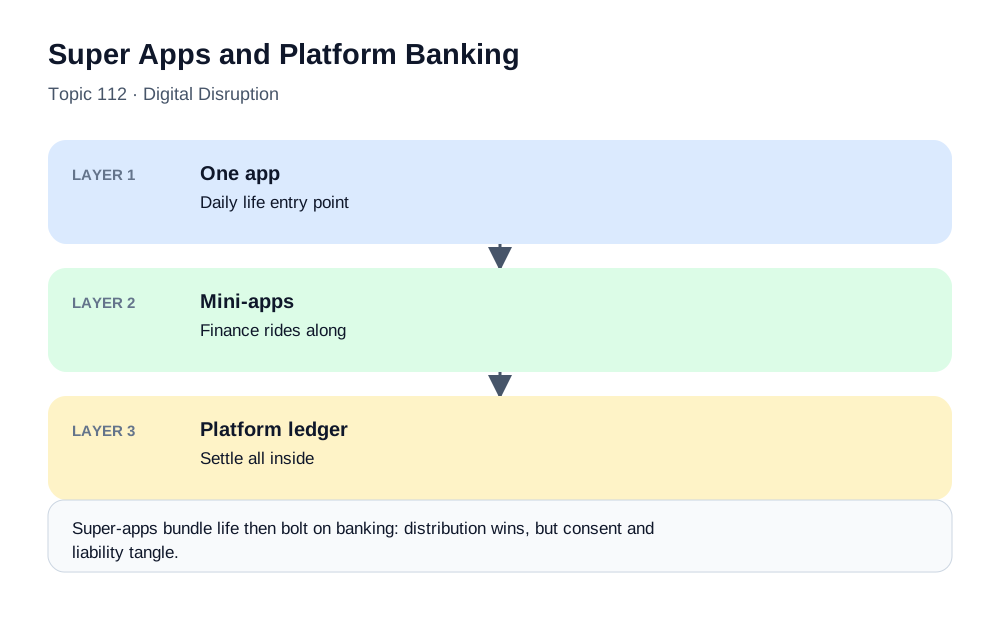
Super Apps and Platform Banking at a glance — Financial services bundling, platform economy.
Financial Services Bundling and the Platform Economy
Super apps are one form of digital convergence in which a single application combines multiple services such as payments, commerce, transportation, communication or financial products. Their relevance varies by market, regulation and customer behaviour, so they should be analysed as a platform strategy rather than described as the inevitable or ultimate form of digital banking. In banking, the platform model is fundamentally redefining distribution strategy: rather than building every product internally, banks and fintechs create ecosystems where partners offer services on shared platforms, creating value through curation and coordination rather than production. Banks increasingly need to decide where platform models add value, which capabilities should remain under direct bank control, and when participation in external ecosystems improves distribution without weakening accountability, customer protection or strategic resilience.
A super app is defined by its comprehensive scope—a single mobile application offering multiple services spanning entirely different industries that users would traditionally access through separate applications, creating a one-stop destination for daily needs. The concept originated with WeChat in China, which evolved from a simple messaging application into a comprehensive platform handling payments, shopping, government services, and mini-programs from third-party developers that extended functionality without requiring separate app downloads. A super app aims to reduce the need to move between separate applications by combining services through a shared identity, interface and ecosystem. Revenue models vary: platforms may earn from merchant services, advertising, subscriptions, financial-product distribution, technology fees or other sources rather than necessarily taking a cut of every transaction. Network effects can strengthen a platform, but they do not guarantee permanent dominance.
Global super apps demonstrate the model's power across different markets and cultural contexts, adapting to local conditions while maintaining the core platform approach. WeChat in China remains the archetype, handling everything from messaging to payments to government interactions and healthcare appointments within a single application that has become essential for daily life. Alipay, also Chinese, emphasizes financial services including payments, investments, insurance, and credit scoring alongside lifestyle features that make it a comprehensive financial companion. Grab dominates Southeast Asia with ride-hailing, food delivery, payments, banking, and insurance integrated into one application serving multiple daily needs. Gojek serves Indonesia with transportation, food, payments, and healthcare in a super app tailored to the Indonesian market. KakaoTalk in South Korea integrates messaging, payments, banking, taxi services, and shopping for Korean consumers. In India, Paytm offers payments, banking, insurance, tickets, and commerce in a comprehensive super app that has evolved significantly over time. PhonePe provides UPI, mutual funds, insurance, gold, and lending in a financial-focused super app. Tata Neu bundles shopping, payments, flights, hotels, and groceries for the Tata ecosystem of services.
Platform banking represents the strategic response of traditional financial institutions to the super app phenomenon that threatens to disintermediate them from customer relationships. Traditional banking operated on a vertically integrated model: banks built all products internally, distributed them through their own branches and channels, and serviced all customers directly with proprietary systems and staff. Platform banking inverts this model fundamentally. The platform provides infrastructure, distribution reach, and customer base that partners can access without building their own. Partners provide specialized products such as insurance, lending, and investments that the platform does not build itself, focusing on their core competencies. Customers receive multiple products within a single application, enjoying convenience and choice without managing multiple relationships. All participants benefit: the platform gains traffic and data, partners gain distribution without customer acquisition costs, and customers gain seamless access to best-of-breed products curated by the platform.
Platform banking strategies vary in how the roles of platform and provider are distributed across different arrangements and business models. The "bank as platform" strategy has banks opening their applications to third-party products, exemplified by DBS in Singapore with its marketplace approach that offers products from multiple providers to DBS customers under the bank's brand. The "bank on platform" strategy places bank products inside someone else's platform, as when banks offer credit on Amazon or loans through Flipkart, leveraging the e-commerce platform's traffic and data. A non-bank platform can add regulated financial services through licensed group entities or partner institutions, but the legal provider and regulatory perimeter must remain explicit. Historical examples should not be treated as permanent structures: RBI imposed significant business restrictions on Paytm Payments Bank in 2024, illustrating why a platform brand, a regulated bank and the current permission to provide a particular service must be distinguished carefully. The marketplace model offers comparison and selection of third-party products, as PolicyBazaar and BankBazaar provide for insurance and loans, acting as aggregators rather than product providers.
The competitive advantages of platform models over traditional approaches explain their growing dominance in financial services distribution. Traditional institutions build all products in-house with limited distribution reach constrained by their own marketing and branch networks. Platforms curate the best products from multiple providers, accessing massive user bases that would take years and billions in marketing to build organically. Single-brand identity limits customer perception of traditional banks to their own offerings, while platforms enable multiple brands to compete for customer choice, ensuring quality through competition. Revenue for traditional banks comes from own products only, while platforms generate revenue from transaction fees and data in addition to product margins, creating multiple revenue streams. Innovation speed in traditional banks is limited by internal resources and approval processes, while platform ecosystems enable innovation from many builders competing to serve customers with new ideas.
Network effects can make scaled platforms more attractive by bringing together users, merchants and service providers, but financial services remain shaped by interoperability, regulation, switching behaviour, trust, competition and multi-homing. Scale can be an advantage without making market outcomes inevitably winner-take-most. More users attract more merchants, which in turn attract more users in a virtuous cycle that concentrates activity and makes competing platforms less attractive. More data enables better personalization, driving higher engagement and transaction frequency that improves the user experience further. India's UPI operates at very large scale—NPCI reported 23.20 billion transactions in May 2026—but UPI is interoperable infrastructure rather than proprietary transaction ownership by one app. Individual providers may gain behavioural insights from their own customer interactions, yet access to the payment rail does not mean one platform owns the ecosystem's full transaction data. These self-reinforcing dynamics mean that early leadership often translates into lasting dominance, making the current period of platform competition particularly consequential for long-term market structure.
Data aggregation creates competitive advantages that traditional banks struggle to match because they see only banking data while platforms see comprehensive life data that reveals deeper insights. Payment history reveals spending patterns and enables accurate income estimation beyond what banks can determine from deposits alone. E-commerce behavior indicates purchase preferences and financial capacity through basket size, frequency, and category choices. Ride-hailing data shows mobility patterns that serve as income proxies for gig workers and indicate lifestyle. Utility payment histories demonstrate payment discipline and financial responsibility through consistent on-time payments for essential services. Social media activity supports identity verification and network analysis for fraud detection. Super apps that aggregate these diverse data sources can offer superior credit scoring, more personalized products, and more targeted marketing than traditional banks limited to transaction data alone.
Regulatory concerns accompany the rise of super apps and platform banking as authorities recognize the concentration of economic power and data these platforms represent. Data monopoly risks emerge when super apps control vast amounts of financial and behavioral data about their users, creating information asymmetries and potential for abuse through discriminatory pricing or exclusion. Consumer protection questions arise when it is unclear who bears responsibility when things go wrong in a multi-party ecosystem with complex relationships between platform, providers, and banks. Competition concerns suggest that platform dominance may harm smaller players unable to achieve the network effects necessary to compete effectively, reducing innovation in the long run. Systemic risk increases when a single super app failure could affect millions of users and potentially disrupt significant economic activity through payment system concentration. Financial data privacy questions focus on how payment and behavioral data is used, shared, and protected by platforms with comprehensive visibility into users' lives.
Regulators worldwide are responding to these concerns with varying approaches reflecting different regulatory philosophies and market structures. China cracked down on Ant Group, forcing restructuring that reduced its dominance and separated financial services from the parent company's technology platforms to reduce systemic risk. UPI concentration policy has evolved over time, including NPCI measures concerning third-party application-provider volume concentration. Because implementation dates and exemptions can change, current NPCI circulars should be checked before quoting a market-share cap as an effective present-day rule. The European Union's Digital Markets Act regulates platform dominance across sectors including financial services, establishing rules for gatekeeper platforms that control access to markets. These regulatory developments will shape how super apps and platform banking evolve in different jurisdictions, potentially constraining their growth or requiring structural changes.
India's platform landscape demonstrates both the opportunities and challenges of this model for financial services in a rapidly evolving market. Paytm, PhonePe, CRED, Amazon, Flipkart, and Tata Neu all offer expanding suites of financial services alongside their core businesses, competing to become the primary financial interface for Indian consumers and capture the data and transaction revenue that position entails. The competition among these platforms drives innovation and benefits consumers through better products and lower costs, while raising questions about data concentration and market power that regulators continue to address through policy development and enforcement actions.
Platform-mediated distribution is an important banking model, but it will coexist with direct bank channels, specialised financial applications, embedded finance and other forms of distribution. The appropriate model depends on customer need, economics, regulation, risk appetite and strategic control. Whether controlled by traditional banks adapting to new models, fintech challengers building from scratch, or technology giants from outside financial services entering the market, platforms will determine how customers discover, evaluate, and consume financial products. Success in this environment requires either building platform scale through significant investment and network effects that create defensible positions, or effectively participating in others' platforms as a product provider that adds value—a strategic choice that will shape the industry for decades to come and determine which institutions thrive and which become marginalized.
<!-- MBA-DEEP-DIVE-START -->Super Apps and Platform Banking Deepening — Architecture, Distribution, Risk, and Accountability
A super app is primarily a distribution architecture
A super app can make many services appear to belong to one digital experience, but behind the screen they may be provided by different legal entities, technology platforms and regulated institutions. The banking value of the model comes from distribution: the customer can discover, consent to and use services without repeatedly starting from a separate application. This can reduce friction and improve engagement, but it also creates a responsibility problem. The interface may be unified while the underlying product owners remain separate. Banks should therefore design platform relationships so provider identity, terms, data access, transaction state and customer support remain clear even when the customer journey feels continuous.
Platform banking changes the boundary of the bank
A traditional bank can build, own and operate most products through its own channels. A platform model allows some capabilities to be supplied by partners and distributed through shared digital infrastructure. This can accelerate product breadth, but it also means the bank depends on external APIs, partner controls, data contracts and service levels. The strategic question is not simply whether to become a platform. It is which responsibilities the bank is willing to share and which must remain under direct control because they relate to regulated obligations, financial risk, customer trust or critical operations. The boundary should be intentional rather than emerging accidentally through a series of commercial integrations.
Product ownership and interface ownership are not the same
The brand that owns the screen may not own the financial product. A customer can purchase insurance, obtain credit or make a payment inside one app while the legal provider is another institution. The journey should identify the provider at the point where it matters, especially before contractual acceptance or financial commitment. Customer service also needs to know who can actually resolve a problem. A platform support team may explain navigation but cannot change the terms of a partner bank's loan. If the operating model does not separate interface support from product authority, customers can be passed between organisations without anyone taking ownership.
Shared identity can reduce friction but increases the value of one compromised account
A super app often uses a common customer login across several services. This improves convenience because the user does not authenticate separately for every mini-service. It also concentrates risk. If one account takeover exposes shopping, payments, stored value, credit and personal information, the consequence is much larger than compromise of a single-purpose app. Platform security should therefore apply risk-based authentication to sensitive actions even when the customer already has an active session. Device change, new beneficiary creation, credit application, profile changes and high-value payments can require stronger controls than browsing or ordering food.
Single sign-on should not mean single authorisation
Authentication establishes that the user has access to the platform account. It does not automatically mean the person has approved every financial action available inside the ecosystem. A payment, mandate, loan acceptance or investment order should still obtain appropriate transaction-level consent. Corporate users may require maker-checker or role-based approval. The platform should preserve evidence showing which terms and transaction details the customer authorised. This protects both customer and provider when an integrated journey makes many actions feel like one continuous session.
Mini-app ecosystems need a permission model
Third-party mini-apps can expand platform functionality quickly, but they should not receive unrestricted access to the user's entire platform profile. Permissions should be scoped to the data and capability required for the service. A food-delivery mini-app does not automatically need access to investment holdings, while a lending partner may need specific consented financial data under the relevant framework. Customers should be able to understand which entity is requesting access. Platform governance should review permissions before publication and monitor whether partners continue to use only approved scopes after launch.
API gateways become important control points
A platform can connect dozens or hundreds of services through APIs. The gateway layer often handles authentication, routing, throttling, logging and policy enforcement. It should distinguish customer identity from partner identity and validate that each partner is permitted to invoke a particular operation. Rate limits can prevent one faulty or malicious partner from overwhelming a bank service. Correlation identifiers should follow requests across the platform and provider systems so failed transactions can be investigated end to end. Good API governance is essential because a visually seamless platform can otherwise hide fragmented technical accountability.
Platform data should have clear ownership and purpose
A super app can observe rich behaviour across commerce, mobility, payments and other services. That data can improve personalisation, but broad collection does not mean every business unit or partner should use it freely. Data governance should identify purpose, consent, legal basis, retention and permitted sharing. Financial data can be especially sensitive because it reveals income, spending and relationships. Cross-use should be controlled. A customer buying groceries should not unknowingly create a hidden credit-decision variable unless such use is lawful, transparent and governed. Competitive advantage from data is sustainable only when customers and regulators can trust how it is handled.
Data lineage matters when several partners enrich the same profile
A platform may combine customer-declared details, bank data, merchant activity, third-party scores and inferred attributes. Downstream decisions should know where each field came from and when it was updated. If a partner supplies an incorrect income category, the platform should not silently propagate it into lending, marketing and fraud systems. Provenance allows teams to correct source data and understand which decisions were affected. Without lineage, a unified profile can become a unified error that spreads across many services.
Consent should be specific enough to remain meaningful
Long platform terms that authorise broad future data use do not necessarily create informed customer understanding. Sensitive financial integrations should present the purpose of access at the point of action and allow the customer to see which provider receives data. Where the relevant framework supports revocation, the app should make it practical. Consent history should be retained so operations can demonstrate what was authorised. Platform convenience is strongest when customers do not have to read the same information repeatedly, but reuse of consent should not silently expand beyond the original purpose.
Partner onboarding should be treated like product risk assessment
Adding a partner to a platform is not merely a marketplace merchandising decision. The platform should assess legal status, security, financial condition, customer-service capability, product terms, data practices, resilience and regulatory obligations. High-risk partners may require deeper due diligence than a simple commerce merchant. A financial provider can affect customer money and the platform's reputation even if the platform itself does not take balance-sheet risk. Approval should identify what the partner can offer, to whom, through which APIs and with what limits.
Partner monitoring should continue after launch
A provider that was safe at onboarding can later change ownership, pricing, underwriting, service levels or technical controls. Platforms need ongoing monitoring through incidents, complaints, transaction patterns, audits and regulatory status. Material product changes should trigger review before they appear in the app. If a partner loses permission to offer a service, the platform should be able to disable new activity while preserving servicing for existing customers where required. The ecosystem should not depend on manually removing promotional banners while transactional APIs remain active.
A platform catalogue needs version control
Products, terms and eligibility rules change. The platform should know which version of a partner's product was shown to each customer and which terms were accepted. This is important for complaints and regulatory evidence. A customer who took a loan last year should not be shown today's terms as if they applied historically. Product metadata such as fees, provider identity, effective date and eligibility should be governed like other critical data. Version control turns the platform catalogue from marketing content into reliable product infrastructure.
Payments inside a super app still require payment-state discipline
A purchase may appear as one tap, but the underlying payment can pass through authorisation, routing, debit, settlement, merchant confirmation and refund stages. The app should not mark an order paid solely because the front end sent the request. Payment status should come from the authoritative financial process. If the customer is debited but the merchant order fails, the platform needs a linked refund or reversal path. Common transaction references across order and payment systems prevent support teams from searching by amount and timestamp alone.
Merchant settlement is separate from customer payment confirmation
A customer payment can succeed before the merchant receives settlement. The platform should distinguish these states internally. Merchant finance teams need statements showing gross sales, fees, refunds, chargebacks and net settlement. If the platform aggregates several payment methods, reconciliation should preserve the original rail and transaction identifier. A merchant should not be told that every difference is “a bank delay” without evidence. Accurate settlement reporting is critical as platform merchant bases grow.
Refunds expose responsibility boundaries
The merchant decides whether a commercial refund is due under the purchase terms, while the financial provider executes the money movement. The platform often coordinates both. The customer should know whether a refund has been approved, initiated or actually credited. Partial refunds and multiple items create allocation complexity. The platform should link each refund to the original order and payment. A bank or payment provider cannot determine whether the delivered product was defective, while the merchant cannot directly alter a completed bank ledger. A good platform orchestrates the workflow without confusing commercial and financial roles.
Chargebacks and disputes require evidence from several services
A card dispute can involve order records, delivery proof, authentication, payment data and customer communication stored in different systems. Platform architecture should preserve those links before a dispute occurs. Manual requests to partner teams for screenshots are difficult at scale and can miss scheme deadlines. Structured evidence APIs and case-management workflows can reduce response time. The final chargeback outcome should reconcile to merchant settlement and customer credit. A super app becomes easier to support when transactions and commerce evidence share durable identifiers.
Embedded credit must preserve lender identity
A customer can receive a credit offer inside a shopping or travel flow, but the app should make clear which regulated lender provides the loan, how much the customer receives, total cost, repayment schedule and who handles servicing. The platform's brand familiarity should not create the impression that credit is risk-free or that the platform itself is always the lender. Pre-approved marketing is not the same as final approval. Credit data use and consent should follow applicable rules. Post-disbursement support should not disappear behind a generic marketplace help desk.
Platform insurance distribution needs product suitability and claims clarity
Insurance can be offered alongside travel, purchases, devices or financial products. The convenience can be useful, but customers should understand coverage, exclusions, premium and provider before purchase. A preselected insurance add-on can create conduct concerns if customers do not notice it. Claims handling is a separate journey from purchase and should identify the insurer and required evidence. Platforms should monitor claim-related complaints, not only policy conversion, because high sales with poor claim experience can create long-term customer harm.
Investment distribution should not turn engagement into speculation pressure
A platform with high daily engagement can surface investment products frequently. Product design should avoid using gamification, notifications or social pressure in ways that encourage unsuitable trading. Customer risk profile, time horizon and product complexity matter. The financial provider remains responsible for applicable suitability, appropriateness and disclosure obligations. The platform should not assume that a user who frequently shops or makes payments has automatically consented to investment marketing or is financially sophisticated.
Loyalty programmes can affect financial behaviour
Rewards can increase engagement and steer customers toward particular merchants or payment methods. Banks and platforms should understand whether incentives change the economics presented to the customer. Cashback can be funded by the platform, merchant or financial provider, and conditions should be clear. Rewards should not obscure high fees or encourage unnecessary borrowing. Expiry rules and redemption should be transparent. A loyalty system is not merely marketing when it influences which financial product or payment route customers choose.
Cross-subsidisation should be visible to management
A platform may offer one service below cost because it expects to earn revenue elsewhere. This can be a legitimate strategy, but management should know the economics of each customer relationship and product. Hidden cross-subsidy can create sustainability problems if regulation or competition removes the profitable revenue stream. Finance teams should allocate technology, acquisition, support, fraud and partner costs accurately enough to understand whether growth creates value. Customer pricing should remain transparent even when internal profitability depends on the broader ecosystem.
Network effects can strengthen both value and concentration risk
More users can attract more merchants and service providers, increasing utility. At the same time, a highly concentrated platform can become critical infrastructure for customers or merchants. An outage may then affect many everyday activities simultaneously. Risk management should consider concentration across payment providers, cloud services, identity services and partner APIs. Multi-region architecture or backup providers can reduce some technology concentration, but ecosystem concentration also has a commercial dimension. Merchants should not be unable to operate simply because one nonessential platform feature fails.
Interoperability can reduce platform lock-in
Open payment networks, standard APIs and portable data can allow customers and merchants to use multiple providers. This changes the economics of network effects because users can multi-home rather than committing exclusively to one platform. Banks participating in interoperable infrastructure should not describe the entire network's scale as proprietary platform dominance. Strategic advantage may come instead from service quality, trust, user experience and adjacent services. Interoperability can support competition while still allowing successful platforms to build strong customer relationships.
Platform resilience should isolate failures
A food-delivery outage should not necessarily disable banking, and a partner investment service failure should not block core payments. Architecture can separate domains so one service degrades without taking down the entire application. Shared identity, API gateways or common databases can become dangerous common dependencies if not designed for resilience. Critical financial functions may require higher availability and recovery standards than lifestyle features. The platform should define which services are essential, how degraded mode works and how customers will be informed during partial outages.
Kill switches should operate at product and partner level
During fraud, cyber incidents or regulatory issues, the platform may need to stop one capability quickly. It should be possible to disable new loans from one partner while allowing existing borrowers to make repayments, or to stop a suspicious payment route without shutting down unrelated services. Emergency controls need authority, logging and testing. A single master shutdown button is too blunt for a complex ecosystem. Granular suspension helps protect customers while preserving continuity of safe services.
Incident communication should present one coherent customer message
A platform incident may involve a partner bank, cloud provider, merchant or network. Customers do not benefit from public arguments about which company caused the issue. The platform should coordinate an impact-based message explaining what is unavailable, what customers should do and when updates will follow. Internally, accountability can be investigated separately. Support teams need the same facts so customers do not receive contradictory explanations. Post-incident review should trace root cause across organisational boundaries and update contracts or controls where necessary.
Fraud models can use cross-service context carefully
A platform may see account changes, device behaviour, shopping patterns and payment activity. Combining signals can improve fraud detection; for example, a new device followed by unusual high-value purchases and rapid fund transfers may warrant review. The same data can create privacy and fairness concerns if reused without clear purpose. Fraud teams should identify which signals are necessary, validate their effectiveness and restrict access. More data does not automatically mean better fraud control; noisy lifestyle information can increase false positives if it is poorly interpreted.
Customer service needs a routing model, not only one contact button
A unified help entry point is convenient, but the backend must route cases to the team with authority to resolve them. Payment failures, merchant fulfilment, loan servicing, insurance claims and identity issues require different expertise. The customer should not need to understand the organisational chart. Case metadata can capture the product, provider and transaction reference so the platform routes correctly. Shared case visibility helps avoid repeated explanations. Service-level agreements with partners should include response and evidence requirements rather than only technology uptime.
Complaints can reveal platform-design problems
If many customers complain that they did not realise a loan was provided by a partner, the problem may be provider disclosure. If refunds are repeatedly delayed because order and payment IDs do not link, the problem is architecture. If customers cannot revoke data access, the problem may be consent design. Platforms should analyse complaints as operational data, not only close tickets. Cross-product patterns can reveal ecosystem weaknesses that individual partners do not see from their own limited view.
Regulatory perimeter should be mapped product by product
A platform may offer payments, deposits, credit, insurance and investments, each governed by different laws and regulators. The fact that the customer sees one app does not merge those legal regimes. Compliance teams should maintain a product map showing regulated provider, licence or registration, customer terms, complaints route, data obligations and critical controls. A change in one partner's status should trigger review of only the affected services rather than creating confusion about the whole platform. This map also supports internal audit and board oversight.
Platform strategy should include exit as well as onboarding
A partner relationship can end because of performance, commercial disagreement, acquisition, regulatory change or control concerns. The platform needs to know how existing customers will be serviced, how data is retained or deleted, how open complaints are handled and whether products can be transferred. Simply removing a tile from the app does not end the financial relationship. Loans, policies and investments can remain active for years. Exit planning should therefore be part of initial partner design.
Vendor concentration can hide behind brand diversity
A platform may show many different financial brands while those providers rely on the same cloud, identity, payment processor or data vendor. A failure in that shared provider can affect several partners simultaneously. Third-party risk teams should therefore map fourth-party dependencies where material. Apparent product diversity does not guarantee operational diversity. Concentration assessment should consider both direct partners and common infrastructure supporting them.
Revenue attribution should not encourage bad customer outcomes
If the platform earns more when customers choose one lender, insurer or payment route, recommendation logic can become conflicted. Product ranking should have governance around commercial incentives. Sponsored placement can be disclosed. A recommendation described as “best for you” should not simply mean “highest commission for us.” Banks and platforms should separate personalised suitability logic from advertising where possible and retain evidence of how financial products were presented to customers.
Personalisation needs boundaries
Customers may welcome relevant offers, but predictive models can become intrusive or unfair when every behaviour is turned into a financial inference. The platform should decide which data are appropriate for marketing, risk and servicing. A customer's late-night food order should not automatically become a credit-risk variable merely because it is available. Model governance should test whether features are stable, explainable and lawful. Personalisation should improve service relevance rather than create a hidden surveillance model.
Platform analytics should measure end-to-end outcomes
A platform can optimise clicks and conversion while missing downstream problems such as loan delinquency, insurance complaints or merchant refund failures. Dashboards should therefore connect front-end engagement with product outcomes. For financial services, quality measures can include complaint rates, fraud loss, approval performance, transaction success, settlement exceptions, claims experience and customer retention. Commercial growth is healthier when control and customer-outcome metrics are reviewed alongside revenue.
A payment scenario shows why the unified screen needs multiple back-end states
A customer orders groceries and pays through the super app. The order service confirms inventory, the payment service authorises the transaction, the bank account is debited and the merchant platform records the order. If the merchant later cancels an item, the platform initiates a partial refund. The customer sees one order timeline, but operations need separate authoritative states for order, payment, settlement and refund. Common references make the unified experience possible without pretending that all events are one transaction.
A lending scenario shows why partner identity must remain visible
A customer shopping for a device selects monthly instalments inside the app. The platform collects the application and consent, while a regulated lender assesses and funds the loan. The customer should know the lender, total repayment, due dates and servicing contact before accepting. After disbursement, repayments should go to the lender through the agreed mechanism even if the shopping platform later changes its interface. The platform created the distribution experience; it did not erase the legal credit relationship.
A partner outage shows the value of graceful degradation
Suppose an external insurance service is unavailable while payments, commerce and banking remain healthy. The super app should be able to hide or mark the insurance purchase function unavailable without preventing customers from paying merchants or viewing account balances. Existing policy documents may remain accessible from cached or internal records if permitted. Support should identify the affected provider. This narrow failure mode is preferable to a shared platform dependency that causes the entire application to crash because one partner API times out.
The strategic value of a platform is coordination, not simply feature count
Adding more icons does not make an app a better platform. Value comes from coherent identity, reliable integration, clear provider responsibility, useful cross-service journeys and disciplined governance. A focused platform with ten well-integrated services can be stronger than an app with one hundred poorly supported mini-products. Banks should evaluate whether each partner improves customer value and whether the operating model can support it safely. Platform strategy is therefore as much about what not to integrate as what to add.
The final platform-banking test is whether accountability remains legible
A customer should be able to move through a seamless journey without needing to understand the technical architecture. Inside the bank and platform, however, every financial action should remain traceable to the legal provider, customer consent, transaction reference, ledger state, data purpose, partner obligation and complaint owner. If convenience makes those responsibilities invisible internally as well as externally, the platform becomes fragile. The best platform banking combines a simple front end with highly explicit back-end accountability.
Super Apps Final Depth — Economics, Controls, and Operating Model
Platform economics should be measured by contribution, not gross transaction value
Large payment or commerce volume can make a platform look successful even when the underlying economics are weak. Management should understand revenue by service, partner payments, rewards, fraud losses, customer support, technology cost, funding cost where relevant and the cost of acquiring or retaining users. Gross transaction value is useful as an activity measure but is not revenue or profit. A platform can deliberately subsidise some services to increase engagement, but those subsidies should be visible so leaders understand what happens if the profitable cross-subsidy disappears. Financial discipline matters because an ecosystem that depends permanently on unsustainable incentives can shrink rapidly when funding conditions change.
Customer acquisition should not be counted repeatedly across products
One attraction of a super app is the ability to distribute several services to an existing customer base. Analytics should therefore distinguish a genuinely new platform customer from an existing customer adopting another product. Otherwise, each cross-sell can be reported as if a new customer was acquired. Cohort analysis can show whether the platform deepens useful engagement over time or merely increases promotional activity. Financial-service adoption should also be measured by retained, healthy use rather than one-time clicks or applications.
Partner commissions need transparent accounting
A platform can receive referral, distribution, servicing, advertising or transaction-related income from partners. Finance should know which contract creates each amount and whether revenue is recognised before or after customer cancellation, refund, claim or loan performance events. Partners need settlement statements that explain volumes, rates, adjustments and taxes. Disputed commissions should not be mixed with customer funds. Clean accounting supports both commercial management and customer protection because incentive structures become visible to governance teams.
Platform fraud can cross product boundaries
A compromised account may be used to purchase goods, draw credit, redeem rewards and transfer money in one attack. Fraud controls should therefore share relevant risk signals across domains while maintaining lawful data boundaries. A new device followed by password recovery, a new delivery address, high-value purchase and immediate financial transfer may warrant stronger review than any event alone. Case systems should show the sequence so investigators do not treat each product incident separately. Cross-service analytics can be valuable precisely because the attacker uses the unified platform experience.
Merchant fraud is different from customer account takeover
A platform may onboard merchants, service providers and financial partners in addition to consumers. A fraudulent merchant can accept stolen funds, misrepresent goods, abuse refunds or create fake transactions to earn incentives. Merchant due diligence, transaction monitoring and reserve or settlement controls can address these risks. The platform should not assume that strong consumer authentication makes every merchant legitimate. Marketplace integrity requires controls on both sides of the transaction.
Rewards abuse should be treated as a financial-control problem
Promotional campaigns can be exploited through fake accounts, circular transactions, merchant collusion or repeated refund patterns. Although each reward may be small, automated abuse can create material loss. Campaign systems should set eligibility, velocity and clawback rules and should reconcile issued rewards to qualifying activity. Fraud controls should distinguish genuine customers who naturally use a promotion from networks created solely to extract incentives. Marketing design and fraud risk therefore need to work together before a campaign launches.
Identity deduplication matters in a multi-service ecosystem
The same person may create several profiles through different phone numbers, emails or partner journeys. Duplicate identity can distort customer counts, credit exposure, rewards and fraud controls. Platforms should use appropriate identity matching and customer-master governance while respecting privacy. Corporate users add another layer because one human may legitimately represent several legal entities. Deduplication should therefore distinguish duplicate consumer accounts from valid multi-entity roles rather than collapsing everything into one simplistic identifier.
Customer-master data should not overwrite legal product records
A central profile can provide a current address, phone number or preference, but individual financial products may need to preserve the evidence and details that applied when the contract was created. Updating the platform profile should not silently rewrite historic loan, investment or insurance records in a way that destroys audit history. Master-data architecture should distinguish current customer data from product-specific snapshots and effective-dated changes. This becomes important during disputes and regulatory reviews.
Notifications need prioritisation
A super app can generate marketing alerts, order updates, security messages, payment confirmations and financial obligations. If every service sends frequent notifications, critical alerts can be lost in noise. Platforms should prioritise security, payment, repayment and regulatory messages above promotional traffic. Customers should be able to manage marketing preferences without disabling essential financial notices. Notification design is therefore part of risk management, not only engagement optimisation.
Search and navigation can affect financial conduct
A customer who searches “loan” or “insurance” may see sponsored, partner or platform-owned products. The ranking logic should be governed when it influences financial choices. Search results should distinguish advertising from suitability-based recommendation. Important information such as provider, cost and eligibility should not be hidden behind the platform's visual consistency. Even navigation order can create commercial steering, so governance should understand how financial products are surfaced.
Accessibility should apply across partner journeys
A platform can have excellent accessibility in its own screens but lose it when a partner mini-app or embedded page opens. Standards for language, text size, assistive technology, error handling and customer support should therefore be part of partner onboarding. Customers with disabilities should not be forced into a less secure workaround because one partner journey cannot be used independently. A unified brand experience creates an expectation of consistent accessibility even when the underlying provider differs.
Cross-border super apps introduce currency and jurisdiction complexity
A platform operating across markets may support different currencies, payment rails, data rules and financial licences. A service available in one country may be prohibited or structured differently in another. The app should not assume that a common interface creates one legal product. Cross-border payments need exchange-rate, fee and settlement transparency. Data localisation or transfer restrictions can affect architecture. Product catalogues and terms should therefore be jurisdiction-aware rather than copied globally without control.
Cloud and identity concentration should be tested in resilience exercises
Many ecosystem services may depend on one cloud region, identity provider, notification service or API gateway. A failure at that shared layer can disable seemingly independent products at once. Resilience testing should therefore include common-dependency scenarios, not only individual partner outages. Recovery objectives for core financial functions may require separate architecture from lifestyle features. The bank or platform should know which dependencies are critical enough to justify redundancy or alternative procedures.
Service ownership should remain clear during merger or acquisition
Platforms and partners can be acquired, rebranded or reorganised. Existing customer contracts, consent records and complaints should survive the corporate change. Governance should identify whether a new legal entity becomes provider, whether fresh consent is required for data use, and how branding is updated. Customers should not discover only during a complaint that the company they contracted with no longer exists in the same form. Corporate change is an operating-model event, not just a marketing announcement.
The platform should know when simplicity becomes opacity
Customers value one-tap journeys, but removing too much information can hide material financial choices. A purchase button can remain simple while still showing that credit will be created, the lender's name, key cost and repayment obligation. The design challenge is progressive disclosure: provide essential facts at the decision point and detailed terms for those who need them. Simplicity is successful when it removes irrelevant friction, not when it removes understanding.
Platform banking succeeds when integration strengthens accountability
The long-term advantage of a platform is not merely that many services sit behind one icon. It is that identity, consent, transaction references, partner responsibilities, data controls, settlement and support can be coordinated more effectively than in a collection of disconnected apps. That advantage disappears if the platform becomes a maze where nobody can explain who owns the product or where money is. World-class platform banking therefore uses integration to make the operating model more controlled internally even as the customer experience becomes simpler externally.
Super-App Banking Control Deepening — Mini-App Boundaries, Consent, Payments, and Platform Governance
A super app should not become one giant trust zone
The customer may experience one application, but banking, commerce, transport, insurance, investments, messaging, and third-party mini-apps should retain controlled security and data boundaries. A mini-app that helps book travel should not automatically inherit permission to read account history merely because both functions sit inside the same parent interface. Entitlements should follow purpose, customer consent, legal entity, and product need. The visual shell can be unified while authorization remains granular.
Consent should identify the service that will receive the data
A broad statement that “the app may use your information to improve services” is too weak for sensitive financial sharing. The platform should record which business or partner receives which data, for what purpose, for how long, and whether the customer can revoke the permission. If a mini-app changes provider or begins a materially different use, old consent should not silently expand. This is especially important when the platform mixes regulated banking with less-regulated commercial services.
Embedded payment initiation needs a clear moment of financial confirmation
Super apps reduce navigation by letting customers pay inside another journey, but convenience should not obscure who will receive money, how much, from which account, and when the transaction becomes irrevocable. The bank should retain an authoritative payment reference and approval evidence. Commerce status and payment status must remain distinct: an order can be cancelled after a payment succeeds, requiring a refund rather than deletion of the financial transaction.
Platform outages should degrade by capability, not create one total failure
A failed food-delivery service should not make customers unable to view balances, and a banking outage should not corrupt unrelated commerce records. Service boundaries, feature flags, circuit breakers, and independent status models help isolate incidents. The parent app should tell the customer which capability is unavailable and whether any financial instruction is pending. A single generic “something went wrong” message is dangerous after a payment attempt.
Partner onboarding needs both technology and conduct due diligence
Before a mini-app can offer credit, insurance, investments, or payment-related services, the platform should establish the legal provider, required licence or permission, complaints ownership, customer-data access, security controls, settlement arrangements, pricing, and exit process. A partner should not obtain the credibility of a bank-branded environment without bank-grade review. Ongoing monitoring should include customer complaints, fraud, API behaviour, service availability, and changes to subcontractors.
Super-app analytics should not silently turn into credit underwriting
Rich behavioural data may show location, purchases, transport, communication, and social activity. The technical ability to use those signals does not establish a lawful, fair, or economically meaningful credit basis. Credit models should use permitted data with documented purpose, validation, explainability, and customer-protection controls. Platform data can be valuable, but governance should prevent convenience telemetry from becoming uncontrolled financial profiling.
The platform ledger and the bank ledger should reconcile independently
Wallet balances, loyalty points, merchant orders, refunds, and bank-account postings can coexist in the same user experience while representing different liabilities. Systems should never treat a commerce database as proof that money settled. Stable transaction references and daily reconciliation should connect initiation, authorization, bank posting, merchant settlement, refund, and customer status so operations can investigate discrepancies without guessing.
<!-- MBA-DEEP-DIVE-END -->