Visual overview
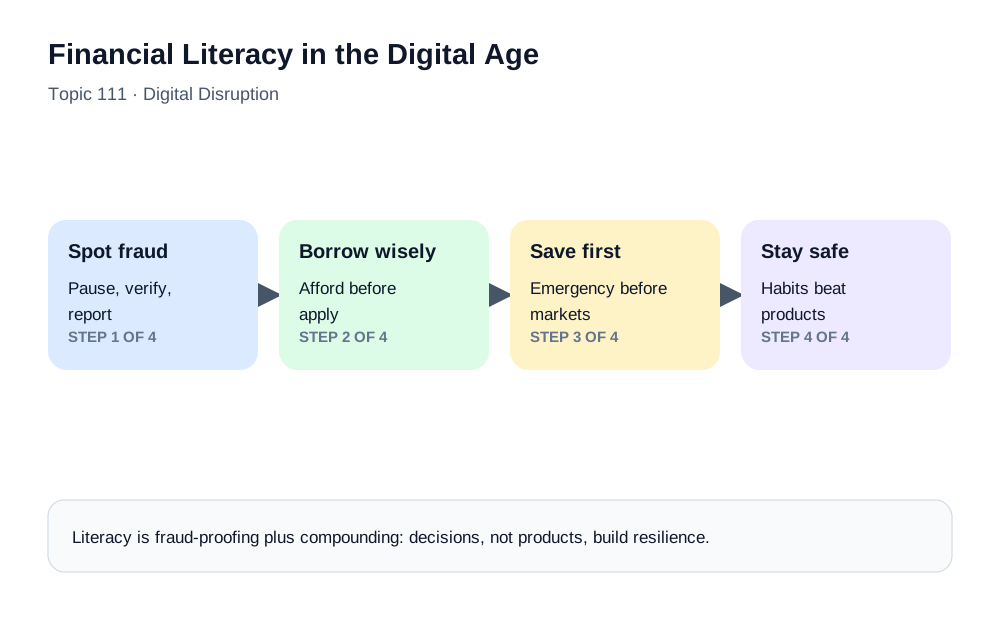
Financial Literacy in the Digital Age at a glance — Digital fraud, responsible lending, consumer education.
Digital Fraud, Responsible Borrowing, and Consumer Education
Financial literacy—the ability to understand and effectively use financial services—has never been more critical than in today's rapidly evolving digital banking environment where new risks and opportunities emerge constantly. As banking transitions from physical branches to mobile applications, consumers face new categories of risk that previous generations never encountered and for which they may be unprepared due to lack of education or experience. Phishing scams, loan traps, investment fraud, and data theft have become daily threats affecting millions of people and causing substantial financial losses. Education serves as the first line of defense against these dangers, and both regulators and financial institutions bear responsibility for ensuring customers can navigate the financial system safely, confidently, and to their benefit rather than becoming victims of exploitation.
The shift to digital banking has created an urgent need for enhanced financial literacy across several dimensions that differ fundamentally from traditional banking education and require new skills and awareness. The transition from cash to digital payments requires understanding UPI, cards, and online banking systems that have different risk profiles than physical currency and create new vulnerabilities to fraud. The move from branch banking to app-based services eliminates the bank manager or relationship officer who traditionally guided customer decisions and answered questions, leaving customers to make complex choices without expert guidance. Banking products have evolved from simple savings accounts to complex mutual funds, insurance policies, and Buy Now Pay Later arrangements—all accessible instantly through mobile phones with limited explanation of terms, risks, and costs that can trap unwary consumers. Information overload from social media provides financial advice that is often incorrect, biased, or deliberately misleading, creating confusion among consumers seeking guidance on investments and financial planning. Most alarmingly, digital fraud has exploded in scale and sophistication, targeting vulnerable users with increasingly convincing scams that can result in devastating financial losses and emotional distress.
Digital fraud represents the most significant threat facing banking consumers today, with losses running into thousands of crores annually and affecting individuals across all income levels and educational backgrounds. Phishing attacks use fake emails and SMS messages containing links that appear to come from banks but actually lead to fraudulent websites designed to steal credentials when users enter them, trusting the apparent authenticity. The protection is straightforward but requires constant vigilance: never click links in unsolicited messages claiming to be from banks, even if they appear urgent or threatening with warnings about account suspension or security breaches. Vishing, or voice phishing, involves fraudulent phone calls claiming to represent banks and requesting OTPs or PINs to "verify" accounts or resolve supposed problems that create panic. Banks never ask for OTPs over the phone—any such request is fraudulent regardless of how convincing the caller may sound or what information they claim to have. SIM swap attacks occur when fraudsters obtain duplicate SIM cards by impersonating the victim to the mobile operator, enabling them to intercept OTPs intended for legitimate customers and take over accounts. Reporting sudden SIM loss or service disruption immediately can prevent this attack from succeeding by alerting the operator to potential fraud.
QR code fraud tricks victims into scanning codes that actually debit rather than credit their accounts—a critical misunderstanding since scanning a QR code sends money rather than receiving it, the opposite of what many users intuitively expect. Fake UPI apps generate counterfeit payment confirmation screenshots that appear genuine but represent no actual transfer, tricking merchants into releasing goods without payment. Remote access fraud involves convincing victims to install screen-sharing applications like AnyDesk or TeamViewer under the guise of technical support, giving criminals complete control of the device and access to banking applications that can be operated while the victim watches helplessly. Loan app fraud involves unauthorized lending applications that harass borrowers and charge illegal interest rates far exceeding regulatory limits, often using access to contacts and photos to blackmail victims. Investment scams promise returns that are too good to be true—and invariably are, representing Ponzi schemes or outright theft that collapse when new investors stop joining.
Digital fraud is a material and evolving consumer risk in India, but headline loss estimates and complaint rankings vary by source, reporting period and classification. Financial-literacy material should therefore emphasise durable controls—verifying counterparties, protecting credentials, using official support channels and reporting suspected fraud quickly—rather than relying on one unsourced annual-loss figure or assuming that one demographic group is always the most frequently targeted. The emotional impact of fraud extends beyond financial losses to include shame, anxiety, and loss of trust in the financial system that can prevent future participation.
Responsible borrowing requires consumers to understand several key principles that protect them from debt traps and financial distress that can take years to escape. The fundamental rule is to borrow only what can be repaid sustainably after essential living costs, existing obligations, emergency needs and plausible income volatility are considered. A single universal EMI-to-income percentage is not appropriate for every borrower because affordability depends on income stability, household circumstances, loan type, tenor and other commitments. Understanding the total cost of borrowing means looking beyond headline interest rates to include processing fees, insurance charges, and potential penalties that significantly affect the effective cost and make apparently cheap loans expensive. Checking one's CIBIL score before applying provides clarity on creditworthiness and likely terms, enabling better decision-making about whether to proceed and which lenders to approach with realistic expectations. Reading the fine print reveals prepayment charges, distinctions between floating and fixed rates, and foreclosure terms that affect flexibility and total cost over the loan life. Avoiding multiple simultaneous loans prevents debt stacking across BNPL, personal loans, and credit cards that can quickly become unmanageable as obligations multiply and payment dates scatter across the month. Comparing offers from multiple lenders ensures competitive terms rather than accepting the first offer received, which may not be the most favorable available in the market.
Dangerous borrowing patterns signal potential financial distress and should trigger reassessment before situations worsen beyond recovery. Credit-card cash advances can be expensive because interest and fees may apply differently from ordinary purchase transactions and the usual purchase grace period may not apply. Customers should check the issuer's current schedule of charges and terms before using a cash advance rather than relying on a single percentage that can vary by product and time. Paying only the minimum due on credit cards allows interest to compound on the full balance rather than just the remaining amount, extending debt for years and dramatically increasing total cost through compound interest working against the borrower. Taking personal loans to pay off other loans creates debt spirals that grow increasingly difficult to escape as principal balances remain while new interest accrues, digging deeper holes rather than climbing out. Using BNPL services across multiple providers simultaneously creates invisible debt accumulation that may exceed repayment capacity when all obligations are considered together, leading to default and credit damage. Borrowing from unregistered applications exposes consumers to harassment, data theft, and illegal interest charges with no regulatory protection or recourse.
The Reserve Bank of India has implemented several financial literacy initiatives to address these challenges at the population level through various channels and partnerships. Financial Literacy Week occurs annually with specific themes to focus public attention on priority topics such as digital payments, borrower rights, or investor protection. FAME, the Financial Awareness Messages program, provides multilingual awareness materials accessible to diverse linguistic populations across India's many states and regions. RBI Kehta Hai delivers consumer awareness messages through mass media channels including television, radio, and print that reach broad audiences. Banks, RBI-supported financial-literacy initiatives and Centres for Financial Literacy use local outreach and assisted education to reach communities that may not rely on digital resources. The number and structure of centres evolve over time, so current RBI and sponsor-bank reporting should be used when an exact count is needed. Financial literacy has been integrated into school curricula to build knowledge from an early age before bad habits form and financial behaviors become entrenched. The Sachet Portal enables reporting of unauthorized deposit schemes and fraudulent collection activities, helping authorities identify and shut down scams that target the public.
Several key financial concepts form the foundation of consumer financial literacy and should be understood by all to make informed decisions. Compound interest works powerfully both for and against consumers—multiplying returns on savings and investments while accelerating debt growth when borrowing, making the distinction critical for financial health. Inflation erodes purchasing power over time, so long-term financial planning should consider real returns after inflation rather than assuming that a fixed nominal amount will buy the same goods and services in the future. The relevant inflation rate changes over time and should not be taught as a permanent five-to-six-percent constant. Emergency funds covering three to six months of expenses provide crucial protection against unexpected setbacks like job loss or medical emergencies that would otherwise force desperate borrowing at high cost. The distinction between insurance, which protects against loss, and investment, which grows wealth, prevents the common error of purchasing investment products mislabeled as insurance, which typically provide poor returns and inadequate protection, serving neither need well. Diversification across asset classes reduces risk by avoiding concentration in any single investment that could fail, following the principle of not putting all eggs in one basket. Tax treatment depends on the taxpayer's regime, eligibility and the law in force for the relevant assessment year. For AY 2026-27 the new tax regime is the default for individuals and most Chapter VI-A deductions such as the traditional Section 80C and 80D deductions are generally associated with opting for the old regime, subject to the detailed tax rules. Financial education should therefore separate investment suitability from tax treatment and encourage customers to verify current official guidance. Regular investing can demonstrate the mathematics of compounding, but an assumed investment return is only an illustration and not a promise. Equity and market-linked returns vary, and the future value of a systematic investment depends on actual performance, costs, taxes, timing and investment horizon.
Digital safety requires consistent adherence to specific practices that should become automatic habits for anyone using digital financial services. Never sharing OTPs, PINs, or CVV codes with anyone is the most critical rule—banks never request these under any circumstances, and any such request is fraudulent. Enabling transaction alerts through both SMS and app notifications provides immediate awareness of account activity and enables quick response to unauthorized transactions that might otherwise go unnoticed for days. Strong, unique passwords for each financial account prevent credential stuffing attacks that use breached passwords from one service to access others, protecting against cascade failures. Two-factor authentication adds essential protection beyond passwords alone, ensuring that stolen passwords are insufficient for access without the second factor. Installing applications only from official app stores prevents malware infections from sideloaded apps that bypass security screening. Verifying URLs before entering banking credentials prevents phishing site compromises that steal login information for account takeover. Customers should report unauthorised electronic transactions immediately. RBI's customer-protection framework can provide zero or limited liability in specified circumstances, including certain third-party breaches reported within the prescribed time window, but liability depends on how the breach occurred, whether the customer contributed through negligence, and how quickly the transaction was reported. A blanket statement that every fraud reported within three days receives zero liability is therefore inaccurate. Regular CIBIL report checks reveal any unauthorized accounts opened in one's name through identity theft that might damage credit scores.
The digital transformation of banking offers tremendous benefits in convenience, access, and cost that should not be rejected due to fear of fraud or complexity. However, realizing these benefits safely requires consumers to develop new skills and awareness appropriate to the digital environment that differs fundamentally from physical banking. Financial literacy is not merely helpful but essential for protecting oneself in a digital-first banking world where threats are constantly evolving. The combination of individual vigilance, regulatory protection, and institutional education creates the best defense against the fraud and abuse that unfortunately accompany digital finance, enabling consumers to enjoy the benefits while managing the risks effectively.
<!-- MBA-DEEP-DIVE-START -->Financial Literacy Deepening — Decisions, Digital Safety, Credit, and Financial Resilience
Financial literacy is the ability to make a sound decision, not memorise terminology
A customer can know the definitions of interest, inflation and insurance yet still make a poor financial decision if the information is not connected to real choices. Practical financial literacy means understanding enough to compare alternatives, recognise risk, ask the right questions and know when specialist advice is needed. The objective is not to turn every customer into a banker or investment professional. It is to help people understand what they are agreeing to, what can go wrong, how much a product can cost, how to protect access to their money and where to seek help. The strongest education therefore uses actual decisions—borrowing, paying, saving, investing, insuring, sharing data or responding to a suspicious message—as the unit of learning.
Digital literacy and financial literacy now overlap
A customer using mobile banking needs both financial understanding and basic digital-security skills. The person may understand that money should be transferred only to a known recipient but still be deceived into installing remote-access software or approving a fraudulent collect request. Conversely, a technically confident user can make poor financial choices through excessive leverage or speculative investing. Banks should therefore avoid treating cyber awareness and financial education as unrelated programmes. Digital finance combines identity, device security, payment authorisation and financial consequences in one journey. Education is strongest when it explains both what the action does and how the customer can verify that the action is legitimate.
The first digital-safety question is who initiated the interaction
Many scams begin with an unsolicited call, message or link that creates urgency. Customers should pause and independently verify who is contacting them. A caller can know the customer's name, bank, card type or recent transaction and still be a fraudster; leaked or socially obtained information is not proof of authority. Banks can teach customers to terminate the incoming contact and use the official application, website or published support number to continue. This simple behavioural rule is often more useful than trying to memorise every new scam type because the criminal's story can change while the need for independent verification remains constant.
Urgency is a fraud signal because it reduces thinking time
Fraudsters often claim that an account will be frozen, a refund will expire, a parcel is blocked, a tax case has been opened or an investment opportunity is available only for minutes. The purpose is to push the customer from reflection into compliance. Financial literacy should therefore include emotional awareness. A person who feels frightened, excited or embarrassed should recognise that the emotion itself is a reason to slow down. Banks can reinforce this through messages such as “Stop, verify and then act.” A legitimate financial institution can normally provide a traceable channel for the customer to verify a request rather than requiring immediate disclosure of credentials during an unexpected interaction.
OTPs and approval prompts are authorisation instruments
Customers sometimes think of an OTP as a harmless verification code. In many journeys it can authorise login, device registration, payment or a sensitive change. Education should therefore explain the purpose of the code rather than merely saying “never share OTP.” The customer should read the surrounding message and ask what action the code is approving. The same principle applies to biometric prompts, app approvals and PIN entry. If the customer did not initiate the action described, the safest response is not to approve it. Understanding the meaning of authentication reduces dependence on memorised rules and helps customers adapt as technology changes.
Receiving money normally does not require giving away payment authority
Scams can exploit confusion between sending and receiving. A customer expecting a refund may be told to enter a PIN, approve a collect request or scan a code that actually initiates a debit. Financial education should show the difference between payer and payee actions in the specific payment system. Merchants should verify incoming funds through their own transaction history rather than relying on a screenshot shown by the customer. The durable rule is that the receiver should understand why any approval is required and what the approval screen says before confirming. A transaction confirmation should be checked in the authoritative banking or payment application, not inferred from an image or message controlled by the other party.
Remote-access applications can turn customer consent into attacker control
A fraudster may persuade a customer to install legitimate screen-sharing or remote-support software and then observe credentials or operate the device. The application itself may be lawful; the danger comes from who controls the session. Customers should understand that a bank normally does not need unrestricted remote control of a personal device to resolve a routine account issue. If support genuinely requires screen sharing, the customer should use a verified official process and know what the other party can see. Device permissions should be reviewed after any support session. This teaches customers to think in terms of access rights rather than maintaining a list of “bad apps” that quickly becomes outdated.
SIM and mobile-number security affects banking access
Mobile numbers are often used for alerts, recovery and authentication. A sudden loss of network service can therefore be more than a telecom problem. Customers should contact the mobile operator and bank promptly if a SIM unexpectedly stops working, particularly if other suspicious activity occurs. They should also protect mobile-operator accounts and avoid casually sharing information used for SIM replacement. Banks can reduce reliance on one signal by combining device, credential and transaction context. Financial literacy should explain that the phone number is part of the customer's security perimeter even though it is issued by a telecom provider rather than the bank.
Password habits matter because financial identities span many services
Using the same password across banking, email, shopping and social platforms allows a breach at one service to threaten others. Customers should use strong, unique credentials and secure password-management methods appropriate to their capabilities. Email deserves particular protection because it can be used to reset other accounts. Multi-factor authentication improves security but is not a substitute for recognising fraudulent approvals. A customer who knowingly confirms an attacker-generated prompt can bypass sophisticated technical controls. Education should therefore combine credential hygiene with approval awareness rather than treating password strength as the entire security model.
Investment scams often borrow the language of legitimate finance
Fraudsters can use professional-looking dashboards, fake profits, fabricated regulatory claims and screenshots of other people's returns. The customer should ask who regulates the provider, what legal product is being offered, how money can be withdrawn, what underlying asset generates the return and whether independent official sources confirm the firm's status. Guaranteed high returns with little or no risk are a major warning sign. Even a real asset can be sold through a fraudulent scheme. Financial literacy should distinguish the legitimacy of the investment category from the legitimacy of the person or platform offering it.
Social proof is not financial due diligence
A large messaging group, celebrity endorsement, influencer video or friend referral can make a product feel safe, but none replaces product analysis or regulatory verification. People tend to trust familiar networks, and scams exploit that tendency. Customers should know that early participants in a fraudulent scheme may receive genuine payments funded by later participants, creating convincing testimonials. Independent verification is therefore essential. Banks and regulators can teach customers how to check official registers and recognised disclosure documents rather than relying on screenshots circulated within the same promotional network.
Borrowing literacy begins with cash flow
The most important lending question is not “What EMI can I get approved for?” but “What payment can I sustain when ordinary expenses and plausible shocks are considered?” A borrower should map regular income, irregular income, essential expenses, existing debt and near-term commitments before taking new credit. Income volatility matters. A self-employed person with strong annual earnings can still face months with weak cash flow. A longer tenor can reduce monthly payment but increase total interest. Financial literacy should therefore teach trade-offs rather than a single debt-to-income rule. Affordability is personal, but the logic of testing repayment capacity before borrowing is universal.
Headline interest rates are only part of the cost of credit
Loans can include processing fees, insurance, documentation charges, taxes, late-payment charges or other permitted costs. The customer should compare the total amount received with the total amount expected to be repaid and understand whether the quoted rate is reducing-balance, flat or another convention. Early repayment can also have consequences depending on product terms. Standardised key-fact statements and disclosures can help, but education remains necessary so customers know which fields matter. Two loans with the same nominal interest rate can have different effective costs because of fees, timing or repayment structure.
Fixed and floating rates create different uncertainty
A fixed-rate loan offers more payment predictability for the period in which the rate is fixed, while a floating-rate loan can change with its reference rate and contractual reset mechanism. Customers should understand how often the rate can change, what benchmark or policy determines the change, whether EMI or tenor is adjusted and what options exist after a reset. A lower starting floating rate is not automatically cheaper over the full life of the loan. Financial literacy should help borrowers think about uncertainty and budget resilience, not forecast future interest rates with false confidence.
Credit cards are payment tools and revolving credit at the same time
A credit card can provide convenience and a purchase grace period when the full amount due is paid under the card terms. When balances revolve, interest and fees can accumulate. The minimum amount due is designed to keep the account from immediately falling into a different delinquency state; it does not mean the remaining balance is inexpensive. Customers should read statements for total due, minimum due, due date, finance charges and new spending. Cash advances and certain transactions may receive different treatment from retail purchases. Literacy should focus on how the account actually accrues cost rather than on memorising one headline card interest rate.
BNPL should be treated as debt even when the interface feels like checkout
Buy Now Pay Later can make borrowing look like a payment option because it appears at the merchant screen. The customer should still consider repayment dates, total cost, late consequences and all other outstanding BNPL commitments. Small instalments across many providers can create a large combined obligation. A product that charges no interest can still affect cash flow or impose late fees. The psychological risk is that separating purchase enjoyment from future payment reduces the feeling of borrowing. Financial literacy should therefore encourage customers to aggregate all instalment commitments before taking another one.
Refinancing can solve or hide a debt problem
Replacing expensive debt with a lower-cost structured loan can improve cash flow when the new terms are genuinely better and the borrower stops re-accumulating the old debt. Refinancing becomes dangerous when new borrowing is used repeatedly to meet payments without addressing an underlying income or spending gap. Customers should compare total cost, fees and tenor rather than only the new EMI. A lower monthly payment achieved by extending repayment for many more years can increase total interest. Debt counselling can be valuable when the issue is structural rather than a one-time mismatch.
A credit report is a financial record that should be checked for accuracy
Credit information can affect access and pricing across future borrowing. Customers should periodically review reports available through authorised credit-information channels and look for accounts, enquiries or overdue balances they do not recognise. Errors should be disputed through the appropriate process. A score is a summary, while the underlying report contains the data that often explains why the score changed. Education should not encourage obsessive score monitoring or imply that one number determines every lending decision. Lenders also use income, product, collateral, internal history and policy rules.
Credit scores are not universal measures of personal worth
A lower credit score can reflect missed obligations, short history, high utilisation or other credit behaviour, but it should not be interpreted as a judgment about a person's character or future potential. Different lenders apply different risk policies. Customers should focus on controllable behaviours such as paying obligations on time, correcting errors and avoiding unsustainable borrowing. Financial education should reduce shame because shame can cause customers to ignore problems rather than seek help. A borrower who anticipates difficulty is often better served by contacting the lender early than by hiding until arrears become severe.
Emergency funds are about resilience, not a magic number of months
Common financial education suggests keeping several months of expenses in accessible savings. The exact amount depends on income stability, dependants, insurance, employment type, health, other assets and access to family or social support. A worker with volatile income may need more liquidity than someone with highly stable income. The fund should generally be accessible and low risk because its purpose is to absorb shocks rather than maximise return. Customers can build it gradually rather than delaying all other financial goals until a large target is reached. The key lesson is to create a buffer that reduces forced high-cost borrowing after an unexpected event.
Saving and investing serve different time horizons
Money needed for near-term obligations should not automatically be placed in volatile assets merely because expected long-term returns are higher. Savings products prioritise capital availability and stability, while investments can accept market risk for potential return over a longer horizon. Customers should match the product to the time when money is needed. A house down-payment required next month has a different risk capacity from retirement savings decades away. Financial literacy should therefore begin with goal, horizon and loss tolerance before discussing product names.
Compounding is powerful in both directions
Returns earned on earlier returns can accelerate long-term savings, while interest charged on unpaid debt can accelerate borrowing cost. The mathematical principle is simple but its effect depends on rate, time, cash flows and fees. Illustrations should make assumptions explicit rather than implying guaranteed investment results. A regular investment can grow substantially over long periods, but market-linked returns vary and losses can occur. On the debt side, paying only small amounts against high-cost revolving credit can keep balances outstanding for much longer than customers expect. Seeing both sides helps customers understand why time is valuable in finance.
Inflation should be understood as purchasing-power risk
A balance can grow in nominal terms while still losing real purchasing power if the return does not keep pace with inflation. Customers planning for long-term goals should therefore consider the future cost of education, housing, healthcare or retirement rather than saving only today's price. The appropriate investment response depends on risk tolerance and horizon; inflation does not mean every customer should take aggressive market risk. Education should teach the concept of real value without pretending that future inflation can be forecast precisely.
Diversification reduces dependence on one outcome
Investing all long-term wealth in one company, property, asset class or speculative instrument can create concentration risk. Diversification spreads exposure so one adverse event has less impact on the entire portfolio. It does not guarantee profit or prevent broad market losses. Customers should understand what they actually own because several funds can hold the same underlying securities and appear more diversified than they are. Diversification should also consider liquidity and time horizon. A well-diversified long-term portfolio can still be unsuitable for money needed soon.
Insurance transfers defined risks rather than creating investment certainty
Insurance is designed to protect against specified financial consequences such as death, illness, accident, property damage or other covered events. Customers should understand sum insured, premium, exclusions, waiting periods, deductibles and claim procedures. Some products combine insurance and savings or investment features, but the customer should still separate the protection need from the return objective. A policy is valuable only if the coverage matches the risk and the claim can be made under the terms. Education should focus as much on claim conditions as on purchase.
Health and life protection should be linked to household dependency
The need for life insurance generally relates to the financial impact if an income earner dies, including dependants, debts and future obligations. Health coverage relates to the risk of medical expenses, access and policy terms. Simple multiples of income can be a starting illustration but are not universal answers. Customers should review coverage as family, debt and employment circumstances change. Employer-provided protection can be useful but may end when the job ends. Financial literacy helps customers identify the underlying risk before selecting a product.
Tax should follow the financial decision, not drive it blindly
Tax benefits can improve the economics of eligible savings, insurance or retirement contributions, but tax rules change and depend on the regime and taxpayer. A poor investment does not become suitable simply because it offers a deduction. Customers should confirm current official tax rules for the relevant year and consider lock-in, liquidity, risk and goal fit. The new tax regime being the default for individual taxpayers changes the relevance of traditional deduction-based planning for many people. Education should therefore teach tax awareness without turning financial planning into a checklist of deduction sections.
Investment return should be discussed with risk and uncertainty
An illustration that assumes a fixed annual return can help explain future-value mathematics, but customers may interpret the number as a promise. Financial education should label assumptions clearly and show that actual market returns vary year to year. Sequence of returns can matter, especially when withdrawing money. Costs and taxes also reduce realised outcomes. The goal is to teach how regular saving and time can support wealth creation while preserving the truth that market-linked products do not deliver guaranteed compounding at one constant rate.
Fraud reporting should be immediate even before liability is known
Customers sometimes delay reporting because they are embarrassed or hope the transaction will reverse automatically. Speed matters because the bank may be able to block credentials, trace funds or prevent additional loss. Liability rules depend on the cause of the unauthorised transaction and how quickly the customer reports it, so a simple “three-day guarantee” is misleading. The practical lesson is stronger: report immediately through an official channel, keep the complaint reference, secure compromised credentials and preserve messages or other evidence. Customers should not pay a supposed recovery agent who contacts them after the fraud.
Complaint escalation is part of financial literacy
Customers should know how to raise a complaint with the financial institution, what evidence to keep and when an external ombudsman, regulator or other redress channel may be relevant under the applicable framework. A complaint should identify the transaction, date, amount and requested resolution rather than relying on repeated informal calls. Digital complaint references make follow-up easier. Financial literacy is incomplete if customers know how to buy products but not how to challenge an error. Effective recourse also improves market discipline because institutions can see where product or service failures recur.
Customers should understand the difference between bank, fintech and merchant roles
A payment or loan journey can involve several brands. The app displaying the transaction may not be the regulated bank that holds the account, and a merchant may use a payment service provider that connects to another institution. Customers do not need the full architecture, but they should know where money is held and who owns the financial product. This matters when support is needed. A failed merchant order may require the merchant to cancel, while an unauthorised account transaction requires bank action. Clear provider identity reduces confusion and prevents fraudsters from exploiting brand complexity.
Data-sharing consent is a financial decision
Open-banking and account-aggregation services can allow customers to share financial data with authorised providers for lending, budgeting or other services. Customers should understand what data is requested, for what purpose, for how long and how consent can be revoked where the framework provides that option. “Allow access” should not be treated as routine app permission. Financial data can reveal income, spending, debts and relationships. Literacy therefore includes the ability to distinguish a legitimate consent flow from a phishing request and to question why a provider needs particular information.
Privacy literacy includes knowing what not to post publicly
Customers can unintentionally expose account numbers, card images, boarding passes, loan documents or screenshots containing personal information on social media. Fraudsters can combine small pieces of public data to make later impersonation more convincing. Education should encourage customers to review images before sharing and avoid posting sensitive identifiers or transaction details. Privacy does not require secrecy about every financial decision; it requires awareness that information can be recombined. Banks should also practise data minimisation themselves rather than placing the full burden on customers.
Elderly customers may need support without surrendering control
Older customers can be confident digital users, while some may prefer assisted service. Support should not assume incapacity, but it should recognise risks such as social engineering, family coercion or difficulty with fast-changing interfaces. Trusted-contact or mandate arrangements can help where legally supported, but they should preserve clear authority boundaries. Staff should be trained to identify unusual pressure around high-value transfers without blocking legitimate independent decisions simply because of age. Inclusive literacy respects autonomy while making help accessible.
Young customers need education before debt becomes normalised
Digital credit, gaming payments, subscriptions and social-media investing can expose young adults to financial decisions before they have much experience with recurring obligations. Education should explain cash flow, credit reports, long-term debt cost, investment risk and scams in practical terms. A first credit product can help build history if used responsibly, but multiple quick-credit products can create financial stress. Schools and colleges can teach foundational concepts, while banks should design onboarding that does not rely on customers learning only after a costly mistake.
Financial education should avoid shame and moralising
People make financial decisions under pressure, incomplete information, family obligations and unequal economic circumstances. Telling customers simply to “spend less” or blaming fraud victims can make them less likely to seek help. Effective education provides tools and options. A borrower in distress needs information about contacting lenders, prioritising essential expenses and avoiding additional harmful debt. A fraud victim needs urgent support, not ridicule for having trusted a convincing scam. Respectful education improves behaviour because customers can focus on the next decision instead of defending themselves from judgment.
Behavioural design can support or undermine literacy
Apps can make a good decision easier through clear fee disclosure, default security settings, warnings before high-risk actions and simple comparison. They can also exploit behavioural biases through countdown timers, pre-selected credit, confusing cancellation or celebratory borrowing experiences. Financial literacy should not be used as an excuse for poor product design. Institutions have responsibility to design fair journeys while customers develop capability. The best outcome combines informed customers with interfaces that do not manipulate them into decisions they would not make with clear information.
Financial institutions should measure whether education works
Counting brochures, seminars or video views does not prove improved capability. Banks can measure whether customers recognise fraud warnings, use secure channels, understand key product terms, reduce repeated fee problems, build emergency savings or resolve complaints more effectively. Testing should avoid collecting unnecessary personal data and should not punish customers for low scores. The purpose is to improve education. Localised content can be refined when one concept repeatedly causes confusion. Financial literacy is an operating discipline when institutions learn from customer behaviour rather than treating education as a one-time compliance campaign.
A fraud scenario shows why verification habits matter
Imagine a customer receives a call saying a bank account will be frozen unless KYC is updated immediately. The caller knows the customer's name and partial account information, then sends a link and asks for an OTP. A financially and digitally literate response is to stop the interaction, open the bank's official application or use the published contact channel and verify whether any action is actually required. The customer does not need to identify the exact scam family. The verification habit protects them even if the criminal changes the story from KYC to refund, tax, parcel or reward.
A borrowing scenario shows why affordability comes before approval
A customer is offered an instant personal loan with an affordable-looking monthly EMI. Before accepting, the customer compares existing obligations, essential expenses, income volatility, total repayment and fees. They notice that the low EMI comes from a longer tenor and that another loan payment begins next month. The customer may still borrow, but the decision now reflects the full cash-flow impact rather than the app's approval amount. Financial literacy does not mean always rejecting credit; it means understanding the obligation well enough to decide whether it helps or harms.
An investment scenario shows why assumptions should be challenged
A social-media message promises a fixed high return from an unfamiliar platform and shows screenshots of successful withdrawals. A financially literate customer asks what legal product is being offered, whether the provider can be verified through official sources, what asset generates the return, how withdrawal works and what could cause loss. If the seller cannot explain those basics or relies only on urgency and testimonials, the customer walks away. The same scepticism can be applied to legitimate investments by checking fees, risk, liquidity and time horizon before committing money.
The final goal is confident, informed and recoverable financial behaviour
No customer can know every product rule or fraud method. The durable capabilities are to pause before consequential actions, verify identity and provider status, understand cash-flow obligations, compare total cost, protect credentials, diversify appropriately, read key terms and know how to seek redress. Financial literacy should make customers more capable without pretending that all responsibility rests on them. Banks, regulators, platforms and product designers still have obligations to build safe, fair and understandable services. A financially literate system is one where informed customers and responsible institutions reinforce each other.
Financial Literacy Final Depth — Everyday Control and Decision Habits
Statements should be read as a control document, not only a balance notice
Regularly reviewing bank, card and loan statements helps customers identify unfamiliar transactions, unexpected fees, missed payments and changes in outstanding balance. A customer does not need to reconcile like a bank accountant, but should know the opening balance, material credits and debits, amount due, due date and closing position. Early detection matters because an error that is noticed quickly is generally easier to investigate. Digital alerts are helpful, yet they do not replace periodic review because alerts can be missed, delayed or suppressed when a device is compromised.
Standing instructions and subscriptions deserve periodic review
Small recurring debits can continue long after a service stops being useful. Customers should periodically review mandates, subscriptions, automatic debits and stored merchant permissions. Cancelling a subscription with the merchant and revoking a payment mandate are related but not always identical actions, so the customer should understand the service's process. This habit also reduces the chance that an unfamiliar recurring debit is ignored for months simply because the amount is small.
Beneficiary verification is part of payment literacy
Before sending money, customers should verify the recipient using the information available in the payment journey. Names can be similar, phone numbers can be mistyped and fraudsters can pressure users to transfer to a “safe account.” For material or unfamiliar payments, independent confirmation can be sensible. Once an instant payment is validly authorised and settled, recovery can be difficult. Financial literacy therefore includes understanding that speed and convenience increase the importance of checking the beneficiary before approval.
Financial goals should be converted into dates and amounts
“Save more” is hard to act on. A goal becomes clearer when the customer identifies what the money is for, when it is needed and roughly how much will be required. Emergency savings, a near-term purchase, education and retirement have different horizons and risk capacities. This simple structure helps the customer decide what should remain liquid, what can be invested for longer, and which commitments are affordable. Planning does not require precise forecasting; it requires enough structure to avoid using long-term or emergency money for the wrong purpose.
Nominees and estate instructions are practical financial literacy
Customers should understand the role of nominees, beneficiaries, joint holders or equivalent arrangements applicable to their financial products and jurisdiction. These arrangements can simplify servicing after death but do not always determine ultimate inheritance in the same way as succession law. Records should be kept current after marriage, divorce, death or other family changes. The important literacy lesson is that financial accounts continue to require operational instructions even when the customer is no longer able to act.
Financial records should be organised for recovery and support
Customers benefit from keeping a secure record of important account relationships, policy details, loan references and official support channels without storing passwords or PINs insecurely. During illness, fraud or device loss, knowing which institutions to contact can reduce delay. Families can also discuss where essential financial information is stored without sharing credentials casually. Good organisation is a resilience control: it helps legitimate customers recover access and resolve problems without creating a new security weakness.
Financial literacy should evolve with the customer's life
The information needed by a student using a first account differs from that needed by a parent taking a mortgage, a business owner managing cash flow or a retiree protecting savings. Education should therefore be continuous and event-driven. Banks can present concise guidance when customers encounter a new product or life event rather than assuming one annual awareness campaign is enough. The most useful literacy is timely, relevant and tied to the next real decision.
The durable habit is to understand before authorising
Across payments, borrowing, investment, insurance and data sharing, one principle repeatedly protects customers: understand what is being authorised before confirming it. Who receives the money or data? What obligation is created? What can be lost? How can the decision be cancelled or disputed? Where is the official support channel? A customer who habitually asks these questions is better equipped to deal with new products and new scams even when the technology changes.
<!-- MBA-DEEP-DIVE-END -->