Visual overview
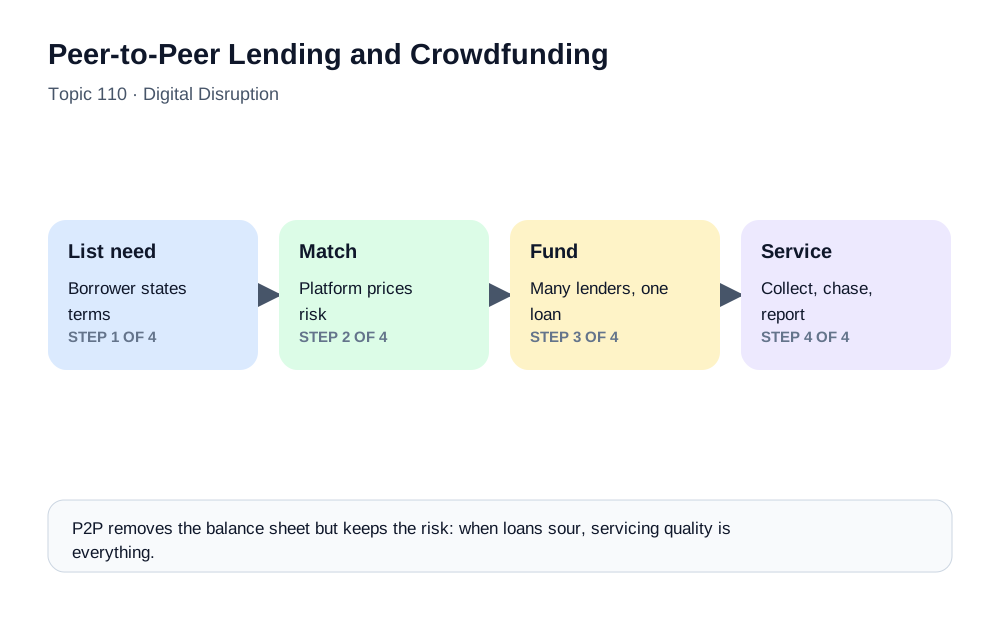
Peer-to-Peer Lending and Crowdfunding at a glance — P2P platforms, equity crowdfunding, alternative credit.
P2P Platforms, Equity Crowdfunding, and Alternative Credit Markets
Peer-to-Peer lending and crowdfunding represent a fundamental rethinking of how capital flows from those who have it to those who need it in the modern economy, challenging the traditional banking monopoly on credit intermediation. P2P lending platforms connect individual borrowers directly with individual lenders through online interfaces, eliminating the traditional bank intermediary and its associated costs and inefficiencies that have made credit expensive and inaccessible for many. Crowdfunding platforms aggregate small contributions from large numbers of people to fund projects, startups, and causes that might not qualify for traditional financing due to size, risk profile, or lack of collateral. Together, these alternative finance models offer new possibilities for both borrowers and investors while introducing new risks that participants must understand and manage through proper due diligence and diversification.
P2P lending operates through a straightforward but sophisticated process that has been refined over the past decade since the model first emerged. A borrower applies through a P2P platform, providing information about their creditworthiness, income, employment, and loan purpose that the platform uses for risk assessment. The platform assesses credit risk using traditional credit scores alongside alternative data sources such as education, profession, and social signals that may predict repayment behavior, assigning a risk grade and appropriate interest rate to the borrower based on this comprehensive assessment. The borrower is then listed on the platform, visible to potential lenders who can review the borrower's profile and choose to fund portions of the loan according to their risk appetite. Multiple lenders typically fund each loan in small increments—perhaps five thousand rupees per lender—spreading risk across the lender base and enabling diversification even with modest investment amounts. Once the loan is fully funded, it is disbursed to the borrower, who begins making monthly repayments of principal and interest. These repayments are distributed proportionally to the participating lenders, and the platform takes fees from both sides of the transaction, typically one to five percent, for facilitating the match and servicing the loan throughout its life.
India's P2P lending market operates under a regulatory framework established by the Reserve Bank of India in 2017 that provides important protections while enabling innovation in this emerging sector. P2P platforms must register as NBFC-P2P with the RBI, subjecting them to prudential oversight and capital requirements that ensure they have resources to operate responsibly. RBI prudential limits distinguish lender and borrower exposure. Under the current NBFC-P2P Master Direction, a lender's aggregate exposure across all P2P platforms is capped at ₹50 lakh, subject to consistency with net worth and an additional net-worth certification requirement when aggregate lending exceeds ₹10 lakh. A borrower's aggregate loans across all P2P platforms are capped at ₹10 lakh, and a single lender's exposure to the same borrower across all P2P platforms is capped at ₹50,000. Maximum loan tenure is capped at thirty-six months, preventing long-term entanglements that create prolonged risk exposure. Fund flows are required to use the prescribed escrow mechanism rather than the NBFC-P2P's own balance sheet. RBI requires separate lender and borrower escrow accounts operated through a bank-promoted trustee, and since November 15, 2024 funds received into these escrow accounts are not permitted to remain there beyond T+1 day. This structure reduces misuse risk but does not remove borrower credit risk or every operational risk. Platforms are prohibited from guaranteeing returns to lenders, ensuring that participants understand the credit risk they are taking rather than treating P2P as equivalent to bank deposits. P2P platforms cannot lend from their own balance sheets, maintaining their role as pure intermediaries rather than disguised lenders that would require banking licenses.
Indian NBFC-P2P operators can differ in borrower sourcing, risk assessment, lender interfaces, servicing and portfolio composition. Because licences, product models and platform status can change, learners should verify the RBI's current list of registered entities and each platform's disclosures rather than treating any named provider or historical product range as permanent. The regulatory principle is more important than the brand list: the platform intermediates, assesses and services loans but does not become the lender of record or guarantee the lender's return.
Comparing P2P lending with traditional bank lending reveals important trade-offs that explain why the model appeals to certain participants while remaining a small portion of overall credit. Traditional banks intermediate between depositors and borrowers, taking deposits and making loans from their own balance sheets, bearing the credit risk and earning the net interest margin that compensates for this risk. P2P platforms merely connect lenders and borrowers without taking balance sheet risk or using their own capital, acting as matchmakers rather than principals. Pricing and realised returns vary materially by borrower risk, platform policy, defaults, recoveries, fees and market conditions, so fixed percentage ranges quickly become misleading. The durable distinction is that a bank deposit is a liability of the bank and may qualify for applicable deposit-insurance protection, while a P2P lender directly bears the credit loss on the loans funded through the platform; an advertised or expected yield is not a guaranteed return. Approval times favor P2P, with hours to days compared to days to weeks for traditional bank loans with their manual processes and committee approvals. P2P platforms often use alternative data alongside traditional credit criteria, potentially serving borrowers excluded from bank lending due to thin credit files or unconventional income sources. Most importantly, the risk bearer differs fundamentally: banks absorb credit risk with deposits insured by governments, while P2P lenders bear full credit risk with no insurance protection if borrowers default, making diversification essential.
Crowdfunding encompasses several distinct models serving different purposes and offering different risk-return profiles to contributors who must understand what they are supporting. Rewards-based crowdfunding supports creative projects and product development, with contributors receiving the finished product or other rewards rather than financial returns—essentially pre-purchasing rather than investing, suitable for consumer goods and artistic projects. Donation-based crowdfunding supports social causes and medical expenses, with contributors receiving nothing but the satisfaction of helping others—pure philanthropy facilitated by technology that makes giving easier and more transparent. Equity crowdfunding enables investment in startups and small businesses, with contributors receiving actual ownership shares and participating in upside if the company succeeds through sale or IPO. Debt crowdfunding provides loans to businesses and real estate projects, with contributors receiving interest payments similar to bonds but often with higher risk. Revenue-sharing arrangements give contributors a portion of future business revenue rather than fixed interest or equity, aligning returns with business performance without diluting ownership.
Major crowdfunding platforms serve these various models globally and in India with varying degrees of success and regulatory acceptance depending on local frameworks. Kickstarter and Indiegogo dominate rewards-based crowdfunding internationally, having funded countless creative projects and product launches that might never have found traditional financing. Ketto and Milaap lead donation and social cause crowdfunding in India, helping families raise funds for medical emergencies and education expenses that would otherwise drive them into debt. Seedrs provides equity crowdfunding in the UK and Europe with regulatory compliance that protects investors through disclosure requirements. Republic and Wefunder serve the US market for startup investment with different approaches to investor protection and deal curation that reflect American regulatory frameworks.
Equity crowdfunding requires particular attention from potential investors due to its unique risks that differ substantially from public market investing and require different approaches to evaluation. The process involves startups listing on equity crowdfunding platforms, providing business plans, financial projections, and valuation information for potential investors to evaluate with limited resources for due diligence. Equity-crowdfunding rules differ sharply by jurisdiction, and public solicitation of private-company securities is not automatically permitted merely because a digital platform exists. Investors and issuers must therefore distinguish rewards or donation crowdfunding from regulated securities issuance and check the applicable securities-law framework before treating online startup funding as an available investment product. If the funding target is met, investors receive shares in the company and become shareholders with rights defined by the company's constitution and shareholder agreements. Investors realize returns when the company is sold to a larger acquirer, goes public through an IPO, or pays dividends—events that may never occur for most startups that fail before reaching such milestones. The risks are substantial and must be understood: shares in private companies are illiquid and cannot be easily sold if the investor needs cash, potentially locking up capital for years. Early-stage companies have high failure risk, and an investor can lose the entire amount committed. A single universal startup-failure percentage is not a reliable basis for investment decisions because outcomes vary by definition, cohort, market and time period. Fraud is more common than in public markets due to lighter regulation and less disclosure, requiring skepticism about claims. Future funding rounds may dilute early investors' ownership percentages if they do not participate in follow-on investments. Information asymmetry means investors always know less than company founders and insiders, creating adverse selection risks.
Alternative credit extends beyond P2P lending to encompass innovative financing models that address gaps in traditional banking and serve segments that banks find unprofitable or too risky. Invoice financing allows businesses to sell unpaid invoices for immediate cash rather than waiting for payment terms that might be sixty or ninety days, improving cash flow without taking on debt or diluting ownership. Revenue-based financing structures repayment as a percentage of future revenue rather than fixed installments, aligning lender returns with business success and reducing burden during slow periods when revenue is low. Micro-lending apps use phone data for credit scoring, extending small loans to thin-file borrowers based on behavioral signals rather than credit history that they lack. Supply chain finance enables buyers to guarantee supplier payments in exchange for early financing terms, optimizing working capital across the supply chain and strengthening supplier relationships. Digitized community lending through rotating savings groups modernizes traditional chit fund structures for the digital age, combining social pressure with technology convenience.
The alternative credit ecosystem serves important functions in expanding access to capital for underserved segments that traditional banking has failed to serve adequately. For borrowers excluded from traditional banking due to lack of credit history, collateral, or documentation, these platforms offer financing options that were previously unavailable, enabling economic participation and growth that contributes to broader development. For investors seeking higher returns than traditional deposits provide, alternative credit offers yield with corresponding risk that can be managed through diversification across many loans or investments. For the financial system as a whole, alternative credit provides competition that can drive innovation and efficiency in traditional banking while serving segments that banks find uneconomical to address directly due to high servicing costs or small transaction sizes.
However, participants in P2P lending and crowdfunding must approach these opportunities with clear understanding of the risks involved and appropriate expectations about returns and liquidity. P2P lenders bear credit risk directly without the protections of deposit insurance or regulatory capital requirements that back bank deposits, meaning they can lose principal if borrowers default. Crowdfunding investments, particularly equity investments, are illiquid and speculative by nature, suitable only for capital that investors can afford to lose completely without affecting their financial security. Due diligence is essential despite limited information available about private companies or individual borrowers, and diversification across multiple loans or investments can help manage risk but cannot eliminate it entirely. The regulatory framework provides important protections against platform misconduct, but cannot protect investors from the fundamental risk that borrowers may default or investments may fail to generate returns. Alternative credit is a valuable addition to the financial ecosystem but requires informed participation and realistic expectations.
<!-- MBA-DEEP-DIVE-START -->P2P Lending Deepening — Intermediation, Credit Risk, Servicing, and Lender Protection
P2P lending changes who bears credit risk, not whether credit risk exists
A peer-to-peer lending platform can make borrower acquisition, assessment and loan servicing more digital, but it does not remove the fundamental possibility that a borrower will not repay. In a traditional bank loan the bank normally owns the loan and absorbs the resulting credit loss, supported by capital, provisioning, pricing and recovery processes. In a P2P structure the individual or institutional lender participating through the platform bears the economic loss on the specific funded exposure. This difference should be visible in every part of the customer journey. A lender should not interpret a smooth app, risk grade or automated allocation feature as equivalent to a guaranteed deposit. Technology can improve diversification and information, but the underlying asset remains a loan to a borrower whose repayment capacity can deteriorate.
The platform is an intermediary with defined regulatory boundaries
A regulated P2P platform can perform important functions such as participant onboarding, borrower due diligence, credit assessment, risk grading, documentation, matching, disbursement assistance, repayment servicing and recovery support. Those functions can make the platform operationally significant even though it does not lend from its own balance sheet. The distinction matters because business models can drift. If a platform begins promising assured returns, recycling one lender's money to repay another, or economically taking borrower risk while describing itself as a neutral marketplace, it can blur the regulatory perimeter. Governance should therefore monitor what the platform actually does, not only what its marketing says. Product features, fee structures and automation should remain consistent with the intermediary role.
Lender onboarding should assess suitability and understanding
A person who can technically transfer money into a P2P platform is not automatically well suited to the risk. Lender onboarding should communicate that principal and interest can be lost, liquidity can be limited, recovery can take time, and historical portfolio performance is not a promise of future results. Suitability controls can include risk disclosures, knowledge checks, exposure limits and confirmation that the lender understands the product. Where the regulatory framework requires evidence of net worth or exposure declarations, those checks should be built into the process rather than collected as after-the-fact paperwork. The objective is informed participation: the lender should know whether the money is a loan exposure, where it is deployed and what happens if borrowers stop paying.
Borrower onboarding should separate identity from creditworthiness
Verifying a borrower's identity answers who is applying; it does not answer whether the person can repay. P2P platforms therefore need both KYC and credit assessment. Income evidence, bank cash flows, bureau data, existing obligations, employment or business information and other permitted signals can contribute to affordability analysis. The platform should also detect duplicate or synthetic applications, multiple accounts and attempts to exceed aggregate borrowing limits across platforms. A digital application can be completed in minutes, but a fast user interface should not collapse all risk checks into one generic score. Identity fraud, affordability, credit history and application manipulation are different problems and should remain visible in the decision process.
Affordability should be assessed before pricing the risk
A high interest rate does not make an unaffordable loan safe. Pricing can compensate lenders for expected loss only when the borrower still has a realistic ability to repay. Platforms should therefore assess income stability, existing debt service, essential expenses, recent borrowing behaviour and loan purpose before deciding that a higher rate solves the risk. This is particularly important for borrowers who may already be using digital credit across several providers. A lender can earn a high nominal rate and still experience poor realised returns if the borrower enters distress. Responsible underwriting protects both sides of the marketplace because unsustainable lending eventually damages borrower outcomes, lender confidence and platform reputation.
Risk grades should explain relative risk without pretending to be certainty
Platforms commonly place borrowers into risk bands or grades. These can help lenders compare exposures, but the grade is an estimate based on available data and model assumptions. It should not be presented as a guarantee that one borrower will repay and another will default. The methodology should be governed, tested and monitored. If the platform changes its scoring model, historical grades may not be directly comparable with new grades. Lenders should receive enough information to understand what the grade means, how often it is reviewed and whether pricing reflects it. Operations should also preserve the grade and model version used at origination so later portfolio analysis can distinguish genuine credit deterioration from changes in scoring methodology.
Diversification reduces concentration but cannot eliminate systematic loss
Funding small portions of many loans can reduce the impact of one borrower default. However, diversification works only when exposures are genuinely spread across independent risk drivers. A lender who funds hundreds of borrowers from the same employer, location, credit segment or acquisition partner can still experience correlated losses. Economic stress can affect many borrowers at once. Automated allocation tools should therefore consider concentration by borrower, segment, vintage and other material characteristics where feasible. Lenders should understand that diversification reduces idiosyncratic risk; it does not turn unsecured consumer or small-business credit into a risk-free asset.
Auto-invest features need transparent allocation rules
Automated allocation can make diversification easier, but it also moves decision power from the lender to platform rules. The lender should know the criteria used to select loans, such as risk band, tenure, target exposure, geography or product type, and should be able to see where funds were ultimately deployed. The system should not silently change the mandate in response to available supply. If eligible loans are unavailable, unallocated money should remain identifiable rather than being forced into weaker credit. Auto-invest also requires fair allocation across lenders so the platform does not favour selected participants with higher-quality loans unless the product terms clearly permit differentiated service.
Loan matching should preserve the identity of each exposure
Even when the platform makes the experience look like a single pooled investment, regulatory and accounting treatment may depend on the lender's actual exposure to identifiable borrower loans. The system should preserve which lender funded which borrower, principal amount, disbursement date, interest rate, tenure, fees and repayment allocation. This data is essential for exposure-limit checks, statements, tax reporting, recovery and audit. A platform that relies only on an aggregate lender balance can struggle when one borrower prepays, defaults or is restructured. Granular sub-ledger records ensure that every cash movement can be attributed to the underlying loan.
Escrow protects fund flow only when instructions are tightly controlled
The use of separate escrow accounts helps prevent the platform from treating participant money as its own operating cash, but the control depends on how payments are instructed and reconciled. Funds received from lenders should move only according to permitted disbursement instructions, while borrower repayments should be routed to the appropriate lenders. The platform should not use a new lender's money to satisfy an older lender's withdrawal or repayment expectation. Escrow transactions need reference data linking them to lenders, borrowers and loans. Bank statements, platform sub-ledgers and participant records should reconcile frequently so misuse or operational error is detected quickly rather than hidden inside a pooled cash balance.
T+1 escrow requirements change operational discipline
Where regulation limits how long funds can remain in escrow, the platform needs precise cut-off and exception handling. Money arriving late in the day, on non-working days or during a system outage must still be tracked against the applicable clock. Unmatched receipts should not remain indefinitely while operations search manually for the owner. The platform can use virtual references, payer validation and automated reconciliation to reduce suspense items. If a disbursement cannot proceed because borrower documentation is incomplete, the system should know whether funds must be returned or held under another permitted status. Time-bound escrow rules are therefore both a safeguarding control and a data-quality test.
Disbursement should occur only after all conditions are satisfied
A loan should not be disbursed merely because lenders have expressed interest. The platform should confirm that documentation is complete, exposure limits are respected, borrower and lender checks are valid, loan terms are accepted, and the funding amount is available through the prescribed mechanism. The disbursement instruction should identify the borrower's verified bank account and the specific loans being funded. Changes to bank details close to disbursement should receive additional control because they can indicate account takeover or fraud. Once funds move, the platform should generate a clear loan state and repayment schedule so borrower, lender and servicing systems share the same record.
Repayment allocation needs deterministic rules
Borrower repayments can include principal, interest, permitted fees or overdue amounts. The platform should define how incoming money is allocated and how each lender's share is calculated. Partial payments and late payments need especially clear treatment. If a borrower owes multiple lenders through one matched loan, the system should distribute funds according to the contractual structure rather than favouring one lender. Rounding differences should be controlled. The borrower statement, lender statement, escrow movement and loan sub-ledger should reconcile. Small allocation defects can accumulate across thousands of loans and create customer disputes that are difficult to repair later.
Prepayment changes lender cash flow and expected return
A borrower may repay early where the loan terms allow it. This generally reduces the time the lender's money remains exposed and can lower the interest ultimately earned compared with the original schedule. Lender interfaces should therefore distinguish expected returns from realised returns. The platform also needs rules for any prepayment charge permitted under the product and for allocating the final repayment. Automated reinvestment should not occur without the lender's mandate. Prepayment is not a credit loss, but from an investment perspective it creates reinvestment risk because the lender may need to find another loan at different market conditions.
Delinquency should have clear ageing and status definitions
A missed instalment can progress through overdue, delinquent, non-performing or default states depending on the applicable framework and product. The platform should use consistent definitions in internal systems and lender disclosures. A lender should be able to distinguish a payment that is one day late because of a technical issue from a loan with sustained repayment stress. Collections teams need the same state model so actions are appropriate to the severity and age of the delinquency. Historical performance reporting should also use stable definitions; changing the meaning of “default” can make portfolio results look better without improving underlying credit quality.
Collections should remain fair even when lenders bear the loss
The fact that lenders bear credit risk does not justify abusive collection practices. Platforms or their service providers should contact borrowers according to applicable conduct requirements, preserve privacy and provide accurate information about the amount due. Collection incentives should not encourage harassment. Where restructuring or settlement is permitted, the platform needs authority rules and clear disclosure of how the outcome affects lenders. The lender may be economically interested in maximum recovery, while the platform must still manage legal and consumer-protection obligations. Recovery records should show payments, fees and write-offs so lender returns are calculated from actual cash flows rather than headline recovery percentages.
Platform failure should not erase participant records
A P2P platform can face financial distress or operational failure even if participant funds are segregated. Business-continuity planning should therefore address who can continue servicing outstanding loans, access contracts, collect repayments and distribute funds if the platform stops normal operations. Data portability and backup are critical because the economic relationships between borrowers and lenders continue beyond the technology provider. A wind-down plan should identify key systems, bank relationships, trustees, service providers and customer communications. Lenders should not assume escrow alone solves platform continuity; money can be segregated while servicing data or operational capability is still unavailable.
Cybersecurity protects both money and loan records
Attackers can target lender accounts, borrower identities, bank-detail changes, platform administrators and payment instructions. A compromised lender account could redirect withdrawals; a compromised borrower profile could alter repayment information; privileged access could manipulate risk grades or allocation. Security controls should include strong authentication, device and session monitoring, segregation of duties, protected payment instructions and audit logging. Incident response should preserve evidence across application, payment and escrow systems. Because the platform links many participants, one security failure can affect a large number of individual credit relationships even if the underlying loans remain legally valid.
Data privacy should limit the information shown to prospective lenders
Lenders need enough information to assess risk, but they do not need unrestricted access to a borrower's personal identity data. Platforms should separate credit-relevant attributes from unnecessary personal details. Sensitive fields can be masked or represented through verified indicators. Consent and permitted-use rules should govern bureau and financial data. The platform should also prevent lenders from using information to contact or harass borrowers outside authorised processes. Transparency about risk does not require turning the borrower into a publicly identifiable profile. Good design balances lender information needs with borrower privacy and data-protection obligations.
Credit information reporting creates a durable consequence for borrowers
Where P2P loans are reported to credit information companies under the regulatory framework, repayment behaviour can affect the borrower's broader credit history. Platforms should therefore maintain accurate, timely and complete reporting. A duplicate loan, incorrect overdue amount or unrecorded repayment can harm a borrower beyond the platform itself. Reconciliation between servicing records and credit-reporting files should be controlled. Borrowers need a dispute process for errors. The reporting obligation also reduces the risk that digital P2P credit becomes invisible leverage outside the formal credit-information system.
Lender performance dashboards should use realised rather than promotional metrics
A platform can display funded amount, interest rate, expected return, delinquency, principal loss, recoveries and fees. These measures should be clearly defined. Expected yield before defaults is not the same as realised return after credit losses and fees. Portfolio averages can hide dispersion across vintages and risk grades. Lenders should be able to see how much principal remains outstanding, how much is overdue and what losses have actually occurred. Regulators have emphasised disclosure of portfolio performance because attractive headline rates can otherwise cause lenders to underestimate risk. Honest dashboards support sustainable participation better than marketing based on best-case outcomes.
Vintage analysis helps reveal underwriting change
Loans originated in different periods can perform differently because the platform changed its credit model, acquisition channel, pricing or borrower segment, or because economic conditions changed. Vintage analysis groups loans by origination period and tracks delinquency and loss as they age. This helps risk teams distinguish a recent deterioration from normal portfolio seasoning. Lenders may also benefit from understanding that a new book with little historical delinquency is not necessarily superior; it may simply be too young for losses to have emerged. A mature P2P platform uses vintage data to recalibrate underwriting and concentration limits rather than relying only on aggregate current defaults.
Cohort and channel analysis can expose adverse selection
Borrowers acquired through one marketing partner, employer channel or digital campaign may perform differently from borrowers sourced elsewhere. High-growth channels can sometimes attract applicants rejected by other lenders or customers motivated by promotional pricing. Risk teams should therefore examine performance by acquisition source, product, geography and other relevant cohorts. If one channel has significantly worse outcomes, the platform should investigate the cause rather than averaging it into the overall portfolio. Commercial teams need governance so volume incentives do not override credit-quality evidence.
Fraud losses should not be mixed with ordinary credit losses
A borrower who cannot repay after losing income presents credit risk. A fabricated identity that receives a loan and disappears presents fraud. Both cause lender loss, but the controls and lessons differ. Platforms should classify fraud separately, investigate identity and account-linkage weaknesses, and update onboarding controls. Lenders should understand whether portfolio loss is driven by economic default or fraudulent origination. If fraud is hidden inside credit performance, underwriting teams may wrongly change affordability criteria while the actual weakness lies in identity verification or disbursement controls.
Interest-rate comparison should include all borrower charges
Borrowers should understand the total cost of the loan, including interest and permitted fees. Platforms can charge for intermediation or servicing within regulatory rules, but fee structures should be transparent before acceptance. A low advertised rate can be misleading if processing charges materially increase the cost. Likewise, lender returns should be shown net of applicable platform fees when possible. Standardised cost disclosure supports comparison with bank, NBFC or other credit products. P2P should compete through efficient matching and service quality, not through hidden economics that neither side can easily reconstruct.
The platform's own revenue model can create conflicts
If the platform earns primarily when a loan is originated, it may have an incentive to maximise volume even when credit quality weakens. If it earns from outstanding balances, it may prefer longer tenure. If it receives fees linked to collections, incentives can influence recovery strategy. Governance should identify these conflicts and use independent risk limits, board oversight and performance monitoring to keep commercial incentives aligned with participant protection. The platform should not become economically indifferent to loan quality merely because the lender ultimately bears the credit loss. Poor underwriting can destroy marketplace confidence and invite regulatory intervention.
Borrower concentration limits need system-wide information
A platform may know the loans a borrower has on its own system but not automatically know all exposure across competing P2P platforms. Regulatory limits can therefore require borrower declarations, credit-information checks and other mechanisms. The control should be designed to detect obvious inconsistencies and retain evidence. A borrower attempting to obtain many loans simultaneously can create a timing problem if each application sees stale information. Frequent credit reporting and inquiry data can reduce the gap, but platforms should recognise residual risk and avoid assuming that an applicant's declared exposure is perfectly current.
Lender exposure limits should be enforced before matching
A lender can diversify across many loans and still exceed an aggregate regulatory limit if the platform does not track current principal and committed amounts correctly. The system should check exposure at the point of allocation and again before disbursement where necessary. Pending commitments, repayments and cancelled matches should have defined effects on the limit. Where the lender must provide a net-worth certificate after crossing a threshold, the platform should prevent further exposure until valid evidence is available. Manual monitoring after loans are funded is too late because the regulatory breach has already occurred.
Marketplace liquidity should not be confused with loan liquidity
A digital interface can let lenders view positions every day, but the underlying loan may not be readily saleable. Unless a permitted secondary-transfer mechanism exists, the lender generally receives money through scheduled repayments or prepayment. Platforms should not imply instant withdrawal of invested principal unless the product genuinely provides that right under the regulatory framework. Features that appear to offer immediate exit need careful analysis to ensure one lender is not simply being replaced by another in a manner inconsistent with rules. Liquidity promises are particularly dangerous because they can make a credit marketplace resemble a deposit product in customers' minds.
A secondary market would create additional control layers
Where a jurisdiction permits transfers of loan interests, the platform would need rules for eligibility, pricing, disclosure, ownership records and settlement. Buyers should know the loan's payment history and current status, while sellers should not possess hidden information unavailable to the buyer. Transfer should update the servicing sub-ledger so future repayments go to the correct owner. The existence of a resale mechanism does not guarantee liquidity; stressed loans may have no buyers except at deep discounts. Any secondary market should therefore be treated as a market infrastructure feature, not as a promise that lenders can always exit at par.
Crowdfunding should be separated by what the contributor receives
Donation crowdfunding, rewards crowdfunding, debt crowdfunding and equity crowdfunding create fundamentally different relationships. A donor expects no financial return. A rewards contributor may be pre-purchasing a product or supporting a project. A debt investor expects repayment with agreed compensation. An equity investor receives a security or ownership interest and bears business risk. Platforms should not blur these categories because legal obligations, disclosures and investor protections differ. Learners should always ask: what legal claim does the contributor receive, who owes the obligation, and which regulatory framework governs the offering?
Equity crowdfunding raises valuation and dilution problems
Early-stage companies can be difficult to value because revenue, profitability and future funding needs are uncertain. A platform may make investing easy, but the investor still needs to understand the valuation at which shares are issued and what rights those shares carry. Later funding rounds can dilute ownership, and preferred investors may receive rights that small investors do not. Exit can take years or never occur. These risks are not solved by spreading small amounts across many startups. Diversification helps, but the underlying securities remain speculative and illiquid. Jurisdiction-specific securities rules should be checked before assuming that public online solicitation is permitted.
Rewards crowdfunding has delivery risk rather than investment return risk
A creator can raise money for a product that is never delivered, delivered late or materially different from the prototype. Contributors should understand whether the platform guarantees delivery, holds funds conditionally or merely facilitates the campaign. Platform due diligence can reduce obvious fraud but cannot make an early-stage product certain to succeed. This distinction matters because contributors sometimes describe a reward campaign as an “investment” even when no security or financial return is involved. Clear terminology helps consumers understand what remedies may exist if the project fails.
Donation crowdfunding requires strong beneficiary and purpose controls
Medical, disaster and social-cause crowdfunding can mobilise money quickly, but the emotional urgency can attract fraud. Platforms should verify campaign organisers and beneficiaries according to risk, explain how funds are released and monitor suspicious activity. Donors should understand whether contributions are refundable and whether the platform verifies the underlying need. Banks processing large crowdfunding flows may need to understand unusual account activity and source or use of funds. Financial inclusion and philanthropy do not remove financial-crime and consumer-protection responsibilities.
Invoice finance and P2P lending should not be treated as the same asset
Alternative finance covers many structures. Financing an invoice depends on the underlying receivable, debtor quality, assignment rights and dilution risk. An unsecured personal P2P loan depends primarily on the individual's repayment capacity. Revenue-based finance depends on future business receipts and contractual collection mechanics. Investors and risk teams should therefore analyse the specific cash-flow source and legal claim. Digital distribution can make these products look similar on a platform screen while their risk drivers are completely different.
Supply-chain finance introduces buyer concentration
A small supplier may obtain early payment because a strong buyer has approved an invoice. This can reduce financing cost compared with unsecured borrowing, but risk can concentrate in the anchor buyer and in the authenticity of invoices. Platforms need controls against duplicate financing, false invoices and collusion. Payment status should reconcile with the buyer's records. The product can support working-capital inclusion for small businesses, but it requires different underwriting and operations from consumer P2P lending.
Alternative credit should be evaluated against customer outcome
A borrower excluded by a bank may benefit from a well-priced alternative credit product that reflects real cash flow. The same borrower can be harmed by repeated short-term high-cost loans that merely delay financial distress. Inclusion therefore requires more than approval rates. Lenders and platforms should monitor repeat borrowing, delinquency, complaints, refinancing and customer affordability. Credit innovation is valuable when it makes risk assessment more accurate and service more efficient, not when it finds new ways to lend beyond sustainable repayment capacity.
Complaints need a route that recognises the multi-party relationship
A borrower may complain about fees, repayment allocation, collection conduct, credit reporting or account access. A lender may complain about allocation, portfolio reporting, repayments or loss disclosure. The platform needs processes for both groups and clear escalation to the appropriate external redress mechanism where applicable. Customer-service teams should understand that the platform's role differs from that of the borrower or lender's bank. A transfer failure may belong to the banking rail, while a wrong repayment allocation belongs to the platform. Good case management identifies the exact failure domain rather than sending participants in circles.
Regulatory reporting should be generated from controlled source data
P2P platforms may need to report exposures, portfolio quality, participant counts, financial information or other regulatory data. The source should come from the same governed loan and participant records used for servicing, with clear definitions and reconciliation. Spreadsheet reconstruction from multiple operational systems increases error risk. Changes in loan status, write-offs or recoveries should flow consistently into lender reporting and regulatory reporting. Data lineage is particularly important when the platform uses many digital services but the regulator expects one coherent view of the marketplace.
A practical scenario: a borrower misses two instalments
Assume a borrower has one loan funded by dozens of lenders and misses two scheduled payments. The servicing system should mark the instalments overdue, calculate contractual amounts, trigger appropriate collection contact and update lender views proportionally. The platform should not make lenders appear fully paid by using unrelated marketplace cash. If the borrower later makes a partial payment, allocation should follow documented rules and reconcile through the borrower escrow account. Credit reporting should reflect the correct status, and any eventual settlement or recovery should be distributed according to ownership. This scenario demonstrates why transparent sub-ledgers and cash controls matter as much as the digital matching algorithm.
A practical scenario: lender withdrawal request after recent funding
A lender deposits money and funds several loans. Shortly afterward the lender asks to withdraw the full original amount. Operations should distinguish unallocated cash from principal already disbursed to borrowers. Unallocated money can follow the permitted return process, but invested principal remains subject to the loan contracts and repayment schedule unless a lawful transfer mechanism exists. The customer interface should make this distinction visible before funding occurs. If the platform has marketed “anytime withdrawal” without explaining how invested loans are treated, it has created a conduct problem even if the technical system works exactly as designed.
The final test is whether marketplace convenience preserves financial truth
P2P lending can make credit matching faster, broaden access and give lenders direct exposure to loan returns. The model is strongest when the technology makes the underlying economics clearer rather than disguising them. The lender should know the credit exposure and loss risk. The borrower should know the total cost and repayment obligation. The platform should know exactly where participant money is, which loan it belongs to, and what state it is in. Escrow, exposure limits, disclosures, reconciliation, fair collections and resilient servicing keep the marketplace aligned with those truths. Innovation is sustainable when digital convenience does not make responsibility disappear.
P2P Lending Final Depth — Governance and Portfolio Interpretation
Lender returns should be understood as cash-flow outcomes
A lender's realised result depends on scheduled interest, principal repayments, borrower defaults, recoveries, prepayments, platform fees, taxes where applicable and the timing of each cash flow. Two portfolios can advertise the same average borrower rate and still produce different realised outcomes because one experiences more early default or slower recovery. Performance reporting should therefore distinguish contractual yield, expected return and realised return. This is especially important for novice lenders who may compare P2P lending directly with a fixed deposit. A deposit states a contractual bank liability; a P2P portfolio contains multiple individual credit exposures whose future cash flows are uncertain.
Recovery reporting should show time as well as amount
A loan that eventually recovers most overdue principal after two years is economically different from one that pays on schedule. Lender reporting should therefore show ageing and timing rather than only a final recovery percentage. Collections cost, legal action and delayed cash flow can reduce the economic value of recovery. Portfolio analytics can display overdue buckets, cumulative recovery by vintage and time-to-recovery. This helps lenders understand that a high eventual recovery rate does not create immediate liquidity.
Portfolio concentration should be visible in plain language
A lender may have one hundred loans yet still be concentrated if many borrowers share the same employer, location, acquisition partner or borrower type. Dashboards can therefore show concentration by risk grade, geography, loan purpose, vintage and other relevant attributes while preserving borrower privacy. The purpose is not to encourage constant trading or manual micromanagement. It is to make diversification real rather than numerical. A marketplace that shows only the count of loans can give a misleading impression of risk spread.
Platform governance should review incentives across the full lifecycle
Management should review whether commercial incentives encourage high origination volume, weak underwriting, aggressive collections or misleading lender marketing. Risk and compliance functions need authority to stop or modify activity when portfolio evidence deteriorates. Board reporting can combine origination growth, delinquency, lender concentration, complaints, escrow exceptions, cyber incidents and regulatory breaches. Looking at these measures together makes it harder for rapid growth to hide control deterioration.
New products should be tested through bounded exposure
A platform introducing a new borrower segment or underwriting model can begin with controlled volumes and exposure limits. Early vintages should be monitored before full-scale expansion. This allows teams to compare expected and realised performance, identify data problems and improve servicing. A successful digital experiment is not one that generates applications quickly; it is one that demonstrates sustainable repayment and controlled operations after enough time has passed for losses to emerge.
Operational evidence should survive vendor changes
P2P platforms can rely on identity, bureau, payment, cloud and collections vendors. If one provider changes, historical loan decisions and transaction evidence should remain reconstructable. The platform should retain model version, decision inputs, payment references and contractual records independently enough to support servicing and audit. Outsourcing a function should not make the participant relationship dependent on a vendor's temporary dashboard.
The durable lesson from P2P lending
P2P lending is best understood as digitally organised direct credit exposure. The platform can improve access, matching, diversification, data and servicing, but it cannot transform borrower credit risk into a guaranteed savings product. Strong regulation, escrow, transparent reporting, exposure limits, fair collections, resilient servicing and accurate sub-ledgers make the model safer by keeping that reality visible to both borrower and lender.
P2P Lending Control Deepening — Platform Risk, Cash Separation, and Servicing Continuity
The platform should separate marketplace activity from its own balance sheet
Peer-to-peer lending is easiest to understand when the roles are separated. The borrower receives credit, investors or funding participants provide economic capital under the permitted structure, and the platform performs activities such as acquisition, underwriting support, matching, servicing, payment collection, reporting, and collections. The legal model differs by jurisdiction, so a bank or platform should document exactly who is the lender of record, who owns the receivable, where customer money is held, and which entity bears credit loss. Confusing these roles creates accounting, disclosure, conduct, and insolvency risk.
Client-money and repayment flows need independent reconciliation
Money moving through a P2P platform should never depend on an informal operating account. Where the regulatory model requires segregated or trustee-controlled accounts, incoming lender funds, borrower disbursements, repayments, fees, recoveries, and investor distributions should be reconciled to the loan sub-ledger every business day. Breaks need an owner, ageing, and escalation. A platform can appear profitable while customer money is incorrectly allocated, so cash reconciliation is one of the most important operational controls.
Credit assessment should not be weakened because investors bear the risk
A marketplace may not retain the same credit exposure as a bank, but poor underwriting still harms borrowers, investors, reputation, and market integrity. The platform should define eligibility, affordability, identity verification, fraud checks, bureau usage, income evidence, policy exceptions, model validation, and reason codes. Investor appetite is not a substitute for responsible lending. If high-risk borrowers can always be funded simply by increasing the price, the platform can create predictable customer harm.
Servicing continuity should be designed for platform failure
A loan can remain legally valid even if the technology company that originated it fails. The operating model should therefore define how repayment instructions, customer records, investor ownership, balances, complaints, collections, and statements continue if the platform becomes insolvent or unavailable. Backup servicing, escrowed data, documented interfaces, and tested handover arrangements can prevent a technology failure from turning into mass borrower delinquency or investor uncertainty.
Investors need risk information that reflects portfolio reality
Return displays should distinguish contractual interest from realised return after defaults, recoveries, fees, cash drag, and tax where relevant. Concentration by borrower, geography, credit grade, employer, industry, or origination period can materially change risk. Historical performance should be presented with appropriate cohort definitions rather than blended averages that hide deteriorating recent vintages. P2P lending remains credit investing, not a deposit substitute, unless a specific regulated product structure says otherwise.
Collections should protect both borrower treatment and investor economics
Missed payments require a controlled strategy covering reminders, hardship, restructuring where permitted, recovery agencies, legal action, write-off, and allocation of recoveries. The platform should not allow individual investors to contact or pressure borrowers directly. Customer complaints and hardship indicators should feed portfolio monitoring because aggressive collection can temporarily improve cash recovery while creating conduct, legal, and reputational damage.
Scenario: the platform stops operating after a cyber incident
A serious cyber event takes the consumer portal offline. Because repayment accounts, loan ownership records, amortisation schedules, customer contact data, and investor allocation files are independently recoverable, the backup servicer can continue collecting scheduled payments and allocating them correctly. Customers receive a verified communication channel and fraud warnings. The incident demonstrates why a P2P platform needs bank-like continuity controls even when it does not operate as a traditional bank.
<!-- MBA-DEEP-DIVE-END -->