Visual overview
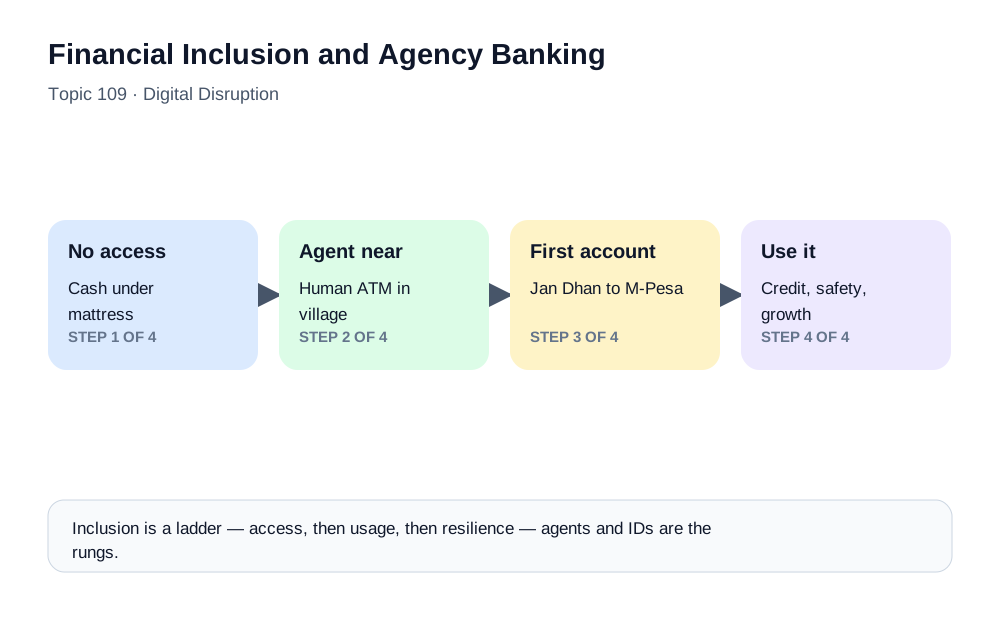
Financial Inclusion and Agency Banking at a glance — Banking the unbanked, M-Pesa, banking correspondents.
Banking the Unbanked — From Jan Dhan to M-Pesa to Banking Correspondents
Financial inclusion—the goal of ensuring that every person has access to affordable, appropriate financial services—remains one of the most significant challenges in global development and economic policy. Opening a bank account represents merely the first step in a longer journey toward true inclusion; genuine financial inclusion requires that people actively use these accounts for savings, credit, insurance, and payments to improve their financial lives and economic opportunities in meaningful ways. India's Pradhan Mantri Jan Dhan Yojana program opened over five hundred million bank accounts, demonstrating the scale that government-led initiatives can achieve when backed by political will and enabling technology infrastructure. Yet the journey from account access to genuine financial inclusion continues, requiring sustained effort across multiple fronts to ensure that financial services translate into financial security and opportunity for the previously excluded.
The global financial inclusion gap remains substantial despite significant progress over the past decade and billions of dollars invested in inclusion programs. The World Bank's Global Findex 2025, based on 2024 survey data, reports that about 1.3 billion adults worldwide still lack a financial account even though global account ownership has risen to 79 percent. A gender gap remains: globally, 77 percent of women and 81 percent of men have an account, while gaps are also visible by income, geography, digital access, and financial resilience. The barriers to inclusion are multiple and reinforcing: physical distance to bank branches in rural areas where populations are dispersed, documentation requirements that exclude those without formal identification or proof of address, costs of account maintenance and transactions that are prohibitive for the poor who live on irregular and limited incomes, lack of trust in formal financial institutions that may be perceived as exploitative or inaccessible, and low financial literacy that makes banking products seem confusing or risky compared to familiar informal alternatives.
India's financial inclusion journey includes one of the largest national account-access programmes and offers useful lessons about public infrastructure, identity, distribution and consumer protection. The Pradhan Mantri Jan Dhan Yojana, launched in August 2014, continues to operate at very large scale. Beneficiary and account counts change as the official dashboard is updated, so a current lesson should link the dated PMJDY progress report rather than present an undated headline as a permanent fact. The scheme provides access to basic banking accounts without a minimum-balance requirement under its design, helping reduce an important entry barrier to formal banking. Account benefits can include a RuPay debit card, insurance subject to the applicable conditions, and overdraft eligibility subject to scheme and bank rules. Direct Benefit Transfer linkage can route government benefits into eligible accounts, but the operational result depends on programme design, account status and implementation evidence. The durable lesson is how account access, identity, mobile channels and last-mile service can work together; account counts alone do not prove active or effective inclusion.
The JAM Trinity—combining Jan Dhan accounts, Aadhaar digital identity, and mobile phone penetration—provides the infrastructure foundation for India's inclusion success and has become a model studied globally by policymakers seeking to replicate its achievements. Jan Dhan provides the bank account for every citizen willing to open one, creating the basic infrastructure for financial participation. Aadhaar provides digital identity verification through biometrics, eliminating documentation barriers that previously excluded millions who lacked traditional proof of identity. Mobile phones serve as the delivery channel for services, reaching even remote areas without bank branches through basic feature phones or smartphones that have become nearly ubiquitous. The JAM architecture has enabled government payments and benefits to reach verified bank accounts more directly, reducing dependence on cash-based distribution and creating a stronger audit trail for programmes such as subsidies and wage payments. The exact fiscal savings attributed to Direct Benefit Transfer depend on programme, period, and methodology, so banking analysis should separate the operational benefits of account-based delivery from any single headline savings estimate.
Banking Correspondents serve as the human face of financial inclusion in areas without bank branches, extending the reach of formal banking into villages and communities that would otherwise remain unserved by the formal financial system. These agents—local shopkeepers, post office workers, retired teachers, and other trusted community members—are authorized to provide banking services on behalf of banks in villages and underserved areas where establishing branches would be economically unviable. The process is straightforward and designed for accessibility even by those with limited literacy: a customer visits a BC agent in their village, who uses a micro-ATM handheld device equipped with an Aadhaar biometric reader. The customer authenticates their identity via fingerprint, and the transaction is processed in real-time on the bank's core banking system. The customer can deposit or withdraw cash and receive an immediate receipt, with the same security and record-keeping as a branch transaction but without the need to travel to distant towns.
BCs provide comprehensive services including account opening for new customers who previously had no access to banking, cash deposits and withdrawals for routine banking needs, fund transfers to other accounts for remittances and payments, balance inquiries, micro-loan disbursement for small credit needs that help businesses grow, insurance enrollment for risk protection against health shocks and accidents, and pension payments for elderly beneficiaries who may be unable to travel to branches. India has developed a very large Business Correspondent network to extend banking access beyond conventional branches. The network size and activity change over time and differ by reporting definition, so the operational lesson is more durable than a single count: agents give banks a scalable last-mile service layer where permanent branch economics are weak. These agents earn commissions on transactions, creating sustainable livelihoods while serving their communities and building trust in formal banking among populations that were previously excluded.
Microfinance provides credit access to low-income borrowers excluded from traditional banking due to lack of collateral or credit history that banks require for lending. These small loans, typically ranging from ten thousand to one lakh rupees, target below-poverty-line individuals and rural entrepreneurs who need capital to start or expand small businesses that generate income for their families. The lending model often uses Joint Liability Groups or Self-Help Groups, where borrowers mutually guarantee each other's loans, creating social pressure for repayment that substitutes for collateral and reduces default rates. Repayment occurs through weekly or fortnightly group meetings that also provide financial education, peer support, and community building that strengthen social capital. Interest rates, while higher than bank rates at eighteen to twenty-six percent, remain far below moneylender rates that can exceed fifty percent monthly, and include the costs of intensive servicing required for small loans that banks find unprofitable to administer. Since 2022, the Reserve Bank of India has brought all microfinance under unified regulation, providing clearer oversight and consumer protection while enabling responsible growth of the sector.
M-Pesa in Kenya represents the most celebrated mobile money success story and offers lessons for financial inclusion globally that remain relevant years after its launch. Launched in 2007 by Safaricom, a telecommunications company rather than a bank, M-Pesa enables mobile money transactions via SMS without requiring a smartphone. This accessibility proved crucial in a market with limited smartphone penetration but high feature phone ownership among the target population. M-Pesa's large cash-in and cash-out agent network demonstrates why agent liquidity and geographic reach matter as much as the mobile interface. Research on Kenya has associated mobile-money expansion with meaningful household welfare and poverty effects, but penetration and agent counts change over time and should be read from current operator or regulatory reporting rather than treated as fixed properties of the model. The key insight from M-Pesa is that telecommunications infrastructure reaches where banks cannot, and financial services can be effectively delivered through mobile networks when properly designed with appropriate agent networks that provide cash access.
India has developed multiple payment infrastructure systems specifically designed for inclusion across different technology contexts and user capabilities. UPI provides interoperable instant account-to-account payments through participating banks and payment applications. NPCI's official statistics show 23.20 billion UPI transactions in May 2026, illustrating the scale that low-friction digital payments can reach when identity, bank accounts, mobile access, and interoperable acceptance work together. USSD code *99# enables banking on feature phones without internet access, extending digital payments to basic mobile phones that remain common in rural areas with limited smartphone adoption. The Aadhaar-enabled Payment System allows biometric transactions at BC points for those without cards or phones, using only fingerprints for authentication that works even for the illiterate. The BHIM app provides a simplified UPI interface designed for low-literacy users with voice support and minimal text. QR codes enable any merchant to accept digital payments with simply a printed code, requiring no expensive point-of-sale equipment or smartphone ownership that would exclude small vendors.
Despite substantial progress, significant challenges remain in converting account access into genuine financial wellness for the newly included population. Dormancy and low usage remain important risks in any mass account-opening programme. Account ownership should therefore be assessed alongside activity, savings behaviour, payment use, access to appropriate credit or protection products, and the customer's ability to obtain help when something goes wrong. Financial literacy gaps mean that account holders may not understand available products or how to use them effectively to improve their financial lives, leaving them vulnerable to exploitation. Last-mile connectivity problems persist in remote areas with limited internet and mobile coverage, preventing full utilization of digital services that require network access. Digital fraud increasingly targets low-literacy customers who may be vulnerable to scams due to unfamiliarity with digital security practices and trust in apparent authorities. Access to credit remains limited despite account ownership, as having an account does not guarantee loan approval without credit history or income documentation that banks require. Protection gaps can remain substantial even after account access improves. Affordable insurance, pensions, emergency savings, and suitable credit all contribute to financial resilience, so inclusion should not be measured only by the number of bank accounts opened.
The next frontier of financial inclusion focuses on these remaining challenges through integrated approaches that address multiple barriers simultaneously. Converting account access into active usage requires product design that meets genuine needs and financial education that builds confidence and capability among new users. Credit access must expand beyond microfinance to include appropriate products for small businesses and agricultural needs that drive rural economies and create employment. Insurance products must be designed for affordability and accessibility while providing meaningful protection against the shocks that destroy accumulated wealth. The infrastructure built through Jan Dhan, Aadhaar, and mobile penetration provides the foundation; the work now is to ensure that this foundation supports genuine financial security and opportunity for all Indians, regardless of their location, income level, or educational background, creating a truly inclusive financial system that serves everyone.
<!-- MBA-DEEP-DIVE-START -->Financial Inclusion in Practice — Access, Usage, Agents, and Financial Resilience
Inclusion begins with a usable account, not an account-opening statistic
Financial inclusion is sometimes measured by counting how many people have an account, but account ownership is only the entry point. A useful account should let the customer store value safely, receive money, make payments, obtain cash when needed, understand charges, resolve problems, and gradually use additional services that fit the customer's circumstances. An account that is opened to satisfy a programme target but remains inaccessible, unaffordable, confusing, or dormant provides limited economic value. Banks should therefore distinguish access from active usage and active usage from improved financial resilience. A customer who receives wages digitally but immediately withdraws every rupee may still benefit from safer receipt of funds, yet the institution should not automatically infer that the customer now has useful savings, credit, insurance, or emergency-finance capability.
The right product depends on the customer's actual financial life
Low-income and previously excluded customers are not one homogeneous segment. A small farmer may receive seasonal income and face weather-linked expenses. A migrant worker may need frequent low-value remittances. A street vendor may have daily cash turnover but little formal documentation. A domestic worker may be paid monthly into an account while supporting relatives elsewhere. A self-employed woman may need privacy and independent control over household money. Product design should therefore begin with cash-flow patterns, risks, distances, device access, literacy, language, and trust. A bank can offer a technically sophisticated account and still fail the customer if its transaction limits, branch hours, minimum documentation, or repayment schedule do not fit the customer's economic reality.
Agency banking extends the bank without turning the agent into the bank
A Banking Correspondent or other authorised agent can provide last-mile services on behalf of a regulated institution, but the underlying customer relationship and regulated responsibilities remain defined by the bank and applicable framework. The agent may facilitate onboarding, deposits, withdrawals, transfers, balance enquiries, benefit payments, or other approved services. The bank should clearly define what the agent can and cannot do. Customers should not be left to assume that every product sold by the shopkeeper is a bank product or that the agent can alter loan terms, waive controls, or retain customer documents for unrelated purposes. Clear branding, receipts, fee disclosure, transaction limits, and complaint channels help preserve the distinction between local service delivery and institutional responsibility.
Agent selection is a risk decision as well as a distribution decision
An agent sits close to customer cash, identity information, and transaction initiation. Selecting an agent only because the location is convenient can create fraud, conduct, and reputational risk. Banks should assess identity, business history, financial capacity, local reputation, expected transaction volumes, physical security, connectivity, and conflicts of interest. The bank should also understand whether the agent operates other financial or commercial services that could confuse customers. Training should cover not only how to use the device but also customer privacy, prohibited practices, fraud escalation, fee rules, receipt handling, and what to do when a transaction fails. Ongoing review matters because a trustworthy agent can later face financial stress, ownership change, or pressure to earn commissions through inappropriate behaviour.
Agent liquidity determines whether access exists at the moment the customer needs it
A rural customer may see a functioning micro-ATM and still be unable to withdraw money if the agent has insufficient cash. Conversely, an agent receiving many cash deposits may need a safe way to rebalance excess physical cash. Agent liquidity is therefore one of the most important operational controls in an agency-banking network. Banks can forecast demand by location, day of week, benefit-payment cycles, harvest periods, pension dates, and local events. Rebalancing arrangements should be realistic for the geography. An agent located hours from a cash point may need different limits or support from one near a branch. Liquidity monitoring should distinguish a technology outage from a cash shortage because the customer experience can look similar even though the remedy is different.
Cash-in and cash-out require end-to-end reconciliation
When an agent accepts cash for deposit, the customer should receive immediate evidence that the bank account was credited or that the transaction is pending under a defined status. The agent's physical cash position, device records, bank settlement account, customer ledger, and commission record should reconcile. The same principle applies to withdrawals: the customer account is debited, cash is handed over, and the agent's settlement position changes. If connectivity drops after the debit but before the receipt appears, the agent should not simply repeat the transaction. Status enquiry and duplicate protection are essential. Small-value financial-inclusion transactions can occur at enormous scale, so a tiny unresolved error rate can create large volumes of customer complaints and operational loss.
Agent commissions should reward service without encouraging abuse
Agents need sustainable economics. If commissions are too low, agents may refuse low-value services, add unofficial charges, or stop operating. If incentives reward only account opening or product sales, agents may push unsuitable products or create inactive accounts. Banks should therefore design remuneration around the service model and monitor outcomes. A balanced structure can recognise transaction volume, availability, service quality, cash-management effort, and customer acquisition without creating pressure to bypass controls. Customers should know which fees are official and receive receipts. Mystery shopping, complaint analysis, transaction-pattern review, and agent-level exception monitoring can reveal unofficial charging or coercive behaviour that ordinary financial reports do not show.
Consumer protection is central because excluded customers can have less bargaining power
Newly banked customers may be unfamiliar with interest calculations, insurance exclusions, digital security, or complaint processes. They can therefore be more vulnerable to misleading sales, hidden fees, forced bundling, and fraud. Inclusion should not mean giving customers access to products they cannot understand or afford. Product terms should use clear language and local-language support where needed. Key charges and obligations should be visible before the transaction. Customers should be able to obtain a statement or transaction history and know how to challenge an error. A low-value customer deserves the same discipline around consent, evidence, and fair treatment as a wealthy customer, even if the channel and product are simpler.
Financial literacy is useful only when it changes a real decision
Generic training that explains banking vocabulary may have limited effect if it is disconnected from the customer's next action. Financial capability is stronger when education is tied to practical decisions: how to recognise an official agent fee, why an OTP should not be shared, how interest accumulates, what happens after a missed loan instalment, how to verify a payment recipient, or where to complain. Banks can integrate these messages into onboarding, transaction confirmations, agent conversations, and digital interfaces. Repetition matters, but so does relevance. A customer learning how to protect a PIN immediately before first card use is more likely to benefit than one receiving a long brochure months earlier.
Trust can be as important as price or technology
People who have relied on cash, family networks, rotating savings groups, or local moneylenders may not automatically trust a formal bank. Past experience with branch queues, unexpected charges, rejected documents, or inaccessible staff can reinforce scepticism. Building trust requires consistent service. Balances should be accurate, receipts should match transactions, agents should behave predictably, and complaints should receive responses. If a digital payment fails, the customer should not have to visit several offices to recover a small amount. Trust can be destroyed quickly when the customer perceives that formal systems are more difficult to correct than informal ones. Inclusion programmes should therefore measure reliability and recourse, not only acquisition.
Identity requirements should enable lawful access without becoming unnecessary barriers
Banks need customer due diligence, but identity processes should use permitted evidence proportionate to the product and applicable rules. Customers may lack conventional proof of address, formal employment documents, or consistent spelling across records. Digital identity and simplified or risk-based processes can reduce friction where the framework allows them. Exception handling is important. A mismatch caused by transliteration, marriage-related name change, or document-format difference should not automatically be treated as fraud. At the same time, inclusion objectives should not justify weak identity controls that make accounts attractive to criminals. The goal is secure access: enough reliable evidence to establish the relationship while avoiding collection that is irrelevant to the actual risk.
Women can face financial barriers that product screens do not reveal
Women may have lower device ownership, less control over household documents, limited mobility, lower access to formal employment records, or social pressure around independent financial decisions. A product that assumes a private smartphone and free travel to a branch can therefore exclude legitimate customers even when eligibility rules are formally gender-neutral. Agent location, female-agent availability, privacy of notifications, language, account-control design, and financial education can matter. Banks should analyse usage and failure rates by gender where lawful and appropriate, looking beyond simple account-opening parity. An account in a woman's name does not guarantee that she controls the credentials, understands the product, or can use the funds independently.
Shared and basic phones require different security assumptions
Not every customer uses a personal smartphone protected by a strong device credential. Feature phones, shared family devices, changed SIMs, and intermittent connectivity remain relevant in many inclusion markets. Security design should therefore avoid assuming that possession of the phone always proves control by the account holder. Sensitive notifications may need masking. High-risk changes can require additional evidence. USSD or other low-bandwidth channels should have session controls and clear confirmation. Banks should also plan for SIM replacement and number recycling. A mobile number is a useful contact and authentication signal, but it should not become the sole identity anchor for a vulnerable customer's entire financial relationship.
Offline and low-connectivity service needs explicit transaction states
A rural agent or mobile user may lose connectivity during a transaction. The system should define whether the instruction was never received, received but pending, committed, or rejected. Customers and agents should not be forced to guess. Offline-capable products can improve access but introduce synchronisation and duplicate-risk challenges. Even without true offline payments, channels can cache requests or retry after connectivity returns. Idempotency, transaction references, and status enquiry reduce the chance of double debit or double credit. Operational teams should monitor locations with repeated connectivity-related exceptions because poor network quality can become a systematic inclusion barrier even when the core banking system is healthy.
Mobile money and bank accounts solve overlapping but different problems
Mobile money can provide stored value and payments through a telecommunications or specialised financial-service ecosystem, often supported by a dense agent network. Bank accounts provide a different regulated deposit relationship and can connect to broader savings, credit, and payment services. Customers may use both. The useful question is not which model is superior, but how easily value can move between them and whether the customer understands where money is held. Interoperability can reduce the need to maintain separate liquidity pools, but it requires clear fees, settlement, identity, and transaction references. A transfer that appears instant to the customer still needs reconciliation between the participating institutions.
The enduring lesson from M-Pesa is distribution plus liquidity plus simplicity
M-Pesa demonstrated that digital value can achieve broad everyday use when customers have nearby places to convert between cash and electronic value, the service works on widely available devices, and the transaction experience is simple enough for frequent use. The lesson is not that every country should copy the same telecom-led model. Regulatory structure, banking penetration, identity systems, competition, and customer behaviour differ. The transferable insight is that digital finance succeeds when the service solves a common problem and the physical and digital layers reinforce each other. A brilliant mobile interface without agent liquidity or merchant acceptance can remain a niche product.
Government payments can accelerate inclusion but also distort usage metrics
When salaries, pensions, welfare payments, or subsidies are paid into formal accounts, customers gain a strong reason to open and access those accounts. This can reduce leakage and create a reliable transaction history. However, a government payment does not automatically mean the customer has adopted broader financial services. Some recipients may withdraw the full amount immediately because local commerce remains cash-based or because they distrust digital balances. Banks should therefore distinguish payment receipt from voluntary account usage. Programmes can encourage broader utility by improving local merchant acceptance, simple savings options, reliable cash-out, and customer education rather than assuming that the inbound government transfer completes the inclusion journey.
Remittances are often the first high-value use case for excluded households
Migrant workers may need to send small amounts frequently to families in rural areas. Traditional cash-based remittance can involve travel, informal intermediaries, or high fees. Formal digital channels can reduce risk and improve speed, but only if the recipient can access funds conveniently. A transfer to a bank account is not useful if the nearest cash point is unreliable or expensive. Banks should therefore analyse both sending and receiving journeys. Transaction limits, recipient identification, fees, failed-transfer handling, and cash-out availability matter. Remittance history can also help the bank understand household cash flow, but it should not be repurposed for unrelated decisions without appropriate governance and consent.
Small savings products should accommodate irregular income
Customers with volatile or seasonal earnings may struggle with products designed around fixed monthly contributions. Inclusion-focused savings can support very small deposits, flexible frequency, transparent interest, and easy access to emergency funds. Automatic sweeps or goal-based features can help, but the customer should remain in control. Penalties that consume a large share of a small balance can undermine trust. The bank should also distinguish between encouraging savings and locking away money the customer needs for basic consumption. Product performance can be measured by sustained balances and repeat saving behaviour rather than the number of accounts marketed as savings products.
Credit inclusion must be responsible, not simply more available
Access to credit can help households smooth emergencies and businesses invest, but unsuitable debt can worsen vulnerability. Lenders should assess affordability using reliable evidence and recognise irregular income patterns. Small-ticket digital loans can be approved rapidly, which makes transparent pricing and collection controls especially important. Customers should understand total repayment, due dates, consequences of delay, and whether fees change after missed payment. Repeated refinancing can be a warning sign of distress rather than customer engagement. Inclusion should expand access to productive and emergency finance while avoiding a model where the most financially vulnerable customers become the most aggressively monetised.
Alternative data can expand credit access but creates fairness and privacy questions
Customers without conventional credit histories may still have useful financial signals such as transaction patterns, merchant sales, utility payments, or verified business activity. These data can support underwriting where lawful and appropriate. However, more data does not automatically create a fairer decision. Models can reproduce social or geographic bias, use unstable proxies, or penalise customers for behaviour unrelated to repayment capacity. Banks should understand data source, consent, quality, model performance, and explainability. Customers should have a route to correct erroneous data and challenge adverse outcomes. Alternative data should reduce information gaps, not create invisible rules that excluded customers cannot understand or escape.
Insurance supports inclusion when claims work as reliably as enrolment
Low-income households can lose years of progress after illness, accident, crop failure, or death of an income earner. Affordable insurance can therefore be a critical part of financial resilience. Distribution through bank accounts or agents can improve reach, but customers need clear information about coverage, exclusions, premiums, and claim evidence. A product that is easy to enrol into but difficult to claim against can damage trust in the entire financial system. Banks acting as distributors should monitor complaints and claim outcomes rather than measuring only policies sold. Premium collection should also be designed carefully so customers are not surprised by recurring deductions from small balances.
Merchant acceptance turns an account from a storage product into a daily tool
Customers are more likely to keep and use digital balances when nearby merchants accept digital payments reliably. Merchant onboarding should therefore be part of inclusion strategy. Small merchants need simple acceptance, transparent fees, predictable settlement, and easy reconciliation. QR-based or mobile acceptance can lower hardware cost, but the merchant still needs to know whether the payment succeeded and when funds are available. Fraud controls should consider fake confirmation screens, misdirected QR codes, and account takeover. If merchants immediately cash out every digital receipt because suppliers operate only in cash, the ecosystem may still remain partially cash dependent. Inclusion improves as both consumer and business sides gain practical reasons to retain digital value.
Inclusion metrics should measure resilience and control, not only reach
A mature dashboard can track active accounts, transaction frequency, savings behaviour, digital-payment use, agent availability, failed transactions, complaint resolution, fraud loss, credit performance, and customer ability to access funds during stress. Metrics should be interpreted carefully. High transaction volume can reflect healthy usage or repeated small cash-outs caused by low trust. Large numbers of registered agents do not prove they are active or liquid. Zero-balance accounts may be useful for occasional government payments but provide limited savings resilience. The purpose of measurement is to understand whether customers can use formal finance safely and effectively, not to maximise one headline number.
Financial Inclusion Deepening — Operations, Supervision, and Last-Mile Control
Agent networks need continuous supervision after onboarding
An agent network can change quickly. A shop can change ownership, an operator can delegate the device to an untrained employee, local transaction volumes can grow beyond the agent's cash capacity, or an agent can begin charging unofficial fees. Banks should therefore supervise the network using both field and data signals. Transaction reversals, unusually high failed biometric attempts, repeated balance enquiries followed by no transaction, excessive dormant accounts opened by one agent, unusual cash patterns, and complaint concentration can all justify review. Field visits can confirm branding, receipt practices, customer privacy, cash security, and whether the registered agent is actually providing the service. Supervision should focus on risk rather than becoming a ceremonial checklist.
Agent fraud should be separated from customer fraud
Financial-inclusion channels can face different fraud patterns. A customer can be tricked by a criminal, an agent can misuse customer information, a fake agent can impersonate an authorised outlet, or collusion can occur between agents and customers. The control response differs. Customer education may reduce social-engineering fraud, while agent misconduct requires contractual enforcement, monitoring, suspension, and investigation. Banks should preserve evidence showing which terminal, agent identifier, device, and customer authentication were used. Customers also need a reliable method to verify that an outlet is authorised. If the only proof is a poster on the wall, fraudsters can copy the appearance of legitimacy without being connected to the bank.
Cash security is part of the inclusion operating model
Agents handling physical cash face robbery, theft, counterfeit notes, and employee misconduct. The bank should understand who bears loss at each stage and what security measures are appropriate for the location. Excessive physical-security requirements can make the model uneconomic, but no controls can expose agents and customers to harm. Cash limits, secure storage, insurance where appropriate, discreet rebalancing, and transaction monitoring can reduce risk. An agent facing repeated security incidents may reduce available cash, which then becomes a customer-access problem. Physical and digital controls therefore need to be designed together rather than treated as separate programmes.
Customer authentication should fit the channel without creating single-point dependence
Biometrics, PINs, OTPs, cards, device credentials, or combinations of these can support customer authentication. The right method depends on the channel and customer population. A biometric can help customers who struggle with passwords but can also fail because of worn fingerprints, sensor quality, injury, or connectivity. OTPs depend on mobile-number control and network availability. Cards can be lost or shared. Banks should provide controlled alternatives so legitimate customers are not permanently excluded by one failed factor. At the same time, fallback should not become weaker than the primary control. Exception methods need limits, staff guidance, and audit evidence.
Aadhaar-enabled or identity-linked services should not be confused with the bank account itself
An identity credential can help a customer authenticate or establish a relationship, but it does not replace the underlying account, ledger, or customer-service responsibility. In an Aadhaar-enabled transaction, for example, the identity and authentication layer helps the bank identify the customer and route the request, while the financial transaction still affects an account held within the banking system. This distinction matters when customers dispute a transaction. Operations should know whether the issue involved identity authentication, transaction routing, core-ledger posting, agent cash handling, or settlement. Calling every problem an “Aadhaar issue” can delay resolution and obscure the bank's own responsibility.
Inclusion channels should be designed for local language and accessibility
A customer may understand money well but struggle with an interface presented in an unfamiliar language or with dense financial terminology. Channels should use clear wording, meaningful symbols, accessible audio or assistance where appropriate, and consistent confirmation messages. Accessibility also includes customers with visual, hearing, motor, or cognitive impairments. A security control should not force a customer to disclose a PIN to an agent because the interface is impossible to operate independently. Banks should test journeys with real target users rather than assuming that a simplified screen is automatically inclusive. Good design reduces both customer error and dependence on intermediaries.
Complaint handling is a core financial-inclusion service
A customer with a small balance can experience a failed transaction as a major financial event. If a pension payment or wage withdrawal is unavailable, the customer may not be able to buy food, travel, or medicine. Complaint processes should therefore prioritise impact rather than transaction value alone. The customer needs a reference, expected resolution path, and a channel that does not require expensive travel. Agents should know how to register or escalate complaints but should not be able to suppress them. Banks can monitor time to resolve inclusion-channel complaints separately from average call-centre metrics because last-mile failures may have different causes and customer consequences.
Reversals need transparent timing and customer communication
Digital transactions can fail after the customer account is debited or while the agent is unsure whether cash should be handed over. Automatic reversal mechanisms can correct many cases, but the customer should understand the status. “Failed” can mean never processed, pending reversal, or completed with confirmation lost. These states should not be presented as identical. Operations should track ageing of unresolved reversals and reconcile them against switch, network, agent, and core records. When a reversal takes longer than expected, customers need a route for manual investigation. Trust improves when the bank can explain exactly where the money is rather than asking the customer simply to wait.
Financial inclusion can create new operational peaks
Benefit-payment days, crop-sale periods, school-fee seasons, festivals, or disaster-relief programmes can create sudden transaction peaks in locations that normally have modest activity. Agent cash, network capacity, support staffing, and fraud monitoring should anticipate these events. A system designed only around average volume can fail at the moment the service is most important. Banks can use historical transaction data and programme calendars to plan liquidity and capacity. Contingency arrangements may include temporary cash support, extended service hours, additional agents, or alternative access points. Peak planning is a practical inclusion control because reliability during critical periods strongly influences whether customers continue to trust formal channels.
Disaster response shows why financial resilience matters beyond account access
Floods, storms, droughts, conflict, or public-health emergencies can interrupt income and physical access while increasing the need for emergency money. Digitally reachable accounts can help governments, employers, and families transfer funds quickly, but only if customers can authenticate, access devices, find working agents or merchants, and recover credentials. Banks should include inclusion channels in disaster-recovery planning. Agent locations may be physically damaged even when central systems remain available. Offline or alternative connectivity options can be valuable. Emergency transaction limits and fraud controls should be designed carefully so urgency does not become an excuse to remove safeguards entirely.
Rural credit needs to recognise seasonal repayment capacity
Agricultural and rural customers often earn in cycles rather than regular salaries. A loan with fixed monthly repayment can therefore create avoidable stress even when the underlying activity is viable. Responsible product design should consider crop cycles, expected harvest dates, input costs, weather risk, and local market conditions where appropriate. Credit assessment should also distinguish temporary seasonal cash-flow gaps from structural inability to repay. Rescheduling or insurance arrangements may be relevant under defined policies. Inclusion is stronger when financial products reflect how customers earn money rather than forcing every customer into a standard urban salary-based template.
Micro-enterprise banking needs business services as well as credit
A small merchant or home-based enterprise may benefit from payments, collections, savings, simple bookkeeping, and working-capital tools before taking a loan. Digital transaction history can help formalise the business gradually. Banks should avoid defining inclusion only as small-ticket lending because payment acceptance and cash-flow visibility can create more sustainable value. Merchant accounts need clear separation between personal and business funds where the product requires it. Reconciliation should be simple enough that the customer can understand daily receipts. Over time, reliable transaction behaviour can support better credit assessment, but the bank should still consider affordability and data quality rather than lending automatically against turnover.
Informal workers need products that tolerate income volatility
Gig workers, casual labourers, domestic workers, and self-employed customers can have frequent changes in income. Traditional products built around stable payroll assumptions may produce fees, failed debits, or inappropriate credit limits. Inclusion-focused banking can use flexible savings, variable payment schedules, low-balance functionality, and transparent alerts. The customer should not be penalised simply because income arrives on irregular dates. At the same time, the bank needs fraud and credit controls that recognise genuine volatility without treating every unusual month as suspicious. Segment-level analytics can help distinguish normal irregularity from behaviour that requires review.
Financial health gives a better long-term measure of inclusion
Account ownership is an access measure; financial health asks whether customers can manage day-to-day obligations, absorb shocks, save, borrow responsibly, and plan for the future. Banks cannot control every aspect of a customer's financial health, but product design can either support or undermine it. Frequent penalty fees, opaque credit, difficult claims, or inaccessible savings can worsen vulnerability. Conversely, reliable payments, emergency savings features, fair credit, and clear information can help. Inclusion programmes should therefore avoid celebrating transaction volume in isolation. A customer making many transactions because of repeated failed payments or debt rollovers is not necessarily experiencing better financial outcomes.
Data should reveal exclusion inside the process
A bank can have inclusive eligibility rules while its process excludes people at specific steps. Analytics can identify where applicants abandon onboarding, where identity checks fail, which locations suffer transaction errors, which customers repeatedly use assisted service, and which groups have high complaint rates. These signals should be investigated carefully and lawfully. A high failure rate can indicate poor connectivity, language barriers, outdated devices, inaccessible design, data mismatch, or fraud attempts. The objective is not to remove legitimate controls but to understand whether the control is working as intended. Process-level data often reveals more actionable inclusion barriers than top-level account counts.
Credit-bureau participation can help customers build a formal financial history
When responsible lending and repayment are reported through appropriate credit-information systems, customers who previously lacked a formal history can begin to demonstrate financial behaviour. This can improve future access, but data accuracy is essential. A mistaken delinquency on a small loan can have disproportionate impact on a new borrower with little other history. Customers should have a route to dispute errors. Lenders should also avoid assuming that lack of history means high risk; it may simply reflect previous exclusion. Credit information is most useful when it improves decision quality rather than becoming another barrier that permanently disadvantages first-time borrowers.
Inclusion partnerships need clear accountability across organisations
Banks may work with governments, fintech firms, telecom operators, agent aggregators, microfinance institutions, identity providers, and payment networks. Each partner can improve reach, but responsibility can become fragmented. The operating model should identify who owns customer onboarding, transaction processing, agent management, fraud monitoring, settlement, data protection, and complaints. Contractual language should be translated into actual escalation paths and system access. During an incident, customers should not be sent back and forth between organisations. The regulated provider should know which partner holds the evidence needed to resolve the case and how quickly it can be obtained.
Agent aggregators require oversight beyond the first contractual layer
A bank may use an aggregator to recruit and manage thousands of agents. This can improve scale, but the bank should not lose visibility into the actual outlets serving customers. The bank needs data on agent identity, location, status, training, transaction activity, complaints, and termination. Subcontracting arrangements should be understood, particularly where the aggregator uses further intermediaries. Controls should ensure that a terminated or suspended agent cannot continue transacting through old credentials. The bank should also be able to intervene directly in serious customer-protection or fraud cases rather than relying entirely on the aggregator's commercial relationship.
Settlement with agents should be predictable and auditable
Agents need confidence that commissions, cash positions, and settlement balances are calculated correctly. Delayed or opaque settlement can push agents to charge customers unofficially or withdraw from the service. Banks should provide clear statements showing transaction activity, fees, commissions, adjustments, and outstanding amounts. Disputes should be resolved through documented processes. Where prefunding is required, the agent should understand how much working capital is tied up and when it becomes available. Agent economics are not separate from customer service: an unstable settlement model eventually appears as low liquidity, unavailable outlets, or inappropriate charging.
Supervision should distinguish inactive agents from unavailable agents
An agent may be registered but rarely transact, or may be active only on certain days. Counting all registered locations can therefore overstate real access. Banks should measure service availability using transaction activity, cash readiness, opening patterns, failed requests, and customer feedback. An outlet that exists on a map but cannot provide cash or complete transactions is not equivalent to an active access point. Network management can identify underserved areas where nominal coverage hides practical gaps. This is particularly important before branch closures or programme changes that assume the agent network can absorb additional demand.
Digital safety education should be embedded in the service
Customers new to digital finance may be targeted by callers asking for OTPs, fake support links, remote-access applications, or messages promising benefits. Security education should therefore appear in transaction and servicing moments, not only in annual campaigns. Agents and staff should use consistent language: the bank will not ask for certain credentials, customers should verify payment details, and urgent pressure to transfer funds is a warning sign. Fraud reporting should be easy. Banks should also learn from scam patterns and update messaging as criminals change tactics. Inclusion should expand digital capability without transferring unreasonable security burden to inexperienced customers.
Inclusion should not depend on permanent cash availability forever
Agent cash-out is essential in cash-heavy economies, but long-term digital inclusion becomes stronger when customers can use balances directly for purchases, bills, savings, and transfers. Banks and payment ecosystems can gradually reduce dependence on cash by expanding merchant acceptance and interoperable payments. This transition should follow customer needs rather than forcing digital-only behaviour before local infrastructure is ready. Removing cash access too quickly can exclude older, rural, or low-connectivity users. The strategic direction can be more digital while the operating model still respects current customer reality.
A village benefit-payment scenario shows the full operating chain
Suppose several hundred customers receive a government benefit on the same morning and visit nearby agents to withdraw cash. The bank's core system may be fully available, but inclusion fails if the agent runs out of cash, the biometric device cannot connect, transaction status is unclear, or customers are charged unofficial fees. Good preparation includes liquidity forecasting, capacity monitoring, clear fee rules, customer authentication alternatives, status enquiry, and support escalation. At day end, agent cash, customer debits, settlement positions, and commissions should reconcile. This scenario demonstrates that financial inclusion is an operational ecosystem, not simply a policy objective or a mobile application.
A migrant-remittance scenario shows why both ends of the journey matter
A worker in a city sends a small amount digitally to a parent in a rural area. The sender needs transparent pricing and confirmation that the transfer reached the intended account. The recipient needs a practical way to use or withdraw the money. If the recipient must travel far, pay an unofficial fee, or face repeated agent liquidity problems, the remittance is less inclusive even though the electronic transfer itself was instant. A mature bank monitors end-to-end success, including failed credits, recipient access, reversals, and complaints. The value of formal finance is realised only when the household can actually use the funds safely.
The final inclusion test is whether the customer can rely on the service during ordinary and difficult days
A genuinely inclusive financial system works not only when opening an account is easy but when the customer loses a phone, disputes a transaction, needs emergency cash, has irregular income, experiences a failed biometric, or asks for help in a local language. It should be possible to identify the responsible institution, recover from errors, and understand the customer's financial position. Inclusion therefore combines reach with reliability, fairness, security, and relevance. The strongest programmes use technology and agents to lower barriers while preserving the same core banking disciplines of accurate records, controlled authority, transparent pricing, reconciliation, risk management, and customer recourse.
<!-- MBA-DEEP-DIVE-END -->