Visual overview
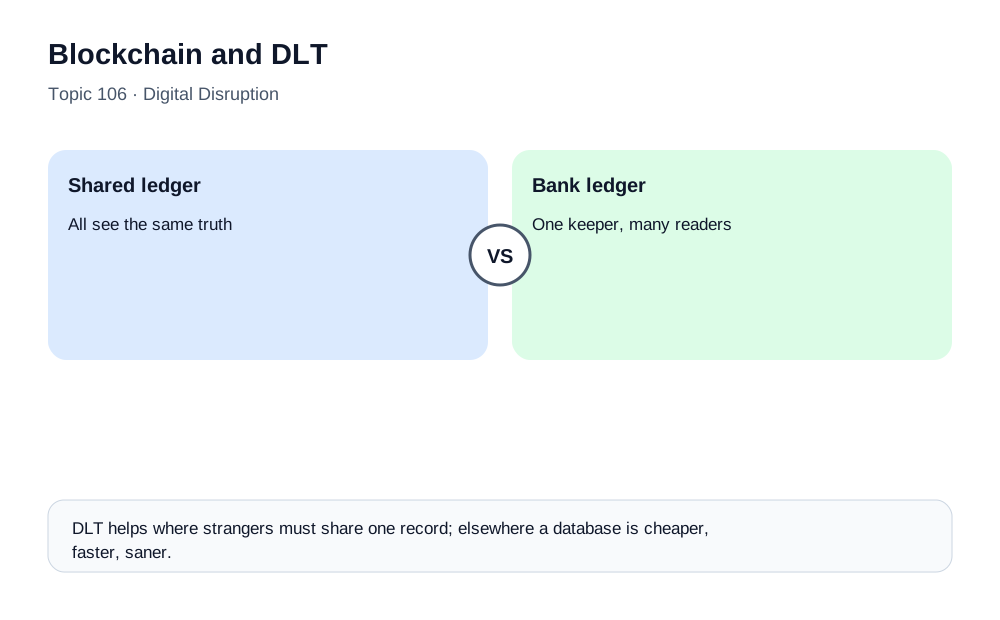
Blockchain and DLT at a glance — Consensus mechanisms, smart contracts, use cases.
Consensus Mechanisms, Smart Contracts, and Banking Use Cases
Blockchain technology emerged with ambitious promises to revolutionize banking by removing intermediaries and creating trustless systems where parties could transact directly without relying on central authorities or traditional institutions. While the reality has proven more nuanced than early predictions suggested, both public blockchains like Bitcoin and Ethereum and enterprise Distributed Ledger Technology have found meaningful applications in financial services that address real pain points. The technology is finding practical deployment in trade finance, settlement systems, and identity management, offering solutions to long-standing inefficiencies even as the initial vision of replacing banks has given way to a more collaborative approach where blockchain augments rather than replaces existing infrastructure that has evolved over centuries.
At its core, blockchain provides a distributed, immutable ledger for recording transactions in a way that multiple parties can trust without requiring a central authority to maintain the record. The key characteristics that define this technology include its distributed nature, with copies of the ledger existing across multiple nodes to eliminate single points of failure and resist censorship or manipulation by any single party. Once data is written to the blockchain, it becomes immutable and cannot be altered or deleted, providing an authoritative and auditable record of all transactions that have occurred since the system's inception. Transparency allows all participants to verify transactions independently, creating accountability and reducing the need for trust in counterparties. Consensus mechanisms ensure that all participants agree on the state of the ledger before new entries are confirmed, preventing double-spending and fraud without requiring a central authority. Cryptographic techniques including hashing and digital signatures secure the entire system against tampering and unauthorized access, providing mathematical guarantees of integrity.
Comparing blockchain with traditional bank databases reveals important trade-offs that explain why blockchain has not simply replaced existing systems despite its theoretical advantages in certain dimensions. Traditional bank databases are centralized, with the bank maintaining full control over the system and data, enabling quick decision-making about changes and upgrades. Trust is placed in the banking institution as a regulated entity with legal accountability for its actions and errors. Immutability requires application-level controls and audit trails rather than being built into the database architecture, allowing corrections of errors when discovered. Performance is fast, with systems capable of processing thousands to millions of transactions per second depending on architecture and hardware. Privacy is maintained by default, with access restricted to authorized users and detailed audit logs recording who accessed what data. Energy consumption is relatively low for database operations, making them environmentally sustainable at scale.
Blockchain systems, by contrast, distribute control across many participants with no single point of authority, making changes difficult to coordinate but eliminating single points of failure. They rely on mathematical consensus and economic incentives rather than institutional trust, creating different risk profiles that institutions are still learning to manage. Immutability is a fundamental property of the data structure—once written, data cannot be changed, which provides auditability but creates challenges when errors occur. Processing capacity is more limited, with throughput ranging from seven transactions per second for Bitcoin to three thousand for optimized blockchains, far below traditional database capabilities that financial markets require. Data is public by default on most blockchains, though privacy solutions are emerging for sensitive financial applications. Energy consumption is significant, particularly for blockchains using Proof of Work consensus mechanisms, raising environmental concerns that have driven interest in alternatives.
Consensus mechanisms differ across distributed-ledger designs. Bitcoin uses Proof of Work, while Ethereum uses Proof of Stake. Permissioned enterprise platforms use different ordering, notary or consensus services depending on implementation. Hyperledger Fabric separates transaction endorsement from ordering and supports configurable ordering approaches rather than being defined by one PBFT mechanism. Corda uses notary services to prevent conflicting states and can support different notary implementations; it should not be described simply as 'using Raft consensus.' The relevant banking questions are finality, fault tolerance, participant identity, governance and performance under the chosen configuration.
For banking applications, enterprise blockchains like Hyperledger Fabric and R3 Corda use permission-based consensus mechanisms that are faster, more private, and less energy-intensive than public blockchains. These systems trade the openness and censorship resistance of public blockchains for characteristics better suited to regulated financial services, where participants are known, privacy is essential for competitive and legal reasons, and transaction throughput must match business requirements for high-volume operations that process thousands of transactions per second.
Smart contracts represent one of blockchain's most significant innovations for banking applications, enabling automated execution of agreements without intermediaries to enforce terms. These self-executing programs run when predefined conditions are met, automatically enforcing business logic without requiring manual intervention or trusted third parties to interpret agreements. The analogy to an escrow agent is apt: like an escrow agent who releases funds only when conditions are verified by all parties, smart contracts automatically execute when specified criteria are satisfied, eliminating delays and disputes about interpretation. Major platforms supporting smart contracts include Ethereum for public applications where broad participation is desired, and Hyperledger Fabric and R3 Corda for enterprise use cases requiring privacy and performance that public blockchains cannot provide.
Banking applications of smart contracts span multiple domains with significant potential for efficiency gains and risk reduction. In trade finance, smart contracts can release payment automatically when shipping documents are verified against agreed criteria, eliminating the delays and disputes that plague paper-based processes that require manual review. Insurance claims can be paid automatically when objective conditions are met, such as flight delays exceeding four hours verified through flight data oracles, eliminating claims processing costs and delays while improving customer satisfaction. Loan disbursement can proceed without manual intervention once all conditions including KYC verification and collateral confirmation are satisfied and recorded on the blockchain, accelerating access to funds for borrowers. Derivatives contracts can automatically calculate and settle margin calls based on market prices, reducing counterparty risk and operational overhead while ensuring timely settlement that prevents accumulation of exposures.
Financial institutions have used platforms and technologies including Corda, Hyperledger Fabric, Ethereum-compatible enterprise stacks and Digital Asset's smart-contract technology. Product ownership, naming and market adoption evolve, so it is better to evaluate current platform capabilities than label a fixed set as permanent leaders. Relevant criteria include privacy, identity, finality, smart-contract model, interoperability, operating governance, tooling and support for the institution's target asset or workflow.
Trade finance is a natural area to examine DLT because multiple banks, corporates, carriers and document providers need to coordinate records and conditions. Shared digital state can reduce duplicate data entry and make document status more visible, but it does not guarantee that an off-ledger fact or uploaded document is genuine. Legal recognition of electronic trade documents, trusted data sources, interoperability and network participation remain decisive. Several trade-finance DLT consortia have been launched and some have later changed, been acquired or ceased operations, illustrating that business governance and network economics matter as much as technical proof of concept.
DLT has been explored for cross-border payments because multi-party settlement, liquidity and transaction visibility can create friction in some corridors. Traditional cross-border payment speed and cost vary widely by banks, currencies, cut-off times, compliance review, local infrastructures and correspondent chains, so universal three-to-five-day or five-to-ten-percent figures are misleading. A DLT network may reduce some messaging or settlement steps, but foreign exchange, liquidity, sanctions, beneficiary-bank access, local regulation and final cash delivery still need to be solved.
Securities settlement is another important DLT use case because tokenised assets and shared state can support shorter settlement cycles or coordinated delivery-versus-payment. Settlement cycles differ by market and have changed over time; for example, some major markets have moved from T+2 to T+1, so T+2 should not be treated as a universal current standard. DLT projects run by market infrastructures demonstrate practical experimentation and production use, but integration with custody, cash settlement, legal finality, corporate actions and existing market systems remains essential.
Digital identity applications of blockchain address the problem of siloed identity data across institutions that creates inefficiency and privacy risks for consumers. KYC processes are duplicated at every financial institution a customer works with, creating costs for both institutions and customers while increasing exposure to data breaches. Blockchain solutions enable shared, verifiable credentials that allow individuals to "do KYC once, share securely" across multiple institutions while maintaining control over their personal data through cryptographic techniques that prove identity without revealing underlying data. This reduces costs for banks and friction for customers while improving privacy and security.
A realistic assessment of blockchain in banking requires acknowledging the gap between initial expectations and current reality. The prediction that blockchain would replace banks has not materialized; instead, banks are adopting DLT for specific use cases where it provides clear advantages while remaining central to the financial system. Global adoption has been slower than early proponents anticipated, with interoperability challenges, regulatory uncertainty, and legacy integration requirements creating barriers to implementation that have delayed many projects. Rather than eliminating all intermediaries as initially promised, blockchain has created new intermediary roles for node operators and platform providers that must be managed. Immutability, while providing security benefits, can create problems when errors occur or when data subject to the right of erasure under privacy regulations must be managed in ways that conflict with blockchain's permanent record. Blockchain systems remain much slower than centralized databases for most use cases, limiting their applicability where high throughput is essential for market functioning.
The key insight for banking professionals is that blockchain and DLT augment rather than replace existing infrastructure, finding their place in specific applications where their characteristics provide clear advantages over traditional systems. Adoption is incremental rather than revolutionary, with the technology finding its niche in areas like trade finance and cross-border payments where multiple parties need to share trusted data without a central authority. Production deployments are demonstrating real benefits even as the technology continues to mature and standards evolve to enable broader interoperability.
<!-- MBA-DEEP-DIVE-START -->Blockchain and DLT in Banking — Where Shared Ledgers Help and Where They Do Not
Distributed ledger technology solves a coordination problem
The strongest reason to consider a distributed ledger is not that blockchain is newer than a database. It is that several independent parties may need to maintain a shared record and do not want one participant to have unilateral control over the authoritative state. Traditional banking already solves many coordination problems through trusted infrastructures, central securities depositories, clearing houses, correspondent banks and messaging networks. DLT provides another design option when shared state, programmable rules and multi-party verification create enough value to justify the additional complexity.
A single bank running an internal customer ledger rarely needs a blockchain simply because the ledger is important. The bank already has authority over that record and can use conventional databases with access control, replication and audit trails. DLT becomes more interesting when several banks, market infrastructures, custodians, issuers or corporate participants need to agree on the same asset or workflow state.
This test prevents technology-first design. Before choosing DLT, architects should ask who needs to share state, why a conventional central operator is insufficient, what trust assumptions exist, and whether participants are willing to operate under common governance.
A blockchain is one form of distributed ledger, not a synonym for every DLT
Blockchain typically organises transactions into cryptographically linked blocks, but distributed ledgers can use other data structures and consensus models. Enterprise financial platforms may share state only among relevant participants rather than broadcasting every record to every node.
This distinction matters because public cryptocurrency networks and permissioned banking networks make very different design choices. Public networks optimise for open participation and resistance to control by a single authority. Permissioned financial networks can rely on known legal entities, contractual rules and controlled membership.
When discussing “blockchain in banking,” learners should therefore identify the network type, governance model, asset, participants and settlement mechanism rather than assuming characteristics from Bitcoin apply automatically.
Immutability means controlled append-only history, not magical impossibility of change
Blockchain is often described as immutable. In practice, immutability is a property created by cryptographic linking, distributed consensus, governance and economic or operational barriers to rewriting history. It does not mean that incorrect business data can never be corrected.
A mistaken transaction may be reversed through a new transaction. A smart contract may include an authorised amendment mechanism. A permissioned network may have governance for exceptional correction. Public chains can undergo protocol changes and, in extraordinary cases, communities can choose different chain histories.
For banks, the useful property is tamper-evident history with clear accountability. Legal and accounting corrections still need explicit business events rather than pretending that every original record was necessarily correct.
Consensus determines who may update shared state
A distributed system needs a way to agree which proposed transactions are valid and in what order they are recorded. Public blockchain networks may use Proof of Work or Proof of Stake to coordinate participants that do not know one another. Permissioned systems can use voting, notary, ordering or Byzantine-fault-tolerant mechanisms among identified nodes.
There is no single “best” consensus. The choice depends on threat model, number of participants, performance requirement, finality, governance and network assumptions. A mechanism suited to a global permissionless asset may be inefficient for a network of regulated financial institutions, while a permissioned mechanism depends more heavily on membership governance and legal accountability.
Banks should understand the failure conditions. How many validators can be unavailable before the network stops? How many malicious or conflicting nodes can it tolerate? Who can add or remove validators? These questions are more useful than memorising protocol names.
Finality is a business property as well as a technical one
A blockchain transaction may be technically confirmed while legal settlement finality depends on the governing rules and asset structure. Public proof-based chains can provide probabilistic or economic finality that increases with additional confirmations. Some permissioned ledgers provide deterministic finality once required participants or ordering services accept a transaction.
For securities and payments, the legal meaning matters. When is the obligation discharged? Who owns the asset after the ledger update? Can insolvency law challenge the transfer? What happens if the ledger forks or a participant enters resolution?
A banking implementation should align technical finality with the legal framework rather than assume that writing to a ledger automatically creates enforceable settlement.
Tokenisation separates the digital representation from the underlying legal right
A token can represent money, a security, a fund unit, a bond, collateral, a claim on a real asset or another right. The technical token is valuable only if the legal and operational framework connects it reliably to the underlying entitlement.
If a token represents a bond, the system needs to define issuer obligations, holder rights, corporate actions, transfer restrictions and redemption. If it represents a bank deposit, the token should map to a claim on the issuing bank under the product's terms. If it represents central bank money, the central bank determines the legal and technical structure.
Tokenisation can simplify transfer and programmability, but it does not remove custody, ownership, compliance or accounting questions. The asset model should be understood before discussing blockchain throughput.
Smart contracts are software that controls business state
A smart contract is code deployed in a DLT environment that applies predefined rules. The word “contract” can be misleading because not every smart contract is itself a complete legal contract. It may simply automate part of a workflow governed by separate legal agreements.
In banking, smart contracts can enforce transfer conditions, calculate cash flows, manage collateral or coordinate delivery-versus-payment. The advantage is repeatable execution against shared state. The risk is that a defect can execute consistently and at scale.
Smart-contract development therefore needs ordinary software-engineering discipline plus financial-model validation. Code review, testing, formal methods where appropriate, access control, upgrade governance and emergency procedures matter. “Code is law” is not an adequate operating model for regulated financial services.
Oracles connect on-ledger code to off-ledger facts
Smart contracts often depend on information that does not originate on the ledger: market prices, interest rates, delivery confirmation, identity status or corporate events. An oracle supplies that external fact.
The oracle becomes part of the trust model. If a derivatives contract uses an incorrect price feed, perfectly functioning smart-contract code can calculate the wrong payment. Banks should assess source authority, update frequency, fallback, manipulation risk and what happens when the data is unavailable.
Critical workflows may use multiple sources or defined dispute processes. DLT does not eliminate external data risk; it makes the dependency explicit.
Permissioned networks need membership governance
A bank cannot join a regulated consortium merely because it can connect a node. The network needs rules for admission, identity, roles, certificates, operating obligations, incident handling and exit.
Membership services establish which legal entity controls each technical identity. Certificates and keys need lifecycle management. If a member leaves or is compromised, its ability to submit or validate transactions should be revoked promptly.
Governance should also address software upgrades. A network with twenty banks cannot rely on every institution independently choosing protocol versions. Change procedures, test environments and coordinated release windows are part of the platform.
Privacy is not automatic on a distributed ledger
Replicating data across nodes can conflict with banking confidentiality if every participant sees every transaction. Permissioned designs therefore use channels, private data collections, point-to-point state sharing, encryption or other mechanisms to limit visibility.
The bank should identify which participants need each field. A securities transaction may need to be known to buyer, seller, custodian and infrastructure without revealing commercial details to every member of the network.
Metadata can also be sensitive. Even if amounts are encrypted, transaction timing and counterparties may reveal trading behaviour. Privacy design needs to consider the complete data model rather than only payload encryption.
Key management becomes asset control
In many DLT systems, a private key authorises transactions or controls an asset. Losing or compromising the key can therefore create direct financial consequences.
Institutional custody rarely means storing one private key on an employee laptop. Banks use controlled wallets, hardware security modules, multi-party approval, key backup, segregation and policy engines appropriate to the asset and risk.
Key rotation and recovery are important. If the system provides no safe recovery from a lost key, operational risk can be unacceptable for institutional assets. If recovery is too easy, unauthorised administrators may bypass ownership. Governance must balance resilience and security.
Wallets are interfaces to keys and ledger state
A wallet may generate and store keys, construct transactions, display balances and interact with smart contracts. In institutional environments, the customer-facing wallet can be separated from the secure signing service.
This architecture allows business controls before signing. A payment or asset transfer can pass entitlement, limit, sanctions and approval checks before the custody service produces the cryptographic signature.
The wallet balance itself should be reconciled to authoritative ledger data. Caches and indexing services can become stale even when the underlying blockchain remains correct.
DLT does not eliminate reconciliation; it changes its boundaries
A shared ledger can reduce reconciliation among parties that truly use the same state. However, banks still maintain core ledgers, general ledgers, risk systems, customer records and regulatory data outside the network.
A tokenised bond platform may reduce trade-position reconciliation between participants while still requiring reconciliation to cash settlement, custody accounting and financial statements. A DLT payment network may share transfer state while banks reconcile customer postings to network positions.
The right claim is therefore “less duplicated reconciliation in selected shared processes,” not “blockchain removes reconciliation.”
Delivery-versus-payment is a natural DLT use case
Securities settlement contains two linked legs: asset delivery and cash payment. If one occurs without the other, principal risk arises. DLT can coordinate the two legs when tokenised assets and a suitable settlement asset are available.
Atomic or synchronised delivery-versus-payment can reduce the time participants carry unsettled exposure. But the design depends on the cash leg. A tokenised security settled against an unregulated private token can introduce new risk even if the asset leg is technologically elegant.
Banks should identify whether cash is commercial bank money, central bank money, a regulated stablecoin or another asset, and how finality applies to each leg.
Tokenised deposits preserve the commercial bank liability model
A tokenised deposit can represent a deposit claim on a commercial bank in token form. It differs from a general cryptocurrency because the issuer is a bank and the token is linked to a banking liability under defined terms.
This can support programmable transfers and integration with tokenised assets while retaining familiar bank-money economics. Design questions include convertibility to conventional deposits, interoperability among banks, compliance controls, interest treatment and settlement across issuers.
Tokenisation changes representation and transfer rails; it does not make the bank's obligation disappear.
Wholesale settlement networks need liquidity management
Near-real-time or atomic settlement can reduce counterparty exposure but may increase intraday liquidity demands because participants cannot rely on delayed net settlement in the same way.
A DLT network should therefore consider liquidity-saving mechanisms, queuing, credit, prefunding or synchronised funding. Faster settlement is not automatically cheaper if institutions must hold large idle balances to ensure every transaction can settle immediately.
Treasury and operations should participate in design, not only technology teams.
Cross-border DLT payments still face foreign-exchange and compliance realities
A shared ledger can reduce messaging hops or enable faster transfer of a settlement asset. Cross-border payments still involve currencies, liquidity, sanctions, local regulations, beneficiary information and access to domestic payment systems.
If a platform converts dollars to euros, somebody provides the FX price and takes or hedges the position. If a beneficiary needs funds in a local bank account, the network must connect to the domestic banking system. If legal requirements restrict data or participants, the DLT must enforce them.
The technology can improve coordination, but the economics and regulation of cross-border money remain.
Trade finance benefits only when document and legal ecosystems participate
Trade finance contains many parties: buyer, seller, banks, carriers, insurers, customs and document providers. A shared ledger can improve visibility and reduce duplicate records, but only if enough participants can exchange legally accepted electronic documents and trusted data.
A blockchain does not make a fraudulent source document true. If an incorrect shipping event enters the ledger, immutable storage preserves the incorrect fact. Digital signatures, trusted issuers and legal recognition of electronic records are therefore essential.
The failure of or limited adoption of earlier trade platforms illustrates that consortium economics and network participation matter as much as technology.
Identity credentials can use DLT without placing personal data on-chain
Digital identity use cases sometimes use ledgers to publish issuer identifiers, schemas, revocation registries or proofs while keeping personal data in the customer's wallet or controlled systems.
This can support verifiable credentials without replicating full identity documents across network nodes. Privacy-by-design is important because permanent on-chain storage of personal data can conflict with data-minimisation and correction requirements.
DLT should therefore anchor trust where useful, not become a database for every identity attribute.
Public chains and regulated finance can interact through controlled gateways
Banks may provide custody, trading, tokenisation or settlement services that interact with public blockchain networks. The open network cannot be governed by the bank, so control focuses on the bank's own entry and exit points.
Customer due diligence, wallet screening, transaction monitoring, asset eligibility, key management and exposure limits can be applied before the bank signs or accepts transactions. The bank also needs policies for forks, airdrops, smart-contract risk and network disruption.
This is different from a permissioned consortium where membership and software governance are centrally coordinated.
Forks create operational questions for asset ownership
A blockchain can split into competing histories after software or governance disagreement. Public networks may resolve this through community and market adoption. A bank holding assets for customers needs a policy for which chain it supports, how balances are reported and whether assets on the other chain are recognised.
Permissioned networks can reduce this risk through coordinated governance, but upgrade failure can still create inconsistent node state. Recovery procedures should define how participants return to one authoritative history.
Smart-contract upgradeability is a governance choice
Immutable code prevents silent changes but makes defects difficult to fix. Upgradeable contracts allow remediation and product evolution but introduce administrator power.
Financial institutions may use governance structures in which upgrades require multiple authorised parties, notice periods, testing or formal network approval. Emergency pause functions can limit damage from a discovered defect, but the ability to pause also creates concentration and operational risk.
The design should make these powers visible. A platform should not market itself as completely decentralised while one administrator can unilaterally replace core logic.
DLT performance should be measured against the actual use case
Transactions per second is often used to compare blockchains, but headline throughput can obscure confirmation time, finality, payload size, privacy processing, node geography and hardware.
A trade-finance network may need only modest transaction volume but complex documents and privacy. A retail payment system can require high sustained throughput and predictable latency. A securities platform may prioritise deterministic finality and atomic settlement.
Benchmarks should reproduce the banking workload rather than quote generic network maximums.
Energy consumption depends strongly on consensus model
Proof-of-Work networks can consume significant energy because miners compete using computational work. Proof-of-Stake and permissioned consensus mechanisms have different energy profiles.
It is therefore inaccurate to treat “blockchain” as inherently energy intensive. The environmental impact depends on protocol, validator infrastructure, energy source and scale. Banks assessing sustainability should evaluate the specific network rather than applying Bitcoin's characteristics to every DLT.
Legal entity identifiers and participant identity remain useful
DLT does not eliminate the need to know counterparties in regulated wholesale finance. Banks may use legal entity identifiers, certificates, account references and other established identifiers alongside cryptographic addresses.
A blockchain address alone often does not provide the legal identity needed for contracts, reporting or sanctions controls. Institutional platforms therefore map technical keys to governed participant identities.
This mapping must be maintained when keys rotate so history remains attributable to the correct legal entity.
Accounting needs a clear valuation and ownership model
Holding or issuing tokenised assets creates accounting questions that depend on the legal nature of the asset. The fact that something is represented on blockchain does not determine whether it is cash, a deposit, security, intangible asset or another category.
Finance teams need authoritative balances, valuation sources, transaction history and evidence for ownership. On-chain data can support these records, but accounting policy follows the underlying right and applicable standards.
Operational support needs blockchain-specific diagnostics
When a transaction is delayed, operations need to know whether the issue is insufficient balance, smart-contract rejection, missing signature, consensus failure, network congestion, privacy configuration or an off-chain dependency.
Block explorers or internal ledger viewers can help, but customer-service staff should not be expected to interpret raw hashes. Systems should translate ledger state into actionable business status while preserving the technical evidence for specialists.
A practical scenario: tokenised bond settlement
Imagine a bank participates in a permissioned network where a corporate bond is represented as a token. The investor submits a purchase instruction through the bank. The bank verifies customer authority and compliance, reserves cash, and prepares the asset-transfer transaction.
The seller's custodian confirms availability of the bond token. The network coordinates delivery with the chosen cash settlement asset so neither side is exposed to principal risk. Once finality is reached, both parties update their customer and accounting records.
Reconciliation still confirms that customer holdings, network positions and cash accounts agree. Corporate actions such as coupon payment require issuer data and holder records. If the network is unavailable, the market needs contingency procedures.
This illustrates the practical value of shared state while showing that custody, cash, compliance and accounting remain.
Another scenario: shared KYC credential network
Several banks agree to accept credentials issued under a common governance framework. The ledger stores issuer keys and credential status, not the customer's full personal data. A customer presents a digitally signed credential to a second bank.
The receiving bank verifies the signature, issuer status and revocation state, then determines whether the credential satisfies its own customer-due-diligence requirement. It may still request additional information based on product or risk.
The network reduces duplicate verification but does not transfer accountability blindly. Each institution remains responsible for its customer decision under the applicable framework.
DLT governance determines whether the technology can survive success
Pilot projects can work with a small group of enthusiastic institutions. Production networks need rules for fees, software maintenance, liability, dispute handling, upgrades, new members, member exit and intellectual property.
If no participant wants to fund the shared infrastructure after the initial project budget ends, a technically successful network can still fail. Business incentives and governance are therefore core architecture components.
The correct conclusion is selective use, not revolution or dismissal
Blockchain and DLT are neither universal replacements for banking infrastructure nor useless technologies. Their value is strongest where multiple parties need shared programmable state, legal and operational governance can be aligned, and the resulting reduction in reconciliation or settlement friction exceeds the cost of the network.
A central database remains better for many single-owner banking processes. DLT becomes compelling when the trust and coordination problem is genuinely distributed. The disciplined banking question is always the same: what business problem becomes materially easier because this state is shared?
Blockchain and DLT Deepening — Banking Architecture, Controls, and Operating Reality
A distributed ledger changes where agreement is created
Traditional banking systems usually rely on a clearly identified system of record controlled by one institution or infrastructure provider. Distributed-ledger technology changes that arrangement by allowing several authorised participants to maintain or validate a shared state according to agreed rules. The important banking question is therefore not whether the database is called blockchain, but where agreement about ownership, transaction state and finality is created. A ledger can be distributed while governance remains tightly controlled. Conversely, a system can use cryptographic chains while still behaving operationally like a centralised platform. Architecture should begin with the business problem, participant model and legal responsibility, then decide whether distribution provides a real advantage.
Consensus is a control mechanism, not a magical source of truth
Consensus mechanisms help participants agree which state changes are valid under the protocol. They do not prove that the underlying business data was true when it entered the network. If an authorised participant submits an incorrect asset reference, fraudulent invoice or wrong customer instruction, consensus can faithfully replicate the error. Banks therefore still need onboarding, entitlements, data validation, transaction controls and dispute procedures around a distributed ledger. The strongest design separates technical consensus from business assurance. Nodes can agree that a transaction met protocol rules while compliance or operations may still need to determine whether the transaction was legally authorised or economically correct.
Permissioned networks fit many regulated banking use cases better than open participation
Banks usually need to know who can connect, submit transactions, validate state and access data. Permissioned DLT networks can support these requirements through participant onboarding, certificates, organisational roles and restricted visibility. This can simplify compliance compared with a network where unknown parties can join freely. Permission does not remove governance complexity. The consortium must decide who admits members, who can suspend them, how software upgrades are approved and what happens when participants disagree. A technically distributed platform can still fail operationally if no one has clear authority during an incident.
Finality must be understood at both protocol and legal level
A transaction can become technically irreversible under a ledger protocol while its legal effect remains uncertain. Banking systems therefore need alignment between technical finality, contractual rules and applicable law. Participants should know the point at which an instruction becomes binding, whether correction requires a compensating transaction, and which jurisdiction governs a dispute. This is especially important for tokenised securities, collateral and cross-border settlement where several legal regimes can interact. Operational procedures should avoid casually using the word “immutable” as if it removes the possibility of legal reversal, court order or participant error. Immutability describes a technical characteristic of records, not the entire legal relationship.
Smart contracts automate rules but also create software risk
Smart contracts can execute defined logic when conditions are met, such as releasing collateral, calculating an entitlement or synchronising asset and cash movements. This can reduce manual processing and create consistent execution. The same automation can amplify a defect if code does not reflect the intended legal or commercial rule. Banks should therefore apply software-development controls, testing, change approval, access management and independent review according to the importance of the contract. The institution also needs a method to pause, upgrade or replace logic safely where the network design permits it. “Code is law” is not a sufficient operating model for regulated banking because accountable organisations still have legal and customer obligations outside the code.
Tokenisation separates the economic claim from the database representation
A token can represent a security, deposit, fund unit, claim on an asset or another right, but the token itself is only useful if the legal framework connects the digital representation to the underlying economic claim. Banks should therefore ask what the holder owns, who is the issuer, how the claim is recorded, and what happens if the technology platform fails. A tokenised bond, for example, still needs issuance terms, payment obligations, investor eligibility and default treatment. The DLT layer can improve transfer and servicing, but it does not remove the product’s legal substance. This distinction prevents technology teams from treating every token as economically equivalent simply because it uses the same technical format.
Tokenised deposits remain commercial-bank money
A bank can represent a deposit claim on a distributed ledger without changing the fact that the money is a liability of the issuing commercial bank. This differs from central-bank money and from privately issued stablecoins. The distinction matters for credit risk, regulation, redemption and settlement. If several banks issue tokenised deposits on one network, participants need rules for interoperability and conversion between issuers. A token that looks identical in a wallet may represent different credit exposure depending on the issuing bank. Treasury, finance and risk teams therefore need visibility of the issuer and the legal claim, not only the token symbol.
Stablecoins and bank liabilities should not be merged conceptually
A stablecoin can be designed to maintain a value relative to a currency or asset, but its risk depends on the issuer, reserve structure, redemption rights and regulatory framework. Commercial-bank deposits are governed by a different institutional and prudential model. Banks evaluating digital-asset infrastructure should therefore avoid assuming that any instrument labelled “digital dollars” or equivalent is interchangeable. Settlement design should identify the exact asset used for the cash leg, who bears issuer risk and how redemption works under stress. This is a financial-risk decision as much as a technology choice.
DLT can reduce reconciliation only when participants truly share the same state
One attraction of shared ledgers is the possibility of reducing repeated bilateral reconciliation. If all authorised parties rely on the same transaction record and common data model, fewer copies may need to be matched later. That benefit disappears when each institution still maintains separate transformed records with different identifiers or timing. Banks should therefore examine the full data lineage. A shared ledger can reduce one reconciliation layer while creating new reconciliation between the DLT platform, core ledger, accounting system and regulatory reporting environment. Real efficiency comes from common state and disciplined integration, not from adding another database to the architecture.
Off-chain processing often remains necessary
Not every calculation, document or customer record belongs on a distributed ledger. Sensitive personal data may require privacy controls that make permanent shared storage inappropriate. Large documents can be inefficient to replicate across nodes. Complex analytics may be better performed in conventional systems. Many banking designs therefore keep selected data or processing off-chain while storing references, hashes, entitlements or settlement events on the ledger. The challenge is maintaining integrity between the two worlds. If an off-chain record changes, the bank should know whether the ledger reference remains valid and how participants can retrieve authoritative evidence during investigation.
Privacy in a shared network must be designed deliberately
A network can be permissioned and still expose too much information to other members. Banks may compete with one another and should not automatically see each other’s customer positions, transaction details or pricing. Privacy mechanisms can restrict data to relevant participants, use cryptographic proofs or separate channels, but each approach creates operational and performance trade-offs. Teams should define who needs to see each field and why. Compliance requirements can also differ from commercial confidentiality: an operator may need enough data to enforce scheme rules without receiving every customer attribute. Privacy architecture should therefore be part of the original network design, not added after participants discover that shared state reveals sensitive information.
Key management becomes a critical banking control
Distributed-ledger transactions often rely on cryptographic keys to sign instructions or control assets. Loss or compromise of those keys can have severe consequences. Banks need secure key generation, storage, rotation, backup, recovery and revocation. High-value institutional keys may require hardware security modules, multi-person control or threshold-signature arrangements. Customer-facing digital assets may use different custody models, but recovery still needs clear policy. A system that is technically secure but cannot recover from legitimate key loss may create unacceptable customer or operational risk. Conversely, an easy recovery mechanism can become a hidden backdoor if governance is weak.
Node security affects the whole network
Each participating node is part of the collective trust model. A compromised node may submit malicious transactions, leak sensitive data or disrupt availability even if it cannot rewrite the whole ledger. Consortium standards should therefore cover infrastructure hardening, patching, certificate management, monitoring, incident reporting and recovery. Banks should understand whether nodes run internally, in cloud environments or through managed providers. Outsourcing node operation does not outsource accountability. Concentration risk can also arise if many institutions use the same hosting or technology provider, creating a common failure point in a network that appears distributed on paper.
Governance must define how the network changes
Protocols, data models and business rules will evolve. A multi-bank network therefore needs a formal change process. Participants should know how upgrades are proposed, tested, approved and deployed, including how backward compatibility is handled. A minority participant should not be surprised by a change that alters transaction semantics or access rights. Emergency changes require additional controls because speed can bypass normal review. Version management becomes especially important when smart contracts or token standards are part of the financial product. A technically decentralised network still needs disciplined release governance if it supports regulated activity.
Interoperability is broader than moving tokens between chains
Banks often operate several ledgers, payment systems, securities platforms and internal databases. Interoperability can therefore mean more than technical bridge connectivity. It includes common identifiers, legal recognition, message semantics, settlement timing, identity and compliance. Moving a token from one network to another without preserving the underlying claim or transaction evidence can create risk. Integration architecture should define which platform is authoritative at each stage and how state changes are synchronised. Where bridges or connectors are used, they become critical control points because a defect can create inconsistent supply or settlement across systems.
Atomic settlement can reduce principal risk but change liquidity behaviour
DLT platforms can support transactions where asset and cash legs complete together or not at all. This can reduce the risk that one party delivers while the other does not. The benefit should be analysed alongside liquidity. Traditional markets sometimes use netting or deferred settlement to reduce funding needs. A move toward immediate gross atomic settlement may require participants to hold more liquidity at specific times. Treasury teams should model this impact rather than assuming faster settlement is automatically cheaper. The optimal design balances counterparty risk, liquidity efficiency, operational resilience and market structure.
Cross-border DLT projects still face foreign-exchange and legal constraints
A shared platform can reduce messaging and reconciliation friction across borders, but it cannot remove currency conversion, sanctions, capital controls, local access rules or different legal definitions of finality. Cross-border projects therefore need governance across jurisdictions and currencies. Participants should understand where each asset is issued, where customer due diligence occurs and which authority governs disputes. If foreign-exchange liquidity remains fragmented or compliance relies on manual intervention, a technically fast ledger may not produce an end-to-end instant transaction. Technology can simplify parts of the chain, but institutional coordination remains essential.
Oracle risk appears whenever external facts drive on-ledger logic
Smart contracts often need information that originates outside the ledger, such as an interest rate, market price, shipping event or identity status. An oracle supplies that external fact. The smart contract can execute perfectly and still produce the wrong outcome if the oracle is incorrect, stale or manipulated. Banks should therefore assess oracle source, redundancy, update frequency and dispute handling. Critical financial logic should not depend blindly on one unaudited data feed. Where several sources are combined, the method for resolving disagreement should be documented and tested.
Digital-asset custody is an operating model, not only a wallet
If a bank holds tokenised assets for customers, custody includes safeguarding keys, recording entitlement, processing transfers, reconciling positions, handling corporate actions and supporting recovery. The customer should know whether assets are held directly, through an omnibus structure or via a sub-custodian. Internal books should reconcile to on-ledger balances. A transfer visible on-chain may still require accounting and client-record updates before the bank can treat the position as settled. Custody design therefore connects DLT engineering with traditional securities operations and fiduciary responsibilities.
Financial crime controls must be positioned in the transaction flow
Permissioned networks can identify participants, while public networks can provide transparent transaction histories, but neither model eliminates financial-crime risk. Banks still need to know customers, screen relevant parties where required, monitor behaviour and investigate suspicious activity. The architecture should define where controls occur before a transaction is committed and what happens if risk is discovered afterward. For tokenised assets, addresses and legal identities may need controlled linkage. Screening raw technical addresses without understanding the customer or economic purpose can create false confidence.
Incident response should include network-level coordination
A DLT incident can affect several institutions simultaneously. Participants should therefore know how to communicate, suspend risky activity, preserve evidence and decide whether the network can continue in degraded mode. A software defect may require coordinated upgrade; a compromised participant may require certificate revocation; inconsistent state may require investigation before new transactions proceed. The network operator or governance body should have clear authority for these actions. Waiting to debate governance during a live financial incident can be more damaging than the original technical failure.
A practical scenario: tokenised collateral transfer
Imagine two regulated institutions using a permissioned ledger to transfer tokenised collateral. The pledgor submits an instruction, its authorised user signs it and the platform checks asset availability. The recipient confirms eligibility, and the ledger records the new control position. Internally, both institutions still need to update collateral-management systems, risk exposures and accounting records. If the ledger transfer succeeds but one internal update fails, reconciliation should detect the mismatch immediately. If the collateral is later released, a new authorised transaction should record the change rather than deleting history. The scenario shows that DLT can improve shared state while still depending on disciplined banking integration.
DLT is valuable when shared control solves a real coordination problem
The strongest use cases involve several parties that need a common record but do not want one participant to own the entire infrastructure, or where synchronised asset transfer materially reduces risk and reconciliation. DLT is less compelling when one institution already controls the process and a conventional database can meet the need more simply. Banks should therefore compare alternatives based on governance, resilience, cost, privacy, scalability and legal certainty. The technology should earn its place by improving the operating model, not by being newer than the existing platform.
<!-- MBA-DEEP-DIVE-END -->