Visual overview
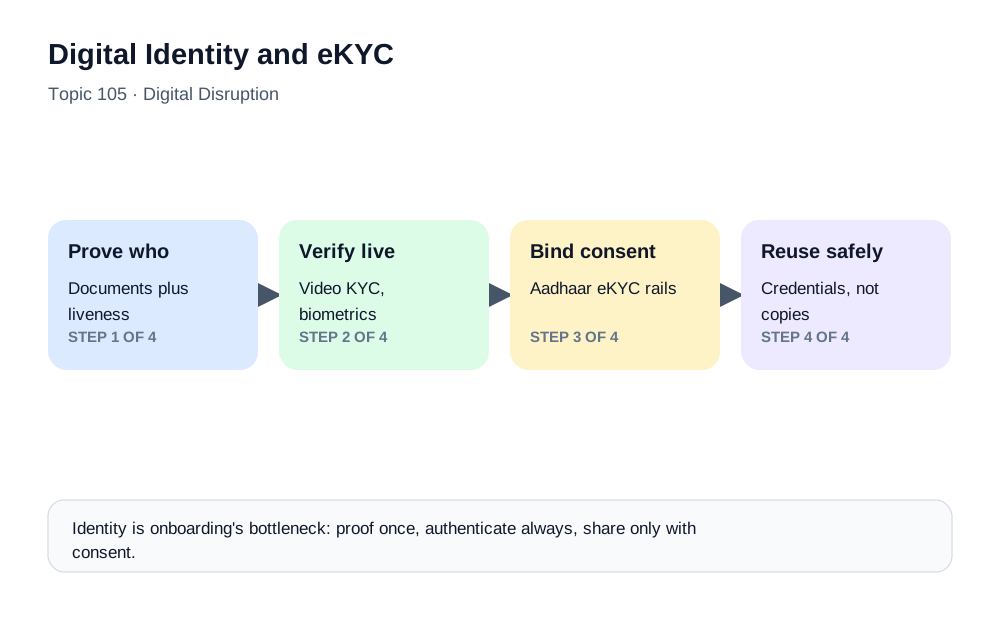
Digital Identity and eKYC at a glance — Aadhaar eKYC, video KYC, biometrics, verifiable credentials.
Aadhaar eKYC, Video KYC, Biometrics, and Verifiable Credentials
Digital identity is a foundational capability in modern banking because institutions need reliable ways to establish customer identity, authenticate access and connect authority to financial actions. India's Aadhaar ecosystem has materially expanded digital identity infrastructure and supports permitted authentication and eKYC use cases, but the number of bank accounts attributable to one identity mechanism is not a stable universal measure of success. Video-based identification, device authentication, biometrics and emerging verifiable-credential models can reduce friction when used under the applicable legal, privacy and banking-control framework.
The importance of identity verification in banking cannot be overstated, as it serves multiple critical functions throughout the customer relationship and the broader financial system. Every account opening requires verification of customer identity before deposits can be accepted, satisfying both regulatory requirements designed to prevent money laundering and fraud prevention needs that protect the institution and its customers. Anti-money laundering and Know Your Customer regulations mandate that financial institutions verify and maintain records of customer identities, with severe penalties for non-compliance that can include fines, license restrictions, and criminal charges for responsible executives. Credit assessment depends on confirming identity before extending credit to prevent fraud and ensure that credit histories are correctly attributed to the right individuals rather than fraudsters using stolen identities. Transaction security requires authentication of every digital transaction to ensure that only authorized users can access accounts and move funds, protecting against account takeover and unauthorized transfers. Regulatory reporting to Financial Intelligence Units and tax authorities depends on accurate identification of the parties to financial transactions, creating accountability in the financial system and enabling law enforcement to trace illicit funds.
KYC has progressively adopted digital documents, authorised electronic verification, remote customer-identification processes and automated checks, reducing dependence on branch-based paper handling for many eligible customers. The permitted method and required evidence depend on the institution, customer, product and current regulatory framework. Processing time can vary substantially when exceptions or enhanced review are required. Verifiable credentials may further reduce repeated disclosure in suitable use cases, but they do not remove the need for a bank to determine whether the credential and assurance level satisfy its legal and risk requirements.
Aadhaar eKYC operates through a straightforward but powerful process that has transformed banking access in India and enabled unprecedented financial inclusion. When a customer provides their Aadhaar number for identity verification, authentication proceeds through either biometric verification using fingerprints or iris scans at physical points, or through One-Time Password sent to the Aadhaar-linked mobile number. The Unique Identification Authority of India confirms the identity against its centralized database and returns KYC data including name, address, date of birth, photo, and gender to the requesting bank through secure channels. The account can then be opened or KYC completed without any paper documents required, dramatically reducing friction and cost while maintaining security standards that satisfy regulatory requirements.
Aadhaar has become a major component of India's digital identity infrastructure and has supported financial inclusion and digital service delivery alongside Jan Dhan accounts, mobile connectivity and other policy and payment initiatives. Enrolment, authentication and account statistics change continuously and should be taken from current UIDAI, RBI or government sources when needed. Digital verification can reduce document handling and operating cost, but there is no universal per-customer cost or processing-time figure because institutions use different journeys, risk checks and exception processes.
Use of Aadhaar is governed by the Aadhaar Act, associated regulations, judicial decisions and the rules applicable to the requesting entity and use case. The legal position has evolved, including significant Supreme Court scrutiny of mandatory linkage and private-sector use. Banks and other entities must use only authorised Aadhaar authentication or offline-verification arrangements for which they are eligible and must follow applicable consent, security, masking, storage and record-handling requirements. It is not accurate to reduce the framework to a rule that every bank must be an Authentication User Agency or that all Aadhaar numbers can simply be discarded after KYC; the exact handling depends on the permitted method and operative requirements.
Video KYC, approved by the Reserve Bank of India in 2020, addresses the need for remote account opening while maintaining security standards equivalent to in-person verification. This process involves live video interaction between the customer and a bank official, during which the official verifies identity documents such as PAN or Aadhaar cards displayed on camera. Liveness detection technologies ensure that the customer is physically present rather than displaying a photograph or video recording of someone else, preventing spoofing attacks. Geo-tagging records the customer's location during the verification, creating an audit trail and preventing location spoofing that might obscure the true origin of the application. The entire video call is recorded and stored for audit purposes and dispute resolution, providing evidence of the verification process. While artificial intelligence can assist with face matching and document verification to improve accuracy and efficiency, regulations require human presence and oversight throughout the process to ensure accountability.
Biometric characteristics such as fingerprint, face, iris and voice can provide strong authentication signals, but no biometric method is universally the most secure for every banking context. Accuracy and spoof resistance depend on sensors, algorithms, thresholds, liveness controls, device security and population characteristics. Device biometrics, central biometric authentication and remote face matching also have different trust models. Behavioural biometrics can add continuous risk signals, but these are probabilistic indicators that should be combined with other evidence rather than treated as conclusive identity proof.
Biometric authentication faces several challenges that the industry continues to address through technological advancement and procedural safeguards. Spoofing attempts using fake fingerprints, photographs, or deepfake videos require sophisticated detection capabilities that are constantly evolving to stay ahead of attackers. Liveness detection must reliably distinguish real persons from photographs, videos, or synthetic representations that attempt to fool the system, using challenges like blinking or head movements that are difficult to fake. Accessibility concerns arise for manual laborers whose fingerprints may be worn from work or elderly individuals with faint prints due to thinning skin, requiring alternative verification methods that do not exclude these populations. Most fundamentally, biometric data represents the most sensitive category of personal information because it cannot be changed if compromised—a stolen password can be reset, but a stolen fingerprint is compromised forever. This requires the highest standards of protection against misuse or breach, including encryption, secure storage, strict access controls, and legal penalties for unauthorized use.
Verifiable credentials represent the emerging future of digital identity, addressing limitations of current systems while preserving their benefits and adding new privacy protections. These digital versions of identity documents can be cryptographically verified without requiring the verifier to access or store the underlying data, reducing privacy risks. Instead of sharing raw personal data, individuals can prove specific claims—such as being over eighteen years of age, residing in a particular state, or holding a valid driving license—without revealing their actual date of birth, full address, or license number that could be misused. This approach supports self-sovereign identity models where individuals maintain control over their own identity data rather than depending on centralized repositories that create single points of failure and surveillance risks.
DigiLocker, India's government-backed digital document repository, provides a foundation for verifiable credentials in banking and other applications that require document verification. The platform holds over two hundred million users' documents including Aadhaar, PAN, driving licenses, educational certificates, and vehicle registrations that are commonly required for various services. Banks can verify these documents directly from DigiLocker through API integration, eliminating the need for customers to provide physical copies or scanned images that could be forged or tampered with. This integration streamlines KYC processes while maintaining document authenticity through government-backed verification and digital signatures that cryptographically prove the document's validity. As verifiable credential standards mature, DigiLocker is positioned to become a source of cryptographically verifiable claims that can be shared selectively and verified instantly without revealing unnecessary information.
The trajectory of digital identity in banking points toward systems that are simultaneously more secure and more privacy-preserving than current approaches, addressing the legitimate needs of both financial institutions and consumers. The combination of Aadhaar's universal coverage, Video KYC's remote capabilities, biometric authentication's security, and emerging verifiable credentials technologies creates a comprehensive identity infrastructure that supports financial inclusion while protecting individual rights. As these technologies mature and standards converge across institutions and jurisdictions, the friction of identity verification will continue to decrease while security standards improve, enabling even more seamless and secure banking experiences for consumers while giving them greater control over their personal information and how it is used.
<!-- MBA-DEEP-DIVE-START -->Digital Identity in Banking — Identity Proofing, Authentication, Consent, and Lifecycle Control
Digital identity is not one credential
A banking identity is the collection of evidence and controls that allow an institution to decide who a person or organisation is, what relationship they hold, and whether a particular action is authorised. A passport, Aadhaar credential, PAN, driving licence, corporate registration record, mobile number, device binding, password and biometric are not interchangeable. Each proves or supports a different fact.
Identity proofing is the process used to establish an identity at onboarding or another significant event. Authentication is the process used later to establish that the person or system attempting access is the legitimate holder of that identity. Authorisation decides what the authenticated identity may do. Keeping these concepts separate prevents weak design. A customer can be strongly authenticated but still lack authority to operate a corporate account, and a genuine identity document does not prove that the person presenting it online is the document holder.
Banks therefore build digital identity as a chain: collect permitted evidence, validate it, bind the verified customer to credentials or devices, apply permissions, monitor changes, and maintain the relationship over time.
KYC is broader than identity verification
Know Your Customer is often reduced to checking a document, but a bank's customer-due-diligence process can include legal identity, address or other attributes, beneficial ownership for legal persons, purpose of the relationship, expected activity and risk classification according to the applicable framework.
Digital identity technology can make these steps faster, but it does not remove the need to interpret the result. An identity may be genuine while the proposed relationship still requires enhanced review because of ownership complexity, sanctions concerns, geography, product risk or other factors.
This distinction matters operationally. A digital onboarding system should not present “identity verified” as equivalent to “customer fully approved” unless every required control has actually completed. Status models should distinguish document validation, identity match, screening, risk assessment and final account decision.
Identity proofing should use evidence appropriate to risk
Different products and customers create different consequences if identity is wrong. Opening a low-value product under controlled limits can have different risk from establishing a high-value private-banking relationship or granting administrator rights to a corporate treasury user.
Risk-based identity proofing can combine authoritative data sources, documents, database checks, live interaction, device signals and other evidence permitted by law and policy. Stronger proofing may be required when evidence conflicts or the product has greater financial impact.
The goal is not to collect the maximum amount of data. Excessive data creates privacy and security burden. The goal is to collect enough reliable evidence to reach the required assurance level and retain only what the bank needs for its legal and operational purposes.
Digital onboarding should separate data capture from data verification
A customer may type a name and address into an application, scan a document, or consent to retrieve data from an approved source. These are input methods, not proof by themselves. Verification asks whether the evidence is authentic, current, belongs to the applicant and satisfies the product requirements.
Structured data retrieval can reduce manual entry errors, while document scanning can improve convenience. But source reliability, expiry, tamper detection and matching rules remain important. If the name in one source differs from another, the system should handle the difference transparently rather than silently force a match.
Operations teams need explainable exception reasons. “KYC failed” is too broad. “Document expired,” “face does not match document,” “authoritative record unavailable,” or “name requires review” allow the right team to act.
Aadhaar is an identity infrastructure with specific permitted uses
Aadhaar provides a unique identity framework in India and supports authentication and identity-related services under the Aadhaar legal and regulatory framework. Financial institutions should use Aadhaar only through permitted methods and entities, with the required consent, security and data-handling controls.
The important banking lesson is not that Aadhaar replaces all KYC. It is that digital identity infrastructure can reduce repetitive document handling when a regulated institution can rely on an authorised verification process. Depending on the customer, product and applicable RBI KYC requirements, other officially valid documents, digital documents or verification methods may also be used.
Banks should avoid designing processes that expose the Aadhaar number unnecessarily. Masking, tokenisation or other approved mechanisms can reduce sensitive identifier exposure. Staff and application logs should not display more identity data than required for the task.
Consent should be specific enough to mean something
A generic checkbox saying “I agree” is weak evidence if the customer cannot understand what data will be accessed and why. Digital identity journeys should make the purpose of consent clear and record when and how it was obtained.
Consent does not automatically authorise every later use of identity data. A bank may need to retain certain records under law even after a customer relationship ends, while optional reuse for unrelated analytics or marketing can have different requirements. Product, privacy and compliance teams should distinguish these purposes.
Revocation also needs an operational meaning. If a permission controls future access to an external identity or data service, revocation should stop future retrieval where applicable. It does not necessarily erase records the bank is legally required to retain.
Video-based customer identification is a controlled verification process
Video customer identification allows eligible customers to complete specified verification steps remotely. The exact process should follow the current regulatory requirements applicable to the institution, including permitted technology, official interaction, evidence capture and records.
From an operating perspective, the bank needs to establish that the interaction is live, that the applicant matches the identity evidence, and that the process has not been manipulated. Technology can support face comparison, document checks, location or session controls where permitted, but accountable staff or approved process controls remain important where regulation requires them.
The recording and associated data are sensitive evidence. Access, retention, encryption and retrieval should be governed. A video record should not become a general-purpose customer-service recording simply because it already exists.
Liveness detection is an anti-spoofing control, not proof of identity on its own
Liveness mechanisms attempt to distinguish a live person from a photograph, replayed video, mask or synthetic presentation. They can use passive analysis, active challenges, depth information or other techniques.
A successful liveness result says something about the presentation, not necessarily the person's legal identity. The bank still needs to match the live person to trusted identity evidence. Conversely, a liveness failure may be caused by poor camera quality, accessibility issues or network conditions rather than fraud.
Thresholds should therefore be tested across real customer populations. Very aggressive settings can exclude legitimate users; weak settings can permit spoofing. Exception handling and alternative verification paths are part of inclusive security design.
Biometrics are powerful authenticators but have unique risk
Fingerprint, face, iris and voice characteristics can support authentication because they are linked to the person rather than something memorised. They are not automatically “the most secure” method in every context. Security depends on sensor quality, template protection, matching thresholds, spoof resistance, device security and the consequences of false acceptance or false rejection.
Unlike a password, a biometric characteristic cannot simply be reissued if the underlying template is compromised. Systems should therefore protect templates carefully and, where possible, keep biometric matching inside trusted devices or protected services rather than distributing raw biometric data widely.
Banks should also provide alternatives for customers who cannot use a particular biometric reliably. Accessibility is a control requirement because forcing customers into repeated failed biometric attempts can push them toward unsafe support workarounds.
Device biometrics and central identity biometrics are different models
When a mobile banking app uses fingerprint or face unlock provided by the customer's phone, the bank often receives a device-level assertion that local authentication succeeded rather than receiving the customer's raw fingerprint or face image. This can reduce biometric-data handling by the bank.
A central biometric identity system has a different trust and privacy architecture. The system may authenticate against an authoritative biometric record under specific legal rules. Product teams should not describe both simply as “biometric login” because the evidence, storage and responsibility differ.
Understanding this distinction helps security teams decide what happens when a device is replaced, a biometric is re-enrolled, or the customer reports compromise.
Multi-factor authentication works by combining independent factors
Authentication factors are commonly described as something the user knows, something the user has, and something the user is. Strong multi-factor design combines independent evidence so compromise of one factor does not immediately grant access.
A password and two security questions are not strong independent factors if both rely on knowledge that can be stolen together. A device-bound cryptographic key plus local biometric may provide a different security model. One-time passwords can add protection but remain vulnerable to phishing and social engineering when the customer is tricked into disclosing or approving them.
Banks should choose authentication according to transaction risk and channel capability rather than using one method forever simply because customers recognise it.
Transaction authentication should bind the customer to what is being approved
Authenticating login proves access to the session. High-risk actions can require additional confirmation tied to the transaction. The customer should understand the beneficiary, amount or other material action being authorised.
This reduces the risk that malware or social engineering changes transaction data after login. Dynamic transaction confirmation, secure in-app approval or cryptographic signing can strengthen the link between customer intention and the payment instruction.
The design should also handle changes. If the beneficiary or amount changes after approval, the prior authorisation should not silently remain valid unless the product's approved control model supports it.
Corporate digital identity includes organisation and mandate
For business banking, identifying the human user is only part of the problem. The bank must establish which legal entity the user represents and what authority that person has.
A corporate administrator may create other users, a maker may prepare payments, and a signer may approve within specified limits. These rights can come from corporate mandates, board authority or delegated administration under the bank's product terms.
Digital identity architecture should therefore link person, organisation, role, account and limit. A user moving to another department should not automatically retain old payment authority. Periodic access review and corporate administrator controls help keep entitlements current.
Beneficial ownership is an identity relationship, not a login problem
Legal entities can be owned or controlled through complex structures. Digital onboarding may retrieve company-registry information, but the bank still needs to identify and verify beneficial owners according to applicable requirements and understand control relationships.
This information can change over time through share transfers, mergers or governance changes. Event-driven data sources can help, but the bank needs a review process when ownership changes are detected.
A corporate digital identity solution that verifies only the employee operating the account does not satisfy the broader customer-due-diligence need for the legal entity.
Identity lifecycle management continues after onboarding
Customers change names, addresses, phone numbers, devices, directors and ownership. Identity documents expire. Risk classifications change. Credentials are reset. A sound identity programme manages these events throughout the relationship.
Some changes can be self-service with appropriate authentication. Others may require fresh evidence. A mobile-number change deserves strong control because the number may be used for authentication or alerts. A corporate signatory change can directly affect payment authority.
Systems should preserve history so investigators can establish which identity attributes and credentials were active at the time of a disputed transaction.
Credential recovery is often the weakest authentication path
Attackers frequently target password reset, SIM replacement, device migration and account recovery rather than the normal login flow. If a customer can reset strong authentication using weak personal questions, the overall system is only as strong as the recovery process.
Recovery should use evidence proportionate to the access being restored. High-risk cases may require additional verification or temporary restrictions. Notifications to existing trusted channels can alert customers to unauthorised recovery attempts.
Support agents need clear procedures because social engineering often targets call centres. An urgent story from a caller should not bypass identity controls without approved escalation.
SIM-swap risk changes how banks should think about mobile numbers
A mobile number is useful for communication and can support authentication, but control of the number can be transferred through the telecommunications ecosystem. SIM-swap or number-porting fraud can allow criminals to receive messages intended for the customer.
Banks can use additional device and behavioural signals rather than treating possession of an OTP as conclusive identity. High-risk actions following a recent device or contact change may justify additional review.
The bank should also avoid exposing full account or security information in messages that may be visible on a locked phone or redirected channel.
Passkeys and phishing-resistant authentication change the credential model
Modern cryptographic authentication can bind credentials to a device or authenticator and verify the legitimate service domain, reducing the usefulness of stolen passwords. Passkeys and related standards can therefore improve resistance to phishing when implemented correctly.
Banks still need recovery, device enrolment, revocation and cross-device policy. A customer with several devices may hold several credentials. If one device is lost, the bank needs to revoke its access without unnecessarily blocking every other trusted device.
Migration should also consider customers who do not have compatible devices. Stronger technology should not create financial exclusion.
Digital identity data should follow minimisation principles
Identity systems often collect highly sensitive information. Every retained copy increases security and privacy risk. Banks should decide which fields are necessary for regulatory evidence, fraud controls and servicing, and avoid duplicating raw documents or biometrics across unrelated systems.
Masking can reduce exposure in operations screens. Tokenised identifiers can allow internal linkage without displaying the underlying national identifier. Lower environments should use synthetic or appropriately protected data rather than uncontrolled copies of production identity records.
Data lineage should show where identity evidence flows so deletion, correction, retention and incident response can be managed accurately.
Document authenticity and person authenticity are separate checks
A genuine passport can be stolen. A live person can present a forged document. Digital onboarding therefore needs to consider both document authenticity and the relationship between the document and the applicant.
Document checks can examine security features, machine-readable data and issuer-supported verification where available. Face matching can compare the applicant with the document image. Additional data can help identify inconsistencies.
No automated signal should be treated as infallible. Confidence thresholds, source quality and manual review for ambiguous cases remain important.
Verifiable credentials can reduce repeated disclosure
A verifiable credential is a digitally signed assertion issued by a trusted party that can be checked cryptographically. Instead of every bank storing a scan of the same document, a customer could present a credential proving a required fact, subject to the legal and technical framework.
Selective disclosure can allow proof of an attribute without sharing unrelated data. For example, a service may need proof that a customer is above a threshold age without needing the complete date of birth for that particular purpose.
These models can improve privacy and portability, but trust still depends on the issuer, revocation status, governance and accepted standards. Cryptographic validity does not tell the bank whether the credential satisfies a particular regulatory requirement.
Digital wallets for credentials need recovery and revocation
If customers hold identity credentials in digital wallets, the ecosystem must handle lost devices, compromised wallets and revoked credentials. An issuer may need to indicate that a credential is no longer valid, while verifiers need a reliable way to check current status without undermining privacy goals.
Recovery should not create a simple central backdoor that defeats the decentralised design. The exact solution depends on the identity architecture, but operational support is as important as cryptography.
Identity federation reduces repeated login but creates trust dependencies
Federated identity allows one trusted identity provider to authenticate a user for another service. Banks use federation internally and sometimes in customer or partner ecosystems.
The receiving service should understand the assurance level and attributes contained in the assertion. A successful login from an external identity provider does not automatically mean the user is authorised for a high-risk banking action.
Federation can also create concentration. If the central identity provider is unavailable, many services may become inaccessible. Resilience and emergency access therefore belong in the identity design.
Machine identities are part of digital identity too
APIs, microservices, bots and devices act on banking systems without a human entering a password. These machine identities need credentials, ownership, rotation and least privilege.
A payment service calling the core ledger should be identifiable as that service, not as a generic shared technical account. Certificates, workload identities or managed credentials can establish the machine relationship.
When a service is retired, its credentials should be revoked. Forgotten machine identities are a common source of hidden access.
Identity monitoring should detect impossible or unusual transitions
Authentication logs provide useful security context. A customer who appears to log in from distant locations within an impossible time, a service account used interactively, or a privileged user accessing systems outside normal patterns can justify investigation.
Behavioural analytics should support rather than replace deterministic controls. Unusual does not always mean malicious; travel, accessibility tools and changing work patterns can create legitimate anomalies. Risk signals should be combined with transaction and device context.
Identity evidence supports investigations and customer disputes
When a customer disputes a digital transaction, the bank may need to reconstruct the identity chain: which device was registered, which authentication method succeeded, whether credentials were reset, what transaction details were shown, and how approval was recorded.
This evidence should be understandable to investigators rather than scattered across unrelated logs. Correlation identifiers and consistent timestamps help connect authentication with the financial event.
Evidence retention should follow applicable legal and operational requirements. Keeping every technical log forever is neither necessary nor necessarily lawful.
Identity failures need customer-friendly exceptions
False rejection can cause real harm. A customer may urgently need access but fail face matching because of lighting, age-related change, disability or camera quality. A document may be valid even though automated extraction fails.
Banks should provide alternate verification routes proportionate to risk. The objective is secure inclusion: do not weaken identity proofing, but do not design a single technical path that excludes legitimate customers with no recourse.
Exception statistics can reveal bias or usability problems and should feed model and process improvement.
A practical scenario: new device plus high-value beneficiary
Suppose a customer enrols a new device and immediately creates a new beneficiary followed by a high-value transfer. Each action may be individually valid, but the sequence creates additional risk.
The identity system can provide device-enrolment age and authentication context to the fraud engine. The payment system can apply step-up authentication or temporary controls according to policy. If the customer confirms the activity through a trusted channel, the transaction can proceed; if evidence suggests takeover, credentials and payments can be restricted.
The important point is that digital identity does not stop at login. It provides context throughout the transaction lifecycle.
Digital identity maturity means reducing friction without weakening assurance
The strongest banking identity systems make legitimate access easier because evidence is reusable, data is captured accurately, authentication is phishing-resistant, and exceptions are handled intelligently. At the same time, they preserve clear authority, consent, privacy and auditability.
Digital identity is therefore not a single Aadhaar call, biometric or video process. It is a lifecycle that joins identity proofing, customer due diligence, authentication, authorisation, credential recovery, data protection and financial transaction evidence. When those pieces work together, banking can become both more accessible and more secure.
Digital Identity Deepening — Lifecycle, Control, and Banking Operations
Identity assurance should be matched to the consequence of error
A bank does not need the same level of identity assurance for every action. Viewing a product brochure, checking an indicative rate, opening a low-risk relationship, changing a registered mobile number, adding a high-value beneficiary and granting corporate payment authority all create different consequences if the person is not who they claim to be. Good identity architecture therefore connects the strength of proofing and authentication to the risk of the event. That reduces unnecessary customer friction for routine activity while preserving stronger controls for events that can move money, change ownership, alter security settings or create a regulated relationship. The design should be explicit about why a particular control exists. A stronger step should not be added simply because technology allows it; it should reduce a defined risk such as impersonation, account takeover, mandate abuse or synthetic identity creation.
Proofing, authentication and authorisation must remain separate in the data model
These three concepts are often blended in front-end language, but the bank needs them to remain distinct internally. Proofing establishes that the person or organisation corresponds to reliable identity evidence. Authentication establishes that the current user is the legitimate holder of the registered credential or device. Authorisation determines what that authenticated identity is permitted to do. A customer may pass authentication perfectly and still lack authority to approve a company payment. A corporate director may be an authorised signatory but fail authentication because the registered credential has been compromised. A clean data model lets fraud, operations and investigations understand which part of the chain failed rather than receiving a generic “identity problem” status that hides the real control point.
Identity lifecycle events are as important as onboarding
Most identity programmes invest heavily in account opening, but risk continues throughout the customer relationship. Names change, addresses change, directors leave, beneficial owners change, documents expire, phones are replaced, SIMs are reissued and passwords are reset. Each event can alter the level of assurance the bank has about the relationship. The bank should classify lifecycle changes by risk and define which can be completed through self-service, which require additional authentication and which require fresh evidence or manual review. A registered mobile-number change deserves particular care because the number may be used for alerts or recovery. A corporate-signatory change affects legal authority. Keeping effective dates and historical values allows investigators to reconstruct what the bank knew and which credentials were active when a disputed transaction occurred.
Re-KYC should be an evidence refresh, not a ceremonial repetition
Periodic or event-driven review should focus on whether customer information remains accurate, complete and appropriate for the relationship. Repeating the original onboarding screens without considering changed risk provides little value. Banks can use reliable data sources, customer confirmation and triggered review when material changes occur, subject to applicable regulatory requirements. A change in ownership, unusual product use, repeated failed identity checks or inconsistent address information can justify deeper review than an unchanged low-risk relationship. The operational objective is to maintain a current customer record while avoiding unnecessary collection. A well-designed review process also preserves the reason for each update so auditors can distinguish a customer correction from a bank-generated enrichment or an externally sourced change.
Recovery controls often determine the real strength of authentication
A banking login can use strong cryptography and still be vulnerable if account recovery relies on weak questions or easily manipulated support processes. Attackers frequently target forgotten-password flows, device migration, contact-detail changes and call-centre reset procedures because those routes may bypass the normal authentication stack. Recovery should therefore be designed as part of the primary security model. The evidence required should reflect what access is being restored. A low-risk read-only session can have a different recovery path from restoring the ability to make high-value payments. Notifications to existing trusted channels, cooling periods for sensitive changes and enhanced review after repeated failed recovery attempts can reduce takeover risk without preventing legitimate customers from regaining access.
Device identity provides useful context but should not become customer identity
Banks increasingly bind mobile applications to devices and collect signals such as device keys, operating-system integrity, application version and previous usage. These signals are valuable because a familiar trusted device can lower risk while a newly enrolled or compromised device can raise it. However, the device is not the customer. Families may share hardware, customers replace phones, corporate users work across approved devices and fraudsters can sometimes obtain access to legitimate devices. Device information should therefore strengthen the overall evidence rather than replace personal or organisational identity. The bank should also know when a device credential was issued, when it was revoked and which transactions used it, because that timeline can become decisive during a fraud investigation.
Transaction signing should communicate exactly what is being approved
Authentication at login does not automatically prove customer intent for every later action. High-risk payments or mandate changes can benefit from approval that is bound to the transaction details. The customer should see the beneficiary, amount, currency or other material information before confirming. If those details change after approval, the prior confirmation should not silently remain valid unless the product design explicitly supports that behaviour. This is especially important when malware or social engineering attempts to substitute a beneficiary after the customer has authenticated. Strong customer experience is not only about adding another factor; it is about making the meaning of the approval clear enough that the customer and the bank can later demonstrate what was authorised.
Corporate identity requires a graph of people, entities, roles and limits
Business banking identity is structurally more complex than consumer identity. The bank needs to understand the legal entity, beneficial owners, directors, administrators, operators, signatories and delegated users. A single person can hold different roles across several companies, and each role can carry different account permissions and limits. The system should therefore link the human identity to the organisation and to specific authorities rather than storing a generic “business user” flag. Maker-checker rules, dual approval, account restrictions and transaction thresholds depend on this graph. When a person leaves the company or changes role, access should be removed without destroying historical evidence that the person previously acted legitimately on behalf of the organisation.
Beneficial ownership information should be treated as living relationship data
Ownership structures can change after onboarding through share transfers, mergers, reorganisations or changes in control. A bank that verifies beneficial owners once and never revisits the relationship can become dependent on stale information. Event-driven sources may help identify changes, but the institution still needs a controlled process to assess whether new evidence alters customer risk or requires refreshed verification. Complex structures also demand clear lineage. Operations should be able to see how the bank concluded who ultimately owns or controls the entity rather than receiving only a final name with no supporting chain. This becomes important for sanctions, tax, anti-money-laundering and credit decisions where ownership relationships can affect obligations and risk.
Identity data quality should be measured before it reaches downstream systems
Small defects in identity data can propagate across many banking processes. A truncated legal name can create sanctions-screening noise. An incorrectly parsed date of birth can cause false matches or missed matches. A company identifier stored in the wrong field can break regulatory reporting or reconciliation with external registries. Identity platforms should therefore validate format, source, confidence and effective date at capture. Where different sources disagree, the system should preserve the conflict rather than silently overwriting one value. Downstream systems should know whether a field was customer-declared, document-extracted, retrieved from an authoritative source or manually corrected. That provenance helps investigators and auditors assess the strength of the evidence.
Digital identity should support inclusion through controlled alternatives
Strong security should not assume every legitimate customer has the same device, biometric quality, connectivity or digital confidence. Fingerprints can be difficult for some customers, facial matching can be affected by camera quality or physical change, and some users may not possess a modern smartphone. A secure design therefore provides alternative routes that preserve assurance without forcing the customer into an unsafe workaround. The alternative may involve assisted verification, another credential, a branch process or additional evidence depending on the product and local rules. Exception rates should be monitored by customer segment and channel. If one control disproportionately rejects legitimate customers, the institution should investigate whether the threshold, capture process or fallback design needs improvement.
Privacy engineering belongs inside identity architecture
Identity data is among the most sensitive information a bank holds. Security alone is not enough; the bank should minimise collection, restrict reuse and control visibility according to purpose. Operations staff may need to know that an identity check passed without seeing the complete underlying document. A fraud system may need a tokenised identifier rather than the national identity number itself. Test environments should not receive uncontrolled copies of real identity evidence. Retention should follow legal and operational requirements, and data lineage should show where copies exist so correction, deletion or incident response can be managed. Privacy is strongest when the architecture reduces unnecessary exposure rather than relying only on policy statements after the data has already spread across systems.
Third-party identity services create dependency and concentration risk
Banks commonly use external document-verification, biometric, device-intelligence, registry or data-retrieval services. These services can improve speed and accuracy, but the bank remains responsible for understanding how the outsourced control affects its regulated process. Vendor due diligence should cover availability, security, model performance where relevant, data handling, subcontractors, geographic processing and change management. A provider outage should not leave the bank unable to identify which applications are pending or whether a verification request completed. Where a single supplier supports several critical onboarding steps, concentration should be visible in resilience planning. Contractual service levels matter, but operational fallbacks and decision ownership matter more during a real incident.
Identity APIs need explicit status semantics
An API response such as 200 OK confirms that a technical request was processed; it does not necessarily mean identity verification succeeded. Identity services should return clear business outcomes such as verified, rejected, inconclusive, expired evidence, source unavailable or manual review required. The bank should also distinguish retryable technical failure from a substantive identity mismatch. Without this separation, channels may automatically retry a rejected case or incorrectly tell the customer that verification failed when the external source was simply unavailable. Correlation identifiers should link the customer journey, identity request, provider response and final account decision. This makes exception management and investigation much more reliable than searching separate systems by name or timestamp.
Fraud monitoring should use identity change as transaction context
Identity events can materially change the risk of later payments. A newly enrolled device, recently changed phone number, password reset, beneficiary creation and high-value transfer occurring in a short sequence can be more suspicious than any one event alone. Fraud systems should therefore receive relevant identity lifecycle context, not only the final authentication result. The model or rule engine can then apply step-up controls or review according to policy. Care is needed to avoid treating every change as fraud; genuine customers replace phones and update details every day. The value comes from combining the event with transaction amount, beneficiary novelty, device history and other risk signals.
Investigations need a reconstructable identity trail
When a customer disputes a transaction, investigators should be able to answer a sequence of concrete questions: which identity was registered, which device or credential authenticated, whether recovery or contact details had recently changed, what transaction details were displayed, which approval was recorded and what the payment system did afterwards. These facts may sit in different technical platforms, so common identifiers and consistent timestamps are important. The evidence should be understandable to an investigator who is not a developer. A giant unstructured log is less useful than a clear timeline. Good identity evidence can protect a genuine customer from account takeover and can also demonstrate when a correctly authenticated customer authorised the disputed action.
Identity controls should degrade safely during outages
An identity provider outage should not force teams to choose between stopping every customer and bypassing controls. Product design should define what can continue in degraded mode. Existing authenticated customers may retain limited service while new onboarding or sensitive changes are paused. Cached or previously verified data can sometimes support servicing, but the bank should know its age and permitted use. Manual override should be exceptional, authorised and auditable. Once service recovers, queued requests and temporary restrictions need reconciliation so no application or credential change is lost. Resilience therefore includes business rules for degraded identity service, not only redundant servers.
A practical scenario: contact change followed by payment authority
Consider a corporate customer whose administrator changes a registered mobile number, enrols a new device and then attempts to add a new payment approver. Each request may arrive through valid credentials. A mature identity platform evaluates the sequence, not just the individual calls. The contact change may trigger stronger verification or a cooling period. The new device can be recorded with its enrolment age. The role change should be checked against the company mandate and existing administrator authority. If the evidence is consistent, the customer can proceed. If the sequence conflicts with expected behaviour, the bank can hold the change for review before any money is moved. This shows how digital identity supports the whole operating model rather than functioning as a one-time KYC gate.
The strongest identity design makes accountability clearer as technology becomes simpler
Customers increasingly expect identity checks to feel almost invisible. That is possible only when the bank has stronger internal evidence, not weaker evidence. A well-designed identity service can reduce repeated document requests, use trusted digital sources, bind credentials securely and make routine authentication fast. Behind that simplicity, the institution should still know which evidence established the identity, which control authorised the action, who owns an exception and how the decision can be reconstructed. Digital identity succeeds when it reduces friction for legitimate customers while making impersonation, unauthorised access and hidden responsibility harder.
<!-- MBA-DEEP-DIVE-END -->