Visual overview
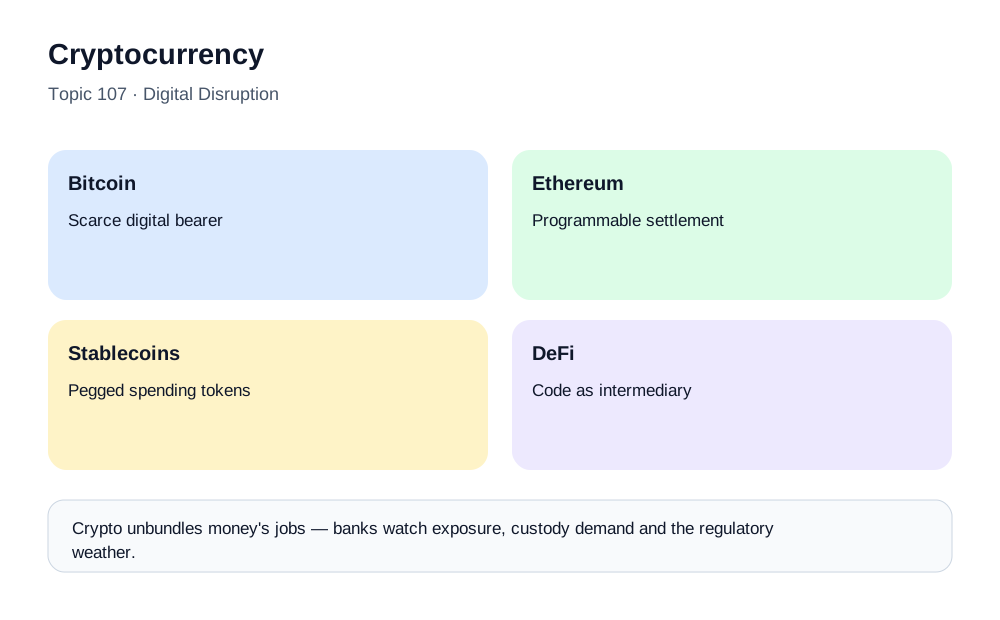
Cryptocurrency at a glance — Bitcoin, Ethereum, stablecoins, DeFi, regulatory debate.
Bitcoin, Ethereum, Stablecoins, DeFi, and the Regulatory Debate
Cryptocurrency has evolved from a technical experiment into a significant global digital-asset market attracting institutional participation, regulatory attention and substantial speculative activity. Market capitalisation changes continuously and should be taken from current market data when needed rather than frozen in teaching content. Bitcoin, Ethereum, stablecoins and other token models serve different purposes and carry different risks, so banking analysis should distinguish the asset, network, issuer or protocol rather than treating cryptocurrency as one uniform form of money.
The cryptocurrency ecosystem includes native blockchain assets such as Bitcoin and Ether, fiat-referenced and other stablecoins, tokens issued by applications, and assets used in decentralised-finance protocols. Their market values change continuously. Bitcoin is often described by investors as a store-of-value asset, but that is a market narrative rather than a guarantee of inflation protection. Ethereum provides programmable smart-contract infrastructure, while other networks make different trade-offs in throughput, decentralisation, governance and application design. Stablecoins seek to maintain reference values through specific reserve or protocol mechanisms whose risks must be analysed separately.
Bitcoin operates through an elegant but energy-intensive process that has remained largely unchanged since its creation in 2009 by the pseudonymous Satoshi Nakamoto. When a user wants to send Bitcoin to another user, they sign the transaction with their private key to prove ownership and authorize the transfer. This signed transaction is broadcast to the Bitcoin network where miners compete to validate it and add it to the next block through the Proof of Work mechanism that requires solving computational puzzles. The block is added to the blockchain approximately every ten minutes, after which the recipient's wallet reflects the received Bitcoin. This transaction is irreversible—there are no chargebacks in the Bitcoin network, providing certainty to recipients but eliminating recourse for erroneous or fraudulent sends. Bitcoin's key properties include its decentralized nature with no central authority controlling the network, a fixed supply cap of twenty-one million coins creating deflationary characteristics that appeal to those concerned about inflation, pseudonymous addresses that are visible on the blockchain but not directly linked to real-world identities, and transaction finality that protects recipients from reversal.
Stablecoins have emerged as crucial infrastructure connecting cryptocurrency markets with traditional finance, enabling traders to move between volatile assets and stable values without leaving the crypto ecosystem or returning to fiat through regulated exchanges. Issuer-backed fiat-referenced stablecoins generally seek to maintain redeemability through reserve assets, but reserve composition, custody, redemption rights, liquidity and assurance arrangements differ by issuer and jurisdiction. It is therefore too simple to state that every token is backed one-for-one only by bank deposits and government securities or that solvency alone determines safety. Users and financial institutions should assess the issuer's legal obligation, reserve quality, redemption mechanism and current disclosures. Crypto-collateralized stablecoins like DAI are over-collateralized with cryptocurrency assets to maintain their pegs, using smart contracts to automatically manage collateralization ratios and liquidate positions if values fall too low. Algorithmic stablecoins attempt to maintain value through supply management mechanisms without full collateralization, though the collapse of UST in May 2022 demonstrated the risks of this approach when confidence is lost and death spirals occur.
Stablecoins matter for traditional banking because they enable faster and cheaper cross-border payments than traditional SWIFT transfers that can take days and charge significant fees, serve as the primary unit of account in decentralized finance applications that require stable values, provide store of value functions in countries with unstable currencies experiencing hyperinflation where citizens seek alternatives to collapsing local money, and offer potential for instant securities settlement that could transform capital markets by enabling immediate delivery versus payment. The growth of stablecoins has attracted significant regulatory attention due to concerns about financial stability if large stablecoin issuers fail, money laundering through pseudonymous transactions, and consumer protection for users who may not understand the risks.
Decentralized Finance, or DeFi, represents an ambitious attempt to replicate traditional banking services without intermediaries using smart contracts on blockchain platforms that execute automatically when conditions are met. Lending protocols like Aave and Compound replace bank savings accounts, allowing users to earn interest on deposited cryptocurrency assets with rates determined by supply and demand algorithms rather than bank decisions. Decentralized exchanges like Uniswap enable trading without centralized order books or custody, using automated market maker algorithms to determine prices based on pool ratios. DeFi insurance through Nexus Mutual provides coverage against smart contract failures that could result in loss of funds. Synthetic assets through Synthetix track the value of real-world assets like stocks and commodities without requiring direct ownership, enabling exposure to traditional markets through crypto infrastructure. DeFi operates through open-source code that anyone can audit for vulnerabilities, provides permissionless access allowing anyone to participate without approval from gatekeepers, and eliminates traditional intermediaries entirely through automated smart contracts.
However, DeFi carries significant risks that banking professionals should understand when assessing the sector and its potential impact on traditional finance. Smart contract bugs have led to hundreds of millions of dollars in losses when code errors are exploited by attackers or result in unintended behavior that locks funds or drains pools. Rug pulls occur when developers abandon projects and steal user funds, exploiting the pseudonymous nature of crypto to disappear with stolen assets. Regulatory uncertainty persists as most DeFi protocols operate in legal grey zones without clear compliance frameworks or consumer protections, leaving users without recourse when things go wrong. Liquidation cascades can occur when price drops trigger automated liquidations that further depress prices, creating feedback loops that amplify volatility. Many DeFi arrangements do not provide the same deposit protection, complaint channels or contractual recourse associated with regulated bank products, but legal rights and available remedies depend on the protocol, service provider, jurisdiction and activity. Users can face substantially greater responsibility for wallet security and smart-contract risk, and institutions should not assume that technical decentralisation eliminates identifiable operators or legal obligations in every case.
Traditional banks have responded to cryptocurrency with varying strategies reflecting different risk appetites, strategic assessments, and regulatory environments. Some institutions including BNY Mellon and Fidelity now offer custody services, holding cryptocurrency for institutional clients who want exposure without managing private keys and security themselves. Goldman Sachs and others have established trading desks to serve client demand for crypto trading and derivatives, treating it as an emerging asset class like any other. JPMorgan has created JPM Coin for internal settlement between institutional clients, using blockchain technology within a permissioned network rather than public cryptocurrencies. Major market infrastructure providers like DTCC and SIX Exchange are developing tokenized securities settlement using blockchain technology that could improve efficiency while maintaining regulatory compliance. However, many banks continue to avoid cryptocurrency entirely, refusing to open accounts for crypto-related businesses or process crypto transactions due to compliance concerns, reputational risk, and uncertainty about regulatory treatment.
Crypto-asset regulation varies materially across jurisdictions and has changed rapidly. The European Union has implemented the Markets in Crypto-Assets framework in phases, while the United States, India, China, Singapore, the United Arab Emirates and other jurisdictions use different combinations of securities, commodities, payments, tax, anti-money-laundering and bespoke crypto rules. Specific tax rates, licensing status, legal-tender treatment and agency responsibilities should be checked against current official sources before being quoted because these details can change. Banks should analyse the rule applicable to the precise activity—custody, trading, transfer, issuance, payments or investment—rather than rely on a generic country label such as 'crypto-friendly' or 'banned.'
India's treatment of virtual digital assets includes tax, anti-money-laundering and other legal requirements that have evolved over time, while RBI has repeatedly highlighted financial-stability and monetary concerns associated with unbacked private crypto assets. The Supreme Court's 2020 decision set aside the RBI circular that had restricted regulated entities from providing services related to virtual currencies, but that judgment did not make every crypto activity unregulated or automatically permissible. Current tax rates, reporting duties and regulatory treatment should be verified from operative Indian law and official guidance before implementation.
The cryptocurrency landscape continues to evolve rapidly, with institutional adoption gradually increasing even as regulatory uncertainty persists and market volatility remains high compared to traditional assets. Bitcoin and Ethereum have established themselves as enduring assets with substantial market capitalizations and developer ecosystems that suggest longevity beyond speculative bubbles. Stablecoins have proven their utility as bridges between traditional and crypto finance, facilitating billions in daily transaction volume. DeFi demonstrates both the possibilities and risks of decentralized financial services that operate without traditional intermediaries. The regulatory debate will shape how this asset class develops and integrates with traditional banking in coming years, determining whether cryptocurrency becomes a mainstream component of financial portfolios and payment systems or remains a niche speculative asset used primarily for trading and speculation.
<!-- MBA-DEEP-DIVE-START -->Cryptocurrency and Digital Assets — A Banking Risk and Operating Model
Digital assets should be classified before they are discussed as one market
The term cryptocurrency covers assets with very different economic and legal characteristics. Bitcoin is a native asset of its own public blockchain. Ether is the native asset used within the Ethereum network. Stablecoins are tokens designed to track a reference value such as a fiat currency. Security or asset tokens may represent a legal claim on an issuer or underlying asset. Governance tokens may provide protocol voting rights. Tokenised deposits can represent bank liabilities and are conceptually different again.
Banks should therefore avoid a single generic “crypto risk rating.” The first step is to identify what the asset represents, who issues or controls it, what rights the holder has, how it is transferred, where liquidity comes from, and what happens if the network or issuer fails. Those answers determine custody, market, credit, liquidity, operational and regulatory risk.
The technology layer and the financial claim should be separated. Two tokens can run on the same blockchain while representing completely different obligations.
Bitcoin combines a monetary asset with an open settlement network
Bitcoin operates without a central issuer. Transactions are authorised through cryptographic keys and validated under the network's consensus rules. The ledger is public, while addresses are pseudonymous rather than inherently tied to verified legal identities.
For a bank, the important operational consequences are different from ordinary deposit money. There is no central administrator that can reverse an erroneous native Bitcoin transfer. Private-key control determines the ability to spend. Transaction fees and confirmation timing can vary with network demand. Finality is based on the network's consensus and accumulated confirmations rather than a bank posting rule.
This does not mean a bank customer has no recourse against a regulated service provider. If a bank or custodian makes an operational error, contractual and legal responsibilities can still apply. The network's irreversibility and the service provider's accountability are separate questions.
Ethereum adds programmable execution to the asset layer
Ethereum supports smart contracts that can create tokens, lending protocols, exchanges and other applications. Users interact not only with the native asset but also with code that can hold and transfer value.
This creates additional risk. A transaction can be cryptographically valid yet interact with a flawed or malicious smart contract. Token permissions can allow an issuer to mint, freeze or upgrade assets. A decentralised application can depend on external price oracles, governance votes and administrative keys.
Banks evaluating Ethereum-based assets should therefore analyse both the network and the specific contract. “It is on Ethereum” is not equivalent to “it has Ethereum's risk profile.”
Private keys are operational authority
In conventional banking, account authority is managed through identities, entitlements and recoverable credentials. On public blockchains, control of a private key can directly control assets.
Institutional custody therefore uses stronger arrangements than an individual software wallet. Keys may be generated and protected in hardware security modules, distributed across multiple approval components, or controlled through multi-party computation. Policy engines can require multiple authorised approvals before a transaction is signed.
The bank also needs recovery. Key loss should not make customer assets permanently inaccessible, yet recovery powers should not allow one administrator to seize assets. Backup, quorum, emergency procedures and segregation of duties are core custody controls.
Hot, warm and cold custody represent different trade-offs
A hot wallet remains connected enough to sign transactions quickly, supporting customer withdrawals and trading. This convenience increases exposure to online attack. Cold storage keeps signing material more isolated, improving security but making transfers slower and operationally more complex. Institutions may use intermediate arrangements for different service levels.
Asset allocation between wallet tiers should reflect expected liquidity. Moving every asset into deep cold storage can make normal withdrawals difficult; leaving all assets online can create excessive attack exposure.
Transfers between tiers should be controlled and reconciled. The bank should know the on-chain address, customer entitlement, internal ledger balance and approval trail for every movement.
Custody is more than storing keys
A digital-asset custodian may need to support deposits, withdrawals, network upgrades, forks, token migrations, staking, corporate actions and suspicious-transaction controls. It must decide which assets and networks are supported and what happens to unsupported tokens sent to controlled addresses.
Customer books and records need to map on-chain holdings to beneficial ownership. Omnibus wallets can reduce operational overhead but make internal sub-ledger accuracy essential. Segregated addresses improve visibility but can increase network and key-management complexity.
Proof that the blockchain address holds an asset does not by itself prove which customer owns it. The internal ledger and legal custody terms provide that relationship.
Blockchain analytics is not the same as identity
Public ledgers provide transaction history, allowing analytics tools to identify patterns, known services and exposure to addresses associated with illicit activity. This information can support risk assessment.
An address label remains an analytical assertion, not necessarily legal proof of who controlled the key at a particular time. Risk scores can contain uncertainty and should be used within a governed compliance process.
Banks can combine blockchain analytics with customer due diligence, transaction context and source-of-funds information. The transparency of the ledger creates useful evidence but does not eliminate traditional financial-crime analysis.
Stablecoins are liabilities or mechanisms, not just stable prices
A stablecoin aims to maintain a stable reference value, but the method matters. Fiat-referenced tokens can be backed by reserves held by an issuer or custodian. Crypto-collateralised designs use other digital assets and liquidation rules. Algorithmic designs may rely more heavily on market incentives and linked tokens.
For an issuer-backed stablecoin, users are exposed to the quality, custody and liquidity of reserves, redemption terms, operational controls and legal structure. “One token equals one dollar” is an objective or promise, not a guarantee that every holder can always redeem instantly under every condition.
Banks should analyse stablecoin credit and liquidity risk much like other claims: who owes what to whom, under what terms, backed by which assets, with which redemption mechanism?
Stablecoin reserves need liquidity as well as nominal value
An issuer can hold high-quality assets and still face liquidity pressure if many holders seek redemption at once. Reserve duration, market liquidity, concentration, custody and access to banking rails all matter.
Attestation or audit reports can provide information about reserves, but users should understand the scope and date of the assurance. A report showing assets at one point in time does not guarantee future composition or eliminate operational risk.
Banking partners should also consider the flow of customer funds into and out of reserve accounts, segregation, authorised signers and contingency arrangements.
Stablecoins can improve settlement only when both ends accept them
A stablecoin can move on-chain quickly, but the end-to-end payment is not complete if the beneficiary needs conventional bank money and cannot redeem the token. Cross-border use therefore depends on liquidity, exchange, local regulation and access to banking systems.
The technology may shorten the transfer leg while foreign-exchange conversion or off-ramp settlement remains. Banks should measure the complete customer journey rather than only blockchain confirmation time.
For wholesale use, stablecoins or tokenised money can support delivery-versus-payment with tokenised securities, but legal finality and issuer risk still matter.
DeFi is a collection of protocols, not one institution
Decentralised finance uses smart contracts and public blockchain infrastructure to provide functions such as trading, collateralised borrowing, liquidity provision and derivatives. Some protocols have decentralised governance; others retain significant control with developers, foundations, multisignature administrators or token holders.
The label “DeFi” should therefore not be treated as proof that there is no intermediary or control point. Banks should examine governance, upgrade keys, oracle dependencies, front-end operators and asset issuers.
A protocol can be technologically decentralised in one dimension and economically concentrated in another, for example when a small group controls governance votes or liquidity.
Automated market makers replace an order book with a pricing function
An automated market maker lets users trade against pools of assets using a formula rather than matching each buyer with a seller. Liquidity providers deposit assets and earn fees, while traders alter the pool balance and therefore the quoted price.
This design creates risks such as slippage, smart-contract failure and loss relative to simply holding the assets. Large trades can move the pool price significantly when liquidity is shallow.
Banks do not need to adopt AMMs to understand them, but treasury, market-risk and digital-asset teams should know that liquidity mechanics differ from traditional central-limit order books.
DeFi lending is usually collateral-driven rather than ordinary bank credit
Many public DeFi lending protocols require borrowers to post digital assets worth more than the loan, allowing automated liquidation if collateral value falls. This is different from unsecured consumer or corporate lending based primarily on income, cash flow or credit analysis.
Interest rates can vary algorithmically with utilisation. During volatile markets, collateral prices can fall rapidly and trigger mass liquidations. Oracles become critical because the protocol needs trustworthy prices.
The absence of a traditional loan officer does not remove credit and liquidity risk; it changes how those risks are controlled.
Smart-contract risk can create losses without anyone stealing a password
A contract defect can allow unintended withdrawal, miscalculate collateral or lock assets permanently. Security audits can reduce risk but cannot prove absence of every vulnerability.
Protocols may offer bug bounties, formal verification or emergency pause mechanisms. Each introduces governance questions. Who can pause? Can they upgrade the contract? How quickly can users exit?
Institutional users should understand these controls before treating a smart contract as equivalent to a regulated counterparty.
Oracles can become systemic dependencies inside DeFi
A lending or derivatives protocol may depend on an external market price. If the oracle is stale, manipulated or unavailable, the protocol can liquidate healthy positions or fail to liquidate risky ones.
Oracle design can use multiple venues, time weighting or fallback sources, but each has trade-offs. A protocol's financial safety can therefore depend on infrastructure outside its own blockchain code.
This is a useful lesson for banking generally: automation is only as reliable as the data that drives it.
Governance tokens create decision rights with market incentives
Some protocols allow token holders to vote on parameters, upgrades or treasury spending. Voting power may be concentrated among founders, investors or large holders.
Banks evaluating governance exposure should ask whether a malicious or poorly informed vote can change collateral requirements, fees, oracle configuration or administrative rights. Governance attacks are an operational and financial risk, not merely a community-management issue.
Crypto exchanges create a traditional intermediary around decentralised assets
Centralised exchanges provide customer accounts, custody, order matching, fiat conversion and customer support. Users may hold a contractual claim against the exchange rather than directly control blockchain keys for assets shown in the account.
This introduces familiar risks: custody, fraud, liquidity, operational resilience, conflicts of interest and insolvency. The failure of a centralised exchange is different from failure of the underlying blockchain.
Banks servicing exchanges should therefore conduct due diligence on the legal entity and controls rather than assume all risk comes from crypto price volatility.
Market risk is unusually visible because digital assets trade continuously
Many crypto markets operate around the clock, creating price movements outside traditional market hours. Volatility can be substantial and liquidity can change quickly during stress.
Banks offering custody without principal exposure still face operational demands during market volatility because customer withdrawal and trading volumes can spike. Banks that provide financing, derivatives or market-making additionally face counterparty and market risk.
Limits and stress tests should reflect gap risk, concentration and the possibility that liquidity disappears when most needed.
Leverage can amplify crypto market stress
Derivatives and margin borrowing allow traders to hold exposure larger than their capital. Rapid price movement can trigger liquidation, which can push prices further and create cascades across venues.
A bank providing credit or settlement services to digital-asset firms should understand how those firms use leverage and where collateral is held. The client's balance sheet can deteriorate faster than daily reporting suggests.
Crypto assets do not provide automatic inflation protection
Bitcoin's issuance schedule is constrained by protocol rules, which is one reason some investors describe it as “digital gold.” A fixed or predictable supply does not guarantee purchasing-power stability. Price depends on demand, liquidity, regulation and market expectations.
Banks should avoid presenting speculative investment narratives as financial facts. Suitability and customer communications should distinguish protocol characteristics from claims about future returns.
Pseudonymity is not anonymity
Public blockchain addresses do not usually contain a person's name, but transaction history is visible and can often be linked through exchanges, wallet reuse or analytical techniques. This creates a different privacy model from cash.
At the same time, determined users can use complex transaction patterns and privacy-enhancing technologies. Financial-crime controls should therefore neither assume every blockchain transaction is anonymous nor assume public visibility makes every participant identifiable.
Travel-rule and transfer-data obligations depend on jurisdiction
Regulated virtual-asset or crypto-asset service providers in many jurisdictions face requirements to collect or transmit information about originators and beneficiaries for certain transfers. The exact scope, thresholds and implementation depend on applicable law.
Banks should maintain current jurisdiction-specific requirements rather than hard-code one global rule into teaching or systems. Interoperability among service providers remains an operational issue because blockchain addresses themselves do not carry all required customer information.
Regulatory classification matters more than the marketing name
A token may be treated as a security, commodity, payment instrument, e-money-like claim, crypto asset or another category depending on jurisdiction and facts. The label used by the issuer does not decide the legal classification.
Banks should obtain legal and compliance analysis for the activity they actually perform: custody, trading, execution, issuance, payments, staking, lending or account servicing. Regulatory frameworks have changed rapidly, making static global summaries unreliable.
Bank exposure can be direct or indirect
A bank can hold a digital asset, provide custody without owning it, lend to a crypto company, hold deposits for an exchange, process fiat payments, provide derivatives or invest in a related firm. Each exposure has different risk.
Risk inventories should therefore capture indirect concentration. A bank may have no Bitcoin on balance sheet but still face deposit concentration from several crypto businesses whose liquidity depends on the same market.
Tokenisation is distinct from speculative cryptocurrency
A regulated bond represented as a token and a meme coin can both use blockchain technology but have completely different economics. Banks should avoid treating “digital assets” as synonymous with unbacked cryptocurrency.
Tokenised deposits, securities, funds and collateral may use DLT to improve processing while remaining linked to established legal claims. The relevant risk follows the underlying asset, issuer, custody and transfer model.
Accounting and valuation require reliable market evidence
Digital assets can trade on many venues with different prices and liquidity. Financial reporting needs a controlled valuation methodology and reliable data sources appropriate to the asset and accounting framework.
Thinly traded tokens can show quoted prices that cannot be realised at institutional size. Valuation controls should consider market quality, stale quotes and concentration.
Network fees and operational dust create practical custody issues
Public blockchains require network fees to move assets. A custodian may need native tokens to pay those fees even when the customer holds another token on the same chain. Fee levels can change with demand.
Small residual balances can remain after transfers, creating “dust” that is uneconomic to move. Custody terms and accounting processes should explain how these amounts are handled.
Forks, airdrops and token migrations need policy
A network can fork, a token issuer can migrate contracts, or holders can receive new assets through an airdrop. A custodian cannot automatically support every resulting asset.
The institution should define eligibility, security review, legal treatment and customer communication. Supporting an unknown token can create technical and compliance exposure; ignoring an economically significant fork can create customer disputes.
Staking creates reward and slashing risk
Proof-of-Stake networks can reward validators or delegators for participating in consensus. Institutional staking services need to define who operates validators, how rewards are calculated, what fees apply and who bears losses if the network penalises improper validator behaviour.
Staked assets can also have liquidity restrictions or unbonding periods. Customers should understand that earning a staking reward is not equivalent to interest on a bank deposit.
A practical scenario: institutional stablecoin settlement
A corporate client wants to pay a supplier using a fiat-referenced stablecoin. The bank first determines whether it can support the asset and service in the relevant jurisdictions. The client is authenticated and the beneficiary wallet is screened under the bank's approved process.
The bank checks that the client has sufficient assets, applies transaction controls and signs the on-chain transfer through institutional custody. The transaction hash is recorded against the customer's instruction. On-chain confirmation is monitored, and the customer ledger is updated consistently.
If the supplier ultimately needs bank deposits, redemption or exchange creates another leg. Operations should distinguish the blockchain transfer from final fiat credit.
Another scenario: customer sends an unsupported token
A customer transfers a token to an address controlled by the bank but the bank does not support that asset. The token may technically be visible on-chain, yet the custody platform may not be able to credit, secure or return it safely.
The institution needs a policy for recovery requests, technical feasibility, fees, legal ownership and financial-crime checks. This is why customer communication should clearly list supported assets and networks before deposits occur.
The mature banking view is neither enthusiasm nor rejection
Cryptocurrency and digital assets create genuine technology, market and operating innovations alongside substantial risk. Public blockchains provide open settlement networks, stablecoins create new forms of tokenised claims, DeFi automates financial functions, and tokenisation can reshape market infrastructure.
Banks should analyse each activity through ordinary financial discipline: legal claim, customer authority, custody, liquidity, market risk, credit exposure, compliance, reconciliation, resilience and accounting. The technology is new in important ways; the obligation to understand and control financial risk is not.
Cryptocurrency and Digital Assets Deepening — Banking Exposure, Controls, and Operating Reality
Cryptocurrency should be analysed as an asset, network and service model
The word cryptocurrency is often used as if it describes one product. In practice, a bank may be exposed to several different things: a digital asset held by a customer, a blockchain network used to transfer it, an exchange or broker providing market access, a custodian safeguarding keys, a stablecoin used for settlement, or a lending arrangement where digital assets are collateral. Each creates different legal, market, operational and financial-crime risks. Good banking analysis therefore begins by identifying the exact service and the bank's role. A bank providing fiat payment services to an exchange has a different exposure from a bank that directly safeguards customer tokens or accepts them as collateral.
The economic claim behind a token matters more than the label
Two tokens can use similar technology while representing completely different rights. One may have no claim on an issuer, another may represent a contractual claim on reserve assets, and another may represent ownership or access rights in a digital platform. Banks should understand who issued the asset, what rights the holder has, whether redemption exists, what law governs the claim and what happens during issuer failure. Market price alone does not answer these questions. This is especially important when digital assets are used for treasury, collateral or customer investment because the legal substance affects valuation, credit exposure and customer disclosure.
Public blockchain transparency does not equal customer transparency
Many public blockchains make transaction history visible, but addresses are not automatically linked to verified legal identities. A bank may see that funds moved from one address to another without knowing who controls either address unless additional information is available. This creates a different information model from traditional account-based banking. Analytics can identify patterns and known clusters, but those tools generate risk signals rather than perfect identity. Customer due diligence, source-of-funds review and investigation remain necessary. Banks should avoid assuming that a transparent ledger removes the need for financial-crime controls simply because transactions can be viewed publicly.
Wallets store control credentials, not coins in the ordinary sense
A digital-asset wallet generally manages cryptographic keys or credentials that allow transactions to be authorised on the network. The asset record remains on the blockchain or ledger. This distinction is operationally important because loss of control credentials can prevent access even though the ledger still records the asset. Custody therefore focuses heavily on key generation, storage, signing, backup and recovery. A customer interface may call the service a wallet, but the bank needs to know whether keys are held by the customer, the bank, a specialist custodian or through a shared-control arrangement.
Custodial and non-custodial models create different responsibilities
In a custodial model, the service provider controls or helps control the credentials required to move customer assets. That creates safeguarding, operational, security and record-keeping responsibilities. In a non-custodial model, the customer retains control, which can reduce some custody obligations but may make recovery difficult after loss or compromise. Banks should be precise when describing these models to customers. A service that only displays an external wallet balance is not the same as one that can transfer the asset. Complaint handling, fraud response and legal responsibility depend heavily on where control actually sits.
Private-key protection should be treated like critical payment authority
A key capable of moving high-value digital assets should receive controls comparable to other critical financial authorities. Institutions can use hardware security modules, offline storage, multi-signature or threshold mechanisms, role segregation and controlled signing workflows. The goal is to prevent one compromised user, device or system from moving assets without appropriate approval. Key backups and recovery also need governance. A backup that is easy to access can undermine the security of the primary storage. Conversely, a design with no recoverable path may expose the institution to permanent loss after hardware failure or operational error.
Hot and cold storage represent a security-liquidity trade-off
Online or hot wallets support faster transaction processing because signing capability is readily available, but they are exposed to more cyber risk. Offline or cold arrangements reduce online attack exposure but can be slower to access. Institutions often combine the two, keeping only the amount needed for expected operational flows online while holding larger balances under more restricted controls. The allocation should reflect withdrawal patterns, settlement commitments and incident scenarios. Operations also need a governed process for moving assets between storage tiers so replenishment does not become an emergency procedure with weak controls.
Blockchain finality can differ across networks
Different networks reach practical finality in different ways. Some transactions become extremely difficult to reverse after additional blocks or confirmations, while other networks use different consensus and finality mechanisms. Banks should understand the network-specific point at which they treat a deposit as available or a withdrawal as complete. Crediting a customer too early can expose the institution to reorganisation or double-spend risk; waiting excessively can create poor customer experience. The required confirmation policy should be based on network characteristics, transaction value and risk rather than copying one rule across every asset.
Forks and protocol changes create asset-servicing questions
Blockchain networks can change rules through planned upgrades or, in some cases, split into different versions. A custodian or exchange may need to decide whether to support the resulting assets, how to record customer entitlements and when deposits or withdrawals should be paused. These decisions require technical, legal and operational governance. The institution should not promise support for every new token created by a fork. Customer terms should explain how such events are handled, while internal teams need a process to assess security, liquidity, market support and accounting implications before enabling a new asset.
Token listing should be a governed product decision
Supporting a new digital asset is not simply adding a symbol to a trading screen. The institution should understand the asset's technology, issuer or governance structure, liquidity, custody support, market integrity, legal characteristics and operational dependencies. Technical teams need to know whether the network can be integrated securely. Risk teams need to assess manipulation, concentration and counterparty issues. Compliance teams need to understand transaction-monitoring feasibility. Finance needs valuation sources. A controlled listing process reduces the chance that commercial pressure introduces an asset the operating model cannot safely support.
Market liquidity can disappear faster than quoted prices suggest
Digital-asset markets can trade continuously across many venues, but visible prices do not guarantee that a large position can be liquidated without significant impact. Liquidity can fragment across exchanges and currency pairs, and stress can cause spreads to widen sharply. Banks using digital assets as collateral or treasury positions should therefore consider depth, venue concentration, volatility and liquidation mechanics rather than relying on a single screen price. Risk models should recognise that a highly volatile asset may require larger margins or more frequent valuation than traditional collateral.
Stablecoins require analysis of reserves, redemption and issuer structure
A stablecoin seeks to maintain a stable value, but the method matters. Some rely on reserve assets and redemption arrangements, while others use different mechanisms. The bank should understand what supports the value, who holds reserves, what the holder can redeem, whether redemption is direct or intermediated, and how quickly liquidity may be available during stress. A token trading near a currency value in normal markets does not prove that it will remain stable during a run. Treasury and risk teams should assess the legal claim and reserve quality before treating a stablecoin as cash-like.
Stablecoin settlement can change the timing of treasury flows
If a business accepts stablecoin payments, value may move outside traditional banking hours. The company may then convert the asset into bank deposits or retain it for future payments. Banks supporting these customers need to understand when fiat liquidity is required and how conversion flows settle. A twenty-four-hour digital-asset market can create weekend or overnight exposures even if the bank's internal treasury systems operate on traditional cycles. Reconciliation, limits and liquidity planning should therefore reflect the actual service window rather than assuming activity stops at the banking day boundary.
Exchange relationships create both payment and counterparty exposure
Banks may provide accounts and payment services to digital-asset exchanges. The bank is then exposed to the exchange as a customer and to the transaction patterns generated by the exchange's users. Due diligence should examine ownership, governance, customer controls, safeguarding arrangements, jurisdictions, expected volumes and financial condition. Payment flows can be large and rapid, so monitoring should distinguish legitimate customer settlement from unusual activity. The bank should also understand whether client money is segregated and how the exchange identifies the underlying purpose of incoming and outgoing transfers.
Fiat on-ramps and off-ramps connect two different record systems
When a customer uses bank money to buy digital assets, the fiat payment and blockchain transfer often occur in separate systems. Good operations should link them through references and account records. If the bank payment succeeds but the exchange order fails, the customer may need a refund. If the digital-asset transfer succeeds but the internal customer record does not update, the institution faces a reconciliation break. The service should define which system is authoritative at each stage and how exceptions are repaired. A seamless front-end experience can hide a complex two-ledger operating model that still needs robust control.
Reconciliation must include blockchain, custody books and customer books
A custodian should be able to reconcile on-ledger balances with internal records showing customer ownership. Omnibus wallet structures require particularly strong sub-ledger control because the public address may show one aggregate balance while the institution owes portions to many customers. Fees, pending withdrawals, staking positions or assets held through sub-custodians can complicate the picture. Reconciliation should therefore distinguish available, pending, restricted and externally delegated positions. Unexplained differences need investigation before they become customer losses or accounting misstatements.
Digital-asset transaction fees can create operational exceptions
Blockchain networks often require transaction fees that vary with network conditions. A withdrawal instruction may therefore involve both the customer asset amount and a network fee. Institutions should define how fees are estimated, disclosed and accounted for. If the required fee rises sharply after the customer instruction is accepted, the service needs a policy for repricing, delay or absorbing the difference. Dust balances and small residual amounts can also complicate reconciliation. These details matter because operational errors often appear in the small mechanics that are invisible in high-level product descriptions.
Address validation is not the same as beneficiary validation
A technically valid blockchain address may still be controlled by the wrong person. Sending assets to the wrong network or address can be difficult or impossible to recover. Interfaces should therefore clearly identify the selected network and use format checks, address books or controlled beneficiary processes where appropriate. For institutional payments, test transfers or whitelisting can reduce risk. Customer warnings should be meaningful rather than generic. A bank should not imply that validating address syntax proves the recipient's identity unless a separate verified relationship exists.
Network selection creates a real customer-risk decision
The same token name can sometimes exist on several networks or through wrapped representations. A customer who sends an asset using an unsupported network may create a recovery problem even if the destination address looks familiar. Product design should make network selection explicit, and operations should know which recoveries are technically possible. Supporting more networks can improve flexibility but increases integration, security and reconciliation complexity. The institution should therefore expand network support only when the operating model can manage the added risk.
Source-of-funds analysis changes when assets move through many addresses
Traditional bank investigations often trace transactions through named accounts. Digital assets may move through many addresses, exchanges, bridges or protocols before reaching the customer. Blockchain analytics can help trace patterns, but investigators still need context from the customer and counterparties. The objective is to understand the economic source and purpose, not merely to count hops. A long transaction chain is not automatically suspicious, and a short chain is not automatically safe. Risk assessment should combine technical tracing with customer profile, known counterparties, transaction value and behaviour.
DeFi exposure should be broken into specific financial risks
Decentralised-finance protocols can support trading, lending, liquidity provision and other functions through smart contracts. Banks should avoid treating “DeFi” as one risk category. A lending protocol can create credit, collateral and smart-contract risk. A liquidity pool can create market and valuation risk. A bridge can create technology and custody risk. Governance tokens can create concentration issues. If a bank serves a customer active in these markets or invests directly, it should understand the specific protocol exposure rather than relying on the decentralised label as a substitute for analysis.
Smart-contract risk can become counterparty-like risk
In some digital-asset transactions there may be no traditional counterparty performing the core function; instead, software determines whether assets can be withdrawn, exchanged or liquidated. A defect, exploit or governance failure can therefore cause loss similar to counterparty default. Risk assessment should consider code audits, upgrade authority, concentration of administrative keys, incident history and dependency on external oracles. Technical review does not guarantee safety, but it helps the bank understand where control exists and who can change the protocol after funds are committed.
Collateral management needs conservative valuation and liquidation rules
If digital assets secure a loan, the bank needs reliable pricing, haircut policy, margin thresholds and liquidation procedures. High volatility means collateral value can change rapidly. Liquidation systems should consider market depth and operational ability to transfer or sell the asset. A theoretically liquid token is not useful collateral if the institution cannot access the required venue or key during stress. Legal enforceability of the security interest and custody structure also matters. Credit teams should therefore integrate legal, market and operational analysis rather than treating the digital asset as a conventional security with a new ticker.
Customer disclosures should explain operational risk, not only price volatility
Customers may understand that cryptocurrency prices can fall, but they may not understand custody, network, transaction-finality or recovery risk. Product disclosures should explain material risks in clear language: transfers can be irreversible, network congestion can delay activity, unsupported networks can create loss, custody depends on key security, and some assets may lose liquidity or redemption value. The goal is not to overwhelm customers with technical detail. It is to prevent a simple trading interface from creating the impression that every digital asset behaves like money held in a bank account.
Accounting needs a clear record of ownership and valuation source
Digital assets can create accounting questions around classification, valuation and fee treatment. Whatever accounting framework applies, finance teams need traceable records of quantity, ownership, transaction date, price source and custody location. When several exchanges show different prices, the institution should have a governed valuation methodology. Corporate actions, forks or staking rewards can create additional entries. Finance should reconcile these records to both custody systems and the general ledger so digital assets do not become a parallel environment outside normal financial control.
Operational resilience should cover blockchain-specific failure modes
A digital-asset service can be unavailable because of the bank, custodian, exchange, network or external data provider. Incident procedures should distinguish these failure domains. A blockchain may continue operating while the bank's signing system is offline, leaving withdrawals queued. A network may halt or become congested while customer channels remain healthy. Teams should define when deposits, trading or withdrawals are suspended and how customers are informed. Recovery should also reconcile transactions submitted before the incident so repeated requests do not create duplicate transfers.
A practical scenario: customer withdrawal during network congestion
Suppose a customer instructs a withdrawal from a custodial platform to an external address. The bank validates the address format, checks customer authority, applies financial-crime controls and queues the transaction for signing. Network fees rise sharply and confirmations slow. The service should not mark the withdrawal complete merely because it was broadcast. It should retain the transaction identifier, show a pending state and monitor finality according to the network policy. If the transaction fails or is replaced, the internal ledger must be corrected consistently. This scenario shows why digital-asset operations need the same discipline around state, exceptions and reconciliation as traditional payments, even though the underlying network is different.
Banking maturity means treating digital assets as financial infrastructure, not novelty
Digital assets can support new forms of value transfer, investment and settlement, but the banking standard remains familiar: know the customer, understand the product, protect authority, maintain accurate books, manage liquidity and market risk, detect abuse, recover from incidents and resolve complaints. The technology changes the control points, not the need for control. Institutions that make these responsibilities explicit can evaluate digital assets rationally, separating useful innovation from risks that are hidden by technical language or market excitement.
<!-- MBA-DEEP-DIVE-END -->