Visual overview
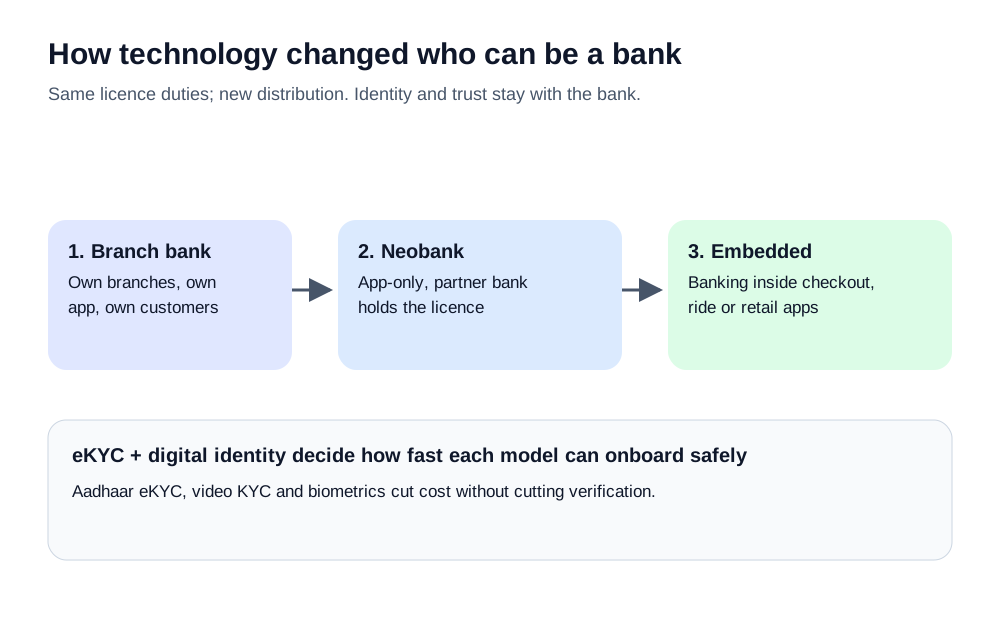
Phase 11 map: branch bank → neobank → embedded finance. Identity and trust stay with the bank.
How Technology Is Reshaping Financial Services Across Payments, Lending, Insurance, and Wealth Management
The term "fintech"—a simple contraction of "financial technology"—belies the profound transformation it represents in the global financial services landscape. Over the past decade and a half, fintech has fundamentally disrupted how financial services are delivered, who delivers them, and who receives them. From payments and lending to insurance and wealth management, technology companies have challenged centuries-old banking models with alternatives that are faster, cheaper, remarkably more user-friendly, and often more accessible to populations historically excluded from formal financial services. This revolution has unfolded in distinct waves, each building upon the last, and has given rise to entirely new categories of financial services that would have been unimaginable just twenty years ago.
The first wave of fintech, roughly spanning 2010 to 2015, emerged in the aftermath of the global financial crisis when public trust in traditional banks was at its nadir and regulatory scrutiny was at its peak. Entrepreneurs recognized that technology could address pain points that banks seemed unwilling or unable to fix, creating opportunities for startups to enter markets previously dominated by incumbents. Payment startups began offering seamless digital transactions that bypassed traditional card networks, peer-to-peer lending platforms connected borrowers directly with lenders outside the banking system, and digital wallets made carrying physical cash increasingly unnecessary for urban consumers. Companies like Stripe and Square in the United States, and later Razorpay in India, demonstrated that payment processing could be simple, fast, and developer-friendly—a stark contrast to the complex, slow systems that banks had built over decades. This wave established the fundamental premise that financial services could be unbundled and delivered more effectively by technology-focused companies that prioritized customer experience over traditional banking conventions.
The second wave, from 2015 to 2020, saw the rise of neobanks that operated entirely without branches, embedded finance that integrated banking services into non-financial applications, and platform banking that opened bank infrastructure to third-party developers. This period was characterized by a deeper integration of financial services into daily life and commerce. Banking was no longer something you did at a bank branch or even through a banking app—it became invisible, woven into the fabric of e-commerce, ride-hailing, and social media platforms. The technology stack matured significantly during this period, with cloud-native architectures and API-first designs becoming standard rather than exceptional, enabling faster development and deployment of new services. Companies realized that the future of financial services lay not in standalone applications but in contextual experiences that met customers at their point of need, providing financing when they were shopping, insurance when they were booking travel, and investments when they received their salary.
Recent fintech development is increasingly shaped by artificial intelligence, embedded finance, open APIs, real-time infrastructure, digital identity and new forms of programmable or tokenised finance. It is useful to describe these as evolving themes rather than a universally agreed 'third wave', because markets adopt them at different speeds and many services still depend on traditional regulated intermediaries. The important shift is that financial capability is becoming more software-driven and more deeply integrated into non-financial journeys, while governance, risk, funding and customer protection remain essential.
The fintech landscape includes payments, lending, insurance technology, wealth technology, regulatory technology and many adjacent models. Real-time payment systems such as India's UPI demonstrate how shared interoperable infrastructure can support very high digital-payment adoption, but transaction volumes change continuously and should be taken from current official data when quoted. Lending fintechs use digital data and automated workflows to expand or accelerate credit assessment, while InsurTech and WealthTech firms simplify distribution, servicing and access. Technology can broaden participation, but each segment still carries its underlying financial risks and regulatory obligations.
RegTech, short for regulatory technology, represents another crucial fintech segment that often receives less public attention but serves as the essential infrastructure enabling the entire ecosystem to operate within legal and compliance boundaries. These companies use artificial intelligence and machine learning to automate compliance processes, monitor transactions for suspicious activity, and help financial institutions navigate the increasingly complex regulatory landscape that has expanded significantly since the financial crisis. Without RegTech innovations, many fintech business models would simply not be viable due to the costs and complexity of compliance that would require armies of human compliance officers. As regulations have tightened in response to financial crimes, consumer protection concerns, and systemic stability requirements, RegTech has become indispensable for both traditional banks and fintech companies seeking to scale their operations efficiently.
The fundamental reasons for fintech's success become apparent when comparing the traditional banking model with the fintech approach across multiple dimensions. Traditional banks rely on branch-based distribution networks that are expensive to maintain and often inconvenient for customers who must travel to physical locations during limited hours. Fintech companies lead with mobile-first experiences available twenty-four hours a day, seven days a week, from anywhere with internet connectivity. Where traditional banks might take weeks to approve a loan application through manual review processes involving multiple departments and paper documentation, fintech lenders use algorithmic decision-making that provides answers in minutes based on data-driven models. Paper-heavy processes have given way to fully digital workflows that can be completed from a smartphone in the time it takes to drink a cup of coffee, with electronic signatures and document upload replacing physical paperwork. Perhaps most importantly, while traditional banks often offer one-size-fits-all products designed for mass markets, fintech companies leverage data to provide personalized services tailored to individual needs, behaviors, and preferences that evolve over time.
Insurance technology, or InsurTech, exemplifies how thoroughly technology can transform a traditional industry that had seen little innovation for decades beyond incremental pricing adjustments. Usage-based insurance represents a fundamental shift from the traditional model of fixed premiums to dynamic pricing based on actual behavior and risk. Drivers can now pay for auto insurance per kilometer driven rather than estimates that may not reflect their actual usage, and travelers can purchase coverage for single trips rather than annual policies they may not need. Instant claims processing, powered by artificial intelligence analyzing photographs of damage submitted through mobile apps, has reduced settlement times from weeks to minutes, dramatically improving customer experience at the moment of truth when policyholders need their insurer most. Micro-insurance products provide coverage for specific events—a single flight, a particular concert, a defined period—at costs accessible to virtually everyone, expanding the insurance market to populations previously priced out. Embedded insurance, offered at the point of purchase through e-commerce platforms or travel booking sites, has dramatically expanded distribution reach while reducing customer acquisition costs and improving conversion rates.
Leading InsurTech companies have demonstrated these possibilities at scale across global markets, attracting significant customer bases and investment capital. Acko in India pioneered digital-first insurance with zero paperwork, entirely eliminating the traditional documentation burden that deterred many potential customers and slowed the purchase process. PolicyBazaar created a comprehensive insurance marketplace that enables comparison shopping and transparent pricing, bringing much-needed transparency to a historically opaque industry where customers struggled to understand what they were buying. Lemonade in the United States built its business around artificial intelligence for claims processing and incorporated a social impact model where unused premiums are donated to customer-selected charities, creating a differentiated value proposition that resonated with younger consumers who wanted their insurance purchases to reflect their values. These companies have proven that insurance can be simple, fast, and even delightful—adjectives rarely associated with the industry previously.
WealthTech has similarly democratized access to investment opportunities that were once reserved for the affluent with substantial assets. Zero-commission trading platforms like Robinhood in the United States and Zerodha in India eliminated the transaction costs that previously discouraged small investors from participating in markets, making it economical to invest even small amounts regularly. Robo-advisory services use algorithms to provide portfolio management that was once available only through expensive human advisors, bringing professional investment management to the mass market with minimum investments of just hundreds or thousands of rupees rather than lakhs. Fractional investing allows individuals to purchase small portions of expensive stocks like Amazon or Google, making diversified portfolios accessible with minimal capital that would not have been sufficient to buy even a single share of some companies. Systematic investment plans can now be automated through mobile applications, removing the discipline required for regular investing and ensuring consistent participation in markets regardless of market conditions or investor emotions. Goal-based investing tools help users translate life objectives like buying a home or funding education into concrete investment strategies with clear progress tracking and adjustments over time.
India's WealthTech ecosystem includes technology-led brokers, investment platforms and portfolio products that have helped make digital investing more accessible. Firms such as Zerodha, Groww and smallcase illustrate different approaches to brokerage, distribution and curated investment experiences. Market leadership and customer counts change over time, so the enduring lesson is not a permanent ranking but the way lower-friction digital distribution, transparent interfaces and educational tools changed retail participation.
Regulatory technology has become essential as compliance requirements have grown more complex and demanding across jurisdictions, with new regulations emerging regularly in response to market developments and crises. Banks have historically struggled with anti-money-laundering and screening systems that can generate large numbers of false positives requiring human investigation. Machine-learning and other advanced analytics can help prioritise or improve alert quality in some implementations, but there is no universal percentage reduction that applies across institutions. Any tuning must be validated so operational efficiency does not come at the cost of weaker detection of genuinely suspicious activity. Regulatory reporting, traditionally a manual and error-prone process involving data aggregation from multiple systems and formats, can now be automated with data extracted directly from source systems and formatted according to regulatory specifications. Know Your Customer processes have evolved from paper-heavy exercises requiring branch visits to fully digital experiences through eKYC and video KYC technologies that can verify identity remotely. Trade surveillance systems use machine learning to detect patterns indicative of insider trading and market manipulation across vast transaction datasets that would be impossible for human analysts to review. Data privacy compliance with regulations like the General Data Protection Regulation in Europe and India's Digital Personal Data Protection Act can be automated through consent management platforms and data mapping tools that track how personal data flows through systems.
India's digital public infrastructure has become an important reference point for digital finance. Aadhaar, UPI, DigiLocker and the Account Aggregator ecosystem provide different layers for identity, interoperable payments, digital documents and consent-based financial-data sharing, while other initiatives support credit and commerce use cases. They are operated under different legal and institutional arrangements and should not be treated as one single financial product. Adoption statistics change rapidly, so current figures should be taken from the relevant official operator when needed. The enduring lesson is that interoperable public infrastructure can reduce integration friction and enable private firms and regulated institutions to build new services on common rails.
The fintech revolution represents more than technological change—it signals a fundamental restructuring of the financial services industry that will play out over decades with winners and losers among both incumbents and challengers. Traditional institutions must adapt or risk obsolescence, while new entrants must navigate complex regulatory environments and build sustainable business models beyond initial growth phases. For consumers, the benefits are substantial: greater access to services, lower costs, better user experiences, and more personalized products that meet their specific needs. As the third wave of fintech continues to unfold, the boundaries between financial and non-financial services will continue to blur, creating an ecosystem where finance is seamlessly embedded in every aspect of economic life. The institutions and individuals who understand and adapt to this transformation will thrive; those who resist it will find themselves increasingly marginalized in a world where financial services are defined by technology and customer experience rather than branch networks and legacy relationships.
<!-- MBA-DEEP-DIVE-START -->Fintech Continuation: How New Financial Models Fit Inside Real Banking Operations
Fintech is a delivery model, not an exemption from financial risk
The word fintech can make a business sound fundamentally different from a bank, insurer, broker, lender or payment provider, but technology does not remove the underlying financial activity. A company that moves money still needs reliable payment execution and reconciliation. A lender still faces credit risk, funding risk and collections. A wallet or stored-value product still needs safeguarding, fraud controls and accurate customer balances according to the rules that apply. An investment platform still needs suitable market access, asset records and customer protection. Technology changes the way the service is designed and delivered; it does not make the economics or operational consequences disappear.
This distinction is essential when analysing fintech business models. The first question should not be whether the front end looks innovative. It should be: what regulated or financial activity is actually taking place, which legal entity performs it, where customer money sits, which party owns the ledger, who makes the risk decision, who executes the transaction, and who resolves the customer problem when something goes wrong?
Many fintech propositions involve several entities. A mobile application may control the user experience while a licensed bank holds deposits, a payment processor executes card transactions, a separate lender funds credit, and a cloud provider hosts the technology. The customer sees one brand, but the operating model is distributed. Strong fintech design therefore makes responsibility clear across product, technology, regulation and operations.
Unbundling made fintech possible; rebundling makes it sustainable
Early fintech companies often attacked one narrow banking pain point. Payments startups simplified merchant acceptance. digital lenders shortened application processes. investment platforms reduced friction in brokerage. remittance providers improved cross-border customer journeys. This unbundling was powerful because focused teams could redesign one experience without replacing the entire financial institution.
As businesses mature, however, customers usually need more than one narrow function. A small-business payments provider may add invoicing, working-capital finance, payroll and expense management. A consumer investment app may add cash management or credit. A digital lender may add payment collections and account aggregation. The industry therefore moves between unbundling and rebundling.
Rebundling creates operational complexity. Each added product introduces different risk, accounting, support and regulatory obligations. A company that was excellent at merchant payment acceptance cannot assume the same controls are sufficient for lending. Product expansion should therefore be treated as a change in risk profile, not merely a new feature in the application.
Banks experience the same effect from the opposite direction. They increasingly expose components of their capabilities through APIs or embedded partnerships while still managing the balance sheet, licences and control framework behind the scenes. The competitive boundary between bank and fintech becomes a question of who owns which part of the value chain.
A fintech payment journey still needs the ordinary payment lifecycle
A polished payment button does not remove the steps required to move money safely. The journey still has initiation, authentication or authority, validation, fraud controls, compliance checks where applicable, account or funding checks, routing, clearing or network processing, settlement, posting, status and reconciliation.
Fintech companies often improve the initiation layer dramatically. They reduce data entry, use saved beneficiaries, tokenise card credentials, present clear status and integrate payment capability directly into commerce. But downstream processing still depends on banks, payment schemes, domestic infrastructures, card networks or correspondent relationships.
This creates a useful analytical split. Customer experience can be owned by the fintech while payment finality may depend on an external infrastructure. An instant-looking user interface does not prove that settlement is final at that moment. A wallet credit can represent an internal ledger event before external funds arrive. A card authorisation is not the same as clearing and settlement. Good products present status accurately rather than collapsing several states into one vague “paid” message.
Operations should preserve end-to-end identifiers so a customer issue can be traced from app instruction through processor and bank records to the external network. Without this linkage, a simple payment dispute becomes a multi-party search exercise.
Fintech lending changes data and distribution more than the mathematics of credit
Digital lenders can improve application speed by using electronic data, automated verification and model-based underwriting. Alternative data can help assess applicants with limited traditional credit history, but the underlying questions remain familiar: can the customer repay, what is the probability of default, what loss may occur, how is the loan funded, and what happens when repayment fails?
Fast decisions can create risk when speed becomes the objective rather than an outcome of better data. A model that produces an answer in seconds can still be poorly calibrated. The lender needs governance around training data, feature selection, model validation, bias, overrides, monitoring and adverse outcomes according to applicable law and policy.
Collections are part of the product design from the beginning. A lender that acquires customers easily but lacks effective, fair collections can create both losses and consumer harm. Repayment channels, delinquency treatment, restructuring, hardship handling and complaint management belong in the operating model, not as later additions after the first wave of defaults.
Funding matters as well. Some fintech lenders use their own balance sheet; others originate for banks or non-bank financial institutions; some operate marketplaces or distribution arrangements. The customer experience may look similar even though the credit risk and funding structure are very different. Analysts should therefore identify the lender of record and the party ultimately carrying the exposure.
Alternative data is useful only when it is lawful, explainable and relevant
Fintech underwriting is often associated with using more data than a traditional credit application. Transaction history, cash-flow patterns, business invoices and other information can improve risk assessment. However, more data is not automatically better.
The institution should have a lawful basis and customer permission where required for obtaining and using data. The feature should have a defensible relationship to the risk being assessed. Data quality must be understood. A model can produce confident predictions from inaccurate inputs, and this confidence can hide rather than reduce risk.
Explainability matters most when an automated decision affects a customer materially. The institution should be able to identify why an application was declined or why additional review was required at a level appropriate to the applicable legal framework and product. A black-box score that nobody can challenge creates operational and conduct risk.
Data can also drift. A model trained during one economic period may behave differently when inflation, employment, interest rates or customer behaviour changes. Monitoring therefore continues after deployment. Fintech's advantage is not simply collecting novel data; it is building a disciplined data lifecycle around decisions.
Embedded finance separates the customer context from the regulated capability
Embedded finance places a financial service inside a non-financial customer journey. A marketplace may offer seller financing, a travel platform may offer insurance, an accounting application may initiate payments, or a commerce platform may provide merchant cash-management tools.
The advantage is context. The customer can obtain the financial service where the need arises instead of leaving the journey to visit a separate bank or insurer. This can improve convenience and reduce acquisition friction.
The control challenge is that customers may not understand which entity provides the regulated service. The interface should avoid creating misleading impressions about who holds funds, provides credit, issues insurance or handles complaints. Contracts and legal disclosures are important, but customer understanding also depends on clear operational communication when a transaction fails.
Embedded models need strong partner governance. The non-financial platform controls much of the customer experience, while the regulated institution may remain responsible for important compliance or prudential outcomes. Data exchange, service levels, incident response, marketing approval, complaints and exit planning should be defined before scale makes the relationship difficult to unwind.
Banking-as-a-Service is architecture plus accountability
Banking-as-a-Service allows financial capabilities to be consumed through technology interfaces by another business. The capability can include account creation, payments, card issuance, identity services or lending components depending on the provider and jurisdiction.
From an architecture perspective, BaaS exposes controlled services through APIs, files or platform workflows. From a governance perspective, it creates a chain of responsibilities across provider, programme manager, distributor and customer-facing brand. The bank needs to know which party performs onboarding, screening, transaction monitoring, customer support and dispute handling, and which evidence is returned to the bank.
Scale can change the risk rapidly. One partner may bring millions of end customers or a transaction pattern very different from the bank's historical business. Limits, fraud models, monitoring capacity and operational staffing should be designed for the partner's actual use case rather than assuming ordinary retail behaviour.
A strong BaaS model therefore includes partner due diligence, product approval, technical certification, production monitoring, control testing and exit capability. API connectivity is only the visible layer.
RegTech should strengthen control evidence, not merely reduce headcount
RegTech applies technology to regulatory and compliance processes such as customer due diligence, screening, transaction monitoring, regulatory reporting, surveillance and record management. The strongest use cases improve consistency and evidence while reducing repetitive manual effort.
For example, a customer-due-diligence platform can collect identity evidence, run verification, record screening outcomes and manage review dates. This can create a more complete audit trail than disconnected spreadsheets. However, the regulated institution still needs to decide which rules apply, how risk is assessed, when enhanced review is required and how exceptions are handled.
Machine learning can help prioritise monitoring alerts, but tuning must be controlled. Reducing false positives is useful only if the institution continues detecting meaningful suspicious behaviour. Performance should be assessed against risk outcomes rather than a simple target to reduce alert volume.
Regulatory reporting automation has similar characteristics. Data extraction and formatting can be automated, but source lineage, interpretation, reconciliation and accountable sign-off remain essential. Technology can make the process repeatable; it cannot determine regulatory meaning without governed business logic.
InsurTech still depends on underwriting, claims and reserves
Digital insurance can simplify quotation, policy issuance and claims submission. Telematics, connected devices and contextual data can support more tailored products. Embedded distribution can reach customers at the moment a risk arises.
Yet insurance economics still depend on pricing risk correctly, collecting sufficient premium, controlling fraud, maintaining reserves and paying valid claims. Faster claims processing is valuable only when evidence and policy coverage are interpreted correctly.
Automated image assessment or document extraction can support claims handlers, but complex losses may require investigation, expert assessment or legal interpretation. Human review is therefore not a failure of digital insurance; it is appropriate when uncertainty or materiality requires judgment.
The key fintech lesson is consistent across sectors: technology can remove administrative friction while the financial risk remains real.
WealthTech lowers access barriers but does not remove investment risk
Digital investment platforms can make market access, portfolio construction and reporting far easier. Fractional ownership, low minimums and automated rebalancing can expand participation. Education and goal tracking can improve customer engagement.
However, user-interface simplicity should not make risk appear simple. A one-click investment can still expose a customer to market volatility, liquidity risk, concentration and product complexity. Suitability, appropriateness, disclosure and advice requirements depend on jurisdiction and service model.
Robo-advice adds model governance. The recommendation engine needs controlled assumptions about goals, time horizon and risk tolerance. If a customer's circumstances change, the platform should not continue applying an outdated profile indefinitely. Overrides and model changes need evidence.
Custody and asset records are also fundamental. A customer should understand who holds the asset, how ownership is recorded, how corporate actions are handled and what happens if the platform itself becomes unavailable.
Unit economics determine whether customer-friendly pricing can survive
Fintech growth can be misleading when measured only by downloads, registered users or gross transaction value. A sustainable business needs revenue that can support customer acquisition, fraud losses, credit losses, operations, technology, compliance, funding and capital where applicable.
A payment business with very low transaction pricing may scale rapidly but still struggle if processing and fraud costs consume the margin. A lender may show high origination growth while future credit losses are not yet visible. A subscription model may look attractive but suffer high customer churn. A free product can be viable when another revenue source supports it, but “free” is not itself a business model.
Banks partnering with fintech companies should therefore understand partner economics. Financial weakness can become operational risk if a critical service provider suddenly reduces support, seeks aggressive monetisation or exits the market. Due diligence should look beyond funding announcements to the durability of the service.
Customer acquisition can create conduct risk when growth incentives are too strong
Digital channels make it easy to run targeted campaigns, referral programmes and instant offers. These capabilities can improve access, but they can also encourage aggressive sales behaviour. If staff, affiliates or algorithms are rewarded only for conversion, customers may be pushed toward products they do not understand or need.
Product governance should therefore connect marketing to eligibility, suitability and fair communication. Disclosures must be visible in the actual journey rather than technically available behind several links. Pricing, fees and consequences of late payment should be understandable before acceptance.
Dark patterns are particularly relevant in digital finance. Interface choices that make it difficult to decline, cancel or understand a product can create consumer harm even when every contractual term exists somewhere in the application.
A strong fintech product treats trust as a long-term asset rather than a conversion metric.
Fraud controls must evolve with the digital journey
Fintech reduces friction, and criminals value low friction too. Instant onboarding, real-time payments and remote account access can create opportunities for identity theft, account takeover, mule accounts and authorised push-payment scams.
Fraud controls therefore need to be designed into the customer journey. Device intelligence, behavioural patterns, identity checks, beneficiary risk, transaction velocity and historical account activity can all contribute, subject to lawful and appropriate use. The objective is not to maximise friction but to introduce the right challenge when risk rises.
False positives matter because a payment blocked incorrectly can harm the customer. Models and rules should be monitored for both missed fraud and unnecessary disruption. Manual review queues need service levels so a supposedly instant product does not trap legitimate customers for days when automation is uncertain.
Fraud responsibility can be complex in partnerships. The fintech may own the app and device signals while the bank owns account history and payment execution. Clear signal sharing and incident escalation are therefore essential.
Reconciliation is the hidden backbone of fintech operations
A customer-facing platform may show one balance while funds move across sponsor bank accounts, processors, card networks, payment schemes and internal ledgers. Reconciliation proves that these records agree or explains why they do not.
Payment businesses should reconcile customer instructions, processor records, bank statements, settlement reports, fees, refunds and chargebacks. Lending platforms reconcile disbursements, repayments, interest, fees and funding positions. Investment platforms reconcile orders, cash, holdings and custodian records.
The need becomes stronger as volume grows. A tiny unexplained difference repeated millions of times can become material. Automation can perform matching, but exception ownership and ageing remain important.
Fintech products that neglect reconciliation often discover problems only after customers complain or balances diverge. Reconciliation should therefore be designed before scale, not added later as an operations patch.
The ledger is more important than the screen balance
A mobile interface may display a customer balance instantly, but the authoritative ledger determines financial position. Fintech architectures often maintain several layers of balance: available balance, ledger balance, pending transactions, reserved amounts, wallet sub-ledgers or processor positions.
These concepts should be defined clearly. If a card authorisation reduces available balance but has not settled, the system should represent that state correctly. If a payment is reversed, both the customer-facing balance and accounting records should reflect the reversal consistently.
Distributed architectures create risk when several services independently calculate balances. The institution should know which system is authoritative and how downstream views are reconciled. Event-driven design can improve transparency, but events still need ordering, idempotency and recovery.
A fintech can have a beautiful interface and still fail fundamentally if its ledger model is weak.
Partner-bank models need explicit responsibility for customer problems
When a fintech uses a licensed bank or other regulated partner, customers may not understand the boundary. A failed transfer can involve the app, sponsor bank, payment network and receiving institution. The customer should not be forced to discover the architecture before receiving help.
The operating agreement should define which party receives complaints, who investigates transaction state, how evidence is exchanged, who communicates outcomes and how regulatory or scheme deadlines are met. Service levels should reflect customer impact, not just API uptime.
Incident handling needs similar clarity. If the fintech detects account takeover, can it freeze activity directly or must the bank act? If the bank detects suspicious transactions, how quickly can the fintech contact the customer? Pre-agreed processes reduce delay during high-risk events.
Open APIs increase innovation and dependency at the same time
APIs allow fintech companies to connect to banks, payment providers and data services quickly. This modularity accelerates product development, but it also creates dependency chains. An outage in one external API can affect many customer journeys.
Resilient design should define timeouts, retries, idempotency and fallback behaviour. A payment API that times out after submission needs status enquiry before retry. An account-data API outage may justify showing stale data with a clear timestamp rather than displaying zero or an error that suggests the account disappeared.
Version changes require governance because external consumers cannot always update instantly. Providers need deprecation policies, test environments and communication. Consumers need inventory of dependencies so they know which products are affected by an external change.
Data portability and consent require operational accuracy
Fintech often depends on customer-authorised data sharing. Consent should describe which data is accessed, for what purpose, for how long and by which party according to the applicable framework. Revocation should actually stop future access at enforcement points, not merely change a screen status.
Data received under consent should not automatically become unrestricted internal data. Purpose limitation, retention and onward sharing need governance. If the customer's consent expires, systems should know whether historical data can still be retained for legal or contractual reasons and whether new refreshes must stop.
Consent failures can also create customer-service issues. An app that suddenly stops showing account information may simply have an expired permission. Clear status and re-authorisation journeys reduce confusion.
India Stack and digital public infrastructure should be understood as layers
India's digital financial ecosystem includes public and regulated infrastructure that supports identity, payments, document exchange and consent-based data sharing. These components should not be treated as one monolithic product owned by one organisation. Aadhaar, UPI, DigiLocker and the Account Aggregator ecosystem have different legal bases, operators, participants and use cases.
The architecture is powerful because services can compose these capabilities. A customer can prove identity through an approved process, share permitted data through a consent framework and make a payment through interoperable rails. But every layer still has its own rules, security model and participant responsibilities.
When teaching India Stack, it is better to explain these functional layers than to rely on rapidly changing transaction counts. The enduring lesson is that shared digital infrastructure can reduce the cost of innovation when identity, payments and data exchange are interoperable.
Artificial intelligence in fintech needs the same model discipline as banking AI
AI can help with customer support, fraud detection, underwriting, document extraction, personalisation and software development. The risk depends on the use case. A model summarising a support conversation is different from one deciding credit eligibility or generating a regulatory report.
High-impact decisions need data governance, validation, explainability appropriate to the context, monitoring and human oversight where required. Generative models also require controls around confidential data, unsupported outputs and action authority.
A chatbot should not be allowed to invent an account balance, promise a refund or execute a financial transaction simply because its language sounds confident. It should retrieve trusted data and operate through controlled tools with clear permissions.
Fintech resilience includes the startup itself
Customers depend on the continuity of the provider, not only the continuity of its cloud servers. Financial stress, acquisition, loss of funding or business-model change can affect service. Critical partnerships should therefore include exit and migration planning.
Customer funds and records should remain protected if the fintech stops operating. The exact mechanism depends on product and jurisdiction, but the operating model should identify where funds sit, which entity maintains authoritative records and how customers continue to receive service.
Technology concentration is another issue. Many fintech companies use common cloud, identity, analytics and communication providers. A failure in one widely used supplier can affect numerous firms simultaneously.
A practical scenario: embedded merchant lending
Imagine an e-commerce platform offers working-capital finance to sellers. The seller sees an offer inside the commerce dashboard based on sales history. A partner lender provides the credit while the platform supplies data and manages much of the user experience.
A strong design identifies the lender of record, obtains permitted data, records the underwriting decision, presents pricing clearly and captures customer acceptance. Disbursement is reconciled to the seller's account. Repayment may be collected from future marketplace proceeds, so the system must distinguish loan repayment from ordinary merchant settlement.
If sales fall, collections and hardship processes should follow the lender's approved policy. If the platform's data feed fails, the lender should not make silent decisions using incomplete information. Complaints must reach the party capable of resolving the underlying issue.
This scenario shows how fintech combines distribution, data, credit, payments and operations. The customer sees one button; the institution must control the entire lifecycle.
Bank-fintech collaboration works when control boundaries are explicit
Banks bring licences, balance-sheet strength, customer trust, risk infrastructure and access to payment systems. Fintech companies can bring focused product design, rapid engineering and specialised data or workflow capability. Collaboration can therefore be more powerful than a simple “banks versus fintechs” narrative.
Partnerships fail when each party assumes the other owns a control. Customer due diligence, fraud monitoring, transaction screening, complaints, reconciliation, data protection, incident reporting and business continuity should be allocated explicitly. Where responsibility is shared, the interface and evidence exchange should be defined.
The bank should not outsource oversight simply because the partner uses modern technology. The fintech should not assume the bank will solve every operational issue merely because it holds the licence.
The durable fintech advantage is disciplined removal of friction
Fintech's most important contribution is not any single company or valuation. It is the demonstration that many financial journeys contained friction because of historical process design rather than because the risk truly required it. Digital identity, APIs, real-time data, automated workflows and better interfaces can remove that friction.
The challenge is to remove unnecessary friction without removing necessary control. A five-minute account opening is valuable if identity, screening, consent and records remain sound. Instant credit is useful if underwriting and affordability remain controlled. Real-time payment is powerful if fraud, authorisation and reconciliation keep pace.
The mature fintech model therefore combines speed with financial discipline. Technology changes the experience; strong banking principles keep the experience trustworthy.
Fintech Top-Up: Scale, Control, and the Economics Behind the App
A customer-facing product may sit on several regulated rails
A single fintech application can combine services from different providers. The wallet may use one banking partner, card issuance another processor, lending a separate regulated lender, investment execution a broker, and identity verification a specialist vendor. To the customer, these capabilities appear inside one interface. To the operating model, they are a chain of legal and technical responsibilities.
This means product design should maintain a service map that identifies the provider, authoritative record, customer money location and escalation path for each capability. Without that map, operations can resolve ordinary cases only by discovering architecture during an incident.
Payment status should reflect the rail actually used
Fintech apps often support multiple payment methods that have different processing states. A card authorisation, account transfer, wallet movement and cross-border remittance do not all become final in the same way. The application should translate complex rail status into clear customer language without pretending that every successful initiation is final settlement.
This becomes especially important during timeouts. If the app submits an instruction and loses the response, it should query or reconcile status before creating another transaction. Idempotent request identifiers and downstream references are key controls for preventing duplicates.
Fast customer growth can outpace operations
A digital product can acquire customers far faster than a branch network. That advantage creates an operational challenge: fraud alerts, complaints, disputes, KYC exceptions, chargebacks and reconciliation breaks can also scale quickly.
Capacity planning should therefore include operations and control teams, not just cloud infrastructure. Launching into a new market or adding a popular partner can change transaction patterns overnight. Backlogs in customer review or dispute handling can turn a successful growth campaign into service and conduct risk.
Product metrics need a risk-adjusted view
Gross transaction value, active users and loan originations are useful growth indicators, but they do not show the quality of the business. Payment volume should be viewed alongside fraud loss, disputes and margin. Lending growth should be considered with delinquency, vintage performance and cost of funding. Customer growth should be considered with retention, support demand and acquisition cost.
A fintech that optimises only the visible growth metric can create hidden future cost. Mature management therefore combines commercial and risk indicators in the same operating view.
Settlement and safeguarding can be invisible to customers but central to trust
Where a fintech receives or controls customer money, the exact legal model determines how funds are held and protected. Some services move funds directly between regulated accounts; others may use safeguarded, pooled or settlement accounts under applicable rules.
The platform should maintain accurate sub-ledgers where required and reconcile them to bank or processor records. Customer-facing balances should never depend solely on a cache or application database that is not reconciled to the actual financial position.
Customer disputes reveal whether the operating model is genuinely integrated
A smooth app can hide fragmented responsibility until a customer disputes a transaction. The front-line team needs access to enough evidence to determine whether the issue concerns authorisation, processing, settlement, refund, chargeback, merchant dispute or account compromise.
Where partners are involved, evidence exchange and case ownership should be pre-agreed. The customer should not be asked to contact several providers separately for one journey that the fintech presented as a single service.
Innovation governance should distinguish experiments from production banking
Fintech firms benefit from rapid experimentation, but an A/B test on a marketing screen is different from experimentation with a credit decision, payment release or customer fee. Change governance should reflect consequence.
High-impact financial logic needs controlled testing, approval and monitoring. Feature flags can help limit rollout, but the institution should know which customer population receives which version and how to roll back safely if the change affects financial state.
A fintech platform needs the same continuity questions as a bank service
Who can operate the product if the primary cloud region fails? What happens if the sponsor bank API is unavailable? Can customers still report fraud? Are ledger and transaction records recoverable? Can critical providers be contacted outside normal business hours?
Digital-native architecture may make recovery easier in some areas, but resilience still requires explicit design and exercises. Modern technology does not automatically equal operational resilience.
Fintech maturity is visible when controls disappear into the journey
The best digital financial experiences do not force customers to understand the bank's internal controls. Identity verification, transaction limits, fraud detection, consent and reconciliation operate behind the interface while the customer sees a clear, responsive service.
This is not control reduction. It is control integration. The mature fintech advantage is the ability to make a regulated financial process feel simple because the underlying architecture and operating model are well designed, not because important checks were omitted.
Financial innovation still needs books and records that can be explained
As fintech products become more modular, accounting and operational evidence becomes more important rather than less. Revenue may come from interchange, subscription, interest, fees or partner commissions, while customer money and settlement positions sit in different accounts. Finance teams should be able to trace these flows from product event to ledger and external statement.
This is particularly important when several partners participate in one service. A platform may calculate a customer fee, a processor may net its own charge from settlement, and a sponsor bank may post the resulting amount. The parties need a shared understanding of gross and net amounts so reconciliation does not treat legitimate deductions as unexplained losses.
Reliable books and records also support product decisions. If management cannot separate acquisition incentives, fraud loss, funding cost, processing cost and servicing expense, it cannot know whether growth is economically sustainable.
A mature fintech knows when not to automate the final decision
Digital products can automate large parts of onboarding, credit, fraud review and customer service, but automation should follow the consequence of error. Clear deterministic cases can often proceed without manual touch. Ambiguous, high-value or legally sensitive cases may require human review.
The objective is not to preserve manual work for its own sake. It is to direct human judgment to the small proportion of cases where policy, evidence or customer circumstance cannot be resolved safely by fixed rules or validated models.
The enduring test is whether the service can be trusted at scale
A fintech proposition becomes infrastructure when customers depend on it for wages, savings, credit, investments or daily payments. At that point the standard is higher than a successful app launch. The service must remain accurate during high volume, recover after outages, detect abuse, protect data, explain decisions and resolve customer problems.
Innovation and control are therefore not opposites. The strongest fintech businesses make control part of the product architecture so scale does not require rebuilding trust from scratch.
Final fintech control principle
A financial product should never become less explainable as it becomes more digital. The institution should still be able to identify the customer instruction, regulated provider, financial ledger, decision rule, partner hand-off, final transaction state and complaint owner. When those elements remain visible, technology can simplify the customer journey without making the underlying banking responsibility disappear.
<!-- MBA-DEEP-DIVE-END -->