Visual overview
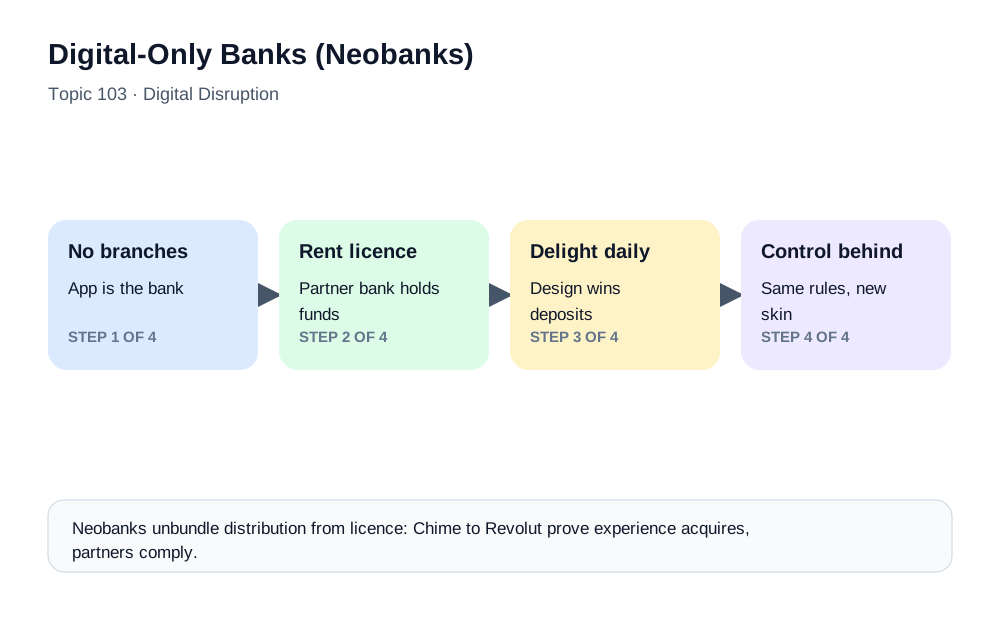
Digital-Only Banks (Neobanks) at a glance — Chime, Revolut, Monzo, digital-first experience.
Chime, Revolut, Monzo, and the Digital-First Banking Experience
Neobanks represent the purest expression of fintech's promise to reimagine banking entirely for the digital age, unencumbered by legacy infrastructure or traditional distribution models. These institutions are built from the ground up for the smartphone era—operating with no branches, no legacy systems, and no paper-based processes that have defined traditional banking for generations. They offer sleek mobile applications, lower fees, and features that traditional banks struggle to match, all delivered through user experiences that feel more like consumer technology than financial services. Yet their journey from disruptive startups to sustainable financial institutions remains challenging, with questions of profitability, regulatory sustainability, and long-term customer loyalty still being answered across global markets as the sector matures.
Understanding what distinguishes a neobank from a traditional bank requires examining the fundamental differences in their operating models, organizational DNA, and strategic priorities. Traditional banks maintain extensive branch networks with hundreds or thousands of physical locations, each requiring staff, real estate, maintenance, and operational support that creates significant fixed costs. They run on legacy core banking systems built decades ago, often in programming languages no longer taught in universities, making innovation slow, expensive, and risky. Customers typically must visit branches and complete extensive paperwork to open accounts or access services, creating friction that deters many potential customers. Multiple fees for various services generate revenue but create customer friction and negative perceptions. The user experience is often complex and fragmented across multiple screens and channels, reflecting organizational silos rather than customer needs.
Neobanks, by contrast, operate with zero physical branches, distributing their services entirely through digital channels that scale efficiently without geographic constraints. They run on cloud-native technology architectures that enable rapid deployment of new features and automatic scaling to meet demand without upfront infrastructure investment. Account opening takes five minutes through a mobile phone rather than hours at a branch, with instant verification through digital identity systems. They charge minimal or zero fees, having built cost structures that do not require fee income to survive, funded instead by interchange, lending margins, or subscription services. Their user interfaces are clean, intuitive, and designed specifically for digital natives who expect the same experience from their bank that they receive from social media or e-commerce applications.
The global neobank landscape includes large digital-first firms such as Revolut, Chime, Monzo, N26, Nubank and KakaoBank, but their licences, product sets, geographies and customer counts differ and change over time. They illustrate several models: fully licensed digital banks, technology-led consumer financial platforms, and digital banking businesses linked closely to broader ecosystems. Current scale should be taken from each firm's latest official reporting rather than treated as a fixed fact. The enduring lesson is that branchless distribution and mobile-first servicing can reach significant scale in both developed and emerging markets when the underlying banking, risk and operating model is sound.
India's market has commonly used partnership-led digital banking models in which technology brands provide the customer experience while licensed banks or other regulated entities provide the underlying regulated product. Firms such as Jupiter, Fi, Niyo, Open and RazorpayX have illustrated different consumer and business propositions over time, but individual partnerships and product structures can change and should be checked from current official disclosures. The key point is to identify the regulated entity behind each account, deposit, card, credit or payment service rather than assume that every app described as a 'neobank' is itself a licensed deposit-taking bank.
A partnership-led neobank can involve the customer-facing technology provider, one or more regulated financial institutions and supporting processors or service providers. Responsibility is not automatically identical across every arrangement. The legal holder of a deposit, issuer of a payment instrument, lender of record and responsible complaint-handling entity should be identified from the actual product structure. Deposit-insurance eligibility, prudential responsibility and consumer protections follow the applicable law and the regulated institution involved, not the neobank label itself.
Neobanks have developed diverse revenue models to achieve profitability, moving beyond the initial growth phase focused on customer acquisition to sustainable unit economics. Interchange fees represent a significant revenue source, with neobanks earning a share every time customers use their debit or credit cards for purchases, though this is shared with the partner bank in many arrangements. Premium subscriptions offer additional features for a monthly fee, following models established by Revolut Premium and Metal tiers that provide benefits like higher withdrawal limits, travel insurance, concierge services, and exclusive rewards. Lending activities, including personal loans, Buy Now Pay Later products, and overdraft facilities, generate interest income with attractive margins that improve as neobanks build underwriting expertise. Foreign exchange markups on international transactions provide another revenue stream, as many neobank customers travel frequently or send money across borders and value the convenience of favorable rates. Float income earned on customer deposits held at partner banks contributes to revenue, though interest rate environments significantly affect this source. Business-to-business services, including business accounts, payroll processing, and invoicing tools, extend the revenue base beyond retail consumers into the lucrative small business segment with higher transaction values and stickier relationships.
The user experience advantages that neobanks offer have set new standards for the industry and forced traditional banks to improve their own digital offerings to remain competitive. Real-time notifications provide instant alerts for every transaction, helping users stay aware of their spending and quickly detect unauthorized activity that might indicate fraud. Automated spending analytics categorize transactions and reveal trends, making budgeting effortless and helping users understand where their money goes without manual tracking. Savings tools like round-ups that transfer spare change to savings accounts, dedicated savings pots for specific goals like vacations or emergencies, and auto-save rules that transfer fixed amounts periodically help users build financial discipline without conscious effort or willpower. Fee transparency ensures customers understand exactly what they are paying without hidden charges buried in fine print or surprise fees that erode trust. The ability to ship new features weekly rather than quarterly enables rapid innovation that traditional banks struggle to match with their legacy systems and risk-averse cultures. Modern user interface design, including clean layouts, intuitive navigation, and features like dark mode, creates experiences that feel contemporary rather than dated.
Neobanks face the same basic sustainability challenge as other financial businesses: customer growth must eventually support the cost of acquisition, technology, compliance, fraud, service and any credit risk taken. Profitability varies widely by firm and period, so it is not accurate to treat all neobanks as loss-making. Expansion into lending, investment or business services can improve revenue but also adds new risk and control requirements. Partner-led models can limit product flexibility, while fully licensed digital banks take on greater prudential responsibility. The competitive question is therefore whether the digital model can convert convenient acquisition into durable, trusted customer relationships and sustainable economics.
The competitive comparison between neobanks and traditional banks reveals distinct advantages for each that suggest a future of coexistence rather than replacement of one by the other. Neobanks excel at user experience, innovation speed, and fee structures that appeal to digital-native customers who prioritize convenience and design. Traditional banks maintain advantages in trust built over generations, product range spanning every financial need from simple savings to complex corporate finance, lending capability supported by large balance sheets and established underwriting processes, and physical presence that remains important for certain customer segments and transaction types that require in-person interaction. The likely future is collaboration, where neobanks handle user experience and distribution while traditional banks manage licensing, complex lending, and the trust relationships built over decades, with customers benefiting from the strengths of both.
Nubank's growth in Latin America is a useful case study of how a digital-first financial institution can scale by targeting customer pain points in a market with high smartphone adoption and historically expensive or inconvenient financial services. Its current customer numbers and financial performance should be taken from the latest company disclosures rather than frozen in teaching content. More broadly, the neobank sector shows that digital distribution can reach enormous scale, but long-term success depends on profitability, risk management, resilience, customer trust and the ability to operate as a mature financial institution rather than only as a fast-growing application.
<!-- MBA-DEEP-DIVE-START -->Neobank Continuation: Digital-First Banking Beyond the Mobile Interface
A neobank is defined by its operating model, not by the absence of branches alone
The word neobank is used loosely across markets. In some countries it refers to a fully licensed bank built around digital channels. In others it refers to a technology company that provides a banking-like experience while a licensed partner holds deposits, issues accounts or provides other regulated services. A third category includes digital brands created by established banks. These models can look similar to customers even though their legal structure, balance sheet and regulatory responsibilities are very different.
The useful analytical question is therefore not, “Does it have branches?” It is, “Which entity performs which banking function?” Who holds the customer deposit? Who owns the authoritative account ledger? Who performs customer due diligence? Who issues the card? Who makes lending decisions? Who settles payments? Who is responsible for complaints and regulatory reporting? The answers reveal the real operating model.
Branchless distribution can lower certain operating costs and support faster geographic expansion, but a bank still needs core processing, liquidity management, reconciliation, fraud controls, customer service, regulatory reporting and resilience. Digital-only delivery changes where work happens; it does not remove the work.
Licensing structure determines what the digital brand can actually control
A fully licensed digital bank can potentially control more of the stack because it owns the banking licence, customer relationship, deposits and prudential obligations. A partner-led neobank may control the interface and product experience while depending on a sponsor bank for regulated account functionality. The practical difference appears whenever the product changes or an incident occurs.
If the digital brand wants to launch a new deposit feature, a licensed bank may be able to change its own product configuration subject to governance and regulatory requirements. A partner-led model may need the sponsor bank to approve the product, configure accounts, update compliance rules and support reporting. This can slow innovation but also places prudential controls with an institution built to manage them.
Customers may not understand this distinction. The interface should therefore avoid implying that the technology company is the deposit-taking bank if another institution actually holds the funds. Clear legal disclosure matters, but operational behaviour matters just as much. If a transfer fails, the customer should not be pushed from app provider to sponsor bank and back again without clear ownership.
Deposit protection follows the legal holder of the deposit
Digital branding does not determine deposit protection. The applicable protection depends on the legal institution holding the deposit and the scheme rules in that jurisdiction. A customer may see a neobank brand while the protected deposit sits on the balance sheet of a partner bank.
This makes record accuracy important. The sponsor bank needs sufficient customer and account information to establish depositor ownership and meet applicable obligations. The fintech or digital brand should not maintain a customer-facing balance that cannot be reconciled to the bank's authoritative records.
Where a structure uses pooled or omnibus accounts with sub-ledgers, the legal and operational design becomes even more important. The platform may maintain the detailed customer allocation while the sponsor bank sees a pooled balance. Reconciliation and record retention must be strong enough to identify beneficial customer positions according to the applicable model.
The teaching point is simple: “money in a neobank app” is not a complete legal description. Learners should trace where the money actually sits.
Digital onboarding is a control chain, not a five-minute screen flow
Neobanks compete strongly on fast onboarding, but the visible customer journey is only one layer. Behind the scenes, the institution may verify identity, screen names, validate documents, assess fraud risk, create the customer record, establish account ownership, assign product terms and issue authentication credentials.
Good digital onboarding separates low-friction from low-control. A well-designed flow can complete quickly because data is captured once, validated automatically and routed through integrated services. Speed should come from better process design rather than skipping checks.
Exceptions need an explicit path. A customer may have an unreadable document, name mismatch, duplicate identity, sanctions alert, unusual device, incomplete address or product restriction. The system should not force every case through automation merely to maintain a fast headline onboarding time. Genuine ambiguity belongs in a review queue with enough evidence for an analyst to decide.
The onboarding process should also prevent synthetic or mule-account abuse. Fraud controls can examine device patterns, repeated identities, unusual contact information and other appropriate signals, subject to applicable law and policy. The exact checks vary, but the operating principle is constant: digital scale can amplify both legitimate customer acquisition and fraudulent account creation.
A modern user experience still depends on a reliable core ledger
Neobank interfaces often provide real-time balances, instant notifications, savings pots and spending analytics. These features feel modern because they are immediate and contextual. They still depend on accurate transaction state.
The product should distinguish available balance from ledger balance where the underlying account model requires it. A card authorisation can reserve funds before clearing. A bank transfer may be accepted but still processing. A cash withdrawal can be reversed after a failed dispense. The interface should represent these states clearly so the customer understands what is actually spendable and what remains pending.
If the app maintains its own cache or event store for performance, it must remain reconciled to the authoritative ledger. A temporary sync delay should not create an invented balance. Where stale data is shown during an outage, the timestamp or status should be clear enough to prevent customer confusion.
The most elegant digital bank experience can lose trust quickly if customers see unexplained balance differences.
Notifications are operational events, not proof of financial finality
Instant notifications are one of the features that made digital-first banks feel more responsive than many traditional institutions. However, the event triggering a notification should be understood precisely.
A message saying “payment completed” should correspond to the actual state the bank intends to represent. A card authorisation, payment acceptance, posting and settlement are different events. A transfer can be accepted by the bank and later rejected externally. If the app uses the same success message for every intermediate state, the customer receives a misleading picture.
Notification systems also need resilience. A delayed push message should not imply that the financial transaction itself was delayed. Conversely, a failed notification should not cause the transaction to be repeated. Customer communications should be downstream of authoritative transaction processing, not part of the financial control logic.
Card-led neobank economics need more than interchange income
Many neobanks initially relied heavily on card usage because frequent transactions drive engagement and may generate interchange revenue. The economics vary significantly by market, card type, regulation, customer behaviour and scheme arrangements. Interchange alone may not support the full cost of acquisition, fraud, service, compliance and technology.
This is why digital banks often broaden into lending, subscriptions, foreign exchange, business services, wealth products or marketplace revenue. Each new revenue source changes the risk profile. Lending introduces credit risk and collections. Investment distribution introduces conduct and suitability considerations. Premium subscriptions create customer-value expectations and churn management.
The strategic challenge is to expand revenue without turning a simple product into a confusing bundle. A digital bank that attracted customers through transparency can damage trust if fees, cross-selling or product complexity grow faster than customer understanding.
Low fees are a design choice supported by economics, not a permanent feature of every neobank
Digital distribution can reduce branch costs, but neobanks still incur customer support, compliance, fraud losses, payment processing, engineering, cloud infrastructure, card issuance, dispute handling and partner-bank costs. Some products can remain free because other revenue supports them; others charge subscriptions, transaction fees or interest.
The durable lesson is therefore not that neobanks always charge zero fees. It is that digital cost structures and clearer pricing can allow different fee models. Customers should be able to understand the price before using the service.
Customer service becomes more important when there is no branch fallback
A branchless model removes the physical location customers may use when a problem becomes urgent. This makes digital and remote support part of the critical operating infrastructure.
Routine issues can be handled through in-app help, chat or automated guidance. Complex cases still need human escalation. Account restriction, fraud, bereavement, vulnerable-customer situations, disputed payments and identity problems often require judgment and empathy.
Support design should avoid trapping customers in automated loops. A chatbot can answer common questions, but it should recognise when the issue requires access to account evidence or authorised action. Escalation should carry the conversation context so the customer does not repeat the entire problem.
Service continuity also needs planning. If the app is unavailable, customers should have an alternate way to report fraud, block a card or obtain urgent help. A digital-only bank is not resilient if every support path depends on the same mobile application that is failing.
Partner-bank architecture creates a two-ledger control problem
In some neobank models, the customer-facing platform maintains detailed transaction information while the sponsor bank owns the regulated account ledger. These records must agree.
The platform may enrich transactions with merchant names, categories, budgets and user-facing metadata. The sponsor bank may record postings using more formal accounting references. Reconciliation needs stable identifiers that connect the two views. If one side shows a transfer and the other does not, the difference should be detected quickly.
Timing differences are normal. A platform can receive an event before a nightly statement or settlement file. The reconciliation design should distinguish expected timing from true breaks.
This control becomes especially important during outages or migrations. Replaying events without idempotency can duplicate customer-facing records even when the bank ledger is correct. Conversely, missing events can make the app appear to lose a transaction that still exists financially.
Open APIs are essential to partner-led neobanks
Where the digital brand depends on a sponsor bank, APIs or structured file interfaces often connect onboarding, account enquiry, payments, card controls and reporting. The quality of these interfaces directly affects the customer experience.
A slow or unstable account API can make the neobank appear unreliable even when the sponsor bank's own channels work normally. Version changes can break customer journeys if the parties do not coordinate. Error messages should distinguish invalid customer input, regulatory rejection, insufficient funds, technical failure and uncertain status.
Authentication between institutions should use controlled machine identities, certificates or other approved mechanisms rather than shared human credentials. Secrets need rotation and monitoring. The bank should be able to attribute requests to the correct partner and product.
Product ownership can be split, but control ownership cannot be vague
A neobank partnership often contains a product team at the fintech and a product team at the sponsor bank. Both may believe they own the customer journey. Problems arise when control ownership is not equally clear.
Customer due diligence, sanctions screening, fraud monitoring, transaction limits, complaints, chargebacks, data protection, regulatory reporting and incident notification should each have explicit ownership. Some responsibilities may be shared, but the hand-off and evidence should be defined.
For example, the fintech may collect identity data and perform front-end validation while the bank performs formal customer onboarding and screening. If an alert requires enhanced due diligence, the workflow needs a clear route back to the party that can obtain additional information from the customer.
Fraud patterns can be different in app-first banking
Digital-first banks often acquire customers rapidly through mobile channels, referrals and social marketing. This can attract genuine users and fraud networks at the same time. Mule-account recruitment, synthetic identity, account takeover, remote-access scams and authorised payment fraud can exploit the same low-friction journeys that customers value.
Fraud controls should therefore use the signals available in the digital model. Device consistency, login behaviour, beneficiary patterns, transaction velocity and account age can be relevant when lawfully and appropriately used. A new account receiving many unrelated inbound transfers and immediately forwarding funds may warrant review even if each individual payment is technically valid.
Friction should be targeted. Applying the strongest challenge to every customer damages experience; applying no challenge to high-risk activity damages trust. Digital banks often compete on using data to introduce controls at the moment risk changes.
Savings tools need accounting clarity
Savings pots, goals and sub-accounts can help customers organise money, but the implementation can vary. A pot may be a separate legal deposit account, a sub-ledger within one account, a user-interface categorisation or a transfer to another product.
Customers should understand whether funds remain instantly available, whether interest applies, whether account details differ and whether any restrictions exist. Internally, the product should reconcile pot balances to the underlying deposit ledger.
If a customer moves money between pots and the main balance, the operation should be idempotent and atomic enough to avoid temporary duplication or loss in the interface. A failed update should not leave the sum of sub-balances different from the actual deposit.
Early-wage or salary-linked features depend on settlement reality
Some digital banking products offer access to expected salary funds before the traditional payday or make payroll credits visible quickly. The mechanics can differ substantially. The bank may advance funds based on an expected payroll deposit, provide overdraft-like credit, or simply make an incoming payment available as soon as it is received.
These models create different credit and liquidity implications. Marketing language should reflect the actual product rather than imply that money has arrived when the bank is advancing it.
If the expected salary is delayed or reversed, the product needs clear treatment. This is another example where a simple customer feature rests on accounting and risk design behind the interface.
Foreign-exchange features create market, pricing and disclosure considerations
Multi-currency accounts and travel features are common in digital banking. The customer may hold separate currency balances, convert between currencies or spend internationally using card conversion.
The platform should distinguish exchange rate from fee or markup and show the customer which rate applies. Rate availability can change outside market hours or during volatility. A quoted rate may be valid for only a limited time.
The bank or partner also needs to manage its own currency exposure. Customer conversion can create positions that must be hedged or passed to a market provider. Neobank design therefore connects the app to treasury and settlement, not only to a currency-conversion screen.
Neobank lending turns a transaction app into a balance-sheet risk business
Offering credit can improve revenue and customer engagement, but it changes the institution materially. Underwriting, pricing, provisioning, funding, collections and credit-risk governance become central capabilities.
A neobank with rich transaction data may assess cash flow effectively, but the model still needs validation. High engagement does not guarantee low default risk. Economic downturns can reveal weaknesses that were invisible during rapid growth.
Collections should be fair and controlled. Digital channels can send reminders automatically, but frequency, language and treatment of hardship matter. The same user-experience discipline used to make borrowing easy should also make repayment obligations clear.
Growth metrics should not be confused with primary-bank relationships
Registered users, app downloads and open accounts can overstate customer depth. A person may maintain several banking apps while keeping salary, savings and major payments with another institution.
More meaningful relationship measures can include active customers, deposit balances, recurring income credits, payment activity, product usage and retention. The exact metrics depend on strategy.
Digital banks need to move from acquisition to trust. Becoming the customer's primary financial relationship requires reliability during everyday use and confidence during stressful events such as fraud or disputed transactions.
Profitability is not simply a matter of reaching scale
Scale can improve unit economics by spreading technology costs across more customers, but some costs also grow with volume. Payment processing, customer service, fraud losses, card operations and compliance workload increase as activity increases.
A neobank should understand contribution by customer and product rather than assume millions of users automatically create profitability. Promotional rates and rewards can attract customers who leave when incentives end. Lending can raise revenue but also create losses.
Sustainable economics come from a product set that customers value enough to use repeatedly, supported by controlled operating costs and risk.
Cloud-native architecture does not mean the bank has no legacy
Digital-first institutions may avoid decades-old mainframes, but every successful platform eventually accumulates its own legacy. APIs acquire old versions. Data models become difficult to change. Early services become critical dependencies. Temporary workarounds turn permanent.
The difference is not that neobanks have no legacy; it is that they can design governance and modular architecture early enough to manage technical debt. Automated testing, infrastructure-as-code, service ownership and observability can help changes remain safe as the organisation scales.
Rapid deployment is valuable only when control keeps pace. A weekly release cycle that repeatedly causes financial defects is not superior to a slower controlled process.
Observability should connect technical events to customer impact
A digital bank may operate hundreds of services. Monitoring each server or container is insufficient. Teams need to know whether customers can log in, see accurate balances, make payments and receive support.
Service-level monitoring should therefore follow important journeys. A payment success rate can be broken down by channel, payment type, bank dependency and error category. If an upstream sponsor-bank API is failing, the neobank should identify that dependency quickly and communicate accurately.
Trace identifiers can connect one customer action across API gateway, application services, partner calls and ledger updates. This is invaluable during incidents and customer investigations.
Release management must protect financial state
Digital banks often use modern software delivery practices such as continuous integration and frequent deployment. Financial services add constraints around data migration, backward compatibility and transaction correctness.
A database schema change should not make older app versions interpret balances incorrectly. A payment-service deployment should preserve idempotency for instructions already in flight. Feature flags can limit exposure during rollout, but they need governance so temporary states do not become permanent confusion.
Rollback planning should consider data changes. Code can sometimes be reverted quickly while a database transformation cannot. Testing therefore needs realistic financial scenarios, not only unit tests.
Outsourcing can create hidden concentration in a digital-only model
Neobanks often rely heavily on specialised providers for cloud hosting, card processing, identity verification, messaging, customer support tools and analytics. This allows a small team to build quickly, but it creates dependency.
Supplier risk should consider criticality, resilience, security, data access and exit options. Several apparently independent vendors may themselves depend on one common cloud or communications provider.
The bank should know which customer services fail when each provider is unavailable and whether a manual or alternative path exists. A branchless institution can become especially vulnerable if digital identity, app distribution or messaging dependencies fail simultaneously.
Complaint ownership is a test of whether the partnership is mature
Routine operation can hide unclear responsibilities. Complaints expose them. A customer may dispute a transfer, complain about credit reporting, challenge a fee or report identity theft.
The party receiving the complaint should be able to identify the regulated product and route the case correctly. Evidence should move between fintech and sponsor bank without the customer acting as courier. Deadlines and communication ownership should be explicit.
Complaint data is also product intelligence. Repeated confusion about pending card transactions may indicate poor user-interface wording. Repeated payment failures from one partner API may indicate a technical issue. Mature neobanks use complaint themes to improve design.
Crisis communication matters more when the brand promise is digital reliability
A digital-only bank often markets itself as always available, simple and immediate. Outages therefore create a direct challenge to the brand promise.
Incident communication should distinguish what is unavailable and what remains safe. If card payments work but the app is down, customers need that specific information. If balances are temporarily stale, the bank should say so rather than display misleading data.
Social media can spread confusion quickly. A coordinated status page, in-app messaging where available and trained support responses reduce speculation.
A practical scenario: sponsor-bank payment API outage
Imagine a neobank app accepts customer transfer instructions through a sponsor bank's API. The sponsor API begins timing out after some requests have reached the bank. The worst response is to retry every timed-out request automatically because some may already have been accepted.
The neobank should mark the affected transactions as uncertain, preserve its own instruction identifiers and query status through the agreed mechanism. The sponsor bank should expose enough reference data for the fintech to match accepted instructions. Customer messaging should avoid declaring failure until status is known.
Once service returns, both parties reconcile fintech instructions against bank records and external payment state. Any truly missing instructions can be resubmitted safely. Duplicate candidates are isolated before posting.
This scenario demonstrates that the quality of a neobank is measured not only by its onboarding speed but by how responsibly it handles ambiguous financial state.
Digital-first banking still needs treasury and liquidity management
A bank that holds deposits and executes payments must manage liquidity regardless of whether customers ever see a branch. Intraday payment outflows, card settlement, cash withdrawals, funding and regulatory liquidity requirements still exist.
A partner-led neobank may not manage liquidity directly if the sponsor bank holds the accounts, but product behaviour can influence the sponsor's flows. A successful promotion can cause sudden deposit inflows. A new international transfer feature can change currency and settlement requirements. Partnership governance should therefore include volume forecasting and operational capacity.
Regulatory reporting is a backend product requirement
Digital products generate regulatory and management data that must be complete and explainable. Customer onboarding, balances, transactions, credit exposure, complaints and fraud events may all feed reporting obligations.
Data lineage should be designed from the beginning. If the neobank platform holds one set of attributes and the sponsor bank holds another, both parties need a controlled mapping. Manual spreadsheet reconstruction becomes difficult once volume grows.
Neobanks should be taught as an operating-model innovation
The lasting significance of neobanks is not that they eliminated branches. It is that they demonstrated how banking can be built around real-time digital interaction, modular technology, transparent interfaces and narrow customer problems.
Traditional banks have adopted many of the same design principles. Neobanks, meanwhile, have learned that banking requires balance-sheet discipline, control, resilience and service operations behind the screen.
The mature conclusion is therefore not that neobanks replace banks. It is that digital-first distribution has permanently changed the standard customers expect, while the core responsibilities of banking remain.
Neobank Top-Up: Controls Behind the Digital-First Experience
The authoritative customer record should not be ambiguous
In a partner-led digital banking model, customer information can exist in the fintech platform and the sponsor bank. The two records may serve different purposes: the fintech stores preferences, interface settings and behavioural context, while the bank maintains the regulated customer and account record. The operating model should define which attributes are authoritative and how updates flow.
If a customer changes an address in the app, the system needs to know whether that change updates the regulated customer record immediately, requires verification, or remains only a contact preference. Unclear ownership can create mismatches that later affect statements, regulatory reporting, fraud checks or customer service.
The same applies to account status. If the sponsor bank freezes or closes an account, the fintech should receive and enforce that state promptly. The app must not continue offering payment initiation against an account that the authoritative bank ledger considers restricted.
Entitlements should survive the convenience layer
Consumer neobanks often appear simple because one individual controls one account through one device. Business neobanks can be much more complex. Companies may require several users, different account access, maker-checker approval, transaction limits and signing mandates.
The digital interface should represent these authorities accurately rather than inventing a simplified permission model that conflicts with the underlying account mandate. A finance employee may prepare payments while a director releases them. Another user may be allowed to view balances but not beneficiary details. These controls should be enforced in the authoritative transaction path, not merely hidden or shown by the app.
Changes to authority need strong governance because they can enable financial loss. Adding a new approver or increasing a payment limit may require stronger authentication and, depending on the product, additional approval or bank processing.
Device trust is useful but should not become the only trust signal
Mobile-first banks can use device binding, application integrity, biometric unlock and behavioural signals to reduce fraud. These controls improve context, but devices are lost, replaced, shared or compromised. Recovery journeys therefore need as much attention as ordinary login.
A criminal who cannot defeat normal authentication may target the device-change or credential-reset process instead. The bank should verify account recovery strongly enough that a new device cannot be enrolled solely using information easily stolen from email or social engineering.
At the same time, recovery should remain usable for legitimate customers. Excessively rigid processes can lock people out when they most need access. Risk-based escalation and access to human support help balance security with service.
Real-time card controls are a service chain
Digital banks often allow customers to freeze a card, enable travel use, change limits or control certain transaction categories from the app. These features feel immediate, but the command may need to pass through the neobank platform, sponsor or issuer processor and card-management system before becoming effective.
The interface should reflect the confirmed state rather than assuming that a button tap succeeded. If the downstream processor is unavailable, the customer should know whether the control is pending or failed. This matters particularly for emergency card freeze, where false confirmation can expose the customer to further loss.
Operational monitoring should measure how quickly high-risk control changes propagate and identify failures. The service should also preserve audit evidence of who requested the change and when it took effect.
Cash withdrawal remains physical even for a branchless bank
A digital-only institution may still provide cash access through ATM networks. This introduces dependencies on card processors, networks, cash machines and settlement arrangements outside the mobile application.
Cash withdrawal disputes are a good example of end-to-end operations. The customer's account may be debited even though the ATM did not dispense cash, or the machine may partially dispense. Resolution can require ATM logs, network records and reconciliation. A neobank needs an investigation path even though it owns no ATM.
This illustrates a broader point: eliminating branches does not eliminate physical-world banking events. Cards, cash, merchant terminals and customer identity problems still connect the digital product to external infrastructure.
Chargebacks and card disputes create long-lived workflows
A card purchase can generate a dispute weeks after the original transaction. The neobank therefore needs more than instant authorisation processing. It needs case management, evidence collection, scheme timeframes, provisional-credit logic where applicable and customer communication.
The front end can simplify evidence submission, but the backend still interacts with the issuer processor, card network and merchant side. Status should be translated accurately so the customer knows whether the case is received, under review, awaiting external response or resolved.
Disputes also create accounting events. Temporary credits, reversals and final settlement should reconcile to the customer ledger and processor records.
Customer vulnerability needs a digital design
Some customers need additional support because of disability, age, financial distress, language barriers or difficult personal circumstances. A digital-only model should not assume every customer can resolve every problem through self-service.
Accessible design, alternative communication channels and trained human escalation are part of responsible digital banking. The absence of a branch makes these alternatives more important, not less.
The product should also recognise that automation can produce harsh outcomes if context is ignored. Repeated automated collections messages or account restrictions may need human review when a vulnerable customer is involved, according to applicable policy and regulation.
Deposit growth changes treasury needs
If a licensed digital bank attracts deposits quickly, treasury must manage the resulting liquidity and interest-rate position. Customer funds need to be invested or held in assets consistent with prudential requirements and the bank's risk appetite. Sudden outflows can also occur quickly because customers can transfer money digitally.
This creates a distinctive liquidity dynamic. A bank with highly connected customers and fast payment rails should not assume that historically stable retail deposits will always move slowly. Liquidity stress testing should reflect actual product behaviour and customer concentration.
In partner models, the sponsor bank carries much of this balance-sheet responsibility, but the fintech's promotions, pricing and customer growth can influence flows. Forecasting and communication between partners therefore matter.
Interest and fee calculations need ordinary banking precision
A digital app can display interest accrued each day or explain fees interactively, but the accounting engine still needs exact product rules. Day-count basis, rate changes, balance tiers, tax treatment, overdraft conditions and effective dates can affect the amount posted.
Product configuration should be versioned and tested. When a savings rate changes, the bank needs to know which balances and dates receive the old or new rate. Customer disclosures and ledger calculations should align.
Small calculation errors become material at scale. A one-paisa discrepancy repeated across millions of accounts can create reconciliation and customer-trust problems.
Data analytics should not silently redefine the product contract
Neobanks often use transaction data to produce spending categories, forecasts and personalised insights. These features can improve financial management, but they should be clearly distinguished from authoritative accounting information.
A merchant category inferred by a model can be wrong without changing the underlying transaction. A predicted bill is not an actual debit. A savings recommendation is not the same as a guaranteed future balance.
This distinction matters when customers rely on app insights to make decisions. Product teams should label predictions and derived classifications appropriately and provide correction mechanisms where useful.
Personalisation requires consent and purpose discipline
A digital bank can observe detailed customer behaviour, creating opportunities for tailored offers. The institution should use data according to applicable privacy, banking secrecy and consumer rules, and according to the permissions and purposes established with the customer.
Data collected to secure an account should not automatically become marketing data. Sensitive financial behaviour deserves careful governance even where broad analytics are technically possible.
Personalisation should also be challenged for fairness. A model that offers one customer a beneficial feature and hides it from another may create conduct concerns depending on the product and reason for differentiation.
Reconciliation should operate at several layers
A neobank does not have one reconciliation. It may reconcile its app ledger to the sponsor bank, card authorisations to clearing files, card clearing to settlement, payment instructions to bank processing, refunds to original transactions, and customer balances to general-ledger control accounts.
Each reconciliation answers a different completeness question. Combining them into one vague daily check can hide breaks. Clear ownership and ageing rules ensure unmatched items do not accumulate.
Exception trends also provide architectural insight. Repeated differences between app and sponsor ledger can reveal event-loss, mapping or timing problems that need engineering fixes rather than manual adjustment.
Product migration is a high-risk moment for digital banks
A neobank may change sponsor banks, processors or core platforms as it grows. Such migration can affect account details, cards, transaction history, mandates, balances and customer communications.
The migration plan should preserve authoritative state and explain any changes customers must make. Old and new systems need a clear cutover boundary, and in-flight payments or card transactions require special treatment.
Customer support capacity should be increased around major migrations because even a technically successful transition can generate questions. Reconciliation should prove that balances, pending items and historical records moved correctly.
Exiting a sponsor relationship must be feasible before conflict occurs
Partnership contracts should consider what happens if either party wants to end the relationship. Customer records, balances, open disputes, cards, standing instructions and regulatory records cannot simply disappear when a commercial contract ends.
An exit plan should identify migration options, data transfer, customer communication, residual obligations and access revocation. The process may take significant time because customers and financial products need orderly treatment.
This protects both parties and, more importantly, customers who should not bear the operational consequence of a failed commercial relationship.
Service-level agreements should measure customer journeys
An API uptime percentage is useful but incomplete. A neobank's customer may be unable to make a payment because authentication works but the sponsor bank posting service is slow. Service reporting should therefore include end-to-end success, latency and error categories for important journeys.
Metrics can be split between technical availability and business outcomes. This helps partners avoid arguments in which every individual component reports green while customers experience failure.
Regulatory change should flow through both product and technology
Digital banking products can change quickly, but regulations, scheme rules and supervisory expectations also evolve. The operating model needs a route from legal or compliance interpretation to product rules, customer communication, system configuration, training and testing.
A new requirement affecting authentication, complaint handling or data retention is not complete when a policy document is updated. The relevant systems and workflows must reflect it.
Partner models add another coordination layer because both bank and fintech may need changes. Responsibility for interpretation and implementation should be clear, with enough lead time for joint testing.
A practical scenario: disputed instant transfer after account takeover
A customer reports that a transfer was made shortly after a new device was registered. The neobank should be able to connect device-enrolment evidence, authentication events, beneficiary creation, transfer authorisation, fraud decisions, sponsor-bank payment records and final transaction status.
Security teams assess whether the account was compromised. Fraud teams examine beneficiary and behavioural patterns. Payment operations determine whether the transfer can be stopped or recovered under the relevant rail. Customer service keeps the customer informed and applies account-protection steps.
If the fintech and sponsor bank each hold only part of the evidence, the investigation process should exchange it quickly through established channels. This is where partnership maturity becomes visible.
The digital-first promise is ultimately an operational promise
Customers are attracted by fast onboarding, clear design, real-time notifications and low-friction payments. They stay when the service remains dependable during disputes, fraud, outages and life changes.
The neobank model therefore succeeds when modern distribution is supported by ordinary banking strengths: accurate ledgers, controlled authority, liquidity, reconciliation, resilient technology, responsible lending, strong customer service and clear accountability.
A mobile interface can make banking feel different. The institution behind it still has to make banking work.
<!-- MBA-DEEP-DIVE-END -->