Visual overview
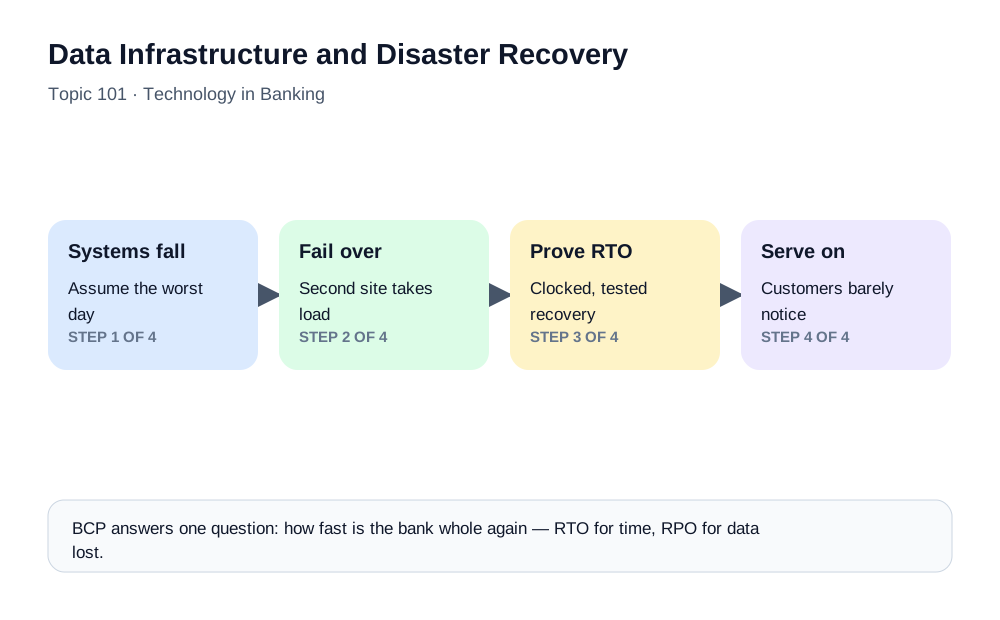
Data Infrastructure and Disaster Recovery at a glance — Data centers, BCP, RTO/RPO.
Data Centers, BCP, RTO/RPO — Keeping Banks Running No Matter What
The modern banking system operates as a continuously running digital infrastructure that processes millions of transactions every hour, maintains billions of customer records, and manages trillions of rupees in deposits and loans. When this infrastructure fails — whether from hardware malfunctions, cyber attacks, natural disasters, or human error — the consequences extend far beyond technical inconvenience. Automated teller machines stop dispensing cash, payment systems reject legitimate transactions, customers lose access to their funds, and businesses cannot execute the financial flows that keep commerce functioning. Data infrastructure and disaster recovery capabilities ensure that banks survive disruptions with minimal impact to customers and the broader economy, maintaining the trust that makes banking possible. In an interconnected financial system, the resilience of individual banks affects the stability of the entire economy.
Bank data center architecture reflects the layered resilience required for mission-critical financial operations. The primary data center hosts all production systems that serve customers and process transactions in real-time — the core banking platform, payment systems, digital banking applications, and all supporting infrastructure. This facility operates with redundant power supplies, cooling systems, network connections, and hardware components that eliminate single points of failure during normal operations. Enterprise-class data centers feature uninterruptible power supply systems, diesel generators with days of fuel capacity, multiple internet service provider connections, and sophisticated environmental controls that maintain optimal conditions for sensitive equipment. However, even the most robust primary data center can fail completely due to fire, flood, earthquake, or catastrophic infrastructure damage. Disaster recovery sites provide the backup capacity that enables business continuity when primary facilities become unavailable.
Banks use different recovery topologies depending on service criticality, geography, technology and risk appetite. Some operate nearby secondary facilities, some use geographically separated data centres or cloud regions, and some combine several patterns. Proximity can make low-latency or synchronous replication more practical, while greater geographic separation can reduce exposure to correlated physical events, but there is no universal distance, number of sites, recovery time or guarantee of zero data loss that applies to every bank. The design should be justified against credible failure scenarios, shared dependencies, data-consistency requirements and tested recovery capability.
Two widely used metrics describe recovery requirements. Recovery Time Objective is the target period for restoring a process or service after disruption, while Recovery Point Objective describes the maximum tolerable age of recoverable data. The actual targets vary by bank, jurisdiction, business service and risk assessment; there is no universal one-hour or two-to-four-hour standard for all payment or core systems. A fifteen-minute RPO means the organisation designs to recover data to a point no more than fifteen minutes before disruption, while a two-hour RTO means the service is intended to be restored within two hours under the defined scenario. These remain objectives until exercises demonstrate that the complete service can actually meet them.
Data replication technologies bridge the physical distance between primary and disaster recovery sites while balancing the competing demands of data protection and performance. Synchronous replication writes data to both primary and disaster recovery sites before acknowledging transaction completion to the application. This approach ensures zero data loss — the disaster recovery site has every transaction that the primary site has — but introduces latency because applications must wait for distant confirmation. Synchronous replication is practical only for near disaster recovery sites where network latency remains low. Asynchronous replication acknowledges transactions when the primary site commits them, with replication to the disaster recovery site occurring subsequently as network capacity allows. This approach minimizes performance impact but creates a replication lag during which transactions exist only at the primary site — a failure during this window means those transactions are lost. Asynchronous replication is necessary for far disaster recovery sites where distance makes synchronous confirmation impractical. Semi-synchronous replication offers a middle ground, waiting for disaster recovery confirmation when possible but proceeding without it if delays exceed thresholds — providing near-zero data loss under normal conditions with graceful degradation during network congestion.
Business Continuity Planning extends beyond technology recovery to encompass the full organizational response that maintains essential functions during disruptions. The Business Impact Analysis identifies critical business processes and quantifies the operational and financial impact of their interruption, prioritizing recovery efforts based on severity. This analysis considers not just direct revenue loss but reputational damage, regulatory consequences, and customer impact. Recovery strategies define how each critical process will be restored, specifying alternative approaches when primary methods are unavailable. The disaster recovery plan provides detailed technical procedures for information technology system restoration. Communication plans establish protocols for notifying employees, customers, regulators, and other stakeholders during disruptions, ensuring that accurate information flows promptly rather than allowing rumor and uncertainty to spread. Alternate work site arrangements identify locations where employees can continue operations if primary facilities become unusable, including both immediate backup sites for short-term displacement and longer-term arrangements for extended disruptions. Testing plans specify regular exercises that validate recovery capabilities and identify improvement opportunities before real disasters occur.
Banks in India must implement business continuity, disaster recovery and IT-resilience controls under the RBI directions and guidance applicable to their type of regulated entity. Current requirements should be read from the operative RBI framework rather than reduced to one universal drill frequency for every institution. Governance, business-impact assessment, recovery arrangements, testing, cyber-resilience scenarios and senior-management or board oversight are recurring supervisory themes, but exact scope, cadence and evidence requirements depend on the applicable direction and the criticality of the service.
Banks commonly classify incidents by severity so response, escalation and communication scale with impact, but the labels and number of levels are institution-specific. A minor component failure may be handled through normal high-availability procedures, while loss of a site, widespread service disruption, cyber compromise or regional event can require formal disaster-recovery and business-continuity activation. What matters is that thresholds, authority, escalation paths and communication responsibilities are defined before the incident rather than that every bank uses the same Level 1-to-Level 4 scheme.
High availability architectures complement disaster recovery by minimizing the frequency and duration of outages even before disaster recovery activation becomes necessary. Active-active configurations distribute live traffic across both primary and disaster recovery data centers, with each site handling production workload continuously. If one site fails, traffic automatically routes to the surviving site with no interruption — customers may not even notice the failure. This architecture requires sophisticated load balancing and data synchronization but provides the highest levels of availability. Active-passive configurations maintain the disaster recovery site in standby mode, activated only when the primary site fails — less expensive than active-active but requiring minutes to hours for failover. Database clustering technologies such as Oracle Real Application Clusters and SQL Server Always On enable databases to survive individual node failures without application interruption. Load balancers distribute incoming traffic across multiple servers and automatically reroute when individual servers fail. Auto-scaling capabilities in cloud environments add computational capacity automatically during traffic spikes, preventing performance degradation or outages under load.
Backup strategy should maintain enough independent, protected recovery copies to survive credible failure and attack scenarios. The well-known 3-2-1 pattern is a useful design heuristic in many environments, but banks may use different architectures involving immutable storage, offline or logically isolated copies, snapshots, transaction logs and geographically separated repositories. Backup frequency and retention should follow the recovery needs of each data set rather than a universal weekly, daily or hourly schedule. Multiple backup layers can support point-in-time recovery only when the relevant data, logs, keys and configuration are captured and restoration has been tested.
Testing disaster recovery capabilities through regular exercises ensures that plans work when needed and identifies improvement opportunities in controlled circumstances rather than during actual crises. Tabletop exercises gather response teams to walk through disaster scenarios on paper, discussing actions and decisions without actually executing procedures. These exercises test understanding of roles and responsibilities while revealing gaps in planning. Simulations create more realistic conditions where teams respond to injected scenarios with time pressure and partial information, testing coordination and communication. Partial failovers switch specific applications to disaster recovery sites, validating technical procedures without risking all operations. Full failovers transfer all operations to disaster recovery sites for defined periods, providing the most comprehensive validation of recovery capabilities. Unannounced drills introduce surprise elements by triggering responses without advance warning, revealing how teams perform under realistic conditions rather than rehearsed scenarios. These tests often reveal issues that would be catastrophic in actual disasters — network configuration errors, missing documentation, or communication gaps — allowing correction before they matter.
The importance of disaster recovery and business continuity in banking cannot be overstated. Unlike many industries where temporary service interruption causes inconvenience, banking outages can prevent customers from accessing funds for essential needs, disrupt business operations that depend on payment flows, and undermine confidence in the financial system itself. The layered approach — primary data centers with redundant components, near disaster recovery sites for rapid failover, far disaster recovery sites for catastrophic protection, comprehensive backup strategies, and regularly tested business continuity plans — reflects the gravity of this responsibility. The banks that master these capabilities not only protect their customers and shareholders but also fulfill the systemic role that makes banking infrastructure essential to economic functioning. In an increasingly digital and interconnected world, the resilience of banking infrastructure has become a matter of public interest and regulatory priority. The institutions that invest appropriately in disaster recovery capabilities demonstrate the reliability that customers and regulators expect from institutions entrusted with the safekeeping of money.
<!-- MBA-DEEP-DIVE-START -->Disaster Recovery Continuation: From Backup Technology to End-to-End Banking Resilience
Resilience begins with a business service, not a data centre
Banks often describe resilience in infrastructure terms: primary site, secondary site, backup, replication and failover. Those components matter, but customers experience services rather than infrastructure. A retail customer experiences account access, card usage, cash withdrawal and payment initiation. A corporate customer experiences host-to-host files, APIs, balance reporting and payment status. Treasury experiences liquidity positions and market connectivity. Regulators care whether critical functions remain controlled. The resilience design should therefore start by identifying important business services and then tracing every dependency required to deliver them.
A payment service may depend on customer authentication, channel infrastructure, fraud controls, account balance, payment routing, sanctions screening, ledger posting, external network connectivity, reference data, cryptographic services and reporting. Recovering only the payment application while one of these dependencies remains unavailable does not restore the service. This dependency map is the foundation for realistic recovery design.
Business-service thinking also prevents false confidence from component availability percentages. A bank may operate several highly available systems yet still suffer a customer outage because one small shared dependency fails. Identity platforms, DNS, certificate services, messaging middleware, network routes and reference-data services frequently become hidden concentration points. Resilience therefore asks not only whether each system has redundancy, but whether the complete customer journey can survive the loss of a component, site, provider, credential domain or operating team.
Business impact analysis determines recovery priority
A Business Impact Analysis converts disruption into operational consequence. It identifies which processes become harmful when unavailable, how quickly the harm increases, which customers or markets are affected, what manual alternatives exist and which external deadlines or obligations could be missed. This analysis supports recovery objectives that reflect business need rather than technology convenience.
For example, a historical analytics platform may hold valuable data but tolerate a longer outage than a service that validates customer payment authority. A regulatory reporting service may tolerate several hours during normal days but become critical near a filing deadline. A payroll processing channel may become more time-sensitive near a major salary date. Recovery priority can therefore vary with time, calendar events and external cut-offs.
Dependencies should be included in the same analysis. If a high-priority payment service relies on a lower-classified reference-data application, the lower classification is inconsistent. The bank either needs to raise the dependency's resilience or redesign the service so it can operate safely without it for a defined period.
The BIA should also consider data integrity. Some services can resume with a known data delay and reconcile later. Others cannot. A balance ledger or payment-status system may require very strong recovery-point protection because lost or duplicated financial state creates customer and accounting risk.
RTO and RPO are design constraints, not marketing promises
Recovery Time Objective describes the target time for restoring a process or service after a disruptive event. Recovery Point Objective describes the maximum tolerable age of recoverable data, expressed as a point in time. These measures are useful only when the scope is clear.
An application can meet a technical RTO while the business service still fails because downstream connectivity, operations access or data validation is not ready. Similarly, a database can meet a small RPO while another system in the same transaction chain recovers from an older point, creating inconsistent state. Recovery objectives should therefore be defined and tested at the level where the business consequence is understood.
Zero data loss is an especially demanding statement. Synchronous replication can reduce the risk of losing committed data across certain failure scenarios, but it does not eliminate every source of loss or corruption. Application defects, malicious changes, accidental deletion and logically corrupted transactions can replicate perfectly to the secondary site. Backups and point-in-time recovery remain important even when infrastructure replication is strong.
The bank should distinguish objective, architecture capability and tested result. A documented one-hour RTO is not evidence that the service can actually recover in one hour. Repeated exercises provide the evidence and reveal whether the objective remains realistic as systems evolve.
High availability and disaster recovery solve different failure classes
High availability aims to keep a service running through routine component failure. Multiple servers, clustered databases, redundant network devices and load balancing can allow the system to survive loss of one node without invoking a major recovery plan. Disaster recovery addresses larger events where a substantial part of the production environment becomes unavailable or untrusted.
The distinction matters because the response is different. If one application node fails, automated traffic redistribution may be appropriate. If an attacker obtains administrative control across the production environment, automatically failing over an identically configured secondary environment may reproduce the compromise. A cyber incident may require isolation, evidence preservation and recovery from known-good state rather than ordinary high-availability failover.
Likewise, a data-centre power event differs from a data-corruption event. Replication is excellent for physical infrastructure loss but can propagate bad data. Backups help recover historical state but may take longer. Active-active architecture can improve availability but introduces complex consistency and routing considerations. No single pattern protects against every failure mode.
Resilience architecture should therefore map control mechanisms to scenarios: hardware failure, network isolation, site loss, cloud-region outage, cyber compromise, ransomware, database corruption, operator error, third-party failure and large-scale staff unavailability.
Geographic separation should be driven by correlated risk
The purpose of a geographically separate recovery environment is to reduce the probability that one event affects both production and recovery capability. There is no universal distance that guarantees independence. The relevant risks include flood zones, seismic conditions, power grids, telecommunications routes, cloud control planes, civil infrastructure and operational staffing.
Two facilities can be hundreds of kilometres apart yet depend on the same network carrier, software control plane or identity service. Conversely, two facilities closer together may protect against many local failures while not protecting against a regional disaster. The bank should identify which scenarios each site arrangement addresses and where residual concentration remains.
Cloud architecture changes the physical view but not the principle. Availability zones and regions provide different isolation characteristics depending on the provider, service and design. Using multiple zones can protect against some facility failures, while a provider-wide identity or configuration error may still affect all zones. Multi-region architecture may improve resilience but adds complexity around data replication, latency, cost and consistency.
Geographic strategy should also consider people. If the same small operations team is required to activate both environments, a regional emergency or pandemic can disable the recovery process even though the technology survives.
Replication protects currency of data; backup protects recoverability of history
Replication and backup are complementary. Replication keeps another copy of current data so a service can continue or recover quickly after infrastructure failure. Backup preserves recoverable historical states so the bank can return to an earlier point after deletion, corruption, ransomware or application error.
A replicated database can be perfectly synchronized and still be unusable if a destructive command or corrupted update is copied to every replica. A backup taken before the corruption can provide the clean recovery point. This is why resilience programmes that focus only on secondary-site replication remain exposed to logical failure.
Backup design should consider frequency, retention, protection, encryption, access and restoration speed. Different data sets can justify different policies. Transaction logs may support fine-grained point-in-time recovery, while large document stores may use less frequent snapshots combined with durable object storage. Critical configuration, certificates and infrastructure definitions may need backup alongside business data because restoring a database alone does not recreate a functioning service.
Recovery teams should know which backup is authoritative. During a crisis, finding several copies with unclear timestamps, encryption keys or ownership can delay restoration. Cataloguing and periodic restore testing convert backup from a storage activity into a recovery capability.
Immutable and isolated recovery copies reduce ransomware risk
Ransomware attackers often attempt to destroy backups or disable recovery tooling before encrypting production systems. If production administrators can delete every recovery copy using the same credentials that operate live systems, the backup architecture may fail exactly when needed most.
Protected copies can reduce this risk. Techniques include immutable retention controls, separate administrative domains, offline copies, logically isolated vaults and tightly controlled break-glass procedures. The appropriate combination depends on the platform and threat model. The principle is that compromise of ordinary production administration should not automatically provide the power to destroy every recovery option.
Protection must include keys and configuration. An encrypted backup is unusable if the required decryption keys are lost. Conversely, storing keys with broad access can undermine the security of the backup. Key recovery therefore needs the same seriousness as data recovery.
Periodic exercises should prove that the bank can obtain a protected copy, access the required credentials and keys, restore the data and validate the resulting service. A theoretically immutable backup that nobody knows how to restore does not provide operational resilience.
Recovery sequencing matters because banking systems are interdependent
A large banking service cannot usually be restored by starting every component at once. Systems have dependencies and state relationships that determine recovery order. Identity and network services may need to be available before applications can authenticate. Databases may need recovery before middleware starts. Reference data may need to load before transaction processing begins. Outbound connections may need to remain blocked until integrity checks are complete.
Runbooks should describe these sequences at a level useful during real incidents. They should identify decision points, prerequisites, owners, validation steps and rollback criteria rather than simply listing server names. Contact details and access methods must remain available even when normal collaboration tools are unavailable.
Financial services require additional validation before reopening. Ledger balances, payment queues, settlement positions and sequence numbers may need reconciliation. If systems recovered from different points in time, teams need to identify in-flight transactions and decide how to repair state safely. Releasing customer traffic before this work is complete can turn a recoverable outage into duplicate payments or inconsistent balances.
This is why recovery speed and recovery correctness must be balanced. A service restored ten minutes faster but with uncertain financial state is not necessarily a better outcome.
In-flight transactions are the hardest part of payment recovery
Payments can fail at inconvenient points. A customer may have authorised an instruction, the bank may have debited the account, the external network may or may not have accepted the message, and the confirmation may be missing. After a disruption, the system cannot safely assume that every transaction without a final response failed.
Recovery procedures need status evidence and idempotent behaviour. Internal payment identifiers, external references, timestamps, queue state and network acknowledgements help determine what happened. Where an external scheme or correspondent offers status enquiry, that information can support repair. Reconciliation against settlement or statement evidence may be required for uncertain cases.
Retry logic should be specific to the operation. Re-reading a customer profile is generally safer than resubmitting a financial instruction. Systems should distinguish an instruction that was never sent from one that was sent but has an unknown response. This distinction belongs in application design, not only disaster documentation.
Operations teams should have a defined process for uncertain transactions. Customers may call while systems are recovering, and service teams need language that reflects the true state rather than prematurely saying a payment failed or succeeded.
Active-active architecture introduces consistency responsibilities
Running production traffic across more than one site can reduce failover time because both environments are already serving work. However, active-active architecture is not simply “double everything.” The bank must define how traffic is routed, how data remains consistent, how sessions behave, how shared limits are enforced and what happens during partial network separation.
A split-brain condition is particularly dangerous when two sides of a system continue accepting changes without a safe way to coordinate. Financial applications may require consensus, partition handling or carefully designed ownership of transaction ranges. The correct pattern depends on the data and service.
Operational procedures also change. If one site becomes degraded, traffic may need to shift gradually rather than through a dramatic disaster declaration. Monitoring should detect imbalance and capacity risk. Each site must have enough headroom, or the surviving side may become overloaded precisely when it needs to carry more traffic.
Active-active can be highly effective, but it increases the importance of architecture, testing and state-management discipline. It should not be adopted merely because it sounds more resilient.
Cloud recovery needs clarity about shared responsibility
Cloud platforms can simplify some resilience capabilities through managed replication, snapshots, infrastructure automation and geographically distributed services. They also introduce provider dependencies and a shared-responsibility model. The provider may maintain physical facilities and managed service availability, while the bank remains responsible for architecture, identity, configuration, data protection and application recovery.
A common failure is configuration replicated across environments. Infrastructure-as-code is valuable because it makes environments reproducible, but a flawed template can deploy the same mistake everywhere. Recovery design should include protected versions of configuration and independent validation.
Identity is another concentration point. If all recovery access depends on the same compromised identity tenant, secondary infrastructure may exist but remain inaccessible. Break-glass arrangements, alternate access procedures and strong governance can reduce this risk without creating uncontrolled permanent backdoors.
Provider-native backup and recovery services can be useful, but banks should understand retention, deletion protection, regional behaviour and export capability. Outsourcing infrastructure does not remove the need to prove recovery.
Cyber recovery differs from ordinary disaster recovery
Traditional disaster recovery often assumes that the secondary environment is trustworthy. Cyber incidents challenge that assumption. Malware, stolen credentials, malicious configuration or compromised software may exist in both primary and recovery environments. Failing over quickly could restore the attacker as well as the service.
Cyber recovery therefore emphasises clean-room concepts, known-good images, protected backups, credential reset, integrity validation and controlled reconnection. The bank may need to rebuild selected components rather than simply start the standby system. Forensic investigation and recovery may occur in parallel, with careful governance to avoid destroying evidence.
The decision to reconnect external networks or customer channels should be based on confidence that the environment is controlled. This can require validation of privileged accounts, endpoint status, configuration, certificates, software integrity and transaction data.
Cyber recovery exercises should include realistic uncertainty. Teams should practise scenarios where the latest replica is suspected of compromise and the exact attack start time is unknown. This is harder than a scripted data-centre outage but more representative of modern threats.
Business continuity includes people, premises and decision authority
Technology can recover while the business remains unable to operate. A serious event may make offices inaccessible, affect transport, reduce staffing or disable ordinary communication channels. Business continuity plans should identify critical roles, alternates and remote or alternate-site arrangements.
Decision authority is essential. Who can declare a disaster? Who can approve switching payment processing to an alternate environment? Who contacts regulators or external networks? Who decides whether manual contingency is acceptable? If these decisions depend on one unavailable executive, recovery can stall.
Cross-training helps reduce key-person risk. A runbook known only to one specialist is not a resilient process. Documentation should be accessible through protected channels that do not depend entirely on the systems being recovered.
Vendor and partner continuity also matters. A bank may recover its own payment hub while a critical telecommunications provider or managed-service supplier remains unavailable. Contracts, escalation contacts and alternate arrangements should be part of continuity planning for material dependencies.
Manual fallback can help, but it must remain controlled
Some banking processes have manual contingency procedures for technology outages. These can preserve service, but they create different risks. Manual processing may have lower capacity, weaker automated validation and greater opportunity for duplicate or unauthorised activity.
Fallback procedures should therefore define when they can be activated, which transactions are eligible, what approvals are required, what limits apply and how records will be reconciled when systems return. A paper or spreadsheet-based process should not become an uncontrolled bypass of sanctions, fraud or authority checks.
The bank also needs a re-entry plan. Transactions handled manually during an outage may later need to be captured in core systems. Teams must prevent double posting when original automated flows resume. Reconciliation between manual records, customer instructions and restored system state is crucial.
Testing manual fallback occasionally can reveal whether staff still understand it and whether forms, contacts and approval methods remain current.
Disaster declarations should not be delayed by uncertainty about labels
Real incidents rarely announce themselves as “Level 3 disaster.” A network outage can begin as a local technical issue and later reveal wider infrastructure failure. A cyber alert can appear minor before evidence shows privileged compromise. Effective response therefore focuses on impact and decision thresholds rather than arguing about the incident label.
Escalation criteria can include service unavailability, transaction backlog, data-integrity concern, customer impact, loss of a site, failure of a critical dependency or evidence that the production environment is untrusted. The response structure can scale as more information emerges.
A central command function helps coordinate technology, business, communications, security, operations and management. Technical teams need freedom to investigate, while incident leadership maintains priorities, decisions and stakeholder communication.
The declaration itself should trigger known actions such as activating recovery teams, freezing nonessential changes, establishing communication cadence and engaging external parties. Clear triggers reduce the risk that teams wait too long because nobody wants to use the word disaster.
Testing should become progressively more realistic
Tabletop exercises are useful because they allow leaders and teams to reason through scenarios without operational risk. Technical component tests prove that individual recovery mechanisms work. Application failover tests validate systems. End-to-end service tests go further by including channels, dependencies, operations and reconciliation.
The most useful programme uses several forms of testing rather than relying on one annual event. Frequent smaller exercises can test specific capabilities such as restoring a database, rotating a recovery credential or failing a message broker. Periodic larger exercises can validate complete services and command structures.
Success criteria should be defined before the exercise. Did the service meet its recovery objective? Was recovered data consistent? Were customer transactions reconciled? Did monitoring and communication work? Were manual contingencies controlled? Did teams use the current runbook? These questions create evidence for improvement.
Exercises should produce tracked actions. Repeatedly documenting the same problem without closing it turns testing into ceremony. Material findings need owners, deadlines and risk acceptance where remediation cannot be immediate.
Recovery exercises should test the return to normal as well as failover
Failing over is only half the lifecycle. At some point the bank must return to its normal architecture or establish a new primary environment. This failback can be risky because data created during the recovery period must be synchronised correctly.
If the disaster-recovery site processed customer transactions for several days, the original site may now be stale. Reversing replication without careful control can overwrite valid data. Network routes, certificates, batch schedules and external connectivity also need coordinated transition.
Testing should therefore include the path back to steady state. Teams should understand whether failback is automated, planned as a separate migration or avoided until new infrastructure is built. The correct approach depends on architecture, but it should not be invented after the emergency has passed.
Recovery metrics should show capability, not just compliance
Useful resilience metrics include recovery-test success, actual recovery time, data loss observed in tests, age of unresolved recovery findings, percentage of critical services with current dependency maps, backup restoration success, protected-copy coverage and availability of alternate operational staff.
Metrics should distinguish planned objective from proven capability. If a service has a two-hour RTO but the last two exercises took four hours, management should see the gap. If a backup job reports success but restoration has not been tested for a year, the bank has storage evidence rather than recovery evidence.
Trend analysis can reveal whether resilience is improving or degrading as technology changes. Rapid application releases, cloud migrations and new third-party integrations can create dependencies faster than continuity documentation is updated.
Data centres still matter, but logical dependencies matter just as much
Physical resilience remains important. Power, cooling, fire protection, network diversity and facility access all affect service availability. However, modern banking increasingly depends on logical control planes that can fail across physical sites: identity, configuration, software supply chains, certificates, shared databases and managed cloud services.
A mature resilience programme considers both. Physical diversity without logical separation can leave common failure points. Logical redundancy without physical planning can leave several systems exposed to the same local event.
The objective is not to eliminate every shared dependency, which may be impossible or economically unreasonable. It is to know which dependencies are shared, understand the consequence and decide whether the residual risk is acceptable or requires additional control.
A practical scenario: primary payment platform unavailable before cut-off
Imagine a bank loses its primary payment-processing environment shortly before an important market cut-off. Customer channels continue accepting instructions for several minutes before the outage is fully understood. Some payments are already posted, some are queued, and others may have been sent externally without final acknowledgements.
Incident leadership first stabilises intake so the backlog does not grow uncontrolled. Technology determines whether ordinary high-availability recovery can restore service or whether alternate-site activation is required. Payment operations identifies in-flight transactions and preserves references. Treasury considers settlement and liquidity implications. Customer-service teams receive controlled messaging rather than guessing outcomes.
When the alternate environment becomes available, the bank does not blindly replay the queue. It reconciles transaction state, identifies instructions that are safe to resume and isolates uncertain cases for status enquiry or manual investigation. External network connectivity is validated before new traffic is released.
After service restoration, customer ledger state, outbound messages, acknowledgements and settlement evidence are reconciled. The review asks not only why the platform failed but also whether intake controls, failover, state recovery, communication and reconciliation worked as designed.
This scenario shows why disaster recovery in banking is not an infrastructure-only subject. It joins channels, payment state, accounting, external networks, operations, liquidity and customer communication.
Operational resilience is broader than restoring technology
Disaster recovery is one capability inside operational resilience. The broader objective is to keep important banking services within tolerable impact even when disruption occurs. Sometimes that requires technical failover. Sometimes it requires demand management, manual contingency, alternate suppliers, customer communication or controlled degradation of nonessential features.
A mobile banking application might temporarily disable low-priority functions while preserving balance access and payments. A reporting service might delay noncritical analytics to protect transaction capacity. A call centre may route priority cases differently during a major outage. These are business design choices rather than server-level recovery actions.
Resilience therefore belongs to technology and business together. Architects design redundancy, operations manages recovery, business owners define tolerable impact, security addresses cyber scenarios, risk challenges assumptions, and management allocates resources according to criticality.
The strongest recovery plan is one the bank has repeatedly proven
Documentation is necessary, but confidence comes from evidence. A bank can own multiple data centres, cloud regions and backup tools and still discover during a crisis that certificates expired, access was unavailable, data was inconsistent or nobody knew who could approve failover.
Repeated testing turns assumptions into knowledge. Findings should improve architecture and procedures. Changes to production should trigger review of recovery dependencies. New critical services should not wait until the next annual planning cycle to obtain continuity arrangements.
The practical standard is simple to state even though it is difficult to achieve: the bank should know which services matter most, understand what they depend on, protect recoverable data, maintain alternate capability, practise using it and restore customer service with financial state that can be trusted. That is the difference between owning disaster-recovery technology and being operationally resilient.
Resilience Top-Up: Recovery Evidence, External Dependencies, and Customer Impact
Recovery plans should name the minimum viable banking service
During a severe incident, restoring every feature at once can delay restoration of the capabilities customers need most. A bank should know the minimum viable service for each important business process. For retail banking this may include secure login, accurate balance access, critical payments and card controls before lower-priority functions such as marketing offers or detailed analytics return. For corporate banking it may include file intake, payment release, status reporting and emergency support.
Defining a minimum viable service helps technology teams prioritise dependencies and helps business owners decide what controlled degradation is acceptable. It also prevents a recovery programme from treating all applications as equally urgent merely because each has a production label.
External payment networks belong in recovery tests
A payment platform can recover internally and still be unable to send or receive transactions because external connectivity is not ready. Certificates, network routes, participant identifiers, queues, security devices and external counterparties can all be part of the service.
Recovery exercises should therefore test the boundary where feasible. At minimum, the bank should validate connectivity, authentication and message exchange with representative external services in an approved test or controlled production arrangement. Operations should know who to contact at schemes, correspondents or infrastructure providers when connectivity must be re-established urgently.
If an alternate site uses different network addresses or certificates, those details should be pre-arranged rather than improvised during a crisis. A technically healthy recovery site that cannot communicate with the payment infrastructure is not a recovered payment service.
Customer authentication can become a hidden recovery blocker
Digital banking recovery depends on identity services. If multifactor authentication, token validation, device registration or customer directory services remain unavailable, restoring the channel application itself provides little value.
Identity dependencies deserve resilience appropriate to the services they protect. The bank should understand whether authentication runs in the same failure domain as the application and whether alternate environments can validate existing sessions or require new login.
Security must not be weakened casually during recovery. Disabling strong authentication to restore access more quickly can create fraud risk precisely when monitoring and staffing are under pressure. Any contingency authentication method should be designed and governed before an incident.
Communication systems need their own continuity path
Major outages generate demand for internal coordination and customer communication at the same time ordinary collaboration tools may be affected. Incident leaders need alternate contact methods, current distribution lists and a reliable place to maintain the authoritative situation record.
Customer communication should describe impact in banking terms. “Database unavailable” is less useful than “some outbound transfers are delayed; card payments and account balances remain available.” The message should distinguish confirmed facts from investigation and avoid declaring transactions failed when status is uncertain.
A status page should ideally be hosted in a failure domain independent enough that customers can still see updates when the main digital platform is down. Call-centre scripts and social channels should use the same confirmed status to reduce contradictory information.
Recovery access must work when ordinary identity infrastructure does not
Administrators may need privileged access to recovery infrastructure during an identity outage or cyber incident. Break-glass arrangements can provide a controlled emergency path, but they create risk if they become permanent undocumented backdoors.
Emergency credentials should be strongly protected, limited in number, tested periodically and monitored whenever used. Access instructions need to remain available through protected offline or alternate means. After use, credentials should be rotated and activity reviewed.
This is a practical example of resilience and security pulling in different directions. The bank needs a path that remains usable under severe failure without creating everyday uncontrolled privilege.
Recovery data should be reconciled before customer balances are trusted
After restoring account or transaction systems, operations should prove that the recovered state is financially coherent. Ledger control totals, account balances, transaction counts and suspense positions can be compared with expected records. Related systems should be checked for timing differences.
If the customer ledger restored to 10:02 while the payment orchestration service restored to 10:00, two minutes of events may need reconstruction or controlled replay. The bank should identify those differences explicitly instead of assuming each system's successful restore implies end-to-end correctness.
For card, payment and treasury processes, external settlement evidence may provide an independent reference. Reconciliation can reveal instructions that were externally processed but absent from the recovered internal state.
Batch schedules need special treatment after an outage
Banking contains many scheduled jobs: end-of-day processing, interest accrual, statements, regulatory extracts, reconciliations, settlement files and housekeeping. After a prolonged outage, simply restarting every missed batch can create dependency conflicts or duplicate processing.
Recovery runbooks should define which jobs can be skipped, which must be rerun, and in what sequence. A file-generation job may depend on a ledger close. A reconciliation may need the external statement to arrive first. A recurring debit process may require duplicate prevention if the original schedule's outcome is uncertain.
Schedulers themselves are critical infrastructure because they hold calendars, run state and dependencies. Their recovery should preserve enough history to distinguish a genuinely missed job from one that completed before the incident.
Regulatory deadlines can change recovery priority
The business impact of an outage depends on timing. A reporting platform unavailable early in a reporting cycle may have lower immediate impact than the same outage hours before a statutory submission. A payment service failure near a market cut-off may be more urgent than the same duration overnight.
Continuity planning should identify time-sensitive obligations and escalation points. This does not mean every deadline requires separate infrastructure, but incident leaders need visibility so resources can be prioritised rationally.
If a deadline may be missed, the responsible business and compliance teams should follow the applicable notification or contingency process rather than assuming technology recovery alone resolves the obligation.
Supplier recovery claims should be tested through evidence
A critical provider may contractually promise strong availability and recovery, but the bank still needs assurance appropriate to the dependency. This can include resilience documentation, independent assurance, service reports, incident history, test evidence or participation in joint exercises where justified.
The bank should understand what the provider's recovery objective actually covers. A cloud service may restore infrastructure while the bank remains responsible for restoring its application. A software provider may recover the platform while customer data integration still requires action by the bank.
Contracts should support timely incident communication and access to information needed for the bank's own regulatory and customer responsibilities.
Crisis exercises should include decision pressure and incomplete information
Real incidents rarely provide perfect diagnosis at the beginning. Exercises are more valuable when teams receive evolving evidence and must decide whether to fail over, isolate systems, stop intake, communicate with customers or invoke manual contingency.
The purpose is not to trap participants. It is to reveal whether decision rights, evidence needs and escalation paths are clear. If every important decision requires an executive who is unavailable in the scenario, the operating model has a key-person weakness.
Exercises can also test handover between shifts. A long-running disruption may span many hours or days, and loss of context during handover can lead to repeated investigation or contradictory decisions.
Post-incident review should connect root cause with recovery performance
After service returns, the bank should examine two separate questions. Why did the disruption occur, and how well did the institution respond? A hardware defect may be unavoidable, yet poor monitoring, slow escalation or an outdated runbook can make the customer impact much larger.
Reviews should preserve evidence and avoid reducing complex incidents to individual blame. Architectural concentration, process gaps, unclear ownership and weak testing often contribute. Actions should be specific enough to close the observed weakness and tracked to completion.
Near misses are valuable too. If failover succeeded only because one experienced engineer remembered an undocumented step, the outcome should not be marked simply as a success. The undocumented dependency is a resilience gap.
Recovery capability should evolve with every major architecture change
A new API gateway, cloud migration, identity platform, payment engine or outsourcing arrangement can alter recovery dependencies. Continuity documentation should be updated as part of the change rather than months later.
The design review can ask simple questions: does this change alter the authoritative data store, recovery sequence, external connectivity, credentials, backup method or business-service dependency map? If yes, recovery testing and runbooks may need to change too.
This prevents a common problem in which production architecture evolves continuously while the disaster-recovery plan describes last year's system.
The operational objective is trusted service, not merely uptime
Banking resilience combines availability with integrity, control and customer clarity. A service that is technically online but displays stale balances, duplicates payments or cannot authenticate customers safely is not genuinely recovered.
The strongest recovery programmes prove three things together: the technology can run, the financial state can be trusted, and operations can support customers through the transition. That is why disaster recovery belongs to the full banking operating model rather than only to infrastructure teams.
<!-- MBA-DEEP-DIVE-END -->