Visual overview
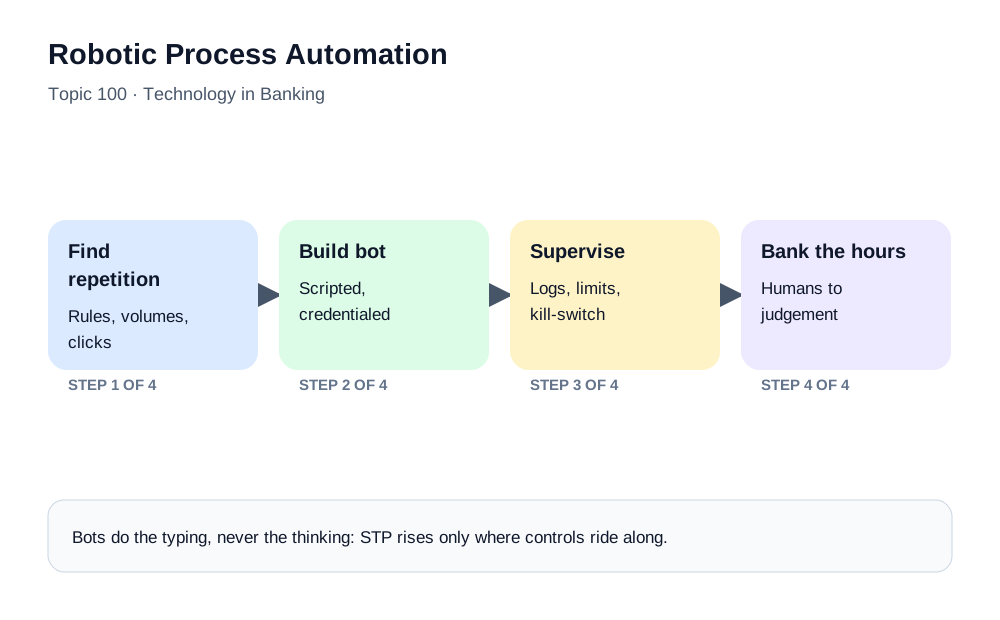
Robotic Process Automation at a glance — Automation use cases, STP, efficiency gains.
Bots, Straight-Through Processing, and Efficiency at Scale
Robotic Process Automation deploys software bots that interact with computer systems exactly as human workers do — clicking buttons, entering data, copying information between applications, and executing routine tasks with speed and precision that human operators cannot match. In the banking industry, where operations have traditionally relied on armies of back-office staff processing high volumes of repetitive transactions, RPA has emerged as a transformative technology that delivers substantial efficiency gains while improving accuracy and freeing human workers to focus on activities requiring judgment, creativity, and interpersonal skills. The technology has moved from experimental deployments to mainstream adoption, with many banks now operating thousands of bots that collectively handle millions of transactions annually.
The fundamental concept underlying Robotic Process Automation distinguishes it from traditional software development. Where conventional automation requires building application programming interfaces and integrating systems at the technical level, RPA bots interact with applications through the user interface layer — the same screens and buttons that human employees use. A bot processing a loan application opens the core banking system exactly as a human would, logs in with appropriate credentials, navigates to the loan origination screen, enters data from the application form, and submits for approval. This approach provides remarkable flexibility — bots can automate processes across virtually any application combination without requiring changes to the underlying systems. This non-intrusive characteristic makes RPA particularly valuable for legacy environments where system integration would be prohibitively expensive or technically impractical.
The operational characteristics of software bots explain their value in banking operations. Properly engineered unattended bots can run outside normal staffing hours and can execute repetitive steps consistently, but they are not inherently error-free and they do not provide unlimited capacity. Their speed depends on application response times, orchestration, licensing, infrastructure, business rules and exception rates. Bots are most useful where work is high-volume, rule-based, repeatable and supported by stable systems, while monitoring and capacity management remain necessary because an automated error can also be repeated at scale.
Robotic Process Automation implementations fall into three categories that reflect different levels of human involvement and automation sophistication. Attended RPA deploys bots that work alongside human employees, triggered by user actions when specific tasks require automation assistance. A customer service agent handling a complex inquiry might click a button that triggers a bot to pull customer data from four separate systems — relationship details from the core banking platform, recent transactions from the payment system, open service requests from the complaint management application, and credit status from the loan system. The bot consolidates this information for the agent, who then uses their judgment and communication skills to address the customer's needs. This human-in-the-loop approach combines the efficiency of automation with the irreplaceable capabilities of human judgment and empathy.
Unattended RPA operates autonomously on schedules or triggers, requiring no human intervention for routine execution. A nightly batch process might have bots download statements from correspondent banks, reconcile transactions against internal records, and flag exceptions for morning review by human analysts. These bots can process thousands of transactions overnight, presenting only the exceptions that require human judgment when staff arrive in the morning. Intelligent RPA combines traditional automation with artificial intelligence and machine learning capabilities, enabling bots to handle semi-structured data and simple decisions that previously required human judgment. A bot processing loan documents might use optical character recognition to read income documents, extract relevant data fields, and make preliminary eligibility assessments based on configured rules. This cognitive automation extends RPA's reach to processes that would be impractical to automate with purely rule-based approaches.
Banking operations present numerous use cases where RPA delivers substantial value across functional areas. In account opening processes, bots extract data from application forms whether submitted digitally or scanned from paper, enter the information into core banking systems, and verify Know Your Customer documents against regulatory databases. Loan processing bots collect credit bureau reports, assemble income documentation, populate underwriting templates with standardized calculations, and route complete packages to credit analysts for decision. Reconciliation processes that historically consumed hours of analyst time are handled by bots that match transactions between internal systems and external statements, flagging only the exceptions that require human investigation. Regulatory reporting benefits from bots that pull data from multiple source systems, apply formatting requirements, and generate submission-ready reports. Statement processing bots read incoming documents whether delivered by email, fax, or physical mail, extract key data elements, and enter transactions into appropriate systems.
Compliance functions particularly benefit from RPA given the high stakes of regulatory adherence and the repetitive nature of many compliance activities. Know Your Customer refresh processes require periodic verification that customer information remains current and accurate — bots pull existing records, check against latest available data sources, and flag discrepancies for review. Suspicious activity report preparation demands assembly of transaction data, account history, and customer information into regulatory formats — bots gather and pre-populate these reports, leaving analysts to focus on narrative descriptions of suspicious patterns. Sanctions screening requires running customer and transaction party names against government and international sanctions lists, then reviewing matches to identify false positives — bots execute the screening and perform initial triage, presenting only questionable matches for human judgment. Regulatory returns compilation involves gathering data across the institution for submission to Reserve Bank of India and other regulators — bots automate much of this data collection and formatting.
Customer service operations leverage RPA to improve response times and service quality. Query resolution bots retrieve account information, transaction details, and relationship history in real-time as agents converse with customers, eliminating the delays of manual system navigation. Complaint logging bots automatically capture details from customer communications, categorize issues according to type and severity, and assign to appropriate resolution teams without requiring manual ticket creation. Email processing bots read incoming customer messages, classify intent through natural language understanding, and route to the correct departments or even draft preliminary responses for agent review. These capabilities enable faster, more consistent service while freeing agents to focus on complex issues that require human judgment.
Straight-Through Processing represents the ultimate goal of banking automation — completing entire workflows without any human intervention from start to finish. The contrast between manual processing and straight-through processing illustrates the transformation RPA enables. Manual processes involve multiple human touchpoints, require hours to days for completion, exhibit error rates of two to five percent due to data entry mistakes and oversight, and incur high labor costs. Straight-through processing achieves zero human intervention for standard cases, completes in seconds to minutes, maintains near-zero error rates for rule-based activities, and operates at dramatically lower cost once implemented. The journey from manual to straight-through processing represents the cumulative impact of systematic automation across process steps.
Straight-through processing rates vary widely by institution, product, channel, data quality, control design and the point in the lifecycle being measured. Standardised electronic payment flows can achieve very high levels of automated processing, while documentary trade, complex lending and exception-heavy onboarding generally retain more manual judgment. A universal percentage should not be quoted without defining the process boundary and evidence source. Banks obtain more value by analysing why cases leave the automated path — for example missing data, compliance review, repair, approval, system failure or uncertain external status — and then removing avoidable causes without weakening legitimate controls.
The gap between current straight-through processing rates and theoretical one hundred percent represents the continuing opportunity for RPA and related automation technologies. Each percentage point improvement translates to substantial cost savings and customer experience enhancement as processing times compress and error rates decline. Banks increasingly view straight-through processing rates as key performance indicators that drive continuous improvement initiatives.
Well-implemented RPA can reduce manual handling, shorten processing time, improve repeatability and free employees from some repetitive work, but the size of the benefit depends on process volume, exception rates, target-system stability and the cost of building and maintaining the automation. Auditability can improve when bot actions, versions, inputs and outcomes are logged properly, but a bot does not automatically create a complete regulatory audit trail. Scalability also depends on platform capacity, target-application limits and licensing. Benefits should therefore be measured from actual production outcomes rather than assumed from generic percentage claims.
Banks use a range of enterprise automation platforms, including products from UiPath, Automation Anywhere, SS&C Blue Prism, Microsoft and other vendors. Market position and product capabilities change over time, so platform selection should be based on current evidence and the bank's requirements rather than a permanent ranking. Relevant criteria include attended and unattended automation, orchestration, credential management, auditability, development controls, deployment model, integration capability, support, resilience, licensing and the institution's existing technology estate.
Despite its transformative potential, RPA implementation presents challenges that banks must address to realize sustained benefits. Brittle bots that depend on specific user interface layouts break whenever applications change — a button movement or screen redesign can halt automation until developers update bot configurations. This maintenance burden increases as bot portfolios grow and target applications evolve. Scalability limits emerge as user interface-based automation consumes more computing resources and requires more maintenance than application programming interface integration as volumes grow. Governance challenges arise when business units deploy bots without central oversight, creating automation proliferation that becomes difficult to manage and secure. Security concerns include the need to manage bot credentials carefully — bots require system access like human users, and compromised bot accounts can enable significant unauthorized activity. Process quality prerequisites mean that automating broken processes simply makes them fail faster — organizations must streamline workflows before automating them.
The strategic view of RPA recognizes it as a bridge technology that delivers immediate benefits while longer-term transformation proceeds. Application programming interface integration remains more robust and scalable for permanent automation, but developing these integrations takes time that RPA can fill immediately. Banks increasingly view RPA as complementary to broader digital transformation — handling processes that resist immediate re-engineering while modernizing core systems and developing native automation capabilities. The institutions that maximize RPA value treat it not as a one-time cost reduction exercise but as a capability that continuously expands as processes are standardized and automation opportunities are systematically identified and implemented. The most successful programs establish centers of excellence that provide governance, reusable components, and best practices while enabling business units to identify and implement automation opportunities.
<!-- MBA-DEEP-DIVE-START -->RPA Continuation: Designing Automation That Behaves Like Controlled Banking Infrastructure
RPA is useful because banks contain many process seams
A modern bank rarely runs one end-to-end process inside one application. Customer onboarding can cross a digital channel, identity-verification service, customer master, sanctions-screening tool, document store and core banking platform. A payment investigation can require data from the payment hub, customer ledger, message archive, case-management system and external network. Regulatory operations may need evidence from dozens of source systems that were never designed to work together. These seams create manual work: people copy values, download files, compare records, re-key references and move cases from one queue to another.
Robotic Process Automation is valuable when it bridges such seams without pretending that it has redesigned the underlying architecture. A bot can reproduce repetitive screen-level actions or orchestrate rule-based steps while the bank works toward stronger API, event or service integration. This is why RPA is often described as non-invasive. It can add automation around an existing application without changing that application's source code.
That advantage is also its limitation. A bot that depends on a particular screen layout, label or desktop sequence is coupled to the user interface. When the target application changes, the automation may need to change as well. Banks therefore get the most value when they are explicit about the role RPA is playing: tactical bridge, durable automation for a stable process, attended assistant for a human worker, or one component in a broader workflow.
The first decision is whether the process should be automated at all
Automation should not begin with the question, “Can a bot click through this?” The better question is, “Should this process exist in its current form?” A manual process may contain duplicate approvals, unnecessary data entry, historical workarounds or checks that were added after old incidents and never revisited. Automating every step preserves the complexity and can make future change harder.
A strong discovery exercise separates business rules from accidental manual activity. If an operations analyst copies the same customer identifier into three systems because no integration exists, that is a candidate for automation. If the analyst reviews supporting documents because legal judgment is required, the bank should not reduce that activity to a screen click merely to increase an automation percentage. If two approvals are required because the risk is material, RPA should preserve the control rather than bypass it.
Process mining, task observation, procedure review and exception analysis can help reveal where time is actually spent. High-volume repetitive work with stable inputs and clear rules is normally more suitable than low-volume work dominated by judgment. The quality of source data matters too. A bot cannot reliably automate a process whose input is inconsistent, incomplete or dependent on knowledge held only in experienced employees' heads.
The best candidates have a defined trigger, clear completion criteria, known exceptions, predictable system behaviour and measurable operational value. The weakest candidates are processes that change constantly, rely on ambiguous documents, need frequent negotiation or depend on applications that are themselves being replaced.
A bot is a production identity and must be governed like one
Software bots often need access to sensitive banking systems. They may read customer data, create service requests, prepare payment instructions, update case statuses or download reports. That means a bot identity is not a harmless technical convenience. It is a non-human user with real business capability.
Each bot should have a named business owner and a technical owner. Its access should reflect only the tasks it performs. Credentials should be stored and retrieved through controlled mechanisms rather than embedded in scripts or shared among several automations. If the bot no longer operates, its access should be removed. If its process changes, entitlements should be reviewed instead of allowing permissions to accumulate indefinitely.
Shared bot accounts weaken accountability. If ten automations run under one credential, audit evidence may show that the account changed a customer record but not which automation, version or job made the change. Separate identities, job-level logging and transaction correlation improve traceability. High-risk operations may also require step-up controls or a design in which the bot prepares work but cannot perform final release.
Banks should also distinguish the bot's system identity from the human or business authority behind the task. A bot executing an approved instruction does not become the customer or employee who authorised the underlying action. Evidence should preserve both: who authorised the business event and which automation technically executed the downstream steps.
Attended automation is strongest when it removes searching, not judgment
Attended RPA runs in support of a human user. It can collect information, populate fields, compare records or trigger repeatable actions while the employee remains responsible for the case. This is particularly useful in customer service and investigations, where the expensive part of the job is often navigating many systems rather than making the final decision.
Imagine a customer calls about an incoming transfer that has not been credited. Without automation, the service agent may search the customer account, payment tracker, exception queue and message archive separately. An attended bot can retrieve the relevant records using a common reference and place them in one view. The agent can then interpret the result, explain the situation and decide whether escalation is required.
The control design should make the division of responsibility visible. If the bot found a probable match rather than an exact match, the user should know that. If the bot could not retrieve one source, it should not silently present an incomplete view as if it were complete. If the user changes a value proposed by the automation, that override can be logged when the process is material.
This model can improve both speed and decision quality because people spend less time on mechanical navigation and more time on understanding the case. It also reduces pressure to automate judgment merely to claim a higher level of straight-through processing.
Unattended automation needs an operational operating model
An unattended bot may run from a schedule, queue or event without a person sitting in front of the screen. This makes it powerful for overnight reconciliation, periodic reporting, data preparation and large-volume housekeeping activities. It also creates a new operational responsibility: somebody must know whether the bot actually ran, whether it completed, what it skipped and what happened to failed items.
A bank should therefore treat unattended automation as a service. Jobs need monitoring, expected schedules, failure thresholds and support ownership. If a bot is supposed to process five thousand records but completes only four thousand before an application timeout, “job completed” is not an acceptable status. The automation should record item-level outcome or enough batch evidence to prove completeness.
Retries require care. Repeating a read-only lookup is different from repeating a transaction-creating step. If a bot submits a payment, posting or account-maintenance instruction and loses the response, it cannot safely assume the action failed. It needs idempotent design, status enquiry, reference checking or reconciliation before retrying. Otherwise automation can create duplicates faster than a human operator ever could.
Queues should distinguish technical failure from business exception. A password expiry, application outage or screen mismatch needs technical support. A customer record that fails a business rule belongs in an operations or case-management queue. Mixing both into one “bot failed” bucket slows resolution and hides the real reason work stopped.
Straight-through processing is an outcome, not an RPA product feature
Straight-through processing means that an eligible transaction or case moves from initiation to completion without manual intervention. RPA can contribute to STP, but it is only one possible mechanism. APIs, workflow engines, event-driven services, rules engines and native application processing can often deliver stronger long-term STP because they operate at the system or data layer rather than by imitating user actions.
A bank should therefore define STP at the business-process level. For a payment, does STP mean accepted from the customer without repair? Does it include sanctions screening, posting, external transmission and confirmation? For account opening, does it include identity verification, customer-master creation, product setup and welcome communication? Different definitions can produce very different percentages.
The useful measure is not the headline percentage but the reason cases fall out of STP. Missing data, compliance hits, invalid account information, system outages, manual approval requirements and uncertain external status represent different problems. Some should be eliminated through better design; some are legitimate control points that should remain.
RPA is most valuable where it removes avoidable manual touch without weakening legitimate control. A process that still requires a human to make a credit decision is not a failure of automation. A process that requires a human simply to copy an already validated customer number between applications probably is an automation opportunity.
Rule engines and RPA solve different problems
A common design mistake is to embed complex business policy directly inside bot scripts. This can make changes difficult to govern because process logic, screen navigation and decision rules become mixed together. Where rules change frequently or affect material customer outcomes, the bank benefits from separating them.
A rules engine or decision service can determine whether a case is eligible, which approval level is required or how an exception should be classified. The bot can then perform the mechanical steps required to execute that decision in systems that lack modern integration. This creates cleaner ownership: business policy can be reviewed and tested independently from user-interface automation.
The distinction is important in regulated processes. If a lending policy, customer-risk rule or transaction threshold changes, the bank needs to know where that rule is implemented. Hidden copies inside multiple bots create inconsistency. One automation may apply the new rule while another still uses an old threshold.
Reusable decision services, reference data and common control components reduce this risk. RPA should consume trusted decisions where possible rather than become an unofficial policy platform.
Reconciliation is the control that proves automation did what it claimed
A bot log saying “success” is not enough evidence that the banking outcome is correct. The automation may have clicked the right button while the target system rejected the transaction, timed out or processed only part of a batch. Reconciliation connects the automation record to the resulting business state.
For a data-migration or update process, the bank can compare the input population with records changed successfully and records sent to exception. The counts should explain the whole population. For a payment-support process, a bot-created instruction can be tied to the payment identifier and subsequent posting or network state. For regulatory reporting, source totals can be reconciled to the output file and submission acknowledgement.
Control totals are simple but powerful. Suppose a bot reads 12,000 records. If 11,700 were completed and 300 failed with explicit reasons, the population is accounted for. If the bot merely says “completed” but only 11,700 output records exist, the bank has an unexplained completeness gap.
Reconciliation also helps after restart. If a bot crashes halfway through a batch, the next run should know which items are already complete. A durable status store or target-system check prevents duplicate execution and supports clear resumption.
Exception design determines whether automation really reduces work
Many RPA programmes automate the easy path and leave exceptions as an afterthought. The result can be a fast bot that generates a chaotic manual queue. A strong design treats exception handling as part of the primary process.
Exceptions should be classified by cause and routed with enough evidence for the receiving team to act. “Automation failed” is not useful. “Customer identifier not found in core system,” “beneficiary account closed,” “target application unavailable,” and “mandatory document missing” are actionable categories. The case should carry relevant references, timestamps and attempted actions so analysts do not repeat the bot's work from the beginning.
Recurring exceptions should feed improvement. If a large percentage of account-opening cases fail because one channel omits a mandatory field, the answer is not to hire more exception analysts. The upstream data-capture process should be corrected. If a bot repeatedly breaks because a target screen changes, perhaps UI automation is no longer the right integration method.
Exception-rate trends therefore reveal the health of both the automation and the underlying business process. A falling exception rate can indicate better data quality, stronger upstream validation or more mature automation. A sudden increase may signal a product change, policy change or system incident.
Change management is where many bots become brittle
RPA depends on target applications. A seemingly minor application release can rename a field, change a menu, alter a web element or introduce a new confirmation screen. Human users adapt quickly; bots may not. This makes dependency management essential.
The automation inventory should identify every application, screen, file layout and credential dependency used by each bot. When a target system plans a release, affected automation owners can be notified and regression testing can occur before production deployment. Without this visibility, bots fail after changes and business teams discover the break only when queues build up.
Where tooling supports robust selectors or object recognition, automations should avoid fragile dependencies such as fixed screen coordinates. Even then, interface changes can alter behaviour. Critical bots need representative test environments and release evidence proportionate to their business impact.
Emergency application changes create another risk. A security patch may need to be deployed quickly, leaving little time for bot testing. The bank should know which automations are affected and have a fallback process. This is another reason RPA needs service ownership rather than being treated as personal desktop macros.
Security controls must account for the scale and speed of automation
A human operator can make an error; a bot can repeat the same error thousands of times before anyone notices. Security and control design should therefore assume that automation amplifies both good and bad instructions.
Least privilege limits the blast radius. Transaction limits, approval boundaries and system controls should remain effective when actions are initiated by bots. A bot should not receive broad administrative access simply because it is easier to configure. Where possible, the target system should enforce business entitlements independently of the automation layer.
Monitoring can also recognise bot behaviour. Expected schedules, source hosts, action patterns and transaction volumes can help detect misuse or malfunction. A bot that normally runs overnight should attract attention if the same identity begins creating transactions interactively during the day. A sudden increase in activity may indicate a runaway process, compromised credential or legitimate business spike; operations needs enough context to distinguish them.
Secrets must be protected carefully. Credentials stored in plain configuration files, spreadsheets or scripts are an obvious weakness. Central credential vaults and controlled runtime retrieval reduce exposure, while rotation procedures ensure automation does not fail unexpectedly when passwords or certificates change.
RPA and segregation of duties must coexist
Automation can accidentally collapse responsibilities that were deliberately separated in the manual process. If one employee prepared a transaction and another approved it, building one bot that performs both steps removes a control unless the bank recreates the separation elsewhere.
A well-designed automation may prepare data, validate completeness and create a draft transaction while leaving approval to an authorised person. Alternatively, two system services can represent distinct stages with independent policy controls. The correct design depends on the underlying risk and mandate, not on whether a bot is technically capable of clicking the approval button.
Segregation also applies to development and operation of bots. The person who writes an automation should not automatically be able to deploy arbitrary changes to production or alter production credentials without control. Source control, code review, release approval and restricted production access make RPA engineering more like ordinary software engineering.
Audit teams should be able to trace which bot version performed an action and which approved change introduced that version. This becomes important when a defect is discovered months later and the bank needs to establish which transactions were affected.
Testing should include business outcomes, not only successful screen navigation
RPA testing often starts with whether the bot can log in and complete a happy-path case. Production quality requires much more. Test data should cover invalid input, missing fields, system timeout, duplicate records, partial response, application warning messages, cancelled transactions, permission failure and restart after interruption.
The expected business outcome should be asserted. If the bot posts a service charge, the test should confirm the correct amount, account, accounting entries and customer record rather than merely confirming that the final screen displayed “success.” If the bot prepares a regulatory file, totals, formatting and population completeness should be validated.
Volume testing is important because a workflow that succeeds for ten cases may behave differently for fifty thousand. Target applications may throttle sessions, time out or enforce concurrency limits. The automation platform itself may have queue and worker constraints. Testing realistic load helps avoid discovering these limits during a month-end or regulatory deadline.
Resilience testing should deliberately stop components and observe recovery. Can the bot resume safely? Does it know which items were completed? Does it create duplicates? Does monitoring detect the interruption? These tests turn restart behaviour from an assumption into evidence.
Monitoring should distinguish availability, throughput and correctness
A bot can be technically running while producing the wrong result. Monitoring therefore needs several dimensions. Availability asks whether the automation platform and target applications are reachable. Throughput asks how many items are being processed and whether backlogs are growing. Correctness asks whether business outcomes reconcile and exception rates remain within expected patterns.
Service-level indicators can include queue age, completion rate, technical failure rate, business exception rate, average handling time, retry rate and reconciliation breaks. The right measures depend on the process. An automation that runs only once per month may care more about deadline completion and control totals than minute-by-minute throughput.
Alert thresholds should be meaningful. A single recoverable application timeout may not need an incident, while an entire queue remaining untouched for thirty minutes could. A bot that normally handles a stable daily volume may need investigation when input suddenly drops to zero, because zero errors can sometimes mean the source feed never arrived.
Operational dashboards are strongest when they show end-to-end status rather than only the RPA platform. If the target core system is down, operations should know that the bot is blocked by a dependency rather than mistakenly restart the bot repeatedly.
Regulatory and compliance automation should preserve accountable judgment
RPA can reduce the administrative burden of compliance work without replacing the accountable decisions that regulations may require. A bot can gather customer records for periodic KYC review, compare dates, identify missing documents and prepare a case. A compliance analyst can then assess the material change, customer risk and required action.
For sanctions operations, automation can move data and manage queues, but screening quality depends on the underlying screening engine, list management, matching rules and analyst disposition. A bot should not convert a complex potential match into a false-positive closure simply because a string comparison passed one rule unless the bank's approved methodology genuinely supports that decision.
Regulatory reporting also benefits from automation, particularly extraction and formatting, but the bank still needs data lineage, reconciliation and accountable sign-off. A perfectly automated file can be consistently wrong if source mapping or business interpretation is wrong. Automation improves repeatability; governance provides correctness.
Evidence should therefore show the source data, transformation or rule version, automation run, exceptions and final approval where required. This allows the bank to demonstrate not only that a bot ran, but why the regulatory outcome can be trusted.
RPA can support reconciliations, but matching logic needs explicit governance
Reconciliation is a common RPA use case because analysts often download statements from one system, extract internal transactions from another and compare them manually. Automation can obtain files, normalise data and apply deterministic matching rules far faster than manual work.
The risk lies in over-aggressive matching. Two transactions with the same amount and date are not necessarily the same transaction. Matching rules should use reliable identifiers where available and define tolerances carefully where exact identifiers do not exist. If the bot uses fuzzy or probabilistic logic, the confidence threshold and review process should be transparent.
Unmatched items should remain visible. An automation that forces every record into a match produces impressive completion statistics but destroys the purpose of reconciliation. The real value is identifying unexplained differences so operations can investigate them.
Reconciliation automation can also provide strong completeness evidence for other bots. If an RPA process posts transactions into a target system, an independent reconciliation can compare the source instruction set with resulting records. This separation reduces reliance on the bot's own success messages.
Desktop automation and enterprise automation are not the same thing
Employees can create small automations for personal productivity, such as extracting data from a report or filling a repetitive internal form. These can be valuable, but the governance required increases sharply when the automation affects customers, money, regulatory data or shared production systems.
Enterprise RPA needs controlled source code, test evidence, production deployment procedures, credential management, monitoring, support and version ownership. A desktop macro running under one employee's account may be unsuitable for a process that must execute every night even when that employee is absent.
Banks can use tiered governance so low-risk personal automations are not burdened with the same controls as payment-processing bots. The classification should consider data sensitivity, transaction impact, volume, customer impact, criticality and whether the automation changes records or merely reads them.
This approach avoids two extremes: uncontrolled bot proliferation on one side and a governance process so heavy that business teams return to manual work on the other.
Process ownership remains with the business even when technology runs it
When a manual process becomes automated, ownership sometimes drifts toward the RPA team because the bot is visible and technical. That is dangerous. The business still owns the outcome, policy, customer impact and control requirements. Technology owns the automation platform and implementation quality, but it should not silently become the authority for business rules.
A business owner should know why the process exists, what success means, what exceptions require judgment and what changes are planned. Operations should understand fallback procedures if automation is unavailable. Technology should know dependencies, credentials, runtime and support. Risk and compliance should know which controls rely on automation.
This shared ownership becomes critical during incidents. If a bot stops processing a regulatory queue, the answer is not simply “RPA team is fixing it.” The business needs to know backlog size, deadline impact and whether manual contingency should start. Technical recovery and business continuity run together.
A bot should have a lifecycle from design to retirement
Automation portfolios accumulate unless retirement is deliberate. A bot can remain scheduled even after the underlying process changes, creating duplicate work or unexpected system load. Every automation should therefore have a lifecycle: idea, assessment, design, build, test, approval, production operation, change, periodic review and retirement.
Periodic review asks whether the automation is still necessary. Perhaps the target application now exposes an API. Perhaps the process was redesigned. Perhaps volumes fell and the maintenance cost exceeds the benefit. Perhaps regulatory changes altered the underlying business rule.
Retirement should remove credentials, schedules, queues, monitoring, infrastructure and support documentation that are no longer needed. Historical logs may still need retention according to applicable requirements, but dormant production access should not remain simply because nobody remembered to remove it.
A healthy RPA programme therefore measures not only how many bots it creates but also how effectively it simplifies and retires old automation when better architecture becomes available.
APIs are usually better for durable system integration when they exist
RPA and APIs are sometimes presented as competing technologies, but they solve different situations. An API exposes a structured interface designed for system-to-system interaction. It normally provides clearer contracts, better performance and less dependence on screen layout. RPA is useful when such an interface does not exist or when the effort to build one cannot be justified immediately.
If a core system already exposes a supported API for account enquiry, using a bot to open the user interface and scrape the same data is usually weaker. The API is more likely to provide stable fields, machine-readable errors and controlled authentication. If no API exists and the system will remain in service for several years, RPA may be the practical bridge.
Banks should therefore maintain an architectural preference rather than an absolute rule. Use native integration where it is available and appropriate; use RPA where it creates value without creating unacceptable fragility; and replace tactical UI automation when a stronger interface becomes feasible.
Intelligent automation should not blur the boundary between deterministic and probabilistic decisions
Traditional RPA is deterministic: given the same inputs and rules, it should perform the same actions. Artificial intelligence can extend automation into document classification, text extraction, anomaly identification or decision support, but these models may produce probabilistic outputs.
A bank should know where certainty changes. Optical character recognition may extract an invoice number with high confidence, but low-confidence fields should be reviewed rather than silently posted. A machine-learning model may classify an email as a dispute or fraud complaint, but a routing error can affect service and regulatory treatment. Confidence thresholds, human review and monitoring should match the consequence of error.
Generative AI introduces further considerations because outputs can vary and may contain unsupported statements. It can assist with summarising a case or drafting an explanation, but material financial decisions and record updates need controls that ensure the final action is based on validated data and authorised policy.
Intelligent automation is strongest when AI handles ambiguity and RPA handles deterministic execution, with clear boundaries and evidence between the two.
A practical banking scenario: automating a returned-payment investigation
Consider an operations team that receives returned payment notifications. An analyst currently reads the return record, searches the original payment, checks whether the customer has already been re-credited, updates an investigation case and sends a standard notification where appropriate.
A controlled automation can take the return reference, locate the original instruction, retrieve current ledger state and compare the return amount and currency. If all required identifiers match and the posting state confirms that a defined automated action is permitted, the bot can prepare or execute the next step according to approved rules. If the amount differs, the original payment cannot be found, the account is closed or another exception exists, the case is routed to an analyst with the evidence already collected.
The design should prevent duplicate action if the same return event is received twice. It should preserve the original return reference, payment identifier and bot-run identifier. Reconciliation should confirm that every incoming return is either completed or sitting in an explainable exception state.
This is a good RPA use case because much of the work is deterministic cross-system navigation, while genuine exceptions remain with people. The goal is not “remove humans.” The goal is “remove unnecessary human navigation and preserve judgment where it matters.”
Cost savings are an outcome of good process design, not a guaranteed percentage
RPA business cases often focus on labour savings, but the full economics include platform licences, infrastructure, development, testing, monitoring, change maintenance, exception handling and control. A bot that saves a few minutes per case may still be worthwhile at very high volume, while an automation that removes hours of work from a rare monthly process may not justify its maintenance burden.
Benefits can include faster turnaround, reduced re-keying errors, extended operating windows, improved evidence, more predictable processing and better employee experience. Some benefits are strategic: automation can stabilise a legacy process while a larger transformation is underway.
Banks should measure realised benefits after implementation rather than assuming the original business-case estimate became true automatically. If exception volumes remain high or the bot requires frequent repair, the economics may differ materially from plan.
The mature view of RPA is disciplined automation, not digital headcount
The simplest way to describe RPA is software that performs computer-based tasks previously performed by people. The more useful banking view is broader: RPA is one automation technique inside an operating architecture that includes policy, workflows, APIs, data quality, controls, identities, exceptions, reconciliation and human judgment.
Success is not the number of bots deployed. A bank can have thousands of bots and still operate fragmented processes. Success is visible when customer journeys become faster, repetitive manual work falls, exceptions become clearer, controls remain strong, system changes are easier to manage and automation failures do not create unexplained financial outcomes.
Used in this way, RPA can be an effective bridge between legacy banking and modern service integration. It creates value where system seams remain, while the bank preserves the discipline required of any production capability that can touch customer data, financial records or regulated processes.
RPA Top-Up: Production Controls That Separate a Useful Bot from a Risky Macro
Automation inventories should connect bots to business services
A mature bank should be able to list every material automation and identify its owner, purpose, target applications, credentials, schedule, business criticality and recovery path. This inventory becomes especially valuable when a target application changes. Operations can immediately identify which bots may fail instead of discovering dependencies after queues stop moving.
The same inventory supports access review and retirement. A bot that no longer has a business owner or has not run for months should not retain production credentials indefinitely. Lifecycle information turns automation from scattered scripts into a managed estate.
Maker-checker control can remain even when preparation is automated
RPA can automate data gathering and transaction preparation without removing independent approval. For example, a bot can collect invoice data, validate mandatory fields and create a draft payment while an authorised employee performs release. This preserves segregation where the underlying risk requires it.
Where a process is legitimately approved for full automation, the target system should still enforce limits, entitlements and business rules. The fact that a bot is trusted to execute does not mean it should receive unrestricted capability.
Bot changes need traceability to transaction outcomes
When an automation defect affects production, the bank should be able to determine which version ran during the affected period. Source control, release records and runtime version identifiers make that possible. If a rule changed on Monday and a reconciliation break began Tuesday, investigators should not have to guess which code executed.
Material changes should therefore follow controlled testing and deployment. Emergency fixes can use an accelerated process, but the bank should still record what changed and perform retrospective review.
Capacity should be tested against the slowest dependency
Adding more bot workers does not help when the target application supports only a small number of concurrent sessions. In fact, excessive parallelism can make the target slower or trigger protective controls. Capacity testing should therefore include the complete chain: orchestration platform, network, target applications, databases and external services.
Queue-based processing can smooth demand. Rather than opening hundreds of sessions at once, workers can consume items at a rate the downstream systems can safely support. This makes scaling controlled rather than merely fast.
A useful automation KPI is unexplained work, not bot utilisation
High bot utilisation sounds efficient, but it does not prove that the business process is healthy. More useful measures include queue age, completion rate, business-exception rate, technical-failure rate, number of unexplained records, reconciliation breaks and manual minutes removed from genuinely repetitive work.
The best RPA programme gradually reduces avoidable exceptions and sometimes eliminates its own bots when stronger APIs or redesigned processes replace them. That is a sign of maturity, not failure.
Final control check: automation should fail safely
A banking bot should have a defined safe state when an unexpected condition occurs. If a screen changes, a reference is missing or a downstream system returns an unfamiliar response, the bot should stop or route the item to exception rather than guess. This is especially important for money movement and account maintenance, where an incorrect assumption can become a financial event. Safe failure, visible exception handling and reconciliation are stronger controls than maximising the percentage of cases that a bot forces through automatically.
<!-- MBA-DEEP-DIVE-END -->