Visual overview
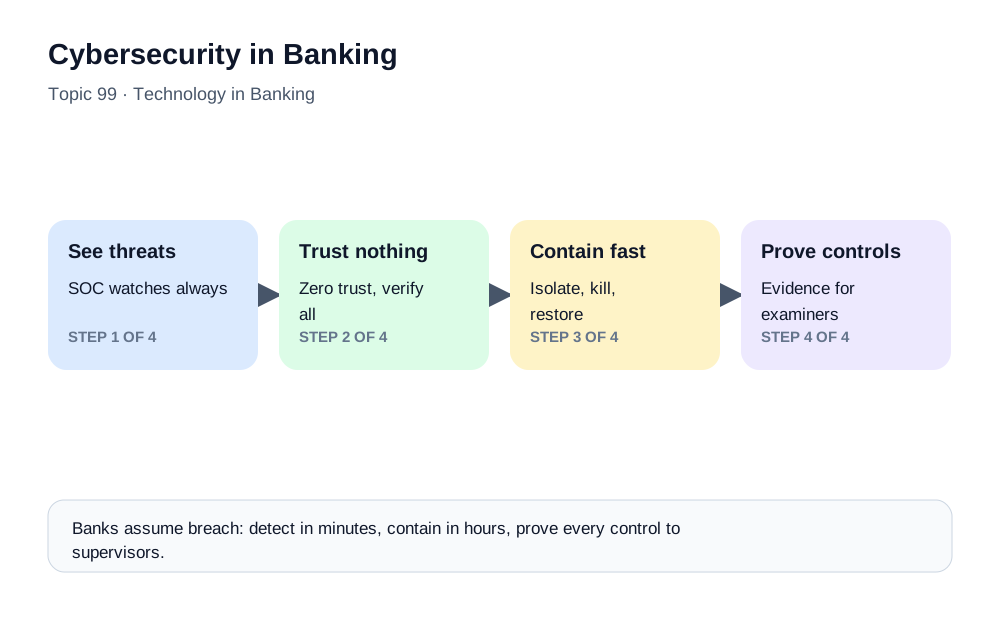
Cybersecurity in Banking at a glance — Threat landscape, SOC operations, zero trust.
Threat Landscape, SOC Operations, and Zero Trust
Financial institutions occupy a unique position in the cyber threat landscape, facing relentless attacks from sophisticated adversaries motivated by the vast sums of money flowing through banking networks and the rich personal data stored in customer databases. Nation-state actors seek to disrupt financial systems or steal funds to support geopolitical objectives. Organized criminal groups deploy ransomware and fraud schemes that generate enormous profits. Individual hackers and insider threats complete the hostile ecosystem. For banks, cybersecurity has evolved from a technical function to an existential risk management discipline that demands board-level attention, substantial investment, and continuous adaptation to an ever-changing threat environment. The stakes could not be higher — a major breach can destroy customer trust built over generations, trigger regulatory sanctions, and threaten the very survival of the institution.
The banking threat landscape encompasses diverse attack vectors that exploit different vulnerabilities in technology, processes, and human behavior. Phishing and social engineering attacks trick employees or customers into revealing credentials or executing malicious actions — an email purporting to be from bank information technology requesting an urgent password reset can compromise entire networks when successful. These attacks have grown increasingly sophisticated, with criminals conducting reconnaissance to craft highly convincing messages that reference real colleagues, projects, or events. Ransomware encrypts critical bank data and demands payment for decryption keys, with incidents such as the LockBit attack on Industrial and Commercial Bank of China's United States subsidiary in 2023 demonstrating the operational disruption such attacks can cause. The banking sector has become a prime target for ransomware gangs who recognize both the deep pockets of their victims and the existential pressure to restore operations quickly.
Distributed denial of service attacks overwhelm bank websites and applications with traffic volumes that crash services and prevent legitimate access. While these attacks do not typically result in data theft, they can cause significant reputational damage and may be used as distractions while other attacks proceed. The Society for Worldwide Interbank Financial Telecommunication fraud represents a particularly devastating threat vector — unauthorized messages that transfer funds to criminal-controlled accounts. The Bangladesh Bank heist in 2016 exemplifies the scale of potential losses, with attackers stealing eighty-one million dollars through compromised credentials and fraudulent transfer instructions. The incident revealed how weaknesses in internal security procedures can enable catastrophic losses even when underlying systems are technically sound.
Insider threats involve employees or contractors with legitimate access misusing privileges, deliberately or through negligence. Banking fraud cases can involve combinations of insider misconduct, control failures, collusion and weak reconciliation; they should not be reduced to a single 'rogue employee' explanation unless the established facts support that conclusion. Supply chain attacks compromise vendors or software providers to reach ultimate targets, as demonstrated by the SolarWinds incident that affected numerous financial institutions. Automated teller machine and point-of-sale malware enables cash dispensing or card data theft at physical terminals, with jackpotting attacks specifically designed to make machines dispense their entire cash contents. Application programming interface attacks exploit the interfaces that enable Open Banking, using credential stuffing and data scraping to compromise accounts or steal information. Each of these threat vectors requires distinct defensive measures, and banks must maintain capabilities to address them all simultaneously.
Defense in depth provides the architectural philosophy for banking cybersecurity, layering multiple protective controls so that breaching one barrier does not compromise the entire system. The perimeter layer deploys firewalls that filter network traffic, distributed denial of service protection that absorbs attack volumes, and web application firewalls that block common attack patterns. The network layer implements segmentation that isolates critical systems, preventing attackers who breach one segment from moving laterally, along with intrusion detection and prevention systems that identify and block suspicious traffic patterns. The endpoint layer protects individual devices with anti-malware software and endpoint detection and response tools that monitor for compromise indicators. The application layer ensures secure coding practices, vulnerability scanning, and penetration testing that identify weaknesses before attackers exploit them. The data layer encrypts information both at rest and in transit, supplemented by data loss prevention tools that monitor for unauthorized exfiltration. The identity layer implements multi-factor authentication and privileged access management that restricts administrative capabilities. The user layer provides security awareness training and phishing simulations that reduce human vulnerability to social engineering.
A Security Operations Centre can serve as a central capability for continuous security monitoring, detection, investigation and response. Many large banks operate or procure 24x7 SOC coverage because banking services and threats are continuous, but the exact operating model, scope and regulatory requirement depend on the institution and jurisdiction. Security Operations Center teams perform several critical functions that together create comprehensive threat management. Monitoring consumes vast streams of security events from across the bank's technology environment, using Security Information and Event Management platforms to aggregate and correlate data from thousands of sources. Detection identifies suspicious activities and potential breaches through rule-based alerting, behavioral analytics, and threat intelligence integration. Response investigates alerts, contains active threats, and coordinates recovery activities to restore normal operations. Hunting involves proactive searches for hidden threats that have evaded automated detection, using sophisticated techniques to uncover advanced persistent threats. Reporting documents incidents for management and regulators, ensuring transparency and supporting continuous improvement.
Security Operations Centers organize their analysts into tiers that reflect increasing skill levels and responsibilities. Tier one analysts perform initial alert triage, assessing incoming security events to identify genuine threats and dismiss false positives — this entry-level role handles high volumes of alerts and escalates complex cases. Tier two analysts conduct deeper investigations and execute incident response procedures when threats are confirmed, requiring greater technical expertise and judgment. Tier three analysts engage in advanced threat hunting, malware analysis, and digital forensics — the most senior technical specialists who handle the most sophisticated incidents. Security Operations Center managers oversee operations, coordinate with other departments, and ensure that reporting obligations to management and regulators are fulfilled.
Technology platforms enable Security Operations Center effectiveness at scale. Security Information and Event Management systems collect and correlate logs from all systems across the bank, applying rules and analytics to identify threat patterns that individual data sources might not reveal. Security Orchestration, Automation, and Response platforms automate response actions, enabling rapid containment without waiting for human intervention and orchestrating complex response workflows across multiple tools and teams. These technologies have become essential as the volume of security events exceeds what human analysts can manually review.
Zero Trust Architecture represents a fundamental shift in security philosophy that responds to the inadequacy of traditional perimeter-based approaches. The traditional model assumed that everything inside the corporate network could be trusted — once past the firewall, users and devices enjoyed broad access. This approach fails in an era of cloud computing, remote work, and sophisticated attackers who inevitably breach perimeter defenses. Zero Trust removes implicit trust based solely on network or physical location and focuses access decisions on identities, devices, resources and policy. NIST SP 800-207 describes authentication and authorization as discrete functions before a session to an enterprise resource is established; the practical model is not literally to challenge a user with a new multi-factor prompt for every packet or screen action. This approach recognizes that in modern computing environments, the perimeter has dissolved and security must focus on protecting individual resources regardless of where access originates.
Comparing traditional and Zero Trust approaches reveals the magnitude of this shift. Traditional security trusts everything inside the network perimeter, focuses protection at organizational boundaries, grants full access upon virtual private network connection, and maintains flat internal networks where compromise of one system enables lateral movement. Zero Trust trusts nothing and verifies everything, focuses protection on individual identities and resources, grants least privilege access per specific request, and implements micro-segmentation that isolates network zones so breaches remain contained. The transition to Zero Trust requires significant architectural changes but provides substantially stronger protection against modern threats.
Zero Trust implementations incorporate several key components working together. Identity controls in a Zero Trust design use strong authentication and authorization appropriate to the resource and risk, with trust continually evaluated through policy and context. This does not mean a human must perform multi-factor authentication for every individual API call; sessions, device posture and service identities can be evaluated continuously according to policy. Least privilege principles grant users and applications only the minimum access necessary for their specific roles, preventing over-provisioned permissions that attackers exploit. Micro-segmentation creates isolated network zones such that a breach in one area cannot spread to others — the payment processing network remains separate from human resources systems even though both reside within the same corporate infrastructure. Continuous validation re-verifies trust at every step rather than establishing trust once at login and maintaining it indefinitely — a user accessing sensitive data after hours from an unusual location triggers additional verification even if their initial login was legitimate. Assume breach mentality designs systems to limit damage even when compromise occurs, recognizing that determined attackers will eventually succeed and that resilience requires containment capability.
Regulatory cybersecurity obligations must be read from the current rules applicable to the institution. In India, the RBI's November 7, 2023 Information Technology Governance, Risk, Controls and Assurance Practices Directions consolidate and update requirements on IT governance, controls, assurance and business continuity for the regulated entities in scope, while earlier sector-specific cyber frameworks and other RBI directions can remain relevant according to applicability. Requirements for governance, information-security responsibility, monitoring, incident management, vulnerability assessment, testing and board oversight should therefore be implemented from the current applicable direction rather than from a universal statement that every bank must perform the same activity on one fixed quarterly schedule.
India's CERT-In directions of April 28, 2022 require specified entities to report listed cyber incidents to CERT-In within six hours of noticing the incident or being brought to notice about it, and require relevant ICT logs to be enabled and securely maintained for a rolling 180-day period within Indian jurisdiction. Card environments may also be subject to PCI DSS through contractual and scheme requirements, while securities-sector entities follow applicable SEBI cyber-resilience rules. India's Digital Personal Data Protection Rules, 2025 and the notified enforcement timeline must be read with the DPDP Act to determine the exact personal-data breach notification duties applicable at a given date; cyber-incident reporting and personal-data breach notification are related but distinct obligations.
Major cyber incidents in banking history illustrate the consequences of security failures and inform current defensive strategies. The Bangladesh Bank heist in 2016 demonstrated how compromised credentials and inadequate internal controls enabled the theft of eighty-one million dollars through fraudulent Society for Worldwide Interbank Financial Telecommunication messages. The Capital One data breach in 2019 exposed over one hundred million customer records through a misconfigured web application firewall, highlighting cloud security complexity. Cosmos Bank in India lost ninety-four crore rupees in 2018 through coordinated automated teller machine and Society for Worldwide Interbank Financial Telecommunication attacks that revealed weaknesses in international transaction controls. The SolarWinds supply chain attack in 2020 affected multiple financial institutions through compromised software updates, demonstrating third-party risk. The Industrial and Commercial Bank of China ransomware incident in 2023 disrupted United States Treasury market operations, showing how attacks on individual institutions can affect broader financial stability.
Banking cybersecurity will continue evolving as threats become more sophisticated and technology creates new vulnerabilities. Artificial intelligence can support both defensive analysis and more convincing social engineering, while advances in quantum computing create a long-term cryptographic migration concern for algorithms vulnerable to sufficiently capable future quantum machines. Banks should inventory cryptographic dependencies and follow recognised post-quantum transition standards and supervisory guidance rather than assume that current production encryption has already been broken by quantum computers. The expanding attack surface created by Internet of Things devices, Open Banking APIs, and remote work arrangements demands adaptive security architectures that can protect assets regardless of location. In this dynamic environment, the institutions that thrive will be those that treat cybersecurity not as a cost center but as a strategic capability that protects customer trust and enables business innovation. The banks that build robust security capabilities will be positioned to pursue digital transformation confidently, while those that underinvest will find themselves increasingly constrained by fear of breaches and regulatory censure.
<!-- MBA-DEEP-DIVE-START -->Cybersecurity Continuation: How a Bank Turns Security Controls into Daily Operations
Cybersecurity begins with understanding what must not fail
A bank cannot protect every system with the same intensity because not every system creates the same consequence when it fails. The practical starting point is therefore asset and service criticality. A public marketing website, a staff learning portal, a real-time payment gateway, a core deposit ledger, a sanctions-screening service and the privileged-access platform may all sit inside the same technology estate, but their security requirements are different. The bank needs to know which services can directly move money, which can change customer data, which can expose confidential information, which support regulatory reporting, and which become systemic dependencies for many downstream applications.
This classification should connect technology assets to business services rather than remain a spreadsheet maintained only by infrastructure teams. If an API gateway is classified as important but nobody records that it supports mobile banking, open-banking access and payment initiation, incident responders may underestimate the business impact of an outage or compromise. Conversely, a small database can be extremely sensitive if it stores authentication secrets, cryptographic material or privileged configuration. Good cyber-risk management therefore asks two questions at the same time: what technical component is affected, and what customer or banking service depends on it?
Criticality also influences recovery priority. A system that authorises payment release may need rapid restoration but must not be brought back online before integrity has been established. Restoring a compromised payment component quickly without proving that credentials, configuration and transaction state are trustworthy can convert a cyber incident into a financial-loss event. Cyber resilience is therefore not simply availability. It is the ability to restore service with confidence that confidentiality, integrity and authorisation remain controlled.
Identity is the first control plane in a modern bank
Most important banking systems do not become compromised because an attacker physically reaches a server. They become compromised because an identity, credential, token, session or service account is abused. Identity and access management is therefore one of the strongest control planes available to a bank. Human identities, machine identities and emergency identities should all be governed, but they should not be treated as if they behave the same way.
For employees, the access lifecycle begins before the first login. The bank needs a trusted source for employment status, role and organisational ownership. Joiner, mover and leaver processes should provision appropriate access, change it when responsibilities change and remove it promptly when employment or assignment ends. Access that remains active after a person leaves creates avoidable risk, while access accumulated over years of role changes can create toxic combinations even when every individual entitlement was originally approved.
Privileged access needs stronger treatment because administrators can change operating systems, databases, security policies and application configurations. Mature banks use separate privileged identities, approval workflows, strong authentication, session controls and evidence that allows later review of sensitive actions. Shared administrator passwords are particularly dangerous because they weaken accountability. If several engineers use the same credential, an investigation may prove that an administrator account changed a firewall rule but not which person actually performed the action.
Service identities require equally careful governance. Payment applications, schedulers, middleware, RPA bots and monitoring tools often need non-human credentials to call other systems. These credentials should have named owners, defined purpose, least privilege, rotation arrangements and revocation procedures. A service account with broad rights and no clear owner can survive long after the original application has changed, creating an invisible route through the environment.
Authentication is only one decision; authorisation is the continuing control
Strong authentication does not mean that every authenticated user should be allowed to perform every action. Authentication answers who or what is attempting access. Authorisation answers whether that identity is allowed to perform the requested action on the requested resource in the current context. Banking security becomes much stronger when these two decisions are separated conceptually and technically.
Consider a corporate payment user who successfully signs in with strong authentication. That login should not automatically permit the user to release any payment from any account. Entitlements may limit the user to specific legal entities, accounts, payment types, currencies or amount thresholds. A maker may be permitted to create an instruction but not release it. A second authorised person may need to approve the transaction under the corporate mandate. Fraud controls may still hold the payment if behaviour is unusual. Sanctions or compliance controls may also block progression. The secure outcome comes from several independent decisions, not from a single successful login.
The same principle applies internally. A database administrator may be authorised to maintain database software but not to read decrypted customer data. A developer may deploy to a test environment but not production. An operations analyst may investigate payment status but not alter a customer balance. These distinctions reduce the consequence of a compromised identity and make accidental misuse less likely.
Context can also matter. A privileged action from a managed workstation inside an approved administrative path may be treated differently from the same request originating from an unmanaged device. A service account that suddenly attempts an operation outside its normal pattern may deserve investigation even if the credential itself is valid. Security therefore combines static entitlements with dynamic evidence rather than assuming that possession of a valid credential is sufficient proof of legitimacy.
Segmentation should follow business risk, not only network diagrams
Network segmentation is often described as dividing a network into zones, but a bank needs a more functional view. The purpose is to prevent compromise of one component from providing an easy route to systems with materially greater financial or data impact. Segmentation should therefore reflect trust boundaries and service dependencies.
A workstation network used for ordinary office productivity should not provide unrestricted paths to core banking administration. Internet-facing services should be separated from sensitive internal systems through controlled interfaces. Payment-zone connectivity should be narrow enough that only required applications, protocols and destinations are permitted. Management networks should be treated differently from customer transaction traffic. Backup infrastructure also deserves protection because attackers frequently attempt to disable recovery capability after gaining access.
Micro-segmentation can extend this concept deeper into data-centre and cloud environments by controlling communication between workloads rather than relying only on broad network zones. However, more segmentation does not automatically mean more security. Rules that are so complex that nobody understands legitimate data flows can cause operational fragility and create emergency bypasses. The objective is controlled connectivity: every material path should have a business purpose, an owner and monitoring appropriate to its risk.
A useful test is to imagine that one application server is fully compromised. Security architects should ask which systems the attacker could reach next, which credentials might be available, which data could be accessed, and what controls would detect unusual movement. This attack-path view is more valuable than simply confirming that a firewall exists.
Payment security must preserve both instruction integrity and transaction state
Payments create distinctive cyber risk because attackers do not always need to steal customer data; they may instead attempt to create, alter, approve or redirect a financial instruction. A secure payment architecture therefore protects the payment across its complete lifecycle. The bank should be able to establish where the instruction originated, who or what authorised it, what material data changed, which controls were applied, what was sent externally, and what final state was recorded.
Integrity controls are especially important around beneficiary data, amount, currency, execution date, debtor account and routing information. If a payment is approved and one of these fields changes afterwards, the bank needs either to prevent the change or to invalidate the existing approval so that the modified instruction cannot inherit trust from an earlier state. This is a functional security requirement as much as a technical one.
Transaction state also matters during incidents. Suppose an outage occurs after a payment has been debited internally but before the external network confirms acceptance. A simple retry could create a duplicate if the original instruction actually reached the network. Cyber incident procedures must therefore integrate with payment-recovery and reconciliation logic. Security teams may focus on containment while payment operations focuses on financial correctness, but both groups need the same evidence and identifiers.
The best security control is sometimes an accounting control. Independent reconciliation between initiated payments, ledger postings, network acknowledgements, settlement records and customer reporting can reveal manipulation that an access-control system did not prevent. This is why banking cybersecurity cannot be isolated from operations, finance and reconciliation.
Fraud risk and cyber risk overlap but are not identical
Banks frequently use the words fraud and cyber together, but the disciplines answer different questions. Cybersecurity protects systems, identities, data and technology services from unauthorised access, disruption and manipulation. Fraud management focuses on deceptive or unauthorised financial behaviour and the resulting customer or bank loss. One event can belong to both domains, but not every fraud event is a cyber incident and not every cyber incident creates fraud.
A customer persuaded by a criminal to authorise a genuine payment may involve no technical compromise of the bank's systems. The login, device and approval may all be valid, yet the customer has been manipulated. Fraud controls need behavioural, beneficiary and transaction context that conventional cybersecurity controls may not possess. Conversely, exploitation of a vulnerability in an internal server can be a serious cyber incident even if no payment is attempted.
The overlap becomes critical when compromised credentials are used to initiate transactions. Cyber teams may detect credential theft, malware or impossible login behaviour, while fraud systems detect unusual beneficiaries, amounts or transaction velocity. Sharing signals can improve response, provided governance respects data-protection and operational constraints. A payment should not be released merely because the session passed cybersecurity checks, and a cybersecurity alert should not automatically block every transaction without considering false-positive impact.
Clear ownership prevents cases from falling between teams. Incident playbooks should define when a cyber alert becomes a fraud investigation, when accounts or credentials should be restricted, how customers are contacted, what evidence is retained and who decides whether payments can continue.
Logging is useful only when evidence can be trusted and interpreted
Banks generate enormous volumes of logs, but collecting data is not the same as creating investigative evidence. Effective logging begins by identifying what questions the institution must be able to answer after a suspicious event. Who authenticated? Which device or service identity was used? What privileged changes occurred? Which customer record was accessed? Which payment state changed? Which security control allowed or blocked the action? Which system generated the event, and is its time synchronised accurately enough to correlate with other sources?
Logs should therefore be designed into applications and platforms rather than added only after an incident. Sensitive actions need sufficient context to distinguish legitimate operations from misuse. For example, recording that a payment was updated is less useful than recording which authorised identity initiated the change, which fields were modified, which request or transaction identifier was involved and whether approval had already occurred.
Evidence integrity matters as well. If an attacker with application administrator rights can freely delete or alter the only audit trail, the logging architecture does not provide strong accountability. Central collection, access separation, retention controls and monitoring for gaps or tampering can improve confidence. Retention periods must follow applicable legal, regulatory, operational and investigative requirements rather than a single universal number applied to every record.
Time is another hidden dependency. Security events from different systems can appear in the wrong sequence if clocks are not appropriately synchronised. During a complex incident, a few minutes of clock drift can make a valid user action appear to occur after an attacker action when it actually happened before it. Reliable time sources and timestamp handling are therefore small controls with major investigative value.
A SOC should optimise for decisions, not alert volume
A Security Operations Centre becomes ineffective when success is measured only by the number of alerts processed. The real objective is to identify meaningful threats early enough to limit impact while avoiding unnecessary disruption to legitimate banking activity. This requires good detection engineering, context, escalation discipline and feedback from completed investigations.
Detections should reflect realistic attack paths and business impact. Hundreds of failed login attempts against a public portal may be ordinary internet noise, while one successful privileged login from an unusual administrative path can be highly significant. A new process on a payment server may deserve more urgency than the same process on a low-risk test machine. Enrichment with asset criticality, identity privilege, vulnerability information and service ownership helps analysts prioritise correctly.
False positives are not merely an efficiency problem. If analysts are repeatedly asked to investigate harmless conditions, attention is consumed and genuine alerts may be missed. Tuning therefore needs governance: controls should not be weakened simply to reduce workload, but rules that consistently produce no useful signal should be redesigned. Likewise, automating response without adequate context can create outages. Automatically disabling a privileged identity may be appropriate in some cases, but automatically isolating a production payment cluster because one noisy indicator fired could harm customers more than the suspected attack.
Post-incident learning should feed the detection library. If an investigation discovers that attackers moved through a sequence of events that existing rules treated separately, detection engineers can build logic that recognises the pattern earlier next time. SOC maturity is therefore a cycle of observing, investigating, learning and improving.
Vulnerability management is a risk process, not a patch-counting exercise
A vulnerability scanner can identify thousands of findings, but not every finding deserves the same urgency. Banks need to combine technical severity with exploitability, asset exposure, business criticality and available compensating controls. A severe vulnerability on an isolated test server may present less immediate risk than a lower-rated weakness on an internet-facing authentication component used by millions of customers.
The lifecycle starts with knowing which assets actually exist. Unmanaged servers, forgotten APIs and old internet domains can create greater risk than well-governed production systems because nobody owns their patching or monitoring. Discovery and ownership therefore precede remediation. Once a vulnerability is identified, the bank needs a decision: patch, mitigate, isolate, replace, accept temporarily under governance, or remove the affected service.
Emergency vulnerabilities create special tension because applying a patch quickly can itself introduce operational risk. A bank may need to test compatibility with core or payment applications, but waiting too long leaves an exploitable weakness exposed. Mature processes define emergency change paths, temporary controls and business sign-off so teams do not have to invent governance during a crisis.
Unsupported technology is a long-term vulnerability problem. A system can remain functionally reliable while becoming increasingly difficult to secure because the vendor no longer supplies fixes. Modernisation plans should therefore include security obsolescence, not only feature demand. A legacy system that sits behind several compensating controls can sometimes be managed for a period, but indefinite dependence on unsupported technology creates accumulating risk.
Secure change management protects the bank from its own speed
Many serious incidents are caused not by malicious actors but by ordinary changes that unintentionally weaken security. A firewall rule can expose a service, a cloud policy can make storage public, a certificate update can break authentication, or an emergency fix can bypass a segregation-of-duties control. Secure engineering therefore needs to be part of the change lifecycle.
Code changes should be reviewed and tested according to risk. Infrastructure-as-code and policy-as-code can make configuration more repeatable and reviewable, but automated deployment is safe only when the templates themselves are controlled. Secrets should not be embedded in source code or deployment scripts. Production credentials should be obtained through managed secret mechanisms appropriate to the environment.
Security teams also need visibility into planned material changes. If a payment application migrates from one data centre to another, monitoring, network rules, certificates, access paths, vulnerability scanning, logging and recovery procedures may all need updates. Treating cybersecurity as a final approval gate after design is complete creates delays and encourages exceptions. Involving security architecture earlier allows controls to become part of the solution rather than obstacles added at the end.
Emergency changes deserve retrospective review. Urgency can justify a faster path, but it should not erase accountability. Once the incident is stabilised, the bank should confirm what changed, whether temporary access or firewall rules remain, and whether the emergency workaround introduced new long-term risk.
Cloud security changes responsibility; it does not remove responsibility
Moving banking workloads to cloud infrastructure changes the operating model but does not transfer all security responsibility to the provider. The exact division depends on the service. With infrastructure services, the bank generally retains more responsibility for operating systems, network configuration and applications. With managed platform or software services, the provider may manage more technical layers, while the bank still remains responsible for how the service is configured, who can access it, what data is placed there and whether use complies with applicable obligations.
Identity configuration becomes especially important because cloud control planes can create powerful administrative capability across many resources. Excessive privileges, long-lived keys and poorly governed service identities can undermine otherwise strong infrastructure. Logging from the cloud control plane should therefore be integrated with central security monitoring, and high-risk administrative changes should be visible to the right teams.
Data protection needs an explicit design. Encryption, key ownership, backup, geographic location, retention and deletion should align with the sensitivity of the data and applicable requirements. Merely stating that data is encrypted does not answer who controls the keys, who can request decryption, how keys are rotated or what happens if the key-management service becomes unavailable.
Cloud resilience also needs independent thinking. Using two availability zones in one provider can protect against some infrastructure failures, but it may not protect against every control-plane, identity, configuration or provider-wide incident. The architecture should reflect the actual business service and its recovery objectives rather than assume that the word cloud automatically means highly available.
API security is banking security because APIs expose business capability
An API is not just a technical interface. It can expose balances, customer data, payment initiation, account maintenance or administrative capability. API security therefore begins with understanding what business action an endpoint permits. A low-volume administrative API can be more sensitive than a high-volume public information API.
Authentication and authorisation should be enforced consistently, and the API should validate that the requesting identity is permitted to act on the specific customer, account or resource involved. Object-level authorisation failures are particularly dangerous because an authenticated user may attempt to reference another customer's identifier. Input validation, rate control, replay protection where appropriate, secure error handling and monitoring all contribute to resilience.
API gateways can centralise useful controls, but they should not become a false sense of security. A gateway may confirm that a token is valid while the backend still needs to enforce whether the user can perform the requested business operation. Likewise, internal APIs need protection. Attackers who gain a foothold inside the environment often target internal services because teams sometimes assume that internal network location is sufficient trust.
Versioning and decommissioning matter too. Old API versions can preserve vulnerabilities or outdated authentication methods long after newer versions are available. Banks need an inventory that identifies active consumers so insecure versions can be retired without unexpectedly breaking legitimate services.
Third-party cyber risk continues after procurement approval
A bank can outsource a service but cannot outsource the consequences of disruption to customers. Third-party cyber-risk management therefore goes beyond a questionnaire completed before contract signature. The bank needs to understand what the supplier does, which data and systems it can access, whether it supports a critical business service, how incidents will be reported, what evidence the bank can obtain and how the service can be recovered or replaced if necessary.
Concentration risk is important. Different vendors may depend on the same cloud provider, identity service, telecommunications network or software component. Looking only at direct contractual relationships can hide a common dependency that creates correlated failure. Material subcontractors and fourth parties may therefore matter even though the bank has no direct contract with them.
Access should be controlled according to purpose. Vendor engineers who need temporary production access should not automatically retain permanent privileged accounts. Remote support paths should be monitored and disabled when not needed. If a supplier changes ownership, operating location or service architecture, the bank may need to reassess risk rather than assume the original due diligence remains valid forever.
Exit planning is also a cybersecurity control. If a provider fails, suffers a prolonged incident or no longer meets requirements, the bank needs a practical way to recover data, revoke access, migrate service and preserve evidence. A contract clause stating that data will be returned is not sufficient unless the technical process has been considered.
Incident response should protect evidence while restoring customer service
The first minutes of a serious incident are often ambiguous. Teams may know that something is wrong without understanding whether the cause is malicious activity, software failure, operator error or an external dependency. Incident response therefore needs disciplined command, evidence preservation and communication rather than premature certainty.
Containment decisions should consider both security and banking impact. Disconnecting a compromised component may stop attacker activity but can interrupt payment or account services. Leaving it online may preserve customer availability but allow further damage. The decision should be made by accountable responders using available evidence, criticality and predefined authority rather than by whichever engineer notices the problem first.
Evidence preservation should begin early. Logs, volatile system information, suspicious files, identity records, configuration states and transaction references may later be needed for forensic analysis, regulatory reporting, customer disputes or legal proceedings. Rebuilding a server immediately can destroy evidence if responders do not first capture what is needed.
Communication also needs control. Customers should receive useful information about service impact and safe actions without speculative technical detail. Regulators and authorities may have specific reporting requirements and timeframes. Internal executives need clear facts, uncertainty and decisions rather than raw alert data. A single incident can therefore require several communication streams with different audiences and obligations.
Recovery should include security validation. Systems should not return to normal operation simply because they boot successfully. Credentials may need rotation, malicious persistence must be removed, configuration must be verified and financial state may require reconciliation. Closing an incident means restoring trusted service, not merely restoring technology.
Backups must be recoverable even when the attacker reaches production administration
Ransomware has made backup architecture a cybersecurity concern rather than only an infrastructure concern. If the same privileged identity can administer production systems and delete every backup, an attacker who compromises that identity can remove the bank's recovery path. Separation of duties, protected backup credentials, immutable or otherwise protected copies where appropriate, and offline or logically isolated recovery options can reduce this risk.
A backup is valuable only if it can be restored. Banks should test restoration of complete business services, not just confirm that backup jobs reported success. Applications often depend on databases, keys, configuration, middleware, network routes, identity services and external interfaces. Recovering only the database may not produce an operational customer service.
Recovery testing also needs transaction integrity checks. After restoration, teams should confirm which transactions are present, which may have been in flight and how downstream systems will be reconciled. This is especially important when recovery points differ across related systems. A payment application restored to one timestamp and a ledger restored to another can create mismatched state even if both individual restorations were technically successful.
Cyber recovery should therefore be designed with business continuity, disaster recovery and operations together. The objective is not simply to produce a clean server but to restore an end-to-end banking service with trustworthy data.
Cryptographic controls need lifecycle governance, not just strong algorithms
Encryption protects confidentiality only when keys and certificates are controlled throughout their lifecycle. A bank can use a strong algorithm and still be exposed if private keys are copied into scripts, certificates expire without warning, obsolete keys remain active or too many administrators can export sensitive key material.
Key management should define generation, storage, distribution, activation, rotation, revocation, backup and destruction. Hardware security modules can provide strong protection for high-value keys by restricting extraction and performing cryptographic operations inside controlled hardware, but they still require governance around who can administer them and how ceremonies or approvals operate.
Certificates create operational dependencies as well as security controls. Expired certificates can cause outages across APIs, payment connectivity, websites and internal services. Inventory and expiry monitoring are therefore essential. Emergency revocation must also be possible if a private key is suspected to be compromised.
Long-term cryptographic planning includes algorithm agility. Standards evolve, vulnerabilities are discovered and post-quantum migration is becoming a strategic planning issue for long-lived sensitive data and infrastructure. Banks benefit from knowing where cryptography is used so algorithms can be changed deliberately instead of discovering hidden dependencies during an emergency migration.
Data-loss prevention needs to understand legitimate banking flows
Banks legitimately move sensitive data between many systems: customer onboarding sends identity information to verification services, payment systems send beneficiary data to networks, regulatory reporting extracts records for authorised submission, and analytics platforms consume data for risk and service purposes. A data-loss prevention programme must distinguish these legitimate flows from unauthorised exfiltration.
Classification helps controls understand which information requires stronger handling. Customer credentials, authentication secrets, card data, personal information, transaction records and internal security data can have different handling rules. Access controls, encryption, masking, tokenisation and monitoring should match the sensitivity and business purpose.
The bank should also minimise unnecessary copies. Every additional spreadsheet, email attachment, test database and support extract creates another location that must be protected, retained and eventually deleted. Production data should not automatically be copied into development or test environments when representative synthetic data can meet the need.
Monitoring should focus on context rather than raw volume alone. A large authorised regulatory extract may be legitimate, while a small export of privileged credentials is highly suspicious. Security tools need business context and ownership so analysts can evaluate what a transfer actually means.
Security testing should challenge assumptions before attackers do
Vulnerability scanning, penetration testing, red-team exercises and secure code review answer different questions. Automated scanning identifies known weaknesses at scale. Penetration testing explores whether vulnerabilities can be exploited in a defined scope. Red-team exercises test how multiple weaknesses in technology, people and process can be combined to achieve a business objective such as gaining privileged access or reaching a critical payment environment. Secure code review examines weaknesses earlier in the development lifecycle.
Testing should be risk-based and coordinated with operations. Aggressive testing against production banking systems can itself create service risk, while test environments may not fully represent production controls. Rules of engagement should therefore define scope, timing, escalation and safety constraints.
Findings become valuable only when they drive remediation and learning. Repeatedly discovering the same class of access-control defect suggests a development or architecture problem, not merely several isolated bugs. Root-cause analysis can lead to reusable libraries, secure design patterns, better testing or stronger deployment controls.
Security testing also needs to include recovery and detection. A red-team exercise is incomplete if success is measured only by whether the team reached a target. The bank should also assess whether monitoring detected the activity, whether responders escalated correctly and whether evidence was sufficient to reconstruct what happened.
Metrics should reveal risk and control effectiveness, not create comfort
Cybersecurity dashboards can become misleading when they focus on easy counts such as number of alerts, patches installed or phishing emails blocked. These figures may show activity without showing whether the institution is safer. Better metrics connect control performance to exposure and business consequence.
Examples include the proportion of critical assets with current ownership, time to revoke access after a leaver event, percentage of privileged accounts under controlled management, age of unremediated high-risk vulnerabilities on exposed assets, recovery-test success for critical services, percentage of material third parties with tested incident contacts, certificate-expiry risk, logging coverage for high-value systems and time between detection and containment of confirmed incidents.
Trends matter more than isolated numbers. A temporary increase in vulnerabilities may reflect better discovery rather than worsening security. A fall in alerts may indicate successful tuning or a broken logging pipeline. Metrics therefore need narrative interpretation and independent challenge.
Board reporting should translate technical exposure into service and risk language. Directors do not need every event signature, but they do need to understand whether critical banking services can withstand plausible attacks, whether major control gaps are being accepted, and whether remediation commitments are actually closing risk.
A practical cyber scenario: suspicious privileged activity during payment processing
Imagine that monitoring detects an unusual privileged login to a payment-support server shortly before a high-value transaction is modified. The identity is valid, the server is healthy and no malware alert has fired. A weak response would treat the login and payment change as separate events because one belongs to cybersecurity and the other to payment operations.
A stronger response correlates identity, system and transaction evidence. Security verifies whether the administrator was scheduled to work, how authentication occurred and what commands or configuration changes were made. Payment operations identifies the affected instruction, whether approval had already occurred, whether the beneficiary or amount changed and whether the transaction left the bank. Fraud teams assess beneficiary risk and related customer activity. If the payment was transmitted, external status and settlement evidence may be needed. If it was stopped, the bank still needs to determine whether other transactions were affected.
Containment may require suspending the privileged identity, isolating one server, preserving logs and rotating credentials. However, the response should avoid unnecessarily shutting the entire payment estate if evidence supports a narrower action. Reconciliation then confirms that no other instructions were altered and that internal ledger state matches external processing.
The scenario shows why cybersecurity in a bank is an operating discipline rather than a collection of technical products. Identity, payment controls, monitoring, fraud, reconciliation, incident command and customer impact all form one control story.
The strongest cyber programme makes secure behaviour the normal operating path
Security becomes sustainable when employees and systems can follow secure processes without constant improvisation. Developers should have approved ways to obtain secrets and deploy applications. Operations teams should have controlled emergency-access procedures. Business users should understand why payment entitlements and dual control exist. Vendors should know how to report incidents. SOC analysts should have asset context. Recovery teams should know how to restore a service without losing transaction integrity.
This does not eliminate risk. Banks will continue to face phishing, ransomware, credential theft, software vulnerabilities, supplier incidents and new attack techniques. The objective is to reduce the probability that one weakness becomes a major customer or financial event, to detect meaningful compromise quickly, and to recover with trusted data and controlled access.
Cybersecurity therefore supports the basic promise of banking. Customers expect that their money, identity and instructions will be protected; that authorised services will remain available; and that the bank can explain what happened when something goes wrong. Meeting that promise requires technology, but it also requires governance, operational discipline and evidence across the entire banking lifecycle.
<!-- MBA-DEEP-DIVE-END -->