Visual overview
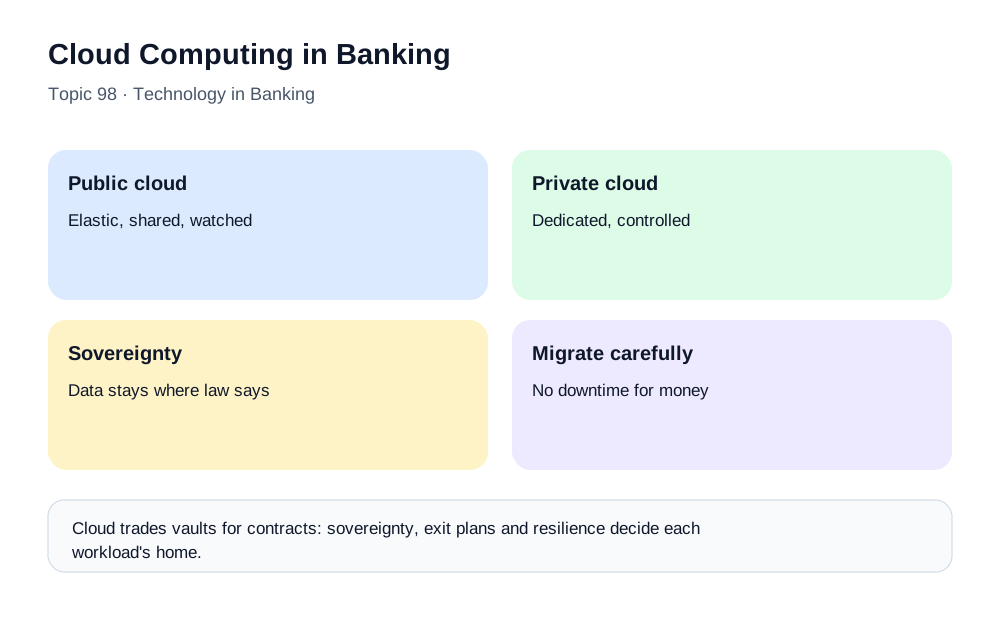
Cloud Computing in Banking at a glance — Public vs private cloud, data sovereignty, migration.
Public vs Private Cloud, Data Sovereignty, and Migration Challenges
The migration of banking infrastructure from physical data centers owned and operated by financial institutions to elastic, scalable computing resources managed by specialized providers represents one of the most significant shifts in the industry's technology landscape. Cloud computing offers compelling advantages in cost efficiency, operational flexibility, and access to innovation — yet banking's unique regulatory requirements, data sensitivity, and reliability demands make cloud adoption substantially more complex than in less regulated industries. Understanding these trade-offs and the strategies banks employ to navigate them illuminates the future direction of financial technology infrastructure. The journey to cloud is not simply a technical migration but a fundamental rethinking of how banking technology is provisioned, managed, and consumed.
Several powerful drivers are pushing banks toward cloud adoption despite the complexities involved. Cloud can change the economics of technology by replacing some fixed infrastructure investment with consumption-based services and by making elastic capacity easier to obtain. It does not automatically reduce cost: poorly governed consumption, data-transfer charges, duplicated environments, resilience design and premium managed services can make a cloud workload more expensive than an efficient existing platform. Banks therefore evaluate total cost, operational capability and risk rather than assuming that pay-as-you-go pricing guarantees savings. Scalability enables handling of traffic spikes that would overwhelm traditional infrastructure, such as the surge in initial public offering applications or tax payment deadlines. Speed to market accelerates dramatically when development teams can provision infrastructure in minutes rather than weeks, enabling faster product launches and more responsive customer service. Innovation access puts cutting-edge artificial intelligence, machine learning, and analytics capabilities within reach of banks that could never justify building such expertise internally. Resilience improves through multi-region redundancy that few banks could afford to replicate in their own facilities. Maintenance burden shifts to cloud providers who handle hardware management, security patching, and capacity planning.
Cloud deployment in banking follows several distinct models that balance these benefits against regulatory and risk considerations. The public cloud model utilizes shared infrastructure operated by major providers such as Amazon Web Services, Microsoft Azure, and Google Cloud Platform. Banks deploy customer-facing applications, analytics workloads, and development environments on these platforms, benefiting from the full economies of scale and innovation velocity that public cloud offers. Private cloud uses infrastructure dedicated to one organisation or controlled environment, while hybrid designs combine private, public and sometimes traditional on-premises platforms. Workload placement is risk-based rather than determined by a universal rule that core banking or sensitive data must remain private. Regulated institutions increasingly use public-cloud services for important workloads where legal, security, resilience, data-location, outsourcing and supervisory requirements can be satisfied. Community cloud creates shared infrastructure among banks or across the financial sector, enabling industry utilities such as payment platforms to achieve scale while maintaining sector-specific security and compliance standards.
Banks source cloud services from several global and regional providers, and many providers publish financial-services architecture, security and compliance material. Provider selection should not be reduced to customer-name lists or claims that one platform is universally widest or strongest. A bank should assess the exact services it intends to consume, contractual rights, data locations, resilience architecture, security controls, portability, operational support, concentration risk, auditability, cost and regulatory fit. The same provider can be appropriate for one workload and unsuitable for another.
Regulatory considerations fundamentally shape cloud adoption. For Indian regulated entities within scope, the RBI's 2023 Outsourcing of Information Technology Services Directions explicitly include cloud computing and require risk assessment, governance, contractual and supervisory access, business continuity, exit planning, and cloud-specific controls covering the data lifecycle, multi-tenancy, data sovereignty, recoverability, storage requirements, security and resilience. The directions do not support a simplistic rule that every category of bank customer data must always remain only in an Indian private cloud or that the bank must personally operate every encryption key. Workload teams must identify the exact data and service, then apply all relevant RBI directions, payment-data rules, privacy law and other legal or contractual requirements.
Data sovereignty extends beyond technical requirements to encompass complex legal and geopolitical considerations. The physical location of data storage must comply with local residency laws that may restrict cross-border data flows. Access questions arise regarding which governments can demand data through subpoenas or national security orders — United States legislation such as the Clarifying Lawful Overseas Use of Data Act creates particular concerns about American cloud providers. Cross-border transfer restrictions may prohibit customer data from leaving the country without explicit consent, complicating global banking operations. Encryption control becomes a sovereignty issue when banks hold keys domestically while data resides abroad, ensuring that foreign jurisdictions cannot compel disclosure even if they gain physical access to storage media. These considerations have led many banks to adopt hybrid strategies that keep the most sensitive data in domestic private clouds while using public cloud for less sensitive workloads.
Banks have developed systematic approaches to cloud migration that manage risk while capturing benefits. Development and testing environments typically move first, as these carry minimal regulatory exposure and provide opportunities to build cloud expertise. Customer-facing applications follow, where cloud scalability and global content delivery networks improve user experience. Analytics and big data workloads migrate early due to their substantial resource requirements and tolerance for brief availability interruptions. Payment processing moves more cautiously given the immediate financial impact of any disruption. Core banking systems remain on private infrastructure longest, with many major banks still operating traditional platforms decades after their initial deployment. This staged approach allows organizations to build capabilities and confidence before tackling the most challenging migrations.
Migration strategies vary in their aggressiveness and transformation scope. Lift and shift approaches move existing applications to cloud infrastructure with minimal modification, prioritizing speed over optimization. This approach is appropriate when the primary goal is to exit owned data centers quickly, though it may not capture the full cost benefits of cloud. Re-platforming makes targeted modifications to applications so they can leverage specific cloud services, improving efficiency without complete rewrites. Re-architecting redesigns applications as cloud-native solutions using containers, microservices, and serverless functions — the most transformative but also most resource-intensive approach. Software-as-a-service adoption replaces custom applications with cloud-native commercial products, transferring both infrastructure and functional maintenance to specialized vendors. The optimal strategy often combines these approaches, applying each where circumstances warrant.
Cloud-native and software-as-a-service banking platforms have expanded the range of core and product-processing options available to banks. Some are built around containers, APIs and managed cloud services; established core vendors have also modernised deployment models. Product names and market positions change quickly, so the durable evaluation criteria are ledger integrity, product capability, regulatory fit, resilience, data architecture, integration, operational tooling, portability, vendor viability and migration risk. Cloud-native deployment is an architectural characteristic, not proof that a platform is automatically safer or better than an established core.
Key technologies enable cloud-native banking architectures. Containers package applications with their dependencies for consistent deployment across environments, eliminating the "works on my machine" problems that plague traditional deployments. Kubernetes orchestrates containers at production scale, automating deployment, scaling, and recovery operations. Microservices architectures break monolithic applications into small, independent services that can be developed, deployed, and scaled separately — enabling teams to innovate without coordinating massive releases. Serverless computing allows code execution without server management, with platforms such as Amazon Web Services Lambda charging only for actual compute time consumed. Continuous integration and continuous deployment pipelines automate testing and release processes, enabling multiple production deployments daily rather than quarterly releases. Together these technologies enable the agility that competitive banking increasingly demands.
Cloud adoption presents persistent challenges that banks must actively manage. Legacy integration difficulties arise when thirty to forty-year-old core banking systems must connect to modern cloud infrastructure — these systems were never designed for API-based integration or elastic scaling. Talent gaps emerge as traditional information technology teams lack cloud architecture, DevOps, and containerization skills that require significant retraining or new hiring. Vendor lock-in risks increase as deep integration with one cloud provider's proprietary services makes future migration technically difficult and expensive. Cost management requires new disciplines — cloud can exceed traditional infrastructure costs if resource consumption grows unchecked without optimization. Latency concerns affect applications such as high-frequency trading that require sub-millisecond response times that cloud networks may not guarantee. Shared responsibility models require clear understanding of which security and compliance obligations remain with the bank and which transfer to the provider.
Cloud adoption in banking will continue to evolve, but there is no single destination architecture. Some institutions will use public cloud extensively, others will retain important on-premises or private environments, and many will operate hybrid and multi-provider estates for long periods. The sound strategy is workload-led: modernise when the business, resilience and control case is strong, retain or re-engineer existing platforms when that is safer, and avoid treating cloud adoption itself as a measure of digital maturity. Competitive advantage comes from reliable, secure and adaptable technology services, not from a particular hosting label.
<!-- MBA-DEEP-DIVE-START -->Cloud Computing in Banking — A Practical Operating Model
Cloud changes responsibility more than it removes responsibility
When a bank moves a workload to cloud infrastructure, the bank does not hand the banking obligation to the technology provider. The provider may operate physical data centres, networking, hypervisors, managed databases or application platforms, but the regulated institution still has to understand the service, configure it securely, control access, protect customer information, maintain continuity, monitor performance and demonstrate compliance. This is the heart of the shared-responsibility model.
The division of responsibility changes by service. With infrastructure-as-a-service, the provider may secure the physical facility and underlying virtualisation while the bank remains responsible for operating-system configuration, applications, identities and most data controls. With a managed database, more patching and resilience functions move to the provider, but schema design, user privileges, data classification and application behaviour remain with the bank. With software-as-a-service, the provider may operate almost the whole application stack, yet the bank still owns decisions about who can use it, what data may be placed there, whether the contractual and regulatory terms are adequate, and how the service fits into customer processes.
A cloud control framework is therefore strongest when every material control has a named owner on both sides. “The cloud provider handles security” is not an acceptable control statement. The bank should be able to say which party patches the operating system, which party rotates platform certificates, who monitors privileged access, who backs up the data, who tests restore, who reports an incident and who decides that a customer-facing service must be taken offline.
Workload classification comes before cloud selection
A bank should not start by asking whether it prefers one cloud provider or another. It should first understand the workload. What banking process does the application support? Which customers and legal entities depend on it? Does it create or merely display financial state? What data does it hold? What is the maximum tolerable interruption? Which upstream and downstream systems are required? What happens to customers if it is unavailable at month end, during a payment cut-off or during a fraud event?
This workload view determines the control requirement. A public marketing website can tolerate different recovery, data and access assumptions from a core deposit ledger. A machine-learning development environment using synthetic data has a different risk profile from a sanctions-screening service processing live transactions. A document archive may have modest compute needs but very long retention and confidentiality requirements.
Classification should also identify whether the service supports a critical or important function under the applicable regulatory framework. In the European Union, the Digital Operational Resilience Act has applied since 17 January 2025 and imposes specific ICT risk and third-party requirements on in-scope financial entities. In India, the RBI's 2023 IT outsourcing directions require regulated entities in scope to assess materiality, risk, cloud-specific considerations, continuity and exit. The exact legal treatment depends on institution, jurisdiction and service, but the architecture team needs that determination before the contract is signed.
Public, private, hybrid and multi-cloud solve different problems
Public cloud means computing resources are delivered through a provider's shared service platform, with logical isolation among customers. Private cloud is dedicated to one organisation or controlled environment. Hybrid cloud connects cloud services with private or traditional infrastructure. Multi-cloud means an institution uses services from more than one cloud provider, though not necessarily for the same workload.
None of these labels guarantees resilience or security. A poorly configured private environment can be less secure than a well-governed public-cloud service. A multi-cloud strategy can reduce dependence on one provider at enterprise level while increasing operational complexity, skills requirements and data-consistency risk. A hybrid architecture can support gradual migration but can also create difficult network, identity and monitoring boundaries.
The bank should choose architecture based on business requirements rather than a slogan such as “cloud first” or “never put core banking in public cloud.” The more useful principle is “risk-assessed and service-led.” Some workloads benefit greatly from managed cloud capabilities. Others may be constrained by latency, software licensing, legacy dependencies or migration risk. The design should make those trade-offs visible.
Data classification drives cloud controls
Not all bank data need identical protection. Customer authentication secrets, payment information, employee records, public product information, source code, model data and regulatory reports have different confidentiality, integrity and availability requirements. Data classification helps translate those differences into technical controls.
A classified dataset can drive encryption, access approval, masking, retention, backup and location rules. A production database containing account and transaction information may require tightly controlled privileged access and stronger monitoring than a public website asset. Development teams may be prohibited from copying production customer data into lower environments unless an approved masking or synthetic-data method is used.
Classification is also necessary for data movement. Cloud services can replicate or cache information across zones or regions for resilience and performance. The bank needs to know which copies exist, who can access them, how long they remain and what happens when the service is terminated. The RBI cloud appendix, for example, specifically requires in-scope regulated entities to address the full data lifecycle, including entry into cloud and permanent deletion, and to consider multi-location storage and processing.
Data residency and data sovereignty are related but not identical
Data residency asks where data are stored or processed. Data sovereignty is broader: which legal jurisdictions, government powers, contractual rules and provider structures can affect those data and the service around them. A workload can store data in one country while administration, support or corporate control involves another jurisdiction.
Banking teams should avoid reducing sovereignty to a map pin. They need to understand primary storage, replicas, backups, logs, support access, encryption-key location, subcontractors, and the laws that apply to each part of the arrangement. Cross-border outsourcing can also affect supervisory access and the bank's ability to retrieve records during provider distress.
The correct rule depends on the dataset and legal framework. Payment-data localisation requirements can differ from general personal-data requirements. A multinational bank may also have obligations to home and host regulators. Legal, privacy, information-security and architecture teams therefore need one data-flow map rather than separate assumptions.
Encryption needs a key-management story
Cloud providers make encryption easy to switch on, but the banking control is not complete until the institution knows how keys are generated, stored, rotated, accessed, backed up and revoked. Provider-managed keys may be appropriate for some workloads. Customer-managed or externally held keys may be required or preferred for others. The choice should follow risk and regulatory requirements rather than a blanket statement that one model is always mandatory.
Key ownership also affects recovery. If an application is restored from backup but the relevant historical key is unavailable, the data can be intact yet unusable. If too many administrators can use or export a master key, encryption may provide less protection than expected. Hardware security modules, key-management services, separation of duties and audit logs can support stronger models.
Applications should minimise embedding secrets in code or configuration files. Database passwords, API keys, signing keys and certificates should use managed secret stores with controlled access and rotation. A leaked application secret can undermine an otherwise well-designed cloud environment.
Identity is the real perimeter of many cloud environments
Cloud platforms are controlled through powerful APIs and management consoles. An attacker with privileged cloud credentials may create resources, copy data, change network rules or disable logging without ever entering a traditional bank office. Identity and access management is therefore one of the most critical layers.
Human administrators should receive least-privilege roles and strong authentication. Highly privileged access should be limited, monitored and preferably time-bound or just-in-time where the platform supports it. Service identities need the same discipline. A microservice should not receive broad administrator rights simply because that makes deployment easier.
Access reviews should identify unused accounts, excessive roles and stale permissions. Emergency “break glass” access needs strict protection and post-use review. The bank should also integrate cloud identity with joiner, mover and leaver processes so employee changes propagate reliably.
Network design should assume cloud resources are not trusted merely because they are private
A virtual private network or private subnet can reduce exposure, but internal location should not automatically grant trust. Cloud applications often connect to APIs, data stores, software repositories and external services across complex paths. Segmentation, service identity, encryption and explicit authorization help prevent one compromised workload from becoming a route to the rest of the bank.
Security groups, firewall rules and routing should be treated as code or controlled configuration where possible. Broad rules such as “allow all traffic from the corporate network” create hidden trust. Egress controls also matter because compromised applications may attempt to send data outward.
Connectivity to on-premises banking systems can become a single point of failure. Direct links, virtual private networks, DNS, certificate services and identity federation all need resilience. A cloud application can be perfectly healthy while unable to reach the bank's core because the connecting network path failed.
Landing zones create guardrails before application teams arrive
A cloud landing zone is a governed foundation containing account or subscription structure, identity, network patterns, logging, security policies, encryption defaults, tagging and deployment controls. It reduces the risk that every project invents a different security model.
For a bank, the landing zone can enforce approved regions, prevent public exposure of sensitive storage, require central logging, control administrative roles and route security events to enterprise monitoring. It can also separate production from development and different legal entities where necessary.
Guardrails should not become so rigid that teams bypass the platform. The design needs a controlled exception process. When an application genuinely requires a non-standard service or network pattern, the risk should be assessed and documented rather than solved through an undocumented workaround.
Infrastructure as code improves repeatability but increases code risk
Cloud resources are commonly created through templates and code rather than manual console changes. This improves repeatability, peer review and disaster recovery because the environment can be recreated from version-controlled definitions. It also means a configuration defect can be deployed consistently across hundreds of resources.
Infrastructure code should therefore pass security and policy checks in the delivery pipeline. Changes need review, testing and segregation appropriate to risk. Secrets should not be stored in repositories. Production deployment rights should be limited and logged.
Drift detection is valuable because administrators can sometimes change resources outside the approved code path. The bank should know when production no longer matches the controlled template and either restore the expected state or formally accept the difference.
Cloud resilience must be designed above the provider marketing layer
A provider may offer several availability zones or regions, but using them correctly is the customer's architectural responsibility. A workload running on one virtual machine in one zone is not resilient simply because the provider itself operates many data centres.
The bank should identify failure domains: instance, rack, zone, region, identity service, network service, database service and provider-wide dependencies. It should then decide which failures the application must survive and what customer impact remains acceptable. Active-active deployment across zones may protect against a data-centre failure. Cross-region recovery may protect against a regional event but introduce replication and data-location questions.
Resilience also requires dependency analysis. If both application regions depend on one shared database, certificate authority or on-premises link, the apparent redundancy may be false. Testing should deliberately remove components to prove the service continues as designed.
Backup is not the same as high availability
High availability keeps a service running through certain component failures. Backup allows data to be restored after deletion, corruption, ransomware or other loss. Replication alone can copy corruption or malicious deletion to every replica, so a resilient bank needs independent recoverability as well as live redundancy.
Cloud backup policies should define retention, immutability or protection against deletion where appropriate, encryption, geographic location and restore testing. The bank should understand whether backups are application-consistent and whether restoring the database also requires files, configuration, keys or event streams.
Recovery tests should measure the actual time and data point achieved, not merely confirm that a backup job completed. A green backup dashboard is only evidence that data were copied, not that the business service can be restored.
Cloud disaster recovery needs application-level proof
A disaster-recovery plan should explain how the full banking service is restored: application, data, network, identity, secrets, interfaces, monitoring and customer access. Restoring infrastructure without reconnecting the payment hub or core does not restore the service.
The RBI's cloud-specific direction requires in-scope regulated entities to ensure their continuity framework can support critical operations if cloud services or the provider fail and calls for demonstrable cyber-resilience and disaster-recovery capabilities, including drills at relevant cloud-service levels. In the EU, DORA similarly makes ICT resilience and third-party risk part of regulated operational-resilience governance.
Testing should include realistic failures. What happens if a region is unavailable? If the provider identity service is degraded? If an administrator accidentally deletes a resource? If a cyber incident requires restoring from a clean point rather than failing over to a compromised replica? The answers can differ, which is why one generic DR runbook is not enough.
Cloud security posture needs continuous monitoring
Cloud environments change quickly. New storage, functions, roles and network rules can be created in minutes. Annual security review alone is too slow for a large dynamic estate.
Banks commonly use configuration monitoring, cloud-security posture tools, vulnerability management and central logging to identify risky changes. Controls can detect publicly exposed storage, encryption disabled, overly broad identities, unapproved regions or missing logs. Findings should flow into accountable remediation processes rather than another dashboard that nobody owns.
Monitoring should include the cloud control plane as well as workloads. Changes to IAM policies, encryption settings, network routes and audit logging can be security events even when no application error occurs.
Logs are part of the evidence chain
Cloud logs help answer who accessed a resource, what configuration changed, which API was called, whether security controls were disabled and how an incident unfolded. The bank should decide which logs are mandatory, where they are centralised, how long they are retained and who can alter them.
Security logs should preferably be protected from the administrators whose actions they record. If the same privileged account can perform a sensitive action and delete all evidence, audit value is weak. Time synchronisation and consistent identifiers also matter for investigations across cloud and on-premises systems.
Logs can contain sensitive data. Application teams should avoid writing passwords, tokens, full payment information or unnecessary personal data into logs merely for debugging convenience.
Vulnerability management changes in managed services
In a traditional server, the bank may patch operating systems directly. In software-as-a-service, the provider controls much of the stack. The bank's vulnerability-management responsibility shifts toward provider assurance, secure configuration, application dependencies, API use and the parts of the service still under bank control.
Contracts should support notification and remediation expectations for material vulnerabilities. The bank also needs an inventory linking services to owners so a newly disclosed issue can be assessed quickly. Software bills of materials and dependency scanning can help for applications the bank builds itself.
Cloud-native development does not remove the need for secure coding. Serverless functions and containers can still contain vulnerable libraries, excessive privileges or insecure business logic.
Provider concentration is different from ordinary vendor risk
A bank may be comfortable with its own cloud provider while regulators worry about many financial institutions depending on the same underlying provider or region. This creates sector-level concentration that no individual bank can fully solve.
At institution level, the bank can map critical services to providers, regions and subcontractors, understand exit time, and avoid unnecessary concentration of unrelated critical workloads in one failure domain. Multi-cloud can reduce some dependency but may not be economically or technically sensible for every application.
The goal is informed resilience, not artificial duplication. Building every workload identically on three providers can create huge complexity and may actually reduce reliability if teams cannot operate the environments competently.
Exit strategy should be designed before adoption
Exit is not simply downloading a database. A cloud service can depend on proprietary databases, queues, identity models, serverless functions, monitoring tools and deployment pipelines. The deeper the use of provider-specific managed services, the more work may be required to move.
The RBI's outsourcing direction requires a clear exit strategy for in-scope arrangements and cloud guidance specifically highlights data completeness, portability, secure purge, transition, liabilities and recovery of records. A credible exit plan identifies the alternative: another provider, bank-owned environment, replacement software or managed service.
Exit testing can begin with practical questions. Can the bank export the data in a usable format? How long would transfer take? Are encryption keys and schemas portable? Which licences are required? What happens to backups after termination? Can the bank maintain service while the migration runs?
FinOps is financial control over cloud consumption
Cloud changes technology spending from large periodic infrastructure purchases to millions of consumption events. Without ownership, teams can leave unused resources running, overprovision databases or move large datasets repeatedly and create unexpected bills.
FinOps practices connect engineering decisions to cost. Tagging identifies which product or business unit consumes resources. Budgets and anomaly alerts identify unusual growth. Reserved capacity or committed-use discounts can lower predictable workloads, while elasticity suits variable demand.
Cost control should not undermine resilience. Turning off backup, monitoring or redundancy to achieve a monthly target can create much larger risk. The useful metric is cost per reliable business service or transaction, not the smallest possible infrastructure bill.
Cloud migration needs a transaction-boundary plan
Migrating a stateless website is different from moving a banking system that owns financial state. For stateful services, the bank must identify which platform is authoritative before, during and after cutover. Data may be replicated while the old system is still active, but there must be a controlled point at which new business transactions stop on the source and begin on the target.
In-flight messages need special treatment. A payment accepted before cutover may complete after the target becomes active. If both systems process it, the customer may be charged twice; if neither does, the payment disappears. Stable identifiers and reconciliation are essential.
Rollback must also be realistic. Once the target has accepted new transactions, simply switching traffic back to the old database can lose financial events unless a reverse-synchronisation or other recovery plan exists.
Rehosting, replatforming and rearchitecting produce different risks
Rehosting moves an application with minimal change. It can accelerate data-centre exit but may carry legacy architecture and licensing costs into a new environment. Replatforming changes selected infrastructure components, such as moving from self-managed database to a managed service. Rearchitecting changes the application more fundamentally, perhaps into services or event-driven components.
The more transformation performed during migration, the harder it becomes to separate migration defects from business-logic defects. Banks often stage changes so hosting moves first and functional redesign follows, or the reverse, depending on risk and business need.
The best strategy is not the one with the most cloud-native terminology. It is the one that gives the bank a controlled path to the target while preserving customer and financial correctness.
Cloud-native does not automatically mean microservices
Microservices can allow independent scaling and deployment, but they create distributed-system complexity: network failures, partial completion, event ordering, version compatibility and observability. A well-structured modular application may be safer than hundreds of tiny services created without clear domain boundaries.
Banking architecture should identify business capabilities and transaction boundaries first. A service that owns account posting needs different consistency guarantees from one that sends notifications. Splitting them can be useful. Splitting one strongly consistent ledger across many independently updated services without a clear model can be dangerous.
Containers and Kubernetes similarly provide deployment and orchestration capabilities, not banking controls. They can improve portability and recovery while still hosting poorly designed applications.
Serverless is an execution model, not “no servers”
Serverless platforms execute code while the provider manages much of the underlying server infrastructure. They can suit event processing, APIs, scheduled tasks and bursty workloads. The bank still needs to control code, permissions, dependencies, data access, observability and resilience.
Execution limits, cold starts, service quotas and provider dependencies need assessment for critical workloads. Functions should use least-privilege identities and avoid storing secrets in code. Event retries must be idempotent so a function triggered twice does not create duplicate financial effects.
The same banking invariant applies regardless of hosting model: technical retry must not become financial duplication.
Cloud databases require consistency choices
Managed databases can simplify patching, replication and backup, but they offer different consistency, failover and geographic models. A read replica may lag the primary. A multi-region database may trade latency for consistency depending on configuration. An automatically promoted replica may have a different recovery point from what the application assumes.
Teams should map database behaviour to the business requirement. A marketing profile can tolerate different consistency from an available-balance decision. Financial posting needs a clear authoritative write path, duplicate protection and reconciliation.
Testing should deliberately include failover and recovery. A feature described as “multi-region” is not enough; the bank must know what happens to transactions acknowledged immediately before the failure.
SaaS adoption requires strong service ownership
Software-as-a-service can remove infrastructure operations but often increases dependency on the provider's release schedule, configuration model and data architecture. A bank needs an accountable service owner who understands both the vendor and the business process.
Configuration changes should follow bank governance when they affect financial, security or customer behaviour. Provider releases need impact assessment and testing where possible. Integration credentials, user roles and data exports require monitoring. The bank should understand how it can retrieve evidence during an investigation and how long logs remain available.
The phrase “the vendor manages it” should never become a reason that nobody inside the bank understands the service.
Cloud incidents need joint command without surrendering bank accountability
During a provider outage, the provider may diagnose infrastructure while the bank manages customer impact. The bank needs pre-agreed support channels, severity definitions and escalation contacts. A public provider status page can be useful but is not a substitute for contractual incident management for a critical service.
The bank's incident commander should understand which customer journeys are affected, whether payments are queued, whether data integrity is at risk, what workaround exists and when communication is required. Provider technical updates must be translated into banking consequences.
After restoration, reconciliation is critical. The cloud service may be healthy while messages submitted during the outage remain unprocessed or duplicated. Recovery therefore ends when the business state is reconciled, not when infrastructure dashboards turn green.
A practical banking scenario: payment API on cloud
Imagine a bank hosts a payment-initiation API in public cloud while the authoritative account ledger remains elsewhere. The API receives a request, authenticates the client, performs preliminary validation and sends the instruction to the payment service. During a regional cloud failure, the API becomes unavailable after some requests have been accepted but before responses reached customers.
A resilient design uses stable instruction identifiers and durable messaging. When service recovers in another region, accepted requests remain traceable. Retried requests with the same idempotency key do not create duplicate payments. Operations can reconcile the API receipt log, payment-engine records and core postings.
A weak design focuses only on restarting servers. Customers retry because they saw errors, creating duplicate instructions. This example shows why cloud resilience must protect banking state, not merely compute availability.
A practical banking scenario: analytics data lake
A bank wants to move transaction analytics to cloud storage and managed data-processing services. The use case does not own customer balances, but it contains sensitive transaction information and supports fraud, risk and reporting.
The architecture classifies the data, defines permitted regions, encrypts it, controls service identities, masks data for development, logs access and sets retention. Data pipelines carry source timestamps and reconciliation counts so analysts know whether today's feed is complete. The fraud team receives fresher data, while Finance continues using controlled sources for official accounting unless the cloud dataset has been formally governed for that purpose.
The bank gains scale without confusing analytical convenience with financial authority.
What a world-class cloud bank should be able to prove
A mature bank can answer practical questions for every material cloud service. What business process is supported? Who owns it? Which data are stored and where? Which party is responsible for each control? How is privileged access managed? What happens if one zone, region or provider fails? Can data be restored? Can the service be exited? How will transactions be reconciled after an incident? What regulatory and contractual requirements apply?
Cloud maturity is therefore not measured by the percentage of servers migrated. It is measured by whether the bank can use external and elastic technology without losing control of financial integrity, customer data, resilience or accountability. The strongest cloud strategy makes infrastructure more flexible while making ownership, evidence and recovery more explicit than they were in the traditional data centre.
Cloud Continuation: Migration, Recovery, and Financial Integrity in Practice
Cloud migration needs a transaction-boundary plan
Moving a stateless website is fundamentally different from moving a banking system that maintains balances, payment states, customer entitlements or accounting records. A migration plan must identify the point at which the old environment stops being authoritative and the new environment becomes authoritative. Without that boundary, two systems can accept changes at the same time and create conflicting state.
Banks commonly use phased approaches such as read-only replication, shadow processing, parallel validation or controlled cutover windows. Whatever method is chosen, the team should define which transactions are allowed during the transition, how in-flight items are handled, and how the final population is reconciled. A migration is complete only when the financial and customer records in the new environment can be proven to match the intended source state.
For a payment platform, that proof may include counts and values of queued instructions, posted items, rejected items, outbound messages and acknowledgements. For a customer master, it can include customer counts, key attributes, active products and entitlement relationships. Technical success such as “all servers started” is not enough.
Database migration requires more than copying rows
A cloud database migration can change engine, storage model, replication technology or operational tooling. The bank should understand whether data types, precision, ordering, sequences, timestamps and transaction semantics behave identically after the move. Small differences can become material in financial systems.
Monetary fields deserve particular attention. Currency amounts should not silently lose precision because a target schema uses a different numeric type. Timestamp conversion should preserve the time zone and business meaning required for cut-offs and audit evidence. Sequence generators should not create duplicate identifiers after failover or restart.
Data migration testing should therefore include business assertions rather than only row counts. Sample balances can be independently recalculated. Ledger debits and credits can be checked for equality. Payment identifiers can be traced across source and target. Referential integrity can be verified for customer, account and product relationships.
Event-driven cloud systems need replay discipline
Cloud-native systems frequently use queues, streams and event buses. These can improve decoupling and scalability, but they introduce operational questions that traditional synchronous applications may not have exposed clearly. What happens if a consumer processes an event twice? What if events arrive out of order? What if one consumer is unavailable for several hours?
Banking services should design for idempotency where duplicate delivery is possible. A repeated event should not automatically create a second payment, second fee or second customer record. Consumers may need durable business keys, processed-event records or target-system checks before applying an action.
Replay is powerful during recovery, but it should be controlled. Replaying an entire event stream after a defect is fixed can recreate downstream activity unless consumers know which events are safe to reprocess. Operations should understand whether replay changes financial state or merely rebuilds a projection or cache.
Observability should follow a customer journey across cloud boundaries
Infrastructure metrics such as CPU, memory and storage remain useful, but a bank needs service-level observability. A customer can experience a failed payment even when every server is technically healthy. Distributed tracing, transaction identifiers and structured logs help connect the channel request to authentication, fraud checks, core posting, external routing and final status.
Monitoring should distinguish technical failure from business rejection. A payment rejected because the account lacks funds is not the same as a timeout from the ledger service. Treating both as application errors makes operational dashboards misleading.
Cloud services can also fail partially. One availability zone may degrade, one API dependency may become slow, or one database shard may experience contention. Service-level indicators should reveal whether customers are affected and which dependency is responsible.
Autoscaling must respect downstream banking limits
Elastic compute is a major cloud advantage, but increasing front-end capacity does not automatically increase end-to-end banking capacity. A channel may scale from ten application instances to one hundred while the core banking system, sanctions engine or external payment gateway still supports the same throughput.
Uncontrolled autoscaling can therefore move the bottleneck downstream and create cascading failure. Rate limits, queues, back-pressure and admission control help protect dependencies. The architecture should decide which workload can wait and which requires immediate response.
During extreme demand, controlled degradation can be safer than unlimited retries. A bank might preserve balance enquiry and critical payments while delaying nonessential analytics or statement generation. Capacity engineering should be based on complete service dependencies rather than cloud compute alone.
Multi-region design needs a financial-state authority model
Running applications in more than one region can improve resilience, but financial state must still have clear authority. If both regions can write to the same account independently during network partition, the bank needs a consistency model that prevents contradictory balances or duplicate transactions.
Some architectures nominate one region as the write authority while another remains ready for takeover. Others use distributed databases with defined consistency properties. The correct design depends on the transaction and latency requirement. Strong consistency can increase coordination cost, while eventual consistency may be acceptable for some read models but unsafe for certain financial postings.
The design should explicitly state which data may be eventually consistent and which must be strongly controlled. Customer-facing caches, analytics and notification state can tolerate different consistency from the accounting ledger.
Cloud incident response needs provider and bank evidence together
When a cloud-hosted banking service is disrupted, the bank may need evidence from its own application, the cloud control plane and the provider. Incident procedures should define how support is escalated, which logs are accessible, how provider advisories are obtained and who can request urgent assistance.
The bank should not wait for a major incident to discover that only one employee has access to the provider support portal or that the contract does not provide the needed escalation route. Critical services need current contacts and tested support processes.
Evidence preservation remains important. If a cloud administrator changes a security policy during containment, the action should be recorded. If a compromised workload is terminated, snapshots or forensic artefacts may need preservation first when safe and appropriate.
Exit planning should include data, interfaces, and operational knowledge
A credible cloud exit plan identifies more than a destination. The bank should know how data will be exported, how schemas and metadata will be preserved, how encryption keys are handled, which provider-specific services must be replaced and how customer traffic will move.
Operational knowledge is part of exit risk. Teams that have used one provider's managed services for years may not be immediately able to operate an alternative. Skills, tooling and documentation therefore influence exit time just as much as data transfer bandwidth.
Exit can also be partial. A bank may move one critical workload while continuing to use the same provider for lower-risk services. This can reduce concentration without forcing an unrealistic enterprise-wide migration.
Cloud cost anomalies can be operational signals
Unexpected cloud cost is often treated as a finance problem, but it can indicate technical or security issues. A runaway process can create excessive compute. A misconfigured data transfer can generate large network charges. Compromised credentials can be used to create unauthorised resources.
Cost monitoring should therefore connect with service ownership and, where useful, security monitoring. Teams should understand normal consumption patterns and investigate material anomalies. The purpose is not to treat every cost spike as an attack, but to use another source of evidence about what the environment is doing.
A practical scenario: payment service cutover to cloud
Suppose a bank migrates a payment orchestration service from a private data centre to a cloud environment. For several days, the cloud instance receives a copy of production events but does not send payments externally. Teams compare routing decisions, validation outcomes and status changes with the existing service. Differences are investigated before cutover.
At the agreed boundary, new customer instructions are routed only to the cloud service. The old platform remains read-only for a defined period so operations can investigate historical transactions. Queues are reconciled before and after the switch, and external network acknowledgements are monitored closely.
If the new platform fails shortly after cutover, the fallback decision cannot be “turn the old one back on” without checking which instructions have already been accepted and transmitted. The bank must prevent duplicate execution by reconciling authoritative transaction state before rerouting work.
This scenario captures the central cloud lesson for banking: elasticity and modern infrastructure are valuable, but financial correctness depends on explicit authority, controlled state transitions and reconciliation.
Cloud maturity is visible in ordinary operational questions
A mature cloud operating model can answer practical questions without assembling an emergency project team. Who owns this service? Which customers depend on it? Where is its data? Who can administer it? Which provider services are critical? What is the tested recovery path? Which transactions could be uncertain after failover? How is usage reconciled to the ledger? How would the service be exited?
When these answers are clear, cloud becomes a controlled technology choice rather than a leap of faith. The strongest banking cloud architecture combines provider capability with bank-owned accountability, evidence and financial integrity.
<!-- MBA-DEEP-DIVE-END -->