Visual overview
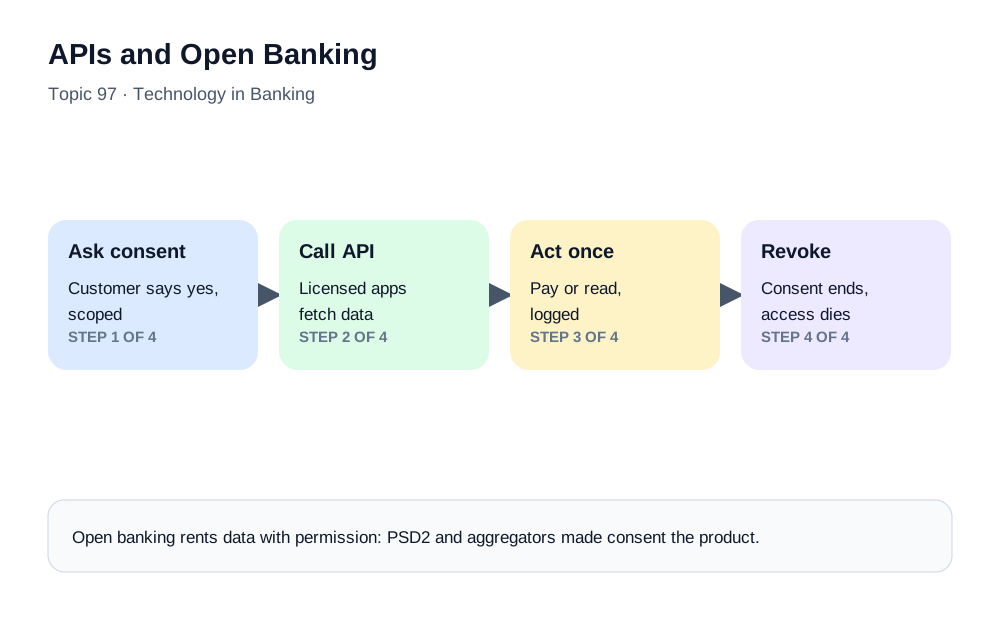
APIs and Open Banking at a glance — PSD2, Account Aggregator, consent management.
PSD2, Account Aggregator, and Consent Management
Open Banking is a major structural change in financial services because it allows authorised providers to access defined account information or initiate permitted services through controlled interfaces when the customer has given the required consent or authorisation. Legal rights in financial data differ by jurisdiction, so it is more accurate to speak about customer control, access and permitted sharing under applicable law than to claim that customers universally 'own' every item of bank-held data. Application Programming Interfaces make this principle operational, creating standardized connections that allow banks, fintech companies, and third-party providers to exchange data and initiate transactions with explicit customer permission. This ecosystem is reshaping competitive dynamics, accelerating innovation, and fundamentally redefining what it means to be a bank in the digital age. The shift from closed, vertically integrated banking to open, interconnected financial services represents both a threat to traditional business models and an opportunity for those who adapt effectively.
An Application Programming Interface functions as a set of rules and protocols that enable software applications to communicate with each other. In banking contexts, APIs allow external applications to access bank functionality and data in controlled, secure ways. A fintech application might use a bank's API to retrieve a customer's account balance and transaction history, enabling the customer to view all their financial relationships in a single dashboard. Another API might initiate a payment directly from the customer's bank account to complete an e-commerce purchase. Yet another might enable a lending platform to verify a customer's identity and income through direct bank integration. These interfaces have become the connective tissue of modern financial services, enabling capabilities that would be impossible within the constraints of traditional banking architectures.
The analogy of a restaurant helps clarify how APIs function in practice. The customer places an order with a waiter, who carries the request to the kitchen and returns with the prepared food. The customer never interacts directly with the kitchen — the waiter serves as the interface that translates customer desires into kitchen operations and delivers results back to the customer. Similarly, a banking API receives requests from external applications, retrieves or processes the required information within the bank's systems, and returns the results in a standardized format that the requesting application can interpret and use. This abstraction layer enables innovation by external developers without requiring them to understand the internal complexity of bank systems.
Banking APIs fall into several functional categories that reflect different use cases and risk profiles. Data APIs provide read-only access to information such as account balances, transaction histories, and account details. These enable account aggregation, personal financial management tools, and lending decisions based on verified bank data. Payment APIs enable write operations that initiate fund transfers, bill payments, and merchant settlements directly from customer accounts. Product APIs support both read and write operations for banking services, enabling third parties to open accounts, originate loans, and issue cards through bank infrastructure. Consent APIs manage the permissions that govern data sharing, allowing customers to grant, review, and revoke access rights through standardized interfaces. Together these API categories create a comprehensive ecosystem that enables third parties to build rich financial experiences on bank infrastructure.
Several major regulatory frameworks have driven the adoption of Open Banking across different jurisdictions, each with distinctive characteristics shaped by local market conditions and policy objectives.
The EU's revised Payment Services Directive (PSD2) created regulated account-information and payment-initiation services and rules for secure access to payment accounts. Strong Customer Authentication applies under the PSD2 framework to specified situations, subject to the detailed regulatory technical standards and permitted exemptions; it should not be described as identical multi-factor treatment for every transaction. The framework is also evolving: the European Commission proposed PSD3 and a new Payment Services Regulation in June 2023, and the European Parliament and Council reached political agreement on the PSD2 review on 27 November 2025. Until the successor legislation becomes applicable, teams must distinguish current PSD2 obligations from agreed or proposed future changes.
The United Kingdom's open-banking framework grew from the Competition and Markets Authority's retail-banking remedies and the wider PSD2 environment. Open Banking Limited (OBL) publishes the UK Open Banking Standard; version 4.0.1 was published on 1 April 2026, with API specifications covering secure information access and payment initiation with customer consent. Participation, governance and the future UK framework continue to evolve, so implementation teams should use the current OBL standards and applicable FCA/CMA requirements rather than rely on old adoption figures or legacy entity names.
India's Account Aggregator framework is governed for NBFC Account Aggregators by Reserve Bank of India directions and uses a consent-based architecture for sharing specified financial information between eligible providers and users. The regulatory framework predates the later commercial scaling of the ecosystem, so it should not be reduced to a single 'launch year'. Rather than connecting fintechs directly to banks, the framework introduces Account Aggregators as licensed intermediaries that manage consent between data providers and data consumers. When a customer wishes to share their financial data — perhaps to support a loan application — they provide explicit consent through an Account Aggregator application. The Account Aggregator transmits this consent artifact to the data provider, typically the customer's bank. The bank encrypts the requested financial data and transmits it to the Account Aggregator, which forwards the encrypted package to the data consumer, such as a lending platform. The data consumer decrypts and uses the information to underwrite the loan application.
Under the RBI's NBFC-AA directions, customer financial information accessed from Financial Information Providers must not reside with the Account Aggregator, and the Account Aggregator must not request or store customer authentication credentials. The Account Aggregator obtains, submits and manages explicit consent and securely transfers information to the customer or an authorised Financial Information User according to the consent artefact. This is more precise than saying the intermediary simply 'never sees' data: the rules define secure transit, non-retention, authorised use and consent controls.
Consent management forms the ethical and legal foundation of Open Banking, ensuring that data sharing occurs only with genuine customer authorization and only for legitimate purposes. Several core principles govern effective consent frameworks across jurisdictions. Informed consent requires that customers understand exactly what data will be shared, with which parties, and for what purposes — no hidden permissions buried in lengthy terms of service. Granularity allows customers to specify which accounts, which data types, and which time periods are included in sharing permissions rather than granting blanket access. Revocability ensures that customers can withdraw consent at any time, with data sharing ceasing immediately upon revocation. Time limitations ensure that consent expires after defined periods, requiring renewal rather than granting indefinite access. Purpose binding restricts data use to the specific stated purpose — a lender receiving data for credit assessment cannot repurpose it for marketing or sell it to other parties.
India's consent artifact exemplifies these principles in concrete implementation. A typical consent record specifies the data provider by name, such as a particular bank; the data consumer receiving the information, such as a lending platform; the specific purpose such as loan assessment; the types of data being shared, perhaps limited to savings accounts and fixed deposits; the time period covered, such as the last twelve months; the frequency of access, whether one-time or recurring; and an expiration date after which the consent becomes invalid. This granular approach gives customers precise control over their information while providing data recipients with clear boundaries for their usage. The consent artifact is digitally signed and tamper-evident, providing an audit trail that regulators can examine.
Banking-as-a-Service is a commercial model in which a regulated institution or specialist provider exposes selected banking capabilities to another business through technology interfaces and contractual arrangements. The regulated bank may remain responsible for activities that sit within its licence, but the partner does not become regulation-free: data protection, consumer protection, outsourcing, payments, financial-crime, marketing and other obligations can still apply according to role and jurisdiction. The operating model must therefore define regulatory accountability, customer ownership, controls, service levels and incident responsibilities as clearly as the API contract. This partnership model has enabled a new generation of financial services companies that combine the trust and regulatory compliance of banks with the innovation and agility of technology startups.
Practical Banking-as-a-Service implementations include e-commerce platforms that integrate Unified Payments Interface functionality through bank APIs, enabling seamless checkout experiences without redirecting customers to external banking applications. Lending fintechs use bank loan APIs to offer credit products under their own brand while the actual funding and servicing occur through licensed bank infrastructure. Neobanks issue payment cards and provide current accounts powered by licensed banks behind the scenes, focusing their innovation on mobile applications and customer service rather than core banking technology. Third-party verification services use bank Know Your Customer APIs to confirm identity and address details, streamlining onboarding processes across industries.
The security of banking APIs receives intense attention given the sensitive nature of financial data and the potential consequences of breaches. Multiple protective layers work together to ensure that only authorized parties access appropriate data for legitimate purposes. Banking APIs commonly use standards-based authorization, transport security, client authentication, signed or protected messages where required, rate and traffic controls, monitoring and API gateways. OAuth 2.0 and related profiles are widely used in open-banking ecosystems, while mechanisms such as mutual TLS, private-key authentication and certificate-based trust depend on the relevant standard and jurisdiction. The security objective is not to collect fashionable protocols but to ensure that the caller is authorised, the customer's consent is valid, the message cannot be altered unnoticed, sensitive data are protected, and every material access can be audited.
The emergence of Open Banking marks a transition from banking as a closed, vertically integrated industry to an open ecosystem where value creation occurs through networks of specialized providers. Banks must decide whether to compete primarily as infrastructure providers serving the ecosystem, as customer-facing brands leveraging ecosystem capabilities, or as hybrid players combining both approaches. The winners in this new landscape will be those who master API strategy — creating secure, reliable, developer-friendly interfaces that enable innovation while maintaining the trust that remains banking's most valuable asset. As Open Banking matures, we can expect to see increasingly sophisticated use cases, from AI-powered financial advisors that access complete customer financial histories to automated savings and investment products that optimize across multiple accounts and providers. The banks that embrace this future will find themselves at the center of an expanding ecosystem; those that resist risk being reduced to commodity infrastructure providers.
<!-- MBA-DEEP-DIVE-START -->APIs and Open Banking — From Consent to a Controlled Banking Interface
An API is a business contract expressed through technology
An API is often introduced as a technical doorway between two applications. In banking, that is incomplete. A banking API also represents a business contract: who may call it, which customer or corporate relationship the caller represents, what information can be requested, what action can be initiated, which limits and controls apply, what consent or mandate is required, how errors are communicated, and how the bank proves later what happened.
A GET /accounts endpoint can look trivial in code while carrying significant obligations. The bank must determine which accounts the customer has authorised for the requesting party, whether the consent is still valid, which fields the caller may see, whether data should be masked, how fresh balances must be, and what happens when one underlying system is unavailable. Likewise, a payment-initiation endpoint cannot be judged merely by whether it returns HTTP 200. The bank needs to know whether the payment instruction was accepted, authorised, booked, routed, settled, rejected or still pending.
For business analysts and architects, API design should therefore start with the banking meaning and only then move to verbs, payloads and schemas.
Open banking is not the same thing as public banking APIs
The word “open” can be misleading. Open banking does not mean exposing customer accounts to the open internet without restriction. Regulated open-banking ecosystems normally define trusted participants, customer consent or authorisation, security standards, data scope and liability arrangements. An API may be reachable over internet infrastructure while access remains tightly authenticated and authorised.
Banks also operate APIs outside formal open-banking regimes. A corporate host-to-host API, an internal mobile-banking API, a card-processing API or a bilateral fintech integration can use similar technology without being an open-banking service. Conversely, an open-banking regime may mandate particular access rights or participant roles that do not apply to a private API partnership.
The useful question is therefore not “Is this an API?” but “Under which business and regulatory model is this API operating?” That answer determines consent, participant eligibility, security, customer rights and operational responsibility.
Consent, authentication and authorization are three separate controls
Consent records what the customer has agreed to share or allow. Authentication establishes the identity of the person or system acting. Authorization determines whether that authenticated actor may perform the requested action under the consent, mandate and bank rules. Mixing these concepts creates dangerous gaps.
Imagine a customer has consented for a budgeting application to read transaction data for one current account for ninety days. The third party authenticates successfully to the bank. That does not authorise it to read a savings account, initiate payments or continue after the consent expires. The API gateway or consent service must evaluate the scope every time the protected resource is used according to the framework.
Similarly, a customer can authenticate strongly but decline a consent request. Authentication does not create permission. A valid consent can also exist while the customer's account is blocked for legal or security reasons, meaning the bank may still be unable to fulfil the request.
A good consent record is specific enough to enforce
A vague statement such as “I agree to share my banking data” is difficult to govern. A strong consent artefact identifies the customer, the receiving party, the information or action in scope, the purpose where required, the relevant accounts or data categories, permitted frequency, start and expiry conditions, and the mechanism for revocation.
The exact attributes differ by jurisdiction and scheme. The design principle is durable: what the system stores must be precise enough for the bank to evaluate a future API call automatically and for the customer to understand what was authorised.
Consent should also be inspectable. Customers should be able to see active permissions in a clear dashboard where the applicable framework expects this, understand which provider has access and revoke permissions through an effective process. A consent system that records permissions but makes revocation practically impossible has not achieved meaningful customer control.
Revocation is an operational event, not just a screen button
When a customer revokes consent, several systems may need to react. The consent store marks the permission inactive. API access tokens may need invalidation or reduced scope. Scheduled data retrieval should stop. Downstream services should know that future access is no longer permitted. The customer and third party may need confirmation according to the governing rules.
Revocation also raises a separate data question. Stopping future access does not automatically mean every copy of lawfully obtained historical data must be deleted immediately. Retention and continued use depend on purpose, contract and applicable law. The open-banking platform should therefore distinguish the right to obtain new data from the obligations governing data already received.
From a control perspective, revocation needs a timestamp and audit trail. If a third party accessed information after the customer withdrew permission, the bank and provider should be able to establish whether the request was authorised at that exact time.
Customer credentials should remain with the appropriate authentication domain
One major security benefit of modern open-banking design is that customers should not need to hand their online-banking password to an unrelated third party merely to obtain a service. The customer can authenticate with the account provider through an approved flow while the third party receives tokens or other evidence representing permitted access rather than the credential itself.
This separation reduces credential exposure and allows permission to be limited and revoked without changing the customer's main password. It also gives the account provider an opportunity to apply its own authentication controls for sensitive access.
Implementations should protect against confusing the customer about where authentication occurs. Redirect, decoupled and app-to-app journeys need clear branding and anti-phishing design so users do not learn to enter credentials into arbitrary screens. Technical security and customer comprehension work together here.
Tokens represent authority and must be handled like sensitive assets
An access token can allow a caller to retrieve account information or invoke another protected resource without repeatedly presenting the customer's primary credential. If stolen, that token may be valuable to an attacker until it expires or is revoked.
Banks and third parties therefore need secure token storage, short and appropriate lifetimes, scoped permissions, secure transmission and controls around refresh tokens or equivalent long-lived authority. Logs should not expose full bearer tokens. Support teams should not copy them into tickets. Development environments should use separate credentials and test data.
Token scope should reflect the permission granted. A token for account information should not automatically enable payment initiation. A token for one customer should never be reusable for another. The principle of least privilege applies to machine authorization just as it does to employee access.
API identity is not the same as customer identity
The bank often needs to authenticate the calling software organisation as well as understand the end customer's authorization. These are separate layers. The third party may have certificates, client credentials, directory registration or another ecosystem identity. The customer has their own relationship and consent.
A request should therefore be attributable to both. Investigators may need to answer: Which third-party provider made the call? Which software or client instance was used? Which customer consent supported it? Which bank account was accessed? Which user authenticated the consent? When did the request occur?
Without this chain, audit logs can show that “the API” accessed data without identifying the responsible participant. Strong open-banking control preserves participant identity across gateways, microservices and backend systems.
Read access and payment initiation have different risk profiles
Account-information services are often described as read-only, but read-only does not mean low risk. Transaction histories can reveal salary, medical spending, political donations, locations, merchant relationships and financial vulnerability. Excessive data exposure can create privacy harm even when no money moves.
Payment initiation creates a different set of risks because an authorised request can cause a financial obligation. The bank must validate the payer account, amount, currency, beneficiary details, account status, limits, fraud controls and the customer's required authorization. The API status must also distinguish payment initiation from final settlement.
The security architecture should therefore be proportionate to the capability. A single generic “API permission” for both data access and payments is too coarse for most banking ecosystems.
An account-information API needs clear data semantics
Returning a balance requires more than an amount. Is it ledger balance, available balance, credit limit, cash balance or another scheme-defined type? What currency applies? When was it calculated? Does it include pending card transactions? Is the account closed, blocked or dormant?
Transaction data has similar questions. Booking date and value date are different. A pending item is not the same as a booked transaction. Merchant information may be enriched by the bank after settlement. Reversals and refunds need references to the original event where possible.
Open-banking standards improve interoperability by defining common structures, but banks still need to map those structures accurately from internal systems. A technically valid JSON response can contain misleading business data if the internal mapping is wrong.
Payment initiation is an instruction lifecycle
When a third party submits a payment, the API may first create a consent or payment object, obtain customer authorization, then submit or release the instruction depending on the framework. The bank validates the request and returns a status. That status can change as the payment moves through internal and external processing.
The third party therefore needs status-retrieval rules and stable identifiers. A timeout should not lead it to create a second payment blindly. Idempotency and duplicate protection are critical because API retries are normal behaviour in distributed systems.
The bank should define what each state means. “Accepted” may mean the instruction passed validation, not that the beneficiary has received funds. “Completed” should be used only when the relevant framework's completion condition is met. Clear semantics prevent customer-facing applications from overstating certainty.
API errors should be actionable without leaking sensitive information
An API can fail for many reasons: invalid syntax, expired consent, insufficient authorization, closed account, unsupported currency, limit breach, duplicate request, fraud hold, backend unavailability or external payment rejection. A generic 500 Internal Server Error is rarely sufficient for a regulated banking ecosystem.
Error codes should allow the caller to decide what to do next. A validation error may require customer correction. An expired consent requires a new consent journey. A temporary technical failure may be retried. A rejected payment should not be retried automatically if the business reason will not change.
At the same time, error messages should not disclose internal security rules or personal data unnecessarily. “Fraud rule 43 triggered because device reputation is poor” can help an attacker tune future attempts. The external response and the internal diagnostic record can therefore have different levels of detail.
Rate limiting protects capacity but needs business awareness
APIs need protection from accidental loops, abusive traffic and denial-of-service conditions. Rate limiting and quotas can constrain call volume by participant, endpoint, customer or other dimension. However, an arbitrary limit can also break legitimate services.
A corporate account-information provider may retrieve balances for thousands of accounts at the start of the business day. A personal-finance application may synchronise many customers after a temporary outage. The bank needs capacity planning and limits aligned to realistic usage, not merely the lowest technical number that protects a server.
Where standards or service levels require particular performance and availability, monitoring should show whether throttling is affecting legitimate participants. Operational teams need a process to investigate abnormal traffic without disabling the ecosystem unnecessarily.
Availability is part of open-banking trust
A third-party service depends on the bank's interface. If the dedicated API is frequently unavailable while the bank's own mobile channel remains healthy, customers experience a poorer service simply because they chose another provider. Open-banking operational frameworks therefore pay close attention to availability, performance, testing and problem resolution.
Banks need monitoring at the API layer and through the full backend journey. A gateway returning HTTP 200 while account data are stale is not truly healthy. Likewise, a consent endpoint may be available while the authentication journey fails in the mobile app.
Service management should measure customer-visible outcomes: successful account retrieval, successful authorization journeys, response latency, error rates and recovery. Technical component uptime is only part of the picture.
Versioning is unavoidable because standards evolve
Open-banking standards change as regulations, security practices and market requirements evolve. A new API version may add fields, change enumerations, introduce payment types or retire weak security mechanisms. Banks and third parties need enough notice and testing capacity to adapt safely.
Backward compatibility should be deliberate. Adding an optional field may be safe for tolerant clients, while changing the meaning of an existing field can be dangerous even if the schema still validates. Deprecation dates, migration guidance, test environments and participant communication form part of the change process.
The UK's Open Banking Standard v4.0.1, published in 2026, illustrates that mature ecosystems continue to refine standards rather than reach a permanent final version. Teams should therefore build version-management capability into the operating model instead of treating standard upgrades as exceptional projects.
Sandboxes are useful only when they resemble real banking behaviour
A sandbox allows third parties to test authentication, consent, account information and payment flows without accessing production customers or money. It can accelerate integration and reduce defects, but a sandbox that always returns happy-path responses creates false confidence.
Useful test environments include realistic validation, consent expiry, duplicate requests, rejected payments, unavailable services, different account types and state transitions. Synthetic data should represent the structure and edge cases of production without exposing actual customer information.
Certification or conformance testing can confirm that an implementation meets required interface behaviours, but banks still need their own production-readiness testing for security, resilience, monitoring and operations.
Consent does not remove the need for data minimisation
A customer may authorise access to a broad category of information, but a service should still consider whether it needs every available field for its stated purpose. Collecting more data than necessary increases security exposure and can conflict with privacy principles.
API products can support minimisation through scopes, field sets and purpose-specific endpoints. A lender assessing recent cash flow may not need years of transaction history. A balance-checking service may not need full transaction descriptions.
Banks and receiving providers should understand their respective obligations for purpose limitation, retention and security under applicable law. “The customer consented” is not a universal answer to every later data use.
Open banking changes fraud patterns rather than eliminating fraud
Secure API access can reduce some risks associated with credential sharing and screen scraping, but criminals can exploit legitimate consent journeys through social engineering. A fraudster may convince a victim to authorise account access or a payment under false pretences. Technically valid consent does not prove the underlying purpose was honest.
Banks and third parties therefore still need fraud monitoring, customer education and safe confirmation journeys. Transaction context should be presented clearly so the customer understands which provider is requesting access and what action is being approved.
Fraud investigation also requires cross-party cooperation. The bank may see account and transaction behaviour while the third party sees the initiating device and customer journey. Incident procedures and lawful information-sharing routes should be defined before fraud occurs.
Disputes require end-to-end evidence
A customer may say they never authorised a third-party payment or that an application accessed data after consent was revoked. Resolving the dispute requires evidence from several systems: participant identity, consent record, authentication event, API request, transaction state, customer notifications and any downstream payment processing.
Timestamp consistency and stable references are essential. If one system logs local time and another logs UTC without clear conversion, the sequence can appear contradictory. If tokens are rotated without preserving linkage to the original consent, investigators may struggle to reconstruct authority.
Audit data should be designed for this purpose rather than assembled after an incident. The bank needs enough evidence to explain the decision while avoiding unnecessary retention of sensitive secrets.
The India Account Aggregator model separates consent management from transactions
The RBI's NBFC-AA framework is useful because it highlights that financial-data sharing is not the same as payment initiation. The Account Aggregator obtains and manages the customer's consent and facilitates secure sharing of specified financial information between Financial Information Providers and authorised recipients. The directions explicitly state that the Account Aggregator shall not support transactions by customers.
The framework also requires that financial information accessed from providers does not reside with the Account Aggregator and that customer authentication credentials are not requested or stored by it. This creates a distinct control model from an application that logs into the customer's bank and copies credentials.
For implementation teams, the important roles are the customer, Account Aggregator, Financial Information Provider and Financial Information User. Every data flow should be traceable to a valid consent artefact and the permitted purpose and usage defined there.
The European framework is in transition, so dates matter
PSD2 remains an important reference point for account information, payment initiation and strong customer authentication in Europe. However, banking change teams in 2026 should not write requirements as though the framework will never change. The European Commission proposed PSD3 and a Payment Services Regulation in June 2023, and the European Parliament and Council reached political agreement on the review in November 2025.
That creates a familiar delivery challenge: current law, agreed future law, technical standards and implementation dates can coexist. A requirement marked “PSD3” is incomplete unless the team knows whether the relevant provision has been formally adopted, entered into force and become applicable to the service being changed.
Good regulatory traceability therefore records the legal source, version, effective or application date, affected product and implementation evidence. This avoids building future proposals prematurely or missing a later transition deadline.
Banking-as-a-Service needs a responsibility matrix
When one institution exposes accounts, cards or payments for another brand, customers may see only the front-end company while regulated activities are performed by a partner bank. This can create confusion when service fails or a complaint arises.
A strong Banking-as-a-Service agreement defines who performs onboarding, KYC, sanctions screening, fraud monitoring, transaction processing, safeguarding or deposit handling where relevant, complaints, chargebacks, regulatory reporting, customer communication, data retention and incident notification. Technology service levels should map to those responsibilities.
The bank should also monitor the partner as part of third-party risk management. An API does not transfer accountability automatically. Rapid customer growth through a partner can create operational, compliance and liquidity effects inside the bank even if the bank does not own the front-end brand.
API gateways centralise enforcement but are not the whole control framework
An API gateway can authenticate clients, enforce certificates or tokens, apply quotas, route requests, validate schemas and create logs. This makes it an important control point. However, it should not be expected to understand every banking rule.
The backend service must still validate customer consent, account status, entitlements, limits and transaction state. A gateway can prove that a licensed client called the endpoint; it cannot by itself prove that the requested account belongs to the authorised customer or that the payment is permitted.
Layered responsibility is therefore healthy. The gateway protects the interface boundary, identity infrastructure validates participants, consent services evaluate permission, domain services enforce banking rules, and ledgers preserve financial state.
Observability should preserve the business journey across services
One API request can cross gateway, identity service, consent service, account service, core banking platform and notification service. If each component generates an unrelated technical ID, operations cannot reconstruct the journey quickly.
Correlation identifiers should travel across the call chain while business identifiers remain stable for the underlying customer instruction. Logs and traces should record service timing, result and relevant non-sensitive context. Metrics should show both technical and business outcomes.
For example, a spike in 401 responses may indicate expired client credentials, while a spike in business rejection code CONSENT_EXPIRED may indicate normal customer consent ageing. They require different actions even though both prevent access.
API security also includes software-supply and configuration risk
Banks focus heavily on authentication protocols but can still suffer incidents through vulnerable libraries, exposed secrets, incorrect gateway policies or insecure deployment pipelines. API security therefore extends into software delivery.
Secrets should not be embedded in source code. Certificates and keys need lifecycle management. Dependencies require vulnerability monitoring. Infrastructure and gateway configuration should be reviewed and tested. Production changes need audit and rollback.
A sophisticated OAuth design is of little value if a debug endpoint exposes customer data or a deployment accidentally disables authorization on one route. Security testing should include the complete implementation, not just the protocol diagram.
A practical scenario: a budgeting app retrieves three accounts
A customer connects a budgeting application to their bank. The application identifies itself as an authorised participant and requests consent to read balances and transactions for three selected accounts for an allowed period. The customer is sent through the bank's authentication and authorization journey and confirms the request.
The bank creates or records the consent, and the application later calls the account-information API using its authorised client identity and access token. The API verifies participant trust, token validity, consent scope and account linkage before returning permitted data. One account service is temporarily unavailable, so the bank must decide according to the standard whether to return a partial result, error or retryable response rather than fabricate a zero balance.
A month later, the customer revokes access. The consent becomes invalid for future retrieval. A subsequent API call is rejected with an actionable error. Logs show participant, consent, account scope, request time and revocation time. No employee needs to infer authority from screenshots because the control evidence is built into the platform.
A practical scenario: payment initiation times out
A merchant uses an open-banking payment service. The customer authorises a payment of 2,500. The third party submits the authorised instruction with idempotency reference OBP-49002. The bank validates the request and creates the payment, but the network connection fails before the response reaches the third party.
A weak client submits a fresh payment and risks duplication. A strong client queries status or retries with the same idempotency identity as permitted by the API design. The bank recognises the existing instruction and returns its state rather than creating another debit.
The customer's merchant page should not claim the payment failed merely because the browser saw a timeout. It should resolve the authoritative status. This is a classic example of why API reliability in banking means protecting financial meaning during technical failure.
What world-class open banking should achieve
A world-class open-banking platform lets customers use authorised third-party services without forcing the bank to surrender control of security, consent, financial integrity or operational resilience. It makes permission explicit, participant identity verifiable, data semantics consistent, errors actionable, payment states traceable and revocation effective.
It also treats standards as living contracts. Regulatory frameworks evolve, API versions change and customer expectations rise. Banks need governance that can translate those changes into controlled specifications, implementation, testing, communication and evidence.
The most durable principle is that openness and control are not opposites. An API can make a bank easier to integrate with while making authority more explicit than an old manual or credential-sharing process. The quality of the ecosystem depends on whether every request can answer four questions: who is calling, on whose authority, for what permitted purpose or action, and what business outcome actually occurred. When those answers remain clear from consent through backend processing and audit, APIs become a safe extension of banking rather than merely another technology channel.
Open Banking Continuation: Operational Governance Across Participants
Participant onboarding is a trust-establishment process
Before a third party can access protected banking APIs, the ecosystem needs confidence in who that party is and which regulated or approved roles it holds. The precise mechanism differs by market, but the bank generally relies on registration, certificates, directory information, contractual onboarding or regulatory status rather than accepting a self-declared application identity.
Onboarding should create an internal participant record that can be linked to credentials, allowed API roles, contact information, incident escalation and status. If a participant loses authorization, changes legal identity or rotates certificates, the bank needs a controlled way to update or suspend access without affecting unrelated providers.
The operating model should also distinguish production trust from sandbox registration. A developer that can call a test API is not automatically entitled to customer data or payment capability in production.
Certificate lifecycle failures can become banking outages
Where an ecosystem uses certificates for client authentication or message protection, expiry and rotation are operational risks. A certificate can be cryptographically valid today and unusable tomorrow if renewal was missed. Several participants can fail simultaneously if trust stores are not updated correctly.
Banks should monitor upcoming expiry, test renewal procedures and support overlapping credentials where the standard permits so rotation does not require an outage. Emergency revocation needs a separate process because compromised credentials may have to be blocked immediately.
Operations also needs to know whether a failed connection represents an expired certificate, invalid participant status, authorization failure or ordinary network error. Treating every TLS problem as “API down” delays resolution.
Consent dashboards need accurate status across systems
A customer-facing consent dashboard is only useful if it reflects the permissions actually enforced by the API platform. If the screen says access is revoked while an old token still works, the bank has created a serious control gap. If the screen says consent is active but backend access was disabled, the customer receives a misleading service view.
Consent state should therefore have clear ownership and propagation rules. Revocation, expiry and supersession events should update enforcement points deterministically. Where multiple account providers or services are involved, the customer should understand which permission each record covers.
History can be useful as well. Showing that a consent expired or was revoked on a particular date can help customers understand why an application stopped refreshing and can support later dispute investigation.
API monitoring should separate participant behaviour from customer behaviour
A surge in calls from one third party can indicate a software loop, legitimate customer growth, replay after an outage or malicious activity. A surge in requests for one customer from many parties suggests a different risk. Monitoring should preserve both participant and customer dimensions.
Metrics can include request volumes, latency, success rates, consent failures, authentication failures, throttling, payment rejection and backend dependency errors. Security teams may also monitor unusual client locations, certificate changes and token behaviour where technically meaningful.
The purpose is not to profile participants unfairly but to detect conditions that threaten customers, resilience or data protection. Operational thresholds should be reviewed as the ecosystem scales.
Third-party outages should not erase the bank's transaction evidence
A customer may begin a payment journey in a fintech application that becomes unavailable after the bank has accepted the payment. The bank's own records must still preserve the instruction and its state. The customer may later contact the bank directly, and operations should be able to identify the transaction using references supplied through the ecosystem.
Likewise, if the bank is temporarily unavailable, the third party should not invent outcomes. Retry and status rules should be defined by the API contract. Queued requests need careful treatment because a customer may revoke consent or change account state before delayed processing occurs.
End-to-end resilience therefore includes participant failure modes, not just the bank's infrastructure.
Customer journeys need protection against consent manipulation
A malicious or misleading application could request broader permissions than the service genuinely needs, obscure the identity of the provider or pressure a customer to approve quickly. The bank's authorization screen should present the request in a consistent way that makes scope understandable.
The account provider should not rewrite the third party's commercial proposition, but it can ensure that the customer sees which provider is asking, which accounts or actions are in scope and what approval is being given under the relevant standard. Sensitive changes in scope should require a fresh authorization rather than silently expanding an existing consent.
This is another reason customer experience is part of security. A perfectly signed request can still produce poor outcomes if people cannot understand what they are approving.
Payment fraud controls should recognise the open-banking context
A payment initiated through a third party may look different from one created in the bank's own mobile app. Device and session data can sit with the initiating provider, while the bank sees the customer's account history and payment destination. Fraud controls should use the information lawfully available to each participant and avoid assuming that absence of the bank's usual mobile-device signals makes every open-banking payment suspicious.
Where the framework supports relevant risk information, participants can coordinate to improve detection. Incident procedures should define how suspected fraud is escalated and how lawful information can be exchanged. Customers should not be trapped between two providers, each claiming the other owns the problem.
Liability and reimbursement decisions must follow the applicable legal and scheme framework rather than an informal assumption that “the API provider is responsible.”
Service-level reporting should measure the dedicated interface honestly
Open-banking ecosystems depend on reliable interfaces. Performance reporting should therefore measure the actual customer and third-party service, including authentication redirections and backend dependencies that are essential to completing the journey.
Excluding failed calls because they never reached the core can make availability look better than the experience. Conversely, requests rejected correctly for invalid consent should not necessarily be counted as technical failures. Metrics need precise definitions.
Trend analysis can identify whether one API version, participant group or backend dependency is creating disproportionate errors. This evidence supports capacity planning and fair problem resolution rather than arguments based on isolated screenshots.
API change governance should include external consumers
An internal service can sometimes coordinate a breaking change across one organisation. An open-banking API may have many independently operated consumers. The bank therefore needs disciplined notice, version support and test facilities consistent with the applicable standard.
Changes should be classified by impact. A documentation clarification differs from a new optional field, security-profile update or removal of an endpoint. Participants need enough information to decide whether code, certificates, consent handling or customer journeys must change.
Emergency security changes can require faster action, but even then the bank should communicate the reason, affected interfaces and recovery steps through established operational contacts.
Open banking should be reconciled like any other material service
Payment initiation creates financial events that should reconcile from API instruction through the bank's posting and external payment process. Account-information access creates non-financial evidence that should reconcile conceptually to consent and audit logs: every protected access should be attributable to an authorised participant and valid permission.
Reconciliation does not mean storing excessive copies of customer data. It means preserving enough identifiers and control evidence to establish completeness and legitimacy. A payment record with no corresponding authorised API instruction or an API access with no valid consent should trigger investigation.
This control view prevents open banking from becoming an isolated digital programme. It becomes part of ordinary payments, security, customer service, data governance and operational-risk management.
A mature ecosystem makes responsibility visible before an incident
Open banking introduces several organisations into one customer journey. The customer should not need to understand every technical boundary, but the institutions do. Responsibility matrices should cover consent, authentication, API availability, payment processing, fraud, customer complaints, data protection, certificate incidents and regulatory notification.
When those responsibilities are unclear, incidents become coordination failures. Each party can be technically correct about its own component while the customer remains unresolved. Pre-agreed contacts, evidence standards and escalation routes reduce this risk.
The defining quality of a strong open-banking implementation is therefore controlled interoperability. The bank is genuinely open to authorised external services, yet every participant, consent, data request and payment remains attributable, bounded and recoverable. That is what turns an API ecosystem from a collection of endpoints into dependable banking infrastructure.
<!-- MBA-DEEP-DIVE-END -->