Visual overview
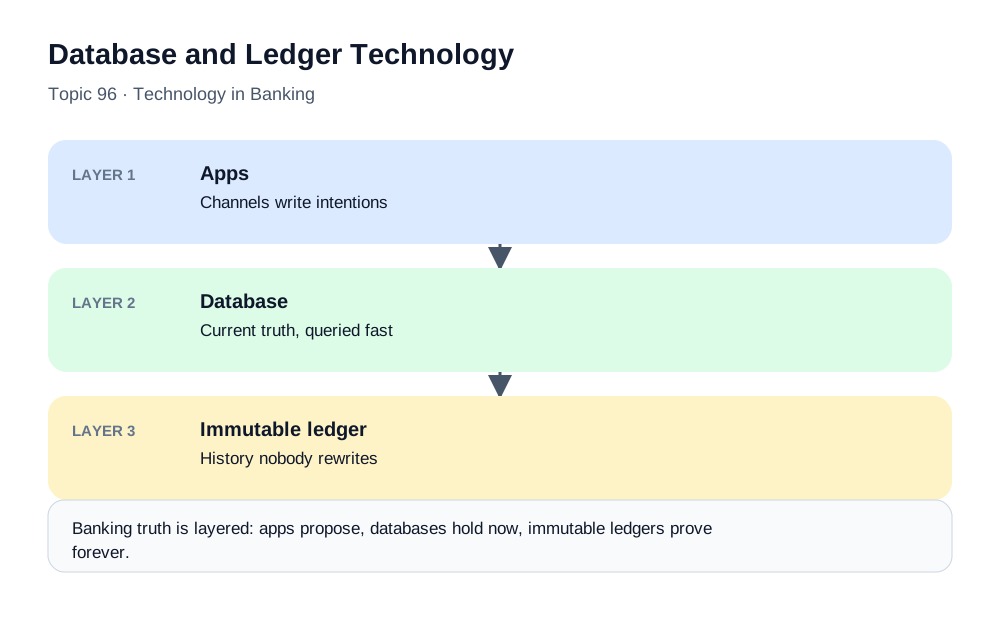
Database and Ledger Technology at a glance — Relational databases, event sourcing, immutable ledgers.
Relational Databases, Event Sourcing, and Immutable Ledgers
Every banking transaction, from a routine ATM withdrawal to a complex cross-border trade finance settlement, ultimately resolves to a database entry. The database technology underlying banking systems determines not only operational performance but also the reliability, auditability, and adaptability of financial institutions. The choices banks make about data storage — whether to rely on traditional relational models or adopt emerging approaches like event sourcing and immutable ledgers — shape their capacity to meet regulatory requirements, detect fraud, and innovate in an increasingly competitive marketplace. As regulators demand ever-greater transparency and customers expect real-time access to their financial information, the database layer has become a strategic differentiator for modern banking.
Relational databases have served as the technological foundation of banking systems for over four decades, and they remain the dominant approach for core banking operations today. These databases organize data into structured tables with predefined schemas, where relationships between data elements are explicitly defined and rigorously enforced. The enduring popularity of relational databases in banking stems from characteristics that align perfectly with financial industry requirements. The structured nature of relational data models corresponds to the orderly, rules-driven nature of banking itself, where precision and consistency are paramount. The mathematical foundations of relational theory, established by Edgar Codd at IBM in the 1970s, provide the theoretical basis for operations that banks depend upon daily.
ACID compliance represents the most critical attribute that makes relational databases suitable for banking. Atomicity ensures that transactions complete entirely or not at all — when a customer transfers funds between accounts, either both the debit and credit occur, or neither does, eliminating the possibility of funds disappearing into system errors. Consistency means a committed transaction must respect the integrity rules that the database and application actually enforce. It can help protect accounting invariants, but double-entry balance is not created automatically by the ACID acronym; the ledger design must explicitly encode and validate the relevant business and accounting rules. Isolation prevents concurrent transactions from interfering with each other, ensuring that two simultaneous ATM withdrawals from the same account cannot combine to overdraw available funds. Durability ensures that once a transaction commits, it survives any subsequent system failure — a power outage immediately after a transaction confirmation cannot cause data loss. These properties, taken together, provide the guarantees that make banking possible.
The structured schema approach of relational databases provides the predictability and auditability that regulators and auditors demand. Predefined data structures ensure that all records conform to expected formats, simplifying validation and reporting. The standardized Structured Query Language provides a mature ecosystem of tools and a large pool of skilled professionals who can develop, maintain, and optimize database operations. Referential integrity constraints through foreign keys ensure that relationships between data elements remain valid — a loan account cannot exist without a corresponding customer record, preventing orphaned data that could complicate regulatory reporting. Schema definitions serve as documentation of data structure, and database management systems enforce these structures at the point of data entry, catching errors immediately rather than allowing corrupt data to propagate through systems.
Banks use several mature relational database technologies, including commercial enterprise platforms, mainframe-oriented databases and open-source systems. Product choice varies by institution and workload, so broad market-share claims are less useful than the engineering criteria: transactional semantics, consistency and isolation options, replication, recovery, security, support, operational tooling, performance, licensing and integration with the surrounding platform. A database can support ACID transactions while still being implemented poorly; banking integrity depends on schema, application logic, operating controls and reconciliation as well as the database product.
The traditional ledger model in banking implements digital double-entry bookkeeping, a principle that has governed accounting since the Renaissance. Every financial transaction creates two equal and opposite entries that maintain the fundamental accounting equation. When a customer deposits ten thousand rupees, the system records a debit to the cash or bank asset account and a credit to the customer deposit liability account. When a loan is disbursed, the entry debits the loan account as an asset and credits the customer's account. Interest income recognition debits the customer receivable and credits interest income as revenue. This dual-entry structure ensures that the books always balance and provides the foundation for financial reporting. The system of accounts — assets, liabilities, equity, income, and expenses — provides a comprehensive framework for tracking every financial aspect of the bank's operations.
Traditional relational implementations can be designed either around mutable current-state records or around append-only journal patterns. A poorly controlled mutable design can make historical reconstruction difficult, but mature relational databases also support transaction logs, temporal techniques, auditing, immutable or append-only tables through design, and tightly restricted update privileges. Reconciliation becomes difficult when multiple applications maintain competing state or when event lineage is weak, not simply because the underlying database is relational. Concurrency can also create contention under some designs, but performance depends on access patterns, isolation choices, partitioning and ledger architecture rather than row locking alone.
Event sourcing represents a fundamental paradigm shift in how banking data is stored and managed. Rather than maintaining only the current state of an account — a balance of fifty thousand rupees — event sourcing stores every event that contributed to reaching that state. The event log might show account opening with zero balance, followed by a deposit of one hundred thousand rupees, a withdrawal of thirty thousand, an interest credit of five hundred, and an equated monthly installment debit of twenty thousand five hundred, arriving at the current fifty thousand rupee balance. The authoritative history is the sequence of events, while current state can be derived from that history. Production event-sourced systems commonly use projections and snapshots so they do not need to replay an entire lifetime of events for every query. Each event is immutable once recorded, and the sequence of events provides a complete narrative of the account's history.
This approach delivers substantial benefits that address many limitations of traditional ledger models. The complete audit trail preserves every change that ever occurred, with nothing lost to updates or deletions. Regulators can examine not just what the current state is, but exactly how it was reached, providing unprecedented transparency. Time travel capabilities enable reconstruction of account states at any historical moment, invaluable for dispute resolution and regulatory investigation. If a customer questions a fee charged six months ago, the system can show exactly what the balance was, what transactions occurred, and why the fee was applied. Debugging becomes straightforward by replaying events to understand exactly what happened and when. Event stores are normally designed so recorded events are append-only and corrections are represented by new events. This improves traceability, but it does not magically eliminate tampering risk: privileged access, storage controls, cryptographic verification where used, backups, segregation of duties and independent reconciliation remain necessary. Analytics capabilities expand dramatically as rich event data reveals patterns in customer behavior, transaction timing, and operational flows that simple balance records obscure.
Immutable or tamper-evident ledger designs can strengthen historical traceability, but no production record should be described as absolutely tamper-proof. Security depends on privileged-access controls, cryptographic and storage design where applicable, operational governance, independent evidence and the ability to verify the history. In an immutable ledger, records can only be appended — never updated, never deleted. Corrections are made by adding new entries that reverse erroneous transactions and establish corrected values, preserving complete visibility into the entire history including mistakes and their resolution. Cryptographic hashing enables verification that data has not been tampered with, as any modification would change hash values and immediately signal interference. Hash chains link each record to its predecessor, creating a mathematical guarantee of sequence integrity.
Several technology patterns can implement immutable or tamper-evident ledger concepts. Append-only journals restrict normal business processing to new entries rather than destructive updates. Event stores preserve ordered business events. Some systems add cryptographic hashes or chained digests so later verification can reveal alteration. Distributed-ledger designs use replicated consensus and cryptographic linkage where a shared multi-party record is genuinely needed. Product examples change over time, so the durable design question is not which branded database sounds most modern but which trust, audit, consistency, recovery and operating requirements the bank must satisfy.
Immutable ledgers add particular value in use cases where auditability and trust are paramount. Transaction records maintained in immutable ledgers provide tamper-proof evidence that satisfies regulatory examiners and supports legal proceedings. In disputes between banks and customers, immutable records provide definitive proof of what occurred. Regulatory reporting backed by immutable data allows banks to prove that submitted figures have not been altered after the fact. Interbank settlement processes benefit from shared immutable records that establish a single source of truth between parties, eliminating disputes about what transactions occurred and when. Trade finance applications use immutable ledgers to maintain document chains of custody, tracking bills of lading, letters of credit, and inspection certificates through complex international transaction flows.
NoSQL databases have emerged as important complements to relational systems in banking architectures, addressing use cases where relational constraints create inefficiencies. Document databases such as MongoDB excel at storing customer profiles and Know Your Customer records, where flexible schemas accommodate varying data requirements across customer types and regulatory jurisdictions. A retail customer's profile may require different fields than a corporate customer's, and document databases accommodate this variation without complex schema modifications. Key-value stores like Redis provide high-performance session management and caching that accelerate customer-facing applications. Column-family databases including Cassandra handle time-series data such as transaction histories with exceptional efficiency for analytical queries. Graph databases such as Neo4j power fraud detection systems that analyze relationship networks to identify suspicious patterns and collusion networks.
The comparison between relational and NoSQL approaches reveals complementary strengths rather than simple superiority of one over the other. Relational databases provide native ACID compliance essential for core banking operations, enforce rigid schemas that ensure data consistency, scale vertically through more powerful servers, and serve as the system of record for transactional data. NoSQL databases offer varying consistency models that trade strict guarantees for performance, provide flexible schemas that adapt to changing requirements, scale horizontally across distributed server clusters, and excel at analytics, real-time processing, and artificial intelligence applications.
The optimal banking architecture increasingly combines both approaches — relational databases maintaining the golden record of financial transactions, NoSQL systems powering customer-facing applications and analytical workloads. This polyglot persistence strategy allows banks to match database technologies to specific use case requirements, optimizing for consistency where financial integrity demands it and for flexibility and scale where these characteristics provide competitive advantage. As regulatory expectations around data auditability continue to strengthen and as customers demand ever-more sophisticated real-time services, the evolution of database and ledger technology remains central to banking's technological future. The institutions that master these technologies will be positioned to offer superior customer experiences while maintaining the trust that is banking's most valuable asset.
<!-- MBA-DEEP-DIVE-START -->Database and Ledger Technology — Designing a Banking Record That Can Be Trusted
A banking ledger is a business control implemented through technology
A ledger is not simply a table containing balances. It is a controlled record of financial events with rules that determine when an entry may be created, which accounts it affects, how it is dated, who or what authorised it, how it can be corrected, and how the resulting balances reconcile to the bank's financial statements. The database is the mechanism that persists this record, but the trustworthiness of the ledger comes from the combination of data model, transaction semantics, application rules, access control and operational reconciliation.
This distinction prevents a common architecture mistake: assuming that choosing a database with strong transactional features automatically creates a correct banking ledger. A database can commit two perfectly durable rows that represent the wrong accounting. It can enforce a foreign key while allowing an invalid business state. Banking integrity therefore requires explicit invariants such as balanced entries, valid currencies, authorised account states, deterministic rounding and linkage to the source business event.
The safest design starts by defining those invariants before selecting implementation patterns.
The journal and the balance serve different purposes
A financial journal records entries. A balance represents the cumulative effect of relevant entries at a point in time. Storing only the latest balance is insufficient for a bank because the institution must explain how that number arose. Storing only entries can be operationally expensive if every balance enquiry requires recalculating an entire history.
Mature ledger designs therefore often keep an authoritative journal and efficiently maintained balance views. The journal preserves the financial history. Derived balances, projections or snapshots provide fast access for customer channels and operational decisions. The two must remain reconcilable.
If an account shows 100,000, operations should be able to trace that figure to opening state, credits, debits, holds where relevant, reversals, interest, fees and other valid events. If a derived balance is corrupted, it can be rebuilt from the authoritative history according to the design. That recoverability is one reason append-oriented ledger patterns are attractive.
Double-entry is about economic meaning, not merely two rows
Double-entry bookkeeping requires equal debits and credits at the level defined by the accounting model. A simplistic implementation can create one debit row and one credit row yet still be economically wrong. The accounts might be mapped incorrectly, the currency conversion could be wrong, or a fee could be booked to the wrong income category.
A ledger therefore needs a posting rule that connects the business event to accounting intent. “Customer cash deposit” is different from “loan disbursement” even if both increase a customer's deposit balance. The first increases a cash asset and customer deposit liability. The second increases a loan asset and usually creates or increases the deposit liability through disbursement. The accounting story differs.
For testing, balancing is necessary but not sufficient. Teams should verify the correct accounts, amounts, currencies, dates, dimensions and references as well as the equality of debit and credit totals.
A transaction identifier should describe identity at the right level
Banking systems contain many identifiers: channel request ID, API correlation ID, payment instruction ID, ledger transaction ID, journal-entry ID, external clearing reference and reconciliation reference. Problems occur when teams assume these are interchangeable.
The ledger should preserve a stable link to the originating business event. If a payment engine retries the same posting after a timeout, a new network request identifier should not cause a second debit. Idempotency usually requires an identifier whose meaning survives technical retries.
At the same time, one business instruction can legitimately create several ledger transactions over its lifecycle. A card purchase may have an authorisation hold, final clearing entry and later reversal. The data model needs to show that relationship without pretending all events are the same entry.
Good identity design is therefore essential for duplicate prevention, customer investigation, audit and reconciliation.
Atomicity needs a clearly defined transaction boundary
Atomicity is useful only after the system defines what must succeed or fail together. Within one ledger database, a transfer between two accounts might be one atomic database transaction: debit one account, credit another, create journal records and update derived balances. Across multiple systems, true atomicity may not exist.
Consider a cross-border payment. The bank can atomically book its customer's debit, but it cannot place the recipient bank's external ledger inside the same local database transaction. The wider process therefore uses business states, messages, acknowledgements, settlement and reconciliation to coordinate independent systems.
Architecture teams should resist the phrase “make it transactional” when the business crosses boundaries that cannot share one commit. The correct design may be local atomicity plus durable workflow, idempotent messages, compensating actions and explicit exception handling.
Isolation protects concurrent decisions on the same money
Two transactions can arrive almost simultaneously against one account. If both read an available balance of 10,000 and each attempts to debit 8,000, a naive implementation can approve both. Isolation and application-level concurrency controls prevent simultaneous operations from making decisions on stale state.
Different database isolation levels make different trade-offs between concurrency and protection from anomalies. Banking systems may use row locks, optimistic version checks, serializable operations, account-level sequencing or other techniques depending on throughput and architecture.
The business requirement should be expressed first: what combinations must never occur? For a deposit account, the rule may be that confirmed debits cannot exceed available funds unless an overdraft permits it. For a credit limit, concurrent authorisations should not collectively exceed the permitted exposure. The implementation then needs concurrency semantics strong enough to preserve that rule.
Durability includes recovery, not just disk write
Durability means committed data survives failure according to the platform's guarantees. In real banking operations, teams also need to know how the system recovers after server loss, storage corruption, regional outage or operator error. Replication and backup policies turn theoretical durability into an operating capability.
A replicated database can still reproduce a bad application write across every replica. A backup can be useless if restore procedures are untested. A disaster-recovery site can be available while being behind the authoritative transaction stream. Therefore resilience includes transaction logs, replica monitoring, backup validation, recovery-point measurement and reconciliation after failover.
For high-value financial systems, recovery testing should prove not only that the database starts but that the bank can establish which transactions were committed, restore derived balances, reconnect interfaces and reconcile the recovered ledger to surrounding systems.
Ledger entries should normally be additive
When a booked transaction is wrong, the safest accounting pattern is usually to create a correcting or reversing entry rather than destructively editing the historical posting. This preserves evidence of the original event and the action taken to correct it.
The reversal should reference the original transaction and apply the appropriate business rules. If an erroneous fee is reversed, the refund may need to reverse tax and income effects as well as the customer debit. If an old value date is corrected, interest may need recalculation.
An additive model makes investigation easier because the story remains visible. It also reduces the power of privileged users to rewrite history invisibly. Direct database changes should be exceptional, governed, logged and independently reconciled rather than treated as an ordinary support technique.
Event sourcing is broader than an audit log
An audit log records information about changes made elsewhere. In event sourcing, the event history itself is the authoritative source from which application state is derived. That distinction matters. Adding a log table to a mutable application does not automatically turn it into an event-sourced design.
A useful domain event describes a business fact that has happened: AccountOpened, FundsReserved, PaymentPosted, InterestApplied or AccountBlocked. Events should be immutable facts, not commands such as “try to debit account.” The event payload must contain enough information and version context to be meaningful later.
Projections then transform the event stream into views suited to different uses: current account balance, statement history, risk exposure or customer timeline. If a projection contains a defect, it can be corrected and rebuilt from authoritative events, subject to data volume and retention design.
Event versioning is a long-term banking responsibility
A bank may retain financial records for many years under applicable legal and business requirements. Event structures will evolve during that period. If an old event cannot be interpreted by new software, replay and investigation become unreliable.
Event schemas therefore need versioning. Changes should distinguish backward-compatible additions from semantic changes. Consumers should know whether they can ignore unknown fields, and producers should not silently change the meaning of existing values.
One approach keeps old events immutable and teaches new readers how to interpret historical versions. Another introduces upcasting during read so old representations are converted into a current in-memory model without rewriting the stored history. The correct choice depends on the platform, but uncontrolled schema drift is dangerous in a ledger whose history is part of the product.
Snapshots are a performance optimisation, not a replacement for history
Replaying millions of events to display one account balance can be inefficient. Event-sourced systems therefore often create snapshots or persistent projections that represent state at a known event position. Newer events are then applied from that point.
A snapshot should be reproducible or at least verifiable against the authoritative event stream. If it becomes inconsistent, the system needs a recovery method. The snapshot also needs a version because the structure of derived state can evolve.
This is analogous to maintaining balances from a journal. Performance improves because the application does not recalculate from the beginning every time, while the underlying history remains available for audit and reconstruction.
Immutable does not mean infallible
An append-only system can preserve a wrong event perfectly. If a user authorises the wrong beneficiary or an application calculates the wrong fee, immutability does not make the business result correct. It merely preserves what was recorded.
Controls therefore need to operate before and after persistence. Before posting, the system validates authority, account state, amount, currency and business rules. After posting, reconciliation and monitoring detect inconsistencies with external obligations, product expectations and financial reporting.
Likewise, cryptographic hashes can help show whether stored data changed, but they do not prove that the original data were truthful. The integrity of banking records depends on validated source events and governed processes as much as on storage technology.
Tamper evidence needs independent trust anchors
If a system calculates a hash for each journal block but an attacker can alter both the data and the stored hashes, the verification mechanism provides less assurance. Stronger tamper-evident designs place verification evidence in a separately protected location, use signed roots, external anchoring or independent replication depending on the threat model.
The bank should define what threat it is trying to resist. Ordinary operator mistakes require different controls from malicious database administrators. Multi-party settlement records require different trust assumptions from an internal retail ledger.
Security architecture should therefore avoid fashionable claims such as “blockchain makes it immutable.” The useful questions are who can write, who can change storage, who can verify, how consensus is established, how keys are protected, and what happens when an authorised business correction is required.
Database constraints are valuable but do not replace domain validation
A schema can require non-null currency, valid foreign keys and unique transaction identifiers. Check constraints can prevent negative values where inappropriate. These are strong last-line controls because they operate close to the data.
Some business rules are too contextual for simple constraints. Whether an account can be debited may depend on available balance, overdraft, product status, legal restrictions, sanctions controls, time of day and other services. The application or domain layer must make that decision consistently.
The strongest approach layers controls: validate at the API boundary, enforce domain rules in the transaction service, use database constraints for structural invariants, and reconcile outcomes independently. Each layer catches a different class of error.
NoSQL is a family of patterns, not one consistency model
The label NoSQL covers document, key-value, wide-column and graph databases with very different capabilities. Some can provide transactions and strong consistency; others are deliberately optimised for availability, distribution or flexible access patterns. It is inaccurate to assume every NoSQL system sacrifices consistency.
Banks select storage based on workload. A document store can suit flexible customer-profile data. A graph database can help analyse relationships among accounts, devices, merchants and counterparties for fraud. A key-value cache can reduce latency for non-authoritative session data. A wide-column store can support large analytical or event workloads.
The crucial control is authoritative ownership. If a fraud graph contains a copied transaction feed, it should not become the source for customer balances. Each dataset needs lineage, refresh semantics and a clear statement of whether it is authoritative, derived or cached.
CQRS can separate writing from reading without creating two truths
Command Query Responsibility Segregation separates the model that processes state changes from models optimised for reading. A ledger command side may use strict transaction rules, while read projections support fast statements, search and analytics.
This can improve scalability because customer balance enquiries do not need to compete with complex reporting queries on the same structures. It can also allow different read models for mobile banking, operations and reporting.
The risk is eventual consistency. A read model may lag behind the committed ledger by seconds. The user interface must know whether that is acceptable. Immediately after a payment, a channel may need the command result or a strongly consistent balance rather than a stale projection. Architecture should define acceptable lag by use case rather than assuming all queries are equal.
Reconciliation connects separate systems of record
Banks often have several authoritative records for different domains: core deposit ledger, card ledger, loan subledger, treasury books, securities records and the general ledger. Reconciliation does not mean one of them must be wrong. It proves that defined financial relationships between them are complete and consistent.
A payment hub may record an instruction, a core ledger records the customer debit, an external network reports settlement, and the general ledger records accounting. Each system answers a different question. Reconciliation links them using stable identifiers, amounts, currencies and dates.
Exceptions need ownership. A missing external settlement record is different from a duplicate core posting. Good reconciliation classifies breaks according to cause and next action rather than creating one generic queue.
The general ledger should not be used as a substitute for transaction detail
The enterprise general ledger aggregates financial accounting by chart-of-account dimensions. It is not normally designed to hold every piece of customer and payment workflow data required for investigation. Conversely, an operational transaction database may contain rich details but is not a substitute for controlled financial statements.
A sound architecture retains the appropriate granularity in each layer and keeps traceability between them. Finance should be able to explain how operational subledger totals map to general-ledger accounts. Operations should be able to trace a general-ledger reconciliation break back to source transactions where necessary.
Trying to make one database serve every analytical, operational and financial need often creates unnecessary coupling and performance risk.
Data partitioning must respect banking access patterns
Large ledgers need to distribute workload. Partitioning can be by account, customer, legal entity, region, time or another key. The choice affects transaction locality and complexity.
If transfers frequently occur between partitions, the platform needs a reliable cross-partition transaction strategy. If all events for one account are kept together, account-level sequencing may be easier. Time-based partitioning can simplify archival but may complicate current balance calculations.
Business requirements therefore influence physical data design. A consumer bank with huge numbers of independent retail accounts has different patterns from a correspondent banking ledger with fewer but highly connected accounts and large intraday movements.
Multi-currency ledgers need explicit amount semantics
A banking record should not store an amount without a currency and should not assume all decimal rules are the same. Foreign-exchange transactions can involve transaction currency, account currency, settlement currency and reporting currency. Rates have quotation conventions, precision and effective times.
A customer paying 100 EUR from a GBP account may require a debit in GBP, an FX position, a payment amount in EUR, fees in one of those currencies and accounting translation into the bank's functional currency. Each amount should have an explicit meaning.
Rounding is also financial logic. Repeated rounding at intermediate stages can create small differences that accumulate across large volumes. The ledger needs defined precision and residual-handling rules rather than relying on programming-language defaults.
Time ordering is difficult in distributed banking systems
A timestamp tells when one system recorded an event, not necessarily the global order of all business events. Server clocks can differ, messages can be delayed and retries can arrive after later actions. A ledger may therefore use sequence numbers, version counters or stream offsets in addition to timestamps.
For one account, the system often needs a deterministic order so balance-affecting events cannot be applied inconsistently. Across independent accounts, strict global ordering may be unnecessary and expensive.
Investigations should distinguish event time, processing time, booking time and settlement time. A message received at 10:02 may represent a payment initiated at 10:00 and settled externally at 10:05. Flattening those into one timestamp loses business meaning.
Data retention should be driven by obligation and purpose
Financial institutions retain records to meet accounting, regulatory, legal, customer-service, fraud and operational needs, but retention periods vary by data category and jurisdiction. “Keep everything forever” is not automatically good governance. It creates privacy, security, cost and discovery burdens.
A ledger's required history may be long-lived, while caches, logs and analytical copies can have shorter justified retention. Policies should distinguish the authoritative financial record from duplicated technical telemetry.
Deletion requirements also interact with immutability. Where law requires certain personal data to be erased or minimised, architects need designs that preserve mandatory financial evidence without unnecessarily retaining unrelated personal information. Tokenisation, separation of identity from journal entries and controlled archival can help, subject to the applicable legal framework.
Production support should never rely on casual SQL fixes
Direct production database changes are tempting because they can resolve a visible problem quickly. They are also dangerous because application rules, derived balances, audit events and downstream feeds may not be updated consistently.
Support tooling should expose controlled business actions such as reverse transaction, release hold, correct reference or rebuild projection. These actions can validate permissions, create audit records and preserve accounting semantics.
If emergency SQL is unavoidable, the bank needs exceptional-access approval, peer review where feasible, exact before-and-after evidence, backup or rollback planning, and reconciliation after the change. The objective is to make direct modification rare enough that it remains an emergency procedure rather than an undocumented operating model.
A practical failure scenario: acknowledgement lost after commit
A payment service sends ledger request PAY-7781 to debit a customer's account. The ledger begins a database transaction, validates the account, records balanced journal entries, updates the derived available balance and commits. Immediately afterward, the application server crashes before returning the success response.
The payment service times out and retries PAY-7781. If the ledger relies only on the new network connection, it may book the debit again. A robust ledger stores the business idempotency key as part of the original transaction. On retry it recognises that PAY-7781 already committed and returns the existing result.
After recovery, reconciliation confirms one source payment, one customer debit, one accounting event and the expected external processing record. This small scenario illustrates why database semantics, business identity and operational controls must be designed together.
What world-class ledger technology should achieve
A world-class banking ledger allows the institution to answer five questions reliably. What financial event happened? Who or what authorised it? Which accounts and amounts were affected? What is the resulting state? Can the bank prove and, where necessary, correct the history without destroying evidence?
Relational databases, event stores, append-only journals, NoSQL technologies and distributed ledgers are tools that can contribute to those answers. None is automatically “the future” for every workload. A traditional relational ledger can be exceptionally safe when designed well; a fashionable distributed platform can be unsafe when business invariants and operating controls are weak.
The durable engineering principle is therefore simple: financial truth must be explicit. The bank should know which record is authoritative, how it is created, how duplicates are prevented, how concurrency is controlled, how history is preserved, how derived views are reconciled, how failures recover and how every material entry reaches the financial accounts. Database architecture becomes banking architecture when it protects that chain of truth.
Ledger Technology Continuation: Controls Around Scale, Privacy and Recovery
Balance reconstruction should be a tested capability
If a bank maintains derived balances or projections for performance, it should know how to rebuild them from the authoritative journal or event history. A rebuild is not only a developer exercise. It is a financial recovery process that must preserve ordering, version logic, currency precision and business dates.
A practical test takes a known account population, rebuilds balances into an isolated environment, and reconciles the reconstructed result to production control totals at a defined event position. Differences should be explainable. If the system cannot reproduce its own balances from authoritative history, the bank has a hidden dependency on mutable derived state.
Rebuild time also matters. A theoretically recoverable projection that requires several days may not support a service with a much shorter recovery objective. Snapshots, partitioning and parallel processing can reduce recovery time, but each optimisation needs its own integrity checks.
A ledger should distinguish posting time from effective financial time
Financial events can be recorded after the economic date to which they apply. A late correction may be posted today with a value date in the past. Interest or fee recalculation may therefore depend on effective date while audit evidence needs the actual posting timestamp.
Storing one generic timestamp loses this distinction. A bank may need event creation time, booking time, value date, settlement date and accounting period depending on the product. The database model should use explicit fields rather than forcing downstream systems to infer meaning from a single date.
This becomes particularly important around period close. A back-valued entry may change customer economics without reopening a previously published financial period; Finance may instead require an adjusting entry in the current period. The ledger and accounting architecture must support that policy deliberately.
Corrections need causal links, not just opposite amounts
A reversal that happens to offset the amount of an earlier transaction is not enough for strong auditability. The new entry should identify which original event it corrects and why. This causal relationship allows statements, operations and reconciliation systems to understand that the two entries belong to one correction lifecycle.
Partial reversals make the need clearer. A transaction of 1,000 may need only 200 corrected. Several adjustments may follow over time. Without references, investigators are left matching amounts and dates heuristically.
The ledger should also distinguish technical rollback before commitment from a booked financial reversal. If a database transaction never committed, there is normally no financial entry to reverse. Calling both situations “reversal” creates confusion in incident analysis.
Privacy and ledger integrity require careful separation
Financial records may need long retention, while some personal attributes should be minimised, corrected or deleted under applicable privacy law. Embedding excessive personal data directly inside immutable journal entries can make future privacy obligations harder to satisfy.
A useful pattern stores stable internal identifiers in the financial journal and keeps changeable or unnecessary identity attributes in governed customer-master systems. The ledger can still prove which account and customer relationship the event concerned without copying names, addresses and contact data into every event.
This separation also reduces breach impact. An attacker who accesses a transaction journal should not automatically receive every piece of customer identity information if the business purpose does not require it to be stored there.
Encryption protects confidentiality but key management determines usability
Encrypting ledger data at rest or in transit is valuable only if cryptographic keys are protected and recoverable according to policy. If application administrators can freely retrieve master keys, the control may be weaker than the architecture diagram suggests. If keys are lost during disaster recovery, perfectly intact encrypted data can become unusable.
Banks therefore need key generation, storage, rotation, access control, backup and revocation processes appropriate to the platform. Separation of duties can prevent one administrator from controlling both encrypted data and the keys needed to decrypt it.
Rotation also needs operational design. Large historical ledgers cannot always be rewritten instantly when a key changes. Envelope encryption, key versioning or other patterns can support rotation without corrupting historical access. The exact technology varies, but the business requirement is continuity of authorised access with controlled exposure.
Database replication creates consistency choices
Replicas can improve availability and read scale, but the bank needs to know when data become visible on each copy. An asynchronously replicated read database may lag the primary. That can be acceptable for historical analytics and unacceptable for a balance check immediately before authorising a debit.
Applications should therefore select data sources according to consistency need. A statement search may tolerate seconds of lag. A spend decision should usually use a sufficiently current authoritative state. Hidden routing to stale replicas can create errors that appear random to customers.
Failover also needs a rule for the last acknowledged commit. If the primary fails before a replica receives the newest transaction, the recovery design must define whether that transaction can be lost, recovered from a durable log or reconciled from an upstream source. Recovery Point Objective should be expressed in financial terms as well as seconds.
Active-active architecture needs conflict prevention
Running two active sites can improve resilience, but allowing both to update the same account independently can create conflicting financial state. Banks may partition ownership so one account or shard has one active writer at a time, use consensus protocols, or apply another design that preserves ordering and uniqueness.
The marketing term “active-active” does not explain the consistency model. Architects should ask what happens when network connectivity between sites fails. Can both continue accepting debits? How are duplicate identifiers coordinated? What prevents a customer spending the same available funds in each region?
A resilience architecture is successful only when it preserves financial correctness during the failure it was built to survive.
Data migration should reconcile meaning, not only records
Moving a ledger to a new database or platform can produce identical record counts while changing business meaning. An old system may store debit amounts as negative numbers while the target uses separate debit and credit indicators. Interest accrual may be stored at account level in one platform and event level in another. Currency precision can differ.
Migration mapping should therefore define semantics field by field. Control totals should include balances by product and currency, not just total row counts. Sampled accounts should be reconstructed through their transaction history. General-ledger mappings and suspense balances require special attention.
The cutover also needs a transaction boundary. Instructions in flight at the moment of migration must have one authoritative owner. If both old and new ledgers process them, duplication occurs; if neither does, instructions disappear.
Analytical copies must not silently become financial truth
Banks move ledger data into warehouses, lakes and analytical platforms for reporting, risk and machine learning. These copies may transform, aggregate or arrive later than the source. They are valuable but should have clear lineage and freshness indicators.
An analyst calculating today's liquidity from a data lake needs to know whether the latest hour of transactions is present. A customer-service agent should not quote an overnight warehouse balance as current available funds. Regulatory reporting needs controlled reconciliation between source, transformation and submitted figures.
Data governance should label authoritative, replicated, derived and analytical datasets explicitly. The more copies a bank creates, the more important it becomes to know which question each copy is designed to answer.
Schema evolution needs financial compatibility tests
Changing a ledger schema can affect writers, readers, reconciliation and history replay. Adding a nullable descriptive field may be low risk; changing amount precision, account identifiers or event semantics can be fundamental.
Migration scripts should be tested against realistic volumes and historical states. During rolling deployment, old and new application versions may operate simultaneously, so compatibility matters in both directions. Event consumers should not fail because a producer introduced a new enum value without coordination.
Financial compatibility tests can compare posting outcomes before and after the change for the same business scenarios. The bank should care not only that the database migration succeeds but that balances and accounting remain identical where business rules did not intentionally change.
Ledger observability should focus on financial invariants
Traditional monitoring checks CPU, memory, disk, latency and error rates. A ledger also needs business controls: imbalance count, duplicate-key attempts, rejected postings, suspense growth, projection lag, reconciliation breaks, unusual reversal volume and delayed event processing.
A system can be technically healthy while posting the wrong fee to every account. Business observability helps detect that class of failure quickly. Thresholds should be calibrated to normal volumes and product behaviour rather than generating constant noise.
Alerts need owners and playbooks. An imbalance alert is critical only if somebody knows how to stop further impact, identify affected transactions and reconcile the ledger after recovery.
The safest database architecture makes financial uncertainty visible
Banking systems cannot eliminate every failure. Networks partition, processes crash, migrations go wrong and data arrive late. The architecture should avoid converting uncertainty into false certainty.
If the system does not know whether an external instruction settled, it should record a pending or exception state rather than fabricate completion. If a projection is stale, the consumer should know its freshness. If reconciliation has not completed, management should see the outstanding break.
This is the deeper purpose of ledger technology: not merely to store numbers, but to preserve an explainable boundary between what the bank knows, what it has committed financially, what remains pending and what requires investigation. A trustworthy ledger makes those distinctions durable even when the surrounding technology is under stress.
Final Ledger Depth: Control Totals and Proof of Completeness
Control totals make invisible data loss visible
A ledger interface can appear technically successful while silently losing or duplicating a subset of transactions. Control totals provide an independent way to detect that problem. A source batch or event window can carry expected record count, debit total, credit total and other relevant dimensions, while the receiving system calculates what it actually processed.
The comparison should be performed at a level meaningful to the business. A single grand total can hide offsetting errors, so banks may reconcile by currency, legal entity, product or posting date as appropriate. Differences should create an exception with ownership rather than being corrected through undocumented manual adjustments.
Real-time architectures need the same principle even when there is no traditional batch. Teams can reconcile sequence ranges, event counts and financial totals across defined time windows. The technology changes, but the control objective remains: prove that every expected financial event arrived once, was processed once, and produced the intended accounting effect.
Control totals are especially valuable after recovery, replay or migration because they provide evidence that the restored ledger is complete rather than merely available.
Final Ledger Check: Provenance
Every material balance should retain provenance
A reliable ledger lets the bank trace a displayed or reported balance back to the journal entries, source business events and processing rules that created it. Provenance should survive retries, migrations and downstream replication. When a balance is corrected, the bank should be able to identify the original event, the correcting event and the reason for the change rather than relying on an unexplained database adjustment. This traceability is what allows operations, Finance, auditors and investigators to reach the same conclusion from the same financial history.
<!-- MBA-DEEP-DIVE-END -->