Visual overview
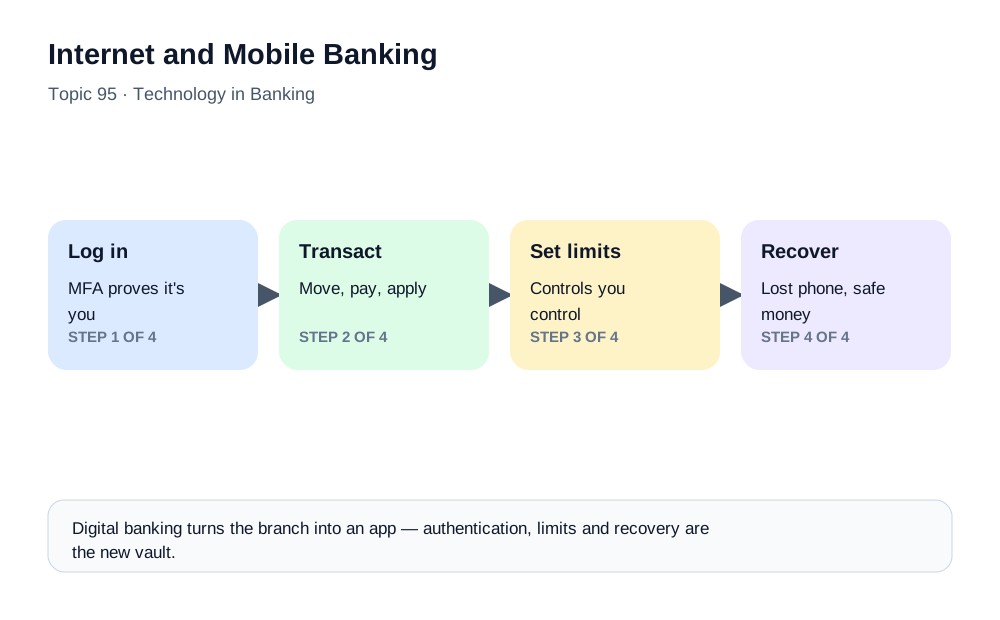
Internet and Mobile Banking at a glance — Multi-factor authentication, channel evolution.
Multi-Factor Authentication and Channel Evolution
The transformation of banking from a physical destination to a digital service represents one of the most profound shifts in how people manage their financial lives. Where customers once planned their week around branch visits during limited operating hours, they now expect to access their accounts, execute transactions, and manage investments from anywhere at any time. Internet and mobile banking have evolved from simple balance inquiry tools to comprehensive financial platforms that handle everything from routine payments to complex investment strategies, all secured through sophisticated authentication mechanisms that protect customers while preserving convenience. This evolution has fundamentally altered the relationship between banks and their customers, making banking an integrated part of daily life rather than a separate activity requiring special effort. The shift has been so complete that many younger customers have never experienced banking inside a physical branch, and the concept of waiting in line to deposit a cheque seems as antiquated as telegrams or rotary phones.
The journey of digital banking channels traces a clear arc of technological and social change. Before the 1990s, banking was entirely a physical experience — customers visited branches for every transaction, from depositing cheques to requesting account statements. The branch was the center of the banking universe, and customers accepted the limitations of fixed operating hours and geographic proximity as natural constraints. Banking hours were typically limited to weekdays during business hours, forcing working people to rush during lunch breaks or take time off to handle financial matters. The introduction of phone banking in the 1990s offered the first taste of remote access, enabling customers to check balances and initiate fund transfers through interactive voice response systems. While revolutionary for its time, phone banking was limited by its menu-driven structure and the inability to handle complex transactions. Nevertheless, it represented an important psychological shift — the recognition that banking services could extend beyond the branch walls and that customers might value convenience over personal interaction.
The early 2000s brought internet banking, which fundamentally altered the banking relationship. Customers could now view account details, transfer funds between accounts, pay utility bills, and access statements through web browsers from any connected computer. This era established the foundation of digital self-service, though early platforms offered limited functionality compared to branch services. Banks invested heavily in educating customers about the security of online transactions, addressing fears about the safety of conducting financial activities over the internet. Many early adopters were initially skeptical, concerned about the security of transmitting sensitive financial data across networks. The 2010s witnessed the mobile revolution, as smartphones became ubiquitous and banking applications migrated to pocket-sized devices. Mobile banking not only replicated internet banking functionality but added capabilities uniquely suited to mobile contexts — biometric authentication, QR code payments, location-based services, and push notifications that kept customers informed in real time.
Today, the 2020s are ushering in an era of super applications and embedded finance, where banking functions integrate seamlessly into broader lifestyle platforms. Customers can access financial services through messaging applications, e-commerce platforms, and artificial intelligence assistants without ever opening a traditional banking app. This evolution reflects a fundamental truth about modern banking — customers value convenience above all, and the winning providers are those who make financial management effortless and invisible. The distinction between banking and other daily activities is blurring as financial services become embedded in the moments when they are needed. A customer purchasing a product online can receive instant financing offers at checkout, or a ride-share driver can receive earnings directly to a digital wallet without ever visiting a bank branch. This embedding of financial services into everyday activities represents the culmination of decades of digital transformation.
Internet banking has matured into a comprehensive platform that addresses nearly every banking need a customer might have. Account management capabilities allow customers to view real-time balances across all their accounts, access detailed transaction histories and statements, and review account details including interest rates, charges, and terms. Fund transfer functionality supports the full spectrum of payment options including National Electronic Funds Transfer for standard transfers, Real Time Gross Settlement for high-value same-day transactions, Immediate Payment Service for instant transfers, and internal transfers between a customer's own accounts. The bill payment module consolidates utility payments, credit card settlements, insurance premiums, and tax obligations into a single interface, often with scheduling options that ensure payments never miss their due dates.
For customers with investment interests, internet banking platforms provide direct access to fixed deposit creation with rate comparisons and tenure calculators, mutual fund purchase and portfolio tracking, and integration with dematerialized account services for equity trading. The service request section digitizes traditionally branch-dependent activities — customers can order cheque books, update addresses, place stop payment requests, and manage debit card settings without human intervention. Corporate customers gain additional capabilities including trade finance functions such as letter of credit submission and bank guarantee management, essential for businesses engaged in domestic and international commerce. Many banks have also integrated insurance products, allowing customers to purchase policies and pay premiums through the same platform they use for banking.
Corporate internet banking extends these capabilities with features designed specifically for organizational needs. Multi-level authorization workflows implement maker-checker-approver hierarchies that ensure no single individual can execute significant transactions without oversight. This segregation of duties is essential for fraud prevention and regulatory compliance in corporate environments. Bulk payment capabilities enable salary uploads for thousands of employees and vendor payment batches that would be impractical to process individually. Cash management features provide sophisticated tools for liquidity pooling across multiple accounts, automated sweeping between operating and interest-bearing accounts, and virtual account structures that simplify reconciliation. Application programming interface integration allows businesses to connect their enterprise resource planning systems directly to banking platforms, automating financial workflows and eliminating manual data entry. Management information system reporting delivers transaction reports, balance monitoring dashboards, and analytical tools that help finance teams maintain visibility and control.
Mobile applications have become a major digital banking channel in many markets, while browser-based internet banking remains important, especially for complex retail and corporate workflows. The exact mix varies by country, customer segment and bank, so channel strategy should be based on observed usage rather than a universal assumption that one channel has permanently displaced another. The smartphone's omnipresence creates unprecedented convenience — the banking platform lives in the customer's pocket, available instantly through biometric authentication that eliminates password fatigue. The integration with Unified Payments Interface has been transformative, enabling customers to pay via QR codes at millions of merchant locations using only a virtual payment address, without needing to remember account numbers or navigate complex transfer workflows. Push notifications provide real-time awareness of every transaction, building trust through transparency and enabling immediate response to any unauthorized activity. Even offline capabilities exist for basic functions through USSD banking, ensuring that customers in areas with limited connectivity can still access essential services.
Mobile banking has developed features that extend well beyond what internet banking platforms offer. Biometric login through fingerprint or facial recognition provides both enhanced security and frictionless access. QR code payments have become the standard for peer-to-peer transfers and merchant transactions, eliminating the need to exchange sensitive account details. Voice banking allows customers to execute commands through spoken instructions, valuable for users with visual impairments or those multitasking. In-app chat connects customers with support representatives without requiring them to exit the application or wait on telephone queues. Location-based services help customers find the nearest ATM or branch when they need physical services. Cardless withdrawal functionality generates one-time codes that customers can use at ATMs when they have forgotten or misplaced their physical cards. Perhaps most significantly, instant credit capabilities leverage data analytics to offer pre-approved loans that customers can accept with a few taps, receiving funds in their accounts within minutes.
The security of digital banking channels relies fundamentally on multi-factor authentication, an approach that recognizes the limitations of single-factor security in an era of sophisticated cyber threats. Authentication factors fall into three distinct categories. Knowledge factors encompass something the customer knows — passwords, personal identification numbers, and answers to security questions that theoretically only the legitimate customer can provide. Possession factors involve something the customer has — one-time passwords sent to registered mobile devices, hardware tokens that generate cryptographic codes, and smart cards that must be physically present. Inherence factors relate to something the customer is — biometric characteristics including fingerprints, facial recognition patterns, and iris scans that are unique to each individual.
Authentication requirements are jurisdiction- and service-specific. In India, the RBI's Digital Payment Security Controls directions require applicable regulated entities to use risk-based authentication and state that multi-factor authentication and alerts should be applied for payment transactions and sensitive changes such as beneficiary or limit changes. The RBI does not require one universal technology such as SMS OTP for every context; banks can use combinations of knowledge, possession, inherence, device and risk signals consistent with applicable directions. Individual banks may also apply cooling periods, transaction-specific controls or stronger verification according to product risk and their approved security framework.
The importance of multi-factor authentication becomes clear when comparing scenarios with and without its protection. In a single-factor environment, a stolen password means immediate account compromise — the attacker has everything needed to access funds and execute transactions. Phishing attacks succeed easily when only one credential stands between a criminal and victim's money. The security architecture presents a single point of failure that can devastate customer finances. With multi-factor authentication, a stolen password alone proves insufficient — the attacker would additionally need physical possession of the customer's registered mobile device or the ability to replicate their biometric characteristics. Phishing attacks face substantially higher barriers, as capturing one credential does not provide complete access. Multiple independent barriers must fall before unauthorized access occurs, dramatically reducing successful attack rates.
The security architecture protecting digital banking channels extends well beyond authentication. Banks normally use current, non-deprecated transport encryption, secure storage and key-management controls, session time-outs, hardened application design, device and behavioural signals where appropriate, transaction and velocity limits, fraud monitoring, alerts, logging and controlled beneficiary or profile changes. The exact controls differ by institution and risk assessment; practices such as device binding, geo-location checks or cooling periods can be useful layers but should not be described as universal features. Security is strongest when these layers work together and when exceptions, false positives and customer recovery are designed as carefully as the normal path.
USSD banking represents an important channel that extends digital services to customers without smartphone access or internet connectivity. In India, the *99# USSD service has been used to provide menu-driven banking and payment access on supported mobile networks and participating services, including for feature phones; availability and supported functions should be checked against the current provider and payment-system arrangements rather than assumed universally. The system supports balance inquiries, mini-statements showing recent transactions, and fund transfers to registered beneficiaries. This channel primarily serves rural areas with limited internet infrastructure and customers who have not adopted smartphones. While slower than app-based banking and limited in functionality, USSD banking ensures that digital financial inclusion reaches beyond the smartphone-owning population, fulfilling the broader social mission of extending banking services to all segments of society. The service is particularly valuable for basic transactions in areas with poor network coverage, as USSD requires minimal bandwidth and works even on older 2G networks.
The evolution of digital banking channels reflects a broader transformation in how financial services integrate into daily life. From branch-centric origins through internet accessibility to mobile dominance and emerging super application integration, each phase has brought banking closer to customers while raising new security challenges that the industry continues to address through increasingly sophisticated authentication and protective technologies. The future of banking will likely see even greater integration, with financial services becoming truly invisible — embedded in the activities and moments where they create value, rather than requiring customers to seek them out through dedicated channels. Banks that succeed in this evolving landscape will be those who master both the technology of secure, seamless service delivery and the psychology of customer trust and engagement.
<!-- MBA-DEEP-DIVE-START -->Internet and Mobile Banking — How a Digital Channel Becomes a Controlled Banking Service
A digital channel is the front door, not the banking engine
When a customer taps “transfer” in a mobile application, the app itself rarely performs the full banking transaction. It captures intent and presents information, while a chain of backend services performs identity checks, entitlement validation, balance checks, fraud screening, payment creation, posting, routing, notification and reporting. Internet banking follows the same principle. The browser or app is the visible layer of a much larger operating model.
This distinction helps explain why a screen can show an error even though money has moved, or show “processing” while the bank is waiting for an external payment outcome. The channel needs to represent the business state held by authoritative backend systems rather than invent a status from the success or failure of one technical call. A timeout between the app and an API does not prove the payment failed; the backend may have accepted and posted it before the response was lost.
For analysts and testers, every digital feature should therefore be traced end to end: customer action, authentication, authorization, API call, business validation, financial posting, external processing where relevant, customer notification, audit log and recovery path.
Authentication and authorization answer different questions
Authentication asks, “Who is attempting to use the service?” Authorization asks, “What is this authenticated person allowed to do?” A customer may authenticate successfully yet lack authority to close an account, change a corporate payment limit or approve a transaction above a delegated threshold.
Retail banking often appears simple because one individual owns the relationship. Even there, authorization can depend on account type, legal restrictions, account blocks, product terms, transaction limits and consent. Corporate banking makes the difference obvious. A user may be allowed to view balances but not create payments. Another may create payments but not approve them. A treasurer may approve up to one amount while a director is required above that threshold.
Digital-channel design should therefore avoid treating “logged in” as equivalent to “permitted.” Entitlements need an authoritative source, effective dates, segregation-of-duties rules and audit history. When a user changes role or leaves a company, access should be removed promptly across all connected channels.
Multi-factor authentication works best when factors are genuinely independent
Security is stronger when compromise of one factor does not automatically compromise the others. A password and a security question are both knowledge factors. Two passwords are therefore not equivalent to two independent factors. A password combined with a possession factor, biometric or securely bound device can provide stronger assurance, subject to how each factor is implemented.
The implementation detail matters. An SMS one-time code provides little extra protection if malware on the same compromised device can read both the banking session and the message. A biometric check is only as strong as the device's secure biometric implementation and the bank's trust in that device. Push approval can be abused through repeated prompts if users are conditioned to approve without reading transaction details.
Banks increasingly combine explicit factors with contextual signals such as device reputation, transaction behaviour, location consistency, account history and fraud intelligence. These signals should complement, not obscure, the authentication policy. A customer and an investigator should still be able to understand why stronger verification was required.
Login authentication and transaction authorization should not be confused
A secure login proves access to the channel, but high-risk actions may require additional authorization tied to the transaction. This is particularly important when a fraudster takes over an already authenticated session. If the user can add a beneficiary and send a large payment with no further challenge, the strength of the original login may be insufficient for the risk created later in the session.
Transaction authorization can bind approval to the amount, beneficiary and action being approved. The customer should see meaningful details before confirming. Where the security design uses an out-of-band or cryptographic mechanism, the approval can be linked to those details so that an attacker cannot silently change the payment after the customer authorizes it.
Risk-based step-up is also useful. Viewing a statement may need less assurance than changing a registered phone number or initiating an unusual high-value transfer. The design goal is proportionate security: strong enough for the risk without making routine safe activity unnecessarily difficult.
Device registration creates a lifecycle that needs controls
Many mobile-banking applications establish trust in a registered device. Registration can involve a one-time activation process, cryptographic keys, secure application storage and association with the customer's profile. Once trusted, the device may support biometric login or lower-friction authentication.
The security problem then becomes a lifecycle problem. What happens when the customer buys a new phone, loses the old one, changes the SIM, restores a backup, reinstalls the app or transfers data between devices? How does the bank distinguish a legitimate migration from an account-takeover attempt? Can the customer see registered devices and revoke one immediately?
Recovery flows deserve the same security review as initial enrolment. Attackers often target “forgot password,” device reset and profile-change processes because these can bypass stronger controls on the normal path. A beautifully secured payment screen is not enough if a criminal can replace the registered device through a weak call-centre process.
Session management protects an authenticated relationship over time
After authentication, the channel normally creates a session representing the customer's authenticated state. The bank must protect that session from theft, replay, fixation and unintended persistence. Inactivity time-outs, absolute session lifetimes, secure tokens, re-authentication for sensitive actions and invalidation after logout are common controls.
Mobile applications introduce additional considerations because users expect the app to reopen quickly. A local biometric unlock may release a securely stored token rather than create a completely new banking login each time. The design must define how long the server-side trust remains valid and what events force re-authentication, such as a password change, device-risk event or suspected compromise.
The business analyst should care because session rules affect customer journeys. If the app times out during a payment approval, the customer needs a safe way to resume without duplicating the transaction. If logout occurs after the backend accepted the payment, the next login should show the real payment status rather than invite the customer to submit it again.
The channel should never guess whether money moved
Distributed systems fail in partial ways. The app may submit a payment and receive a network timeout. The API gateway may have forwarded it. The payment service may have accepted it. The core may already have posted the debit. From the customer's perspective, one tap produced uncertainty.
The correct design uses a stable business identifier and a status-retrieval mechanism. When communication resumes, the channel asks the backend for the instruction's authoritative state. A retry should be idempotent so it does not create a second financial instruction. The customer can then be told “submitted,” “processing,” “completed,” “rejected” or another precisely defined state.
This is one of the most important differences between ordinary application design and banking application design. A shopping page can sometimes ask a user to try again. A banking channel needs to know whether retrying can move money twice.
Available balance needs context in the user experience
A digital channel frequently shows an available balance and a ledger balance, although labels vary. Pending card authorizations, payment reservations, uncleared credits, overdraft availability and product rules can make the figures different. If the app shows only one number without explaining what it represents, customers may believe the bank lost money or incorrectly blocked funds.
The balance displayed should come from an authoritative service with a clear timestamp and definition. Cached balances can improve performance, but the channel should not present stale information as real time. When a customer is about to make a payment, the decision may require a fresh availability check even if the home screen used cached data seconds earlier.
Good design also explains pending items. A card hold that has not yet become a final debit should look different from a booked transaction. Transparency reduces calls and complaints while helping customers notice fraud early.
Corporate digital banking is entitlement engineering
Corporate online banking is not simply retail banking with larger amounts. A company may have hundreds of users, multiple legal entities, many accounts and formal signing rules. Payment creation, file upload, approval, release and reporting can be separated across teams.
A maker-checker model is only the beginning. Some organizations require two approvers from different groups. Others have amount-based matrices, account-specific permissions or restrictions on self-approval. A user may have rights for one subsidiary but not another. Temporary authority may apply during leave periods. Bulk salary files may have different confidentiality and approval requirements from vendor payments.
The digital platform therefore needs an entitlement model that can express the customer's legal and operational mandate accurately. Changes to that model should be auditable and, for sensitive permissions, independently approved. When corporate fraud occurs, investigators need to reconstruct not only who clicked approve but what authority that person had at that exact time.
Bulk payments create control problems hidden by a single file upload
A corporate user may upload a file containing thousands of payments. The channel can display one file status, but internally each instruction can have a different result. Some may pass validation, others fail because of account details, sanctions controls, insufficient funds or cut-off conditions. The file may also require approval before individual instructions are released.
Good channel design separates file-level and transaction-level states. A file can be “partially accepted” while individual payments are accepted, rejected or pending. The customer should be able to download actionable errors without seeing sensitive information they are not entitled to access.
Duplicate protection is essential. If a network problem occurs after upload, the customer may upload the same file again. File identifiers, hashes and business reference rules can help detect accidental resubmission while allowing a legitimately corrected file to be processed. Operations needs a clear rule for when a duplicate warning can be overridden and by whom.
Fraud controls should challenge risk without creating blind denial
Digital banking fraud controls evaluate identity, device, beneficiary, amount, velocity, behaviour and many other signals. A transaction can be legitimate yet unusual: a customer may travel, replace a phone, buy a home or make an emergency transfer. A rule that blocks every unusual event may reduce fraud while making the bank unusable.
The control model therefore needs graded responses. Low-risk activity can proceed. Medium-risk activity may trigger step-up authentication or confirmation. High-risk activity may be held or declined and routed for review. The exact decision framework depends on product, regulation and bank risk appetite.
False positives are operational risk. Every challenged transaction can create call-centre volume, complaint risk and customer harm. Fraud teams should measure both prevented loss and customer friction, then tune rules using confirmed outcomes. The objective is not the maximum number of blocks; it is the best risk decision with evidence.
Beneficiary management is a high-risk change process
Adding a beneficiary can be as sensitive as sending money because it creates a future destination for funds. Account-takeover fraud often combines profile compromise with beneficiary creation and rapid transfer. Banks therefore commonly apply stronger verification, alerts, transaction restrictions or cooling logic according to risk and applicable rules.
The customer experience should make the destination clear. Account number, name information where available, bank details and payment type should be presented in a way that helps the customer notice mistakes. If payee-verification or name-check services are available for a particular rail, the response should be explained carefully rather than treated as an absolute guarantee of legitimacy.
Deletion and modification also require control. An attacker should not be able to replace account details behind a familiar beneficiary label without the customer understanding what changed.
Profile changes can be more dangerous than payments
Changing a registered mobile number, e-mail address, mailing address, password, transaction limit or recovery method can weaken future security. If a criminal changes the alert destination first, later fraudulent transactions may occur without the customer receiving warnings.
Sensitive profile changes should therefore use appropriate authentication, confirmation and notification. Some banks intentionally notify both old and new contact points when security details change. High-risk changes may trigger temporary restrictions or additional review depending on policy.
From an architecture perspective, the channel should not maintain an isolated copy of critical profile data with unclear synchronization. There should be authoritative ownership and defined propagation to fraud, notification, core and customer-master systems. A successful screen update that fails to reach downstream systems can leave the bank with contradictory customer information.
Notifications are part of control, not just marketing
Real-time or near-real-time transaction alerts help customers detect unauthorised activity quickly. Security-change notifications can reveal account takeover. Service messages can explain delayed or failed processing before customers submit duplicates.
Notification systems need their own resilience and data controls. If a payment posts but the alert service is unavailable, the financial transaction should not necessarily fail, yet the missed alert needs monitoring according to policy. Sensitive data should be minimised in push, SMS and e-mail because those channels may be visible on locked screens or shared devices.
The bank should also avoid contradictory messages. A notification saying “payment successful” should not be sent merely because the channel accepted the instruction if external completion remains pending. Language must match business state.
Accessibility is a banking control issue as well as a design issue
Digital banking should remain usable by customers with visual, motor, hearing or cognitive impairments and by users with older devices, limited connectivity or low digital confidence. Accessibility failures can become conduct and exclusion risks, not just user-interface defects.
Security mechanisms deserve special attention. A CAPTCHA that cannot be used by a screen reader, a biometric-only recovery process or an approval timer too short for assisted use can lock legitimate customers out. Alternative methods should preserve security while providing a realistic route to access.
Corporate banking also needs accessibility because critical treasury activities cannot depend on one individual's physical ability to use a specific control. Testing with assistive technologies and real user scenarios produces better results than checking layout alone.
Digital banking depends on clear service availability and graceful degradation
A mobile app may be healthy while a payment rail is unavailable. The login service may be degraded while balance APIs remain operational. A bank should distinguish these conditions so customers receive accurate guidance.
Graceful degradation means allowing safe functions to continue where possible while unavailable functions are clearly marked. If transfers are temporarily unavailable, customers may still need balances, statements, card controls or fraud reporting. The app should not display a generic “banking unavailable” message if only one backend service is affected.
Operational dashboards should map technical components to customer journeys. A database latency alarm becomes more useful when teams know which actions it slows. This journey-based observability helps incident managers prioritise restoration according to customer and financial impact.
Release management matters because a small app change can move money
Digital channels are updated frequently, but the speed of release should not bypass banking controls. A change to beneficiary validation, decimal handling, currency display or duplicate-submission logic can create financial consequences even if the user-interface change looks minor.
Testing should cover API contracts, authentication, authorization, accessibility, fraud integration, error handling and recovery from partial failure. Mobile releases also need backward compatibility because customers do not all upgrade on the same day. Backend changes should account for supported older app versions until they are deliberately retired.
Feature flags can reduce deployment risk by enabling controlled activation, but flags themselves need governance. A dormant feature can still become a production risk if accidentally enabled. Critical flags should have ownership, audit history and tested rollback.
Digital-channel data should be minimised and classified
A channel needs enough data to serve the customer but should not collect or retain sensitive information without purpose. Credentials, authentication secrets, payment data, identity information and behavioural signals require appropriate classification and handling.
Logs deserve special attention. Developers may want rich request and response logging for troubleshooting, but raw logs can accidentally capture account numbers, tokens, personal data or authentication values. Masking, structured logging and access controls should be designed before production rather than added after a breach.
Analytics data should also be separated from authoritative financial records. Clickstream events can show that a customer viewed a payment screen, but they do not prove a payment was booked. Investigations should use the correct source for each question.
Customer support needs a secure view of the same transaction story
When a customer calls because a transfer appears stuck, the service agent should see a controlled summary of the instruction's real state. The agent should not need to open five technical tools and infer what happened from timestamps.
The support view should identify the customer, payment reference, amount, destination, current status, relevant error or hold reason, and next expected action without exposing data beyond the agent's role. Where a case requires specialist investigation, the handoff should retain identifiers so the customer does not have to retell the entire story.
Support actions can themselves be sensitive. Resetting digital access, changing contact details or overriding a block should require stronger permissions and audit evidence. Social engineering often targets helpful employees, so service quality and security must be designed together.
A practical scenario: the customer taps “Pay” and the screen freezes
Suppose a customer sends 25,000 to a new beneficiary. Authentication succeeds and the channel sends the instruction with business reference ABC123. The payment service validates it, reserves funds and asks the core to post the debit. The core commits successfully. Before the response returns, the customer's mobile connection drops. The app displays a network error.
A weak design invites the customer to press Pay again. A strong design stores ABC123, and on reconnection the app queries its status. If the backend received a second submission with the same business identity, idempotency prevents another debit. The customer sees that the instruction is processing rather than being told it failed.
Now add fraud monitoring. Because the beneficiary is new and the amount is unusual, the transaction may have been held before release. The app should explain that additional review is occurring without exposing fraud rules that criminals could exploit. Operations should have a queue with ownership and a service target. If the hold is released, the same instruction continues; the customer should not create a new one.
What world-class digital banking should feel like
The best digital banking is not the application with the most animations or features. It is the service in which customers can understand what happened to their money, recover safely when something goes wrong, and complete routine tasks without unnecessary friction. Behind that simplicity sits rigorous identity, entitlement, transaction-state, security and operational design.
For banking teams, the essential questions are practical. Who is the user? What are they permitted to do? What exactly are they authorizing? Which backend system owns the financial state? How is duplicate movement prevented? What happens after a timeout? How is fraud handled without trapping legitimate customers? Can support teams explain the outcome? Can the bank prove the action later?
Internet and mobile banking are therefore not merely channels layered on top of traditional banking. They are real-time operating environments in which customer experience, cybersecurity, fraud, payments, account servicing, data and operational resilience meet. A strong channel makes that complexity almost invisible to the customer while keeping every critical decision visible and controllable inside the bank.
Digital Banking Continuation: Recovery, Limits, Fraud and Customer Control
Transaction limits are a banking rule, not just a screen setting
Digital channels commonly apply per-transaction, daily or beneficiary-specific limits. The visible limit may come from several layers: product rules, customer preferences, corporate mandates, fraud controls, payment-rail restrictions or bank risk policy. A mobile application should not assume that one number stored in the channel represents the final authority.
When a customer requests a limit increase, the bank is changing future financial authority. That change may therefore require stronger authentication, eligibility checks, cooling or review according to policy, and notification through a trusted channel. The effective time matters. A screen saying “limit updated” is misleading if the backend change will not take effect until the next business event or after an approval.
Corporate banking can be more complex because a user may have a personal approval limit inside a company mandate while the account itself has another transaction limit. A payment can be valid for the account but outside the user's authority. The channel needs to explain the correct reason without exposing security logic unnecessarily.
Password reset and account recovery are part of the attack surface
Banks frequently invest in strong login controls but underestimate recovery. A criminal who cannot defeat biometric or multi-factor authentication may instead impersonate the customer to reset credentials, replace a registered device or change the contact details used for verification.
Recovery design should therefore establish identity with assurance appropriate to the access being restored. It should consider recent profile changes, device history, unusual location, failed attempts and fraud intelligence. The process also needs a route for genuine customers who have lost both phone and credentials, so security does not become permanent exclusion.
Call-centre and branch recovery actions need the same governance as digital self-service. Staff should not be able to bypass controls merely because a customer sounds convincing. Sensitive overrides should be logged, monitored and independently reviewed where the risk warrants it.
Account takeover often unfolds as a sequence, not one event
Fraud monitoring is stronger when it connects events. A new device registration, password reset, beneficiary creation, limit increase and large transfer within a short period may be far more suspicious together than any one action alone.
Digital platforms should therefore publish meaningful security and transaction events to fraud systems with reliable identity, device, customer and session references. Event ordering matters because the model or rules need to know that the profile change happened before the payment.
The response can also be sequenced. The bank may allow the password reset but require stronger verification for the next sensitive action. It may notify the customer of the new device immediately, giving them an opportunity to report compromise before money moves.
Push approvals need transaction clarity
A push notification asking a customer simply to “Approve” can be exploited through consent fatigue or repeated prompts. A safer approval journey displays meaningful information such as the action, amount and destination where appropriate so the customer knows what is being authorised.
The bank should also distinguish a login approval from a payment approval. Customers who are taught to approve every prompt to make the app work are vulnerable to social engineering. Clear wording, contextual information and limits on repeated prompts can reduce this risk.
If an attacker calls the customer pretending to be bank staff and asks them to approve a transaction, technology alone cannot eliminate the deception. Customer education and fraud analytics remain necessary. The bank should never design a process that requires customers to disclose passwords, one-time codes or other secrets to employees over an ordinary support interaction.
Digital statements and documents require integrity and retrieval controls
Internet and mobile banking increasingly deliver statements, tax documents, loan letters and confirmations electronically. These documents may be evidence in disputes and may contain sensitive personal information.
The channel should retrieve the correct document for the authenticated relationship, prevent one customer from guessing another customer's document reference, and maintain a reliable generation history. If statements are regenerated after a data correction, the bank should know which version was originally issued and which version replaced it.
Download links and temporary URLs should be protected appropriately. Sending a permanent public link to a statement defeats the security of the authenticated channel even if the app itself is well protected.
Notifications need delivery-state awareness
A bank can send an alert without knowing that the customer actually received it. Mobile push tokens expire, phones are offline, SMS delivery can fail and e-mail can be filtered. Security design should distinguish “notification generated,” “sent to provider” and any available delivery confirmation rather than assuming a message always reached the customer.
Critical workflows should not rely on a best-effort notification as the only control. If the bank must verify a high-risk action, it should use an authentication mechanism designed for that purpose. Alerts remain valuable as detection and transparency controls.
Customers should also be able to manage non-essential marketing preferences without accidentally disabling security or regulatory communications that the bank has a different lawful basis or obligation to send.
App-store distribution creates a software-supply responsibility
Mobile banking depends on more than the bank's source code. Build pipelines, signing keys, third-party libraries, mobile operating systems and app-store distribution all influence the security of the service.
Release signing keys need strong protection because compromise could allow malicious software to appear legitimate. Dependencies should be scanned and updated according to risk. The bank should monitor for counterfeit apps that imitate its brand and provide customers with reliable guidance on where the official application is published.
A release can also create operational risk through incompatibility with older devices or operating-system versions. Support policy should state which versions remain supported and give customers sufficient notice where practical before access is withdrawn.
Rooted or compromised devices require proportionate treatment
A bank may detect indicators that a device is rooted, jailbroken, running instrumentation tools or otherwise outside the normal trusted configuration. Automatically blocking every such device can improve security but can also create accessibility and support issues.
The risk decision should consider what the detection proves, how reliable it is and which action the customer is attempting. Some institutions may block sensitive functions, require stronger authentication or deny use according to approved security policy. False positives need a recovery path.
The important principle is that device risk is one input, not proof of customer fraud. Controls should be explainable internally and monitored for both security effectiveness and customer impact.
Mobile malware changes the trust model of one-time passwords
A one-time password can be captured when malware controls the same device on which the customer receives and enters it. This is one reason banks increasingly combine factors with device binding, cryptographic app approvals, behavioural signals and transaction context according to their security design and regulatory environment.
No authentication method is invulnerable. Hardware-backed keys can be undermined by social engineering if the customer knowingly approves the wrong action. Biometrics can fail through weak enrolment or device compromise. SMS can be attacked through SIM-swap or malware. Security architecture should therefore avoid claiming that one technology “solves” fraud.
Layered defence gives the bank several opportunities to detect or stop compromise before financial loss becomes final.
SIM change and contact change should be treated as context
A recent SIM replacement, porting event or registered-mobile change can be a legitimate customer action or a fraud indicator. Where the bank has lawful and reliable access to such signals, it can use them as context for step-up decisions.
The signal should not become an unexplained permanent block. Customers change telecom providers and phones routinely. The system needs expiry logic, false-positive handling and evidence of what the signal means.
Customer-service teams should understand the difference between a fraud precaution and an account restriction. They should not tell the customer that the bank “knows the SIM was stolen” when the system merely detected a recent change.
Transaction history should reflect the lifecycle honestly
Digital channels frequently combine pending and booked transactions in one list. The design should make their states clear. A pending card authorisation may change amount or disappear if the merchant never clears it. A booked transfer has a different accounting status. A returned payment may require a new credit entry rather than deletion of the original debit.
Customers use transaction history to make financial decisions and report fraud. If items move or change without explanation, trust falls quickly. The channel should use backend status and ledger references to present a coherent story.
Operations should be able to view the same customer-facing state alongside deeper technical and settlement information. This reduces disputes where the app says one thing and staff tools say another.
Digital banking controls should survive degraded connectivity
Customers may lose connectivity after initiating a transaction. The app should store enough non-sensitive state to recover the journey safely without treating the absence of a response as failure. When the connection returns, authoritative status should be retrieved using the original business reference.
Offline design needs caution. Viewing previously cached information may be acceptable if clearly marked, while creating financial instructions offline can introduce duplicate, time, authorization and fraud challenges. The bank should define which functions can operate without live server validation rather than trying to make every screen available.
Poor-network testing is especially important in markets where customers frequently move between mobile networks or have intermittent data access. A service that works only on perfect Wi-Fi can fail precisely where digital banking is most valuable.
Customer control includes the ability to secure the account quickly
A strong app lets customers take immediate protective actions such as freezing a card, reporting a suspicious transaction, viewing registered devices or contacting fraud support without navigating a complex menu. The exact self-service functions depend on the bank and product, but speed matters when compromise is suspected.
Protective actions should have clear semantics. “Freeze card” should explain whether it blocks ATM, point-of-sale, online, recurring and wallet transactions, because different card systems may treat them differently. “Log out all devices” should invalidate server-side sessions rather than merely clearing the current phone.
These controls turn the customer into part of the bank's detection and response system while keeping final investigation and liability decisions within the applicable framework.
Digital banking succeeds when recovery is designed as carefully as the happy path
The true quality of an internet or mobile banking platform appears after something goes wrong: a timeout, lost phone, disputed transfer, failed authentication, duplicate submission or widespread outage. A world-class service can establish the real state, prevent further harm, restore legitimate access and explain the outcome without forcing the customer to understand the bank's internal architecture.
That requires consistent identifiers, authoritative statuses, secure recovery, fraud integration, resilient notifications, accessible support and reconciled backend data. The visible app may be simple, but the operating model behind it must be precise. Digital banking becomes trustworthy when convenience does not depend on pretending that failure never happens.
<!-- MBA-DEEP-DIVE-END -->