CIF, General Ledger, Product Configuration, and EOD Processing
The core banking system serves as the technological heart of every financial institution — the invisible engine that processes every transaction, maintains every account balance, and generates every customer statement. When a customer deposits cash at a branch in Mumbai and immediately withdraws it from an ATM in Delhi, or when a business executes a high-value RTGS transfer at 3 AM, the core banking system makes these seamless interactions possible. Understanding how these systems function is essential to comprehending the operational foundations of modern banking, as these platforms have evolved from simple ledger maintenance tools to sophisticated, real-time transaction processors that form the backbone of the entire financial ecosystem.
The concept of centralized banking represents one of the most significant technological transformations in financial services history. Before the advent of core banking systems, each branch of a bank operated as an autonomous unit with its own ledgers and records. A customer who opened an account at a particular branch could only conduct transactions at that specific location. If they needed to access their funds while traveling, they faced the cumbersome process of obtaining a demand draft or carrying travelers cheques. This fragmented approach limited customer convenience and created operational inefficiencies that constrained banking's growth potential. The branch manager at each location maintained complete control over local operations, and inter-branch coordination required manual processes that were slow and error-prone. Customers accepted these limitations as the natural state of banking, but the inefficiency was substantial.
Modern core banking systems have largely removed the old branch-by-branch geographical constraints, although access still depends on channel availability, product rules, legal-entity boundaries, cut-offs, controls, and local service design. When a bank implements a centralized core banking platform, every branch, ATM, mobile application, and internet banking portal connects to a single, unified database. This architecture enables what the industry calls "anywhere banking" — the ability for customers to access their accounts and conduct transactions from any channel, at any time, with real-time balance updates and instant transaction processing. The transformation has been so fundamental that younger banking customers may find it difficult to imagine a time when their money was effectively trapped at a single physical location. Today, a customer can walk into any branch of their bank anywhere in the country, or indeed anywhere in the world, and receive the same level of service with access to the same complete account information. This ubiquity of access has transformed banking from a local service into a global utility.
At the foundation of every core banking system lies the Customer Information File, universally known as CIF. This master record creates a comprehensive profile for each customer that transcends individual products or accounts. When a customer walks into a bank and opens a savings account, applies for a personal loan, and requests a credit card, traditional systems might treat these as three separate relationships with three separate files. The CIF approach consolidates all of this information into a single, unified record that provides the bank with a complete 360-degree view of the customer relationship. This unified view enables banks to understand the full scope of their relationship with each customer, identifying opportunities for cross-selling and ensuring that service quality remains consistent across all touchpoints. The CIF number becomes the golden thread that connects every interaction a customer has with their bank.
The CIF contains essential identification information including the customer's name, permanent address, contact details, and Know Your Customer documentation. It stores regulatory information such as Permanent Account Number for tax purposes, risk classification ratings, and relationship mapping that identifies connections between family members or business entities. Most importantly, the CIF number serves as a unique identifier that links all of a customer's accounts, loans, deposits, and cards together. When a relationship manager pulls up a customer's profile, they see not just one account but the entire banking relationship — a powerful tool for delivering personalized service and identifying cross-selling opportunities. The CIF also maintains historical records of the customer's interactions with the bank, including service requests, complaints, and communication preferences, enabling truly personalized service delivery. This comprehensive view allows banks to treat customers as valued relationships rather than isolated transactions.
The account module within a core banking system handles the diverse range of products that banks offer to their customers. Savings accounts form the backbone of retail banking, and the system manages balance tracking with precision, calculating interest accrual according to the bank's configured rates and generating periodic statements that provide customers with complete transaction histories. Current accounts, designed primarily for business customers, require additional functionality including overdraft management, cash sweeping mechanisms that automatically move excess funds to interest-bearing accounts, and sophisticated cash management features that help businesses optimize their liquidity. The system must handle complex scenarios such as post-dated cheques, standing instructions for regular payments, and auto-sweep facilities that optimize returns on idle funds. Each product type requires specific processing logic while maintaining consistency in core operations.
Fixed deposit accounts present their own unique processing requirements. The system must track tenure periods, calculate interest accrual using either simple or compound methods depending on the product configuration, manage maturity dates with options for auto-renewal or credit to a designated account, and handle premature withdrawal requests with appropriate penalty calculations. Loan accounts add further complexity with repayment scheduling, allocation between principal, interest and fees, multiple interest-calculation methods, delinquency tracking, and asset-classification logic. The precise threshold for non-performing or default classification is jurisdiction-, product-, and rule-dependent; for example, many Indian prudential rules use a 90-days-past-due concept for relevant loan categories, but a core platform must implement the applicable rule rather than assume one universal threshold. The system must also handle specialized loan products such as overdrafts, cash credit facilities, and demand loans, each with distinct processing requirements and regulatory treatment. The diversity of products demands flexibility while maintaining rigorous control.
The General Ledger represents the master accounting system of the bank, functioning as the ultimate record of every financial transaction that occurs within the institution. While customer-facing accounts track individual relationships, the General Ledger provides the comprehensive view that satisfies regulatory requirements, enables financial reporting, and ensures the fundamental integrity of the bank's books. Every transaction that flows through the core banking system generates corresponding entries in the General Ledger, creating an unbreakable chain of financial accountability. The General Ledger serves as the single source of truth for the bank's financial position, supporting everything from daily operational decisions to strategic planning and regulatory compliance. Without the General Ledger, a bank would be unable to report its financial condition to regulators, shareholders, or the public.
The General Ledger operates on the principles of double-entry bookkeeping that have governed accounting for centuries. Every transaction creates equal and offsetting debit and credit entries that must always remain in balance. When a customer deposits ten thousand rupees, the General Ledger records a debit to the cash or bank asset account and a corresponding credit to the customer deposit liability account. When the bank earns interest income on its loan portfolio, the entry debits the customer receivable and credits interest income. This dual-entry system ensures that the bank's books always balance — and when they do not, it serves as an immediate signal that something requires investigation. The General Ledger also supports complex accounting treatments such as provisioning for non-performing assets, amortization of premiums and discounts on securities, and foreign exchange revaluation adjustments. The precision of these entries determines the accuracy of financial statements that regulators and investors rely upon.
Each transaction in the General Ledger carries a classification code that categorizes it according to standard accounting principles. These codes distinguish between interest income, fee income, various categories of expenses, assets of different types, and liabilities with varying characteristics. At regular intervals, the system generates a trial balance that aggregates all General Ledger entries and verifies that total debits equal total credits. This reconciliation process serves as a critical control mechanism that catches errors before they compound and ensures the accuracy of regulatory returns and financial statements. The chart of accounts in a typical bank's General Ledger may contain thousands of distinct codes, enabling granular tracking of income, expenses, assets, and liabilities across business lines, geographies, and product categories. This granular structure enables management to analyze profitability and performance at multiple levels of detail.
Product configuration capabilities have transformed how banks develop and launch new offerings. Traditional core banking systems required custom programming whenever a bank wanted to introduce a new type of account or loan product — a process that could take months and cost significant resources. Modern systems incorporate what the industry calls a "product factory" that allows business users to define new products through configuration rather than coding. Bank staff can specify interest rate structures, fee schedules, transaction limits, tenure options, penalty calculations, and other parameters through intuitive interfaces. The same underlying core banking engine supports savings accounts, fixed deposits, personal loans, credit cards, and countless other products through intelligent configuration rather than separate code bases. This flexibility has dramatically compressed product development timelines, enabling banks to launch innovative offerings in days rather than months and respond rapidly to competitive pressures. The ability to innovate quickly has become a key competitive differentiator in modern banking.
The end-of-day and start-of-day processing cycles represent critical operational rhythms that maintain the integrity and accuracy of banking data. While customers experience banking as a continuous service, behind the scenes the system performs essential maintenance tasks that ensure everything remains synchronized and compliant. These batch processes have evolved significantly over time, from simple interest calculations to complex suites of regulatory reporting, risk assessment, and data synchronization tasks. The timing and sequencing of these processes require careful orchestration to ensure that dependencies are respected and that downstream processes receive accurate, complete data from upstream steps.
End-of-day processing encompasses a comprehensive suite of batch operations that execute during the traditionally quiet overnight hours. Interest calculation runs across all deposit and loan accounts, accruing the appropriate amounts according to product configurations and current rates. Periodic fees post to accounts on their scheduled dates, ensuring customers are charged appropriately for services rendered. The non-performing asset classification process scans loan portfolios and flags accounts that have crossed critical delinquency thresholds, triggering regulatory reporting and provisioning requirements. The General Ledger balancing routine verifies that all debits equal all credits across the entire system, generating alerts if any discrepancies appear. Regulatory reporting processes compile the data required for statutory returns including cash reserve ratio and statutory liquidity ratio calculations. Account statements generate for customers who receive monthly or quarterly summaries. Loan aging processes update overdue classifications to ensure accurate portfolio reporting. Additional processes include accrual of income and expenses, tax deduction at source calculations, and generation of alerts for accounts requiring manual review.
Start-of-day processing prepares the system for the new business day that lies ahead. The system date advances to reflect the new calendar day, ensuring that all transactions carry the correct timestamps. New interest rates and foreign exchange rates load into the system, reflecting market movements and policy decisions. Daily transaction limits refresh, giving customers their full allowance of transfers and withdrawals for the new day. Queued transactions and standing instructions execute according to their schedules, moving funds between accounts and making scheduled payments without requiring manual intervention. The system also performs health checks to verify that all components are functioning correctly before opening for business.
Historically, end-of-day processing required a maintenance window during which certain services were unavailable — typically from late evening until early morning. This downtime allowed the system to complete its batch operations without interference from real-time transactions. However, the demands of modern banking have made this approach increasingly untenable. Customers expect to access their accounts and execute transactions at any hour, including during traditional maintenance windows. The emergence of real-time payment systems has created additional pressure, as these operate continuously without interruption. In response, banks are migrating to continuous processing architectures that enable true 24/7 core banking operations, eliminating maintenance windows while still ensuring that essential batch processes complete successfully. This transition represents one of the most significant architectural changes in banking technology, requiring fundamental redesign of processes that have operated in batch mode for decades.
The core-banking market includes long-established enterprise platforms, mainframe-oriented solutions, packaged suites, and newer cloud-native or software-as-a-service offerings. Banks commonly evaluate products from multiple global and regional vendors, but market position varies materially by country, segment, institution size and product scope, so broad claims that one vendor universally dominates are rarely useful. Platform selection should instead consider ledger integrity, product coverage, regulatory fit, availability, scalability, integration patterns, operational tooling, data architecture, vendor support, exit options and migration risk. The strategic implication is durable: moving between core platforms is one of the most consequential technology changes a bank can make.
Core banking system modernization represents one of the most challenging undertakings in financial technology. Many banks continue to operate systems that were implemented twenty to forty years ago, running on mainframe infrastructure that predates the internet era. These legacy systems have proven remarkably reliable and capable, processing transactions with uptime percentages that newer platforms struggle to match. However, they constrain innovation and create operational risks as the expertise required to maintain them gradually retires from the workforce. The programming languages and technologies of these legacy systems are no longer taught in universities, creating a shrinking pool of skilled professionals.
Modernization initiatives face formidable obstacles. Data migration presents a particularly daunting challenge — billions of customer records, transaction histories, and account details must transfer to new systems without error or loss. Even minor discrepancies can create significant problems when they affect customer accounts or regulatory reporting. The 24/7 nature of modern banking eliminates the possibility of extended downtime for cutover, requiring sophisticated migration strategies that maintain service continuity. Core banking systems connect to hundreds of peripheral systems including ATMs, payment networks, regulatory reporting platforms, and customer relationship management tools — each requiring careful integration planning. Most critically, a failed core banking migration can shut down a bank entirely, triggering immediate regulatory intervention and potentially catastrophic reputational damage. Several high-profile migration failures have cost banks hundreds of millions of dollars and years of management attention.
Banks have developed several approaches to navigate these challenges. The big bang approach replaces the entire core banking system in a single cutover event — risky but fast, with all the pain concentrated in a brief period. Progressive migration moves individual products or customer segments to the new system gradually, spreading risk over time but extending the overall transition period. The strangler pattern builds new capabilities around the existing core system, gradually shifting functionality until the legacy platform can be fully decommissioned. Cloud-native adoption increasingly favors implementing new digital products on modern platforms while maintaining legacy core systems for traditional operations, creating a hybrid architecture that evolves over time. Each approach has advantages and risks, and the optimal choice depends on the specific circumstances of the institution.
The core banking system remains the essential infrastructure upon which all other banking technology depends. As the industry continues its digital transformation, these systems evolve from transaction processors to customer experience platforms, from batch-oriented ledgers to real-time data engines, and from closed proprietary architectures to open API-enabled ecosystems. Understanding their function and evolution provides essential context for comprehending the broader transformation of financial services. The banks that successfully navigate core banking modernization will be positioned to deliver superior customer experiences, launch innovative products rapidly, and operate with the efficiency that competitive markets demand. Those who delay face increasing technical debt and competitive disadvantage as more nimble competitors leverage modern platforms to serve customer needs. The core banking system, invisible to customers but essential to every transaction, will continue to define the operational capabilities and competitive positioning of financial institutions for decades to come.
Visual overview
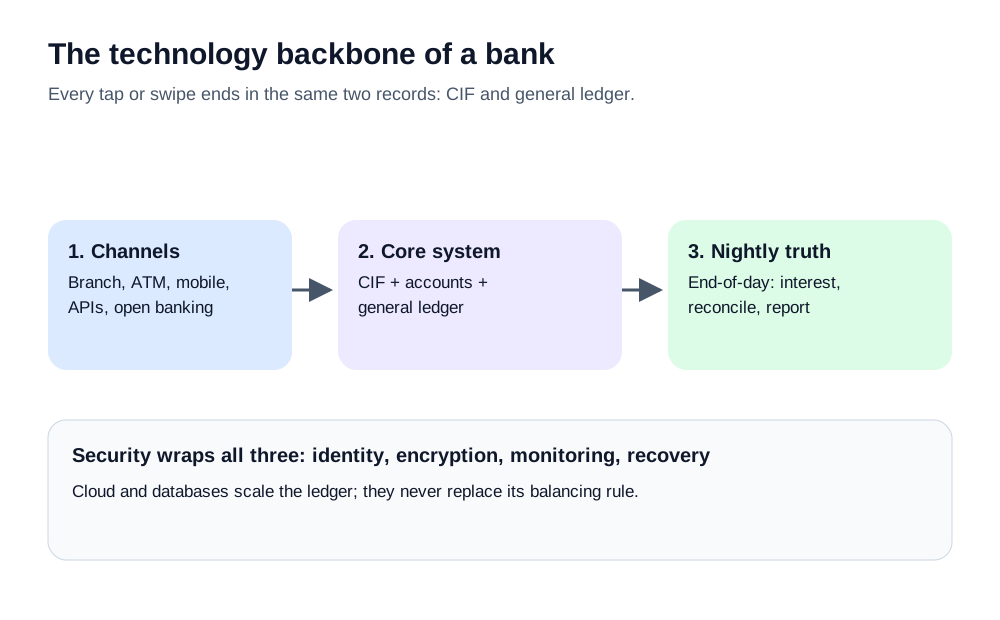
Phase 10 map: channels → core system (CIF + ledger) → nightly truth. Security wraps all three.
<!-- MBA-DEEP-DIVE-START -->Core Banking Systems — From Customer Instruction to Controlled Ledger State
The core is a system of record, not the whole bank
A common beginner picture shows every banking channel talking directly to one giant core banking application. Real institutions are usually more layered. Mobile banking, branch systems, payment hubs, card processors, loan-origination platforms, treasury systems, fraud engines, data platforms and regulatory systems may all sit around the core. Some transactions are authorised elsewhere and only the resulting financial posting reaches the core; others require the core to check account state before an external service can continue. The important idea is therefore not that the core performs every banking function. It is that the core normally owns a critical part of the authoritative customer-account and product state.
This distinction matters when troubleshooting. If a customer sees a transfer as submitted in the mobile app but the beneficiary has not been paid, the failure could be in the channel, payment orchestration, fraud screening, external clearing, settlement, or the account posting itself. Operations should not describe every such problem as a “core issue.” A mature incident model identifies where the instruction is, what business state it has reached, whether money has been reserved or posted, and whether an external obligation has been created.
Customer, account, product and arrangement are different concepts
The customer record answers who the bank is dealing with. The account record answers where balances and transactions are recorded. The product definition describes the commercial and processing rules. An arrangement or contract connects a particular customer to a particular product under agreed terms. These concepts are related but should not be collapsed into one object.
A customer may hold several accounts under one relationship. A joint account may involve several customers. A corporate group may contain a parent, subsidiaries, authorised signatories and beneficial owners. A savings product might exist as one reusable definition while thousands of customers hold individual accounts created from it. A loan contract may begin from a standard product but carry customer-specific pricing, collateral, repayment dates or negotiated covenants.
For business analysts, this separation is fundamental. Requirements such as “change the interest rate” are incomplete until the scope is clear: Is the product rate changing for new accounts only? Is an existing customer contract repriced? Is a benchmark moving while a margin remains fixed? Does the change apply from a value date, a booking date or the next reset date? The core needs explicit rules because accounting cannot rely on human interpretation after the transaction arrives.
The difference between ledger balance and available balance
Customers often speak about “the balance” as though one number exists. Core banking typically manages several balance concepts. The ledger or book balance reflects posted entries. The available balance adjusts that figure for items such as holds, reserved amounts, overdraft availability, uncleared funds or other constraints. A value-dated balance may support interest calculations. Product-specific systems may maintain further balances for principal, accrued interest, fees or past-due amounts.
Consider a customer with a ledger balance of 50,000. A card authorisation places a hold of 8,000, while an approved overdraft provides 20,000 of additional availability. Depending on product rules, the customer may see 42,000 of own funds available, or 62,000 including the overdraft line. If a payment channel validates only the ledger balance and ignores the hold, it can allow money to be committed twice.
This is why balance APIs are not trivial technical endpoints. They embody product and risk logic. The consumer of the API must know what the returned number means, its timestamp, currency, account status and whether it includes pending items or credit facilities.
Holds, reservations and memo postings protect money before final posting
Many banking flows have a stage between “nothing happened” and “final accounting entry posted.” A debit-card purchase may first create an authorisation hold and later be cleared for the final amount. A bank transfer may reserve funds while sanctions, fraud or payment processing completes. A cash-withdrawal request may be authorised before the ATM confirms dispensation.
The core or an adjacent ledger service therefore needs controlled reservation logic. A reservation reduces spendable funds without pretending that final settlement has already happened. It needs an identifier, amount, currency, expiry logic, release mechanism and relationship to the eventual posting. If final processing succeeds, the reservation is consumed or replaced by the booked debit. If the instruction fails, the reservation is released according to policy.
Weak reservation design creates familiar customer complaints: money appears “missing,” duplicate holds remain for days, available balance is wrong, or a reversal restores the book balance but not the available amount. The control objective is not merely technical consistency. It is that every intermediate state has a business meaning and a deterministic route to completion, cancellation or investigation.
Posting engines need explicit debit, credit and accounting rules
A core posting engine converts a business event into financial entries. The event “customer pays loan instalment” may produce several accounting effects: debit the customer's deposit account, credit principal receivable, credit accrued interest, credit fees, and perhaps update tax or suspense accounts depending on the product. The allocation sequence matters because contracts frequently define whether payments satisfy charges, interest or principal first.
Posting rules should be versioned and traceable. If a fee structure changes next month, the bank needs to know which configuration governed a transaction posted today and which configuration will apply to future events. Retrospective investigation becomes difficult when configuration is overwritten without history.
The engine also needs controls around invalid combinations. A posting should not silently send an unknown accounting event to a generic account simply because a mapping is missing. Where suspense is genuinely required, the suspense account should be monitored, reconciled and cleared under defined ownership. “The transaction posted somewhere” is not the same as correct accounting.
Double entry must connect customer books to the general ledger
Customer accounts are often operational subledgers, while the general ledger provides the financial-accounting view used by Finance. The relationship between them must reconcile. If customer deposits total a given amount in the operational system, the corresponding general-ledger liability should agree after defined timing and adjustment differences.
This reconciliation is one of the most important controls in banking technology. A transaction can look correct to a customer yet still be accounted for incorrectly at the enterprise level. Conversely, the general ledger can balance in aggregate while one customer's posting is wrong. Both views are necessary.
Interfaces between subledgers and the general ledger may be real time, near real time or batch, depending on architecture. The timing itself is not a quality measure. What matters is whether the bank has a complete posting model, identifiable source transactions, balanced entries, deterministic retries, exception handling and reconciliation from source event to financial statement account.
Dates are business data, not decorative timestamps
Core banking transactions commonly contain several dates: initiation date, booking date, value date, settlement date, maturity date, interest-accrual date and sometimes an accounting period date. These dates answer different questions. Booking date may tell when the bank recorded the entry. Value date may determine when interest starts or stops. Settlement date may reflect when cash or securities moved externally.
Confusing these dates can create real financial errors. If an incoming credit settles today but receives an incorrect value date of tomorrow, the customer may lose a day's interest. If a back-valued correction is applied without recalculating accruals, the ledger can be numerically balanced yet economically wrong.
Business requirements should therefore state which date drives each calculation. End-of-day routines, holiday calendars, cut-off rules and back-dated adjustments all depend on this. A core platform should also make historical date changes auditable because changing a date can change interest, fees, ageing and regulatory classification.
Interest is a calculation chain, not one percentage
A displayed annual rate is only the start of interest processing. The core may need a benchmark, customer margin, day-count convention, compounding rule, rounding policy, minimum or maximum rate, reset frequency, effective dates and calendar logic. Deposit and lending products may use different conventions, and contractual rules can differ across markets.
For a floating-rate loan, the system may determine the applicable benchmark on a reset date, add the contractual spread, apply any floor, calculate accrual for the relevant days and post interest at the scheduled event. If the benchmark is corrected or published late, the product rules need a defined response. For deposits, tiered balances may receive different rates, promotional periods may expire, or accrued interest may be paid monthly while calculated daily.
Testing should therefore cover more than a “normal month.” Leap years, month ends, rate changes, holidays, early closure, arrears, partial repayments and back-dated transactions can expose defects that simple examples miss.
Fees need the same discipline as interest
Fees can be event-based, periodic, tiered, bundled, waived, capped or conditional. A transfer fee may depend on channel or amount. An account-maintenance fee may be waived if average balance exceeds a threshold. A corporate package may bundle a fixed number of transactions before unit charges apply.
The core or pricing service needs to know both when a fee is assessed and when it is collected. If an account lacks funds, is the fee rejected, accrued, placed into receivable, partly collected, or waived? Different products make different choices. The system also needs tax treatment where applicable and clear narration so customers and operations can explain the charge.
Conduct risk enters here. A technically correct calculation can still be wrong if the configuration does not match the customer contract or if a fee continues after a waiver was approved. Product governance should therefore treat pricing configuration as controlled business logic with approval, effective dating, testing and audit history.
Product factories should separate configuration from uncontrolled customization
A product factory allows reusable product rules to be parameterised rather than hard-coded repeatedly. This can accelerate launches, but flexibility creates a governance problem: if every business unit creates slightly different variants, the bank can accumulate hundreds of products that are expensive to maintain and difficult to explain.
Strong product governance defines which parameters are configurable, which require development, who may approve changes, and how dependencies are tested. A new deposit product might reuse the account engine but specify eligibility, interest tiers, statement frequency, fees, limits and closure rules. Before launch, teams need to test accounting, customer communications, tax, reporting, digital channels, statements, complaints, and downstream data consumers.
A product is therefore not complete when the core accepts its configuration. It is complete when the end-to-end banking operating model can support it. This is a recurring lesson in bank change programmes: product configuration is only one layer of implementation.
End-of-day is a controlled business boundary even in a 24/7 bank
The disappearance of customer-facing downtime does not eliminate business-day concepts. A bank still needs accounting periods, daily accruals, statement boundaries, regulatory snapshots, reconciliation cycles and date-dependent events. Modern architectures increasingly execute these functions without taking the entire bank offline, but the logical business boundary remains.
End-of-day processing may include accruals, scheduled postings, maturity events, revaluations, delinquency ageing, statement generation, accounting extracts and control reports. Some steps are parallel; others depend on previous completion. Failures need restartability. If one task succeeds and the next fails, blindly rerunning the whole chain can duplicate postings.
Operations therefore needs job-level visibility, dependencies, checkpoints and recovery procedures. The important control question is not “did EOD finish?” but “which business obligations for the day completed, which remain outstanding, and has any partial processing changed customer or accounting state?”
Start-of-day is about controlled activation of the next processing context
Start-of-day can load new effective rates, calendars, limits, product parameters and dated instructions. It can also make matured items eligible for action or activate configuration whose effective date has arrived. In globally distributed banks, the idea of one universal start of day may be inappropriate because legal entities, currencies and markets operate in different time zones.
A modern core therefore needs explicit business-date handling rather than assuming server time equals banking date. This becomes important around daylight-saving changes, year end, local holidays and cross-border services. A payment initiated at 23:59 in one market may belong to a different business day in another.
Controls should prevent accidental date advancement and make rollback rules clear. Changing the business date is not the same as changing a display label; it can cause scheduled events, accruals and maturities to execute.
Idempotency prevents duplicate financial effects
Distributed banking systems retry messages because networks fail, timeouts occur and acknowledgements can be lost. A payment hub may send a posting request, receive no response, and legitimately retry. If the core treats the retry as a new instruction, the customer can be debited twice.
Idempotency means the same business request can be received repeatedly without producing repeated financial effects. The design typically uses a stable transaction or request identifier, together with rules defining what counts as the same instruction. The core stores enough state to recognise a retry and return the previous result or continue the existing process.
This is especially important when technical identifiers and business identifiers differ. A new HTTP request ID on a retry should not automatically make the banking instruction new. Analysts need to define identity at the business-event level. Duplicate protection also needs retention rules so a genuinely new transaction months later is not rejected because an identifier was recycled incorrectly.
Reversals and corrections should preserve the audit trail
Financial systems should avoid simply editing history to make an incorrect posting disappear. A controlled reversal creates an offsetting entry tied to the original transaction. If necessary, a corrected entry is then posted. This preserves a chain showing what happened, what was wrong, who corrected it and what the resulting balance became.
Reversal rules must understand the original business event. Reversing a loan payment may need to restore principal, interest, delinquency and fee states, not merely credit cash back to the customer. Reversing an FX transaction can create market-value consequences if rates moved. Reversing a transaction after statement production or accounting close may require additional reporting treatment.
The core should therefore expose a controlled correction capability rather than encouraging database updates. Direct data fixes may sometimes be required under exceptional incident procedures, but they need strict authorization, audit evidence, reconciliation and post-change validation.
Status design needs business meaning
Core systems and connected platforms often accumulate statuses such as RECEIVED, VALIDATED, POSTED, COMPLETED, REVERSED and FAILED. Problems arise when teams use the same word for different stages. “Completed” in the core might mean accounting posted, while “completed” in a payment channel might mean the beneficiary bank has been notified or settlement has occurred.
A robust state model defines what each status proves and what it does not prove. It also defines terminal and non-terminal states, allowed transitions, ownership, and recovery routes. A failed posting before any ledger effect is different from a failure after debit but before external confirmation.
Clear states make customer messaging safer. The channel can say “processing” rather than “paid” when external completion has not yet been established. They also make operations more efficient because queues can be segmented by the actual recovery action required.
Core interfaces need contracts, not informal field mappings
Every interface should define semantics, validation, identifiers, currencies, amounts, dates, error behaviour, retry rules and versioning. A field named balance is not sufficient unless consumers know whether it is ledger, available or cleared balance. An amount is incomplete without currency and decimal rules. An account identifier is incomplete without knowing whether it identifies a customer account, internal ledger account or external account representation.
Versioning becomes important because core changes have a wide blast radius. If an API response adds a new field, consumers may tolerate it. If the meaning of an existing field changes, silent downstream errors can occur. Contract testing and compatibility rules help teams change independently without losing semantic alignment.
For message-based integration, the same principles apply. Kafka or MQ does not remove the need for a business contract. Events need schema ownership, evolution rules, ordering assumptions and replay behaviour.
Security around the core follows least privilege and segregation of duties
The core contains high-value capabilities: create customers, change limits, post money, amend product parameters, reverse transactions and modify access rights. Privileged functions should therefore be tightly restricted. Roles need to reflect job responsibilities, sensitive actions may require maker-checker approval, and privileged access should be monitored and periodically reviewed.
Service accounts also matter. A payment system calling a core posting API should receive only the permissions required for that interface, not broad administrative rights. Credentials need secure storage and rotation. Production support access should be controlled, time-bound where appropriate and logged.
Security controls must also consider fraud by authorised users. Authentication proves who performed an action; it does not prove the action was legitimate. Transaction limits, approval workflows, behavioural monitoring and independent reconciliation provide additional layers.
Resilience means preserving correctness during failure
High availability is not simply keeping a server online. A core must continue or recover without corrupting financial state. Replication, clustering, disaster recovery and failover designs therefore need consistency rules. If two sites believe they are active at the same time without proper coordination, duplicate or conflicting postings can occur.
Recovery objectives should be tied to business impact. Recovery Time Objective addresses how quickly service should resume; Recovery Point Objective addresses how much data loss is tolerable. For committed financial postings, the practical tolerance for lost transactions may be extremely low, so architecture needs durable logs, replication and reconciliation mechanisms appropriate to the service.
Disaster-recovery testing should prove more than infrastructure startup. Banks should validate customer access, posting, interfaces, security, reconciliation and downstream feeds after failover. A technically successful switch that leaves stale balances or broken payment connectivity is not an operationally successful recovery.
Core migration is a data, accounting and customer event
Migrating a core is often described as a technology replacement, but the hardest questions are business questions. Which customers and accounts are in scope? How are dormant, blocked or closed relationships handled? How are accrued interest, unpaid fees, limits, collateral links, standing instructions and historical transactions represented in the target? Which source values are authoritative when legacy systems disagree?
Data migration needs reconciliation at several levels: record counts, customer-to-account relationships, monetary balances, product attributes, accounting totals and sampled transaction histories. A target database can contain every source record and still be wrong if balances map to the wrong accounting semantics.
Cutover design also needs a clear transaction boundary. Teams must know which system owns instructions received before and after the migration point, how in-flight items are treated, and how late external messages are routed. Without this, duplicate or missing transactions can appear even when static data migration is perfect.
Progressive modernization introduces coexistence risk
Many banks cannot replace a large core in one step. They introduce a new platform for selected products or customers while the legacy core continues operating. This reduces cutover concentration but creates a period in which the bank has multiple systems of record for different populations.
Coexistence needs routing rules so every instruction reaches the correct ledger. Customer channels may need an abstraction layer that hides whether an account is legacy or modern. Enterprise reporting must combine data consistently. Transfers between accounts on different cores may require internal clearing and reconciliation rather than a single-database book transfer.
The greatest danger is ambiguous ownership. A customer should not exist in two active ledgers for the same account without a deliberate synchronization model. Every product, account and transaction needs an authoritative system during each migration stage.
Cloud changes infrastructure economics, not accounting fundamentals
Cloud-native deployment can improve elasticity, automation, environment provisioning and managed-service options. It can support smaller independently deployable components and reduce dependence on fixed infrastructure. None of this changes the fundamental banking requirements for controlled posting, durability, auditability, security, reconciliation and resilience.
Architecture decisions should therefore start from business and risk requirements rather than a slogan such as “move the core to cloud.” Data residency, encryption, key management, network design, vendor dependency, operational access, resilience zones, exit strategy and regulatory expectations may all affect the target design. A managed database can reduce patching effort but does not decide the bank's ledger semantics.
The most useful modernization question is often: which capabilities need to change, and which risks must remain invariant? Customer experience and product speed may improve dramatically while accounting integrity, authorization and audit controls remain deliberately conservative.
A practical end-to-end example: salary credit into a current account
Consider a company submitting a salary batch through corporate banking. The channel authenticates the company and authorised users. A payment or file-processing layer validates structure, limits and duplicate identifiers. Fraud and control checks may run. The payment engine determines how individual salary instructions will be processed. For an employee whose account is held within the same bank, the core may receive an internal credit posting; for an external beneficiary, the bank may debit the corporate account and create an obligation for the appropriate external payment route.
Inside the core, the posting engine validates account status, amount, currency, value date and product rules. It records the debit and credit effects, updates available and ledger balances, produces accounting events, and returns an outcome tied to the original business identifier. Downstream services publish notifications, update statements, feed reconciliation and supply data to Finance and reporting systems.
Now imagine one posting times out. The payment engine retries using the same business identity. Idempotency prevents a second debit. If the first request never committed, processing can continue. If it did commit but the acknowledgement was lost, the existing result is returned. This small example captures why core banking is less about screens and more about controlled state transitions.
What “world-class core banking” should mean
A strong core banking platform is not defined by having the newest programming language or the largest feature list. It is defined by whether the bank can trust its records, explain every balance, launch products without losing control, recover from failure without financial corruption, integrate through stable contracts, and evolve without breaking customers or accounting.
For business analysts, architects, developers, testers and operations teams, the core should be understood as a set of business invariants. Money cannot appear or disappear through technical retry. A customer should not spend reserved funds twice. Product rules must be effective-dated and auditable. Subledgers must reconcile to the general ledger. Corrections must preserve history. Access must reflect authority. Every in-flight state needs an owner and a recovery path.
Once those invariants are clear, technology choices become easier to evaluate. The real purpose of core banking is not to centralise software for its own sake. It is to maintain a reliable, controlled and continuously usable representation of the bank's financial obligations to customers and of customers' obligations to the bank.
Core Banking Continuation: Reconciliation, Cutover and Operational Control
Suspense accounts should be temporary by design
Core banking platforms sometimes need suspense or control accounts when a transaction cannot yet be allocated to its final destination. Their existence is not automatically a defect; the risk arises when entries remain unresolved, ownership is unclear or balances grow without explanation.
A good suspense process records the source transaction, reason, age, amount, currency and accountable team. Daily reconciliation should identify new and aged items, with escalation thresholds for material or long-outstanding balances. Clearing the suspense entry must also preserve linkage to the final accounting so an investigator can reconstruct the full path.
The control objective is simple: temporary uncertainty must not become permanent accounting ambiguity.
Cut-off and business-calendar logic belongs in the core operating model
Products often depend on business days, holidays, cut-off times and local calendars. A deposit maturing on a weekend, a loan repayment falling on a holiday or a scheduled transfer created near day end may require specific contractual treatment.
Calendars therefore need governance just like interest rates. Wrong holiday configuration can move thousands of maturity or fee events to the wrong date. Changes should be effective-dated, tested and propagated consistently across core, payments, statements and downstream reporting where those systems depend on the same calendar concept.
Global banks may require different calendars by currency, country, legal entity and product. “Today” is not always one universal business date across the bank.
Operational reconciliation should prove completeness as well as balance
A balanced ledger does not prove every source instruction was processed. Two missing transactions can leave debits and credits equal while customers are still affected. Reconciliation should therefore test both financial totals and transaction completeness.
For a file of one thousand incoming postings, operations may reconcile source count, accepted count, rejected count, total debit, total credit and individual identifiers. Exceptions should be classified according to whether the issue is missing, duplicate, amount mismatch, account mismatch or timing difference.
This becomes especially important around end-of-day and recovery. After a failed batch restarts, the bank needs evidence that previously committed entries were not duplicated and unprocessed instructions were not lost.
Core change should be assessed by financial blast radius
A small configuration change can affect every account of a product. A new rounding rule, fee mapping or interest parameter can create millions of incorrect entries without causing a technical outage. Change governance should therefore consider the financial population and reversibility, not only software complexity.
Testing should include representative accounts, boundary conditions, historical configurations and accounting reconciliation. High-impact changes may need staged activation, parallel calculation or post-release sampling. Monitoring should focus on business outcomes such as unexpected posting volumes, fee totals or reconciliation breaks rather than only CPU and error rates.
The strongest core-banking control mindset asks after every change: can the bank prove that the right financial state was created for the right population, and can it recover safely if the answer is no?
Final Core-Banking Depth: Reference Data Governance
Reference data can change financial behaviour without changing code
Core platforms depend on controlled reference data such as currencies, branch identifiers, account-status codes, calendars, product mappings, fee tables and accounting relationships. Because these values are configurable, teams can underestimate their risk compared with software releases.
A wrong currency exponent, holiday calendar or accounting mapping can affect a large customer population even though no application code changed. Critical reference data should therefore have ownership, approval, effective dating, validation and audit history. High-impact changes may require maker-checker control and post-change reconciliation.
Reference data should also be consistent across connected systems. If the core treats an account status as debit-blocked while a payment channel interprets the same code as fully active, customers can receive contradictory outcomes. Shared semantics, governed mappings and controlled versioning reduce this risk.
The broader lesson is that core integrity depends on configuration as much as programming. Anything capable of changing balances, eligibility, posting or accounting deserves change governance proportional to its financial effect.
<!-- MBA-DEEP-DIVE-END -->