Visual overview
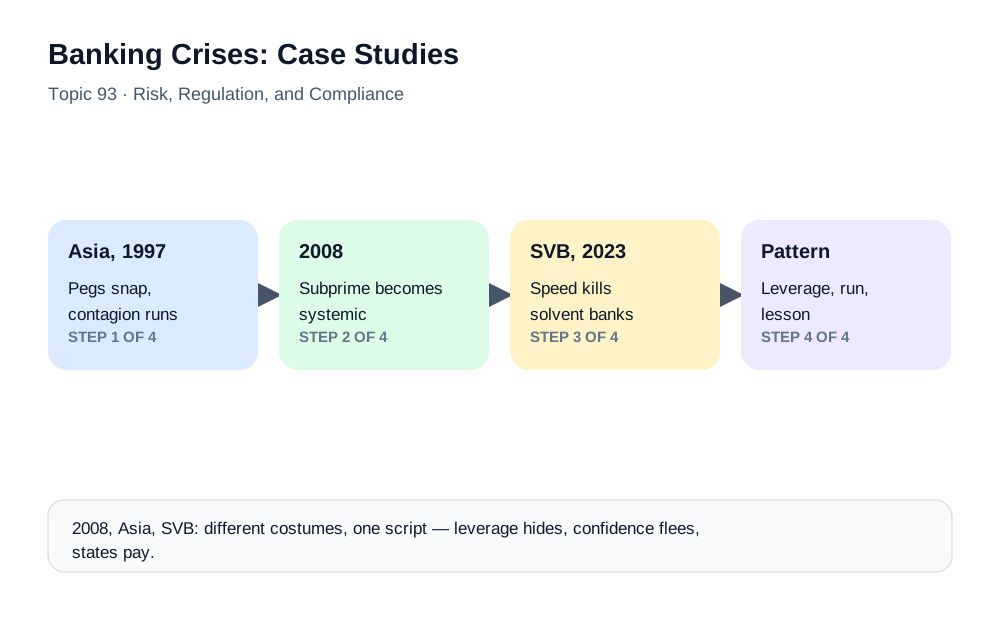
Banking Crises: Case Studies at a glance — 2008 crisis, Asian crisis, SVB 2023, lessons learned.
2008 Global Financial Crisis, Asian Crisis, SVB 2023, and Lessons Learned
Every banking crisis follows a recognizable pattern even as the specific circumstances vary. Periods of economic optimism generate excessive credit expansion and risk-taking. Asset prices inflate beyond sustainable levels supported by borrowed money. A triggering event punctures the optimism and reveals the fragility of the accumulated positions. Panic follows as confidence evaporates, spreading from institution to institution through channels of contagion. The resulting collapse imposes enormous economic and social costs that persist for years. By studying past crises, we recognize not only what went wrong in specific instances but the recurring human and institutional failures that make crises almost inevitable features of financial systems.
The 2008 global financial crisis stands as the most severe financial disruption since the Great Depression, originating in the United States housing market but spreading worldwide to cause lasting damage to economies across the globe. The crisis developed through a chain of interconnected developments that each seemed reasonable in isolation but combined to create catastrophe. The subprime lending boom of 2003 to 2006 extended mortgages to borrowers with poor credit histories who would not have qualified under traditional standards. These mortgages were packaged into mortgage-backed securities and sold to investors seeking yield in a low-rate environment. Investment banks further sliced these securities into collateralized debt obligations, creating tranches with different risk levels and credit ratings. Rating agencies assigned AAA ratings to many of these tranches based on flawed models that underestimated correlation risk and assumed housing prices would never fall nationally. Banks, insurance companies, and pension funds loaded up on these apparently safe assets, holding them on balance sheet or in off-balance-sheet vehicles. When housing prices began falling in 2007, defaults spiked and the value of mortgage-backed securities and collateralized debt obligations collapsed. Lehman Brothers failed in September 2008, triggering a global credit freeze as institutions stopped lending to each other for fear of counterparty default. Stock markets crashed worldwide, destroying trillions in wealth. Governments and central banks responded with extraordinary interventions, including the United States Troubled Asset Relief Program and large-scale liquidity, guarantee, recapitalisation, and asset-support measures across multiple jurisdictions. The form, committed amount, and eventual fiscal cost of these interventions differed materially, so headline totals should not be treated as directly comparable.
The key failures that enabled this crisis spanned multiple actors and systems. Predatory lending by mortgage originators extended credit to borrowers who could not afford the loans they received. Faulty risk models at banks and rating agencies underestimated the probability of simultaneous defaults across regions and borrower types. Banks held insufficient capital for the risks they were taking, particularly in off-balance-sheet vehicles that escaped regulatory attention. Regulatory gaps allowed the shadow banking system to operate without the constraints applied to traditional banks. Perverse incentives throughout the originate-to-distribute model meant that parties who created loans bore no risk if those loans subsequently failed. The aftermath included a severe recession, major bank failures and restructurings, large employment losses, and far-reaching regulatory reforms. Those reforms included stronger capital and liquidity standards under Basel III and, in the United States, measures under the Dodd-Frank Act covering areas such as enhanced prudential standards, stress testing, and resolution planning.
The Asian financial crisis of 1997 and 1998 demonstrated how rapidly distress can spread across borders when common vulnerabilities exist. Thailand devalued the baht on July 2, 1997, after exhausting foreign exchange reserves attempting to defend its currency peg against speculative attack. The crisis spread rapidly across the region. Indonesia saw the rupiah lose eighty percent of its value, contributing to the fall of the Suharto regime. South Korea required a fifty-seven billion dollar International Monetary Fund bailout as the won collapsed and major conglomerates failed. Malaysia imposed controversial capital controls that restricted currency outflows but proved effective in stabilizing the situation. The Philippines experienced currency and banking stress requiring international assistance.
The root causes of the Asian crisis reflected structural vulnerabilities that had developed during the preceding boom years. Fixed exchange rates pegged to the United States dollar created an illusion of stability and encouraged excessive foreign borrowing in dollars that became unmanageable when local currencies fell. Short-term foreign borrowing by banks and corporations created maturity and currency mismatches, as dollar debt funded local currency assets. Crony capitalism directed lending based on political connections rather than creditworthiness, resulting in inefficient investments that could not generate returns to service debt. Weak regulation and supervision failed to identify or constrain the buildup of these risks. Capital flow reversals occurred suddenly when international investors lost confidence, withdrawing funds faster than economies could adjust.
The collapse of Silicon Valley Bank in March 2023 provided a stunning demonstration of how quickly modern digital banking crises can unfold. The timeline compressed events that historically took weeks into mere hours. During 2020 and 2021, SVB tripled deposits from technology companies and venture capital firms, growing from sixty-two billion to one hundred eighty-nine billion dollars. The bank invested these deposits in long-duration Treasury bonds and mortgage-backed securities, seeking yield in a low-rate environment without adequately hedging the resulting interest rate risk. As the Federal Reserve tightened monetary policy sharply during 2022 and early 2023, higher market yields reduced the market value of SVB's long-duration fixed-rate securities. The accounting and capital effect depended on the classification of those securities, while the economic interest-rate exposure remained relevant regardless of classification. On March 8, 2023, SVB announced a one point eight billion dollar loss from selling bonds to meet withdrawal requests. On March 9, deposit outflows exceeded forty billion dollars in a single day. The speed of electronic banking and rapid communication among commercially connected depositors contributed to an unusually fast loss of funding confidence. On March 10, the Federal Deposit Insurance Corporation seized SVB, marking the second-largest United States bank failure in history.
SVB's failure featured several unique factors that distinguished it from earlier crises. The concentrated deposit base meant that eighty-eight percent of deposits exceeded the insurance limit, creating greater panic potential than at banks with more diversified funding. Interest rate blindness reflected a failure to hedge the massive duration risk in the bond portfolio, an elementary risk management error. Social media accelerated the bank run, with venture capital firms and technology executives coordinating withdrawal decisions in real-time through platforms like Twitter and WhatsApp. Regulatory failure played a role as Federal Reserve supervisors had identified issues but failed to force corrective action before the crisis. Contagion immediately threatened, with Signature Bank and First Republic failing in subsequent weeks as depositors fled regional banks for perceived safety at systemically important institutions.
India experienced its own banking stress from 2015 to 2020, driven by an infrastructure lending boom that turned sour and left the banking system with massive non-performing assets. Infrastructure project lending expanded rapidly in the early 2010s, often to projects with weak viability assessments and aggressive assumptions. When projects stalled due to land acquisition problems, environmental clearance delays, or demand shortfalls, loans turned non-performing. At the peak of the cycle, gross non-performing assets across the Indian banking system reached historically high levels, putting severe pressure on profitability, capital, and lending capacity at a number of institutions. The Insolvency and Bankruptcy Code enacted in 2016 provided a framework for resolution, though implementation proceeded gradually. The broader period of financial-sector stress also included distinct failures, resolutions, or rescues involving institutions such as Yes Bank, IL&FS, Dewan Housing Finance, and Punjab and Maharashtra Cooperative Bank. These cases involved different legal structures and immediate causes and should not be treated as one homogeneous NPA event.
The European sovereign debt crisis of 2010 to 2012 illustrated the dangerous feedback loop between weak banks and weak governments. European banks held substantial portfolios of government bonds from Greece, Italy, Spain, and Portugal, treating them as risk-free assets under regulatory frameworks. When sovereign creditworthiness came into question, the value of these bond holdings fell, weakening bank capital positions. Simultaneously, governments faced pressure to support their banking systems, increasing sovereign debt burdens and further undermining creditworthiness. European Central Bank President Mario Draghi's July 2012 commitment to do 'whatever it takes' to preserve the euro, followed by the announcement of the Outright Monetary Transactions framework, helped restore market confidence. OMT was designed as a conditional sovereign-bond purchase backstop and was not ultimately activated.
Across all these diverse crises, common patterns emerge with disturbing regularity. Excessive credit growth precedes many major banking crises, as optimism can fuel lending that outpaces sustainable economic expansion. Asset price bubbles develop in housing, infrastructure, or other sectors, with borrowed money pushing prices beyond fundamental values. Concentration risk accumulates as banks concentrate exposure in particular sectors, regions, or funding sources that appear attractive during the boom. Weaknesses in regulation, supervision, governance, or the timely escalation of known risks appear in many major crises, although the balance of responsibility differs by case. Herd behavior drives market participants to follow the crowd into popular strategies until the crowded trades inevitably fail. Moral hazard encourages risk-taking as market participants assume they will be bailed out if things go wrong. The speed of contagion accelerates with each crisis as financial integration and now digital communication compress the timeline from initial distress to systemic panic.
The lessons learned from this history have driven substantial reforms. Banks need more and better quality capital, leading to the dramatic increases in capital requirements under Basel III. Banks need liquidity buffers to survive funding disruptions, leading to introduction of the Liquidity Coverage Ratio and Net Stable Funding Ratio. Too-big-to-fail institutions require special resolution frameworks, leading to living wills requirements and dedicated resolution regimes. Risk models fail in crises, leading to mandatory stress testing and constraints on model-based capital calculations. The experience reinforced the importance of early supervisory intervention and credible corrective-action frameworks that can escalate requirements before a bank reaches insolvency. Social media accelerates crises, requiring faster emergency response capabilities and contingency planning for digital bank runs.
Banking crises are neither random accidents nor inevitable disasters. They are the predictable result of patterns that recur because human nature and institutional incentives do not change. The challenge for banking professionals, regulators, and policymakers is to maintain vigilance during the good times when risks accumulate invisibly, to act decisively when warning signs appear, and to build resilient systems that can absorb the shocks that will inevitably come. History provides the curriculum. Whether we learn from it remains our choice.
<!-- MBA-DEEP-DIVE-START -->Banking Crises: Case Studies — A Practical Risk, Operations and Control Deep Dive
A crisis is usually a chain, not a single bad event
A useful way to study banking crises is to stop looking for one dramatic cause. Bank failures normally emerge from a chain in which a business model creates exposure, management underestimates the exposure, market conditions move against the bank, funding confidence deteriorates, and the institution discovers that assets cannot be converted into cash quickly enough without crystallising losses. The order matters. A bank can be economically solvent on a long-term view and still fail if it cannot meet withdrawals today. It can also be liquid today but fundamentally insolvent if the value of its assets is persistently below the value of its liabilities.
For a banking professional, the practical lesson is to separate credit risk, market risk, interest-rate risk, liquidity risk, concentration risk and operational risk while still understanding how they interact. A concentrated deposit base may be a funding issue; a long-duration securities portfolio is an interest-rate issue; unrealised losses affect capital confidence; social media can accelerate withdrawals; and weak governance can allow all of these conditions to persist. The crisis is the interaction, not merely one line item on a risk report.
2008 began long before Lehman Brothers failed
The global financial crisis did not begin on the day Lehman Brothers filed for bankruptcy. The preceding years saw strong mortgage origination, securitisation, leverage, reliance on short-term wholesale funding and widespread confidence that diversified pools of mortgage assets were less risky than the underlying loans appeared individually. The originate-to-distribute model also weakened the traditional connection between the lender that assessed the borrower and the investor that ultimately carried the credit risk.
Once US house prices weakened and mortgage delinquencies rose, uncertainty spread beyond the loans themselves. Investors no longer knew how much structured mortgage exposure was held by each institution, what those assets were worth, or which counterparties might fail. That information problem is critical. Interbank and wholesale markets depend on confidence that the next institution can meet its obligations. When confidence disappears, institutions conserve liquidity, haircuts rise, collateral becomes harder to finance and normal market-making capacity contracts.
For operations teams, this is a reminder that a crisis is not only a market-price event. Treasury, collateral management, confirmations, settlement, margining, payments, reconciliations and intraday liquidity all become more difficult at the same time. The bank may still be processing millions of routine customer transactions while senior management is simultaneously deciding which assets to pledge, which funding lines to draw and which counterparties to reduce.
Securitisation itself was not the problem; incentive and risk understanding were
Securitisation can be a legitimate financing technique. It can transfer risk, diversify funding and connect borrowers with a broader investor base. The 2008 experience showed what happens when underwriting standards deteriorate, structures become opaque, model assumptions are treated as facts and the parties creating loans do not retain enough economic incentive to care about long-term loan performance.
A practical credit-control framework therefore asks who originates the exposure, who validates income and collateral, who approves exceptions, who ultimately owns the risk, and whether compensation encourages volume without sufficient regard to quality. It also asks whether senior management can understand the products being held. Complexity is not automatically dangerous, but a bank is vulnerable when a product is too complex for the people approving its risk limits to challenge the assumptions underneath it.
The same logic applies outside mortgages. A rapidly growing portfolio of leveraged loans, commercial real estate, unsecured consumer credit or structured trade assets can create similar problems if growth outruns underwriting discipline.
Liquidity transformation is normal banking, but it must be survivable
Banks transform maturities. Depositors often expect money to be available on demand, while bank assets such as mortgages, corporate loans and long-dated securities mature over years. This mismatch is part of banking's economic function. The danger arises when a bank assumes that stable funding will always remain stable or that assets can always be sold at book value.
Liquidity risk management therefore has two separate questions. First, how much cash could leave under stress? Second, how much reliable liquidity can the bank generate within the required time? The second question must consider the real marketability of securities, central-bank eligibility, collateral haircuts, legal-entity restrictions, operational readiness and the time needed to mobilise collateral. An asset that is theoretically liquid but operationally unavailable is not useful during the first hours of a run.
A strong contingency funding plan is therefore executable, not aspirational. Named people know who can authorise emergency borrowing, Treasury knows which assets are unencumbered, collateral data are accurate, payment teams understand intraday priorities, and communication lines with supervisors and market infrastructures are tested.
The Asian crisis shows how currency and maturity mismatches become banking problems
The 1997 Asian financial crisis was not simply a story of exchange rates. Many firms and financial institutions had borrowed in foreign currency, often at short maturities, while earning revenues or holding assets in domestic currency. When capital flows reversed and currencies depreciated, the domestic-currency cost of servicing foreign-currency debt rose sharply. A borrower that looked viable at the earlier exchange rate could become distressed almost immediately.
This is a classic asset-liability-management problem. The bank must understand not only its own direct foreign-exchange position but the currency risk embedded in customers. A corporate borrower may appear to have no problem servicing a US-dollar loan while its local currency is stable. If the borrower has no dollar revenues or hedges, the bank is indirectly exposed to the exchange rate through credit risk.
The Asian experience also demonstrates the danger of short-term external funding used to finance longer-term domestic assets. When lenders refuse to roll the short-term debt, institutions must find foreign currency quickly, often at exactly the moment market liquidity disappears. Modern liquidity stress tests therefore need scenarios that combine market closure, currency depreciation, collateral calls and deposit or wholesale outflows rather than testing each shock independently.
A fixed or managed exchange rate can change behaviour before the crisis
When market participants believe an exchange rate will remain stable, they may stop hedging because hedging appears unnecessary and expensive. That behaviour can make the eventual adjustment more damaging. This is an important risk-governance lesson: a long period of stability can create more vulnerability, not less, if it causes institutions to remove protection.
Risk committees should therefore distinguish historical volatility from potential loss. A currency that has barely moved for several years can still represent a large tail risk when policy arrangements change. The same principle applies to interest rates. Years of low rates can create portfolios that appear safe precisely because the stress has not occurred recently.
Silicon Valley Bank demonstrates the interaction of duration, concentration and speed
Silicon Valley Bank failed in March 2023 after rapid growth had left it with a concentrated funding base and substantial exposure to rising interest rates through securities. The Federal Reserve's post-failure review identified weaknesses in governance and risk management, liquidity risk management, and interest-rate risk and investment portfolio management. The report also described deposit outflows of more than forty billion dollars on March 9, with management expecting much larger additional outflows the next day.
The case is particularly useful because it shows why accounting classification cannot replace economic risk management. Securities carried at amortised cost may not recognise day-to-day market-value changes in regulatory or accounting measures in the same way as trading assets, depending on the applicable framework. But if the bank must sell those assets to meet withdrawals, the market value suddenly matters. The liquidity event converts an unrealised economic loss into a realised one.
The case also illustrates concentration risk. A deposit base dominated by commercially connected customers can behave differently from a broad retail base. If many depositors receive the same advice from the same investors, belong to the same industry and use digital channels that allow rapid transfers, their behaviour can become highly correlated.
Digital banking changes the speed assumption in liquidity stress
Traditional liquidity models often used runoff assumptions derived from historical periods when customers needed to visit branches, call relationship managers or wait for payment cut-offs. Modern customers can move large balances through online and mobile channels quickly. Corporate treasury systems and APIs can automate movement even further.
This does not mean that every digital bank is unstable. It means that behavioural assumptions need evidence and frequent review. Banks should segment deposits by customer type, insurance coverage where relevant, operational relationship, concentration, rate sensitivity and ease of movement. A payroll operating account used every day by a business may behave differently from a large non-operational deposit placed mainly for yield.
Operations and technology teams should be part of this analysis because channel design affects withdrawal speed. Transaction limits, approval workflows, cut-off times, fraud controls and payment-system availability can influence how quickly funding can leave, although these controls must never be misused as an artificial substitute for genuine liquidity strength.
Interest-rate risk belongs on both sides of the balance sheet
The SVB case is often simplified into a statement that bond prices fall when rates rise. That is true, but incomplete. A bank's interest-rate risk depends on assets, liabilities, optionality, customer behaviour, hedges and accounting treatment. Depositors can reprice or leave. Borrowers may prepay fixed-rate loans. Securities change value. Derivatives can offset or introduce exposure. The result must be assessed across multiple scenarios.
Net interest income sensitivity asks how earnings change as rates move over a shorter horizon. Economic value measures examine how the present value of future cash flows changes over a longer horizon. A bank can look acceptable on one measure and weak on another. Governance therefore needs limits for both earnings and economic-value perspectives, supported by assumptions that are independently challenged.
The control lesson is simple: a Treasury or ALM report should not merely display numbers. It should explain which assumptions drive the numbers, how reliable the hedge is, what happens if deposits reprice faster than expected, and what management action is actually possible under stress.
Credit Suisse shows that confidence can fail even without a classic deposit-only story
The emergency takeover of Credit Suisse by UBS in March 2023 followed years of losses, control failures, litigation and reputational damage. The immediate liquidity pressure occurred in a global environment already sensitised by US regional-bank failures. The case demonstrates that confidence is cumulative. A bank can survive individual incidents yet gradually consume the trust of clients, counterparties, employees and investors.
For risk professionals, reputational risk should therefore not be treated as a vague public-relations category. Repeated control failures can affect funding costs, client retention, collateral terms, staff turnover and the willingness of counterparties to maintain exposures. These channels eventually become measurable financial risks.
A practical early-warning framework should connect complaints, operational incidents, legal events, control breaches, rating changes, deposit behaviour, market spreads and relationship-manager feedback. No single signal proves that a crisis is coming, but the pattern can show deteriorating confidence before headline liquidity ratios fail.
The European sovereign-debt crisis demonstrates the bank-sovereign feedback loop
During the euro-area sovereign-debt crisis, concerns about government creditworthiness weakened banks holding significant sovereign exposures, while governments themselves faced pressure to support domestic banking systems. This created a feedback loop in which concern about the sovereign affected banks and concern about banks affected the sovereign.
The operational lesson is that assets regarded as highly liquid or low risk under normal frameworks can behave differently in a crisis. Risk managers should understand concentration by sovereign, legal entity and currency, and should not assume that a regulatory risk weight by itself describes market liquidity or mark-to-market volatility.
The European Central Bank's 2012 commitment to preserve the euro, together with the announced Outright Monetary Transactions framework, was important in restoring confidence. The distinction matters: the credibility of a backstop can influence markets even when a particular programme is not actually used.
India's asset-quality cycle shows how delayed recognition can prolong weakness
India's banking-system stress during the 2010s was strongly associated with corporate and infrastructure lending, stalled projects and delayed recognition of problem assets. The lesson is broader than any one jurisdiction: restructuring a weak exposure does not make the underlying borrower stronger if cash flow has not improved.
Supervisory asset-quality reviews, stronger recognition of non-performing assets and formal insolvency mechanisms can force losses into the open. This is painful in the short term because provisions rise and capital is consumed, but delayed recognition can produce a banking system that appears healthier than it really is and continues allocating capital poorly.
For a bank, the control framework must separate genuine borrower rehabilitation from evergreening. Credit committees need reliable cash-flow information, realistic collateral valuations and transparent treatment of concessions. Collections, restructuring and legal teams should share one view of the borrower's position so that different systems do not report contradictory delinquency or exposure status.
A crisis exposes data weaknesses immediately
Senior management cannot manage a crisis if it cannot answer basic questions quickly. How much money has left today? Which depositors are driving the outflow? What unencumbered collateral is available? Which securities can be sold or pledged? Which legal entity owns them? How much cash is required by payment systems before the next settlement cycle? Which counterparties can demand additional margin?
These questions cut across core banking, Treasury, securities systems, general ledger, risk warehouses, customer master data and payment platforms. If the bank needs several days to reconcile them, the crisis may move faster than the reporting process.
Crisis readiness therefore requires pre-built data products with clear ownership and reconciliation. The figures used by Treasury, Finance, Risk and senior management must tie back to authoritative records. Manual spreadsheets may still be necessary for scenario work, but critical data lineage and definitions should be agreed before stress begins.
Intraday liquidity can fail before the daily liquidity ratio does
A bank can satisfy a daily or monthly liquidity metric and still encounter intraday stress. Payment and securities systems require funding at particular times. Large customer payments, margin calls, securities settlement and central-counterparty obligations can create peaks that are invisible in end-of-day balances.
Treasury and payment operations therefore need visibility into expected inflows and outflows during the day. They should know which receipts are genuinely reliable, what collateral can be mobilised, and which payments are time-critical. Delaying a payment to conserve liquidity can create operational, legal and reputational consequences, so escalation rules should be defined in advance.
This is particularly important for banks active in multiple currencies and time zones. Liquidity may be trapped in one entity or currency while another part of the group faces an immediate obligation. Transferability assumptions must reflect legal, regulatory and operational constraints rather than treating group cash as one unrestricted pool.
Collateral management becomes a survival function during stress
In normal conditions, collateral optimisation can look like a Treasury efficiency exercise. During crisis, it becomes a survival function. The bank must identify assets, confirm ownership, know whether they are already encumbered, understand eligibility at central banks or counterparties, apply the correct haircut and physically deliver or pledge them through the required settlement infrastructure.
Errors in security identifiers, legal agreements or settlement instructions can make high-quality assets unusable when they are needed most. This is why crisis preparedness includes operational testing of collateral mobilisation, not simply a list of eligible assets.
A mature bank also monitors concentration in secured funding. If many institutions depend on the same collateral market at once, haircuts may rise and market capacity may shrink. Stress assumptions should therefore consider both idiosyncratic and market-wide shocks.
Deposit insurance reduces panic but does not eliminate liquidity risk
Deposit-insurance schemes are designed to protect eligible depositors within defined limits and support confidence in the banking system. Their design differs by jurisdiction. Banks should not assume that insurance means insured deposits can never move; customers may still transfer money because of uncertainty, convenience or misunderstanding.
The more important management question is the composition of funding. Large uninsured or otherwise less-sticky balances, concentrated commercial deposits, brokered funding and price-sensitive deposits may behave differently under stress. The bank should know its actual depositor structure rather than rely on a single average runoff rate.
Communication also matters. Customers need clear, accurate information. Statements about deposit protection must match the relevant scheme and legal entity. Overpromising can create legal and conduct risk; vague communication can intensify fear.
Resolution planning changes the objective from saving the firm to protecting critical functions
Not every failing bank should be kept alive. Modern resolution frameworks seek to preserve financial stability and critical services while allocating losses according to the legal framework. This requires planning before failure. Authorities and banks need to understand legal entities, critical operations, shared services, funding dependencies, contracts and the operational steps required to transfer or continue essential functions.
For the bank, resolution planning exposes architectural problems that ordinary business planning can miss. If a critical payment service depends on a shared technology platform with no clean contractual separation, transferring one legal entity may be difficult. If customer and transaction data cannot be extracted reliably, a transfer may be delayed.
Resolution readiness therefore connects law, Finance, Risk, Operations, Technology and data governance. It is not merely a document produced for supervisors.
Stress testing should break the business model, not reassure management
A weak stress test selects scenarios that the bank can comfortably survive. A strong stress test asks what combination of events would make the business model fail. It may combine rising rates, deposit outflows, collateral haircuts, credit downgrades, market closure and operational disruption.
The purpose is not to predict the exact next crisis. The purpose is to understand sensitivity and management options. If the scenario shows that survival depends on selling assets that would become illiquid under the same scenario, the assumed management action is not credible.
Reverse stress testing is especially valuable. It starts with failure or breach of risk appetite and works backward to identify the conditions that could cause it. This helps boards understand where multiple moderate risks can combine into a severe outcome.
Early-warning indicators need thresholds and decision rights
Banks monitor many indicators: deposit outflows, wholesale funding spreads, collateral usage, market prices, credit-default-swap spreads, rating actions, customer concentration, payment behaviour, liquidity buffers and intraday positions. Monitoring alone is not control.
Each important indicator should have thresholds, escalation routes and named decision rights. Management should know what action follows an amber signal and what action follows a red one. Otherwise dashboards become descriptive rather than preventive.
The thresholds should also be reviewed after market change. A withdrawal amount that was material when the bank had fifty billion in deposits may be less meaningful after growth to two hundred billion, while percentage-based triggers may miss concentration in a few major clients.
Communications can affect the balance sheet
During a crisis, communications are financially material. A poorly worded capital-raising announcement can be interpreted as evidence of hidden losses. Inconsistent messages from executives, relationship managers and call centres can accelerate withdrawals. Silence can allow rumours to dominate.
A crisis communication plan should therefore coordinate senior management, Legal, Compliance, Investor Relations, customer service and regulators. Messages need to be factual and consistent with disclosure obligations. Front-line staff should know what they are authorised to say and where to escalate questions.
Internal communication is equally important. Employees may be depositors and social-media users. If they learn about the crisis from public news before receiving internal guidance, confusion can spread quickly.
Crisis management requires a single operating picture
Banks often have separate crisis teams for liquidity, cyber incidents, business continuity and communications. A financial crisis can involve all of them. For example, heavy digital withdrawals may overload channels, creating a technology incident at the same time liquidity is deteriorating. Fraud attempts may increase because criminals exploit customer fear. Call centres can become congested. Payment queues can grow.
The crisis-management structure needs one operating picture that connects financial and operational facts. Senior decision-makers should see funding, collateral, customer behaviour, channel capacity, fraud alerts, settlement obligations and public communications together.
Roles should be rehearsed through simulation. A plan that has never been exercised is an assumption. Exercises reveal practical problems such as missing phone numbers, unavailable decision-makers, inconsistent data and unclear authority.
The board's role is challenge, not operational micromanagement
Boards are not expected to run Treasury hour by hour, but they are responsible for ensuring that the business model's major risks are understood and governed. They should challenge rapid growth, concentrated funding, large interest-rate exposures, weak risk infrastructure and repeated supervisory findings.
A strong board asks whether growth is supported by control capacity. If assets double, have risk staff, systems, liquidity resources and governance matured accordingly? If a strategy depends on deposit stability, what evidence supports that assumption? If management says a risk is hedged, how effective is the hedge under stress?
The board also needs information that is concise enough to understand but detailed enough to challenge. Oversimplified green dashboards can hide the very concentrations that matter.
Regulatory reform after crises should be understood by purpose
Post-crisis rules are easier to understand when linked to the failure they address. Higher-quality capital increases the bank's capacity to absorb losses. Liquidity requirements require buffers and more stable funding structures. Stress testing challenges resilience under adverse scenarios. Recovery and resolution planning prepares for severe distress and orderly failure. Margin and clearing reforms address counterparty and derivatives exposures. Stronger governance expectations seek to ensure that risk management keeps pace with complexity.
A banking professional should avoid treating these as unrelated compliance exercises. They are different responses to the same fundamental problem: banks are highly leveraged institutions whose failure can disrupt customers, markets and the broader economy.
This purpose-based view also helps when regulations evolve. The exact ratio, template or jurisdictional rule may change, but the underlying control objective remains understandable.
A practical crisis case study should end with control questions
When reviewing any bank failure, ask the same disciplined questions. What was the business model? How did the bank make money? What balance-sheet concentrations did that model create? What assumptions did management make about customer behaviour, markets and funding? Which risk indicators deteriorated first? Were those indicators visible? Who had authority to act? Why was action delayed? Which operational dependencies became critical when stress accelerated?
Then ask what would have prevented failure or reduced impact. More capital may help, but capital alone does not solve a same-day liquidity run. More liquidity may help, but it cannot repair a fundamentally unprofitable business model. Better hedging may reduce rate sensitivity, but not customer concentration. Better governance may identify all three earlier.
The best lesson from crises is therefore not a slogan such as “hold more liquidity” or “avoid long-duration bonds.” It is to understand the interaction between strategy, balance sheet, customer behaviour, market conditions, operational capability and decision-making.
Final perspective: resilience is built during calm periods
The most difficult time to strengthen a bank is after confidence has already broken. Once customers are leaving, markets are repricing the institution and counterparties are protecting themselves, management options narrow quickly.
Resilience is built earlier through disciplined underwriting, diversified funding, realistic interest-rate and liquidity assumptions, high-quality data, tested contingency plans, credible collateral mobilisation, strong governance and a culture that escalates uncomfortable information. These controls can appear conservative during profitable periods because they impose cost and constrain growth. Their value becomes visible only when conditions reverse.
That is the recurring lesson across 1997, 2008, the euro-area stress period, India's asset-quality cycle and the bank failures of 2023: the institutions most exposed are often those that treated a favourable environment as a permanent condition. Banking risk management exists to challenge that assumption before the market does.
Market value, book value and liquidity value answer different questions
Crisis analysis becomes confused when people treat one valuation concept as universally correct. A loan or security can have an accounting carrying value, a fair or market value, a collateral value after haircut, and a stressed liquidation value. Each serves a different purpose. A bank may be able to hold an asset to maturity and collect contractual cash flows, yet still face a liquidity problem if customers demand cash before maturity. Conversely, an asset may be easy to sell but only at a price that creates a capital loss the bank cannot comfortably absorb.
Treasury, Finance and Risk therefore need reconciled views rather than competing numbers. Finance explains accounting classification and recognised gains or losses. Market Risk measures economic sensitivity. Liquidity Risk asks what cash can be generated and when. Collateral teams identify the value that central banks or market counterparties will lend against. Senior management needs to understand all of these perspectives before selecting a management action.
This distinction is especially important in rising-rate environments. Long-duration fixed-rate assets can continue paying exactly as contracted while their market value falls. If funding remains stable, the bank may have time. If funding runs, time disappears. The risk is therefore not “a bond loss” in isolation but the interaction between valuation and funding.
Recovery planning should contain options that are executable under stress
A recovery plan usually lists actions such as raising capital, selling assets, securitising portfolios, reducing lending, drawing committed lines, issuing secured funding, selling a business or changing deposit pricing. The quality of the plan depends on whether those options remain available in the scenario that caused the stress.
For example, selling a loan portfolio may be possible in normal markets but slow during a systemic crisis. Raising equity may take too long during a same-day deposit run. Increasing deposit rates can slow outflows but can also compress margins and attract highly price-sensitive funding. Drawing a credit line may provide liquidity, but only if the lender remains willing and the legal documentation has not been breached by the same deterioration affecting the bank.
Banks should therefore estimate time to execute, operational dependencies, financial effect, side effects and mutual exclusivity between recovery options. The plan should also identify who can approve each action and which supervisor or market infrastructure must be informed.
Customer segmentation matters more than the average deposit number
A bank with one hundred billion of deposits does not have one homogeneous funding source. Retail salary accounts, small-business operating accounts, public-sector balances, corporate liquidity, trust accounts, venture-backed company deposits and wealth-management cash can behave differently. Some customers maintain balances because they use the bank's broader services; others move money rapidly when another institution offers a better rate.
Liquidity analysis should therefore connect deposit accounts to customer relationships and behaviour. Historical runoff during benign periods is not enough. The bank should know concentration by depositor, industry, geography and relationship type, and should model what happens when commercially connected customers act together.
This is a data-quality problem as much as a Treasury problem. If customer master data do not correctly link related entities, a bank can underestimate concentration. If operational and non-operational deposits are poorly classified, stress assumptions can be misleading. Accurate segmentation allows management to understand which funding is genuinely relationship-based and which is opportunistic.
Contagion does not require identical balance sheets
Banks can suffer outflows because customers compare them with a failing peer even when the balance sheets are different. Depositors and investors often use simple observable characteristics such as size, geography, sector focus or proportion of uninsured deposits as proxies for risk. Market participants may sell first and analyse later.
This means peer monitoring belongs in crisis surveillance. A bank should identify which external institutions customers, analysts and media are likely to consider comparable. If a peer fails, management can immediately assess differences and similarities, prepare communication, update liquidity scenarios and increase monitoring.
Contagion can also arrive through counterparties rather than depositors. A clearing broker may reduce limits, a correspondent may request more collateral, or a money-market investor may decline to roll funding. These actions can reinforce each other even when the bank's underlying credit quality has not changed materially.
Payment continuity is part of financial-stability protection
Customers experience a bank crisis through practical questions: can salaries be paid, cards work, direct debits settle, ATMs dispense cash and businesses access operating funds? The preservation of these services can matter more to the real economy than the survival of the bank's shareholders.
For this reason, crisis planning should map critical payment and deposit services to the systems, staff, accounts and infrastructures required to keep them running. If an institution enters resolution or is transferred to another bank, operational continuity depends on data, connectivity, settlement accounts, fraud controls and customer support continuing through the transition.
A payment operations team may need to work under unusual funding constraints while still meeting scheme deadlines and customer obligations. Clear prioritisation and communication with settlement functions are essential. Financial resilience and operational resilience therefore meet at the point where a customer expects money to move.
What a banking analyst should capture from every future crisis
A disciplined case-study template prevents hindsight bias. Record the institution's business model and growth path first. Then map assets by credit quality, duration, liquidity and concentration; liabilities by depositor or funding type, maturity and behavioural stability; and capital by quality and loss-absorbing capacity. Add governance findings, supervisory history, market signals and operational dependencies.
Next, build the timeline using dated events rather than narrative compression. Identify the first public signal, the first material outflow, management actions, market reaction, regulatory intervention and final resolution. This helps distinguish causes from consequences. A capital raise announced after confidence has fallen, for example, may accelerate a run without being the original cause of weakness.
Finally, document counterfactual controls. Ask which action six months earlier, one month earlier, one week earlier and one day earlier could realistically have changed the outcome. This is more useful than simply naming the control that failed because it shows when management still had room to act.
Reading a crisis through the balance sheet, funding profile and operating model
A banking crisis becomes easier to understand when the institution is viewed through three connected lenses rather than through headlines alone. The first lens is the balance sheet: what assets does the bank own, how uncertain are their values, how long will they take to mature, and how sensitive are they to credit spreads, interest rates or exchange rates? The second is funding: who has provided the money, how concentrated are those providers, how quickly can they withdraw, and what alternative funding sources exist if confidence weakens? The third is the operating model: can Treasury, Risk, Finance, Payments, Collateral, Legal, Communications and Technology obtain one reliable view of the situation and act before the market moves again?
This three-lens approach prevents a common analytical mistake. A bank may have high-quality assets but still face a liquidity crisis if those assets cannot be monetised quickly enough. It may have a large liquidity buffer but still face solvency pressure if credit losses are severe and persistent. It may appear adequately capitalised on reported measures yet lose market confidence because investors believe losses are understated or funding assumptions are unrealistic. Crisis analysis therefore needs to connect accounting values, economic values, cash timing and confidence rather than treating any single ratio as conclusive.
The difference between solvency, liquidity and confidence
Solvency asks whether the economic value of a bank's assets is sufficient to cover its liabilities over time. Liquidity asks whether the bank can meet obligations when they fall due. Confidence determines whether customers, counterparties and investors are willing to continue providing time for those assets and liabilities to mature normally. These three conditions interact but are not identical.
A bank can be solvent but illiquid when assets are valuable yet difficult to sell quickly. It can be liquid for a period but insolvent if emergency funding merely delays recognition of large credit losses. Confidence can disappear even before either condition becomes fatal, because depositors and wholesale lenders make decisions based on their expectations of what other market participants will do. Once customers believe others will withdraw first, individually rational behaviour can create a collectively destructive run.
For senior management, this distinction shapes the response. A temporary liquidity problem may be addressed through collateral mobilisation, market funding or central-bank facilities subject to eligibility and applicable rules. A solvency problem requires capital, asset restructuring, loss recognition, resolution or another structural solution. A confidence problem requires credible facts and actions; communications unsupported by balance-sheet strength rarely restore trust for long.
Deposit behaviour is a risk factor that needs segmentation
Treating deposits as one homogeneous funding source hides important crisis dynamics. Retail operating balances, insured balances where a scheme applies, corporate operating cash, institutional deposits, brokered deposits and rate-sensitive treasury balances can behave very differently. The same is true inside corporate banking. A company that uses a bank for payroll, collections, liquidity management and trade services may have operational dependencies that make its behaviour different from a customer holding excess cash mainly for yield.
Banks therefore need funding segmentation that is both behavioural and operational. Concentration should be measured not only by the largest account balances but also by relationships between depositors. Ten apparently separate technology companies funded by the same investors may respond to the same advice. Twenty subsidiaries controlled by one parent are not twenty independent funding relationships. Digital connectivity can make these correlations visible only when customer master data, ownership data and relationship data are correctly linked.
The control implication is practical. Treasury should be able to identify the largest potential outflows quickly, relationship managers should know which customers are concerned, and senior management should see whether outflows are broad-based or concentrated. A daily static deposit report is not enough during fast-moving stress; the bank needs intraday behaviour and reliable attribution of movements.
The payments function sits inside the crisis response
Liquidity stress and payment operations are tightly connected. A bank does not merely need enough cash at the end of the day. It needs liquidity in the right currency, legal entity and settlement account at the time payment obligations arise. Customer transfers, card settlement, securities settlement, margin calls, correspondent obligations and market-infrastructure funding needs can all compete for liquidity during the same period.
A strong crisis playbook therefore defines which payment flows are time-critical, how intraday positions are monitored, who may escalate unusual outflows, and how Treasury receives information from payment operations. This does not mean arbitrarily blocking legitimate customer transactions. Using operational friction as a substitute for adequate liquidity can create legal, conduct and reputational problems. The objective is to understand the cash requirement early enough to arrange funding and to recognise when transaction behaviour itself is an early-warning indicator.
Reconciliation becomes more important, not less, during stress. If a payment appears to have left a channel but its settlement status is unclear, operations needs to know whether the bank has an actual cash exposure, a pending obligation or merely an internal posting issue. Unreconciled suspense accounts and delayed settlement data can distort the liquidity picture precisely when accuracy is most valuable.
Margin and collateral calls can accelerate a funding problem
Market stress can create cash demands that are not visible from deposits alone. Derivative counterparties may request additional collateral when market values move. Clearing houses can increase margin requirements. Secured lenders can apply larger haircuts to collateral. Rating downgrades may trigger contractual collateral provisions or reduce access to unsecured funding. The resulting liquidity needs can be highly procyclical: the bank is asked to provide more cash at the same time that the market value and financing capacity of its assets are weakening.
This is why Treasury, market risk and collateral management need a shared stress view. A liquidity stress test that assumes deposit outflows but ignores margin calls may materially understate the need. Likewise, a market-risk stress that calculates valuation losses without considering the collateral cash consequence is incomplete. The crisis mechanism sits between risk types.
Operational readiness matters as much as theoretical collateral capacity. Security positions must be accurate, ownership must be clear, assets must not already be encumbered, settlement instructions must work, and staff must know the operating hours and procedures of the relevant facilities. A spreadsheet showing eligible collateral has limited value if the institution cannot mobilise the assets in time.
Crisis governance must be simpler than normal governance
Normal banking governance can involve many committees, review cycles and delegated authorities. During a crisis, delay itself becomes a risk. The bank therefore needs a crisis-governance structure agreed in advance: who chairs the response, which executives have decision rights, which thresholds trigger escalation, how the board is informed, which regulators or authorities must be contacted, and how facts are validated before external communication.
The crisis team should not replace normal controls with improvisation. Instead, it should compress decision-making while preserving essential challenge and record keeping. Treasury may need authority to execute pre-approved contingency actions; Legal should understand contractual and disclosure consequences; Compliance should assess conduct and regulatory obligations; Operations should report service impacts; Technology should distinguish business stress from system incidents; and Finance should maintain a reconciled view of capital and liquidity consequences.
A decision log is valuable because crisis choices are later reviewed by boards, supervisors, auditors and sometimes courts. The log should capture what information was available, what alternatives were considered, who approved the action and what assumptions were used. Good documentation does not slow the crisis response when the template and responsibilities have been prepared in advance.
Communication must be consistent with the facts
A bank under stress communicates with many audiences at once: customers, employees, investors, counterparties, rating agencies, market infrastructures, regulators and the media. Different teams may naturally emphasise different messages, but contradictions can damage confidence quickly. A statement that liquidity is strong must be supported by verifiable liquidity information. A relationship manager should not make commitments about deposit protection or transaction availability that are inconsistent with the legal framework or operational reality.
Internal communications matter as well. Employees hearing rumours externally may contact customers with incomplete information. Branch and call-centre staff need approved factual scripts, escalation routes and clear instructions on what they may and may not promise. Treasury and senior management need rapid feedback from customer-facing teams because questions and withdrawal requests can provide early evidence of changing sentiment.
The strongest communication is usually concrete: what services remain available, what actions have been taken, which protections apply, and where customers can obtain authoritative information. Reassurance without substance can be interpreted as defensiveness, while excessive technical detail can confuse the people it is meant to calm.
Recovery planning and resolution planning are different disciplines
Recovery planning asks how the bank itself could restore financial strength after severe stress. Options may include raising capital, selling assets or businesses, reducing risk-weighted assets, changing funding, drawing available contingency facilities, or taking other measures permitted by the applicable framework. A credible recovery option must be executable under the same conditions that created the stress. An asset sale is not credible if the relevant market is assumed to be closed in the scenario.
Resolution planning begins from a different premise: the institution may no longer be recoverable, so authorities need a way to manage failure while protecting financial stability and critical functions according to law. This requires understanding legal entities, loss-absorbing resources where applicable, operational dependencies, contracts, payment access, shared services and data separability. The objective is not automatically to preserve shareholders or the existing corporate structure; it is to manage failure in an orderly way under the relevant statutory framework.
For technology and operations teams, these plans are practical architecture documents. They reveal whether critical services can continue if a legal entity is transferred, whether customer records can be separated, whether access rights can be changed quickly, and whether a payment platform depends on infrastructure owned by another part of the group.
What a crisis dashboard should actually answer
A useful crisis dashboard is not a collection of every risk metric the bank owns. It should answer the decisions management faces. How much liquidity is immediately available? How much has left since the previous checkpoint? Which customers and products are driving the movement? What funding matures next? What collateral can be mobilised, by when, and after what haircut? What margin calls are expected? Are there operational incidents affecting payment execution or customer access? What are the latest capital and loss estimates? Which recovery thresholds have been breached?
Every number should have a clear source, owner, timestamp and definition. If Treasury says available liquidity is one figure while Finance reports another, the difference must be explained rather than hidden. Data lineage is therefore a crisis-control issue. A bank that cannot reconcile its own position may struggle to convince supervisors and markets that management has control of the situation.
The dashboard should also distinguish actuals from forecasts. Today's confirmed outflows are different from tomorrow's stressed assumptions. Mixing them makes decision-making harder. Scenario ranges are useful when uncertainty is genuine, but management should know which assumptions create the range.
A practical crisis scenario for banking teams
Imagine a mid-sized bank with a strong franchise in one industry. It has grown rapidly because customers in that industry hold large operational and investment balances with it. During several years of low interest rates, the bank invested a portion of excess deposits in longer-duration securities. Rates then rise sharply. The securities remain high quality, but their market value falls. At the same time, the industry experiences a downturn and customers begin using their cash balances.
A public announcement about a planned capital action causes customers to question why the bank needs capital. Several influential investors advise portfolio companies to diversify deposits. Online transfers accelerate. Treasury now faces a funding outflow while selling securities would crystallise market losses. Wholesale lenders demand wider spreads, derivatives generate additional collateral requirements, and social media amplifies every rumour.
A weak organisation treats these as separate issues: Treasury handles cash, Finance handles losses, Communications handles rumours, and Operations handles payment volumes. A strong organisation recognises one connected event. It quantifies the cash requirement, mobilises collateral, validates capital impacts, monitors payment flows, contacts authorities as required, coordinates customer communications and continuously updates the board. The difference is not that the strong bank predicted the exact crisis; it prepared the interfaces between teams before the crisis happened.
What every banking professional should carry forward
The deepest lesson from historical crises is not that banks should avoid all risk. Banking exists to transform maturities, allocate credit, facilitate payments and support economic activity, all of which involve risk. The objective is to understand risk honestly, price it appropriately, diversify where possible, maintain sufficient capital and liquidity, and build controls that remain effective when assumptions break.
Crises repeatedly reveal the same organisational weaknesses: growth targets outrun control capacity, concentrations are rationalised because recent performance has been good, models treat stable history as proof of low future risk, data cannot be reconciled fast enough, warning indicators lack decision rights, and management actions assume markets will behave normally during abnormal conditions.
A world-class bank therefore treats resilience as an operating capability rather than a regulatory document. It tests who will decide, what data they will use, which funding and collateral actions can actually be executed, how customers will be served, and how the institution will continue critical functions if the first line of defence fails. Historical case studies matter because they convert abstract concepts such as liquidity, concentration, governance and operational resilience into consequences that people can see. The purpose of studying them is not to memorise dates. It is to recognise the pattern early enough to act differently when the next stress arrives.
<!-- MBA-DEEP-DIVE-END -->